| DEX (D003):— task_set | Date: 2008/03/11 17:07:00 Revision: 1.67 |
The following sections provide a detailed description on how to represent a Task Specification DEX using ISO 10303-239 PLCS. The representation of the Task Specification DEX is defined using PLCS capabilities, PLCS templates and PLCS reference data.
This description may be further tailored by specific parties by extending the reference data defined in the PLCS reference data library.
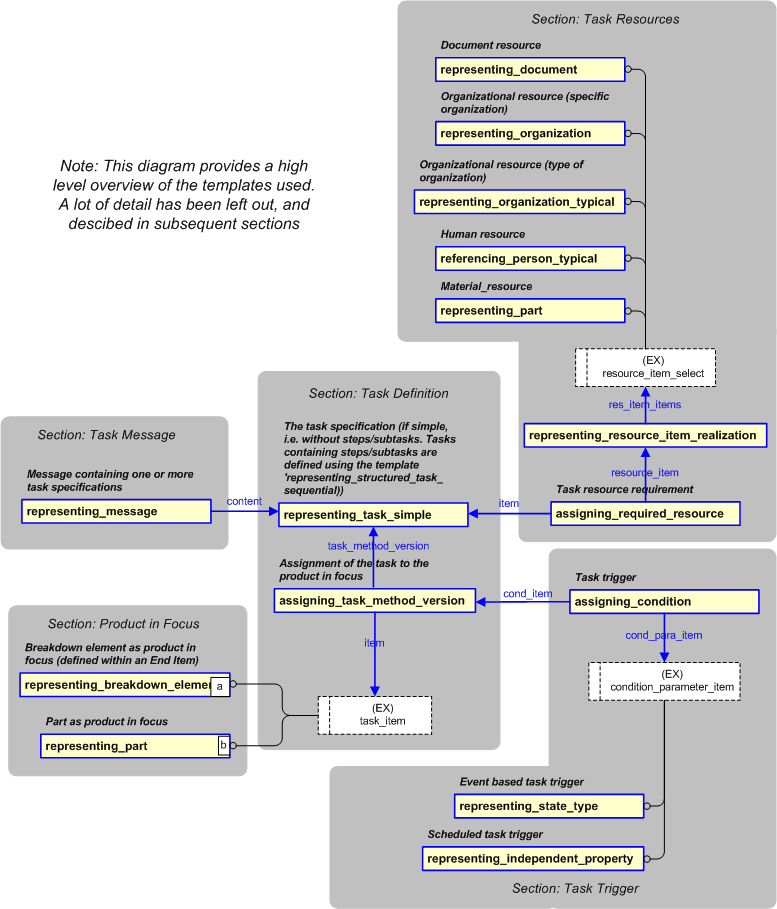
An overview of the information to be exchanged by the Task Specification DEX has been described in Section: Task Specification: Business Information Overview. A more detailed definition of the type of information that can be exchanged using the Task Specification DEX is provided in Section: Task Specification - Business Information Requirements. A summary of how this information is represented in PLCS is provided in Figure 19, and is expanded in subsequent sections.
The rest of this section contains a step by step description on how each business information requirement defined in Section: Task Specification - Business Information Requirements is to be represented in PLCS, and is organized in accordance with the business information requirements.
Information related to a single task ISO 10303-239 representation - Table of content:
Product in focus information includes:
Product in focus may be either a part or an element in a breakdown structure. These are represented as Part and Breakdown_element respectively, in PLCS.
NOTE Detailed information requirements for describing the product in focus is defined in Section: Information requirements - Product in focus.
The PLCS representation for part as product in focus is described in Figure 20
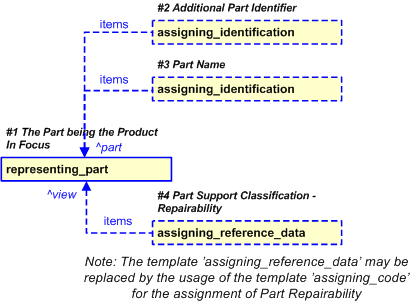
Basic representation of a part and its identification is done in accordance with the template representing_part. Template instantiation for a part being the product in focus within this DEX, must follow the rules defined in the template table: Template #1(Figure 20) below.
| Template #1 (Figure 20): representing_part | |||
|---|---|---|---|
| Description | Representation of the part being the product in focus. | ||
| Parameter name: | Parameter value: | Parameter description: | |
| part_id | ?part_id? | The identifier of the part | |
| part_id_class_name | "Part_identification_code" (urn:plcs:rdl:std:Part_identification_code) or subclass thereof. | The name of the class being used to classify the identifier being assigned to the part (i.e. the part_id). | |
| part_id_ecl_id | ?part_id_ecl_id? | The location of the External_class_library that stores the class used to classify the part_id. | |
| part_org_id | ?part_org_id? | The name or identifier of the organization that owns the part id. | |
| part_org_id_class_name | "Organization_identification_code" (urn:plcs:rdl:std:Organization_identification_code) or "Organization_name" (urn:plcs:rdl:std:Organization_name) or subclass thereof. | The name of the class being used to classify the identification (Identification_assignment) of the organization responsible for creating the part representation | |
| part_org_id_ecl_id | ?part_org_id_ecl_id? | The identifier of the External_class_library storing the definition of the External_class used to classify the organization identifier. | |
| part_vn_id | ?part_vn_id? | The identifier of the part version | |
| part_vn_id_class_name | "Progression_identification_code" (urn:plcs:rdl:std:Progression_identification_code) or subclass thereof. | The name of the class being used to classify the identifier assigned ( Identification_assignment ) to the part version (i.e. the part_vn_id) | |
| part_vn_id_ecl_id | ?part_vn_id_ecl_id? | The location of the External_class_library that stores the class used to classify the part version id. | |
| part_vn_org_id | ?part_vn_org_id? | The name or identifier of the organization owns the part version id. | |
| part_vn_org_id_class_name | "Organization_identification_code" (urn:plcs:rdl:std:Organization_identification_code) or "Organization_name" (urn:plcs:rdl:std:Organization_name) or subclass thereof. | The name of the class being used to classify the identification (Identification_assignment) of the organization responsible for providing the part version representation | |
| part_vn_org_id_ecl_id | ?part_vn_org_id_ecl_id? | The identifier of the External_class_library storing the definition of the External_class used to classify the organization identifier. | |
| domain |
"Application_domain"
(urn:plcs:rdl:std:Application_domain)
or subclass thereof.
NOTE Part information related to Logistics Support Analysis is recommended to use the subclass "Product_life_cycle_support" (urn:plcs:rdl:std:Product_life_cycle_support). |
The identifier of the External_class_library used to describe the type of application domain of the View_definition_context instance. | |
| domain_ecl_id | ?domain_ecl_id? | The location of the External_class_library that stores the class used to classify the View_definition_context from an application domain perspective. | |
| life_cycle_stage |
"Life_cycle_stage"
(urn:plcs:rdl:std:Life_cycle_stage) or
subclass thereof.
NOTE Part information related to Logistics Support Analysis is recommended to use the subclass "Development_stage" (urn:plcs:rdl:std:Development_stage). |
The identifier of the External_class_library used to describe the type of life cycle stage of the View_definition_context instance. | |
| life_cycle_stage_ecl_id | ?life_cycle_stage_ecl_id? | The location of the External_class_library that stores the class used to classify the View_definition_context from a life cycle stage perspective. | |
NOTE Representation of version identification where the version identification is not known must follow the guidelines given in the assigning_identification template.
Additional part identifiers may be assigned to the Part using the template assigning_identification. Template instantiation for additional part identifiers must follow the rules defined in template table: Template #2(Figure 20) below.
| Template #2 (Figure 20): assigning_identification | |||
|---|---|---|---|
| Description | Assignment of additional identifiers to the part being the product in focus. | ||
| Parameter name: | Parameter value: | Parameter description: | |
| id | ?id? | The additional identifier being assigned to the part. | |
| id_class_name | "Part_identification_code" (urn:plcs:rdl:std:Part_identification_code) or subclass thereof. | The name of the class used to classify the identifier and so provide the role or reason for the identification. | |
| id_ecl_id | ?id_ecl_id? | The id of the External_class_library storing the id_class_name class | |
| org_id | ?org_id? | The identifier of the organization that "owns" the identifier. | |
| org_id_class_name | "Organization_identification_code" (urn:plcs:rdl:std:Organization_identification_code) or "Organization_name" (urn:plcs:rdl:std:Organization_name) or subclass thereof. | The name of the class being used to classify the identification of the organization, or the organization name. For example CAGE code. | |
| org_id_ecl_id | ?org_id_ecl_id? | The id of the External_class_library storing the org_id_class_name class | |
| items | Part | The Part representing the product in focus, as described in template table: Template #1(Figure 20) | |
NOTE Additional characterizations of the respective identifier may be done in accordance with what is described under Section: Optional characterization of template assigning_identification .
Names may be assigned to the Part using the template assigning_identification. Template instantiation for part names must follow the rules defined in template table: Template #3(Figure 20) below.
| Template #3 (Figure 20): assigning_identification | |||
|---|---|---|---|
| Description | Assignment of a name to the part being the product in focus. | ||
| Parameter name: | Parameter value: | Parameter description: | |
| id | ?id? | The name being assigned to the part. | |
| id_class_name | "Part_name" (urn:plcs:rdl:std:Part_name) or subclass thereof. | The name of the class used to classify the identifier and so provide the role or reason for the identification. | |
| id_ecl_id | ?id_ecl_id? | The id of the External_class_library storing the id_class_name class | |
| org_id | ?org_id? | The identifier of the organization that "owns" the identifier. | |
| org_id_class_name | "Organization_identification_code" (urn:plcs:rdl:std:Organization_identification_code) or "Organization_name" (urn:plcs:rdl:std:Organization_name) or subclass thereof. | The name of the class being used to classify the identification of the organization, or the organization name. For example CAGE code. | |
| org_id_ecl_id | ?org_id_ecl_id? | The id of the External_class_library storing the org_id_class_name class | |
| items | Part | The Part representing the product in focus, as described in template table: Template #1(Figure 20). | |
NOTE Additional characterizations of the respective name may be done in accordance with what is described under Section: Optional characterization of template assigning_identification .
Part support classification - repairability
Classification of the Part from a support perspective is done using the template assigning_reference_data. The basic support classification for a Part defines its repairability.
EXAMPLE Examples of part repairability subclasses are: 'Fully repairable', 'Partial repairable' and 'Discardable'.
NOTE Wherever the template assigning_reference_data is being used, it may be replaced by the usage of the assigning_code template.
Template instantiation for part support classification must follow the rules defined in template table: Template #4(Figure 20) below.
| Template #4 (Figure 20): assigning_reference_data | |||
|---|---|---|---|
| Description | Assignment of a support classification to the part being the product in focus. | ||
| Parameter name: | Parameter value: | Parameter description: | |
| class_name | Subclass of "Part_repairability" (urn:plcs:rdl:std:Part_repairability). | The name of the class being used to determine the type of support classification. | |
| ecl_id | ?ecl_id? | The id of the External_class_library that stores the definition for the class being used. | |
| items | Part_view_definition | The defined view of the part representing the product in focus, as described in template table: Template #1(Figure 20). | |
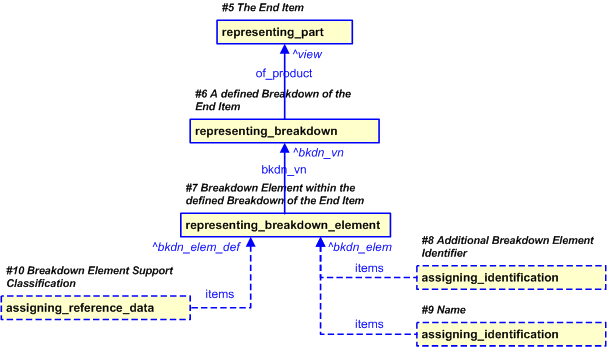
The PLCS representation for a breakdown element as being the product in focus is described in Figure 21
Breakdown element identification
The basic representation of a breakdown element and its identification is done in accordance with the following templates:
Instantiation of the respective template for this DEX must follow the rules defined in the respective template table below:
| Template #5 (Figure 21): representing_part | |||
|---|---|---|---|
| Description | Representation of the end item to which the breakdown element belongs. | ||
| Parameter name: | Parameter value: | Parameter description: | |
| part_id | ?part_id? | The identifier of the part representing the end item. | |
| part_id_class_name | "Part_identification_code" (urn:plcs:rdl:std:Part_identification_code) or subclass thereof. | The name of the class being used to classify the identifier being assigned to the part (i.e. the part.id). | |
| part_id_ecl_id | ?part_id_ecl_id? | The location of the External_class_library that stores the class used to classify the part id. | |
| part_org_id | ?part_org_id? | The name or identifier of the organization that owns the part id. | |
| part_org_id_class_name | "Organization_identification_code" (urn:plcs:rdl:std:Organization_identification_code) or "Organization_name" (urn:plcs:rdl:std:Organization_name) or subclass thereof. | The name of the class being used to classify the identification (Identification_assignment) of the organization responsible for creating the part representation | |
| part_org_id_ecl_id | ?part_org_id_ecl_id? | The identifier of the External_class_library storing the definition of the External_class used to classify the organization identifier. | |
| part_vn_id | ?part_vn_id? | The identifier of the part version | |
| part_vn_id_class_name | "Progression_identification_code" (urn:plcs:rdl:std:Progression_identification_code) or subclass thereof. | The name of the class being used to classify the identifier assigned ( Identification_assignment ) to the part version (i.e. the part_vn_id) | |
| part_vn_id_ecl_id | ?part_vn_id_ecl_id? | The location of the External_class_library that stores the class used to classify the part version id. | |
| part_vn_org_id | ?part_vn_org_id? | The name or identifier of the organization owns the part version id. | |
| part_vn_org_id_class_name | "Organization_identification_code" (urn:plcs:rdl:std:Organization_identification_code) or "Organization_name" (urn:plcs:rdl:std:Organization_name) or subclass thereof. | The name of the class being used to classify the identification (Identification_assignment) of the organization responsible for providing the part version representation | |
| part_vn_org_id_ecl_id | ?part_vn_org_id_ecl_id? | The identifier of the External_class_library storing the definition of the External_class used to classify the organization identifier. | |
| domain |
"Application_domain"
(urn:plcs:rdl:std:Application_domain)
or subclass thereof.
NOTE Part information related to Logistics Support Analysis is recommended to use the subclass "Product_life_cycle_support" (urn:plcs:rdl:std:Product_life_cycle_support). |
The identifier of the External_class_library used to describe the type of application domain of the View_definition_context instance. | |
| domain_ecl_id | ?domain_ecl_id? | The location of the External_class_library that stores the class used to classify the View_definition_context from an application domain perspective. | |
| life_cycle_stage |
"Life_cycle_stage"
(urn:plcs:rdl:std:Life_cycle_stage) or
subclass thereof.
NOTE Part information related to Logistics Support Analysis is recommended to use the subclass "Development_stage" (urn:plcs:rdl:std:Development_stage). |
The identifier of the External_class_library used to describe the type of life cycle stage of the View_definition_context instance. | |
| life_cycle_stage_ecl_id | ?life_cycle_stage_ecl_id? | The location of the External_class_library that stores the class used to classify the View_definition_context from a life cycle stage perspective. | |
NOTE Representation of version identification where the version identification is not known must follow the guidelines given in the assigning_identification template.
| Template #6 (Figure 21): representing_breakdown | |||
|---|---|---|---|
| Description | Representation of the type of Breakdown to which the Breakdown Element belongs. | ||
| Parameter name: | Parameter value: | Parameter description: | |
| id | ?id? | The identifier of the Breakdown. | |
| id_class_name | "Breakdown_identification_code" (urn:plcs:rdl:std:Breakdown_identification_code), "Breakdown_name" (urn:plcs:rdl:std:Breakdown_name) or subclass thereof. | The name of the class being used to classify the identification (Identification_assignment) of the breakdown. This provides the role or reason for the identification. | |
| id_ecl_id | ?id_ecl_id? | The identifier of the External_class_library storing the definition of the class referenced by the parameter @id_class_name class. | |
| id_owner | ?id_owner? | The name or identifier of the organization owning the id or name. | |
| id_owner_class_name | "Organization_identification_code" (urn:plcs:rdl:std:Organization_identification_code), "Organization_name" (urn:plcs:rdl:std:Organization_name) or subclass thereof. | The name of the class being used to classify the identification of the organization. For example CAGE code, or organization name. | |
| id_owner_ecl_id | ?id_owner_ecl_id? | The id of the External_class_library storing the @id_owner_class_name class | |
| bkdn_type | "Breakdown" (urn:plcs:rdl:std:Breakdown) or subclass thereof. | The name of the class being used to classify the Breakdown. | |
| bkdn_type_ecl_id | ?bkdn_type_ecl_id? | The identifier of the External_class_library storing the definition of the class referenced by the parameter @bkdn_type class. | |
| vn_id | ?vn_id? | The identifier of the Breakdown_version. | |
| vn_id_class_name | "Progression_identification_code" (urn:plcs:rdl:std:Progression_identification_code), or subclass thereof | The name of the class being used to classify the identification (Identification_assignment) of the breakdown version. This provides the role or reason for the identification. | |
| vn_id_ecl_id | ?vn_id_ecl_id? | The identifier of the External_class_library storing the definition of the class referenced by the parameter @vn_id_class_name class. | |
| vn_id_owner | ?vn_id_owner? | The name or identifier of the organization owning the @vn_id. | |
| vn_id_owner_class_name | "Organization_identification_code" (urn:plcs:rdl:std:Organization_identification_code), "Organization_name" (urn:plcs:rdl:std:Organization_name) or subclass thereof. | The name of the class being used to classify the identification of the organization. For example CAGE code, or organization name. | |
| vn_id_owner_ecl_id | ?vn_id_owner_ecl_id? | The id of the External_class_library storing the @vn_id_owner_class_name class | |
| of_product | Part_view_definition | The defined view of the part representing the end item, as described in template table: Template #5(Figure 21). | |
NOTE Representation of version identification where the version identification is not known must follow the guidelines given in the assigning_identification template.
| Template #7 (Figure 21): representing_breakdown_element | |||
|---|---|---|---|
| Description | Representation of the breakdown element being the product in focus | ||
| Parameter name: | Parameter value: | Parameter description: | |
| id | ?id? | The identifier of the Breakdown_element . | |
| id_class_name | "Breakdown_element_identification_code" (urn:plcs:rdl:std:Breakdown_element_identification_code), "Breakdown_element_name" (urn:plcs:rdl:std:Breakdown_element_name) or subclass thereof. | The name of the class being used to classify the (Identification_assignment) of the breakdown_element. This provides the role or reason for the identification. | |
| id_ecl_id | ?id_ecl_id"? | The identifier of the External_class_library storing the definition of the class referenced by the parameter @id_class_name class. | |
| id_owner | ?id_owner? | The name or identifier of the organization owning the id or name. | |
| id_owner_class_name | "Organization_identification_code" (urn:plcs:rdl:std:Organization_identification_code), "Organization_name" (urn:plcs:rdl:std:Organization_name) or subclass thereof. | The name of the class being used to classify the identification of the organization. For example CAGE code, or organization name. | |
| id_owner_ecl_id | ?id_owner_ecl_id? | The id of the External_class_library storing the @id_owner_class_name class | |
| vn_id | ?vn_id? | The identifier of the Breakdown_element_version. | |
| vn_id_class_name | "Progression_identification_code" (urn:plcs:rdl:std:Progression_identification_code) or subclass thereof. | The name of the class being used to classify the identification (Identification_assignment) of the breakdown_element_version. This provides the role or reason for the identification. | |
| vn_id_ecl_id | ?vn_id_ecl_id? | The identifier of the External_class_library storing the definition of the class referenced by the parameter @vn_id_class_name class. | |
| vn_id_owner | ?vn_id_owner? | The name or identifier of the organization owning the version_id. | |
| vn_id_owner_class_name | "Organization_identification_code" (urn:plcs:rdl:std:Organization_identification_code), "Organization_name" (urn:plcs:rdl:std:Organization_name) or subclass thereof. | The name of the class being used to classify the identification of the organization. For example CAGE code, or organization name. | |
| vn_id_owner_ecl_id | ?vn_id_owner_ecl_id? | The id of the External_class_library storing the @vn_id_owner_class_name class | |
| life_cycle_stage |
"Life_cycle_stage"
(urn:plcs:rdl:std:Life_cycle_stage) or
subclass thereof.
NOTE Breakdown element information related to Logistics Support Analysis is recommended to use the subclass "Development_stage" (urn:plcs:rdl:std:Development_stage). |
The identifier of the External_class_library used to describe the type of life cycle stage of the View_definition_context instance. | |
| life_cycle_stage_ecl_id | ?life_cycle_stage_ecl_id? | The identifier of the External_class_library storing the definition of the class referenced by the parameter @life_cycle_stage class. | |
| domain |
"Application_domain"
(urn:plcs:rdl:std:Application_domain)
or subclass thereof.
NOTE Breakdown element information related to Logistics Support Analysis is recommended to use the subclass "Product_life_cycle_support" (urn:plcs:rdl:std:Product_life_cycle_support). |
The identifier of the External_class_library used to describe the type of application domain of the View_definition_context instance. | |
| domain_ecl_id | ?domain_ecl_id? | The identifier of the External_class_library storing the definition of the class referenced by the parameter @domain class. | |
| bkdn_vn | Breakdown_version | The Breakdown_element_version described in template table: Template #6(Figure 21) of which this Breakdown_element is a constituent. | |
NOTE Representation of version identification where the version identification is not known must follow the guidelines given in the assigning_identification template.
Additional identifications may be assigned to the Breakdown_element using the template assigning_identification. Template instantiation for additional breakdown element identifiers must follow the rules defined in template table: Template #8(Figure 21) below.
| Template #8 (Figure 21): assigning_identification | |||
|---|---|---|---|
| Description | Assignment of additional identifiers to the breakdown element being the product in focus. | ||
| Parameter name: | Parameter value: | Parameter description: | |
| id | ?id? | The additional identifier being assigned to the breakdown element. | |
| id_class_name | "Breakdown_element_identification_code" (urn:plcs:rdl:std:Breakdown_element_identification_code) or subclass thereof. | The name of the class used to classify the identifier and so provide the role or reason for the identification. | |
| id_ecl_id | ?id_ecl_id? | The id of the External_class_library storing the id_class_name class | |
| org_id | ?org_id? | The identifier of the organization that "owns" the identifier. | |
| org_id_class_name | "Organization_identification_code" (urn:plcs:rdl:std:Organization_identification_code) or "Organization_name" (urn:plcs:rdl:std:Organization_name) or subclass thereof. | The name of the class being used to classify the identification of the organization, or the organization name. For example CAGE code. | |
| org_id_ecl_id | ?org_id_ecl_id? | The id of the External_class_library storing the org_id_class_name class | |
| items | Breakdown_element | The Breakdown_element representing the product in focus, as described in template table: Template #7(Figure 21). | |
NOTE Additional characterizations of the respective identifier may be done in accordance with what is described under Section: Optional characterization of template assigning_identification .
Names may be assigned to the Breakdown_element using the template assigning_identification. Template instantiation for breakdown element names must follow the rules defined in template table: Template #9(Figure 21) below.
| Template #9 (Figure 21): assigning_identification | |||
|---|---|---|---|
| Description | Assignment of a name to the breakdown element being the product in focus. | ||
| Parameter name: | Parameter value: | Parameter description: | |
| id | ?id? | The name being assigned to the breakdown element. | |
| id_class_name | "Breakdown_element_name" (urn:plcs:rdl:std:Breakdown_element_name) or subclass thereof. | The name of the class used to classify the identifier and so provide the role or reason for the identification. | |
| id_ecl_id | ?id_ecl_id? | The id of the External_class_library storing the id_class_name class | |
| org_id | ?org_id? | The identifier of the organization that "owns" the identifier. | |
| org_id_class_name | "Organization_identification_code" (urn:plcs:rdl:std:Organization_identification_code) or "Organization_name" (urn:plcs:rdl:std:Organization_name) or subclass thereof. | The name of the class being used to classify the identification of the organization, or the organization name. For example CAGE code. | |
| org_id_ecl_id | ?org_id_ecl_id? | The id of the External_class_library storing the org_id_class_name class | |
| items | Breakdown_element | The Breakdown_element representing the product in focus, as described in template table: Template #7(Figure 21). | |
NOTE Additional characterizations of the respective name may be done in accordance with what is described under Section: Optional characterization of template assigning_identification .
Breakdown element support classification
Classification of the Breakdown_element as being important from a support perspective is done using the template assigning_reference_data.
NOTE A Breakdown_element may have many different support classifications, e.g. 'Maintenance significant item' and 'Line replaceable'.
NOTE Wherever the template assigning_reference_data is being used, it may be replaced by the usage of the assigning_code template.
Template instantiation for breakdown element support classification must follow the rules defined in template table: Template #10(Figure 21) below.
| Template #10 (Figure 21): assigning_reference_data | |||
|---|---|---|---|
| Description | Assignment of a support classification to the breakdown element being the product in focus. | ||
| Parameter name: | Parameter value: | Parameter description: | |
| class_name | Subclass of "Breakdown_element_support_classification" (urn:plcs:rdl:std:Breakdown_element_support_classification). | The name of the class being used to determine the type of support classification being done. | |
| ecl_id | ?ecl_id? | The id of the External_class_library that stores the definition for the class being used. | |
| items | Breakdown_element_definition | The Breakdown_element representing the product in focus, as described in template table: Template #7(Figure 21). | |
Task definition information includes:
NOTE Detailed information requirements for task definition are defined in Section: Information requirements - Task definition.
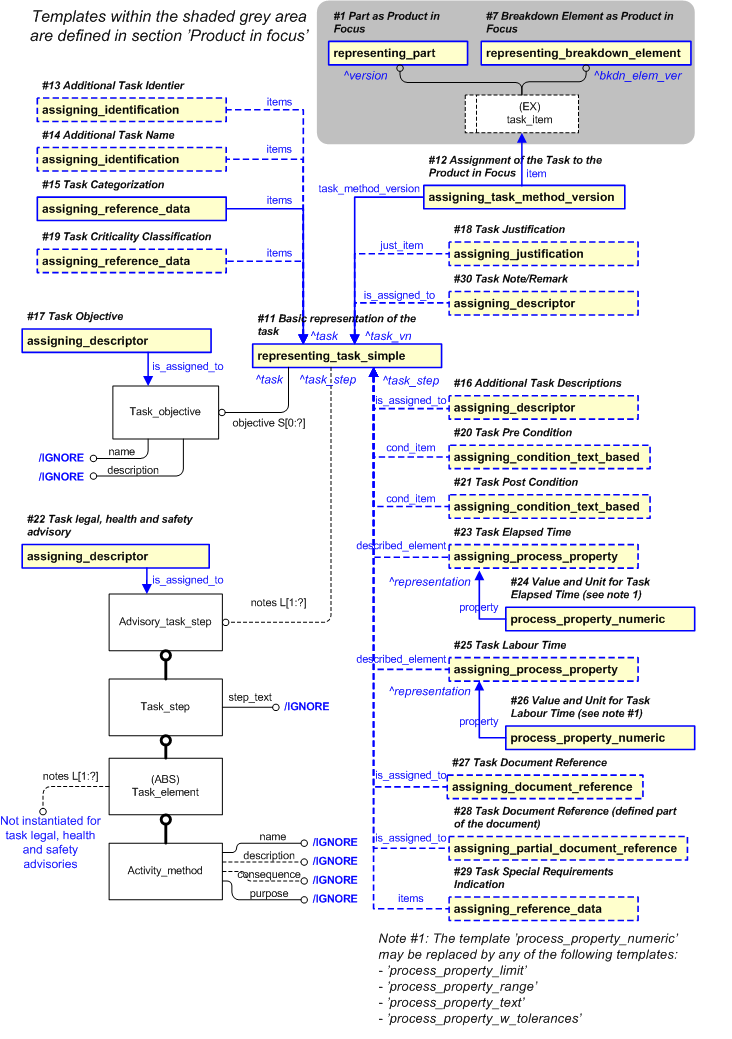
The PLCS representation for task definition is described in Figure 22
NOTE The first sections of the DEX focuses on defining a simple Task. Representation of a structured task is defined in Section: Task structure.
Basic representation of a task and its identification is done in accordance with the template representing_task_simple. A simple task in PLCS is represented using the following entities:
Template instantiation for a simple task must follow the rules defined in the template table: Template #11(Figure 22) below.
| Template #11 (Figure 22): representing_task_simple | |||
|---|---|---|---|
| Description | |||
| Parameter name: | Parameter value: | Parameter description: | |
| task_id | ?task_id? | The task identifier, e.g. the task number. | |
| task_id_class_name | "Task_method_identification_code" (urn:plcs:rdl:std:Task_method_identification_code) or subclass thereof. | The name of the class being used to classify the identifier being assigned to the task (i.e. the @task_id) | |
| task_id_ecl_id | ?task_id_ecl_id? | The identifier of the External_class_library storing the definition of the class referenced by the parameter @task_id_class_name. | |
| task_org_id | ?task_org_id? | The name or identifier of the Organization that owns the @task_id. | |
| task_org_id_class_name | "Organization_identification_code" (urn:plcs:rdl:std:Organization_identification_code), "Organization_name" (urn:plcs:rdl:std:Organization_name), or subclass thereof. | The name of the class being used to classify the identification of the Organization responsible for creating the @task_id. | |
| task_org_id_ecl_id | ?task_org_id_ecl_id? | The identifier of the External_class_library storing the definition of the class referenced by the parameter @task_org_id_class_name. | |
| task_ver_id | ?task_ver_id? | The task version identifier. | |
| task_ver_id_class_name | "Progression_identification_code" (urn:plcs:rdl:std:Progression_identification_code) or subclass thereof. | The name of the class being used to classify the task version identifier (@tesk_ver_id) assigned to Task_method_version. | |
| task_ver_id_ecl_id | ?task_ver_id_ecl_id? | The identifier of the External_class_library storing the definition of the class referenced by the parameter @task_ver_id_class_name. | |
| task_ver_org_id | ?task_ver_org_id? | The name or identifier of the organization that owns the task version identifier. | |
| task_ver_org_id_class_name | "Organization_identification_code" (urn:plcs:rdl:std:Organization_identification_code), "Organization_name" (urn:plcs:rdl:std:Organization_name), or subclass thereof. | The name of the class being used to classify the identification of the Organization responsible for creating the @task_ver_id. | |
| task_ver_org_id_ecl_id | ?task_ver_org_id_ecl_id? | The identifier of the External_class_library storing the definition of the class referenced by the parameter @task_ver_org_id_class_name. | |
| task_name | ?task_name? | The task name. | |
| task_name_class_name | "Task_method_name" (urn:plcs:rdl:std:Task_method_name) or subclass thereof. | The name of the class being used to classify the task name assigned to Task_method_version. | |
| task_name_ecl_id | ?task_name_ecl_id? | The identifier of the External_class_library storing the definition of the class referenced by the parameter @task_name_class_name. | |
| task_name_org_id | ?task_name_org_id? | The name or identifier of the organization that owns the task name. | |
| task_name_org_id_class_name | "Organization_identification_code" (urn:plcs:rdl:std:Organization_identification_code), "Organization_name" (urn:plcs:rdl:std:Organization_name), or subclass thereof. | The name of the class being used to classify the identification of the Organization responsible for creating the @task_name. | |
| task_name_org_id_ecl_id | ?task_name_org_id_ecl_id? | The identifier of the External_class_library storing the definition of the class referenced by the parameter @task_name_org_id_class_name. | |
| task_details | ?task_details? | A detailed description on how to perform the task. | |
NOTE Representation of version identification where the version identification is not known must follow the guidelines given in the assigning_identification template.
Additional identifications for a task may be assigned to the Task_method using the template assigning_identification. Template instantiation for additional task identifiers must follow the rules defined in template table: Template #13(Figure 22) below.
| Template #13 (Figure 22): assigning_identification | |||
|---|---|---|---|
| Description | Assignment of additional identifiers to the task. | ||
| Parameter name: | Parameter value: | Parameter description: | |
| id | ?id? | The identifier being assigned to the task. | |
| id_class_name | "Task_method_identification_code" (urn:plcs:rdl:std:Task_method_identification_code) or subclass thereof. | The name of the class used to classify the identifier and so provide the role or reason for the identification. | |
| id_ecl_id | ?id_ecl_id? | The id of the External_class_library storing the id_class_name class | |
| org_id | ?org_id? | The identifier of the organization that "owns" the identifier. | |
| org_id_class_name | "Organization_identification_code" (urn:plcs:rdl:std:Organization_identification_code) or "Organization_name" (urn:plcs:rdl:std:Organization_name) or subclass thereof. | The name of the class being used to classify the identification of the organization, or the organization name. For example CAGE code. | |
| org_id_ecl_id | ?org_id_ecl_id? | The id of the External_class_library storing the org_id_class_name class | |
| items | Task_method | The task under consideration, as described in template table: Template #11(Figure 22). | |
NOTE Additional characterizations of the respective identifier may be done in accordance with what is described under Section: Optional characterization of template assigning_identification .
Assignment of a task to the product in focus is done in accordance with the template assigning_task_method_version. Template instantiation for the assignment of the task to the product in focus must follow the rules defined in template table: Template #12(Figure 22) below.
| Template #12 (Figure 22): assigning_task_method_version | |||
|---|---|---|---|
| Description | Assignment of the task to the product in focus. | ||
| Parameter name: | Parameter value: | Parameter description: | |
| assignment_role | "Applicable_to" (urn:plcs:rdl:std:Applicable_to) or subclass thereof. | The role of the assignment. | |
| role_ecl_id | ?role_ecl_id? | The External_class_library storing the definition of the class referenced by the parameter @assignment_role | |
| item | Breakdown_element_version or Part_version | The version of the Breakdown_element or Part that represents the product in focus. Detailed representations of those are described in template table: Template #7(Figure 21) and template table: Template #1(Figure 20) respectively. | |
| task_method_version | Task_method_version | The version of the task under consideration, as described in template table: Template #11(Figure 22). | |
A mandatory task name is part of the template table: Template #11(Figure 22) defined under Section: Task identification and revisioning above.
Additional task names may be assigned to the Task_method using the template assigning_identification. Template instantiation for additional task names must follow the rules defined in template table: Template #14(Figure 22) below.
| Template #14 (Figure 22): assigning_identification | |||
|---|---|---|---|
| Description | Assignment of an additional task name. | ||
| Parameter name: | Parameter value: | Parameter description: | |
| id | ?id? | The name being assigned to the task. | |
| id_class_name | "Task_method_name" (urn:plcs:rdl:std:Task_method_name) or subclass thereof. | The name of the class used to classify the identifier and so provide the role or reason for the identification. | |
| id_ecl_id | ?id_ecl_id? | The id of the External_class_library storing the id_class_name class | |
| org_id | ?org_id? | The identifier of the organization that "owns" the identifier. | |
| org_id_class_name | "Organization_identification_code" (urn:plcs:rdl:std:Organization_identification_code) or "Organization_name" (urn:plcs:rdl:std:Organization_name) or subclass thereof. | The name of the class being used to classify the identification of the organization, or the organization name. For example CAGE code. | |
| org_id_ecl_id | ?org_id_ecl_id? | The id of the External_class_library storing the org_id_class_name class | |
| items | Task_method | The task under consideration, as described in template table: Template #11(Figure 22). | |
NOTE Additional characterizations of the respective task name may be done in accordance with what is described under Section: Optional characterization of template assigning_identification .
Task categorization can be assigned to the Task_method using the template assigning_reference_data.
NOTE Wherever the template assigning_reference_data is being used, it can be replaced by the usage of the assigning_code template.
Template instantiation for task categorization must follow the rules defined in template table: Template #15(Figure 22) below.
| Template #15 (Figure 22): assigning_reference_data | |||
|---|---|---|---|
| Description | Assignment of a task categorization to the task. | ||
| Parameter name: | Parameter value: | Parameter description: | |
| class_name | Subclass of "Task_categorization" (urn:plcs:rdl:std:Task_categorization). | The name of the class in the reference data library External_class being used to categorize the task. | |
| ecl_id | ?ecl_id? | The id of the External_class_library that stores the definition for the class being used. | |
| items | Task_method | The task under consideration, as described in template table: Template #11(Figure 22). | |
A mandatory task description is part of the template table: Template #11(Figure 22) defined under Section: Task identification and revisioning above.
Additional task descriptions can be assigned to the Task_step using the template assigning_descriptor. Template instantiation for additional task descriptions must follow the rules defined in template table: Template #16(Figure 22) below.
| Template #16 (Figure 22): assigning_descriptor | |||
|---|---|---|---|
| Description | Additional descriptions for the task. | ||
| Parameter name: | Parameter value: | Parameter description: | |
| descr | ?descr? | The text being assigned as a description. | |
| class_name | "Description" (urn:plcs:rdl:std:Description) or subclass thereof. | The name of the class (External_class) being used to determine type of descriptor. | |
| ecl_id | ?ecl_id? | The id of the External_class_library that stores the class. | |
| is_assigned_to | Task_step | The details of the task under consideration, as described in template table: Template #11(Figure 22). | |
NOTE Additional characterizations of the respective description may be done in accordance with what is described under Section: Optional characterization of template assigning_descriptor .
Task objective is represented as an instance of the Task_objective entity. A textual description of the task objective is represented as a description being assigned to the Task_objective, using the assigning_descriptor template. Template instantiation for the description of the Task objective must follow the rules defined in template table: Template #17(Figure 22).
| Template #17 (Figure 22): assigning_descriptor | |||
|---|---|---|---|
| Description | Textual description of the task objective. | ||
| Parameter name: | Parameter value: | Parameter description: | |
| descr | ?descr? | The text describing the task objective. | |
| class_name | "Description" (urn:plcs:rdl:std:Description) or subclass thereof. | The name of the class (External_class) being used to determine type of descriptor. | |
| ecl_id | ?ecl_id? | The id of the External_class_library that stores the class. | |
| is_assigned_to | Task_objective | The entity representing task objective. | |
NOTE Additional characterizations of the respective task objective description may be done in accordance with what is described under Section: Optional characterization of template assigning_descriptor .
Task justification can be assigned to the Task_method_version using the template assigning_justification. Template instantiation for task justification must follow the rules defined in template table: Template #18(Figure 22) below.
| Template #18 (Figure 22): assigning_justification | |||
|---|---|---|---|
| Description | Justification for the task. | ||
| Parameter name: | Parameter value: | Parameter description: | |
| just_item | Task_method_version | The version of the task, as described in template table: Template #11(Figure 22), for which the justification is defined. | |
| just_asgn_role | "Justification_assignment" (urn:plcs:rdl:std:Justification_assignment) or subclass thereof. | The type of Justification_assignment. The type allows the explicit representation of the reason for something to be represented by reference data. | |
| role_ecl_id | ?role_ecl_id? | The identifier of the External_class_library storing the definition of the class referenced by the parameter @just_asgn_role. | |
| just_txt | ?just_txt? | Text describing the justification for the task. | |
NOTE Additional characterizations of the justification and its description, can be done in accordance with what is described under Section: Optional characterization of template assigning_justification and Section: Optional characterization of template assigning_descriptor .
Task criticality can be assigned to the Task_method using the template assigning_reference_data.
NOTE Wherever the template assigning_reference_data is being used, it can be replaced by the usage of the assigning_code template.
Template instantiation for task criticality must follow the rules defined in template table: Template #19(Figure 22) below.
| Template #19 (Figure 22): assigning_reference_data | |||
|---|---|---|---|
| Description | Criticality of the task. | ||
| Parameter name: | Parameter value: | Parameter description: | |
| class_name | "Task_criticallity" (urn:plcs:rdl:std:Task_criticallity) or subclass thereof. | The name of the class in the reference data library External_class being used to define the task criticality. | |
| ecl_id | ?ecl_id? | The id of the External_class_library that stores the definition for the class being used. | |
| items | Task_method | The task under consideration, as described in template table: Template #11(Figure 22). | |
The simplest representation of task precondition(s) is done using the template assigning_condition_text_based. This template provides the ability to textually describe the task precondition. Task precondition is assigned to the Task_step. Template instantiation for task precondition must follow the rules defined in template table: Template #20(Figure 22) below.
| Template #20 (Figure 22): assigning_condition_text_based | |||
|---|---|---|---|
| Description | Textual description of the task precondition(s). | ||
| Parameter name: | Parameter value: | Parameter description: | |
| cond_item | Task_step | The details of the task under consideration, as described in template table: Template #11(Figure 22). | |
| cond_asg_class | "Precondition" (urn:plcs:rdl:std:Precondition) or subclass thereof | The name of the class used to classify the Condition_assignment and to provide the role or reason for the condition. | |
| cond_asg_ecl_id | ?cond_asg_ecl_id? | The identifier of the External_class_library storing the definition of the class referenced by the parameter @cond_asg_class. | |
| cond_descr | ?cond_descr? | The text describing the task precondition(s). | |
NOTE For representation of compound preconditions see Section: Task compound conditions representation below .
NOTE Task preconditions may also be represented as task steps in a structured task. See Section: Structured task.
This has been raised as issue, GYL-18, against ISO 10303-239. The EXPRESS schema has been modified in DEXlib (Long form: dexlib/data/schemas/ap239_arm_lf.exp, short form: dexlib/data/schemas/ap239_arm_sf.exp). These changes will be made to ISO 10303-239 as a Technical Corrigendum at some stage.
The simplest representation of task post condition(s) is done using the template assigning_condition_text_based. This template provides the ability to textually describe the task post condition. Task post condition is assigned to the Task_step. Template instantiation for task post condition must follow the rules defined in template table: Template #21(Figure 22) below.
| Template #21 (Figure 22): assigning_condition_text_based | |||
|---|---|---|---|
| Description | Textual description of the task post condition(s). | ||
| Parameter name: | Parameter value: | Parameter description: | |
| cond_item | Task_step | The details of the task under consideration, as described in template table: Template #11(Figure 22). | |
| cond_asg_class | "Post_condition" (urn:plcs:rdl:std:Post_condition) or subclass thereof | The name of the class used to classify the Condition_assignment and to provide the role or reason for the condition. | |
| cond_asg_ecl_id | ?cond_asg_ecl_id? | The identifier of the External_class_library storing the definition of the class referenced by the parameter @cond_asg_class. | |
| cond_descr | ?cond_descr? | The text describing the task post condition(s). | |
NOTE For representation of compound post conditions see Section: Task compound conditions representation below .
NOTE Task post conditions may also be represented as task steps in a structured task. See Section: Structured task.
This has been raised as issue, GYL-18, against ISO 10303-239. The EXPRESS schema has been modified in DEXlib (Long form: dexlib/data/schemas/ap239_arm_lf.exp, short form: dexlib/data/schemas/ap239_arm_sf.exp). These changes will be made to ISO 10303-239 as a Technical Corrigendum at some stage.
Task legal, health and safety advisories are represented as an instance of the Advisory_task_step entity. A textual description of task legal, health and safety advisories is represented as a description being assigned to the Advisory_task_step, using the assigning_descriptor template. Template instantiation for the description of task legal, health and safety advisories must follow the rules defined in template table: Template #22(Figure 22).
| Template #22 (Figure 22): assigning_descriptor | |||
|---|---|---|---|
| Description | Textual description of legal, health and safety advisories for the task. | ||
| Parameter name: | Parameter value: | Parameter description: | |
| descr | ?descr? | The text describing the task legal, health and safety advisories. | |
| class_name | "Description" (urn:plcs:rdl:std:Description) or subclass thereof. | The name of the class (External_class) being used to determine type of descriptor. | |
| ecl_id | ?ecl_id? | The id of the External_class_library that stores the class. | |
| is_assigned_to | Advisory_task_step | The entity representing information about task legal, health and safety advisories. | |
NOTE Additional characterizations of the respective description may be done in accordance with what is described under Section: Optional characterization of template assigning_descriptor .
Task elapsed time is represented as a property being assigned to the Task_step entity, using the assigning_process_property and process_property_numeric templates. Template instantiation for the task elapsed time must follow the rules defined in template table: Template #23(Figure 22) and template table: Template #24(Figure 22).
| Template #23 (Figure 22): assigning_process_property | |||
|---|---|---|---|
| Description | Definition of the task elapsed time property. | ||
| Parameter name: | Parameter value: | Parameter description: | |
| property_class_name | "Activity_planned_duration" (urn:plcs:rdl:std:Activity_planned_duration) or subclass thereof. | The class name of the External_class corresponding to the property name. | |
| property_ecl_id | ?property_ecl_id? | The identifier of the External_class_library storing the definition of the class referenced by the parameter @property_class_name. | |
| described_element | Task_step | The details of the task under consideration, as described in template table: Template #11(Figure 22). | |
| Template #24 (Figure 22): process_property_numeric | |||
|---|---|---|---|
| Description | Value and unit for the task elapsed time property. | ||
| Parameter name: | Parameter value: | Parameter description: | |
| value | ?value? | The value of the property. The datatype is always 'any_number_value' and should not be registered together with the value, i.e. enter the value as a number, without datatype. | |
| unit | "Second" (urn:plcs:rdl:std:Second), "Minute" (urn:plcs:rdl:std:Minute), "Hour" (urn:plcs:rdl:std:Hour), or "Day" (urn:plcs:rdl:std:Day) | The class name of the unit in which the value is expressed. | |
| unit_ecl_id | "urn:plcs:rdl:std" | The identifier of the External_class_library storing the definition of the class referenced by the parameter @unit. | |
| si_unit | 'true' or 'false' |
TRUE if unit is defined as "Second" (urn:plcs:rdl:std:Second), otherwise FALSE. If Part 11 STEP file, true is represented by the string '.T.' and false '.F.', while in Part 28 (XML) they are represented by text strings 'true' and 'false'. |
|
| context | Subclass of "Representation_context" (urn:plcs:rdl:std:Representation_context) | The name of the class being used to classify the representation context (Numerical_representation_context) of the property. | |
| context_ecl_id | ?context_ecl_id? | The identifier of the External_class_library storing the definition of the class referenced by the parameter @context. | |
| property | Activity_property | The Activity_property instantiated in template table: Template #23(Figure 22) representing the property 'Elapsed time'. | |
NOTE Additional characterizations of the respective template used for representing the elapsed time property and its value, may be done in accordance with what is described under Section: Optional characterization of templates for property representation .
NOTE The usage of the template process_property_numeric may be replaced by the usage of:
Task labour time is represented as a property being assigned to the Task_step entity, using the assigning_process_property and process_property_numeric templates. Template instantiation for the task labour time must follow the rules defined in template table: Template #25(Figure 22) and template table: Template #26(Figure 22).
| Template #25 (Figure 22): assigning_process_property | |||
|---|---|---|---|
| Description | Definition of the task labour time property. | ||
| Parameter name: | Parameter value: | Parameter description: | |
| property_class_name | "Labour_time_planned" (urn:plcs:rdl:std:Labour_time_planned) or subclass thereof. | The class name of the External_class corresponding to the property name. | |
| property_ecl_id | ?property_ecl_id? | The identifier of the External_class_library storing the definition of the class referenced by the parameter @property_class_name. | |
| described_element | Task_step | The details of the task under consideration, as described in template table: Template #11(Figure 22). | |
| Template #26 (Figure 22): process_property_numeric | |||
|---|---|---|---|
| Description | Value and unit for the task labour time property. | ||
| Parameter name: | Parameter value: | Parameter description: | |
| value | ?value? | The value of the property. The datatype is always 'any_number_value' and should not be registered together with the value, i.e. enter the value as a number, without datatype. | |
| unit | "Man_day" (urn:plcs:rdl:std:Man_day) "Man_hour" (urn:plcs:rdl:std:Man_hour) or "Man_minute" (urn:plcs:rdl:std:Man_minute) | The class name of the unit in which the value is expressed. | |
| unit_ecl_id | "urn:plcs:rdl:std" | The identifier of the External_class_library storing the definition of the class referenced by the parameter @unit. | |
| si_unit | 'false' |
There is no si unit for labour time. If Part 11 STEP file, true is represented by the string '.T.' and false '.F.', while in Part 28 (XML) they are represented by text strings 'true' and 'false'. |
|
| context | Subclass of "Representation_context" (urn:plcs:rdl:std:Representation_context) | The name of the class being used to classify the representation context (Numerical_representation_context) of the property. | |
| context_ecl_id | ?context_ecl_id? | The identifier of the External_class_library storing the definition of the class referenced by the parameter @context. | |
| property | Activity_property | The Activity_property instantiated in template table: Template #25(Figure 22) representing the property 'Labour time'. | |
NOTE Additional characterizations of the respective template used for representing the labour time property and its value, may be done in accordance with what is described under Section: Optional characterization of templates for property representation .
NOTE The usage of the template process_property_numeric may be replaced by the usage of:
Task document references are represented as Document_version being assigned to the Task_step entity, using either the assigning_document_reference or the assigning_partial_document_reference template. Template instantiation for task document reference must follow the rules defined in template table: Template #27(Figure 22) or in template table: Template #28(Figure 22).
| Template #27 (Figure 22): assigning_document_reference | |||
|---|---|---|---|
| Description | Document reference relevant for the task. | ||
| Parameter name: | Parameter value: | Parameter description: | |
| doc_id | ?doc_id? | The identification of the Document being referenced. | |
| doc_id_class_name | "Document_identification_code" (urn:plcs:rdl:std:Document_identification_code) or subclass thereof. | The name of the External_class that determines the type of identifier given by the input parameter @doc_id. | |
| doc_id_ecl_id | ?doc_id_ecl_id? | The identification of the External_class_library storing the External_class given by the input parameter @doc_id_class_name. | |
| doc_ver_id | ?doc_ver_id? | The identification of the Document_version being referenced. | |
| doc_ver_id_class_name | "Progression_identification_code" (urn:plcs:rdl:std:Progression_identification_code) or subclass thereof. | The name of the External_class that determines the type of identifier given by the input parameter @doc_ver_id. | |
| doc_ver_id_ecl_id | ?doc_ver_id_ecl_id? | The identification of the External_class_library storing the External_class given by the input parameter @doc_ver_id_class_name. | |
| org_id | ?org_id? | The identification of the Organization that "owns" the Document and Document_version identifiers (@doc_id and @doc_ver_id). | |
| org_id_class_name | "Organization_identification_code" (urn:plcs:rdl:std:Organization_identification_code), "Organization_name" (urn:plcs:rdl:std:Organization_name), or subclass thereof. | The name of the External_class that determines the type of organization identification (@org_id) being used. For example CAGE code. | |
| org_id_ecl_id | ?org_id_ecl_id? | The identification of the External_class_library storing the External_class given by the input parameter @org_id_class_name | |
| doc_asg_class_name | "Document_reference" (urn:plcs:rdl:std:Document_reference) or subclass thereof. | The name of the External_class that determines the role of Document_assignment, i.e. providing the role of the referenced Document | |
| doc_asg_ecl_id | ?doc_asg_ecl_id? | The identification of the External_class_library storing the External_class given by the input parameter @doc_asg_class_name class | |
| is_assigned_to | Task_step | The details of the task under consideration, as described in template table: Template #11(Figure 22). | |
NOTE Representation of version identification where the version identification is not known must follow the guidelines given in the assigning_identification template.
| Template #28 (Figure 22): assigning_partial_document_reference | |||
|---|---|---|---|
| Description | Reference to a specific portion of a document being relevant for the task.. | ||
| Parameter name: | Parameter value: | Parameter description: | |
| doc_id | ?doc_id? | The identification of the Document being referenced. | |
| doc_id_class_name | "Document_identification_code" (urn:plcs:rdl:std:Document_identification_code) or subclass thereof. | The name of the External_class that determines the type of identifier given by the input parameter @doc_id. | |
| doc_id_ecl_id | ?doc_id_ecl_id? | The identification of the External_class_library storing the External_class given by the input parameter @doc_id_class_name. | |
| doc_ver_id | ?doc_ver_id? | The identification of the Document_version being referenced. | |
| doc_ver_id_class_name | "Progression_identification_code" (urn:plcs:rdl:std:Progression_identification_code) or subclass thereof.. | The name of the External_class that determines the type of identifier given by the input parameter @doc_ver_id. | |
| doc_ver_id_ecl_id | ?doc_ver_id_ecl_id? | The identification of the External_class_library storing the External_class given by the input parameter @doc_ver_id_class_name. | |
| org_id | ?org_id? | The identification of the Organization that "owns" the Document and Document_version identifiers (@doc_id and @doc_ver_id). | |
| org_id_class_name | "Organization_identification_code" (urn:plcs:rdl:std:Organization_identification_code), "Organization_name" (urn:plcs:rdl:std:Organization_name), or subclass thereof. | The name of the External_class that determines the type of organization identification (@org_id) being used. For example CAGE code. | |
| org_id_ecl_id | ?org_id_ecl_id? | The identification of the External_class_library storing the External_class given by the input parameter @org_id_class_name | |
| doc_portion | ?doc_portion? | A textual description identifying the portion of the document being referenced. | |
| doc_asg_class_name | "Partial_document_reference" (urn:plcs:rdl:std:Partial_document_reference) or subclass thereof. | The name of the External_class that determines the role of Partial_document_assignment, i.e. providing the role of the referenced Document | |
| doc_asg_ecl_id | ?doc_asg_ecl_id? | The identification of the External_class_library storing the External_class given by the input parameter @doc_asg_class_name class | |
| is_assigned_to | Task_step | The details of the task under consideration, as described in template table: Template #11(Figure 22). | |
NOTE Representation of version identification where the version identification is not known must follow the guidelines given in the assigning_identification template.
Task special requirements indication can be assigned to the Task_step using the template assigning_reference_data.
NOTE Wherever the template assigning_reference_data is being used, it can be replaced by the usage of the assigning_code template.
Template instantiation for task special requirements indication must follow the rules defined in template table: Template #29(Figure 22) below.
| Template #29 (Figure 22): assigning_reference_data | |||
|---|---|---|---|
| Description | Assignment of a task special requirements indication to the task. | ||
| Parameter name: | Parameter value: | Parameter description: | |
| class_name | Subclass of "Task_special_resource_requirement" (urn:plcs:rdl:std:Task_special_resource_requirement). | The name of the class in the reference data library External_class being used to define the task special requirements. | |
| ecl_id | ?ecl_id? | The id of the External_class_library that stores the definition for the class being used. | |
| items | Task_step | The details of the task under consideration, as described in template table: Template #11(Figure 22). | |
Task notes/remarks can be assigned to the Task_method_version using the template assigning_descriptor. Template instantiation for task notes/remarks must follow the rules defined in template table: Template #30(Figure 22) below.
| Template #30 (Figure 22): assigning_descriptor | |||
|---|---|---|---|
| Description | Note or remark associated with the task. | ||
| Parameter name: | Parameter value: | Parameter description: | |
| descr | ?descr? | The text being assigned as a note or remark. | |
| class_name | "Note" (urn:plcs:rdl:std:Note) or subclass thereof. | The name of the class (External_class) being used to determine type of descriptor. | |
| ecl_id | ?ecl_id? | The id of the External_class_library that stores the class. | |
| is_assigned_to | Task_method_version | The details of the task under consideration, as described in template table: Template #11(Figure 22). | |
NOTE Additional characterizations of the respective note or remark may be done in accordance with what is described under Section: Optional characterization of template assigning_descriptor .
Task required resources information includes:
NOTE Detailed information requirements for task resources are defined in Section: Information requirements - Task Resources.
The PLCS representation for task resources is described in Figure 23
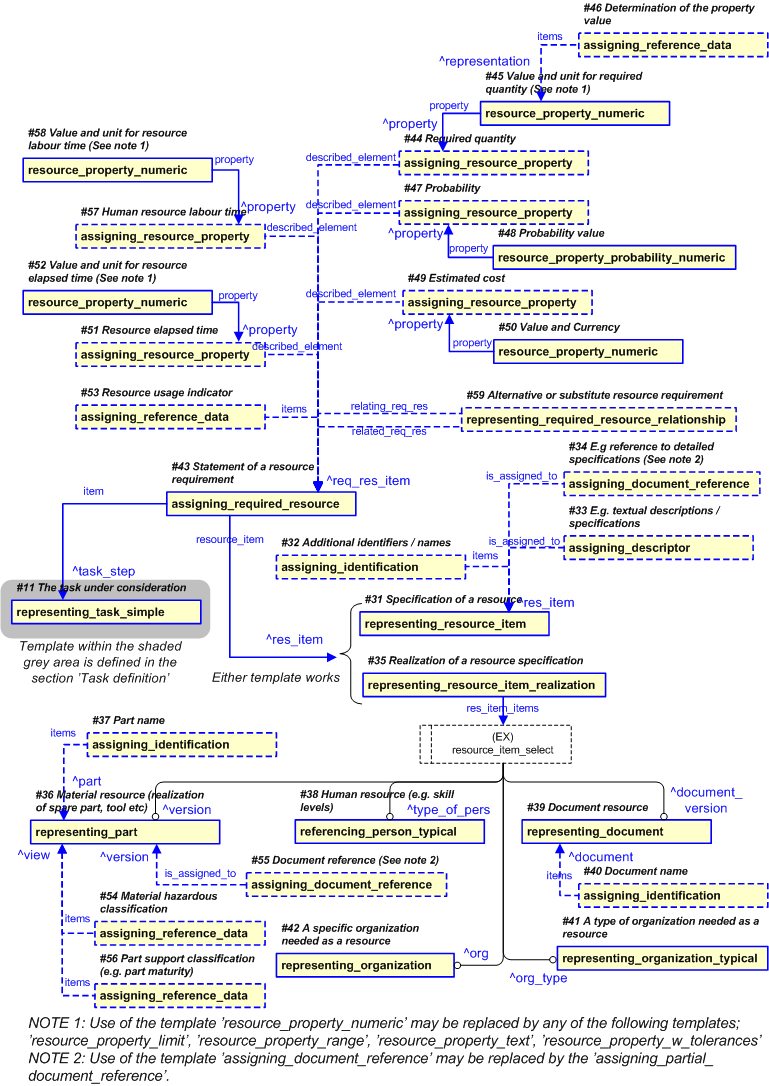
Basic representation of a resource and its identification is done in accordance with the template representing_resource_item, where the Resource_item entity defines the resource.
NOTE A Resource_item may have one or many realizations, e.g. Parts, Type_of_persons etc, as described in the next section.
Template instantiation for the basic representation of a resource must follow the rules defined in the template table: Template #31(Figure 23) below.
| Template #31 (Figure 23): representing_resource_item | |||
|---|---|---|---|
| Description | Basic representation of resource. | ||
| Parameter name: | Parameter value: | Parameter description: | |
| res_item_id | ?res_item_id? | Identification of the Resource_item
NOTE In more generic cases, the identification of a resource specification. |
|
| res_item_id_class | "Resource_item_identification_code" (urn:plcs:rdl:std:Resource_item_identification_code), or subclass thereof. | The name of the class used to classify the identifier (@res_item_id) and to provide the role or reason for the identification | |
| res_item_id_ecl_id | ?res_item_id_ecl_id? | The id of the External_class_library storing the @res_item_id_class | |
| res_item_id_org_id | ?res_item_id_org_id? | The identifier of the Organization that "owns" the identifier. | |
| res_item_id_org_id_class | "Organization_identification_code" (urn:plcs:rdl:std:Organization_identification_code), "Organization_name" (urn:plcs:rdl:std:Organization_name), or subclass thereof. | The name of the class being used to classify the identification of the Organization. For example CAGE code. | |
| res_item_id_org_id_ecl_id | ?res_item_id_org_id_ecl_id? | The id of the External_class_library storing the definition of the class used to classify the organization identifier. | |
| res_item_class | "Resource_item" (urn:plcs:rdl:std:Resource_item) or subclass thereof | Classification/categorization of the Resource_item | |
| res_item_class_ecl_id | ?res_item_class_ecl_id? | The id of the External_class_library storing the definition of the class used to classify/categorize the Resource_item. | |
NOTE Additional characterizations of the respective resource can be done in accordance with what is described under the characterization section in the representing_resource_item template.
Proposed characterizations of representing_resource_item template (i.e. the Resource_item entity) includes:
Template instantiation for the assignment of additional identification codes and/or names to the Resource_item entity, instantiated within the template table: Template #31(Figure 23), must follow the rules defined in the template table: Template #32(Figure 23) below.
| Template #32 (Figure 23): assigning_identification | |||
|---|---|---|---|
| Description | Assignment of an additional identifier or name to the resource. | ||
| Parameter name: | Parameter value: | Parameter description: | |
| id | ?id? | The identifier or name being assigned to the resource. | |
| id_class_name | "Resource_item_identification_code" (urn:plcs:rdl:std:Resource_item_identification_code), "Resource_item_name" (urn:plcs:rdl:std:Resource_item_name) or subclass thereof. | The name of the class used to classify the identifier and so provide the role or reason for the identification. | |
| id_ecl_id | ?id_ecl_id? | The id of the External_class_library storing the id_class_name class | |
| org_id | ?org_id? | The identifier of the organization that "owns" the identifier. | |
| org_id_class_name | "Organization_identification_code" (urn:plcs:rdl:std:Organization_identification_code) or "Organization_name" (urn:plcs:rdl:std:Organization_name) or subclass thereof. | The name of the class being used to classify the identification of the organization, or the organization name. For example CAGE code. | |
| org_id_ecl_id | ?org_id_ecl_id? | The id of the External_class_library storing the org_id_class_name class | |
| items | Resource_item | The Resource_item defined in template table: Template #31(Figure 23). | |
NOTE Additional characterizations of the respective identifier/name may be done in accordance with what is described under Section: Optional characterization of template assigning_identification .
Resource description (specification)
Resource description (specification) can be assigned to the Resource_item using the template assigning_descriptor. Template instantiation for resource description (specification) must follow the rules defined in template table: Template #33(Figure 23) below.
| Template #33 (Figure 23): assigning_descriptor | |||
|---|---|---|---|
| Description | Descriptions or specifications of the resource. | ||
| Parameter name: | Parameter value: | Parameter description: | |
| descr | ?descr? | The text being assigned as a description or specification of the resource under consideration. | |
| class_name | "Description" (urn:plcs:rdl:std:Description), "Specification" (urn:plcs:rdl:std:Specification), or subclass thereof. | The name of the class (External_class) being used to determine type of descriptor. | |
| ecl_id | ?ecl_id? | The id of the External_class_library that stores the class. | |
| is_assigned_to | Resource_item | The Resource_item defined in template table: Template #31(Figure 23). | |
NOTE Additional characterizations of the respective description/specification may be done in accordance with what is described under Section: Optional characterization of template assigning_descriptor .
Resource document references are represented as Document_version being assigned to the Resource_item entity, using the assigning_document_reference template. Template instantiation for resource document reference must follow the rules defined in template table: Template #34(Figure 23) below.
| Template #34 (Figure 23): assigning_document_reference | |||
|---|---|---|---|
| Description | Document reference relevant for the resource. | ||
| Parameter name: | Parameter value: | Parameter description: | |
| doc_id | ?doc_id? | The identification of the Document being referenced. | |
| doc_id_class_name | "Document_identification_code" (urn:plcs:rdl:std:Document_identification_code) or subclass thereof. | The name of the External_class that determines the type of identifier given by the input parameter @doc_id. | |
| doc_id_ecl_id | ?doc_id_ecl_id? | The identification of the External_class_library storing the External_class given by the input parameter @doc_id_class_name. | |
| doc_ver_id | ?doc_ver_id? | The identification of the Document_version being referenced. | |
| doc_ver_id_class_name | "Progression_identification_code" (urn:plcs:rdl:std:Progression_identification_code) or subclass thereof. | The name of the External_class that determines the type of identifier given by the input parameter @doc_ver_id. | |
| doc_ver_id_ecl_id | ?doc_ver_id_ecl_id? | The identification of the External_class_library storing the External_class given by the input parameter @doc_ver_id_class_name. | |
| org_id | ?org_id? | The identification of the Organization that "owns" the Document and Document_version identifiers (@doc_id and @doc_ver_id). | |
| org_id_class_name | "Organization_identification_code" (urn:plcs:rdl:std:Organization_identification_code), "Organization_name" (urn:plcs:rdl:std:Organization_name), or subclass thereof. | The name of the External_class that determines the type of organization identification (@org_id) being used. For example CAGE code. | |
| org_id_ecl_id | ?org_id_ecl_id? | The identification of the External_class_library storing the External_class given by the input parameter @org_id_class_name | |
| doc_asg_class_name | "Document_reference" (urn:plcs:rdl:std:Document_reference) or subclass thereof. | The name of the External_class that determines the role of Document_assignment, i.e. providing the role of the referenced Document | |
| doc_asg_ecl_id | ?doc_asg_ecl_id? | The identification of the External_class_library storing the External_class given by the input parameter @doc_asg_class_name class | |
| is_assigned_to | Resource_item | The Resource_item defined in template table: Template #31(Figure 23). | |
NOTE Representation of version identification where the version identification is not known must follow the guidelines given in the assigning_identification template.
NOTE The use of the assigning_document_reference template may be replaced by the use of assigning_partial_document_reference. For instantiation of the assigning_partial_document_reference template see template table: Template #28(Figure 22).
NOTE Additional characterizations of the respective referenced document (including partial document) may be done in accordance with what is described under Section: Optional characterization of template assigning referenced document .
Resource realizations includes:
NOTE Facilities and infrastructure resources are normally just defined as Resource_items, using the representing_resource_item template above, i.e. they do not have a corresponding realization.
NOTE In business situations where the resource requirement refers directly to a Part, Type_of_person etc, i.e. there is no notion of a resource concept within the business domain, there still needs to be a Resource_item in between the task and the resource.
Representation of a resource realization is done in accordance with the template representing_resource_item_realization.
Template instantiation for a resource realization must follow the rules defined in the template table: Template #35(Figure 23) below.
| Template 35 (Figure 23): representing_resource_item_realization | |||
|---|---|---|---|
| Description | Association between the resource identification/specification and one realization(s) of the resource. | ||
| Parameter name: | Parameter value: | Parameter description: | |
| res_item_id | ?res_item_id? | The identification of the Resource_item | |
| res_item_id_class | "Resource_item_identification_code" (urn:plcs:rdl:std:Resource_item_identification_code), or subclass thereof. | The type of identifier (@res_item_id) being referenced | |
| res_item_id_ecl_id | ?res_item_id_ecl_id? | The id of the External_class_library storing the @res_item_id_class | |
| res_item_id_org_id | ?res_item_id_org_id? | The Organization that "owns" the identifier. | |
| res_item_id_org_id_class | "Organization_identification_code" (urn:plcs:rdl:std:Organization_identification_code), "Organization_name" (urn:plcs:rdl:std:Organization_name), or subclass thereof. | The type of Organization identifier. | |
| res_item_id_org_id_ecl_id | res_item_id_org_id_ecl_id | The id of the External_class_library storing the definition of the class used to classify the organization identifier. | |
| res_item_items | The entity that represents the realization of the defined resource. Part_version if a material resource, Type_of_person if human resource, Document_version if document resource, Organization or Organization_type if organizational resource. | Item that shall be added to the SET of resource items that realizes the resource item under consideration. | |
Detailed representation of material resource realizations is done in accordance with the template representing_part and the part name is represented in accordance with assigning_identification.
Template instantiations for a material resource realization, and its name, must follow the rules defined in the template table: Template #36(Figure 23) and template table: Template #37(Figure 23) below.
Additional optional characterization of a material resource realization includes:
Template instantiations for these optional characterizations of a material resource realization must follow the rules defined in:
| Template #36 (Figure 23): representing_part | |||
|---|---|---|---|
| Description | Representation of the part that is the realization of a material resource (specification). | ||
| Parameter name: | Parameter value: | Parameter description: | |
| part_id | ?part_id? | The identifier of the part (material resource) | |
| part_id_class_name | "Part_identification_code" (urn:plcs:rdl:std:Part_identification_code) or subclass thereof. | The name of the class being used to classify the identifier being assigned to the part (i.e. the part_id). | |
| part_id_ecl_id | ?part_id_ecl_id? | The location of the External_class_library that stores the class used to classify the part_id. | |
| part_org_id | ?part_org_id? | The name or identifier of the organization that owns the part id. | |
| part_org_id_class_name | "Organization_identification_code" (urn:plcs:rdl:std:Organization_identification_code) or "Organization_name" (urn:plcs:rdl:std:Organization_name) or subclass thereof. | The name of the class being used to classify the identification (Identification_assignment) of the organization responsible for creating the part representation | |
| part_org_id_ecl_id | ?part_org_id_ecl_id? | The identifier of the External_class_library storing the definition of the External_class used to classify the organization identifier. | |
| part_vn_id | ?part_vn_id? | The identifier of the part version | |
| part_vn_id_class_name | "Progression_identification_code" (urn:plcs:rdl:std:Progression_identification_code) or subclass thereof. | The name of the class being used to classify the identifier assigned ( Identification_assignment ) to the part version (i.e. the part_vn_id) | |
| part_vn_id_ecl_id | ?part_vn_id_ecl_id? | The location of the External_class_library that stores the class used to classify the part version id. | |
| part_vn_org_id | ?part_vn_org_id? | The name or identifier of the organization owns the part version id. | |
| part_vn_org_id_class_name | "Organization_identification_code" (urn:plcs:rdl:std:Organization_identification_code) or "Organization_name" (urn:plcs:rdl:std:Organization_name) or subclass thereof. | The name of the class being used to classify the identification (Identification_assignment) of the organization responsible for providing the part version representation | |
| part_vn_org_id_ecl_id | ?part_vn_org_id_ecl_id? | The identifier of the External_class_library storing the definition of the External_class used to classify the organization identifier. | |
| domain |
"Application_domain"
(urn:plcs:rdl:std:Application_domain)
or subclass thereof.
NOTE Part information related to Logistics Support Analysis is recommended to use the subclass "Product_life_cycle_support" (urn:plcs:rdl:std:Product_life_cycle_support). |
The identifier of the External_class_library used to describe the type of application domain of the View_definition_context instance. | |
| domain_ecl_id | ?domain_ecl_id? | The location of the External_class_library that stores the class used to classify the View_definition_context from an application domain perspective. | |
| life_cycle_stage |
"Life_cycle_stage"
(urn:plcs:rdl:std:Life_cycle_stage) or
subclass thereof.
NOTE Part information related to Logistics Support Analysis is recommended to use the subclass "Development_stage" (urn:plcs:rdl:std:Development_stage). |
The identifier of the External_class_library used to describe the type of life cycle stage of the View_definition_context instance. | |
| life_cycle_stage_ecl_id | ?life_cycle_stage_ecl_id? | The location of the External_class_library that stores the class used to classify the View_definition_context from a life cycle stage perspective. | |
NOTE Representation of version identification where the version identification is not known must follow the guidelines given in the assigning_identification template.
| Template #37 (Figure 23): assigning_identification | |||
|---|---|---|---|
| Description | Assignment of a name to the part realizing a resource. | ||
| Parameter name: | Parameter value: | Parameter description: | |
| id | ?id? | The name being assigned to the part. | |
| id_class_name | "Part_name" (urn:plcs:rdl:std:Part_name) or subclass thereof. | The name of the class used to classify the identifier and so provide the role or reason for the identification. | |
| id_ecl_id | ?id_ecl_id? | The id of the External_class_library storing the id_class_name class | |
| org_id | ?org_id? | The identifier of the organization that "owns" the identifier. | |
| org_id_class_name | "Organization_identification_code" (urn:plcs:rdl:std:Organization_identification_code) or "Organization_name" (urn:plcs:rdl:std:Organization_name) or subclass thereof. | The name of the class being used to classify the identification of the organization, or the organization name. For example CAGE code. | |
| org_id_ecl_id | ?org_id_ecl_id? | The id of the External_class_library storing the org_id_class_name class | |
| items | Part | The part realizing a resource requirement defined in template table: Template #36(Figure 23). | |
NOTE Additional characterizations of the respective name may be done in accordance with what is described under Section: Optional characterization of template assigning_identification .
Material resource hazardous classification
Material hazardous classification is assigned to a Part_view_definition of the Part representing the material resource, using the template assigning_reference_data.
NOTE Wherever the template assigning_reference_data is being used, it can be replaced by the usage of the assigning_code template.
Template instantiation for material hazardous classification must follow the rules defined in template table: Template #54(Figure 23) below.
| Template #54 (Figure 23): assigning_reference_data | |||
|---|---|---|---|
| Description | Assigning the material hazardous classification to the part representing the material resource. | ||
| Parameter name: | Parameter value: | Parameter description: | |
| class_name | Subclass of "Part_hazardous_class" (urn:plcs:rdl:std:Part_hazardous_class). | The name of the class in the reference data library (External_class) being used to classify something | |
| ecl_id | ?ecl_id? | The id of the External_class_library that stores the definition for the class being used. | |
| items | Part_view_definition | The support analysis related Part_view_definition for the Part representing the material resource, described in template table: Template #36(Figure 23). | |
Material resource document reference
Material resources such as spares may have document references e.g. exploded views.
Material resource document reference is represented as a Document_version being assigned to the Part_version of the Part representing the material resource, using the assigning_document_reference template. Template instantiation for each material resource document reference must follow the rules defined in the template table: Template #55(Figure 23) below.
| Template #55 (Figure 23): assigning_document_reference | |||
|---|---|---|---|
| Description | Document reference relevant for the material resource. | ||
| Parameter name: | Parameter value: | Parameter description: | |
| doc_id | ?doc_id? | The identification of the Document being referenced. | |
| doc_id_class_name | "Document_identification_code" (urn:plcs:rdl:std:Document_identification_code) or subclass thereof. | The name of the External_class that determines the type of identifier given by the input parameter @doc_id. | |
| doc_id_ecl_id | ?doc_id_ecl_id? | The identification of the External_class_library storing the External_class given by the input parameter @doc_id_class_name. | |
| doc_ver_id | ?doc_ver_id? | The identification of the Document_version being referenced. | |
| doc_ver_id_class_name | "Progression_identification_code" (urn:plcs:rdl:std:Progression_identification_code) or subclass thereof. | The name of the External_class that determines the type of identifier given by the input parameter @doc_ver_id. | |
| doc_ver_id_ecl_id | ?doc_ver_id_ecl_id? | The identification of the External_class_library storing the External_class given by the input parameter @doc_ver_id_class_name. | |
| org_id | ?org_id? | The identification of the Organization that "owns" the Document and Document_version identifiers (@doc_id and @doc_ver_id). | |
| org_id_class_name | "Organization_identification_code" (urn:plcs:rdl:std:Organization_identification_code), "Organization_name" (urn:plcs:rdl:std:Organization_name), or subclass thereof. | The name of the External_class that determines the type of organization identification (@org_id) being used. For example CAGE code. | |
| org_id_ecl_id | ?org_id_ecl_id? | The identification of the External_class_library storing the External_class given by the input parameter @org_id_class_name | |
| doc_asg_class_name | "Document_reference" (urn:plcs:rdl:std:Document_reference) or subclass thereof. | The name of the External_class that determines the role of Document_assignment, i.e. providing the role of the referenced Document | |
| doc_asg_ecl_id | ?doc_asg_ecl_id? | The identification of the External_class_library storing the External_class given by the input parameter @doc_asg_class_name class | |
| is_assigned_to | Part_version | The Part_version representing the material resource, described in template table: Template #36(Figure 23). | |
NOTE Representation of version identification where the version identification is not known must follow the guidelines given in the assigning_identification template.
NOTE The use of the assigning_document_reference template may be replaced by the use of assigning_partial_document_reference. For instantiation of the assigning_partial_document_reference template see template table: Template #28(Figure 22).
NOTE Additional characterizations of the respective referenced document (including partial document) may be done in accordance with what is described under Section: Optional characterization of template assigning referenced document .
Material resource support classification
Material resource support classification, e.g. part maturity, is assigned to a Part_view_definition of the Part representing the material resource, using the template assigning_reference_data.
NOTE Wherever the template assigning_reference_data is being used, it can be replaced by the usage of the assigning_code template.
Template instantiation for material resource maturity classification must follow the rules defined in template table: Template #56(Figure 23) below.
| Template #56 (Figure 23): assigning_reference_data | |||
|---|---|---|---|
| Description | Assigning the maturity classification to the part representing the material resource. | ||
| Parameter name: | Parameter value: | Parameter description: | |
| class_name | Subclass of "Part_maturity" (urn:plcs:rdl:std:Part_maturity). | The name of the class in the reference data library (External_class) being used to classify something | |
| ecl_id | ?ecl_id? | The id of the External_class_library that stores the definition for the class being used. | |
| items | Part_view_definition | The support analysis related Part_view_definition for the Part representing the material resource, described in template table: Template #36(Figure 23). | |
Detailed representation of human resource realizations is done in accordance with the template referencing_person_typical.
Template instantiation for a human resource realization must follow the principles defined in the template table: Template #38(Figure 23) below.
| Template #38 (Figure 23): referencing_person_typical | |||
|---|---|---|---|
| Description | Representation of a type of person that is the realization of a human resource (specification). | ||
| Parameter name: | Parameter value: | Parameter description: | |
| type_of_pers_class_name | Subclass of "Type_of_person" (urn:plcs:rdl:std:Type_of_person). | The name of the External_class that determines the type of person being referenced. | |
| type_of_pers_ecl_id | ?type_of_pers_ecl_id? | The identification of the External_class_library storing the External_class given by the input parameter @type_of_person_class_name. | |
NOTE In a data exchange the usage of reference data within template table: Template #38(Figure 23) may be replaced by the usage of codes in order to determine type of person (also see template assigning_code).
Detailed representation of document resource realizations is done in accordance with the template representing_document. An optional document name is represented in accordance with the assigning_identification template.
Template instantiation for a document resource realization and its name must follow the principles defined in the template table: Template #39(Figure 23) and template table: Template #40(Figure 23) below.
| Template #39 (Figure 23): representing_document | |||
|---|---|---|---|
| Description | Representation of the document that is the realization of a document resource (specification). | ||
| Parameter name: | Parameter value: | Parameter description: | |
| doc_id | ?doc_id? | The identifier of the Document. | |
| doc_id_class_name | "Document_identification_code" (urn:plcs:rdl:std:Document_identification_code) or subclass thereof. | The name of the class being used to classify the identification (Identification_assignment) of the Document. This provides the role or reason for the identification. The identifier of the External_class_library that stores the class used to classify the type of identifier | |
| doc_id_ecl_id | ?doc_id_ecl_id? | The identifier of the External_class_library storing the definition of the class referenced by the parameter @doc_id_class_name. | |
| doc_org_id | ?doc_org_id? | The name or identifier of the Organization owning the document identifier or name @doc_id. | |
| doc_org_id_class_name | "Organization_identification_code" (urn:plcs:rdl:std:Organization_identification_code) or "Organization_name" (urn:plcs:rdl:std:Organization_name) or subclass thereof. | The name of the class being used to classify the identification (Identification_assignment) of the Organization owning the identifier (@doc_org_id). | |
| doc_org_id_ecl_id | ?doc_org_id_ecl_id? | The identifier of the External_class_library storing the definition of the class used to classify the Organization identifier. | |
| doc_vn_id | ?doc_vn_id? | The identifier of the document version. | |
| doc_vn_id_class_name | "Progression_identification_code" (urn:plcs:rdl:std:Progression_identification_code) or subclass thereof. | The name of the class being used to classify the identification (Identification_assignment) of the the version identifier. | |
| doc_vn_id_ecl_id | ?doc_vn_id_ecl_id? | The identifier of the External_class_library storing the definition of the class referenced by the parameter @doc_vn_id_class_name. | |
| doc_vn_org_id | ?doc_vn_org_id? | The name or identifier of the Organization owning the document version identifier or name @doc_vn_id. | |
| doc_vn_org_id_class_name | "Organization_identification_code" (urn:plcs:rdl:std:Organization_identification_code) or "Organization_name" (urn:plcs:rdl:std:Organization_name) or subclass thereof. | The name of the class being used to classify the identification (Identification_assignment) of the Organization owning the version identifier (@doc_vn_org_id). | |
| doc_vn_org_id_ecl_id | ?doc_vn_org_id_ecl_id? | The identifier of the External_class_library storing the definition of the class used to classify the Organization identifier. | |
| domain |
"Application_domain"
(urn:plcs:rdl:std:Application_domain)
or subclass thereof.
NOTE Document information related to Logistics Support Analysis is recommended to use the subclass "Product_life_cycle_support" (urn:plcs:rdl:std:Product_life_cycle_support). |
The identifier of the External_class_library used to describe the type of application domain of the View_definition_context instance. | |
| domain_ecl_id | ?domain_ecl_id? | The identifier of the External_class_library storing the definition of the class referenced by the parameter @domain class. | |
| life_cycle_stage |
"Life_cycle_stage"
(urn:plcs:rdl:std:Life_cycle_stage) or
subclass thereof.
NOTE Document information related to Logistics Support Analysis is recommended to use the subclass "Development_stage" (urn:plcs:rdl:std:Development_stage). |
The identifier of the External_class_library used to describe the type of life cycle stage of the View_definition_context instance. | |
| life_cycle_stage_ecl_id | ?life_cycle_stage_ecl_id? | The identifier of the External_class_library storing the definition of the class referenced by the parameter @life_cycle_stage class. | |
NOTE Representation of version identification where the version identification is not known must follow the guidelines given in the assigning_identification template.
| Template #40 (Figure 23): assigning_identification | |||
|---|---|---|---|
| Description | Assignment of a name to the document realizing a resource. | ||
| Parameter name: | Parameter value: | Parameter description: | |
| id | ?id? | The name being assigned to the document. | |
| id_class_name | "Document_name" (urn:plcs:rdl:std:Document_name) or subclass thereof. | The name of the class used to classify the identifier and so provide the role or reason for the identification. | |
| id_ecl_id | ?id_ecl_id? | The id of the External_class_library storing the id_class_name class | |
| org_id | ?org_id? | The identifier of the organization that "owns" the identifier. | |
| org_id_class_name | "Organization_identification_code" (urn:plcs:rdl:std:Organization_identification_code) or "Organization_name" (urn:plcs:rdl:std:Organization_name) or subclass thereof. | The name of the class being used to classify the identification of the organization, or the organization name. For example CAGE code. | |
| org_id_ecl_id | ?org_id_ecl_id? | The id of the External_class_library storing the org_id_class_name class | |
| items | Document | The document realizing a resource requirement as described in template table: Template #39(Figure 23). | |
NOTE Additional characterizations of the respective name may be done in accordance with what is described under Section: Optional characterization of template assigning_identification .
Detailed representation of organizational resource realizations is done in accordance with the templates representing_organization_typical and representing_organization.
Template instantiation for a organizational resource realization must follow the principles defined in template table: Template #41(Figure 23) and template table: Template #42(Figure 23) templates below.
| Template #41 (Figure 23): representing_organization_typical | |||
|---|---|---|---|
| Description | Representation of a type organization that is the realization of an organizational resource specification, e.g. work centre or line of maintenance | ||
| Parameter name: | Parameter value: | Parameter description: | |
| org_type_class_name | Subclass of "Organization_type" (urn:plcs:rdl:std:Organization_type) | The name of the External_class that determines the organization type being referenced. | |
| org_type_ecl_id | ?org_type_ecl_id? | The identification of the External_class_library storing the External_class given by the input parameter @org_type_class_name. | |
NOTE In a data exchange the usage of reference data within template table: Template #41(Figure 23) may be replaced by the usage of codes in order to determine type of organization (also see template assigning_code).
| Template #42 (Figure 23): representing_organization | |||
|---|---|---|---|
| Description | Representation of a specific organization that is the realization of an organizational resource specification | ||
| Parameter name: | Parameter value: | Parameter description: | |
| org_id | ?org_id? | The identifier or name of the organization. | |
| org_id_class_name | "Organization_identification_code" (urn:plcs:rdl:std:Organization_identification_code) or "Organization_name" (urn:plcs:rdl:std:Organization_name) or subclass thereof. | The name of the class being used to classify the identification (Identification_assignment) of the organization. This provides the role or reason for the identification. For example CAGE code. | |
| org_id_ecl_id | ?org_id_ecl_id? | The identifier of the External_class_library storing the definition of the class referenced by the parameter @org_id_class_name class. | |
Resource requirements are assigned to the task details, i.e. the Task_step.
Detailed representation of assigning a required resource to a task is done in accordance with the template assigning_required_resource.
Template instantiation for a assigning a required resource must follow the principles defined in the template table: Template #43(Figure 23) below.
| Template #43 (Figure 23): assigning_required_resource | |||
|---|---|---|---|
| Description | Assignment of a resource requirement to the task under consideration. | ||
| Parameter name: | Parameter value: | Parameter description: | |
| item | Task_step | The task details for the task under consideration. See template table: Template #11(Figure 22) for a simple task. | |
| resource_item | Resource_item | The resource defined in template table: Template #31(Figure 23) and template table: Template #35(Figure 23) | |
| class_name | "Required_resource_by_resource_item_role" (urn:plcs:rdl:std:Required_resource_by_resource_item_role) or subclass thereof. | The name of the External_class that determines the role of the required resource given by the input parameter @resource_item. | |
| ecl_id | ?ecl_id? | The identification of the External_class_library storing the External_class given by the input parameter @class_name. | |
NOTE Subclasses of "Required_resource" (urn:plcs:rdl:std:Required_resource) defines the role for the Resource_item within the task under consideration. Examples of roles can be; spare, test equipment, supervisor, etc. The same Resource_item may have different roles in different tasks.
The role of the required resource is part of template table: Template #43(Figure 23). The role is determined using the 'class_name' and 'ecl_id' input parameters for template table: Template #43(Figure 23).
Required resource quantity is represented as a property being assigned to the Required_resource_by_resource_item entity, using the assigning_resource_property and resource_property_numeric templates. Template instantiation for the required resource quantity must follow the rules defined in template table: Template #44(Figure 23) and template table: Template #45(Figure 23).
| Template #44 (Figure 23): assigning_resource_property | |||
|---|---|---|---|
| Description | Assignment of a quantity property to the resource required for the task under consideration. | ||
| Parameter name: | Parameter value: | Parameter description: | |
| property_class_name | "Quantity" (urn:plcs:rdl:std:Quantity) or subclass thereof. | The class name of the property type corresponding to the property name. | |
| property_ecl_id | ?property_ecl_id? | The identifier of the External_class_library storing the definition of the class referenced by the parameter @property. | |
| described_element | Required_resource_by_resource_item | The Required_resource_by_resource_item described in template table: Template #43(Figure 23). | |
| Template #45 (Figure 23): resource_property_numeric | |||
|---|---|---|---|
| Description | Value and unit for the required resource quantity property. | ||
| Parameter name: | Parameter value: | Parameter description: | |
| value | ?value? | The value of the property. The datatype is always 'any_number_value' and should not be registered together with the value, i.e. enter the value as a number, without datatype. | |
| unit | Subclass of "Unit" (urn:plcs:rdl:std:Unit) | The class name of the unit in which the value is expressed. | |
| unit_ecl_id | "urn:plcs:rdl:std" | The identifier of the External_class_library storing the definition of the class referenced by the parameter @unit. | |
| si_unit | 'true' or 'false' |
Value should be set to true if the unit is a SI base unit defined by ISO, i.e.
kilogram (kg) for Mass,
second (s) for Time,
metre (m) for Displacement,
ampere (A) for Electrical current,
kelvin (K) for Temperature,
mole (mol) for Amount of substance, and
candela (cd) for Luminous intensity. If this is not the case it should be set to false.
Note that the representation of true and false depends on exchange format. In Part 11 (a STEP file) true is represented by the string ".T.", and false by ".F.", while in Part 28 (XML) they are represented by text strings "true" and "false". |
|
| context | Subclass of "Representation_context" (urn:plcs:rdl:std:Representation_context) | The name of the class being used to classify the representation context (Numerical_representation_context) of the property. | |
| context_ecl_id | ?context_ecl_id? | The identifier of the External_class_library storing the definition of the class referenced by the parameter @context. | |
| property | Resource_property | The Resource_property instantiated in template table: Template #44(Figure 23) representing the property 'Quantity'. | |
NOTE Additional characterizations of the respective template used for representing the required quantity and its value, may be done in accordance with what is described under Section: Optional characterization of templates for property representation .
NOTE The usage of the template resource_property_numeric may be replaced by the usage of either of:
Resource quantity determination
Resource quantity determination can represented, either by specialization of the "Quantity" (urn:plcs:rdl:std:Quantity) class in the reference data library, or by classification of the Resource_property_representation entity instantiated in template table: Template #45(Figure 23).
Resource quantity determination by classification is done using the template assigning_reference_data.
NOTE Wherever the template assigning_reference_data is being used, it can be replaced by the usage of the assigning_code template.
Template instantiation for resource quantity determination must follow the rules defined in template table: Template #46(Figure 23) below.
| Template #46 (Figure 23): assigning_reference_data | |||
|---|---|---|---|
| Description | The method by which the value has been determined. | ||
| Parameter name: | Parameter value: | Parameter description: | |
| class_name | Subclass of "Property_value_representation_determination" (urn:plcs:rdl:std:Property_value_representation_determination). | The class in the reference data library being used to determine the method by which the value has been determined. | |
| ecl_id | ?ecl_id? | The id of the External_class_library that stores the definition for the class being used. | |
| items | Resource_property_representation | The representation of quantity property value under consideration ( template table: Template #45(Figure 23)). | |
Required probability is represented as a property being assigned to the Required_resource_by_resource_item entity, using the assigning_resource_property and resource_property_probability_numeric templates. Template instantiation for the required resource quantity must follow the rules defined in template table: Template #47(Figure 23) and template table: Template #48(Figure 23) below.
| Template #47 (Figure 23): assigning_resource_property | |||
|---|---|---|---|
| Description | Assignment of a probability to the resource required for the task under consideration. | ||
| Parameter name: | Parameter value: | Parameter description: | |
| property_class_name | "Probability" (urn:plcs:rdl:std:Probability) or subclass thereof. | The class name of the property type corresponding to the property name. | |
| property_ecl_id | ?property_ecl_id? | The identifier of the External_class_library storing the definition of the class referenced by the parameter @property. | |
| described_element | Required_resource_by_resource_item | The Required_resource_by_resource_item defined in template table: Template #43(Figure 23). | |
| Template #48 (Figure 23): resource_property_probability_numeric | |||
|---|---|---|---|
| Description | The value for the required resource probability property. | ||
| Parameter name: | Parameter value: | Parameter description: | |
| value | ?value? | The value of the property. The datatype is always 'any_number_value' and should not be registered together with the value, i.e. enter the value as a number, without datatype. | |
| class_name | "Normalized_numeric_probability" (urn:plcs:rdl:std:Normalized_numeric_probability) or "Percentage_numeric_probability" (urn:plcs:rdl:std:Percentage_numeric_probability). | The class name of the probability in which the probability value is expressed. | |
| class_ecl_id | ?class_ecl_id? | The identifier of the External_class_library storing the definition of the class referenced by the parameter @class_name. | |
| context | "Representation_context" (urn:plcs:rdl:std:Representation_context) or subclass thereof. | The name of the class being used to classify the representation context (Representation_context) of the property. | |
| context_ecl_id | ?context_ecl_id? | The identifier of the External_class_library storing the definition of the class referenced by the parameter @context. | |
| property | Resource_property | The Resource_property instantiated in template table: Template #47(Figure 23) representing the property 'Probability'. | |
Estimated resource cost is represented as a property being assigned to the Required_resource_by_resource_item entity, using the assigning_resource_property and resource_property_numeric templates. Template instantiation for the estimated resource cost must follow the rules defined in template table: Template #49(Figure 23) and template table: Template #50(Figure 23).
| Template #49 (Figure 23): assigning_resource_property | |||
|---|---|---|---|
| Description | Assignment of an estimated cost property to the resource required for the task under consideration. | ||
| Parameter name: | Parameter value: | Parameter description: | |
| property_class_name | "Estimated_cost" (urn:plcs:rdl:std:Estimated_cost) or subclass thereof. | The class name of the property type corresponding to the property name. | |
| property_ecl_id | ?property_ecl_id? | The identifier of the External_class_library storing the definition of the class referenced by the parameter @property. | |
| described_element | Required_resource_by_resource_item | The Required_resource_by_resource_item defined in template table: Template #43(Figure 23). | |
| Template #50 (Figure 23): resource_property_numeric | |||
|---|---|---|---|
| Description | Value and currency of the estimated cost for a required resource. | ||
| Parameter name: | Parameter value: | Parameter description: | |
| value | ?value? | The value of the property. The datatype is always 'any_number_value' and should not be registered together with the value, i.e. enter the value as a number, without datatype. | |
| unit | Subclass of "Currency" (urn:plcs:rdl:std:Currency) | The class name of the unit in which the value is expressed. | |
| unit_ecl_id | "urn:plcs:rdl:std" | The identifier of the External_class_library storing the definition of the class referenced by the parameter @unit. | |
| si_unit | 'false' |
There is no si unit for currency. |
|
| context | Subclass of "Representation_context" (urn:plcs:rdl:std:Representation_context) | The name of the class being used to classify the representation context (Numerical_representation_context) of the property. | |
| context_ecl_id | ?context_ecl_id? | The identifier of the External_class_library storing the definition of the class referenced by the parameter @context. | |
| property | Resource_property | The Resource_property instantiated in template table: Template #49(Figure 23) representing the property Estimated cost. | |
NOTE Additional characterizations of the respective template used for representing the estimated cost and its value, may be done in accordance with what is described under Section: Optional characterization of templates for property representation .
NOTE The usage of the template resource_property_numeric may be replaced by the usage of either of:
Estimated resource elapsed time
Estimated resource elapsed time is represented as a property being assigned to the Required_resource_by_resource_item entity, using the assigning_resource_property and resource_property_numeric templates. Template instantiation for the resource elapsed time must follow the rules defined in template table: Template #51(Figure 23) and template table: Template #52(Figure 23).
| Template #51 (Figure 23): assigning_resource_property | |||
|---|---|---|---|
| Description | Assignment of resource elapsed time property to the resource required for the task under consideration. | ||
| Parameter name: | Parameter value: | Parameter description: | |
| property_class_name | "Resource_planned_duration" (urn:plcs:rdl:std:Resource_planned_duration) or subclass thereof. | The class name of the property type corresponding to the property name. | |
| property_ecl_id | ?property_ecl_id? | The identifier of the External_class_library storing the definition of the class referenced by the parameter @property. | |
| described_element | Required_resource_by_resource_item | The Required_resource_by_resource_item defined in template table: Template #43(Figure 23). | |
| Template #52 (Figure 23): resource_property_numeric | |||
|---|---|---|---|
| Description | Value and unit for the elapsed time property. | ||
| Parameter name: | Parameter value: | Parameter description: | |
| value | ?value? | The value of the property. The datatype is always 'any_number_value' and should not be registered together with the value, i.e. enter the value as a number, without datatype. | |
| unit | "Second" (urn:plcs:rdl:std:Second), "Minute" (urn:plcs:rdl:std:Minute), "Hour" (urn:plcs:rdl:std:Hour), or "Day" (urn:plcs:rdl:std:Day) | The class name of the unit in which the value is expressed. | |
| unit_ecl_id | "urn:plcs:rdl:std" | The identifier of the External_class_library storing the definition of the class referenced by the parameter @unit. | |
| si_unit | 'true' or 'false' |
TRUE if unit is defined as "Second" (urn:plcs:rdl:std:Second), otherwise FALSE. If Part 11 STEP file, true is represented by the string '.T.' and false '.F.', while in Part 28 (XML) they are represented by text strings 'true' and 'false'. |
|
| context | Subclass of "Representation_context" (urn:plcs:rdl:std:Representation_context) | The name of the class being used to classify the representation context (Numerical_representation_context) of the property. | |
| context_ecl_id | ?context_ecl_id? | The identifier of the External_class_library storing the definition of the class referenced by the parameter @context. | |
| property | Resource_property | The Resource_property instantiated in template table: Template #51(Figure 23) representing the property 'Elapsed time'. | |
NOTE Additional characterizations of the respective template used for representing resource elapsed time and its value, may be done in accordance with what is described under Section: Optional characterization of templates for property representation .
NOTE The usage of the template resource_property_numeric may be replaced by the usage of either of:
Resource usage indicator is assigned to the Required_resource_by_resource_item using the template assigning_reference_data.
NOTE Wherever the template assigning_reference_data is being used, it can be replaced by the usage of the assigning_code template.
Template instantiation for resource usage indicator must follow the rules defined in template table: Template #53(Figure 23) below.
| Template #53 (Figure 23): assigning_reference_data | |||
|---|---|---|---|
| Description | Assigning the resource usage indicator to the required resource. | ||
| Parameter name: | Parameter value: | Parameter description: | |
| class_name | Subclass of "Resource_usage_indicator" (urn:plcs:rdl:std:Resource_usage_indicator) | The name of the class in the reference data library (External_class) being used to classify something | |
| ecl_id | ?ecl_id? | The id of the External_class_library that stores the definition for the class being used. | |
| items | Required_resource_by_resource_item | The Required_resource_by_resource_item defined in template table: Template #43(Figure 23). | |
Human resource estimated labour time
Human resource estimated labour time is represented as a property being assigned to the Required_resource_by_resource_item entity, using the assigning_resource_property and resource_property_numeric templates. Template instantiation for the human resource estimated labour time must follow the rules defined in template table: Template #57(Figure 23) and template table: Template #58(Figure 23).
| Template #57 (Figure 23): assigning_resource_property | |||
|---|---|---|---|
| Description | Assignment of human resource estimated labour time property to the required human or organizational resource for the task under consideration. | ||
| Parameter name: | Parameter value: | Parameter description: | |
| property_class_name | "Labour_time_planned" (urn:plcs:rdl:std:Labour_time_planned) or subclass thereof. | The class name of the property type corresponding to the property name. | |
| property_ecl_id | ?property_ecl_id? | The identifier of the External_class_library storing the definition of the class referenced by the parameter @property. | |
| described_element | Required_resource_by_resource_item | The Required_resource_by_resource_item defined in template table: Template #43(Figure 23). | |
| Template #58 (Figure 23): resource_property_numeric | |||
|---|---|---|---|
| Description | Value of the estimated labour time property. | ||
| Parameter name: | Parameter value: | Parameter description: | |
| value | ?value? | The value of the property. The datatype is always 'any_number_value' and should not be registered together with the value, i.e. enter the value as a number, without datatype. | |
| unit | "Man_minute" (urn:plcs:rdl:std:Man_minute), "Man_hour" (urn:plcs:rdl:std:Man_hour), or "Man_day" (urn:plcs:rdl:std:Man_day). | The class name of the unit in which the value is expressed. | |
| unit_ecl_id | "urn:plcs:rdl:std" | The identifier of the External_class_library storing the definition of the class referenced by the parameter @unit. | |
| si_unit | ''false' |
Value should be set to true if the unit is a SI base unit defined by ISO, i.e.
kilogram (kg) for Mass,
second (s) for Time,
metre (m) for Displacement,
ampere (A) for Electrical current,
kelvin (K) for Temperature,
mole (mol) for Amount of substance, and
candela (cd) for Luminous intensity. If this is not the case it should be set to false.
Note that the representation of true and false depends on exchange format. In Part 11 (a STEP file) true is represented by the string ".T.", and false by ".F.", while in Part 28 (XML) they are represented by text strings "true" and "false". |
|
| context | Subclass of "Representation_context" (urn:plcs:rdl:std:Representation_context) | The name of the class being used to classify the representation context (Numerical_representation_context) of the property. | |
| context_ecl_id | ?context_ecl_id? | The identifier of the External_class_library storing the definition of the class referenced by the parameter @context. | |
| property | Resource_property | The Resource_property instantiated in template table: Template #57(Figure 23) representing the property 'Labour time'. | |
NOTE Additional characterizations of the respective template used for representing resource labour time and its value, may be done in accordance with what is described under Section: Optional characterization of templates for property representation .
NOTE The usage of the template resource_property_numeric may be replaced by the usage of either of:
Alternative / substitute resource requirement
Alternative or substitute resource requirements can be defined using the template representing_required_resource_relationship.
Template instantiation for alternative or substitute resource requirements must follow the rules defined in template table: Template #59(Figure 23) below.
| Template #59 (Figure 23): representing_required_resource_relationship | |||
|---|---|---|---|
| Description | |||
| Parameter name: | Parameter value: | Parameter description: | |
| req_res_rel_class_name | "Alternative" (urn:plcs:rdl:std:Alternative) or "Substitute" (urn:plcs:rdl:std:Substitute) | The name of the External_class that determines type of relationship. | |
| req_res_rel_ecl_id | ?ecl_id? | The identification of the External_class_library storing the External_class given by the input parameter @class_name. | |
| relating_req_res | Required_resource_by_resource_item | The resource requirement that has an alternative or substitute. | |
| related_req_res | Required_resource_by_resource_item | The representation of the alternative or substitute resource requirement. | |
Task trigger information includes:
NOTE Detailed information requirements for task triggers are defined in Section: Information requirements - Task Trigger.
The PLCS representation for task trigger is described in Figure 24
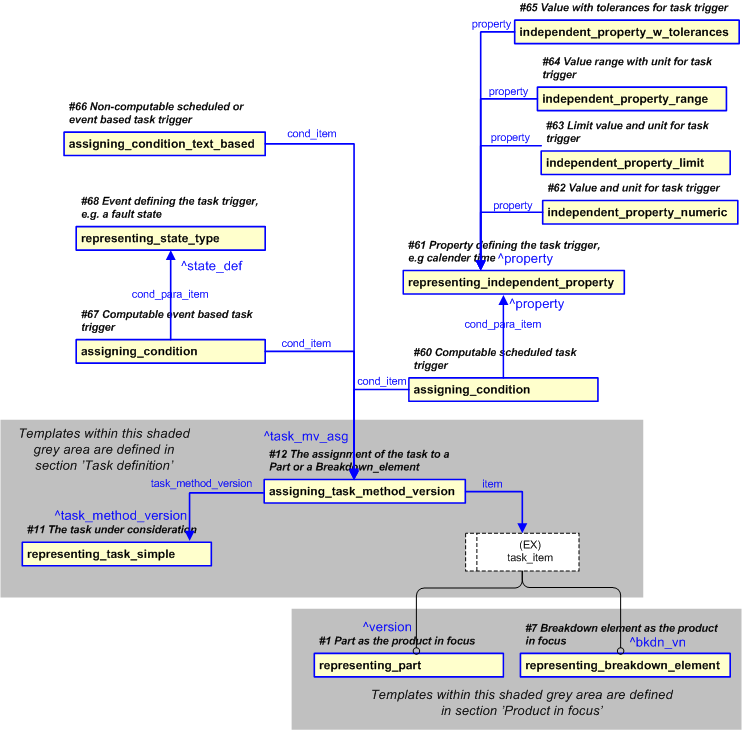
All types of task triggers are represented as Conditions, along with a Condition_assignment being classified as "Trigger" (urn:plcs:rdl:std:Trigger), or subclass thereof. The Condition_assignment is assigned to the Task_method_version_assignment representing the assignment of a task to the product in focus (Part_version defined in template table: Template #1(Figure 20) or Breakdown_element_version defined in template table: Template #7(Figure 21)).
Scheduled task triggers may either be defined in a way that they are computable, or just defined as a text string in which case the content need to be analyzed by a human in order to decide when the condition defined in the task trigger is being fulfilled.
Computable scheduled task triggers
Computable scheduled task triggers relates to a measurable value, e.g. calendar time, flight hours etc. Scheduled task trigger parameters are represented as Independent_property being referenced from the Condition_parameter entity.
The simplest form of computable scheduled task triggers contains just one parameter, and is represented using the assigning_condition template.
Template instantiation for computable scheduled task triggers, containing one parameter, must follow the rules defined in template table: Template #60(Figure 24), below.
NOTE Representation of task triggers that requires advanced logical expressions in terms of e.g. AND/OR/XOR conditions are described in Section: Task compound conditions representation below.
The property that defines the parameter for the computable scheduled task trigger is represented using the representing_independent_property template.
Template instantiation for the property defining the computable scheduled task trigger parameter must follow the rules defined in template table: Template #61(Figure 24) below.
The property value for the task trigger parameter can be represented as either:
Template instantiation for the value of the task trigger property must follow the rules defined in either of the following template tables below:
| Template #60 (Figure 24): assigning_condition | |||
|---|---|---|---|
| Description | The scheduled task trigger. | ||
| Parameter name: | Parameter value: | Parameter description: | |
| cond_item | Task_method_version_assignment | The entity representing the assignment of the task to the product in focus, as described in template table: Template #12(Figure 22). | |
| cond_asg_class | "Scheduled_trigger" (urn:plcs:rdl:std:Scheduled_trigger) or subclass thereof. | The name of the class used to classify the Condition_assignment and to provide the role or reason for the condition. | |
| cond_asg_ecl_id | ?cond_asg_ecl_id? | The identifier of the External_class_library storing the definition of the class referenced by the parameter @cond_asg_class. | |
| cond_class | "Computable_condition" (urn:plcs:rdl:std:Computable_condition), "Computable_not_condition" (urn:plcs:rdl:std:Computable_not_condition)or subclass thereof. | Type of Condition that can be evaluated. | |
| cond_ecl_id | ?cond_ecl_id? | The identifier of the External_class_library storing the definition of the class referenced by the parameter @cond_class. | |
| cond_para_item | Independent_property | The property representing the parameter that triggers the scheduled task (described in template table: Template #61(Figure 24)). | |
| Template #61 (Figure 24): representing_independent_property | |||
|---|---|---|---|
| Description | The scheduled task trigger parameter | ||
| Parameter name: | Parameter value: | Parameter description: | |
| property_class_name | Subclass of "Independent_property" (urn:plcs:rdl:std:Independent_property). | The class name corresponding to the property name. | |
| property_ecl_id | ?property_ecl_id? | The identifier of the External_class_library storing the definition of the class referenced by the parameter @property_class_name. | |
| Template #62 (Figure 24): independent_property_numeric | |||
|---|---|---|---|
| Description | Value and unit defining the task trigger interval. | ||
| Parameter name: | Parameter value: | Parameter description: | |
| value | ?value? | The value of the property. The datatype is always 'any_number_value' and should not be registered together with the value, i.e. enter the value as a number, without datatype. | |
| unit | Subclass of "Unit" (urn:plcs:rdl:std:Unit). | The class name of the unit in which the value is expressed. | |
| unit_ecl_id | ?unit_ecl_id? | The identifier of the External_class_library storing the definition of the class referenced by the parameter @unit. | |
| si_unit | 'true' or 'false' |
Value should be set to true if the unit is a SI base unit defined by ISO, i.e.
kilogram (kg) for Mass,
second (s) for Time,
metre (m) for Displacement,
ampere (A) for Electrical current,
kelvin (K) for Temperature,
mole (mol) for Amount of substance, and
candela (cd) for Luminous intensity. If this is not the case it should be set to false.
Note that the representation of true and false depends on exchange format. In Part 11 (a STEP file) true is represented by the string ".T.", and false by ".F.", while in Part 28 (XML) they are represented by text strings "true" and "false". |
|
| context | Subclass of "Representation_context" (urn:plcs:rdl:std:Representation_context). | The name of the class being used to classify the representation context (Numerical_representation_context) of the property. | |
| context_ecl_id | ?context_ecl_id? | The identifier of the External_class_library storing the definition of the class referenced by the parameter @context. | |
| property | Independent_property | The property representing the parameter that triggers the scheduled task, as described in template table: Template #61(Figure 24). | |
| Template #63 (Figure 24): independent_property_limit | |||
|---|---|---|---|
| Description | Single limit value and unit for task trigger. | ||
| Parameter name: | Parameter value: | Parameter description: | |
| limit | ?limit? | The value of the property. The datatype is always 'any_number_value' and should not be registered together with the value, i.e. enter the value as a number, without datatype. | |
| qualifier | 'maximum' or 'minimum' | The limit qualifier of the property. Allowed values are 'maximum' or 'minimum' | |
| unit | Subclass of "Unit" (urn:plcs:rdl:std:Unit). | The class name of the unit in which the value is expressed. | |
| unit_ecl_id | ?unit_ecl_id? | The identifier of the External_class_library storing the definition of the class referenced by the parameter @unit. | |
| si_unit | 'true' or 'false' |
Value should be set to true if the unit is a SI base unit defined by ISO, i.e.
kilogram (kg) for Mass,
second (s) for Time,
metre (m) for Displacement,
ampere (A) for Electrical current,
kelvin (K) for Temperature,
mole (mol) for Amount of substance, and
candela (cd) for Luminous intensity. If this is not the case it should be set to false.
Note that the representation of true and false depends on exchange format. In Part 11 (a STEP file) true is represented by the string ".T.", and false by ".F.", while in Part 28 (XML) they are represented by text strings "true" and "false". |
|
| context | Subclass of "Representation_context" (urn:plcs:rdl:std:Representation_context). | The name of the class being used to classify the representation context (Numerical_representation_context) of the property. | |
| context_ecl_id | ?context_ecl_id? | The identifier of the External_class_library storing the definition of the class referenced by the parameter @context. | |
| property | Independent_property | The property representing the parameter that triggers the scheduled task, as described in template table: Template #61(Figure 24). | |
| Template #64 (Figure 24): independent_property_range | |||
|---|---|---|---|
| Description | Numerical values with units for lower and upper limits. | ||
| Parameter name: | Parameter value: | Parameter description: | |
| upper_limit | ?upper_limit? | The upper limit value of the property. The datatype must also be indicated in this parameter, e.g. "ANY_NUMBER_VALUE(5)". | |
| lower_limit | ?lower_limit? | The lower limit value of the property. The datatype must also be indicated in this parameter, e.g. "ANY_NUMBER_VALUE(5)". | |
| unit | Subclass of "Unit" (urn:plcs:rdl:std:Unit). | The class name of the unit in which the value is expressed. | |
| unit_ecl_id | ?unit_ecl_id? | The identifier of the External_class_library storing the definition of the class referenced by the parameter @unit. | |
| si_unit | 'true' or 'false' |
Value should be set to true if the unit is a SI base unit defined by ISO, i.e.
kilogram (kg) for Mass,
second (s) for Time,
metre (m) for Displacement,
ampere (A) for Electrical current,
kelvin (K) for Temperature,
mole (mol) for Amount of substance, and
candela (cd) for Luminous intensity. If this is not the case it should be set to false.
Note that the representation of true and false depends on exchange format. In Part 11 (a STEP file) true is represented by the string ".T.", and false by ".F.", while in Part 28 (XML) they are represented by text strings "true" and "false". |
|
| context | Subclass of "Representation_context" (urn:plcs:rdl:std:Representation_context). | The name of the class being used to classify the representation context (Numerical_representation_context) of the property. | |
| context_ecl_id | ?context_ecl_id? | The identifier of the External_class_library storing the definition of the class referenced by the parameter @context. | |
| property | Independent_property | The property representing the parameter that triggers the scheduled task, as described in template table: Template #61(Figure 24). | |
| Template #65 (Figure 24): independent_property_w_tolerances | |||
|---|---|---|---|
| Description | Single numerical value with tolerances for task trigger. | ||
| Parameter name: | Parameter value: | Parameter description: | |
| value | ?value? | The value of the property. The datatype is always 'any_number_value' and should not be registered together with the value, i.e. enter the value as a number, without datatype. | |
| upper_limit | ?upper_limit? | The upper tolerance limit of the property value given as an offset from the base value. | |
| lower_limit | ?lower_limit? | The lower tolerance limit of the property value given as an offset from the base value, e.g. -4.0. | |
| unit | Subclass of "Unit" (urn:plcs:rdl:std:Unit). | The class name of the unit in which the value is expressed. | |
| unit_ecl_id | ?unit_ecl_id? | The identifier of the External_class_library storing the definition of the class referenced by the parameter @unit. | |
| si_unit | 'true' or 'false' |
Value should be set to true if the unit is a SI base unit defined by ISO, i.e.
kilogram (kg) for Mass,
second (s) for Time,
metre (m) for Displacement,
ampere (A) for Electrical current,
kelvin (K) for Temperature,
mole (mol) for Amount of substance, and
candela (cd) for Luminous intensity. If this is not the case it should be set to false.
Note that the representation of true and false depends on exchange format. In Part 11 (a STEP file) true is represented by the string ".T.", and false by ".F.", while in Part 28 (XML) they are represented by text strings "true" and "false". |
|
| context | Subclass of "Representation_context" (urn:plcs:rdl:std:Representation_context). | The name of the class being used to classify the representation context (Numerical_representation_context) of the property. | |
| context_ecl_id | ?context_ecl_id? | The identifier of the External_class_library storing the definition of the class referenced by the parameter @context. | |
| property | Independent_property | The property representing the parameter that triggers the scheduled task, as described in template table: Template #61(Figure 24). | |
NOTE Additional characterizations of the respective template used for representing the scheduled task trigger parameter and its value, may be done in accordance with what is described under Section: Optional characterization of templates for property representation .
This has been raised as issue, GYL-19, against ISO 10303-239. The EXPRESS schema has been modified in DEXlib (Long form: dexlib/data/schemas/ap239_arm_lf.exp, short form: dexlib/data/schemas/ap239_arm_sf.exp). These changes will be made to ISO 10303-239 as a Technical Corrigendum at some stage.
Non-computable scheduled task triggers
Situations where the task trigger can not be defined as a computable expression, can use the assigning_condition_text_based template. This template allows for a textual description of the task trigger. Template instantiation for non-computable task triggers must follow the rules defined in template table: Template 66(Figure 24) below.
| Template #66 (Figure 24): assigning_condition_text_based | |||
|---|---|---|---|
| Description | Textual description of the scheduled task trigger. | ||
| Parameter name: | Parameter value: | Parameter description: | |
| cond_item | Task_method_version_assignment | The entity representing the assignment of the task to the product in focus, as described in template table: Template #12(Figure 22). | |
| cond_asg_class | "Scheduled_trigger" (urn:plcs:rdl:std:Scheduled_trigger), or subclass thereof. | The name of the class used to classify the Condition_assignment and to provide the role or reason for the condition. | |
| cond_asg_ecl_id | ?cond_asg_ecl_id? | The identifier of the External_class_library storing the definition of the class referenced by the parameter @cond_asg_class. | |
| cond_descr | ?cond_descr? | Text describing the task trigger. | |
Event based task triggers may either be defined in a way that they are computable, or just defined as a text string in which case the content need to be analyzed by a human in order to decide when the condition defined in the task trigger is being fulfilled.
Computable event based task triggers
Computable event based task triggers relates to defined states, e.g. a failure (fault state). The event based task trigger parameter is represented as a State_definition being referenced from the Condition_parameter.
The simplest form of computable event based task triggers contains just one parameter and is represented using the assigning_condition template.
Template instantiation for computable event based task triggers, containing one parameter, must follow the rules defined in template table: Template #67(Figure 24) below.
NOTE Representation of task triggers that requires advanced logical expressions in terms of e.g. AND/OR/XOR conditions are described in Section: Task compound conditions representation below.
The property that defines the parameter for the computable event based task trigger is represented using the representing_state_type template.
Template instantiation for the state defining the computable event based task trigger must follow the rules defined in template table: Template #68(Figure 24) below.
| Template #67 (Figure 24): assigning_condition | |||
|---|---|---|---|
| Description | The event based task trigger. | ||
| Parameter name: | Parameter value: | Parameter description: | |
| cond_item | Task_method_version_assignment | The entity representing the assignment of the task to the product in focus, as described in template table: Template #12(Figure 22). | |
| cond_asg_class | "Event_based_trigger" (urn:plcs:rdl:std:Event_based_trigger) or subclass thereof. | The name of the class used to classify the Condition_assignment and to provide the role or reason for the condition. | |
| cond_asg_ecl_id | ?cond_asg_ecl_id? | The identifier of the External_class_library storing the definition of the class referenced by the parameter @cond_asg_class. | |
| cond_class | "Computable_condition" (urn:plcs:rdl:std:Computable_condition), "Computable_not_condition" (urn:plcs:rdl:std:Computable_not_condition), or subclass thereof. | Type of Condition that can be evaluated. | |
| cond_ecl_id | ?cond_ecl_id? | The identifier of the External_class_library storing the definition of the class referenced by the parameter @cond_class. | |
| cond_para_item | State_definition | The defined state that triggers the event based task (described in template table: Template #68(Figure 24)). | |
| Template #68 (Figure 24): representing_state_type | |||
|---|---|---|---|
| Description | The defined state that triggers the event based task.. | ||
| Parameter name: | Parameter value: | Parameter description: | |
| sd_class_name | Subclass of "State_definition" (urn:plcs:rdl:std:State_definition). | The name of the class that defines the state type. | |
| sd_ecl_id | ?sd_ecl_id? | The id of the External_class_library storing the @sd_class_name class | |
Non-computable event based task triggers
Situations where the event based task trigger can not be defined as a computable expression, can use the assigning_condition_text_based template. This template allows for a textual description of the task trigger. Template instantiation for non-computable task triggers must follow the rules defined in template table: Template #66(Figure 24) below.
| Template #66 (Figure 24): assigning_condition_text_based | |||
|---|---|---|---|
| Description | Textual description of the task trigger. | ||
| Parameter name: | Parameter value: | Parameter description: | |
| cond_item | Task_method_version_assignment | The entity representing the assignment of the task to the product in focus. | |
| cond_asg_class | "Event_based_trigger" (urn:plcs:rdl:std:Event_based_trigger) or subclass thereof. | The name of the class used to classify the Condition_assignment and to provide the role or reason for the condition. | |
| cond_asg_ecl_id | ?cond_asg_ecl_id? | The identifier of the External_class_library storing the definition of the class referenced by the parameter @cond_asg_class. | |
| cond_descr | ?cond_descr? | Text describing the task trigger. | |
Task end item context information includes:
NOTE Detailed information requirements for task end item context are defined in Section: Information requirements - Task end item context.
The PLCS representation for task end item context information is described in Figure 25
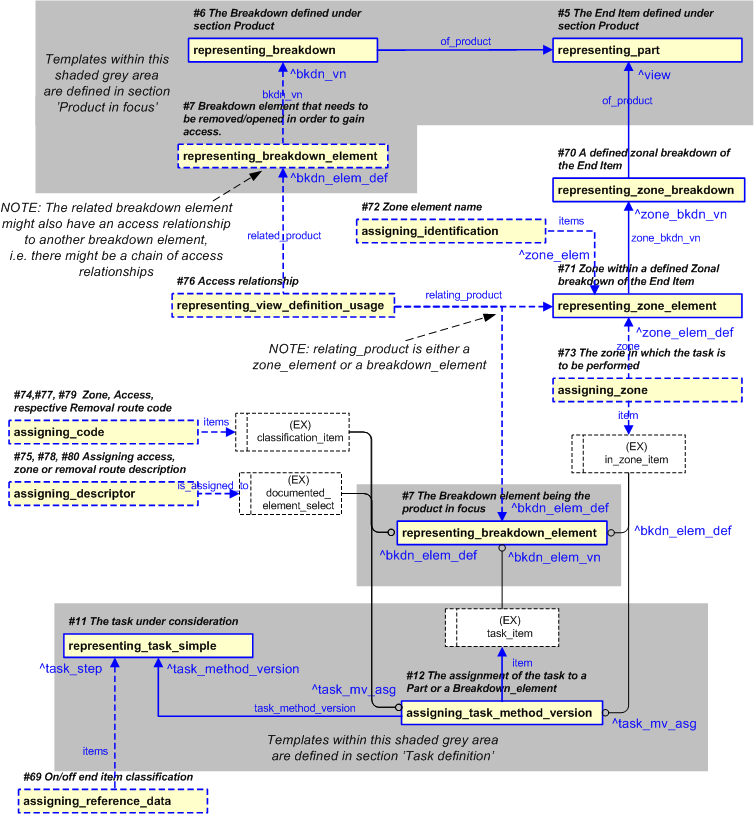
On/off end item classification
On/off end item classification is assigned to the Task_step, representing the task under consideration, using the template assigning_reference_data.
NOTE Wherever the template assigning_reference_data is being used, it can be replaced by the usage of the assigning_code template.
Template instantiation for on/off end item classification must follow the rules defined in template table: Template #69(Figure 25) below.
| Template #69 (Figure 25): assigning_reference_data | |||
|---|---|---|---|
| Description | Assigning the on/off end item classification to the task under consideration. | ||
| Parameter name: | Parameter value: | Parameter description: | |
| class_name | Subclass of "On_platform_classification" (urn:plcs:rdl:std:On_platform_classification). | The name of the class in the reference data library External_class being used to classify the task with respect to whether the task can be performed on the end item, or if the part that is being maintained needs to be removed from the end item. | |
| ecl_id | ?ecl_id? | The id of the External_class_library that stores the definition for the class being used. | |
| items | Task_step | The entity representing the task under consideration, as described in template table: Template #11(Figure 22). | |
Zone information associated with the task can be represented in the following ways:
These alternative ways of defining zone information are represented in different ways in PLCS.
Zone as an explicit zone element in a zone breakdown
The basic representation of a zone and its identification is done in accordance with the following templates:
Instantiation of the respective template must follow the rules defined in the respective template table below:
NOTE The template table: Template #5(Figure 21) is defined under Section: Breakdown element as product in focus.
Zone defined as a representing_zone_element may be assigned to either the breakdown element, or to the assignment of the task to the product in focus if the task is performed in another zone than the zone where the associated breakdown element is located.
The association between the zone and the task (or breakdown element) under consideration is represented using the assigning_zone template, where the In_zone.zone attribute is associated with the zone element, and the In_zone.item attribute is associated with either the Task_method_version_assignment representing the assignment of the task to the product in focus, or with the Breakdown_element itself.
Template instantiation for in zone assignment must follow the rules defined in template table: Template #73(Figure 25) below.
This has been raised as issue, GYL-7, against ISO 10303-239. The EXPRESS schema has been modified in DEXlib (Long form: dexlib/data/schemas/ap239_arm_lf.exp, short form: dexlib/data/schemas/ap239_arm_sf.exp). These changes will be made to ISO 10303-239 as a Technical Corrigendum at some stage.
| Template #70 (Figure 25): representing_zone_breakdown | |||
|---|---|---|---|
| Description | Representation of the zone breakdown to which the zone element belongs. | ||
| Parameter name: | Parameter value: | Parameter description: | |
| id | ?id? | The identifier of the Zone_breakdown. | |
| id_class_name | "Zone_breakdown_identification_code" (urn:plcs:rdl:std:Zone_breakdown_identification_code), "Zone_breakdown_name" (urn:plcs:rdl:std:Zone_breakdown_name) or subclass thereof. | The name of the class used to classify the identification (Identification_assignment) of the zone breakdown. This provides the role or reason for the identification. | |
| id_ecl_id | ?id_ecl_id? | The identifier of the External_class_library storing the definition of the class referenced by the parameter @id_class_name class. | |
| id_owner | ?id_owner? | The name or identifier of the organization that is responsible for naming or identifying the zonal breakdown. | |
| id_owner_class_name | "Organization_identification_code" (urn:plcs:rdl:std:Organization_identification_code), "Organization_name" (urn:plcs:rdl:std:Organization_name) or subclass thereof. | The name of the class used to classify the identification of the organization. For example, the organization might be identified using a CAGE code or using a name. | |
| id_owner_ecl_id | ?id_owner_ecl_id? | The id of the External_class_library storing the @id_owner_class_name class | |
| bkdn_type | "Zone_breakdown" (urn:plcs:rdl:std:Zone_breakdown) or subclass thereof. | The name of the class used to classify the Zone_breakdown. | |
| bkdn_type_ecl_id | ?bkdn_type_ecl_id? | The identifier of the External_class_library storing the definition of the class referenced by the parameter @bkdn_type class. | |
| vn_id | ?vn_id? | The identifier of the Zone_breakdown_version. | |
| vn_id_class_name | "Progression_identification_code" (urn:plcs:rdl:std:Progression_identification_code), or subclass thereof | The name of the class used to classify the identification (Identification_assignment) of the zonal breakdown version. This provides the role or reason for the identification. | |
| vn_id_ecl_id | ?vn_id_ecl_id? | The identifier of the External_class_library storing the definition of the class referenced by the parameter @vn_id_class_name class. | |
| vn_id_owner | ?vn_id_owner? | The name or identifier of the organization responsible for identifying the zonal breakdown version. | |
| vn_id_owner_class_name | "Organization_identification_code" (urn:plcs:rdl:std:Organization_identification_code), "Organization_name" (urn:plcs:rdl:std:Organization_name) or subclass thereof. | The name of the class used to classify the identification of the organization. For example, the organization might be identified using a CAGE code or using a name. | |
| vn_id_owner_ecl_id | ?vn_id_owner_ecl_id? | The id of the External_class_library storing the @vn_id_owner_class_name class | |
| of_product | Part_view_definition | The Part_view_definition representing the support view of the end item, as described in template table: Template #5(Figure 21). | |
NOTE Representation of version identification where the version identification is not known must follow the guidelines given in the assigning_identification template.
| Template #71 (Figure 25): representing_zone_element | |||
|---|---|---|---|
| Description | Representation of the zone element | ||
| Parameter name: | Parameter value: | Parameter description: | |
| id | ?id? | The identifier of the Zone_element. | |
| id_class_name | "Zone_element_identification_code" (urn:plcs:rdl:std:Zone_element_identification_code), "Zone_element_name" (urn:plcs:rdl:std:Zone_element_name) or subclass thereof. | The name of the class assigned to the Identification_assignment that applies to the zone element. | |
| id_ecl_id | ?id_ecl_id"? | The id of the External_class_library that stores the @id_class_name class. | |
| id_owner | ?id_owner? | The name or identifier of the organization responsible for the id or name of the zone element. | |
| id_owner_class_name | "Organization_identification_code" (urn:plcs:rdl:std:Organization_identification_code), "Organization_name" (urn:plcs:rdl:std:Organization_name) or subclass thereof. | The name of the class assigned to the Identification_assignment that applies to the the organization responsible for identifying the zone element. (e.g. "CAGE code"). | |
| id_owner_ecl_id | ?id_owner_ecl_id? | The id of the External_class_library that stores the @id_owner_class_name class. | |
| vn_id | ?vn_id? | The identifier of the Zone_element_version. | |
| vn_id_class_name | "Progression_identification_code" (urn:plcs:rdl:std:Progression_identification_code) or subclass thereof. | The name of the class assigned to the Identification_assignment that applies to the zone element version. | |
| vn_id_ecl_id | ?vn_id_ecl_id? | The identifier of the External_class_library that stores the definition of the class referenced by the parameter @vn_id_class_name class. | |
| vn_id_owner | ?vn_id_owner? | The name or identifier of the organization responsible for the identification of the zone element version. | |
| vn_id_owner_class_name | "Organization_identification_code" (urn:plcs:rdl:std:Organization_identification_code), "Organization_name" (urn:plcs:rdl:std:Organization_name) or subclass thereof. | The name of the class assigned to the Identification_assignment that applies to the the organization responsible for identifying the zone element version. (e.g. "CAGE code"). | |
| vn_id_owner_ecl_id | ?vn_id_owner_ecl_id? | The id of the External_class_library that stores the @vn_id_owner_class_name class. | |
| life_cycle_stage |
"Life_cycle_stage"
(urn:plcs:rdl:std:Life_cycle_stage) or
subclass thereof.
NOTE Breakdown element information related to Logistics Support Analysis is recommended to use the subclass "Development_stage" (urn:plcs:rdl:std:Development_stage). |
A classification of the view definition context. | |
| life_cycle_stage_ecl_id | ?life_cycle_stage_ecl_id? | The identifier of the External_class_library that stores the definition of the class referenced by the parameter @life_cycle_stage class. | |
| domain |
"Application_domain"
(urn:plcs:rdl:std:Application_domain)
or subclass thereof.
NOTE Breakdown element information related to Logistics Support Analysis is recommended to use the subclass "Product_life_cycle_support" (urn:plcs:rdl:std:Product_life_cycle_support). |
A classification of the view definition context. | |
| domain_ecl_id | ?domain_ecl_id? | The identifier of the External_class_library that stores the definition of the class referenced by the parameter @domain class. | |
| zone_bkdn_vn | Zone_breakdown_version | The Zone_breakdown_version (described in template table: Template #70(Figure 25)) of which the Zone_element is a constituent. | |
NOTE Representation of version identification where the version identification is not known must follow the guidelines given in the assigning_identification template.
Proposed characterization of the Zone_element defined within template table: Template #71(Figure 25) includes a zone element name. Zone element name is assigned using the template assigning_identification. Template instantiation for zone element name must follow the rules defined in template table: Template #72(Figure 25) below.
| Template #72 (Figure 25): assigning_identification | |||
|---|---|---|---|
| Description | Assignment of a zone element name. | ||
| Parameter name: | Parameter value: | Parameter description: | |
| id | ?id? | The name being assigned to the zone element. | |
| id_class_name | "Zone_element_name" (urn:plcs:rdl:std:Zone_element_name) or subclass thereof. | The name of the class used to classify the identifier and so provide the role or reason for the identification. | |
| id_ecl_id | ?id_ecl_id? | The id of the External_class_library storing the id_class_name class | |
| org_id | ?org_id? | The identifier of the organization that "owns" the identifier. | |
| org_id_class_name | "Organization_identification_code" (urn:plcs:rdl:std:Organization_identification_code) or "Organization_name" (urn:plcs:rdl:std:Organization_name) or subclass thereof. | The name of the class being used to classify the identification of the organization, or the organization name. For example CAGE code. | |
| org_id_ecl_id | ?org_id_ecl_id? | The id of the External_class_library storing the org_id_class_name class | |
| items | Zone_element | The Zone_element under consideration, as described in template table: Template #71(Figure 25). | |
NOTE Additional characterizations of the respective identifier may be done in accordance with what is described under Section: Optional characterization of template assigning_identification .
| Template #73 (Figure 25): assigning_zone | |||
|---|---|---|---|
| Description | Assignment of a zone element to the task assignment, or to a breakdown element, in order to define where the task is to be performed. | ||
| Parameter name: | Parameter value: | Parameter description: | |
| zone | Zone_element_definition | The zone being assigned (Zone_element_definition as described in template table: Template #71(Figure 25)). | |
| item | Task_method_version_assignment or Breakdown_element_definition | Either the entity representing the assignment of the task to the product in focus if the zone is different from the breakdown elements zonal location, or the zonal location of the breakdown element. See Task_method_version_assignment as described in template table: Template #12(Figure 22), and Breakdown_element_definition as described in template table: Template #7(Figure 21), respectively. | |
Zone defined as a code may be assigned to either the breakdown element, or to the assignment of the task to the product in focus if the task is performed in another zone than the zone where the breakdown element is located.
Template instantiation for a defined zone code must follow the rules defined in template table: Template #74(Figure 25) below.
| Template #74 (Figure 25): assigning_code | |||
|---|---|---|---|
| Description | The code that identifies the zone. | ||
| Parameter name: | Parameter value: | Parameter description: | |
| class_name | ?class_name? | The text representing the zone code. | |
| code_class_name | "Zone_element_identification_code" (urn:plcs:rdl:std:Zone_element_identification_code) or subclass thereof. | The name of the class in the reference data library (External_class) being used to determine type of code. | |
| code_ecl_id | ?code_ecl_id? | The id of the External_class_library that stores the External_class given in @code_class_name. | |
| items | Task_method_version_assignment or Breakdown_element_definition | Either the entity representing the breakdown element, or the assignment of the task to the product in focus if the zone for the performance of the task is different from the breakdown elements zonal location, i.e. the either the Task_method_version_assignment as described in template table: Template #12(Figure 22), or to the Breakdown_element_definition as described in template table: Template #7(Figure 21). | |
NOTE Additional characterizations of the respective code may be done in accordance with what is described under Section: Optional characterization of template assigning_code .
Zone provided as a description
Zone exchanged as a description may be assigned to either the breakdown element, or to the assignment of the task to the product in focus if the task is performed in another zone than the zone where the breakdown element is located.
Template instantiation for a zone description must follow the rules defined in template table: Template #75(Figure 25) below.
| Template #75 (Figure 25): assigning_descriptor | |||
|---|---|---|---|
| Description | Zone description. | ||
| Parameter name: | Parameter value: | Parameter description: | |
| descr | ?descr? | The text being assigned as the zone description. | |
| class_name | "Zone_description" (urn:plcs:rdl:std:Zone_description) or subclass thereof. | The name of the class (External_class) being used to determine type of descriptor. | |
| ecl_id | ?ecl_id? | The id of the External_class_library that stores the class. | |
| is_assigned_to | Task_method_version_assignment or Breakdown_element_definition | Either the entity representing the breakdown element, or the assignment of the task to the product in focus if the zone for the performance of the task is different from the breakdown elements zonal location. See Task_method_version_assignment as described in template table: Template #12(Figure 22), and Breakdown_element_definition as described in template table: Template #7(Figure 21), respectively. | |
NOTE Additional characterizations of the respective description may be done in accordance with what is described under Section: Optional characterization of template assigning_descriptor .
List of access points which needs to be removed/opened in order to perform the task can be represented in the following ways:
These alternative ways of defining access are represented in different ways in PLCS.
Access via a breakdown element
The first alternative for representing access is through an association between the product in focus and the breakdown element representing the item that needs to be opened or removed. This is represented as:
The relationship between the Breakdown_element that needs to be opened/removed in order to gain access, and the Breakdown_element_definition / Zone_element_definition representing the item/zone to be accessed, is represented as a View_definition_usage.
NOTE Access relationships might also be defined for the Breakdown_element that needs to opened/removed.
Template instantiation for the item that needs to be opened/removed must follow the rules defined in template table: Template #7(Figure 21) in Section: Breakdown element as product in focus.
Template instantiation for the access relationship must follow the rules defined in template table: Template #76(Figure 25) below.
| Template #76 (Figure 25): representing_view_definition_usage | |||
|---|---|---|---|
| Description | Access relationship between two Breakdown Elements | ||
| Parameter name: | Parameter value: | Parameter description: | |
| relating_product | Breakdown_element_definition or Zone_element_definition | The breakdown element or zone element that is to be accessed, as described in template table: Template #7(Figure 21) and template table: Template #71(Figure 25) respectively. | |
| related_product | Breakdown_element_definition | The Breakdown Element that needs to be opened/removed in order to gain access, as described in template table: Template #7(Figure 21). | |
| class_name | "Access_relationship" (urn:plcs:rdl:std:Access_relationship) or subclass thereof. | The name of the External_class that determines the role of the relationship between the relating_product and the related_product. | |
| class_ecl_id | ?class_ecl_id? | The identification of the External_class_library storing the External_class given by the input parameter @class_name. | |
Access defined as a code may be assigned to either the breakdown element, or to the assignment of the task to the product in focus if the task is performed in requires access to another zone than the zone where the breakdown element is located.
Template instantiation for a defined access code must follow the rules defined in template table: Template #77(Figure 25) below.
| Template #77 (Figure 25): assigning_code | |||
|---|---|---|---|
| Description | The code that identifies the access point. | ||
| Parameter name: | Parameter value: | Parameter description: | |
| class_name | ?class_name? | The text representing the access code. | |
| code_class_name | "Access_point_identification_code" (urn:plcs:rdl:std:Access_point_identification_code) or subclass thereof. | The name of the class in the reference data library (External_class) being used to determine type of code. | |
| code_ecl_id | ?code_ecl_id? | The id of the External_class_library that stores the External_class given in @code_class_name. | |
| items | Task_method_version_assignment or Breakdown_element_definition | Either the entity representing the breakdown element, or the assignment of the task to the product in focus if the access for the performance of the task is different from the access to the breakdown element. See Breakdown_element_definition as described in template table: Template #7(Figure 21), and Task_method_version_assignment as described in template table: Template #12(Figure 22), respectively. | |
NOTE Additional characterizations of the respective code may be done in accordance with what is described under Section: Optional characterization of template assigning_code .
Access provided as a description
Access exchanged as a description may be assigned to either the breakdown element, or to the assignment of the task to the product in focus if the task requires access to another zone than the zone where the breakdown element is located.
Template instantiation for access description must follow the rules defined in template table: Template #78(Figure 25) below.
| Template #78 (Figure 23): assigning_descriptor | |||
|---|---|---|---|
| Description | Access description. | ||
| Parameter name: | Parameter value: | Parameter description: | |
| descr | ?descr? | The text being assigned as the access description. | |
| class_name | "Access_description" (urn:plcs:rdl:std:Access_description) or subclass thereof. | The name of the class (External_class) being used to determine type of descriptor. | |
| ecl_id | ?ecl_id? | The id of the External_class_library that stores the class. | |
| is_assigned_to | Task_method_version_assignment or Breakdown_element_definition | Either the entity representing the breakdown element, or the assignment of the task to the product in focus if the performance of the task requires access to a different location than the location of the product in focus. See Breakdown_element_definition as described in template table: Template #7(Figure 21), and Task_method_version_assignment as described in template table: Template #12(Figure 22), respectively. | |
NOTE Additional characterizations of the respective description may be done in accordance with what is described under Section: Optional characterization of template assigning_descriptor .
Access provided as a task step
Access may be defined as a set of task steps (subtasks) that needs to be performed prior to the core task step.
NOTE Structured tasks are described under Section: Structured task below.
Removal routes for a breakdown element can be represented in the following ways:
These alternative ways of defining removal routes are represented in different ways in PLCS.
Removal route defined as a code
Removal route defined as a code is assigned to the breakdown element.
Template instantiation for a defined removal route code must follow the rules defined in template table: Template #79(Figure 25) below.
| Template #79 (Figure 25): assigning_code | |||
|---|---|---|---|
| Description | The code that identifies the removal route. | ||
| Parameter name: | Parameter value: | Parameter description: | |
| class_name | ?class_name? | The text representing the removal route code. | |
| code_class_name | "Removal_route_identification_code" (urn:plcs:rdl:std:Removal_route_identification_code) or subclass thereof. | The name of the class in the reference data library (External_class) being used to determine type of code. | |
| code_ecl_id | ?code_ecl_id? | The id of the External_class_library that stores the External_class given in @code_class_name. | |
| items | Breakdown_element_definition | The entity representing the breakdown element that is to be removed (described in template table: Template #7(Figure 21)). | |
NOTE Additional characterizations of the respective code may be done in accordance with what is described under Section: Optional characterization of template assigning_code .
Removal route provided as a description
Removal route information exchanged as a description is assigned to the breakdown element.
Template instantiation for removal route description must follow the rules defined in template table: Template #80(Figure 25) below.
| Template #80 (Figure 23): assigning_descriptor | |||
|---|---|---|---|
| Description | Removal route description. | ||
| Parameter name: | Parameter value: | Parameter description: | |
| descr | ?descr? | The text being assigned as the removal route description. | |
| class_name | "Removal_route_description" (urn:plcs:rdl:std:Removal_route_description) or subclass thereof. | The name of the class (External_class) being used to determine type of descriptor. | |
| ecl_id | ?ecl_id? | The id of the External_class_library that stores the class. | |
| is_assigned_to | Breakdown_element_definition | The entity representing the breakdown element that requires a removal route description (described in template table: Template #7(Figure 21)). | |
NOTE Additional characterizations of the respective description may be done in accordance with what is described under Section: Optional characterization of template assigning_descriptor .
Removal provided as a task step
Removal may be defined as a set of task steps (subtasks) that needs to be performed prior to the core task step.
NOTE Structured tasks are described under Section: Structured task below.
A task specification may be subdivided into task steps. This is represented as a task structure. The two basic entities in PLCS that is to be used in order to represent a task structure are:
The recommended default representation for a structured task is to use Task_element_sequence. The order of the included Task_steps is determined by it position in Task_element_sequence.elements attribute, which is an ordered list.
The representation of a structured task using Task_element_sequence can be summarized into the following two templates:
NOTE The main difference between using representing_task_simple as described in the sections above, and using representing_structured_task_sequential is that the later requires at least two Task_steps.
The characterizations of a structured task follows the same principles as has been described in the sections above, i.e. the same set of templates and template instantiations are to be used as has been described under the following sections:
NOTE Templates assigned to representing_task_simple reference parameters ^task_method and ^task_method_version for a simple task, shall be assigned to representing_structured_task_sequential reference parameters ^task and ^task_vn for a structured task.
NOTE Templates assigned to representing_task_simple reference parameter ^task_step for a simple task, shall be assigned to representing_task_step reference parameter ^task_step for a structured task.
A structured task may include the following information in addition to the information being defined for a simple task:
NOTE Detailed information requirements for a structured task are defined in Section: Information requirements - Structured task.
The PLCS representation for task structure is described in Figure 26
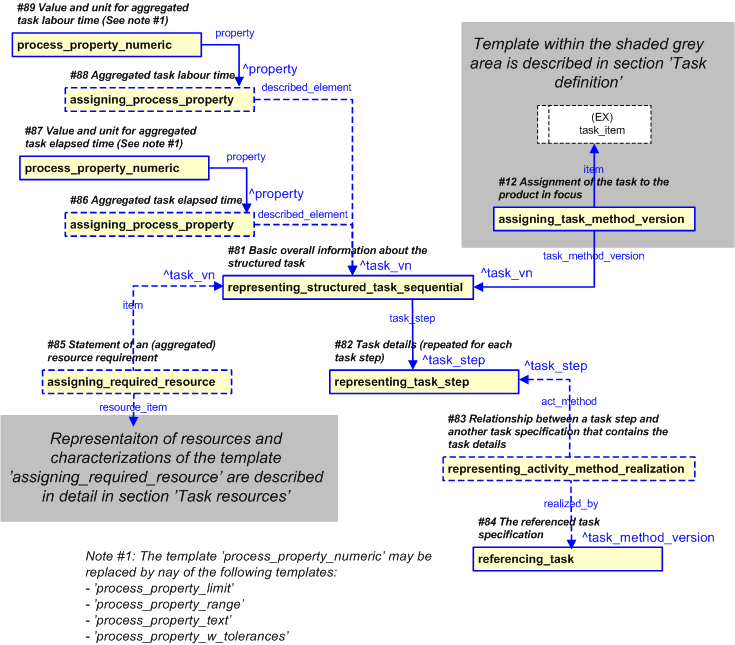
Task step identification and categorization
Basic overall representation for structured task and its identification is done in accordance with the template representing_structured_task_sequential. A structured sequential task in PLCS is represented by the usage of the following entities:
Template instantiation for a sequential task must follow the rules defined in the template table: Template #81(Figure 26) below.
Representation of each task step is done in accordance with the template representing_task_step. A task step in PLCS is represented by the usage of:
Template instantiation for a Task step must follow the rules defined in the template table: Template #82(Figure 26) below.
| Template #81 (Figure 26): representing_structured_task_sequential | |||
|---|---|---|---|
| Description | Basic overall representation of a structured task containing a set of sequential task steps. | ||
| Parameter name: | Parameter value: | Parameter description: | |
| task_id | ?task_id? | The task identifier, e.g. the task number. | |
| task_id_class_name | "Task_method_identification_code" (urn:plcs:rdl:std:Task_method_identification_code) or subclass thereof. | The name of the class being used to classify the identifier being assigned to the task (i.e. the @task_id) | |
| task_id_ecl_id | ?task_id_ecl_id? | The identifier of the External_class_library storing the definition of the class referenced by the parameter @task_id_class_name. | |
| task_org_id | ?task_org_id? | The name or identifier of the Organization that owns the @task_id. | |
| task_org_id_class_name | "Organization_identification_code" (urn:plcs:rdl:std:Organization_identification_code), "Organization_name" (urn:plcs:rdl:std:Organization_name), or subclass thereof. | The name of the class being used to classify the identification of the Organization responsible for creating the @task_id. | |
| task_org_id_ecl_id | ?task_org_id_ecl_id? | The identifier of the External_class_library storing the definition of the class referenced by the parameter @task_org_id_class_name. | |
| task_ver_id | ?task_ver_id? | The task version identifier, for example, the sequence number of the version. | |
| task_ver_id_class_name | "Progression_identification_code" (urn:plcs:rdl:std:Progression_identification_code) or subclass thereof. | The name of the class being used to classify the task version identifier (@tesk_ver_id) assigned to Task_method_version. | |
| task_ver_id_ecl_id | ?task_ver_id_ecl_id? | The identifier of the External_class_library storing the definition of the class referenced by the parameter @task_ver_id_class_name. | |
| task_ver_org_id | ?task_ver_org_id? | The name or identifier of the organization that owns the task version identifier. | |
| task_ver_org_id_class_name | "Organization_identification_code" (urn:plcs:rdl:std:Organization_identification_code), "Organization_name" (urn:plcs:rdl:std:Organization_name), or subclass thereof. | The name of the class being used to classify the identification of the Organization responsible for creating the @task_ver_id. | |
| task_ver_org_id_ecl_id | ?task_ver_org_id_ecl_id? | The identifier of the External_class_library storing the definition of the class referenced by the parameter @task_ver_org_id_class_name. | |
| task_name | ?task_name? | The task name. | |
| task_name_class_name | "Task_method_name" (urn:plcs:rdl:std:Task_method_name) or subclass thereof. | The name of the class being used to classify the task name assigned to Task_method. | |
| task_name_ecl_id | ?task_name_ecl_id? | The identifier of the External_class_library storing the definition of the class referenced by the parameter @task_name_class_name. | |
| task_name_org_id | ?task_name_org_id? | The name or identifier of the organization that owns the task name. | |
| task_name_org_id_class_name | "Organization_identification_code" (urn:plcs:rdl:std:Organization_identification_code), "Organization_name" (urn:plcs:rdl:std:Organization_name), or subclass thereof. | The name of the class being used to classify the identification of the Organization responsible for creating the @task_name. | |
| task_name_org_id_ecl_id | ?task_name_org_id_ecl_id? | The identifier of the External_class_library storing the definition of the class referenced by the parameter @task_name_org_id_class_name. | |
| task_step | Task_step | The detailed description of how to perform the task, as described in template table: Template #82(Figure 26) | |
NOTE Representation of version identification where the version identification is not known must follow the guidelines given in the assigning_identification template.
| Template #82 (Figure 26): representing_task_step | |||
|---|---|---|---|
| Description | A task step within the structured task. | ||
| Parameter name: | Parameter value: | Parameter description: | |
| task_step_id | ?task_step_id? | The task step identifier, e.g. the task step number. | |
| task_step_id_class_name | "Task_step_identification_code" (urn:plcs:rdl:std:Task_step_identification_code) or subclass thereof. | The name of the class being used to classify the task step identifier (i.e. the @task_step_id) | |
| task_step_id_ecl_id | ?task_step_id_ecl_id? | The identifier of the External_class_library storing the definition of the class referenced by the parameter @task_step_id_class_name. | |
| task_step_org_id | ?task_step_org_id? | The name or identifier of the Organization that owns the @task_step_id. | |
| task_step_org_id_class_name | "Organization_identification_code" (urn:plcs:rdl:std:Organization_identification_code), "Organization_name" (urn:plcs:rdl:std:Organization_name), or subclass thereof. | The name of the class being used to classify the identification of the Organization responsible for creating the @task_step_id. | |
| task_step_org_id_ecl_id | ?task_step_org_id_ecl_id? | The identifier of the External_class_library storing the definition of the class referenced by the parameter @task_step_org_id_class_name. | |
| task_step_category | Subclass of "Task_categorization" (urn:plcs:rdl:std:Task_categorization). | Categorization of the task step. | |
| task_step_category_ecl_id | ?task_step_category_ecl_id? | The identifier of the External_class_library storing the definition of the class referenced by the parameter @task_step_category. | |
| task_step_details | ?task_step_details? | Detailed description of how the to perform the task step. | |
EXAMPLE An example of categorizing task steps in a task structure is precondition-, core-, and post condition task steps. Each of those task steps may in turn refer to other task specifications. This is illustrated in Figure 15 under Section: Information requirements - Task structure.
Representation of a reference from a task step to another task specification which contains the details for the task step, is done in accordance with the template representing_activity_method_realization. The referenced task is represented in accordance with the template referencing_task
Template instantiation for the task step realization and the referenced task must follow the rules defined in the template table: Template #83(Figure 26) and template table: Template #84(Figure 26) below.
NOTE Within this DEX, nested task structures, i.e. task steps within a task step, requires that each nested level is defined as separate tasks.
| Template #83 (Figure 26): representing_activity_method_realization | |||
|---|---|---|---|
| Description | Reference from a task step to another task specification that contains the details for the task step. | ||
| Parameter name: | Parameter value: | Parameter description: | |
| act_method | Task_step | The Task_step for which further specification is provided. | |
| realized_by | Task_method_version | The referenced task (Task_method_version) that contains the details for the Task_step. | |
| class_name | "Activity_method_realization" (urn:plcs:rdl:std:Activity_method_realization) or subclass thereof. | "Activity_method_realization" (urn:plcs:rdl:std:Activity_method_realization), or subclass thereof, used to determine the role of the realization relationship. | |
| ecl_id | ?ecl_id? | The identifier of the External_class_library storing the definition of the class referenced by the parameter @class_name. | |
| Template #84 (Figure 26): referencing_task | |||
|---|---|---|---|
| Description | Identification of the referenced task specification. | ||
| Parameter name: | Parameter value: | Parameter description: | |
| task_id | ?task_id? | The task identifier, e.g. the task number. | |
| task_id_class_name | "Task_method_identification_code" (urn:plcs:rdl:std:Task_method_identification_code) or subclass thereof. | The class which specifies the role of the Identification_assignment as an identifier for the Task_method. | |
| task_ecl_id | ?task_ecl_id? | The identifier of the External_class_library storing the definition of the class referenced by the parameter @task_id_class_name. | |
| task_org_id | ?task_org_id? | The name or identifier of the Organization that owns the task id. | |
| task_org_id_class_name | "Organization_identification_code" (urn:plcs:rdl:std:Organization_identification_code), "Organization_name" (urn:plcs:rdl:std:Organization_name), or subclass thereof. | The class which specifies the role of the (Identification_assignment) as the identifier or name of the Organization responsible for creating the task specification | |
| task_org_id_ecl_id | ?task_org_id_ecl_id? | The identifier of the External_class_library storing the definition of the class referenced by the parameter @task_org_id_class_name. | |
| task_ver_id | ?task_ver_id? | The task version identifier, for example, the sequence number of the version. | |
| task_ver_id_class_name | "Progression_identification_code" (urn:plcs:rdl:std:Progression_identification_code) or subclass thereof. | The class which specifies the role of the Identification_assignment as a version identifier for the Task_method_version. | |
| task_ver_ecl_id | ?task_ver_ecl_id? | The identifier of the External_class_library storing the definition of the class referenced by the parameter @task_ver_id_class_name. | |
| task_ver_org_id | ?task_ver_org_id? | The name or identifier of the organization that owns the task version identifier. | |
| task_ver_org_id_class_name | "Organization_identification_code" (urn:plcs:rdl:std:Organization_identification_code), "Organization_name" (urn:plcs:rdl:std:Organization_name), or subclass thereof. | The class which specifies the role of the (Identification_assignment) as the identifier or name of the Organization responsible for creating the task specification version. | |
| task_ver_org_id_ecl_id | ?task_ver_org_id_ecl_id? | The identifier of the External_class_library storing the definition of the class referenced by the parameter @task_ver_org_id_class_name. | |
NOTE Representation of version identification where the version identification is not known must follow the guidelines given in the assigning_identification template.
Representation of aggregated resource requirements for the entire task, is done in accordance with the template assigning_required_resource.
Aggregated resource requirement for a structured task is assigned to the task, i.e. the Task_method_version entity.
Template instantiation for aggregated resource requirements must follow the principles defined for template table: Template #85(Figure 26). Detailed information associated with the aggregated resource requirement must follow the same templates and principles as has been defined in Section: Task resources.
| Template #85 (Figure 26): assigning_required_resource | |||
|---|---|---|---|
| Description | Assignment of aggregated resource requirement to the task under consideration. | ||
| Parameter name: | Parameter value: | Parameter description: | |
| item | Task_method_version | The task under consideration, as described in template table: Template #81(Figure 26). | |
| resource_item | Resource_item | The resource item that plays the role of a required resource | |
| class_name | "Required_resource" (urn:plcs:rdl:std:Required_resource) or subclass thereof | The name of the External_class that determines the role of the required resource given by the input parameter @resource_item. | |
| ecl_id | ?ecl_id? | The identification of the External_class_library storing the External_class given by the input parameter @class_name. | |
The only difference between aggregated resource requirements and the resource requirements defined under Section: Task resources is that aggregated resource requirements are assigned to the Task_method_version instead of to the Task_step
Task aggregated elapsed time for a complete structured task is assigned to the task, i.e. the Task_method_version entity.
Representation of task aggregated elapsed time is represented as a property being assigned to the Task_method_version entity, using the assigning_process_property and process_property_numeric templates. Template instantiation for the aggregated task elapsed time must follow the rules defined in template table: Template #86(Figure 26) and template table: Template #87(Figure 26) below.
| Template #86 (Figure 26): assigning_process_property | |||
|---|---|---|---|
| Description | Definition of the aggregated elapsed time property for the task. | ||
| Parameter name: | Parameter value: | Parameter description: | |
| property_class_name | "Aggregated_activity_planned_duration" (urn:plcs:rdl:std:Aggregated_activity_planned_duration) or subclass thereof. | The class name of the External_class corresponding to the property name. | |
| property_ecl_id | ?property_ecl_id? | The identifier of the External_class_library storing the definition of the class referenced by the parameter @property_class_name. | |
| described_element | Task_method_version | The Task_method_version described in template table: Template #81(Figure 26). | |
| Template #87 (Figure 26): process_property_numeric | |||
|---|---|---|---|
| Description | Value of the aggregated elapsed time property for the task. | ||
| Parameter name: | Parameter value: | Parameter description: | |
| value | ?value? | The value of the property. The datatype is always 'any_number_value' and should not be registered together with the value, i.e. enter the value as a number, without datatype. | |
| unit | "Second" (urn:plcs:rdl:std:Second), "Minute" (urn:plcs:rdl:std:Minute), "Hour" (urn:plcs:rdl:std:Hour), or "Day" (urn:plcs:rdl:std:Day) | The class name of the unit in which the value is expressed. | |
| unit_ecl_id | "urn:plcs:rdl:std" | The identifier of the External_class_library storing the definition of the class referenced by the parameter @unit. | |
| si_unit | 'true' or 'false' |
TRUE if unit is defined as "Second" (urn:plcs:rdl:std:Second), otherwise FALSE. If Part 11 STEP file, true is represented by the string '.T.' and false '.F.', while in Part 28 (XML) they are represented by text strings 'true' and 'false'. |
|
| context | Subclass of "Representation_context" (urn:plcs:rdl:std:Representation_context) | The name of the class being used to classify the representation context (Numerical_representation_context) of the property. | |
| context_ecl_id | ?context_ecl_id? | The identifier of the External_class_library storing the definition of the class referenced by the parameter @context. | |
| property | Activity_property | The Activity_property instantiated in template table: Template #86(Figure 26) representing the property 'Aggregated elapsed time'. | |
NOTE Additional characterizations of the respective template used for representing the aggregated elapsed time property and its value, may be done in accordance with what is described under Section: Optional characterization of templates for property representation .
NOTE The usage of the template process_property_numeric may be replaced by the usage of either of:
Task aggregated labour time for a complete structured task is assigned to the task, i.e. the Task_method_version entity.
Representation of task aggregated labour time is represented as a property being assigned to the Task_method_version entity, using the assigning_process_property and process_property_numeric templates. Template instantiation for the aggregated task labour time must follow the rules defined in template table: Template #88(Figure 26) and template table: Template #89(Figure 26) below.
| Template #88 (Figure 26): assigning_process_property | |||
|---|---|---|---|
| Description | Definition of the aggregated labour time property for the task. | ||
| Parameter name: | Parameter value: | Parameter description: | |
| property_class_name | "Aggregated_labour_time_planned" (urn:plcs:rdl:std:Aggregated_labour_time_planned) or subclass thereof. | The class name of the External_class corresponding to the property name. | |
| property_ecl_id | ?property_ecl_id? | The identifier of the External_class_library storing the definition of the class referenced by the parameter @property_class_name. | |
| described_element | Task_method_version | The Task_method_version described in template table: Template #81(Figure 26). | |
| Template #89 (Figure 26): process_property_numeric | |||
|---|---|---|---|
| Description | Value of the aggregated labour time property for the task. | ||
| Parameter name: | Parameter value: | Parameter description: | |
| value | ?value? | The value of the property. The datatype is always 'any_number_value' and should not be registered together with the value, i.e. enter the value as a number, without datatype. | |
| unit | "Man_minute" (urn:plcs:rdl:std:Man_minute), "Man_hour" (urn:plcs:rdl:std:Man_hour), or "Man_day" (urn:plcs:rdl:std:Man_day) | The class name of the unit in which the value is expressed. | |
| unit_ecl_id | "urn:plcs:rdl:std" | The identifier of the External_class_library storing the definition of the class referenced by the parameter @unit. | |
| si_unit | 'false' |
If Part 11 STEP file, true is represented by the string '.T.' and false '.F.', while in Part 28 (XML) they are represented by text strings 'true' and 'false'. |
|
| context | Subclass of "Representation_context" (urn:plcs:rdl:std:Representation_context) | The name of the class being used to classify the representation context (Numerical_representation_context) of the property. | |
| context_ecl_id | ?context_ecl_id? | The identifier of the External_class_library storing the definition of the class referenced by the parameter @context. | |
| property | Activity_property | The Activity_property instantiated in template table: Template #88(Figure 26) representing the property 'Aggregated labour time'. | |
NOTE Additional characterizations of the respective template used for representing the aggregated labour time property and its value, may be done in accordance with what is described under Section: Optional characterization of templates for property representation .
NOTE The usage of the template process_property_numeric may be replaced by the usage of either of:
Task effectivities (applicabilities) supported by this DEX are:
Dated effectivities from a task perspective can be assigned to:
This has been raised as issue, GYL-10, against ISO 10303-239. The EXPRESS schema has been modified in DEXlib (Long form: dexlib/data/schemas/ap239_arm_lf.exp, short form: dexlib/data/schemas/ap239_arm_sf.exp). These changes will be made to ISO 10303-239 as a Technical Corrigendum at some stage.
The PLCS representation for task dated effectivity Figure 27
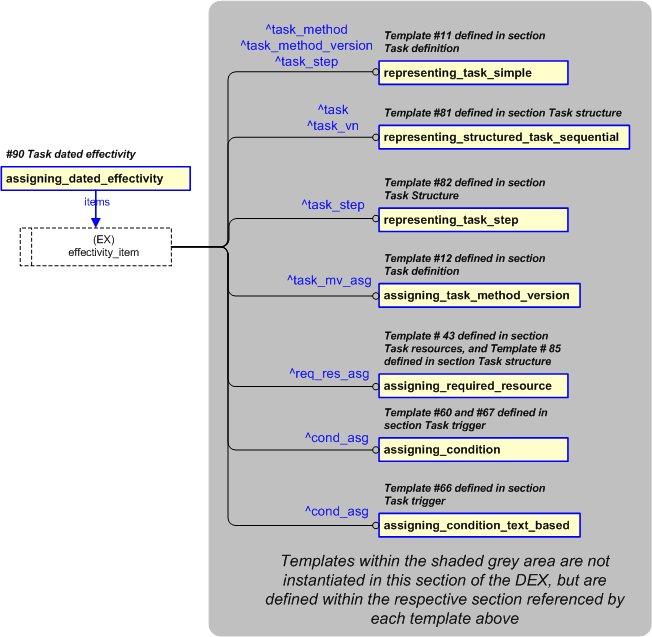
Template instantiation of a dated effectivity must follow the rules defined in template table: Template #90(Figure 27) below.
| Template #90 (Figure 27): assigning_dated_effectivity | |||
|---|---|---|---|
| Description | Dated effectivity assigned to a Task or portions thereof. | ||
| Parameter name: | Parameter value: | Parameter description: | |
| start_year | ?start_year? | Calendar_date year_component of the effectivity start date and time. | |
| start_month | ?start_month? | Calendar_date month_component of the effectivity start date and time. | |
| start_day | ?start_day? | Calendar_date day_component of the effectivity start date and time. | |
| start_hour | ?start_hour? | Local_time hour_component of the effectivity start date and time. | |
| start_minute | ?start_minute? | Local_time minute_component of the effectivity start date and time. This parameter is optional. If not given, it will remain unset. | |
| start_second | ?start_second? | Local_time day_component of the effectivity start date and time. This parameter is optional. If not given, it will remain unset. | |
| start_sense | ?start_sense? | The direction of the offset. Enumeration values: 'ahead', 'exact' or 'behind'. | |
| start_hour_offset | ?start_hour_offset? | The number of hours by which a time is offset from Coordinated Universal Time. | |
| start_minute_offset | ?start_minute_offset? | The number of minutes by which a time is offset from Coordinated Universal Time. The value of this attribute need not be specified. This parameter is optional. If not given, it will remain unset. | |
| end_year | ?end_year? | Calendar_date year_component of the effectivity end date and time. This parameter is optional. If not given, it will remain unset. | |
| end_month | ?end_month? | Calendar_date month_component of the effectivity end date and time. This parameter is optional. If not given, it will remain unset. | |
| end_day | ?end_day? | Calendar_date day_component of the effectivity end date and time. This parameter is optional. If not given, it will remain unset. | |
| end_hour | ?end_hour? | Local_time hour_component of the effectivity end date and time. This parameter is optional. If not given, it will remain unset. | |
| end_minute | ?end_minute? | Local_time minute_component of the effectivity end date and time. This parameter is optional. If not given, it will remain unset. | |
| end_second | ?end_second? | Local_time second_component of the effectivity end date and time. This parameter is optional. If not given, it will remain unset. | |
| end_sense | ?end_sense? | The direction of the offset. Enumeration values: 'ahead', 'exact' or 'behind'. | |
| end_hour_offset | ?end_hour_offset? | The number of hours by which a time is offset from Coordinated Universal Time. | |
| end_minute_offset | ?end_minute_offset? | The number of minutes by which a time is offset from Coordinated Universal Time. The value of this attribute need not be specified. This parameter is optional. If not given, it will remain unset. | |
| role_class_name | "Dated_effectivity" (urn:plcs:rdl:std:Dated_effectivity) or subclass thereof | The name of the class being used to classify the effectivity assignment (Effectivity_assignment) This provides the role for the assignment. | |
| role_ecl_id | ?role_ecl_id? | The identifier of the External_class_library storing the definition of the class referenced by the parameter @role_class_name class. | |
| items | Task_method, Task_method_version, Task_step, Task_method_version_assignment, Required_resource_assignment or Condition_assignment | The items to which the effectivity is assigned, e.g. an identification_assignment, a next_assembly_usage, etc. | |
The representation of effectivity statements where the effectivity domain is expressed as a condition, e.g. 'Arctic conditions', 'After modification' etc is done using the assigning_conditional_effectivity template.
Conditional effectivity (applicability) may be assigned to:
The PLCS representation for each of those items are described in detail in the previous sections. Use of conditional effectivities shall be assigned as follows (a summary is given in Figure 28):
NOTE Representation of task condition-based effectivities that requires advanced logical expressions in terms of e.g. AND/OR/XOR conditions are described in Section: Task compound conditions representation below.
NOTE Conditional effectivity may also be used in combination with other valid process property value representations i.e. limit, range, text and tolerances;
NOTE Conditional effectivity may also be used in combination with other valid process property value representations i.e. limit, range, text and tolerances;
NOTE Also defined in template table: Template #11(Figure 22) but not accessible as a template reference parameter;
NOTE Conditional effectivity may also be used in combination with other valid resource property value representations i.e. limit, range, text and tolerances;
This has been raised as issue, GYL-9, against ISO 10303-239. The EXPRESS schema has been modified in DEXlib (Long form: dexlib/data/schemas/ap239_arm_lf.exp, short form: dexlib/data/schemas/ap239_arm_sf.exp). These changes will be made to ISO 10303-239 as a Technical Corrigendum at some stage.
This has been raised as issue, GYL-10, against ISO 10303-239. The EXPRESS schema has been modified in DEXlib (Long form: dexlib/data/schemas/ap239_arm_lf.exp, short form: dexlib/data/schemas/ap239_arm_sf.exp). These changes will be made to ISO 10303-239 as a Technical Corrigendum at some stage.
This has been raised as issue, GYL-11, against ISO 10303-239. The EXPRESS schema has been modified in DEXlib (Long form: dexlib/data/schemas/ap239_arm_lf.exp, short form: dexlib/data/schemas/ap239_arm_sf.exp). These changes will be made to ISO 10303-239 as a Technical Corrigendum at some stage.
This has been raised as issue, GYL-12, against ISO 10303-239. The EXPRESS schema has been modified in DEXlib (Long form: dexlib/data/schemas/ap239_arm_lf.exp, short form: dexlib/data/schemas/ap239_arm_sf.exp). These changes will be made to ISO 10303-239 as a Technical Corrigendum at some stage.
This has been raised as issue, GYL-13, against ISO 10303-239. The EXPRESS schema has been modified in DEXlib (Long form: dexlib/data/schemas/ap239_arm_lf.exp, short form: dexlib/data/schemas/ap239_arm_sf.exp). These changes will be made to ISO 10303-239 as a Technical Corrigendum at some stage.
The PLCS representation for the assignment of task conditional effectivity is shown in Figure 28 below.
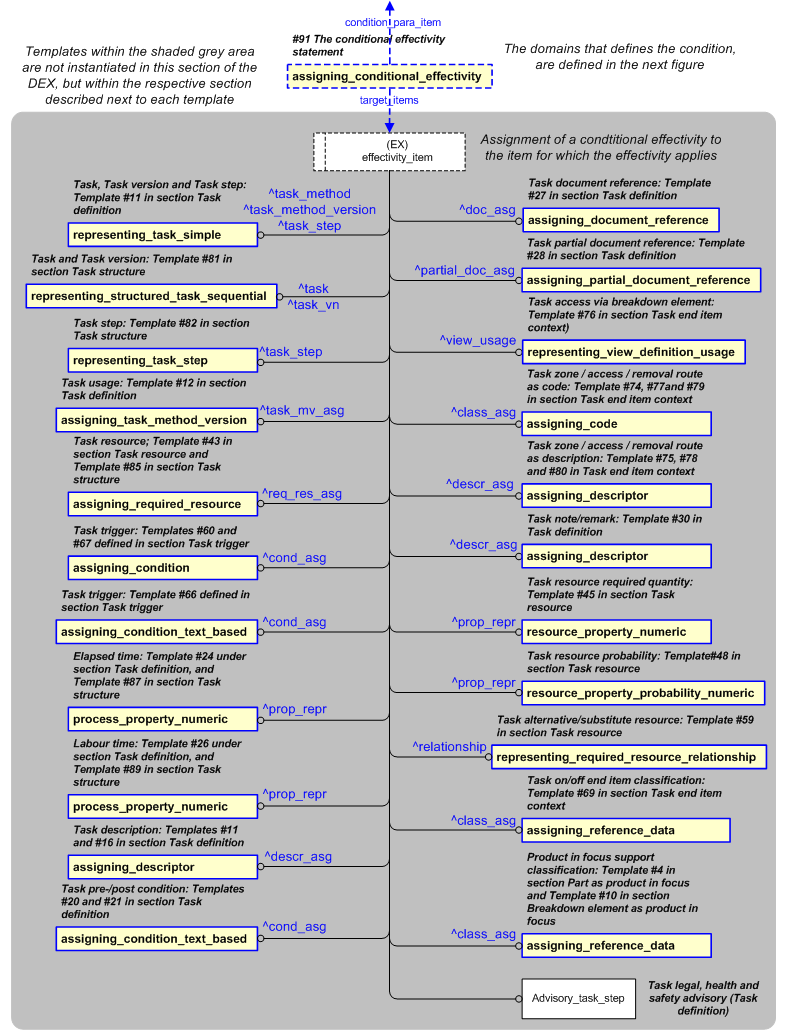
The condition under which something is effective may be expressed in terms of:
NOTE Detailed information requirements for task effectivity condition parameters, are defined in Section: Information requirements - Task effectivity/applicability.
The PLCS representation for task effectivity condition parameters are shown in Figure 29
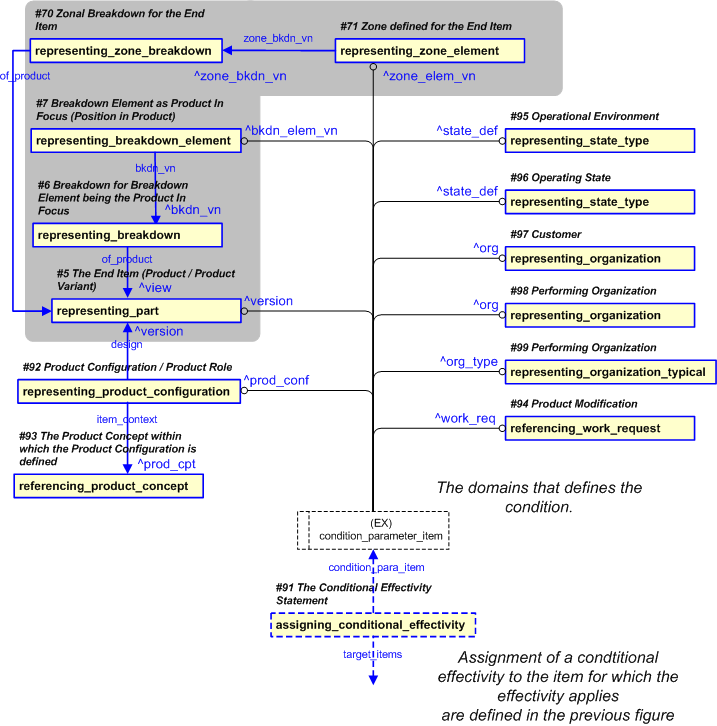
Template instantiation of a conditional effectivity must follow the rules defined in template table: Template #91(Figure 28) below.
Template instantiation for condition parameters are described in the next subsections.
This has been raised as issue, GYL-14, against ISO 10303-239. The EXPRESS schema has been modified in DEXlib (Long form: dexlib/data/schemas/ap239_arm_lf.exp, short form: dexlib/data/schemas/ap239_arm_sf.exp). These changes will be made to ISO 10303-239 as a Technical Corrigendum at some stage.
This has been raised as issue, GYL-15, against ISO 10303-239. The EXPRESS schema has been modified in DEXlib (Long form: dexlib/data/schemas/ap239_arm_lf.exp, short form: dexlib/data/schemas/ap239_arm_sf.exp). These changes will be made to ISO 10303-239 as a Technical Corrigendum at some stage.
This has been raised as issue, GYL-17, against ISO 10303-239. The EXPRESS schema has been modified in DEXlib (Long form: dexlib/data/schemas/ap239_arm_lf.exp, short form: dexlib/data/schemas/ap239_arm_sf.exp). These changes will be made to ISO 10303-239 as a Technical Corrigendum at some stage.
This has been raised as issue, GYL-20, against ISO 10303-239. The EXPRESS schema has been modified in DEXlib (Long form: dexlib/data/schemas/ap239_arm_lf.exp, short form: dexlib/data/schemas/ap239_arm_sf.exp). These changes will be made to ISO 10303-239 as a Technical Corrigendum at some stage.
Product (Product variant) end item as effectivity condition
Template instantiation for a referenced end item (product / product variant) is defined in the template table: Template #5(Figure 21).
NOTE When referring to an end item (product / product variant) as the effectivity condition, the 'para_class' input parameter for template table: Template #91(Figure 29) shall be set to "Product_condition_parameter" (urn:plcs:rdl:std:Product_condition_parameter) or "Product_variant_condition_parameter" (urn:plcs:rdl:std:Product_variant_condition_parameter) respectively.
Product configuration (Product role) as effectivity condition
Basic representation of a reference to a product configuration (incl. product role) as the effectivity condition is done in accordance with the templates:
NOTE All three templates are required in order to uniquely identify a product configuration.
NOTE When referring to a product configuration (incl. product role) as the effectivity condition, the 'para_class' input parameter for template table: Template #91(Figure 29) shall be set to "Product_configuration_condition_parameter" (urn:plcs:rdl:std:Product_configuration_condition_parameter).
Template instantiation for referencing a Product Configuration must follow the rules defined in the template table: Template #92(Figure 29) and template table: Template #93(Figure 29) below, together with the template table: Template #5(Figure 21) representing the end item.
| Template #92 (Figure 29): representing_product_configuration | |||
|---|---|---|---|
| Description | Identification of the Product Configuration | ||
| Parameter name: | Parameter value: | Parameter description: | |
| id | ?id? | Identification of the product configuration (Product_configuration). | |
| id_class_name | "Product_configuration_identification_code" (urn:plcs:rdl:std:Product_configuration_identification_code), "Product_configuration_name" (urn:plcs:rdl:std:Product_configuration_name) or subclass thereof. | The name of the class used to classify the product configuration identifier (@id) and to provide the role or reason for the identification. | |
| id_ecl_id | ?id_ecl_id? | The id of the External_class_library storing the @id_class_name | |
| org_id | ?org_id? | The identifier of the Organization that "owns" the product configuration identifier. | |
| org_id_class_name | "Organization_identification_code" (urn:plcs:rdl:std:Organization_identification_code) or "Organization_name" (urn:plcs:rdl:std:Organization_name) or subclass thereof. | The name of the class that determines the type of identifier being used for identifying the Organization. For example CAGE code. | |
| org_id_ecl_id | ?org_id_ecl_id? | The id of the External_class_library storing the definition of the class used to classify the organization identifier. | |
| design | Part_version | The product for which the product configuration is defined, as specified in template table: Template #5(Figure 21) | |
| item_context | Product_concept | Defines the context in which the product configuration has been defined. Described in template table: Template #93(Figure 29) | |
| Template #93 (Figure 29): referencing_product_concept | |||
|---|---|---|---|
| Description | Identification of the product concept within which the product configuration has been defined. | ||
| Parameter name: | Parameter value: | Parameter description: | |
| prod_cpt_id | ?prod_cpt_id? | The product concept within which the product configuration is defined. | |
| prod_cpt_id_class | "Product_concept_identification_code" (urn:plcs:rdl:std:Product_concept_identification_code), "Product_concept_name" (urn:plcs:rdl:std:Product_concept_name) or subclass thereof. | The name of the class used to classify the product concept identifier (@prod_cpt_id) and to provide the role or reason for the identification. | |
| prod_cpt_id_ecl_id | ?prod_cpt_id_ecl_id? | The id of the External_class_library storing the @prod_cpt_id_class | |
| prod_cpt_org_id | ?prod_cpt_org_id? | The identifier of the Organization that "owns" the product concept identifier. | |
| prod_cpt_org_id_class | "Organization_identification_code" (urn:plcs:rdl:std:Organization_identification_code) or "Organization_name" (urn:plcs:rdl:std:Organization_name) or subclass thereof. | The name of the class that determines the type of identifier being used for identifying the Organization. For example CAGE code. | |
| prod_cpt_org_id_ecl_id | ?prod_cpt_org_id_ecl_id? | The id of the External_class_library storing the definition of the class used to classify the organization identifier. | |
Product Modification as Effectivity Condition
A reference to a defined product modification is represented as a Work_request using the template referencing_work_request.
NOTE When referring to a product modification as the effectivity condition, the 'para_class' input parameter for template table: Template #91(Figure 29) shall be set to "Product_modification_condition_parameter" (urn:plcs:rdl:std:Product_modification_condition_parameter).
Template instantiation for a referenced product modification must follow the rules defined in the template table: Template #94(Figure 29) below.
| Template #94 (Figure 29): referencing_work_request | |||
|---|---|---|---|
| Description | Reference to a work request representing the defined product modification. | ||
| Parameter name: | Parameter value: | Parameter description: | |
| id | ?id? | The identifier being assigned to the Work_request representing the defined product modification | |
| id_class_name | "Work_request_identification_code" (urn:plcs:rdl:std:Work_request_identification_code), "Work_request_name" (urn:plcs:rdl:std:Work_request_name) or subclass thereof. | The name of the class used to classify the identifier and so provide the role or reason for the identification. | |
| id_ecl_id | ?id_ecl_id? | The identifier of the External_class_library storing the id_class_name class | |
| org_id | ?org_id? | The identifier of the organization that "owns" the identifier. | |
| org_id_class_name | "Organization_identification_code" (urn:plcs:rdl:std:Organization_identification_code) or "Organization_name" (urn:plcs:rdl:std:Organization_name) or subclass thereof. | The name of the class being used to classify the identification of the organization. For example CAGE code. | |
| org_id_ecl_id | ?org_id_ecl_id? | The identifier of the External_class_library storing the org_id_class_name class | |
| version_id | ?version_id? |
The version identifier being assigned to the
Work_request.
NOTE If the version is not known use /NULL. |
|
| version_id_class_name | "Progression_identification_code" (urn:plcs:rdl:std:Progression_identification_code) or subclass thereof. | The name of the class used to classify the identifier and so provide the role or reason for the identification. | |
| version_id_ecl_id | ?version_id_ecl_id? | The identifier of the External_class_library storing the class provide by the input parameter @version_id_class_name | |
| version_org_id | ?version_org_id? | The identifier of the organization that "owns" the version identifier. | |
| version_org_id_class_name | "Organization_identification_code" (urn:plcs:rdl:std:Organization_identification_code) or "Organization_name" (urn:plcs:rdl:std:Organization_name) or subclass thereof. | The name of the class being used to classify the identification of the organization that "owns" the version identifier. For example CAGE code. | |
| version_org_id_ecl_id | ?version_org_id_ecl_id? | The identifier of the External_class_library storing the class provide by the input parameter @version_org_id_class_name. | |
NOTE Representation of version identification where the version identification is not known must follow the guidelines given in the assigning_identification template.
Position in product as effectivity condition
Position in product is represented as a Breakdown_element within the product in focus, and its instantiation is defined in the template table: Template #5(Figure 21), template table: Template #6(Figure 21), and template table: Template #7(Figure 21), in Section: Breakdown element as product in focus.
NOTE When referring to a position in the product as the effectivity condition, the 'para_class' input parameter for template table: Template #91(Figure 29) shall be set to "Position_in_product_condition_parameter" (urn:plcs:rdl:std:Position_in_product_condition_parameter).
Zone in product is represented as a Zone_element within the product in focus, and its instantiation is defined in the template table: Template #5(Figure 21), template table: Template #70(Figure 25), and template table: Template #71(Figure 25) in Section: Task end item context.
NOTE When referring to a position in the product as the effectivity condition, the 'para_class' input parameter for template table: Template #91(Figure 29) shall be set to "Product_zone_condition_parameter" (urn:plcs:rdl:std:Product_zone_condition_parameter).
Operational environment as effectivity condition
Operational environment is represented as a State_definition using the template representing_state_type.
Template instantiation for operational environment must follow the rules defined in template table: Template #95(Figure 29).
NOTE When referring to operational environment as the effectivity condition, the 'para_class' input parameter for template table: Template #91(Figure 29) shall be set to "Operational_environment_condition_parameter" (urn:plcs:rdl:std:Operational_environment_condition_parameter).
| Template #95 (Figure 29): representing_state_type | |||
|---|---|---|---|
| Description | Representation of operational environment | ||
| Parameter name: | Parameter value: | Parameter description: | |
| sd_class_name | Subclass of "Environment_typical" (urn:plcs:rdl:std:Environment_typical). | The name of the class that defines the operational environment. | |
| sd_ecl_id | ?sd_ecl_id? | The id of the External_class_library storing the @sd_class_name class | |
NOTE In a data exchange the usage of reference data within template table: Template #95(Figure 29) may be replaced by the usage of codes in order to determine the operational environment (also see template assigning_code).
Operating state as effectivity condition
Operating state is represented as a State_definition using the template representing_state_type.
Template instantiation for operating state must follow the rules defined in template table: Template #96(Figure 29).
NOTE When referring to operating state as the effectivity condition, the 'para_class' input parameter for template table: Template #91(Figure 29) shall be set to "Operating_state_condition_parameter" (urn:plcs:rdl:std:Operating_state_condition_parameter).
| Template #96 (Figure 29): representing_state_type | |||
|---|---|---|---|
| Description | Representation of operating state | ||
| Parameter name: | Parameter value: | Parameter description: | |
| sd_class_name | Subclass of "Operational_state" (urn:plcs:rdl:std:Operational_state). | The name of the class that defines the operating state. | |
| sd_ecl_id | ?sd_ecl_id? | The id of the External_class_library storing the @sd_class_name class | |
NOTE In a data exchange the usage of reference data within template table: Template #96(Figure 29) may be replaced by the usage of codes in order to determine the operating state (also see template assigning_code).
Customer as effectivity condition
Customer is represented as an Organization using the template representing_organization.
Template instantiation for customer must follow the rules defined in template table: Template #97(Figure 29).
NOTE When referring to a customer as the effectivity condition, the 'para_class' input parameter for template table: Template #91(Figure 29) shall be set to "Customer_condition_parameter" (urn:plcs:rdl:std:Customer_condition_parameter).
| Template #97 (Figure 29): representing_organization | |||
|---|---|---|---|
| Description | Customer organization | ||
| Parameter name: | Parameter value: | Parameter description: | |
| org_id | ?org_id? | The identifier or name of the organization. | |
| org_id_class_name | "Organization_identification_code" (urn:plcs:rdl:std:Organization_identification_code) or "Organization_name" (urn:plcs:rdl:std:Organization_name) or subclass thereof. | The name of the class being used to classify the identification (Identification_assignment) of the organization. This provides the role or reason for the identification. For example CAGE code. | |
| org_id_ecl_id | ?org_id_ecl_id? | The identifier of the External_class_library storing the definition of the class referenced by the parameter @org_id_class_name class. | |
Performing organization as effectivity condition
Performing organization can be represented as either Organization or Organization_type. Organization is represented using the representing_organization template, and Organization_type is represented using the representing_organization_typical template.
Template instantiation for performing organization must follow the rules defined in template table: Template #98(Figure 29) for specific organization and template table: Template #99(Figure 29) for type of organization.
NOTE When referring to a performing organization as the effectivity condition, the 'para_class' input parameter for template table: Template #91(Figure 29) shall be set to "Performing_organization_condition_parameter" (urn:plcs:rdl:std:Performing_organization_condition_parameter).
| Template #98 (Figure 29): representing_organization | |||
|---|---|---|---|
| Description | A specific performing organization | ||
| Parameter name: | Parameter value: | Parameter description: | |
| org_id | ?org_id? | The identifier or name of the organization. | |
| org_id_class_name | "Organization_identification_code" (urn:plcs:rdl:std:Organization_identification_code) or "Organization_name" (urn:plcs:rdl:std:Organization_name) or subclass thereof. | The name of the class being used to classify the identification (Identification_assignment) of the organization. This provides the role or reason for the identification. For example CAGE code. | |
| org_id_ecl_id | ?org_id_ecl_id? | The identifier of the External_class_library storing the definition of the class referenced by the parameter @org_id_class_name class. | |
| Template 99 (Figure 29): representing_organization_typical | |||
|---|---|---|---|
| Description | A type of performing organization. | ||
| Parameter name: | Parameter value: | Parameter description: | |
| org_type_class_name | Subclass of "Organization_type" (urn:plcs:rdl:std:Organization_type). | The name of the External_class that determines the organization type being referenced. | |
| org_type_ecl_id | ?org_type_ecl_id? | The identification of the External_class_library storing the External_class given by the input parameter @org_type_class_name. | |
NOTE In a data exchange the usage of reference data within template table: Template #99(Figure 29) may be replaced by the usage of codes in order to determine the type of performing organization (also see template assigning_code).
Task effectivity for a single serialized item, or a block/batch of serialized items, is represented as a Serial_effectivity using the assigning_serial_effectivity template. The product for which the defined range of serialized items are valid is identified through the assigning_condition template, where the end item is identified in accordance with template table: Template #5(Figure 21).
Serial effectivities from a task perspective can be assigned to:
This has been raised as issue, GYL-10, against ISO 10303-239. The EXPRESS schema has been modified in DEXlib (Long form: dexlib/data/schemas/ap239_arm_lf.exp, short form: dexlib/data/schemas/ap239_arm_sf.exp). These changes will be made to ISO 10303-239 as a Technical Corrigendum at some stage.
The PLCS representation for task serial effectivity Figure 30
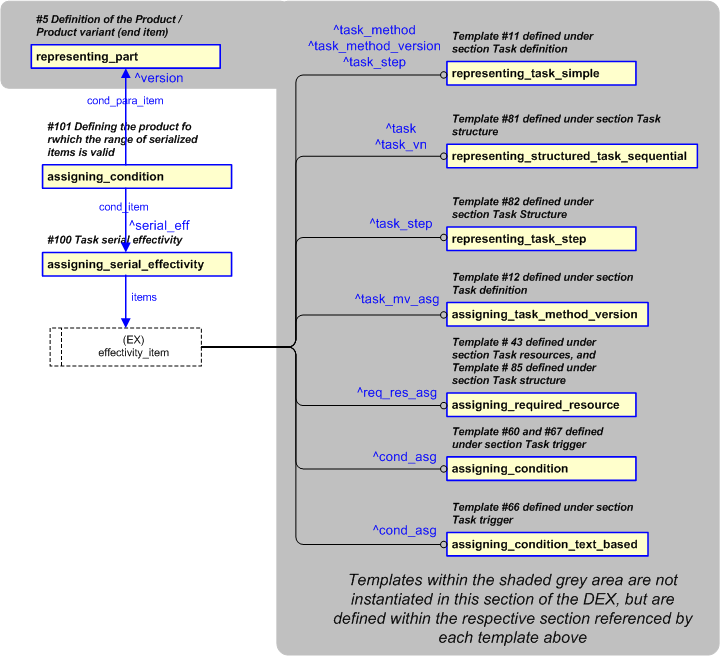
Template instantiation of a serial effectivity must follow the rules defined in template table: Template #100(Figure 30) and template table: Template #101(Figure 30) below.
| Template #100 (Figure 30): assigning_serial_effectivity | |||
|---|---|---|---|
| Description | Serial effectivity definition and assignment. | ||
| Parameter name: | Parameter value: | Parameter description: | |
| start_id | ?start_id? | Identification of the first serialized item within a range of serialized items. | |
| end_id | ?end_id? | Identification of the last serialized item within the range of serialized items. | |
| role_class_name | "Effectivity_assignment" (urn:plcs:rdl:std:Effectivity_assignment) or subclass thereof. | The name of the class being used to classify the effectivity assignment (Effectivity_assignment) This provides the role for the assignment. | |
| role_ecl_id | ?role_ecl_id? | The identifier of the External_class_library storing the definition of the class referenced by the parameter @role_class_name class. | |
| items | Task_method, Task_method_version, Task_step, Task_method_version_assignment, Required_resource_assignment or Condition_assignment | The items to which the effectivity is assigned, e.g. an identification_assignment, a next_assembly_usage, etc. | |
| Template #101 (Figure 30): assigning_condition | |||
|---|---|---|---|
| Description | End item in scope for the serial effectivity. | ||
| Parameter name: | Parameter value: | Parameter description: | |
| cond_item | Serial_effectivity | The item to which the Condition_assignment is assigned | |
| cond_asg_class | "Serial_effectivity_statement_assignment" (urn:plcs:rdl:std:Serial_effectivity_statement_assignment) or subclass thereof. | The name of the class used to classify the Condition_assignment and to provide the role or reason for the condition. | |
| cond_asg_ecl_id | ?cond_asg_ecl_id? | The identifier of the External_class_library storing the definition of the class referenced by the parameter @cond_asg_class. | |
| cond_class | "Serial_effectivity_statement" (urn:plcs:rdl:std:Serial_effectivity_statement) or subclass thereof. | Type of Condition that can be evaluated. | |
| cond_ecl_id | ?cond_ecl_id? | The identifier of the External_class_library storing the definition of the class referenced by the parameter @cond_class. | |
| cond_para_item | Part_version | The version of the end item defined in template table: Template #5(Figure 21). | |
Compound conditions are represented as Condition_relationships using the template representing_condition_relationship.
Compound conditions for task may use logical expressions such as AND, OR and XOR expressions.
Logical expressions can be used to define more advanced combinations of e.g.:
Template instantiation for condition relationship must follow the rules defined in template table: Template #102(Figure 31).
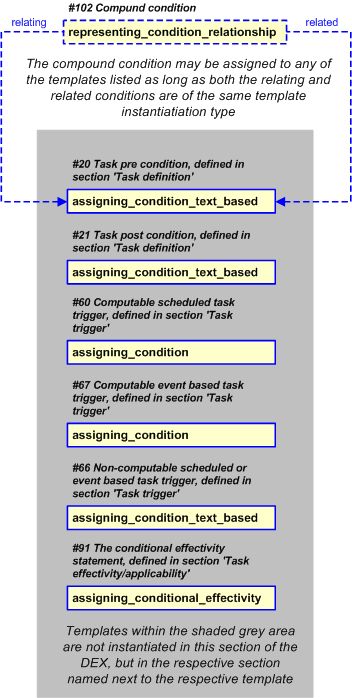
| Template #102 (Figure 31): representing_condition_relationship | |||
|---|---|---|---|
| Description | |||
| Parameter name: | Parameter value: | Parameter description: | |
| class_name | Subclass of "Logical_operator" (urn:plcs:rdl:std:Logical_operator) | The name of the External_class used to describe the role of the relationship. | |
| ecl_id | 'urn:plcs:rdl:std' | The id of the External_class_library storing the @class_name | |
| relating | Condition | The Condition entity which relates to another Condition. | |
| related | Condition | The Condition entity which is related to from another Condition. | |
NOTE AND relationships shall be evaluated prior to OR/XOR relationships.
Task specification administrative information includes:
NOTE Detailed information requirements for task administrative information is defined in Section: Information requirements - Task administrative information.
The PLCS representation for task administrative information is described in Figure 32 below.
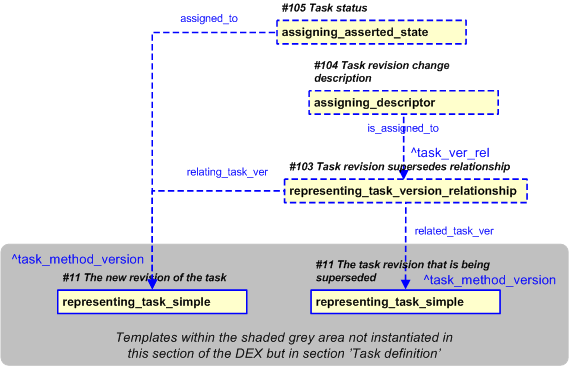
Task supersedes information is represented as a Task_method_version_relationship using the template representing_task_version_relationship.
Template instantiation for task supersedes information must follow the rules defined in template table: Template #103(Figure 32) below.
| Template #103 (Figure 32): representing_task_version_relationship | |||
|---|---|---|---|
| Description | Task supersedes relationship. | ||
| Parameter name: | Parameter value: | Parameter description: | |
| relating_task_ver | Task_method_version | The task specification revision that supersedes a previous revision of the task specification. | |
| related_task_ver | Task_method_version | The task specification revision that is being superseded. | |
| rel_class_name | "Supersede" (urn:plcs:rdl:std:Supersede) or subclass thereof. | The name of the class (External_class) in a reference data library that determines the role of the relationship. | |
| rel_ecl_id | ?rel_ecl_id? | The identification of the External_class_library storing the definition of the External_class referenced by the @rel_class_name parameter. | |
Task revision change description
Task revision change descriptions can be assigned to the Task_method_version_relationship representing the supersedes association, using the template assigning_descriptor. Template instantiation for task revision change descriptions must follow the rules defined in template table: Template #104(Figure 32) below.
| Template #104 (Figure 32): assigning_descriptor | |||
|---|---|---|---|
| Description | Task revision change description. | ||
| Parameter name: | Parameter value: | Parameter description: | |
| descr | ?descr? | The text describing the change. | |
| class_name | "Description" (urn:plcs:rdl:std:Description) or subclass thereof. | The name of the class (External_class) being used to determine type of descriptor. | |
| ecl_id | ?ecl_id? | The id of the External_class_library that stores the class. | |
| is_assigned_to | Task_method_version_relationship | The Task_method_version_relationship representing the supersedes relationship. | |
NOTE Additional characterizations of the respective description may be done in accordance with what is described under Section: Optional characterization of template assigning_descriptor .
Task status is represented as a State_assertion using the template assigning_asserted_state. The State_assertion is assigned to the task version (Task_method_version) to which the status applies.
Template instantiation for task status must follow the rules defined in template table: Template #105(Figure 32) below.
| Template #105 (Figure 32): assigning_asserted_state | |||
|---|---|---|---|
| Description | Defined status for the task revision. | ||
| Parameter name: | Parameter value: | Parameter description: | |
| state_class_name | Subclass of "State_assertion" (urn:plcs:rdl:std:State_assertion) | The class name of the External_class corresponding to the State_definition name. | |
| state_ecl_id | ?state_ecl_id? | The identifier of the External_class_library storing the definition of the class referenced by the parameter @state_class_name. | |
| assigned_to | Task_method_version | The task under consideration. | |
The following section describes how ISO 10303-239 PLCS is used to represent a task specification message. This is summarized in Figure 33 below.
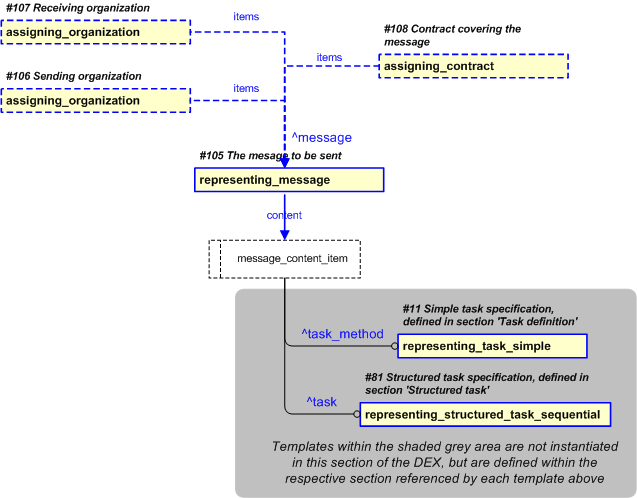
Extracted information should be packaged as a message which is then sent to the recipient. Message containing the task specification is represented as an instance of Message in ISO 10303-239 PLCS. Instantiation of Message is done using the template representing_message. The instantiation of representing_message must follow the rules defined in template table: Template #105(Figure 33) below.
The following message meta data may be assigned to the Message.
In addition to the message meta data, the content of the message is identified. This is represented by linking Message to the task specifications (Task_methods) via the Content_item_selected entity and message_content_item select.
This has been raised as issue, RBN-4, against ISO 10303-239. The EXPRESS schema has been modified in DEXlib (Long form: dexlib/data/schemas/ap239_arm_lf.exp, short form: dexlib/data/schemas/ap239_arm_sf.exp). These changes will be made to ISO 10303-239 as a Technical Corrigendum at some stage.
NOTE A DEX defines one business transaction, e.g. one task specification. If however, the message is required to contain a number of business transactions, e.g. multiple task specifications, then this is represented by instantiating multiple occurrences of the Content_item_selected item within the representing_message template.
| Template #105 (Figure 33): representing_message | |||
|---|---|---|---|
| Description | Information about the message containing one or many task specifications. | ||
| Parameter name: | Parameter value: | Parameter description: | |
| rep_msg_id | ?rep_msg_id? | The identifier of the message. | |
| rep_msg_id_class_name | "Message_identification_code" (urn:plcs:rdl:std:Message_identification_code) | The name of the class being used to classify the identification (Identification_assignment) of the message. This provides the role or reason for the identification. | |
| rep_msg_id_ecl_id | 'urn_plcs_rdl_std' | The identifier of the External_class_library storing the definition of the class referenced by the parameter @id_class_name class. | |
| rep_msg_id_owner | ?rep_msg_id_owner? | The name or identifier of the organization owning the id or name. | |
| rep_msg_id_owner_class_name | "Organization_identification_code" (urn:plcs:rdl:std:Organization_identification_code), "Organization_name" (urn:plcs:rdl:std:Organization_name), or subclass thereof. | The name of the class being used to classify the identification of the organization. For example CAGE code, or organization name. | |
| rep_msg_id_owner_ecl_id | ?rep_msg_id_owner_ecl_id? | The id of the External_class_library storing the @id_owner_class_name class | |
| date_class_name | "Date_actual_extraction" (urn:plcs:rdl:std:Date_actual_extraction) | The name of the class being used to classify the role date assignment, e.g. the message sending date. | |
| date_ecl_id | 'urn_plcs_rdl_std' | The id of the External_class_library storing the date_class_name class items. | |
| year | ?year? | The 'year' component of: the date the data was extracted from the system and the message created.. | |
| month | ?month? | The 'month' component of: the date the data was extracted from the system and the message created. . | |
| day | ?day? | The 'day' component of: the date the data was extracted from the system and the message created.. This can be in local time or UTC | |
| hour | ?hour? | The 'hour' component of: the date the data was extracted from the system and the message created.. This can be in local time or UTC. | |
| minute | ?minute? | The 'minute' component of: the date the data was extracted from the system and the message created.. This can be in local time or UTC. | |
| second | ?second? | The 'second' component of: the date the data was extracted from the system and the message created.. This can be in local time or UTC | |
| sense | ?sense? | The direction of the offset. Enumeration values: 'ahead', 'exact' or 'behind'. | |
| hour_offset | ?hour_offset? | The number of hours by which a time is offset from Coordinated Universal Time. | |
| minute_offset | ?minute_offset? | The number of minutes by which a time is offset from Coordinated Universal Time. The value of this attribute need not be specified. This parameter is optional. If not given, it will remain unset. | |
| ap239_id_class_name | "AP239_version" (urn:plcs:rdl:std:AP239_version) | The name of the class being used to classify the Message as a container of ISO 10303-239 data of a given version. The class identifies the version of ISO 10303-239 to which the data in the message conforms. | |
| ap239_id_ecl_id | 'urn_plcs_rdl_std' | The id of the External_class_library storing the @ap239_id_class_name | |
| dex_id_class_name | "DEX_task_specification" (urn:plcs:rdl:std:DEX_task_specification) | The name of the class being used to classify the Message as a container of an identified DEX. The class defines the DEX to which the data in the message conforms. | |
| dex_id_ecl_id | 'urn_plcs_rdl_std' | The id of the External_class_library storing the @dex_id_class_name | |
| content | Task_method_version | Reference to the Task_method_version being in scope for the message. | |
Message - Date time of data extraction
Date time of data extraction is part of the input parameters for the representing_message template defined in template table: Template #105(Figure 33) above.
Message - Sending and receiving organization
Sending and receiving organizations are represented as Organizations using the assigning_organization template.
Template instantiation for sending and receiving organization must follow the rules defined in template table: Template #106(Figure 33) and template table: Template #107(Figure 33) respectively.
| Template #106 (Figure 33): assigning_organization | |||
|---|---|---|---|
| Description | Organization sending the message. | ||
| Parameter name: | Parameter value: | Parameter description: | |
| org_id | ?org_id? | The name or identifier of the organization. | |
| org_id_class_name | "Organization_identification_code" (urn:plcs:rdl:std:Organization_identification_code), "Organization_name" (urn:plcs:rdl:std:Organization_name), or subclass thereof. | The name of the class being used to classify the identification (Identification_assignment) of the organization. This provides the role or reason for the identification. For example CAGE code. | |
| org_id_ecl_id | ?org_id_ecl_id? | The identifier of the External_class_library storing the definition of the class referenced by the parameter @org_id_class_name class. | |
| org_assgn_class_name | "Sender_of" (urn:plcs:rdl:std:Sender_of) | The name of the class being used to classify the assignment of the organization. (Organization_or_person_in_organization_assignment) This provides the role or reason for the assignment. For example 'Owner_of'. | |
| org_assgn_ecl_id | 'urn_plcs_rdl_std' | The identifier of the External_class_library storing the definition of the class referenced by the parameter @org_assgn_class_name. | |
| items | Message | The message to which the sending organization is assigned. | |
| Template #107 (Figure 33): assigning_organization | |||
|---|---|---|---|
| Description | Organization receiving the message. | ||
| Parameter name: | Parameter value: | Parameter description: | |
| org_id | ?org_id? | The name or identifier of the organization. | |
| org_id_class_name | "Organization_identification_code" (urn:plcs:rdl:std:Organization_identification_code), "Organization_name" (urn:plcs:rdl:std:Organization_name), or subclass thereof. | The name of the class being used to classify the identification (Identification_assignment) of the organization. This provides the role or reason for the identification. For example CAGE code. | |
| org_id_ecl_id | ?org_id_ecl_id? | The identifier of the External_class_library storing the definition of the class referenced by the parameter @org_id_class_name class. | |
| org_assgn_class_name | "Receiver_of" (urn:plcs:rdl:std:Receiver_of) | The name of the class being used to classify the assignment of the organization. (Organization_or_person_in_organization_assignment) This provides the role or reason for the assignment. For example 'Owner_of'. | |
| org_assgn_ecl_id | 'urn_plcs_rdl_std' | The identifier of the External_class_library storing the definition of the class referenced by the parameter @org_assgn_class_name. | |
| items | Message | The message to which the receiving organization is assigned. | |
Message - Contract information
Contract information represented as Contract using the assigning_contract template.
Template instantiation for message contract information must follow the rules defined in template table: Template #108(Figure 33) below.
| Template #108 (Figure 33): assigning_contract | |||
|---|---|---|---|
| Description | Message contract information. | ||
| Parameter name: | Parameter value: | Parameter description: | |
| cnt_id | ?cnt_id? | The name or identifier of the contract. | |
| cnt_id_class_name | "Contract_identification_code" (urn:plcs:rdl:std:Contract_identification_code) or subclass thereof. | The name of the class being used to classify the identification (Identification_assignment) of the contract. | |
| cnt_id_ecl_id | ?cnt_id_ecl_id? | The identifier of the External_class_library storing the definition of the class referenced by the parameter @cnt_id_class_name class. | |
| cnt_org_id | ?cnt_org_id? | The name or identifier of the organization owning or holding the contract. | |
| cnt_org_id_class_name | "Organization_identification_code" (urn:plcs:rdl:std:Organization_identification_code), "Organization_name" (urn:plcs:rdl:std:Organization_name), or subclass thereof. | The name of the class being used to classify the identification (Identification_assignment) of the organization. | |
| cnt_org_id_ecl_id | ?cnt_org_id_ecl_id? | The identifier of the External_class_library storing the definition of the class referenced by the parameter @org_id_class_name class. | |
| items | Message | The message to which the contract is assigned. | |
This section summarizes common characterizations for some of the basic templates used in this DEX. This avoids repeating the same type of information over and over again in the previous sections.
Optional characterization of template assigning_code
The assigning_code template can be characterized using the following templates:
Characterizations of assigning_code is summarized in Figure 34 below.
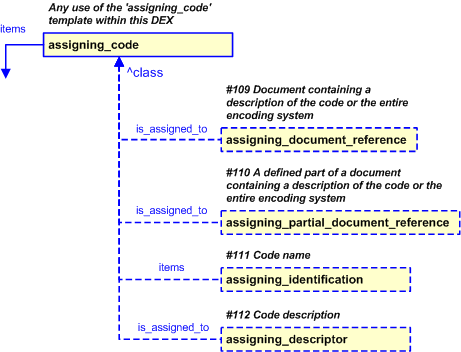
This has been raised as issue, GYL-3, against ISO 10303-239. The EXPRESS schema has been modified in DEXlib (Long form: dexlib/data/schemas/ap239_arm_lf.exp, short form: dexlib/data/schemas/ap239_arm_sf.exp). These changes will be made to ISO 10303-239 as a Technical Corrigendum at some stage.
This has been raised as issue, GYL-4, against ISO 10303-239. The EXPRESS schema has been modified in DEXlib (Long form: dexlib/data/schemas/ap239_arm_lf.exp, short form: dexlib/data/schemas/ap239_arm_sf.exp). These changes will be made to ISO 10303-239 as a Technical Corrigendum at some stage.
Template instantiation for assigning_code characterization must follow the rules defined in template table: Template #109(Figure 34), template table: Template #110(Figure 34), template table: Template #111(Figure 34) and template table: Template #112(Figure 34) respectively.
| Template #109 (Figure 34): assigning_document_reference | |||
|---|---|---|---|
| Description | Reference to a document containing a description of the code or the entire encoding system. | ||
| Parameter name: | Parameter value: | Parameter description: | |
| doc_id | ?doc_id? | The identification of the Document being referenced. | |
| doc_id_class_name | "Document_identification_code" (urn:plcs:rdl:std:Document_identification_code) or subclass thereof. | The name of the External_class that determines the type of identifier given by the input parameter @doc_id. | |
| doc_id_ecl_id | ?doc_id_ecl_id? | The identification of the External_class_library storing the External_class given by the input parameter @doc_id_class_name. | |
| doc_ver_id | ?doc_ver_id? | The identification of the Document_version being referenced. | |
| doc_ver_id_class_name | "Progression_identification_code" (urn:plcs:rdl:std:Progression_identification_code) or subclass thereof. | The name of the External_class that determines the type of identifier given by the input parameter @doc_ver_id. | |
| doc_ver_id_ecl_id | ?doc_ver_id_ecl_id? | The identification of the External_class_library storing the External_class given by the input parameter @doc_ver_id_class_name. | |
| org_id | ?org_id? | The identification of the Organization that "owns" the Document and Document_version identifiers (@doc_id and @doc_ver_id). | |
| org_id_class_name | "Organization_identification_code" (urn:plcs:rdl:std:Organization_identification_code), "Organization_name" (urn:plcs:rdl:std:Organization_name), or subclass thereof. | The name of the External_class that determines the type of organization identification (@org_id) being used. For example CAGE code. | |
| org_id_ecl_id | ?org_id_ecl_id? | The identification of the External_class_library storing the External_class given by the input parameter @org_id_class_name | |
| doc_asg_class_name | "Document_reference" (urn:plcs:rdl:std:Document_reference) or subclass thereof. | The name of the External_class that determines the role of Document_assignment, i.e. providing the role of the referenced Document | |
| doc_asg_ecl_id | ?doc_asg_ecl_id? | The identification of the External_class_library storing the External_class given by the input parameter @doc_asg_class_name class | |
| is_assigned_to | Class | The code to which the referenced document is assigned. | |
NOTE Representation of version identification where the version identification is not known must follow the guidelines given in the assigning_identification template.
| Template #110 (Figure 34): assigning_partial_document_reference | |||
|---|---|---|---|
| Description | Reference to a specific part of a document containing a description of the code or the entire encoding system. | ||
| Parameter name: | Parameter value: | Parameter description: | |
| doc_id | ?doc_id? | The identification of the Document being referenced. | |
| doc_id_class_name | "Document_identification_code" (urn:plcs:rdl:std:Document_identification_code) or subclass thereof. | The name of the External_class that determines the type of identifier given by the input parameter @doc_id. | |
| doc_id_ecl_id | ?doc_id_ecl_id? | The identification of the External_class_library storing the External_class given by the input parameter @doc_id_class_name. | |
| doc_ver_id | ?doc_ver_id? | The identification of the Document_version being referenced. | |
| doc_ver_id_class_name | "Progression_identification_code" (urn:plcs:rdl:std:Progression_identification_code) or subclass thereof. | The name of the External_class that determines the type of identifier given by the input parameter @doc_ver_id. | |
| doc_ver_id_ecl_id | ?doc_ver_id_ecl_id? | The identification of the External_class_library storing the External_class given by the input parameter @doc_ver_id_class_name. | |
| org_id | ?org_id? | The identification of the Organization that "owns" the Document and Document_version identifiers (@doc_id and @doc_ver_id). | |
| org_id_class_name | "Organization_identification_code" (urn:plcs:rdl:std:Organization_identification_code), "Organization_name" (urn:plcs:rdl:std:Organization_name), or subclass thereof. | The name of the External_class that determines the type of organization identification (@org_id) being used. For example CAGE code. | |
| org_id_ecl_id | ?org_id_ecl_id? | The identification of the External_class_library storing the External_class given by the input parameter @org_id_class_name | |
| doc_portion | ?doc_portion? | A textual description identifying the portion of the document being referenced. | |
| doc_asg_class_name | "Partial_document_reference" (urn:plcs:rdl:std:Partial_document_reference) or subclass thereof. | The name of the External_class that determines the role of Partial_document_assignment, i.e. providing the role of the referenced Document | |
| doc_asg_ecl_id | ?doc_asg_ecl_id? | The identification of the External_class_library storing the External_class given by the input parameter @doc_asg_class_name class | |
| is_assigned_to | Class | The code to which the referenced document is assigned. | |
NOTE Representation of version identification where the version identification is not known must follow the guidelines given in the assigning_identification template.
| Template #111 (Figure 34): assigning_identification | |||
|---|---|---|---|
| Description | Code name. | ||
| Parameter name: | Parameter value: | Parameter description: | |
| id | ?id? | The code name being assigned. | |
| id_class_name | "Name" (urn:plcs:rdl:std:Name) or subclass thereof. | The name of the class used to classify the identifier and so provide the role or reason for the identification. | |
| id_ecl_id | ?id_ecl_id? | The id of the External_class_library storing the id_class_name class | |
| org_id | ?org_id? | The identifier of the organization that "owns" the identifier. | |
| org_id_class_name | "Organization_identification_code" (urn:plcs:rdl:std:Organization_identification_code) or "Organization_name" (urn:plcs:rdl:std:Organization_name) or subclass thereof. | The name of the class being used to classify the identification of the organization, or the organization name. For example CAGE code. | |
| org_id_ecl_id | ?org_id_ecl_id? | The id of the External_class_library storing the org_id_class_name class | |
| items | Class | The code to which the code name is assigned. | |
NOTE Additional characterizations of the respective name may be done in accordance with what is described under Section: Optional characterization of template assigning_identification .
| Template #112 (Figure 34): assigning_descriptor | |||
|---|---|---|---|
| Description | Description of the meaning of the code. | ||
| Parameter name: | Parameter value: | Parameter description: | |
| descr | ?descr? | The text being assigned as a description. | |
| class_name | "Description" (urn:plcs:rdl:std:Description) or subclass thereof. | The name of the class (External_class) being used to determine type of descriptor. | |
| ecl_id | ?ecl_id? | The id of the External_class_library that stores the class. | |
| is_assigned_to | Class | The code under consideration. | |
NOTE Additional characterizations of the respective description may be done in accordance with what is described under Section: Optional characterization of template assigning_descriptor .
Optional characterization of template assigning_descriptor
The assigning_descriptor template can be characterized using the following templates:
Characterizations of assigning_descriptor is summarized in Figure 35 below.
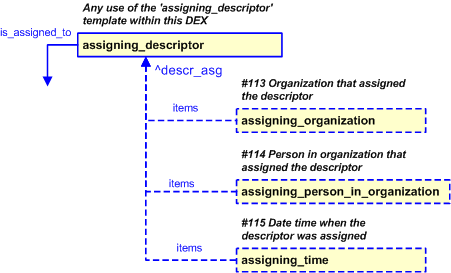
Template instantiation for assigning_descriptor characterization must follow the rules defined in template table: Template #113(Figure 35), template table: Template #114(Figure 35) and template table: Template #115(Figure 35) respectively.
| Template #113 (Figure 35): assigning_organization | |||
|---|---|---|---|
| Description | Organization assigning the descriptor (description/note/remark etc). | ||
| Parameter name: | Parameter value: | Parameter description: | |
| org_id | ?org_id? | The name or identifier of the organization. | |
| org_id_class_name | "Organization_identification_code" (urn:plcs:rdl:std:Organization_identification_code), "Organization_name" (urn:plcs:rdl:std:Organization_name), or subclass thereof. | The name of the class being used to classify the identification (Identification_assignment) of the organization. This provides the role or reason for the identification. For example CAGE code. | |
| org_id_ecl_id | ?org_id_ecl_id? | The identifier of the External_class_library storing the definition of the class referenced by the parameter @org_id_class_name class. | |
| org_assgn_class_name | "Creator_of" (urn:plcs:rdl:std:Creator_of) | The name of the class being used to classify the assignment of the organization. (Organization_or_person_in_organization_assignment) This provides the role or reason for the assignment. For example 'Owner_of'. | |
| org_assgn_ecl_id | 'urn_plcs_rdl_std' | The identifier of the External_class_library storing the definition of the class referenced by the parameter @org_assgn_class_name. | |
| items | Document_assignment | The Document_assignment representing the Descriptor_assignment. | |
| Template #114 (Figure 35): assigning_person_in_organization | |||
|---|---|---|---|
| Description | Person in organization assigning the descriptor (description/note/remark etc). | ||
| Parameter name: | Parameter value: | Parameter description: | |
| last_name | ?last_name? | the last name (surname) of the person doing the approval | |
| first_name | ?first_name? | The first element of the Person's list of forenames. This parameter is optional. | |
| middle_names | ?middle_names? | The Person's other forenames. | |
| prefix_titles | ?prefix_titles? | The text that specifies the Person's social or professional standing and appear before his or her names. This parameter is optional. | |
| suffix_titles | ?suffix_titles? | The text that specifies the Person's social or professional standing and appear after his or her names. This parameter is optional. | |
| org_id | ?org_id? | The identifier or name of the organization. | |
| org_id_class_name | "Organization_identification_code" (urn:plcs:rdl:std:Organization_identification_code), "Organization_name" (urn:plcs:rdl:std:Organization_name), or subclass thereof. | The name of the class used to classify the identification (Identification_assignment) of the organization. This provides the role or reason for the identification. For example CAGE code. | |
| org_id_ecl_id | ?org_id_ecl_id? | The identifier of the External_class_library storing the definition of the class referenced by the parameter @org_id_class_name class. | |
| person_role_class_name | "Creator_of" (urn:plcs:rdl:std:Creator_of) | The name of the class being used to classify the person assignment () This provides the role for the assignment. | |
| person_role_ecl_id | 'urn_plcs_rdl_std' | The identifier of the External_class_library storing the definition of the class referenced by the parameter @person_role_class_name class. | |
| items | Document_assignment | The Document_assignment representing the Descriptor_assignment. | |
| Template #115 (Figure 35): assigning_time | |||
|---|---|---|---|
| Description | Date time when the descriptor was assigned. | ||
| Parameter name: | Parameter value: | Parameter description: | |
| date_class_name | "Date_actual_creation" (urn:plcs:rdl:std:Date_actual_creation) | The name of the class being used to classify the role date assignment, e.g. the start date. | |
| date_ecl_id | 'urn_plcs_rdl_std' | The id of the External_class_library in which the date class is defined. | |
| year | ?year? | Calendar_date year_component | |
| month | ?month? | Calendar_date month_component | |
| day | ?day? | Calendar_date day_component | |
| hour | ?hour? | Local_time year_component of the date and time. | |
| minute | ?minute? | Local_time month_component of the date and time. This parameter is optional. If not given, it will remain unset. | |
| second | ?second? | Local_time day_component of the date and time. This parameter is optional. If not given, it will remain unset. | |
| sense | ?sense? | The direction of the offset. Enumeration values: 'ahead', 'exact' or 'behind'. | |
| hour_offset | ?hour_offset? | The number of hours by which a time is offset from Coordinated Universal Time. | |
| minute_offset | ?minute_offset? | The number of minutes by which a time is offset from Coordinated Universal Time. The value of this attribute need not be specified. This parameter is optional. If not given, it will remain unset. | |
| items | Document_assignment | The Document_assignment representing the Descriptor_assignment. | |
Optional characterization of template assigning_identification
The assigning_identification template can be characterized using the following templates:
Characterizations of assigning_identification is summarized in Figure 36 below.
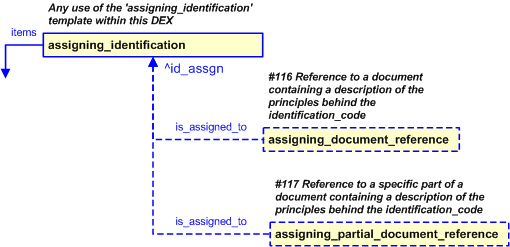
Template instantiation for assigning_identification characterization must follow the rules defined in template table: Template #116(Figure 34) and template table: Template #117(Figure 34) respectively.
| Template #116 (Figure 36): assigning_document_reference | |||
|---|---|---|---|
| Description | Reference to a document containing a description of the principles behind the identification code, or the entire encoding system. | ||
| Parameter name: | Parameter value: | Parameter description: | |
| doc_id | ?doc_id? | The identification of the Document being referenced. | |
| doc_id_class_name | "Document_identification_code" (urn:plcs:rdl:std:Document_identification_code) or subclass thereof. | The name of the External_class that determines the type of identifier given by the input parameter @doc_id. | |
| doc_id_ecl_id | ?doc_id_ecl_id? | The identification of the External_class_library storing the External_class given by the input parameter @doc_id_class_name. | |
| doc_ver_id | ?doc_ver_id? | The identification of the Document_version being referenced. | |
| doc_ver_id_class_name | "Progression_identification_code" (urn:plcs:rdl:std:Progression_identification_code) or subclass thereof. | The name of the External_class that determines the type of identifier given by the input parameter @doc_ver_id. | |
| doc_ver_id_ecl_id | ?doc_ver_id_ecl_id? | The identification of the External_class_library storing the External_class given by the input parameter @doc_ver_id_class_name. | |
| org_id | ?org_id? | The identification of the Organization that "owns" the Document and Document_version identifiers (@doc_id and @doc_ver_id). | |
| org_id_class_name | "Organization_identification_code" (urn:plcs:rdl:std:Organization_identification_code), "Organization_name" (urn:plcs:rdl:std:Organization_name), or subclass thereof. | The name of the External_class that determines the type of organization identification (@org_id) being used. For example CAGE code. | |
| org_id_ecl_id | ?org_id_ecl_id? | The identification of the External_class_library storing the External_class given by the input parameter @org_id_class_name | |
| doc_asg_class_name | "Document_reference" (urn:plcs:rdl:std:Document_reference) or subclass thereof. | The name of the External_class that determines the role of Document_assignment, i.e. providing the role of the referenced Document | |
| doc_asg_ecl_id | ?doc_asg_ecl_id? | The identification of the External_class_library storing the External_class given by the input parameter @doc_asg_class_name class | |
| is_assigned_to | Identification_assignment | The identifier to which the referenced document is assigned. | |
NOTE Representation of version identification where the version identification is not known must follow the guidelines given in the assigning_identification template.
| Template #117 (Figure 36): assigning_partial_document_reference | |||
|---|---|---|---|
| Description | Reference to a specific part of a document containing a description of the principles behind the identification code, or the entire encoding system. | ||
| Parameter name: | Parameter value: | Parameter description: | |
| doc_id | ?doc_id? | The identification of the Document being referenced. | |
| doc_id_class_name | "Document_identification_code" (urn:plcs:rdl:std:Document_identification_code) or subclass thereof. | The name of the External_class that determines the type of identifier given by the input parameter @doc_id. | |
| doc_id_ecl_id | ?doc_id_ecl_id? | The identification of the External_class_library storing the External_class given by the input parameter @doc_id_class_name. | |
| doc_ver_id | ?doc_ver_id? | The identification of the Document_version being referenced. | |
| doc_ver_id_class_name | "Progression_identification_code" (urn:plcs:rdl:std:Progression_identification_code) or subclass thereof. | The name of the External_class that determines the type of identifier given by the input parameter @doc_ver_id. | |
| doc_ver_id_ecl_id | ?doc_ver_id_ecl_id? | The identification of the External_class_library storing the External_class given by the input parameter @doc_ver_id_class_name. | |
| org_id | ?org_id? | The identification of the Organization that "owns" the Document and Document_version identifiers (@doc_id and @doc_ver_id). | |
| org_id_class_name | "Organization_identification_code" (urn:plcs:rdl:std:Organization_identification_code), "Organization_name" (urn:plcs:rdl:std:Organization_name), or subclass thereof. | The name of the External_class that determines the type of organization identification (@org_id) being used. For example CAGE code. | |
| org_id_ecl_id | ?org_id_ecl_id? | The identification of the External_class_library storing the External_class given by the input parameter @org_id_class_name | |
| doc_portion | ?doc_portion? | A textual description identifying the portion of the document being referenced. | |
| doc_asg_class_name | "Partial_document_reference" (urn:plcs:rdl:std:Partial_document_reference) or subclass thereof. | The name of the External_class that determines the role of Partial_document_assignment, i.e. providing the role of the referenced Document | |
| doc_asg_ecl_id | ?doc_asg_ecl_id? | The identification of the External_class_library storing the External_class given by the input parameter @doc_asg_class_name class | |
| is_assigned_to | Identification_assignment | The identifier to which the referenced document is assigned. | |
NOTE Representation of version identification where the version identification is not known must follow the guidelines given in the assigning_identification template.
Optional characterization of template assigning_justification
The assigning_justification template can be characterized using the following templates:
Characterizations of assigning_justification is summarized in Figure 37 below.
This has been raised as issue, RBN-5, against ISO 10303-239. The EXPRESS schema has been modified in DEXlib (Long form: dexlib/data/schemas/ap239_arm_lf.exp, short form: dexlib/data/schemas/ap239_arm_sf.exp). These changes will be made to ISO 10303-239 as a Technical Corrigendum at some stage.
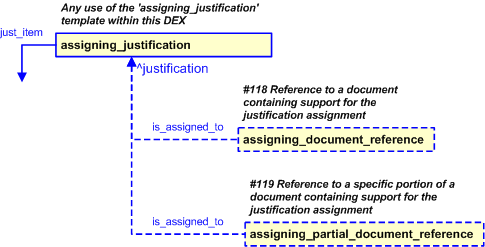
Template instantiation for assigning_justification characterization must follow the rules defined in template table: Template #118(Figure 37) and template table: Template #119(Figure 37) respectively.
| Template #118 (Figure 37): assigning_document_reference | |||
|---|---|---|---|
| Description | Reference to a document containing justification support. | ||
| Parameter name: | Parameter value: | Parameter description: | |
| doc_id | ?doc_id? | The identification of the Document being referenced. | |
| doc_id_class_name | "Document_identification_code" (urn:plcs:rdl:std:Document_identification_code) or subclass thereof. | The name of the External_class that determines the type of identifier given by the input parameter @doc_id. | |
| doc_id_ecl_id | ?doc_id_ecl_id? | The identification of the External_class_library storing the External_class given by the input parameter @doc_id_class_name. | |
| doc_ver_id | ?doc_ver_id? | The identification of the Document_version being referenced. | |
| doc_ver_id_class_name | "Progression_identification_code" (urn:plcs:rdl:std:Progression_identification_code) or subclass thereof. | The name of the External_class that determines the type of identifier given by the input parameter @doc_ver_id. | |
| doc_ver_id_ecl_id | ?doc_ver_id_ecl_id? | The identification of the External_class_library storing the External_class given by the input parameter @doc_ver_id_class_name. | |
| org_id | ?org_id? | The identification of the Organization that "owns" the Document and Document_version identifiers (@doc_id and @doc_ver_id). | |
| org_id_class_name | "Organization_identification_code" (urn:plcs:rdl:std:Organization_identification_code), "Organization_name" (urn:plcs:rdl:std:Organization_name), or subclass thereof. | The name of the External_class that determines the type of organization identification (@org_id) being used. For example CAGE code. | |
| org_id_ecl_id | ?org_id_ecl_id? | The identification of the External_class_library storing the External_class given by the input parameter @org_id_class_name | |
| doc_asg_class_name | "Document_reference" (urn:plcs:rdl:std:Document_reference) or subclass thereof. | The name of the External_class that determines the role of Document_assignment, i.e. providing the role of the referenced Document | |
| doc_asg_ecl_id | ?doc_asg_ecl_id? | The identification of the External_class_library storing the External_class given by the input parameter @doc_asg_class_name class | |
| is_assigned_to | Justification | The justification to which the referenced document is assigned. | |
NOTE Representation of version identification where the version identification is not known must follow the guidelines given in the assigning_identification template.
| Template #119 (Figure 37): assigning_partial_document_reference | |||
|---|---|---|---|
| Description | Reference to a specific part of a document containing justification support. | ||
| Parameter name: | Parameter value: | Parameter description: | |
| doc_id | ?doc_id? | The identification of the Document being referenced. | |
| doc_id_class_name | "Document_identification_code" (urn:plcs:rdl:std:Document_identification_code) or subclass thereof. | The name of the External_class that determines the type of identifier given by the input parameter @doc_id. | |
| doc_id_ecl_id | ?doc_id_ecl_id? | The identification of the External_class_library storing the External_class given by the input parameter @doc_id_class_name. | |
| doc_ver_id | ?doc_ver_id? | The identification of the Document_version being referenced. | |
| doc_ver_id_class_name | "Progression_identification_code" (urn:plcs:rdl:std:Progression_identification_code) or subclass thereof. | The name of the External_class that determines the type of identifier given by the input parameter @doc_ver_id. | |
| doc_ver_id_ecl_id | ?doc_ver_id_ecl_id? | The identification of the External_class_library storing the External_class given by the input parameter @doc_ver_id_class_name. | |
| org_id | ?org_id? | The identification of the Organization that "owns" the Document and Document_version identifiers (@doc_id and @doc_ver_id). | |
| org_id_class_name | "Organization_identification_code" (urn:plcs:rdl:std:Organization_identification_code), "Organization_name" (urn:plcs:rdl:std:Organization_name), or subclass thereof. | The name of the External_class that determines the type of organization identification (@org_id) being used. For example CAGE code. | |
| org_id_ecl_id | ?org_id_ecl_id? | The identification of the External_class_library storing the External_class given by the input parameter @org_id_class_name | |
| doc_portion | ?doc_portion? | A textual description identifying the portion of the document being referenced. | |
| doc_asg_class_name | "Partial_document_reference" (urn:plcs:rdl:std:Partial_document_reference) or subclass thereof. | The name of the External_class that determines the role of Partial_document_assignment, i.e. providing the role of the referenced Document | |
| doc_asg_ecl_id | ?doc_asg_ecl_id? | The identification of the External_class_library storing the External_class given by the input parameter @doc_asg_class_name class | |
| is_assigned_to | Justification | The justification to which the referenced document is assigned. | |
NOTE Representation of version identification where the version identification is not known must follow the guidelines given in the assigning_identification template.
Optional characterization of templates for assigning referenced document
The assigning_document_reference and assigning_partial_document_reference templates can be characterized using the following templates:
Characterizations of assigning_document_reference and assigning_partial_document_reference are summarized in Figure 38 below.
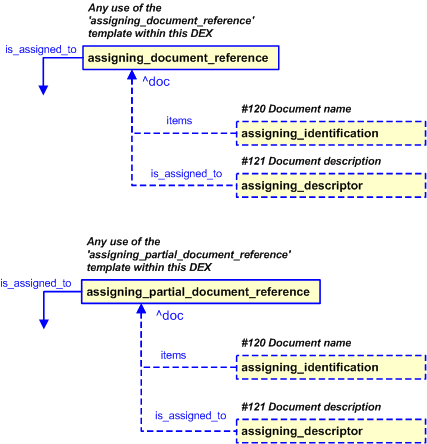
Template instantiation for assigning_document_reference and assigning_partial_document_reference characterization must follow the rules defined in template table: Template #120(Figure 38) and template table: Template #121(Figure 38) respectively.
| Template #120 (Figure 38): assigning_identification | |||
|---|---|---|---|
| Description | Document name. | ||
| Parameter name: | Parameter value: | Parameter description: | |
| id | ?id? | The name being assigned. | |
| id_class_name | "Document_name" (urn:plcs:rdl:std:Document_name) or subclass thereof. | The name of the class used to classify the identifier and so provide the role or reason for the identification. | |
| id_ecl_id | ?id_ecl_id? | The id of the External_class_library storing the id_class_name class | |
| org_id | ?org_id? | The identifier of the organization that "owns" the identifier. | |
| org_id_class_name | "Organization_identification_code" (urn:plcs:rdl:std:Organization_identification_code) or "Organization_name" (urn:plcs:rdl:std:Organization_name) or subclass thereof. | The name of the class being used to classify the identification of the organization, or the organization name. For example CAGE code. | |
| org_id_ecl_id | ?org_id_ecl_id? | The id of the External_class_library storing the org_id_class_name class | |
| items | Document or | The document under consideration. | |
NOTE Additional characterizations of the respective name may be done in accordance with what is described under Section: Optional characterization of template assigning_identification .
| Template #121 (Figure 38): assigning_descriptor | |||
|---|---|---|---|
| Description | Document description. | ||
| Parameter name: | Parameter value: | Parameter description: | |
| descr | ?descr? | The text being assigned as a description. | |
| class_name | "Description" (urn:plcs:rdl:std:Description) or subclass thereof. | The name of the class (External_class) being used to determine type of descriptor. | |
| ecl_id | ?ecl_id? | The id of the External_class_library that stores the class. | |
| is_assigned_to | Document or | The document under consideration. | |
NOTE Additional characterizations of the respective description may be done in accordance with what is described under Section: Optional characterization of template assigning_descriptor .
Optional characterization of templates for property representation
All property related templates containing the Representation entity, can be characterized using the following templates:
The following templates used by this DEX contains the Representation entity:
Characterizations of Representation entity is summarized in Figure 39 below.
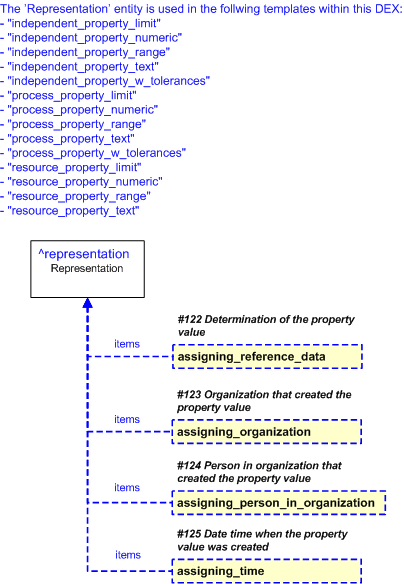
Template instantiation for Representation characterization must follow the rules defined in template table: Template #122(Figure 39), template table: Template #123(Figure 39), template table: Template #124(Figure 39) and template table: Template #125(Figure 39) respectively.
| Template #122 (Figure 39): assigning_reference_data | |||
|---|---|---|---|
| Description | Determination of the property value representation, e.g. measured, estimated etc. | ||
| Parameter name: | Parameter value: | Parameter description: | |
| class_name | Subclass of "Representation" (urn:plcs:rdl:std:Representation). | The name of the class in the reference data library being used to assign determination to the property value. | |
| ecl_id | ?ecl_id? | The id of the External_class_library that stores the definition for the class being used. | |
| items | Representation | The items to which the External_class is assigned. | |
| Template #123 (Figure 39): assigning_organization | |||
|---|---|---|---|
| Description | Organization responsible for the creation of the property value. | ||
| Parameter name: | Parameter value: | Parameter description: | |
| org_id | ?org_id? | The name or identifier of the organization. | |
| org_id_class_name | "Organization_identification_code" (urn:plcs:rdl:std:Organization_identification_code), "Organization_name" (urn:plcs:rdl:std:Organization_name), or subclass thereof. | The name of the class being used to classify the identification (Identification_assignment) of the organization. This provides the role or reason for the identification. For example CAGE code. | |
| org_id_ecl_id | ?org_id_ecl_id? | The identifier of the External_class_library storing the definition of the class referenced by the parameter @org_id_class_name class. | |
| org_assgn_class_name | "Creator_of" (urn:plcs:rdl:std:Creator_of) | The name of the class being used to classify the assignment of the organization. (Organization_or_person_in_organization_assignment) This provides the role or reason for the assignment. For example 'Owner_of'. | |
| org_assgn_ecl_id | 'urn_plcs_rdl_std' | The identifier of the External_class_library storing the definition of the class referenced by the parameter @org_assgn_class_name. | |
| items | Representation | The items to which the organization is assigned | |
| Template #124 (Figure 39): assigning_person_in_organization | |||
|---|---|---|---|
| Description | Person in organization responsible for the creation of the property value. | ||
| Parameter name: | Parameter value: | Parameter description: | |
| last_name | ?last_name? | the last name (surname) of the person doing the approval | |
| first_name | ?first_name? | The first element of the Person's list of forenames. This parameter is optional. | |
| middle_names | ?middle_names? | The Person's other forenames. | |
| prefix_titles | ?prefix_titles? | The text that specifies the Person's social or professional standing and appear before his or her names. This parameter is optional. | |
| suffix_titles | ?suffix_titles? | The text that specifies the Person's social or professional standing and appear after his or her names. This parameter is optional. | |
| org_id | ?org_id? | The identifier or name of the organization. | |
| org_id_class_name | "Organization_identification_code" (urn:plcs:rdl:std:Organization_identification_code), "Organization_name" (urn:plcs:rdl:std:Organization_name), or subclass thereof. | The name of the class used to classify the identification (Identification_assignment) of the organization. This provides the role or reason for the identification. For example CAGE code. | |
| org_id_ecl_id | ?org_id_ecl_id? | The identifier of the External_class_library storing the definition of the class referenced by the parameter @org_id_class_name class. | |
| person_role_class_name | "Creator_of" (urn:plcs:rdl:std:Creator_of) | The name of the class being used to classify the person assignment () This provides the role for the assignment. | |
| person_role_ecl_id | 'urn_plcs_rdl_std' | The identifier of the External_class_library storing the definition of the class referenced by the parameter @person_role_class_name class. | |
| items | Representation | The items to which the person is assigned | |
| Template #125 (Figure 39): assigning_time | |||
|---|---|---|---|
| Description | Date time when the property value was created. | ||
| Parameter name: | Parameter value: | Parameter description: | |
| date_class_name | "Date_actual_creation" (urn:plcs:rdl:std:Date_actual_creation) | The name of the class being used to classify the role date assignment, e.g. the start date. | |
| date_ecl_id | 'urn_plcs_rdl_std' | The id of the External_class_library in which the date class is defined. | |
| year | ?year? | Calendar_date year_component | |
| month | ?month? | Calendar_date month_component | |
| day | ?day? | Calendar_date day_component | |
| hour | ?hour? | Local_time year_component of the date and time. | |
| minute | ?minute? | Local_time month_component of the date and time. This parameter is optional. If not given, it will remain unset. | |
| second | ?second? | Local_time day_component of the date and time. This parameter is optional. If not given, it will remain unset. | |
| sense | ?sense? | The direction of the offset. Enumeration values: 'ahead', 'exact' or 'behind'. | |
| hour_offset | ?hour_offset? | The number of hours by which a time is offset from Coordinated Universal Time. | |
| minute_offset | ?minute_offset? | The number of minutes by which a time is offset from Coordinated Universal Time. The value of this attribute need not be specified. This parameter is optional. If not given, it will remain unset. | |
| items | Representation | The items to which the date is assigned. | |
© OASIS 2008 — All rights reserved