The Identity Metasystem Interoperability specification
prescribes a subset of the mechanisms defined in [WS-Trust
1.2], [WS-Trust 1.3], [WS-SecurityPolicy
1.1], [WS-SecurityPolicy 1.2], and [WS-MetadataExchange] to facilitate the integration of Digital
Identity into an interoperable token issuance and consumption framework using
the Information Card Model. It documents the Web interfaces utilized by
browsers and Web applications that utilize the Information Card Model.
Finally, it extends WS-Addressing’s endpoint reference by providing identity
information about the endpoint that can be verified through a variety of
security means, such as https or the wealth of WS-Security specifications.
This profile constrains the schema elements/extensions used
by the Information Card Model, and behaviors for conforming Relying Parties,
Identity Providers, and Identity Selectors.
The key words “MUST”, “MUST NOT”, “REQUIRED”, “SHALL”,
“SHALL NOT”, “SHOULD”, “SHOULD NOT”, “RECOMMENDED”, “MAY”, and “OPTIONAL” in
this document are to be interpreted as described in [RFC
2119].
This specification uses the following syntax to define
outlines for assertions:
- The syntax appears as an XML instance, but values in
italics indicate data types instead of literal values.
- Characters are appended to elements and attributes to
indicate cardinality:
- "?" (0 or 1)
- "*" (0 or more)
- "+" (1 or more)
- The character "|" is used to indicate a choice
between alternatives.
- The characters "(" and ")" are used to
indicate that contained items are to be treated as a group with respect to
cardinality or choice.
- The characters "[" and "]" are used to
call out references and property names.
- Ellipses (i.e., "...") indicate points of
extensibility. Additional children and/or attributes MAY be added at the
indicated extension points but MUST NOT contradict the semantics of the
parent and/or owner, respectively. By default, if a receiver does not
recognize an extension, the receiver SHOULD ignore the extension;
exceptions to this processing rule, if any, are clearly indicated below.
- XML namespace prefixes (see Table 2) are used to indicate
the namespace of the element being defined.
Elements and Attributes defined by
this specification are referred to in the text of this document using XPath 1.0
expressions. Extensibility points are referred to using an extended version of
this syntax:
- An element extensibility point is
referred to using {any} in place of the element name. This indicates that
any element name can be used, from any namespace other than the namespace
of this specification.
- An attribute extensibility point is
referred to using @{any} in place of the attribute name. This indicates
that any attribute name can be used, from any namespace other than the
namespace of this specification.
Extensibility points in the exemplar may not be described in
the corresponding text.
Table 1 lists the
XML namespaces that are used in this document.
|
Prefix
|
XML Namespace
|
Specification(s)
|
|
ds
|
http://www.w3.org/2000/09/xmldsig#
|
XML Digital
Signatures
|
|
ic
|
http://schemas.xmlsoap.org/ws/2005/05/identity
|
This document
|
|
ic07
|
http://schemas.xmlsoap.org/ws/2007/01/identity
|
Namespace for
additional elements also defined by this document
|
|
ic08
|
http://docs.oasis-open.org/imi/ns/identity-200810
|
Namespace for
new elements defined by this document
|
|
S
|
May refer to
either http://schemas.xmlsoap.org/soap/envelope
or http://www.w3.org/2003/05/soap-envelope since both may be used
|
SOAP
|
|
S11
|
http://schemas.xmlsoap.org/soap/envelope
|
SOAP 1.1 [SOAP 1.1]
|
|
S12
|
http://www.w3.org/2003/05/soap-envelope
|
SOAP 1.2 [SOAP 1.2]
|
|
saml
|
urn:oasis:names:tc:SAML:1.0:assertion
|
SAML 1.0
|
|
sp
|
May refer to
either http://schemas.xmlsoap.org/ws/2005/07/securitypolicy
or http://docs.oasis-open.org/ws-sx/ws-securitypolicy/200702 since
both may be used
|
WS-SecurityPolicy
|
|
sp11
|
http://schemas.xmlsoap.org/ws/2005/07/securitypolicy
|
WS-SecurityPolicy
1.1 [WS-SecurityPolicy
1.1]
|
|
sp12
|
http://docs.oasis-open.org/ws-sx/ws-securitypolicy/200702
|
WS-SecurityPolicy
1.2 [WS-SecurityPolicy
1.2]
|
|
wsa
|
http://www.w3.org/2005/08/addressing
|
WS-Addressing [WS-Addressing]
|
|
wsdl
|
May refer to
either http://schemas.xmlsoap.org/wsdl/
or http://www.w3.org/TR/wsdl20 since both may be used
|
Web Services
Description Language
|
|
wsdl11
|
http://schemas.xmlsoap.org/wsdl/
|
Web Services
Description Language [WSDL
1.1]
|
|
wsdl20
|
http://www.w3.org/TR/wsdl20
|
Web Services
Description Language [WSDL
2.0]
|
|
wsid
|
http://schemas.xmlsoap.org/ws/2006/02/addressingidentity
|
Identity
Extension for Web Services Addressing also defined by this document
|
|
wsp
|
http://schemas.xmlsoap.org/ws/2004/09/policy
|
WS-Policy [WS-Policy]
|
|
wsse
|
http://docs.oasis-open.org/wss/2004/01/oasis-200401-wss-wssecurity-secext-1.0.xsd
|
WS-Security
Extensions [WS-Security]
|
|
wst
|
May refer to
either http://schemas.xmlsoap.org/ws/2005/02/trust
or http://docs.oasis-open.org/ws-sx/ws-trust/200512 since both may be
used
|
WS-Trust
|
|
wst12
|
http://schemas.xmlsoap.org/ws/2005/02/trust
|
WS-Trust 1.2 [WS-Trust 1.2]
|
|
wst13
|
http://docs.oasis-open.org/ws-sx/ws-trust/200512
|
WS-Trust 1.3 [WS-Trust 1.3]
|
|
wsu
|
http://docs.oasis-open.org/wss/2004/01/oasis-200401-wss-wssecurity-utility-1.0.xsd
|
WS-SecurityUtility
|
|
wsx
|
http://schemas.xmlsoap.org/ws/2004/09/mex
|
WS-MetadataExchange
[WS-MetadataExchange]
|
|
xs
|
http://www.w3.org/2001/XMLSchema
|
XML Schema [Part 1, 2]
|
It should be noted that the versions identified in the above
table supersede versions identified in referenced specifications.
A copy of the XML
Schemas for this document can be found at:
1.4 Terminology
The following
definitions establish the terminology and usage in this document.
Information Card Model – The “Information Card
Model” refers to the use of Information Cards containing metadata for
obtaining Digital Identity claims from Identity Providers and then conveying
them to Relying Parties under user control.
Information Card – An Information Card provides
a visual representation of a Digital Identity for the end user. Information
Cards contain a reference to an IP/STS that issues Security Tokens containing
the Claims for that Digital Identity.
Digital Identity – A “Digital Identity” is a
set of Claims made by one party about another party.
Claim – A “Claim” is a piece of information
about a Subject that an Identity Provider asserts about that Subject.
Subject – A “Subject” is an individual or entity
about whom claims are made by an Identity Provider.
Service Requester – The term “Service Requester”
means software acting on behalf of a party who wants to obtain a service
through a digital network.
Relying Party – The term “Relying Party” (RP)
means a network entity providing the desired service, and relying upon Digital
Identity.
Identity Provider – The term “Identity Provider”
(IP) means a network entity providing the Digital Identity claims used by a
Relying Party.
Security Token Service – The term “Security Token
Service” (STS) refers to a WS-Trust endpoint.
Identity Provider Security Token Service – The term “Identity
Provider Security Token Service” (IP/STS) refers to the Security Token Service
run by an Identity Provider to issue tokens.
Relying Party Security Token Service – The term “Relying
Party Security Token Service” (RP/STS) refers to a Security Token Service run
by a Relying Party to accept and issue tokens.
Identity Selector – The term “Identity Selector”
(IS) refers to a software component available to the Service Requester through
which the user controls and dispatches her Digital Identities.
Trust
Identity – A trust
identity is a verifiable claim about a principal
(e.g. name, identity, key, group, privilege, capability, etc).
Security Token – A security token
represents a collection of claims.
Signed
Security Token – A
signed security token is a security token that is
asserted and cryptographically endorsed by a specific authority (e.g. an X.509
certificate, a Kerberos ticket, or a self-issued Information Card).
Unsigned
Security Token – An
unsigned security token is a security token that is not
cryptographically endorsed by a specific authority (e.g. a security token
backed by shared secrets such as usernames and passwords).
Proof-of-Possession – The proof-of-possession
information is data that is used in a proof process to demonstrate the sender's
knowledge of information that SHOULD only be known to the claiming sender of a
security token.
Integrity – Integrity
is the process by which it is guaranteed that information is not modified in
transit.
Confidentiality – Confidentiality
is the process by which data is protected such that only authorized actors or
security token owners can view the data
Digest – A digest
is a cryptographic checksum of an octet stream.
Signature - A signature
is a cryptographic binding of a proof-of-possession and a digest. This covers
both symmetric key-based and public key-based signatures. Consequently,
non-repudiation is not always achieved.
[DOM]
“Document Object Model (DOM)”, November 2000. http://www.w3.org/DOM/
[EV Cert]
CA / Browser Forum, “Guidelines for the Issuance and
Management of Extended Validation Certificates, Version 1.1”, April 2008. http://cabforum.org/EV_Certificate_Guidelines_V11.pdf
[HTTP]
R. Fielding et al., “IETF RFC 2616: Hypertext Transfer
Protocol -- HTTP/1.1”, June 1999. http://www.ietf.org/rfc/rfc2616.txt
[HTTPS]
E. Rescorla, “RFC 2818: HTTP over TLS”, May 2000. http://www.ietf.org/rfc/rfc2818.txt
[RFC 1274]
P. Barker and S. Kille, “RFC 1274: The COSINE and Internet
X.500 Schema”, November 1991. http://www.ietf.org/rfc/rfc1274.txt
[RFC 2119]
S. Bradner, “RFC 2119: Key words for use in RFCs to
Indicate Requirement Levels”, March 1997. http://www.ietf.org/rfc/rfc2119.txt
[RFC 2256]
M. Wahl, “RFC 2256: A Summary of the X.500(96) User Schema
for use with LDAPv3”, December 1997. http://www.ietf.org/rfc/rfc2256.txt
[RFC 2459]
R. Housley, W. Ford, W. Polk, and D. Solo, “RFC 2459:
Internet X.509 Public Key Infrastructure - Certificate and CRL Profile”,
January 1999. http://www.ietf.org/rfc/rfc2459.txt
[RFC 2898]
B. Kaliski, “PKCS #5: Password-Based Cryptography
Specification, Version 2.0”, September 2000. http://www.ietf.org/rfc/rfc2898.txt
[RFC 3066]
H. Alvestrand, “Tags for the Identification of Languages”,
January 2001. http://www.faqs.org/rfcs/rfc3066.html
[SOAP 1.1]
W3C Note, "SOAP: Simple Object Access Protocol 1.1,"
08 May 2000. http://www.w3.org/TR/2000/NOTE-SOAP-20000508/
[SOAP 1.2]
M. Gudgin, et al., “SOAP Version 1.2 Part 1: Messaging
Framework”, June 2003. http://www.w3.org/TR/soap12-part1/
[URI]
T. Berners-Lee, R. Fielding, L. Masinter, "Uniform
Resource Identifiers (URI): Generic Syntax," RFC 2396, MIT/LCS, U.C.
Irvine, Xerox Corporation, August 1998. http://www.ietf.org/rfc/rfc2396.txt
[WS-Addressing]
W3C Recommendation, “Web Service
Addressing (WS-Addressing)”, 9 May 2006. http://www.w3.org/TR/2006/REC-ws-addr-core-20060509/
[WS-MetadataExchange]
“Web Services Metadata Exchange
(WS-MetadataExchange), Version 1.1”, August 2006. http://specs.xmlsoap.org/ws/2004/09/mex/WS-MetadataExchange.pdf
[WSDL 1.1]
W3C Note, "Web Services Description Language (WSDL
1.1)," 15 March 2001. http://www.w3.org/TR/wsdl
[WSDL 2.0]
“Web Services Description Language (WSDL) Version 2.0 Part
1: Core Language”, June 2007. http://www.w3.org/TR/wsdl20
[WS-Policy]
“Web Services Policy Framework (WS-Policy), Version 1.2”,
March 2006. http://specs.xmlsoap.org/ws/2004/09/policy/ws-policy.pdf
[WS-Security]
A. Nadalin et al., “Web Services Security: SOAP Message
Security 1.0”, May 2004. http://docs.oasis-open.org/wss/2004/01/oasis-200401-wss-soap-message-security-1.0.pdf
[WS-SecurityPolicy
1.1]
“Web Services Security Policy Language (WS-SecurityPolicy),
Version 1.1”, July 2005. http://specs.xmlsoap.org/ws/2005/07/securitypolicy/ws-securitypolicy.pdf
[WS-SecurityPolicy 1.2]
OASIS, “WS-SecurityPolicy 1.2”, July 2007. http://docs.oasis-open.org/ws-sx/ws-securitypolicy/200702/ws-securitypolicy-1.2-spec-os.pdf
[WS-Trust 1.2]
“Web Services Trust Language (WS-Trust)”, February 2005. http://specs.xmlsoap.org/ws/2005/02/trust/WS-Trust.pdf
[WS-Trust 1.3]
OASIS, “WS-Trust 1.3”, March 2007. http://docs.oasis-open.org/ws-sx/ws-trust/200512/ws-trust-1.3-os.pdf
[XML 1.0]
W3C Recommendation, “Extensible Markup Language (XML) 1.0
(Fourth Edition)”, September 2006. http://www.w3.org/TR/xml/
[XMLDSIG]
Eastlake III, D., Reagle, J., and Solo, D., “XML-Signature
Syntax and Processing”, March 2002. http://www.ietf.org/rfc/rfc3275.txt
[XMLENC]
Imamura, T., Dillaway, B., and Simon, E., “XML Encryption
Syntax and Processing”, August 2002. http://www.w3.org/TR/xmlenc-core/
[XML Schema, Part 1]
H. Thompson et al., “XML Schema Part 1: Structures”, May
2001. http://www.w3.org/TR/xmlschema-1/
[XML Schema, Part 2]
P. Biron et al., “XML Schema Part 2: Datatypes”, May 2001. http://www.w3.org/TR/xmlschema-2/
Non-Normative References
[Addressing-Ext]
J. Alexander et al., “Application Note: Web Services
Addressing Endpoint References and Identity”, July 2008. http://schemas.xmlsoap.org/ws/2006/02/addressingidentity
[ISIP]
A. Nanda and M. Jones, “Identity Selector Interoperability
Profile V1.5”, July 2008. http://www.microsoft.com/downloads/details.aspx?FamilyID=b94817fc-3991-4dd0-8e85-b73e626f6764&DisplayLang=en
[ISIP Guide]
Microsoft Corporation and Ping Identity Corporation, “An
Implementer’s Guide to the Identity Selector Interoperability Profile V1.5”,
July 2008. http://www.microsoft.com/downloads/details.aspx?FamilyID=b94817fc-3991-4dd0-8e85-b73e626f6764&DisplayLang=en
[ISIP Web Guide]
M. Jones, “A Guide to Using the Identity Selector
Interoperability Profile V1.5 within Web Applications and Browsers”, July 2008.
http://www.microsoft.com/downloads/details.aspx?FamilyID=b94817fc-3991-4dd0-8e85-b73e626f6764&DisplayLang=en
This section defines the constructs used by a Relying Party
Web service for specifying and conveying its Security Token requirements to the
Service Requester.
A Relying Party specifies its Security Token requirements as
part of its Security Policy using the primitives and assertions defined in WS-SecurityPolicy.
The primary construct in the Security Policy of the Relying Party used to
specify its requirement for a Security Token from an Identity Provider is the sp:IssuedToken policy assertion. The
basic form of the issued token policy assertion as defined in WS-SecurityPolicy
is as follows.
<sp:IssuedToken
sp:Usage="xs:anyURI" sp:IncludeToken="xs:anyURI"
...>
<sp:Issuer>
wsa:EndpointReference
| xs:any
</sp:Issuer>
<sp:RequestSecurityTokenTemplate>
...
</sp:RequestSecurityTokenTemplate>
<wsp:Policy>
...
</wsp:Policy>
...
</sp:IssuedToken>
The attributes and elements listed in the schema fragment
above are described in WS-SecurityPolicy.
The ensuing subsections describe special parameters added by
this profile as extensions to the sp:IssuedToken
policy assertion that convey additional instructions to the Identity Selector
available to the Service Requester.
The sp:IssuedToken/sp:Issuer
element in an issued token policy specifies the issuer for the required token.
More specifically, it should contain the endpoint reference of an Identity
Provider STS that can issue the required token.
A Relying Party
MUST specify the issuer for a required token in one of the following ways:
§ Indicate a specific issuer by
specifying the issuer’s endpoint as the value of the sp:Issuer/wsa:Address
element.
§ Indicate that the issuer is unspecified
by omitting the sp:Issuer element, which means that the Service
Requester should determine the appropriate issuer for the required token with
help from the user if necessary.
When requiring a
specific issuer, a Relying Party MAY specify that it will accept self-issued
Security Tokens by using the special URI below as the value of the wsa:Address element within the endpoint reference for the issuer.
URI:
http://schemas.xmlsoap.org/ws/2005/05/identity/issuer/self
Following is an
example of using this URI within an issued token policy.
Example:
<sp:IssuedToken
...>
<sp:Issuer>
<wsa:Address>
http://schemas.xmlsoap.org/ws/2005/05/identity/issuer/self
</wsa:Address>
</sp:Issuer>
...
</sp:IssuedToken>
A Relying Party
MAY specify the value of the sp:Issuer/wsa:Address element in policy as a “logical name”
of the token issuer instead of an actual network address where the token is
issued. An Identity Selector SHOULD resolve the logical name to an appropriate
endpoint for the token issuer by matching the issuer name in Information Cards
available to it.
If a Relying Party
specifies the token issuer as a network endpoint in policy, then it MUST also
specify the location of issuer metadata from where the issuer’s policy metadata
can be obtained. This is done using the mechanism defined in [WS-Addressing] for embedding metadata within an endpoint
reference. The following example shows a token policy where the issuer endpoint
and its corresponding metadata location are specified.
Example:
<sp:IssuedToken
...>
<sp:Issuer>
<wsa:Address>http://contoso.com/sts</wsa:Address>
<wsa:Metadata>
<wsx:Metadata>
<wsx:MetadataSection
Dialect="http://schemas.xmlsoap.org/ws/2004/09/mex">
<wsx:MetadataReference>
<wsa:Address>https://contoso.com/sts/mex</wsa:Address>
</wsx:MetadataReference>
</wsx:MetadataSection>
</wsx:Metadata>
</wsa:Metadata>
</sp:Issuer>
...
</sp:IssuedToken>
An Identity
Selector SHOULD request an asymmetric key token from the Identity Provider to
maximize user privacy and security if no explicit key type is specified by the
Relying Party.
A Relying Party
MAY explicitly request the use of an asymmetric or symmetric key
in the required token by using the wst:KeyType element within its issued token
policy assertion. The key type URIs are defined
in [WS-Trust]. The following example illustrates the use of this element
in the Relying Party’s Security Policy to request a symmetric key in the issued
token.
Example:
<sp:IssuedToken>
<sp:RequestSecurityTokenTemplate>
<wst:KeyType>
http://schemas.xmlsoap.org/ws/2005/02/trust/SymmetricKey
</wst:KeyType>
</sp:RequestSecurityTokenTemplate>
</sp:IssuedToken>
The claims
requirement of a Relying Party can be expressed in its token policy by using
the optional wst:Claims parameter
defined in [WS-Trust 1.2] and [WS-Trust
1.3]. However, the wst:Claims parameter
has an open content model. This profile defines the ic:ClaimType element
for use as a child of the wst:Claims element.
A Relying Party MAY use this element to specify an individual claim type
required. Further, each required claim MAY be specified as being mandatory
or optional. Multiple ic:ClaimType elements
can be included to specify multiple claim types required.
The outline for
the ic:ClaimType element
is as follows:
Syntax:
<ic:ClaimType
Uri="xs:anyURI" Optional="xs:boolean"?
/> *
The following
describes the attributes and elements listed in the schema outlined above:
/ic:ClaimType
Indicates the required claim type.
/ic:ClaimType/@Uri
The unique identifier of the required claim type.
/ic:ClaimType/@Optional
Indicates if the claim can be absent in the Security Token.
By default, any required claim type is a mandatory claim and must be present in
the issued Security Token.
Two <ic:ClaimType>
elements refer to the same claim type if and only if the values of their XML
attribute named Uri are equal in a case-sensitive string
comparison.
When the ic:ClaimType
element is used within the wst:Claims parameter
in a token policy to specify claims requirement, the wst:Dialect attribute
on the wst:Claims element
MUST be qualified with the URI value below.
Dialect URI:
http://schemas.xmlsoap.org/ws/2005/05/identity
The above dialect
URI value indicates that the specified claim elements are to be processed
according to this profile.
Following is an
example of using this assertion within an issued token policy to require two
claim types where one claim type is optional.
Example:
<sp:IssuedToken
...>
...
<sp:RequestSecurityTokenTemplate>
...
<wst:Claims
Dialect="http://schemas.xmlsoap.org/ws/2005/05/identity">
<ic:ClaimType
Uri="http://.../ws/2005/05/identity/claims/givenname"/>
<ic:ClaimType
Uri="http://.../ws/2005/05/identity/claims/surname"
Optional="true" />
</wst:Claims>
</sp:RequestSecurityTokenTemplate>
...
</sp:IssuedToken>
This profile also
defines a standard set of claim types for common personal information about
users that MAY be requested by Relying Party Web services in Security Tokens
and supported by any Identity Provider. These standard claim types are defined
in Section 7.4.
A Relying Party
Web service SHOULD publish its “Privacy Policy”. Users may decide to release
tokens and interact further with that service based on its Privacy Policy. No
assumptions are made regarding the format and content of the Privacy Policy and
an Identity Selector is not required to parse, interpret or act on the Privacy
Policy programmatically.
To express the
location of its privacy statement, a Web service MUST use the optional policy
assertion ic:PrivacyNotice defined below:
Syntax:
<ic:PrivacyNotice
Version="xs:unsignedInt"?> xs:anyURI </ic:PrivacyNotice>
The following
describes the attributes and elements listed in the schema outlined above:
/ic:PrivacyNotice
This element is used to express the location of the privacy
statement of a Web service.
/ic:PrivacyNotice/@Version
This optional attribute provides a version number for the
privacy statement allowing changes in its content to be reflected as a change
in the version number. If present, it MUST have a minimum value of 1.
Following is an
example of using this policy element to express the location of the privacy
statement of a Web service.
Example:
<wsp:Policy>
...
<ic:PrivacyNotice Version="1">
http://www.contoso.com/privacy
</ic:PrivacyNotice>
...
</wsp:Policy>
An Identity Selector
MUST be able to accept a privacy statement location specified as an URL using
the [HTTP] scheme (as illustrated above) or the [HTTPS] scheme.
Because
the Privacy Policy assertion points to a “privacy statement” that applies to a
service endpoint, the assertion MUST apply to [Endpoint Policy Subject]. In
other words, a policy expression containing the Privacy Policy assertion MUST
be attached to a wsdl:binding in the metadata for the service.
Further, when an Identity Selector can only render the
privacy statement document in a limited number of document formats (media
types), it MAY use the HTTP request-header field “Accept” in its HTTP GET
request to specify the media-types it can accept. For example, the following
request-header specifies that the client will accept the Privacy Policy only as
a plain text or a HTML document.
Accept:
text/plain, text/html
Similarly, if an
Identity Selector wants to obtain the privacy statement in a specific language,
it MAY use the HTTP request-header field “Accept-Language” in its HTTP GET
request to specify the languages it is willing to accept. For example, the
following request-header specifies that the client will accept the Privacy
Policy only in Danish.
A Web service,
however, is not required to be able to fulfill the document format and language
requests of an Identity Selector. It may publish its privacy statement in a
fixed set of document formats and languages.
2.3 Employing Relying Party STSs
The Security
Policy of a Relying Party MAY require that an issued token be obtained from a
Relying Party STS. This can create a chain of STSs. The Identity Selector
MUST follow the RP/STS chain, contacting each referenced STS, resolving its
Policy statements and continuing to the STS it refers to.
When following a
chain of STSs, when an STS with an ic:RequireFederatedIdentityProvisioning declaration is encountered as per
Section 3.2.1, this informs the Identity Selector
that the STS is an IP/STS, rather than a member of the RP/STS chain.
Furthermore, if an RP or RP/STS provides an incomplete Security Policy, such as
no issuer or no required claims, the Identity Selector MUST be invoked so a
card and requested claims can be selected by the user, enabling a Request for
Security Token (RST) to be constructed and sent to the selected IP/STS.
The RP/STS’s
Policy is used for card matching. If the RP/STS requests a PPID, the RP/STS’s
certificate is used for calculating the PPID – not the certificate of the
Relying Party. This enables a single RP/STS to service multiple Relying Parties
while always receiving the same PPID for a given user from the Identity
Selector.
Identity Selectors
MUST enable users to make Relying Party trust decisions based on the identity
of the Relying Party, possibly including displaying attributes from its
certificate. By trusting the RP, the user is implicitly trusting the chain of
RP/STSs that the RP employs.
Each RP/STS
endpoint MUST provide a certificate. This certificate MAY be communicated
either via Transport (such as HTTPS) or Message (such as WS-Security)
Security. If Message Security is employed, transports not providing security
(such as HTTP) may be used.
Like IP/STSs,
RP/STSs publish endpoint metadata. This metadata MAY be retrieved via either
WS-MetadataExchange or HTTPS GET in the same manner that IP/STS metadata can
be, as described in Section 3.1.1.2.
Like IP/STSs, no changes to the syntax used to specify metadata
locations occurs when RP/STS metadata is published by the Relying Party STS as
a page retrievable using HTTPS GET. Relying Parties and Identity Providers MAY
consequently support either or both retrieval methods for the same metadata
addresses.
3
Identity Provider Interactions
This section
defines the constructs used by an Identity Selector for interacting with an
Identity Provider to obtain Information Cards, and to request and obtain
Security Tokens.
An Information
Card represents a Digital Identity of a Subject that can be issued by an
Identity Provider. It is an artifact containing metadata that represents the
token issuance relationship between an Identity Provider and a Subject, and
provides a visual representation of the Digital Identity. Multiple Digital
Identities for a Subject from the same Identity Provider are represented by
different Information Cards. Subjects may obtain an Information Card from an
Identity Provider, and may have a collection of Information Cards from various
Identity Providers.
An Information
Card is represented as a signed XML document that is issued by an Identity
Provider. The XML schema for an Information Card is defined below:
Syntax:
<ic:InformationCard
xml:lang="xs:language"
...>
<ic:InformationCardReference> ...
</ic:InformationCardReference>
<ic:CardName> xs:string </ic:CardName> ?
<ic:CardImage MimeType="xs:string"> xs:base64Binary
</ic:CardImage> ?
<ic:Issuer> xs:anyURI </ic:Issuer>
<ic:TimeIssued> xs:dateTime </ic:TimeIssued>
<ic:TimeExpires> xs:dateTime </ic:TimeExpires> ?
<ic:TokenServiceList> ... </ic:TokenServiceList>
<ic:SupportedTokenTypeList> ... </ic:SupportedTokenTypeList>
<ic:SupportedClaimTypeList> ... </ic:SupportedClaimTypeList>
<ic:RequireAppliesTo ...> ... </ic:RequireAppliesTo> ?
<ic:PrivacyNotice ...> ... </ic:PrivacyNotice> ?
<ic07:RequireStrongRecipientIdentity /> ?
<ic07:IssuerInformation> ... </ic07:IssuerInformation> *
...
</ic:InformationCard>
The following
describes the attributes and elements listed in the schema outlined above:
/ic:InformationCard
An Information Card issued by an Identity Provider.
/ic:InformationCard/@xml:lang
A required language identifier, using the language codes
specified in [RFC 3066], in which the content of
localizable elements have been localized.
/ic:InformationCard/ic:InformationCardReference
This required element provides a specific reference for the
Information Card by which it can be uniquely identified within the scope of an
issuer. This reference MUST be included by an Identity Selector in all token
requests sent to the Identity Provider based on that Information Card. The
detailed schema of this element is defined in Section 3.1.1.1.
/ic:InformationCard/ic:CardName
This optional element provides a friendly textual name for
the issued Information Card. The content of this element MAY be localized in a
specific language.
/ic:InformationCard/ic:CardImage
This optional element contains a base64 encoded inline
image that provides a graphical image for the issued Information Card. It
SHOULD contain an image within the size range of 60 pixels wide by 40 pixels
high and 240 pixels wide by 160 pixels high. It is RECOMMENDED that the image
have an aspect ratio of 3:2 and the image size be 120 by 80 pixels.
/ic:InformationCard/ic:CardImage/@MimeType
This required attribute provides a MIME type specifying the
format of the included card image. This profile supports multiple image formats
(e.g., JPEG, GIF) as enumerated in the schema for this profile.
/ic:InformationCard/ic:Issuer
This required element provides a logical name for the
issuer of the Information Card. If a Relying Party specifies a token issuer by
its logical name, then the content of this element MUST be used to match the
required token issuer with an Information Card.
/ic:InformationCard/ic:TimeIssued
This required element provides the date and time when the
Information Card was issued.
/ic:InformationCard/ic:TimeExpires
This optional element provides the date and time after
which the Information Card SHOULD be treated as expired and invalid.
/ic:InformationCard/ic:TokenServiceList
This required element provides an ordered list of Security
Token Service (IP/STS) endpoints, and corresponding credential descriptors
(implying the required authentication mechanisms), where tokens can be
requested. Each service endpoint MUST be tried in order by the Service
Requester when requesting tokens.
/ic:InformationCard/ic:SupportedTokenTypeList
This required element contains the list of token types that
are offered by the Identity Provider.
/ic:InformationCard/ic:SupportedClaimTypeList
This required element contains the list of claim types that
are offered by the Identity Provider.
/ic:InformationCard/ic:RequireAppliesTo
This optional element indicates that token requests MUST
include information identifying the Relying Party where the issued token will
be used. The Relying Party information MUST be included as the content of a wsp:AppliesTo element in the token
request.
/ic:InformationCard/ic:PrivacyNotice
This optional element provides the location of the privacy
statement of the Identity Provider.
/ic:InformationCard/ic07:RequireStrongRecipientIdentity
This optional element informs the Identity Selector that it
MUST only allow the card to be used at a Relying Party that presents a
cryptographically protected identity, for example, an X.509v3 certificate.
/ic:InformationCard/ic07:IssuerInformation
This optional element provides information from the card
issuer about the card that can be displayed by the Identity Selector user
interface.
.../ic:InformationCard/@{any}
This is an extensibility point to allow additional
attributes to be specified. While an Identity Selector MAY ignore any
extensions it does not recognize it SHOULD preserve those that it does not
recognize and emit them in the respective ic:InformationCard
element of an ic:RoamingStore
when representing the card in the Information Cards Transfer Format in Section 6.1.
.../ic:InformationCard/{any}
This is an extensibility point to allow additional metadata
elements to be specified. While an Identity Selector MAY ignore any extensions
it does not recognize it SHOULD preserve those that it does not recognize and
emit them in the respective ic:InformationCard
element of an ic:RoamingStore
when representing the card in the Information Cards Transfer Format in Section 6.1.
Every Information
Card issued by an Identity Provider MUST have a unique reference by which it
can be identified within the scope of the Identity Provider. This reference is
included in all token requests sent to the Identity Provider based on that
Information Card.
The card reference
MUST be expressed using the following schema element within an Information
Card.
Syntax:
<ic:InformationCardReference>
<ic:CardId> xs:anyURI </ic:CardId>
<ic:CardVersion> xs:unsignedInt </ic:CardVersion>
</ic:InformationCardReference>
The following
describes the attributes and elements listed in the schema outlined above:
.../ic:InformationCardReference
A specific reference for an Information Card.
.../ic:InformationCardReference/ic:CardId
This required element provides a unique identifier in the
form of a URI for the specific Information Card. The identifier provider must
be able to identify the specific Information Card based on this identifier.
.../ic:InformationCardReference/ic:CardVersion
This required element provides a versioning epoch for the
Information Card issuance infrastructure used by the Identity Provider. The
minimum value for this field MUST be 1. Note that it is possible to include
version information in CardId as it is a URI, and can have hierarchical
content. However, it is specified as a separate value to allow the Identity
Provider to change its issuance infrastructure, and thus its versioning epoch,
independently without changing the CardId of all issued Information Cards. For
example, when an Identity Provider makes a change to the supported claim types
or any other policy pertaining to the issued cards, the version number allows
the Identity Provider to determine if the Information Card needs to be
refreshed. The version number is assumed to be monotonically increasing. If two
Information Cards have the same CardId value but different CardVersion values,
then the one with a higher numerical CardVersion value should be treated as
being more up-to-date.
Every Information
Card issued by an Identity Provider MUST include an ordered list of IP/STS
endpoints, and the corresponding credential type to be used, for requesting
tokens. The list MUST be in a decreasing order of preference. Identity
Selectors SHOULD attempt to use the endpoints in the order listed, using the
first endpoint in the list for which the metadata is retrievable and the
endpoint is reachable. For each endpoint, the required credential type
implicitly determines the authentication mechanism to be used. Each credential
descriptor is personalized for the user to allow an Identity Selector to
automatically locate the credential once the user has selected an Information
Card.
Further, each
IP/STS endpoint reference in the Information Card MUST include the Security
Policy metadata for that endpoint. The policy metadata MAY be specified as a
metadata location within the IP/STS endpoint reference. If a metadata location URL is specified, it
MUST use the [HTTPS] transport. An Identity Selector MAY retrieve the
Security Policy it will use to communicate with the IP/STS from that metadata
location using the mechanism specified in [WS-MetadataExchange].
The ordered list
of token service endpoints MUST be expressed using the following schema element
within an Information Card.
Syntax:
<ic:TokenServiceList>
(<ic:TokenService>
<wsa:EndpointReference> ... </wsa:EndpointReference>
<ic:UserCredential>
<ic:DisplayCredentialHint> xs:string </ic:DisplayCredentialHint>
?
(
<ic:UsernamePasswordCredential>...</ic:UsernamePasswordCredential>
|
<ic:KerberosV5Credential>...</ic:KerberosV5Credential> |
<ic:X509V3Credential>...</ic:X509V3Credential> |
<ic:SelfIssuedCredential>...</ic:SelfIssuedCredential> | ...
)
</ic:UserCredential>
</ic:TokenService>) +
</ic:TokenServiceList>
The following
describes the attributes and elements listed in the schema outlined above:
.../ic:TokenServiceList
This required element provides an ordered list of Security
Token Service endpoints (in decreasing order of preference), and the
corresponding credential types, for requesting tokens. Each service endpoint
MUST be tried in order by a Service Requester.
.../ic:TokenServiceList/ic:TokenService
This required element describes a single token issuing
endpoint.
.../ic:TokenServiceList/ic:TokenService/wsa:EndpointReference
This required element provides the endpoint reference for a
single token issuing endpoint. For the Self-issued Identity Provider, the
special address value defined in Section 2.1.1 MAY be used. The wsid:Identity extension element (see
Section 12) for endpoint references MAY be used to include the protection token
for this endpoint to secure communications with it.
.../ic:TokenServiceList/ic:TokenService/ic:UserCredential
This required element indicates the credential type to use
to authenticate to the token issuing endpoint.
.../ic:TokenServiceList/ic:TokenService/ic:UserCredential/ic:DisplayCredentialHint
This optional element provides a hint (string) to be
displayed to the user to prompt for the correct credential (e.g. a hint to
insert the right smart card). The content of this element MAY be localized in a
specific language.
.../ic:TokenServiceList/ic:TokenService/ic:UserCredential/<credential
descriptor>
This required element provides an unambiguous descriptor
for the credential to use for authenticating to the token issuing endpoint. The
schema to describe the credential is specific to each credential type. This
profile defines the schema elements ic:UsernamePasswordCredential,
ic:KerberosV5Credential, ic:X509V3Credential or ic:SelfIssuedCredential later in
Section 4 corresponding to username/password, Kerberos v5, X.509v3 certificate
and self-issued token based credential types. Other credential types MAY be
introduced via the extensibility point defined in the schema within this
element.
Alternatively, Identity
Providers MAY publish metadata for Information Cards as WSDL documents that can
be retrieved by Identity Selectors via HTTPS GET operations on URLs using the
HTTPS scheme. An endpoint’s metadata URL is communicated to Identity Selectors
in a token service wsx:MetadataReference element in an Information Card using
exactly the same syntax as when WS-MetadataExchange is employed to retrieve the
metadata. No change occurs in the card.
The metadata
documents published via HTTPS GET SHOULD contain the WSDL for the endpoint as
the top-level element of the document without any SOAP or WS-MetadataExchange
elements enclosing it.
Identity Providers
MAY publish endpoint metadata via both the HTTPS GET and WS-MetadataExchange
methods at the same metadata location. If they publish the metadata via
multiple mechanisms, the metadata delivered via both mechanisms SHOULD be the
same. Likewise, Identity Selectors MAY attempt to retrieve metadata via
multiple mechanisms, either in sequence or in parallel.
The following
example illustrates an Identity Provider with two endpoints for its IP/STS, one
requiring Kerberos (higher priority) and the other requiring username/password
(lower priority) as its authentication mechanism. Further, each endpoint also
includes its policy metadata location as a URL using the [HTTPS] scheme.
Example:
<ic:TokenServiceList>
<ic:TokenService>
<wsa:EndpointReference>
<wsa:Address>http://contoso.com/sts/kerb</wsa:Address>
<wsid:Identity>
<wsid:Spn>host/corp-sts.contoso.com</wsid:Spn>
</wsid:Identity>
<wsa:Metadata>
<wsx:Metadata>
<wsx:MetadataSection
Dialect="http://schemas.xmlsoap.org/ws/2004/09/mex">
<wsx:MetadataReference>
<wsa:Address>https://contoso.com/sts/kerb/mex</wsa:Address>
</wsx:MetadataReference>
</wsx:MetadataSection>
</wsx:Metadata>
</wsa:Metadata>
</wsa:EndpointReference>
<ic:UserCredential>
<ic:KerberosV5Credential />
</ic:UserCredential>
</ic:TokenService>
<ic:TokenService>
<wsa:EndpointReference>
<wsa:Address>http://contoso.com/sts/pwd</wsa:Address>
<wsa:Metadata>
<wsx:Metadata>
<wsx:MetadataSection
Dialect="http://schemas.xmlsoap.org/ws/2004/09/mex">
<wsx:MetadataReference>
<wsa:Address>https://contoso.com/sts/pwd/mex</wsa:Address>
</wsx:MetadataReference>
</wsx:MetadataSection>
</wsx:Metadata>
</wsa:Metadata>
</wsa:EndpointReference>
<ic:UserCredential>
<ic:UsernamePasswordCredential>
<ic:Username>Zoe</ic:Username>
</ic:UsernamePasswordCredential>
</ic:UserCredential>
</ic:TokenService>
</ic:TokenServiceList>
Every Information
Card issued by an Identity Provider SHOULD include an unordered list of token
types that can be issued by the Identity Provider. The set of token types
offered by the Identity Provider MUST be expressed using the following schema
element within an Information Card.
Syntax:
<ic:SupportedTokenTypeList>
<wst:TokenType> xs:anyURI </wst:TokenType> +
</ic:SupportedTokenTypeList>
The following
describes the attributes and elements listed in the schema outlined above:
.../ic:SupportedTokenTypeList
This required element contains the set of token types
offered by the Identity Provider.
.../ic:SupportedTokenTypeList/wst:TokenType
This required element indicates an individual token type
that is offered.
The following
example illustrates an Identity Provider that offers both SAML 1.1 and SAML 2.0
tokens.
Example:
<ic:SupportedTokenTypeList>
<wst:TokenType>urn:oasis:names:tc:SAML:1.0:assertion</wst:TokenType>
<wst:TokenType>urn:oasis:names:tc:SAML:2.0:assertion</wst:TokenType>
</ic:SupportedTokenTypeList>
Every Information
Card issued by an Identity Provider SHOULD include an unordered list of claim
types that can be issued by the Identity Provider. The set of claim types
offered by the Identity Provider MUST be expressed using the following schema
element within an Information Card.
Syntax:
<ic:SupportedClaimTypeList>
(<ic:SupportedClaimType Uri="xs:anyURI">
<ic:DisplayTag> xs:string </ic:DisplayTag> ?
<ic:Description> xs:string </ic:Description> ?
</ic:SupportedClaimType>) +
</ic:SupportedClaimTypeList>
The following
describes the attributes and elements listed in the schema outlined above:
.../ic:SupportedClaimTypeList
This required element contains the set of claim types
offered by the Identity Provider.
.../ic:SupportedClaimTypeList/ic:SupportedClaimType
This required element indicates an individual claim type
that is offered.
.../ic:SupportedClaimTypeList/ic:SupportedClaimType/@Uri
This required attribute provides the unique identifier
(URI) of this individual claim type offered.
.../ic:SupportedClaimTypeList/ic:SupportedClaimType/ic:DisplayTag
This optional element provides a friendly name for this
individual. The content of this element MAY be localized in a specific
language.
.../ic:SupportedClaimTypeList/ic:SupportedClaimType/ic:Description
This optional element provides a description of the semantics
for this individual claim type. The content of this element MAY be localized in
a specific language.
The following
example illustrates an Identity Provider that offers two claim types.
Example:
<ic:SupportedClaimTypeList>
<ic:SupportedClaimType Uri=".../ws/2005/05/identity/claims/givenname">
<ic:DisplayTag>Given Name</DisplayTag>
</ic:SupportedClaimType>
<ic:SupportedClaimType Uri=".../ws/2005/05/identity/claims/surname">
<ic:DisplayTag>Last Name</DisplayTag>
</ic:SupportedClaimType>
</ic:SupportedClaimTypeList>
An Identity
Selector, by default, SHOULD NOT convey information about the Relying Party
where an issued token will be used (i.e., target scope) when requesting
Security Tokens. This helps safeguard user privacy. However, an Identity
Provider MAY override that behavior.
Every Information
Card issued by an Identity Provider MAY include a requirement that token
requests must include token scope information identifying the Relying Party
where the token will be used. The requirement to submit token scope information
MUST be expressed using the following schema element within an Information
Card.
Syntax:
<ic:RequireAppliesTo
Optional="xs:boolean" /> ?
The following
describes the attributes and elements listed in the schema outlined above:
.../ic:RequireAppliesTo
This optional element indicates a requirement for a token
requester to submit token scope information in the request. Absence of this
element in an Information Card means that the token requester MUST NOT submit
any token scope information.
.../ic:RequireAppliesTo/@Optional
This optional attribute indicates whether the token scope
information is mandatory or is optionally accepted by the Identity Provider. An
attribute value of “true” indicates that the token scope information is not
mandatory, but will be accepted by the Identity Provider if submitted. An
attribute value of “false” (default) indicates that the token scope information
is mandatory.
The following
example illustrates the use of this element.
Example:
<ic:RequireAppliesTo
Optional="true" />
If token scope
information is required by an Identity Provider, an Identity Selector MUST
include the Relying Party identity as the content of the wsp:AppliesTo element in the token request. The actual behavior of an
Identity Selector vis-à-vis the possible requirements that can be expressed by
the above element is specified in Section 3.3.3.
Every Information
Card issued by an Identity Provider SHOULD include a pointer to the privacy
statement of the Identity Provider. The location of the privacy statement MUST
be expressed using the following schema element within an Information Card.
Syntax:
<ic:PrivacyNotice
Version="xs:unsignedInt" /> ?
The following
describes the attributes and elements listed in the schema outlined above:
.../ic:PrivacyNotice
This optional element provides the location of the privacy
statement of the Identity Provider.
.../ic:PrivacyNotice/@Version
This optional attribute indicates a version number that
tracks changes in the content of the privacy statement. This field MUST have a
minimum value of 1 when present.
The following
example illustrates the use of this element.
Example:
<ic:PrivacyNotice
Version="1">
http://www.contoso.com/privacynotice
</ic:PrivacyNotice>
An Identity
Selector MUST be able to accept a privacy statement location specified as an
URL using the [HTTP] scheme (as illustrated above) or the
[HTTPS] scheme.
3.1.1.7 Prohibiting Use at Relying
Parties Not Identified by a Cryptographically Protected Identity
Information Cards
issuers MAY specify that a card MUST NOT be used at Relying Parties that do not
present a cryptographically protected identity, such as an X.509v3
Certificate. This would typically be done when the issuer determines that the
use of HTTP without Message Security would not provide a sufficiently secure
environment for the use of the card.
Syntax:
<ic07:RequireStrongRecipientIdentity
/> ?
.../ic07:RequireStrongRecipientIdentity
This optional element informs the Identity Selector that it
MUST only allow the card to be used at a Relying Party that presents a
cryptographically protected identity, such as an X.509v3 certificate.
Card issuers MAY
supply a set of information about the card that MAY be displayed by the
Identity Selector user interface.
Syntax:
<ic07:IssuerInformation>
<IssuerInformationEntry>
<EntryName> xs:string </EntryName>
<EntryValue> xs:string </EntryValue>
</IssuerInformationEntry> +
</ic07:IssuerInformation>
The following
describes the attributes and elements listed in the schema outlined above:
.../ic07:IssuerInformation
This optional element provides a set of information from the
card issuer about the card that can be displayed by the Identity Selector user
interface.
.../ic07:IssuerInformation/IssuerInformationEntry
This element provides one item of information about the
card.
.../ic07:IssuerInformation/IssuerInformationEntry/EntryName
This element provides the name of one item of information
about the card.
.../ic07:IssuerInformation/IssuerInformationEntry/EntryValue
This element provides the value of one item of information
about the card.
The following
example illustrates the use of this feature.
Example:
<ic07:IssuerInformation>
<IssuerInformationEntry>
<EntryName>Customer Service</EntryName>
<EntryValue>+1-800-CONTOSO</EntryValue>
</IssuerInformationEntry>
<IssuerInformationEntry>
<EntryName>E-mail Contact</EntryName>
<EntryValue>cardhelp@contoso.com</EntryValue>
</IssuerInformationEntry>
</ic07:IssuerInformation>
An Identity
Provider can issue Information Cards to its users using any out-of-band
mechanism that is mutually suitable.
In order to
provide the assurance that an Information Card is indeed issued by the Identity
Provider expected by the user, the Information Card MUST be carried inside a
digitally signed envelope that is signed by the Identity Provider. For this, the
“enveloping signature” construct (see [XMLDSIG]) MUST be
used where the Information Card is included in the ds:Object element. The signature on the digitally signed envelope
provides data origin authentication assuring the user that it came from the
right Identity Provider.
The specific
profile of XML digital signatures [XMLDSIG] that is
RECOMMENDED for signing the envelope carrying the Information Card is as
follows. Usage of other
algorithms is not described.
·
Use enveloping
signature format when signing the Information Card XML document.
·
Use a single ds:Object element within the signature to hold the ic:InformationCard element that represents the issued
Information Card. The ds:Object/@Id attribute provides a convenient way
for referencing the Information Card from the ds:SignedInfo/ds:Reference
element within the signature.
·
Use RSA signing
and verification with the algorithm identifier given by the URI http://www.w3.org/2000/09/xmldsig#rsa-sha1.
·
Use exclusive
canonicalization with the algorithm identifier given by the URI http://www.w3.org/2001/10/xml-exc-c14n#.
·
Use SHA1 digest
method for the data elements being signed with the algorithm identifier http://www.w3.org/2000/09/xmldsig#sha1.
·
There MUST NOT be
any other transforms used in the enveloping signature for the Information Card
other than the ones listed above.
·
The ds:KeyInfo element MUST be present in the signature carrying the
signing key information in the form of an X.509 v3 certificate or a X.509 v3
certificate chain specified as one or more ds:X509Certificate
elements within a ds:X509Data element.
The following
example shows an enveloping signature carrying an Information Card that is
signed by the Identity Provider using the format outlined above. Note that
whitespace (newline and space character) is included in the example only to
improve readability; they may not be present in an actual implementation.
Example:
<Signature
xmlns="http://www.w3.org/2000/09/xmldsig#">
<SignedInfo>
<CanonicalizationMethod
Algorithm="http://www.w3.org/2001/10/xml-exc-c14n#" />
<SignatureMethod
Algorithm="http://www.w3.org/2000/09/xmldsig#rsa-sha1" />
<Reference URI="#_Object_InformationCard">
<Transforms>
<Transform Algorithm="http://www.w3.org/2001/10/xml-exc-c14n#"
/>
</Transforms>
<DigestMethod Algorithm="http://www.w3.org/2000/09/xmldsig#sha1"
/>
<DigestValue> ... </DigestValue>
</Reference>
</SignedInfo>
<SignatureValue> ... </SignatureValue>
<KeyInfo>
<X509Data>
<X509Certificate> ... </X509Certificate>
</X509Data>
</KeyInfo>
<Object Id="_Object_InformationCard">
<ic:InformationCard
xmlns:ic="http://schemas.xmlsoap.org/ws/2005/05/identity"
xml:lang="en-us">
[Information Card content]
</ic:InformationCard>
</Object>
</Signature>
An Identity Selector MUST verify the
enveloping signature. The ic:InformationCard element can then be extracted and
stored in the Information Card collection.
3.2
Identity Provider Policy
This section
specifies additional policy elements and requirements introduced by this
profile for an IP/STS policy metadata.
3.2.1 Require Information Card
Provisioning
In the Information
Card Model, an Identity Provider requires provisioning in the form of an
Information Card issued by it which represents the provisioned identity of the
user. In order to enable an Identity Selector to learn that such
pre-provisioning is necessary before token requests can be made, the Identity
Provider MUST provide an indication in its policy.
An Identity
Provider issuing Information Cards MUST specify this provisioning requirement
in its policy using the following schema element.
Syntax:
<ic:RequireFederatedIdentityProvisioning
/>
The following
describes the attributes and elements listed in the schema outlined above:
.../ic:RequireFederatedIdentityProvisioning
This element indicates a requirement that one or more
Information Cards, representing identities that can be federated, must be
pre-provisioned before token requests can be made to the Identity Provider.
The following
example illustrates the use of this policy element.
Example:
<wsp:Policy>
...
<ic:RequireFederatedIdentityProvisioning />
<sp:SymmetricBinding>
...
</sp:SymmetricBinding>
...
</wsp:Policy>
In the Information
Card Model, an Identity Provider MUST make the Security Policy metadata for its
IP/STS endpoints available. If a metadata location is used for this purpose,
the location URL MUST use the [HTTPS]
scheme. An Identity
Selector MAY retrieve the Security Policy it will use to communicate with the
IP/STS from that metadata location using the mechanism specified in [WS-MetadataExchange].
3.3 Token Request
and Response
For any given
Information Card, an Identity Selector can obtain a Security Token from the
IP/STS for that Information Card. Tokens MUST be requested using the “Issuance
Binding” mechanism described in [WS-Trust 1.2] and [WS-Trust 1.3]. This section specifies additional
constraints and extensions to the token request and response messages between
the Identity Selector and the IP/STS.
The WS-Trust
protocol requires that a token request be submitted by using the wst:RequestSecurityToken element in the request message, and that a token response be
sent using the wst:RequestSecurityTokenResponse element in the response message. This profile refers to the
“Request Security Token” message as RST and the “Request Security Token
Response” message as RSTR in short.
The WS-Trust
protocol allows for a token response to optionally provide multiple tokens by
using the wst:RequestSecurityTokenResponseCollection element in the response message. This profile, however, requires
that an Identity Provider MUST NOT use the wst:RequestSecurityTokenResponseCollection element in the response. The token
response MUST consist of a single wst:RequestSecurityTokenResponse element.
When requesting a
Security Token from the IP/STS, an Identity Selector MUST include the
Information Card reference in the body of the RST message as a top-level
element information item. The ic:InformationCardReference element in the Information Card,
including all of its [children], [attributes] and [in-scope namespaces], MUST
be copied as an immediate child of the RST element in the message as follows.
The following
example illustrates the Information Card reference included in a RST message.
Example:
<wst:RequestSecurityToken>
...
<ic:InformationCardReference>
<ic:CardId>http://xyz.com/CardId/d795621fa01d454285f9</ic:CardId>
<ic:CardVersion>1</ic:CardVersion>
</ic:InformationCardReference>
...
</wst:RequestSecurityToken>
The IP/STS MAY fault with ic:InformationCardRefreshRequired to
signal to the Service Requester that the Information Card needs to be refreshed.
A
Relying Party’s requirements of claims and other token parameters are expressed
in its policy using the sp:RequestSecurityTokenTemplate parameter within the sp:IssuedToken
policy assertion (see Section 2.1). If all token parameters are acceptable to the Identity
Selector, it MUST copy the content of this element (i.e. all of its [children]
elements) into the body of the RST message as top-level element information
items. However, if optional claims are requested by the Relying Party,
requests for optional claims not selected by the user MUST NOT be copied into
the RST message.
3.3.3
Token Scope
The WS-Trust
protocol allows a token requester to indicate the target where the issued token
will be used (i.e., token scope) by using the optional element wsp:AppliesTo
in the RST message. By default, an Identity Selector SHOULD NOT send token
scope information to the Identity Provider in token requests to protect user
privacy. In other words, the element wsp:AppliesTo is absent in the RST message.
However, if the
Identity Provider requires it (see the modes of the ic:RequireAppliesTo
element described in Section 3.1.1.5), or if the Relying Party’s token policy includes the wsp:AppliesTo
element in the sp:RequestSecurityTokenTemplate parameter, then an Identity Selector
MUST include token scope information in its token request as per the behavior
summarized in the following table.
|
<RequireAppliesTo> mode in
Information Card
|
<AppliesTo> element present in
RP policy
|
Resulting behavior of Identity
Selector
|
|
Mandatory
|
Yes
|
Send
<AppliesTo> value from RP policy in token request to IP.
|
|
Mandatory
|
No
|
Send the RP
endpoint to which token will be sent as the value of <AppliesTo> in
token request to IP.
|
|
Optional
|
Yes
|
Send
<AppliesTo> value from RP policy in token request to IP.
|
|
Optional
|
No
|
Do not send
<AppliesTo> in token request to IP.
|
|
Not present
|
Yes
|
Fail
|
|
Not present
|
No
|
Do not send
<AppliesTo> in token request to IP.
|
The following example illustrates the token scope
information included in a RST message when it is sent to the Identity Provider.
Example:
<wst:RequestSecurityToken>
<wsp:AppliesTo>
<wsa:EndpointReference>
<wsa:Address>http://ip.fabrikam.com</wsa:Address>
<wsid:Identity>
<ds:KeyInfo>
<ds:X509Data>
<ds:X509Certificate>...</ds:X509Certificate>
</ds:X509Data>
</ds:KeyInfo>
</wsid:Identity>
</wsa:EndpointReference>
</wsp:AppliesTo>
...
</wst:RequestSecurityToken>
A private personal
identifier (PPID), defined in Section 7.5.14, identifies a Subject to a Relying Party in a way such
that a Subject’s PPID at one Relying Party cannot be correlated with the
Subject’s PPID at another Relying Party. If an Identity Provider offers the
PPID claim type then it MUST generate values for the claim that have this
prescribed privacy characteristic using data present in the RST request.
When a Relying
Party requests a PPID claim, an Identity Selector MUST provide a Client
Pseudonym value via an ic:PPID element in the RST request that can
be used by the IP/STS as input when computing the PPID claim value in the
issued token. The Client Pseudonym SHOULD be produced as described in Section 3.3.4.1. It is RECOMMENDED that the IP/STS combine this Client
Pseudonym value with information specific to the entity to which the card was
issued as well as a secret known only by the IP/STS and pass the combination
through a cryptographically non-invertible function, such as a cryptographic
hash function, to generate the PPID claim value sent in the token. Alternatively,
when target scope information is sent in the token request using the wsp:AppliesTo element, the IP/STS MAY instead choose to use that
information to generate an appropriate PPID value.
When Client
Pseudonym information is included by an Identity Selector in a token request,
it MUST be sent using the following schema element.
Syntax:
<ic:ClientPseudonym>
<ic:PPID> xs:base64Binary </ic:PPID>
</ic:ClientPseudonym>
The following
describes the attributes and elements listed in the schema outlined above:
.../ic:ClientPseudonym
This optional top-level element contains the Client
Pseudonym information item.
.../ic:ClientPseudonym/ic:PPID
This optional element contains the Client Pseudonym value that
the client has submitted for use in computing the PPID claim value for the
issued token. The IP/STS MAY use this value as the input (a seed) to a custom cryptographically
non-invertible function, with the result used as the PPID claim value in the
issued token.
The following
example illustrates the Client Pseudonym information sent in a RST message.
Example:
<wst:RequestSecurityToken>
<ic:ClientPseudonym>
<ic:PPID>MIIEZzCCA9CgAwIBAgIQEmtJZc0=</ic:PPID>
</ic:ClientPseudonym >
...
</wst:RequestSecurityToken>
When
the target scope information is not sent in the token request to an IP/STS, the
Identity Provider MUST NOT record any Client Pseudonym values included in the
RST message. It likewise MUST NOT record the PPID claim value that it
generates.
3.3.4.1 PPID
When a token
request for a PPID claim is sent to an IP/STS, an Identity Selector SHOULD
compute the Client Pseudonym PPID information it sends in the RST message as follows:
·
Construct the RP
PPID Seed as described in Section 7.6.1.
·
Decode the base64
encoded value of the ic:HashSalt element of the Information Card (see Section 6.1) to obtain SaltBytes.
·
Decode the base64
encoded value of the ic:MasterKey element of the Information Card (see Section 6.1) to obtain MasterKeyBytes.
·
Hash the
concatenation of MasterKeyBytes, RP PPID Seed,
and SaltBytes using the SHA256 hash function to
obtain the Client Pseudonym PPID value.
Client
Pseudonym PPID = SHA256 (MasterKeyBytes + RP PPID Seed + SaltBytes)
·
Convert Client
Pseudonym PPID to a base64 encoded string and send as the value of the ic:PPID
element in the RST request.
An issued token
may have a symmetric proof key (symmetric key token), an asymmetric
proof key (asymmetric key token), or no proof key (bearer token). If no key type is specified in the
Relying Party policy, then an
Identity Selector SHOULD request
an asymmetric key token from the IP/STS by default.
The optional wst:KeyType element in the RST request indicates the type of proof
key desired in the issued Security Token. The
IP/STS may return the proof key and/or entropy towards the proof key in the RSTR response. This section
describes the behaviors for how
each proof key type is requested, who contributes entropy, and how the proof
key is computed and returned.
When requesting a
symmetric key token, an
Identity Selector MUST
submit entropy towards the proof key by augmenting the RST request message as
follows:
·
The RST SHOULD
include a wst:KeyType element with one of the two following
URI values, depending upon the version of WS-Trust being used:
http://schemas.xmlsoap.org/ws/2005/02/trust/SymmetricKey
http://docs.oasis-open.org/ws-sx/ws-trust/200512/SymmetricKey
·
The RST MUST
include a wst:BinarySecret element inside a wst:Entropy element containing client-side entropy to be used as
partial key material. The entropy is conveyed as raw base64 encoded bits.
The size of the
submitted entropy SHOULD be equal to the key size required in the Relying Party
policy. If no key size is specified by the Relying Party, then an Identity Selector SHOULD request a key at least 256-bits in
size, and submit an entropy of equal size to the IP/STS.
Following is a
sample RST request fragment that illustrates a symmetric key token request.
Example:
<wst:RequestSecurityToken>
...
<wst:KeyType>
http://schemas.xmlsoap.org/ws/2005/02/trust/SymmetricKey
</wst:KeyType>
<wst:KeySize>256</wst:KeySize>
<wst:Entropy>
<wst:BinarySecret>mQlxWxEiKOcUfnHgQpylcD7LYSkJplpE=</wst:BinarySecret>
</wst:Entropy>
</wst:RequestSecurityToken>
When processing
the token request, the IP/STS MAY:
a)
accept the client
entropy as the sole key material for the proof key,
b)
accept the client
entropy as partial key material and contribute additional server-side entropy
as partial key material to compute the proof key as a function of both partial
key materials, or
c)
reject the
client-side entropy and use server-side entropy as the sole key material for
the proof key.
For each of the
cases above, the IP/STS MUST compute and return the proof key by augmenting the
RSTR response message as follows.
For case (a)
where IP/STS accepts client entropy as the sole key material:
·
The RSTR MUST NOT
include a wst:RequestedProofToken element. The proof key is implied and an Identity Selector MUST use the client-side entropy as the
proof key.
For case (b)
where IP/STS accepts client entropy and contributes additional server entropy:
·
The RSTR MUST
include a wst:BinarySecret element inside a wst:Entropy element containing the server-side entropy to be used as
partial key material. The entropy is conveyed as raw base64 encoded bits.
·
The partial key
material from the IP/STS MUST be combined (by each party) with the partial key
material from the client to determine the resulting proof key.
·
The RSTR MUST
include a wst:RequestedProofToken element containing a wst:ComputedKey element to indicate how the proof key is to be computed. It is
RECOMMENDED that an Identity Selector support the P_SHA1 computed key mechanism
defined in [WS-Trust 1.2] or [WS-Trust 1.3]
with the particulars below.
Usage of other algorithms is not described.
Following is a
sample RSTR response fragment that illustrates a token response with partial
key material from the IP/STS and a computed proof key.
Example:
<wst:RequestSecurityTokenResponse>
...
<wst:Entropy>
<wst:BinarySecret>mQlxWxEiKOcUfnHgQpylcD7LYSkJplpE=</wst:BinarySecret>
</wst:Entropy>
<wst:RequestedProofToken>
<wst:ComputedKey>
http://schemas.xmlsoap.org/ws/2005/02/trust/CK/PSHA1
</wst:ComputedKey>
</wst:RequestedProofToken>
</wst:RequestSecurityTokenResponse>
For case (c)
where IP/STS contributes server entropy as the sole key material:
·
The RSTR MUST
include a wst:BinarySecret element inside a wst:RequestedProofToken element containing the specific proof key to be used. The proof key
is conveyed as raw base64 encoded bits.
Following is a
sample RSTR response fragment that illustrates a token response with fully
specified proof key from the IP/STS.
Example:
<wst:RequestSecurityTokenResponse>
...
<wst:RequestedProofToken>
<wst:BinarySecret>
mQlxWxEiKOcUfnHgQpylcDKOcUfnHg7LYSkJplpE=
</wst:BinarySecret>
</wst:RequestedProofToken>
</wst:RequestSecurityTokenResponse>
The following
table summarizes the symmetric proof key computation rules to be used by an
Identity Selector:
|
Token
Requester (Identity Selector)
|
Token Issuer
(IP/STS)
|
Results
|
|
Provides entropy
|
Uses requester
entropy as proof key
|
No
<wst:RequestedProofToken> element present in RSTR. Proof key is
implied.
|
|
Provides entropy
|
Uses requester
entropy and provides additional entropy of its own
|
<wst:Entropy>
element present in RSTR containing issuer supplied entropy.
<wst:RequestedProofToken>
element present in RSTR containing computed key mechanism.
Requestor and
Issuer compute proof key by combining both entropies using the specified
computed key mechanism.
|
|
Provides entropy
|
Uses own entropy
as proof key (rejects requester entropy)
|
<wst:RequestedProofToken>
element present in RSTR containing the proof key.
|
When requesting an
asymmetric key token, it is RECOMMENDED that an Identity Selector generate an ephemeral RSA key pair.
Usage of other algorithms is not described. The generated RSA key pair MUST be
at least 1024-bits in size for use as the proof key. It MUST submit the public
key to the IP/STS by augmenting the RST request as follows:
·
The RST MUST
include a wst:KeyType element with one of the two following
URI values, depending upon the version of WS-Trust being used:
http://schemas.xmlsoap.org/ws/2005/02/trust/PublicKey
http://docs.oasis-open.org/ws-sx/ws-trust/200512/PublicKey
·
The RST SOAP body
MUST include a wst:UseKey element containing the public key to
be used as proof key in the returned token. The public key is present as a raw
RSA key in the form of a ds:RSAKeyValue element inside a ds:KeyValue element.
·
The RST SOAP
security header SHOULD include a supporting signature to prove ownership of the
corresponding private key. The ds:KeyInfo element within the signature, if
present, MUST include the same public key as in the wst:UseKey element in the SOAP body.
·
The supporting
signature, if present, MUST be placed in the SOAP security header where the
signature for an endorsing supporting token would be placed as per the security
header layout specified in WS-SecurityPolicy.
Following is a
sample RST request fragment that illustrates an asymmetric key based token
request containing the public key and proof of ownership of the corresponding
private key.
Example:
<s:Envelope
... >
<s:Header>
...
<wsse:Security>
...
<ds:Signature Id="_proofSignature">
<!-- signature proving possession of submitted proof key
-->
...
<!-- KeyInfo in signature contains the submitted proof
key -->
<ds:KeyInfo>
<ds:KeyValue>
<ds:RSAKeyValue>
<ds:Modulus>...</ds:Modulus>
<ds:Exponent>...</ds:Exponent>
</ds:RSAKeyValue>
</ds:KeyValue>
</ds:KeyInfo>
</ds:Signature>
</wsse:Security>
</s:Header>
<s:Body wsu:Id="req">
<wst:RequestSecurityToken>
...
<wst:KeyType>
http://schemas.xmlsoap.org/ws/2005/02/trust/PublicKey
</wst:KeyType>
<wst:UseKey
Sig="#_proofSignature">
<ds:KeyInfo>
<ds:KeyValue>
<ds:RSAKeyValue>
<ds:Modulus>...</ds:Modulus>
<ds:Exponent>...</ds:Exponent>
</ds:RSAKeyValue>
</ds:KeyValue>
</ds:KeyInfo>
</wst:UseKey>
</wst:RequestSecurityToken>
</s:Body>
</s:Envelope>
If a supporting
signature for the submitted proof key is not present in the token request, the
IP/STS MAY fail the request. If a supporting signature is present, the IP/STS
MUST verify the signature and MUST ensure that the RSA key included in the wst:UseKey element and in the supporting signature are the same. If
verification succeeds and the IP/STS accepts the submitted public key for use
in the issued token, then the token response MUST NOT include a wst:RequestedProofToken element. The proof key is implied and an Identity Selector MUST
use the public key it submitted as the proof key.
The following
table summarizes the asymmetric proof key rules used by an Identity Selector:
|
Token
Requester (Identity Selector)
|
Token Issuer
(IP/STS)
|
Results
|
|
Provides
ephemeral public key for use as proof key
|
Uses requester
supplied proof key
|
No
<wst:RequestedProofToken> element present in RSTR. Proof key is
implied.
|
When requesting a
token with no proof key, an Identity Selector MUST augment the RST request
message as follows:
·
The RST MUST
include a wst:KeyType element with the following URI value
if [WS-Trust
1.2] is being used:
http://schemas.xmlsoap.org/ws/2005/05/identity/NoProofKey
or
the RST MUST include a wst:KeyType element with the following URI value if [WS-Trust 1.3]
is being used:
http://docs.oasis-open.org/ws-sx/wstrust/200512/Bearer
Following is a
sample RST request fragment that illustrates a bearer token request.
Example:
<wst:RequestSecurityToken>
...
<wst:KeyType>
http://schemas.xmlsoap.org/ws/2005/05/identity/NoProofKey
</wst:KeyType>
</wst:RequestSecurityToken>
When processing the
token request, if the IP/STS issues a SAML v1.1 bearer token then:
·
It MUST specify
“urn:oasis:names:tc:SAML:1.0:cm:bearer” as the subject confirmation method in
the token.
·
It SHOULD include
a saml:AudienceRestrictionCondition element restricting the token to the
target site URL submitted in the token request.
3.3.6
Display Token
An Identity
Selector MAY request a
Display Token – a representation of the claims carried in the issued Security
Token that can be displayed in an user interface – from an IP/STS as part of
the token request. To request a Display Token, the following optional element
MUST be included in the RST message as a top-level element information item.
Syntax:
<ic:RequestDisplayToken
xml:lang="xs:language"? ... />
The following
describes the attributes and elements listed in the schema outlined above:
/ic:RequestDisplayToken
This optional element is used to request an Identity
Provider to return a Display Token corresponding to the issued token.
/ic:RequestDisplayToken/@xml:lang
This optional attribute indicates a language identifier,
using the language codes specified in [RFC 3066], in
which the Display Token content should be localized.
An IP/STS MAY
respond to a Display Token request. If it does, it MUST use the following
element to return a Display Token for the issued Security Token in the RSTR
message.
Syntax:
<ic:RequestedDisplayToken
...>
<ic:DisplayToken xml:lang="xs:language"
... >
[
<ic:DisplayClaim Uri="xs:anyURI" ...>
<ic:DisplayTag> xs:string </ic:DisplayTag> ?
<ic:Description> xs:string </ic:Description> ?
<ic:DisplayValue> xs:string
</ic:DisplayValue> ?
</ic:DisplayClaim> ] +
|
[
<ic:DisplayTokenText MimeType="xs:string">
xs:string
</ic:DisplayTokenText> ]
...
</ic:DisplayToken>
</ic:RequestedDisplayToken>
The following
describes the attributes and elements listed in the schema outlined above:
/ic:RequestedDisplayToken
This optional element is used to return a Display Token for
the Security Token returned in the response.
/ic:RequestedDisplayToken/ic:DisplayToken
The returned Display Token.
/ic:RequestedDisplayToken/ic:DisplayToken/@xml:lang
This required attribute indicates a language identifier,
using the language codes specified in [RFC 3066], in
which the Display Token content is localized.
/ic:RequestedDisplayToken/ic:DisplayToken/ic:DisplayClaim
This required element indicates an individual claim
returned in the Security Token.
/ic:RequestedDisplayToken/ic:DisplayToken/ic:DisplayClaim/@Uri
This required attribute provides the unique identifier
(URI) of the individual claim returned in the Security Token.
/ic:RequestedDisplayToken/ic:DisplayToken/ic:DisplayClaim/ic:DisplayTag
This optional element provides a friendly name for the
claim returned in the Security Token.
/ic:RequestedDisplayToken/ic:DisplayToken/ic:DisplayClaim/ic:Description
This optional element provides a description of the
semantics for the claim returned in the Security Token.
/ic:RequestedDisplayToken/ic:DisplayToken/ic:DisplayClaim/ic:DisplayValue
This optional element provides the displayable value for
the claim returned in the Security Token.
/ic:RequestedDisplayToken/ic:DisplayToken/ic:DisplayTokenText
This element provides an alternative textual representation
of the entire token as a whole when the token content is not suitable for
display as individual claims.
/ic:RequestedDisplayToken/ic:DisplayToken/ic:DisplayTokenText/@MimeType
This required attribute provides a MIME type specifying the
format of the Display Token content (e.g., “text/plain”).
The following
example illustrates a returned Display Token corresponding to a Security Token
with two claims.
Example:
<ic:RequestedDisplayToken>
<ic:DisplayToken xml:lang="en-us">
<ic:DisplayClaim Uri="http://.../ws/2005/05/identity/claims/givenname">
<ic:DisplayTag>Given Name</ic:DisplayTag>
<ic:DisplayValue>John</ic:DisplayValue>
</ic:DisplayClaim>
<ic:DisplayClaim Uri="http://.../ws/2005/05/identity/claims/surname">
<ic:DisplayTag>Last
Name</ic:DisplayTag>
<ic:DisplayValue>Doe</ic:DisplayValue>
</ic:DisplayClaim>
<ic:DisplayToken>
</ic:RequestedDisplayToken>
When an IP/STS
returns the token requested by an Identity Selector, it MUST also include an
attached and an un-attached token reference for the issued security token using
the wst:RequestedAttachedReference and
wst:RequestedUnattachedReference elements, respectively, in the RSTR response
message.
An Identity
Selector is truly a conduit for the security tokens issued by an IP/STS and
required by an RP, and it should remain agnostic of the type of the security
token passing through it. Furthermore, a security token issued by an IP/STS may
be encrypted directly for the RP, thus preventing visibility into the token by
the Identity Selector. However, an Identity Selector (or a client application)
needs to be able to use the issued security token to perform security
operations (such as signature or encryption) on a message sent to an RP and thus
needs a way to reference the token both when it is attached to a message and
when it is not. The attached and unattached token references returned by an
IP/STS in the RSTR message provide the necessary references that can be used
for this purpose.
4
Authenticating to Identity Provider
The Information
Card schema includes the element content necessary for an Identity Provider to
express what credential the user must use in order to authenticate to the
IP/STS when requesting tokens. This section defines the schema used to express
the credential descriptor for each supported credential type.
When the Identity
Provider requires a username and password as the credential type,
the following credential descriptor format MUST be used in the Information Card
to specify the required credential.
Syntax:
<ic:UserCredential>
<ic:UsernamePasswordCredential>
<ic:Username> xs:string </ic:Username> ?
</ic:UsernamePasswordCredential>
</ic:UserCredential>
The following
describes the attributes and elements listed in the schema outlined above:
.../ic:UsernamePasswordCredential
This element indicates that a username/password credential
is needed.
.../ic:UsernamePasswordCredential/ic:Username
This optional element provides the username part of the
credential for convenience. An Identity Selector MUST prompt the user for the
password. If the username is specified, then its value MUST be copied into the
username token used to authenticate to the IP/STS; else an Identity Selector
MUST prompt the user for the username as well.
Furthermore, the
actual Security Policy of the IP/STS (expressed in its WSDL) MUST include the sp:UsernameToken assertion requiring a username and
password value.
When the Identity
Provider requires a Kerberos v5 service ticket for the IP/STS as the
credential type, the following credential descriptor format MUST be used in the
Information Card to specify the required credential.
Syntax:
<ic:UserCredential>
<ic:KerberosV5Credential />
</ic:UserCredential>
The following
describes the attributes and elements listed in the schema outlined above:
.../ic:KerberosV5Credential
This element indicates that a Kerberos v5 credential is
needed.
To enable the
Service Requester to obtain a Kerberos v5 service ticket for the IP/STS, the
endpoint reference of the IP/STS in the Information Card or in the metadata
retrieved from it MUST include a “service principal name” identity claim (i.e.
a wsid:Spn element) under the wsid:Identity tag as defined in Section
12.
Furthermore, the
actual Security Policy of the IP/STS (expressed in its WSDL) MUST include the sp:KerberosToken assertion requiring a Kerberos
service ticket.
When the Identity
Provider requires an X.509 v3 certificate for the user as the credential
type, where the certificate and keys are in a hardware-based smart card or a
software-based certificate, the following credential descriptor format MUST be
used in the Information Card to specify the required credential.
Syntax:
<ic:UserCredential>
<ic:DisplayCredentialHint> xs:string
</ic:DisplayCredentialHint>
<ic:X509V3Credential>
<ds:X509Data>
<wsse:KeyIdentifier
ValueType="http://docs.oasisopen.org/wss/oasiswss-soap-messagesecurity-1.1#ThumbPrintSHA1"
EncodingType="http://docs.oasis-open.org/wss/2004/01/oasis200401-wss-soap-message-security-1.0#Base64Binary">
xs:base64binary
</wsse:KeyIdentifier>
</ds:X509Data>
</ic:X509V3Credential>
</ic:UserCredential>
The following
describes the attributes and elements listed in the schema outlined above:
.../ic:DisplayCredentialHint
This optional element provides a user hint string which can
be used to prompt the user, for example, to insert the appropriate smart card into
the reader.
.../ic:X509Credential
This element indicates that a X.509 certificate credential
is needed.
.../ic:X509V3Credential/ds:X509Data/wsse:KeyIdentifier
This element provides a key identifier for the X.509
certificate based on the SHA1 hash of the entire certificate content expressed
as a “thumbprint.” Note that the extensibility point in the ds:X509Data element is used to add wsse:KeyIdentifier as a child element.
Furthermore,
the actual Security Policy of the IP/STS, expressed in its WSDL, MUST include
the sp:X509Token assertion requiring an X.509v3
certificate.
4.4
Self-issued Token Credential
When the Identity
Provider requires a self-issued token as the credential type, the
following credential descriptor format MUST be used in the Information Card to
specify the required credential.
Syntax:
<ic:UserCredential>
<ic:SelfIssuedCredential>
<ic:PrivatePersonalIdentifier>
xs:base64Binary
</ic:PrivatePersonalIdentifier>
</ic:SelfIssuedCredential>
</ic:UserCredential>
The following describes
the attributes and elements listed in the schema outlined above:
.../ic:SelfIssuedCredential
This element indicates that a self-issued token credential
is needed.
.../ic:SelfIssuedCredential/ic:PrivatePersonalIdentifier
This required element provides the value of the PPID claim asserted in the self-issued
token used previously to register with the IP/STS (see Section 7.5.14).
Furthermore, the
actual Security Policy of the IP/STS (expressed in its WSDL) MUST include the sp:IssuedToken assertion requiring a self-issued token with exactly one
claim, namely, the PPID.
In addition to the
standard faults described in WS-Addressing, WS-Security and WS-Trust, this
profile defines the following additional faults that may occur when interacting
with an RP or an IP. The binding of the fault properties (listed below) to a
SOAP 1.1 or SOAP 1.2 fault message is described in [WS-Addressing].
If the optional [Detail] property for a fault includes any specified
content, then the corresponding schema fragment is included in the listing
below.
The following
faults MAY occur when submitting Security Tokens to an RP per its Security
Policy.
|
[action]
|
http://www.w3.org/2005/08/addressing/soap/fault
|
|
[Code]
|
S:Sender
|
|
[Subcode]
|
ic:RequiredClaimMissing
|
|
[Reason]
|
A required claim is missing from the Security Token.
|
|
[Detail]
|
[URI of missing claim]
<ic:ClaimType
Uri="[Claim URI]" />
|
|
[action]
|
http://www.w3.org/2005/08/addressing/soap/fault
|
|
[Code]
|
S:Sender
|
|
[Subcode]
|
ic:InvalidClaimValue
|
|
[Reason]
|
A claim value asserted in the Security Token is invalid.
|
|
[Detail]
|
[URI of invalid claim]
<ic:ClaimType Uri="[Claim URI]" />
|
The following
faults MAY occur when requesting Security Tokens from an IP using Information
Cards.
|
[action]
|
http://www.w3.org/2005/08/addressing/soap/fault
|
|
[Code]
|
S:Sender
|
|
[Subcode]
|
ic:MissingAppliesTo
|
|
[Reason]
|
The request is missing Relying Party identity information.
|
|
[Detail]
|
(None defined.)
|
|
[action]
|
http://www.w3.org/2005/08/addressing/soap/fault
|
|
[Code]
|
S:Sender
|
|
[Subcode]
|
ic:InvalidProofKey
|
|
[Reason]
|
Invalid proof key specified in request.
|
|
[Detail]
|
(None defined.)
|
|
[action]
|
http://www.w3.org/2005/08/addressing/soap/fault
|
|
[Code]
|
S:Sender
|
|
[Subcode]
|
ic:UnknownInformationCardReference
|
|
[Reason]
|
Unknown
Information Card reference specified in request.
|
|
[Detail]
|
[Unknown Information Card reference]
<ic:InformationCardReference>
<ic:CardId>[card
ID]</ic:CardId>
<ic:CardVersion>[version]</ic:CardVersion>
</ic:InformationCardReference>
|
|
[action]
|
http://www.w3.org/2005/08/addressing/soap/fault
|
|
[Code]
|
S:Sender
|
|
[Subcode]
|
ic:FailedRequiredClaims
|
|
[Reason]
|
Could not
satisfy required claims in request; construction of token failed
|
|
[Detail]
|
[URIs of claims that could not be satisfied]
<ic:ClaimType
Uri="[Claim URI]" />
...
|
|
[action]
|
http://www.w3.org/2005/08/addressing/soap/fault
|
|
[Code]
|
S:Sender
|
|
[Subcode]
|
ic:InformationCardRefreshRequired
|
|
[Reason]
|
Stale
Information Card reference specified in request; Information Card should be
refreshed
|
|
[Detail]
|
[Information Card reference that needs refreshing]
<ic:InformationCardReference>
<ic:CardId>[card
ID]</ic:CardId>
<ic:CardVersion>[version]</ic:CardVersion>
</ic:InformationCardReference>
|
Identity Providers
MAY return custom error messages to Identity Selectors via SOAP faults that can
be displayed by the Identity Selector user interface. The error message MUST
be communicated as an S:Text element within the S:Reason
element of a SOAP fault message. Multiple S:Text
elements MAY be returned with different xml:lang values and the Identity Selector
SHOULD use the one matching the user’s locale, if possible.
Example:
<s:Envelope
xmlns:a="http://www.w3.org/2005/08/addressing" xmlns:s="http://www.w3.org/2003/05/soap-envelope">
<s:Header>
<a:Action
s:mustUnderstand="1">http://www.w3.org/2005/08/addressing/soap/fault</a:Action>
</s:Header>
<s:Body>
<s:Fault>
<s:Code>
<s:Value>s:Sender</s:Value>
</s:Code>
<s:Reason>
<s:Text xml:lang="en">Message in English ...</</s:Text>
<s:Text xml:lang="es-ES">Message in the Spanish of Spain ...</s:Text>
</s:Reason>
</s:Fault>
</s:Body>
</s:Envelope>
6
Information Cards Transfer Format
This section
defines how collections of Information Cards are transferred between Identity
Selectors. The cards collection is always transferred after encrypting it with
a key derived from a user specified password. Section 6.1 describes the transfer format of the collection in the
clear, whereas Section 6.1.2 describes the transfer format after the necessary
encryption is applied.
Each Information
Card in the transfer stream will contain metadata and key material maintained
by the originating
Identity Selector in
addition to the original Information Card metadata. If an Identity Selector
includes a co-resident Self-issued Identity Provider (described in Section 7),
an exported self-issued card may also contain any associated claims
information.
The XML schema
used for the transfer format is defined below:
Syntax:
<ic:RoamingStore>
<ic:RoamingInformationCard> +
<ic:InformationCardMetaData>
[Information Card]
<ic:IsSelfIssued> xs:boolean </ic:IsSelfIssued>
<ic:PinDigest> xs:base64Binary </ic:PinDigest> ?
<ic:HashSalt> xs:base64Binary </ic:HashSalt>
<ic:TimeLastUpdated> xs:dateTime </ic:TimeLastUpdated>
<ic:IssuerId> xs:base64Binary </ic:IssuerId>
<ic:IssuerName> xs:string </ic:IssuerName>
<ic:BackgroundColor> xs:int </ic:BackgroundColor>
</ic:InformationCardMetaData>
<ic:InformationCardPrivateData> ?
<ic:MasterKey> xs:base64Binary </ic:MasterKey>
<ic:ClaimValueList> ?
<ic:ClaimValue Uri="xs:anyURI" ...> +
<ic:Value> xs:string </ic:Value>
</ic:ClaimValue>
</ic:ClaimValueList>
</ic:InformationCardPrivateData>
...
</ic:RoamingInformationCard>
...
</ic:RoamingStore>
The following
describes the attributes and elements listed in the schema outlined above:
/ic:RoamingStore
The collection of Information Cards selected for transfer.
/ic:RoamingStore/ic:RoamingInformationCard (one or more)
An individual Information Card within the transfer stream.
For brevity, the prefix string
“/ic:RoamingStore/ic:RoamingInformationCard” in the element names below is
shortened to “...”.
.../ic:InformationCardMetaData
This required element contains the metadata for an
Information Card.
.../ic:InformationCardMetaData/[Information
Card]
The original content of the Information Card as issued by
the Identity Provider (described in Section 3.1.1).
.../ic:InformationCardMetaData/ic:IsSelfIssued
This required element indicates if the card is self-issued
(“true”) or not (“false”).
.../ic:InformationCardMetaData/ic:PinDigest
This optional element contains a digest of the
user-specified PIN information if the card is PIN-protected. The digest contains
the base64 encoded bytes of the SHA1 hash of the user-specified PIN represented
as Unicode bytes. Usage of other algorithms is not described.
.../ic:InformationCardMetaData/ic:HashSalt
This optional element contains a random per-card entropy
value used for computing the Relying Party specific PPID claim when the card is
used at a Relying Party and for computing the Client Pseudonym PPID value sent
an Identity Provider.
.../ic:InformationCardMetaData/ic:TimeLastUpdated
This required element contains the date and time when the
card was last updated.
.../ic:InformationCardMetaData/ic:IssuerId
This required element contains an identifier for the
Identity Provider with which a self-issued credential descriptor in a card
issued by that Identity Provider can be resolved to the correct self-issued
card. The element content SHOULD be the empty string for self-issued cards.
.../ic:InformationCardMetaData/ic:IssuerName
This required element contains a friendly name of the card
issuer.
.../ic:InformationCardMetaData/ic:BackgroundColor
This required element contains the background color used to
display the card image.
.../ic:InformationCardMetaData/{any}
This is an extensibility point to allow additional metadata
to be included.
.../ic:InformationCardPrivateData
This required element contains the private data for an
Information Card.
.../ic:InformationCardPrivateData/ic:MasterKey
This required element contains a base64 encoded 256-bit
random number that provides a “secret key” for the Information Card. This key
is used for computing the Relying Party specific PPID claim when the card is
used at a Relying Party and for computing the Client Pseudonym PPID value sent
to an Identity Provider. This element is present both for self-issued and
managed Information Cards.
.../ic:InformationCardPrivateData/ic:ClaimValueList
This optional element is a container for the set of claim
types and their corresponding values embodied by a self-issued card.
.../ic:InformationCardPrivateData/ic:ClaimValueList/ic:ClaimValue (one or more)
This required element is a container for an individual
claim, i.e., a claim type and its corresponding value.
.../ic:InformationCardPrivateData/ic:ClaimValueList/ic:ClaimValue/@Uri
This required attribute contains a URI that identifies the
specific claim type.
.../ic:InformationCardPrivateData/ic:ClaimValueList/ic:ClaimValue/ic:Value
This required element contains the value for an individual
claim type.
…/@{any}
This is an extensibility point to allow additional
attributes to be specified. While an Identity Selector MAY ignore any
extensions it does not recognize it SHOULD preserve those that it does not
recognize and emit them in the respective ic:RoamingStore/ic:RoamingInformationCard
element when updating information using the Information Cards Transfer Format.
…/{any}
This is an extensibility point to allow additional metadata
elements to be specified. While an Identity Selector MAY ignore any extensions
it does not recognize it SHOULD preserve those that it does not recognize and
emit them in the respective ic:RoamingStore/ic:RoamingInformationCard
element when updating information using the Information Cards Transfer Format.
/ic:RoamingStore/@{any}
This is an extensibility point to allow additional
attributes to be specified. While an Identity Selector MAY ignore any
extensions it does not recognize it SHOULD preserve those that it does not
recognize and emit them in the respective ic:RoamingStore
element when updating information using the Information Cards Transfer Format.
/ic:RoamingStore/{any}
This is an extensibility point to allow additional metadata
elements to be specified. While an Identity Selector MAY ignore any extensions
it does not recognize it SHOULD preserve those that it does not recognize and
emit them in the respective ic:RoamingStore
element when updating information using the Information Cards Transfer Format.
When an
Information Card is PIN protected, in addition to storing a digest of the PIN
in the card data, the master key and claim values associated with the card MUST
also be encrypted with a key derived from the user-specified PIN.
It is RECOMMENDED
that the PKCS-5 based key derivation method be used with the input parameters
summarized in the table below for deriving the encryption key from the PIN. Usage of other algorithms is not
described.
|
Key
derivation method
|
PBKDF1 per [RFC 2898] (Section 5.1)
|
|
Input
parameters:
|
|
|
Password
|
UTF-8 encoded octets of PIN
|
|
Salt
|
16-byte random number (actual value stored along with master
key)
|
|
Iteration count
|
1000 (actual value stored along with master key)
|
|
Key
length
|
32 octets
|
|
Hash function
|
SHA-256
|
The encryption
method and the corresponding parameters that MUST be used are summarized in the
table below.
|
Encryption
method
|
AES-256
|
|
Parameters:
|
|
|
Padding
|
As per PKCS-7 standard
|
|
Mode
|
CBC
|
|
Block size
|
16 bytes (as required by AES)
|
In a PIN-protected
card, the encrypted content of the master key and the claim value fields are
described below.
.../ic:InformationCardPrivateData/ic:MasterKey
This element MUST contain a base64 encoded byte array
comprised of the encryption parameters and the encrypted master key serialized
as per the binary structure summarized in the table below.
|
Field
|
Offset
|
Size
(bytes)
|
|
Version (for internal use)
|
0
|
1
|
|
Salt used for key-derivation method
|
1
|
16
|
|
Iteration count used for key-derivation method
|
17
|
4
|
|
Initialization Vector (IV) used for encryption
|
21
|
16
|
|
Encrypted master key
|
37
|
master key length
|
.../ic:InformationCardPrivateData/ic:ClaimValueList/ic:ClaimValue/ic:Value
This element MUST contain a base64 encoded byte array
comprised of the encrypted claim value. The encryption parameters used are
taken from those serialized into the master key field and summarized in the
table above.
The ic:IssuerId value used for a card when representing it in the
Information Cards Transfer Format SHOULD be computed as a function of the ds:KeyInfo field of the envelope digitally signed by the Identity
Provider. Specifically:
·
Compute IP PPID
Seed in the same manner as RP PPID Seed in Section 7.6.1, except
that the certificate from ds:KeyInfo is used, rather than the Relying
Party’s.
Use the IP PPID
Seed as the ic:IssuerId value.
The ic:IssuerId value SHOULD be the empty string for self-issued cards.
The ic:IssuerName value used for a card when representing it in the
Information Cards Transfer Format SHOULD be computed as a function of the ds:KeyInfo field of the envelope digitally signed by the Identity
Provider. Specifically, if the certificate from ds:KeyInfo
is an extended validation (EV) certificate [EV Cert], then set ic:IssuerName to the Organization Name (O) field value from the
certificate, otherwise set ic:IssuerName to the Common Name (CN) field value
from the certificate.
A random ic:HashSalt value for a card SHOULD be created by the Identity
Selector when that card is created from the ic:InformationCard
data provided by an Identity Provider.
The transfer
stream MUST be encrypted with a key derived from a user specified password.
The XML schema used for the encrypted transfer stream is defined below:
Syntax:
Byte-order-mark
<?xml
version="1.0" encoding="utf-8"?>
<ic:EncryptedStore>
<ic:StoreSalt> xs:base64Binary </ic:StoreSalt>
<xenc:EncryptedData>
<xenc:CipherData>
<xenc:CipherValue> ... </xenc:CipherValue>
</xenc:CipherData>
</xenc:EncryptedData>
</ic:EncryptedStore>
...
The following
describes the elements listed in the XML schema outlined above:
Byte-order-mark
The first three bytes in the stream containing the values
{0xEF, 0xBB, 0xBF} constitutes a “byte order mark”.
/ic:EncryptedStore
The top-level container element for the encrypted transfer
stream.
/ic:EncryptedStore/ic:StoreSalt
This required element contains the random salt used as a
parameter for the key derivation function to derive the encryption key from a
user-specified password.
/ic:EncryptedStore/xenc:EncryptedData/xenc:CipherData/xenc:CipherValue
This element contains a base64 encoded byte array
containing the ciphertext corresponding to the clear text transfer stream
described in Section 6.1.
@{any}
This is an extensibility point to allow additional
attributes to be specified. While an Identity Selector MAY ignore any
extensions it does not recognize it SHOULD preserve those that it does not
recognize and emit them when updating information using the Information Cards
Transfer Format.
{any}
This is an extensibility point to allow additional metadata
elements to be specified. While an Identity Selector MAY ignore any extensions
it does not recognize it SHOULD preserve those that it does not recognize and
emit them when updating information using the Information Cards Transfer
Format.
The remainder of
this section describes the element content of the xenc:CipherValue
element in the schema outline above. Specifically, it describes the encryption
method used and the format of the encrypted content.
The following
table defines two symbolic constants, namely EncryptionKeySalt and IntegrityKeySalt,
and their corresponding values used by the key derivation and the encryption
methods described below to encrypt the transfer stream.
|
EncryptionKeySalt
|
{ 0xd9, 0x59, 0x7b, 0x26, 0x1e, 0xd8, 0xb3, 0x44, 0x93,
0x23, 0xb3, 0x96, 0x85, 0xde, 0x95, 0xfc }
|
|
IntegrityKeySalt
|
{ 0xc4, 0x01, 0x7b, 0xf1, 0x6b, 0xad, 0x2f, 0x42, 0xaf,
0xf4, 0x97, 0x7d, 0x4, 0x68, 0x3, 0xdb }
|
The transfer
stream content is encrypted with a key derived from a user-specified password. It
is RECOMMENDED that the PKCS-5 based key derivation method be used with the
input parameters summarized in the table below for deriving the key from the
password. Usage of other
algorithms is not described.
|
Key
derivation method
|
PBKDF1 per [RFC 2898] (Section 5.1)
|
|
Input
parameters:
|
|
|
Password
|
UTF-8 encoded octets of user-specified password
|
|
Salt
|
16-byte random number (actual value stored in the ic:StoreSalt field)
|
|
Iteration count
|
1000
|
|
Key
length
|
32 octets
|
|
Hash function
|
SHA-256
|
The PKCS-5 key
derived as per the preceding table MUST be further hashed with a 16-byte salt
using the SHA256 hash function, and the resulting value used as the encryption
key. The order in which the values used MUST be hashed is as follows:
Encryption Key = SHA256 (EncryptionKeySalt +
PKCS5-derived-key)
Further, to
provide an additional integrity check at the time of import, a “hashed
integrity code” MUST be computed as follows and included along with the
encrypted transfer stream content.
·
The PKCS-5 key
derived as per the preceding table MUST be further hashed with a 16-byte salt
using the SHA256 hash function, and the resulting value used as the integrity
key. The order in which the values used MUST be hashed is as follows:
Integrity Key = SHA256 (IntegrityKeySalt +
PKCS5-derived-key)
·
The last block of
the clear text transfer stream MUST be captured and further hashed with the integrity
key (IK) and the initialization vector (IV) using the SHA256 hash
function, and the resulting value used as the hashed integrity code. The order
in which the values used MUST be hashed is as follows:
Hashed Integrity Code = SHA256 (IV + IK +
Last-block-of-clear-text)
The encryption
method and the corresponding parameters that MUST be used to encrypt the
transfer stream are summarized in the table below.
|
Encryption
method
|
AES-256
|
|
Parameters:
|
|
|
Padding
|
As per PKCS-7 standard
|
|
Mode
|
CBC
|
|
Block size
|
16 bytes (as required by AES)
|
The element
content of xenc:CipherValue MUST be a base64 encoded byte array
comprised of the initialization vector used for encryption, the hashed
integrity code (as described above), and the encrypted transfer stream. It MUST
be serialized as per the binary structure summarized in the table below.
|
Field
|
Offset
|
Size
(bytes)
|
|
Initialization Vector (IV) used for encryption
|
0
|
16
|
|
Hashed integrity code
|
16
|
32
|
|
Ciphertext of transfer stream
|
48
|
Arbitrary
|
A simple Identity
Provider, called the “Self-issued Identity Provider” (SIP), is one which allows
users to self-assert identity in the form of self-issued tokens. An Identity Selector MAY include a
co-resident Self-issued Identity Provider that conforms to the Simple Identity
Provider Profile defined in this section. This profile allows self-issued
identities created within one Identity Selector to be used in another Identity
Selector such that users do not have to reregister at a Relying Party when
switching Identity Selectors. Because of the co-location there is data and
metadata specific to an Identity Provider that need to be shareable between
Identity Selectors.
The ic:Issuer element within an Information Card provides a logical
name for the issuer of the Information Card. An Information Card issued by a
SIP (i.e., a self-issued Information Card) MUST use the special URI below as the value of
the ic:Issuer element in the Information Card.
URI:
http://schemas.xmlsoap.org/ws/2005/05/identity/issuer/self
7.2 Self-Issued Token
Characteristics
The self-issued
tokens issued by a SIP MUST have the following characteristics:
·
The token type of
the issued token MUST be SAML 1.1 which MUST be identified by either of the
following token type URIs:
o
urn:oasis:names:tc:SAML:1.0:assertion, or
o
http://docs.oasis-open.org/wss/oasis-wss-saml-token-profile-1.1#SAMLV1.1.
·
It is RECOMMENDED
that the signature key used in the issued token be a 2048-bit asymmetric RSA
key which identifies the issuer. Usage
of other algorithms is not described.
·
The issuer of the
token, indicated by the value of the saml:Issuer attribute
on the saml:Assertion root element, MUST be identified by
the following URI defined in Section 2.1.1 representing the issuer “self”.
http://schemas.xmlsoap.org/ws/2005/05/identity/issuer/self
·
The issued token
MUST contain the saml:Conditions element specifying:
o
the token validity
interval using the NotBefore and NotOnOrAfter
attributes, and
o
the saml:AudienceRestrictionCondition element restricting the token to a
specific target scope (i.e., a specific recipient of the token).
·
The saml:NameIdentifier element SHOULD NOT be used to specify
the Subject of the token.
·
The subject
confirmation method MUST be specified as one of:
o
urn:oasis:names:tc:SAML:1.0:cm:holder-of-key, or
o
urn:oasis:names:tc:SAML:1.0:cm:bearer (for Browser based applications).
·
When the subject
confirmation method is “holder of key”, the subject confirmation key (also
referred to as the proof key) MUST be included in the token in the ds:KeyInfo child element under the saml:SubjectConfirmation
element. The proof key MUST be encoded in the token as follows:
o
For symmetric
key tokens, the proof key is encrypted to the recipient of the token in the
form of a xenc:EncryptedKey child element. It is RECOMMENDED that
an AES key with a default size of 256 bits be used, but a different size may be
specified by the Relying Party. Usage
of other algorithms is not described.
o
For asymmetric
key tokens, it is RECOMMENDED that the proof key be a public RSA key value
specified as a ds:RSAKeyValue child element under the ds:KeyValue element. The default size of the key is 2048 bits. Usage of other algorithms is not
described.
·
The issued token
MUST contain a single attribute statement (i.e., a single saml:AttributeStatement element) containing the subject
confirmation data and the required claims (called attributes in a SAML
token).
·
The claim types
supported by the self-issued token SHOULD include those listed in Section 7.4.
·
The claims
asserted in the saml:AttributeStatement element of the issued token MUST be
named as follows using the claim type definitions in the XML schema file
referenced in Section 7.4. For each claim represented by a saml:Attribute element,
o
the AttributeName attribute is set to the NCname of the corresponding
claim type defined in the XML schema file, and
o
the AttributeNamespace attribute is set to the target
namespace of the XML schema file, namely
http://schemas.xmlsoap.org/ws/2005/05/identity/claims
It is RECOMMENDED
that the XML digital signature [XMLDSIG] profile used to
sign a self-issued token be as follows. Usage
of other algorithms is not described.
·
Uses the enveloped
signature format identified by the transform algorithm identifier “http://www.w3.org/2000/09/xmldsig#enveloped-signature”.
The token signature contains a single ds:Reference containing a URI reference to the AssertionID attribute value of the root element of the SAML token.
·
Uses the RSA
signature method identified by the algorithm identifier “http://www.w3.org/2000/09/xmldsig#rsa-sha1”.
·
Uses the exclusive
canonicalization method identified by the algorithm identifier “http://www.w3.org/2001/10/xml-exc-c14n#”
for canonicalizing the token content as well as the signature content.
·
Uses the SHA1
digest method identified by the algorithm identifier “http://www.w3.org/2000/09/xmldsig#sha1”
for digesting the token content being signed.
·
No other
transforms, other than the ones listed above, are used in the enveloped
signature.
·
The ds:KeyInfo element is always present in the signature carrying the
signing RSA public key in the form of a ds:RSAKeyValue child element.
Following is an
example of a self-issued signed Security Token containing three claims.
Example:
<Assertion
xmlns="urn:oasis:names:tc:SAML:1.0:assertion"
AssertionID="urn:uuid:08301dba-d8d5-462f-85db-dec08c5e4e17"
Issuer="http://schemas.xmlsoap.org/ws/2005/05/identity/issuer/self"
IssueInstant="2004-10-06T16:44:20.00Z"
MajorVersion="1" MinorVersion="1">
<Conditions NotBefore="2004-10-06T16:44:20.00Z"
NotOnOrAfter="2004-10-06T16:49:20.00Z">
<AudienceRestrictionCondition>
<Audience>http://www.relying-party.com</Audience>
</AudienceRestrictionCondition>
</Conditions>
<AttributeStatement>
<Subject>
<!-- Content here differs; see examples that follow -->
</Subject>
<Attribute AttributeName="privatpersonalidentifier"
AttributeNamespace="http://schemas.xmlsoap.org/ws/2005/05/identity/claims">
<AttributeValue>
f8301dba-d8d5a904-462f0027-85dbdec0
</AttributeValue>
</Attribute>
<Attribute AttributeName="givenname" AttributeNamespace="http://schemas.xmlsoap.org/ws/2005/05/identity/claims">
<AttributeValue>dasf</AttributeValue>
</Attribute>
<Attribute AttributeName="emailaddress" AttributeNamespace="http://schemas.xmlsoap.org/ws/2005/05/identity/claims">
<AttributeValue>dasf@mail.com</AttributeValue>
</Attribute>
</AttributeStatement>
<Signature xmlns="http://www.w3.org/2000/09/xmldsig#">
<SignedInfo>
<CanonicalizationMethod
Algorithm="http://www.w3.org/2001/10/xml-exc-c14n#"/>
<SignatureMethod
Algorithm="http://www.w3.org/2000/09/xmldsig#rsa-sha1"/>
<Reference URI="urn:uuid:08301dba-d8d5-462f-85db-dec08c5e4e17">
<Transforms>
<Transform
Algorithm="http://.../2000/09/xmldsig#enveloped-signature"/>
<Transform
Algorithm="http://www.w3.org/2001/10/xml-exc-c14n#"/>
</Transforms>
<DigestMethod
Algorithm="http://www.w3.org/2000/09/xmldsig#sha1"/>
<DigestValue>vpnIyEi4R/S4b+1vEH4gwQ9iHsY=</DigestValue>
</Reference>
</SignedInfo>
<SignatureValue>...</SignatureValue>
<!-- token signing key -->
<KeyInfo>
<KeyValue>
<RSAKeyValue>
<Modulus>... utnQyEi8R/S4b+1vEH4gwR9ihsV ...</Modulus>
<Exponent>AQAB</Exponent>
</RSAKeyValue>
</KeyValue>
</KeyInfo>
</Signature>
</Assertion>
The content of the
saml:Subject element in the self-issued token
differs based on the subject confirmation method and the type of proof key
used. The following examples illustrate each of the three variations of the
content of this element.
The following
example illustrates the content of the saml:Subject element when subject confirmation
method is “holder of key” using a symmetric proof key.
Example:
<Subject>
<SubjectConfirmation>
<ConfirmationMethod>
urn:oasis:names:tc:SAML:1.0:cm:holder-of-key
</ConfirmationMethod>
<ds:KeyInfo>
<!-- symmetric proof key encrypted to recipient -->
<xenc:EncryptedKey>
<xenc:EncryptionMethod
Algorithm="http://www.w3.org/2001/04/xmlenc#rsa-oaep-mgf1p"/>
<ds:KeyInfo>
<ds:X509Data>
<wsse:KeyIdentifier
ValueType="http://docs.oasis-open.org/wss/2004/xx/oasis-2004xx-wss-soap-message-security-1.1#ThumbprintSHA1">
EdFoIaAeja85201XTzjNMVWy7532jUYtrx=
</wsse:KeyIdentifier>
</ds:X509Data>
</ds:KeyInfo>
<xenc:CipherData>
<xenc:CipherValue>
AuFhiu72+1kaJiAuFhiu72+1kaJi=
</xenc:CipherValue>
</xenc:CipherData>
</xenc:EncryptedKey>
</ds:KeyInfo>
</SubjectConfirmation>
</Subject>
The following
example illustrates the content of the saml:Subject element when subject confirmation
method is “holder of key” using an asymmetric proof key.
Example:
<Subject>
<SubjectConfirmation>
<ConfirmationMethod>
urn:oasis:names:tc:SAML:1.0:cm:holder-of-key
</ConfirmationMethod>
<ds:KeyInfo>
<!-- asymmetric RSA public key as proof key -->
<KeyValue>
<RSAKeyValue>
<Modulus>>... FntQyKi6R/E4b+1vDH4gwS5ihsU ...</Modulus>
<Exponent>AQAB</Exponent>
</RSAKeyValue>
</KeyValue>
</ds:KeyInfo>
</SubjectConfirmation>
</Subject>
The following
example illustrates the content of the saml:Subject element when subject confirmation method
is “bearer” using no proof key.
Example:
<Subject>
<SubjectConfirmation>
<ConfirmationMethod>
urn:oasis:names:tc:SAML:1.0:cm:bearer
</ConfirmationMethod>
</SubjectConfirmation>
</Subject>
One of the goals
of the Information Card
Model is to ensure that
any claims are exposed only to the Relying Party intended by the user. For this
reason, the SIP SHOULD encrypt the self-issued token under the key of the
Relying Party. This guarantees that a token intended for one Relying Party
cannot be decoded by nor be meaningful to another Relying Party. As described
in Section 8.3, when the Relying Party is not identified by a
certificate, because no key is available for the Relying Party in this case,
the token can not be encrypted, but SHOULD still be signed.
When a self-issued
token is encrypted, the XML encryption [XMLENC] standard
MUST be used. The encryption construct MUST use encrypting the self-issued token
with a randomly generated symmetric key which in turn is encrypted to the
Relying Party’s public key taken from its X.509 v3 certificate. The encrypted
symmetric key MUST be placed in an xenc:EncryptedKey element within the xenc:EncryptedData element carrying the encrypted
Security Token.
It is RECOMMENDED
that the XML encryption [XMLENC] profile that is used for
encrypting the key and the token be as follows. Usage of other algorithms is not described.
·
Uses the RSA-OAEP
key wrap method identified by the algorithm identifier “http://www.w3.org/2001/04/xmlenc#rsa-oaep-mgf1p”
for encrypting the encryption key.
·
Uses the AES256
with CBC encryption method identified by the algorithm “http://www.w3.org/2001/04/xmlenc#aes256-cbc”
for encrypting the token. The padding method used is as per the PKCS-7 standard
in which the number of octets remaining in the last block is used as the
padding octet value.
·
The ds:KeyInfo element is present in the encrypted key specifying the
encryption key information in the form of a Security Token reference.
Following is an
illustration of a self-issued token encrypted to a Relying Party using the
encryption structure described above.
Example:
<xenc:EncryptedData
Type="http://www.w3.org/2001/04/xmlenc#Element">
<xenc:EncryptionMethod
Algorithm="http://www.w3.org/2001/04/xmlenc#aes256-cbc" />
<ds:KeyInfo>
<xenc:EncryptedKey>
<xenc:EncryptionMethod
Algorithm="http://www.w3.org/2001/04/xmlenc#rsa-oaep-mgf1p">
<ds:DigestMethod
Algorithm="http://www.w3.org/2000/09/xmldsig#sha1"/>
</xenc:EncryptionMethod
<ds:KeyInfo>
<wsse:SecurityTokenReference>
<wsse:KeyIdentifier
ValueType="http://docs.oasis-open.org/wss/2004/xx/oasis-2004xx-wss-soap-message-security-1.1#ThumbprintSHA1"
EncodingType="http://docs.oasis-open.org/wss/2004/01/oasis200401-wss-soap-message-security-1.0#Base64Binary">
+PYbznDaB/dlhjIfqCQ458E72wA=
</wsse:KeyIdentifier>
</wsse:SecurityTokenReference>
</ds:KeyInfo>
<xenc:CipherData>
<xenc:CipherValue>...Ukasdj8257Fjwf=</xenc:CipherValue>
</xenc:CipherData>
</xenc:EncryptedKey>
</ds:KeyInfo>
<xenc:CipherData>
<!-- Start encrypted Content
<Assertion
xmlns="urn:oasis:names:tc:SAML:1.0:assertion"
AssertionID="urn:uuid:08301dba-d8d5-462f-85db-dec08c5e4e17"
...>
...
</Assertion>
End encrypted content -->
<xenc:CipherValue>...aKlh4817JerpZoDofy90=</xenc:CipherValue>
</xenc:CipherData>
</xenc:EncryptedData>
The key used to
sign a self-issued token presented to a Relying Party also represents a unique
identifier for the Subject of the token. In order to prevent the key from
becoming a correlation identifier across relying parties, a SIP SHOULD use a
different key to sign a self-issued token for each Relying Party where the card
is used. In other words, the key used to sign the self-issued token is
pair-wise unique for a given Information Card and RP combination. To allow self-issued identities created
by a SIP within one Identity Selector to be used in another, the signing keys
used by the two SIPs should be the same.
It is RECOMMENDED
that the signing key be an RSA key. Usage
of other algorithms is not described.
This section
specifies the “processing rules” that SHOULD be used by a SIP to derive the RSA key used to sign the self-issued
token for a combination
of an Information Card and an RP where the card is used. Each self-issued
Information Card contains a 256-bit secret random number, called the “master
key” (see Section 6.1), that is used as the secret entropy in deriving the
token signing RSA key. (Managed Information Cards also have a master key that
is used in the Client Pseudonym PPID calculation, as per Section 3.3.4.1.)
Key derivation is
done according to the ANSI X9.31 standard for key generation which starts with
requiring the use of six random values denoted by Xp1, Xp2,
Xq1, Xq2, Xp, and Xq. The
processing rules described here enunciate how to transform the master key in an
Information Card into the six random inputs for the X9.31 key generation
process. The actual key computation algorithm in the X9.31 standard is not
reproduced here.
The values Xp
and Xq are required to be at least 512 bits and each
independently carries the full entropy of any Information Card master key of up
to 512 bits in length. The values Xp1, Xp2, Xq1,
and Xq2 have a length of only 100 to 121 bits and therefore will be
shorter than the Information Card master key and hence cannot each
independently carry the full master key entropy. The details of the X9.31
protocol, however, ensure that for reasonably sized master keys, full entropy
will be achieved in the generated asymmetric key pair.
This
key generation mechanism can be used to generate 1024 or 2048-bit RSA keys.
Notation: If H is an n-bit big-endian
value, the convention H[1..p] denotes bits 1 through p in the
value of H where p ≤ n, and bit-1 is the rightmost (least
significant) bit whereas bit-n is the leftmost (most significant) bit in the
value of H. Also, the convention X + Y denotes the concatenation of the
big-endian bit value of X followed by the big-endian bit value of Y.
Assume that the
master key for the selected Information Card (see Section 6.1) is M and the unique RP Identifier (derived as
per Section 7.6.1) is T. The following processing rules SHOULD be used to
derive the inputs for the X9.31 key generation process.
1.
Define 32-bit
DWORD constants Cn
as follows:
Cn = n, where n = 0,1,2,...,15
2.
Compute SHA-1 hash
values Hn as follows:
If the
required key size = 1024 bits, compute
Hn = SHA1 (M + T + Cn) for n = 0,1,2,...,9
If the required
key size = 2048 bits, compute
Hn = SHA1 (M + T + Cn) for n = 0,1,2,...,15
3.
Extract the random
input parameters for the X9.31 protocol as follows:
For
all key sizes, compute
Xp1 [112-bits long] = H0[1..112]
Xp2 [112-bits long] = H1[1..112]
Xq1 [112-bits long] = H2[1..112]
Xq2 [112-bits long] = H3[1..112]
If the
required key size = 1024 bits, compute
Xp [512-bits long] = H4[1..160] + H5[1..160] + H6[1..160] + H0[129..160]
Xq [512-bits long] = H7[1..160] + H8[1..160] + H9[1..160] + H1[129..160]
If the required
key size = 2048 bits, compute
Xp [1024-bits long] = H4[1..160] + H5[1..160] + H6[1..160] + H0[129..160] +
H10[1..160] + H11[1..160] + H12[1..160] + H2[129..160]
Xq [1024-bits long] = H7[1..160]
+ H8[1..160] + H9[1..160] + H1[129..160] +
H13[1..160] + H14[1..160] + H15[1..160] + H3[129..160]
4.
The X9.31
specification (Section 4.1.2) requires that the input values Xp1, Xp2, Xq1,
Xq2 MUST satisfy the following
conditions.
·
The large prime
factors p1, p2, q1, and q2
are the first primes greater than their respective random Xp1, Xp2, Xq1,
Xq2 input
values. They are randomly selected from the set of prime numbers between 2100
and 2120, and each shall pass at least 27 iterations of
Miller-Rabin.
To
ensure that the lower bound of 2100 is met, set the 101th
bit of Xp1, Xp2, Xq1,
Xq2 to ‘1’ (i.e. Xp1[13th byte] |= 0x10, Xp2[13th byte] |= 0x10, Xq1[13th byte] |= 0x10, Xq2[13th byte] |= 0x10).
5.
The X9.31
specification (Section 4.1.2) requires that the input values Xp and Xq MUST satisfy the following
conditions.
·
If the required
key size = 1024 bits, then
Xp ≥ (√2)(2511)
and Xq ≥ (√2)(2511)
·
If the required
key size = 2048 bits, then
Xp ≥ (√2)(21023)
and Xq ≥ (√2)(21023)
To
ensure this condition is met, set the two most significant bits of Xp and Xq to ‘1’ (i.e. Xp[most significant byte] |= 0xC0, Xq[most significant byte] |= 0xC0).
6.
Compute 1024 or
2048-bit keys as per the X9.31 protocol using {Xp1, Xp2, Xq1,
Xq2, Xp, Xq}
as the random input parameters.
7.
Use a 32-bit DWORD
size public exponent value of 65537 for the generated RSA keys.
There are three
conditions as follows in the X9.31 specification which, if not met, require
that one or more of the input parameters must be regenerated.
·
(Section 4.1.2 of
X9.31) |Xp-Xq| ≥ 2412 (for 1024-bit keys) or |Xp-Xq| ≥ 2924 (for 2048-bit keys). If not
true, Xq must be regenerated and q recomputed.
·
(Section 4.1.2 of
X9.31) |p-q| ≥ 2412 (for 1024-bit keys) or |p-q| ≥
2924 (for 2048-bit keys). If not true, Xq must be regenerated and q recomputed.
·
(Section 4.1.3 of
X9.31) d > 2512 (for 1024-bit keys) or d > 21024
(for 2048-bit keys). If not true, Xq1,
Xq2, and Xq must be regenerated and key
generation process repeated.
When it is
necessary to regenerate an input parameter as necessitated by one or more of
the conditions above, it is essential that the regeneration of the input
parameter be deterministic to guarantee that all implementations of the key
generation mechanism will produce the same results. Furthermore, input
regeneration is a potentially unlimited process. In other words, it is possible
that regeneration must be performed more than once. In theory, one may need to
regenerate input parameters many times before a key that meets all of the
requirements can be generated.
The following
processing rules MUST be used for regenerating an input parameter X of
length n-bits when necessary:
a.
Pad the input
parameter X on the right, assuming a big-endian representation, with m
zero-bits where m is the smallest number which satisfies ((n+m) mod
128 = 0).
b.
Encrypt the padded
value with the AES-128 (Electronic Code Book mode)
algorithm using the 16-byte constant below as the encryption key:
|
Encryption Key
|
{ 0x8b, 0xe5, 0x61, 0xf5, 0xbc, 0x3e, 0x0c, 0x4e, 0x94,
0x0d, 0x0a, 0x6d, 0xdc, 0x21, 0x9d, 0xfd }
|
c.
Use the leftmost n-bits
of the result above as the required regenerated parameter.
If a regenerated
parameter does not satisfy the necessary conditions, then repeat the 3-step
process above (call it RegenFunction) to generate the parameter again by
using the output of one iteration as input for the next iteration. In other
words, if the output of the ith iteration of the regeneration
function above for an input parameter X is given by Xi
then
Xi+1 = RegenFunction (Xi)
This section specifies
a set of claim (attribute) types and the corresponding URIs that is defined by
this profile for some commonly used personal information. These claim types may
be used by a SIP, in self-issued tokens, or by other Identity Providers. Note
that, wherever possible, the claims included here reuse and refer to the
attribute semantics defined in other established industry standards that deal
with personal information. A SIP SHOULD support these claim types at a minimum.
Other Identity Providers MAY also support these claim types when appropriate.
The URIs defined here MAY be used by a Relying Party to specify required claims in its
policy.
The
base XML namespace URI that is used by the claim types defined here is as
follows:
http://schemas.xmlsoap.org/ws/2005/05/identity/claims
For
convenience, an XML Schema for the claim types defined here can be found at:
http://schemas.xmlsoap.org/ws/2005/05/identity/claims.xsd
URI: http://schemas.xmlsoap.org/ws/2005/05/identity/claims/givenname
Type: xs:string
Definition: (givenName in [RFC 2256]) Preferred name or first name of a Subject.
According to RFC 2256: “This attribute is used to hold the part of a person’s
name which is not their surname nor middle name.”
URI: http://schemas.xmlsoap.org/ws/2005/05/identity/claims/surname
Type: xs:string
Definition: (sn in [RFC
2256]) Surname or family name of a Subject. According to RFC 2256: “This is
the X.500 surname attribute which contains the family name of a person.”
URI: http://schemas.xmlsoap.org/ws/2005/05/identity/claims/emailaddress
Type: xs:string
Definition: (mail in inetOrgPerson)
Preferred address for the “To:” field of email to be sent to the Subject,
usually of the form <user>@<domain>. According to inetOrgPerson
using [RFC 1274]: “This attribute type specifies an
electronic mailbox attribute following the syntax specified in RFC 822.”
URI: http://schemas.xmlsoap.org/ws/2005/05/identity/claims/streetaddress
Type: xs:string
Definition: (street in [RFC
2256]) Street address component of a Subject’s address information.
According to RFC 2256: “This attribute contains the physical address of the object
to which the entry corresponds, such as an address for package delivery.” Its
content is arbitrary, but typically given as a PO Box number or apartment/house
number followed by a street name, e.g. 303 Mulberry St.
URI: http://schemas.xmlsoap.org/ws/2005/05/identity/claims/locality
Type: xs:string
Definition: (l in [RFC
2256]) Locality component of a Subject’s address information. According to
RFC 2256: “This attribute contains the name of a locality, such as a city,
county or other geographic region.” e.g. Redmond.
URI: http://schemas.xmlsoap.org/ws/2005/05/identity/claims/stateorprovince
Type: xs:string
Definition: (st in [RFC
2256]) Abbreviation for state or province name of a Subject’s address
information. According to RFC 2256: “This attribute contains the full name of a
state or province. The values should be coordinated on a national level and if
well-known shortcuts exist - like the two-letter state abbreviations in the US
– these abbreviations are preferred over longer full names.” e.g. WA.
URI: http://schemas.xmlsoap.org/ws/2005/05/identity/claims/postalcode
Type: xs:string
Definition: (postalCode in X.500) Postal
code or zip code component of a Subject’s address information. According to
X.500(2001): “The postal code attribute type specifies the postal code of the
named object. If this attribute value is present, it will be part of the
object’s postal address - zip code in USA, postal code for other countries.”
URI: http://schemas.xmlsoap.org/ws/2005/05/identity/claims/country
Type: xs:string
Definition: (c in [RFC
2256]) Country of a Subject. According to RFC 2256: “This attribute
contains a two-letter ISO 3166 country code.”
URI: http://schemas.xmlsoap.org/ws/2005/05/identity/claims/homephone
Type: xs:string
Definition: (homePhone in inetOrgPerson)
Primary or home telephone number of a Subject. According to inetOrgPerson using
[RFC 1274]: “This attribute type specifies a home
telephone number associated with a person.” Attribute values should follow the
agreed format for international telephone numbers, e.g. +44 71 123 4567.
URI: http://schemas.xmlsoap.org/ws/2005/05/identity/claims/otherphone
Type: xs:string
Definition: (telephoneNumber in X.500
Person) Secondary or work telephone number of a Subject. According to
X.500(2001): “This attribute type specifies an office/campus telephone number
associated with a person.” Attribute values should follow the agreed format for
international telephone numbers, e.g. +44 71 123 4567.
URI: http://schemas.xmlsoap.org/ws/2005/05/identity/claims/mobilephone
Type: xs:string
Definition: (mobile in inetOrgPerson)
Mobile telephone number of a Subject. According to inetOrgPerson using [RFC 1274]: “This attribute type specifies a mobile
telephone number associated with a person.” Attribute values should follow the
agreed format for international telephone numbers, e.g. +44 71 123 4567.
URI: http://schemas.xmlsoap.org/ws/2005/05/identity/claims/dateofbirth
Type: xs:date
Definition: The date of birth of a Subject in a
form allowed by the xs:date data type.
URI: http://schemas.xmlsoap.org/ws/2005/05/identity/claims/gender
Type: xs:token
Definition: Gender of a Subject that can have
any of these exact string values – ‘0’ (meaning unspecified), ‘1’ (meaning
Male) or ‘2’ (meaning Female). Using these values allows them to be language
neutral.
URI: http://schemas.xmlsoap.org/ws/2005/05/identity/claims/privatepersonalidentifier
Type: xs:base64binary
Definition: A private personal identifier (PPID)
that identifies the Subject to a Relying Party. The word “private” is used in
the sense that the Subject identifier is specific to a given Relying Party and
hence private to that Relying Party. A Subject’s PPID at one Relying Party
cannot be correlated with the Subject’s PPID at another Relying Party.
Typically, the PPID should be generated by an Identity Provider as a pair-wise
pseudonym for a Subject for a given Relying Party. For a self-issued
Information Card, the Self-issued Identity Provider in an Identity Selector system should generate a PPID for
each Relying Party as a function of the card identifier and the Relying Party’s
identity. The processing rules and encoding of the PPID claim value is
specified in Section 7.6.
Compatibility Note: Some existing Identity Selectors omit listing the PPID
claim as an ic:SupportedClaimType from the ic:SupportedClaimTypeList when saving a self-issued Information
Card in the Information Cards Transfer Format defined in Section 6.1, even though the PPID claim is supported by the card.
This behavior is deprecated, as all supported claims should be listed.
Nonetheless, Identity Selectors may choose to recognize this case and support
the PPID claim for self-issued cards not explicitly listing this claim.
7.5.15 Web Page
URI: http://schemas.xmlsoap.org/ws/2005/05/identity/claims/webpage
Type: xs:string
Definition: The Web page of a Subject expressed
as a URL.
The PPID claim for
a Subject user represents a unique identifier for that user at a given Relying
Party that is different from all identifiers for that user at any other Relying
Party. In other words, the PPID is a pair-wise unique identifier for a given
user identity and Relying Party combination. Since an Information Card
represents a specific user identity and a Relying Party is the organization
behind a Web service or site that the user interacts with, the PPID claim is
logically a function of an Information Card and the organizational identity of
the Relying Party.
This section
describes the processing rules that SHOULD be used by a SIP to derive a PPID claim value for a combination of an
Information Card and a Relying Party where it is used.
7.6.1 Relying Party Identifier and
Relying Party PPID Seed
In order to derive
the PPID and Signing Key as functions of the RP’s organizational identity, a
stable and unique identifier for the RP, called the RP Identifier, is
needed. In the Information Card Model, the identity of a Relying Party (RP)
possessing an X.509v3 certificate is presented in the form of that certificate.
Therefore the organizational identity of the RP is obtained by applying a
series of transformations to the identity information carried in the X.509
certificate. (See Section 8
for the specification of how to compute these values for Relying Parties not
possessing a certificate.)
As specified in [RFC 2459], the subject field inside an X.509 certificate
identifies the entity associated with the public key stored in the subject
public key field. Where it is non-empty, the subject field MUST contain an
X.500 distinguished name (DN). The DN MUST be unique for each subject entity
certified by the one CA as defined by the issuer name field.
The subject field
contains a DN of the form shown below:
CN=string,
[OU=string, ...,] O=string, L=string, S=string, C=string
For an end-entity
certificate, the values of the attribute types O (organizationName), L
(localityName), S (stateOrProvinceName) and C (countryName) together uniquely
identify the organization to which the end-entity identified by the certificate
belongs. These attribute types are collectively referred to as the organizational
identifier attributes here. The RP Identifier is constructed using
these organizational identifier attributes as described below.
The RP
Identifier value is used as an input to the Signing Key computation. A
closely related value called the Relying Party PPID Seed is also computed,
which is used as an input to the PPID claim and Client Pseudonym PPID
computations. In many cases these are the same but in one case they differ.
There are four
cases of how the RP Identifier and RP PPID Seed are constructed
depending on which organizational identifier attributes the RP’s certificate
contains, if it is an extended validation (EV) certificate [EV
Cert] with respect to the organizational identifier attributes, and if it
chains to a trusted root certificate.
Case 1: RP’s certificate is EV for
organizational identifier attributes and chains to a trusted root certificate
authority
·
Convert the
organizational identifier attributes in the end-entity certificate into a
string, call it OrgIdString, of the following form:
|O="string"|L="string"|S="string"|C="string"|
The
vertical bar character (ASCII 0x7C) is used as a delimiter at the start and end
of the string as well as between the attribute types. Further, the string
values of the individual attribute types are enclosed within double quote
characters (ASCII 0x22). If an attribute type is absent in the subject field of
the end-entity certificate, then the corresponding string value is the empty
string (""). Following is an example OrgIdString per this
convention.
|O="Microsoft"|L="Redmond"|S="Washington"|C="US"|
·
Encode all the
characters in OrgIdString into a sequence of bytes, call it OrgIdBytes,
using Unicode encoding (UTF-16LE with no byte order mark).
·
Hash OrgIdBytes
using the SHA256 hash function, and use the resulting value as the RP
Identifier and RP PPID Seed.
RP
PPID Seed = RP Identifier = SHA256 (OrgIdBytes)
Case 2: RP’s certificate is not EV
for organizational identifier attributes, has a non-empty Organization (O)
value, and chains to a trusted root certificate authority
·
Convert the
organizational identifier attributes in the end-entity certificate into a
string, call it OrgIdString, in the same manner as employed for Case 1
above.
·
Let QualifierString
be the string:
|Non-EV
·
Let QualifiedOrgIdString
be the concatenation of QualifierString and OrgIdString.
QualifiedOrgIdString = QualifierString + OrgIdString
·
Encode all the
characters in QualifiedOrgIdString into a sequence of bytes, call it QualifiedOrgIdBytes,
using Unicode encoding (UTF-16LE with no byte order mark).
·
Hash QualifiedOrgIdBytes
using the SHA256 hash function, and use the resulting value as the RP
Identifier.
RP
Identifier = SHA256 (QualifiedOrgIdBytes)
·
Encode all the
characters in OrgIdString into a sequence of bytes, call it OrgIdBytes,
using Unicode encoding (UTF-16LE with no byte order mark).
·
Hash OrgIdBytes
using the SHA256 hash function, and use the resulting value as the Relying
Party PPID Seed.
RP
PPID Seed = SHA256 (OrgIdBytes)
Case 3: RP’s certificate has an empty or no
Organization (O) value and has an empty or no Common Name (CN) or does not
chain to a trusted root certificate authority
·
Take the subject
public key in the end-entity certificate, call it PublicKey, as a byte
array.
·
Hash PublicKey
using the SHA256 hash function, and use the resulting value as the RP
Identifier and RP PPID Seed.
RP
PPID Seed = RP Identifier = SHA256 (PublicKey)
Case 4: RP’s certificate has an empty or no
Organization (O) value but has a non-empty Common Name (CN) value and chains to
a trusted root certificate authority
·
Convert the Common
Name attribute value in the end-entity certificate into a string, call it CnIdString,
of the following form:
|CN="string"|
Following
is an example CnIdString per this convention:
|CN="login.live.com"|
·
Encode all the
characters in CnIdString into a sequence of bytes, call it CnIdBytes,
using Unicode encoding (UTF-16LE with no byte order mark).
·
Hash CnIdBytes
using the SHA256 hash function, and use the resulting value as the RP
Identifier and RP PPID Seed.
RP
PPID Seed = RP Identifier = SHA256 (CnIdBytes)
The PPID value
SHOULD be produced as follows using the card identifier and the RP PPID Seed
(specified in Section 7.6.1):
·
Encode the value
of the ic:CardId element of the Information Card into a sequence of bytes, call
it CardIdBytes, using Unicode encoding.
·
Hash CardIdBytes
using the SHA256 hash function to obtain the canonical card identifier CanonicalCardId.
CanonicalCardId
= SHA256 (CardIdBytes)
·
Hash the
concatenation of RP PPID Seed and CanonicalCardId using the
SHA256 hash function to obtain the PPID.
PPID
= SHA256 (RP PPID Seed + CanonicalCardId)
7.6.3
Friendly Identifier
The PPID provides
an RP-specific identifier for a Subject that is suitable for programmatic
processing, but is not a user-friendly identifier. The simple transformation
rules specified in this section MAY be used by a SIP, or any other Identity
Provider supporting the PPID claim, to create a friendly identifier for use
within a Display Token accompanying a Security Token carrying the PPID claim.
The Friendly
Identifier has the following characteristics:
·
It is encoded as a
10-character alphanumeric string of the form “AAA-AAAA-AAA” grouped into three
groups separated by the ‘hyphen’ character (e.g., the string
“6QR-97A4-WR5”). Note that the hyphens are used for punctuation only.
·
The encoding
alphabet does NOT use the numbers ‘0’ and ‘1’, and the letters ‘O’ and ‘I’ to
avoid confusion stemming from the similar glyphs used for these numbers and
characters. This leaves 8 digits and 24 letters – a total of 32 alphanumeric
symbols – as the alphabet for the encoding.
The processing
rules used for deriving a Friendly Identifier from a PPID are as follows:
·
The PPID value is
conveyed as a base64 encoded string inside tokens. Start with the base64 decoded
PPID value as input.
·
Hash the PPID
value using the SHA1 hash function to obtain a hashed identifier.
HashId
= SHA1 (PPID)
·
Let the Friendly
Identifier be the string “A0 A1 A2– A3
A4 A5 A6– A7 A8 A9”
where each Ai is an alphanumeric character from the encoding
alphabet described above.
·
For i := 0 to 9,
each Ai is determined as below:
o
Take the ith
octet of HashId (denoted as HashId[i])
o
Find RawValue
= HashId[i] % 32 (where % is the remainder operation)
o
Ai = EncodedSymbol obtained by
mapping RawValue to EncodedSymbol using the table below
|
Raw Value
|
0
|
1
|
2
|
3
|
4
|
5
|
6
|
7
|
8
|
9
|
10
|
11
|
12
|
13
|
14
|
15
|
|
Encoded Symbol
|
Q
|
L
|
2
|
3
|
4
|
5
|
6
|
7
|
8
|
9
|
A
|
B
|
C
|
D
|
E
|
F
|
|
Raw Value
|
16
|
17
|
18
|
19
|
20
|
21
|
22
|
23
|
24
|
25
|
26
|
27
|
28
|
29
|
30
|
31
|
|
Encoded Symbol
|
G
|
H
|
J
|
K
|
M
|
N
|
P
|
R
|
S
|
T
|
U
|
V
|
W
|
X
|
Y
|
Z
|
8
Relying Parties without Certificates
While Relying
Parties are typically identified by presenting a cryptographically protected
identity, such as an X.509v3 certificate, the Information Card Model is also
applicable in situations in which no Relying Party certificate is available.
This section specifies how Information Cards are used at Relying Parties with
no certificate: specifically, Web sites using the [HTTP]
scheme. Also see ic07:RequireStrongRecipientIdentity in Section 3.1.1.7 for a means whereby card issuers can prohibit the use of
cards at Relying Parties not identified by a certificate.
The Relying Party
Identifier and Relying Party PPID Seed values for Relying Parties without
certificates are computed in this manner:
·
Set the string OrgIdString
to be the fully qualified
DNS host name in lowercase characters specified in the URI of the Relying
Party, or if a numeric IP address was used, then the canonical string
representation of the IP address of the server.
·
Encode all the
characters in OrgIdString into a sequence of bytes, call it OrgIdBytes,
using the Unicode encoding UTF-16LE with no byte order mark.
·
Hash OrgIdBytes
using the SHA256 hash function, and use the resulting value as both the RP
Identifier and the RP PPID Seed.
The RP Identifier and RP PPID Seed are then used
in the same manner as for Relying Parties identified by certificates when
computing PPID claim and Client Pseudonym PPID values.
Under the
circumstances described in Section 3.3.3 that the RP endpoint to which the token will be sent is
supplied as the wsp:AppliesTo value to the IP, when the RP
possesses no certificate, the URL of the RP is supplied as that wsp:AppliesTo value.
Example:
<wst:RequestSecurityToken>
<wsp:AppliesTo>
<wsa:EndpointReference>
<wsa:Address>http://login.contoso.com</wsa:Address>
</wsa:EndpointReference>
</wsp:AppliesTo>
...
</wst:RequestSecurityToken>
8.3 Token Signing and Encryption
When the Relying
Party is not identified by a certificate, tokens sent from the Self-issued
Identity Provider are not encrypted, although they are still signed in the
manner described in Section 7.2. Tokens generated by Identity Providers for Relying
Parties not identified by a certificate are also typically not encrypted, as no
encryption key is available. However, the token may still be encrypted if the
Identity Provider has a pre-existing relationship with the Relying Party and
they have mutually agreed on the use of a known encryption key. The token
should still typically be signed, even when not encrypted.
Software implementing
the Information Card Model SHOULD utilize the OASIS standard versions of
WS-SecurityPolicy and WS-Trust – [WS-SecurityPolicy 1.2] and [WS-Trust
1.3] and MAY utilize the previous draft versions – [WS-SecurityPolicy 1.1] and [WS-Trust 1.2]. This section describes the differences
between the old and standard versions of these protocols that may affect
software implementing the Information Card Model.
The following
changes between the protocol versions affect software implementing this
specification:
·
Namespace
changes:
http://docs.oasis-open.org/ws-sx/ws-securitypolicy/200702 replaces http://schemas.xmlsoap.org/ws/2005/07/securitypolicy.
http://docs.oasis-open.org/ws-sx/ws-trust/200512 replaces http://schemas.xmlsoap.org/ws/2005/02/trust.
·
Use of RequestSecurityTokenResponseCollection: A wst:RequestSecurityTokenResponseCollection element
encloses the wst:RequestSecurityTokenResponse when WS-Trust 1.3
is used.
·
Use of
SecondaryParameters:
An Identity Selector sends some information received from the Relying Party to
the Identity Provider in a wst:SecondaryParameters element.
·
Bearer Token
Request Syntax: The
new wst:KeyType value http://docs.oasis-open.org/ws-sx/wstrust/200512/Bearer is used to request a bearer token.
Identity Selectors
MUST determine the WS-Trust versions used by Identity Provider STSs and Relying
Party STSs using their Security Policy.
Identity Selectors
supporting WS-Trust 1.3 MUST understand the new WS-Trust 1.3 elements and
syntax such as wst13:RequestSecurityTokenResponseCollection and new URIs such as http://docs.oasis-open.org/ws-sx/wstrust/200512/Bearer.
They MUST also understand that typical properties of an RST like Claims and
KeyType may be either a direct child of the top level wst13:RequestSecurityToken element or contained within a wst13:SecondaryParameters element in the RST.
When constructing
an RST for an Identity Provider using WS-Trust 1.3, the Identity Selector
SHOULD send parameters received from the Relying Party in a wst13:SecondaryParameters element within the wst13:RequestSecurityToken, with these exceptions:
·
The user chooses
not to send optional claims. In this scenario, no SecondaryParameters element
is sent in order to hide this user decision.
·
No wsp:AppliesTo is being sent in the RST. In this scenario, no wst13:SecondaryParameters element is sent so that the Identity
Provider does not obtain any identifying information about the Relying Party.
Example:
<wst13:RequestSecurityToken
Context="ProcessRequestSecurityToken">
<wst13:RequestType>http://docs.oasis-open.org/ws-sx/ws-trust/200512/Issue</wst13:RequestType>
<wsid:InformationCardReference
xmlns:wsid="http://schemas.xmlsoap.org/ws/2005/05/identity">
...
</wsid:InformationCardReference>
<wst13:Claims
Dialect="http://schemas.xmlsoap.org/ws/2005/05/identity">
...
</wst13:Claims>
<wst13:KeyType>http://docs.oasis-open.org/ws-sx/ws-trust/200512/SymmetricKey</wst13:KeyType>
<wst13:SecondaryParameters>
<wst13:RequestType>http://docs.oasis-open.org/ws-sx/ws-trust/200512/Issue</wst13:RequestType>
<wst13:TokenType>urn:oasis:names:tc:SAML:1.0:assertion</wst13:TokenType>
<wst13:KeyType>http://docs.oasis-open.org/ws-sx/ws-trust/200512/SymmetricKey</wst13:KeyType>
<wst13:KeyWrapAlgorithm>http://www.w3.org/2001/04/xmlenc#rsa-oaep-mgf1p</wst13:KeyWrapAlgorithm>
...
</wst13:SecondaryParameters>
</wst13:RequestSecurityToken>
The wst13:RequestSecurityTokenResponse constructed must be enclosed within a
wst13:RequestSecurityTokenResponseCollection element.
Example:
<wst13:RequestSecurityTokenResponseCollection>
<wst13:RequestSecurityTokenResponse>
<wst13:TokenType>urn:oasis:names:tc:SAML:1.0:assertion</wst13:TokenType>
<wst13:RequestedSecurityToken> ... </wst13:RequestedSecurityToken>
...
</wst13:RequestSecurityTokenResponse>
</wst13:RequestSecurityTokenResponseCollection>
To utilize
WS-Trust 1.3, an Identity Provider STS and Relying Party STSs MUST express
their Security Policy using WS-SecurityPolicy 1.2.
STSs using WS-Trust 1.3 MUST understand the new WS-Trust 1.3
elements and syntax such as wst13:RequestSecurityTokenResponseCollection
and new URIs such as http://docs.oasis-open.org/ws-sx/wstrust/200512/Bearer.
They MUST also understand that typical properties of an RST like Claims and KeyType
may be either a direct child of the top level wst13:RequestSecurityToken
element or contained within a wst13:SecondaryParameters
element in the RST.
This section
explains the steps that a Web browser takes when using an Information Card to
authenticate to a Web site. Two cases are described. The basic case is where
the Web site provides all the Relying Party functionality via HTML extensions
transported over HTTPS. The second case is where the Relying Party employs a
Relying Party Security Token Service (STS), which it references via HTML
extensions transported over HTTPS.
This section
explains the protocol flow when using an Information Card to authenticate at a
Web site where no Relying Party STS is employed.
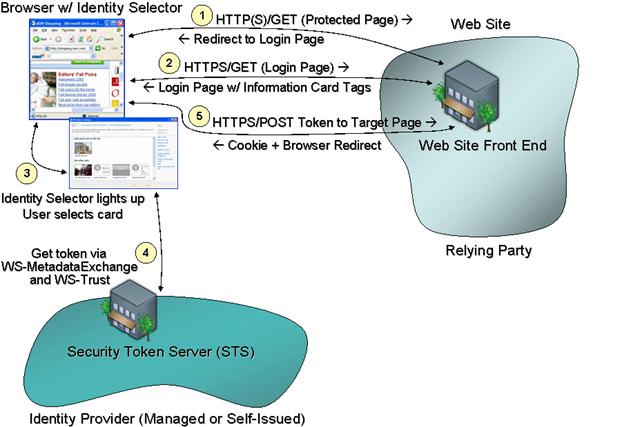
Figure 1.
Basic protocol flow when using an Information Card to authenticate at a Web
site
Figure 1 gives an
example of the basic protocol flow when an Information Card is used to
authenticate at a Web site that employs no Relying Party STS. Steps 1, 2, and
5 are essentially the same as a typical forms-based login today: (1) The user
navigates to a protected page that requires authentication. (2) The site
redirects the browser to a login page, which presents a Web form. (5) The
browser posts the Web form that includes the login credentials supplied by the
user back to the login page. The site then validates the contents of the form
including the user credentials, typically writes a client-side browser cookie
to the client for the protected page domain, and redirects the browser back to
the protected page.
The key difference
between this scenario and today’s site login scenarios is that the login page
returned to the browser in step (2) contains an HTML tag that allows the user
to choose to use an Information Card to authenticate to the site. When the user
selects this tag, the browser invokes an Identity Selector, which implements
the Information Card user experience and protocols, and triggers steps (3)
through (5).
In Step (3), the
browser Information Card support code invokes the Identity Selector, passing it
parameter values supplied by the Information Card HTML tag supplied by the site
in Step (2). The user then uses the Identity Selector to choose an Information
Card, which represents a Digital Identity that can be used to authenticate at
that site. Step (4) retrieves a Security Token that represents the Digital
Identity selected by the user from the STS at the Identity Provider for that
identity.
In Step (5), the
browser posts the token obtained back to the Web site using a HTTPS/POST. The
Web site validates the token, completing the user’s Information Card-based
authentication to the Web site. Following authentication, the Web site
typically then writes a client-side browser cookie and redirects the browser
back to the protected page.
It is worth noting
that this cookie is likely to be exactly the same cookie as the site
would have written back had the user authenticated via other means, such as a
forms-based login using username/password. This is one of the ways that the
goal of “minimal impact on Web sites” is achieved. Other than its
authentication subsystem, the bulk of a Web site’s code can remain completely
unaware that Information Card-based authentication is even utilized. It just
uses the same kinds of cookies as always.
In the previous
scenario, the Web site communicated with the client Identity Selector using
only the HTML extensions enabling Information Card use, transported over the
normal browser HTTPS channel. In this scenario, the Web site also employs a
Relying Party STS to do part of the work of authenticating the user, passing
the result of that authentication on to the login page via HTTPS POST.
There are several
reasons that a site might factor its solution this way. One is that the same Relying
Party STS can be used to do the authentication work for both browser-based
applications and smart client applications that are using Web services. Second,
it allows the bulk of the authentication work to be done on servers dedicated
to this purpose, rather than on the Web site front-end servers. Finally, this
means that the front-end servers can accept site-specific tokens, rather than
the potentially more general or more complicated authentication tokens issued
by the Identity Providers.

Figure 2.
Protocol flow when using an Information Card to authenticate
at a Web site, where the Web site employs a Relying Party STS
This scenario is
similar to the previous one, with the addition of steps (3) and (6). The
differences start with the Information Card information supplied to the browser
by the Web site in Step (2). In the previous scenario, the site encoded its
WS-SecurityPolicy information using Information Card HTML extensions and
supplied them to the Information Card-extended browser directly. In this
scenario, the site uses different Information Card HTML extensions in the Step
(2) reply to specify which Relying Party STS should be contacted to obtain the
WS-SecurityPolicy information.
In Step (3), the
Identity Selector contacts the Relying Party STS specified by the Web site and
obtains its WS-SecurityPolicy information via WS-MetadataExchange. In Step (4)
the Identity Selector user interface is shown and the user selects an
Information Card, which represents a Digital Identity to use at the site. In
Step (5), the Identity Provider is contacted to obtain a Security Token for the
selected Digital Identity. In Step (6), the Security Token is sent to the Web
site’s Relying Party STS to authenticate the user and a site-specific
authentication token is returned to the Identity Selector. Finally, in Step
(7), the browser posts the token obtained in Step (6) back to the Web site
using HTTPS/POST. The Web site validates the token, completing the user’s
Information Card-based authentication to the Web site. Following
authentication, the Web site typically then writes a client-side browser cookie
and redirects the browser back to the protected page.
The Information
Card user experience at Web sites is intended to be intuitive and natural
enough that users’ perspective on it will simply be “That’s how you log in”.
Today, Web sites that require authentication typically ask the user to supply a
username and password at login time. With Information Cards, they instead ask users
to choose an Information Card. Some sites will choose to accept only
Information Cards whereas others will give users the choice of Information
Cards or other forms of authentication.
A site that
accepts Information Cards typically has a login screen that contains button
with a label such as “Sign in with an Information Card” or “Log in
using an Information Card”. Upon clicking this button, the user is
presented with a choice of his Information Cards that are accepted at the site,
and is asked to choose one. Once a card is selected and submitted to the site,
the user is logged in and continues using the site, just as they would after
submitting a username and password to a site.
Sites that accept
both Information Cards and other forms of authentication present users with
both an Information Card login choice and whatever other choices the site
supports. For instance, a site login screen might display both “Sign in
with your username and password” and “Sign in with an Information Card”
buttons.
Very little
additional support is required from today’s Web browsers to also support
Information Cards. The main addition is that they must recognize special HTML
and/or XHTML tags for invoking the Identity Selector, pass encoded parameters
on to the Identity Selector on the platform, and POST back the token resulting
from the user’s choice of an Information Card.
Web sites that
employ Information Card-based authentication must support two new pieces of
functionality: adding HTML or XHTML tags to their login page to request an
Information Card-based login and code to log the user into the site using the
POSTed credentials. In response to the Information Card-based login, the Web
site typically writes the same client-side browser cookie that it would have if
the login had occurred via username/password authentication or other
mechanisms, and issue the same browser redirects. Thus, other than the code
directly involved with user authentication, the bulk of a Web site can remain
unchanged and oblivious to the site’s acceptance of Information Cards as a
means of authentication.
HTML extensions
are used to signal to the browser when to invoke the Identity Selector.
However, not all HTML extensions are supported by all browsers, and some
commonly supported HTML extensions are disabled in browser high security
configurations. For example, while the OBJECT tag is widely supported, it is also
disabled by high security settings on some browsers, including Internet
Explorer.
An alternative is
to use an XHTML syntax that is not disabled by changing browser security
settings. However, not all browsers provide full support for XHTML.
To address this
situation, two HTML extension formats are specified. Browsers may support one
or both of the extension formats.
An example of the
OBJECT syntax is as follows:
<html>
<head>
<title>Welcome to Fabrikam</title>
</head>
<body>
<img src='fabrikam.jpg'/>
<form name="ctl00" id="ctl00" method="post"
action="https://www.fabrikam.com/InfoCard-Browser/Main.aspx">
<center>
<img src='infocard_56x39.png' onClick='ctl00.submit()'/>
<input type="submit" name="InfoCardSignin"
value="Log in"
id="InfoCardSignin" />
</center>
<OBJECT type="application/x-informationCard"
name="xmlToken">
<PARAM Name="tokenType"
Value="urn:oasis:names:tc:SAML:1.0:assertion">
<PARAM Name="issuer" Value=
"http://schemas.xmlsoap.org/ws/2005/05/identity/issuer/self">
<PARAM Name="requiredClaims" Value=
"http://schemas.xmlsoap.org/ws/2005/05/identity/claims/emailaddress
http://schemas.xmlsoap.org/ws/2005/05/identity/claims/givenname
http://schemas.xmlsoap.org/ws/2005/05/identity/claims/surname">
</OBJECT>
</form>
</body>
</html>
This is an example
of a page that requests that the user log in using an Information Card. The
key portion of this page is the OBJECT of type “application/x-informationCard”. Once a card is selected by the user, the resulting
Security Token is included in the resulting POST as the xmlToken value of the
form. Appendix A shows a sample POST resulting from
using a login page similar to the preceding one. If the user cancels the
authentication request, the resulting POST contains an empty xmlToken value.
Parameters of the
Information Card OBJECT are used to encode the required WS-SecurityPolicy
information in HTML. In this example, the Relying Party is requesting a SAML
1.0 token from a Self-issued Identity Provider, supplying the required claims “emailaddress”, “givenname”, and “surname”.
This example uses the basic protocol described in Section 2.1 (without employing a Relying Party STS).
A second example
of the OBJECT syntax is as follows:
<html>
<body>
<form name="ctl01" method="post"
action="https://www.fabrikam.com/InfoCard-Browser-STS/login.aspx"
id="ctl01" onSubmit="fnGetCard();">
<img src='infocard_56x39.png' onClick='ctl01.submit()'/>
<input type="submit" name="InfoCardSignin"
value="Log in"
id="InfoCardSignin" />
<OBJECT type="application/x-informationCard" name="xmlToken"
ID="oCard" />
</form>
<script type="text/javascript">
<!--
function fnGetCard(){
oCard.issuer = "http://www.fabrikam.com/sts";
oCard.issuerPolicy = "https://www.fabrikam.com/sts/mex";
oCard.tokenType = "urn:fabricam:custom-token-type";
}
//-->
</script>
</body>
</html>
This example uses
the enhanced protocol described in Section 2.3, which employs a Relying Party STS. Note that in this
case, the “issuer” points to a Relying Party STS. The “issuerPolicy” points to
an endpoint where the Security Policy of the STS (expressed via
WS-SecurityPolicy) is to be obtained using WS-MetadataExchange. Also, note
that the “tokenType” parameter requests a custom token type defined by the site
for its own purposes. The “tokenType” parameter could have been omitted as
well, provided that the Web site is capable of understanding all token types
issued by the specified STS or if the STS has prior knowledge about the token type
to issue for the Web site.
The object
parameters can be set in normal script code. This is equivalent to setting
them using the “PARAM” declarations in the previous example.
An example of the
XHTML syntax is as follows:
<html
xmlns="http://www.w3.org/1999/xhtml"
xmlns:ic="http://schemas.xmlsoap.org/ws/2005/05/identity">
<head>
<title>Welcome to Fabrikam</title>
</head>
<body>
<img src='fabrikam.jpg'/>
<form name="ctl00" id="ctl00" method="post"
action="https://www.fabrikam.com/InfoCard-Browser/Main.aspx">
<ic:informationCard name='xmlToken'
style='behavior:url(#default#informationCard)'
issuer="http://schemas.xmlsoap.org/ws/2005/05/identity/issuer/self"
tokenType="urn:oasis:names:tc:SAML:1.0:assertion">
<ic:add claimType=
"http://schemas.xmlsoap.org/ws/2005/05/identity/claims/emailaddress"
optional="false" />
<ic:add claimType=
"http://schemas.xmlsoap.org/ws/2005/05/identity/claims/givenname"
optional="false" />
<ic:add claimType=
"http://schemas.xmlsoap.org/ws/2005/05/identity/claims/surname"
optional="false" />
</ic:informationCard>
<center>
<input type="submit" name="InfoCardSignin"
value="Log in"
id="InfoCardSignin" />
</center>
</form>
</body>
</html>
The parameters to
the OBJECT and XHTML Information Card objects are used to encode information in
HTML that is otherwise supplied as WS-SecurityPolicy information via
WS-MetadataExchange when an Identity Selector is used in a Web services
context.
This parameter
specifies the URL of the STS from which to obtain a token. If omitted, no specific
STS is requested. The special value “http://schemas.xmlsoap.org/ws/2005/05/identity/issuer/self” specifies that the token should come
from a Self-issued Identity Provider.
This parameter
specifies the URL of an endpoint from which the STS’s WS-SecurityPolicy can be
retrieved using WS-MetadataExchange. This endpoint must use HTTPS.
This parameter
specifies the type of the token to be requested from the STS as a URI. This
parameter can be omitted if the STS and the Web site front-end have a mutual
understanding about what token type will be provided or if the Web site is
willing to accept any token type.
This parameter
specifies the types of claims that must be supplied by the identity. If
omitted, there are no required claims. The value of requiredClaims is a space-separated list of URIs, each specifying a
required claim type.
This parameter
specifies the types of optional claims that may be supplied by the identity.
If omitted, there are no optional claims. The value of optionalClaims is a space-separated list of URIs, each specifying a
claim type that can be optionally submitted.
This parameter
specifies the URL of the human-readable Privacy Policy of the site, if
provided.
This parameter
specifies the Privacy Policy version. This must be a value greater than 0 if a
privacyUrl is specified. If this value changes, the UI notifies the user and
allows them review the change to the Privacy Policy.
The object used in
the Information Card HTML extensions has the following type signature, allowing
it to be used by normal scripting code:
interface
IInformationCardSigninHelper
{
string issuer; // URI specifying token issuer
string issuerPolicy; // MetadataExchange endpoint of issuer
string tokenType; // URI specifying type of token to be requested
string [] requiredClaims; // Array of required claims
string [] optionalClaims; // Array of optional claims
string privacyUrl; // URL of the Privacy Policy of the site
string privacyVersion; // Version number of the Privacy Policy
boolean isInstalled; // True when an Identity Selector is available
// to the browser
}
Web sites may
choose to detect browser and Identity Selector support for Information Cards
and modify their login page contents depending upon whether Information Card
support is present, and which of the OBJECT and/or XHTML syntaxes are supported
by the browser and supported by the Web site. This allows Information Card
capabilities to be shown when available to the user, and to be not displayed
otherwise.
Detecting an
Information Card-enabled browser may require detecting specific browser and
Identity Selector versions and being aware of the nature of their Information
Card support.
When the object tag
is specified in an embedded frame, the certificate of the frame is compared to
that of the root frame. For this configuration to work, the scheme, domain, and
security zone (for example https, microsoft.com, and Intranet) of the URL of
the embedded frame must be the same as that of the root frame. If they do not match, the object
tag should not be acted upon. This prevents a form of cross-site scripting
attacks.
In addition to
being invokable using static HTML tags and script code, Identity Selectors can
be invoked from script injected into the page using the Document Object Model [DOM]. Invocation from dynamically generated script allows the
Web site’s requirements to be set dynamically.
·
Auditing Card: When a managed card with an ic:RequireAppliesTo element and no Optional
attribute or Optional=false attribute is used at a Web site, the
Request Security Token (RST) sent to the Identity Provider contains a wsp:AppliesTo element.
·
Non-Auditing
Card: When a managed
card with no ic:RequireAppliesTo element is used at a Web site, the
Request Security Token (RST) sent to the Identity Provider contains no wsp:AppliesTo element.
·
Auditing-Optional
Card: When a managed
card with an ic:RequireAppliesTo element with Optional=true attribute is used at a Web site, the Request Security
Token (RST) sent to the Identity Provider contains a wsp:AppliesTo element.
This section adds the wsid:Identity
property to an Endpoint Reference [WS-Addressing] and leverages extensibility
of the wsa:EndpointReferenceType
schema to include a wsid:Identity
element as described below:
<wsa:EndpointReference>
...
<wsid:Identity>...Claim...</wsid:Identity>
...
</wsa:EndpointReference>
The Identity element inside wsa:EndpointReference
can hold any of the claims defined in Section 12.2 below.
If an EndpointReference does not contain an Identity
element, a DNS Name claim can be assumed by extracting the hostname from the
Address URI.
If the URI does
not have a hostname, it does not have an implicit identity value and can not be
verified by the mechanisms defined in this document.
The DNS Name claim implies that the remote principal is
trusted to speak for that DNS name. For instance the DNS Name claim could
specify “fabrikam.com”. When challenged, the endpoint contacted must be able to
prove its right to speak for “fabrikam.com”. The service could prove its right
by proving ownership of a certificate containing a reference to fabrikam.com
and signed by a trusted Certificate Authority (e.g. VeriSign). The following
element of type xs:string can be used to represent a DNS Name claim within a wsid:Identity element.
<wsid:Dns>fabrikam.com</wsid:Dns>
The SPN claim implies that the remote principal is trusted
to speak for that SPN, a mechanism common in intranet domains. Its format is
<serviceClass>/<host>. For example, the SPN for a generic service
running on “server1.fabrikam.com” would be “host/server1.fabrikam.com”. The
client could confidentially speak to the service and verify replies back from
the service by obtaining a Kerberos ticket from the realm’s domain controller.
The following element of type xs:string can be used to represent an SPN claim
within a wsid:Identity element.
<wsid:Spn>host/hrweb</wsid:Spn>
The UPN claim implies that the remote principal is a
particular user in a domain. Its format is: <user>@<domain>. For
example, the UPN for a user “someone” at a domain “example.com” would be
“someone@example.com”. A service could prove its UPN by providing the password
for the user associated with “someone@example.com”. The following element of
type xs:string can be used to represent a UPN claim within a wsid:Identity element.
<wsid:Upn>someone@example.com</wsid:Upn>
This identity
value is similar to the previous three, but rather than describing an attribute
of the target, this mechanism describes a reference (embedded or external) to
key material associated with the target. This allows confirmation of the target
trust identity through encryption. These values can also be used to compare
authenticated identities similar to the basic trust identity values by
comparing the hash of the specified trust identity value with a hash of the
authenticated identity of the service. The ds:KeyInfo element defined in [XML
Signature] can be used.
<ds:KeyInfo>...</ds:KeyInfo>
The PublicKey claim states the public key of the remote
principal. A service could prove its ownership of the key by signing some data
with the private key.
<wsid:Identity>
<ds:KeyInfo>
<ds:RSAKeyValue>
<ds:Modulus>xA7SEU+e0yQH5...</ds:Modulus>
<ds:Exponent>AQAB</ds:Exponent>
</ds:RSAKeyValue>
</ds:KeyInfo>
</wsid:Identity>
This example shows a certificate of the remote principal
being used as the identity value.
<wsid:Identity>
<ds:KeyInfo>
<ds:X509Data>
<ds:X509Certificate>MIICXTCCA...</ds:X509Certificate>
</ds:X509Data>
</ds:KeyInfo>
</wsid:Identity>
A security token
can be an identity value representing claims about the identity of an endpoint.
E.g.:
<wsid:Identity>
<wsse:BinarySecurityToken ValueType="...#X509v3">
<!--base64 encoded value of the X509 certificate-->
</wsse:BinarySecurityToken>
</wsid:Identity>
Similarly to
ds:KeyInfo, wsse:SecurityTokenReference element can be used within
wsid:Identity element to reference a token representing collection of claims
about the identity of an endpoint. E.g.:
<wsid:Identity>
<wsse:SecurityTokenReference>
<wsse:KeyIdentifier ValueType="...#ThumbprintSHA1">
<!-- thumbprint of the X509 certificate -->
</wsse:KeyIdentifier>
</wsse:SecurityTokenReference>
</wsid:Identity>
13
Security Considerations
13.1 Protection of Information Cards by Identity Selectors
It is recommended
that Identity Selectors encrypt or otherwise secure the Information Card data
held by them to help protect cards from being stolen and then used by an
attacker. This is particularly important for self-issued Information Cards,
where possession of the unencrypted contents of a card could enable an attacker
to gain access to Relying Parties accounts associated with that card.
13.2 Relying Parties Without Certificates
Because claims
sent to relying parties without certificates are not encrypted, it is
recommended that sensitive claims not be released to these relying parties.
Identity Providers holding sensitive user data that can be released as claim
values are encouraged to issue cards containing an ic07:RequireStrongRecipientIdentity element to prevent transmission of
sensitive claim values over an unencrypted channel.
13.3 Endpoint References
It is recommended
that Endpoint Reference elements be signed to prevent tampering.
An Endpoint
Reference should not be accepted unless it is signed and have an associated
security token to specify the signer has the right to “speak for” the endpoint.
That is, the relying party should not use an endpoint reference unless the
endpoint reference is signed and presented with sufficient credentials to pass
the relying parties acceptance criteria.
It is recommended
that an endpoint reference be encrypted when it contains claims and other
sensitive information.
When included in a SOAP message, endpoint references are
recommended to be protected using the mechanisms described in WS-Security
[WS-Security]
An implementation
conforms to this specification if it satisfies all of the MUST or
REQUIRED level requirements defined within this specification for the portions
of the specification implemented by that implementation. Furthermore, when an implementation
supports functionality in which there is a RECOMMENDED algorithm or set of
parameter choices, conforming implementations MUST support the RECOMMENDED
algorithm and parameter choices. A SOAP Node MUST NOT use the XML namespace
identifiers for this specification (listed in Section 1.2) within SOAP Envelopes unless it is compliant with this
specification.
This specification
references a number of other specifications. In order to comply with this
specification, an implementation MUST implement the portions of referenced
specifications necessary to comply with the required provisions of the portions
of this specification that it implements. Additionally, the implementation of
the portions of the referenced specifications that are specifically cited in
this specification MUST comply with the rules for those portions as established
in the referenced specification.
Additionally,
normative text within this specification takes precedence over normative
outlines (as described in Section 1.1), which in turn take precedence over the XML Schema [XML
Schema Part 1, Part 2] and WSDL [WSDL
1.1] descriptions.
That is, the normative text in this specification further constrains the
schemas and/or WSDL that are part of this specification; and this specification
contains further constraints on the elements defined in referenced schemas.
If an OPTIONAL message is not supported, then the
implementation SHOULD Fault just as it would for any other
unrecognized/unsupported message. If an OPTIONAL message is supported, then the
implementation MUST satisfy all of the MUST and REQUIRED sections of the
message.
The contents of an HTTPS POST
generated by a page like the first example in Section 4.1.1 follow:
POST
/test/s/TokenPage.aspx HTTP/1.1
Cache-Control:
no-cache
Connection:
Keep-Alive
Content-Length:
6478
Content-Type:
application/x-www-form-urlencoded
Accept:
image/gif, image/x-xbitmap, image/jpeg, image/pjpeg, application/x-sh
ockwave-flash,
*/*
Accept-Encoding:
gzip, deflate
Accept-Language:
en-us
Host:
calebb-tst
Referer:
https://localhost/test/s/
User-Agent:
Mozilla/4.0 (compatible; MSIE 7.0; Windows NT 5.1; .NET CLR
2.0.50727;
.NET CLR 3.0.04506.30)
UA-CPU:
x86
InfoCardSignin=Log+in&xmlToken=%3Cenc%3AEncryptedData+Type%3D%22http%3A%2F%2F
www.w3.org%2F2001%2F04%2Fxmlenc%23Element%22+xmlns%3Aenc%3D%22http%3A%2F%2Fww
w.w3.org%2F2001%2F04%2Fxmlenc%23%22%3E%3Cenc%3AEncryptionMethod+Algorithm%3D%
22http%3A%2F%2Fwww.w3.org%2F2001%2F04%2Fxmlenc%23aes256-cbc%22+%2F%3E%3CKeyIn
fo+xmlns%3D%22http%3A%2F%2Fwww.w3.org%2F2000%2F09%2Fxmldsig%23%22%3E%3Ce%3AEn
cryptedKey+xmlns%3Ae%3D%22http%3A%2F%2Fwww.w3.org%2F2001%2F04%2Fxmlenc%23%22%
3E%3Ce%3AEncryptionMethod+Algorithm%3D%22http%3A%2F%2Fwww.w3.org%2F2001%2F04%
2Fxmlenc%23rsa-oaep-mgf1p%22%3E%3CDigestMethod+Algorithm%3D%22http%3A%2F%2Fww
w.w3.org%2F2000%2F09%2Fxmldsig%23sha1%22+%2F%3E%3C%2Fe%3AEncryptionMethod%3E%
3CKeyInfo%3E%3Co%3ASecurityTokenReference+xmlns%3Ao%3D%22http%3A%2F%2Fdocs.oa
sis-open.org%2Fwss%2F2004%2F01%2Foasis-200401-wss-wssecurity-secext-1.0.xsd%2
2%3E%3Co%3AKeyIdentifier+ValueType%3D%22http%3A%2F%2Fdocs.oasis-open.org%2Fws
s%2Foasis-wss-soap-message-security-1.1%23ThumbprintSHA1%22+EncodingType%3D%2
2http%3A%2F%2Fdocs.oasis-open.org%2Fwss%2F2004%2F01%2Foasis-200401-wss-soap-m
essage-security-1.0%23Base64Binary%22%3E%2BPYbznDaB%2FdlhjIfqCQ458E72wA%3D%3C
%2Fo%3AKeyIdentifier%3E%3C%2Fo%3ASecurityTokenReference%3E%3C%2FKeyInfo%3E%3C
e%3ACipherData%3E%3Ce%3ACipherValue%3EEq9UhAJ8C9K5l4Mr3qmgX0XnyL1ChKs2PqMj0Sk
6snw%2FIRNtXqLzmgbj2Vd3vFA4Vx1hileSTyqc1kAsskqpqBc4bMHT61w1f0NxU10HDor0DlNVcV
Dm%2FAfLcyLqEP%2Boh05B%2B5ntVIJzL8Ro3typF0eoSm3S6UnINOHIjHaVWyg%3D%3C%2Fe%3AC
ipherValue%3E%3C%2Fe%3ACipherData%3E%3C%2Fe%3AEncryptedKey%3E%3C%2FKeyInfo%3E
%3Cenc%3ACipherData%3E%3Cenc%3ACipherValue%3ErBvpZydiyDzJtzl1%2FjUFX9XAzO1mOR
q0ypPLjh%2FBagXcfZeYwWD57v4Jvn1QwGajadcDASCisazswn1skdkwgmd4IUWJpPMRH7es9zY0U
vnS4ccsakgDcmscq3pDYTrxbSBfhdvrzjDiHC2XCtowOveoHeB51C5N8UAbff18IxCNtkWO8y3wLH
VGdvwaDOSakK%2FK%2Fv1UgXIc51%2FtYvjeFGeGbbSNxo8DTqeDnAMQ%2B4Y%2B1aUGhI%2FtbSr
EyJECkDgtztcxhrumbupKO%2BogWKUTTpSt851xjOFxAMiVaPZ%2FAm8V8H3ZLsR087sX%2FJ%2Bn
bRqze%2BfbdUwimN5pNoJDdMnF%2BEDLass1dPsvhL4EXzuIp5deGBaqAIoaOMEUW7ssuh1PtwkEM
eqwlOzOhu%2FHtwP1qh3D02U59MtyQnJMD5UwIwO7sZJl6%2BPg6Zp9HHtKKUMnkguvFmhyXS4BFS
ZVxPl18i%2B0MLO1um5dejEFd4nwGO%2FmNw6yEI8DdGVjXcYOT6JhPz9rHNh9%2F%2FOj5snJfL6
j2sg0EvIYoRs%2BhT4sdHZ95tGAiwMwT6cFOXbAQZUbYTr1ZOC6XPsfL2CFwiTM3mI%2Blco4Hc%2
F7IakIA8jwAJdtnd2mGuV67ZbY1mzibM1LUApixZj59El83ixctSQbV7iyywQ4IYN2CAq%2BCLMdl
R%2BDHfgEe8O3IVaGBDUEcd2MYimEiA7Yw3NIDrC14SbLzNvU702HpVJMeYv9q6S9xIVGApSrARsw
RFXyMbkMDp5WIQaJEXon7qLcsZONpdlX9bCcmaiikdpxmCeyS638te%2FhGBLmYJSQ0stf7BhA6E0
kwDRgdwsAa88bODiWHek0vDhAN4HlXFZ%2BCxp53L9Mmvy%2FCAOI%2B9OkPL2yxS22yjWQxom%2F
yZuawsK98JHVShsIVmmbKvRM6xJwvHDSzuBAOlQKS%2FMHcFZn8vHZR4lMhm5nL3F%2B%2BumMKh0
vMuKk6JiCqG9OEj996bVIIkLzESU5Z5vT6I1Kr9Brdx8ckDElipdH3x54WVfaItHJTYU%2BsxIR1T
25fi9k%2FOc%2FMX7Q%2B6NSDs4nGqkn4rzqpez9BUWNZw7caVOrDeao85f%2FiDCGymtl0A3JaSZ
dTKfzHLGmUfSkCAlVeisdvB6R7uBw8tR%2BZlgLIGS28wppFlnUYvSK7DnPrzId%2BGfHwLfL6WA%
2FEzBMMgppb5Vi%2BauHq%2BHxpCamlkrcUkzagbwNkGV8TfafkqUvRwJbxRwNVPI%2F%2Fxs%2Fp
Lcu1dh6eKcmU00%2FNx0zNOScd9XoeEU3zsV78PgvPIBT4EDugdv4bMR6dExXvZBl%2F84b1gOMhK
ZRplF8t6EAc4LCct01ht7VOVNz25NtP27ct9QPrDJc%2FoxihT4Df6NV3l4vlTnu%2B%2BzVB%2BH
JAxNkiO9gx3uLUJM9XEZCDzZKihaBk2y%2F3RhsJpABVneUd%2B3sCRbQXhgKYNBHZyRAUGpMDLhL
qpjoF9x%2FNvUujQ5DBLJafxxzNVshG52jRz%2BikhCNhJDDbeA5MQ8Q7QsYcKDC0DBFsewtWaA%2
FsKxl3JU6hyTotnFS%2FoS2EzbOSvn25qZuBERsZ3w%2B5WMkRzfQadyIYOSv2Df1YoljubDKy1l9
St%2FbCIBgXbVIZKYtQ%2BLyepxxFjrN7cWo2aYFnB6YLurg4USJwhXzcGcvA3%2BR5dRT6Fr37U6
OcHc%2Fz2MaZmn1cQWiDGNxHtRVxEvirBc1x47hWfSRjrKzf3orL5LzgMlYc7Iwclw2rbeWljCqOb
oV3d71ez%2FvNz1pxEMi4w8yUAQL8p%2FRCZ%2BpzvsgORu4RWKWiSwbl7AN0J3jiWShyZgDmxd2O
DDYffXjNiuH1mQWnDTkJX1ig88mqjhOYJEal0W6L0ErwrRIy29tOiAvXZANC8kA1HexulH0e38x8E
IOaVaJtNz9mqrnmnp4GdZ38txV%2BCUeWHOZaHLF4xkdtRxMAu%2FbzQ03YmUOhgxqkTfNzV6Ymne
v2nv5VsyQGJaQsNjb0M4yOe6kX2qNTwKBN2%2Bp%2Fz3f15i8KuGCgBcfP%2BP9xBizBeo7FbFtyo
2pfFhzBPmZeSOJ6kEbF1yQKHYQAT5iZ4SyTIfqqmwGxsQpWMstx3qJF8aW8WFzU1qXcC1LmgClg19
rx9NYFaQshX4f729B9Ue5MX7gTrMgwAnlXty9BsoP7nzGbr3HSXy8pR%2BimuAFW3c2NaQSbjSH5Z
FOr7PZdLHsNVJzFIsaufAwr0CAEtvlPJUt7%2B%2FE5MQsMsVqMoXFmefgdxbvY1Ue6MX1wtuJYY1
PAX7MHTyRUR3RfJDO054EoflVTwNE1fmocUXUh5rtFFuzy2T%2F2Y6pLAARXzo8uslAuH67VkuXv%
2BEMc7e3ogbf5%2BROsgJirZS6qkcYpfEUwqHiQYLnSIP4bt%2BWI5j1bxs7yzcSCkNZ2rd%2FHWr
A41AyGMfYzqxfGcrOaxHsds3JUcByB5Zw17W58GBC32Iusqa69BFTPagEapM0Fb5CbTqXnWTNNB5J
t40BVZvLv3u5oy%2BBRaMKXZhwnbT2WUTp0Ebsn17xvte52B%2BLMlSWJn96Nl5thd%2Ft1D7PlWA
sUvpJAd0UHPizCkY8VIhcXTrsSyEwer2J2I9TQTUosmssFjoP8Lx9qMfXo0eGVmneV8kVBtu4J7N1
QmWfV%2B%2FK8vGbCwW3Gm%2FEUlOO4ZbbK39y0JgNQ7fshxHr5Hdtd%2F6S%2FQkb6NPVDwn7Srh
Y0diWujXz5QlIYBSN7vDfMun3yF%2BGbmMExZ8MkOthuYkgMS9qiFoJGUXGyELsJfxbzdcRE9iyJn
p88L4%2BCtcO3l2JxIhMAgxOZx42RfAiDV1Gbpa4f%2F0urmWQ2VK7uZ%2FlViVrGAJ2kpH0EfwYE
Mb2YYT8FFjogqEpDSJX48BLIh1TE4nMbqQVG1cksCGDc0XyGKaF5Z7Ikw493Xz0JQ0BZvaf2Kceb7
MUZlsU1DSHcQQ9X%2Bxu9RcgUePJEe9BgCMpZ5Kr6r43qyk79noBSgrsSkDhT5sg%2Fc20RHQB8OX
%2BC4r3XGQFWF2m2j0xTc%2Boy14xqUmSB2qJtuWGOXDJspejDRP1GIfFnqDFdqSO3%2FkV9AC5Ee
39iJGv8I%2B5nErtQao645bCytn4B2bJah8R2fXLs8Dd4%2BC2ykxVrLxTUmJaGqd2RK%2F6t1E47
l%2B90Vp4WEzC0CFXXt9XNqdVjo2bZsXbfKQgO2zT2q2qCsgwbxVzIF5y39R%2BrkSkX16uuz3q6w
n3I5RI9M8Hn3DCzzv6Ms4rYxYuiqxaIcb7DgjI2fk1bdyiiRjSxzpCHpK6CWjBD8DPQYdkqGr%2Bs
oWeSvHvPLMSDxEPzwlnaxysRXzKphHUeUa2CCqcpagux2mbKkwHSXemX9I3V3AhPePp5XI5eCRiy3
D4%2BcBXOydie94Nz9DIhW749hPiVD9CioAgyqgAzFwCxEEUCXKTzu9xXX4DXg9b3CUfGzwERtY7x
TGT2y%2F9i7r5Xs0lrKi9ftws4JO5v%2Be3WuAEtWv0w%2FVKCl1WwTbV9xtx%2B4RZQ3%2Fewvv%
2F0GqiiSrhiVBGuCDaQs7stwqfkF3vFgGXmmODGTIkIxvYm2fzcEfq4A6LRp5RkYyJyUTF87c56tn
Qa%2Bo3xeiX5WRJybpabrRou09vyWLdlkhcUaBElGWB7iYUJ9bCltByEdNZnuDV%2FXlfnmDARKp8
RVN028czIk57wQMuizgWrM6S9Ku20noDmLgbT554UBf7FnjRWOb%2FF9OJuPpUcARBPrfuqTcOsBq
tZr7AJl3zz%2F53mpyn9rgzw5gBLgkvrdbciabJOAacccTDEB5kEzCLuprC3SlVedhgY%2BMQ5%2F
xgN%2Faf3TtJiBKFvb1V37BlbXXGosnPFcoH8I0XbqW5FSsxmcnpg48poJcB7j5eHq7Y%2F01RLb4
iMmzNap4%2BFg2F3LrwOI0Wk7ueIjgFd5KJ1iTda1ivGU%2Fchr9aTNpM5HiLb2fDW0pZ%2FFBJcI
XxpT9eNY%2FpVj5pnTW2ubpPnBulPOQTLCi1EOxbl33wnhUIfnGiVWJdrls2j3GWgqOnrYUbP%2FX
tNJqIucnMYGqPbcGIF2QRuiwD%2FiTRMvCRCmdCsYE%2FaXjOMhskX7KYC%2B9iG%2FT1wQRbfHSK
WD%2Fpv450OVDsfc1Adq6FCr1LesDNTew%2FF8Z3SiHnWS76OVsNM2SB%2FhMP67iu5UWVkb3%2FQ
qCN0aosOPs2QX0XBCZFmN6p3FhFnXPbAbaGz9y6KzUiUxC03U0fZcToKl4y%2Bw0P4IvxpjVt4t8b
84Q9hiBxd5xu1%2BRE973a%2FyIWO%2Fit1MdUSmxWakxWuGxDnQxwkNCN7ekL%2FQ%2B6FItm86b
w9cc%2FMiI7q2fK7y7YAzM3tmamhF1%2FWJNj1lH0vh%2BhNehJlLlb4Z%2F9ZtxMWV4LVTyrFaF1
zyCEqcKUTk0jc%2FXDwyKZc%2FSV9EOoPk2fVnmzs3WkA74GB%2BWtjdvQjSmnJYtPkMNsikHw%2B
RyB1hTkYbn3iQ6BUiJ0v97j7MVZHxCa1KS3t2gx8H7ts6Tfy5il89xVUdiZwfj0w06g199qlAqUMZ
EWxh0%3D%3C%2Fenc%3ACipherValue%3E%3C%2Fenc%3ACipherData%3E%3C%2Fenc%3AEncryp
tedData%3E
An un-escaped and
reformatted version of the preceding xmlToken value, with the encrypted value
elided, is as follows:
<enc:EncryptedData
Type="http://www.w3.org/2001/04/xmlenc#Element" xmlns:enc=
"http://www.w3.org/2001/04/xmlenc#">
<enc:EncryptionMethod
Algorithm="http://www.w3.org/2001/04/xmlenc#aes256-cbc"
/>
<KeyInfo
xmlns="http://www.w3.org/2000/09/xmldsig#">
<e:EncryptedKey
xmlns:e="http://www.w3.org/2001/04/xmlenc#">
<e:EncryptionMethod
Algorithm="http://www.w3.org/2001/04/xmlenc#rsa-oaep-mgf1
p">
<DigestMethod
Algorithm="http://www.w3.org/2000/09/xmldsig#sha1" />
</e:EncryptionMethod>
<KeyInfo>
<o:SecurityTokenReference
xmlns:o="http://docs.oasis-open.org/wss/2004/01/oas
is-200401-wss-wssecurity-secext-1.0.xsd">
<o:KeyIdentifier
ValueType="http://docs.oasis-open.org/wss/oasis-wss-soap-mes
sage-security-1.1#ThumbprintSHA1"
EncodingType="http://docs.oasis-open.org/ws
s/2004/01/oasis-200401-wss-soap-message-security-1.0#Base64Binary">
+PYbznDaB/dlhjIfqCQ458E72wA=
</o:KeyIdentifier>
</o:SecurityTokenReference>
</KeyInfo>
<e:CipherData>
<e:CipherValue>
Eq9UhAJ8C9K5l4Mr3qmgX0XnyL1ChKs2PqMj0Sk6snw/IRNtXqLzmgbj2Vd3vFA4Vx1hileSTyqc1
kAsskqpqBc4bMHT61w1f0NxU10HDor0DlNVcVDm/AfLcyLqEP+oh05B+5ntVIJzL8Ro3typF0eoSm
3S6UnINOHIjHaVWyg=
</e:CipherValue>
</e:CipherData>
</e:EncryptedKey>
</KeyInfo>
<enc:CipherData>
<enc:CipherValue>
...=
</enc:CipherValue>
</enc:CipherData>
</enc:EncryptedData>
The following individuals have participated in the creation
of this specification and are gratefully acknowledged:
Original Authors of the initial contributions:
Arun Nanda, Microsoft Corporation
Michael B. Jones, Microsoft
Corporation
Jan Alexander, Microsoft
Giovanni Della-Libera, Microsoft
Martin Gudgin, Microsoft
Kirill Gavrylyuk, Microsoft
Tomasz Janczuk, Microsoft
Michael McIntosh, IBM
Anthony Nadalin, IBM
Bruce Rich, IBM
Doug Walter, Microsoft
Participants:
John Bradley, Individual
Norman Brickman, Mitre Corporation
Jeffrey Broberg, CA
Scott Cantor Internet2
Ruchith Fernando, WSO2
Marc Goodner, Microsoft Corporation (Chair)
Patrick Harding, Ping Identity
Andrew Hodgkinson, Novell
Mario Ivkovic, A-SIT, Zentrum für Sichere
Informationstechnologie - Austria
Michael B. Jones, Microsoft Corporation (Editor)
Mike Kirkwood, Polka Networks
Herbert Leitold, A-SIT, Zentrum für Sichere
Informationstechnologie - Austria
Michael McIntosh, IBM (Editor)
Dale Olds, Novell
Anthony Nadalin, IBM (Chair)
Drummond Reed, Cordance
Bruce Rich ,IBM
Darran Rolls, SailPoint Technologies
Prabath Siriwardena, WSO2
|
Revision
|
Date
|
Editor
|
Changes Made
|
|
cd-02
|
2009-02-19
|
Michael B. Jones
|
Added conformance statement about RECOMMENDED algorithms.
Updated IP/STS PPID calculation recommendation. Corrected ic:IssuerId computation description.
|
|
ed-06
|
2009-02-16
|
Michael B. Jones
|
Changed crypto algorithm language statements from MUST to
RECOMMENDED, to potentially allow alternative algorithms to be used in the
future. Usage of other algorithms is not described.
|
|
ed-05
|
2009-02-04
|
Michael B. Jones
|
Document capability to retrieve metadata with HTTPS GET.
First drafts of complete Security Considerations and Conformance sections.
|
|
ed-04
|
2009-01-12
|
Michael B. Jones
|
Use OASIS-format namespace URI. Added clarifications
about the use of ClientPseudonym in PPID computations, support for the ic:IssuerId element, and self-issued
card support for the PPID claim. Added participant names.
|
|
cd-01
|
2008-11-10
|
Michael B. Jones
|
Created first committee draft from ed-03.
|
|
ed-03
|
2008-11-07
|
Michael B. Jones
|
Rationalized namespace prefixes and references. Clarified
that cards have a 3:2 aspect ratio and a recommended size of 120x80.
|
|
ed-02
|
2008-10-24
|
Michael B. Jones
|
Rationalized content from the different input documents.
|
|
ed-01
|
2008-10-15
|
Marc Goodner
|
Initial conversion of input documents to OASIS format.
|