WS-Policy defines a
framework for allowing web services to express their constraints
and requirements. Such constraints and requirements are expressed
as policy assertions. This document defines a set of security
policy assertions for use with the [WS-Policy] framework with respect to security
features provided in WSS: SOAP Message Security [WSS10, WSS11], [WS-Trust] and [WS-SecureConversation].
The assertions
defined within this specification have been designed to work
independently of a specific version of WS-Policy. At the time of
the publication of this specification the versions of WS-Policy
known to correctly compose with this specification are WS-Policy
1.2 and 1.5. Within this specification the use of the namespace
prefix wsp refers generically to the WS-Policy namespace, not a
specific version. This document takes the
approach of defining a base set of assertions that describe how
messages are to be secured. Flexibility with respect to token
types, cryptographic algorithms and mechanisms used, including
using transport level security is part of the design and allows for
evolution over time. The intent is to provide enough information
for compatibility and interoperability to be determined by web
service participants along with all information necessary to
actually enable a participant to engage in a secure exchange of
messages.
Sections 11, 12 and all examples and all Appendices are
non-normative.
Table 1 shows an "Effective
Policy" example, including
binding assertions and associated property assertions, token
assertions and integrity and confidentiality assertions. This
example has a scope of [Endpoint Policy Subject], but for brevity
the attachment mechanism is not shown.
Table 1: Example security
policy.
(01) <wsp:Policy
xmlns:wsp="..." xmlns:sp="...">
(02) <sp:SymmetricBinding>
(03) <wsp:Policy>
(04) <sp:ProtectionToken>
(05) <wsp:Policy>
(06) <sp:Kerberos
sp:IncludeToken=".../IncludeToken/Once" />
(07) <wsp:Policy>
(08) <sp:WSSKerberosV5ApReqToken11/>
(09) <wsp:Policy>
(10) </sp:Kerberos>
(11) </wsp:Policy>
(12) </sp:ProtectionToken>
(13) <sp:SignBeforeEncrypting
/>
(14) <sp:EncryptSignature
/>
(15) </wsp:Policy>
(16) </sp:SymmetricBinding>
(17) <sp:SignedParts>
(18) <sp:Body/>
(19) <sp:Header
Namespace="http://schemas.xmlsoap.org/ws/2004/08/addressing"
/>
(20) </sp:SignedParts>
(21) <sp:EncryptedParts>
(22) <sp:Body/>
(23) </sp:EncryptedParts>
(24) </wsp:Policy>
Line
1 in Table
1 indicates
that this is a policy statement and that all assertions contained
by the wsp:Policy element are required to be satisfied. Line 2
indicates the kind of security binding in force. Line 3 indicates a
nested wsp:Policy element which contains
assertions that qualify the behavior of the SymmetricBinding
assertion. Line 4 indicates a ProtectionToken assertion. Line 5
indicates a nested wsp:Policy element which contains
assertions indicating the type of token to be used for the
ProtectionToken. Lines 6 to 10 indicate that a Kerberos V5 APREQ
token is to be used by both parties in a message exchange for
protection. Line 13 indicates that signatures are generated over
plaintext rather than ciphertext. Line 14 indicates that the
signature over the signed messages parts is required to be
encrypted. Lines 17-20 indicate which message parts are to be
covered by the primary signature; in this case the soap:Body
element, indicated by Line 18 and any SOAP headers in the
WS-Addressing namespace, indicated by line 19. Lines 21-23 indicate
which message parts are to be encrypted; in this case just the
soap:Body element, indicated by Line 22.
The
XML namespace URI that MUST be used by implementations of this
specification is:
http://docs.oasis-open.org/ws-sx/ws-securitypolicy/200702
Table 2 lists XML namespaces that
are used in this specification. The choice of any namespace prefix
is arbitrary and not semantically significant.
Table 2: Prefixes and XML
Namespaces used in this specification.
A normative copy of the
XML Schema [XML-Schema1, XML-Schema2] description for this
specification can be retrieved from the following
address:
http://docs.oasis-open.org/ws-sx/ws-securitypolicy/200702/ws-securitypolicy-1.2.xsd
Policy - A
collection of policy alternatives.
Policy
Alternative - A collection of policy
assertions.
Policy
Assertion - An individual
requirement, capability, other property, or a behavior.
Initiator - The role sending the
initial message in a message exchange.
Recipient - The targeted role to
process the initial message in a message exchange.
Security
Binding -
A set of properties that together provide enough information to
secure a given message exchange.
Security Binding
Property - A particular aspect of
securing an exchange of messages.
Security Binding
Assertion - A policy assertion that
identifies the type of security binding being used to secure an
exchange of messages.
Security Binding Property
Assertion- A
policy assertion that specifies a particular value for a particular
aspect of securing an exchange of message.
Assertion
Parameter - An element of
variability within a policy assertion.
Token Assertion
-Describes a token
requirement. Token assertions defined within a security binding are
used to satisfy protection requirements.
Supporting
Token - A
token used to provide additional claims.
The key words
“MUST”, “MUST NOT”, “REQUIRED”,
“SHALL”, “SHALL NOT”, “SHOULD”,
“SHOULD NOT”, “RECOMMENDED”,
“MAY”, and “OPTIONAL” in this document are
to be interpreted as described in.
This specification uses
the following syntax to define outlines for assertions:
- The syntax appears as an
XML instance, but values in italics indicate data types instead of
literal values.
- Characters are appended to
elements and attributes to indicate cardinality:
-
- "?" (0 or 1)
- "*" (0 or
more)
- "+" (1 or
more)
- The character "|" is used
to indicate a choice between alternatives.
- The characters "(" and ")"
are used to indicate that contained items are to be treated as a
group with respect to cardinality or choice.
- The characters "[" and "]"
are used to call out references and property names.
- Ellipses (i.e., "...")
indicate points of extensibility. Additional children and/or
attributes MAY be added at the indicated extension points but MUST
NOT contradict the semantics of the parent and/or owner,
respectively. By default, if a receiver does not recognize an
extension, the receiver SHOULD ignore the extension; exceptions to
this processing rule, if any, are clearly indicated
below.
- XML namespace prefixes
(see Table
2) are used
to indicate the namespace of the element being defined.
Elements and
Attributes defined by this specification are referred to in the
text of this document using XPath 1.0 expressions. Extensibility
points are referred to using an extended version of this
syntax:
- An element extensibility
point is referred to using {any} in place of the element name. This
indicates that any element name can be used, from any namespace
other than the namespace of this specification.
- An attribute extensibility
point is referred to using @{any} in place of the attribute name.
This indicates that any attribute name can be used, from any
namespace other than the namespace of this
specification.
Extensibility points in
the exemplar may not be described in the corresponding
text.
In
this document reference is made to the wsu:Idattribute and the
wsu:Created and wsu:Expires elements in a utility
schema (
http://docs.oasis-open.org/wss/2004/01/oasis-200401-wss-wssecurity-utility-1.0.xsd). The wsu:Idattribute and the
wsu:Created and wsu:Expires elements were added to the
utility schema with the intent that other specifications requiring
such an ID type attribute or timestamp element could reference it
(as is done here).
WS-SecurityPolicy is
designed to work with the general Web Services framework including
WSDL service descriptions, UDDI businessServices and
bindingTemplates and SOAP message structure and
message processing model, and WS-SecurityPolicy should be
applicable to any version of SOAP. The current
SOAP 1.2 namespace URI is used
herein to provide detailed examples, but there is no intention to
limit the applicability of this specification to a single version
of SOAP.
[RFC2119]
S. Bradner, "Key words for use in RFCs to Indicate Requirement
Levels", RFC 2119, Harvard University, March 1997.
http://www.ietf.org/rfc/rfc2119.txt
[SOAP]
W3C Note, "SOAP: Simple Object Access Protocol 1.1", 08 May
2000.
http://www.w3.org/TR/2000/NOTE-SOAP-20000508/
[SOAP12]
W3C Recommendation, "SOAP 1.2 Part 1: Messaging Framework", 24 June
2003.
http://www.w3.org/TR/2003/REC-soap12-part1-20030624/
[SOAPNorm]
W3C Working Group Note, "SOAP Version 1.2 Message
Normalization”, 8 October 2003.
http://www.w3.org/TR/2003/NOTE-soap12-n11n-20031008/
[URI]
T. Berners-Lee, R. Fielding, L. Masinter, "Uniform Resource
Identifiers (URI): Generic Syntax", RFC 3986, MIT/LCS, Day
Software, Adobe Systems, January 2005.
http://www.ietf.org/rfc/rfc3986.txt
[RFC2068]
IETF Standard, "Hypertext Transfer Protocol -- HTTP/1.1" January
1997
http://www.ietf.org/rfc/rfc2068.txt
[RFC2246]
IETF Standard, "The TLS Protocol", January 1999.
http://www.ietf.org/rfc/rfc2246.txt
[SwA]
W3C Note, “SOAP Messages with Attachments”, 11 December
2000
http://www.w3.org/TR/2000/NOTE-SOAP-attachments-20001211
[WS-Addressing]
W3C Recommendation, "Web Services Addressing (WS-Addressing)", 9
May 2006.
http://www.w3.org/TR/2006/REC-ws-addr-core-20060509
[WS-Policy]
W3C Member Submission "Web Services Policy 1.2 - Framework", 25
April 2006.
http://www.w3.org/Submission/2006/SUBM-WS-Policy-20060425/
W3C Candidate
Recommendation “Web Services Policy 1.5 –
Framework”, 28 February 2007
http://www.w3.org/TR/2007/CR-ws-policy-framework-20070228/
[WS-PolicyAttachment]
W3C Member Submission "Web Services Policy 1.2 - Attachment", 25
April 2006.
http://www.w3.org/Submission/2006/SUBM-WS-PolicyAttachment-20060425/
W3C Candidate
Recommendation “Web Services Policy 1.5 –
Attachment”, 28 February 2007
http://www.w3.org/TR/2007/CR-ws-policy-attach-20070228/
[WS-Trust]
OASIS Committee Draft, "WS-Trust
1.3", September
2006
http://docs.oasis-open.org/ws-sx/ws-trust/200512
[WS-SecureConversation]
OASIS Committee Draft, “WS-SecureConversation 1.3", September
2006
http://docs.oasis-open.org/ws-sx/ws-secureconversation/200512
[WSS10]
OASIS Standard, "OASIS Web Services Security: SOAP Message Security
1.0 (WS-Security 2004)", March 2004.
http://docs.oasis-open.org/wss/2004/01/oasis-200401-wss-soap-message-security-1.0.pdf
[WSS11]
OASIS Standard, "OASIS Web Services Security: SOAP Message Security
1.1 (WS-Security 2004)", February 2006.
http://www.oasis-open.org/committees/download.php/16790/wss-v1.1-spec-os-SOAPMessageSecurity.pdf
[WSS:UsernameToken1.0]
OASIS Standard, "Web Services Security: UsernameToken Profile",
March 2004
http://docs.oasis-open.org/wss/2004/01/oasis-200401-wss-username-token-profile-1.0.pdf
[WSS:UsernameToken1.1]
OASIS Standard, "Web Services Security: UsernameToken Profile 1.1",
February 2006
http://www.oasis-open.org/committees/download.php/16782/wss-v1.1-spec-os-UsernameTokenProfile.pdf
[WSS:X509Token1.0]
OASIS Standard, "Web Services Security X.509 Certificate Token
Profile", March 2004
http://docs.oasis-open.org/wss/2004/01/oasis-200401-wss-x509-token-profile-1.0.pdf
[WSS:X509Token1.1]
OASIS Standard, "Web Services Security X.509 Certificate Token
Profile", February 2006
http://www.oasis-open.org/committees/download.php/16785/wss-v1.1-spec-os-x509TokenProfile.pdf
[WSS:KerberosToken1.1]
OASIS Standard, “Web Services Security Kerberos Token Profile
1.1”, February 2006
http://www.oasis-open.org/committees/download.php/16788/wss-v1.1-spec-os-KerberosTokenProfile.pdf
[WSS:SAMLTokenProfile1.0]
OASIS Standard, “Web Services Security: SAML Token
Profile”, December 2004
http://docs.oasis-open.org/wss/oasis-wss-saml-token-profile-1.0.pdf
[WSS:SAMLTokenProfile1.1]
OASIS Standard, “Web Services Security: SAML Token Profile
1.1”, February 2006
http://www.oasis-open.org/committees/download.php/16768/wss-v1.1-spec-os-SAMLTokenProfile.pdf
[WSS:RELTokenProfile1.0]
OASIS Standard, “Web Services Security Rights Expression
Language (REL) Token Profile”, December 2004
http://docs.oasis-open.org/wss/oasis-wss-rel-token-profile-1.0.pdf
[WSS:RELTokenProfile1.1]
OASIS Standard, “Web Services Security Rights Expression
Language (REL) Token Profile 1.1”, February 2006
http://www.oasis-open.org/committees/download.php/16687/oasis-wss-rel-token-profile-1.1.pdf
[WSS:SwAProfile1.1]
OASIS Standard, “Web Services Security SOAP Messages with
Attachments (SwA) Profile 1.1”, February 2006
http://www.oasis-open.org/committees/download.php/16672/wss-v1.1-spec-os-SwAProfile.pdf
[XML-Encrypt]
W3C Recommendation, "XML Encryption Syntax and Processing", 10
December 2002.
http://www.w3.org/TR/2002/REC-xmlenc-core-20021210/
[XML-Signature]
W3C Recommendation, "XML-Signature Syntax and Processing", 12
February 2002.
http://www.w3.org/TR/2002/REC-xmlenc-core-20021210/
[XPATH]
W3C Recommendation "XML Path Language (XPath) Version 1.0", 16
November 1999.
http://www.w3.org/TR/1999/REC-xpath-19991116
[XML-Schema1]
W3C Recommendation, "XML Schema Part 1: Structures Second Edition",
28 October 2004.
http://www.w3.org/TR/2004/REC-xmlschema-1-20041028/
[XML-Schema2]
W3C Recommendation,
"XML Schema Part 2: Datatypes Second Edition", 28 October
2004.
http://www.w3.org/TR/2004/REC-xmlschema-2-20041028/
1.6 Non-Normative
References
None.
This
specification defines policy assertions for the security properties for
Web services. These assertions are primarily designed to
represent the
security characteristics defined in the WSS:
SOAP Message Security [WSS10] [WSS11], [WS-Trust] and [WS-SecureConversation]
specifications, but they can also be
used for describing security requirements at a more general or
transport-independent level.
The
primary goal of this specification is to define an initial set of
patterns or sets of assertions that represent common ways to
describe how messages are secured on a communication path.
The intent is to allow flexibility in terms of the tokens,
cryptography, and mechanisms used, including leveraging transport
security, but to be specific enough to ensure interoperability
based on assertion matching.
It
is a goal of the security policy model to leverage the WS-Policy
framework’s intersection algorithm for selecting policy
alternatives and the attachment mechanism for associating policy
assertions with web service artifacts. Consequently, wherever
possible, the security policy assertions do not use parameters or
attributes. This enables first-level, QName based assertion
matching without security domain-specific knowledge to be done at
the framework level. The first level matching is intended to
provide a narrowed set of policy alternatives that are shared by
the two parties attempting to establish a secure communication
path.
In
general, assertions defined in this specification allow additional
attributes, based on schemas, to be added on to the assertion
element as an extensibility mechanism but the WS-Policy framework
will not match based on these attributes. Attributes specified on
the assertion element that are not defined in this specification or
in WS-Policy are to be treated as informational
properties.
The
goal to provide richer semantics for combinations of security
constraints and requirements and enable first-level QName matching,
is enabled by the assertions defined in this specification being
separated into simple patterns: what parts of a message are being
secured (Protection Assertions), general aspects or pre-conditions
of the security (Conditional Assertions), the security mechanism
(Security Binding Assertions) that is used to provide the security,
the token types and usage patterns (Supporting Token Assertions)
used to provide additional claims, and token referencing and trust
options (WSS and Trust Assertions).
To
indicate the scope of protection, assertions identify message parts
that are to be protected in a specific way, such as integrity or
confidentiality protection, and are referred to as protection
assertions.
The
general aspects of security includes the relationships between or
characteristics of the environment in which security is being
applied, such as the tokens being used, which are for integrity or
confidentiality protection and which are supporting, the applicable
algorithms to use, etc.
The
security binding assertion is a logical grouping which defines how
the general aspects are used to protect the indicated parts.
For example, that an asymmetric token is used with a digital
signature to provide integrity protection, and that parts are
encrypted with a symmetric key which is then encrypted using the
public key of the recipient. At its simplest form, the
security binding restricts what can be placed in the wsse:Security header and the associated
processing rules.
The
intent of representing characteristics as assertions is so that
QName matching will be sufficient to find common alternatives and
so that many aspects of security can be factored out and
re-used. For example, it may be common that the mechanism is
constant for an endpoint, but that the parts protected vary by
message action.
Assertions may be used to
further qualify a specific aspect of another assertion. For
example, an assertion describing the set of algorithms to use may
qualify the specific behavior of a security binding. If the schema
outline below for an assertion type requires a nested policy
expression but the assertion does not further qualify one or more
aspects of the behavior indicated by the assertion type (i.e., no
assertions are needed in the nested policy expression), the
assertion MUST include an empty <wsp:Policy/> element. For
further information consult the section Policy Assertion Nesting of
[WS-Policy].
As
previously indicated, individual assertions are designed to be used
in multiple combinations. The binding represents common usage
patterns for security mechanisms. These Security Binding
assertions are used to determine how the security is performed and
what to expect in the wsse:Securityheader.
Bindings are described
textually and enforced programmatically. This specification
defines several bindings but others can be defined and agreed to
for interoperability if participating parties support
it.
A
binding defines the following security characteristics:
·
The minimum set of
tokens that will be used and how they are bound to messages. Note
that services might accept messages containing more tokens than
those specified in policy.
·
Any necessary key
transport mechanisms
·
Any required message
elements (e.g. timestamps) in the wsse:Security header.
·
The content and
ordering of elements in the wsse:Security header. Elements not
specified in the binding are not allowed.
·
Various parameters,
including those describing the algorithms to be used for
canonicalization, signing and encryption.
Together the above pieces
of information, along with the assertions describing conditions and
scope, provide enough information to secure messages between an
initiator and a recipient. A policy consumer has enough information
to construct messages that conform to the service's policy and to
process messages returned by the service. Note that a service may
choose to reject messages despite them conforming to its policy,
for example because a client certificate has been revoked. Note
also that a service may choose to accept messages that do not
conform to its policy.
The
following list identifies the bindings defined in this
specification. The bindings are identified primarily by the
style of encryption used to protect the message exchange. A later
section of this document provides details on the assertions for
these bindings.
·
TransportBinding
(Section 7.3)
·
SymmetricBinding
(Section 7.4)
·
AsymmetricBinding
(Section 7.5)
The
following sections discuss details of WS-Policy and
WS-PolicyAttachment relevant to this specification.
This
specification makes extensive use of nested policy assertions as
described in the
Policy Assertion
Nesting section of
WS-Policy.
WS-PolicyAttachment
defines various attachment points for policy. This section defines
properties that are referenced later in this document describing
the recommended or required attachment points for various
assertions. In addition, Appendix A
groups the various
assertions according to policy subject.
Note: This specification
does not define any assertions that have a scope of [Service Policy
Subject].
[Message Policy
Subject]
This property identifies a
Message Policy Subject [WS-PolicyAttachment]. WS-PolicyAttachment
defines seven WSDL [WSDL 1.1] policy attachment points with Message
Policy Subject:
wsdl:message
A policy expression
containing one or more assertions with Message Policy Subject MUST
NOT be attached to a wsdl:message.
wsdl:portType/wsdl:operation/wsdl:input,
./wsdl:output, or ./wsdl:fault
A policy expression
containing one or more assertions with Message Policy Subject MUST
NOT be attached to a descendant of wsdl:portType.
wsdl:binding/wsdl:operation/wsdl:input,
./wsdl:output, or ./wsdl:fault
A policy expression
containing one or more of the assertions with Message Policy
Subject MUST be attached to a descendant of
wsdl:binding.
[Operation Policy
Subject]
A
token assertion with Operation Policy Subject indicates usage of
the token on a per-operation basis:
wsdl:portType/wsdl:operation
A policy expression
containing one or more token assertions MUST NOT be attached to a
wsdl:portType/wsdl:operation.
wsdl:binding/wsdl:operation
A policy expression
containing one or more token assertions MUST be attached to a
wsdl:binding/wsdl:operation.
[Endpoint Policy
Subject]
A
token assertion instance with Endpoint Policy Subject indicates
usage of the token for the entire set of messages described for the
endpoint:
wsdl:portType
A policy expression
containing one or more assertions with Endpoint Policy Subject MUST
NOT be attached to a wsdl:portType.
wsdl:binding
A policy expression
containing one or more of the assertions with Endpoint Policy
Subject SHOULD be attached to a wsdl:binding.
wsdl:port
A policy expression
containing one or more of the assertions with Endpoint Policy
Subject MAY be attached to a wsdl:port
The
following assertions are used to identify what is being
protected and the level of protection provided. These assertions
SHOULD apply to [Message Policy Subject]. These assertions MAY apply
to [Endpoint Policy Subject] or [Operation Policy Subject]. Where
they apply to [Operation Policy Subject] they apply to all messages
of that operation. Where they apply to [Endpoint Policy Subject]
they apply to all operations of that endpoint.
Note
that when assertions defined in this section are present in a
policy, the order of those assertions in that policy has no effect
on the order of signature and encryption operations (see Section
6.3).
Two
mechanisms are defined for specifying the set of message parts to
integrity protect. One uses QNames to specify either message
headers or the message body while the other uses XPath expressions
to identify any part of the message.
4.1.1 SignedParts
Assertion
The
SignedParts assertion is used to specify the parts of the message
outside of security headers that require integrity protection. This
assertion can be satisfied using WSS: SOAP Message Security
mechanisms or by mechanisms out of scope of SOAP message security,
for example by sending the message over a secure transport protocol
like HTTPS. The binding specific token properties detail the
exact mechanism by which the protection is provided.
There MAY be multiple
SignedParts assertions present. Multiple SignedParts assertions
present within a policy alternative are equivalent to a single
SignedParts assertion containing the union of all specified message
parts. Note that this assertion does not require that a given part
appear in a message, just that if such a part appears, it requires
integrity protection.
Syntax
<sp:SignedParts xmlns:sp="..." ... >
<sp:Body />?
<sp:Header Name="xs:NCName"?
Namespace="xs:anyURI" ... />*
<sp:Attachments />?
...
</sp:SignedParts>
The
following describes the attributes and elements listed in the
schema outlined above:
/sp:SignedParts
This assertion specifies
the parts of the message that need integrity protection. If no
child elements are specified, all message headers targeted at the
UltimateReceiver role [SOAP12] or actor [SOAP11] and the body of
the message MUST be integrity protected.
/sp:SignedParts/sp:Body
Presence of this optional
empty element indicates that the entire body, that is the soap:Body
element, it's attributes and content, of the message needs to be
integrity protected.
/sp:SignedParts/sp:Header
Presence of this optional
element indicates a specific SOAP header, its attributes and
content (or set of such headers) needs to be protected. There may
be multiple sp:Header elements within a single sp:SignedParts
element. If multiple SOAP headers with the same local name but
different namespace names are to be integrity protected multiple
sp:Header elements are needed, either as part of a single
sp:SignedParts assertion or as part of separate sp:SignedParts
assertions.
This element only applies to SOAP header elements targeted to the
same actor/role as the Security header impacted by the policy. If
it is necessary to specify a requirement to sign specific SOAP
Header elements targeted to a different actor/role, that may be
accomplished using the sp:SignedElements assertion.
/sp:SignedParts/sp:Header/@Name
This optional attribute
indicates the local name of the SOAP header to be integrity
protected. If this attribute is not specified, all SOAP headers
whose namespace matches the Namespace attribute are to be
protected.
/sp:SignedParts/sp:Header/@Namespace
This required attribute
indicates the namespace of the SOAP header(s) to be integrity
protected.
/sp:SignedParts/sp:Attachments
Presence of this optional
empty element indicates that all SwA (SOAP Messages with
Attachments) attachments [SwA] are to be integrity protected. When
SOAP Message Security is used to accomplish this, all message parts
other than the part containing the primary SOAP envelope are to be
integrity protected as outlined in WSS: SOAP Message Security
[WSS:SwAProfile1.1].
4.1.2 SignedElements
Assertion
The
SignedElements assertion is used to specify arbitrary elements in
the message that require integrity protection. This assertion can
be satisfied using WSS: SOAP Message Security mechanisms or by
mechanisms out of scope of SOAP message security, for example by
sending the message over a secure transport protocol like
HTTPS. The binding specific token properties detail the exact
mechanism by which the protection is provided.
There MAY be multiple
SignedElements assertions present. Multiple SignedElements
assertions present within a policy alternative are equivalent to a
single SignedElements assertion containing the union of all
specified XPath expressions.
Syntax
<sp:SignedElements XPathVersion="xs:anyURI"?
xmlns:sp="..." ... >
<sp:XPath>xs:string</sp:XPath>+
...
</sp:SignedElements>
The
following describes the attributes and elements listed in the
schema outlined above:
/sp:SignedElements
This assertion specifies
the parts of the message that need integrity protection.
/sp:SignedElements/@XPathVersion
This optional attribute
contains a URI which indicates the version of XPath to use. If no
attribute is provided, then XPath 1.0 is assumed.
/sp:SignedElements/sp:XPath
This element contains a
string specifying an XPath expression that identifies the nodes to
be integrity protected. The XPath expression is evaluated against
the S:Envelope element node of the message. Multiple instances of
this element may appear within this assertion and should be treated
as separate references in a signature when message security is
used.
Two
mechanisms are defined for specifying the set of message parts to
confidentiality protect. One uses QNames to specify either message
headers or the message body while the other uses XPath expressions
to identify any part of the message.
4.2.1 EncryptedParts
Assertion
The
EncryptedParts assertion is used to specify the parts of the
message that require confidentiality. This assertion can be
satisfied with WSS: SOAP Message Security mechanisms or by
mechanisms out of scope of SOAP message security, for example by
sending the message over a secure transport protocol like HTTPS.
The binding specific token properties detail the exact
mechanism by which the protection is provided.
There MAY be multiple
EncryptedParts assertions present. Multiple EncryptedParts
assertions present within a policy alternative are equivalent to a
single EncryptedParts assertion containing the union of all
specified message parts. Note that this assertion does not require
that a given part appear in a message, just that if such a part
appears, it requires confidentiality protection.
Syntax
<sp:EncryptedParts xmlns:sp="..." ... >
<sp:Body/>?
<sp:Header Name="xs:NCName"?
Namespace="xs:anyURI" ... />*
<sp:Attachments />?
...
</sp:EncryptedParts>
The
following describes the attributes and elements listed in the
schema outlined above:
/sp:EncryptedParts
This assertion specifies
the parts of the message that need confidentiality protection. The
single child element of this assertion specifies the set of message
parts using an extensible dialect.
If no child elements are
specified, the body of the message MUST be confidentiality
protected.
/sp:EncryptedParts/sp:Body
Presence of this optional
empty element indicates that the entire body of the message needs
to be confidentiality protected. In the case where mechanisms from
WSS: SOAP Message Security are used to satisfy this assertion, then
the soap:Body element is encrypted using the #Content encryption
type.
/sp:EncryptedParts/sp:Header
Presence of this optional
element indicates that a specific SOAP header (or set of such
headers) needs to be protected. There may be multiple sp:Header
elements within a single Parts element. Each header or set of
headers MUST be encrypted. Such encryption will encrypt such
elements using WSS 1.1 Encrypted Headers. As such, if WSS 1.1
Encrypted Headers are not supported by a service, then this element
cannot be used to specify headers that require encryption using
message level security. If multiple SOAP headers with the same
local name but different namespace names are to be encrypted then
multiple sp:Header elements are needed, either as part of a single
sp:EncryptedParts assertion or as part of separate
sp:EncryptedParts assertions.
/sp:EncryptedParts/sp:Header/@Name
This optional attribute
indicates the local name of the SOAP header to be confidentiality
protected. If this attribute is not specified, all SOAP headers
whose namespace matches the Namespace attribute are to be
protected.
/sp:EncryptedParts/sp:Header/@Namespace
This required attribute
indicates the namespace of the SOAP header(s) to be confidentiality
protected.
/sp:EncryptedParts/sp:Attachments
Presence of this optional
empty element indicates that all SwA (SOAP Messages with
Attachments) attachments [SwA] are to be confidentiality protected.
When SOAP Message Security is used to accomplish this, all message
parts other than the part containing the primary SOAP envelope are
to be confidentiality protected as outlined in WSS: SOAP Message
Security [WSS:SwAProfile1.1].
4.2.2 EncryptedElements
Assertion
The
EncryptedElements assertion is used to specify arbitrary elements
in the message that require confidentiality protection. This
assertion can be satisfied using WSS: SOAP Message Security
mechanisms or by mechanisms out of scope of SOAP message security,
for example by sending the message over a secure transport protocol
like HTTPS. The binding specific token properties detail the
exact mechanism by which the protection is provided.
There MAY be multiple
EncryptedElements assertions present. Multiple EncryptedElements
assertions present within a policy alternative are equivalent to a
single EncryptedElements assertion containing the union of all
specified XPath expressions.
Syntax
<sp:EncryptedElements XPathVersion="xs:anyURI"?
xmlns:sp="..." ... >
<sp:XPath>xs:string</sp:XPath>+
...
</sp:EncryptedElements>
The
following describes the attributes and elements listed in the
schema outlined above:
/sp:EncryptedElements
This assertion specifies
the parts of the message that need confidentiality protection. Any
such elements are subject to #Element encryption.
/sp:EncryptedElements/@XPathVersion
This optional attribute
contains a URI which indicates the version of XPath to use. If no
attribute is provided, then XPath 1.0 is assumed.
/sp:EncryptedElements/sp:XPath
This element contains a
string specifying an XPath expression that identifies the nodes to
be confidentiality protected. The XPath expression is evaluated
against the S:Envelope element node of the message. Multiple
instances of this element may appear within this assertion and
should be treated as separate references.
4.2.3 ContentEncryptedElements
Assertion
The
ContentEncryptedElements assertion is used to specify arbitrary
elements in the message that require confidentiality protection of
their content. This assertion can be satisfied using WSS: SOAP
Message Security mechanisms or by mechanisms out of scope of SOAP
message security, for example by sending the message over a secure
transport protocol like HTTPS. The binding specific token
properties detail the exact mechanism by which the protection is
provided.
There MAY be multiple
ContentEncryptedElements assertions present. Multiple
ContentEncryptedElements assertions present within a policy
alternative are equivalent to a single ContentEncryptedElements
assertion containing the union of all specified XPath
expressions.
Syntax
<sp:ContentEncryptedElements XPathVersion="xs:anyURI"?
...>
<sp:XPath>xs:string</sp:XPath>+
...
</sp:ContentEncryptedElements>
The following describes
the attributes and elements listed in the schema outlined
above:
/sp:ContentEncryptedElements
This assertion specifies
the parts of the message that need confidentiality protection. Any
such elements are subject to #Content encryption.
/sp:ContentEncryptedElements/@XPathVersion
This optional attribute
contains a URI which indicates the version of XPath to
use.
/sp:ContentEncryptedElements/sp:XPath
This element contains a
string specifying an XPath expression that identifies the nodes to
be confidentiality protected. The XPath expression is evaluated
against the S:Envelope element node of the message. Multiple
instances of this element MAY appear within this assertion and
should be treated as separate references.
A
mechanism is defined for specifying, using XPath expressions, the
set of header elements that a message MUST contain.
Note: Specifications are
expected to provide domain specific assertions that specify which
headers are expected in a message. This assertion is provided for
cases where such domain specific assertions have not been
defined.
4.3.1 RequiredElements
Assertion
The
RequiredElements assertion is used to specify header elements that
the message MUST contain. This assertion specifies no security
requirements.
There MAY be multiple
RequiredElements assertions present. Multiple RequiredElements
assertions present within a policy alternative are equivalent to a
single RequiredElements assertion containing the union of all
specified XPath expressions.
Syntax
<sp:RequiredElements XPathVersion="xs:anyURI"?
xmlns:sp="..." ... >
<sp:XPath>xs:string</sp:XPath> +
...
</sp:RequiredElements>
The
following describes the attributes and elements listed in the
schema outlined above:
/sp:RequiredElements
This assertion specifies
the headers elements that MUST appear in a message.
/sp:RequiredElements/@XPathVersion
This optional attribute
contains a URI which indicates the version of XPath to use. If no
attribute is provided, then XPath 1.0 is assumed.
/sp:RequiredElements/sp:XPath
This element contains a
string specifying an XPath expression that identifies the header
elements that a message MUST contain. The XPath expression is
evaluated against the S:Envelope/S:Header element node of the
message. Multiple instances of this element may appear within this
assertion and should be treated as a combined XPath
expression.
4.3.2 RequiredParts
Assertion
RequiredParts is a QName
based alternative to the RequiredElements assertion (which is based
on XPATH) for specifying header elements that MUST be present in
the message. This assertion specifies no security
requirements.
There MAY be multiple
RequiredParts assertions present. Multiple RequiredParts assertions
present within a policy alternative are equivalent to a single
RequiredParts assertion containing the union of all specified
Header elements.
Syntax
<sp:RequiredParts XPathVersion="xs:anyURI"?
xmlns:sp="..." ... >
<sp:Header Name ="..." Namespace= "..." />
+
</sp:RequiredParts>
The
following describes the attributes and elements listed in the
schema outlined above:
/sp:RequiredParts/sp:Header
This assertion specifies
the headers elements that MUST be present in the
message.
/sp:RequiredParts/sp:Header/@Name
This required attribute
indicates the local name of the SOAPHeader that needs to be present
in the message.
/sp:RequiredParts/sp:Header/@Namespace
This required attribute
indicates the namespace of the SOAP header that needs to be present
in the message.
Token assertions specify
the type of tokens to use to protect or bind tokens and claims to
the message. These assertions do not recommend usage of a Policy
Subject. Assertions which contain them SHOULD recommend a policy
attachment point. With the exception of transport token assertions,
the token assertions defined in this section are not specific to
any particular security binding.
Any
token assertion may also carry an optional sp:IncludeToken attribute. The schema type
of this attribute is xs:anyURI. This attribute indicates
whether the token should be included, that is written, in the
message or whether cryptographic operations utilize an external
reference mechanism to refer to the key represented by the token.
This attribute is defined as a global attribute in the
WS-SecurityPolicy namespace and is intended to be used by any
specification that defines token assertions.
The
following table describes the set of valid token inclusion
mechanisms supported by this specification:
|
http://docs.oasis-open.org/ws-sx/ws-securitypolicy/200702/IncludeToken/Never
|
The
token MUST NOT be included in any messages sent between the
initiator and the recipient; rather, an external reference to the
token should be used.
|
|
http://docs.oasis-open.org/ws-sx/ws-securitypolicy/200702/IncludeToken/Once
|
The
token MUST be included in only one message sent from the initiator
to the recipient. References to the token MAY use an internal
reference mechanism. Subsequent related messages sent between the
recipient and the initiator may refer to the token using an
external reference mechanism.
|
|
http://docs.oasis-open.org/ws-sx/ws-securitypolicy/200702/IncludeToken/AlwaysToRecipient
|
The
token MUST be included in all messages sent from initiator to the
recipient. The token MUST NOT be included in messages sent from the
recipient to the initiator.
|
|
http://docs.oasis-open.org/ws-sx/ws-securitypolicy/200702/IncludeToken/AlwaysToInitiator
|
The
token MUST be included in all messages sent from the recipient to
the initiator. The token MUST NOT be included in messages sent from
the initiator to the recipient.
|
|
http://docs.oasis-open.org/ws-sx/ws-securitypolicy/200702/IncludeToken/Always
|
The
token MUST be included in all messages sent between the initiator
and the recipient. This is the default behavior.
|
Note: In examples, the
namespace URI is replaced with "..." for brevity. For example,
.../IncludeToken/Never is actually
http://docs.oasis-open.org/ws-sx/ws-securitypolicy/200702/IncludeToken/Never.
Other token
inclusion URI values MAY be defined but are out-of-scope of this
specification.
The
default behavior characteristics defined by this specification if
this attribute is not specified on a token assertion are
.../IncludeToken/Always.
A
token assertion may carry a sp:IncludeToken attribute that requires
that the token be included in the message. The Web Services
Security specifications [WSS10, WSS11] define mechanisms for
how tokens are included in a message.
Several Token assertions
(see Section 5.3) support mechanisms for referencing tokens in
addition to Direct References, for example external URI references
or references using a Thumbprint.
Certain combination of
sp:IncludeToken value and token reference assertions can result in
a token appearing in a message more than once. For example, if a
token assertion carries a sp:IncludeToken attribute with a value of
'.../Always' and that token assertion also contains a nested
sp:RequireEmbeddedTokenReference (see Section 5.3.3) assertion,
then the token would be included twice in the message. While such
combinations are not in error, they are probably best avoided for
efficiency reasons.
If a
token assertion contains multiple reference assertions, then
references to that token are required to contain all the specified
reference types. For example, if a token assertion contains nested
sp:RequireIssuerSerialReference and sp:RequireThumbprintReference
assertions then references to that token contain both reference
forms. Again, while such combinations are not in error, they are
probably best avoided for efficiency reasons.
Any token
assertion may also carry an optional sp:Issuer element. The schema
type of this attribute is wsa:EndpointReferenceType. This element
indicates the token issuing authority by pointing to the issuer
endpoint address. This element is defined as a global element in
the WS-SecurityPolicy namespace and is intended to be used by any
specification that defines token assertions.
Any token
assertion may also carry an optional sp:IssuerName element. The
schema type of this attribute is xs:anyURI. This element indicated
the token issuing authority by points to the issuer by using its
logical name. This element is defined as a global element in the
WS-SecurityPolicy namespace and is intended to be used by any
specification that defines token assertions.
It is out of
scope of this specification how the relationship between the
issuer’s logical name and the physical manifestation of the
issuer in the security token is defined.
While both
sp:Issuer and sp:IssuerName elements are optional they are also
mutually exclusive and cannot be specified both at the same
time.
Any token
assertion may also carry an optional wst:Claims element. The
element content is defined in the WS-Trust namespace. This
specification does not further define or limit the content of this
element or the wst:Claims/@Dialect attribute as it is out of scope
of this document.
This element
indicates the required claims that the security token must contain
in order to satisfy the requirements of the token
assertion.
Individual
token assertions may further limit what claims may be specified for
that specific token assertion.
The sender is
free to compose the requirements expressed by token assertions
inside the receiver’s policy to as multiple tokens as it sees
fit. As long as the union of all tokens in the received message
contains the required set of claims from required token issuers the
message is valid according to the receiver’s
policy.
For example if
the receiver’s policy contains two token assertions, one
requires IssuedToken from issuer A with claims C1 and C2 and the
second requires IssuedToken from issuer B with claims C3 and C4,
the sender can satisfy such requirements with any of the following
security token decomposition:
-
Two tokens, T1 and T2. T1 is issued by issuer A and contains claims
C1 and C2 and T2 is issued by issuer B and contains claims C3 and
C4.
-
Three tokens, T1, T2 and T3. T1 is issued by issuer A and contains
claim C1, T2 is also issued by issuer A and contains claim C2 and
T3 is issued by issuer B and contains claims C3 and C4.
-
Three tokens, T1, T2 and T3. T1 is issued by issuer A and contains
claims C1 and C2, T2 is issued by issuer B and contains claim C3
and T3 is also issued by issuer B and contains claim C4.
-
Four tokens, T1, T2, T3 and T4. T1 is issued by issuer A and
contains claim C1, T2 is also issued by issuer A and contains claim
C2, T3 is issued by issuer B and contains claim C3 and T4 is also
issued by issuer B and contains claim C4.
This
boolean property specifies whether derived keys should be used as
defined in WS-SecureConversation. If the value is 'true', derived
keys MUST be used. If the value is 'false', derived keys MUST NOT
be used. The value of this property applies to a specific token.
The value of this property is populated by assertions specific to
the token. The default value for this property is
'false'.
See
the [Explicit Derived Keys] and [Implied Derived Key] properties
below for information on how particular forms of derived keys are
specified.
Where the key material
associated with a token is asymmetric, this property applies to the
use of symmetric keys encrypted with the key material associated
with the token.
This
boolean property specifies whether Explicit Derived Keys (see
Section 7 of [WS-SecureConversation]) are allowed. If the
value is 'true' then Explicit Derived Keys MAY be used. If the
value is 'false' then Explicit Derived Keys MUST NOT be
used.
This
boolean property specifies whether Implied Derived Keys (see
Section 7.3 of [WS-SecureConversation]) are allowed. If the value
is 'true' then Implied Derived Keys MAY be used. If the value is
'false' then Implied Derived Keys MUST NOT be used.
5.4 Token Assertion
Types
The
following sections describe the token assertions defined as part of
this specification.
5.4.1 UsernameToken
Assertion
This
element represents a requirement to include a username
token.
There are cases where
encrypting the UsernameToken is reasonable. For example:
1.
When transport
security is not used.
2.
When a plaintext
password is used.
3.
When a weak password
hash is used.
4.
When the username
needs to be protected, e.g. for privacy reasons.
When
the UsernameToken is to be encrypted it SHOULD be listed as a
SignedEncryptedSupportingToken (Section 8.5),
EndorsingEncryptedSupportingToken (Section 8.6) or
SignedEndorsingEncryptedSupportingToken (Section 8.7).
Syntax
<sp:UsernameToken sp:IncludeToken="xs:anyURI"?
xmlns:sp="..." ... >
(
<sp:Issuer>wsa:EndpointReferenceType</sp:Issuer> |
<sp:IssuerName>xs:anyURI</sp:IssuerName>
) ?
<wst:Claims Dialect="..."> ... </wst:Claims> ?
<wsp:Policy xmlns:wsp="...">
(
<sp:NoPassword ... /> |
<sp:HashPassword ... />
) ?
(
<sp:RequireDerivedKeys />
|
<sp:RequireImpliedDerivedKeys ...
/> |
<sp:RequireExplicitDerivedKeys
... />
) ?
(
<sp:WssUsernameToken10 ... />
|
<sp:WssUsernameToken11 ...
/>
) ?
...
</wsp:Policy>
...
</sp:UsernameToken>
The
following describes the attributes and elements listed in the
schema outlined above:
/sp:UsernameToken
This identifies
a UsernameToken assertion.
/sp:UsernameToken/@sp:IncludeToken
This optional attribute
identifies the token inclusion value for this token
assertion.
/sp:UsernameToken
sp:Issuer
This optional element, of
type wsa:EndpointReferenceType, contains reference to the issuer of
the sp:UsernameToken.
/sp:UsernameToken
/sp:IssuerName
This optional element, of
type xs:anyURI, contains the logical name of the sp:UsernameToken
issuer.
/sp:UsernameToken/wst:Claims
This optional element
identifies the required claims that a security token must contain
in order to satisfy the token assertion requirements.
/sp:UsernameToken/wsp:Policy
This required element
identifies additional requirements for use of the sp:UsernameToken
assertion.
/sp:UsernameToken/wsp:Policy/sp:NoPassword
This optional element is a
policy assertion that indicates that the wsse:Password element MUST
NOT be present in the Username token.
/sp:UsernameToken/wsp:Policy/sp:HashPassword
This optional element is a
policy assertion that indicates that the wsse:Password element MUST
be present in the Username token and that the content of the
wsse:Password element MUST contain a hash of the timestamp, nonce
and password as defined in [WSS: Username Token
Profile].
/sp:UsernameToken/wsp:Policy/sp:RequireDerivedKeys
This optional element is a
policy assertion that sets the [Derived Keys], [Explicit Derived
Keys] and [Implied Derived Keys] properties for this token to
'true'.
/sp:UsernameToken/wsp:Policy/sp:RequireExplicitDerivedKeys
This optional element is a
policy assertion that sets the [Derived Keys] and [Explicit Derived
Keys] properties for this token to 'true' and the [Implied Derived
Keys] property for this token to 'false'.
/sp:UsernameToken/wsp:Policy/sp:RequireImpliedDerivedKeys
This optional element is a
policy assertion that sets the [Derived Keys] and [Implied Derived
Keys] properties for this token to 'true' and the [Explicit Derived
Keys] property for this token to 'false'.
/sp:UsernameToken/wsp:Policy/sp:WssUsernameToken10
This optional element is a
policy assertion that indicates that a Username token should be
used as defined in [WSS:UsernameTokenProfile1.0].
/sp:UsernameToken/wsp:Policy/sp:WssUsernameToken11
This
optional element is a policy assertion that indicates that a
Username token should be used as defined in [WSS:UsernameTokenProfile1.1].
5.4.2 IssuedToken
Assertion
This
element represents a requirement for an issued token, which is one
issued by some token issuer using the mechanisms defined in
WS-Trust. This assertion is used in 3rd party scenarios.
For example, the initiator may need to request a SAML token from a
given token issuer in order to secure messages sent to the
recipient.
Syntax
<sp:IssuedToken sp:IncludeToken="xs:anyURI"?
xmlns:sp="..." ... >
(
<sp:Issuer>wsa:EndpointReferenceType</sp:Issuer>
|
<sp:IssuerName>xs:anyURI</sp:IssuerName>
) ?
<wst:Claims Dialect="..."> ... </wst:Claims> ?
<sp:RequestSecurityTokenTemplate
TrustVersion="xs:anyURI"? >
...
</sp:RequestSecurityTokenTemplate>
<wsp:Policy xmlns:wsp="...">
(
<sp:RequireDerivedKeys ... />
|
<sp:RequireImpliedDerivedKeys ...
/> |
<sp:RequireExplicitDerivedKeys
... />
) ?
<sp:RequireExternalReference ... />
?
<sp:RequireInternalReference ... />
?
...
</wsp:Policy>
...
</sp:IssuedToken>
The
following describes the attributes and elements listed in the
schema outlined above:
/sp:IssuedToken
This identifies
an IssuedToken assertion.
/sp:IssuedToken/@sp:IncludeToken
This optional attribute
identifies the token inclusion value for this token
assertion.
/sp:IssuedToken/sp:Issuer
This optional element, of
type wsa:EndpointReferenceType, contains a reference to the issuer
for the issued token.
/sp:IssuedToken/sp:IssuerName
This optional element, of
type xs:anyURI, contains the logical name of the sp:IssuedToken
issuer.
/sp:IssuedToken/wst:Claims
This optional element
identifies the required claims that a security token must contain
in order to satisfy the token assertion requirements.
/sp:IssuedToken/sp:RequestSecurityTokenTemplate
This required element
contains elements which MUST be copied into the
wst:SecondaryParameters of the RST request sent to the specified
issuer. Note: the initiator is not required to understand the
contents of this element.
See Appendix B for details
of the content of this element.
/sp:IssuedToken/sp:RequestSecurityTokenTemplate/@TrustVersion
This optional attribute
contains a WS-Trust specification namespace URI identifying the
version of WS-Trust referenced by the contents of this
element.
/sp:IssuedToken/wsp:Policy
This required element
identifies additional requirements for use of the sp:IssuedToken
assertion.
/sp:IssuedToken/wsp:Policy/sp:RequireDerivedKeys
This optional element is a
policy assertion that sets the [Derived Keys], [Explicit Derived
Keys] and [Implied Derived Keys] properties for this
token to 'true'.
/sp:IssuedToken/wsp:Policy/sp:RequireExplicitDerivedKeys
This optional element is a
policy assertion that sets the [Derived Keys] and [Explicit Derived
Keys] properties for this token to 'true' and the [Implied Derived
Keys] property for this token to 'false'.
/sp:IssuedToken/wsp:Policy/sp:RequireImpliedDerivedKeys
This optional element is a
policy assertion that sets the [Derived Keys] and [Implied Derived
Keys] properties for this token to 'true' and the [Explicit Derived
Keys] property for this token to 'false'.
/sp:IssuedToken/wsp:Policy/sp:RequireInternalReference
This optional element is a
policy assertion that indicates whether an internal reference is
required when referencing this token.
Note: This reference will be supplied by the issuer of the
token.
/sp:IssuedToken/wsp:Policy/sp:RequireExternalReference
This optional element is a
policy assertion that indicates whether an external reference is
required when referencing this token.
Note: This reference will be supplied by the issuer of the
token.
Note: The IssuedToken may
or may not be associated with key material and such key material
may be symmetric or asymmetric. The Binding assertion will imply
the type of key associated with this token. Services may also
include information in the sp:RequestSecurityTokenTemplate
element to
explicitly define the expected key type. See Appendix
Bfor
details of the sp:RequestSecurityTokenTemplate
element.
5.4.3 X509Token
Assertion
This
element represents a requirement for a binary security token
carrying an X509 token.
Syntax
<sp:X509Token sp:IncludeToken="xs:anyURI"? xmlns:sp="..."
... >
(
<sp:Issuer>wsa:EndpointReferenceType</sp:Issuer>
|
<sp:IssuerName>xs:anyURI</sp:IssuerName>
) ?
<wst:Claims Dialect="..."> ... </wst:Claims> ?
<wsp:Policy xmlns:wsp="...">
(
<sp:RequireDerivedKeys ... />
|
<sp:RequireExplicitDerivedKeys
... /> |
<sp:RequireImpliedDerivedKeys ...
/>
) ?
<sp:RequireKeyIdentifierReference ... />
?
<sp:RequireIssuerSerialReference ... />
?
<sp:RequireEmbeddedTokenReference ... />
?
<sp:RequireThumbprintReference ... />
?
(
<sp:WssX509V3Token10 ... />
|
<sp:WssX509Pkcs7Token10 ... />
|
<sp:WssX509PkiPathV1Token10 ...
/> |
<sp:WssX509V1Token11 ... />
|
<sp:WssX509V3Token11 ... />
|
<sp:WssX509Pkcs7Token11 ... />
|
<sp:WssX509PkiPathV1Token11 ...
/>
) ?
...
</wsp:Policy>
...
</sp:X509Token>
The
following describes the attributes and elements listed in the
schema outlined above:
/sp:X509Token
This identifies
an X509Token assertion.
/sp:X509Token/@sp:IncludeToken
This optional attribute
identifies the token inclusion value for this token
assertion.
/sp:X509Token/sp:Issuer
This optional element, of
type wsa:EndpointReferenceType, contains reference to the issuer of
the sp:X509Token.
/sp:X509Token/sp:IssuerName
This optional element, of
type xs:anyURI, contains the logical name of the sp:X509Token
issuer.
/sp:X509Token/wst:Claims
This optional element
identifies the required claims that a security token must contain
in order to satisfy the token assertion requirements.
/sp:X509Token/wsp:Policy
This required element
identifies additional requirements for use of the sp:X509Token
assertion.
/sp:X509Token/wsp:Policy/sp:RequireDerivedKeys
This optional element is a
policy assertion that sets the [Derived Keys], [Explicit Derived
Keys] and [Implied Derived Keys] properties for this token to
'true'.
/sp:X509Token/wsp:Policy/sp:RequireExplicitDerivedKeys
This optional element is a
policy assertion that sets the [Derived Keys] and [Explicit Derived
Keys] properties for this token to 'true' and the [Implied Derived
Keys] property for this token to 'false'.
/sp:X509Token/wsp:Policy/sp:RequireImpliedDerivedKeys
This optional element is a
policy assertion that sets the [Derived Keys] and [Implied Derived
Keys] properties for this token to 'true' and the [Explicit Derived
Keys] property for this token to 'false'.
/sp:X509Token/wsp:Policy/sp:RequireKeyIdentifierReference
This optional element is a
policy assertion that indicates that a key identifier reference is
required when referencing this token.
/sp:X509Token/wsp:Policy/sp:RequireIssuerSerialReference
This optional element is a
policy assertion that indicates that an issuer serial reference is
required when referencing this token.
/sp:X509Token/wsp:Policy/sp:RequireEmbeddedTokenReference
This optional element is a
policy assertion that indicates that an embedded token reference is
required when referencing this token.
/sp:X509Token/wsp:Policy/sp:RequireThumbprintReference
This optional element is a
policy assertion that indicates that a thumbprint reference is
required when referencing this token.
/sp:X509Token/wsp:Policy/sp:WssX509V3Token10
This optional element is a
policy assertion that indicates that an X509 Version 3 token should
be used as defined in [WSS:X509TokenProfile1.0].
/sp:X509Token/wsp:Policy/sp:WssX509Pkcs7Token10
This optional element is a
policy assertion that indicates that an X509 PKCS7 token should be
used as defined in [WSS:X509TokenProfile1.0].
/sp:X509Token/wsp:Policy/sp:WssX509PkiPathV1Token10
This optional element is a
policy assertion that indicates that an X509 PKI Path Version 1
token should be used as defined in [WSS:X509TokenProfile1.0].
/sp:X509Token/wsp:Policy/sp:WssX509V1Token11
This optional element is a
policy assertion that indicates that an X509 Version 1 token should
be used as defined in [WSS:X509TokenProfile1.1].
/sp:X509Token/wsp:Policy/sp:WssX509V3Token11
This optional element is a
policy assertion that indicates that an X509 Version 3 token should
be used as defined in [WSS:X509TokenProfile1.1].
/sp:X509Token/wsp:Policy/sp:WssX509Pkcs7Token11
This optional element is a
policy assertion that indicates that an X509 PKCS7 token should be
used as defined in [WSS:X509TokenProfile1.1].
/sp:X509Token/wsp:Policy/sp:WssX509PkiPathV1Token11
This optional element is a
policy assertion that indicates that an X509 PKI Path Version 1
token should be used as defined in [WSS:X509TokenProfile1.1].
5.4.4 KerberosToken
Assertion
This
element represents a requirement for a Kerberos token [WSS:KerberosToken1.1].
Syntax
<sp:KerberosToken
sp:IncludeToken="xs:anyURI"? xmlns:sp="..." ... >
(
<sp:Issuer>wsa:EndpointReferenceType</sp:Issuer> |
<sp:IssuerName>xs:anyURI</sp:IssuerName>
) ?
<wst:Claims Dialect="..."> ... </wst:Claims> ?
<wsp:Policy xmlns:wsp="...">
(
<sp:RequireDerivedKeys ... />
|
<sp:RequireImpliedDerivedKeys ...
/> |
<sp:RequireExplicitDerivedKeys
... />
) ?
<sp:RequireKeyIdentifierReference ... />
?
(
<sp:WssKerberosV5ApReqToken11 ...
/> |
<sp:WssGssKerberosV5ApReqToken11
... />
) ?
...
</wsp:Policy>
...
</sp:KerberosToken>
The
following describes the attributes and elements listed in the
schema outlined above:
/sp:KerberosToken
This identifies
a KerberosV5ApReqToken
assertion.
/sp:KerberosToken/@sp:IncludeToken
This optional attribute
identifies the token inclusion value for this token
assertion.
/sp:KerberosToken/sp:Issuer
This optional element, of
type wsa:EndpointReferenceType, contains reference to the issuer of
the sp:KerberosToken.
/sp:KerberosToken/sp:IssuerName
This optional element, of
type xs:anyURI, contains the logical name of the sp:KerberosToken
issuer.
/sp:KerberosToken/wst:Claims
This optional element
identifies the required claims that a security token must contain
in order to satisfy the token assertion requirements.
/sp:KerberosToken/wsp:Policy
This required element
identifies additional requirements for use of the sp:KerberosToken
assertion.
/sp:KerberosToken/wsp:Policy/sp:RequireDerivedKeys
This optional element is a
policy assertion that sets the [Derived Keys], [Explicit Derived
Keys] and [Implied Derived Keys] properties for this token to
'true'.
/sp:KerberosToken/wsp:Policy/sp:RequireExplicitDerivedKeys
This optional element is a
policy assertion that sets the [Derived Keys] and [Explicit Derived
Keys] properties for this token to 'true' and the [Implied Derived
Keys] property for this token to 'false'.
/sp:KerberosToken/wsp:Policy/sp:RequireImpliedDerivedKeys
This optional element is a
policy assertion that sets the [Derived Keys] and [Implied Derived
Keys] properties for this token to 'true' and the [Explicit Derived
Keys] property for this token to 'false'.
/sp:KerberosToken/wsp:Policy/sp:RequireKeyIdentifierReference
This optional element is a
policy assertion that indicates that a key identifier reference is
required when referencing this token.
/sp:KerberosToken/wsp:Policy/sp:WssKerberosV5ApReqToken11
This optional element is a
policy assertion that indicates that a Kerberos Version 5 AP-REQ
token should be used as defined in [WSS:KerberosTokenProfile1.1].
/sp:KerberosToken/wsp:Policy/sp:WssGssKerberosV5ApReqToken11
This optional element is a
policy assertion that indicates that a GSS Kerberos Version 5
AP-REQ token should be used as defined in [WSS:KerberosTokenProfile1.1].
5.4.5 SpnegoContextToken
Assertion
This
element represents a requirement for a SecurityContextToken
obtained by executing an n-leg RST/RSTR SPNEGO binary negotiation
protocol with the Web Service, as defined in WS-Trust.
Syntax
<sp:SpnegoContextToken sp:IncludeToken="xs:anyURI"?
xmlns:sp="..." ... >
(
<sp:Issuer>wsa:EndpointReferenceType</sp:Issuer>
|
<sp:IssuerName>xs:anyURI</sp:IssuerName>
) ?
<wst:Claims Dialect="..."> ... </wst:Claims>
?
<wsp:Policy xmlns:wsp="...">
(
<sp:RequireDerivedKeys ... />
|
<sp:RequireImpliedDerivedKeys ...
/> |
<sp:RequireExplicitDerivedKeys
... />
) ?
<sp:MustNotSendCancel ... /> ?
<sp:MustNotSendAmend ... /> ?
<sp:MustNotSendRenew ... /> ?
...
</wsp:Policy>
...
</sp:SpnegoContextToken>
The
following describes the attributes and elements listed in the
schema outlined above:
/sp:SpnegoContextToken
This identifies
a SpnegoContextToken
assertion.
/sp:SpnegoContextToken/@sp:IncludeToken
This optional attribute
identifies the token inclusion value for this token
assertion.
/sp:SpnegoContextToken/sp:Issuer
This optional element, of
type wsa:EndpointReferenceType, contains a reference to the issuer
for the Spnego Context Token.
/sp:SpnegoContextToken/sp:IssuerName
This optional element, of
type xs:anyURI, contains the logical name of the
sp:SpnegoContextToken issuer.
/sp:SpnegoContextToken/wst:Claims
This optional element
identifies the required claims that a security token must contain
in order to satisfy the token assertion requirements.
/sp:SpnegoContextToken/wsp:Policy
This required element
identifies additional requirements for use of the
sp:SpnegoContextToken assertion.
/sp:SpnegoContextToken/wsp:Policy/sp:RequireDerivedKeys
This optional element is a
policy assertion that sets the [Derived Keys], [Explicit Derived
Keys] and [Implied Derived Keys] properties for this token to
'true'.
/sp:SpnegoContextToken/wsp:Policy/sp:RequireExplicitDerivedKeys
This optional element is a
policy assertion that sets the [Derived Keys] and [Explicit Derived
Keys] properties for this token to 'true' and the [Implied Derived
Keys] property for this token to 'false'.
/sp:SpnegoContextToken/wsp:Policy/sp:RequireImpliedDerivedKeys
This optional element is a
policy assertion that sets the [Derived Keys] and [Implied Derived
Keys] properties for this token to 'true' and the [Explicit Derived
Keys] property for this token to 'false'.
sp:SpnegoContextToken/wsp:Policy/sp:MustNotSendCancel
This optional element is a
policy assertion that indicates that the STS issuing the SP/Nego
token does not support SCT/Cancel RST messages. If this assertion
is missing it means that SCT/Cancel RST messages are supported by
the STS.
/sp:SpnegoContextToken/wsp:Policy/sp:MustNotSendAmend
This optional element is a
policy assertion that indicates that the STS issuing the SP/Nego
token does not support SCT/Amend RST messages. If this assertion is
missing it means that SCT/Amend RST messages are supported by the
STS.
/sp:SpnegoContextToken/wsp:Policy/sp:MustNotSendRenew
This optional element is a
policy assertion that indicates that the STS issuing the SP/Nego
token does not support SCT/Renew RST messages. If this assertion is
missing it means that SCT/Renew RST messages are supported by the
STS.
5.4.6 SecurityContextToken
Assertion
This
element represents a requirement for a SecurityContextToken
token.
Syntax
<sp:SecurityContextToken sp:IncludeToken="xs:anyURI"?
xmlns:sp="..." ... >
(
<sp:Issuer>wsa:EndpointReferenceType</sp:Issuer> |
<sp:IssuerName>xs:anyURI</sp:IssuerName>
) ?
<wst:Claims Dialect="..."> ... </wst:Claims> ?
<wsp:Policy xmlns:wsp="...">
(
<sp:RequireDerivedKeys ... />
|
<sp:RequireImpliedDerivedKeys ...
/> |
<sp:RequireExplicitDerivedKeys
... />
) ?
<sp:RequireExternalUriReference ... />
?
<sp:SC13SecurityContextToken... /> ?
...
</wsp:Policy>
...
</sp:SecurityContextToken>
The
following describes the attributes and elements listed in the
schema outlined above:
/sp:SecurityContextToken
This identifies a
SecurityContextToken assertion.
/sp:SecurityContextToken/@sp:IncludeToken
This optional attribute
identifies the token inclusion value for this token
assertion.
/sp:SecurityContextToken/sp:Issuer
This optional element, of
type wsa:EndpointReferenceType, contains reference to the issuer of
the sp:SecurityContextToken.
/sp:SecurityContextToken/sp:IssuerName
This optional element, of
type xs:anyURI, contains the logical name of the
sp:SecurityContextToken issuer.
/sp:SecurityContextToken/wst:Claims
This optional element
identifies the required claims that a security token must contain
in order to satisfy the token assertion requirements.
/sp:SecurityContextToken/wsp:Policy
This required element
identifies additional requirements for use of the
sp:SecurityContextToken assertion.
/sp:SecurityContextToken/wsp:Policy/sp:RequireDerivedKeys
This optional element is a
policy assertion that sets the [Derived Keys], [Explicit Derived
Keys] and [Implied Derived Keys] properties for this token to
'true'.
/sp:SecurityContextToken/wsp:Policy/sp:RequireExplicitDerivedKeys
This optional element is a
policy assertion that sets the [Derived Keys] and [Explicit Derived
Keys] properties for this token to 'true' and the [Implied Derived
Keys] property for this token to 'false'.
/sp:SecurityContextToken/wsp:Policy/sp:RequireImpliedDerivedKeys
This optional element is a
policy assertion that sets the [Derived Keys] and [Implied Derived
Keys] properties for this token to 'true' and the [Explicit Derived
Keys] property for this token to 'false'.
/sp:SecurityContextToken/wsp:Policy/sp:RequireExternalUriReference
This optional element is a
policy assertion that indicates that an external URI reference is
required when referencing this token.
/sp:SecurityContextToken/wsp:Policy/sp:SC13SecurityContextToken
This optional element is a
policy assertion that indicates that a Security Context Token
should be used as defined in [WS-SecureConversation].
Note: This assertion does
not describe how to obtain a Security Context Token but rather
assumes that both parties have the token already or have agreed
separately on a mechanism for obtaining the token. If a definition
of the mechanism for obtaining the Security Context Token is
desired in policy, then either the sp:SecureConversationToken or
the sp:IssuedToken assertion should be used instead.
5.4.7 SecureConversationToken
Assertion
This
element represents a requirement for a Security Context Token
retrieved from the indicated issuer address. If the sp:Issuer
address is absent, the protocol MUST be executed at the same
address as the service endpoint address.
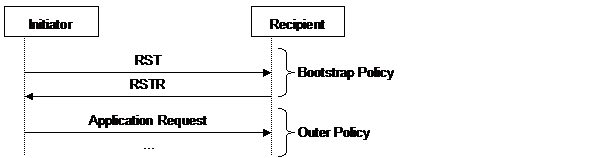
Note: This assertion describes the
token accepted by the target service. Because this token is
issued by the target service and may not have a separate port (with
separate policy), this assertion SHOULD contain a bootstrap policy
indicating the security binding and policy that is used when
requesting this token from the target service. That is, the
bootstrap policy is used to obtain the token and then the current
(outer) policy is used when making requests with the token. This is
illustrated in the diagram below.
Syntax
<sp:SecureConversationToken sp:IncludeToken="xs:anyURI"?
xmlns:sp="..." ... >
(
<sp:Issuer>wsa:EndpointReferenceType</sp:Issuer>
|
<sp:IssuerName>xs:anyURI</sp:IssuerName>
) ?
<wst:Claims Dialect="..."> ... </wst:Claims>
?
<wsp:Policy xmlns:wsp="...">
(
<sp:RequireDerivedKeys ... />
|
<sp:RequireImpliedDerivedKeys ...
/> |
<sp:RequireExplicitDerivedKeys
... />
) ?
<sp:RequireExternalUriReference ... />
?
<sp:SC13SecurityContextToken ... /> ?
<sp:MustNotSendCancel ... /> ?
<sp:MustNotSendAmend ... /> ?
<sp:MustNotSendRenew ... /> ?
<sp:BootstrapPolicy ... > ?
<wsp:Policy> ...
</wsp:Policy>
</sp:BootstrapPolicy>
</wsp:Policy>
...
</sp:SecureConversationToken>
The
following describes the attributes and elements listed in the
schema outlined above:
/sp:SecureConversationToken
This identifies a
SecureConversationToken assertion.
/sp:SecureConversationToken/@sp:IncludeToken
This optional attribute
identifies the token inclusion value for this token
assertion.
/sp:SecureConversationToken/sp:Issuer
This optional element, of
type wsa:EndpointReferenceType, contains a reference to the issuer
for the Security Context Token.
/sp:SecureConversationToken/sp:IssuerName
This optional element, of
type xs:anyURI, contains the logical name of the
sp:SecureConversationToken issuer.
/sp:SpnegoContextToken/wst:Claims
This optional element
identifies the required claims that a security token must contain
in order to satisfy the token assertion requirements.
/sp:SecureConversationToken/wsp:Policy
This required element
identifies additional requirements for use of the
sp:SecureConversationToken assertion.
/sp:SecureConversationToken/wsp:Policy/sp:RequireDerivedKeys
This optional element is a
policy assertion that sets the [Derived Keys], [Explicit Derived
Keys] and [Implied Derived Keys] properties for this token to
'true'.
/sp:SecureConversationToken/wsp:Policy/sp:RequireExplicitDerivedKeys
This optional element is a
policy assertion that sets the [Derived Keys] and [Explicit Derived
Keys] properties for this token to 'true' and the [Implied Derived
Keys] property for this token to 'false'.
/sp:SecureConversationToken/wsp:Policy/sp:RequireImpliedDerivedKeys
This optional element is a
policy assertion that sets the [Derived Keys] and [Implied Derived
Keys] properties for this token to 'true' and the [Explicit Derived
Keys] property for this token to 'false'.
/sp:SecureConversationToken/wsp:Policy/sp:RequireExternalUriReference
This optional element is a
policy assertion that indicates that an external URI reference is
required when referencing this token.
/sp:SecureConversationToken/wsp:Policy/sp:SC13SecurityContextToken
This optional element is a
policy assertion that indicates that a Security Context Token
should be used as obtained using the protocol defined in [WS-SecureConversation].
/sp:SecureConversationToken/wsp:Policy/sp:MustNotSendCancel
This optional element is a
policy assertion that indicates that the STS issuing the secure
conversation token does not support SCT/Cancel RST messages. If
this assertion is missing it means that SCT/Cancel RST messages are
supported by the STS.
/sp:SecureConversationToken/wsp:Policy/sp:MustNotSendAmend
This optional element is a
policy assertion that indicates that the STS issuing the secure
conversation token does not support SCT/Amend RST messages. If this
assertion is missing it means that SCT/Amend RST messages are
supported by the STS.
/sp:SecureConversationToken/wsp:Policy/sp:MustNotSendRenew
This optional element is a
policy assertion that indicates that the STS issuing the secure
conversation token does not support SCT/Renew RST messages. If this
assertion is missing it means that SCT/Renew RST messages are
supported by the STS.
/sp:SecureConversationToken/wsp:Policy/sp:BootstrapPolicy
This optional element is a
policy assertion that contains the policy indicating the
requirements for obtaining the Security Context Token.
/sp:SecureConversationToken/wsp:Policy/sp:BootstrapPolicy/wsp:Policy
This element contains the
security binding requirements for obtaining the Security Context
Token. It will typically contain a security binding assertion (e.g.
sp:SymmetricBinding) along with protection assertions (e.g.
sp:SignedParts) describing the parts of the RST/RSTR messages that
are to be protected.
Example
<wsp:Policy xmlns:wsp="..." xmlns:sp="...">
<sp:SymmetricBinding>
<wsp:Policy>
<sp:ProtectionToken>
<wsp:Policy>
<sp:SecureConversationToken>
<sp:Issuer>
<wsa:Address>http://example.org/sts</wsa:Address>
</sp:Issuer>
<wsp:Policy>
<sp:SC10SecurityContextToken />
<sp:BootstrapPolicy>
<wsp:Policy>
<sp:AsymmetricBinding>
<wsp:Policy>
<sp:InitiatorToken>
...
</sp:InitiatorToken>
<sp:RecipientToken>
...
</sp:RecipientToken>
</wsp:Policy>
</sp:AsymmetricBinding>
<sp:SignedParts>
...
</sp:SignedParts>
...
</wsp:Policy>
</sp:BootstrapPolicy>
</wsp:Policy>
</sp:SecureConversationToken>
</wsp:Policy>
</sp:ProtectionToken>
...
</wsp:Policy>
</sp:SymmetricBinding>
<sp:SignedParts>
...
</sp:SignedParts>
...
</wsp:Policy>
5.4.8 SamlToken
Assertion
This
element represents a requirement for a SAML token.
Syntax
<sp:SamlToken sp:IncludeToken="xs:anyURI"? xmlns:sp="..."
... >
(
<sp:Issuer>wsa:EndpointReferenceType</sp:Issuer> |
<sp:IssuerName>xs:anyURI</sp:IssuerName>
) ?
<wst:Claims Dialect="..."> ... </wst:Claims> ?
<wsp:Policy xmlns:wsp="...">
(
<sp:RequireDerivedKeys ... />
|
<sp:RequireImpliedDerivedKeys ...
/> |
<sp:RequireExplicitDerivedKeys
... />
) ?
<sp:RequireKeyIdentifierReference ... />
?
(
<sp:WssSamlV11Token10 ... />
|
<sp:WssSamlV11Token11 ... />
|
<sp:WssSamlV20Token11 ...
/>
) ?
...
</wsp:Policy>
...
</sp:SamlToken>
The
following describes the attributes and elements listed in the
schema outlined above:
/sp:SamlToken
This identifies a
SamlToken assertion.
/sp:SamlToken/@sp:IncludeToken
This optional attribute
identifies the token inclusion value for this token
assertion.
/sp:SamlToken/sp:Issuer
This optional element, of
type wsa:EndpointReferenceType, contains reference to the issuer of
the sp:SamlToken.
/sp:SamlToken/sp:IssuerName
This optional element, of
type xs:anyURI, contains the logical name of the sp:SamlToken
issuer.
/sp:SamlToken/wst:Claims
This optional element
identifies the required claims that a security token must contain
in order to satisfy the token assertion requirements.
/sp:SamlToken/wsp:Policy
This required element
identifies additional requirements for use of the sp:SamlToken
assertion.
/sp:SamlToken/wsp:Policy/sp:RequireDerivedKeys
This optional element is a
policy assertion that sets the [Derived Keys], [Explicit Derived
Keys] and [Implied Derived Keys] properties for this token to
'true'.
/sp:SamlToken/wsp:Policy/sp:RequireExplicitDerivedKeys
This optional element is a
policy assertion that sets the [Derived Keys] and [Explicit Derived
Keys] properties for this token to 'true' and the [Implied Derived
Keys] property for this token to 'false'.
/sp:SamlToken/wsp:Policy/sp:RequireImpliedDerivedKeys
This optional element is a
policy assertion that sets the [Derived Keys] and [Implied Derived
Keys] properties for this token to 'true' and the [Explicit Derived
Keys] property for this token to 'false'.
/sp:SamlToken/wsp:Policy/sp:RequireKeyIdentifierReference
This optional element is a
policy assertion that indicates that a key identifier reference is
required when referencing this token.
/sp:SamlToken/wsp:Policy/sp:WssSamlV11Token10
This optional element is a
policy assertion that identifies that a SAML Version 1.1 token
should be used as defined in [WSS:SAMLTokenProfile1.0].
/sp:SamlToken/wsp:Policy/sp:WssSamlV11Token11
This optional element is a
policy assertion that identifies that a SAML Version 1.1 token
should be used as defined in [WSS:SAMLTokenProfile1.1].
/sp:SamlToken/wsp:Policy/sp:WssSamlV20Token11
This optional element is a
policy assertion that identifies that a SAML Version 2.0 token
should be used as defined in [WSS:SAMLTokenProfile1.1].
Note: This assertion does
not describe how to obtain a SAML Token but rather assumes that
both parties have the token already or have agreed separately on a
mechanism for obtaining the token. If a definition of the mechanism
for obtaining the SAML Token is desired in policy, the
sp:IssuedToken assertion should be used instead.
5.4.9 RelToken
Assertion
This
element represents a requirement for a REL token.
Syntax
<sp:RelToken sp:IncludeToken="xs:anyURI"? xmlns:sp="..."
... >
(
<sp:Issuer>wsa:EndpointReferenceType</sp:Issuer> |
<sp:IssuerName>xs:anyURI</sp:IssuerName>
) ?
<wst:Claims Dialect="..."> ... </wst:Claims> ?
<wsp:Policy xmlns:wsp="...">
(
<sp:RequireDerivedKeys ... />
|
<sp:RequireImpliedDerivedKeys ...
/> |
<sp:RequireExplicitDerivedKeys
... />
) ?
<sp:RequireKeyIdentifierReference ... />
?
(
<sp:WssRelV10Token10 ... />
|
<sp:WssRelV20Token10 ... />
|
<sp:WssRelV10Token11 ... />
|
<sp:WssRelV20Token11 ...
/>
) ?
...
</wsp:Policy>
...
</sp:RelToken>
The
following describes the attributes and elements listed in the
schema outlined above:
/sp:RelToken
This identifies a RelToken
assertion.
/sp:RelToken/@sp:IncludeToken
This optional attribute
identifies the token inclusion value for this token
assertion.
/sp:RelToken/sp:Issuer
This optional element, of
type wsa:EndpointReferenceType, contains reference to the issuer of
the sp:RelToken.
/sp:RelToken/sp:IssuerName
This optional element, of
type xs:anyURI, contains the logical name of the sp:RelToken
issuer.
/sp:RelToken/wst:Claims
This optional element
identifies the required claims that a security token must contain
in order to satisfy the token assertion requirements.
/sp:RelToken/wsp:Policy
This required element
identifies additional requirements for use of the sp:RelToken
assertion.
/sp:RelToken/wsp:Policy/sp:RequireDerivedKeys
This optional element is a
policy assertion that sets the [Derived Keys], [Explicit Derived
Keys] and [Implied Derived Keys] property for this token to
'true'.
/sp:RelToken/wsp:Policy/sp:RequireExplicitDerivedKeys
This optional element is a
policy assertion that sets the [Derived Keys] and [Explicit Derived
Keys] properties for this token to 'true' and the [Implied Derived
Keys] property for this token to 'false'.
/sp:RelToken/wsp:Policy/sp:RequireImpliedDerivedKeys
This optional element is a
policy assertion that sets the [Derived Keys] and [Implied Derived
Keys] properties for this token to 'true' and the [Explicit Derived
Keys] property for this token to 'false'.
/sp:RelToken/wsp:Policy/sp:RequireKeyIdentifierReference
This optional element is a
policy assertion that indicates that a key identifier reference is
required when referencing this token.
/sp:RelToken/wsp:Policy/sp:WssRelV10Token10
This optional element is a
policy assertion that identifies that a REL Version 1.0 token
should be used as defined in [WSS:RELTokenProfile1.0].
/sp:RelToken/wsp:Policy/sp:WssRelV20Token10
This optional element is a
policy assertion that identifies that a REL Version 2.0 token
should be used as defined in [WSS:RELTokenProfile1.0].
/sp:RelToken/wsp:Policy/sp:WssRelV10Token11
This optional element is a
policy assertion that identifies that a REL Version 1.0 token
should be used as defined in [WSS:RELTokenProfile1.1].
/sp:RelToken/wsp:Policy/sp:WssRelV20Token11
This optional element is a
policy assertion that identifies that a REL Version 2.0 token
should be used as defined in [WSS:RELTokenProfile1.1].
Note: This assertion does
not describe how to obtain a REL Token but rather assumes that both
parties have the token already or have agreed separately on a
mechanism for obtaining the token. If a definition of the mechanism
for obtaining the REL Token is desired in policy, the
sp:IssuedToken assertion should be used instead.
5.4.10 HttpsToken
Assertion
This
element represents a requirement for a transport binding to support
the use of HTTPS.
Syntax
<sp:HttpsToken xmlns:sp="..." ... >
(
<sp:Issuer>wsa:EndpointReferenceType</sp:Issuer> |
<sp:IssuerName>xs:anyURI</sp:IssuerName>
) ?
<wst:Claims Dialect="..."> ... </wst:Claims> ?
<wsp:Policy xmlns:wsp="...">
(
<sp:HttpBasicAuthentication />
|
<sp:HttpDigestAuthentication
/> |
<sp:RequireClientCertificate
/> |
...
)?
...
</wsp:Policy>
...
</sp:HttpsToken>
The
following describes the attributes and elements listed in the
schema outlined above:
/sp:HttpsToken
This identifies
an Https assertion stating that
use of the HTTPS protocol specification is supported.
/sp:HttpsToken/sp:Issuer
This optional element, of
type wsa:EndpointReferenceType, contains reference to the issuer of
the sp:HttpsToken.
/sp:HttpsToken/sp:IssuerName
This optional element, of
type xs:anyURI, contains the logical name of the sp:HttpsToken
issuer.
/sp:HttpsToken/wst:Claims
This optional element
identifies the required claims that a security token must contain
in order to satisfy the token assertion requirements.
/sp:HttpsToken/wsp:Policy
This required element
identifies additional requirements for use of the sp:HttpsToken
assertion.
/sp:HttpsToken/wsp:Policy/sp:HttpBasicAuthentication
This optional element is a
policy assertion that indicates that the client MUST use HTTP Basic
Authentication [RFC2068] to authenticate to the
service.
/sp:HttpsToken/wsp:Policy/sp:HttpDigestAuthentication
This optional element is a
policy assertion that indicates that the client MUST use HTTP
Digest Authentication [RFC2068] to authenticate to the
service.
/sp:HttpsToken/wsp:Policy/sp:RequireClientCertificate
This optional element is a
policy assertion that indicates that the client MUST provide a
certificate when negotiating the HTTPS session.
This
element represents a requirement for a KeyValue token. The next
section defines the KeyValue security token abstraction for
purposes of this token assertion.
This
document defines requirements for KeyValue token when used in
combination with RSA cryptographic algorithm. Additional
cryptographic algorithms can be introduced by another
specifications by introducing new nested assertions besides
sp:RsaKeyValue.
Syntax
<sp:KeyValueToken sp:IncludeToken="xs:anyURI"? xmlns:sp="..."
... >
<wsp:Policy xmlns:wsp="...">
<sp:RsaKeyValue ... /> ?
...
</wsp:Policy>
...
</sp:KeyValueToken>
The following
describes the attributes listed in the schema outlined
above:
/sp:KeyValueToken
This identifies a RsaToken
assertion.
/sp:KeyValueToken/@sp:IncludeToken
This optional attribute
identifies the token inclusion value for this token
assertion.
/sp:KeyValueToken/wsp:Policy
This required element
identifies additional requirements for use of the sp:KeyValueToken
assertion.
/sp:KeyValueToken/wsp:Policy/sp:RsaKeyValue
This optional element is a
policy assertion that indicates that the ds:RSAKeyValue element
must be present in the KeyValue token. This indicates that an RSA
key pair must be used.
5.4.11.1 KeyValue Token
XML
Signature specification allows reference an arbitrary key pair by
using the corresponding public key value. This allows using an
arbitrary key pair to sign or encrypt XML elements. The purpose of
this section is to define the KeyValue token abstraction that
represents such key pair referencing mechanism.
Although
the ds:KeyValue element as defined in the XML Signature
specification is generic enough to be used with any asymmetric
cryptographic algorithm this document only profiles the usage of
ds:KeyValue element in combination with RSA cryptographic
algorithm.
The RSA
key pair is represented by the ds:KeyInfo element containing
the ds:KeyValue element with the RSA public key value in
ds:RSAKeyValue as defined in the XML Signature
specification:
<ds:KeyInfo xmlns="http://www.w3/org/2000/09/xmldsig#">
<ds:KeyValue>
<ds:RSAKeyValue>
<ds:Modulus>ds:CryptoBinary</ds:Modulus>
<ds:Exponent>ds:CryptoBinary</ds:Exponent>
</ds:RSAKeyValue>
<ds:KeyValue>
</ds:KeyInfo>
When the
KeyValue token is used the corresponding public key value appears
directly in the signature or encrypted data ds:KeyInfo
element like in the following example. There is no KeyValue token
manifestation outside the ds:KeyInfo element.
<Signature xmlns="http://www.w3.org/2000/09/xmldsig#">
<SignedInfo>
<CanonicalizationMethod
Algorithm="http://www.w3.org/2001/10/xml-exc-c14n#" />
<SignatureMethod
Algorithm="http://www.w3.org/2000/09/xmldsig#rsa-sha1" />
<Reference URI="#_1">
<Transforms>
<Transform
Algorithm="http://www.w3.org/2001/10/xml-exc-c14n#" />
</Transforms>
<DigestMethod
Algorithm="http://www.w3.org/2000/09/xmldsig#sha1" />
<DigestValue>...</DigestValue>
</Reference>
</SignedInfo>
<SignatureValue>...</SignatureValue>
<KeyInfo>
<KeyValue>
<RSAKeyValue>
<Modulus>...</Modulus>
<Exponent>...</Exponent>
</RSAKeyValue>
</KeyValue>
</KeyInfo>
</Signature>
Since
there is no representation of the KeyValue token outside the
ds:KeyInfo element and thus no identifier can be associated
with the token, the KeyValue token cannot be referenced by using
wsse:SecurityTokenReference element. However the
ds:KeyInfo element representing the KeyValue token can be
used whenever a security token can be used as illustrated on the
following example:
<t:RequestSecurityToken xmlns:t="...">
<t:RequestType>...</t:RequestType>
...
<t:UseKey>
<KeyInfo
xmlns="http://www.w3.org/2000/09/xmldsig#">
<KeyValue>
<RSAKeyValue>
<Modulus>...</Modulus>
<Exponent>...</Exponent>
</RSAKeyValue>
</KeyValue>
</KeyInfo>
</t:UseKey>
</t:RequestSecurityToken>
This
section defines the various properties or conditions of a security
binding, their semantics, values and defaults where appropriate.
Properties are used by a binding in a manner similar to how
variables are used in code. Assertions populate, (or set) the value
of the property (or variable). When an assertion that populates a
value of a property appears in a policy, that property is set to
the value indicated by the assertion. The security binding then
uses the value of the property to control its behavior. The
properties listed here are common to the various security bindings
described in Section 7. Assertions that define values for these
properties are defined in Section 7. The following properties are
used by the security binding assertions.
This
property specifies the algorithm suite required for performing
cryptographic operations with symmetric or asymmetric key based
security tokens. An algorithm suite specifies actual algorithms and
allowed key lengths. A policy alternative will define what
algorithms are used and how they are used. This property defines
the set of available algorithms. The value of this property is
typically referenced by a security binding and is used to specify
the algorithms used for all message level cryptographic operations
performed under the security binding.
Note: In some cases, this
property MAY be referenced under a context other than a security
binding and used to control the algorithms used under that context.
For example, supporting token assertions define such a context. In
such contexts, the specified algorithms still apply to message
level cryptographic operations.
An
algorithm suite defines values for each of the following operations
and properties:
·
[Sym
Sig] Symmetric Key
Signature
·
[Asym
Sig] Signature with an
asymmetric key
·
[Dig]
Digest
·
[Enc]
Encryption
·
[Sym
KW] Symmetric Key
Wrap
·
[Asym
KW] Asymmetric Key
Wrap
·
[Comp
Key] Computed key
·
[Enc
KD]
Encryption key derivation
·
[Sig
KD]
Signature key derivation
·
[Min
SKL] Minimum
symmetric key length
·
[Max
SKL] Maximum
symmetric key length
·
[Min
AKL] Minimum
asymmetric key length
·
[Max
AKL] Maximum
asymmetric key length
The
following table provides abbreviations for the algorithm URI used
in the table below:
|
Abbreviation
|
Algorithm
URI
|
|
HmacSha1
|
http://www.w3.org/2000/09/xmldsig#hmac-sha1
|
|
RsaSha1
|
http://www.w3.org/2000/09/xmldsig#rsa-sha1
|
|
Sha1
|
http://www.w3.org/2000/09/xmldsig#sha1
|
|
Sha256
|
http://www.w3.org/2001/04/xmlenc#sha256
|
|
Sha512
|
http://www.w3.org/2001/04/xmlenc#sha512
|
|
Aes128
|
http://www.w3.org/2001/04/xmlenc#aes128-cbc
|
|
Aes192
|
http://www.w3.org/2001/04/xmlenc#aes192-cbc
|
|
Aes256
|
http://www.w3.org/2001/04/xmlenc#aes256-cbc
|
|
TripleDes
|
http://www.w3.org/2001/04/xmlenc#tripledes-cbc
|
|
KwAes128
|
http://www.w3.org/2001/04/xmlenc#kw-aes128
|
|
KwAes192
|
http://www.w3.org/2001/04/xmlenc#kw-aes192
|
|
KwAes256
|
http://www.w3.org/2001/04/xmlenc#kw-aes256
|
|
KwTripleDes
|
http://www.w3.org/2001/04/xmlenc#kw-tripledes
|
|
KwRsaOaep
|
http://www.w3.org/2001/04/xmlenc#rsa-oaep-mgf1p
|
|
KwRsa15
|
http://www.w3.org/2001/04/xmlenc#rsa-1_5
|
|
PSha1
|
http://docs.oasis-open.org/ws-sx/ws-secureconversation/200512/dk/p_sha1
|
|
PSha1L128
|
http://docs.oasis-open.org/ws-sx/ws-secureconversation/200512/dk/p_sha1
|
|
PSha1L192
|
http://docs.oasis-open.org/ws-sx/ws-secureconversation/200512/dk/p_sha1
|
|
PSha1L256
|
http://docs.oasis-open.org/ws-sx/ws-secureconversation/200512/dk/p_sha1
|
|
XPath
|
http://www.w3.org/TR/1999/REC-xpath-19991116
|
|
XPath20
|
http://www.w3.org/2002/06/xmldsig-filter2
|
|
C14n
|
http://www.w3.org/2001/10/xml-c14n#
|
|
ExC14n
|
http://www.w3.org/2001/10/xml-exc-c14n#
|
|
SNT
|
http://www.w3.org/TR/soap12-n11n
|
|
STRT10
|
http://docs.oasis-open.org/wss/2004/xx/oasis-2004xx-wss-soap-message-security-1.0#STR-Transform
|
|
AbsXPath
|
http://docs.oasis-open.org/...TBD.../AbsXPath
|
The
tables below show all the base algorithm suites defined by this
specification. This table defines values for properties which are
common for all suites:
|
Property
|
Algorithm /
Value
|
|
[Sym Sig]
|
HmacSha1
|
|
[Asym Sig]
|
RsaSha1
|
|
[Comp Key]
|
PSha1
|
|
[Max SKL]
|
256
|
|
[Min AKL]
|
1024
|
|
[Max AKL]
|
4096
|
This
table defines additional properties whose values can be specified
along with the default value for that property.
|
Property
|
Algorithm /
Value
|
|
[C14n
Algorithm]
|
ExC14n
|
|
[Soap Norm]
|
None
|
|
[STR Trans]
|
None
|
|
[XPath]
|
None
|
This
table defines values for the remaining components for each
algorithm suite.
|
Algorithm
Suite
|
[Dig]
|
[Enc]
|
[Sym
KW]
|
[Asym
KW]
|
[Enc
KD]
|
[Sig
KD]
|
[Min
SKL]
|
|
Basic256
|
Sha1
|
Aes256
|
KwAes256
|
KwRsaOaep
|
PSha1L256
|
PSha1L192
|
256
|
|
Basic192
|
Sha1
|
Aes192
|
KwAes192
|
KwRsaOaep
|
PSha1L192
|
PSha1L192
|
192
|
|
Basic128
|
Sha1
|
Aes128
|
KwAes128
|
KwRsaOaep
|
PSha1L128
|
PSha1L128
|
128
|
|
TripleDes
|
Sha1
|
TripleDes
|
KwTripleDes
|
KwRsaOaep
|
PSha1L192
|
PSha1L192
|
192
|
|
Basic256Rsa15
|
Sha1
|
Aes256
|
KwAes256
|
KwRsa15
|
PSha1L256
|
PSha1L192
|
256
|
|
Basic192Rsa15
|
Sha1
|
Aes192
|
KwAes192
|
KwRsa15
|
PSha1L192
|
PSha1L192
|
192
|
|
Basic128Rsa15
|
Sha1
|
Aes128
|
KwAes128
|
KwRsa15
|
PSha1L128
|
PSha1L128
|
128
|
|
TripleDesRsa15
|
Sha1
|
TripleDes
|
KwTripleDes
|
KwRsa15
|
PSha1L192
|
PSha1L192
|
192
|
|
Basic256Sha256
|
Sha256
|
Aes256
|
KwAes256
|
KwRsaOaep
|
PSha1L256
|
PSha1L192
|
256
|
|
Basic192Sha256
|
Sha256
|
Aes192
|
KwAes192
|
KwRsaOaep
|
PSha1L192
|
PSha1L192
|
192
|
|
Basic128Sha256
|
Sha256
|
Aes128
|
KwAes128
|
KwRsaOaep
|
PSha1L128
|
PSha1L128
|
128
|
|
TripleDesSha256
|
Sha256
|
TripleDes
|
KwTripleDes
|
KwRsaOaep
|
PSha1L192
|
PSha1L192
|
192
|
|
Basic256Sha256Rsa15
|
Sha256
|
Aes256
|
KwAes256
|
KwRsa15
|
PSha1L256
|
PSha1L192
|
256
|
|
Basic192Sha256Rsa15
|
Sha256
|
Aes192
|
KwAes192
|
KwRsa15
|
PSha1L192
|
PSha1L192
|
192
|
|
Basic128Sha256Rsa15
|
Sha256
|
Aes128
|
KwAes128
|
KwRsa15
|
PSha1L128
|
PSha1L128
|
128
|
|
TripleDesSha256Rsa15
|
Sha256
|
TripleDes
|
KwTripleDes
|
KwRsa15
|
PSha1L192
|
PSha1L192
|
192
|
This
boolean property specifies whether a wsu:Timestamp element is present in
the wsse:Securityheader. If the value is
'true', the timestamp element MUST be present and MUST be integrity
protected either by transport or message level security. If the
value is 'false', the timestamp element MUST NOT be present. The
default value for this property is 'false'.
This
property indicates the order in which integrity and confidentiality
are applied to the message, in cases where both integrity and
confidentiality are required:
|
EncryptBeforeSigning
|
Signature MUST computed
over ciphertext. Encryption key and signing key MUST be derived
from the same source key unless distinct keys are provided, see
Section 7.5 on the AsymmetricBinding.
|
|
SignBeforeEncrypting
|
Signature MUST be computed
over plaintext. The resulting signature SHOULD be encrypted.
Supporting signatures MUST be over the plain text
signature.
|
The
default value for this property is
'SignBeforeEncrypting'.
This
boolean property specifies whether the signature must be encrypted.
If the value is 'true', the primary signature MUST be encrypted and
any signature confirmation elements MUST also be encrypted. The
primary signature element is not required to be encrypted if the
value is ‘true’ when there is nothing else in the
message that is encrypted. If the value is 'false', the primary
signature MUST NOT be encrypted and any signature confirmation
elements MUST NOT be encrypted. The default value for this property
is 'false'.
This
boolean property specifies whether signatures must cover the token
used to generate that signature. If the value is 'true', then each
token used to generate a signature MUST be covered by that
signature. If the value is 'false', then the token MUST NOT be
covered by the signature. Note that in cases where derived keys are
used the 'main' token, and NOT the derived key token, is covered by
the signature. It is recommended that assertions that define values
for this property apply to [Endpoint Policy Subject]. The default
value for this property is 'false'.
This
boolean property specifies whether signature digests over the SOAP
body and SOAP headers must only cover the entire body and entire
header elements. If the value is 'true', then each digest over the
SOAP body MUST be over the entire SOAP body element and not a
descendant of that element. In addition each digest over a SOAP
header MUST be over an actual header element and not a descendant
of a header element. This restriction does not specifically apply
to the wsse:Security header. However signature digests over child
elements of the wsse:Security header MUST be over the entire child
element and not a descendent of that element. If the value is
'false', then signature digests MAY be over a descendant of the
SOAP Body or a descendant of a header element. Setting the value of
this property to 'true' mitigates against some possible re-writing
attacks. It is recommended that assertions that define values for
this property apply to [Endpoint Policy Subject]. The default value
for this property is 'false'.
This
property indicates which layout rules to apply when adding items to
the security header. The following table shows which rules are
defined by this specification.
|
Strict
|
Items are added to the
security header following the numbered layout rules described below
according to a general principle of 'declare before
use'.
|
|
Lax
|
Items are added to the
security header in any order that conforms to WSS: SOAP Message
Security
|
|
LaxTimestampFirst
|
As
Lax except that the first item in the security header MUST be a
wsse:Timestamp. Note that the [Timestamp]
property MUST also be set to 'true' in this case.
|
|
LaxTimestampLast
|
As
Lax except that the last item in the security header MUST be a
wsse:Timestamp. Note that the [Timestamp]
property MUST also be set to 'true' in this case.
|
- Tokens that are included
in the message MUST be declared before use. For
example:
-
- A local signing token MUST
occur before the signature that uses it.
- A local token serving as
the source token for a derived key token MUST occur before that
derived key token.
- A local encryption token
MUST occur before the reference list that points to
xenc:EncryptedData elements that use it.
- If the same token is used
for both signing and encryption, then it should appear before the
ds:Signature and xenc:ReferenceList elements in the security header
that are generated using the token.
- Signed elements inside the
security header MUST occur before the signature that signs
them. For example:
-
- A timestamp MUST occur
before the signature that signs it.
- A Username token (usually
in encrypted form) MUST occur before the signature that signs
it.
- A primary signature MUST
occur before the supporting token signature that signs the primary
signature's signature value element.
- When an element in a
security header is encrypted, the resulting xenc:EncryptedData
element has the same order requirements as the source plain text
element, unless requirement 4 indicates otherwise. For example, an
encrypted primary signature MUST occur before any supporting token
signature per 2.c above and an encrypted token has the same
ordering requirements as the unencrypted token.
If there are any encrypted
elements in the message then a top level xenc:ReferenceList element
or a top level xenc:EncryptedKey element which contains an
xenc:ReferenceList element MUST be present in the security header.
The xenc:ReferenceList or xenc:EncryptedKey MUST occur before any
xenc:EncryptedData elements in the security header that are
referenced from the reference list. Strict Layout Rules for WSS
1.1
- Tokens that are included
in the message MUST be declared before use. For
example:
-
- A local signing token MUST
occur before the signature that uses it.
- A local token serving as
the source token for a derived key token MUST occur before that
derived key token.
- A local encryption token
MUST occur before the reference list that points to
xenc:EncryptedData elements that use it.
- If the same token is used
for both signing and encryption, then it should appear before the
ds:Signature and xenc:ReferenceList elements in the security header
that are generated using the token.
- Signed elements inside the
security header MUST occur before the signature that signs
them. For example:
-
- A timestamp MUST occur
before the signature that signs it.
- A Username token (usually
in encrypted form) MUST occur before the signature that signs
it.
- A primary signature MUST
occur before the supporting token signature that signs the primary
signature's signature value element.
- A
wsse11:SignatureConfirmation element MUST occur before the
signature that signs it.
- When an element in a
security header is encrypted, the resulting xenc:EncryptedData
element has the same order requirements as the source plain text
element, unless requirement 4 indicates otherwise. For example, an
encrypted primary signature MUST occur before any supporting token
signature per 2.c above and an encrypted token has the same
ordering requirements as the unencrypted token.
- If there are any encrypted
elements in the message then a top level xenc:ReferenceList element
MUST be present in the security header. The xenc:ReferenceList MUST
occur before any xenc:EncryptedData elements in the security header
that are referenced from the reference list. However, the
xenc:ReferenceList is not required to appear before independently
encrypted tokens such as the xenc:EncryptedKey token as defined in
WSS.
- An xenc:EncryptedKey
element without an internal reference list [WSS:
SOAP Message Security 1.1] MUST obey rule 1
above.
The
appropriate representation of the different facets of security
mechanisms requires distilling the common primitives (to enable
reuse) and then combining the primitive elements into patterns. The
policy scope of assertions defined in this section is the policy
scope of their containing element.
7.1 AlgorithmSuite
Assertion
This
assertion indicates a requirement for an algorithm suite as defined
under the [Algorithm Suite] property described in Section 6.1. The
scope of this assertion is defined by its containing
assertion.
Syntax
<sp:AlgorithmSuite xmlns:sp="..." ... >
<wsp:Policy xmlns:wsp="...">
(<sp:Basic256 ... /> |
<sp:Basic192 ... /> |
<sp:Basic128 ... /> |
<sp:TripleDes ... /> |
<sp:Basic256Rsa15 ... /> |
<sp:Basic192Rsa15 ... /> |
<sp:Basic128Rsa15 ... /> |
<sp:TripleDesRsa15 ... /> |
<sp:Basic256Sha256 ... /> |
<sp:Basic192Sha256 ... /> |
<sp:Basic128Sha256 ... /> |
<sp:TripleDesSha256 ... /> |
<sp:Basic256Sha256Rsa15 ... /> |
<sp:Basic192Sha256Rsa15 ... /> |
<sp:Basic128Sha256Rsa15 ... /> |
<sp:TripleDesSha256Rsa15 ... /> |
...)
<sp:InclusiveC14N ... /> ?
<sp:SOAPNormalization10 ... /> ?
<sp:STRTransform10 ... /> ?
(<sp:XPath10 ... /> |
<sp:XPathFilter20 ... /> |
<sp:AbsXPath ... /> |
...)?
...
</wsp:Policy>
...
</sp:AlgorithmSuite>
The
following describes the attributes and elements listed in the
schema outlined above:
/sp:AlgorithmSuite
This identifies
an AlgorithmSuite
assertion.
/sp:AlgorithmSuite/wsp:Policy
This required element
contains one or more policy assertions that indicate the specific
algorithm suite to use.
/sp:AlgorithmSuite/wsp:Policy/sp:Basic256
This optional element is a
policy assertion that indicates that the [Algorithm Suite] property
is set to 'Basic256'.
/sp:AlgorithmSuite/wsp:Policy/sp:Basic192
This optional element is a
policy assertion that indicates that the [Algorithm Suite] property
is set to 'Basic192'.
/sp:AlgorithmSuite/wsp:Policy/sp:Basic128
This optional element is a
policy assertion that indicates that the [Algorithm Suite] property
is set to 'Basic128'.
/sp:AlgorithmSuite/wsp:Policy/sp:TripleDes
This optional element is a
policy assertion that indicates that the [Algorithm Suite] property
is set to 'TripleDes'.
/sp:AlgorithmSuite/wsp:Policy/sp:Basic256Rsa15
This optional element is a
policy assertion that indicates that the [Algorithm Suite] property
is set to 'Basic256Rsa15'.
/sp:AlgorithmSuite/wsp:Policy/sp:Basic192Rsa15
This optional element is a
policy assertion that indicates that the [Algorithm Suite] property
is set to 'Basic192Rsa15'.
/sp:AlgorithmSuite/wsp:Policy/sp:Basic128Rsa15
This optional element is a
policy assertion that indicates that the [Algorithm Suite] property
is set to 'Basic128Rsa15'.
/sp:AlgorithmSuite/wsp:Policy/sp:TripleDesRsa15
This optional element is a
policy assertion that indicates that the [Algorithm Suite] property
is set to 'TripleDesRsa15'.
/sp:AlgorithmSuite/wsp:Policy/sp:Basic256Sha256
This optional element is a
policy assertion that indicates that the [Algorithm Suite] property
is set to 'Basic256Sha256'.
/sp:AlgorithmSuite/wsp:Policy/sp:Basic192Sha256
This optional element is a
policy assertion that indicates that the [Algorithm Suite] property
is set to 'Basic192Sha256'.
/sp:AlgorithmSuite/wsp:Policy/sp:Basic128Sha256
This optional element is a
policy assertion that indicates that the [Algorithm Suite] property
is set to 'Basic128Sha256'.
/sp:AlgorithmSuite/wsp:Policy/sp:TripleDesSha256
This optional element is a
policy assertion that indicates that the [Algorithm Suite] property
is set to 'TripleDesSha256'.
/sp:AlgorithmSuite/wsp:Policy/sp:Basic256Sha256Rsa15
This optional element is a
policy assertion that indicates that the [Algorithm Suite] property
is set to 'Basic256Sha256Rsa15'.
/sp:AlgorithmSuite/wsp:Policy/sp:Basic192Sha256Rsa15
This optional element is a
policy assertion that indicates that the [Algorithm Suite] property
is set to 'Basic192Sha256Rsa15'.
/sp:AlgorithmSuite/wsp:Policy/sp:Basic128Sha256Rsa15
This optional element is a
policy assertion that indicates that the [Algorithm Suite] property
is set to 'Basic128Sha256Rsa15'.
/sp:AlgorithmSuite/wsp:Policy/sp:TripleDesSha256Rsa15
This optional element is a
policy assertion that indicates that the [Algorithm Suite] property
is set to 'TripleDesSha256Rsa15'.
/sp:AlgorithmSuite/wsp:Policy/sp:InclusiveC14N
This optional element is a
policy assertion that indicates that the [C14N] property of an
algorithm suite is set to 'C14N'. Note: as indicated in Section 6.1
the default value of the [C14N] property is 'ExcC14N'.
/sp:AlgorithmSuite/wsp:Policy/sp:SoapNormalization10
This optional element is a
policy assertion that indicates that the [SOAP Norm] property is
set to 'SNT'.
/sp:AlgorithmSuite/wsp:Policy/sp:STRTransform10
This optional element is a
policy assertion that indicates that the [STR Transform] property
is set to 'STRT10'.
/sp:AlgorithmSuite/wsp:Policy/sp:XPath10
This optional element is a
policy assertion that indicates that the [XPath] property is set to
'XPath'.
/sp:AlgorithmSuite/wsp:Policy/sp:XPathFilter20
This optional element is a
policy assertion that indicates that the [XPath] property is set to
'XPath20'.
/sp:AlgorithmSuite/wsp:Policy/sp:AbsXPath
This optional element is a
policy assertion that indicates that the [XPath] property is set to
'AbsXPath' (see
AbsoluteLocationPath
in [XPATH]).
7.2 Layout Assertion
This
assertion indicates a requirement for a particular security header
layout as defined under the [Security Header Layout] property
described in Section 6.7. The scope of this assertion is defined by
its containing assertion.
Syntax
<sp:Layout xmlns:sp="..." ... >
<wsp:Policy xmlns:wsp="...">
<sp:Strict ... /> |
<sp:Lax ... /> |
<sp:LaxTsFirst ... /> |
<sp:LaxTsLast ... /> |
...
</wsp:Policy>
...
</sp:Layout>
The
following describes the attributes and elements listed in the
schema outlined above:
/sp:Layout
This identifies
a Layout assertion.
/sp:Layout/wsp:Policy
This required element
contains one or more policy assertions that indicate the specific
security header layout to use.
/sp:Layout/wsp:Policy/sp:Strict
This optional element is a
policy assertion that indicates that the [Security Header Layout]
property is set to 'Strict'.
/sp:Layout/wsp:Policy/sp:Lax
This optional element is a
policy assertion that indicates that the [Security Header Layout]
property is set to 'Lax'.
/sp:Layout/wsp:Policy/sp:LaxTsFirst
This optional element is a
policy assertion that indicates that the [Security Header Layout]
property is set to 'LaxTimestampFirst'. Note that the [Timestamp]
property MUST also be set to 'true' by the presence of an
sp:IncludeTimestamp assertion.
/sp:Layout/wsp:Policy/sp:LaxTsLast
This optional element is a
policy assertion that indicates that the [Security Header Layout]
property is set to 'LaxTimestampLast'. Note that the [Timestamp]
property MUST also be set to 'true' by the presence of an
sp:IncludeTimestamp assertion.
7.3 TransportBinding
Assertion
The
TransportBinding assertion is used in scenarios in which message
protection and security correlation is provided by means other
than WSS: SOAP Message
Security,
for example by a secure transport like HTTPS. Specifically,
this assertion indicates that the message is protected using the
means provided by the transport. This binding has one binding
specific token property; [Transport Token]. This assertion MUST
apply to [Endpoint Policy Subject].
Syntax
<sp:TransportBinding xmlns:sp="..." ... >
<wsp:Policy xmlns:wsp="...">
<sp:TransportToken ... >
<wsp:Policy> ...
</wsp:Policy>
...
</sp:TransportToken>
<sp:AlgorithmSuite ... > ...
</sp:AlgorithmSuite>
<sp:Layout ... > ... </sp:Layout>
?
<sp:IncludeTimestamp ... /> ?
...
</wsp:Policy>
...
</sp:TransportBinding>
The
following describes the attributes and elements listed in the
schema outlined above:
/sp:TransportBinding
This identifies a
TransportBinding assertion.
/sp:TransportBinding/wsp:Policy
This indicates a
nested wsp:Policy element that defines the
behavior of the TransportBinding assertion.
/sp:TransportBinding/wsp:Policy/sp:TransportToken
This required element is a
policy assertion that indicates a requirement for a Transport
Token. The specified token populates the [Transport Token] property
and indicates how the transport is secured.
/sp:TransportBinding/wsp:Policy/sp:TransportToken/wsp:Policy
This indicates a nested
policy that identifies the type of Transport Token to
use.
/sp:TransportBinding/wsp:Policy/sp:AlgorithmSuite
This required element is a
policy assertion that indicates a value that populates the
[Algorithm Suite] property. See Section 6.1 for more
details.
/sp:TransportBinding/wsp:Policy/sp:Layout
This optional element is a
policy assertion that indicates a value that populates the
[Security Header Layout] property. See Section 6.7 for more
details.
/sp:TransportBinding/wsp:Policy/sp:IncludeTimestamp
This optional element is a
policy assertion that indicates that the [Timestamp] property is
set to 'true'.
7.4 SymmetricBinding
Assertion
The
SymmetricBinding assertion is used in scenarios in which message
protection is provided by means defined in WSS: SOAP Message
Security.
This binding has two binding specific token properties; [Encryption
Token] and [Signature Token]. If the message pattern requires
multiple messages, this binding defines that the [Encryption Token]
used from initiator to recipient is also used from recipient to
initiator. Similarly, the [Signature Token] used from initiator to
recipient is also use from recipient to initiator. If a
sp:ProtectionToken assertion is specified, the specified token
populates both token properties and is used as the basis for both
encryption and signature in both directions. This assertion SHOULD
apply to [Endpoint Policy Subject]. This assertion MAY apply to
[Operation Policy Subject].
Syntax
<sp:SymmetricBinding xmlns:sp="..." ... >
<wsp:Policy xmlns:wsp="...">
(
<sp:EncryptionToken ...
>
<wsp:Policy> ...
</wsp:Policy>
</sp:EncryptionToken>
<sp:SignatureToken ... >
<wsp:Policy> ...
</wsp:Policy>
</sp:SignatureToken>
) | (
<sp:ProtectionToken ...
>
<wsp:Policy> ...
</wsp:Policy>
</sp:ProtectionToken>
)
<sp:AlgorithmSuite ... > ...
</sp:AlgorithmSuite>
<sp:Layout ... > ... </sp:Layout>
?
<sp:IncludeTimestamp ... /> ?
<sp:EncryptBeforeSigning ... /> ?
<sp:EncryptSignature ... /> ?
<sp:ProtectTokens ... /> ?
<sp:OnlySignEntireHeadersAndBody ... />
?
...
</wsp:Policy>
...
</sp:SymmetricBinding>
The
following describes the attributes and elements listed in the
schema outlined above:
/sp:SymmetricBinding
This identifies a
SymmetricBinding assertion.
/sp:SymmetricBinding/wsp:Policy
This indicates a nested
wsp:Policy element that defines the behavior of the
SymmetricBinding assertion.
/sp:SymmetricBinding/wsp:Policy/sp:EncryptionToken
This optional element is a
policy assertion that indicates a requirement for an Encryption
Token. The specified token populates the [Encryption Token]
property and is used for encryption. It is an error for both an
sp:EncryptionToken and an sp:ProtectionToken assertion to be
specified.
/sp:SymmetricBinding/wsp:Policy/sp:EncryptionToken/wsp:Policy
The policy contained here
MUST identify exactly one token to use for encryption.
/sp:SymmetricBinding/wsp:Policy/sp:SignatureToken
This optional element is a
policy assertion that indicates a requirement for a Signature
Token. The specified token populates the [Signature Token] property
and is used for the message signature. It is an error for both an
sp:SignatureToken and an sp:ProtectionToken assertion to be
specified.
/sp:SymmetricBinding/wsp:Policy/sp:SignatureToken/wsp:Policy
The policy contained here
MUST identify exactly one token to use for signatures.
/sp:SymmetricBinding/wsp:Policy/sp:ProtectionToken
This optional element is a
policy assertion that indicates a requirement for a Protection
Token. The specified token populates the [Encryption Token] and
[Signature Token properties] and is used for the message signature
and for encryption. It is an error for both an sp:ProtectionToken
assertion and either an sp:EncryptionToken assertion or an
sp:SignatureToken assertion to be specified.
/sp:SymmetricBinding/wsp:Policy/sp:ProtectionToken/wsp:Policy
The policy contained here
MUST identify exactly one token to use for protection.
/sp:SymmetricBinding/wsp:Policy/sp:AlgorithmSuite
This required element is a
policy assertion that indicates a value that populates the
[Algorithm Suite] property. See Section 6.1 for more
details.
/sp:SymmetricBinding/wsp:Policy/sp:Layout
This optional element is a
policy assertion that indicates a value that populates the
[Security Header Layout] property. See Section 6.7 for more
details.
/sp:SymmetricBinding/wsp:Policy/sp:IncludeTimestamp
This optional element is a
policy assertion that indicates that the [Timestamp] property is
set to 'true'.
/sp:SymmetricBinding/wsp:Policy/sp:EncryptBeforeSigning
This optional element is a
policy assertion that indicates that the [Protection Order]
property is set to 'EncryptBeforeSigning'.
/sp:SymmetricBinding/wsp:Policy/sp:EncryptSignature
This optional element is a
policy assertion that indicates that the [Signature Protection]
property is set to 'true'.
/sp:SymmetricBinding/wsp:Policy/sp:ProtectTokens
This optional element is a
policy assertion that indicates that the [Token Protection]
property is set to 'true'.
/sp:SymmetricBinding/wsp:Policy/sp:OnlySignEntireHeadersAndBody
This optional element is a
policy assertion that indicates that the [Entire Header And Body
Signatures] property is set to 'true'.
7.5 AsymmetricBinding
Assertion
The
AsymmetricBinding assertion is used in scenarios in which message
protection is provided by means defined in WSS: SOAP Message
Security using asymmetric key (Public Key) technology. Commonly
used asymmetric algorithms, such as RSA, allow the same key pair to
be used for both encryption and signature. However it is also
common practice to use distinct keys for encryption and signature,
because of their different lifecycles.
This
binding enables either of these practices by means of four binding
specific token properties: [Initiator Signature Token], [Initiator
Encryption Token], [Recipient Signature Token] and [Recipient
Encryption Token].
If
the same key pair is used for signature and encryption, then
[Initiator Signature Token] and [Initiator Encryption Token] will
both refer to the same token. Likewise [Recipient Signature Token]
and [Recipient Encryption Token] will both refer to the same
token.
If
distinct key pairs are used for signature and encryption then
[Initiator Signature Token] and [Initiator Encryption Token] will
refer to different tokens. Likewise [Recipient Signature Token] and
[Recipient Encryption Token] will refer to different
tokens.
If
the message pattern requires multiple messages, the [Initiator
Signature Token] is used for the message signature from initiator
to the recipient. The [Initiator Encryption Token] is used for the
response message encryption from recipient to the initiator. The
[Recipient Signature Token] is used for the response message
signature from recipient to the initiator. The [Recipient
Encryption Token] is used for the message encryption from initiator
to the recipient. Note that in each case, the token is associated
with the party (initiator or recipient) who knows the
secret.
This
assertion SHOULD apply to [Endpoint Policy Subject]. This assertion
MAY apply to [Operation Policy Subject].
Syntax
<sp:AsymmetricBinding xmlns:sp="..." ... >
<wsp:Policy xmlns:wsp="...">
(
<sp:InitiatorToken>
<wsp:Policy> ...
</wsp:Policy>
</sp:InitiatorToken>
) | (
<sp:InitiatorSignatureToken>
<wsp:Policy> ...
</wsp:Policy>
</sp:InitiatorSignatureToken>
<sp:InitiatorEncryptionToken>
<wsp:Policy> ...
</wsp:Policy>
</sp:InitiatorEncryptionToken>
)
(
<sp:RecipientToken>
<wsp:Policy> ...
</wsp:Policy>
</sp:RecipientToken>
) | (
<sp:RecipientSignatureToken>
<wsp:Policy> ...
</wsp:Policy>
</sp:RecipientSignatureToken>
<sp:RecipientEncryptionToken>
<wsp:Policy> ...
</wsp:Policy>
</sp:RecipientEncryptionToken>
)
<sp:AlgorithmSuite ... > ...
</sp:AlgorithmSuite>
<sp:Layout ... > ... </sp:Layout>
?
<sp:IncludeTimestamp ... /> ?
<sp:EncryptBeforeSigning ... /> ?
<sp:EncryptSignature ... /> ?
<sp:ProtectTokens ... /> ?
<sp:OnlySignEntireHeadersAndBody ... />
?
...
</wsp:Policy>
...
</sp:AsymmetricBinding>
The
following describes the attributes and elements listed in the
schema outlined above:
/sp:AsymmetricBinding
This identifies a
AsymmetricBinding assertion.
/sp:AsymmetricBinding/wsp:Policy
This indicates a nested
wsp:Policy element that defines the behavior of the
AsymmetricBinding assertion.
/sp:AsymmetricBinding/wsp:Policy/sp:InitiatorToken
This optional element is a
policy assertion that indicates a requirement for an Initiator
Token. The specified token populates the [Initiator Signature
Token] and [Initiator Encryption Token] properties and is used for
the message signature from initiator to recipient, and encryption
from recipient to initiator.
/sp:AsymmetricBinding/wsp:Policy/sp:InitiatorToken/wsp:Policy
The policy contained here
MUST identify one or more token assertions.
/sp:AsymmetricBinding/wsp:Policy/sp:InitiatorToken/wsp:Policy/sp:InitiatorSignatureToken
This optional element is a
policy assertion that indicates a requirement for an Initiator
Signature Token. The specified token populates the [Initiator
Signature Token] property and is used for the message signature
from initiator to recipient.
/sp:AsymmetricBinding/wsp:Policy/sp:InitiatorToken/wsp:Policy/sp:InitiatorSignatureToken/wsp:Policy
The policy contained here
MUST identify one or more token assertions.
/sp:AsymmetricBinding/wsp:Policy/sp:InitiatorToken/wsp:Policy/sp:InitiatorEncryptionToken
This optional element is a
policy assertion that indicates a requirement for an Initiator
Encryption Token. The specified token populates the [Initiator
Encryption Token] property and is used for the message encryption
from recipient to initiator.
/sp:AsymmetricBinding/wsp:Policy/sp:InitiatorToken/wsp:Policy/sp:InitiatorEncryptionToken/wsp:Policy
The policy contained here
MUST identify one or more token assertions.
/sp:AsymmetricBinding/wsp:Policy/sp:RecipientToken
This optional element is a
policy assertion that indicates a requirement for a Recipient
Token. The specified token populates the [Recipient Signature
Token] and [Recipient Encryption Token] property and is used for
encryption from initiator to recipient, and for the message
signature from recipient to initiator.
/sp:AsymmetricBinding/wsp:Policy/sp:RecipientToken/wsp:Policy
The policy contained here
MUST identify one or more token assertions.
/sp:AsymmetricBinding/wsp:Policy/sp:RecipientToken/wsp:Policy/sp:RecipientSignatureToken
This optional element is a
policy assertion that indicates a requirement for a Recipient
Signature Token. The specified token populates the [Recipient
Signature Token] property and is used for the message signature
from Recipient to recipient.
/sp:AsymmetricBinding/wsp:Policy/sp:RecipientToken/wsp:Policy/sp:RecipientSignatureToken/wsp:Policy
The policy contained here
MUST identify one or more token assertions.
/sp:AsymmetricBinding/wsp:Policy/sp:RecipientToken/wsp:Policy/sp:RecipientEncryptionToken
This optional element is a
policy assertion that indicates a requirement for a Recipient
Encryption Token. The specified token populates the [Recipient
Encryption Token] property and is used for the message encryption
from recipient to Recipient.
/sp:AsymmetricBinding/wsp:Policy/sp:RecipientToken/wsp:Policy/sp:RecipientEncryptionToken/wsp:Policy
The policy contained here
MUST identify one or more token assertions.
/sp:AsymmetricBinding/wsp:Policy/sp:AlgorithmSuite
This required element is a
policy assertion that indicates a value that populates the
[Algorithm Suite] property. See Section 6.1 for more
details.
/sp:AsymmetricBinding/wsp:Policy/sp:Layout
This optional element is a
policy assertion that indicates a value that populates the
[Security Header Layout] property. See Section 6.7 for more
details.
/sp:AsymmetricBinding/wsp:Policy/sp:IncludeTimestamp
This optional element is a
policy assertion that indicates that the [Timestamp] property is
set to 'true'.
/sp:AsymmetricBinding/wsp:Policy/sp:EncryptBeforeSigning
This optional element is a
policy assertion that indicates that the [Protection Order]
property is set to 'EncryptBeforeSigning'.
/sp:AsymmetricBinding/wsp:Policy/sp:EncryptSignature
This optional element is a
policy assertion that indicates that the [Signature Protection]
property is set to 'true'.
/sp:AsymmetricBinding/wsp:Policy/sp:ProtectTokens
This optional element is a
policy assertion that indicates that the [Token Protection]
property is set to 'true'.
/sp:AsymmetricBinding/wsp:Policy/sp:OnlySignEntireHeadersAndBody
This optional element is a
policy assertion that indicates that the [Entire Header And Body
Signatures] property is set to 'true'.
Security Bindings use
tokens to secure the message exchange. The Security Binding will
require one to create a signature using the token identified in the
Security Binding policy. This signature will here-to-fore be
referred to as the “message signature”. In case of
Transport Binding the message is signed outside of the message XML
by the underlying transport protocol and the signature itself is
not part of the message. Additional tokens may be specified to
augment the claims provided by the token associated with the
“message signature” provided by the Security Binding.
This section defines seven properties related to supporting token
requirements which may be referenced by a Security Binding:
[Supporting Tokens], [Signed Supporting Tokens], [Endorsing
Supporting Tokens], [Signed Endorsing Supporting Tokens], [Signed
Encrypted Supporting Tokens], [Endorsing Encrypted Supporting
Tokens] and [Signed Endorsing Encrypted Supporting Tokens]. Seven
assertions are defined to populate those properties:
SupportingTokens, SignedSupportingTokens,
EndorsingSupportingTokens, SignedEndorsingSupportingTokens,
SignedEncryptedSupportingTokens, EndorsingEncryptedSupportingTokens
and SignedEndorsingEncryptedSupportingTokens. These assertions SHOULD
apply to [Endpoint Policy Subject]. These assertions MAY apply to
[Message Policy Subject] or [Operation Policy Subject].
Supporting tokens may be
specified at a different scope than the binding assertion which
provides support for securing the exchange. For instance, a binding
is specified at the scope of an endpoint, while the supporting
tokens might be defined at the scope of a message. When assertions
that populate this property are defined in overlapping scopes, the
sender should merge the requirements by including all tokens from
the outer scope and any additional tokens for a specific message
from the inner scope.
In
cases where multiple tokens are specified that sign and/or encrypt
overlapping message parts, all the tokens should sign and encrypt
the various message parts. In such cases ordering of elements
(tokens, signatures, reference lists etc.) in the security header
would be used to determine which order signature and encryptions
occurred in.
Policy authors need to
ensure that the tokens they specify as supporting tokens can
satisfy any additional constraints defined by the supporting token
assertion. For example, if the supporting token assertion specifies
message parts that need to be encrypted, the specified tokens need
to be capable of encryption.
To
illustrate the different ways that supporting tokens may be bound
to the message, let’s consider a message with three
components: Header1, Header2, and Body.
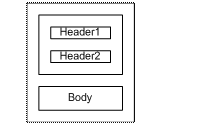
Even
before any supporting tokens are added, each binding requires that
the message is signed using a token satisfying the required usage
for that binding, and that the signature (Sig1) covers important
parts of the message including the message timestamp (TS)
facilitate replay detection. The signature is then included as part
of the Security header as illustrated below:

Note: if required, the
initiator may also include in the Security header the token used as
the basis for the message signature (Sig1), not shown in the
diagram.
If
transport security is used, only the message timestamp (TS) is
included in the Security header as illustrated below. The
“message signature” is provided by the underlying
transport protocol and is not part of the message XML.

8.1 SupportingTokens
Assertion
Supporting tokens are
included in the security header and may optionally include
additional message parts to sign and/or encrypt. The supporting
tokens can be added to any SOAP message and do not require any
protection (signature or encryption) to be applied to the message
before they are added. More specifically there is no requirement on
“message signature” being present before the supporting
tokens are added. However it is RECOMMENDED to employ underlying
protection mechanism to ensure that the supporting tokens are
cryptographically bound to the message during the
transmission.
Syntax
<sp:SupportingTokens xmlns:sp="..." ... >
<wsp:Policy xmlns:wsp="...">
[Token Assertion]+
<sp:AlgorithmSuite ... > ...
</sp:AlgorithmSuite> ?
(
<sp:SignedParts ... > ... </sp:SignedParts> |
<sp:SignedElements ...
> ... </sp:SignedElements> |
<sp:EncryptedParts ... > ... </sp:EncryptedParts> |
<sp:EncryptedElements ... >
... </sp:EncryptedElements> |
) *
...
</wsp:Policy>
...
</sp:SupportingTokens>
The
following describes the attributes and elements listed in the
schema outlined above:
/sp:SupportingTokens
This identifies a
SupportingTokens assertion. The specified tokens populate the
[Supporting Tokens] property.
/sp:SupportingTokens/wsp:Policy
This describes additional
requirements for satisfying the SupportingTokens
assertion.
/sp:SupportingTokens/wsp:Policy/[Token
Assertion]
The policy MUST identify
one or more token assertions.
/sp:SupportingTokens/wsp:Policy/sp:AlgorithmSuite
This optional element is a
policy assertion that follows the schema outlined in Section 7.1
and describes the algorithms to use for cryptographic operations
performed with the tokens identified by this policy
assertion.
/sp:SupportingTokens/wsp:Policy/sp:SignedParts
This optional element is a
policy assertion that follows the schema outlined in Section 4.1.1
and describes additional message parts that MUST be included in the
signature generated with the token identified by this policy
assertion.
/sp:SupportingTokens/wsp:Policy/sp:SignedElements
This optional element is a
policy assertion that follows the schema outlined in Section 4.1.2
and describes additional message elements that MUST be included in
the signature generated with the token identified by this policy
assertion.
/sp:SupportingTokens/wsp:Policy/sp:EncryptedParts
This optional element is a
policy assertion that follows the schema outlined in Section 4.2.1
and describes additional message parts that MUST be encrypted using
the token identified by this policy assertion.
/sp:SupportingTokens/wsp:Policy/sp:EncryptedElements
This optional element is a
policy assertion that follows the schema outlined in Section 4.2.2
and describes additional message elements that MUST be encrypted
using the token identified by this policy assertion.
8.2 SignedSupportingTokens
Assertion
Signed tokens are included
in the “message signature” as defined above
and may optionally
include additional message parts to sign and/or encrypt. The diagram below
illustrates how the attached token (Tok2) is signed by the message
signature (Sig1):
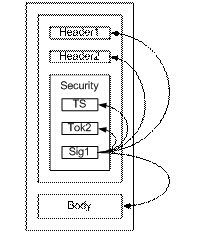
If
transport security is used, the token (Tok2) is included in the
Security header as illustrated below:

Syntax
<sp:SignedSupportingTokens xmlns:sp="..." ... >
<wsp:Policy xmlns:wsp="...">
[Token Assertion]+
<sp:AlgorithmSuite ... > ...
</sp:AlgorithmSuite> ?
(
<sp:SignedParts ... > ... </sp:SignedParts> |
<sp:SignedElements ...
> ... </sp:SignedElements> |
<sp:EncryptedParts ... > ... </sp:EncryptedParts> |
<sp:EncryptedElements ... >
... </sp:EncryptedElements> |
) *
...
</wsp:Policy>
...
</sp:SignedSupportingTokens>
The
following describes the attributes and elements listed in the
schema outlined above:
/sp:SignedSupportingTokens
This identifies a
SignedSupportingTokens assertion. The specified tokens populate the
[Signed Supporting Tokens] property.
/sp:SignedSupportingTokens/wsp:Policy
This describes additional
requirements for satisfying the SignedSupportingTokens
assertion.
/sp:SignedSupportingTokens/wsp:Policy/[Token
Assertion]
The policy MUST identify
one or more token assertions.
/sp:SignedSupportingTokens/wsp:Policy/sp:AlgorithmSuite
This optional element is a
policy assertion that follows the schema outlined in Section 7.1
and describes the algorithms to use for cryptographic operations
performed with the tokens identified by this policy
assertion.
/sp:SignedSupportingTokens/wsp:Policy/sp:SignedParts
This optional element is a
policy assertion that follows the schema outlined in Section 4.1.1
and describes additional message parts that MUST be included in the
signature generated with the token identified by this policy
assertion.
/sp:SignedSupportingTokens/wsp:Policy/sp:SignedElements
This optional element is a
policy assertion that follows the schema outlined in Section 4.1.2
and describes additional message elements that MUST be included in
the signature generated with the token identified by this policy
assertion.
/sp:SignedSupportingTokens/wsp:Policy/sp:EncryptedParts
This optional element is a
policy assertion that follows the schema outlined in Section 4.2.1
and describes additional message parts that MUST be encrypted using
the token identified by this policy assertion.
/sp:SignedSupportingTokens/wsp:Policy/sp:EncryptedElements
This optional element is a
policy assertion that follows the schema outlined in Section 4.2.2
and describes additional message elements that MUST be encrypted
using the token identified by this policy assertion.
8.3 EndorsingSupportingTokens
Assertion
Endorsing tokens sign the
message signature, that is they sign the entire ds:Signature element produced from the
message signature and may optionally include
additional message parts to sign and/or encrypt. The diagram below
illustrates how the endorsing signature (Sig2) signs the message
signature (Sig1):

If
transport security is used, the signature (Sig2) MUST cover the
message timestamp as illustrated below:

Syntax
<sp:EndorsingSupportingTokens xmlns:sp="..." ... >
<wsp:Policy xmlns:wsp="...">
[Token Assertion]+
<sp:AlgorithmSuite ... > ...
</sp:AlgorithmSuite> ?
(
<sp:SignedParts ... > ... </sp:SignedParts> |
<sp:SignedElements ...
> ... </sp:SignedElements> |
<sp:EncryptedParts ... > ... </sp:EncryptedParts> |
<sp:EncryptedElements ... >
... </sp:EncryptedElements> |
) *
...
</wsp:Policy>
...
</sp:EndorsingSupportingTokens>
The
following describes the attributes and elements listed in the
schema outlined above:
/sp:EndorsingSupportingTokens
This identifies an
EndorsingSupportingTokens assertion. The specified tokens populate
the [Endorsing Supporting Tokens] property.
/sp:EndorsingSupportingTokens/wsp:Policy
This describes additional
requirements for satisfying the EndorsingSupportingTokens
assertion.
/sp:EndorsingSupportingTokens/wsp:Policy/[Token
Assertion]
The policy MUST identify
one or more token assertions.
/sp:EndorsingSupportingTokens/wsp:Policy/sp:AlgorithmSuite
This optional element is a
policy assertion that follows the schema outlined in Section 7.1
and describes the algorithms to use for cryptographic operations
performed with the tokens identified by this policy
assertion.
/sp:EndorsingSupportingTokens/wsp:Policy/sp:SignedParts
This optional element is a
policy assertion that follows the schema outlined in Section 4.1.1
and describes additional message parts that MUST be included in the
signature generated with the token identified by this policy
assertion.
/sp:EndorsingSupportingTokens/wsp:Policy/sp:SignedElements
This optional element is a
policy assertion that follows the schema outlined in Section 4.1.2
and describes additional message elements that MUST be included in
the signature generated with the token identified by this policy
assertion.
/sp:EndorsingSupportingTokens/wsp:Policy/sp:EncryptedParts
This optional element is a
policy assertion that follows the schema outlined in Section 4.2.1
and describes additional message parts that MUST be encrypted using
the token identified by this policy assertion.
/sp:EndorsingSupportingTokens/wsp:Policy/sp:EncryptedElements
This optional element is a
policy assertion that follows the schema outlined in Section 4.2.2
and describes additional message elements that MUST be encrypted
using the token identified by this policy assertion.
Signed endorsing tokens
sign the entire ds:Signature element produced from the
message signature and are themselves signed by that message
signature, that is both tokens (the token used for the message
signature and the signed endorsing token) sign each other. This
assertion may
optionally include additional message parts to sign and/or
encrypt. The
diagram below illustrates how the signed token (Tok2) is signed by
the message signature (Sig1) and the endorsing signature (Sig2)
signs the message signature (Sig1):

If
transport security is used, the token (Tok2) is included in the
Security header and the signature (Sig2) should cover the message
timestamp as illustrated below:

Syntax
<sp:SignedEndorsingSupportingTokens xmlns:sp="..." ...
>
<wsp:Policy xmlns:wsp="...">
[Token Assertion]+
<sp:AlgorithmSuite ... > ...
</sp:AlgorithmSuite> ?
(
<sp:SignedParts ... > ... </sp:SignedParts> |
<sp:SignedElements ...
> ... </sp:SignedElements> |
<sp:EncryptedParts ... > ... </sp:EncryptedParts> |
<sp:EncryptedElements ... >
... </sp:EncryptedElements> |
) *
...
</wsp:Policy>
...
</sp:SignedEndorsingSupportingTokens>
The
following describes the attributes and elements listed in the
schema outlined above:
/sp:SignedEndorsingSupportingTokens
This identifies a
SignedEndorsingSupportingTokens assertion. The specified tokens
populate the [Signed Endorsing Supporting Tokens]
property.
/sp:SignedEndorsingSupportingTokens/wsp:Policy
This describes additional
requirements for satisfying the EndorsingSupportingTokens
assertion.
/sp:SignedEndorsingSupportingTokens/wsp:Policy/[Token
Assertion]
The policy MUST identify
one or more token assertions.
/sp:SignedEndorsingSupportingTokens/wsp:Policy/sp:AlgorithmSuite
This optional element is a
policy assertion that follows the schema outlined in Section 7.1
and describes the algorithms to use for cryptographic operations
performed with the tokens identified by this policy
assertion.
/sp:SignedEndorsingSupportingTokens/wsp:Policy/sp:SignedParts
This optional element is a
policy assertion that follows the schema outlined in Section 4.1.1
and describes additional message parts that MUST be included in the
signature generated with the token identified by this policy
assertion.
/sp:SignedEndorsingSupportingTokens/wsp:Policy/sp:SignedElements
This optional element
follows the schema outlined in Section 4.1.2 and describes
additional message elements that MUST be included in the signature
generated with the token identified by this policy
assertion.
/sp:SignedEndorsingSupportingTokens/wsp:Policy/sp:EncryptedParts
This optional element is a
policy assertion that follows the schema outlined in Section 4.2.1
and describes additional message parts that MUST be encrypted using
the token identified by this policy assertion.
/sp:SignedEndorsingSupportingTokens/wsp:Policy/sp:EncryptedElements
This optional element is a
policy assertion that follows the schema outlined in Section 4.2.2
and describes additional message elements that MUST be encrypted
using the token identified by this policy assertion.
8.5 SignedEncryptedSupportingTokens
Assertion
Signed, encrypted
supporting tokens are Signed supporting tokens (See section 8.2) that are also
encrypted when they appear in the wsse:SecurityHeader.
Element Encryption SHOULD be used for encrypting the supporting
tokens.
The
syntax for the sp:SignedEncryptedSupportingTokens differs from
the syntax of
sp:SignedSupportingTokens only in the name of the assertion
itself. All nested policy
is as per the sp:SignedSupportingTokens assertion.
8.6 EncryptedSupportingTokens
Assertion
Encrypted supporting tokens are supporting
tokens (See section 8.1) that are included in the security header
and MUST be encrypted when they appear in the security header.
Element encryption SHOULD be used for encrypting these tokens. The
encrypted supporting tokens can be added to any SOAP message and do
not require the “message signature” being present
before the encrypted supporting tokens are added.
The syntax for the
sp:EncryptedSupportingTokens differs from the syntax of
sp:SupportingTokens only in the name of the assertion itself. All
nested policy is as per the sp:SupportingTokens assertion.
The encrypted supporting tokens SHOULD be only
used when the sender cannot provide the “message
signature” and it is RECOMMENDED that the receiver employs
some security mechanisms external to the message to prevent the
spoofing attacks. In all other cases it is RECOMMENDED to use
signed encrypted supporting tokens instead to ensure that the
encrypted tokens are cryptographically bound to the message (See
section 8.5).
Endorsing, encrypted
supporting tokens are Endorsing supporting tokens (See section 8.3) that are
also encrypted when they appear in the wsse:SecurityHeader.
Element Encryption SHOULD be used for encrypting the supporting
tokens.
The
syntax for the sp:EndorsingEncryptedSupportingTokens differs
from the syntax of
sp:EndorsingSupportingTokens only in the name of the assertion itself. All
nested policy is as per the sp:EndorsingSupportingTokens
assertion.
8.8 SignedEndorsingEncryptedSupportingTokens
Assertion
Signed, endorsing,
encrypted supporting tokens are signed, endorsing supporting tokens (See
section 8.4) that are also encrypted when they appear in the
wsse:SecurityHeader. Element Encryption SHOULD be used for
encrypting the supporting tokens.
The
syntax for the sp:SignedEndorsingEncryptedSupportingTokens
differs from the syntax of
sp:SignedEndorsingSupportingTokens only in the name of the assertion itself.
All nested policy is as per the sp:SignedEndorsingSupportingTokens
assertion.
If
[Token Protection] (see Section 6.5) is true, then each signature
covers the token that generated that signature and the following
statements hold with respect to the various tokens that sign or are
signed;
·
The message
signature, generated from the [Initiator Token] in the Asymmetric
Binding case or the [Signature Token] in the Symmetric binding
case, covers that token.
·
Endorsing signatures
cover the main signature and the endorsing token.
·
For signed,
endorsing supporting tokens, the supporting token is signed twice,
once by the message signature and once by the endorsing
signature.
In
addition, signed supporting tokens are covered by the message
signature, although this is independent of [Token
Protection].
Example policy containing
supporting token assertions:
<!--
Example Endpoint Policy -->
<wsp:Policy xmlns:wsp="...">
<sp:SymmetricBinding xmlns:sp="...">
<wsp:Policy>
<sp:ProtectionToken>
<sp:IssuedToken
sp:IncludeToken=".../IncludeToken/Once" >
<sp:Issuer>...</sp:Issuer>
<sp:RequestSecurityTokenTemplate>
...
</sp:RequestSecurityTokenTemplate>
</sp:IssuedToken>
</sp:ProtectionToken>
<sp:AlgorithmSuite>
<wsp:Policy>
<sp:Basic256 />
</wsp:Policy>
</sp:AlgorithmSuite>
...
</wsp:Policy>
</sp:SymmetricBinding>
...
<sp:SignedSupportingTokens>
<wsp:Policy>
<sp:UsernameToken
sp:IncludeToken=".../IncludeToken/Once" />
</wsp:Policy>
</sp:SignedSupportingTokens>
<sp:SignedEndorsingSupportingTokens>
<wsp:Policy>
<sp:X509Token
sp:IncludeToken=".../IncludeToken/Once" >
<wsp:Policy>
<sp:WssX509v3Token10 />
</wsp:Policy>
</sp:X509Token>
</wsp:Policy>
</sp:SignedEndorsingSupportingTokens>
...
</wsp:Policy>
The
sp:SignedSupportingTokens assertion in the above policy indicates
that a Username Token must be included in the security header and
covered by the message signature. The
sp:SignedEndorsingSupportingTokens assertion indicates that an X509
certificate must be included in the security header and covered by
the message signature. In addition, a signature over the message
signature based on the key material associated with the X509
certificate must be included in the security header.
9
WSS: SOAP Message
Security Options
There are several optional
aspects to the WSS: SOAP Message Security specification that are
independent of the trust and token taxonomies. This section
describes another class of properties and associated assertions
that indicate the supported aspects of WSS: SOAP Message
Security.The
assertions defined here MUST apply to [Endpoint Policy
Subject].
The
properties and assertions dealing with token references defined in
this section indicate whether the initiator and recipient MUST be
able to process a given reference mechanism, or whether the
initiator and recipient MAY send a fault if such references are
encountered.
Note: This approach is
chosen because:
A)
[WSS: SOAP Message
Security] allows for multiple equivalent reference mechanisms to be
used in a single reference.
B)
In a multi-message
exchange, a token may be referenced using different mechanisms
depending on which of a series of messages is being
secured.
If a
message sent to a recipient does not adhere to the
recipient’s policy the recipient MAY raise a wsse:InvalidSecurity fault.
WSS: SOAP Message Security
1.0
Properties
[Direct
References]
This
property indicates whether the initiator and recipient MUST be able
to process direct token references (by ID or URI reference). This
property always has a value of 'true'. i.e. All implementations
MUST be able to process such references.
[Key Identifier
References]
This
boolean property indicates whether the initiator and recipient MUST
be able to process key-specific identifier token references. A
value of 'true' indicates that the initiator and recipient MUST be
able to generate and process such references. A value of 'false'
indicates that the initiator and recipient MUST NOT generate such
references and that the initiator and recipient MAY send a fault if
such references are encountered.This property has a
default value of 'false'.
[Issuer Serial
References]
This
boolean property indicates whether the initiator and recipient MUST
be able to process references using the issuer and token serial
number. A value of 'true' indicates that the initiator and
recipient MUST be able to process such references. A value of
'false' indicates that the initiator and recipient MUST NOT
generate such references and that the initiator and recipient MAY
send a fault if such references are encountered.This property has a
default value of 'false'.
[External URI
References]
This
boolean property indicates whether the initiator and recipient MUST
be able to process references to tokens outside the message using
URIs. A value of 'true' indicates that the initiator and recipient
MUST be able to process such references. A value of 'false'
indicates that the initiator and recipient MUST NOT generate such
references and that the initiator and recipient MAY send a fault if
such references are encountered. This property has a
default value of 'false'.
[Embedded Token
References]
This
boolean property indicates whether the initiator and recipient MUST
be able to process references that contain embedded tokens. A value
of 'true' indicates that the initiator and recipient MUST be able
to process such references. A value of 'false' indicates that the
initiator and recipient MUST NOT generate such references and that
the initiator and recipient MAY send a fault if such references are
encountered.This property has a
default value of 'false'.
WSS: SOAP Message Security
1.1 Properties
[Thumbprint
References]
This
boolean property indicates whether the initiator and recipient MUST
be able to process references using token thumbprints. A value of
'true' indicates that the initiator and recipient MUST be able to
process such references. A value of 'false' indicates that the
initiator and recipient MUST NOT generate such references and that
the initiator and recipient MAY send a fault if such references are
encountered.This property has a
default value of 'false'.
[EncryptedKey
References]
This
boolean property indicates whether the initiator and recipient MUST
be able to process references using EncryptedKey references. A
value of 'true' indicates that the initiator and recipient MUST be
able to process such references. A value of 'false' indicates that
the initiator and recipient MUST NOT generate such references and
that the initiator and recipient MAY send a fault if such
references are encountered.This property has a
default value of 'false'.
[Signature
Confirmation]
This
boolean property specifies whether wsse11:SignatureConfirmation
elements should be
used as defined in WSS: Soap Message Security 1.1. If the value is
'true', wsse11:SignatureConfirmation
elements MUST be
used and signed by the message signature. If the value is 'false',
signature confirmation elements MUST NOT be used. The value of this
property applies to all signatures that are included in the
security header. This property has a default value of
'false'.
9.1 Wss10
Assertion
The
Wss10 assertion allows you to specify which WSS: SOAP Message
Security 1.0 options are supported.
Syntax
<sp:Wss10 xmlns:sp="..." ... >
<wsp:Policy xmlns:wsp="...">
<sp:MustSupportRefKeyIdentifier ...
/> ?
<sp:MustSupportRefIssuerSerial ...
/> ?
<sp:MustSupportRefExternalURI ... />
?
<sp:MustSupportRefEmbeddedToken ...
/> ?
...
</wsp:Policy>
...
</sp:Wss10>
The
following describes the attributes and elements listed in the
schema outlined above:
/sp:Wss10
This identifies a WSS10
assertion.
/sp:Wss10/wsp:Policy
This indicates a policy
that controls WSS: SOAP Message Security 1.0 options.
/sp:Wss10/wsp:Policy/sp:MustSupportRefKeyIdentifier
This optional element is a
policy assertion indicates that the [Key Identifier References]
property is set to 'true'.
/sp:Wss10/wsp:Policy/sp:MustSupportRefIssuerSerial
This optional element is a
policy assertion indicates that the [Issuer Serial References]
property is set to 'true'.
/sp:Wss10/wsp:Policy/sp:MustSupportRefExternalURI
This optional element is a
policy assertion indicates that the [External URI References]
property is set to 'true'.
/sp:Wss10/wsp:Policy/sp:MustSupportRefEmbeddedToken
This optional element is a
policy assertion indicates that the [Embedded Token References]
property is set to 'true'.
9.2 Wss11
Assertion
The
Wss11 assertion allows you to specify which WSS: SOAP Message
Security 1.1 options are supported.
Syntax
<sp:Wss11 xmlns:sp="..." ... >
<wsp:Policy xmlns:wsp="...">
<sp:MustSupportRefKeyIdentifier ...
/> ?
<sp:MustSupportRefIssuerSerial ...
/> ?
<sp:MustSupportRefExternalURI ... />
?
<sp:MustSupportRefEmbeddedToken ...
/> ?
<sp:MustSupportRefThumbprint ... />
?
<sp:MustSupportRefEncryptedKey ...
/> ?
<sp:RequireSignatureConfirmation ...
/> ?
...
</wsp:Policy>
</sp:Wss11>
The
following describes the attributes and elements listed in the
schema outlined above:
/sp:Wss11
This identifies an WSS11
assertion.
/sp:Wss11/wsp:Policy
This indicates a policy
that controls WSS: SOAP Message Security 1.1 options.
/sp:Wss11/wsp:Policy/sp:MustSupportRefKeyIdentifier
This optional element is a
policy assertion indicates that the [Key Identifier References]
property is set to 'true'.
/sp:Wss11/wsp:Policy/sp:MustSupportRefIssuerSerial
This optional element is a
policy assertion indicates that the [Issuer Serial References]
property is set to 'true'.
/sp:Wss11/wsp:Policy/sp:MustSupportRefExternalURI
This optional element is a
policy assertion indicates that the [External URI References]
property is set to 'true'.
/sp:Wss11/wsp:Policy/sp:MustSupportRefEmbeddedToken
This optional element is a
policy assertion indicates that the [Embedded Token References]
property is set to 'true'.
/sp:Wss11/wsp:Policy/sp:MustSupportRefThumbprint
This optional element is a
policy assertion indicates that the [Thumbprint References]
property is set to 'true'.
/sp:Wss11/wsp:Policy/sp:MustSupportRefEncryptedKey
This optional element is a
policy assertion indicates that the [EncryptedKey References]
property is set to 'true'.
/sp:Wss11/wsp:Policy/sp:RequireSignatureConfirmation
This optional element is a
policy assertion indicates that the [Signature Confirmation]
property is set to 'true'.
This
section defines the various policy assertions related to exchanges
based on WS-Trust, specifically with client and server challenges
and entropy behaviors. These assertions relate to interactions with
a Security Token Service and may augment the behaviors defined by
the Binding Property Assertions defined in Section 6. The
assertions defined here MUST apply to [Endpoint Policy
Subject].
WS-Trust 1.3
Properties
[Client
Challenge]
This
boolean property indicates whether client challenges are supported.
A value of 'true' indicates that a wst:SignChallenge element is supported
inside of an RST sent by the client to the server.A value of 'false'
indicates that a wst:SignChallenge is not supported.
There is no change
in the number of messages exchanged by the client and service in
satisfying the RST. This property has a default value of
'false'.
[Server
Challenge]
This
boolean property indicates whether server challenges are supported.
A value of 'true' indicates that a wst:SignChallenge element is supported
inside of an RSTR sent by the server to the client.A value of 'false'
indicates that a wst:SignChallenge is not supported.
A challenge issued
by the server may increase the number of messages exchanged by the
client and service in order to accommodate the wst:SignChallengeResponse
element sent by the
client to the server in response to the wst:SignChallenge element. A final RSTR
containing the issued token will follow subsequent to the server
receiving the wst:SignChallengeResponse
element. This
property has a default value of 'false'.
[Client
Entropy]
This
boolean property indicates whether client entropy is required to be
used as key material for a requested proof token. A value of 'true'
indicates that client entropy is required. A value of 'false'
indicates that client entropy is not required. This property has a
default value of 'false'.
[Server
Entropy]
This
boolean property indicates whether server entropy is required to be
used as key material for a requested proof token. A value of 'true'
indicates that server entropy is required. A value of 'false'
indicates that server entropy is not required. This property has a
default value of 'false'.
Note: If both the [Client
Entropy] and [Server Entropy] properties are set to true, Client
and server entropy are combined to produce a computed key using the
Computed Key algorithm defined by the [Algorithm Suite]
property.
[Issued
Tokens]
This
boolean property indicates whether the wst:IssuedTokens header is supported as
described in WS-Trust. A value of 'true' indicates that the
wst:IssuedTokens header is supported. A value of 'false' indicates
that the wst:IssuedTokensheader is not supported.
This property has a default value of 'false'.
[Collection]
This
boolean property specifies whether a
wst:RequestSecurityTokenCollection element is present. A value of
'true' indicates that the wst:RequestSecurityTokenCollection
element MUST be present and MUST be integrity protected either by
transport or message level security. A value of 'false' indicates
that the wst:RequestSecurityTokenCollection element MUST NOT be
present. This property has a default value of 'false'.
10.1 Trust13
Assertion
The
Trust13 assertion allows you to specify which WS-Trust 1.3 options
are supported.
Syntax
<sp:Trust13 xmlns:sp="..." ... >
<wsp:Policy xmlns:wsp="...">
<sp:MustSupportClientChallenge ...
/>?
<sp:MustSupportServerChallenge ...
/>?
<sp:RequireClientEntropy ...
/>?
<sp:RequireServerEntropy ...
/>?
<sp:MustSupportIssuedTokens ...
/>?
<sp:RequireRequestSecurityTokenCollection
/>?
<sp:RequireAppliesTo />?
...
</wsp:Policy>
...
</sp:Trust13 ... >
The
following describes the attributes and elements listed in the
schema outlined above:
/sp:Trust13
This identifies a Trust13
assertion.
/sp:Trust13/wsp:Policy
This indicates a policy
that controls WS-Trust 1.3 options.
/sp:Trust13/wsp:Policy/sp:MustSupportClientChallenge
This optional element is a
policy assertion indicates that the [Client Challenge] property is
set to 'true'.
/sp:Trust13/wsp:Policy/sp:MustSupportServerChallenge
This optional element is a
policy assertion indicates that the [Server Challenge] property is
set to 'true'.
/sp:Trust13/wsp:Policy/sp:RequireClientEntropy
This optional element is a
policy assertion indicates that the [Client Entropy] property is
set to 'true'.
/sp:Trust13/wsp:Policy/sp:RequireServerEntropy
This optional element is a
policy assertion indicates that the [Server Entropy] property is
set to 'true'.
/sp:Trust13/wsp:Policy/sp:MustSupportIssuedTokens
This optional element is a
policy assertion indicates that the [Issued Tokens] property is set
to 'true'.
/sp:Trust13/wsp:Policy/sp:RequireRequestSecurityTokenCollection
This optional element is a
policy assertion that indicates that the [Collection] property is
set to 'true'.
/sp:Trust10/wsp:Policy/sp:RequireAppliesTo
This optional element is a
policy assertion indicates that the STS requires the requestor to
specify the scope for the issued token using wsp:AppliesTo in the
RST.
This
non-normative appendix provides guidance for designers of new
assertions intended for use with this specification.
·
Prefer Distinct
Qnames
·
Parameterize using
nested policy where possible.
·
Parameterize using
attributes and/or child elements where necessary.
Assertions in WS-SP are
XML elements that are identified by their QName. Matching of
assertions per WS-Policy is performed by matching element QNames.
Matching does not take into account attributes that are present on
the assertion element. Nor does it take into account child elements
except for wsp:Policy elements. If a wsp:Policy element is present,
then matching occurs against the assertions nested inside that
wsp:Policy element recursively (see
Policy Assertion
Nesting [WS-Policy]).
When
designing new assertions for use with WS-SP, the above matching
behaviour needs to be taken into account. In general, multiple
assertions with distinct QNames are preferably to a single
assertion that uses attributes and/or content to distinguish
different cases. For example, given two possible assertion
designs;
Design 1
<A1/>
<A2/>
<A3/>
Design 2.
<A Parameter='1' />
<A Parameter='2' />
<A Parameter='3' />
then
design 1. would generally be prefered because it allows the policy
matching logic to provide more accurate matches between
policies.
A
good example of design 1 is the token assertions defined in Section
5. The section defines 10 distinct token assertions, rather than a
single sp:Token assertion with, for example, a TokenType attribute.
These distinct token assertions make policy matching much more
useful as less false positives are generated when performing policy
matching.
There are cases where
using attributes or child elements as parameters in assertion
design is reasonable. Examples include cases when implementations
are expected to understand all the values for a given parameter and
when encoding the parameter information into the assertion QName
would result in an unmanageable number of assertions. A good
example is the sp:IncludeToken attribute that appears on the
various token assertions. Five possible values are currently
specified for the sp:IncludeToken attribute and implementations are
expected to understand the meaning of all 5 values. If this
information was encoded into the assertion QNames, each existing
token assertion would require five variants, one for each Uri value
which would result in 45 assertions just for the tokens defined in
Section 5.
Nested policy is ideal for
encoding parameters that can be usefully matched using policy
matching. For example, the token version assertions defined in
Section 5 use such an approach. The overall token type assertion is
parameterized by the nested token version assertions. Policy
matching can use these parameters to find matches between policies
where the broad token type is support by both parties but they
might not support the same specific versions.
Note, when designing
assertions for new token types such assertions SHOULD allow the
sp:IncludeToken attribute and SHOULD allow nested
policy.
It
is strongly recommended that policies and assertions be signed to
prevent tampering.
It
is recommended that policies should not be accepted unless they are
signed and have an associated security token to specify the signer
has proper claims for the given policy. That is, a party
shouldn't rely on a policy unless the policy is signed and
presented with sufficient claims. It is further recommended that
the entire policy exchange mechanism be protected to prevent
man-in-the-middle downgrade attacks.
It
should be noted that the mechanisms described in this document
could be secured as part of a SOAP message using WSS: SOAP Message
Security [WSS10, WSS11]
or embedded within other objects using object-specific security
mechanisms.
It
is recommended that policies not specify two (or more)
SignedSupportingTokens or SignedEndorsingSupportingTokens of the
same token type. Messages conforming to such policies are subject
to modification which may be undetectable.
It
is recommended that policies specify the
OnlySignEntireHeadersAndBody assertion along with the rest of the
policy in order to combat certain XML substitution
attacks.
This
non-normative appendix classifies assertions according to their
suggested scope in WSDL 1.1 per Section 4 of [WS-PolicyAttachment].
See Figure 1 in Section 4.1 of [WS-PolicyAttachment] for a
graphical representation of the relationship between policy scope
and WSDL. Unless otherwise noted above, any assertion that is
listed under multiple [Policy Subjects] below MUST only apply to
only one [Policy Subject] in a WSDL 1.1 hierarchy for calculating
an Effective Policy.
A.1 Endpoint Policy Subject
Assertions
A.1.1 Security Binding
Assertions
TransportBinding
Assertion
(Section 7.3)
SymmetricBinding
Assertion
(Section 7.4)
AsymmetricBinding
Assertion
(Section 7.5)
A.1.2 Token
Assertions
SupportingTokens
Assertion
(Section 8.1)
SignedSupportingTokens
Assertion
(Section 8.2)
EndorsingSupportingTokens
Assertion
(Section 8.3)
SignedEndorsingSupportingTokens
Assertion
(Section 8.4)
SignedEncryptedSupportingTokens
Assertion
(Section 8.5)
EndorsingEncryptedSupportingTokens
Assertion
(Section 8.6)
SignedEndorsingEncryptedSupportingTokens
Assertion
(Section 8.7)
A.1.3 WSS: SOAP Message
Security 1.0 Assertions
Wss10
Assertion
(Section 9.1)
A.1.4 WSS: SOAP Message Security
1.1 Assertions
Wss11
Assertion
(Section 9.2)
A.1.5 Trust 1.0
Assertions
Trust13
Assertion
(Section 10.1)
A.2 Operation Policy Subject
Assertions
A.2.1 Security Binding
Assertions
SymmetricBinding
Assertion
(Section 7.4)
AsymmetricBinding
Assertion
(Section 7.5)
A.2.2 Supporting Token
Assertions
SupportingTokens
Assertion
(Section 8.1)
SignedSupportingTokens
Assertion
(Section 8.2)
EndorsingSupportingTokens
Assertion
(Section 8.3)
SignedEndorsingSupportingTokens
Assertion
(Section 8.4)
SignedEncryptedSupportingTokens
Assertion
(Section 8.5)
EndorsingEncryptedSupportingTokens
Assertion
(Section 8.6)
SignedEndorsingEncryptedSupportingTokens
Assertion
(Section 8.7)
A.3 Message Policy Subject
Assertions
A.3.1 Supporting Token
Assertions
SupportingTokens
Assertion
(Section 8.1)
SignedSupportingTokens
Assertion
(Section 8.2)
EndorsingSupportingTokens
Assertion
(Section 8.3)
SignedEndorsingSupportingTokens
Assertion
(Section 8.4)
SignedEncryptedSupportingTokens
Assertion
(Section 8.5)
EndorsingEncryptedSupportingTokens
Assertion
(Section 8.6)
SignedEndorsingEncryptedSupportingTokens
Assertion
(Section 8.7)
A.3.2 Protection
Assertions
SignedParts
Assertion
(Section 4.1.1)
SignedElements
Assertion
(Section 4.1.2)
EncryptedParts
Assertion
(Section 4.2.1)
EncryptedElements
Assertion
(Section 4.2.2)
ContentEncryptedElements
Assertion
(Section 4.2.3)
RequiredElements
Assertion
(Section 4.3.1)
RequiredParts
Assertion
(Section 4.3.2)
A.4 Assertions
With Undefined
Policy Subject
The assertions listed in
this section do not have a defined policy subject because they
appear nested inside some other assertion which does have a defined
policy subject. This list is derived from nested assertions in the
specification that have independent sections. It is not a complete
list of nested assertions. Many of the assertions previously listed
in this appendix as well as the ones below have additional nested
assertions.
A.4.1 General
Assertions
AlgorithmSuite
Assertion
(Section 7.1)
Layout
Assertion
(Section 7.2)
A.4.2 Token Usage
Assertions
See
the nested assertions under the TransportBinding, SymmetricBinding
and AssymetricBinding
assertions.
A.4.3 Token
Assertions
UsernameToken
Assertion
(Section 5.3.1)
IssuedToken
Assertion
(Section 5.3.2)
X509Token
Assertion
(Section 5.3.3)
KerberosToken
Assertion
(Section 5.3.4)
SpnegoContextToken
Assertion
(Section 5.3.5)
SecurityContextToken
Assertion
(Section 5.3.6)
SecureConversationToken
Assertion
(Section 5.3.7)
SamlToken
Assertion
(Section 5.3.8)
RelToken
Assertion
(Section 5.3.9)
HttpsToken
Assertion
(Section 5.3.10)
The section provides
further detail about behavior associated with the IssuedToken
assertion in section 5.3.2.
The issued token security
model involves a three-party setup. There’s a target Server,
a Client, and a trusted third party called a Security Token Service
or STS. Policy flows from Server to Client, and from STS to Client.
Policy may be embedded inside an Issued Token assertion, or
acquired out-of-band. There may be an explicit trust relationship
between the Server and the STS. There must be a trust relationship
between the Client and the STS.
The Issued Token policy
assertion includes two parts: 1) client-specific parameters that
must be understood and processed by the client and 2) STS specific
parameters which are to be processed by the STS. The format of the
Issued Token policy assertion is illustrated in the figure
below.
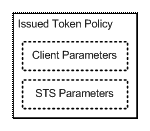
The client-specific
parameters of the Issued Token policy assertion along with the
remainder of the server policy are consumed by the client. The STS
specific parameters of the Issued Token policy assertion are passed
on to the STS by copying the parameters directly into the
wst:SecondaryParameters
of the RST request sent by the
Client to the STS as illustrated in the figure below.
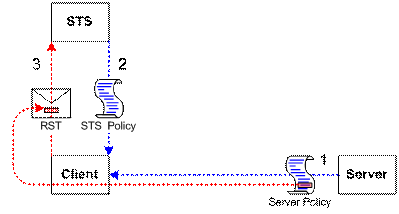
Before the Client sends
the RST to the STS, it will need to obtain the policy for the STS.
This will help to formulate the RST request and will include any
security-specific requirements of the STS.
The Client may augment or
replace the contents of the RST made to the STS based on the
Client-specific parameters received from the Issued Token policy
assertion contained in the Server policy, from policy it received
for the STS, or any other local parameters.
The Issued Token Policy
Assertion contains elements which must be understood by the Client.
The assertion contains one element which contains a list of
arbitrary elements which should be sent along to the STS by copying
the elements as-is directly into the wst:SecondaryParameters
of the RST
request sent by the
Client to the STS following the protocol defined in
WS-Trust.
Elements inside the
sp:RequestSecurityTokenTemplate
element MUST conform
to WS-Trust [WS-Trust]. All items are
optional, since the Server and STS may already have a pre-arranged
relationship which specifies some or all of the conditions and
constraints for issued tokens.
C. Strict Security Header
Layout Examples
The
following sections describe the security header layout for specific
bindings when applying the ‘Strict’ layout rules
defined in Section 6.7.
C.1 Transport
Binding
This
section describes how the ‘Strict’ security header
layout rules apply to the Transport Binding.
C.1.1 Policy
The
following example shows a policy indicating a Transport Binding, an
Https Token as the Transport Token, an algorithm suite, a
requirement to include tokens in the supporting signatures, a
username token attached to the message, and finally an X509 token
attached to the message and endorsing the message signature. No
message protection requirements are described since the transport
covers all message parts.
<wsp:Policy xmlns:wsp="..." xmlns:sp="...">
<sp:TransportBinding>
<wsp:Policy>
<sp:TransportToken>
<wsp:Policy>
<sp:HttpsToken />
</wsp:Policy>
</sp:TransportToken>
<sp:AlgorithmSuite>
<wsp:Policy>
<sp:Basic256 />
</wsp:Policy>
</sp:AlgorithmSuite>
<sp:Layout>
<wsp:Policy>
<sp:Strict />
</wsp:Policy>
</sp:Layout>
<sp:IncludeTimestamp />
</wsp:Policy>
</sp:TransportBinding>
<sp:SignedSupportingTokens>
<wsp:Policy>
<sp:UsernameToken
sp:IncludeToken=".../IncludeToken/Once" />
</wsp:Policy>
</sp:SignedSupportingTokens>
<sp:SignedEndorsingSupportingTokens>
<wsp:Policy>
<sp:X509Token
sp:IncludeToken=".../IncludeToken/Once">
<wsp:Policy>
<sp:WssX509v3Token10 />
</wsp:Policy>
</sp:X509Token>
</wsp:Policy>
</sp:SignedEndorsingSupportingTokens>
<sp:Wss11>
<sp:RequireSignatureConfirmation />
</sp:Wss11>
</wsp:Policy>
This
policy is used as the basis for the examples shown in the
subsequent section describing the security header layout for this
binding.
C.1.2 Initiator to Recipient
Messages
Messages sent from
initiator to recipient have the following layout for the security
header:
1.
A wsu:Timestamp element.
2.
Any tokens contained
in the [Signed Supporting Tokens] property.
3.
Any tokens contained
in the [Signed Endorsing Supporting Tokens] property each followed
by the corresponding signature. Each signature MUST cover
the wsu:Timestampelement from 1 above and
SHOULD cover any other unique identifier for the message in order
to prevent replays. If [Token Protection] is 'true', the signature
MUST also cover the supporting token. If [Derived Keys] is 'true'
and the supporting token is associated with a symmetric key, then a
Derived Key Token, based on the supporting token, appears between
the supporting token and the signature.
4.
Any signatures for
tokens contained in the [Endorsing Supporting Tokens] property.
Each signature MUST cover the wsu:Timestamp element from 1 above and
SHOULD cover at least some other unique identifier for the message
in order to prevent replays. If [Token Protection] is 'true', the
signature MUST also cover the supporting token. If [Derived Keys]
is 'true' and the supporting token is associated with a symmetric
key, then a Derived Key Token, based on the supporting token,
appears before the signature.
The
following diagram illustrates the security header layout for the
initiator to recipient message:

The
outer box shows that the entire message is protected (signed and
encrypted) by the transport. The arrows on the left from the box
labeled Sig2 indicate the parts signed by the supporting
token labeled ST2, namely the message timestamp labeled
TS and the token used as the basis for the signature labeled
ST2. The dotted arrow indicates the token that was used
as the basis for the signature. In general, the ordering of the
items in the security header follows the most optimal layout for a
receiver to process its contents.
Example:
Initiator to recipient
message
<S:Envelope xmlns:S="..." xmlns:wsse="..." xmlns:wsu="..."
xmlns:ds="...">
<S:Header>
...
<wsse:Security>
<wsu:Timestamp
wsu:Id="timestamp">
<wsu:Created>[datetime]</wsu:Created>
<wsu:Expires>[datetime]</wsu:Expires>
</wsu:Timestamp>
<wsse:UsernameToken
wsu:Id='SomeSignedToken' >
...
</wsse:UsernameToken>
<wsse:BinarySecurityToken
wsu:Id="SomeSignedEndorsingToken" >
...
</wsse:BinarySecurityToken>
<ds:Signature>
<ds:SignedInfo>
<ds:References>
<ds:Reference URI="#timestamp" />
<ds:Reference URI="#SomeSignedEndorsingToken" />
</ds:References>
</ds:SignedInfo>
<ds:SignatureValue>...</ds:SignatureValue>
<ds:KeyInfo>
<wsse:SecurityTokenReference>
<wsse:Reference URI="#SomeSignedEndorsingToken" />
</wsse:SecurityTokenReference>
</ds:KeyInfo>
</ds:Signature>
...
</wsse:Security>
...
</S:Header>
<S:Body>
...
</S:Body>
</S:Envelope>
C.1.3 Recipient to Initiator
Messages
Messages sent from
recipient to initiator have the following layout for the security
header:
1.
A wsu:Timestamp element.
2.
If the [Signature
Confirmation] property has a value of 'true', then a wsse11:SignatureConfirmation
element for each
signature in the corresponding message sent from initiator to
recipient. If there are no signatures in the corresponding message
from the initiator to the recipient, then a wsse11:SignatureConfirmation
element with no
Value attribute.
The
following diagram illustrates the security header layout for the
recipient to initiator message:

The
outer box shows that the entire message is protected (signed and
encrypted) by the transport. One wsse11:SignatureConfirmation
element labeled
SC1 corresponding to the signature in the initial
message illustrated previously is included. In general, the
ordering of the items in the security header follows the most
optimal layout for a receiver to process its contents.
Example:
Recipient to initiator
message
<S:Envelope xmlns:S="..." xmlns:wsse="..." xmlns:wsu="..."
xmlns:wsse11="...">
<S:Header>
...
<wsse:Security>
<wsu:Timestamp
wsu:Id="timestamp">
<wsu:Created>[datetime]</wsu:Created>
<wsu:Expires>[datetime]</wsu:Expires>
</wsu:Timestamp>
<wsse11:SignatureConfirmation
Value="..." />
...
</wsse:Security>
...
</S:Header>
<S:Body>
...
</S:Body>
</S:Envelope>
C.2 Symmetric
Binding
This section describes how
the ‘Strict’ security header layout rules apply to the
Symmetric Binding.
C.2.1 Policy
The
following example shows a policy indicating a Symmetric Binding, a
symmetric key based IssuedToken provided as the Protection Token, an algorithm suite, a requirement to
encrypt the message parts before signing, a requirement to encrypt
the message signature, a requirement to include tokens in the
message signature and the supporting signatures, a username token
attached to the message, and finally an X509 token attached to the
message and endorsing the message signature. Minimum message
protection requirements are described as well.
<!--
Example Endpoint Policy -->
<wsp:Policy xmlns:wsp="..." xmlns:sp="...">
<sp:SymmetricBinding>
<wsp:Policy>
<sp:ProtectionToken>
<sp:IssuedToken
sp:IncludeToken=".../IncludeToken/Once" >
<sp:Issuer>...</sp:Issuer>
<sp:RequestSecurityTokenTemplate>
...
</sp:RequestSecurityTokenTemplate>
</sp:IssuedToken>
</sp:ProtectionToken>
<sp:AlgorithmSuite>
<wsp:Policy>
<sp:Basic256 />
</wsp:Policy>
</sp:AlgorithmSuite>
<sp:Layout>
<wsp:Policy>
<sp:Strict />
</wsp:Policy>
</sp:Layout>
<sp:IncludeTimestamp />
<sp:EncryptBeforeSigning
/>
<sp:EncryptSignature />
<sp:ProtectTokens />
</wsp:Policy>
</sp:SymmetricBinding>
<sp:SignedSupportingTokens>
<wsp:Policy>
<sp:UsernameToken
sp:IncludeToken=".../IncludeToken/Once" />
</wsp:Policy>
</sp:SignedSupportingTokens>
<sp:SignedEndorsingSupportingTokens>
<wsp:Policy>
<sp:X509Token
sp:IncludeToken=".../IncludeToken/Once">
<wsp:Policy>
<sp:WssX509v3Token10 />
</wsp:Policy>
</sp:X509Token>
</wsp:Policy>
</sp:SignedEndorsingSupportingTokens>
<sp:Wss11>
<wsp:Policy>
<sp:RequireSignatureConfirmation
/>
</wsp:Policy>
</sp:Wss11>
</wsp:Policy>
<!-- Example Message Policy -->
<wsp:Policy xmlns:wsp="..."
xmlns:sp="...">
<sp:SignedParts>
<sp:Header Name="Header1" Namespace="..."
/>
<sp:Header Name="Header2" Namespace="..."
/>
<sp:Body/>
</sp:SignedParts>
<sp:EncryptedParts>
<sp:Header Name="Header2" Namespace="..."
/>
<sp:Body/>
</sp:EncryptedParts>
</wsp:Policy>
This policy is used as the
basis for the examples shown in the subsequent section describing
the security header layout for this binding.
C.2.2 Initiator to Recipient
Messages
Messages sent from
initiator to recipient have the following layout for the security
header:
1.
A wsu:Timestamp element if [Timestamp] is
'true'.
2.
If the sp:IncludeToken attribute on the
[Encryption Token] is .../IncludeToken/Once or
.../IncludeToken/Always, then the [Encryption Token].
3.
If [Derived Keys] is
'true', then a Derived Key Token, based on the [Encryption Token].
This Derived Key Token is used for encryption.
4.
A reference list
including references to encrypted items. If [Signature Protection]
is 'true', then the reference list MUST include a reference to the
message signature. If [Protection Order] is 'SignBeforeEncrypting',
then the reference list MUST include a reference to all the message
parts specified in the EncryptedParts assertions in the policy. If
[Derived Keys] is 'true', then the key in the token from 3 above
MUST be used, otherwise the key in the [Encryption
Token].
5.
Any tokens from the
[Signed Supporting Tokens] and [Signed Endorsing Supporting Tokens]
properties whose sp:IncludeToken attribute is
.../IncludeToken/Once or .../IncludeToken/Always.
6.
If the [Signature
Token] is not the same as the [Encryption Token], and the
sp:IncludeToken
attribute on the
[Signature Token] is .../IncludeToken/Once or
.../IncludeToken/Always, then the [Signature Token].
7.
If [Derived Keys] is
'true', then a Derived Key Token based on the [Signature Token].
This Derived Key Token is used for signature.
8.
A signature over
the wsu:Timestamp from 1 above, any tokens
from 5 above regardless of whether they are included in the
message, and any message parts specified in SignedParts assertions
in the policy. If [Token Protection] is 'true', the signature MUST
cover the [Signature Token] regardless of whether it is included in
the message. If [Derived Keys] is 'true', the key in the token from
7 above MUST be used, otherwise the key in the [Signature Token]
from 6 above.
9.
Signatures covering
the main signature from 8 above for any tokens from the [Endorsing
Supporting Tokens] and [Signed Endorsing Supporting Tokens]
properties. If [Token Protection] is 'true', the signature MUST
also cover the endorsing token. If [Derived Keys] is 'true' and the
endorsing token is associated with a symmetric key, then a Derived
Key Token, based on the endorsing token, appears before the
signature.
10. If [Protection Order] is
'EncryptBeforeSigning', then a reference list referencing all the
message parts specified in EncryptedParts assertions in the policy.
If [Derived Keys] is 'true', then the key in the token from 3 above
MUST be used, otherwise the key in the [Encryption Token] from 2
above.
The
following diagram illustrates the security header layout for the
initiator to recipient message:

The
arrows on the right indicate parts that were signed as part of the
message signature labeled Sig1. The dashed arrows on the
left from the box labeled Sig2 indicate the parts signed
by the supporting token labeled ST2, namely the message
signature labeled Sig1 and the token used as the basis
for the signature labeled ST2. The arrows on the left
from boxes labeled Ref1 indicate references to parts
encrypted using a key based on the Shared Secret Token labeled
ST1. The dotted arrows inside the box labeled Security
indicate the token that was used as the basis for each
cryptographic operation. In general, the ordering of the items in
the security header follows the most optimal layout for a receiver
to process its contents.
Example:
Initiator to recipient
message using EncryptBeforeSigning:
<S:Envelope xmlns:S="..." xmlns:x="..." xmlns:wsu="..."
xmlns:wsse11="..." xmlns:wsse="..." xmlns:saml="..."
xmlns:xenc="..." xmlns:ds="...">
<S:Header>
<x:Header1 wsu:Id="Header1" >
...
</x:Header1>
<wsse11:EncryptedHeader
wsu:Id="enc_Header2">
<!-- Plaintext Header2
<x:Header2 wsu:Id="Header2"
>
...
</x:Header2>
-->
...
</wsse11:EncryptedHeader>
...
<wsse:Security>
<wsu:Timestamp
wsu:Id="Timestamp">
<wsu:Created>...</wsu:Created>
<wsu:Expires>...</wsu:Expires>
</wsu:Timestamp>
<saml:Assertion
AssertionId="_SharedSecretToken" ...>
...
</saml:Assertion>
<xenc:ReferenceList>
<xenc:DataReference
URI="#enc_Signature" />
<xenc:DataReference
URI="#enc_SomeUsernameToken" />
...
</xenc:ReferenceList>
<xenc:EncryptedData
ID="enc_SomeUsernameToken" >
<!-- Plaintext
UsernameToken
<wsse:UsernameToken
wsu:Id="SomeUsernameToken" >
...
</wsse:UsernameToken>
-->
...
<ds:KeyInfo>
<wsse:SecurityTokenReference>
<wsse:Reference URI="#_SharedSecretToken" />
</wsse:SecurityTokenReference>
</ds:KeyInfo>
</xenc:EncryptedData>
<wsse:BinarySecurityToken
wsu:Id="SomeSupportingToken" >
...
</wsse:BinarySecurityToken>
<xenc:EncryptedData
ID="enc_Signature">
<!-- Plaintext
Signature
<ds:Signature
Id="Signature">
<ds:SignedInfo>
<ds:References>
<ds:Reference URI="#Timestamp"
>...</ds:Reference>
<ds:Reference URI="#SomeUsernameToken"
>...</ds:Reference>
<ds:Reference URI="#SomeSupportingToken"
>...</ds:Reference>
<ds:Reference URI="#_SharedSecretToken"
>...</ds:Reference>
<ds:Reference URI="#Header1" >...</ds:Reference>
<ds:Reference URI="#Header2" >...</ds:Reference>
<ds:Reference URI="#Body" >...</ds:Reference>
</ds:References>
</ds:SignedInfo>
<ds:SignatureValue>...</ds:SignatureValue>
<ds:KeyInfo>
<wsse:SecurityTokenReference>
<wsse:Reference URI="#_SharedSecretToken" />
</wsse:SecurityTokenReference>
</ds:KeyInfo>
</ds:Signature>
-->
...
<ds:KeyInfo>
<wsse:SecurityTokenReference>
<wsse:Reference URI="#_SharedSecretToken" />
</wsse:SecurityTokenReference>
</ds:KeyInfo>
</xenc:EncryptedData>
<ds:Signature>
<ds:SignedInfo>
<ds:References>
<ds:Reference URI="#Signature"
>...</ds:Reference>
<ds:Reference URI="#SomeSupportingToken"
>...</ds:Reference>
</ds:References>
</ds:SignedInfo>
<ds:SignatureValue>...</ds:SignatureValue>
<ds:KeyInfo>
<wsse:SecurityTokenReference>
<wsse:Reference URI="#SomeSupportingToken" />
</wsse:SecurityTokenReference>
</ds:KeyInfo>
</ds:Signature>
<xenc:ReferenceList>
<xenc:DataReference
URI="#enc_Body" />
<xenc:DataReference
URI="#enc_Header2" />
...
</xenc:ReferenceList>
</wsse:Security>
</S:Header>
<S:Body wsu:Id="Body">
<xenc:EncryptedData Id="enc_Body">
...
<ds:KeyInfo>
<wsse:SecurityTokenReference>
<wsse:Reference URI="#_SharedSecretToken" />
</wsse:SecurityTokenReference>
</ds:KeyInfo>
</xenc:EncryptedData>
</S:Body>
</S:Envelope>
C.2.3 Recipient to Initiator
Messages
Messages send from
recipient to initiator have the following layout for the security
header:
1.
A wsu:Timestamp element if [Timestamp] is
'true'.
2.
If the sp:IncludeToken attribute on the
[Encryption Token] is .../IncludeToken/Always, then the [Encryption
Token].
3.
If [Derived Keys] is
'true', then a Derived Key Token, based on the [Encryption Token].
This Derived Key Token is used for encryption.
4.
A reference list
including references to encrypted items. If [Signature Protection]
is 'true', then the reference list MUST include a reference to the
message signature from 6 below, and the wsse11:SignatureConfirmation
elements from 5
below if any. If [Protection Order] is 'SignBeforeEncrypting', then
the reference list MUST include a reference to all the message
parts specified in the EncryptedParts assertions in the policy. If
[Derived Keys] is 'true', then the key in the token from 2 above
MUST be used, otherwise the key in the [Encryption Token] from 2
above.
5.
If [Signature
Confirmation] is 'true' then a wsse11:SignatureConfirmation
element for each
signature in the corresponding message sent from initiator to
recipient. If there are no signatures in the corresponding message
from the initiator to the recipient, then a wsse11:SignatureConfirmation
element with no
Value attribute.
6.
If the [Signature
Token] is not the same as the [Encryption Token], and the
sp:IncludeToken
attribute on the
[Signature Token] is .../IncludeToken/Always, then the [Signature
Token].
7.
If [Derived Keys] is
'true', then a Derived Key Token, based on the [Signature Token].
This Derived Key Token is used for signature.
8.
A signature over the
wsu:Timestamp from 1 above, any wsse11:SignatureConfirmation
elements from 5
above, and all the message parts specified in SignedParts
assertions in the policy. If [Token Protection] is 'true', the
signature MUST also cover the [Signature Token] regardless of
whether it is included in the message. If [Derived Keys] is 'true',
the key in the token from 6 above MUST be used, otherwise the key
in the [Signature Token].
9.
If [Protection
Order] is 'EncryptBeforeSigning' then a reference list referencing
all the message parts specified in EncryptedParts assertions in the
policy. If [Derived Keys] is 'true', then the key in the Derived
Key Token from 3 above MUST be used, otherwise the key in the
[Encryption Token].
The
following diagram illustrates the security header layout for the
recipient to initiator message:
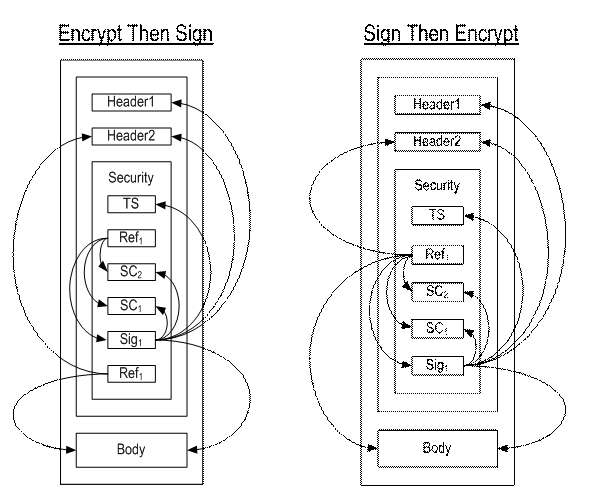
The
arrows on the right indicate parts that were signed as part of the
message signature labeled Sig1. The arrows on the left
from boxes labeled Ref1 indicate references to parts
encrypted using a key based on the [SharedSecret Token] (not shown
in these diagrams as it is referenced as an external token).
Two wsse11:SignatureConfirmation
elements labeled
SC1 and SC2 corresponding to the two
signatures in the initial message illustrated previously is
included. In general, the ordering of the items in the security
header follows the most optimal layout for a receiver to process
its contents. The rules used to determine this ordering are
described in Appendix C.
Example:
Recipient to initiator
message using EncryptBeforeSigning:
<S:Envelope>
<S:Header>
<x:Header1 wsu:Id="Header1" >
...
</x:Header1>
<wsse11:EncryptedHeader
wsu:Id="enc_Header2">
<!-- Plaintext Header2
<x:Header2 wsu:Id="Header2"
>
...
</x:Header2>
-->
...
</wsse11:EncryptedHeader>
...
<wsse:Security>
<wsu:Timestamp
wsu:Id="Timestamp">
<wsu:Created>...</wsu:Created>
<wsu:Expires>...</wsu:Expires>
</wsu:Timestamp>
<xenc:ReferenceList>
<xenc:DataReference
URI="#enc_Signature" />
<xenc:DataReference
URI="#enc_SigConf1" />
<xenc:DataReference
URI="#enc_SigConf2" />
...
</xenc:ReferenceList>
<xenc:EncryptedData
ID="enc_SigConf1" >
<!-- Plaintext
SignatureConfirmation
<wsse11:SignatureConfirmation wsu:Id="SigConf1" >
...
</wsse11:SignatureConfirmation>
-->
...
</xenc:EncryptedData>
<xenc:EncryptedData
ID="enc_SigConf2" >
<!-- Plaintext
SignatureConfirmation
<wsse11:SignatureConfirmation wsu:Id="SigConf2" >
...
</wsse11:SignatureConfirmation>
-->
...
</xenc:EncryptedData>
<xenc:EncryptedData
Id="enc_Signature">
<!-- Plaintext
Signature
<ds:Signature
Id="Signature">
<ds:SignedInfo>
<ds:References>
<ds:Reference URI="#Timestamp"
>...</ds:Reference>
<ds:Reference URI="#SigConf1" >...</ds:Reference>
<ds:Reference URI="#SigConf2" >...</ds:Reference>
<ds:Reference URI="#Header1" >...</ds:Reference>
<ds:Reference URI="#Header2" >...</ds:Reference>
<ds:Reference URI="#Body" >...</ds:Reference>
</ds:References>
</ds:SignedInfo>
<ds:SignatureValue>...</ds:SignatureValue>
<ds:KeyInfo>
<wsse:SecurityTokenReference>
<wsse:Reference URI="#_SomeIssuedToken" />
</wsse:SecurityTokenReference>
</ds:KeyInfo>
</ds:Signature>
-->
</xenc:EncryptedData>
...
<ds:KeyInfo>
<wsse:SecurityTokenReference>
<wsse:Reference URI="#_SomeIssuedToken" />
</wsse:SecurityTokenReference>
</ds:KeyInfo>
<xenc:EncryptedData>
<xenc:ReferenceList>
<xenc:DataReference
URI="#enc_Body" />
<xenc:DataReference
URI="#enc_Header2" />
...
</xenc:ReferenceList>
</xenc:EncryptedData>
</wsse:Security>
</S:Header>
<S:Body wsu:Id="Body">
<xenc:EncryptedData Id="enc_Body">
...
<ds:KeyInfo>
<wsse:SecurityTokenReference>
<wsse:Reference URI="#_SomeIssuedToken" />
</wsse:SecurityTokenReference>
</ds:KeyInfo>
</xenc:EncryptedData>
</S:Body>
</S:Envelope>
C.3 Asymmetric
Binding
This section describes how
the ‘Strict’ security header layout rules apply to the
Asymmetric Binding.
C.3.1 Policy
The
following example shows a policy indicating an Asymmetric Binding,
an X509 token as the [Initiator Token], an X509 token as the
[Recipient Token], an algorithm suite, a requirement to encrypt
the message parts before signing, a requirement to encrypt the
message signature, a requirement to include tokens in the message
signature and the supporting signatures, a requirement to
include wsse11:SignatureConfirmation
elements, a username
token attached to the message, and finally an X509 token attached
to the message and endorsing the message signature. Minimum message
protection requirements are described as well.
<!--
Example Endpoint Policy -->
<wsp:Policy xmlns:wsp="..." xmlns:sp="...">
<sp:AsymmetricBinding>
<wsp:Policy>
<sp:RecipientToken>
<wsp:Policy>
<sp:X509Token sp:IncludeToken=".../IncludeToken/Always"
/>
</wsp:Policy>
</sp:RecipientToken>
<sp:InitiatorToken>
<wsp:Policy>
<sp:X509Token
sp:IncludeToken=".../IncludeToken/Always" />
</wsp:Policy>
</sp:InitiatorToken>
<sp:AlgorithmSuite>
<wsp:Policy>
<sp:Basic256
/>
</wsp:Policy>
</sp:AlgorithmSuite>
<sp:Layout>
<wsp:Policy>
<sp:Strict />
</wsp:Policy>
</sp:Layout>
<sp:IncludeTimestamp />
<sp:EncryptBeforeSigning />
<sp:EncryptSignature />
<sp:ProtectTokens />
</wsp:Policy>
</sp:AsymmetricBinding>
<sp:SignedEncryptedSupportingTokens>
<wsp:Policy>
<sp:UsernameToken
sp:IncludeToken=".../IncludeToken/Once" />
</wsp:Policy>
</sp:SignedEncryptedSupportingTokens>
<sp:SignedEndorsingSupportingTokens>
<wsp:Policy>
<sp:X509Token
sp:IncludeToken=".../IncludeToken/Once">
<wsp:Policy>
<sp:WssX509v3Token10 />
</wsp:Policy>
</sp:X509Token>
</wsp:Policy>
</sp:SignedEndorsingSupportingTokens>
<sp:Wss11>
<wsp:Policy>
<sp:RequireSignatureConfirmation
/>
</wsp:Policy>
</sp:Wss11>
</wsp:Policy>
<!--
Example Message Policy -->
<wsp:All xmlns:wsp="..." xmlns:sp="...">
<sp:SignedParts>
<sp:Header Name="Header1" Namespace="..."
/>
<sp:Header Name="Header2" Namespace="..."
/>
<sp:Body/>
</sp:SignedParts>
<sp:EncryptedParts>
<sp:Header Name="Header2" Namespace="..."
/>
<sp:Body/>
</sp:EncryptedParts>
</wsp:All>
This
policy is used as the basis for the examples shown in the
subsequent section describing the security header layout for this
binding.
C.3.2 Initiator to Recipient
Messages
Messages sent from
initiator to recipient have the following layout:
1.
A wsu:Timestamp element if [Timestamp] is
'true'.
2.
If a [Recipient
Token] is specified, and the associated sp:IncludeToken attribute is
.../IncludeToken/Once or .../IncludeToken/Always, then the
[Recipient Token].
3.
If a [Recipient
Token] is specified and [Protection Order] is
'SignBeforeEncrypting' or [SignatureProtection] is 'true' then an
xenc:EncryptedKey element, containing a key encrypted for the
recipient. The xenc:EncryptedKey element MUST include an
xenc:ReferenceList containing a reference to all the message parts
specified in EncryptedParts assertions in the policy. If [Signature
Protection] is 'true' then the reference list MUST contain a
reference to the message signature from 6 below. It is an error if
[Signature Protection] is 'true' and there is not a message
signature.
4.
Any tokens from the
supporting tokens properties (as defined in section 8) whose
sp:IncludeToken
attribute is
.../IncludeToken/Once or .../IncludeToken/Always.
5.
If an [Initiator
Token] is specified, and the associated sp:IncludeToken attribute is
.../IncludeToken/Once or .../IncludeToken/Always, then the
[Initiator Token].
6.
A signature based on
the key in the [Initiator Token] if specified, over the
wsu:Timestamp from 1 above, any tokens
from 4 above regardless of whether they are included in the
message, and any message parts specified in SignedParts assertions
in the policy. If [Token Protection] is 'true', the signature MUST
also cover the [Initiator Token] regardless of whether it is
included in the message.
7.
Signatures for
tokens from the [Endorsing Supporting Tokens] and [Signed Endorsing
Supporting Tokens] properties. If [Derived Keys] is 'true' and the
supporting token is associated with a symmetric key, then a Derived
Key Token, based on the supporting token, appears before the
signature. If [Token Protection] is 'true', the signature MUST also
cover the supporting token regardless of whether it is included in
the message.
8.
If a [Recipient
Token] is specified and [Protection Order] is
'EncryptBeforeSigning' then if [Signature Protection] is 'false'
then an xenc:EncryptedKey element, containing a key encrypted for
the recipient and a reference list, else if [Signature Protection]
is 'true', a reference list. The reference list includes a
reference to all the message parts specified in EncryptedParts
assertions in the policy. The encrypted parts MUST reference the
key contained in the xenc:EncryptedKey element from 3
above.
The
following diagram illustrates the security header layout for the
initiator to recipient messages:
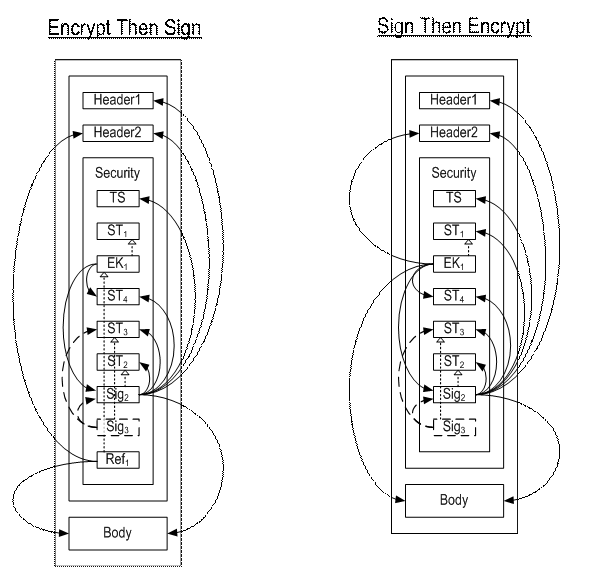
The
arrows on the right indicate parts that were signed as part of the
message signature labeled Sig2 using the [Initiator
Token] labeled ST2. The dashed arrows on the left from
the box labeled Sig3 indicate the parts signed by the
supporting token ST3, namely the message signature
Sig2 and the token used as the basis for the signature
labeled ST3. The arrows on the left from boxes labeled
EK1 indicate references to parts encrypted using a key
encrypted for the [Recipient Token] labeled ST1. The
arrows on the left from boxes labeled Ref1 indicate
additional references to parts encrypted using the key contained in
the encrypted key labeled EK1. The dotted arrows inside
the box labeled Security indicate the token used as the basis for
each cryptographic operation. In general, the ordering of the items
in the security header follows the most optimal layout for a
receiver to process its contents. The rules used to determine this
ordering are described in Appendix C.
Note: In most typical
scenarios, the recipient key is not included in the message, but
rather the encrypted key contains an external reference to the
token containing the encryption key. The diagram illustrates how
one might attach a security token related to the encrypted key for
completeness. One possible use-case for this approach might be a
stack which does not support the STR Dereferencing Transform, but
wishes to include the encryption token in the message
signature.
Initiator to recipient
message Example
<S:Envelope xmlns:S="..." xmlns:x="..."
xmlns:wsu="..."
xmlns:wsse11="..." xmlns:wsse="..." xmlns:xenc="..."
xmlns:ds="...">
<S:Header>
<x:Header1 wsu:Id="Header1" >
...
</x:Header1>
<wsse11:EncryptedHeader
wsu:Id="enc_Header2">
<!-- Plaintext Header2
<x:Header2 wsu:Id="Header2"
>
...
</x:Header2>
-->
...
</wsse11:EncryptedHeader>
...
<wsse:Security>
<wsu:Timestamp
wsu:Id="Timestamp">
<wsu:Created>...</wsu:Created>
<wsu:Expires>...</wsu:Expires>
</wsu:Timestamp>
<wsse:BinarySecurityToken
wsu:Id="RecipientToken" >
...
</wsse:BinarySecurityToken>
<xenc:EncryptedKey
wsu:Id="RecipientEncryptedKey" >
...
<xenc:ReferenceList>
<xenc:DataReference URI="#enc_Signature" />
<xenc:DataReference URI="#enc_SomeUsernameToken" />
...
</xenc:ReferenceList>
</xenc:EncryptedKey>
<xenc:EncryptedData
ID="enc_SomeUsernameToken" >
<!-- Plaintext
UsernameToken
<wsse:UsernameToken
wsu:Id="SomeUsernameToken" >
...
</wsse:UsernameToken>
-->
...
</xenc:EncryptedData>
<wsse:BinarySecurityToken
wsu:Id="SomeSupportingToken" >
...
</wsse:BinarySecurityToken>
<wsse:BinarySecurityToken
wsu:Id="InitiatorToken" >
...
</wsse:BinarySecurityToken>
<xenc:EncryptedData
ID="enc_Signature">
<!-- Plaintext
Signature
<ds:Signature
Id="Signature">
<ds:SignedInfo>
<ds:References>
<ds:Reference URI="#Timestamp"
>...</ds:Reference>
<ds:Reference URI="#SomeUsernameToken"
>...</ds:Reference>
<ds:Reference URI="#SomeSupportingToken"
>...</ds:Reference>
<ds:Reference URI="#InitiatorToken"
>...</ds:Reference>
<ds:Reference URI="#Header1" >...</ds:Reference>
<ds:Reference URI="#Header2" >...</ds:Reference>
<ds:Reference URI="#Body" >...</ds:Reference>
</ds:References>
</ds:SignedInfo>
<ds:SignatureValue>...</ds:SignatureValue>
<ds:KeyInfo>
<wsse:SecurityTokenReference>
<wsse:Reference URI="#InitiatorToken" />
</wsse:SecurityTokenReference>
</ds:KeyInfo>
</ds:Signature>
-->
...
</xenc:EncryptedData>
<ds:Signature>
<ds:SignedInfo>
<ds:References>
<ds:Reference URI="#Signature"
>...</ds:Reference>
<ds:Reference URI="#SomeSupportingToken"
>...</ds:Reference>
</ds:References>
</ds:SignedInfo>
<ds:SignatureValue>...</ds:SignatureValue>
<ds:KeyInfo>
<wsse:SecurityTokenReference>
<wsse:Reference URI="#SomeSupportingToken" />
</wsse:SecurityTokenReference>
</ds:KeyInfo>
</ds:Signature>
<xenc:ReferenceList>
<xenc:DataReference
URI="#enc_Body" />
<xenc:DataReference
URI="#enc_Header2" />
...
</xenc:ReferenceList>
</wsse:Security>
</S:Header>
<S:Body wsu:Id="Body">
<xenc:EncryptedData Id="enc_Body">
...
<ds:KeyInfo>
<wsse:SecurityTokenReference>
<wsse:Reference URI="#RecipientEncryptedKey" />
</wsse:SecurityTokenReference>
</ds:KeyInfo>
</xenc:EncryptedData>
</S:Body>
</S:Envelope>
C.3.3 Recipient to Initiator
Messages
Messages sent from
recipient to initiator have the following layout:
1.
A wsu:Timestamp element if [Timestamp] is
'true'.
2.
If an [Initiator
Token] is specified, and the associated sp:IncludeToken attribute is
.../IncludeToken/Always, then the [Initiator Token].
3.
If an [Initiator
Token] is specified and [Protection Order] is
'SignBeforeEncrypting' or [SignatureProtection] is 'true' then an
xenc:EncryptedKey element, containing a key encrypted for the
initiator. The xenc:EncryptedKey element MUST include an
xenc:ReferenceList containing a reference to all the message parts
specified in EncryptedParts assertions in the policy. If [Signature
Protection] is 'true' then the reference list MUST also contain a
reference to the message signature from 6 below, if any and
references to the wsse11:SignatureConfirmation
elements from 4
below, if any.
4.
If [Signature
Confirmation] is 'true', then a wsse11:SignatureConfirmation
element for each
signature in the corresponding message sent from initiator to
recipient. If there are no signatures in the corresponding message
from the initiator to the recipient, then a wsse11:SignatureConfirmation
element with no
Value attribute.
5.
If a [Recipient
Token] is specified, and the associated sp:IncludeToken attribute is
.../IncludeToken/Always, then the [Recipient Token].
6.
If a [Recipient
Token] is specified, then a signature based on the key in the
[Recipient Token], over the wsu:Timestamp from 1 above, the
wsse11:SignatureConfirmation
elements from 4
above, and any message parts specified in SignedParts assertions in
the policy. If [Token Protection] is 'true' then the signature MUST
also cover the [Recipient Token].
7.
If an [Initiator
Token] is specified and [Protection Order] is
'EncryptBeforeSigning' then if [Signature Protection] is 'false'
then an xenc:EncryptedKey element, containing a key encrypted for
the recipient and a reference list, else if [Signature Protection]
is 'true', a reference list. The reference list includes a
reference to all the message parts specified in EncryptedParts
assertions in the policy. The encrypted parts MUST reference the
key contained in the xenc:EncryptedKey element from 3
above.
The
following diagram illustrates the security header layout for the
recipient to initiator messages:
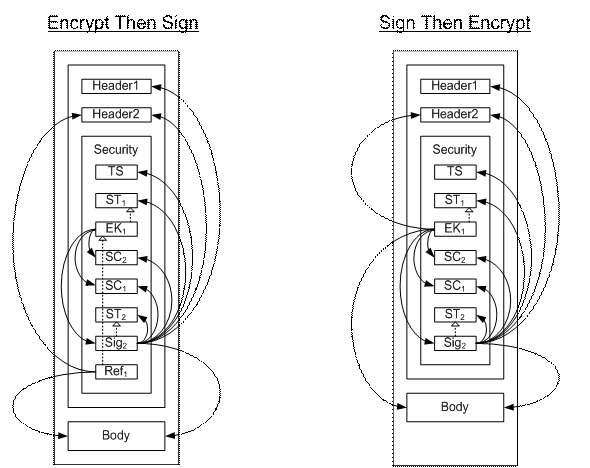
The
arrows on the right indicate parts that were signed as part of the
message signature labeled Sig2 using the [Recipient
Token] labeled ST2. The arrows on the left from boxes
labeled EK1 indicate references to parts encrypted using
a key encrypted for the [Recipient Token] labeled ST1.
The arrows on the left from boxes labeled Ref1 indicate
additional references to parts encrypted using the key contained in
the encrypted key labeled EK1. The dotted arrows inside
the box labeled Security indicate the token used as the basis for
each cryptographic operation. Two wsse11:SignatureConfirmation
elements labeled
SC1 and SC2 corresponding to the two
signatures in the initial message illustrated previously is
included. In general, the ordering of the items in the security
header follows the most optimal layout for a receiver to process
its contents. The rules used to determine this ordering are
described in Appendix C.
Recipient to initiator
message Example:
<S:Envelope xmlns:S="..." xmlns:x="..." xmlns:wsu="..."
xmlns:wsse11="..." xmlns:wsse="..."
xmlns:xenc="..." xmlns:ds="...">
<S:Header>
<x:Header1 wsu:Id="Header1" >
...
</x:Header1>
<wsse11:EncryptedHeader
wsu:Id="enc_Header2">
<!-- Plaintext Header2
<x:Header2 wsu:Id="Header2"
>
...
</x:Header2>
-->
...
</wsse11:EncryptedHeader>
...
<wsse:Security>
<wsu:Timestamp
wsu:Id="Timestamp">
<wsu:Created>...</wsu:Created>
<wsu:Expires>...</wsu:Expires>
</wsu:Timestamp>
<wsse:BinarySecurityToken
wsu:Id="InitiatorToken" >
...
</wsse:BinarySecurityToken>
<xenc:EncryptedKey
wsu:Id="InitiatorEncryptedKey" >
...
<xenc:ReferenceList>
<xenc:DataReference URI="#enc_Signature" />
<xenc:DataReference URI="#enc_SigConf1" />
<xenc:DataReference URI="#enc_SigConf2" />
...
</xenc:ReferenceList>
</xenc:EncryptedKey>
<xenc:EncryptedData
ID="enc_SigConf2" >
<!-- Plaintext
SignatureConfirmation
<wsse11:SignatureConfirmation wsu:Id="SigConf2" ...>
...
</wsse11:SignatureConfirmation>
-->
...
</xenc:EncryptedData>
<xenc:EncryptedData
ID="enc_SigConf1" >
<!-- Plaintext
SignatureConfirmation
<wsse11:SignatureConfirmation wsu:Id="SigConf1" ...>
...
</wsse11:SignatureConfirmation>
-->
...
</xenc:EncryptedData>
<wsse:BinarySecurityToken
wsu:Id="RecipientToken" >
...
</wsse:BinarySecurityToken>
<xenc:EncryptedData
ID="enc_Signature">
<!-- Plaintext
Signature
<ds:Signature
Id="Signature">
<ds:SignedInfo>
<ds:References>
<ds:Reference URI="#Timestamp"
>...</ds:Reference>
<ds:Reference URI="#SigConf1" >...</ds:Reference>
<ds:Reference URI="#SigConf2" >...</ds:Reference>
<ds:Reference URI="#RecipientToken"
>...</ds:Reference>
<ds:Reference URI="#Header1" >...</ds:Reference>
<ds:Reference URI="#Header2" >...</ds:Reference>
<ds:Reference URI="#Body" >...</ds:Reference>
</ds:References>
</ds:SignedInfo>
<ds:SignatureValue>...</ds:SignatureValue>
<ds:KeyInfo>
<wsse:SecurityTokenReference>
<wsse:Reference URI=”#RecipientToken” />
</wsse:SecurityTokenReference>
</ds:KeyInfo>
</ds:Signature>
-->
...
</xenc:EncryptedData>
<xenc:ReferenceList>
<xenc:DataReference
URI="#enc_Body" />
<xenc:DataReference
URI="#enc_Header2" />
...
</xenc:ReferenceList>
</wsse:Security>
</S:Header>
<S:Body wsu:Id="Body">
<xenc:EncryptedData Id="enc_Body">
...
<ds:KeyInfo>
<wsse:SecurityTokenReference>
<wsse:Reference URI="#InitiatorEncryptedKey" />
</wsse:SecurityTokenReference>
</ds:KeyInfo>
</xenc:EncryptedData>
</S:Body>
</S:Envelope>
This section lists the
criteria for when various child elements of the Security header are
signed and/or encrypted at the message level including whether they
are signed by the message signature or a supporting signature. It
assumes that there are no sp:SignedElements and no sp:EncryptedElementsassertions in the policy.
If such assertions are present in the policy then additional child
elements of the security header might be signed and/or
encrypted.
D.1 Elements signed by the
message signature
1.
The wsu:Timestampelement (Section
6.2).
2.
All wsse11:SignatureConfirmation elements (Section
9).
3.
Security Tokens
corresponding to [Initiator Signature Token],[Recipient Signature
Token], [Initiator Encryption Token], [Recipient Encryption Token],
[Signature Token] or [Encryption Token] when [Token Protection] has
a value of 'true' (Section 6.5).
4.
Security Tokens
corresponding to [Signed Supporting Tokens] (see Section 8.2) or
[Signed Endorsing Supporting Tokens] (Section 8.5).
D.2 Elements signed by all
endorsing signatures
1.
The ds:Signatureelement that forms the
message signature (Section 8.3).
2.
The wsu:Timestampelement in the case of a
transport binding (Section 8.3).
D.3 Elements signed by a
specific endorsing signature
1.
Security Tokens
corresponding to [Endorsing Supporting Tokens] or [Signed Endorsing
Supporting Tokens] when [Token Protection] has a value of 'true'
(Section 8.8).
D.4 Elements that are
encrypted
1.
The ds:Signatureelement that forms the
message signature when [Signature Protection] has a value of 'true'
(Section 6.4).
2.
All wsse11:SignatureConfirmation elements when [Signature
Protection] has a value of 'true' (Section 6.4).
3.
A wsse:UsernameTokenmay be encrypted when a
transport binding is not being used (Section 5.3.1).
The following individuals
have participated in the creation of this specification and are
gratefully acknowledged:
Original Authors of the
intial contribution:
Giovanni
Della-Libera, Microsoft
Martin
Gudgin,
Microsoft
Phillip
Hallam-Baker, VeriSign
Maryann Hondo,
IBM
Hans Granqvist,
Verisign
Chris
Kaler,
Microsoft (editor)
Hiroshi Maruyama,
IBM
Michael McIntosh,
IBM
Anthony Nadalin, IBM
(editor)
Nataraj Nagaratnam,
IBM
Rob Philpott, RSA
Security
Hemma
Prafullchandra, VeriSign
John
Shewchuk,
Microsoft
Doug
Walter,
Microsoft
Riaz Zolfonoon, RSA
Security
Original Acknowledgements
of the initial contribution:
Vaithialingam B.
Balayoghan, Microsoft
Francisco Curbera,
IBM
Christopher Ferris,
IBM
Cédric
Fournet, Microsoft
Andy Gordon,
Microsoft
Tomasz Janczuk,
Microsoft
David Melgar,
IBM
Mike Perks,
IBM
Bruce Rich,
IBM
Jeffrey Schlimmer,
Microsoft
Chris Sharp,
IBM
Kent Tamura,
IBM
T.R. Vishwanath,
Microsoft
Elliot Waingold,
Microsoft
TC Members during the
development of this specification:
Don Adams, Tibco
Software Inc.
Jan Alexander,
Microsoft Corporation
Steve Anderson, BMC
Software
Donal Arundel, IONA
Technologies
Howard Bae, Oracle
Corporation
Abbie Barbir, Nortel
Networks Limited
Charlton Barreto,
Adobe Systems
Mighael Botha,
Software AG, Inc.
Toufic Boubez, Layer
7 Technologies Inc.
Norman Brickman,
Mitre Corporation
Melissa Brumfield,
Booz Allen Hamilton
Lloyd Burch,
Novell
Scott Cantor,
Internet2
Greg
Carpenter,
Microsoft Corporation
Steve Carter,
Novell
Ching-Yun (C.Y.)
Chao, IBM
Martin Chapman,
Oracle Corporation
Kate Cherry,
Lockheed Martin
Henry (Hyenvui)
Chung, IBM
Luc Clement,
Systinet Corp.
Paul
Cotton,
Microsoft Corporation
Glen Daniels, Sonic
Software Corp.
Peter Davis,
Neustar, Inc.
Martijn de Boer, SAP
AG
Werner Dittmann,
Siemens AG
Abdeslem DJAOUI,
CCLRC-Rutherford Appleton Laboratory
Fred Dushin, IONA
Technologies
Petr Dvorak,
Systinet Corp.
Colleen
Evans,
Microsoft Corporation
Ruchith Fernando,
WSO2
Mark
Fussell,
Microsoft Corporation
Vijay
Gajjala,
Microsoft Corporation
Marc Goodner,
Microsoft Corporation
Hans Granqvist,
VeriSign
Martin
Gudgin,
Microsoft Corporation
Tony Gullotta, SOA
Software Inc.
Jiandong Guo, Sun
Microsystems
Phillip
Hallam-Baker, VeriSign
Patrick Harding,
Ping Identity Corporation
Heather Hinton,
IBM
Frederick Hirsch,
Nokia Corporation
Jeff Hodges,
Neustar, Inc.
Will Hopkins, BEA
Systems, Inc.
Alex Hristov, Otecia
Incorporated
John Hughes, PA
Consulting
Diane Jordan,
IBM
Venugopal K, Sun
Microsystems
Chris Kaler,
Microsoft Corporation
Dana Kaufman, Forum
Systems, Inc.
Paul Knight, Nortel
Networks Limited
Ramanathan
Krishnamurthy, IONA Technologies
Christopher Kurt,
Microsoft Corporation
Kelvin Lawrence,
IBM
Hubert Le Van Gong,
Sun Microsystems
Jong Lee, BEA
Systems, Inc.
Rich Levinson,
Oracle Corporation
Tommy Lindberg,
Dajeil Ltd.
Mark Little, JBoss
Inc.
Hal Lockhart, BEA
Systems, Inc.
Mike Lyons, Layer 7
Technologies Inc.
Eve Maler, Sun
Microsystems
Ashok Malhotra,
Oracle Corporation
Anand Mani,
CrimsonLogic Pte Ltd
Jonathan
Marsh,
Microsoft Corporation
Robin Martherus,
Oracle Corporation
Miko Matsumura,
Infravio, Inc.
Gary McAfee,
IBM
Michael McIntosh,
IBM
John Merrells, Sxip
Networks SRL
Jeff Mischkinsky,
Oracle Corporation
Prateek Mishra,
Oracle Corporation
Bob Morgan,
Internet2
Vamsi Motukuru,
Oracle Corporation
Raajmohan Na,
EDS
Anthony Nadalin,
IBM
Andrew Nash,
Reactivity, Inc.
Eric Newcomer, IONA
Technologies
Duane Nickull, Adobe
Systems
Toshihiro Nishimura,
Fujitsu Limited
Rob Philpott, RSA
Security
Denis Pilipchuk, BEA
Systems, Inc.
Darren Platt, Ping
Identity Corporation
Martin Raepple, SAP
AG
Nick Ragouzis,
Enosis Group LLC
Prakash Reddy,
CA
Alain Regnier, Ricoh
Company, Ltd.
Irving Reid,
Hewlett-Packard
Bruce Rich,
IBM
Tom Rutt, Fujitsu
Limited
Maneesh Sahu,
Actional Corporation
Frank Siebenlist,
Argonne National Laboratory
Joe Smith, Apani
Networks
Davanum Srinivas,
WSO2
Yakov Sverdlov,
CA
Gene Thurston,
AmberPoint
Victor Valle,
IBM
Asir
Vedamuthu,
Microsoft Corporation
Greg Whitehead,
Hewlett-Packard
Ron Williams,
IBM
Corinna Witt, BEA
Systems, Inc.
Kyle Young,
Microsoft Corporation