The capture and expression of non-functional requirements is
an important aspect of service definition and has an impact on SCA throughout
the lifecycle of components and compositions. SCA provides a framework to
support specification of constraints, capabilities and QoS expectations from
component design through to concrete deployment. This specification describes
the framework and its usage.
Specifically, this section describes the SCA policy
association framework that allows policies and policy subjects specified using WS-Policy
[WS-Policy] and WS-PolicyAttachment [WS-PolicyAttach],
as well as with other policy languages, to be associated with SCA components.
This document should be read in conjunction with the SCA
Assembly Specification [SCA-Assembly]. Details of policies
for specific policy domains can be found in sections 7, 8 and 9.
The key words “MUST”, “MUST NOT”, “REQUIRED”, “SHALL”,
“SHALL NOT”, “SHOULD”, “SHOULD NOT”, “RECOMMENDED”, “MAY”, and “OPTIONAL” in
this document are to be interpreted as described in [RFC2119].
|
Prefixes and Namespaces used in this Specification
|
|
|
Prefix
|
XML Namespace
|
Specification
|
|
sca
|
docs.oasis-open.org/ns/opencsa/sca/200912
This is assumed to be the default namespace in this
specification. xs:QNames that appear without a prefix are from the SCA
namespace.
|
[SCA-Assembly]
|
|
acme
|
Some namespace; a generic prefix
|
|
|
wsp
|
http://www.w3.org/2006/07/ws-policy
|
[WS-Policy]
|
|
xs
|
http://www.w3.org/2001/XMLSchema
|
[XML Schema Datatypes]
|
|
|
|
|
Table 1‑1: XML Namespaces and Prefixes
[RFC2119] S.
Bradner, Key words for use in RFCs to Indicate Requirement Levels, http://www.ietf.org/rfc/rfc2119.txt,
IETF RFC 2119, March 1997.
[SCA-Assembly] OASIS
Committee Draft 05, “Service Component Architecture Assembly Model Specification Version
1.1”, January 2010.
http://docs.oasis-open.org/opencsa/sca-assembly/sca-assembly-1.1-spec-cd05.pdf
[SCA-Java-Annotations]
OASIS Committee Draft 04, “SCA Java
Common Annotations and APIs Specification Version 1.1”, February 2010.
http://docs.oasis-open.org/opencsa/sca-j/sca-javacaa-1.1-spec-cd04.pdf
[SCA-WebServicesBinding]
OASIS Committee Draft 03, “SCA Web Services Binding
Specification Version 1.1”, July 2009.
http://docs.oasis-open.org/opencsa/sca-bindings/sca-wsbinding-1.1-spec-cd03.pdf
[WSDL] Web Services
Description Language (WSDL) Version 2.0 Part 1: Core Language – Appendix http://www.w3.org/TR/2006/CR-wsdl20-20060327/
[WS-AtomicTransaction]
OASIS
Standard, “Web Services Atomic Transaction Version 1.2”, February 2009.
http://docs.oasis-open.org/ws-tx/wsat/2006/06.
[WSDL-Ids] SCA WSDL
1.1 Element Identifiers – forthcoming W3C Note
http://dev.w3.org/cvsweb/~checkout~/2006/ws/policy/wsdl11elementidentifiers.html
[WS-Policy] Web
Services Policy (WS-Policy)
http://www.w3.org/TR/ws-policy
[WS-PolicyAttach] Web
Services Policy Attachment (WS-PolicyAttachment)
http://www.w3.org/TR/ws-policy-attach
[XPATH] XML Path
Language (XPath) Version 1.0.
http://www.w3.org/TR/xpath
[XML-Schema2] XML Schema Part 2:
Datatypes Second Edition XML Schema Part 2: Datatypes Second Edition, Oct. 28
2004.
http://www.w3.org/TR/xmlschema-2/
This specification follows some naming conventions for
artifacts defined by the specification, as follows:
·
For the names of elements and the names of attributes within XSD
files, the names follow the CamelCase convention, with all names starting with
a lower case letter, e.g. <element name="policySet"
type="…"/>.
·
For the names of types within XSD files, the names follow the
CamelCase convention with all names starting with an upper case letter, e.g.
<complexType name="PolicySet">.
·
For the names of intents, the names follow the CamelCase
convention, with all names starting with a lower case letter, EXCEPT for cases
where the intent represents an established acronym, in which case the entire
name is in upper case. An example of an intent which is an acronym is the
"SOAP" intent.
The term Policy is used to describe some
capability or constraint that can be applied to service components or to the
interactions between service components represented by services and references.
An example of a policy is that messages exchanged between a service client and
a service provider have to be encrypted, so that the exchange is confidential
and cannot be read by someone who intercepts the messages.
In SCA, services and references can have policies applied to
them that affect the form of the interaction that takes place at runtime. These
are called interaction policies.
Service components can also have other policies applied to
them, which affect how the components themselves behave within their runtime
container. These are called implementation policies.
How particular policies are provided varies depending on the
type of runtime container for implementation policies and on the binding type
for interaction policies. Some policies can be provided as an inherent part of
the container or of the binding – for example a binding using the https
protocol will always provide encryption of the messages flowing between a
reference and a service. Other policies can optionally be provided by a
container or by a binding. It is also possible that some kinds of container or
kinds of binding are incapable of providing a particular policy at all.
In SCA, policies are held in policySets, which
can contain one or many policies, expressed in some concrete form, such as
WS-Policy assertions. Each policySet targets a specific binding type or a
specific implementation type. PolicySets are used to apply particular policies
to a component or to the binding of a service or reference, through
configuration information attached to a component or attached to a composite.
For example, a service can have a policy applied that
requires all interactions (messages) with the service to be encrypted. A
reference which is wired to that service needs to support sending and receiving
messages using the specified encryption technology if it is going to use the
service successfully.
In summary, a service presents a set of interaction
policies, which it requires the references to use. In turn, each reference has
a set of policies, which define how it is capable of interacting with any
service to which it is wired. An implementation or component can describe its
requirements through a set of attached implementation policies.
SCA intents are used to describe the abstract
policy requirements of a component or the requirements of interactions between
components represented by services and references. Intents provide a means for
the developer and the assembler to state these requirements in a high-level
abstract form, independent of the detailed configuration of the runtime and
bindings, which involve the role of application deployer. Intents support late
binding of services and references to particular SCA bindings, since they
assist the deployer in choosing appropriate bindings and concrete policies
which satisfy the abstract requirements expressed by the intents.
It is possible in SCA to attach policies to a service, to a
reference or to a component at any time during the creation of an assembly,
through the configuration of bindings and the attachment of policy sets.
Attachment can be done by the developer of a component at the time when the
component is written or it can be done later by the deployer at deployment
time. SCA recommends a late binding model where the bindings and the concrete
policies for a particular assembly are decided at deployment time.
SCA favors the late binding approach since it promotes
re-use of components. It allows the use of components in new application
contexts, which might require the use of different bindings and different
concrete policies. Forcing early decisions on which bindings and policies to
use is likely to limit re-use and limit the ability to use a component in a new
context.
For example, in the case of authentication, a service which
requires the client to be authenticated can be marked with an intent called
"clientAuthentication". This intent marks the service as
requiring the client to be authenticated without being prescriptive about how
it is achieved. At deployment time, when a binding is chosen for the service (say
SOAP over HTTP), the deployer can apply suitable policies to the service which
provide aspects of WS-Security and which supply a group of one or more
authentication technologies.
In many ways, intents can be seen as restricting choices at
deployment time. If a service is marked with the confidentiality intent,
then the deployer has to use a binding and a policySet that provides for the
encryption of the messages.
The set of intents available to developers and assemblers
can be extended by policy administrators. The SCA Policy Framework
specification does define a set of intents which address the infrastructure
capabilities relating to security, transactions and reliable messaging.
Multiple policies can be attached to both services and to
references. Where there are multiple policies, they can be organized into
policy domains, where each domain deals with some particular aspect of the
interaction. An example of a policy domain is confidentiality, which covers the
encryption of messages sent between a reference and a service. Each policy
domain can have one or more policy. Where multiple policies are present for a
particular domain, they represent alternative ways of meeting the requirements
for that domain. For example, in the case of message integrity, there could be
a set of policies, where each one deals with a particular security token to be
used: e.g. X509, SAML, Kerberos. Any one of the tokens can be used - they will
all ensure that the overall goal of message integrity is achieved.
In order for a service to be accessed by a wide range of
clients, it is good practice for the service to support multiple alternative
policies within a particular domain. So, if a service requires message
confidentiality, instead of insisting on one specific encryption technology,
the service can have a policySet which has a number of alternative encryption
technologies, any of which are acceptable to the service. Equally, a reference
can have a policySet attached which defines the range of encryption
technologies which it is capable of using. Typically, the set of policies used
for a given domain will reflect the capabilities of the binding and of the
runtime being used for the service and for the reference.
When a service and a reference are wired together, the
policies declared by the policySets at each end of the wire are matched to each
other. SCA does not define how policy matching is done, but instead delegates
this to the policy language (e.g. WS-Policy) used for the binding. For example,
where WS-Policy is used as the policy language, the matching procedure looks at
each domain in turn within the policy sets and looks for 1 or more policies
which are in common between the service and the reference. When only one match
is found, the matching policy is used. Where multiple matches are found, then
the SCA runtime can choose to use any one of the matching policies. No match
implies that the configuration is not valid and the deployer needs to take an
action.
The SCA Policy Framework model is comprised of intents
and policySets. Intents represent abstract assertions and
Policy Sets contain concrete policies that can be applied to SCA bindings and
implementations. The framework describes how intents are related to policySets.
It also describes how intents and policySets are utilized to express the
constraints that govern the behavior of SCA bindings and implementations. Both
intents and policySets can be used to specify QoS requirements on services and
references.
The following section describes the Framework Model and
illustrates it using Interaction Policies. Implementation Policies follow the
same basic model and are discussed later in section 1.5.
As discussed earlier, an intent is an abstract
assertion about a specific Quality of Service (QoS) characteristic that is
expressed independently of any particular implementation technology. An intent
is thus used to describe the desired runtime characteristics of an SCA
construct. Typically, intents are defined by a policy administrator. See
section [Policy
Administrator] for a more detailed description of SCA roles with
respect to Policy concepts, their definition and their use. The semantics of an
intent can not always be available normatively, but could be expressed with
documentation that is available and accessible.
For example, an intent named integrity can be
specified to signify that communications need to be protected from possible
tampering. This specific intent can be declared as a requirement by some SCA
artifacts, e.g. a reference. Note that this intent can be satisfied by a
variety of bindings and with many different ways of configuring those bindings.
Thus, the reference where the intent is expressed as a requirement could
eventually be wired using either a web service binding (SOAP over HTTP) or with
an EJB binding that communicates with an EJB via RMI/IIOP.
Intents can be used to express requirements for interaction
policies or implementation policies. The integrity intent
in the above example is used to express a requirement for an interaction
policy. Interaction policies are, typically, applied to a service or reference.
They are meant to govern the communication between a client and a service
provider. Intents can also be applied to SCA component implementations as
requirements for implementation policies. These intents specify
the qualities of service that need to be provided by a container as it runs the
component. An example of such an intent could be a requirement that the
component needs to run in a transaction.
If the configured instance
of a binding is in conflict with the intents and policy sets selected for that
instance, the SCA runtime MUST raise an error. [POL30001]. For example, a web service binding which
requires the SOAP intent but which points to a WSDL binding that does not
specify SOAP.
For convenience and conciseness, it is often desirable to
declare a single, higher-level intent to denote a requirement that could be
satisfied by one of a number of lower-level intents. For example, the confidentiality
intent requires either message-level encryption or transport-level
encryption.
Both of these are abstract intents because the
representation of the configuration necessary to realize these two kinds of
encryption could vary from binding to binding, and each would also require
additional parameters for configuration.
An intent that can be
completely satisfied by one of a choice of lower-level intents is referred to
as a qualifiable intent. In order to express such intents, the intent
name can contain a qualifier: a “.” followed by a xs:string name. An
intent name that includes a qualifier in its name is referred to as a qualified
intent, because it is “qualifying” how the qualifiable intent is satisfied.
A qualified intent can only qualify one qualifiable intent, so the name of the
qualified intent includes the name of the qualifiable intent as a prefix, for
example, clientAuthentication.message.
In general, SCA allows the developer or assembler to attach
multiple qualifiers for a single
qualifiable intent to the same SCA construct. However,
domain-specific constraints can prevent the use of some combinations of qualifiers
(from the same qualifiable intent).
Intents, their qualifiers and their defaults are defined
using the pseudo schema in Snippet 3‑1:
<intent
name="xs:NCName"
constrains="sca:listOfQNames"?
requires="sca:listOfQNames"?
excludes="sca:listOfQNames"?
mutuallyExclusive="xs:boolean"?
intentType="xs:string"?
>
<description>
xs:string.</description>?
<qualifier
name="xs:string" default="xs:boolean" ?>*
<description>
xs:string.</description>?
</qualifier>
</intent>
Snippet 3‑1: intent Pseudo-Schema
Where the intent element has the following attributes:
·
@name (1..1) - an NCName that defines the name of the intent. The QName for an intent MUST be unique amongst
the set of intents in the SCA Domain. [POL30002]
·
@constrains (0..1) - a list of QNames that specifies the SCA
constructs that this intent is meant to configure. If a value is not specified
for this attribute then the intent can apply to any SCA element.
Note that the “constrains” attribute can name an
abstract element type, such as sca:binding in our running example. This means
that it will match against any binding used within an SCA composite file. An
SCA element can match @constrains if its type is in a substitution group.
·
@requires (0..1) - contains a list of QNames of intents which
defines the set of all intents that the referring intent requires. In essence,
the referring intent requires all the intents named to be satisfied. This
attribute is used to compose an intent from a set of other intents. Each QName in the @requires attribute MUST be the
QName of an intent in the SCA Domain. [POL30015] This use is further described in Profile Intents.
·
@excludes (0..1) - a list of QNames of intents that cannot be
used with this intent. Intents might describe a policy that is incompatible or
otherwise unrealizable when specified with other intents, and therefore are
considered to be mutually exclusive. Each
QName in the @excludes attribute MUST be the QName of an intent in the SCA
Domain. [POL30016]
Two intents are mutually exclusive when any of the
following are true:
–
One of the two intents lists the other intent in its @excludes list.
–
Both intents list the other intent in their respective @excludes list.
Where one intent is attached to an element of an SCA
composite and another intent is attached to one of the element’s parents, the
intent(s) that are effectively attached to the element differs depending on
whether the two intents are mutually exclusive (see @excludes above and “Attaching intents to SCA elements”.
·
@mutuallyExclusive (0..1) - a boolean with a default of “false”.
If this attribute is present and has a value of “true” it indicates that the
qualified intents defined for this intent are mutually exclusive.
·
@intentType attribute (0..1) defines whether the intent is an
interaction intent or an implementation intent. A value of
"interaction", which is the default value, indicates that the intent
is an interaction intent. A value of "implementation" indicates that
the intent is an implementation intent.
One or more <qualifier> child elements can be used to
define qualifiers for the intent. The attributes of the qualifier element are:
·
@name (1..1) - declares the name of the qualifier. The name of each qualifier MUST be unique within the intent
definition. [POL30005].
·
@default (0..1) - a boolean value with a default value of
"false". If @default="true" the particular qualifier is the
default qualifier for the intent. If an intent
has more than one qualifier, one and only one MUST be declared as the default
qualifier. [POL30004]. If only one qualifier for an intent is
given it MUST be used as the default qualifier for the intent. [POL30025]
·
qualifier/description (0..1) - an xs:string that holds a textual
description of the qualifier.
For example, the confidentiality intent
which has qualified intents called confidentiality.transport
and confidentiality.message can be defined as:
<intent name="confidentiality"
constrains="sca:binding">
<description>
Communication through this binding must prevent
unauthorized users from reading the messages.
</description>
<qualifier name=”transport”>
<description>Automatic encryption by
transport
</description>
</qualifier>
<qualifier name=”message”
default=’true’>
<description>Encryption applied to each message
</description>
</qualifier>
</intent>
Snippet 3‑2: Example intent
Definition
An Intent can be contributed to the SCA Domain by including
its definition in a definitions.xml file within a Contribution in the Domain.
Details of the definitions.xml files are described in the SCA
Assembly Model [SCA-Assembly].
SCA normatively defines a set of core intents that all SCA
implementations are expected to support, to ensure a minimum level of portability.
Users of SCA can define new intents, or extend the qualifier set of existing
intents. An SCA Runtime MUST include in the
Domain the set of intent definitions contained in the
Policy_Intents_Definitions.xml described in the appendix "Intent
Definitions" of the SCA Policy specification. [POL30024] It is also good
practice for the Domain to include concrete policies which satisfy these
intents (this may be achieved through the provision of appropriate binding
types and implementation types, augmented by policy sets that apply to those
binding types and implementation types).
The normatively defined intents in the SCA specification
might evolve in future versions of this specification. New intents could be
added, additional qualifiers could be added to existing intents and the default
qualifier for existing intents could change. Such changes would cause the
namespace for the SCA specification to change.
An interaction intent is an intent designed to influence
policy which applies to a service, a reference and the wires that connect them.
Interaction intents affect wire matching between the two ends of a wire and/or
the set of bytes that flow between the reference and the service when a service
invocation takes place.
Interaction intents typically apply to <binding/>
elements.
An implementation intent is an intent designed to influence
policy which applies to an implementation artifact or to the relationship of
that artifact to the runtime code which is used to execute the artifact.
Implementation intents do not affect wire matching between references and
services, nor do they affect the bytes that flow between a reference and a
service.
Implementation intents often apply to
<implementation/> elements, but they can also apply to <binding/>
elements, where the desire is to influence the activity of the binding
implementation code and how it interacts with the remainder of the runtime code
for the implementation.
Interaction intents and implementation intents are
distinguished by the value of the @intentType attribute in the intent
definition.
3.3 Profile Intents
An intent that is satisfied only by satisfying all of
a set of other intents is called a profile intent. It can be used in the
same way as any other intent.
The presence of @requires attribute in the intent definition
signifies that this is a profile intent. The @requires attribute can include
all kinds of intents, including qualified intents and other profile intents.
However, while a profile intent can include qualified intents, it cannot be a
qualified intent. Thus, the name of a profile
intent MUST NOT have a “.” in it. [POL30006]
Requiring a profile intent is semantically identical to
requiring the list of intents that are listed in its @requires attribute. If a profile intent is attached to an artifact, all
the intents listed in its @requires attribute MUST be satisfied as described in
section 4.15. [POL30007]
An example of a profile intent is an intent called messageProtection which is a shortcut for
specifying both confidentiality and integrity, where integrity
means to protect against modification, usually by signing. The
intent definition is shown in Snippet 3‑3:
<intent name="messageProtection"
constrains="sca:binding"
requires="sca:confidentiality sca:integrity">
<description>
Protect messages from unauthorized reading or
modification.
</description>
</intent>
Snippet 3‑3: Example Profile Intent
A policySet element is used to define a set of
concrete policies that apply to some binding type or implementation type, and
which correspond to a set of intents provided by the policySet.
The pseudo schema for policySet is shown in Snippet 3‑4:
<policySet
name="xs:NCName"
provides="sca:listOfQNames"?
appliesTo="xs:string"?
attachTo="xs:string"?
xmlns=http://docs.oasis-open.org/ns/opencsa/sca/200912
xmlns:wsp="http://schemas.xmlsoap.org/ws/2004/09/policy">
<policySetReference
name="xs:QName"/>*
<intentMap/>*
<xs:any>*
</policySet>
Snippet 3‑4: policySet Pseudo-Schema
PolicySet has the attributes:
·
@name (1..1) - the name for the policySet. The value of the @name
attribute is the local part of a QName. The
QName for a policySet MUST be unique amongst the set of policySets in the SCA
Domain. [POL30017]
·
@appliesTo (0..1) - a string which is an XPath 1.0 expression
identifying one or more SCA constructs this policySet can configure. The contents of @appliesTo MUST match the XPath 1.0
[XPATH] production Expr. [POL30018] The @appliesTo
attribute uses the "Deployed Composites Infoset" as described in Appendix
A: The Deployed Composites Infoset section.
·
@attachTo (0..1) - a string which is an XPath 1.0 expression
identifying one or more elements in the Domain. It is used to declare which
set of elements the policySet is actually attached to. The contents of @attachTo MUST match the XPath 1.0
production Expr. [POL30019] The XPath value of the @attachTo attribute is
evaluated against the “Deployed Composite Infoset” as described in Appendix A: Defining the Deployed Composites Infoset. See the section
on "Attaching Intents and PolicySets to
SCA Constructs" for more details on how this attribute is used.
·
@provides (0..1) - a list of intent QNames (that can be qualified),
which declares the intents the PolicySet provides.
PolicySet contains one
or more of the element children
·
intentMap element
·
policySetReference element
·
xs:any extensibility element
Any mix of the above types of elements, in any number, can
be included as children of the policySet element including extensibility
elements. There are likely to be many different policy languages for specific
binding technologies and domains. In order to allow the inclusion of any policy
language within a policySet, the extensibility elements can be from any
namespace and can be intermixed.
The SCA policy framework expects that WS-Policy
will be a common policy language for expressing interaction policies,
especially for Web Service bindings. Thus a common usecase is to attach
WS-Policies directly as children of <policySet> elements; either directly
as <wsp:Policy> elements, or as <wsp:PolicyReference> elements or
using <wsp:PolicyAttachment>. These three elements, and others, can be
attached using the extensibility point provided by the <xs:any> in the
pseudo schema above. See example below.
For
example, the policySet element below declares that it provides serverAuthentication.message
and reliability for the “binding.ws” SCA binding.
<policySet name="SecureReliablePolicy"
provides="serverAuthentication.message
exactlyOne"
appliesTo="//sca:binding.ws"
xmlns="http://docs.oasis-open.org/ns/opencsa/sca/200912"
xmlns:wsp="http://schemas.xmlsoap.org/ws/2004/09/policy">
<wsp:PolicyAttachment>
<!-- policy expression and policy subject for
"basic server authentication" -->
…
</wsp:PolicyAttachment>
<wsp:PolicyAttachment>
<!-- policy expression and policy subject for
"reliability" -->
…
</wsp:PolicyAttachment>
</policySet>
Snippet 3‑5: Example policySet Defineition
PolicySet authors need to be aware of the evaluation of the
@appliesTo attribute in order to designate meaningful values for this
attribute. Although policySets can be attached to any element in an SCA
composite, the applicability of a policySet is not scoped by where it is
attached in the SCA framework. Rather, policySets always apply to either
binding instances or implementation elements regardless of where they are
attached. In this regard, the SCA policy framework does not scope the
applicability of the policySet to a specific attachment point in contrast to
other frameworks, such as WS-Policy.
When computing the policySets that apply to a particular
element, the @appliesTo attribute of each relevant policySet is checked against
the element. If a policySet that is attached to an ancestor element does not
apply to the element in question, it is simply discarded.
With this design principle in mind, an XPath expression that
is the value of an @appliesTo attribute designates what a policySet applies to.
Note that the XPath expression will always be evaluated against the Domain
Composite Infoset as described in Section 4.4.1 “The Form of the @attachTo
Attribute”. The policySet will apply to any child binding or implementation
elements returned from the expression. So, for example,
appliesTo=”//binding.ws” will match any web service binding. If
appliesTo=”//binding.ws[@impl=’axis’]” then the policySet would apply only to
web service bindings that have an @impl attribute with a value of ‘axis’.
When writing policySets, the author needs to ensure that the
policies contained in the policySet always satisfy the intents in the @provides
attribute. Specifically, when using WS-Policy the optional attribute and the
exactlyOne operator can result in alternative policies and uncertainty as to
whether a particular alternative satisfies the advertised intents.
If the WS-Policy attribute optional = ‘true’ is attached to
a policy assertion, it results in two policy alternatives, one that includes
and one that does not include the assertion. During wire validation it is
impossible to predict which of the two alternatives will be selected -if the
absence of the policy assertion does not satisfy the intent, then it is
possible that the intent is not actually satisfied when the policySet is used.
Similarly, if the WS-Policy operator exactlyOne is used,
only one of the set of policy assertions within the
operator is actually used at runtime. If the set of assertions is intended to
satisfy one or more intents, it is vital to ensure that each policy assertion
in the set actually satisfies the intent(s).
Note that section 4.12.1 on Wire Validity
specifies that the strict version of the WS-Policy intersection algorithm is
used to establish wire validity and determine the policies to be used. The
strict version of policy intersection algorithm ignores the ignorable attribute
on assertions. This means that the ignorable facility of WS-Policy cannot be
used in policySets.
For further discussion on
attachment of policySets and the computation of applicable policySets, please
refer to Section 4.
A policySet can be contributed to the SCA Domain by
including its definition in a definitions.xml file within a Contribution in the
Domain. Details of the definitions.xml files are
described in the SCA
Assembly Model [SCA-Assembly].
Intent maps contain the concrete policies and policy
subjects that are used to realize a specific intent that is provided by the
policySet.
The pseudo-schema for intentMaps is given in Snippet 3‑6:
<intentMap
provides="xs:QName">
<qualifier name="xs:string">?
<xs:any>*
</qualifier>
</intentMap>
Snippet 3‑6: intentMap Pseudo-Schema
When a policySet element
contains a set of intentMap children, the value of the @provides attribute of
each intentMap MUST correspond to an unqualified intent that is listed within
the @provides attribute value of the parent policySet element. [POL30008]
If a policySet
specifies a qualifiable intent in the @provides attribute, and it provides an
intentMap for the qualifiable intent then that intentMap MUST specify all
possible qualifiers for that intent. [POL30020]
For each qualifiable intent
listed as a member of the @provides attribute list of a policySet element,
there MUST be no more than one corresponding intentMap element that declares
the unqualified form of that intent in its @provides attribute. In other words,
each intentMap within a given policySet uniquely provides for a specific
intent. [POL30010]
The @provides attribute
value of each intentMap that is an immediate child of a policySet MUST be
included in the @provides attribute of the parent policySet. [POL30021]
An intentMap element contains qualifier element children.
Each qualifier element corresponds to a qualified intent where the unqualified
form of that intent is the value of the @provides attribute value of the parent
intentMap. The qualified intent is either included explicitly in the value of
the enclosing policySet’s @provides attribute or implicitly by that @provides
attribute including the unqualified form of the intent.
A qualifier element designates a set of concrete policy
attachments that correspond to a qualified intent. The concrete policy
attachments can be specified using wsp:PolicyAttachment element children or
using extensibility elements specific to an environment.
As an example, the policySet element in Snippet 3‑7 declares that it provides confidentiality using the @provides attribute.
The alternatives (transport and message) it contains each specify the policy
and policy subject they provide. The default is “transport”.
<policySet name="SecureMessagingPolicies"
provides="confidentiality"
appliesTo="//binding.ws"
xmlns="http://docs.oasis-open.org/ns/opencsa/sca/200912"
xmlns:wsp="http://schemas.xmlsoap.org/ws/2004/09/policy">
<intentMap provides="confidentiality" >
<qualifier name="transport">
<wsp:PolicyAttachment>
<!-- policy expression and policy subject for
"transport" alternative -->
...
</wsp:PolicyAttachment>
<wsp:PolicyAttachment>
...
</wsp:PolicyAttachment>
</qualifier>
<qualifier name="message">
<wsp:PolicyAttachment>
<!-- policy expression and policy subject for
"message"
alternative” -->
...
</wsp:PolicyAttachment>
</qualifier>
</intentMap>
</policySet>
Snippet 3‑7: Example policySet with an intentMap
PolicySets can embed policies that are defined in any policy
language. Although WS-Policy is the most common language for expressing
interaction policies, it is possible to use other policy languagesSnippet 3‑8 is an example of a policySet that embeds a policy defined in a
proprietary language. This policy provides “serverAuthentication” for
binding.ws.
<policySet name="AuthenticationPolicy"
provides="serverAuthentication"
appliesTo="//binding.ws"
xmlns="http://docs.oasis-open.org/ns/opencsa/sca/200912">
<e:policyConfiguration
xmlns:e=”http://example.com”>
<e:authentication type =
“X509”/>
<e:trustedCAStore type=”JKS”/>
<e:keyStoreFile>Foo.jks</e:keyStoreFile>
<e:keyStorePassword>123</e:keyStorePassword>
</e:authentication>
</e:policyConfiguration>
</policySet>
Snippet 3‑8: Example policySet Using a Proprietary Language
In cases where there is no need for defaults or overriding
for an intent included in the @provides of a policySet, the policySet element
can contain policies or policy attachment elements directly without the use of
intentMaps or policy set references. There are two ways of including policies
directly within a policySet. Either the policySet contains one or more
wsp:policyAttachment elements directly as children or it contains extension
elements (using xs:any) that contain concrete policies.
Following the inclusion of
all policySet references, when a policySet element directly contains
wsp:policyAttachment children or policies using extension elements, the set of
policies specified as children MUST satisfy all the intents expressed using the
@provides attribute value of the policySet element. [POL30011] The intent names in the @provides attribute of
the policySet can include names of profile intents.
A policySet can refer to other policySets by using
sca:PolicySetReference element. This provides a recursive inclusion capability
for intentMaps, policy attachments or other specific mappings from different
domains.
When a policySet element contains policySetReference element
children, the @name attribute of a policySetReference element designates a
policySet defined with the same value for its @name attribute. Therefore, the
@name attribute is a QName.
The set of intents in the
@provides attribute of a referenced policySet MUST be a subset of the set of
intents in the @provides attribute of the referencing policySet. [POL30013] Qualified intents are
a subset of their parent qualifiable intent.
The usage of a policySetReference element indicates a copy
of the element content children of the policySet that is being referred is
included within the referring policySet. If the result of inclusion results in
a reference to another policySet, the inclusion step is repeated until the
contents of a policySet does not contain any references to other policySets.
When a policySet is applied to a particular element, the
policies in the policy set
include any standalone polices plus the policies from each
intent map contained in the
PolicySet, as described below.
Note that, since the attributes of a referenced policySet
are effectively removed/ignored by this process, it is the responsibility of
the author of the referring policySet to include any necessary intents in the
@provides attribute of the policySet making the reference so that the policySet
correctly advertises its aggregate policy.
The default values when using this aggregate policySet come
from the defaults in the included policySets. A single intent (or all qualified
intents that comprise an intent) in a referencing policySet ought to be
included once by using references to other policySets.
Snippet 3‑9 is an example to illustrate the inclusion
of two other policySets in a policySet element:
<policySet name="BasicAuthMsgProtSecurity"
provides="serverAuthentication
confidentiality"
appliesTo="//binding.ws"
xmlns="http://docs.oasis-open.org/ns/opencsa/sca/200912">
<policySetReference
name="acme:ServerAuthenticationPolicies"/>
<policySetReference
name="acme:ConfidentialityPolicies"/>
</policySet>
Snippet 3‑9: Example policySet Including Other policySets
The
policySet in Snippet 3‑9 refers to policySets for serverAuthentication and confidentiality
and, by reference, provides policies and policy subject alternatives in
these domains.
If the policySets referred to in Snippet 3‑9 have the
following content:
<policySet name="ServerAuthenticationPolicies"
provides="serverAuthentication"
appliesTo="//binding.ws"
xmlns="http://docs.oasis-open.org/ns/opencsa/sca/200912">
<wsp:PolicyAttachment>
<!-- policy expression and policy subject for
"basic server authentication" -->
…
</wsp:PolicyAttachment>
</policySet>
<policySet name="acme:ConfidentialityPolicies"
provides="confidentiality"
bindings="binding.ws"
xmlns="http://docs.oasis-open.org/ns/opencsa/sca/200912">
<intentMap provides="confidentiality" >
<qualifier name="transport">
<wsp:PolicyAttachment>
<!-- policy expression and policy subject for
"transport" alternative -->
...
</wsp:PolicyAttachment>
<wsp:PolicyAttachment>
...
</wsp:PolicyAttachment>
</qualifier>
<qualifier name="message">
<wsp:PolicyAttachment>
<!-- policy expression and policy subject for
"message"
alternative” -->
...
</wsp:PolicyAttachment>
</qualifier>
</intentMap>
</policySet>
Snippet 3‑10: Example Included policySets for Snippet 3‑9
The
result of the inclusion of policySets via policySetReferences would be
semantically equivalent to Snippet 3‑11.
<policySet name="BasicAuthMsgProtSecurity"
provides="serverAuthentication
confidentiality" appliesTo="//binding.ws"
xmlns="http://docs.oasis-open.org/ns/opencsa/sca/200912">
<wsp:PolicyAttachment>
<!-- policy expression and policy subject for
"basic server authentication" -->
...
</wsp:PolicyAttachment>
<intentMap provides="confidentiality" >
<qualifier name="transport">
<wsp:PolicyAttachment>
<!-- policy expression and policy subject for
"transport" alternative -->
...
</wsp:PolicyAttachment>
<wsp:PolicyAttachment>
...
</wsp:PolicyAttachment>
</qualifier>
<qualifier name="message">
<wsp:PolicyAttachment>
<!-- policy expression and policy subject for
"message" alternative
-->
...
</wsp:PolicyAttachment>
</qualifier>
</intentMap>
</policySet>
Snippet 3‑11: Equivalent policySet
4 Attaching
Intents and PolicySets to SCA Constructs
This section describes how intents and policySets are
associated with SCA constructs. It describes the various attachment points and
semantics for intents and policySets and their relationship to other SCA
elements and how intents relate to policySets in these contexts.
One or more intents can be attached to any SCA element used
in the definition of components and composites. The attachment can be specified
by using the following two mechanisms:
- Direct Attachment mechanism which is
described in the section "Direct Attachment of Intents".
- External Attachment mechanism which is
described in the section "External Attachment of Intents".
Intents can be attached to any SCA element used in the
definition of components and composites. Intents are attached by using the @requires
attribute or the <requires> child element. The @requires attribute takes
as its value a list of intent names. Similarly, the <requires> element
takes as its value a list of intent names. Intents can also be attached to
interface definitions. For WSDL portType elements (WSDL 1.1) the @requires
attribute can be used to attach the list of intents that are needed by the
interface. Other interface languages can define their own mechanism for
attaching a list of intents. Any intents
attached to an interface definition artifact, such as a WSDL portType, MUST be
added to the intents attached to the service or reference to which the
interface definition applies. If no intents are attached to the service or
reference then the intents attached to the interface definition artifact become
the only intents attached to the service or reference. [POL40027]
Because intents specified on interfaces can be seen by both
the provider and the client of a service, it is appropriate to use them to
specify characteristics of the service that both the developers of provider and
the client need to know.
For example:
<service requires="acme:IntentName1 acme:IntentName2">
<binding.xxx/>
…
</service>
<reference requires="acme:IntentName1 acme:IntentName2">
<binding.xxx/>
…
</reference>
Snippet 4‑1: Example of @requires on a service or a
reference
<service>
<requires intents="acme:IntentName1
acme:IntentName2"/>
<binding.xxx/>
…
</service>
<reference>
<requires intents="acme:IntentName1
acme:IntentName2"/>
<binding.xxx/>
…
</reference>
Snippet 4‑2: Example of a <requires> subelement
to attach intents to a service or a reference
External Attachment of intents and policySets is used for
deployment-time application of intents and policySets to SCA elements. It is
called "external attachment" because the principle of the mechanism
is that the attachment is declared in a place that is separate from the
composite files that contain the elements. This separation provides the
deployer with a way to attach intents and/or policySets without having to
modify the artifacts where the intents and policySets are attached.
Intents and policySets can be attached to one or more SCA
elements by using the externalAttachment element, which is declared within a
definitions file.
The pseudo-schema for the externalAttachment element is
shown in Snippet 4‑3.
<externalAttachment intents="sca:listOfQNames"
policySets="sca:listofQNames"
attachTo="xs:string" />
Snippet
4‑3: Pseudo-schema for externalAttachment element
The externalAttachment element has the attributes:
·
@intents : listOfQNames (0..1) A list of QNames
identifying intents which are attached to the elements declared in the
@attachTo attribute.
·
@policySets : listOfQNames (0..1). A list of QNames
identifying policySets which are attached to the elements declared in the
@attachTo attribute
·
@attachTo : string (1..1). A string containing an
XPath 1.0 expression identifying one or more elements in the Domain. It is
used to declare which set of elements the intents are attached to.
The contents of the @attachTo attribute of an
externalAttachment element MUST match the XPath 1.0 production Expr. [POL40035] The XPath value of the @attachTo attribute is
evaluated against the “Deployed Composite Infoset” as described in the appendix
section “The Deployed Composites Infoset”.
One or more policySets can be attached to any SCA element
used in the definition of components and composites. The attachment can be
specified by using the following two mechanisms:
·
Direct Attachment mechanism which is described in Direct Attachment of PolicySets.
·
External Attachment mechanism which is described in
External Attachment of PolicySets.
SCA runtimes MUST support at
least one of the Direct Attachment and External Attachment mechanisms for
policySet attachment. [POL40010]
SCA implementations supporting only the
External Attachment mechanism MUST ignore the policy sets that are applicable
via the Direct Attachment mechanism. [POL40011] SCA
implementations supporting only the Direct Attachment mechanism MUST ignore the
policy sets that are applicable via the External Attachment mechanism. [POL40012] SCA implementations supporting both Direct Attachment
and External Attachment mechanisms MUST ignore policy sets applicable to any
given SCA element via the Direct Attachment mechanism when there exist policy
sets applicable to the same SCA element via the External Attachment mechanism
[POL40001]
4.5 Direct
Attachment of PolicySets
Direct Attachment of PolicySets can be achieved by
·
Using the optional @policySets attribute of the SCA
element
·
Adding an optional child <policySetAttachment/>
element to the SCA element
The policySets attribute takes as its value a list of
policySet names.
For example:
<service> or <reference>…
<binding.binding-type
policySets="listOfQNames">
</binding.binding-type>
…
</service> or </reference>
Snippet 4‑4: Example of @policySets on a service
The <policySetAttachment/> element is an alternative
way to attach a policySet to an SCA composite.
<policySetAttachment name="xs:QName"/>
Snippet 4‑5: policySetAttachment Pseudo-Schema
·
@name (1..1) – the QName of a policySet.
For example:
<service> or <reference>…
<binding.binding-type>
<policySetAttachment
name="sns:EnterprisePolicySet">
</binding.binding-type>
…
</service> or </reference>
Snippet 4‑6:Example of policySetAttachment in a
service or reference
Where an element has both a @policySets attribute and a
<policySetAttachment/> child element, the policySets declared by both are
attached to the element.
The SCA Policy framework enables two distinct cases for
utilizing intents and PolicySets:
·
It is possible to specify QoS requirements by attaching abstract
intents to an element at the time of development. In this case, it is implied
that the concrete bindings and policies that satisfy the abstract intents are
not assigned at development time but the intents are used to select the
concrete Bindings and Policies at deployment time. Concrete policies
are encapsulated within policySets that are applied during deployment using the
external attachment mechanism. The intents associated with a SCA element is the
union of intents specified for it and its parent elements subject to the
detailed rules below.
·
It is also possible to specify QoS requirements for an element by
using both intents and concrete policies contained in directly attached
policySets at development time. In this case, it is possible to configure
the policySets, by overriding the default settings in the specified policySets
using intents. The policySets associated with a SCA element is the
union of policySets specified for it and its parent elements subject to the
detailed rules below.
See also “Matching Intents and PolicySets” for a discussion
of how intents are used to guide the selection and application of specific
policySets.
4.6 External
Attachment of PolicySets
The External Attachment for policySets is used for
deployment-time application of policySets and policies to SCA elements. It is
called "external attachment" because the principle of the mechanism
is that the place that declares the attachment is separate from the composite
files that contain the elements. This separation provides the deployer with a
way to attach policies and policySets without having to modify the artifacts
where they apply.
A PolicySet is attached to one or more elements in one of
two ways:
a) through the @attachTo attribute of the policySet
b) through the @attachTo attribute of an
<externalAttachment/> element which references the policySet in its @policySets
attribute
c) through a reference (via policySetReference) from a
policySet that uses the @attachTo attribute.
Multiple PolicySets can be attached to a single artifact.
This can happen either as the result of one or more direct attachments or as
the result of one or more external attachments which target the particular
artifact.
4.7
Attaching intents to SCA elements
A list of intents can be attached to any SCA element by
using the @requires attribute or the <requires> subelement.
The intents which apply to a given element depend on
·
the intents expressed in its @requires attribute
and/or its <requires> subelement
·
intents derived from the structural hierarchy of
the element
·
intents derived from the implementation
hierarchy of the element
When computing the intents that apply to a
particular element, the @constrains attribute of each relevant intent is
checked against the element. If the intent in question does not apply to that
element it is simply discarded.
Any two intents applied to a
given element MUST NOT be mutually exclusive [POL40009]. Specific examples are discussed later in this document.
The implementation hierarchy
occurs where a component configures an implementation and also where a
composite promotes a service or reference of one of its components. The
implementation hierarchy involves:
·
a composite service or composite reference
element is in the implementation hierarchy of the component service/component
reference element which they promote
·
the component element and its descendent
elements (for example, service, reference, implementation) configure aspects of
the implementation. Each of these elements is in the implementation hierarchy
of the corresponding element in the componentType of the
implementation.
Rule 1: The intents declared on elements lower in the
implementation hierarchy of a given element MUST be applied to the element. [POL40014] A qualifiable intent expressed lower
in the hierarchy can be qualified further up the hierarchy, in which case the
qualified version of the intent MUST apply to the higher level element. [POL40004]
The structural hierarchy of an element
consists of its parent element, grandparent element and so on up to the <composite/>
element in the composite file containing the element.
As an example, for the composite in Snippet 4‑7::
<composite name="C1" requires="i1">
<service name="CS"
promotes="X/S">
<binding.ws requires="i2">
</service>
<component name="X">
<implementation.java class="foo"/>
<service name="S"
requires="i3">
</component>
</composite>
Snippet 4‑7: Example Composite to Illustrate Structural Hierarchy
- the structural hierarchy of the component
service element with the name "S" is the component element named
"X" and the composite element named "C1". Service
"S" has intent "i3" and also has the intent "i1"
if i1 is not mutually exclusive with i3.
Rule2: The intents declared on elements higher in the
structural hierarchy of a given element MUST be applied to the element EXCEPT
·
if any of
the inherited intents is mutually exclusive with an intent applied on the element, then the inherited intent MUST
be ignored
·
if the overall set of intents from the element itself
and from its structural hierarchy contains both an unqualified version and a
qualified version of the same intent, the qualified version of the intent MUST
be used..
[POL40005]
When there are intents present in both
hierarchies implementation intents are calculated before the structural
intents. In other words, When combining implementation
hierarchy and structural hierarchy policy data, Rule 1 MUST be applied BEFORE
Rule 2. [POL40015]
Note that each of the elements in the hierarchy below a
<component> element, such as <service/>, <reference/> or
<binding/>, inherits intents from the equivalent elements in the
componentType of the implementation used by the component. So the
<service/> element of the <component> inherits any intents on the
<service/> element with the same name in the <componentType> - and
a <binding/> element under the service in the component inherits any
intents on the <binding/> element of the service (with the same name) in
the componentType. Errors caused by mutually exclusive intents appearing on corresponding
elements in the component and on the componentType only occur when those
elements match one-to-one. Mutually exclusive intents can validly occur on
elements that are at different levels in the structural hierarchy (as defined
in Rule 2).
Note that it might often be the case that <binding/>
elements will be specified in the structure under the <component/>
element in the composite file (especially at the Domain level, where final
deployment configuration is applied) - these elements might have no
corresponding elements defined in the componentType structure. In this
situation, the <binding/> elements don't acquire any intents from the
componentType directly (ie there are no elements in the implementation
hierarchy of the <binding/> elements), but those <binding/>
elements will acquire intents "flowing down" their structural
hierarchy as defined in Rule 2 - so, for example if the <service/>
element is marked with @requires="confidentiality", the bindings of
that service will all inherit that intent, assuming that they don't have their
own exclusive intents specified.
Also, for example, where say a component <service.../>
element has an intent that is mutually exclusive with an intent in the
componentType<service.../> element with the same name, it is an error,
but this differs when compared with the case of the <component.../>
element having an intent that is mutually exclusive with an intent on the
componentType <service/> element - because they are at different
structural levels: the intent on the <component/> is ignored for that
<service/> element and there is no error.
As an example, consider the composite in Snippet 4‑8:
<composite name="C1" requires="i1">
<service name="CS"
promotes="X/S">
<binding.ws requires="i2">
</service>
<component name="X">
<implementation.java class="foo"/>
<service name="S"
requires="i3">
</component>
</composite>
Snippet
4‑8:Example composite with intents
…the component service with name
"S" has the service named "S" in the componentType of the
implementation in its implementation hierarchy, and the composite service named
"CS" has the component service named "S" in its
implementation hierarchy. Service "CS" acquires the intent
"i3" from service "S" – and also gets the intent
"i1" from its containing composite "C1" IF i1 is not
mutually exclusive with i3.
When intents apply to an element following the rules
described and where no policySets are attached to the element, the intents for
the element can be used to select appropriate policySets during deployment,
using the external attachment mechanism.
Consider the composite in Snippet 4‑9:
<composite requires="confidentiality">
<service name="foo" …/>
<reference name="bar"
requires="confidentiality.message"/>
</composite>
Snippet 4‑9: Example reference with intents
…in this case, the composite declares that all of its
services and references guarantee confidentiality in their communication, but
the “bar” reference further qualifies that requirement to specifically require
message-level security. The “foo” service element has the default qualifier
specified for the confidentiality intent (which might be transport level
security) while the “bar” reference has the confidentiality.message intent.
Consider the variation in Snippet 4‑10 where a
qualified intent is specified at the composite level:
<composite
requires="confidentiality.transport">
<service name="foo" …/>
<reference name="bar"
requires="confidentiality.message"/>
</composite>
Snippet 4‑10: Example Qualified intents
In this case, both the confidentiality.transport and
the confidentiality.message intent are applied for the reference
‘bar’. If there are no bindings that support this combination, an error will be
generated. However, since in some cases multiple qualifiers for the same intent
can be valid or there might be bindings that support such combinations, the SCA
specification allows this.
As indicated above, it is possible to attach both intents
and policySets to an SCA element during development. The most common use cases
for attaching both intents and concrete policySets to an element are with
binding and reference elements.
When the @requires attribute or the <requires>
subelement and one or both of the direct policySet attachment mechanisms are
used together during development, it indicates the intention of the developer
to configure the element, such as a binding, by the application of specific
policySet(s) to this element.
The same behavior can be enabled by external attachment of
intents and policySets.
Developers who attach intents and policySets in conjunction
with each other need to be aware of the implications of how the policySets are
selected and how the intents are utilized to select specific intentMaps,
override defaults, etc. The details are provided in the Section Guided
Selection of PolicySets using Intents.
It is possible to specify intents and policySets within a
component’s implementation, which get exposed to SCA through the corresponding component
type. How the intents or policies are specified within an implementation
depends on the implementation technology. For example, Java can use an
@requires annotation to specify intents.
The intents and policySets specified within an
implementation can be found on the
<sca:implementation.*> and the <sca:service> and
<sca:reference> elements of the component type. Snippet 4‑11 shows
direct attachment of intents and policySets using the @requires and @policySets
attributes:
<omponentType>
<implementation.*
requires="listOfQNames" policySets="="listOfQNames">
...
</implementation>
<service name="myService" requires="listOfQNames"
policySets="listOfQNames">
...
</service>
<reference name="myReference"
requires="listOfQNames"
policySets="="listOfQNames">
...
</reference>
…
</componentType>
Snippet 4‑11: Example of intents on an implementation
Intents expressed in the component type are handled
according to the rule defined for the implementation hierarchy. See Intent rule 2
For explicitly listed policySets, the list in the component
using the implementation can override policySets from the component type. If a component has any policySets attached to it (by
any means), then any policySets attached to the componentType MUST be ignored.
[POL40006]
Interfaces are used in association with SCA services and
references. These interfaces can be declared in SCA composite files and also
in SCA componentType files. The interfaces can be defined using a number of
different interface definition languages which include WSDL, Java interfaces
and C++ header files.
It is possible for some interfaces to be referenced from an
implementation rather than directly from any SCA files. An example of this
usage is a Java implementation class file that has a reference declared that in
turn uses a Java interface defined separately. When this occurs, the interface
definition is treated from an SCA perspective as part of the componentType of
the implementation, logically being part of the declaration of the related
service or reference element.
Both the declaration of interfaces in SCA and also the
definitions of interfaces can carry policy-related information. In particular,
both the declarations and the definitions can have either intents attached to
them, or policySets attached to them - or both. For SCA declarations, the
intents and policySets always apply to the whole of the interface (ie all
operations and all messages within each operation). For interface definitions,
intents and policySets can apply to the whole interface or they can apply only
to specific operations within the interface or they can even apply only to
specific messages within particular operations. (To see how this is done, refer
to the places in the SCA specifications that deal with the relevant interface
definition language)
This means, in effect, that there are 4 places which can
hold policy related information for interfaces:
1.
The interface definition file that is referenced from the component
type.
2.
The interface declaration for a service or reference in the component
type
3.
The interface definition file that is referenced from the component
declaration in a composite
4.
The interface declaration within a component
When calculating the set of
intents and set of policySets which apply to either a service element or to a
reference element of a component, intents and policySets from the interface
definition and from the interface declaration(s) MUST be applied to the service
or reference element and to the binding element(s) belonging to that element.
[POL40016]
The locations where interfaces
are defined and where interfaces are declared in the componentType and in a
component MUST be treated as part of the implementation hierarchy as defined in
section “Attaching intents to SCA elements”. [POL40019]
SCA Binding types implement particular communication
mechanisms for connecting components together. See detailed discussion in the SCA
Assembly Specification [SCA-Assembly].
Some binding types can realize intents inherently by virtue of the kind of
protocol technology they implement (e.g. an SSL binding would natively support
confidentiality). For these kinds of binding types, it might be the case that
using that binding type, without any additional configuration, provides a
concrete realization of an intent. In addition, binding instances which are
created by configuring a binding type might be able to provide some intents by
virtue of their configuration. It is important to know, when selecting a
binding to satisfy a set of intents, just what the binding types themselves can
provide and what they can be configured to provide.
The bindingType element is used to declare a class of
binding available in a SCA Domain. The pseudo-schema for the bindingType
element is shown in Snippet 4‑12:
<bindingType
type="xs:NCName"
alwaysProvides="sca:listOfQNames"?
mayProvide="sca:listOfQNames"?/>
Snippet 4‑12: bindingTypePseudo-Schema
·
@type (1..1) – declares the NCName of the bindingType, which is
used to form the QName of the bindingType. The QName of the bindingType MUST be unique amongst the set of
bindingTypes in the SCA Domain. [POL40020]
·
@alwaysProvides (0..1) – a list of intent QNames that are
natively provided. A natively provided intent is hard-coded into the binding
implementation. The function represented by the intent cannot be turned off.
·
@mayProvides (0..1) – a list of intent QNames that are natively
provided by the binding implementation, but which are activated only when
present in the intent set that is applied to a binding instance.
A binding implementation
MUST implement all the intents listed in the @alwaysProvides and @mayProvides attributes.
[POL40021]
The kind of intents a given binding might be capable of
providing, beyond these inherent intents, are implied by the presence of
policySets that declare the given binding in their @appliesTo attribute.
For example, if the policySet in Snippet 4‑13 is
available in a SCA Domain it says that the (example) foo:binding.ssl can
provide “reliability” in addition to any other intents it might provide
inherently.
<policySet name="ReliableSSL"
provides="exactlyOnce"
appliesTo="//foo:binding.ssl">
...
</policySet>
Snippet 4‑13:Example policySet Applied to a binding
This section discusses the steps involved in the development
and deployment of a component and its relationship to selection of bindings and
policies for wiring services and references.
The SCA developer starts by defining a component. Typically,
this contains services and references. It can also have intents attached at
various locations within composite and component types as well as policySets
attached at various locations.
Both for ease of development as well as for deployment, the
wiring constraints to relate services and references need to be determined.
This is accomplished by matching constraints of the services and references to
those of corresponding references and services in other components.
In this process, the intents, and the policySets that apply
to both sides of a wire play an important role. In addition, concrete policies
need to be selected that satisfy the intents for the service and the reference
and are also compatible with each other. For services and references that make
use of bidirectional interfaces, the same determination of matching policySets
also has to take place for callbacks.
Determining wire compatibility plays an important role prior
to deployment as well as during the deployment phases of a component. For
example, during development, it helps a developer to determine whether it is
possible to wire services and references using the policySets available in the
development environment. During deployment, the wiring constraints determine
whether wiring can be achievable. It also aids in adding additional concrete
policies or making adjustments to concrete policies in order to deliver the
constraints. Here are the concepts that are needed in making wiring decisions:
·
The set of intents that individually apply to each service
or reference.
·
When possible the intents that are
applied to the service, the reference and callback (if any) at the other end of
the wire. This set is called the required intent set and only applies
when dealing with a wire connecting two components within the same SCA Domain.
When external connections are involved, from clients or to services that are
outside the SCA domain, intents are only available for the end of the
connection that is inside the domain. See Section "Preparing
Services and References for External Connection" for more details.
·
The policySets that apply to each service or reference.
The set of provided intents for a binding instance is the
union of the set of intents listed in the “alwaysProvides” attribute and the
set of intents listed in the “mayProvides” attribute of of its binding type.
The capabilities represented by the "alwaysProvides" intent set are
always present, irrespective of the configuration of the binding instance. Each
capability represented by the "mayProvides" intent set is only
present when the list of intents applied to the binding instance (either
applied directly, or inherited) contains the particular intent (or a qualified
version of that intent, if the intent set contains an unqualified form of a
qualifiable intent). When an intent is directly provided by the binding type,
there is no need to apply a policy set that provides that intent.
When bidirectional interfaces are in use, the same process
of selecting policySets to provide the intents is also performed for the
callback bindings.
The above approach
determines the policySets that are used in conjunction with the binding
instances listed for services and references. For services and references that
are resolved using SCA wires, the policySets chosen on each side of the wire
might or might not be compatible. The following approach is used to determine whether they are compatible and
whether the wire is valid. If the wire uses a bidirectional interface, then the
following technique ensures that valid configured policySets can be found for
both directions of the bidirectional interface.
The SCA runtime MUST
determine the compatibility of the policySets at each end of a wire using the
compatibility rules of the policy language used for those policySets. [POL40022] The policySets at each end of a wire MUST be incompatible if they use
different policy languages. [POL40023]
However, there is a special case worth mentioning:
·
If both sides of the wire use identical policySets (by referring
to the same policySet by its QName in both sides of the wire), then they are
compatible.
Where the policy language in
use for a wire is WS-Policy, strict WS-Policy intersection MUST be used to
determine policy compatibility. [POL40024]
In order for a reference to connect to a particular service, the
policies of the reference MUST intersect with the policies of the service.
[POL40025]
Services and references are sometimes not intended for SCA
wiring, but for communication with software that is outside of the SCA domain.
References can contain bindings that specify the endpoint address of a service
that exists outside of the current SCA domain. Services can specify bindings
that can be exposed to clients that are outside of the SCA domain.
Matching service/reference
policies across the SCA Domain boundary MUST use WS-Policy compatibility (strict
WS-Policy intersection) if the policies are expressed in WS-Policy syntax.
[POL40007] For other policy
languages, the policy language defines the comparison semantics.
For external services and references that make use of
bidirectional interfaces, the same determination of matching policies has to also take place for the
callback.
The policies that apply to the service/reference are
computed as discussed in Guided Selection of PolicySets using
Intents.
The SCA Assembly Specification [SCA-Assembly] describes how
to contribute SCA artifacts to the SCA Domain, and how to deploy them to create
running components. This section discusses the Policy aspects of deployment:
how intents, externalAttachments and policySets are contributed, how intents
are satisfied by concrete policies in policySets and the process of
redeployment when intents, externalAttachments or policySets change.
Intents, externalAttachments and policySets can be
contributed to the Domain contained within contributions. These contributions
might only contain policy artifacts or they might also contain composites and
related artifacts. Intents and policySets can be attached to elements within a
composite either by direct attachment (where an attribute or child element
performs the attachment) or they can be attached through the external
attachment mechanism.
When a composite is deployed, the intents which are attached
to each element must be evaluated, both the directly attached intents and intents
attached through external attachment. For external attachment, this means
evaluating the @attachTo attribute of each externalAttachment element with a
non-empty @intents attribute in the SCA Domain - the intents are attached to
those elements which are selected by the XPath expression in the
externalAttachment/@attachTo attribute.
During the deployment of SCA
composites, first all <externalAttachment/> elements within the Domain
MUST be evaluated to determine which intents are attached to elements in the
newly deployed composite and then all policySets within the Domain with an
@attachTo attribute or <externalAttachment> elements that attach policySets
MUST be evaluated to determine which policySets are attached to elements in the
newly deployed composite. [POL40034]
Once the intents attached to the elements of a composite are
known, the policySets attached to each element are evaluated. If external
attachment of policySets is supported, then each policySet in the Domain is
examined and the XPath expression of the @attachTo attribute is evaluated and
the policySet is attached to SCA elements selected by the expression.
The SCA runtime MUST raise
an error if the @attachTo XPath expression resolves to an SCA <property>
element, or any of its children.[POL40002]
The algorithm for matching intents with policySets is
described in the section "Matching
Intents and PolicySets".
Intents and policySets can be managed separately from other
SCA artifacts. It is possible for an SCA runtime to allow deployment of new
intents, new externalAttachments and policySets, modification of existing
intents, externalAttachments and policySets or the undeployment of existing
intents, externalAttachments and policySets, while composites and components
are deployed or are running in the Domain. Collectively, this is referred to
as the redeployment of intents and policySets.
Redeployment can be caused by:
- Adding an externalAttachment element to the Domain
- Adding a policySet with a non-empty attachTo attribute to
the Domain
- Changing the structure of an intent or policySet in the
Domain that is directly or externally attached.
- Changing the attachTo, policySets or intents attribute of
a externalAttachment in the Domain.
- Removing directly attached intents or policySets from the
Domain.
- Removing one or more externalAttachment elements from the
Domain.
Note that an SCA runtime can choose to disallow redeployment
of intents and policySets.
If an SCA runtime supports the redeployment of intents and
policySets, there is an implication that the changed intent and policySet
artifacts can change the configuration of composites and components in the
Domain. How the changes are implemented is determined by the design of the SCA
runtime concerned, but there are three general approaches, as outlined in the
SCA Assembly specification [SCA-Assembly]:
- the SCA runtime can require that all existing running
component instances affected by the configuration changes are stopped and
then restarted using the new configuration
- the SCA runtime can leave existing running component
instances unchanged, but any new component instances are created using the
new configuration
- the SCA runtime can deploy the new or changed intents,
externalAttachments and policySets to the SCA Domain but not activate the
changes until some time in the future. Running component instances and new
component instances are not affected (i.e., the component configuration is
not changed) by the newly deployed intents, externalAttachments and
policySets until the SCA runtime activates those changes. The means and
mechanism for performing this activation is outside the scope of this
specification.
Redeployment of intents and policySets, when it occurs,
first performs external attachment of intents followed by external attachment
of policySets. After this, the algorithm for matching intents with policySets
is executed. The redeployment process may succeed or it may fail, in that the
set of intents attached to artifacts in the domain may or may not be satisfied.
If the process of redeployment of intents, externalAttachments and/or
policySets fails because one or more intents are left unsatisfied, it is
advisable that an error is raised. If the process of redeployment of intents,
externalAttachments and/or policySets fails, it is advisable that the changed
intents, externalAttachments and/or policySets are not deployed and no change
is made to deployed and running artifacts.
If the redeployment of intents, externalAttachments and
policySets succeeds in that all intents are satisfied, then the policies
attached to one or more deployed SCA elements may change. When redeployment of
intents, externalAttachments and policySets succeeds, the components whose
policies are affected by the redeployment can have their policies updated by
the SCA runtime dynamically without the need to stop and restart those
components.
Where components are updated by redeployment of intents,
externalAttachments and policySets (their configuration is changed in some way,
which includes changing the policies associated with a component), it is
expected that the new configuration will apply to all new instances of those
components once the redeployment is complete. Where a component configuration
is changed by the redeployment of intents, externalAttachments and policySets,
the SCA runtime can either choose to maintain existing instances with the old
configuration of the component, or the SCA runtime can choose to stop and
discard existing instances of the component.
4.15
Matching Intents and PolicySets
This section describes the selection of concrete policies
that provide the requirements expressed by the set of intents associated with
an SCA element. The purpose is to construct the set of concrete policies that
are attached to an element taking into account the explicitly declared
policySets that are attached to an element as well as policySets that are externally
attached. The aim is to satisfy all of the intents that apply to each element.
If the unqualified form of a qualifiable intent is attached
to an element, it can be satisfied by a policySet that specifies any one of
qualified forms of the intent in the value of its @provides attribute, or it
can be satisfied by a policySet which @provides the unqualified form of the
intent. If the qualified form of the intent is attached to an element then it
can be satisfied only by a policy that @provides that qualified form of the
intent.
Note: In the
following, the following rule is observed when an intent set is computed.
When a profile intent is encountered in either a global
@requires attribute, an intent/@requires attribute, a <requires>
subelement or a policySet/@provides attribute, the profile intent is
immediately replaced by the intents that it composes (i.e. all the intents that
appear in the profile intent’s @requires attribute). This rule is applied
recursively until profile intents do not appear in an intent set. [This is
stated generally here, in order to not have to restate this at multiple
places].
The required intent set that is attached to an
element is:
5.
The set of intents attached to the element either by direct attachment
or external attachment via the mechanisms described in the sections "Direct Attachment of Intents" and "External Attachment of Intents".
6.
add any intents found in any related interface definition or
declaration, as described in the section “Intents
on Interfaces”.
7.
add any intents found on elements below the target element in its
implementation hierarchy as defined in Rule 1 in the section "Implementation Hierarchy of an
Element".
8.
add any intents attached to each ancestor element in the element's
structural hierarchy as defined in Rule 2 in in the
section "Structural Hierarchy of an
Element"
9.
remove any intents that do not include the target element's type in
their @constrains attribute.
10. remove
the unqualified version of an intent if the set also contains a qualified
version of that intent
If the required intent set
contains a mutually exclusive pair of intents the SCA runtime MUST reject the
document containing the element and raise an error. [POL40017]
The directly provided intent set for an
element is the set of intents listed in the @alwaysProvides attribute combined
with the set of intents listed in the @mayProvides attribute of the bindingType
or implementationType declaration for a binding or implementation element
respectively.
The set of PolicySets attached to an element
include those explicitly specified using the @policySets
attribute or the <policySetAttachment/> element and those which are externally
attached.
A policySet applies to a target element
if the result of the XPath expression contained in the policySet’s @appliesTo
attribute, when evaluated against the document
containing the target element, includes the
target element. For example, @appliesTo=”//binding.ws[@impl=’axis’]” matches
any binding.ws element that has an @impl attribute value of ‘axis’.
The set of explicitly specified policySets for
an element is:
11. The
union of the policySets specified in the element's @policySets attribute and
those specified in any <policySetAttachment/> child element(s).
12. add
the policySets declared in the @policySets attributes and
<policySetAttachment/> elements from elements in the structural hierarchy
of the element.
13. remove
any policySet where the policySet does not apply to the target element.
It is not an error for a policySet to be attached to an element to which it
doesn’t apply.
The set of externally attached policySets for
an element is:
14. Each
<PolicySet/> in the Domain where the element is targeted by the @attachTo
attribute of the policySet
15. Each
PolicySet that is attached to the target element through use of the
<externalAttachment/> element
16. remove
any policySet where the policySet does not apply to the target element.
It is not an error for a policySet to be attached to an element to which it
doesn’t apply.
A policySet provides an intent
if any of the statements are true:
17. The
intent is contained in the @provides list of the policySet.
18. The
intent is a qualified intent and the unqualified form of the intent is
contained in the @provides list of the policySet.
19. The
policySet @provides list contains a qualified form of the intent (where the
intent is qualifiable).
All intents in the required
intent set for an element MUST be provided by the directly provided intents set
and the set of policySets that apply to the element, or else an error is raised.
[POL40018]
The basic model for Implementation Policies is very similar
to the model for interaction policies described above. Abstract QoS requirements,
in the form of intents, can be associated with SCA component implementations to
indicate implementation policy requirements. These abstract capabilities are
mapped to concrete policies via policySets at deployment time. Alternatively,
policies can be associated directly with component implementations using
policySets. Intents and policySets can be attached to an implementation using
any of the mechanisms described in “Attaching Intents and PolicySets to SCA
Constructs”.
Snippet 5‑1 shows one way of associating intents with
an implementation:
<component name="xs:NCName" … >
<implementation.* … requires="listOfQNames">
…
</implementation>
…
</component>
Snippet 5‑1: Example of intents Associated with an implementation
If, for example, one of the intent names in the value of the
@requires attribute is ‘logging’, this indicates that all messages to and from
the component have to be logged. The technology used to implement the logging
is unspecified. Specific technology is selected when the intent is mapped to a
policySet (unless the implementation type has native support for the intent, as
described in the next section). A list of implementation intents can also be specified
by any ancestor element of the <sca:implementation> element. The
effective list of implementation intents is the union of intents specified on
the implementation element and all its ancestors.
In addition, one or more policySets can be specified directly
by associating them with the implementation of a component.
<component name="xs:NCName" … >
<implementation.* …
policySets="="listOfQNames">
…
</implementation>
…
</component>
Snippet 5‑2: Example of policySets Associated with an implemenation
Snippet 5‑2 shows how intents and policySets can be
specified on a component. It is also possible to specify intents and policySets
within the implementation. How this is done is defined by the implementation
type.
The intents and policy sets are specified on the
<sca:implementation.*> element within the component type. This is
important because intent and policy set definitions need to be able to specify
that they constrain an appropriate implementation type.
<componentType>
<implementation.*
requires="listOfQNames" policySets="listOfQNames">
…
</implementation>
…
</componentType>
Snippet 5‑3: intents and policySets Constraining an
implementation
When applying policies, the intents attached to the
implementation are added to the intents attached to the using component. For
the explicitly listed policySets, the list in the component can override
policySets from the componentType.
Some implementation intents are targeted at <binding/>
elements rather than at <implementation/> elements. This occurs in cases
where there is a need to influence the operation of the binding implementation
code rather than the code directly related to the implementation itself.
Implementation elements of this kind will have a @constrains attribute pointing
to a binding element, with a @intentType of "implementation".
Each implementation type (e.g.
<sca:implementation.java> or <sca:implementation.bpel>) has an implementation
type definition within the SCA Domain. An implementation type
definition is declared using an implementationType element within a <definitions/>
declaration. The pseudo-schema for the implementationType element is shown in Snippet 5‑4:
<implementationType
type="xs:QName"
alwaysProvides="sca:listOfQNames"?
mayProvide="sca:listOfQNames"? />
Snippet 5‑4: implementationType Pseudo-Schema
The implementation Type element has the following
attributes:
·
name : QName (1..1) - the name of the
implementationType. The implementationType name
attribute MUST be the QName of an XSD global element definition used for
implementation elements of that type. [POL50001] For example:
"sca:implementation.java".
·
alwaysProvides : list of QNames (0..1) - a set of
intents. The intents in the alwaysProvides set are always provided by this
implementation type, whether the intents are attached to the using component or
not.
·
mayProvide : list of QNames (0..1) - a set of
intents. The intents in the mayProvide set are provided by this implementation
type if the intent in question is attached to the using component.
5.2 Writing
PolicySets for Implementation Policies
The @appliesTo and @attachTo attributes for a policySet take
an XPath expression that is applied to a service, reference, binding or an
implementation element. For implementation policies, in most cases, all that is
needed is the QName of the implementation type. Implementation policies can be
expressed using any policy language (which is to say, any configuration
language). For example, XACML or EJB-style annotations can be used to declare
authorization policies. Other capabilities could be configured using completely
proprietary configuration formats.
For example, a policySet declared to turn on trace-level
logging for a BPEL component could be declared as is Snippet 5‑5:
<policySet name=”loggingPolicy”
provides="acme:logging.trace"
appliesTo="//sca:implementation.bpel" …>
<acme:processLogging level="3"/>
</policySet>
Snippet 5‑5: Example policySet Applied to implemenation.bpel
Authorization policies expressed in XACML could be used in the framework in two ways:
20. Embed
XACML expressions directly in the PolicyAttachment element using the
extensibility elements discussed above, or
21. Define
WS-Policy assertions to wrap XACML expressions.
For EJB-style authorization policy, the same approach could
be used:
22. Embed
EJB-annotations in the PolicyAttachment element using the extensibility
elements discussed above, or
23. Use
the WS-Policy assertions defined as wrappers for EJB annotations.
There are 4 roles that are significant for the SCA Policy
Framework. The following is a list of the roles and the artifacts that the role
creates:
·
Policy Administrator – policySet definitions and intent
definitions
·
Developer – Implementations and component types
·
Assembler - Composites
·
Deployer – Composites and the SCA Domain (including the logical
Domain-level composite)
6.1
Policy Administrator
An intent represents a requirement that a developer or
assembler can make, which ultimately have to be satisfied at runtime. The full
definition of the requirement is the informal text description in the intent
definition.
The policy administrator’s job is to both define the
intents that are available and to define the policySets that represent the
concrete realization of those informal descriptions for some set of binding
type or implementation types. See the sections on intent and policySet
definitions for the details of those definitions.
When it is possible for a component to be written without
assuming a specific binding type for its services and references, then the developer
uses intents to specify requirements in a binding neutral way.
If the developer requires a specific binding type for a component,
then the developer can specify bindings and policySets with the implementation
of the component. Those bindings and policySets will be represented in the
component type for the implementation (although that component type might be
generated from the implementation).
If any of the policySets used for the implementation include
intentMaps, then the default choice for the intentMap can be overridden by an
assembler or deployer by requiring a qualified intent that is present in the
intentMap.
An assembler creates composites. Because composites
are implementations, an assembler is like a developer, except that the
implementations created by an assembler are composites made up of other
components wired together. So, like other developers, the assembler can specify
intents or bindings or policySets on any service or reference of the composite.
However, in addition the definition of composite-level
services and references, it is also possible for the assembler to use the
policy framework to further configure components within the composite. The
assembler can add additional requirements to any component’s services or
references or to the component itself (for implementation policies). The
assembler can also override the bindings or policySets used for the component.
See the assembly specification’s description of overriding rules for details on
overriding.
As a shortcut, an assembler can also specify intents and
policySets on any element in the composite definition, which has the same
effect as specifying those intents and policySets on every applicable binding
or implementation below that element (where applicability is determined by the
@appliesTo attribute of the policySet definition or the @constrains attribute
of the intent definition).
A deployer deploys
implementations (typically composites) into the SCA Domain. It is the deployers
job to make the final decisions about all configurable aspects of an
implementation that is to be deployed and to make sure that all intents are
satisfied.
If the deployer determines that an implementation is
correctly configured as it is, then the implementation can be deployed
directly. However, more typically, the deployer will create a new composite,
which contains a component for each implementation to be deployed along with
any changes to the bindings or policySets that the deployer desires.
When the deployer is determining whether the existing list
of policySets is correct for a component, the deployer needs to consider both
the explicitly listed policySets as well as the policySets that will be chosen
according to the algorithm specified in Guided Selection of PolicySets using
Intents.
The SCA Security Model provides SCA developers the
flexibility to specify the necessary level of security protection for their
components to satisfy business requirements without the burden of understanding
detailed security mechanisms.
The SCA Policy framework distinguishes between two types of
policies: interaction policy and implementation policy.
Interaction policy governs the communications between clients and service
providers and typically applies to Services and References. In the security
space, interaction policy is concerned with client and service provider
authentication and message protection requirements. Implementation policy
governs security constraints on service implementations and typically applies
to Components. In the security space, implementation policy concerns include
access control, identity delegation, and other security quality of service
characteristics that are pertinent to the service implementations.
The SCA security interaction policy can be specified via
intents or policySets. Intents represent security quality of service
requirements at a high abstraction level, independent from security protocols,
while policySets specify concrete policies at a detailed level, which are
typically security protocol specific.
The SCA security policy can be specified either in an SCA
composite or by using the External Policy Attachment Mechanism or by
annotations in the implementation code. Language-specific annotations are
described in the respective language Client and Implementation specifications.
The SCA security specification defines the following intents
to specify interaction policy:
serverAuthentication,
clientAuthentication, confidentiality, and integrity.
·
serverAuthentication – When serverAuthentication is present, an SCA runtime MUST
ensure that the server is authenticated by the client. [POL70013]
·
clientAuthentication – When clientAuthentication is present, an SCA runtime MUST
ensure that the client is authenticated by the server. [POL70014]
·
authentication – this is a profile intent that
requires only clientAuthentication. It is included for backwards
compatibility.
·
mutualAuthentication – this is a profile intent
that includes the serverAuthentication and the clientAuthentication intents just
described.
·
confidentiality – the confidentiality intent is
used to indicate that the contents of a message are accessible only to those
authorized to have access (typically the service client and the service
provider). A common approach is to encrypt the message, although other methods
are possible. When confidentiality
is present, an SCA Runtime MUST ensure that only authorized entities can view
the contents of a message. [POL70009]
·
integrity – the integrity intent is used to
indicate that assurance is that the contents of a message have not been
tampered with and altered between sender and receiver. A common approach is to
digitally sign the message, although other methods are possible.When integrity is present, an SCA Runtime
MUST ensure that the contents of a message are not altered. [POL70010]
The formal definitions of these intents are in the Intent Definitions appendix.
Any one of the three security intents can be further
qualified to specify more specific business requirements. Two qualifiers are
defined by the SCA security specification: transport and message, which can be
applied to any of the above three intent’s.
transport – the transport qualifier specifies
that the qualified intent is realized at the transport or transfer layer of
the communication protocol, such as HTTPS. When
a serverAuthentication, clientAuthentication, confidentiality or integrity
intent is qualified by message, an SCA Runtime MUST delegate
serverAuthentication, clientAuthentication, confidentiality and integrity,
respectively, to the message layer of the communication protocol. [POL70011]
message – the message qualifier specifies that
the qualified intent is realized at the message level of the communication
protocol. When a serverAuthentication,
clientAuthentication, confidentiality or integrity intent is qualified by
message, an SCA Runtime MUST delegate serverAuthentication,
clientAuthentication, confidentiality and integrity, respectively, to the
message layer of the communication protocol.[POL70012]
Snippet 7‑1 shows the usage of intents and qualified
intents.
<composite name="example"
requires="confidentiality">
<service name="foo"/>
…
<reference name="bar"
requires="confidentiality.message"/>
</composite>
Snippet 7‑1: Example using Qualified Intents
In this case, the composite declares that all of its
services and references have to guarantee confidentiality in their
communication by setting requires="confidentiality". This applies to
the "foo" service. However, the “bar” reference further qualifies
that requirement to specifically require message-level security by setting
requires="confidentiality.message".
7.3 Implementation Security Policy Intent
The SCA Security specification defines the authorization
intent to specify implementation policy.
authorization – the authorization intent is
used to indicate that a client needs to be authorized before being allowed to
use the service. Being authorized means that a check is made as to whether any
policies apply to the client attempting to use the service, and if so, those
policies govern whether or not the client is allowed access. When authorization is present, an SCA Runtime
MUST ensure that the client is authorized to use the service. [POL70001]
This unqualified authorization intent implies that basic
“Subject-Action-Resource” authorization support is required, where Subject may
be as simple as a single identifier representing the identity of the client,
Action may be a single identifier representing the operation the client intends
to apply to the Resource, and the Resource may be a single identifier
representing the identity of the Resource to which the Action is intended to be
applied.
Failures can affect the communication between a service
consumer and a service provider.
Depending on the characteristics of the binding, these
failures could cause messages to be redelivered, delivered in a different order
than they were originally sent out or even worse, could cause messages to be
lost. Some transports like JMS provide built-in reliability features such as
“at least once” and “exactly once” message delivery. Other transports like HTTP
need to have additional layers built on top of them to provide some of these
features.
The events that occur due to failures in communication can
affect the outcome of the service invocation. For an implementation of a stock
trade service, a message redelivery could result in a new trade. A client (i.e.
consumer) of the same service could receive a fault message if trade orders are
not delivered to the service implementation in the order they were sent out. In
some cases, these failures could have dramatic consequences.
An SCA developer can anticipate some types of failures and
work around them in service implementations. For example, the implementation of
a stock trade service could be designed to support duplicate message detection.
An implementation of a purchase order service could have built in logic that
orders the incoming messages. In these cases, service implementations don’t
need the binding layers to provide these reliability features (e.g. duplicate
message detection, message ordering). However, this comes at a cost: extra
complexity is built in the service implementation. Along with business logic,
the service implementation has additional logic that handles these failures.
Although service implementations can work around some of these
types of failures, it is worth noting that workarounds are not always possible.
A message can be lost or expire even before it is delivered to the service
implementation.
Instead of handling some of these issues in the service
implementation, a better way is to use a binding or a protocol that supports
reliable messaging. This is better, not just because it simplifies application
development, it can also lead to better throughput. For example, there is less
need for application-level acknowledgement messages. A binding supports
reliable messaging if it provides features such as message delivery guarantees,
duplicate message detection and message ordering.
It is very important for the SCA developer to be able to
require, at design-time, a binding or protocol that supports reliable
messaging. SCA defines a set of policy intents that can be used for specifying
reliable messaging Quality of Service requirements. These reliable messaging
intents establish a contract between the binding layer and the application
layer (i.e. service implementation or the service consumer implementation) (see
below).
Based on the use-cases described above, the following policy
intents are defined:
24. atLeastOnce
- The binding implementation guarantees that a message that is successfully
sent by a service consumer is delivered to the destination (i.e. service
implementation). The message could be delivered more than once to the service
implementation. When atLeastOnce is
present, an SCA Runtime MUST deliver a message to the destination service
implementation,. [POL80001]
The binding implementation
guarantees that a message that is successfully sent by a service
implementation is delivered to the destination (i.e. service consumer). The
message could be delivered more than once to the service consumer.
25. atMostOnce
- The binding implementation guarantees that a message that is successfully
sent by a service consumer is not delivered more than once to the service
implementation. The binding implementation does not guarantee that the message
is delivered to the service implementation. When atMostOnce is present, an SCA Runtime MUST NOT
deliver duplicates of a message to the service implementation. [POL80002]
The binding implementation guarantees that a message
that is successfully sent by a service implementation is not delivered more
than once to the service consumer. The binding implementation does not
guarantee that the message is delivered to the service consumer.
26. ordered
– The binding implementation guarantees that the messages sent by a service
client via a single service reference are delivered to the target service
implementation in the order in which they were sent by the service client.
This intent does not guarantee that messages that are sent by a service client
are delivered to the service implementation. Note that this intent has nothing
to say about the ordering of messages sent via different service references by
a single service client, even if the same service implementation is targeted by
each of the service references. When
ordered is present, an SCA Runtime MUST deliver messages sent by a
single source to a single destination service implementation in the order that
the messages were sent by that source. [POL80003]
For service interfaces that involve messages being
sent back from the service implementation to the service client (eg. a service
with a callback interface), for this intent, the binding implementation
guarantees that the messages sent by the service implementation over a given
wire are delivered to the service client in the order in which they were sent
by the service implementation. This intent does not guarantee that messages
that are sent by the service implementation are delivered to the service
consumer.
27. exactlyOnce
- The binding implementation guarantees that a message sent by a service
consumer is delivered to the service implementation. Also, the binding
implementation guarantees that the message is not delivered more than once to
the service implementation. When exactlyOnce
is present, an SCA Runtime MUST deliver a message to the destination service
implementation and MUST NOT deliver duplicates of a message to the service
implementation. [POL80004]
The binding implementation guarantees that a message
sent by a service implementation is delivered to the service consumer. Also,
the binding implementation guarantees that the message is not delivered more
than once to the service consumer.
NOTE: This is a profile intent, which is composed of atLeastOnce
and atMostOnce.
This is the most reliable intent since it guarantees
the following:
–
message delivery – all the messages sent by a sender are delivered to
the service implementation (i.e. Java class, BPEL process, etc.).
–
duplicate message detection and elimination – a message sent by a sender
is not processed more than once by the service implementation.
The formal definitions of these intents are in the Intent Definitions appendix.
How can a binding implementation guarantee that a message
that it receives is delivered to the service implementation? One way to do it
is by persisting the message and keeping redelivering it until it is processed
by the service implementation. That way, if the system crashes after delivery
but while processing it, the message will be redelivered on restart and
processed again. Since a message could be delivered multiple times to the
service implementation, this technique usually requires the service
implementation to perform duplicate message detection. However, that is not
always possible. Often times service implementations that perform critical
operations are designed without having support for duplicate message detection.
Therefore, they cannot process an incoming message more than once.
Also, consider the scenario where a message is delivered to
a service implementation that does not handle duplicates - the system crashes
after a message is delivered to the service implementation but before it is
completely processed. Does the underlying layer redeliver the message on
restart? If it did that, there is a risk that some critical operations (e.g.
sending out a JMS message or updating a DB table) will be executed again when
the message is processed. On the other hand, if the underlying layer does not
redeliver the message, there is a risk that the message is never completely
processed.
This issue cannot be safely solved unless all the critical
operations performed by the service
implementation are running in a transaction. Therefore, exactlyOnce
cannot be assured without involving the service implementation. In other
words, an exactlyOnce message delivery does not guarantee exactlyOnce
message processing unless the service implementation is transactional. It’s
worth noting that this is a necessary condition but not sufficient. The
underlying layer (e.g. binding implementation, container) would have to ensure
that a message is not redelivered to the service implementation after the
transaction is committed. As an example, a way to ensure it when the binding
uses JMS is by making sure the operation that acknowledges the message is
executed in the same transaction the service implementation is running in.
Failures can occur at different points in the message path:
in the binding layer on the sender side, in the transport layer or in the
binding layer on the receiver side. The SCA service developer doesn’t really
care where the failure occurs. Whether a message was lost due to a network
failure or due to a crash of the machine where the service is deployed, is not
that important. What is important is that the contract between the application
layer (i.e. service implementation or service consumer) and the binding layer
is not violated (e.g. a message that was successfully transmitted by a sender
is always delivered to the destination; a message that was successfully
transmitted by a sender is not delivered more than once to the service
implementation, etc). It is worth noting that the binding layer could throw an
exception when a sender (e.g. service consumer, service implementation) sends a
message out. This is not considered a successful message transmission.
In order to ensure the semantics of the reliable messaging
intents, the entire message path, which is composed of the binding layer on the
client side, the transport layer and the binding layer on the service side, has
to be reliable.
SCA recognizes that the presence or absence of
infrastructure for ACID transaction coordination has a direct effect on how
business logic is coded. In the absence of ACID transactions, developers have
to provide logic that coordinates the outcome, compensates for failures, etc.
In the presence of ACID transactions, the underlying infrastructure is
responsible for ensuring the ACID nature of all interactions. SCA provides
declarative mechanisms for describing the transactional environment needed by
the business logic.
Components that use a synchronous interaction style can be
part of a single, distributed ACID transaction within which all transaction
resources are coordinated to either atomically commit or rollback. The
transmission or receipt of oneway messages can, depending on the transport
binding, be coordinated as part of an ACID transaction as illustrated in the “OneWay Invocations” section below.
Well-known, higher-level patterns such as store-and-forward queuing can be
accomplished by composing transacted one-way messages with reliable-messaging
policies.
This document describes the set of abstract policy intents –
both implementation intents and interaction intents – that can be used to
describe the requirements on a concrete service component and binding
respectively.
The following topics are outside the scope of this document:
·
The means by which transactions are created, propagated and
established as part of an execution context. These are details of the SCA
runtime provider and binding provider.
·
The means by which a transactional resource manager (RM) is
accessed. These include, but are not restricted to:
–
abstracting an RM as an sca:component
–
accessing an RM directly in a language-specific and RM-specific fashion
–
abstracting an RM as an sca:binding
In the absence of any transaction policies there is no explicit
transactional behavior defined for the SCA service component or the
interactions in which it is involved and the transactional behavior is
environment-specific. An SCA runtime provider can choose to define an out of
band default transactional behavior that applies in the absence of any
transaction policies.
Environment-specific default transactional behavior can be
overridden by specifying transactional intents described in this document. The
most common transaction patterns can be summarized:
Managed, shared global transaction pattern –
the service always runs in a global transaction context regardless of whether
the requester runs under a global transaction. If the requester does run under
a transaction, the service runs under the same transaction. Any outbound,
synchronous request-response messages will – unless explicitly directed
otherwise – propagate the service’s transaction context. This pattern offers
the highest degree of data integrity by ensuring that any transactional updates
are committed atomically
Managed, local transaction pattern – the
service always runs in a managed local transaction context regardless of
whether the requester runs under a transaction. Any outbound messages will not
propagate any transaction context. This pattern is advisable for services that
wish the SCA runtime to demarcate any resource manager local transactions and
do not require the overhead of atomicity.
The use of transaction policies to specify these patterns is
illustrated later in Table 9‑2.
This specification defines implementation and interaction
policies that relate to transactional QoS in components and their interactions.
The SCA transaction policies are specified as intents which represent the
transaction quality of service behavior offered by specific component
implementations or bindings.
SCA transaction policy can be specified either in an SCA
composite or annotatively in the implementation code. Language-specific
annotations are described in the respective language binding specifications,
for example the SCA Java Common Annotations and
APIs specification [SCA-Java-Annotations].
This specification defines the following implementation
transaction policies:
·
managedTransaction – Describes the service
component’s transactional environment.
·
transactedOneWay and immediateOneWay – two mutually exclusive
intents that describe whether the SCA runtime will process OneWay messages
immediately or will enqueue (from a client perspective) and dequeue (from a
service perspective) a OneWay message as part of a global transaction.
This specification also defines the following interaction
transaction policies:
·
propagatesTransaction and suspendsTransaction – two mutually
exclusive intents that describe whether the SCA runtime propagates any
transaction context to a service or reference on a synchronous invocation.
Finally, this specification defines a profile intent called
managedSharedTransaction that combines the managedTransaction intent and the
propogatesTransaction intent so that the managed, shared global
transaction pattern is easier to configure.
This specification describes “managed transactions” in terms
of either “global” or “local” transactions. The “managed” aspect of managed
transactions refers to the transaction environment provided by the SCA runtime
for the business component. Business components can interact with other
business components and with resource managers. The managed transaction
environment defines the transactional context under which such interactions
occur.
From an SCA perspective, a global transaction is a unit of
work scope within which transactional work is atomic. If multiple transactional
resource managers are accessed under a global transaction then the
transactional work is coordinated to either atomically commit or rollback
regardless using a 2PC protocol. A global transaction can be propagated on
synchronous invocations between components – depending on the interaction
intents described in this specification - such that multiple, remote service
providers can execute distributed requests under the same global transaction.
From a resource manager perspective a resource manager local
transaction (RMLT) is simply the absence of a global transaction. But from an
SCA perspective it is not enough to simply declare that a piece of business
logic runs without a global transaction context. Business logic might need to access
transactional resource managers without the presence of a global transaction.
The business logic developer still needs to know the expected semantic of
making one or more calls to one or more resource managers, and needs to know
when and/or how the resource managers local transactions will be committed. The
term local transaction containment (LTC) is used to describe the SCA
environment where there is no global transaction. The boundaries of an LTC are
scoped to a remotable service provider method and are
not propagated on invocations between components. Unlike the resources in a
global transaction, RMLTs coordinated within a LTC can fail independently.
The two most common patterns for components using resource
managers outside a global transaction are:
·
The application desires each interaction with a resource manager
to commit after every interaction. This is the default behavior provided by the
noManagedTransaction policy (defined below in “Transaction implementation policy”) in the absence of explicit use of RMLT verbs by
the application.
·
The application desires each interaction with a resource manager
to be part of an extended local transaction that is committed at the end of the
method. This behavior is specified by the managedTransaction.local
policy (defined below in “Transaction implementation policy”).
While an application can use interfaces provided by the
resource adapter to explicitly demarcate resource manager local transactions
(RMLT), this is a generally undesirable burden on applications, which typically
prefer all transaction considerations to be managed by the SCA runtime. In
addition, once an application codes to a resource manager local transaction
interface, it might never be redeployed with a different transaction
environment since local transaction interfaces might not be used in the
presence of a global transaction. This specification defines intents to support
both these common patterns in order to provide portability for applications
regardless of whether they run under a global transaction or not.
The mutually exclusive managedTransaction and noManagedTransaction
intents describe the transactional environment needed by a service component or
composite. SCA provides transaction environments that are managed by the SCA
runtime in order to remove the burden of coding transaction APIs directly into
the business logic. The managedTransaction and noManagedTransaction
intents can be attached to the sca:composite or sca:componentType elements.
The mutually exclusive managedTransaction and noManagedTransaction
intents are defined as follows:
·
managedTransaction – a managed transaction environment is
necessary in order to run this component. The specific type of
managedTransaction needed is not constrained. The valid qualifiers for this
intent are mutually exclusive.
–
managedTransaction.global – There has to be an atomic transaction
in order to run this component. For a component
marked with managedTransaction.global, the SCA runtime MUST ensure that a
global transaction is present before dispatching any method on the component.
[POL90003] The SCA runtime
uses any transaction propagated from the client or else begins and completes a
new transaction. See the propagatesTransaction intent below for
more details.
–
managedTransaction.local – indicates that the component cannot
tolerate running as part of a global transaction. A
component marked with managedTransaction.local MUST run within a local
transaction containment (LTC) that is started and ended by the SCA runtime.
[POL90004] Any global transaction
context that is propagated to the hosting SCA runtime is not visible to the
target component. Any interaction under this policy with a resource manager is
performed in an extended resource manager local transaction (RMLT). Upon
successful completion of the invoked service method, any RMLTs are implicitly
requested to commit by the SCA runtime. Note that, unlike the resources in a
global transaction, RMLTs so coordinated in a LTC can fail independently. If
the invoked service method completes with a non-business exception then any
RMLTs are implicitly rolled back by the SCA runtime. In this context a business
exception is any exception that is declared on the component interface and is
therefore anticipated by the component implementation. The manner in which
exceptions are declared on component interfaces is specific to the interface
type – for example, Java interface types declare Java exceptions, WSDL
interface types define wsdl:faults. Local
transactions MUST NOT be propagated outbound across remotable interfaces.
[POL90006]
·
noManagedTransaction – indicates that the component runs
without a managed transaction, under neither a global transaction nor an LTC. A transaction that is propagated to the hosting SCA
runtime MUST NOT be joined by the hosting runtime on behalf of a component
marked with noManagedtransaction. [POL90007] When interacting with a resource manager under
this policy, the application (and not the SCA runtime) is responsible for
controlling any resource manager local transaction boundaries, using
resource-provider specific interfaces (for example a Java implementation
accessing a JDBC provider has to choose whether a Connection is set to autoCommit(true)
or else it has to call the Connection commit or rollback method). SCA defines
no APIs for interacting with resource managers.
·
(absent) – The absence of a transaction implementation
intent leads to runtime-specific behavior. A runtime that supports global
transaction coordination can choose to provide a default behavior that is the
managed, shared global transaction pattern but it is not mandated to do so.
The formal definitions of these intents are in the Intent Definitions appendix.
When a client uses a reference and sends a OneWay message
then any client transaction context is not propagated. However, the OneWay
invocation on the reference can itself be transacted. Similarly,
from a service perspective, any received OneWay message cannot propagate a
transaction context but the delivery of the OneWay message can be transacted.
A transacted OneWay message is a one-way message that - because
of the capability of the service or reference binding - can be enqueued (from a
client perspective) or dequeued (from a service perspective) as part of a
global transaction.
SCA defines two mutually exclusive implementation intents, transactedOneWay
and immediateOneWay, that determine whether OneWay messages are
transacted or delivered immediately.
Either of these intents can be attached to the sca:service
or sca:reference elements or they can be attached to the sca:component element,
indicating that the intent applies to any service or reference element
children.
The intents are defined as follows:
·
transactedOneWay – When a
reference is marked as transactedOneWay, any OneWay invocation messages MUST be
transacted as part of a client global transaction. [POL90008]
If the client component is not configured to
run under a global transaction or if the binding does not support transactional
message sending, then a reference MUST NOT be marked as transactedOneWay.
[POL90009] If a service is marked as transactedOneWay, any
OneWay invocation message MUST be received from the transport binding in a
transacted fashion, under the target service’s global transaction. [POL90010] The transactedOneWay intent MUST NOT be
attached to a request/response operation. [POL90028]
The receipt of the message from the binding is not committed until the service
transaction commits; if the service transaction is rolled back the the message
remains available for receipt under a different service transaction. If the component is not configured to run under a
global transaction or if the binding does not support transactional message
receipt, then a service MUST NOT be marked as transactedOneWay. [POL90011]
·
immediateOneWay – When
applied to a reference indicates that any OneWay invocation messages MUST be
sent immediately regardless of any client transaction. [POL90012] When applied to a service indicates that any OneWay
invocation MUST be received immediately regardless of any target service
transaction. [POL90013]
The immediateOneWay intent MUST NOT be
attached to a request/response operation. [POL90029] The outcome of any transaction under which an
immediateOneWay message is processed has no effect on the processing (sending
or receipt) of that message.
The absence of either intent leads to runtime-specific
behavior. The SCA runtime can send or receive a OneWay message immediately or
as part of any sender/receiver transaction. The results of combining this
intent and the managedTransaction implementation policy of the
component sending or receiving the transacted OneWay invocation are summarized
low.below in Table 9‑1.
|
transacted/immediate
intent
|
managedTransaction (client or service implementation
intent)
|
Results
|
|
transactedOneWay
|
managedTransaction.global
|
OneWay interaction (either client message enqueue or
target service dequeue) is committed as part of the global transaction.
|
|
transactedOneWay
|
managedTransaction.local
or
noManagedTransaction
|
If a transactedOneWay
intent is combined with the managedTransaction.local or noManagedTransaction
implementation intents for either a reference or a service then an error MUST
be raised during deployment. [POL90027]
|
|
immediateOneWay
|
Any value of managedTransaction
|
The OneWay interaction occurs immediately and is not
transacted.
|
|
<absent>
|
Any value of managedTransaction
|
Runtime-specific behavior. The SCA runtime can send or
receive a OneWay message immediately or as part of any sender/receiver
transaction.
|
Table 9‑1 Transacted OneWay interaction intent
The formal definitions of these intents are in the Intent Definitions appendix.
SCA defines an intent called asyncInvocation
that enables an SCA service to indicate that its request/response operations
are long running and therefore interactions with those operations really need
to be done asynchronously. The use of asyncInvocation with oneway
operations is meaningless because the one way operation is already
asynchronous. Operations which implement this long running behavior can make
use of any transaction implementation intents on a component implementation or
on SCA references. However, implementations of operations which have
long-running behaviour need to be careful in how they use ACID transactions,
which in general are not suited to operating over extended time periods. Also
see section 9.6.4 Interaction intents with asynchronous implementations for
additional considerations on the use of the asyncInvocation
intent with transactions.
The mutually exclusive propagatesTransaction
and suspendsTransaction intents can be attached either to an
interface (e.g. Java annotation or WSDL attribute) or explicitly to an
sca:service and sca:reference XML element to describe how any client
transaction context will be made available and used by the target service
component. Section 9.6.1 considers how these intents apply to service elements
and Section 9.6.2 considers how these intents apply to reference elements.
The formal definitions of these intents are in the Intent Definitions appendix.
The mutually exclusive propagatesTransaction
and suspendsTransaction intents can be attached to an sca:service
XML element to describe how a propagated transaction context is handled by the
SCA runtime, prior to dispatching a service component. If the service requester
is running within a transaction and the service interaction policy is to
propagate that transaction, then the primary business effects of the provider’s
operation are coordinated as part of the client's transaction – if the client
rolls back its transaction, then work associated with the provider's operation
will also be rolled back. This allows clients to know that no compensation
business logic is necessary since transaction rollback can be used.
These intents specify a contract that has to be be
implemented by the SCA runtime. This aspect of a service component is most
likely captured during application design. The propagatesTransaction
or suspendsTransaction intent can be attached to sca:service
elements and their children. The intents are defined as follows:
·
propagatesTransaction – A
service marked with propagatesTransaction MUST be dispatched under any
propagated (client) transaction. [POL90015] Use of the propagatesTransaction
intent on a service implies that the service binding MUST be capable of
receiving a transaction context. [POL90016] However, it is important to understand that some
binding/policySet combinations that provide this intent for a service will need
the client to propagate a transaction context.
In SCA terms, for a reference wired to such a service, this implies that the
reference has to use either the propagatesTransaction intent or a
binding/policySet combination that does propagate a transaction. If, on the
other hand, the service does not need the client to provide a
transaction (even though it has the capability of joining the client's
transaction), then some care is needed in the configuration of the service.
One approach to consider in this case is to use two distinct bindings on the
service, one that uses the propagatesTransaction intent and one
that does not - clients that do not propagate a transaction would then wire to
the service using the binding without the propagatesTransaction
intent specified.
·
suspendsTransaction – A
service marked with suspendsTransaction MUST NOT be dispatched under any
propagated (client) transaction. [POL90017]
The absence of either interaction intent leads to
runtime-specific behavior; the client is unable to determine from transaction
intents whether its transaction will be joined.
The SCA runtime MUST ignore
the propagatesTransaction intent for OneWay methods. [POL90025]
These intents are independent from the implementation’s managedTransaction
intent and provides no information about the implementation’s transaction
environment.
The combination of these service interaction policies and
the managedTransaction implementation policy of the containing
component completely describes the transactional behavior of an invoked
service, as summarized in Table 9‑2:
|
service interaction intent
|
managedTransaction (component implementation intent)
|
Results
|
|
propagatesTransaction
|
managedTransaction.global
|
Component runs in propagated transaction if present,
otherwise a new global transaction. This combination is used for the managed,
shared global transaction pattern described in Common Transaction Patterns. This is equivalent to the managedSharedTransaction intent defined in section 9.6.3.
|
|
propagatesTransaction
|
managedTransaction.local
or
noManagedTransaction
|
A service MUST NOT be
marked with "propagatesTransaction" if the component is marked with
"managedTransaction.local" or with "noManagedTransaction"
[POL90019]
|
|
suspendsTransaction
|
managedTransaction.global
|
Component runs in a new global transaction
|
|
suspendsTransaction
|
managedTransaction.local
|
Component runs in a managed local transaction containment.
This combination is used for the managed, local transaction pattern
described in Common Transaction Patterns. This is the default behavior for a
runtime that does not support global transactions.
|
|
suspendsTransaction
|
noManagedTransaction
|
Component is responsible for managing its own local
transactional resources.
|
Table
9‑2 Combining
service transaction intents
Note - the absence of either interaction or implementation
intents leads to runtime-specific behavior. A runtime that supports global
transaction coordination can choose to provide a default behavior that is the
managed, shared global transaction pattern.
The mutually exclusive propagatesTransaction
and suspendsTransaction intents can also be attached to an
sca:reference XML element to describe whether any client transaction context is
propagated to a target service when a synchronous interaction occurs through
the reference. These intents specify a contract that has to be implemented by
the SCA runtime. This aspect of a service component is most likely captured
during application design.
Either the propagatesTransaction or suspendsTransaction
intent can be attached to sca:service elements and their children. The intents
are defined as defined in Section 9.6.1.
When used as a reference interaction intent, the meaning of
the qualifiers is as follows:
·
propagatesTransaction – When
a reference is marked with propagatesTransaction, any transaction context under
which the client runs MUST be propagated when the reference is used for a
request-response interaction [POL90020] The binding of a reference marked with
propagatesTransaction has to be capable of propagating a transaction context.
The reference needs to be wired to a service that can join the client’s
transaction. For example, any service with an intent that @requires propagatesTransaction
can always join a client’s transaction. The reference consumer can then be
designed to rely on the work of the target service being included in the
caller’s transaction.
·
suspendsTransaction – When
a reference is marked with suspendsTransaction, any transaction context under
which the client runs MUST NOT be propagated when the reference is used.
[POL90022] The reference
consumer can use this intent to ensure that the work of the target service is
not included in the caller’s transaction. .
·
The absence of either interaction intent leads to
runtime-specific behavior. The SCA runtime can choose whether or not to
propagate any client transaction context to the referenced service, depending
on the SCA runtime capability.
These intents are independent from the client’s managedTransaction
implementation intent. The combination of the interaction intent of a reference
and the managedTransaction implementation policy of the
containing component completely describes the transactional behavior of a
client’s invocation of a service. Table 9‑3 summarizes the results of the
combination of either of these interaction intents with the managedTransaction
implementation policy of the containing component.
|
reference interaction intent
|
managedTransaction (client implementation intent)
|
Results
|
|
propagatesTransaction
|
managedTransaction.global
|
Target service runs in the client’s transaction. This
combination is used for the managed, shared global transaction pattern
described in Common Transaction Patterns.
|
|
propagatesTransaction
|
managedTransaction.local
or
noManagedTransaction
|
A reference MUST NOT be
marked with propagatesTransaction if component is marked with
"ManagedTransaction.local" or with "noManagedTransaction"
[POL90023]
|
|
suspendsTransaction
|
Any value of managedTransaction
|
The target service will not run under the same transaction
as any client transaction. This combination is used for the managed, local
transaction pattern described in Common Transaction Patterns.
|
Table 9‑3 Transaction
propagation reference intents
Note - the absence of either
interaction or implementation intents leads to runtime-specific behavior. A
runtime that supports global transaction coordination can choose to provide a
default behavior that is the managed, shared global transaction pattern.
Table 9‑4 shows the valid combination of interaction
and implementation intents on the client and service that result in a single
global transaction being used when a client invokes a service through a
reference.
|
managedTransaction (client implementation intent)
|
reference interaction intent
|
service interaction intent
|
managedTransaction (service implementation intent)
|
|
managedTransaction.global
|
propagatesTransaction
|
propagatesTransaction
|
managedTransaction.global
|
Table 9‑4 Intents for end-to-end transaction propagation
Transaction context MUST NOT
be propagated on OneWay messages. [POL90024] The SCA runtime ignores propagatesTransaction
for OneWay operations.
The managed, local transaction pattern can be
configured quite easily by combining the managedTransaction.global intent with
the propagatesTransaction intent. This is illustrated in Section 9.2 Common Transaction Patterns. In order to enable easier configuration of this
pattern, a profile intent called managedSharedTransaction is defined as in
section C.1 Intent Definitions.
SCA defines an intent called asyncInvocation
that enables an SCA service to indicate that its request/response operations
are long running and therefore interactions with the service really need to be
done asynchronously. Any of the transaction interaction intents can be used
with an asynchronous implementation except for the propagatesTransaction
intent. Due to the long running nature of this kind of implementation, inbound
global transaction context cannot be propagated to the component
implementation. As a result, the propagatesTransaction intent is
mutually exclusive with the asyncInvocation intent. The asyncInvocation intent and the propagatesTransaction
intent MUST NOT be applied to the same service or reference operation. [POL90030] When the asyncInvocation intent is
applied to an SCA service, the SCA runtime MUST behave as if the suspendsTransaction
intent is also applied to the service. [POL90031]
9.6.5 Web Services
Binding for propagatesTransaction policy
Snippet 9‑1 shows a policySet that provides the propagatesTransaction
intent and applies to a Web service binding (binding.ws). When used on a
service, this policySet would require the client to send a transaction context
using the mechanisms described in the Web
Services Atomic Transaction [WS-AtomicTransaction] specification.
<policySet name="JoinsTransactionWS"
provides="sca:propagatesTransaction"
appliesTo="//sca:binding.ws">
<wsp:Policy>
<wsat:ATAssertion
xmlns:wsat="http://docs.oasis-open.org/ws-tx/wsat/2006/06"/>
</wsp:Policy>
</policySet>
Snippet 9‑1: Example policySet Providing propagatesTransaction
The following are standard intents that apply to bindings
and are not related to either security,reliable messaging or transactionality:
·
SOAP – The SOAP intent specifies that the SOAP messaging
model is used for delivering messages. It does not require the use of any
specific transport technology for delivering the messages, so for example, this
intent can be supported by a binding that sends SOAP messages over HTTP, bare
TCP or even JMS. If the intent is attached in an unqualified form then any
version of SOAP is acceptable. Standard mutually exclusive qualified intents
also exist for SOAP.1_1 and SOAP.1_2, which specify the use of versions 1.1 or
1.2 of SOAP respectively. When SOAP is
present, an SCA Runtime MUST use the SOAP messaging model to deliver messages.
[POL100001] When a SOAP intent is qualified with 1_1 or 1_2,
then SOAP version 1.1 or SOAP version 1.2 respectively MUST be used to deliver
messages. [POL100002]
·
JMS – The JMS intent does not specify a wire-level
transport protocol, but instead requires that whatever binding technology is
used, the messages are able to be delivered and received via the JMS API. When JMS is present, an SCA Runtime MUST
ensure that the binding used to send and receive messages supports the JMS API.
[POL100003]
·
noListener – This intent can only be used within the
@requires attribute of a reference. The noListener
intent MUST only be declared on a @requires attribute of a reference. [POL100004] It states that the
client is not able to handle new inbound connections. It requires that the
binding and callback binding be configured so that any response (or callback)
comes either through a back channel of the connection from the client to the
server or by having the client poll the server for messages. When noListener is present, an SCA Runtime MUST not establish
any connection from a service to a client. [POL100005] An example policy assertion that would
guarantee this is a WS-Policy assertion that applies to the <binding.ws>
binding, which requires the use of WS-Addressing with anonymous responses (e.g.
<wsaw:Anonymous>required</wsaw:Anonymous>” – see http://www.w3.org/TR/ws-addr-wsdl/#anonelement).
·
asyncInvocation – This intent can be attached to a request/response
operation or a complete interface, indicating that the request/response
operation(s) are long-running [SCA-Assembly]. The
SCA Runtime MUST ignore the asyncInvocation intent for one way operations.
[POL100007] It is also
possible for a service to set the asyncInvocation intent when using an
interface which is not marked with the asyncInvocation intent. This can be
useful when reusing an existing interface definition that does not contain SCA
information.
·
EJB - The EJB intent specifies that whatever wire-level
transport technology is specified the messages are able to be delivered and
received via the EJB API. When EJB is
present, an SCA Runtime MUST ensure that the binding used to send and receive
messages supports the EJB API. [POL100006]
The formal definitions of these intents are in the Intent Definitions appendix.
The XML schema available at the namespace URI, defined by
this specification, is considered to be authoritative and takes precedence over
the XML Schema defined in the appendix of this document.
An SCA runtime MUST reject a
composite file that does not conform to the sca-policy-1.1.xsd schema. [POL110001]
An implementation that claims to conform to this
specification MUST meet the following conditions:
28. The
implementation MUST conform to the SCA Assembly Model Specification [Assembly].
29. SCA
implementations MUST recognize the intents listed in Appendix B.1 of this
specification. An implementationType / bindingType / collection of policySets
that claims to implement a specific intent MUST process that intent in accord
with any relevant Conformance Items in Appendix C related to the intent and the
SCA Runtime options selected.
30. With
the exception of 2, the implementation MUST comply with all statements in Appendix C: Conformance Items related to an SCA Runtime,
notably all MUST statements have to be implemented.
The @attachTo attribute of a policySet or the @attachTo
attribute of a <externalAttachment/> element is an XPath1.0 expression
identifying SCA elements to which intents and/or policySets are attached. The
XPath applies to the Deployed Composites Infoset for the SCA
domain.
The Deployed Composites Infoset is constructed from all the
deployed SCA composite files [SCA-Assembly] in the Domain, with the special
characteristics:
1.
The Domain is treated as a special composite, with a blank name -
""
2.
The @attachTo/@ppliesTo XPath expression is evaluated against the
Deployed Composite Infoset following the deployment of a deployment composite.
Where one composite includes one or more other composites, it is the including
composite which is addressed by the XPath and its contents are the result of
preprocessing all of the include elements
3.
Where the intent or policySet is intended to be specific to a particular
component, the structuralURI [SCA-Asssembly] of the component is used along
with the URIRef() XPath function to attach a intent/policySet to a specific use
of a nested component. The XPath expression can make use of the unique
structuralURI to indicate specific use instances, where different
intents/policySets need to be used for those different instances.
The XPath expression for the @attachTo attribute can make
use of a series of XPath functions which enable the expression to easily
identify elements with specific characteristics that are not easily expressed
with pure XPath. These functions enable:
·
the identification of elements to which specific intents apply.
This permits the attachment of a policySet to be linked
to specific intents on the target element - for example, a policySet relating
to encryption of messages can be targeted to services and references which have
the confidentiality intent applied.
·
the targeting of subelements of an interface, including operations
and messages.
This permits the attachment of a intent/policySet to
an individual operation or to an individual message within an interface,
separately from the policies that apply to other operations or messages in the
interface.
·
the targeting of a specific use of a component, through its
unique structuralURI [SCA-Assembly].
This permits the attachment of a intent/policySet to a
specific use of a component in one context, that can be different from the
policySet(s) that are applied to other uses of the same component.
Details of the available XPath functions is given in the
section "XPath
Functions for the @attachTo Attribute".
EXAMPLE:
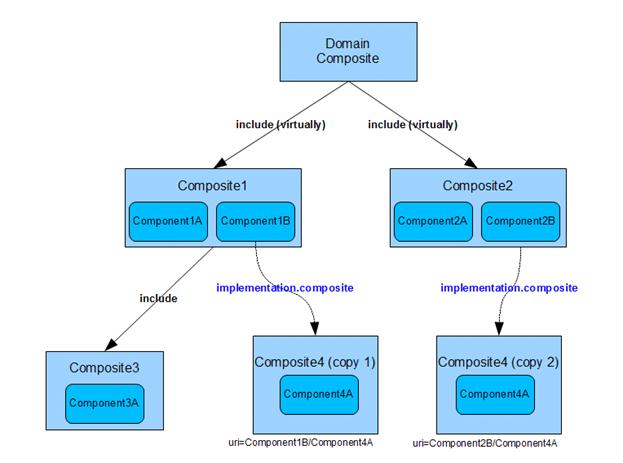
Figure A‑1 Example Domain Composite Infoset
The SCA Domain in Figure A‑1 has been constructed from
the composites and components shown in the figure. Composite1 and Composite2
were deployed into the Domain as described in [SCA-Asembly]. Composite3 is
included in Composite1 using the SCA include mechanism described in
[SCA-Assembly]. Composite4 is used as an implementation of Components 1B and
2B. Following the deployment of all the composites, the Domain contains:
- 3 Composites that can be addressed as part of the Deployed
Composites InfoSet; Composite1, Composite2 and Composite4.
- all the components shown in the diagram. Components 1A,
2A, 3A, 4A (twice) are leaf components.
The following snippets show example usage of the @attachTo
attribute and provide the outcome based on the Domain in Figure A‑1.
1. //component[@name="Component4A"]
Snippet A-1:Example attachTo all Instances of a Name
attach to both instances of Component4A
2. //component[URIRef(
"Component2B/Component4A" ) ]
Snippet A-2: Example attachTo a Specific Instance via a
Path
attach to the unique instance of Component4A when used by
Component2B (Component2B is a component at the Domain level)
3. //component[@name="Component3A"]/service[IntentRefs(
"intent1" ) ]
Snippet A-3:Example attachTo Instances with an intent
attach to the services of Component3A which have the intent
"intent1" applied
4. //component/binding.ws
Snippet A-4: Example attachTo Instances with a binding
attach to the web services binding of all components with a
service or reference with a Web services binding
5. /composite[@name=""]/component[@name="Component1A"]
Snippet A-5:Example attachTo a Specific Instance via Path
and Name
attach to Component1A at the Domain level
This section defines utility functions that can be used in
XPath expressions where otherwise it would be difficult to write the XPath
expression to identify the elements concerned.
This particularly applies in SCA to Interfaces and the child
parts of interfaces (operations and messages). XPath Functions are defined
below for the following:
·
Picking out a specific interface
·
Picking out a specific operation in an interface
·
Picking out a specific message in an operation in an interface
·
Picking out artifacts with specific intents
InterfaceRef( InterfaceName )
picks out an interface identified by InterfaceName
OperationRef( InterfaceName/OperationName )
picks out the operation OperationName in the interface
InterfaceName
MessageRef( InterfaceName/OperationName/MessageName )
picks out the message MessageName in the operation
OperationName in the interface InterfaceName.
·
"*" can be used for wildcarding of any of the names.
The interface is treated as if it is a WSDL interface (for
other interface types, they are treated as if mapped to WSDL using their
regular mapping rules).
Examples of the Interface functions:
InterfaceRef( "MyInterface" )
Snippet A-6: Example use of InterfaceRef
picks out an interface with the name "MyInterface"
OperationRef( "MyInterface/MyOperation" )
Snippet A-7: Example use of OperationRef with a Path
picks out the operation named "MyOperation" within
the interface named "MyInterface"
OperationRef( "*/MyOperation" )
Snippet A-8: Example use of OperationRef without a Path
picks out the operation named "MyOperation" from
any interface
MessageRef( "MyInterface/MyOperation/MyMessage" )
Snippet A-9: Example use of MessageRef with a Path
picks out the message named "MyMessage" from the
operation named "MyOperation" within the interface named
"MyInterface"
MessageRef( "*/*/MyMessage" )
Snippet A-10: Example ue of MessageRef with a Path with
Wildcards
picks out the message named "MyMessage" from any
operation in any interface
For the following intent-based functions, it is the total
set of intents which apply to the artifact which are examined by the function,
including directly or externally attached intents plus intents acquired from
the structural hierarchy and from the implementation hierarchy.
IntentRefs(
IntentList )
picks out an element where the intents applied match
the intents specified in the IntentList:
IntentRefs( "intent1" )
Snippet A-11: Example use of IntentRef
picks out an artifact to which intent named
"intent1" is attached
IntentRefs( "intent1 intent2" )
Snippet A-12: Example use of IntentRef with Multiple
intents
picks out an artifact to which intents named
"intent1" AND "intent2" are attached
IntentRefs( "intent1 !intent2" )
Snippet A-13: Example use of IntentRef with Not Operatior
picks out an artifact to which intent named
"intent1" is attached but NOT the intent named "intent2"
The URIRef function is used to pick out a particular use of
a nested component – i.e. where some Domain level component is implemented
using a composite implementation, which in turn has one or more components
implemented with the composite (and so on to an arbitrary level of nesting):
URIRef(
URI )
picks out the particular use of a component identified
by the structuralURI string URI.
For a full description of structuralURIs, see the SCA
Assembly specification [SCA-Assembly].
Example:
URIRef(
"top_comp_name/middle_comp_name/lowest_comp_name" )
Snippet A-15: Example use of URIRef
picks out the particular use of a component – where
component lowest_comp_name is used within the implementation of
middle_comp_name within the implementation of the top-level (Domain level)
component top_comp_name.
<?xml
version="1.0" encoding="UTF-8"?>
<!--
Copyright(C) OASIS(R) 2005,2010. All Rights Reserved.
OASIS trademark, IPR and other policies apply. -->
<schema xmlns="http://www.w3.org/2001/XMLSchema"
targetNamespace="http://docs.oasis-open.org/ns/opencsa/sca/200912"
xmlns:sca="http://docs.oasis-open.org/ns/opencsa/sca/200912"
xmlns:wsp="http://schemas.xmlsoap.org/ws/2004/09/policy"
elementFormDefault="qualified">
<include schemaLocation="sca-core-1.1-cd06.xsd"/>
<import namespace="http://www.w3.org/ns/ws-policy"
schemaLocation="http://www.w3.org/2007/02/ws-policy.xsd"/>
<element name="intent"
type="sca:Intent"/>
<complexType
name="Intent">
<sequence>
<element
name="description" type="string" minOccurs="0"
maxOccurs="1" />
<element
name="qualifier" type="sca:IntentQualifier"
minOccurs="0" maxOccurs="unbounded" />
<any
namespace="##other" processContents="lax"
minOccurs="0" maxOccurs="unbounded"/>
</sequence>
<attribute
name="name" type="NCName" use="required"/>
<attribute
name="constrains" type="sca:listOfQNames"
use="optional"/>
<attribute
name="requires" type="sca:listOfQNames"
use="optional"/>
<attribute
name="excludes" type="sca:listOfQNames"
use="optional"/>
<attribute
name="mutuallyExclusive" type="boolean"
use="optional" default="false"/>
<attribute
name="intentType"
type="sca:InteractionOrImplementation"
use="optional"
default="interaction"/>
<anyAttribute
namespace="##other" processContents="lax"/>
</complexType>
<complexType
name="IntentQualifier">
<sequence>
<element
name="description" type="string" minOccurs="0"
maxOccurs="1" />
<any
namespace="##other" processContents="lax"
minOccurs="0"
maxOccurs="unbounded"/>
</sequence>
<attribute
name="name" type="NCName" use="required"/>
<attribute
name="default" type="boolean" use="optional"
default="false"/>
</complexType>
<element
name="requires">
<complexType>
<sequence
minOccurs="0" maxOccurs="unbounded">
<any
namespace="##other" processContents="lax"/>
</sequence>
<attribute
name="intents" type="sca:listOfQNames"
use="required"/>
<anyAttribute
namespace="##other" processContents="lax"/>
</complexType>
</element>
<element
name="externalAttachment">
<complexType> <sequence
minOccurs="0" maxOccurs="unbounded"> <any
namespace="##other"
processContents="lax"/> </sequence> <attribute
name="intents" type="sca:listOfQNames"
use="optional"/>
<attribute
name="policySets" type="sca:listOfQNames"
use="optional"/>
<attribute
name="attachTo" type="string"
use="required"/> <anyAttribute
namespace="##other"
processContents="lax"/> </complexType>
</element>
<element
name="policySet" type="sca:PolicySet"/>
<complexType
name="PolicySet">
<choice
minOccurs="0" maxOccurs="unbounded">
<element
name="policySetReference"
type="sca:PolicySetReference"/>
<element
name="intentMap" type="sca:IntentMap"/>
<any
namespace="##other" processContents="lax"/>
</choice>
<attribute
name="name" type="NCName" use="required"/>
<attribute
name="provides" type="sca:listOfQNames"/>
<attribute
name="appliesTo" type="string"
use="optional"/>
<attribute
name="attachTo" type="string" use="optional"/>
<anyAttribute
namespace="##other" processContents="lax"/>
</complexType>
<element
name="policySetAttachment">
<complexType>
<sequence
minOccurs="0" maxOccurs="unbounded">
<any
namespace="##other" processContents="lax"/>
</sequence>
<attribute
name="name" type="QName" use="required"/>
<anyAttribute
namespace="##other" processContents="lax"/>
</complexType>
</element>
<complexType
name="PolicySetReference">
<attribute
name="name" type="QName" use="required"/>
<anyAttribute
namespace="##other" processContents="lax"/>
</complexType>
<complexType
name="IntentMap">
<choice
minOccurs="1" maxOccurs="unbounded">
<element name="qualifier"
type="sca:Qualifier"/>
<any namespace="##other"
processContents="lax"/>
</choice>
<attribute
name="provides" type="QName" use="required"/>
<anyAttribute
namespace="##other" processContents="lax"/>
</complexType>
<complexType
name="Qualifier">
<sequence
minOccurs="0" maxOccurs="unbounded">
<any
namespace="##other" processContents="lax"/>
</sequence>
<attribute
name="name" type="string" use="required"/>
<anyAttribute
namespace="##other" processContents="lax"/>
</complexType>
<simpleType
name="listOfNCNames">
<list
itemType="NCName"/>
</simpleType>
<simpleType
name="InteractionOrImplementation">
<restriction
base="string">
<enumeration
value="interaction"/>
<enumeration
value="implementation"/>
</restriction>
</simpleType>
</schema>
Snippet B‑1SCA Policy Schema
This appendix contains normative XML files that are defined
by this specification.
Intent definitions are contained within a Definitions file
called sca-policy-1.1-intents-definitions.xml, which contains a
<definitions/> element as follows:
<?xml
version="1.0" encoding="UTF-8"?>
<!--
Copyright(C) OASIS(R) 2005,2010. All Rights Reserved.
OASIS trademark, IPR and other policies apply. -->
<sca:definitions xmlns:sca="http://docs.oasis-open.org/ns/opencsa/sca/200912"
xmlns:xsi="http://www.w3.org/2001/XMLSchema-instance"
targetNamespace="http://docs.oasis-open.org/ns/opencsa/sca/200912">
<!-- Security related intents -->
<sca:intent name="serverAuthentication" constrains="sca:binding"
intentType="interaction">
<sca:description>
Communication
through the binding requires that the
server
is authenticated by the client
</sca:description>
<sca:qualifier name="transport" default="true"/>
<sca:qualifier name="message"/>
</sca:intent>
<sca:intent name="clientAuthentication" constrains="sca:binding"
intentType="interaction">
<sca:description>
Communication
through the binding requires that the
client
is authenticated by the server
</sca:description>
<sca:qualifier name="transport" default="true"/>
<sca:qualifier name="message"/>
</sca:intent>
<sca:intent name="authentication" requires="sca:clientAuthentication">
<sca:description>
A
convenience intent to help migration
</sca:description>
</sca:intent>
<sca:intent name="mutualAuthentication"
requires="sca:clientAuthentication sca:serverAuthentication">
<sca:description>
Communication
through the binding requires that the
client
and server to authenticate each other
</sca:description>
</sca:intent>
<sca:intent name="confidentiality" constrains="sca:binding"
intentType="interaction">
<sca:description>
Communication
through the binding prevents unauthorized
users
from reading the messages
</sca:description>
<sca:qualifier name="transport" default="true"/>
<sca:qualifier name="message"/>
</sca:intent>
<sca:intent name="integrity" constrains="sca:binding"
intentType="interaction">
<sca:description>
Communication
through the binding prevents tampering
with
the messages sent between the client and the service.
</sca:description>
<sca:qualifier name="transport" default="true"/>
<sca:qualifier name="message"/>
</sca:intent>
<sca:intent name="authorization" constrains="sca:implementation"
intentType="implementation">
<sca:description>
Ensures
clients are authorized to use services.
</sca:description>
</sca:intent>
<!--
Reliable messaging related intents -->
<sca:intent name="atLeastOnce" constrains="sca:binding"
intentType="interaction">
<sca:description>
This
intent is used to indicate that a message sent
by
a client is always delivered to the component.
</sca:description>
</sca:intent>
<sca:intent name="atMostOnce" constrains="sca:binding"
intentType="interaction">
<sca:description>
This
intent is used to indicate that a message that was
successfully
sent by a client is not delivered more than
once
to the component.
</sca:description>
</sca:intent>
<sca:intent name="exactlyOnce" requires="sca:atLeastOnce
sca:atMostOnce"
constrains="sca:binding" intentType="interaction">
<sca:description>
This
profile intent is used to indicate that a message sent
by
a client is always delivered to the component. It also
indicates
that duplicate messages are not delivered to the
component.
</sca:description>
</sca:intent>
<sca:intent name="ordered" constrains="sca:binding"
intentType="interaction">
<sca:description>
This
intent is used to indicate that all the messages are
delivered
to the component in the order they were sent by
the
client.
</sca:description>
</sca:intent>
<!--
Transaction related intents -->
<sca:intent name="managedTransaction" excludes="sca:noManagedTransaction"
mutuallyExclusive="true" constrains="sca:implementation"
intentType="implementation">
<sca:description>
A
managed transaction environment is necessary in order to
run
the component. The specific type of managed transaction
needed
is not constrained.
</sca:description>
<sca:qualifier name="global" default="true">
<sca:description>
For
a component marked with managedTransaction.global
a
global transaction needs to be present before dispatching
any
method on the component - using any transaction
propagated
from the client or else beginning and completing
a
new transaction.
</sca:description>
</sca:qualifier>
<sca:qualifier name="local">
<sca:description>
A
component marked with managedTransaction.local needs to
run
within a local transaction containment (LTC) that
is
started and ended by the SCA runtime.
</sca:description>
</sca:qualifier>
</sca:intent>
<sca:intent name="noManagedTransaction" excludes="sca:managedTransaction"
constrains="sca:implementation" intentType="implementation">
<sca:description>
A
component marked with noManagedTransaction needs to run without
a
managed transaction, under neither a global transaction nor
an
LTC. A transaction propagated to the hosting SCA runtime
is
not joined by the hosting runtime on behalf of a
component
marked with noManagedtransaction.
</sca:description>
</sca:intent>
<sca:intent name="transactedOneWay" excludes="sca:immediateOneWay"
constrains="sca:binding" intentType="implementation">
<sca:description>
For a reference marked as transactedOneWay any OneWay
invocation
messages
are transacted as part of a client global
transaction.
For
a service marked as transactedOneWay any OneWay invocation
message
are received from the transport binding in a
transacted
fashion, under the service’s global transaction.
</sca:description>
</sca:intent>
<sca:intent name="immediateOneWay" excludes="sca:transactedOneWay"
constrains="sca:binding" intentType="implementation">
<sca:description>
For a reference indicates that any OneWay invocation
messages
are
sent immediately regardless of any client transaction.
For
a service indicates that any OneWay invocation is
received
immediately regardless of any target service
transaction.
</sca:description>
</sca:intent>
<sca:intent name="propagatesTransaction" excludes="sca:suspendsTransaction"
constrains="sca:binding" intentType="interaction">
<sca:description>
A
service marked with propagatesTransaction is dispatched
under
any propagated (client) transaction and the service binding
needs
to be capable of receiving a transaction context.
A
reference marked with propagatesTransaction propagates any
transaction
context under which the client runs when the
reference
is used for a request-response interaction and the
binding
of a reference marked with propagatesTransaction needs to
be
capable of propagating a transaction context.
</sca:description>
</sca:intent>
<sca:intent name="suspendsTransaction" excludes="sca:propagatesTransaction"
constrains="sca:binding" intentType="interaction">
<sca:description>
A
service marked with suspendsTransaction is not dispatched
under
any propagated (client) transaction.
A
reference marked with suspendsTransaction does not propagate
any
transaction context under which the client runs when the
reference
is used.
</sca:description>
</sca:intent>
<sca:intent name="managedSharedTransaction"
requires="sca:managedTransaction.global sca:propagatesTransaction">
<sca:description>
Used
to indicate that the component requires both the
managedTransaction.global
and the propagatesTransactions
intents
</sca:description>
</sca:intent>
<!-- Miscellaneous intents -->
<sca:intent name="asyncInvocation" excludes="sca:propagatesTransaction"
constrains="sca:binding" intentType="interaction">
<sca:description>
Indicates
that request/response operations for the
interface
of this wire are "long running" and must be
treated
as two separate message transmissions
</sca:description>
</sca:intent>
<sca:intent
name="EJB" constrains="sca:binding"
intentType="interaction">
<sca:description>
Specifies
that the EJB API is needed to communicate with
the
service or reference.
</sca:description>
</sca:intent>
<sca:intent
name="SOAP" constrains="sca:binding" intentType="interaction"
mutuallyExclusive="true">
<sca:description>
Specifies
that the SOAP messaging model is used for delivering
messages.
</sca:description>
<sca:qualifier name="v1_1" default="true"/>
<sca:qualifier name="v1_2"/>
</sca:intent>
<sca:intent name="JMS" constrains="sca:binding"
intentType="interaction">
<sca:description>
Requires
that the messages are delivered and received via the
JMS
API.
</sca:description>
</sca:intent>
<sca:intent name="noListener" constrains="sca:binding"
intentType="interaction">
<sca:description>
This
intent can only be used on a reference. Indicates that the
client
is not able to handle new inbound connections. The binding
and
callback binding are configured so that any
response
or callback comes either through a back channel of the
connection
from the client to the server or by having the client
poll
the server for messages.
</sca:description>
</sca:intent>
</sca:definitions>
Snippet C‑1: SCA intent Definitions
The conformance items listed in the section below apply to
the following conformance targets:
·
Document artifacts (or constructs within them) that can be
checked statically.
·
SCA runtimes, which we may require to exhibit certain behaviors.
This section contains a list of conformance items for the
SCA Policy Framework specification.
|
Conformance ID
|
Description
|
|
[POL30001]
|
If the
configured instance of a binding is in conflict with the intents and policy
sets selected for that instance, the SCA runtime MUST raise an error.
|
|
[POL30002]
|
The
QName for an intent MUST be unique amongst the set of intents in the SCA
Domain.
|
|
[POL30004]
|
If an
intent has more than one qualifier, one and only one MUST be declared as the
default qualifier.
|
|
[POL30005]
|
The name
of each qualifier MUST be unique within the intent definition.
|
|
[POL30006]
|
the name
of a profile intent MUST NOT have a “.” in it.
|
|
[POL30007]
|
If a
profile intent is attached to an artifact, all the intents listed in its
@requires attribute MUST be satisfied as described in section 4.15.
|
|
[POL30008]
|
When
a policySet element contains a set of intentMap children, the value of the
@provides attribute of each intentMap MUST correspond to an unqualified
intent that is listed within the @provides attribute value of the parent
policySet element.
|
|
[POL30010]
|
For
each qualifiable intent listed as a member of the @provides attribute list of
a policySet element, there MUST be no more than one corresponding intentMap
element that declares the unqualified form of that intent in its @provides
attribute. In other words, each intentMap within a given policySet uniquely
provides for a specific intent.
|
|
[POL30011]
|
Following the inclusion of all policySet references, when
a policySet element directly
contains wsp:policyAttachment children or policies using extension elements,
the set of policies specified as children MUST satisfy all the intents
expressed using the @provides attribute value of the policySet element.
|
|
[POL30013]
|
The
set of intents in the @provides attribute of a referenced policySet MUST be a
subset of the set of intents in the @provides attribute of the referencing
policySet.
|
|
[POL30015]
|
Each
QName in the @requires attribute MUST be the QName of an intent in the SCA
Domain.
|
|
[POL30016]
|
Each
QName in the @excludes attribute MUST be the QName of an intent in the SCA
Domain.
|
|
[POL30017]
|
The
QName for a policySet MUST be unique amongst the set of policySets in the SCA
Domain.
|
|
[POL30018]
|
The
contents of @appliesTo MUST match the XPath 1.0 [XPATH] production Expr.
|
|
[POL30019]
|
The
contents of @attachTo MUST match the XPath 1.0 production Expr.
|
|
[POL30020]
|
If
a policySet specifies a qualifiable intent in the @provides attribute, and it
provides an intentMap for the qualifiable intent then that intentMap MUST
specify all possible qualifiers for that intent.
|
|
[POL30021]
|
The
@provides attribute value of each intentMap that is an immediate child of a
policySet MUST be included in the @provides attribute of the parent
policySet.
|
|
[POL30024]
|
An
SCA Runtime MUST include in the Domain the set of intent definitions
contained in the Policy_Intents_Definitions.xml described in the appendix
"Intent Definitions" of the SCA Policy specification.
|
|
[POL30025]
|
If
only one qualifier for an intent is given it MUST be used as the default
qualifier for the intent.
|
|
[POL40001]
|
SCA
implementations supporting both Direct Attachment and External Attachment
mechanisms MUST ignore policy sets applicable to any given SCA element via
the Direct Attachment mechanism when there exist policy sets applicable to
the same SCA element via the External Attachment mechanism
|
|
[POL40002]
|
The SCA
runtime MUST raise an error if the @attachTo XPath expression resolves to an
SCA <property> element, or any of its children.
|
|
[POL40004]
|
A qualifiable intent expressed lower in the hierarchy can
be qualified further up the hierarchy, in which case the qualified version of
the intent MUST apply to the higher level element.
|
|
[POL40005]
|
The
intents declared on elements higher in the structural hierarchy of a given
element MUST be applied to the element EXCEPT
·
if any
of the inherited intents is mutually exclusive with an intent applied on the element, then the inherited intent MUST
be ignored
·
if the overall set of intents
from the element itself and from its structural hierarchy contains both an
unqualified version and a qualified version of the same intent, the qualified
version of the intent MUST be used.
|
|
[POL40006]
|
If a
component has any policySets attached to it (by any means), then any
policySets attached to the componentType MUST be ignored.
|
|
[POL40007]
|
Matching
service/reference policies across the SCA Domain boundary MUST use WS-Policy
compatibility (strict WS-Policy intersection) if the policies are expressed
in WS-Policy syntax.
|
|
[POL40009]
|
Any two
intents applied to a given element MUST NOT be mutually exclusive
|
|
[POL40010]
|
SCA
runtimes MUST support at least one of the Direct Attachment and External
Attachment mechanisms for policySet attachment.
|
|
[POL40011]
|
SCA
implementations supporting only the External Attachment mechanism MUST ignore
the policy sets that are applicable via the Direct Attachment mechanism.
|
|
[POL40012]
|
SCA
implementations supporting only the Direct Attachment mechanism MUST ignore
the policy sets that are applicable via the External Attachment mechanism.
|
|
[POL40014]
|
The
intents declared on elements lower in the implementation hierarchy of a given
element MUST be applied to the element.
|
|
[POL40015]
|
When
combining implementation hierarchy and structural hierarchy policy data, Rule
1 MUST be applied BEFORE Rule 2.
|
|
[POL40016]
|
When
calculating the set of intents and set of policySets which apply to either a
service element or to a reference element of a component, intents and
policySets from the interface definition and from the interface
declaration(s) MUST be applied to the service or reference element and to the
binding element(s) belonging to that element.
|
|
[POL40017]
|
If the
required intent set contains a mutually exclusive pair of intents the SCA
runtime MUST reject the document containing the element and raise an error.
|
|
[POL40018]
|
All intents
in the required intent set for an element MUST be provided by the directly
provided intents set and the set of policySets that apply to the element, or
else an error is raised.
|
|
[POL40019]
|
The
locations where interfaces are defined and where interfaces are declared in
the componentType and in a component MUST be treated as part of the
implementation hierarchy as defined in section “Attaching intents to SCA
elements”.
|
|
[POL40020]
|
The
QName of the bindingType MUST be unique amongst the set of bindingTypes in
the SCA Domain.
|
|
[POL40021]
|
A
binding implementation MUST implement all the intents listed in the
@alwaysProvides and @mayProvides attributes.
|
|
[POL40022]
|
The SCA
runtime MUST determine the compatibility of the policySets at each end of a
wire using the compatibility rules of the policy language used for those
policySets.
|
|
[POL40023]
|
The
policySets at each end of a wire MUST be incompatible if they use different
policy languages.
|
|
[POL40024]
|
Where the
policy language in use for a wire is WS-Policy, strict WS-Policy intersection
MUST be used to determine policy compatibility.
|
|
[POL40025]
|
In
order for a reference to connect to a particular service, the policies of the
reference MUST intersect with the policies of the service.
|
|
[POL40027]
|
Any
intents attached to an interface definition artifact, such as a WSDL
portType, MUST be added to the intents attached to the service or reference
to which the interface definition applies. If no intents are attached to the
service or reference then the intents attached to the interface definition
artifact become the only intents attached to the service or reference.
|
|
[POL40034]
|
During
the deployment of SCA composites, first all <externalAttachment/>
elements within the Domain MUST be evaluated to determine which intents are
attached to elements in the newly deployed composite and then all policySets
within the Domain with an @attachTo attribute or <externalAttachment>
elements that attach policySets MUST be evaluated to determine which
policySets are attached to elements in the newly deployed composite.
|
|
[POL40035]
|
The
contents of the @attachTo attribute of an externalAttachment element MUST
match the XPath 1.0 production Expr.
|
|
[POL50001]
|
The
implementationType name attribute MUST be the QName of an XSD global element
definition used for implementation elements of that type.
|
|
[POL70001]
|
When authorization
is present, an SCA Runtime MUST ensure that the client is authorized to use
the service.
|
|
[POL70009]
|
When
confidentiality is present, an SCA Runtime MUST ensure that only authorized
entities can view the contents of a message.
|
|
[POL70010]
|
When
integrity is present, an SCA Runtime MUST ensure that the contents of
a message are not altered.
|
|
[POL70011]
|
When a
serverAuthentication, clientAuthentication, confidentiality or integrity
intent is qualified by transport, an SCA Runtime MUST delegate
serverAuthentication, clientAuthentication, confidentiality and integrity,
respectively, to the transport layer of the communication protocol.
|
|
[POL70012]
|
When a
serverAuthentication, clientAuthentication, confidentiality or integrity
intent is qualified by message, an SCA Runtime MUST delegate
serverAuthentication, clientAuthentication, confidentiality and integrity,
respectively, to the message layer of the communication protocol.
|
|
[POL70013]
|
When
serverAuthentication is present, an SCA runtime MUST ensure that the
server is authenticated by the client.
|
|
[POL70014]
|
When
clientAuthentication is present, an SCA runtime MUST ensure that the
client is authenticated by the server.
|
|
[POL80001]
|
When
atLeastOnce is present, an SCA Runtime MUST deliver a message to the
destination service implementation,.
|
|
[POL80002]
|
When
atMostOnce is present, an SCA Runtime MUST NOT deliver duplicates of a
message to the service implementation.
|
|
[POL80003]
|
When
ordered is present, an SCA Runtime MUST deliver messages sent by a
single source to a single destination service implementation in the order
that the messages were sent by that source.
|
|
[POL80004]
|
When
exactlyOnce is present, an SCA Runtime MUST deliver a message to the
destination service implementation and MUST NOT deliver duplicates of a
message to the service implementation.
|
|
[POL90003]
|
For a
component marked with managedTransaction.global, the SCA runtime MUST ensure
that a global transaction is present before dispatching any method on the
component.
|
|
[POL90004]
|
A
component marked with managedTransaction.local MUST run within a local
transaction containment (LTC) that is started and ended by the SCA runtime.
|
|
[POL90006]
|
Local
transactions MUST NOT be propagated outbound across remotable interfaces.
|
|
[POL90007]
|
A
transaction that is propagated to the hosting SCA runtime MUST NOT be joined
by the hosting runtime on behalf of a component marked with
noManagedtransaction.
|
|
[POL90008]
|
When a
reference is marked as transactedOneWay, any OneWay invocation messages MUST
be transacted as part of a client global transaction.
|
|
[POL90009]
|
If the
client component is not configured to run under a global transaction or if
the binding does not support transactional message sending, then a reference
MUST NOT be marked as transactedOneWay.
|
|
[POL90010]
|
If a
service is marked as transactedOneWay, any OneWay invocation message MUST be
received from the transport binding in a transacted fashion, under the target
service’s global transaction.
|
|
[POL90011]
|
If the
component is not configured to run under a global transaction or if the
binding does not support transactional message receipt, then a service MUST
NOT be marked as transactedOneWay.
|
|
[POL90012]
|
When
applied to a reference indicates that any OneWay invocation messages MUST be
sent immediately regardless of any client transaction.
|
|
[POL90013]
|
When
applied to a service indicates that any OneWay invocation MUST be received
immediately regardless of any target service transaction.
|
|
[POL90015]
|
A service
marked with propagatesTransaction MUST be dispatched under any propagated
(client) transaction.
|
|
[POL90016]
|
Use of
the propagatesTransaction intent on a service implies that the
service binding MUST be capable of receiving a transaction context.
|
|
[POL90017]
|
A service
marked with suspendsTransaction MUST NOT be dispatched under any propagated
(client) transaction.
|
|
[POL90019]
|
A service MUST NOT be marked with
"propagatesTransaction" if the component is marked with
"managedTransaction.local" or with "noManagedTransaction"
|
|
[POL90020]
|
When a reference is marked with propagatesTransaction, any
transaction context under which the client runs MUST be propagated when the
reference is used for a request-response interaction
|
|
[POL90022]
|
When a reference is marked with suspendsTransaction, any
transaction context under which the client runs MUST NOT be propagated when
the reference is used.
|
|
[POL90023]
|
A reference MUST NOT be marked with propagatesTransaction
if component is marked with "ManagedTransaction.local" or with
"noManagedTransaction"
|
|
[POL90024]
|
Transaction context MUST NOT be propagated on OneWay
messages.
|
|
[POL90025]
|
The SCA runtime MUST ignore the propagatesTransaction
intent for OneWay methods.
|
|
[POL90027]
|
If a transactedOneWay intent is combined with the
managedTransaction.local or noManagedTransaction implementation intents for
either a reference or a service then an error MUST be raised during
deployment.
|
|
[POL90028]
|
The transactedOneWay
intent MUST NOT be attached to a request/response operation.
|
|
[POL90029]
|
The immediateOneWay
intent MUST NOT be attached to a request/response operation.
|
|
[POL90030]
|
The asyncInvocation
intent and the propagatesTransaction intent MUST NOT be applied
to the same service or reference operation.
|
|
[POL90031]
|
When the asyncInvocation
intent is applied to an SCA service, the SCA runtime MUST behave as if the suspendsTransaction
intent is also applied to the service.
|
|
[POL100001]
|
When SOAP is present, an SCA Runtime MUST use the
SOAP messaging model to deliver messages.
|
|
[POL100002]
|
When a SOAP intent is qualified with 1_1 or 1_2,
then SOAP version 1.1 or SOAP version 1.2 respectively MUST be used to
deliver messages.
|
|
[POL100003]
|
When JMS is present, an SCA Runtime MUST ensure
that the binding used to send and receive messages supports the JMS API.
|
|
[POL100004]
|
The noListener intent MUST only be declared on a
@requires attribute of a reference.
|
|
[POL100005]
|
When noListener is present, an SCA Runtime MUST not
establish any connection from a service to a client.
|
|
[POL100006]
|
When EJB is present, an SCA Runtime MUST ensure
that the binding used to send and receive messages supports the EJB API.
|
|
[POL100007]
|
The SCA
Runtime MUST ignore the asyncInvocation intent for one way operations.
|
|
[POL110001]
|
An SCA runtime MUST reject a composite file that does not
conform to the sca-policy-1.1.xsd schema.
|
Table D‑1: SCA Policy Normative Statements
The following
individuals have participated in the creation of this specification and are
gratefully acknowledged:
|
Participant Name
|
Affiliation
|
|
Jeff
Anderson
|
Deloitte
Consulting LLP
|
|
Bryan
Aupperle
|
IBM
|
|
Ron
Barack
|
SAP
AG*
|
|
Mirza
Begg
|
Individual
|
|
Michael
Beisiegel
|
IBM
|
|
Vladislav
Bezrukov
|
SAP
AG*
|
|
Henning
Blohm
|
SAP
AG*
|
|
David
Booz
|
IBM
|
|
Fred
Carter
|
AmberPoint
|
|
Tai-Hsing
Cha
|
TIBCO
Software Inc.
|
|
Martin
Chapman
|
Oracle
Corporation
|
|
Vamsavardhana
Chillakuru
|
IBM
|
|
Mike
Edwards
|
IBM
|
|
Raymond
Feng
|
IBM
|
|
Billy
Feng
|
Primeton
Technologies, Inc.
|
|
Robert
Freund
|
Hitachi,
Ltd.
|
|
Murty
Gurajada
|
TIBCO
Software Inc.
|
|
Simon
Holdsworth
|
IBM
|
|
Michael
Kanaley
|
TIBCO
Software Inc.
|
|
Anish
Karmarkar
|
Oracle
Corporation
|
|
Nickolas
Kavantzas
|
Oracle
Corporation
|
|
Rainer
Kerth
|
SAP
AG*
|
|
Pundalik
Kudapkar
|
TIBCO
Software Inc.
|
|
Meeraj
Kunnumpurath
|
Individual
|
|
Rich
Levinson
|
Oracle
Corporation
|
|
Mark
Little
|
Red
Hat
|
|
Ashok
Malhotra
|
Oracle
Corporation
|
|
Jim
Marino
|
Individual
|
|
Jeff
Mischkinsky
|
Oracle
Corporation
|
|
Dale
Moberg
|
Axway
Software*
|
|
Simon
Nash
|
Individual
|
|
Bob
Natale
|
Mitre
Corporation*
|
|
Eisaku
Nishiyama
|
Hitachi,
Ltd.
|
|
Sanjay
Patil
|
SAP
AG*
|
|
Plamen
Pavlov
|
SAP
AG*
|
|
Gilbert
Pilz
|
Oracle
Corporation
|
|
Martin
Raepple
|
SAP
AG*
|
|
Fabian
Ritzmann
|
Sun
Microsystems
|
|
Ian
Robinson
|
IBM
|
|
Scott
Vorthmann
|
TIBCO
Software Inc.
|
|
Feng
Wang
|
Primeton
Technologies, Inc.
|
|
Eric
Wells
|
Hitachi,
Ltd.
|
|
Prasad
Yendluri
|
Software
AG, Inc.*
|
|
Alexander
Zubev
|
SAP
AG*
|
[optional; should not be included in OASIS Standards]
|
Revision
|
Date
|
Editor
|
Changes Made
|
|
2
|
Nov 2, 2007
|
David Booz
|
Inclusion of OSOA errata and
Issue 8
|
|
3
|
Nov 5, 2007
|
David Booz
|
Applied resolution of Issue
7, to Section 4.1 and 4.10. Fixed misc. typos/grammatical items.
|
|
4
|
Mar 10, 2008
|
David Booz
|
Inclusion of OSOA
Transaction specification as Chapter 11. There are no textual changes other
than formatting.
|
|
5
|
Apr 28 2008
|
Ashok Malhotra
|
Added resolutions to issues
17, 18, 24, 29, 37, 39 and 40,
|
|
6
|
July 7 2008
|
Mike Edwards
|
Added resolution for Issue
38
|
|
7
|
Aug 15 2008
|
David Booz
|
Applied Issue 26, 27
|
|
8
|
Sept 8 2008
|
Mike Edwards
|
Applied resolution for Issue
15
|
|
9
|
Oct 17 2008
|
David Booz
|
Various formatting changes
Applied 22 – Deleted text in
Ch 9
Applied 42 – In section 3.3
Applied 46 – Many sections
Applied 52,55 – Many
sections
Applied 53 – In section 3.3
Applied 56 – In section 3.1
Applied 58 – Many sections
|
|
10
|
Nov 26
|
David Booz
|
Applied camelCase words from
Liason
Applied 54 – many sections
Applied 59 – section 4.2,
4.4.2
Applied 60 – section 8.1
Applied 61 – section 4.10,
4.12
Applied 63 – section 9
|
|
11
|
Dec 10
|
Mike Edwards
|
Applied 44 - section 3.1,
3.2 (new), 5.0, A.1
Renamed file to
sca-policy-1.1-spec-CD01-Rev11
|
|
12
|
Dec 25
|
Ashok Malhotra
|
Added RFC 2119 keywords
Renamed file to
sca-policy-1.1-spec-CD01-Rev12
|
|
13
|
Feb 06 2009
|
Mike Edwards, Eric Wells,
Dave Booz
|
All changes accepted
Revision of the RFC 2119
keywords and the set of normative statements
- done in drafts a through g
|
|
14
|
Feb 10 2009
|
Mike Edwards
|
All changes accepted,
comments removed.
|
|
15
|
Feb 10 2009
|
Mike Edwards
|
Issue 64 - Sections A1, B,
10, 9, 8
|
|
16
|
Feb 12, 2009
|
Ashok Malhotra
|
Issue 5 The single sca
namespace is listed on the title page.
Issue 32
clientAuthentication and serverAuthentication
Issue 35 Conformance targets
added to Appendix C
Issue 48 Transaction
defaults are not optional
Issue 66 Tighten schema for
intent
Issue 67 Remove
‘conversational’
|
|
17
|
Feb 16, 2009
|
Dave Booz
|
Issues 57, 69, 70, 71
|
|
CD02
|
Feb 21, 2009
|
Dave Booz
|
Editorial changes to make a
CD
|
|
CD02-rev1
|
April 7, 2009
|
Dave Booz
|
Applied 72, 74,75,77
|
|
CD02-rev2
|
July 21, 2009
|
Dave Booz
|
Applied
81,84,85,86,95,96,98,99
|
|
CD02-rev3
|
Aug 12, 2009
|
Dave Booz
|
Applied
73,76,78,80,82,83,88,102
|
|
CD03-rev4
|
Sept 3, 2009
|
Dave Booz
|
Editorial cleanup to match
OASIS templates
|
|
CD02-rev5
|
Nov 9, 2009
|
Dave Booz
|
Fixed latest URLs
Applied: 79, 87, 90, 97,
100, 101, 103, 106, 107, 108
|
|
CD02-rev6
|
Nov 17, 2009
|
Dave Booz
|
Applied 94, 109
|
|
CD02-rev7
|
Jan 1, 2010
|
Dave Booz
|
Updated namespace to latest
assembly
Applied issues:
79,110,111,112,113,114,115
|
|
CD02-rev8
|
Mar 17, 2010
|
Dave Booz
|
Applied issue 93
Editorial updates to prepare
for next CD
|
|
CD02-rev9
|
April 8, 2010
|
Ashok Malhotra, Dave Booz
|
More Editorial cleanup
|
|
CD03
|
May 5, 2010
|
Dave Booz
|
Applied 117,
Front Matter and TOC updates
|
|
CD03-rev1
|
July 14, 2010
|
Dave Booz
|
Applied 122
|
|
CD04
|
Sept 22, 2010
|
Dave Booz
|
Prepare CD04, front matter,
participants
|
|
wd041
|
11 July 2011
|
Mike Edwards
|
Issue 130 - modify POL80001,
POL80002, downgrade POL40029, POL40030, POL40031, POL40032, POL40033.
|
|
wd042
|
20 July 2011
|
Mike Edwards
|
All changes accepted
|