The key words "MUST", "MUST NOT", "REQUIRED", "SHALL",
"SHALL NOT", "SHOULD", "SHOULD NOT", "RECOMMENDED", "MAY", and "OPTIONAL" are to be
interpreted as described in [RFC2119].
While RFC2119 permits the use of synonyms, to achieve
consistency across specifications, "MUST" is used instead of "SHALL" and
"REQUIRED", "MUST NOT" instead of "SHALL NOT", and "SHOULD" instead of
"RECOMMENDED" in this specification. To enable easy identification of the keywords,
uppercase is used for keywords.
Following are the core entities and its
definitions used by CIQ TC:
Name
Name of a person or an organization
Address
A physical location or a mail delivery point
Party
A Party could be of two types
namely,
· Person
· Organization
An Organization could be a company,
association, club, not-for-profit, private firm, public firm, consortium,
university, school, etc.
Party data consists of many attributes
(e.g. Name, Address, email address, telephone, etc) that are unique to a party.
However, a person or organization's name and address are generally the key
identifiers (but not necessarily the unique identifiers) of a "Party". A
"Customer" is of type "Party".
Name, Address and Party schemas of
version 3.0 share the same design concepts. The commonality should simplify
understanding and adoption of the schemas. The xNAL schema design concept
varies slightly as it is only a simple container for associating names and
addresses.
Name, Address and Party schemas are
designed to bring interoperability to the way these most "common" entities are used
across all spectrums of business and government.
Following are the different schemas
produced for version 3.0:
|
Schema File
name
|
Description
|
Comments
|
|
xNL.xsd
|
Entity
Name
|
Defines a set of
reusable types and elements for a name of individual or
organisation
|
|
xNL-types.xsd
|
Entity Name
Enumerations
|
Defines a set of
enumerations to support Name entity
|
|
xAL.xsd
|
Entity
Address
|
Defines a set of
reusable types and elements for an address, location name or
description
|
|
xAL-types.xsd
|
Entity Address
Enumerations
|
Defines a set of
enumerations to support address entity
|
|
xNAL.xsd
|
Name and Address
binding
|
Defines two
constructs to bind names and addresses for data exchange or postal
purposes
|
|
xNAL-types.xsd
|
Name and Address
binding Enumerations
|
Defines a set of
enumerations to support name and address binding
|
|
xPIL.xsd (formerly
xCIL.xsd)
|
Entity Party
(organisation or individual)
|
Defines a set of
reusable types and elements for a detailed description of an organisation or
individual
|
|
xPIL-types.xsd
|
Entity Party
(organisation or individual) Enumerations
|
Defines a set of
enumerations to support party information entity
|
|
CommonTypes.xsd
|
Common Data Types and
Enumerations
|
Defines a set of
commonly used data types and enumerations in the CIQ Schemas
|
|
xLink-2003-12-31.xsd
|
xLink
attributes
|
Defines a subset of
xLink attributes as XML schema
|
|
*.gc files
|
Entity Party, Name,
and Address
|
Defines a set of
enumerations/code lists in genericode
|
Following are the formal design
requirements taken into consideration for version 3.0 schemas:
· Data structures SHOULD be
described using W3C XML Schema language
· Data structures SHOULD be
separated into multiple namespaces for reuse of the main fundamental entities (e.g.
Person Name, Organisation Name, Address)
· Data structures SHOULD be
able to accommodate all information types used for data exchanges based on previous
versions of the CIQ Specifications
· Data structures SHOULD be
extensible (also, allow reduction in complexity) to provide enough flexibility for
point-to-point solutions and application-specific scenarios
· Data structures SHOULD
allow organisation-specific information to be attached to entities without breaking
the structure.
· Implementation complexity
SHOULD be proportional to the complexity of the subset of data structures used by
the implementer
The entire party information space is
divided into a number of complex information types that are viewed as basic
entities. This enables re-use of the basic entities as required. Following are the
basic CIQ specification entities:
· Name (Person or
Organisation - see xNL.xsd)
· Address (see
xAL.xsd)
· Name and Address combined
(see xNAL.xsd)
· Personal details of a
person (see xPIL.xsd)
· Organisation specific
details (see xPIL.xsd)
· Party Relationships (see
xPRL.xsd [not available in this release] and
xLink-2003-12-31-revised.xsd)
These major entities are supported by
code lists to add "semantics" to the data they represent. We categorise the
major entities of CIQ Specifications into three namely,
· Name
· Address,
and
· Party
Centric Information
The design concepts of name, address and
party schemas are very similar in terms of the way semantic information (e.g.
Semantic information for a person name is "Given Name, "Middle Name' Surname" etc,
i.e. adding semantics to the data) is represented.
All the common design concepts used in
the CIQ Specifications (e.g. using code lists, customizing CIQ entity schemas,
extending CIQ entity schemas, referencing between entities, defining business rules
to constrain CIQ entity schemas) are equally applicable for all key entities of CIQ
specifications namely, Name, Address and Party. These common concepts are explained
in detail in section 3 (Entity "Name"). Users SHOULD study that section in detail
before proceeding to other entities namely, Address and Party, as these concepts
are applicable to these entities also.
|
Entity
|
Namespace
|
Suggested
Prefix
|
Schema
Files
|
|
Name
|
urn:oasis:names:tc:ciq:xnl:3
|
xnl or n
|
xNL.xsd
xNL-types.xsd
|
|
Address
|
urn:oasis:names:tc:ciq:xal:3
|
xal or a
|
xAL.xsd
xAL-types.xsd
|
|
Name and
Address
|
urn:oasis:names:tc:ciq:xnal:3
|
xnal
|
xNAL.xsd
xNAL-types.xsd
|
|
Party
|
urn:oasis:names:tc:ciq:xpil:3
|
xpil or p
|
xPIL.xsd
xPIL-types.xsd
|
|
Party
Relationships
|
urn:oasis:names:tc:ciq:xprl:3
|
xprl or r
|
xPRL.xsd
|
|
xLink
|
http://www.w3.org/1999/xlink
|
xLink
|
xLink-2003-12-31.xsd
|
This document contains references to XML
Linking Language (XLink) Version 1.0, W3C Recommendation 27 June 2001 available at
http://www.w3.org/TR/xlink/ . The CIQ TC
strongly recommends readers to read the xLink specification from W3C if they want
to use this supported feature in CIQ Specifications.
This document contains references to
Code List version 1.0, OASIS Committee Specification, May 2007 at http://www.oasis-open.org/committees/codelist.
The CIQ TC strongly recommends readers to read the code list specification if they
want to use this supported feature in CIQ Specification.
GeoRSS 2.0 (georss.org) from Open
Geospatial Consortium (http://www.opengeospatial.net) has been
referenced in this specification as it is critical to assuring interoperability
with a variety of geospatial technologies, such as GIS, Spatial Data
Infrastructures, Location Services, and the GeoWeb.
Entity "Name" has been modelled
independent of any context as a standalone class to reflect some common
understanding of concepts "Person Name" and "Organisation
Name".
Name schema is separated into two parts:
a structural part (xNL.xsd) as shown in the XML schema diagram below and
separate enumeration/code list files (code lists defined in an XML schema
(xNL-types.xsd) and also, code lists represented in genericode format as
.gc files) supporting the structure. "Genericode" will be discussed in later
sections. The structural part (xNL.xsd) SHOULD remain unchanged over the
course of time while the code list/enumeration files (xNL-types.xsd and
.gc files) MAY be easily changed to meet particular implementation
needs.
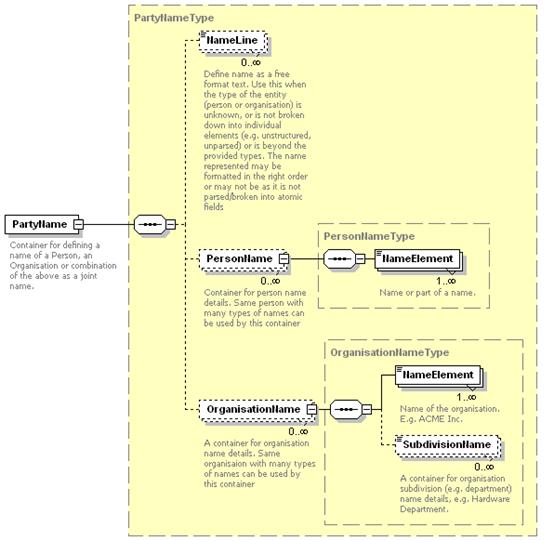
In the schema structure above
(xNL.xsd), "NameElement" stores the name of a party and the supporting
enumeration lists referenced as attributes in the schema structure (see the
xNL.xsd schema for the list of attributes or the HTML documentation of the
schema), provide the semantic meaning of the data.
The structure allows for different
semantic levels based on the following paradigm:
· A simple data structure
with minimum semantics SHOULD fit into the schema with minimal effort
· A complex data structure
SHOULD fit into the schema without loss of any semantic information
A typical database does not
differentiate between a person and an organisation name where only one field has
been allocated for storing the entire name information (unstructured data). This
database can be mapped to xNL as follows:
<n:PartyName>
<n:NameLine>Mr
Jeremy Apatuta Johnson</n:NameLine>
</n:PartyName>
In this example, information related to
party name, resides in NameLine element. It has no semantic information that
MAY indicate what kind of name it is and what the individual name elements are
(i.e., the data has not been parsed into first name, last name, title, etc.). What
is known is that it is a name of some party, be it a person or an
organisation. This is the maximum level of complexity. Data in this free
formatted text form is classified as "poor quality" as it is subject to different
interpretations of the data and will cause interoperability problems.
Many common applications fall under this
"No Semantics" category.
The medium level of complexity is when a
database differentiates between person and organisation name. In this case, names
are placed in the appropriate elements namely, PersonName or
OrganisationName inside the structure.
Person Name:
<n:PartyName>
<n:PersonName>
<n:NameElement>Mr Jeremy Apatuta Johnson</n:NameElement>
</n:PersonName>
</n:PartyName>
This example shows that name information
belongs to an individual, but the semantics of the individual name elements (e.g.
what are the meanings of "Mr", "Jeremy", etc.) are unknown.
Organisation Name:
<n:PartyName>
<n:OrganisationName>
<n:NameElement>Khandallah Laundering Ltd.</n:NameElement>
</n:OrganisationName>
</n:PartyName>
This example is similar to the previous
one, except that the name belongs to an organisation.
Many common applications fall under this
of "Minimal Semantics" category.
The maximum level of complexity is when
a database differentiates between person and organisation name and also
differentiates between different name elements within a name. The data is
structured.
<n:PartyName>
<n:PersonName>
<n:NameElement Abbreviation="true"
ElementType="Title">Mr</n:NameElement>
<n:NameElement
ElementType="FirstName">Jeremy</n:NameElement>
<n:NameElement
ElementType="MiddleName">Apatuta</n:NameElement>
<n:NameElement
ElementType="LastName">Johnson</n:NameElement>
<n:NameElement
ElementType="GenerationIdentifier">III</n:NameElement>
<n:NameElement
ElementType="GenerationIdentifier">Junior</n:NameElement>
<n:NameElement ElementType="Title">PhD</n:NameElement>
</n:PersonName>
</n:PartyName>
This example introduces
ElementType attribute that indicates the exact meaning of the name element.
Few applications and in particular, applications dealing with data quality
and integrity, fall in this "Full Semantics" category and often, the database
supported by these applications are high in the quality of the data it manages.
This is an additional level of semantics that is supported through code
list/enumerated values. Technically, the enumerations sit in a separate schema
(xNL-types.xsd) or in genericode files.
An example of enumeration is a list of
name element types for a person name defined in xNL-types.xsd is shown
below.
<xs:simpleType
name="PersonNameElementsEnumeration">
<xs:restriction
base="xs:string">
<xs:enumeration value="PrecedingTitle"/>
<xs:enumeration value="Title"/>
<xs:enumeration value="FirstName"/>
<xs:enumeration value="MiddleName"/>
<xs:enumeration value="LastName"/>
<xs:enumeration value="OtherName"/>
<xs:enumeration value="Alias"/>
<xs:enumeration value="GenerationIdentifier"/>
</xs:restriction>
</xs:simpleType>
All elements and attributes in xNL
schema have strong data types.
All free-text values of elements (text
nodes) and attributes are constrained by a simple type "String" (255
characters in size and collapsed white spaces) defined in CommonTypes.xsd.
Other XML Schema data types are also used throughout the schema.
This is an important section that users
MUST pay more attention.
A code list (also called
enumeration) defines a classification schema and a set of classification
values to support the scheme. For example, "Administrative Area" is a
classification scheme and a set of classification values for this classification
scheme could be: State, City, Province, Town, Region, District, etc.
XML Schema describes the structural and
lexical constraints on an XML document. Some information items in a document are
described in the schema lexically as a simple value whereby the value is a code
representing an agreed-upon semantic concept. The value used is typically chosen
from a set of unique coded values enumerating related concepts. These sets of coded
values are sometimes termed code lists.
Earlier versions of CIQ Name, Address
and Party Information specifications had concrete schema grammar to define the
party entities. This did not satisfy many name, address and party data usage
scenarios that are geographic and cultural specific. For example, in certain
countries, the concept of first name, middle name, and last/family/surname does not
exist. Representing names from these countries in the earlier version of CIQ
Specifications were difficult as its name schema (for example, v2.0 of
xNL.xsd) had element names as FirstName, MiddleName, and
LastName, and they were semantically incorrect metadata for the data in this
example. To be precise, in a country where the concept of First Name does
not exist, using First Name element of CIQ specification was semantically
incorrect. Therefore, the use of enumeration lists/code lists approach (that is
customisable) in this version of the specifications provides the correct semantics
to the data.
Let us look at the following
example:
<n:PartyName>
<n:PersonName>
<n:NameElement
ElementType="FatherName">Venkat</n:NameElement>
<n:NameElement
ElementType="GivenName">Ramkumar</n:NameElement>
</n:PersonName>
</n:PartyName>
In the above example, NameElement
is the XML tag used to represent name data and it is irrelevant whether the name is
a First Name, Middle Name or Last Name or Surname. The
attribute ElementType that uses enumeration list of semantic information for
a name provides the semantics to the data (FatherName and GivenName
in this example) represented in NameElement.
The Name, Address and
Party schemas in this version provides code lists/enumerations designed to
satisfy common usage scenarios of the data by providing semantically correct
metadata to the data. These code lists are customisable to satisfy different name
and address data requirements, but at the same time ensures that the core CIQ
schema structure is intact i.e., there is no need to change the schema to suit
specific requirements. A default set of code list/enumerated values are provided
with the schemas and these default values are not complete by any means and
therefore, is customisable by the user to suit their requirements.
The default code list
values/enumerations used in the CIQ Specifications are built using common sense and
with culture-specific view of the subject area (in this case Anglo-American
culture, where the terms such as First Name, Middle Name, Last
Name are used), rather than adopted from a specific application. The reason why
we say "cultural specific view" is because some cultures do not have the concept of
First Name, Middle Name, and Last Name and so on.
NOTE: The
code list/enumeration values for different code/enumeration lists that are
provided as part of the specifications are not complete. They only provides some
sample values and it is up to the end users to customise them to meet their data
exchange requirements if the default values are incomplete, not appropriate or
over kill
There is always a possibility that a
specific application requires certain enumerated values that are not part of the
standard xNL, xAL and xPIL specifications. It is acceptable for
specific applications to provide their own enumerated values (e.g. could be new
one, delete an existing default one), but it is important that all participants
(could be internal business systems or external systems) involved in data exchange
SHOULD be aware of what the new enumeration values are to enable interoperability.
Therefore, some agreement SHOULD be in place between the participants involved in
the data exchange process (e.g. Information Exchange Agreement for data exchange)
to agree on the agreed enumeration values. These agreed enumeration values SHOULD
also be governed to manage any changes to the agreed enumeration values in order to
prevent interoperability breakdown. Any further information about these sorts of
agreements is outside the scope of the CIQ technical committee.
If there is neither a requirement to use
the customisable enumeration list nor the default enumeration values provided with
the specifications, make the list empty, but remember that the semantic meaning of
the data will be lost.
Using customisable code list approach
provided by CIQ Specifications, interoperability of data (represented using CIQ
Specifications) between applications can be significantly improved. Any
attribute/element that can add semantic meaning to a piece of data (e.g. type of
address, where the value "Airport" adds semantics to an address data) is defined as
a customisable code list in CIQ Specifications. For example, PersonName
element in xNL.xsd uses an attribute PersonIDType that provides a
default code list, but with no default values. When a code list has no values, XML
Parsers treat the attribute/element that references the code list as XML schema
data type string. This allows an application to define any string value
without any restriction. This could result in interoperability breakdown between
the sending application and the receiver application. To improve interoperability
by controlling the use of the values for the string, users SHOULD specific values
in the code list that SHOULD agreed by the parties exchanging the data. As a
result, applications and users can be confident that the data that is exchanged
conforms to the code list values that have been agreed.
To provide enough flexibility to users
to define the semantics of the data, over 90 default code lists (most of them are
empty, i.e., no default code values are provided) are provided by CIQ
Specifications that are customisable by users to improve
interoperability.
CIQ Specifications provide TWO OPTIONS
to users to define and manage code lists. The options are:
· OPTION 1: An XML schema file per CIQ
entity (Name, Address and Party) representing all code lists for the
entity. The files are xNL-types.xsd (for Name Entity code lists),
xAL-types.xsd (For Address Entity code lists), xNAL-types.xsd
(for Name and Address Entities code list) and xPIL-types.xsd
(for Party Entity code lists). This is the "DEFAULT" approach for using code
lists.
· OPTION 2: A genericode based code list
file (.gc) per code list for all CIQ entities (Name, Address and
Party). Genericode is an OASIS industry specification for representing,
validating, and managing code lists. For example, xNL-types.xsd has 10 code
lists in Option 1, is represented as 10 individual genericode (.gc) files in this
option. This option does not use xNL-types.xsd, xAL-types.xsd, xNAL-types.xsd, and
xPIL-types.xsd Code List schemas.
Users MUST choose one of the above
two options as part of the specification implementation, but not both.
Option 2 (Genericode approach) uses two
pass validations on a CIQ XML document instance (first pass for XML document
structural and lexical validation against the core CIQ XML schema (xNL.xsd)
and second pass for validation of code list value in the XML document).
If only this option is provided as part
of the CIQ specifications, end users implementing CIQ XML schema that is included
as part of their application specific schema to represent party data, will be
forced to perform two pass validation on the application's XML document instance
and in particular, the fragments in the XML document where party data is
represented using CIQ, because their application schema MAY not support code lists
in genericode. This limits the usage of CIQ specifications and hence, two options
are provided to enable end users to pick an approach that suits their requirements.
The two options are explained in the following sections.
"Include" code lists are XML schemas
that are "included" in the CIQ entity structure XML schemas, i.e., xNL.xsd
(Name Entity schema) "includes" xNL-types.xsd code list schema,
xAL.xsd (Address Entity schema) "includes" xAL-types.xsd code list
schema, xNAL.xsd schema "includes" xNAL-types.xsd code list schema,
and xPIL.xsd (party entity schema) "includes" xPIL-types.xsd
schema.
Users MAY modify the code list XML
schemas to add or delete values depending upon their data exchange requirements
without modifying the structure of the CIQ entity schemas. Validation of the code
list values will be performed by XML parsers as part of the XML document instance
validation in "one" pass (i.e., XML document structure validation and the code list
value validation will be performed in one pass). Any changes to the code list
schema results in changes to the software code (e.g. java object generated from
xNL.xsd using XML Beans must be re-created) based on the entity schema as
the entity schema "includes" the code list schema.
The code list values for code lists
provided as part of CIQ Specifications v3.0 are only sample values and by no means
are accurate or complete list of values. It is up to the users to customise the
default code list. However, when exchanging data with more than one party (trading
partner or application), it is important that all the concerned parties SHOULD be
aware of the code list and the values that will be used as part of the data
exchange process to ensure interoperability.
Code Lists for each CIQ entity (Name, Address and Party) are
represented in one XML schema file per CIQ entity. For example,
xNL-types.xsd represents 10 code lists.
In some cases, the code list/enumeration list values are
empty, i.e. no default values are provided. Under this circumstance, the attribute
that uses this empty enumeration is of xml schema data type string and users
can use any value.
For those attributes that do not use any enumeration list
and is of xml schema type string, users SHOULD ensure that any value that is
defined for the attribute that adds semantic value to the attribute's associated
element's data SHOULD be agreed between all the parties that are involved in the
data exchange. For example, the element PartyName has a child element called
NameLine that is used to represent free format name. This child element has
an attribute called Type that does not use an enumeration list and is of xml
schema data type string. If users decide to use this attribute with values
that add semantics to the data represented in NameLine, say, FullName
or PartialName, users SHOULD agree to these values with the parties involved
in data exchange to ensure interoperability of data between the parties.
The following example shows an XML schema representation of
code list for SubDivisionTypeList provided by CIQ specification as part of
xNL-types.xsd.
<xs:simpleType name=SubDivisionTypeList">
<xs:annotation>
<xs:documentation> A list of common types for sub divisions
</xs:documentation>
</xs:annotations>
<xs:restriction
base="xs:string">
<xs:enumeration value="Department"/>
<xs:enumeration value="Branch"/>
<xs:enumeration value="Business Unit"/>
<xs:enumeration value="School"/>
<xs:enumeration value="Section"/>
</xs:restriction>
</xs:simpleType>
Meeting all requirements of different
cultures and ethnicity in terms of representing the names in one specification is
not trivial. This is the reason why code lists/enumerations are introduced in order
to keep the specification/schema simple, but at the same time provide the
flexibility to adapt to different requirements.
Code lists clarifying the meaning for
generic elements (e.g. NameElement) were intentionally taken out of the main
schema file into an "include" file (xNL-types.xsd) to make customisation
easier.
The values of the enumerations MAY be
changed or new ones added as required.
NOTE: The
code lists values for different enumeration lists that are provided as part of
the specification are not complete. They only provides some sample values and it
is up to the end users to customise them to meet their data exchange requirements
if the default values are incomplete, not appropriate or over kill
In the following example, the code list
"OrganisationNameTypeList" under "xNL-types.xsd" is customised by
replacing the default values with new values to meet user requirements.
|
Original xNL values
for OrganisationNameTypeList
|
Possible end user
customised values
|
|
LegalName
|
ReportedName
|
|
NameChange
|
OriginalName
|
|
CommonUse
|
LegalName
|
|
PublishingName
|
|
|
OfficialName
|
|
|
UnofficialName
|
|
|
Undefined
|
|
The code for the specification provided
original code list would look like the following:
<xs:simpleType
name="OrganisationNameTypeList">
<xs:restriction
base="xs:string">
<xs:enumeration value="LegalName"/>
<xs:enumeration value="NameChange"/>
<xs:enumeration value="CommonUse"/>
<xs:enumeration value="PublishingName"/>
<xs:enumeration value="OfficialName"/>
<xs:enumeration value="UnofficialName"/>
<xs:enumeration value="Undefined"/>
</xs:restriction>
</xs:simpleType>
The code for the new end user customised
code list would look like the following:
<xs:simpleType
name="OrganisationNameTypeList">
<xs:restriction
base="xs:string">
<xs:enumeration value="ReportedName"/>
<xs:enumeration value="OriginalName"/>
<xs:enumeration value="LegalName"/>
</xs:restriction>
</xs:simpleType>
This level of flexibility allows customization of the
xNL.xsd schema through changing the code lists only, without changing the
basic structure of the xNL.xsd schema. It is important to ensure that all
schema users involved in data exchange SHOULD use the same code lists for
interoperability to be successful. This SHOULD be negotiated between the data
exchange parties and a proper governance process SHOULD be in place to manage this
process.
Assume that participants of a data exchange agreed that for
their purpose only a very simple name structure is required. One of the options for
them is to modify PersonNameElementsList simple type in the
xNL-types.xsd file with the following values and remove the rest of the
default values provided by the specification:
<xs:simpleType
name="PersonNameElementsList">
<xs:restriction
base="xs:string">
<xs:enumeration value="Title"/>
<xs:enumeration value="FirstName"/>
<xs:enumeration value="MiddleName"/>
<xs:enumeration value="LastName"/>
</xs:restriction>
</xs:simpleType>
In Russia, it would be more appropriate to use the following
enumeration:
<xs:simpleType
name="PersonNameElementList">
<xs:restriction
base="xs:string">
<xs:enumeration value="Title"/>
<xs:enumeration value="Name"/>
<xs:enumeration value="FathersName"/>
<xs:enumeration value="FamilyName"/>
</xs:restriction>
</xs:simpleType>
Again, it is up to the implementers involved in data
exchange to modify PersonNameElementList simple type in xNL-types.xsd
file.
Option 1 is the default approach for CIQ
Specifications to use code lists. However, users are given the choice to use Option
2 instead of Option 1. It is up to the users to decide which approach to use and
this is based on their requirements.
The OASIS Code List Representation
format, "Genericode", is a single industry model and XML format (with a W3C
XML Schema) that can encode a broad range of code list information. The XML format
is designed to support interchange or distribution of machine-readable code list
information between systems. Details about this specification are available
at: http://www.oasis-open.org/committees/codelist.
Let us consider an instance where
trading partners who use CIQ Specifications for exchanging party
related data. The trading partners MAY wish to agree that different sets of values
from the same code lists MAY be allowed at multiple locations within a single
document (perhaps allowing the state for the buyer in an order is from a different
set of states than that allowed for the seller). Option 1 approach MAY not be able
to accommodate such differentiation very elegantly or robustly, or possibly could
not be able to express such varied constraints due to limitations of the schema
language's modelling semantics. Moreover it is not necessarily the role of CIQ
Entity schemas to accommodate such differentiation mandated by the use of
it. Having a methodology and supporting document types
with which to perform code list value validation enables parties involved in
document exchange to formally describe the sets of coded values that are to be used
and the document contexts in which those sets are to be used. Such a formal and
unambiguous description SHOULD then become part of a trading partner contractual
agreement, supported by processes to ensure the agreement is not being breached by
a given document instance.
This option uses a "two" pass validation
approach, whereby, the "first" pass validation, allows the XML document instance to
be validated for its structure and well-formedness (ensures that information items
are in the correct places and are correctly formed) against the entity XML schema,
and the "second" pass validation allows the code list values in XML document
instance to be validated against the genericode based code lists and this does not
involve the entity schemas. Any change to the genericode
based code list does not require changes to the software code (e.g. java object
must be re-created) based on the entity schema as the entity schema has nothing to
do with the genericode based code list.
OASIS Codelist Technical Committee
describes a methodology for validating code list values and supporting document
types with which trading partners can agree unambiguously on the sets of code
lists, identifiers and other enumerated values against which exchanged documents
must validate. The objective of applying this methodology to a set of
document instances being validated is to express the lists of values that are
allowed in the contexts of information items found in the instances. One asserts
that particular values must be used in particular contexts, and the validation
process confirms the assertions do not fail.
Schemata describe the structural and
lexical constraints on a document. Some information items in a document are
described in the schema lexically as a simple value whereby the value is a code
representing an agreed-upon semantic concept. The value used is typically chosen
from a set of unique coded values enumerating related concepts. This methodology is
in support of the second pass of a two-pass validation strategy, where the "first
pass" confirms the structural and lexical constraints of a document and the "second
pass" confirms the value constraints of a document.
The "first pass" can be accomplished
with an XML document schema language such as W3C Schema or ISO/IEC 19757-2 RELAXNG;
"the second pass" is accomplished with a transformation language such as a W3C XSLT
1.0 stylesheet or a Python program. The second pass is as an implementation of
ISO/IEC 19757-3 Schematron schemas that are utilized by this
methodology.
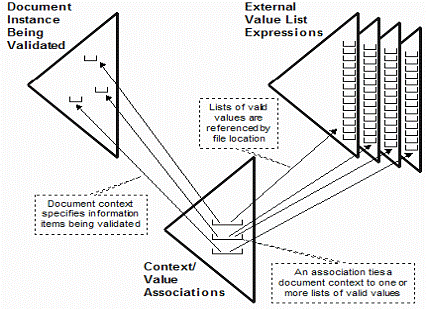
In the figure below, "Methodology
context association" depicts a file of context/value associations in the lower
centre, where each association specifies for information items in the document
instance being validated which lists of valid values in external value list
expressions are to be used.
ISO Schematron is a powerful and yet
simple assertion-based schema language used to confirm the success or failure of a
set of assertions made about XML document instances. One can use ISO Schematron to
express assertions supporting business rules and other limitations of XML
information items so as to aggregate sets of requirements for the value validation
of documents. The synthesis of a pattern of ISO Schematron assertions to validate
the values found in document contexts, and the use of ISO Schematron to validate
those assertions are illustrated in "Methodology overview" figure
below.
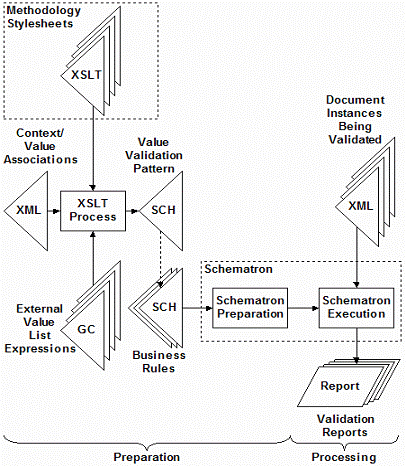
To feed the ISO Schematron process, one
needs to express the contexts of information items and the values used in those
contexts. This methodology prescribes an XML vocabulary to create instances that
express such associations of values for contexts. The stylesheets provided with
this methodology read these instances of context/value associations that point to
externally-expressed lists of values and produce an ISO Schematron pattern
of assertions that can then be combined with other patterns for business rule
assertions to aggregate all document value validation requirements into a single
process. The validation process is then used against documents to be validated,
producing for each document a report of that document's failures of
assertions.
By using this methodology, users can use
a default code list values for data exchange by adding more values to the default
code list or restricting the values in the default code lists by defining
constraints and business rules.
Each code list for a CIQ entity (Name, Address, and Party)
is represented as a separate genericode file. For example, the Name entity has 10
code lists. Each of this code lists is represented in a separate genericode
file.
The following example shows Genericode representation of
code list for SubDivisionTypeList represented in a file called
"SubDivisionTypeList.gc".
<CodeList>
<SimpleCodeList>
<Row>
<Value ColumnRef="code">
<SimpleValue>Department</SimpleValue>
</Value>
<Value ColumnRef="name">
<SimpleValue>Department</SimpleValue>
</Value>
</Row>
<Row>
<Value ColumnRef="code">
<SimpleValue>Division</SimpleValue>
</Value>
<Value ColumnRef="name">
<SimpleValue>Division</SimpleValue>
</Value>
</Row>
<<Row>
<Value ColumnRef="code">
<SimpleValue>Branch</SimpleValue>
</Value>
<Value ColumnRef="name">
<SimpleValue>Branch</SimpleValue>
</Value>
</Row>
<Row>
<Value ColumnRef="code">
<SimpleValue>BusinessUnit</SimpleValue>
</Value>
<Value ColumnRef="name">
<SimpleValue>BusinessUnit</SimpleValue>
</Value>
</Row>
<Row>
<Value ColumnRef="code">
<SimpleValue>Section</SimpleValue>
</Value>
<Value ColumnRef="name">
<SimpleValue>Section</SimpleValue>
</Value>
</Row>
</SimpleCodeList>
</CodeList>
Taking the same example of customizing code lists in Option 1,
OrganisationNameTypeList code list will be a separate file called
"OrganisationNameTypeList.gc". To create a completely new set of code lists
to replace the default one, a new .gc file with the new set of code list values
say, "ReplaceOrganisationNameTypeList.gc" is created. By applying the
constraints rule in a separate file, this new code list replaces the default code
list.
The process of customizing the code lists is documented in the
methodology for code list and value validation.
The OASIS Code List Technical Committee has used OASIS CIQ
Specification V3.0's Name entity (xNL.xsd) as a case study to demonstrate
how genericode based code list approach can be used to replace XML schema approach
to validate code lists (the default approach used by CIQ Specifications). This
document is listed in the reference section.
Following are the documents that users of CIQ
Specifications implementing Genericode based Code List (Option 2) approach MUST
read and understand:
· OASIS
Codelist Representation (Genericode) Version 1.0, May 2007, http://docs.oasis-
open.org/codelist/cd-genericode-1.0/doc/oasis-code-list-representation-genericode.pdf
· OASIS UBL Methodology for Codelist and value validation, Working Draft
0.8, November 2006, http://www.oasis-open.org/committees/document.php?document_id=21324
· OASIS Code List Adaptation Case Study (OASIS CIQ), May 2007,
http://www.oasis-open.org/committees/document.php?document_id=23711
CIQ Specification comes with two sets of supporting CIQ
entity XML schema packages, one for option 1 and the other for option 2 of code
lists. To assist users in getting a quick understanding of option 2, all code
lists for CIQ specifications are represented as genericode files along with default
constraints, appropriate XSLT to process code lists, and with sample test XML
document instance examples. It also contains test scenarios with customised code
lists from the default code lists along with business rules, constraints supporting
the customised code lists, XSLT and sample XML document instance examples.
The CIQ Specification entity schemas (xNL.xsd, xAL.xsd,
xPIL.xsd, and xNAL.xsd) for both option 1 and 2 are in the same
namespaces as users will use one of the two. XML document instances of Option 1 can
be validated against the entity schemas in option 2. This is not true vice versa as
Option 2 entity schemas have additional metadata attributes to support
genericode.
A separate document titled, "CIQ Specifications V3.0
Package" explains the structure of the CIQ Specifications V3.0 package.
Order of name elements MUST be preserved
for correct presentation (e.g. printing name elements on an envelope).
If an application needs to present the
name to a user, it MAY not always be aware about the correct order of the elements
if the semantics of the name elements are not available.
Mr Jeremy Apatuta Johnson PhD
could be presented as follows
<n:PartyName>
<n:PersonName>
<n:NameElement>Mr</n:NameElement>
<n:NameElement>Jeremy</n:NameElement>
<n:NameElement>Apatuta</n:NameElement>
<n:NameElement>Johnson</n:NameElement>
<n:NameElement>PhD</n:NameElement>
</n:PersonName>
</n:PartyName>
and restored back to Mr Jeremy Apatuta Johnson PhD.
Any other order of NameElement tags in the XML fragment
could lead to an incorrect presentation of the name.
Mapping data between the xNL
schema and a target database is not expected to be problematic as xNL
provides enough flexibility for virtually any level of data decomposition. However,
the main issue lies in the area of mapping a data provider with a data consumer
through xNL.
For example, consider a data provider
that has a person name in one line (free text and unparsed) and a data consumer
that has a highly decomposed data structure for a person's name requires first
name, family name and title to reside in their respective fields. There is no way
of putting the provided data (free text) in the target data structure without
parsing it first using some smart name parsing data quality parsing/scrubbing tool
and there are plenty in the market. Such parsing/scrubbing is expected to be the
responsibility of the data consumer under this scenario and importantly, agreeing
in advance with the data provider that the incoming data is not parsed.
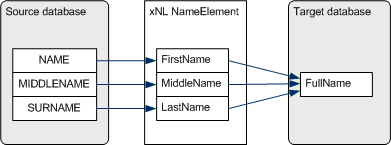
The source database easily maps to the
xNL NameElement qualified with the ElementType attribute set
to values as in the diagram
Source Database
|
NAME
|
MIDDLENAME
|
SURNAME
|
|
John
|
Anthony
|
Jackson
|
xNL
<n:PersonName>
<n:NameElement
n:ElementType="FirstName">John</n:NameElement>
<n:NameElement
n:ElementType="MiddleName">Anthony</n:NameElement>
<n:NameElement
n:ElementType="LastName">Jackson</n:NameElement>
</n:PersonName>
Target Database
|
FULLNAME
|
|
John Anthony
Jackson
|
This type of mapping does not present a
major challenge as it is a direct mapping from source to xNL and then concatenating
the data values to form the full name to be stored in a database
field/column.
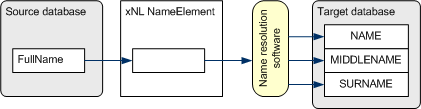
The source database has the name in a
simple unparsed form which can be easily mapped to xNL, but cannot be directly
mapped to the target database as in the following diagram:
Source Database
|
FULLNAME
|
|
John Anthony
Jackson
|
xNL
<n:PersonName>
<n:NameElement>John Anthony Jackson</n:NameElement>
</n:PersonName>
At this point, the name
resolution/parsing software splits John Anthony Jackson into a form
acceptable by the target database.
Target Database
|
NAME
|
MIDDLENAME
|
SURNAME
|
|
John
|
Anthony
|
Jackson
|
The quality of any information
management/processing system is only as good as the quality of the data it
processes/stores/manages. No matter how efficient the
interoperability of data is, if the quality of data that is interoperated is poor,
the business benefit arising out of the information processing system is expected
to be poor. To structurally represent the data, understand the semantics of
the data to integrate and interoperate the data, quality of the data is critical.
CIQ specifications have been designed with the above formula in mind.
xNL schema allows for data quality
information to be provided as part of the entity using attribute DataQuality
that can be set to either "Valid" or "Invalid" (default values), if
such status is known. If DataQuality attribute is omitted, it is presumed
that the validity of the data is unknown. Users can customize the DataQuality code
list to add more data quality attributes if required.
DataQuality attribute refers to the content of a container, e.g.
PersonName, asserting that all the values are known to be true and correct
in a particular defined period. This specification has no provision for partial
data quality where some parts of the content are correct and some are not or
unknown.
<n:PersonName
n:DataQuality="Valid"
n: ValidFrom="2001-01-01T00:00:00"
<n:NameElement>John Anthony Jackson</n:NameElement>
</n:PersonName>
In this example John Anthony Jackson is known to be
the true and correct value asserted by the sender of this data and the validity of
the data has been recorded as of 2001-01-01.
This feature allows the recipient of
data to get an understanding of the quality of data they are receiving and thereby,
assists them to take appropriate measures to handle the data according to its
quality.
This specification does not mandate any
data verification rules or requirements. It is entirely up to the data exchange
participants to establish them.
Also, the participants need to establish
if the data quality information can be trusted.
This specification does not mandate any
data validation rules or requirements. It is entirely up to the data exchange
participants to establish such rules and requirements.
All elements in Name,
Address and Party namespaces support extensibility by allowing for
any number of attributes from a non-target namespace to be added. This is allowed
in the XML Schema specifications of CIQ.
All elements share the same
declaration:
<xs:anyAttribute namespace="##other"
processContents="lax"/>
Although this specification provides an
extensibility mechanism, it is up to the participants of the data exchange process
to agree on the use of any extensions to the target namespace. Extensions without
agreements between data exchange parties will break interoperability.
This specification mandates that an
application SHOULD not fail if it encounters an attribute from a non-target
namespace. The application MAY choose to ignore or remove the attribute.
CIQ Specifications does its best to
provide the minimum required set of elements and attributes that are commonly used
independent of applications to define party data (name, address and other party
attributes). If specific applications require some additional set of attributes
that are not defined in CIQ specifications, then this extensibility mechanism
SHOULD be used provided the extensions are agreed with other parties in case of
data exchange involving more than one application. If no agreement is in place,
interoperability will not be achieved. Use of this extensibility mechanism SHOULD
be governed.
Participants involved in data exchanges MAY wish to add
their system specific identifiers for easy matching of known data, e.g. if system A
sends a message containing a name of a person to system B as in the example
below
<n:PartyName
xmlns:b="urn:acme.org:corporate:IDs" b:PartyID="123445">
<n:PersonName>
<n:NameElement>John Johnson</n:NameElement>
</n:PersonName>
</n:PartyName>
then Attribute b:PartyID="123445" is not in xNL
namespace and acts as an identifier for system A. When system B returns a response
or sends another message and needs to include information about the same party, it
MAY use the same identifier as in the following example:
<n:PartyName
xmlns:b="urn:acme.org:corporate:IDs" b:PartyID="123445" />
The response could include the original payload with the
name details.
Sometimes it MAY be required to include some additional
metadata that is specific to a particular system or application. Consider these
examples:
<n:PartyName
xmlns:x="urn:acme.org:corporate" x:OperatorID="buba7">
.............
<n:PartyName
xmlns:b="urn:acme.org:corporate ">
<n:PersonName>
<n:NameElement b:Corrected="true">John
Johnson</n:NameElement>
</n:PersonName>
</n:PartyName>
In the above examples, "OperatorID" and
"Corrected" are additional metadata added to "PartyName" from different namespaces
without breaking the structure of the schema.
Linking and referencing of different
resources such as Party Name or Party Address (internal to the document or external
to the document) can be achieved by two ways. It is important for parties involved
in data exchange SHOULD decide during design time the approach they will be
implementing. Implementing both the options will lead to interoperability problems.
Just choose one. The two options are:
-
Using xLink
-
Using Key Reference
CIQ has now included support for xLink
style referencing. These attributes are OPTIONAL and so will not impact
implementers who want to ignore them. The xLink attributes have been
associated with extensible type entities within the CIQ data structure thereby
allowing these to be externally referenced to support dynamic value lists.
The xBRL (extensible Business Reporting Language) standards community for
example, uses this approach extensively to indicate the type values of objects in
the data structure.
Names can be referenced internally (i.e.
within some XML infoset that contains both referencing and referenced elements)
through xlink:href pointing at an element with xml:id with a matching
value. External entities can also be referenced if they are accessible by the
recipient via HTTP(s)/GET.
The following example illustrates
PartyName elements that reference other PartyName elements that
reside elsewhere, in this case outside of the document.
<a:Contacts
xmlns:a="urn:acme.org:corporate:contacts"
xmlns:n="urn:oasis:names:tc:ciq:xsdschema:xNL:3.0/20050427"
xmlns:xlink="http://www.w3.org/1999/xlink">
<n:PartyName
xlink:href="http://example.org/party?id=123445"
xlink:type="locator"/>
<n:PartyName
xlink:href="http://example.org/party?id=83453485"
xlink:type="locator"/>
</a:Contacts>
This example presumes that the recipient
of this XML fragment has access to resource http://example.org/party and
that the resource returns PartyName element as an XML fragment of
text/xml MIME type.
Usage of xLink attributes in the
CIQ specifications MAY slightly differ from the original xLink
specification. See CIQ TC Party Relationships Specification for more
information on using xLink with xNL [Not available
in this version]. The xLink specification is available at http://www.w3.org/TR/xlink/.
Element PartyName can be either
of type locator or resource in relation to xLink.
Implementers are not restricted to only using XLink
for this purpose - for example the xlink:href attribute MAY be re-used for a URL to
a REST-based lookup, and so forth. The intent is to provide additional
flexibility for communities of practice to develop their own guidelines when
adopting CIQ.
This approach MAY be used for internal
references (i.e. within some XML infoset that contains both referencing and
referenced elements).
The following example illustrates
PartyName elements that reference other PartyName elements that
reside elsewhere, in this case inside the document.
<c:Customers
xmlns:c="urn:acme.org:corporate:customers"
xmlns:a="urn:oasis:names:tc:ciq:xal:3"
xmlns:n="urn:oasis:names:tc:ciq:xnl:3"
xmlns:p="urn:oasis:names:tc:ciq:xpil:3"
<p:Party
PartyKey="111">
<n:PartyName>
<n:PersonName>
<n:NameElement
n:ElementType="FirstName">Ram</n:NameElement>
<n:NameElement n:ElementType="LastName">Kumar</n:LastName>
</n:PersonName>
</n:PartyName>
<p:Party
p:PartyKey="222">
<n:PartyName>
<n:PersonName>
<n:NameElement
n:ElementType="FirstName">Joe</n:NameElement>
<n:NameElement
n:ElementType="LastName">Sullivan</n:LastName>
</n:PersonName>
</n:PartyName>
</p:Party>
<c:Contacts>
<c:Contact
c:PartyKeyRef="222">
<c:Contact
c:PartyKeyRef="111">
<c:/Contacts>
</c:Customers>
Attribute ID is used with complex
type PersonNameType and elements PersonName and
OrganisationName. This attribute allows unique identification of the
collection of data it belongs to. The value of the attribute MUST be unique within
the scope of the application of xNL and the value MUST be globally unique. The term
'globally unique' means a unique identifier that is "mathematically guaranteed" to
be unique. For example, GUID (Globally Unique Identifier) is a unique
identifier that is based on the simple principle that the total number of unique
keys (or) is so large that the possibility of the same number being generated twice
is virtually zero.
This unique ID attribute SHOULD be used
to uniquely identify collections of data as in the example below:
Application A supplies an xNL fragment containing
some PersonName to Application B. The fragment contains attribute ID
with some unique value.
<n:PartyName
n:ID="52F89CC0-5C10-4423-B367-2E8C14453926">
<n:PersonName>
<n:NameElement>Max Voskob</n:NameElement>
</n:PersonName>
<n:OrganisationName>
<n:NameElement>Khandallah Laundering Ltd.</n:NameElement>
</n:OrganisationName>
</n:PartyName>
If Application B decides to reply to A and use
the same xNL fragment it need only provide the outer element (n:PartyName in
this case) with ID as the only attribute.
<n:PartyName
n:ID="52F89CC0-5C10-4423-B367-2E8C14453926" />
Application A should recognise the value of
ID, so no additional data is required from B in relation to this.
The exact behaviour of the ID
attribute is not specified in this document and is left to the users to decide and
implement.
The difference between the ID
attribute and xLink attributes is that ID attribute cannot be
resolved to a location of the data - it identifies already known data.
Any XML documents produced MUST conform
to the CIQ Specifications Schemas namely, xNL.xsd, xAL.xsd, xNAL.xsd and
xPIL.xsd i.e. the documents MUST be successfully validated against the
Schemas. This assumes that the base schemas MUST be modified.
If Option 2 for Code List is used, all
genericode files MUST conform to the Genericode XML Schema, i.e. all genericode
files MUST successfully validate against the schema.
Any customisation of the code list files
based on Option 1 MUST be well formed schemas.
The broad nature and cultural diversity
of entity "Name" makes it very difficult to produce one schema that would satisfy
all applications and all cultures while keeping the size and complexity of the
schema manageable. This specification allows some changes to the schema by adopters
of the schema to fit their specific requirements and constraints. However, note
that any change to the schema breaks the CIQ Specifications compatibility and so,
they MUST NOT be changed.
The namespace identifier SHOULD be
changed if it is possible for an XML fragment valid under the altered schema to be
invalid under the original schema.
Users SHOULD retain the minimum structure
of Name entity as in the following diagram:
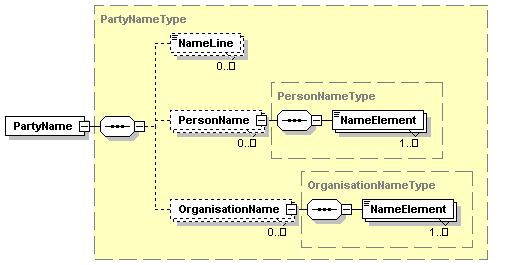
This structure allows for most names to
be represented, with exception for
· organisation subdivision
hierarchy (SubdivisionName), e.g. faculty / school / department
Any further reduction in structure MAY
lead to loss of flexibility and expressive power of the schema.
Users MUST NOT remove any attributes
from the schema. Attributes in the schema can be easily ignored during the
processing.
Any changes to the Name Entity schema
(xNL.xsd) are likely to break the compatibility one way or
another.
It MAY be possible that an XML fragment
created for the original schema is invalid for the altered schema or vice versa.
This issue SHOULD be considered before making any changes to the schema that could
break the compatibility.
Meeting all requirements of different
cultures and ethnicity in terms of representing the names in one specification is
not trivial. This is the reason why code lists/enumerations are introduced in order
to keep the specification/schema simple, but at the same time provide the
flexibility to adapt to different requirements.
The values of the code
lists/enumerations can be changed or new ones added as required.
NOTE: The
code list/enumeration values for different enumeration lists that are provided as
part of the specification are not complete. They only provides some sample values
and it is up to the end users to customise them to meet their data exchange
requirements if the default values are incomplete, not appropriate or over
kill
This level of flexibility allows some customization of the
schema through changing the code list/enumerations only, without changing the basic
structure of the schema. It is important to ensure that all schema users involved
in data exchange use the same code list/enumerations for interoperability to be
successful. This has to be negotiated between the data exchange parties and a
proper governance process SHOULD be in place to manage this process.
The other approach to customize the CIQ Name schema
(includes other entity schemas namely Party and Address) without touching it is by
using the UML Methodology for Code List Value and Validation (UMCLVV). In this
approach, one can use Schematron patterns to define assertion rules to customize
the xNL.xsd schema without modifying it. For example, it is possible to
customize xNL.xsd schema to restrict the use of elements, the occurrence of
elements, the use of attributes, and the occurrence of attributes, making elements
and attributes mandatory, etc.
So, users who believe that many elements and attributes in
the CIQ specifications are overwhelming to what their requirements are, can define
business rules using Schematron patterns to constraint the CIQ base entity schemas.
By constraining the CIQ schemas, users get two major benefits:
· CIQ
Specifications that are tailored indirectly with the help of business rules to meet
specific application requirements
·
Applications that use the customized CIQ Specifications with the help of business
rules are still compliant with the CIQ Specifications.
Therefore, by CIQ specifications providing two options for
customizing schemas (Option 1 and Option 2), the specifications are powerful to
address any specific application requirements for party information.
NOTE: The
business rules used to constraint base schemas SHOULD be agreed by all the
parties that are involved in CIQ based data exchange to ensure interoperability
and the rules SHOULD be governed.
xNL.xsd uses "NameElement" element as part of
"PersonName" element to represent the name of a person and this is supported by
using the attribute "ElementType" to add semantics to the name. Let us look at the
following example:
<n:PersonName>
<n:NameElement
n:ElementType="FirstName>Paruvachi</n:NameElement>
<n:NameElement
n:ElementType="FirstName>Ram</n:NameElement>
<n:NameElement
n:ElementType="MiddleName>Kumar</n:NameElement>
<n:NameElement
n:ElementType="LastName>Venkatachalam</n:NameElement>
<n:NameElement
n:ElementType="LastName>Gounder</n:NameElement>
</n:PersonName>
In the above example, there is no restriction on the number
of times First Name and Last Name can occur as perxNL.xsd
schema grammar. Some applications might want to apply strict validation and
constraint rules on the xNL.xsd schema to avoid use of First Name and
Last Name values to data at least once and no more than once. This is where
UMCLVV can be used to define business rules to constraint the xNL.xsd schema
without modifying or touching the xNL.xsd schema. The business rule
code defined using Schematron pattern for the above constraint is given below:
<rule
context="n:PersonName[not(parent::n:PartyName)]">
<assert test=count(n:NameElement
[@n:ElementType='FirstName']=1"
>Must have exactly one FirstName component</assert>
<assert
test=count(n:NameElement[@n:ElementType='LastName'])=1"
>Must have exactly one LastName component</assert>
</rule>
When first pass validation (structure validation) is
performed on the above sample XML instance document, the document is valid against
the xNL.xsd. During second pass validation (business rule constraint and
value validation) on the above XML instance document, the following error is
reported:
Must have exactly one FirstName component
Must have exactly one LastName component
Entity "Address" has been
modelled independent of any context as a standalone class to reflect some common
understanding of concepts "Location" and "Delivery Point".
The design concepts for "Address"
are similar to "Name". Refer to section 2.4 Common Design Concepts for
more information.
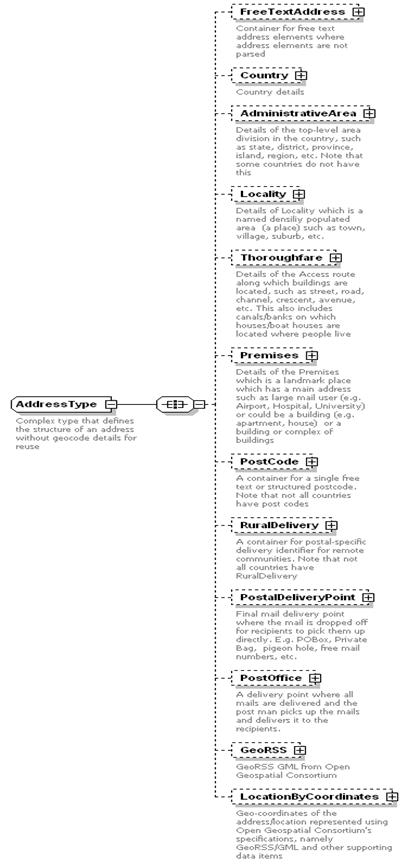
The high level schema elements of
xAL schema are illustrated in the diagram in the next page.
An address can be structured according to
the complexity level of its source.
Suppose that the source database does not differentiate
between different address elements and treats them as Address Line 1, Address Line
2, Address Line "N", then the address information can be placed inside a free text
container (element FreeTextAddress).
<a:Address>
<a:FreeTextAddress>
<a:AddressLine>Substation C</a:AddressLine>
<a:AddressLine >17 James Street</a:AddressLine >
<a:AddressLine>SPRINGVALE VIC 3171</a:AddressLine>
</a:FreeTextAddress>
</a:Address>
It is up to the receiving application to parse this address
and map it to the target data structure. It is possible that some sort of parsing
software or human involvement will be required to accomplish the task. Data
represented in this free formatted text form is classified as "poor quality" as it
is subject to different interpretations of the data and will cause interoperability
problems.
Many common applications fall under this category.
Assume that the address was captured in some semi-structured
form such as State, Suburb and Street.
<a:Address>
<a:AdministrativeArea>
<a:Name>WA</a:Name>
</a:AdministrativeArea>
<a:Locality>
<a:Name>OCEAN REEF</a:Name>
</a:Locality>
<a:Thoroughfare>
<a:NameElement>16 Patterson Street</a:NameElement>
</a:Thoroughfare>
</a:Address>
In this example, the free text information resides in
containers that provide some semantic information on the content. E.g. State ->
AdministrativeArea, Suburb -> Locality, Street -> Thoroughfare. At the same
time, the Thoroughfare element contains street name and number in one line as free
text, which MAY not be detailed enough for data structures where street name and
number are separate fields.
Many common applications fall under this category.
The following example illustrates an address structure that
was decomposed into its atomic elements:
<a:Address>
<a:AdministrativeArea
a:Type="state">
<a:NameElement a:Abbreviation="true"
a:NameType="Name">VIC</a:NameElement>
</a:AdministrativeArea>
<a:Locality
a:Type="suburb">
<a:NameElement a:NameType="Name">CLAYTON</a:NameElement>
<a:SubLocality a:Type="Area">
<a:NameElement a:NameType="Name">Technology
Park</a:NameElement>
</a:SubLocality>
</a:Locality>
<a:Thoroughfare
a:Type="ROAD">
<a:NameElement a:NameType="NameandType">Dandenong
Road</a:NameElement>
<a:Number
a:IdentifierType="RangeFrom">200</a:Number>
<a:Number
a:IdentifierType="Separator">-</a:Number>
<a:Number
a:IdentifierType="RangeTo">350</a:Number>
<a:SubThoroughfare a:Type="AVENUE">
<a:NameElement a:NameType="NameAndType">Fifth
Avenue</a:NameElement>
</a:SubThoroughfare>
</a:Thoroughfare>
<a:Premises
a:Type="Building">
<a:NameElement a:NameType="Name">Toshiba
Building</a:NameElement>
</a:Premises>
<a:PostCode>
<a:Identifier>3168</a:Identifier>
</a:PostalCode>
</a:Address>
Few applications and in particular,
applications dealing with data quality and integrity, fall in this category and the
quality of data processed by these applications are generally high.
xAL supports representation of
Address/location in two ways namely,
1. By
using explicit coordinates with qualifiers for accuracy and precision,
and
2. By
using the GeoRSS application profile, which expresses decimal degrees coordinates
with accuracy and precision, and is implemented via external namespaces (either
ATOM or RSS).
Explicit coordinates are typically
available from the process of geo-coding the street addresses. Coordinates
are expressed in the Latitude and Longitude elements, including
DegreesMeasure, MinutesMeasure, SecondsMeasure, andDirection.
Data quality is expressed as attributes of coordinates including Meridian, Datum
and Projection.
GeoRSS incorporates a huge body of
knowledge and expertise in geographical systems interoperability that can be reused
for our purpose rather than re-inventing what has already been developed. The
basic expression of a:LocationByCoordinate element in xAL.xsd schema
has limits in utility for e-commerce applications. More interoperable
expression of coordinate is possible via GeoRSS, due to the ability to reduce
ambiguity introduced by requirements for different coordinate systems, units and
measurements, or the ability to define more complex (non-point) geographic
features.
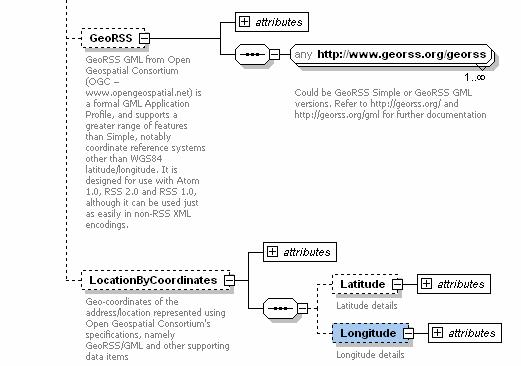
Support for GeoRSS and Location Coordinates for
address/locations in xAL.xsd schema is shown in the following figure.
As RSS becomes more and more prevalent as a way to publish
and share information, it becomes increasingly important that location is described
in an interoperable manner so that applications can request, aggregate, share and map
geographically tagged feeds.
GeoRSS (Geographically Encoded Objects for RSS feeds)
enables geo-enabling, or tagging, "really simple syndication" (RSS) feeds with
location information. GeoRSS proposes a standardized way in which location is
encoded with enough simplicity and descriptive power to satisfy most needs to
describe the location of Web content. GeoRSS MAY not work for every use, but it
should serve as an easy-to-use geo-tagging encoding that is brief and simple with
useful defaults but extensible and upwardly-compatible with more sophisticated
encoding standards such as the OGC (Open Geospatial Consortium) GML (Geography
Markup Language).
GeoRSS was developed as a collaborative effort of numerous
individuals with expertise in geospatial interoperability, RSS, and standards,
including participants in the -- the W3C (World Wide Web Consortium) and OGC (Open Geospatial Consortium).
GeoRSS is a formal GML Application Profile, with two
flavours: 'GeoRSS Simple', which describes a point, and 'GeoRSS GML', which
describes four essential types of shapes for geo-referencing (point, line, box and
polygon).
GeoRSS Simple has greater brevity, but also has limited
extensibility. When describing a point or coordinate, GeoRSS Simple can be used in
all the same ways and places as GeoRSS GML.
GeoRSS GML supports a greater range of features, notably
coordinate reference systems other than WGS84 latitude/longitude. It is designed
for use with Atom 1.0, RSS 2.0 and RSS 1.0, although it can be used just as easily
in non-RSS XML encodings.
Further detailed documentation and sample xml
implementation information are published on the sites listed below:
· http://georss.org/
· http://georss.org/gml
· http://georss.org/atom
The UML model for the GeoRSS application
schema and the XML schema is shown below:
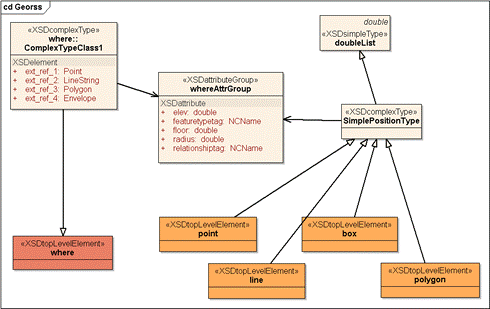
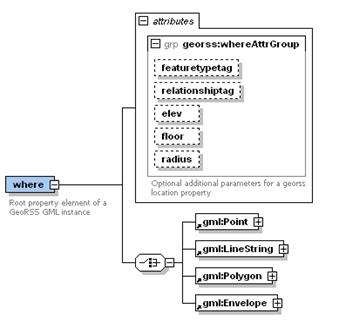
GeoRSS is supported by an element
a:GeoRSS in xAL.xsd schema as a non target namespace. The content of
a:GeoRSS must comply with the following requirements:
· Be from
the GeoRSS/GML/Atom namespace
· Refer to
finest level of address details available in the address structure that a:GeoRSS
belongs to
· Be used
unambiguously so that there is no confusion whether the coordinates belong to the
postal delivery point (e.g. Post Box) or a physical address (e.g. flat) as it is
possible to have both in the same address structure.
There is no restriction on the shape of
the area, a:GeoRSS can describe be it a point, linear feature, polygon or a
rectangle.
The following are GeoRSS examples and demonstrate what
GeoRSS Simple and GeoRSS GML encodings look like. The location being specified is
city center Ft. Collins.
Simple GeoRSS:
<georss:point>40.533203
-105.0712</georss:point>
GML GeoRSS:
<GeoRSS:where>
<gml:Point>
<gml:pos>40.533203 -105.0712</gml:pos>
</gml:Point>
<GeoRSS:where>
These examples are in XML. However, RSS and GeoRSS are
general models that can also be expressed in other serializations such as Java, RDF
or XHTML.
A good way to describe a trip that has many places of
interest like a boat trip or a hike is to specify the overall trip's path with a
line as a child of the <feed>. Then mark each location of interest with a
point in the <entry>.
<feed xmlns="http://www.w3.org/2005/Atom"
xmlns:georss="http://www.georss.org/georss"
xmlns:gml="http://www.opengis.net/gml">
<title>Dino's Mt. Washington
trip</title>
<link
href="http://www.myisp.com/dbv/"/>
<updated>2005-12-13T18:30:02Z</updated>
<author>
<name>Dino Bravo</name>
<email>dbv@example.org</email>
</author>
<id>http://www.myisp.com/dbv/</id>
<georss:where>
<gml:LineString>
<gml:posList>
45.256 -110.45
46.46 -109.48 43.84 -109.86 45.8 -109.2
</gml:posList>
</gml:LineString>
</georss:where>
<entry>
<title>Setting
off</title>
<link
href="http://www.myisp.com/dbv/1"/>
<id>http://www.myisp.com/dbv/1</id>
<updated>2005-08-17T07:02:32Z</updated>
<content>getting ready
to take the mountain!</content>
<georss:where>
<gml:Point>
<gml:pos>45.256 -110.45</gml:pos>
</gml:Point>
</georss:where>
</entry>
<entry>
<title>Crossing Muddy
Creek</title>
<link
href="http://www.myisp.com/dbv/2"/>
<id>http://www.myisp.com/dbv/2</id>
<updated>2005-08-15T07:02:32Z</updated>
<content>Check out the
salamanders here</content>
<georss:where>
<gml:Point>
<gml:pos>45.94 -74.377</gml:pos>
</gml:Point>
</georss:where>
</entry>
</feed>
If end users feel that GeoRSS GML is
"overkill" or complex for their requirement and instead, want to just define the
coordinates for location/address, xAL.xsd schema provides a default set of
basic and commonly used elements representing explicit location coordinates through
the element a:LocationByCoordinates.
a:LocationByCoordinates
element provides attributes namely, Datum, type of code
used for Datum, Meridian, type of code used for Meridian, Projection
and type of code used for Projection.
a:LocationByCoordinates/a:Latitude and
a:LocationByCoordinates/a:Longitude elements provide attributes namely,
DegreesMeasure, MinutesMeasure, SecondsMeasure, and Direction.
All elements and attributes in
xAL schema have strong data types.
All free-text values of elements (text
nodes) and attributes are constrained by a simple type "String" (255
characters in size and collapsed white spaces) defined in CommonTypes.xsd.
Other XML Schema data types are also used throughout the schema.
Other XML Schema defined data types
(e.g. int, string, DateTime) are also used throughout xAL namespace.
Use of code lists/enumerations is
identical to use of code lists/enumerations for entity "Name". Refer to
section 3.3 for more information.
Code Lists used in xAL for Option
1 reside in an "include" file xAL-types.xsd and for option 2 as separate
genericode files.
NOTE: The
code list values for different code lists that are provided as part of the
specifications are not complete. They only provides some sample values and it is
up to the end users to customise them to meet their data exchange requirements if
the default values are incomplete, not appropriate or an over kill
Order of address elements MUST be
preserved for correct presentation in a fashion similar to what is described in
section 3.6.
Child elements of a:Address can
appear in any order as members of xs:all grouping as in the example
below:
23 Archer Street : Thoroughfare
Chatswood, NSW 2067
: Suburb, State, Post Code
Australia
: Country
could be preserved and presented in XML as:
<a:Address>
<a:Thoroughfare
/>
<a:Locality
/>
<a:AdministrativeArea
/>
<a:PostCode
/>
<a:Country
/>
</a:Address>
Other elements can also appear in any order
to preserve the original order.
Mapping data between xAL schema
and a database is similar to that of entity "Name" as described in section
3.7.
23 Archer Street
Chatswood, NSW 2067
Australia
could be presented as follows
<a:Address>
<a:FreeTextAddress>
<a:AddressLine>23 Archer Street</a:AddressLine>
<a:AddressLine>Chatswood, NSW 2067</a:AddressLine>
<a:AddressLine>Australia</a:AddressLine>
</a:FreeTextAddress>
</a:Address>
and restored back to
23 Archer Street
Chatswood, NSW 2067
Australia
during data formatting exercise.
Any other order of AddressLine tags in the XML
fragment could lead to an incorrect presentation of the address.
xAL schema allows for data quality information to be provided as part of
the entity using attribute DataQuality as for entity "Name". Refer to
section 3.8 for more information.
All elements in Address namespace
are extensible as described in section 3.9.
All linking and referencing rules described
in section 3.10 apply to entity "Address".
Use of attribute ID is described in section
3.11.
Schema conformance described in section
3.12 is fully applicable to entity "Address".
Schema customisation rules and concepts
described in section 3.12 are fully applicable to entity
"Address".
Meeting the 240+ country address
semantics in one schema and at the same time keeping the schema simple is not
trivial. Some countries have a city and some do not, some countries have counties,
provinces or villages and some do not, some countries use canal names to represent
the property on the banks of the canal, and, some countries have postal codes and
some do not.
Key components of international
addresses that vary from country to country are represented in the specification
using the schema elements namely, Administrative Area, Sub Administrative
Area, Locality, Sub Locality, Premises, Sub
Premises, Thoroughfare, and Postal Delivery Point. CIQ TC
chose these names because they are independent of any country specific semantic
terms such as City, Town, State, Street, etc. Providing valid and meaningful list
of code lists/enumerations as default values to these elements that covers all
countries is not a trivial exercise. These elements are therefore, customisable
using code lists/enumerations to preserve the address semantics of each country
which assists in improving the semantic quality of the address. To enable end users
to preserve the meaning of the address semantics, the specification provides the
ability to customise the schema using code lists/enumerations without changing the
structure of the schema itself. At the same time, the schema structure remains
intact.
For example, "State" defined in the code
list/enumeration list for Administrative Area type could be valid for countries
like India, Malaysia and Australia, but not for Singapore as it does not have the
concept of "State". A value "Nagar" in the code list/enumeration list for Sub
Locality type could be only valid for countries like India and Pakistan.
If there is no intent to use the code
list/enumeration list for the above schema elements, the code list/enumeration list
can be ignored. There is no absolute must rule that the default values for the
enumeration lists provided by the specification must exist. The list can be empty
also. As long as the code list/enumeration list values are agreed between the
parties involved in data exchange (whether data exchange between internal business
system or with external systems), interoperability is not an issue.
In Option 1 of representing code lists,
the values clarifying the meaning of geographical entity types (e.g.
AdministrativeAreaType, LocalityAreaType) in xAL.xsd were
intentionally taken out of the main schema file into an "include" file
(xAL-types.xsd) to make customisation easier. In Option 2 of Code List
representation, these code lists are represented as separate .gc file in genericode
format.
The values of the code lists/enumerations can be changed or new ones
added as required.
NOTE: The
code lists values for different enumeration lists that are provided as part of
the specification are not complete. They only provides some sample values and it
is up to the end users to customise them to meet their data exchange requirements
if the default values are incomplete, not appropriate or over kill
In the example below, we use the country, Singapore. The
default values provided by CIQ Specification for AdministrativeAreaType
enumeration are given below. The user might want to restrict the values to
meet only the address requirements for Singapore. Singapore does not have any
administrative areas as it does not have state, city, or districts or provinces.
So, the user can customise the schema by making the AdministrativeAreaType
enumeration as an empty list as shown in the table below.
|
Original xAL values
for AdministrativeAreaType List
|
Possible end user
customised values
|
|
City
|
|
|
State
|
|
|
Territory
|
|
|
Province
|
|
This level of flexibility allows some customization of the
schema through changing the enumerations only, without changing the basic structure
of the schema. It is important to ensure that all schema users involved in data
exchange use the same enumerations for interoperability to be successful. This has
to be negotiated between the data exchange parties and a proper governance process
SHOULD be in place to manage this process.
Any changes to the Address Entity schema
(xAL.xsd) are likely to break the compatibility one way or
another.
It MAY be possible that an XML fragment
created for the original schema is invalid for the altered schema or vice versa.
This issue needs to be considered before making any changes to the schema that
could break the compatibility.
The other approach to customize the CIQ address schema
(xAL.xsd) without modifying it is by using the UMCLVV. In this approach, one
can use Schematron patterns to define assertion rules to customize CIQ address
schema without modifying it. For example, it is possible to customize CIQ address
schema to restrict the use of address entitties that are not required for a
specific country. For example, a country like Singapore will not need address
entities namely, Administrative Area, Sub Administrative Area, Sub
Locality, Rural Delivery and Post Office. These entities can be
restricted using Schematron based assertion rules. Some might want to just
use free text address lines and a few of the address entities like locality and
postcode. Schematron assertion rules help users to achieve this.
NOTE: The
business rules used to constraint CIQ address schema SHOULD be agreed by all the
parties that are involved in data exchange of CIQ based address data to ensure
interoperability and the rules SHOULD be governed.
Let us use the country "Singapore" as an example again. Let
us say that the country "Singapore" only requires the following address entities
defined in xAL.xsd and does not need the rest of the entities defined in
xAL.xsd as they are not applicable to the country:
·
Country
·
Locality
·
Thoroughfare
·
PostCode
This restriction can be achieved without modifying the
xAL.xsd schema and by applying the following schematron pattern rules
outside of the schema as follows:
<rule context="a:Address/*">
<assert test="(name()='a:Country') or
(name()='a:PostCode') or
(name()='a.Thoroughfare') or (name()='a:Locality')"
>Invalid data element present in
the document
</assert>
</rule>
The above simple rule restricts the use of other elements
and attributes in xAL.xsd when an XML instance document is produced and
validated.
Now let us take the following XML instance document:
<a:Address>
<a:Country>
<a:NameElement>Singapore</a:NameElement>
</a:Country>
<a:AdministrativeArea>
<a:NameElement></a:NameElement>
</a:AdministrativeArea>
<a:Locality>
<a:NameElement>NUS Campus</a:NameElement>
</a:Locality>
<a:Thoroughfare>
<a:NameElement>23 Woodside Road</a:NameElement>
</a:Thoroughfare>
<a:Premises>
<a:NameElement></a:NameElement>
</a:Premises>
<a:PostCode>
<a:Identifier>51120</a:Identifier>
</a:PostCode>
</a:Address>
When the above document instance is validated using UMCLVV,
pass one validation (structure validation against xAL.xsd) will be
successful. Pass two validation (business rules and value validation) will report
the following errors:
Invalid data element present in the document
:/a:Address/a:AdministrativeArea
Invalid data element present in the document
:/a:Address/a:Premises
Let us consider another example where an application
requires using only the free text address lines in xAL.xsd and no other
address entities.
This restriction can be achieved without modifying the
xAL.xsd schema and by applying the following schematron pattern rules
outside of the schema as follows:
<rule context="a:Address/*">
<assert test="name()='a:FreeTextAddress'"
>Invalid data element present in
the document
</assert>
</rule>
The above simple rule restricts the use of elements and
attributes other than "FreeTextAddress" element in xAL.xsd when an
XML instance document is produced and validated.
xNAL (Name and Address) schema is a container for combining
related names and addresses. This specification recognises two ways of achieving
this and they are:
· Binding multiple names to
multiple addresses (element xnal:Record)
· Binding multiple names to
a single address for postal purposes (element xnal:PostalLabel)
Element xnal:Record is a binding
container that shows that some names relate to some addresses as in the following
diagram:
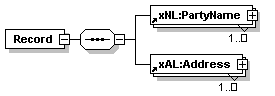
The relationship type is application
specific, but in general it is assumed that a person defined in the xNL part
have some connection/link with an address specified in the xAL part. Use
attributes from other namespace to specify the type of relationships and roles of
names and addresses.
Mr H G Guy, 9 Uxbridge Street, Redwood,
Christchurch 8005
<xnal:Record>
<n:PartyName>
<n:NameLine>Mr H G Guy</n:NameLine>
</n:PartyName>
<a:Address>
<a:Locality>
<a:Name>Christchurch</a:Name>
<a:SubLocality>Redwood</a:SubLocality>
</a:Locality>
<a:Thoroughfare>
<a:Number>9</a:Number>
<a:NameElement>Uxbridge Street</a:NameElement>
</a:Thoroughfare>
<a:PostCode>
<a:Identifier>8005</a:Identifier>
</a:PostCode>
</a:Address>
</xnal:Record>
Element xnal:PostalLabel is a
binding container that provides elements and attributes for information often used
for postal / delivery purposes, as in the following diagram. This has two main
containers, an addressee and the address:
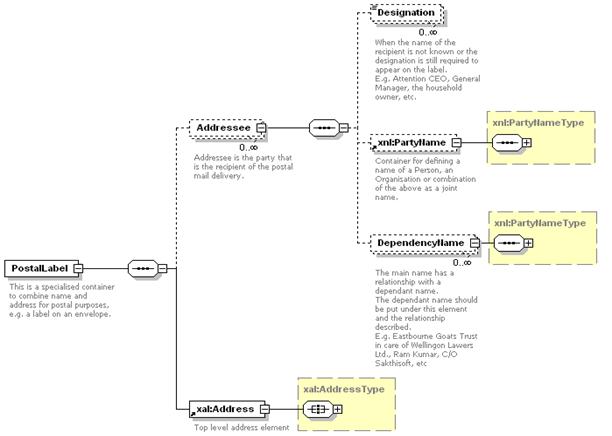
This structure allows for any number of
recipients to be linked to a single address with some delivery specific elements
such as Designation and DependencyName.
Attention: Mr S Mart
Director
Name Plate Engravers
The Emporium
855 Atawhai Drive
Atawhai
Nelson 7001
translates into the following xNAL fragment:
<xnal:PostalLabel>
<xnal:Addressee>
<xnal:Designation>Attention: Mr S Mart</xnal:Designation>
<xnal:Designation>Director</xnal:Designation>
<n:PartyName>
<n:NameLine>Name Plate Engravers</n:NameLine>
</n:PartyName>
</xnal:Addressee>
<a:Address>
<a:Locality>
<a:Name>Nelson</a:Name>
<a:SubLocality>Atawhai</a:SubLocality>
</a:Locality>
<a:Thoroughfare>
<a:NameElement>Atawhai Drive</a:NameElement>
<a:Number>855</a:Number>
</a:Thoroughfare>
<a:PostCode>
<a:Identifier>7001</a:Identifier>
</a:PostCode>
</a:Address>
</xnal:PostalLabel>
Users can use the xNL and xAL constructs and
create their own name and address container schema to meet their specific
requirements rather than using a container element called "Record" as in
xNAL if they believe that xNAL schema does not meet their
requirements. This is where the power of CIQ Specifications comes in to play. It
provides the basic party constructs to enable users to reuse the base constructs of
CIQ specifications as part of their application specific data model and at the same
time meeting their application specific requirements.
For example, users can create a schema called
Customers.xsd that could reuse xNL and xAL to represent their
customers. This is shown in the following figure:
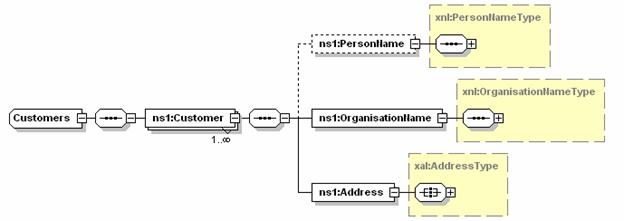
In the above figure, PersonName is OPTIONAL.
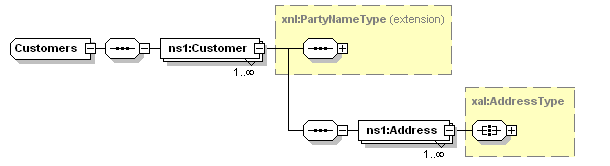
In the above figure, "Customer" is of type "Party" as
defined in xNL schema. "Customer" is then extended to include "Address"
element that is of type "Address" as defined in xAL schema.
Entity "Party" encapsulates some most
commonly used unique characteristics/attributes of Person or
Organisation, such as name, address, personal details, contact details,
physical features, etc.
This assists in uniquely identifying a
party with these unique party attributes.
The schema consists of top level
containers that MAY appear in any order or MAY be omitted. The containers are
declared globally and can be reused by other schemas. The full schema for defining
a Party can be found in xPIL,xsd file with enumerations in
xPIL-types.xsd file for Code List Option 1 and .gc files for Code List
Option 2. See the sample XML files for examples.
xPIL provides a number of elements/attributes that are common to both a
person and an organisation (e.g. account, electronic address identifier, name,
address, contact numbers, membership, vehicle, etc).
xPIL provides a number of elements/attributes that are applicable to a
person only (e.g. gender, marital status, age, ethnicity, physical information,
hobbies, etc)
xPIL provides a number of elements/attributes that are applicable to an
organisation only (e.g. industry type, registration details, number of employees,
etc)
"Name" of xPIL schema
reuses PartyNameType constructs from xNL namespace and "Address" of
the xPIL schema reuses AddressType construct from xAL
namespace as illustrated in the following diagram:
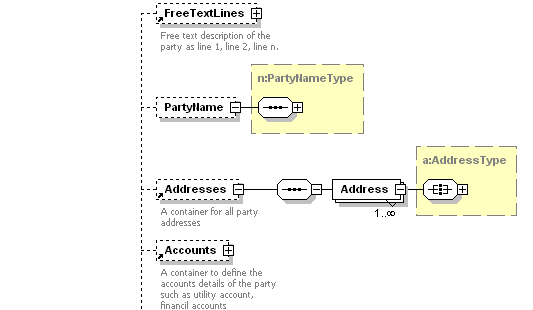
The design paradigm for this xPIL
schema is similar to those of Name and Address entities. Likewise, it is possible
to combine information at different detail and semantic levels.
The following examples illustrate use of
a selection of party constructs.
<p:Qualifications>
<p:Qualification>
<p:QualificationElement
p:Type="QualificationName">BComp.Sc.</p:QualificationElement>
<p:QualificationElement
p:Type="MajorSubject">Mathematics</p:QualificationElement>
<p:QualificationElement
p:Type="MinorSubject">Statistics</p:QualificationElement>
<p:QualificationElement
p:Type="Award">Honours</p:QualificationElement>
<p:InstitutionName>
<n:NameLine>University of Technology Sydney</n:NameLine>
</p:InstitutionName>
</p:Qualification>
</p:Qualifications>
<p:BirthInfo
p:BirthDateTime="1977-01-22T00:00:00"/>
<p:Document
p:ValidTo="2004-04-22T00:00:00">
<p:IssuePlace>
<a:Country>
<a:Name>Australia</a:Name>
</a:Country>
<a:AdministrativeArea>
<a:Name>NSW</a:Name>
</a:AdministrativeArea>
</p:IssuePlace>
<p:DocumentElement
p:Type="DocumentID">74183768C</p:DocumentElement>
<p:DocumentElement
p:Type="DocumentType">Driver License</p:DocumentElement>
<p:DocumentElement
p:Type="Priviledge">Silver</p:DocumentElement>
<p:DocumentElement
p:Type="Restriction">Car</p:DocumentElement>
</p:Document>
<p:ContactNumber
p:MediaType="Telephone" p:ContactNature="Business Line" p:ContactHours="9:00AM -
5:00PM">
<p:ContactNumberElement
p:Type="CountryCode">61</p:ContactNumberElement>
<p:ContactNumberElement
p:Type="AreaCode">2</p:ContactNumberElement>
<p:ContactNumberElement
p:Type="LocalNumber">94338765</p:ContactNumberElement>
</p:ContactNumber>
<p:ElectronicAddressIdentifiers>
<p:ElectronicAddressIdentifier p:Type="SKYPE"
p:Usage="Personal">rkumar
</p:ElectronicAddressIdentifiers>
<p:ElectronicAddressIdentifier p:Type="EMAIL"
p:Usage="Business">ram.kumar@email.com
</p:ElectronicAddressIdentifiers>
<p:ElectronicAddressIdentifier p:Type="URL"
p:Usage="Personal">http://www.ramkumar.com
</p:ElectronicAddressIdentifiers>
xPIL schema represents details of a Party. The Party has a
name as specified in n:PartyName element. A "Party" can be a unique name
(e.g. A person or an Organisation) or a joint name (e.g. Mrs. Sarah Johnson and Mr.
James Johnson (or) Mrs. & Mr. Johnson). In this case, all the other details of
the party defined using xPIL apply to the party as a whole (i.e. to both the
persons in the above example) and not to one of the Parties (e.g. say only to Mrs.
Sarah Johnson or Mr. James Johnson in the example). Also, all the addresses
specified in Addresses element relate to the Party as a whole (i.e.
applies to both Mrs. and Mr. Johnson in this example).
xPIL provides the ability to also define relationships between a party
(person or an organisation) and other parties (person or organisation). This is
shown in the following diagram (an extract of XML schema):
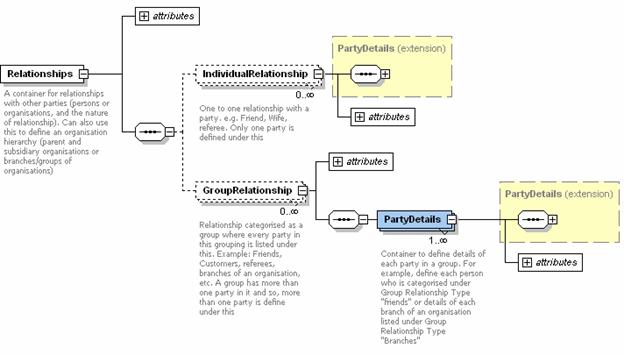
Two categories of relationships with a
party (Person or Organisation) can be defined. They are
· Individual Relationship, and
· Group Relationship
Individual Relationship is a one on one
relationship with another party. Examples include, Friend, Spouse, Referee,
Contact, etc for a person, and Client, customer, branch, head office, etc for an
organisation.
Group Relationship is categorisation of
a group of parties together. For example, friends, contacts, referees, relatives,
children, etc. for a person, and clients, customers, branches, subsidiaries,
partners, etc for an Organisation.
Details of each party can be defined
namely, Person Name, Organisation Name, Contact Numbers and Electronic Address
Identifiers.
Details of individual relationship are
shown in the figure below:
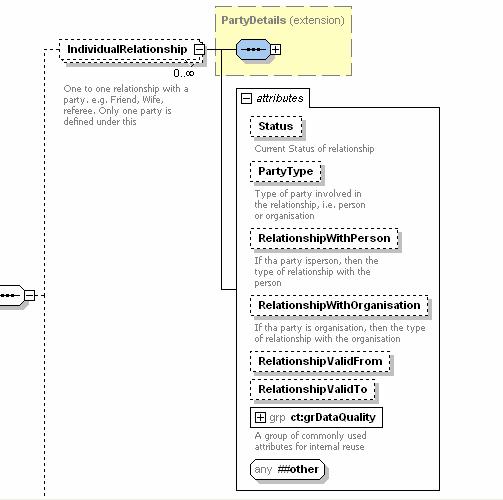
The attribute Status defines the
status of relationship; attribute RelationshipWithPerson defines the type of
relationship with the person (e.g. friend, spouse) if the party is a person;
attribute RelationshipWithOrganisation defines the type of relationship with
the organisation (e.g. client, branch, subsidiary) if the party is an organisation;
attributes RelationshipValidFrom and RelationshipValidTo defines the
dates of the relationship with the party.
Details of group relationship are shown in
the figure below:
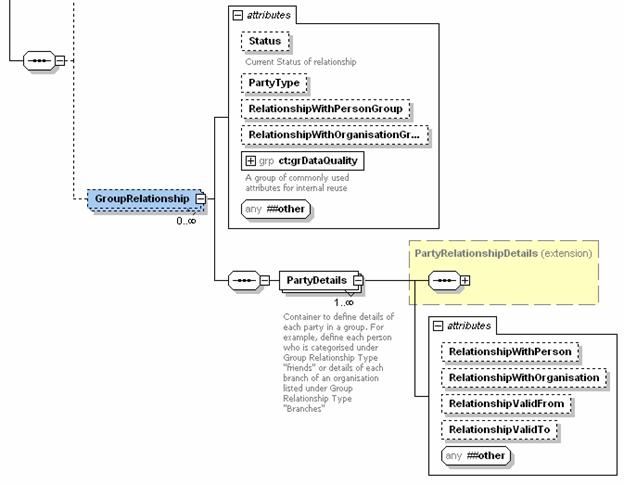
The attribute Status defines the
status of relationship; if the party is of type person, attribute
RelationshipWithPersonGroup defines the grouping of the persons into a type
of relationship such as Friends, Relatives, Children, Referees, Customers;
if the party is of type organisation, attribute
RelationshipWithOrganisationGroup defines the grouping of organisations into
a type of relationship such as Branches, Subsidiaries, Partners, Customers,
etc.
Under the PartyDetails element,
each party associated with the group is defined (details of the party namely, name,
address and contact details). If the party is a person and let us say, the
RelationshipWithPersonGroup value is children. Then, the attribute
RelationshipWithPerson under PartyDetails element can be used to
define the type of child such as daughter, brother, etc.
If the party is an organisation
and let us say, the RelationshipWithOrganisationGroup value is
Partners. Then, the attribute RelationshipWithOrganisation under
PartyDetails element can be used to define the type of partner such as
solution partner, channel partner, marketing partner, etc. The attributes
RelationshipValidFrom and RelationshipValidTo defines the dates of
the relationship with the party.
<p:Relationships>
<p:GroupRelationship
p:RelationshipWithPersonGroup="Friends">
<p:PartyDetails>
<p:PersonName>
<p:NameElement="FullName">Andy
Chen</NameElement>
</p:PersonName>
</p:PartyDetails>
<p:PartyDetails>
<p:PersonName>
<p:NameElement="FullName">John
Freedman</NameElement>
</p:PersonName>
</p:PartyDetails>
<p:PartyDetails>
<p:PersonName>
<p:NameElement="FullName">Peter
Jackson</NameElement>
</p:PersonName>
</p:PartyDetails>
</p:GroupRelationship>
</p:Relationships>
<p:Relationships>
<p:GroupRelationship
p:RelationshipWithOrganisationGroup="Worldwide Branches">
<p:PartyDetails>
<p:NameLine>XYZ Pty. Ltd</p:NameLine>
<p:Address>
<p:FreeTextAddress>
<p:AddressLine>23 Archer Street, Chastwood, NSW 2067,
Australia
</p:AddressLine>
</p:FreeTextAddress>
</p:Address>
<p:PartyDetails>
<p:NameLine>XYZ Pte.
Ltd</p:NameLine>
<p:Address>
<p:FreeTextAddress>
<p:AddressLine>15, Meena Rd, K.K.Nagar, Chennai 600078
India
</p:AddressLine>
</p:FreeTextAddress>
</p:Address>
</p:PartyDetails>
</p:GroupRelationship>
</p:Relationships>
<p:Relationships>
<p:IndividualRelationship
p:RelationsipWithPersonGroup="Son">
<p:PersonName>
<p:NameElement="FullName">Andy Chen</NameElement>
</p:PersonName>
</p:IndividualRelationship>
</p:Relationships>
All elements and attributes in
xPIL schema have strong data types.
All free-text values of elements (text
nodes) and attributes are constrained by a simple type "String" (255
characters in size and collapsed white spaces) defined in CommonTypes.xsd.
Other XML Schema data types are also used throughout the schema.
Other XML Schema defined data types are
also used throughout the schema.
Use of code lists/enumerations is
identical to use of code lists for entity "Name". Refer to section 3.3 for
more information.
Code lists/enumerations used in
xPIL for code list option 1 reside in an "include" xPIL-types.xsd.
Code lists/enumerations used in xPIL for code list option 2 reside as .gc
genericode files.
NOTE: The
code list/enumeration values for different code lists/enumeration lists that are
provided as part of the specifications are not complete. They only provides some
sample values and it is up to the end users to customise them to meet their data
exchange requirements if the default values are incomplete, not appropriate or
over kill
Order of elements without qualifier
(@...type attribute) MUST be preserved for correct presentation as described in
section 3.6.
Mapping data between xPIL schema
and a database is similar to that of entity "Name" as described in section
3.7.
xPIL schema allows for data quality information to be provided as part of
the entity using attribute DataQuality as for entity "Name". Refer to
section 3.8 for more information.
All elements in Party namespaces are
extensible as described in section 3.10.
All linking and referencing rules
described in section 3.9 apply to entity "Party".
The following example illustrates
PartyName elements that reference other PartyName element that
resides elsewhere, in this case outside of the document.
<a:Contacts
xmlns:a="urn:acme.org:corporate:contacts">
<xnl:PartyName
xlink:href="http://example.org/party?id=123445"/>
<xnl:PartyName
xlink:href="http://example.org/party?id=83453485"/>
</a:Contacts>
This example presumes that the recipient
of this XML fragment has access to resource "http://example.org/party"
(possibly over HTTP/GET) and that the resource returns as PartyName element
as an XML fragment of text/xml MIME type.
Use of attribute ID is described in
section 3.11.
Schema conformance described in section
3.12 is fully applicable to entity "Party".
Schema customisation rules and concepts
described in section 3.13 are fully applicable to entity "Party".
If there is no intent to use the code
list/enumeration list for the xPIL schema elements, the code
list/enumeration list can be ignored. There is no absolute must rule that the
default values for the enumeration lists provided by the specification must exist.
The list can be empty also. As long as the code list/enumeration list values are
agreed between the parties involved in data exchange (whether data exchange between
internal business system or with external systems), interoperability is not an
issue.
In Option 1 of representing code lists,
the values clarifying the meaning of party element types (e.g.
DocumentType,ElectronicAddressIdentifierType ) in xPIL.xsd were
intentionally taken out of the main schema file into an "include" file
(xPIL-types.xsd) to make customisation easier. In Option 2 of Code List
representation, these code lists are represented as separate .gc file in genericode
format.
The values of the code
lists/enumerations can be changed or new ones added as required.
NOTE: The
code lists values for different code list/enumeration lists that are provided as
part of the specification are not complete. They only provides some sample values
and it is up to the end users to customise them to meet their data exchange
requirements if the default values are incomplete, not appropriate or over
kill
In the example below, we use Identifier element of
xPIL.xsd. The default values provided by CIQ Specification for
Identifier type's enumeration are given below. The user might want to
restrict these values. So, the user can customise the code list for
Identifier types by making the PartyIdentifierTypeEnumeration with
the required values as shown in the table below.
|
Original xPIL
values for PartyIdentifierTypeList
|
Possible end user
customised values
|
|
TaxID
|
TaxID
|
|
CompanyID
|
|
|
NationalID
|
|
|
RegistrationID
|
|
This level of flexibility allows some customization of the
schema through changing the code list/enumerations only, without changing the basic
structure of the schema. It is important to ensure that all schema users involved
in data exchange use the same cod list/enumerations for interoperability to be
successful. This has to be negotiated between the data exchange parties and a
proper governance process SHOULD be in place to manage this process.
Any changes to the Party Entity schema
(xPIL.xsd) are likely to break the compatibility one way or
another.
It MAY be possible that an XML fragment
created for the original schema is invalid for the altered schema or vice versa.
This issue needs to be considered before making any changes to the schema that
could break the compatibility.
The other approach to customize the CIQ party schema
(xPIL.xsd) without touching it is by using the UMCLVV. In this approach, one
can use Schematron patterns to define assertion rules to customize party schema
without touching or modifying it. For example, it is possible to customize party
schema to restrict the use of party entities (elements and attributes) that are not
required for a specific application. These entities can be restricted using
Schematron based assertion rules.
NOTE: The
business rules used to constraint CIQ party schema SHOULD be agreed by all the
parties that are involved in data exchange of CIQ based party data to ensure
interoperability and the rules SHOULD be governed.
CIQ Specifications comes with two types of
entity schemas (xNL.xsd, xAL.xsd, xPIL.xsd, and xNAL.xsd) based on
the type of code lists/enumerations used. The types of code lists/enumerations
options used are:
Option1 (Default): All code lists for an entity represented using XML schema (in one
file) and "included" in the appropriate entity schema (xNL-types.xsd,
xAL-types.xsd, xNAL-types.xsd, and
xPIL-types.xsd).
Option 2: Code Lists represented using Genericode structure of OASIS Codelist
TC. Each enumeration list in option 1 is a separate ".gc" file in this
option.
Following are the XML schema files provided
as default in CIQ Specifications package for Option 1:
· xNL.xsd
· xNL-types.xsd (10 Default Code Lists defined for
xNL)
· xAL.xsd
· xAL-types.xsd (30 Default Code Lists defined for
xAL)
· xPIL.xsd
· xPIL-types.xsd (56 Default Code Lists defined for
xPIL)
· xNAL.xsd
· xNAL-types.xsd (1 Default Code List defined for
xNAL)
· CommonTypes.xsd (2 Default Code Lists defined for Common Type
for all entities)
· xlink-2003-12-21.xsd
The relationship between the different XML
Schemas for Option 1 is shown in the following diagram:
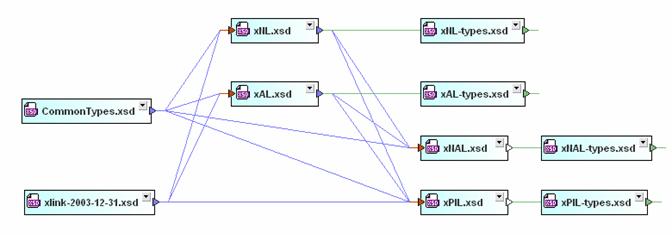
Following are the files provided as default
in CIQ Specifications package for Option 2:
· xNL.xsd
· xAL.xsd
· xPIL.xsd
· xNAL.xsd
· CommonTypes.xsd
· xlink-2003-12-21.xsd
No *-types.xsd files exist in Option
2 as all the code lists are defined as genericode files.
The relationship between the different
schemas for Option 2 is shown in the following figure. As you can see, the
enumeration list XML schemas do not exist. Instead, each CIQ entity (Name, Address,
and Party) has a set of genericode based Code List files (.gc).
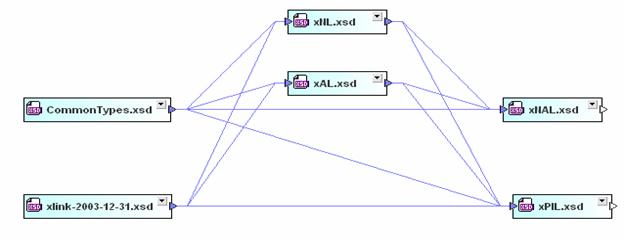
10 default genericode based code list files
with .gc extension. Each enumeration list in Option 1 is defined as a separate file
in Option 2.
30 default genericode based code list files
with .gc extension. Each enumeration list in Option 1 is defined as a separate file
in Option 2.
1 default genericode based code list file
with .gc extension. The enumeration list in Option 1 is defined as a separate file
in Option 2.
56 default genericode based code list files
with .gc extension. Each enumeration list in Option 1 is defined as a separate file
in Option 2.
2 default genericode based code list files
with .gc extension.
Both the types of entity schemas (for
option 1 and option 2) use the same namespaces to ensure that the XML instance
documents generated from any of these two options are compatible with both types of
CIQ entity XML schemas.
The key difference between the two types
of entity schemas are the additional metadata information for information item
values in XML instances for Option 2. This metadata information is defined as
OPTIONAL attributes. It is not mandatory to have instance level metadata, but
having it allows an instance to disambiguate a code value that might be the same
value from two different lists. An application interpreting a given information
item that has different values from different lists MAY need the user to specify
some or all of the list metadata from which the value is found, especially if the
value is ambiguous.
Four types metadata attributes are used
in Option 2 entity schema attributes that reference code lists and they
are:
· Ref - corresponds to genericode
<ShortName> reference
· Ver - corresponds to genericode
<Version> version of the file
· URI - corresponds to genericode
<CanonicalUri> abstract identifier for all versions of the code
list
·
VerURI - corresponds to genericode <CanonicalVersionUri> abstract
identifier for this version of the code list
For detailed explanation of metadata information, read the
Code List Value Validation methodology document (http://www.oasis-open.org/committees/document.php?document_id=21324)
The figure below shows "PersonName"
element in Option 1 (using xNL-types.xsd for all Name entity associated code
lists) of xNL.xsd:
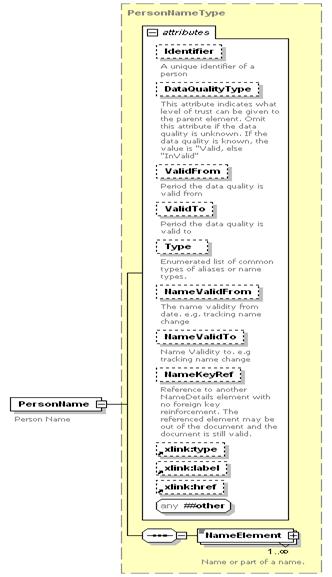
The figure below shows PersonName element in Option
2 (using genericode for Name entity associated code lists) of xNL.xsd with
metadata information for genericode based code lists:
Metadata Information for "Type" attribute that
refers to genericode "PersonNameEnumeration.gc" file
|
|


Metadata Information for "DataQualityType"
attribute that refers to genericode "DataQualityEnumeration.gc"
file
|
|

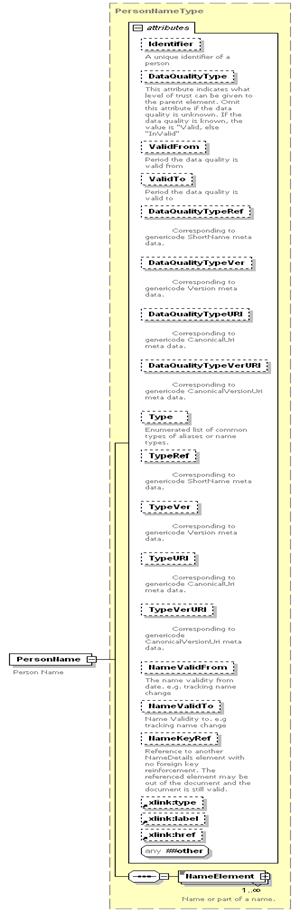
An XML instance document produced from Option 1 SHOULD be
valid against the CIQ entity XML schemas of Option 2.
Similarly, an XML document produced from Option 2 SHOULD be
valid against the CIQ entity XML schemas of Option 1 provided the metadata
information in Option 2 are not used as those metadata attributes do not exist in
Option 1 XML schemas.
It is the view of the CIQ committee that
to enable interoperability of data/information between parties, the best solution
is to parse the data elements into its atomic elements thereby preserving the
semantics and quality of data. By this way the parties involved in data exchange
will be in the best position to understand the semantics and quality of data which
minimises interoperability issues. How the data will be exchanged between parties,
whether in parsed or unparsed structure, must be negotiated between the parties to
enable interoperability.
One cannot expect interoperability to
occur automatically without some sort of negotiation between parties (e.g.
Information Exchange Agreement, whether internal or external to an organisation)
involved in data exchange. Once information exchange agreements between parties are
in place, then the data/information exchange process can be automated. Moreover,
the entire information exchange and interoperability process SHOULD be managed
through an effective governance process which SHOULD involve all the parties
involved in the information exchange process. This enables effective and efficient
management of any change to the information exchange process in the
future.
We at OASIS CIQ TC strongly believe in the
following "Data Interoperability Success Formula":
Data Interoperability = Open Data Architecture + Data
Integration + Data Quality + Data Standards + Data Semantics + Data Governance
All components on the right hand side of the above formula
are important for successful data interoperability. The term "Open" used here
indicates artifacts that are independent of any proprietary solution (e.g. open
industry artifacts or artifacts that are open within an enterprise).
To ensure interoperability of CIQ represented
data/information between applications/business systems (whether internal to the
organization or external to the organization), it is strongly advised that an
information exchange agreement/specification for CIQ SHOULD is in place. This
agreement/specification SHOULD outline in detail the customization of CIQ
specifications.
Following are the features of CIQ specifications that assist
in customization of the specifications to meet specific application or data
exchange requirements, and the details of customization SHOULD be documented and
agreed (if involving more than one party in data exchange) at application/system
design time to enable automating interoperability of information/data represented
using CIQ specifications at application/system run time:
· List of
all elements of CIQ XML Schemas that SHOULD be used in the exchange. This includes
details of which elements are mandatory and which elements are OPTIONAL
· List of
all attributes of CIQ XML Schemas that SHOULD be used in the exchange. This
includes details of which attributes are mandatory and which attributes are
OPTIONAL
· The
approach that will be used for Code Lists (Option 1 or Option 2)
· The code
list values that SHOULD be used for each CIQ code lists. This includes updating the
default XML Schemas for code lists (Option 1) with the values to be used and
updating the default genericode based code lists (Option 2) with the values to be
used. These code list files SHOULD then be implemented by all applications/systems
involved in data exchange. If genericode based code list approach (Option 2) is
used, then the XSLTs for value validation SHOULD be generated and implemented by
all applications/systems involved in data exchange.
· Whether
xLink or Key Reference SHOULD be used to reference party, name or address, and the
details
· Whether
XML schema SHOULD be extended by using new attributes from a
non-target namespace and if so, details of the additional attributes
· Whether
business rules SHOULD be defined to constrain the CIQ XML schemas and if so,
details of the business rules that SHOULD be implemented consistently by all
applications/systems involved in data exchange
Once the agreement is implemented, it is vital that
the agreement SHOULD governed through a governance process to manage change
effectively and efficiently. All parties involved in the data exchange process
SHOULD be key stakeholders of the governance process.
Although, all schema files are fully
documented using XML Schema annotations it is not always convenient to browse the
schema itself. This specification is accompanied by a set of HTML files auto
generated by XML Spy. Note that not all information captured in the schema
annotation tags is in the HTML documentation.
Several examples of instance XML
documents for name, address and party schemas are provided as XML files. The
examples are informative and demonstrate the application of this Technical
Specification.
The example files and their content are
being constantly improved and updated on no particular schedule.
OASIS CIQ TC is open in the way it
conducts its business. We welcome contributions from public in any form. Please,
use "Send A Comment" feature on CIQ TC home page (http://www.oasis-open.org/committees/tc_home.php?wg_abbrev=ciq)
to tell us about:
· errors, omissions,
misspellings in this specification, schemas or examples
· your opinion in the form
of criticisms, suggestions, comments, etc
· willingness to contribute
to the work of CIQ TC by becoming a member of the TC
· willingness to contribute
indirectly to the work of CIQ TC
· provision of sample data
that can be used to test the specifications
· implementation
experience
· etc.
The keywords "MUST", "MUST NOT", "SHOULD", "SHOULD NOT",
"MAY" and "OPTIONAL" interpreted as described in [RFC2119] are used as the
conformance clauses throughout this document.
Implementation of CIQ Specifications
namely the XML Schemas (xNL.xsd, xAL.xsd, xNAL.xsd, and xPIL.xsd)
MUST conform to the specifications if the implementation conforms to as stated in
section 3.12.
Implementation of CIQ Specifications
namely the XML Schemas (xNL.xsd, xAL.xsd, xNAL.xsd, and xPIL.xsd) by
extending them MUST conform as stated in section 3.9.
Customization of the Code List XML
Schemas (xNL-types.xsd, xAL-types.xsd, xNAL-types.xsd, and
xPIL-types.xsd) using Option 1 MUST be well formed. Changes to the default
values provided as part of the specifications is OPTIONAL and MAY be modified by
the user.
Implementation of CIQ Specifications
between two or more applications/systems or parties helps achieve interoperability
if the implementation conforms to using the agreed conformance clauses as defined
in sections 10.1.3.1, 10.1.3.2, 10.1.3.3, 10.1.3.4, 10.1.3.5, and
10.1.3.6.
Implementation of elements and
attributes of CIQ XML Schema enables interoperability if the following conditions
are agreed by two or more parties involved in data exchange and are met:
1. The OPTIONAL elements in the XML Schema that SHOULD be used for
implementation and the OPTIONAL elements in the XML Schema that SHOULD be ignored.
See section 8.2.
2. The OPTIONAL attributes in the XML Schema that SHOULD be used for
implementation and the OPTIONAL attributes in the XML Schema that SHOULD be
ignored. See section 8.2 .
Implementation of the CIQ schema by
extending it SHOULD be agreed and managed between two or more parties involved in
the data exchange and MUST be conformed to in order to achieve interoperability as
stated in section 3.9.
Implementation of a Code List approach
SHOULD be agreed and conformance to the selected approach between two or more
parties involved in the data exchange MUST be achieved in order to ensure
interoperability and this is stated in section 3.4.
Implementation of the Code List values
SHOULD be agreed between two or more parties involved in the data exchange and MUST
be conformed to as agreed in order to ensure interoperability as stated in section
3.4.
Customization of the schema SHOULD be
achieved by the following ways:
1. Using Code List values
2. Defining new business rules to constraint the schema
Implementation of the above approaches
SHOULD be agreed between two or more parties involved in the data exchange and MUST
be conformed to in order to achieve interoperability as stated in section
3.13.
Implementation and conformance of the
implementation to the agreed Data/Information Exchange Agreement between two or
more parties involved in the data exchange MUST be achieved to ensure
interoperability as stated in section 8.2.
The following individuals have participated in the creation
of this specification and are gratefully acknowledged:
Participants:
|
John Glaubitz
|
Vertex, Inc
|
Member, CIQ TC
|
|
Max Voskob
|
Individual
|
Former Member, CIQ TC
|
|
Hidajet Hasimbegovic
|
Individual
|
Member, CIQ TC
|
|
Robert James
|
Individual
|
Member, CIQ TC
|
|
Joe Lubenow
|
Individual
|
Member, CIQ TC
|
|
Mark Meadows
|
Microsoft Corporation
|
Former Member, CIQ TC
|
|
John Putman
|
Individual
|
Former Member, CIQ TC
|
|
Michael Roytman
|
Vertex, Inc
|
Member, CIQ TC
|
|
Colin Wallis
|
New Zealand Government
|
Member, CIQ TC
|
|
David Webber
|
Individual
|
Member, CIQ TC
|
|
Graham Lobsey
|
Individual
|
Member, CIQ TC
|
|
George Farkas
|
XBI Software, Inc
|
Member, CIQ TC
|
OASIS CIQ Technical Committee (TC) also wishes to
acknowledge contributions from former members of the TC since its inception in
2000. Also, the TC would like to express its sincere thanks to the public in
general (this includes other standard groups, organizations and end users) for
their feedback and comments that helped the TC to improve the CIQ
specifications.
Special thanks to Mr.Hugh Wallis, Director of Standards
Development of extensible Business Reporting Language (xBRL) International
Standards Group (http://www.xbrl.org) for
working closely with the CIQ TC in jointly implementing W3C xLink specification
that is now used by both xBRL and CIQ Specifications to enable interoperability
between the two specifications.
Special thanks to Mr.Carl Reed, Chief Technology Officer of
Open Geospatial Consortium (OGC - http://www.opengeospatial.org) for his
guidance and assistance to the TC in referencing the work of OGC on GeoRSS and
Geo-Coordinates for addresses/locations as part of CIQ Address Specifications.
Special thanks to Mr.Ken Holman, Chair of OASIS Code List
TC (http://www.oasis-open.org/committees/tc_home.php?wg_abbrev=codelist)
for his assistance to the TC in releasing the OASIS Code List version of CIQ V3.0
XML Schemas.
Last but not least, the TC thanks all users of the CIQ TC
specifications in real world and for their continuous feedback and support.
CIQ TC Specifications (includes
documents, schemas and examples1 and
2) are free of any Intellectual Property Rights,
Patents, Licenses or Royalties. Public is free to download and implement the
specifications free of charge.
1xAL-Australia.XML
Address examples come from AS/NZ
4819:2003 standard of Standards Australia and are subject to copyright
2xAL-International.xml
Address examples come from a variety of
sources including Universal Postal Union (UPU) website and the UPU address examples
are subject to copyright.
xLink-2003-12-31.xsd
This schema was provided by the xBRL
group in December 2006.
|
Revision
|
Date
|
Editor
|
Changes Made
|
|
V3.0 PRD 01
|
13 April 2006
|
Ram Kumar and Max Voskob
|
Prepared 60 days public review draft from Committee
Draft 01
|
|
V3.0 PRD 02
|
15 June 2007
|
Ram Kumar
|
Prepared second round of 60 days public review draft
from Committee Draft 02 by including all public review comments from PRD 01.
Also included is implementation of OASIS Code list specification
|