This document describes the minimal set of business and technical
prerequisites, functional and non-functional requirements, together with
a reference architecture that when implemented ensures that two or more
Systems of Record can synchronize their system state over a Consensus
Controlled State Machine (CCSM) network with little or no trust
assumptions.
Status:
This document is a Project Specification Draft and is no longer under
active development.
This was last revised or approved by Baseline, part of the Ethereum
OASIS Open Project, on the above date. The level of approval is also
listed above. Check the “Latest stage” location noted above for possible
later revisions of this document.
Comments on this work can be provided by opening issues in the
project repository or by sending an email to the project’s public
comment list baseline@lists.oasis-open-projects.org.
Keywords:
The keywords “MUST”, “MUST NOT”, “REQUIRED”, “SHALL”, “SHALL NOT”,
“SHOULD”, “SHOULD NOT”, “RECOMMENDED”, “NOT RECOMMENDED”, “MAY”, and
“OPTIONAL” in this document are to be interpreted as described in [RFC2119] when, and only when, they appear in all
capitals, as shown here.
Citation format:
When referencing this specification the following citation format
should be used:
The Baseline Protocol is an open-source initiative that combines
advances in cryptography, messaging, and Consensus Controlled State
Machines (CCSMs) often referred to as blockchains or distributed ledger
technology (DLT) to deliver secure and private business processes at low
cost – event ordering, data consistency, and workflow integrity. The
Baseline Protocol provides a framework that allows Baseline Protocol
Implementations (BPIs) to establish a common (business) frame of
reference enabling confidential and complex (business) collaborations
between enterprises without moving any sensitive data between
traditional Systems of Record. The work is an Ethereum Community
Project, which is managed by OASIS.
1.1 Overview
An illustrative example of the use of a BPI is a Buyer placing an
order to a Seller. Normally a Buyer system creates an Order and
transmits it to the Seller system through some preestablished messaging
system without providing any proof that the Order created is correct,
forcing the Seller’s systems to validate the order, and more often than
not, finding data inconsistencies between the Seller system and the
Order. This then leads to a time-consuming, and often expensive, back
and forth between Seller and Buyer to rectify the issue.
In the case that a BPI is used, the Buyer action of creating an order
and submitting it to the BPI creates a cryptographic proof on the BPI
that the order conforms (or not) to the agreed-upon commercial contract
terms and current contract state between Buyer and Seller stored on the
BPI, whereupon verification, the commercial contract state on the BPI is
updated based on the order details. Subsequently, the cryptographic
proof of order correctness is attached to the order and sent to the
Seller using either established integrations or the BPI. The Seller can
then directly validate the proof without having to check the correctness
of the Order against its System of Record anymore. A valid cryptographic
proof ensures that the order will be correctly formulated the first time
avoiding errors, and thus saving time and money – a more detailed
example is provided in section 2.8.1 State
Synchronization. A BPI, therefore, enforces the synchronization of
Systems of Record between Buyer and Seller.
At a high level a BPI’s benefits and characteristics can be
summarized as follows:
BPI usage avoids rework between contract counterparties due to
improperly applied business logic because cryptographic proofs of
correctness ensure that Systems of Record remain synchronized, and that
rework is minimized or even completely avoided.
Existing integrations can continue to be used with only minimal
augmentation of cryptographic proofs that contractual business logic and
data such as discounts are properly applied.
Service request validation such as that of an order against the
service request receiver’s System of Record is no longer necessary.
In the following, this document lays out the requirements on a BPI to
achieve above described benefits and characteristics in several
sections:
Section 2: Design and Architecture with
definitions, key concepts, and overviews of the components of a
compliant Baseline Protocol Implementation as delineated in the
following subsections:
State Object
Transacting Counterparties
Commercial Agreements
Consensus Controlled State Machine (CCSM)
Baseline Protocol Instance
High-Level Functional Requirements
Baseline Protocol Reference Architecture
Section 3: Identifiers, Identity and Credential
Management with definitions, key concepts, and overviews of
identifiers, identities, and credentials necessary in a compliant
Baseline Protocol Implementation as delineated in the following
subsections:
Introduction and high-level Requirements
BPI Identifiers, Identities and Credentials, and their
Management
Section 4: BPI Abstraction Layers with definitions,
concepts, scope, and security considerations for BPI Abstraction Layers:
BPI Abstraction Scope and Components
BPI Abstraction Layer Security and Integration
Section 5: Middleware, Communication, and
Interoperability with definitions, key concepts, and overviews
of BPI Subject Capabilities and Accounts, service orchestration,
communication, BPI Interoperability with its APIs, and Transport
Security:
BPI Subject Capabilities
BPI Subject Account
BPI Service Orchestration
BPI Communication
BPI Integration
Standardized Set of BPI Interoperability APIs
BPI Interoperability: Discoverable Standard Transport Security
Section 6: Agreement Execution with definitions,
key concepts, and overviews of the BPI Processing Layer components
necessary in a compliant Baseline Protocol Implementation as delineated
in the following subsections:
BPI Workstep
BPI Workflow
BPI Workgroup
BPI Account
BPI Transactions
BPI Transaction Lifecycle
Section 7: General BPI Storage Capabilities with
definitions, key concepts, and overviews of BPI Storage components
applicable to all BPI layers and necessary in a compliant Baseline
Protocol Implementation as delineated in the following subsections:
BPI Storage Security
BPI Storage Privacy
BPI Data Orchestration
BPI-External Storage: Edge Storage
BPI-Internal Storage
Section 8: BPI External Data Inputs with
definitions, key concepts, and overviews of BPI External Data Input
components necessary in a compliant Baseline Protocol Implementation as
delineated in the following subsections:
Internal Authoritative Data for BPIs
External Authoritative Data for BPIs
External Non-authoritative, Non-deterministic Data for BPIs
Section 9: Conformance with a specification of
conformance
tests for each requirement and definitions of the different levels of
conformance of a BPI to this standard.
_ Conformance Targets
_ Conformance Levels
1.2 Glossary
Anti-Money Laundering:
Anti-money laundering (AML) refers to a set of laws, regulations, and
procedures intended to prevent criminals from disguising illegally
obtained funds as legitimate income.
International Monetary Fund, Reference Guide to Anti-Money Laundering
and Combating the Financing of Terrorism Second Edition and Supplement
on Special Recommendation IX, 2006.
Baseline Protocol:
The Baseline Protocol is a set of methods that enable two or more
state machines to achieve and maintain data consistency, and workflow
continuity by using a network as a common frame of reference.
Baseline-Bridge:
A mechanism for one Workflow to use the proof generated by a
different Workflow.
For instance a proof generated in a Workflow executed by Workgroup A to
be used as input to a Workflow executed by Workgroup B.
Baseline-Connector:
An interface connecting and synchronizing a baseline stack and system
of record.
Byzantine Fault Tolerant (BFT):
Given a network or system of n components, t of which are dishonest,
and assuming only point-to-point channels between all the components,
then whenever a component A tries to broadcast a value x such as a block
of transactions, the other components are permitted to discuss with each
other and verify the consistency of A’s broadcast, and eventually settle
on a common value y. The system is then considered to resist Byzantine
faults if a component A can broadcast a value x, and then:
If A is honest, then all honest components agree on the value
x.
If A is dishonest, all honest components agree on the common value
y.
“The Byzantine Generals Problem”, Leslie Lamport, Robert E. Shostak,
Marshall Pease, ACM Transactions on Programming Languages and Systems,
1982.
Circuit Breaker:
The ability of a Party to immediately cease all their active
Workflows across all of their Workgroups within a Baseline-compliant
implementation, and, if required, exit a Baseline-compliant
implementation with all their data without any 3rd party being able to
prevent the exit.
Common Frame of Reference:
A Common Frame of Reference as used in this document refers to
achieving and maintaining data consistency between two or more Systems
of Record using a consensus-controlled state machine. This enables
workflow and data continuity and integrity between two or more
counterparties.
Consensus Controlled State Machine:
A Consensus Controlled State Machine (CCSM) is a network of
replicated, shared, and synchronized digital data spread across multiple
sites connected by a peer-to-peer and utilizing a consensus algorithm.
There is no central administrator or centralized data storage.
Data Orchestration:
An automated process for taking siloed data from multiple storage
locations, combining and organizing it, and making it available for
analysis.
Electronic Record:
Information captured through electronic means, and which may or may
not have a paper record to back it up.
Bulletin of the American Society for Information Science and
Technology, Electronic Records Research Working Meeting: A Report from
the Archives Community, May 28‐30, 1997.
Identity:
The condition of being the same with something described or asserted,
per Merriam-Webster Dictionary.
A concretization of the above used in this document: Identity is the
combination of one or more unique identifiers with data associated with
this/these identifier(s). Identity-associated data consists of signed
certificates or credentials such as verifiable credentials and other
unsigned, non-verifiable data objects generated by or on behalf of the
unique identifier(s).
The ability of a Party operating Workflows on a baseline-compliant
implementation A to instantiate and operate one or more Workflows with
one or more Parties on a baseline-compliant implementation B without the
Parties on either implementation A or B having to know anything of the
other Parties’ implementation.
Legal Entity:
An individual, organization, or company that has legal rights and
obligations.
Liveness:
In concurrent computing, liveness refers to a set of properties of
concurrent systems that require a system to make progress, despite its
concurrently executing components (“processes”) may have to “take turns”
in critical sections, parts of the program that cannot be simultaneously
run by multiple processes. Liveness guarantees are important properties
in operating systems and distributed systems.
A latency that does not Materially Impact the overall system latency
of the BPI.
Master Services Agreement (MSA):
A legal contract that defines the general terms and conditions
governing the entire scope of products commercially exchanged between
the parties to the agreement.
Material Impact:
In the context of certain requirements, such as [R96], something that causes the
underlying business requirements of the BPI not to be met. For example
in some deployment situations, a 5-second delay can cause transactions
to fail or introduce instability to the system, while in other
circumstances a 5-minute delay in processing makes no difference to the
system as a whole.
Non-Repudiable:
Refers to a situation where a statement’s author cannot successfully
dispute its authorship or the validity of an associated contract. The
term is often seen in a legal setting when the authenticity of a
signature is being challenged. In such an instance, the authenticity is
being “repudiated”.
Party:
An entity participating in the execution of one or more given
Workflows within a Workgroup. A Workgroup is set up and managed by one
Party that invites other entities as Parties to join as workgroup
participants.
Portability:
The ability of a Party to migrate and re-baseline its existing
Workflows and data from one baseline-compliant implementation to another
baseline-compliant implementation without any 3rd party being able to
prevent the migration.
Principal Owner
An entity controlling the public key(s) which control the identity
and its identifiers.
Privacy Assurance Mechanism:
A way of ensuring the privacy of Workflow data represented on a
consensus controlled state machine (CCSM) network.
Proof of Correctness:
A Proof of Correctness is a mathematical proof that a computer
program or a part thereof will, when executed, yield correct results,
i.e. results fulfilling specific requirements. Before proving a program
correct, the theorem to be proved must, of course, be formulated. The
hypothesis of such a correctness theorem is typically a condition that
the relevant program variables must satisfy immediately before the
program is executed. This condition is called the precondition. The
thesis of the correctness theorem is typically a condition that the
relevant program variables must satisfy immediately after the execution
of the program. This latter condition is called the post-condition. The
thesis of a correctness theorem may be a statement that the final values
of the program variables are a particular function of their initial
values.
“Encyclopedia of Software Engineering”,
Print ISBN: 9780471377375| Online ISBN: 9780471028956| DOI:
10.1002/0471028959,
(2002), John Wiley & Sons, Inc.
Succinct:
Verification of a zero-knowledge proof by any 3rd party in a time
that is sublinear to the size of the prover system that generated the
proof.
System of Record:
The integrity of the data in data architecture is established by what
can be called the “system of record.” The system of record is the one
place where the value of data is definitively established. Note that the
system of record applies only to detailed granular data. The system of
record does not apply to summarized or derived data.
W.H. Inmon, Daniel Linstedt and Mary Levins, “Data Architecture”,
2019, Academic Press, ISBN: 978-0-12-816916-2.
Trust Model:
Collection of entities and processes that entities rely on to help
preserve security, safety, and privacy of data and which is predicated
on the use of a CCSM implementation.
Marsh S. (1994). “Formalizing Trust as a Computational Concept”.
Ph.D. thesis, University of Stirling, Department of Computer Science and
Mathematics.
Verifiably Secure:
A Process that enables a computer to offload the computation of some
function to other perhaps untrusted clients, while maintaining
verifiable, and, thus, secure results. The other clients evaluate the
function and return the result with proof that the computation of the
function was carried out correctly. The proof is not absolute but is
dependent on the validity of the security assumptions used in the proof.
For example, a blockchain consensus algorithm where the proof of
computation is the nonce of a block. Someone inspecting the block can
assume with virtual certainty that the results are correct because the
number of computational nodes that agreed on the outcome of the same
computation is defined as sufficient for the consensus outcome to be
secure in the consensus algorithm’s mathematical proof of security.
Gennaro, Rosario; Gentry, Craig; Parno, Bryan (31 August 2010).
Non-Interactive Verifiable Computing: Outsourcing Computation to
Untrusted Workers. CRYPTO 2010. doi:10.1007/978-3-642-14623-7_25.
Workflow:
A process made up of a series of Worksteps between all or a subset of
Parties in a given Workgroup.
Workgroup
A workgroup is a set of Parties, also referred to as BPI Subjects,
who are the authorized users of a BPI. The Parties use Workflows to
synchronize their Systems of Record through one or more worksteps in the
workflow.
Workstep:
A workstep is characterized by input, the deterministic application
of a set of logic rules and data to that input, and the generation of a
verifiably deterministic and verifiably correct output. A set of
Worksteps used to synchronize the outcomes in two or more Systems of
Record within a Workgroup is called a Workflow.
1.3 Typographical Conventions
1.3.1 Requirement Ids
A requirement is uniquely identified by a unique ID composed of its
requirement level followed by a requirement number, as per convention
[RequirementLevelRequirementNumber].
There are four requirement levels that are coded in requirement ids as
per below convention:
[R] - The requirement level for requirements which
IDs start with the letter R is to be interpreted as
MUST as described in RFC2119.
[D] - The requirement level for requirements which IDs
start with the letter D is to be interpreted as
SHOULD as described in RFC2119.
[O] - The requirement level for requirements which IDs
start with the letter O is to be interpreted as
MAY as described in RFC2119.
Note that requirements are uniquely numbered in ascending order
within each requirement level.
Example: It should be read that [R1] is an absolute requirement of
the specification whereas [D1] is a recommendation and [O1] is truly
optional.
2 Design and Architecture
This section provides definitions, key concepts, and overviews of the
components of a Baseline Protocol Implementation compliant with the
requirements of this document. This section intends to provide
implementers with guidance to be able to build and operate
implementations of the Baseline Protocol not only in an informal but
also in a very formal, highly regulated context. The latter context in
particular requires implementers to prove that compliance with this
standard not only does not violate regulatory frameworks but rather
enables meeting regulatory requirements throughout the entire stack.
The key concepts, definitions, and associated requirements
underpinning a Baseline Protocol Implementation (BPI) which will be
discussed in this section are:
State Object
Transacting Counterparties
Commercially and Legally Binding Documents
Consensus Controlled State Machine
Baseline Protocol Instance
High-Level Functional Requirements
Baseline Protocol Reference Architecture
2.1 Agreement
An agreement is a manifestation of mutual assent by two or more
parties to one another see Cornell Law School.
An Agreement between two or more Counterparties allows for transactions
between them dealing with, for example, commercial items such as
products. An Agreement, therefore, governs and defines all transactions
between counterparties.
2.2 State Object
A State Object is an item that can be exchanged between
counterparties to an agreement, the state of which the counterparties
have agreed on, and which is defined in an agreement. In the context of
this standard, a State Object is assumed to be a document derived from
an agreement and representing a specific state of either an asset, a
product offering or a service offering transacted between
counterparties.
Examples include, but are not limited to, a:
Quote
Order
Invoice referencing for example:
Digital Services
Physical Products
Financial Assets
2.3 Transacting Counterparties
A transacting counterparty, or simply counterparty, that requests one
or more State Objects from another counterparty is the Requester
concerning the State Object. The Requester can also be the final
recipient of one or more State Objects.
A counterparty that provides one or more State Objects to another
counterparty is the Provider concerning the provided State Objects. The
Provider is accountable to the Requester for all the State Objects it
provides to the Requester.
A Requester may request State Objects from multiple Providers, and in
the context of a supply chain of State Objects, a Provider of one State
Object may also play the role of a Requester of other State Objects.
[R1]
Transacting counterparties MUST have an agreement specifying
minimally the transactions to be performed between the transacting
counterparties before a transactable state of an agreement can be
instantiated within a BPI.
Note, that an agreement in the context of this document may or
may not be a commercial agreement as defined in 24-Commercial-Agreements
below.
[R1] Testability: Functional terms of an agreement
between counterparties are always implementable as transactions within a
Baseline Protocol system because they are logical constraints which can
always be represented in code. For example, payment term of 15 days can
be checked whether the payment invoice is larger or smaller than the
payment term.
2.4 Commercial Agreements
If transacting counterparties, also being referred to as Requester(s)
and Provider(s) (“the parties”) in this document, intend to establish a
business and operational environment for commercial transactions, they
will sign one or more agreements that commercially bind the parties,
also known as Commercial Agreements. The aforementioned is only to be
understood within the context of this document.
Such commercial, and thus presumably legally enforceable, documents
may be presented as a combination of one or more of the following:
Master Services Agreement
Specific Terms and Conditions
Order
[R2]
The parties to a Commercial Agreement MUST have signed commercial
documents with each other before a transactable state of a commercial
agreement can be instantiated within a BPI.
[R2] Testability: A commercial agreement represents
a state that has been agreed on in specific terms between two or more
counterparties. Such an agreement with all its elements including its
counterparty signatures can be implemented into a baseline protocol
implementation (BPI) through a Merkle Tree structure stored in database
where each agreement element represented a Merkle Tree leaf. Merkle
Trees can be readily implemented. A secure, offchain Merkle Tree library
with tests can be found here.
2.4.1 Contract
This section details the prerequisites required to be fulfilled by a
legal contract, also referred to as a Commercial Agreement in this
document, between the parties, and defines the general terms and
conditions in the legal contract governing commercial transactions
between these parties. These prerequisites are to be understood only
within the context of this document and are meant to be general and not
specific to particular legal and regulatory frameworks.
A contract will typically govern all commercial transactions between
its parties and includes, but is not limited to, sections defining the
Governing Law, the Legal Jurisdiction, Indemnity, Liability, Force
Majeure, Charges and Taxes, Term, Obligations, definitions of
commercially relevant elements such as locations, equipment, and
products, as well as any other terms and conditions that apply to the
entire scope of commercial and legal relations between the parties.
Other legal documents, such as an order, typically reference the
contract for its general terms and conditions and might contain more
specific terms and conditions, such as rates and discounts and other
commercial information, relevant for the specific context of the legal
document. These specific terms and conditions can expand or override the
original contract and are intentionally not specified in the original
contract. The contract is the legal document from which specific
commercial documents, such as a Quote or an Order, are derived.
[R3]
There MUST be a legally binding contract, however simple and
temporary, before a commercial transaction — such as an order — between
parties takes place.
For example, the contract and the order can be combined into a
single document for a single transaction. However, there must be a legal
framework in place to provide context for monies that are exchanged and
settled. The functional part of the contract forms the basis of a
Baseline Protocol Implementation (BPI) defined in section 2.6 Baseline Protocol
Instance. The requirements below are to be understood solely within
the context of this document. They are not meant to be generalized
beyond this context.
[R3] Testability: A legally binding contract
between parties can be implemented in a baseline system referencing the
suggested Order
example as a W3C Verifiable Credential with its test suite.
[D1]
The contract SHOULD be in an electronic form.
[D1] Testability: A legally binding contract
between parties can be implemented in a baseline system referencing the
suggested Order
example as a W3C Verifiable Credential with its test suite.
[D2]
The functional terms of the contract SHOULD be represented on a BPI
between the counterparties.
For example, a Payment Term such as N30, a discount value, agreed
upon product numbers, Service Level Agreements (SLAs) etc.
[D2] Testability: Legally binding functional terms
of a contract between parties can be implemented in a Baseline Protocol
Implementation using for example a Merkle
Tree, as well as the funcional terms represented as a Zero Knowledge
Circuit Example.
[D3]
The contract SHOULD be an MSA between the contract parties.
An MSA is preferable since it allows a proliferation of
contract-based BPI workflows and worksteps between the parties reducing
complexity and potential errors.
[D3] Testability: MSAs between counterparties can
be implemented in the same way as a legally binding contract between
parties, referencing the suggested Merkle Tree Example,
as well as the funcional terms represented as a Zero Knowledge Circuit
Example.
[CR1]<[D3]
There MUST be only one MSA between contract parties covering
commercial transactions for a given set of products, services, or
assets.
This requirement is intended to disambiguate which terms cover
which part of a commercial relationship between parties.
Specific Terms and Conditions (“Specific T&Cs”) defines the
terms and conditions governing a specific product, service, or asset or
set thereof offered and delivered by Provider(s) to
Requester(s).
[CR1]<[D3] Testability: Business logic can be
expressed in software code, and software code can be tested, and since
BPI logic can ensure only unique combinations of an MSA, unique
identifier, and an agreement type exists between two or more
counterparties, the requirement is testable.
[D4]
Each specific product, service, asset, or set thereof offered and
delivered by Provider(s) to Requester(s) SHOULD have its specific
T&C document.
This would allow the fine-graining and consistent application of
commercial State-Object-specific business rules and data.
[D4] Testability: Since a T&C document is part
of a contract and a contract can be represented in a testable manner per
the testability statement of [R3], requirement [D4] is testable.
2.4.2 Commercial Documents
Commercial documents, a category of commercial State Objects, refer
to the state of a specific product/service/asset or set thereof, which
may or may not be modified from an original offering to meet the
Requester requirements and includes operational and commercial details.
A commercial document is an abstract construct representing mutual
commitments based on a legally binding contract.
[R4]
A commercial State Object to be transacted on MUST be based on a
specific commercial document.
[R4] Testability: Since the testability statement
in [R2] represents a commercial agreement with
commercial documents and is testable as stated, this requirement is
testable as well.
[R5]
A commercial document MUST be derived from a legally binding
contract.
[R5] Testability: A legally binding contract
outside of a BPI can be translated into a commercial document on the BPI
as given in this example of a
legally binding contract expressed as a W3C Verifiable Credential which
can be tested following the W3C Verifiable Credential test suite
approach.
[R6]
A commercial document MUST be represented as an electronic record on
a BPI between the counterparties.
[R6] Testability: Since the testability statement
in [R5] represents an electronic version of a
commercial document and is testable as stated, this requirement is
testable as well.
[R8]
A commercial document MUST be authorized by legal representatives of
the parties or their legal delegates.
[R8] Testability: A digital signature of an
authorized user of the BPI state object associated with the commercial
document can be extracted from the proof section of this Example,
validated and compared to the key identified in the verification
method.
[D5]
The definition of a commercial document authorization SHOULD be
stated in the legal contract underlying the commercial document.
Authorizations for commercial transactions are a foundational
element in the context of this document, as they are in paper based
agreements. Therefore, any legal authorization agreements relevant to
the commercial agreement between commercial counterparties, and thus to
commercial transactions between them, are important to be represented in
a BPI to ensure mitigating the risk of unauthorized signatures.
[D5] Testability: Given is an a W3C Verifiable
Credential Example showing the definition of a commercial document
authorization by identifying “the buyer” and “the issuer” of the
contract. A test to validate the “buyer” and “issuer” requirements can
be written following the W3C Verifiable Credential test suite
approach.
[D6]
The representatives and their authorized delegates who can perform
commercial document authorizations SHOULD be explicitly listed or
inferred from the stated legal delegation rules of the counterparties in
the contract underlying any commercial document.
[D6] Testability: Given is an a W3C Verfiaible
Credential Example showing the definition of a commercial document
authorization by identifying “the buyer” and “the issuer” of the
contract. A test to validate the “buyer” and “issuer” requirements can
be written following the W3C Verifiable Credential test suite
approach.
[R9]
A commercial document MUST be non-repudiable.
Note that while non-repudiation in the physical world is most
often tied to a physical signature of a Legal Entity on a legal
document, in the digital world a digital signature over a digital legal
document such as an Order or an Invoice belonging to a known and
verifiable digital identity of a counterparty serves the same
purpose.
Example: A Buyer (“Requester”) and Seller (“Provider”) may agree
that a signed Order requires a signed original paper copy, or a
digitally signed electronic Order Form, in addition to an Order being
digitally signed and recorded within a BPI.
[R9] Testability: The non-repudiation of a
commercial document can be achieved through the verification of the
digital signatures from both parties over the contract. An Example of
this is given, where in the “proof” section two digital signatures can
be found.
2.5 Consensus Controlled
State Machine
A Consensus Controlled State Machine (CCSM) is a network of
replicated, shared, and synchronized digital data spread across multiple
sites connected by a peer-to-peer and utilizing a consensus algorithm.
There is no central administrator or centralized data storage.
A CCSM with no or limited trust assumptions is the foundational
enabler of a BPI.
For specificity, the popular words “Blockchain” or “DLT” are a
particular form of CCSM design.
2.6 Baseline Protocol Instance
Baseline Protocol Instances or Implementations (BPIs) are logical
constructs shared between transacting counterparties of Requesters and
Providers and implemented on a CCSM. They are used to either validate or
reconcile transactions between Requesters and Providers related to all
State Objects transacted between them. The nature of bi- or
multi-lateral transactions is such that two or more parties may transact
to/from each other interchangeably.
Abstractly, a BPI consists of:
The private messaging between Agreement Counterparties about the
state, or the requested or finalized state changes, of the State Objects
between them
The representation of an agreement and documents and their business
rules and data as distinct workflows and worksteps between transacting
counterparties organized into workgroups based on the stipulations of
the agreement
The deterministic processing and finalization of state change
requests based on documents between the transacting counterparties as
stipulated by the agreement
The preservation of the privacy of all transacting counterparties
and their data from other 3rd parties
BPIs are strongly dependent on the security and privacy capabilities
of the CCSM used to implement a BPI because BPIs without a CCSM are a
single point of failure, whereas with a CCSM, there is no longer a
single point of failure for the state of a BPI because a CCSM has no
single-point-of-failure by its very definition.
[R10]
A BPI MUST utilize a CCSM.
[R10] Testability: The implementation of a BPI
using, for example, an Ethereum Client
Transaction Crafting Function demonstrates how a CCSM transaction is
created, signed and sent to a CCSM client, and is therefore utilzing a
CCSM.
Since security and privacy requirements of a BPI are key, and are
strongly dependent on the security and privacy assurances the CCSM on
which the BPI is implemented can provide, BPIs need to take great care
to avoid the following two situations:
1. Weaken the security assurances of the underlying CCSM by
increasing the CCSM attack surface. Such an expansion of the attack
surface can occur through, for example, the concentration of
value-at-risk in one or more BPIs above the value used to economically
secure the underlying CCSM. This situation would provide an economic
incentive to attack, and subvert, the underlying CCSM to extract the
value in one or more BPIs.2. Increase the existing attack
surface of a CCSM such that the security assurances of the BPI become
significantly weaker than the underlying CCSM. An example of such a
situation can occur when a commercial State Object such as a Financing
contract or an Order in BPI A is dependent on a commercial State Object
such as an invoice as collateral in BPI B, and when BPI B has weaker
transaction finality assurances than either BPI A or the underlying
CCSM. In that scenario, the commercial State Object in BPI A cannot
provably rely on the invoice as collateral in BPI B since the invoice
might be reverted, and it would then no longer be suitable
collateral.
Hence, this document enumerates the following requirements below:
[R11]
A BPI MUST have the same security assurances as to the CCSM it
utilizes.
[R11] Testability: The three security assurances
given by the CCSM (Data Immutability, Provable Time Linearization, and
Double Spend Protection) are automatically extended to the BPI data and,
therefore, the BPI itself, when a BPI commits the Zero Knowledge Proof,
the Public Input of the Proof, and the New State Commitment to, as an
example, the Shield
Smart Contract on the CCSM because all the data to verify the BPI
state are on the CCSM.
[R12]
A BPI MUST support cryptographic algorithms that have public
libraries with verifiable security audits and are recommended by public
security authorities such as the US National Institute of Standards and
Technology (NIST).
For information, please refer to appendix A.2 Non-Normative References for
the cryptographic libraries that successfully passed the NIST
Cryptographic Module Verification Program [CVMP].
[R12] Testability: The A.2 Non-Normative References for
the cryptographic libraries that successfully passed the NIST
Cryptographic Module Verification Program [CVMP] are
testable.
[R13]
If a BPI utilizes a Peer-to-Peer (P2P) message protocol, the protocol
MUST support end-to-end encryption.
[R13] Testability: This can be accomplished
through a number of protocols, examples of P2P suitable messaging
protocols include libp2p, NATS, or DIDCOmm that offers the ability to
encrypt messages, for example through onion encryption and routing where
the relays use layers of encryption around the original encrypted
payload. Using an encrypted JSON web token (JWE) for the original
message payload is recommended.
[R14]
A BPI MUST support cryptographic key management incl. backup and
recovery that adheres to established industry security standards such as
the US Federal Information Processing Standard (FIPS) or ISO 27001.
[R14] Testability: US Federal Information
Processing Standard (FIPS) or ISO 27001 are testable.
[R15]
State changes of a BPI MUST be verifiable on the CCSM it
utilizes.
Verifiable in this context means that a 3rd party can verify, via
a cryptographic proof on the CCSM, that a transaction changed the state
of a State Object in the BPI correctly, based on agreed-upon business
rules - for example changing the Order status from open to
completed.
[R15] Testability: This can be achieved through
the use of Zero-Knowledge Proof verification in a smart contract, such
as this example
[D7]
A BPI SHOULD have at least the same Liveness properties as the CCSM
it utilizes.
Liveness means that if a CCSM does not require counterparties to
constantly monitor its state to ensure that the state of the CCSM is
correct, then the BPI should not require constant observation of its
state either.
[D7] Testability: For a BPI to have the same
Liveness properties as the CCSM it utilizes, you could, for example,
store the relevant business information such as the Zero Knowledge
Proof, the Public Input, and State commitment in a smart contract on the
CCSM, giving the stored data the CCSM Liveness property.
[R16]
A BPI MUST be censorship-resistant.
Censorship-resistant means that a transacting counterparty can
terminate a transaction at any time without another transacting
counterparty, or any Node of the CCSM used to implement the BPI, being
able to stop the termination of the transaction.
[R16] Testability: A simple way to implement the
described censorship resistance in a testable manner is to define a
revocation commitment that allows undoing an in-process transaction as
is for example specified in the DID
Sidetree specification with its test
vectors.
[R17]
A BPI MUST be able to provide privacy of the transacting
counterparties’ data.
[R17] Testability: Asymmetric encryption of the
data by encrypting to a shared key between BPI users and BPI requires
both parties two decrypt the data, one party is not enough.
[R18]
A BPI MUST implement date, time and timestamps according to IETF RFC 3339.
This section describes the prerequisites and high-level general
operational framework requirements:
Functional Requirements on commercial counterparties
CCSM-based Lifecycle Processes
2.7.1
Functional Requirements on commercial counterparties
This section states the commercial and operational functionalities
required from commercial counterparties.
[R19]
Commercial Counterparties MUST ensure that utilized BPIs allow them
to meet all required legal, compliance, and business reporting
requirements as it relates to their BPI activities.
This comprises, e.g., fraud or tax audit requirements based on
commercial transactions on a BPI.
[R19] Testability: Legal, compliance, and business
reporting requirements are always implementable based on commercial
transactions within a Baseline Protocol Instance. Adherence to these
requirements can be verified by third parties utilizing Zero Knowledge
Proofs.
Commercial Counterparties MUST use the BPI APIs to transact on a
commercial State Object – see the specification
of the BPI APIs.
An ability of a Requester to request products, services, or
assets, in other words, commercial State Objects, through an instance of
the Baseline Protocol’s APIs do not necessarily imply the ability to
provide products, services, and assets through an instance of the
Baseline Protocol APIs and vice versa.
Commercial counterparties need to know the level of conformity
other commercial counterparties have with the Baseline Protocol
Standard.
Commercial Counterparties MUST publish their level of conformity
(self-declaration or certification) with the Baseline Protocol Standard
in a publicly accessible manner.
Publicly accessible in the context of this document means that there
exists a URI or URL pointing to a publication specifying the level of
conformity with this document that is accessible through the public
internet.
[R22] Testability: Counterparties can publish
their level of conformity as a W3C verifiable credential in a well-known
location at the root level of their internet domain, public CCSM or
IPFS.
2.7.2 CCSM Lifecycle Processes
Commercial Counterparties must comply with requirements of regulatory
frameworks, e.g., Office of Foreign Assets Control (“OFAC”) of the US
Department of the Treasury when employing new operational and commercial
frameworks as laid out in this standard. This means BPI participants and
BPI operators must be able to provide compliance reports to authorities
derived from a BPI that demonstrate compliance with the applicable
regulatory rules such as Suspicious Activity Reports as required by the
US Bank Secrecy Act of 1970.
[R23]
If required to meet particular third-party requirements, (e.g.,
privacy or regulatory frameworks in different jurisdictions), a
commercial counterparty MUST record a pseudonymous map of the supply
chain that is required to fulfill the provisioning of a request’s
commercial State Object (products, services or assets) transacted on a
BPI.
Note, that in principle every product, service, or asset, or sets
thereof has a supply chain. This requirement aims at situations where
the product, service, or asset or sets thereof cannot be solely supplied
by the Provider without sourcing components from other
Providers.
Requesters are only aware of the identity and commercial data of
their Provider(s), but not of the other participants in the supply
chain. However, Requesters can cryptographically verify that a given set
of claims by Providers about the supply chain are true, for example,
that all supply chain participants are not located in an embargoed
country.
Therefore, a pseudonymous map of a supply chain is a
cryptographically connected and verifiable list of proofs about the
relationships of participants and integrity of supply chain events that
does not disclose identifying details of Providers and their commercial
data.
This allows enforcement of conformance with regulations,
additional legal and technical requirements without disclosure of
confidential information.
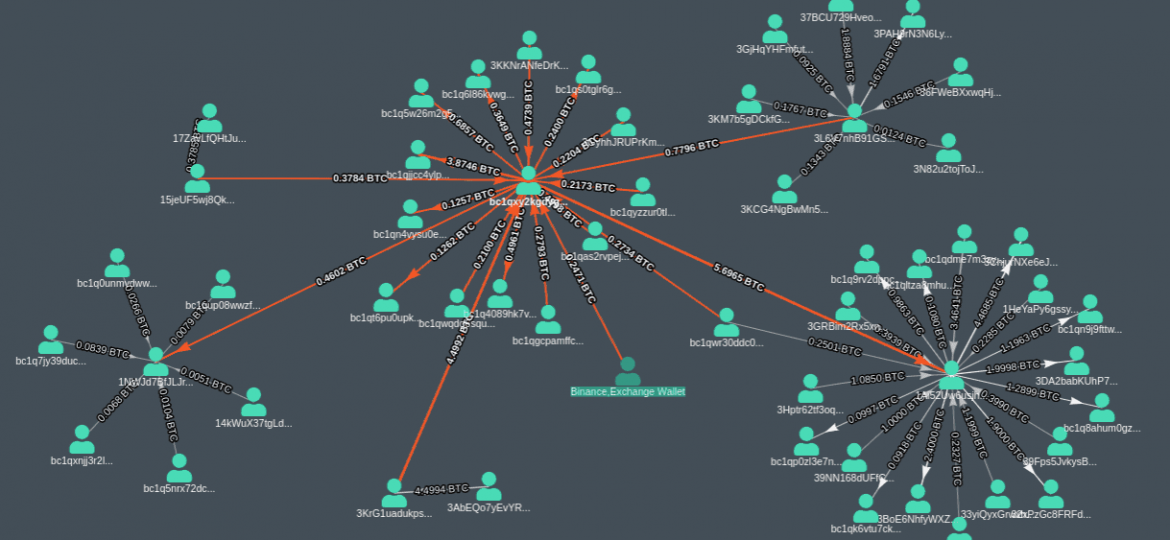
An example of a pseudonymous map is given in the figure below:
Figure 0: Illustrative example of a pseudonymous map using the example
of Bitcoin transactions. Source: Bitquery
In the context of a supply chain in a BPI, the bitcoin values could
be replaced by recursive zero-knowledge proofs. The map allows the BPI
to validate the conformity of all the inputs and business rules of the
supply chain that goes into a BPI State Object with a single proof.
[R23] Testability: A pseudonymous map, such as the
example above, is naturally created by recursively proving the validity
of a chain of commercial transactions using recursive zero-knowledge
proof schemes such as PLONK used in the Aztec Barretenberg
Library and its tests.
2.8 Baseline Protocol
Reference Architecture
This section describes the components of the Baseline Reference
Architecture:
State Synchronization
CCSMs and BPI/CCSM Abstraction Layers
External Applications
Baseline Protocol Stack Detailed Reference Architecture Layers and
Components
2.8.1 State Synchronization
A BPI can be used as a common frame of reference for business
processes that can be used in a complementary way to existing
System-of-Record integrations.
Illustrative High-Level
Example
A Master Services Agreement (MSA) between a Requester (Buyer) and a
Provider (Seller) is implemented on a BPI and contains billing terms,
pricing, discounts, and Seller information such as billing address, etc.
Once established and agreed upon by Buyer and Seller, the BPI provides
state synchronization between Buyer and Seller since the ERP systems for
Buyer and Seller can now refer to mutually agreed-upon data as a common
frame of reference. Based on this mutually agreed-upon state in the MSA,
the Buyer creates an Order in the business workflow based on the MSA and
a cryptographic proof (in zero-knowledge) that confirms not only the
correct application of business logic but also the correct application
of commercial data in the Order creation. This proof is submitted
together with the Order through the BPI and then validated by the Seller
without having to utilize its System of Record for validation using the
BPI. If the proof is validated, the Seller accepts the proposed state
change by generating its cryptographic proof confirming its acceptance
of the state change. The Seller then updates the state of the business
workflow in the BPI and sends the new proof to the Buyer.
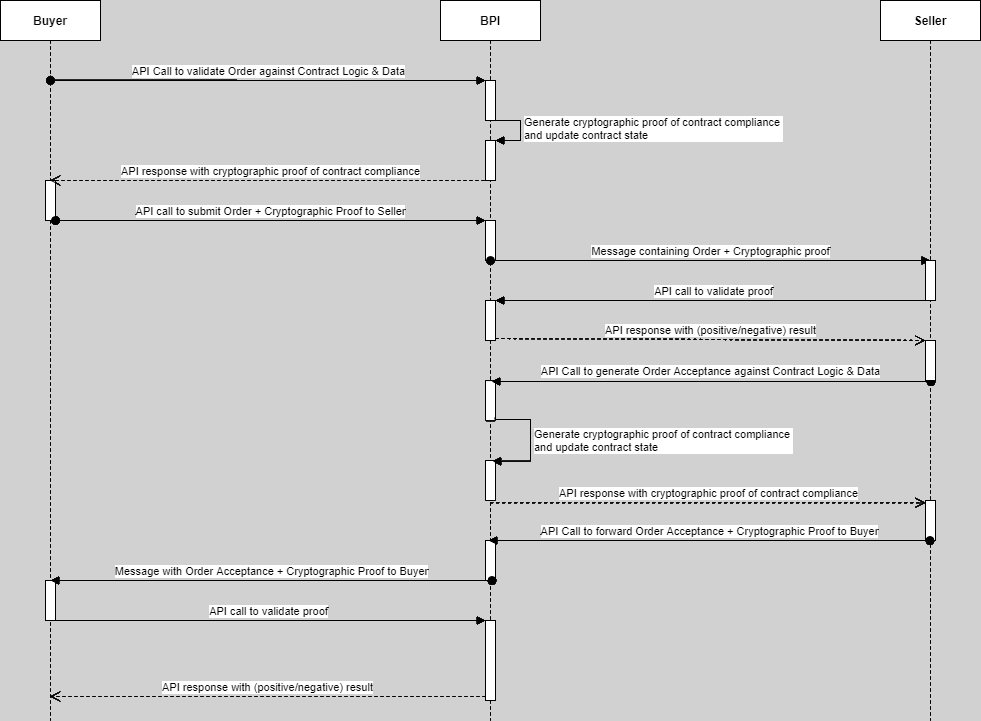
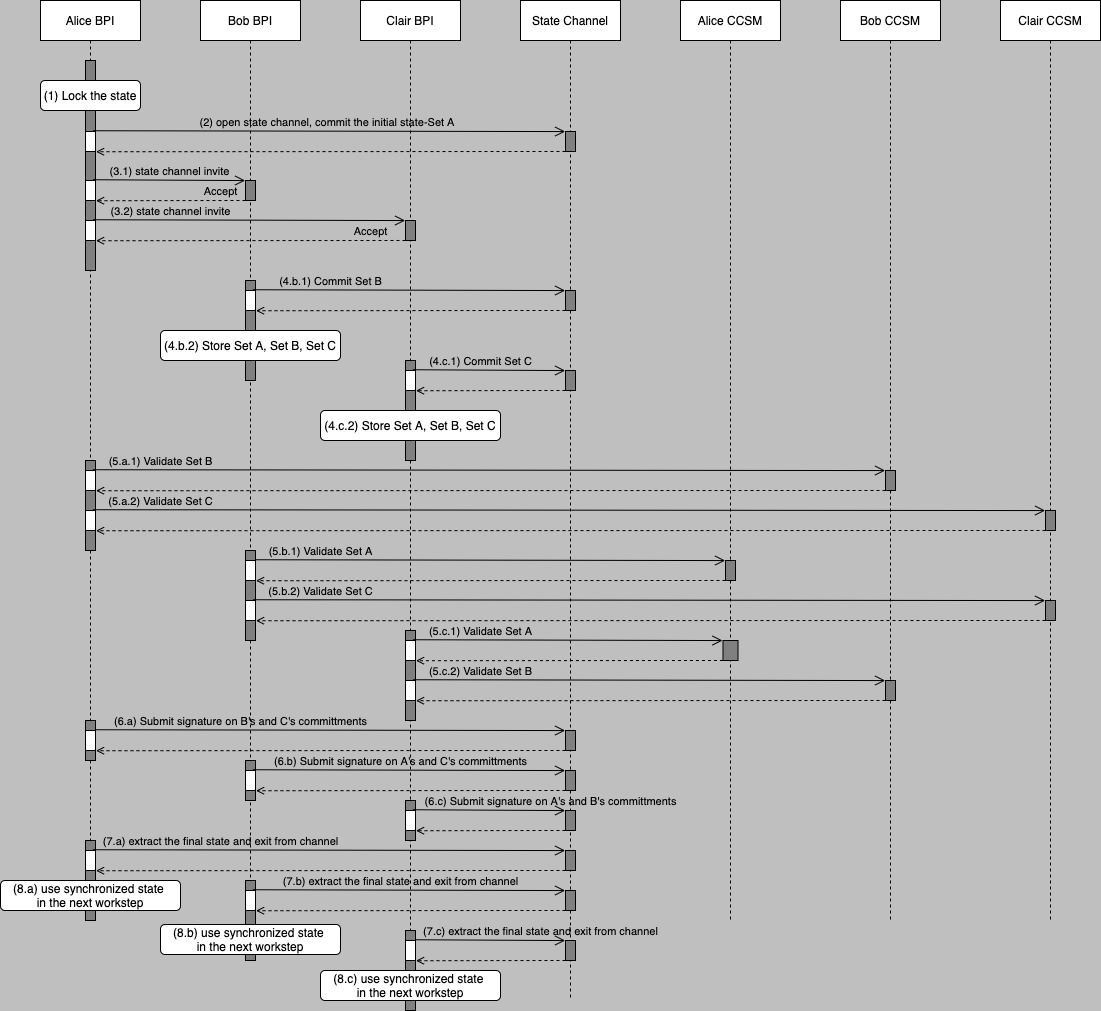
The figure below visually demonstrates high-level Buyer and Seller
Order generation and acceptance assuming that an MSA between Buyer and
Seller already exists and is recorded on a BPI and that the commercial
state has been synchronized up to this workstep in the commercial
business workflow.
Figure 1: Schematic diagram illustrating how the commercial state
between Buyer and Seller is synchronized and an Order created.
Without a BPI, both Buyer and Seller must assume that the MSA between
them and all its values are correctly represented in the other party’s
respective Systems-of-Record. If an order is created based upon the MSA
but does not comply with the MSA, it will likely result in extensive
manual interactions between Seller and Buyer at one stage or another to
resolve the problem to their mutual satisfaction.
[R24]
The transacting counterparties MUST agree on the business process
rules which are represented in the business workflows and worksteps in
the BPI.
[R24] Testability: A BPI can ensure both
counterparties agree on business rules and business data required to
validate the agreement by, for example, utilizing a payment
term agreement between two parties.
[R25]
The transacting counterparties MUST validate the correctness of a
State Object based on a state change against the transaction business
logic in the applicable BPI workflow and workstep.
[R25] Testability: A BPI can validate the
correctness of a State Object based on a state change against
transaction logic by verifying a zero-knowledge proof of the state
change in the BPI, and ultimately on the utilized CCSM. Reference back
to [R16] to understand the verification of a
zero-knowledge proof in a smart contract.
[R26]
The transacting counterparties MUST generate a Proof of Correctness
of a State Object based on a state change that can be validated against
the BPI transaction business logic.
[R26] Testability: This can be accomplished by
creating a privacy
package with Zero-Knowledge Circuits generating Zero-Knowledge
Proofs of the State changes of a State Object.
[R27]
Any new state between counterparties MUST be recorded on the BPI
between them.
[R27] Testability: This can be accomplished by
creating a new entry in the storage of the BPI for the new State, such
as in this example,
which can be queried.
[R28]
Any transacting counterparty having received a Proof of Correctness
of a state change MUST be able to validate that Proof of Correctness
against the BPI between the counterparties.
[R28] Testability: Including a zero-knowledge
proof, public input, and state commitment, together with the prover
scheme, and if required the common reference string, inside the message
payload would enable counterparties to validate the Proof of Correctness
on their own utilizing known libraries for the prover scheme such a
PLONK or Groth16.
[R29]
A transacting counterparty MUST include a Proof of Correctness of the
State Object generated by the state change in the BPI Messages between
the transacting counterparties.
[R29] Testability: A Proof of Correctness of the
State Object can be stored and shared inside a Merkle tree, such as in
this example.
2.8.2
Considerations on BPI and CCSM Abstraction Layers and the CCSM
Layer
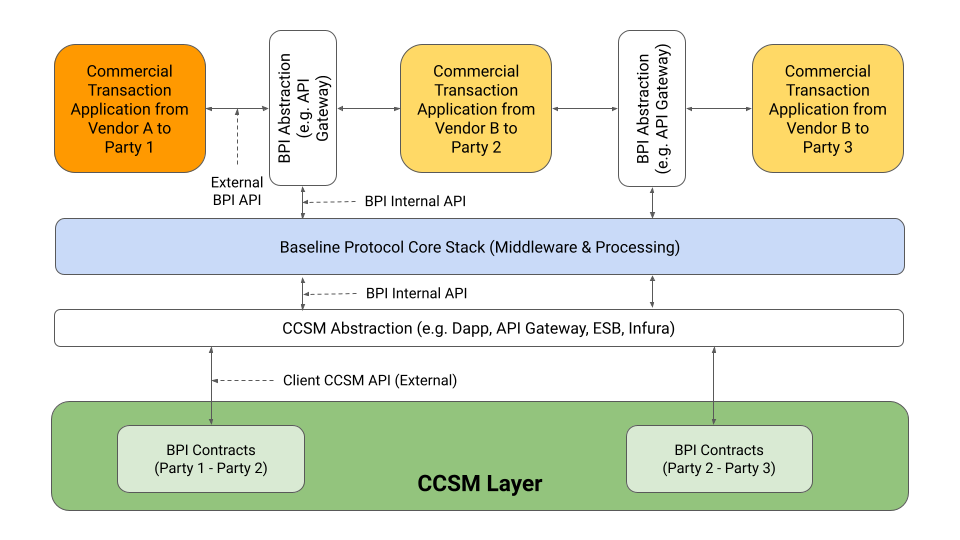
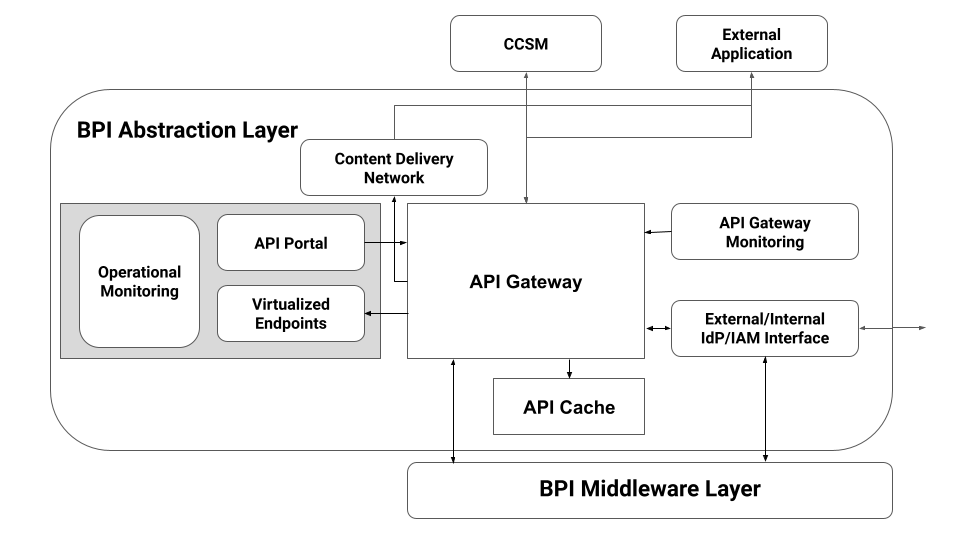
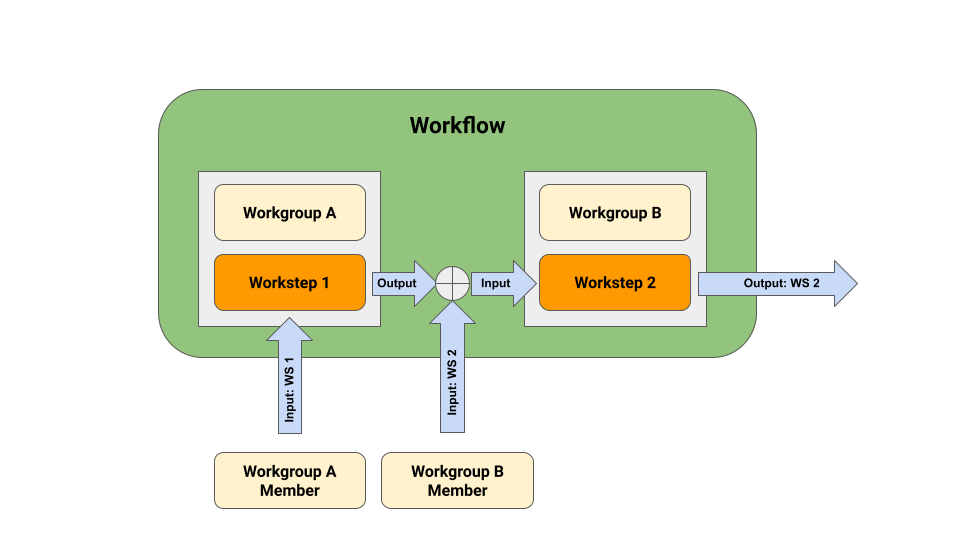
Figure 2: CCSM and BPI Abstraction Architecture
To maintain modularity in the reference architecture, this document
introduces the concept of CCSM and BPI Abstraction. A CCSM or BPI
Abstraction expressed through a BPI or CCSM Abstraction Layer,
constitutes technology applications that wrap capabilities of CCSMs and
BPIs such that these capabilities can be exposed to applications above
the CCSM or BPI Abstraction Layers in a manner that minimizes the
dependency of these applications on the details of a CCSM and BPI –
Figure 2.
The Client CCSM API as an external BPI API is implementation-specific
and will not be discussed further.
[R30]
CCSMs used in the implementation of a BPI MUST support bilateral and
multi-lateral digital representations of contracts as defined in Section 2.4.1.
[R30] Testability: Testability: All requirements
in Section 2.4.1 are testable.
[D8]
A CCSM or BPI Abstraction Layer used in a BPI SHOULD support more
than one CCSM instance.
[D8] Testability: Support for this can come from
the utilization of an adapter, such as in the example code for a simple
Ethereum Adapter given in [R11].
[D9]
A CCSM or BPI Abstraction Layer used in a BPI SHOULD support more
than one CCSM type.
This approach avoids lengthy discussions about which CCSM
protocol to utilize for a BPI, simplifying the decision-making process
considerably if most common CCSMs are incorporated.
Note that irrespective of whether one is in a public or private
CCSM scenario, the protocol settings such as block time, consensus
model, type of execution framework, etc. needs to be agreed upon by
operating entities in some fashion either informally such as in Ethereum or formally such as in the
Trade Finance consortium Komgo.
The agreement on the governance entity, its rules, and its method
of achieving interval synchronization consensus, as well as the
definition of acceptable governance structures and their rules is beyond
the scope of this document.
[D9] Testability: This can be achieved through the
implementation of a new adapter program for each CCSM to add a CCSM into
a BPI. Each adapter program will be different for each CCSM though all
adapter programs will have a constructTx and a sendTransaction function,
which was given in the example in [R11].
[R31]
The transacting counterparties MUST agree on which BPI is to be
used.
[R31] Testability: In order for counterparties to
transact on the same BPI instance, this requirement must have been
fulfilled.
2.8.3 External Applications
[R32]
Application/s providing transaction functionality such as billing to
counterparties, and are, therefore, external concerning the BPI, MUST be
independent of any BPI.
Note, this requirement is motivated by reducing the dependency of
counterparty internal systems on the BPI and vice versa.
[R32] Testability: In an implementation,
counterparties only interact with the BPI utilizing the APIs as defined
by the Baseline Protocol Standard, and not through the integration of
functionalities of external systems directly into a BPI, for example
integrating an API of an ERP system into a BPI.
2.8.4
Baseline Protocol Stack Detailed Reference Architecture Layers and
Components
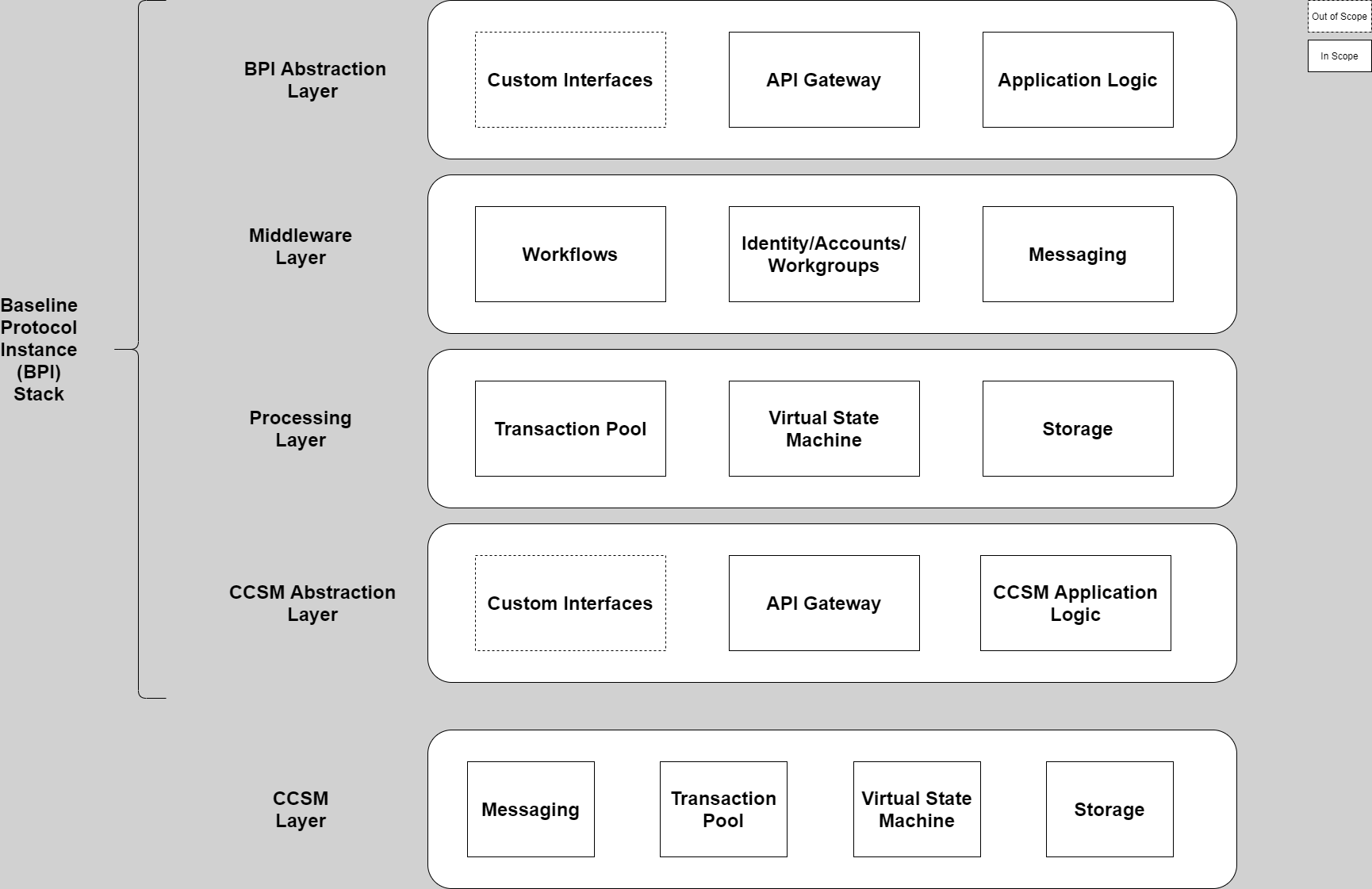
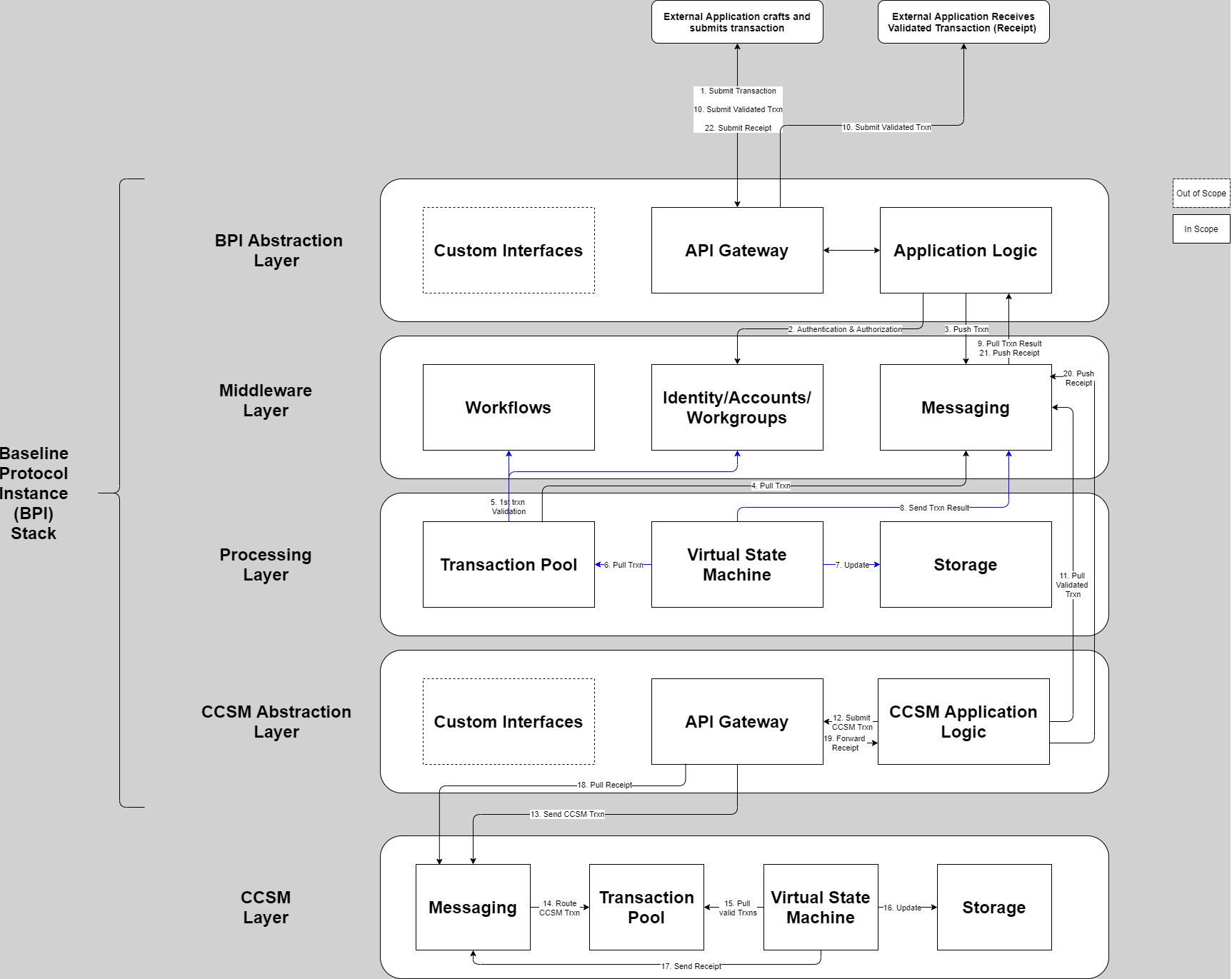
Figure 3: Detailed Baseline Reference Architecture Layers and Components
A Baseline Protocol Stack Reference Architecture as depicted above in
Figure 3 is comprised of the following layers and in the following
order:
Baseline Protocol (BPI) Abstraction Layer: This
layer enables accessing all externally available BPI functions through
APIs as defined in the Baseline Protocol API Standards document
Middleware Layer: This layer manages all
counterparties to an agreement and its associated workflows and
worksteps with business rules and business data as well as all
counterparty delegates. In addition, it manages all messaging between
counterparties to an agreement and instantiation of processing layers
based on newly created or updated agreements and their workflows,
worksteps, business rules, and business data.
Processing Layer: Manages, properly sequences, and
deterministically processes and finalizes in a privacy-preserving,
cryptographically verifiable manner all state change requests from
counterparties to agreements represented in the BPI.
CCSM Abstraction Layer: This layer enables
accessing all required BPI functions implemented on one or more CCSMs
through APIs as defined in the Baseline Protocol API Standards
document.
CCSM Layer: This layer manages, properly sequences,
and deterministically processes in a privacy-preserving,
cryptographically verifiable manner all transactions from the Processing
Layer as well as either deterministically or probabilistically finalizes
on the CCSM all CCSM state transitions based on said transactions.
Below this document lists and defines the components of each layer as
depicted in Figure 3. The detailed requirements for each component will
be discussed in later sections of this document.
BPI Abstraction layer
API Gateway: An API gateway that exposes all
required functionality to the counterparties to an agreement and
enforces all necessary authentication and authorization of API calls as
well as properly directs the API calls within the Baseline Protocol
Stack
Application: The application logic which manages
the pre-processing and routing of all API requests, as well as the
enforcement of authentication and authorization protocols and
rules.
Middleware Layer
Workflows: A Business Process Management engine
that allows for the definition, management, and instantiation of
workflows and worksteps and associated business rules and data based on
agreements between counterparties
Identity/Accounts/Workgroups: A capability that
allows for the identification and management of counterparties and their
delegates as well as members of workflows and worksteps organized in
workgroups that are derived from the counterparties to an
agreement.
Messaging: A messaging capability that allows the
exchange of secure and privacy-preserving messages between
counterparties to an agreement to communicate and coordinate an
agreement on proposed state changes.
Processing Layer
Transaction Pool: one or more transaction pools
that hold, properly sequence, preprocess and batch for processing by the
Virtual State Machine all requested state change transactions of a
BPI.
Virtual State Machine: one or more Virtual State
Machines which deterministically process and finalize in a
privacy-preserving, cryptographically verifiable manner all state change
request transactions.
Storage: A storage system for the cryptographically
linked current and historical state of all agreements in a BPI.
CCSM Abstraction Layer
API Gateway: An API gateway that enables accessing
all required BPI functions implemented on one or more CCSMs, and
properly directs the requests within the CCSM Abstraction layer to the
proper CCSM API application logic.
Application: The CCSM API application logic manages
the pre-processing, as well as the proper usage of the underlying CCSM
and BPI authentication and authorization.
CCSM Layer
Messaging: A messaging capability that allows the
exchange of messages between CCSM nodes that comprise either received
transactions or a new proposed CCSM state.
Transaction Pool: A transaction pool holds,
properly sequences, pre-processes, and batches for processing by the
CCSM Virtual State Machine all submitted CCSM transactions.
Virtual State Machine: A Virtual State Machine
deterministically processes in a cryptographically verifiable manner all
submitted transactions for CCSM state changes.
Storage: A storage system for the cryptographically
linked current and historical state of all CCSM State Objects.
3 Identifiers,
Identity and Credential Management
3.1 Introduction and
High-Level Requirements
Currently, 3rd parties such as Domain
Name Services (DNS) registrars, Internet Corporation for Assigned
Names and Numbers [ICANN], X.509 Certificate
Authorities (see [X.509] and [CA]), or social media companies are responsible for the
creation and management of online identifiers and the secure
communication between them.
As evidenced over the last 20+ years, this design has demonstrated
serious usability and security shortcomings.
When DNS and X.509 Public Key Infrastructure (PKIX) [NIST SP 800-32] was designed, the internet
did not have a way to reliably agree upon the state of a registry (or
database) with no trust assumptions. Consequently, standard bodies
designated trusted 3rd parties (TTP) to manage identifiers and public
keys. Today, virtually all Internet software relies on these
authorities. These trusted 3rd parties, however, are central points of
failure, where each is capable of compromising the integrity and
security of large portions of the Internet. Therefore, once a TTP has
been compromised, the usability of the identifiers it manages is also
compromised.
As a result, companies spend significant resources fighting security
breaches caused by CAs, and public internet communications that are both
truly secure and user-friendly are still out of reach for most.
Given the above, the Baseline Protocol Standard identity approach is
as follows: Every identity is controlled by its Principal Owner and not
by a 3rd party unless the Principal Owner has delegated control to a 3rd
party.
A Principal Owner is defined as the entity controlling the public
key(s) which control the identity and its identifiers.
The Baseline Protocol Standard defines identity in the context of
this document to mean the following:
Identity = <Identifier(s)> + <associated data>
where associated data refers to data describing the characteristics
of the identity that is associated with the identifier(s). An example of
such associated data could be an X.509 issued by a CA.
This approach requires a decentralized, or at least strongly
federated, infrastructure as expressed in the requirements below.
[D10]
The Public Key Infrastructure (PKI) of a BPI SHOULD have no single
point of failure, and SHOULD NOT require pre-existing trust
relationships between participants.*
Baseline Protocol Implementation (BPI) is installed and configured
for testing.
All necessary participants and components are set up and operational
within the BPI.
The PKI component of the BPI is in place.
No pre-existing trust relationships exist between participants.
Test Steps:
Simulate a failure scenario by shutting down one of the PKI
nodes.
Disable all but one PKI node, leaving a single node
operational.
Attempt to establish communication between two BPI participants who
have not previously interacted. Initiate a communication between two
participants who do not have any pre-existing trust relationship.
Expected Results:
The BPI PKI should still be operational without any significant
disruptions or critical failures, demonstrating the absence of a single
point of failure.
The BPI should successfully establish a secure communication channel
between the participants without requiring pre-existing trust
relationships.
[R33]
The PKI of a BPI MUST be strongly federated.
Strongly federated in this context means that there is a known,
finite number of participants, without a single point of failure in the
PKI. However, collusion of a limited number of participants in the
federated infrastructure may still lead to a compromised PKI. The
consensus thresholds required for a change in the infrastructure are out
of scope for this document.
Baseline Protocol Implementation (BPI) is installed and configured
for testing.
All necessary participants and components are set up and operational
within the BPI.
The PKI component of the BPI is in place.
A known, finite number of participants is registered with the
PKI.
There is no single point of failure in the PKI.
Test Steps:
Query the PKI for the list of registered participants.
Have a predefined set of participants attempt to collude and
compromise the PKI.
Review the PKI architecture and configuration to ensure there is no
single point of failure.
Expected Results:
The list should contain a known and finite number of participants,
confirming that the PKI meets the requirement.
The PKI should detect and prevent the collusion, maintaining its
integrity and security.
The PKI architecture should demonstrate resilience against single
points of failure.
[R34]
The identifiers and identity utilized in a BPI MUST be controlled by
its Principal Owner.
For a BPI to properly operate, communication must be trusted and
secure. Communications are secured through the safe delivery of public
keys tied to identities. The Principal Owner of the identity uses a
corresponding secret private key to both decrypt messages sent to them,
and to prove they sent a message by signing it with its private
key.
PKI systems are responsible for the secure delivery of public
keys. However, the commonly used X.509 PKI (PKIX) undermines both the
creation and the secure delivery of these keys.
In PKIX services are secured through the creation of keys signed
by CAs. However, the complexity of generating and managing keys and
certificates in PKIX has caused companies to manage the creation and
signing of these keys themselves, rather than leaving them to their
clients. This creates major security concerns from the outset, as it
results in the accumulation of private keys at a central point of
failure, making it possible for anyone with access to that repository of
keys to compromise the security of connections in a virtually
undetectable way.
The design of X.509 PKIX also permits any of the thousands of CAs
to impersonate any website or web service. Therefore, entities cannot be
certain that their communications are not being compromised by a
fraudulent certificate allowing a PITM (Person-in-the-Middle) attack.
While workarounds have been proposed, good ones do not exist.
Decentralized Public Key Infrastructure (DPKI) has been proposed
as a secure alternative. The goal of DPKI is to ensure that, unlike
PKIX, no single third-party can compromise the integrity and security of
a system employing DPKI as a whole.
Within DPKI, a Principal Owner can be given direct control and
ownership of a globally readable identifier by registering the
identifier for example in a CCSM. Simultaneously, CCSMs allow for the
assignment of arbitrary data such as public keys to these identifiers
and permit those values to be globally readable in a secure manner that
is not vulnerable to the PITM attacks that are possible in PKIX. This is
done by linking an identifier’s lookup value to the latest and most
correct public keys for that identifier. In this design, control over
the identifier is returned to the Principal Owner. Therefore, it is no
longer trivial for any one entity to undermine the security of the
entire DPKI system or to compromise an identifier that is not theirs,
thus, overcoming the challenges of typical PKI.
Furthermore, DPKI requires a public registry of identifiers and
their associated public keys that can be read by anyone but cannot be
compromised. As long as this registration remains valid, and the
Principal Owner can maintain control of their private key, no 3rd party
can take ownership of that identifier without resorting to direct
coercion of the Principal Owner.
Baseline Protocol Implementation (BPI) is installed and configured
for testing.
The Decentralized Public Key Infrastructure (DPKI) component is
integrated into the BPI or available for integration.
All necessary components for secure communication are
operational.
Test Steps:
Examine the BPI configuration to determine if DPKI is present and
properly configured.
Initiate a sample transaction or communication within the BPI and
inspect the methods used for key management and identity
verification.
Review the DPKI documentation and standards.
Expected Results:
The DPKI component should be integrated into the BPI or available
for seamless integration.
The BPI should utilize the DPKI for key management and identity
verification.
The BPI’s use of DPKI should align with the principles and
specifications defined for DPKI.
[CR1]>[D11]
Any Principal Owner in a DPKI system utilized by a BPI MUST be able
to broadcast a message if it is well-formed within the context of the
DPKI.
Other peers in the system do not require admission control. This
implies a decentralized consensus mechanism naturally leading to the
utilization of systems such as CCSMs.
Baseline Protocol Implementation (BPI) is installed and configured
for testing.
The Decentralized Public Key Infrastructure (DPKI) is integrated
into the BPI or available for integration.
A Principal Owner exists within the DPKI system.
The DPKI system is decentralized and utilizes systems such as CCSMs
for consensus.
Test Steps:
The Principal Owner initiates the process of creating and
broadcasting a well-formed message within the context of the DPKI.
Check if other peers within the DPKI system have received the
broadcasted message from the Principal Owner.
Evaluate the architecture and consensus process used within the DPKI
system to ensure it is decentralized.
Expected Results:
The Principal Owner should be able to successfully create and
broadcast a well-formed message without requiring admission control from
other peers.
Expected Result: Other peers should be able to receive the
broadcasted message without requiring admission control.
Expected Result: The DPKI system should employ a decentralized
consensus mechanism, such as the use of systems like CCSMs.
[CR2]>[D11]
Given two or more histories of DPKI updates, any Principal Owner
within a BPI MUST be able to determine which one is preferred due to
security by inspection.
This implies the existence of a method of ascertaining the level
of resources backing a DPKI history such as the hash power in Bitcoin
based on difficulty level and nonce.
Requirements of Identifier registration in DPKI are handled
differently from DNS. Although registrars may exist in DPKI, these
registrars must adhere to several requirements that ensure that
identities belong to the entities they represent. This is achieved the
following way:
Baseline Protocol Implementation (BPI) is installed and configured
for testing.
The Decentralized Public Key Infrastructure (DPKI) is integrated
into the BPI or available for integration.
A Principal Owner has control over their identifier within the
DPKI.
A third party is identified for potential extension of control.
Test Steps:
Access the DPKI registry and verify that the Principal Owner has
control and ownership of their globally readable identifier.
Attempt to extend control of the Principal Owner’s identifier to a
third party as per the requirement.
Access the DPKI registry and inspect the ownership and control of
the extended identifier by the third party.
Expected Results:
The Principal Owner should have direct control and ownership of
their identifier within the DPKI.
The BPI should support the extension of control of the identifier to
a third party, allowing the Principal Owner to grant access and control
to the designated third party.
The third party should have direct control and ownership of the
extended identifier within the DPKI.
[CR6]<[O1]
Extension of control of identifiers to 3rd parties in a BPI MUST be
an explicit, informed decision by the Principal Owner of such
identifiers.
Baseline Protocol Implementation (BPI) is installed and configured
for testing.
Private keys are generated and used within the BPI.
Secure storage and transmission mechanisms are in place for private
keys.
Test Steps:
Review the BPI configuration and settings related to private key
storage.
Initiate a secure transmission of a private key. Attempt to
intercept and compromise the transmission of the private key. Verify the
security of the transmission.
Review the security standards and best practices followed for
private key storage and transmission. Evaluate the BPI’s adherence to
these established security practices.
Expected Results:
Private keys should be stored in a secure manner that is not easily
accessible to unauthorized users.
The private key transmission should be securely encrypted and
resistant to interception or compromise.
The BPI’s handling of private keys should comply with recognized
security standards and best practices.
[CR7]<[D11]
Once a namespace is created within the context of a DPKI, it MUST NOT
be possible to destroy it.
Baseline Protocol Implementation (BPI) is installed and configured
for testing.
A namespace has been created within the context of a Decentralized
Public Key Infrastructure (DPKI) using the BPI.
Secure mechanisms for namespace management are in place.
Test Steps:
Attempt to destroy the previously created namespace.
Check if the previously created namespace still exists and is
accessible.
Expected Results:
The BPI should not allow the destruction of the namespace.
The namespace should be preserved and accessible, and it should not
have been destroyed.
[CR8]<[D11]
Namespaces in a DPKI utilized by a BPI MUST NOT contain blacklisting
mechanisms that would allow anyone to invalidate identifiers that do not
belong to them.
Baseline Protocol Implementation (BPI) is installed and configured
for testing.
A namespace exists within the context of a Decentralized Public Key
Infrastructure (DPKI) using the BPI.
Secure mechanisms for namespace management are in place.
Test Steps:
Review the configuration and settings of the namespace within the
DPKI to check for the presence of blacklisting mechanisms.
Attempt to use the namespace or associated functionality to
invalidate an identifier that does not belong to the user.
Expected Results:
The namespace should not contain any blacklisting mechanisms that
would allow anyone to invalidate identifiers that do not belong to
them.
Expected Result: The BPI should not allow the invalidation of
identifiers that do not belong to the user, confirming the absence of
blacklisting mechanisms.
[CR9]<[D11]
The rules for registering and renewing identifiers in a DPKI utilized
by a BPI MUST be transparent and expressed in simple terms.
Baseline Protocol Implementation (BPI) is installed and configured
for testing.
A Decentralized Public Key Infrastructure (DPKI) is integrated into
the BPI or available for integration.
Rules for registering and renewing identifiers within the DPKI are
established.
Test Steps:
Review the documentation or configuration that defines the rules for
identifier registration.
Review the documentation or configuration that defines the rules for
identifier renewal.
Expected Results:
The rules for registering identifiers should be transparent and
expressed in simple terms that are easily understandable.
The rules for renewing identifiers should be transparent and
expressed in simple terms that are easily understandable.
[R36]
If registration is used as security to an expiration policy, the
Principal Owner MUST be explicitly and timely warned that failure to
renew the registration on time could result in the Principal Owner
losing control of the identifier.
Baseline Protocol Implementation (BPI) is installed and configured
for testing.
Principal Owners are registered within the BPI.
An expiration policy linked to registration exists within the
BPI.
The BPI includes mechanisms for sending warnings to Principal
Owners.
Timely warning thresholds are defined for registration
expiration.
Test Steps:
Review the configuration and settings within the BPI to check for
the existence of an expiration policy linked to registration.
Verify that the BPI specifies the time frame within which Principal
Owners will be warned about impending registration expiration.
Review the documentation or configuration to understand how warnings
are delivered to Principal Owners.
Trigger a scenario where a Principal Owner’s registration is nearing
expiration and observe the warning mechanism in action.
Expected Results:
The BPI should have a registration expiration policy in place.
Timely warning thresholds should be clearly defined.
The BPI should have mechanisms in place to send warnings to
Principal Owners.
The Principal Owner should receive an explicit and timely warning
about the impending expiration, explicitly stating that failure to renew
on time could result in loss of control of the identifier.
[CR10]>[D11]
Once set, namespace rules within a DPKI utilized by a BPI MUST NOT be
altered to introduce any new restrictions for renewing or updating
identifiers.
Otherwise, it would be possible to take control of identifiers
away from Principal Owners without their consent.
Baseline Protocol Implementation (BPI) is installed and configured
for testing.
A namespace exists within the context of a Decentralized Public Key
Infrastructure (DPKI) using the BPI.
Namespace rules are established for renewing or updating identifiers
within the DPKI.
Secure mechanisms for managing namespace rules are in place.
Test Steps:
Review the documentation or configuration that defines the current
namespace rules.
Attempt to alter the existing namespace rules to introduce new
restrictions for renewing or updating identifiers.
Expected Results:
The existing namespace rules should be documented and stable.
The BPI should not allow the alteration of namespace rules to
introduce new restrictions for renewing or updating identifiers.
[CR11]>[D11]
Within a DPKI utilized by a BPI, processes for renewing or updating
identifiers MUST NOT be modified to introduce new restrictions for
updating or renewing an identifier, once issued.
Baseline Protocol Implementation (BPI) is installed and configured
for testing.
A Decentralized Public Key Infrastructure (DPKI) is integrated into
the BPI or available for integration.
Processes for renewing or updating identifiers within the DPKI are
established.
Secure mechanisms for managing identifier renewal and updates are in
place.
Test Steps:
Examine the existing processes for renewing or updating identifiers
within the DPKI.
Attempt to modify the existing processes for identifier renewal and
updates to introduce new restrictions.
Expected Results:
The existing processes for renewing or updating identifiers should
be documented and stable.
The BPI should not allow the modification of processes to introduce
new restrictions for renewing or updating an identifier once it has been
issued.
[CR12]>[D11]
Within a DPKI utilized by a BPI, all network communications for
creating, updating, renewing, or deleting identifiers MUST be sent via a
non-centralized mechanism.
This is necessary to ensure that a single entity cannot prevent
identifiers from being updated or renewed.
Baseline Protocol Implementation (BPI) is installed and configured
for testing.
A Decentralized Public Key Infrastructure (DPKI) is integrated into
the BPI or available for integration.
Processes for creating, updating, renewing, or deleting identifiers
within the DPKI are established.
Secure non-centralized network communication mechanisms are in
place.
Test Steps:
Examine the network communication mechanisms used for creating,
updating, renewing, or deleting identifiers within the DPKI.
Ensure that communications are not centralized through a single
point or entity.
Expected Results:
All network communications related to identifier management should
follow a non-centralized path, avoiding single points of failure.
3.2
BPI Identifiers, Identities and Credentials, and their Management
Building on the requirements in section 3.1 Introduction and
High-Level Requirements, this section focuses on identifiers,
identities, and credentials used within a BPI or a network of BPIs. Note
that BPI interoperability - which will be discussed in section 5 Middleware,
Communication and Interoperability - is predicated on known,
discoverable, and identifiable approaches to how identifiers and
credentials are created, updated, revoked, and deleted and how
standardized identity frameworks are related to those identifiers and
credentials utilized in one or more BPIs.
In the following, this document will use Requester and Provider as
established in this document to refer to the entities making and those
receiving requests.
3.2.1 BPI Identifiers
Uniqueness and security of BPI identifiers are very important to
unambiguously identify entities interacting with and through one or more
BPIs and keep those interactions secure. Furthermore, to facilitate
automation and real-time interactions within and through a BPI, the
discovery of identifiers and an ability to resolve them to the
underlying public keys that secure them is also critical.
[R37]
Requester and Provider interacting with and through a BPI, as well as
any BPI Operator, MUST each have a unique identifier.
Baseline Protocol Implementation (BPI) is installed and configured
for testing.
Unique identifiers are assigned to entities within the BPI (e.g.,
Requesters, Providers, BPI Operators).
Public keys are generated and available for association with
identifiers.
Secure mechanisms for associating public keys with identifiers are
in place.
Test Steps:
Review the identifiers assigned to entities within the BPI and check
if each identifier is associated with a set of public keys.
Attempt to disassociate public keys from an identifier within the
BPI.
Expected Results:
Each unique identifier within the BPI should be associated with the
appropriate set of public keys.
The BPI should not allow the disassociation of public keys from an
identifier, ensuring that all identifiers remain associated with their
respective public keys.
[R39]
Any unique identifier utilized within a BPI MUST be discoverable by
any 3rd party within said BPI.
Baseline Protocol Implementation (BPI) is installed and configured
for testing.
Unique identifiers are assigned to entities within the BPI (e.g.,
Requesters, Providers, BPI Operators).
Secure mechanisms for identifier discoverability are in place.
Test Steps:
Review the identifiers assigned to entities within the BPI and
confirm that unique identifiers can be discovered by any 3rd party
participant within the BPI.
Attempt to configure or test scenarios where unique identifiers
cannot be discovered by any 3rd party within the BPI.
Expected Results:
Each unique identifier within the BPI should be discoverable by any
3rd party participant without any access restrictions.
The BPI should not allow configurations or scenarios that restrict
or prevent the discoverability of unique identifiers by any 3rd party
participant.
[R40]
Any unique identifier utilized within a BPI MUST be resolvable to its
associated public keys used for cryptographic authentication of the
unique identifier.
Baseline Protocol Implementation (BPI) is installed and configured
for testing.
Unique identifiers are assigned to entities within the BPI (e.g.,
Requesters, Providers, BPI Operators).
Each identifier is associated with its corresponding set of public
keys used for cryptographic authentication.
Secure mechanisms for identifier resolution are in place.
Test Steps:
Review the unique identifiers assigned to entities within the BPI
and confirm that each identifier is associated with its corresponding
set of public keys used for cryptographic authentication.
Attempt to configure or test scenarios where unique identifiers
cannot be resolved to their associated public keys.
Expected Results:
Each unique identifier within the BPI should have an established
association with its corresponding set of public keys.
The BPI should not allow configurations or scenarios that disrupt or
prevent the resolution of unique identifiers to their associated public
keys.
[R41]
Any unique identifier utilized within a BPI MUST be resolvable to an
endpoint as a URI that identifies the Baseline Protocol Standard as a
supported protocol including the supported version(s).
Baseline Protocol Implementation (BPI) is installed and configured
for testing.
Unique identifiers are assigned to entities within the BPI (e.g.,
Requesters, Providers, BPI Operators).
Each identifier is associated with an endpoint URI that identifies
the Baseline Protocol Standard as a supported protocol, including
supported version(s).
Secure mechanisms for identifier resolution to URIs are in
place.
Test Steps:
Inspect the records or configuration to ensure that each identifier
can be resolved to a URI with the required protocol information.
Initiate processes or configurations that disrupt or prevent the
resolution of identifiers to URIs with the required protocol
information.
Expected Results:
Each unique identifier within the BPI should have an associated
endpoint URI that correctly identifies the Baseline Protocol Standard as
a supported protocol, including supported version(s).
The BPI should not allow configurations or scenarios that disrupt or
prevent the resolution of unique identifiers to URIs with the required
protocol information.
[R42]
Any unique identifier utilized within a BPI MUST be resolvable to an
endpoint as a URI that allows for BPI messaging.
Baseline Protocol Implementation (BPI) is installed and configured
for testing.
Unique identifiers are assigned to entities within the BPI (e.g.,
Requesters, Providers, BPI Operators).
Each identifier is associated with an endpoint URI that allows for
BPI messaging.
Secure mechanisms for identifier resolution to BPI messaging URIs
are in place.
Test Steps:
Review the unique identifiers assigned to entities within the BPI
and confirm that each identifier is resolvable to an endpoint URI that
allows for BPI messaging.
Attempt to configure or test scenarios where unique identifiers
cannot be resolved to URIs that allow for BPI messaging.
Expected Results:
Each unique identifier within the BPI should have an associated
endpoint URI that enables BPI messaging, ensuring that BPI-related
communication can occur.
The BPI should not allow configurations or scenarios that disrupt or
prevent the resolution of unique identifiers to URIs capable of
facilitating BPI messaging.
[D12]
Any unique identifier utilized within a BPI SHOULD follow the W3C DID
Core specification [W3C DID].
Baseline Protocol Implementation (BPI) is installed and configured
for testing.
Unique identifiers are assigned to entities within the BPI (e.g.,
Requesters, Providers, BPI Operators).
There is a requirement to follow the W3C DID Core specification for
these identifiers.
Secure mechanisms for handling and validating W3C DID-compliant
identifiers are in place.
Test Steps:
Review the unique identifiers assigned to entities within the BPI
and confirm that they follow the format specified in the W3C DID Core
specification.
Attempt to configure or use identifiers that do not comply with the
W3C DID Core specification.
Expected Results:
Each unique identifier within the BPI should follow the format
prescribed by the W3C DID Core specification.
The BPI should not allow configurations or scenarios that result in
the use of identifiers that do not comply with the W3C DID Core
specification.
3.2.2 BPI Identities and
Credentials
After having discussed the minimal set of requirements on identifiers
utilized in a BPI, it is important to discuss how these relate to
identity and claims about facts relevant to Requester, Provider, and BPI
Operator, also called credentials.
Before this document can discuss requirements it needs to establish
the scope of identity and credential management within the context of a
BPI.
In the figure below, this document establishes the context and scope
of identity and credential management for a BPI.
Figure 4: Schematic delineation of the Identity and Credential scope of
a BPI; Source: Oliver Terbu (ConsenSys)
As depicted, identities and credentials are established outside of
the context, and, therefore, the scope of a BPI. Hence, it is incumbent
on BPI participants – Requesters, Providers, and, if distinct, Operators
– to establish the trust context of acceptable identities and
credentials for a BPI. This statement also applies to a network of BPIs
which are to interoperate with one another.
[D13]
A unique identifier utilized within one or more BPIs SHOULD be linked
to an entity accepted by BPI participants through a cryptographically
signed, cryptographically verifiable, and cryptographically revocable
credential based on the public keys associated with the unique
identifier of the credential issuer.
An entity can be a Legal Entity where Legal Entity is an
individual, organization, or company that has legal rights and
obligations.
Note that credentials utilized within one or more BPIs may be
self-issued. The acceptance of self-issued credentials is up to the BPI
participants that need to rely on the claim(s) within a self-issued
credential.
Baseline Protocol Implementation (BPI) is installed and configured
for testing.
Unique identifiers are assigned to (Legal) Entities within the
BPI.
Cryptographically signed credentials are issued and associated with
unique identifiers.
The credentials have a subject field that designates the unique
identifier of the (Legal) Entity.
Entities are accepted by BPI participants based on the associated
credentials.
Test Steps:
Review the credential details and data to verify that the subject
field accurately matches the unique identifier of the (Legal)
Entity.
Attempt to validate credentials by verifying that the subject field
matches the unique identifier of the (Legal) Entity.
Expected Results:
The subject field of each credential should correctly designate the
unique identifier of the associated (Legal) Entity.
Validated credentials should pass the check, confirming that the
subject field matches the unique identifier of the (Legal) Entity.
[R44]
The unique identifier of the issuer of the (Legal) Entity credential
utilized in one or more BPIs MUST have a credential linking the unique
identifier of the issuer to an (Legal) Entity accepted by the
participants within aforementioned BPIs.
Baseline Protocol Implementation (BPI) is installed and configured
for testing.
Unique identifiers are assigned to (Legal) Entities within the
BPI.
Cryptographically signed credentials are issued and associated with
unique identifiers.
The credentials have a subject field designating the unique
identifier of the (Legal) Entity.
There is an issuer credential associated with the (Legal) Entity
issuer’s unique identifier.
Entities are accepted by BPI participants based on the associated
credentials.
Test Steps:
Review the BPI configuration and data to ensure that an issuer
credential exists for the issuer’s unique identifier.
Confirm that the (Legal) Entity issuer’s unique identifier is
accepted by BPI participants based on the issuer credential associated
with it.
Attempt to revoke the issuer credential and confirm that BPI
participants no longer accept the (Legal) Entity issuer’s unique
identifier.
Expected Results:
An issuer credential should be available for the specified issuer’s
unique identifier.
Entities linked to the (Legal) Entity issuer’s unique identifier
through the issuer credential should be accepted by BPI participants for
interactions.
Entities associated with the revoked issuer credential should not be
accepted by BPI participants for interactions.
[D14]
A credential utilized within one or more BPIs SHOULD follow the W3C
Verifiable Credential Standard [W3C VC].
Baseline Protocol Implementation (BPI) is installed and configured
for testing.
Credentials are used within the BPI for entities, issuers, or other
purposes.
There is a requirement for these credentials to follow the W3C
Verifiable Credential Standard.
Cryptographically signed, verifiable, and revocable credentials are
supported within the BPI.
Test Steps:
Review the credential details and data to verify that they comply
with the requirements of the W3C Verifiable Credential Standard.
Attempt to configure or use credentials that do not comply with the
W3C Verifiable Credential Standard.
Expected Results:
Credentials within the BPI should follow the format and standards
prescribed by the W3C Verifiable Credential Standard.
The BPI should not allow configurations or scenarios that result in
the use of credentials that do not comply with the W3C Verifiable
Credential Standard.
[R45]
A credential utilized within one or more BPIs MUST itself have a
unique and resolvable identifier. Note, that the unique and resolvable identifier of a credential does
not have to be associated with any cryptographic keys.
Baseline Protocol Implementation (BPI) is installed and configured
for testing.
Credentials are used within the BPI for entities, issuers, or other
purposes.
There is a requirement for these credentials to have a unique and
resolvable identifier.
Cryptographically signed, verifiable, and revocable credentials are
supported within the BPI.
Test Steps:
Review the credential details and data to verify that each
credential has a unique and resolvable identifier.
Attempt to configure or use credentials that do not have a unique
and resolvable identifier.
Expected Results:
Each credential within the BPI should have a unique and resolvable
identifier.
The BPI should not allow configurations or scenarios that result in
the use of credentials without a unique and resolvable identifier.
[R46]
If present, the status of a credential utilized within one or more
BPIs MUST be discoverable by a party verifying the credential, the
credential verifier.
In the context of this document, a credential verifier is defined
per the W3C Verifiable Credential Standard [W3C
VC].
Baseline Protocol Implementation (BPI) is installed and configured
for testing.
Credentials are used within the BPI for entities, issuers, or other
purposes.
There is a requirement for the status of these credentials to be
discoverable by a party verifying the credential, the credential
verifier.
Cryptographically signed, verifiable, and revocable credentials are
supported within the BPI.
Test Steps:
Review the credential details and data to verify that the status of
each credential is discoverable by a credential verifier.
Attempt to configure or use credentials for which the status cannot
be discovered by a party verifying the credential.
Expected Results:
The status of each credential within the BPI should be discoverable
by a party verifying the credential, as per the requirements of the W3C
Verifiable Credential Standard.
The BPI should not allow configurations or scenarios that result in
the use of credentials for which the status cannot be discovered by a
credential verifier, as required.
[D15]
A credential utilized within one or more BPIs SHOULD be discoverable
by a participant in said BPI(s).
Credential discoverability in the context of this document means
that a BPI Subject can discover credentials of other BPI Subjects
utilized within a BPI or across BPIs, if relevant for BPI
interoperability.
Note that discoverability can be restricted based on privacy and
/ or security rules within a given BPI. Discoverability could be
achieved for example through a credential registry within a BPI or by
listing a credential access endpoint in the DID document of a BPI
Subject.
Baseline Protocol Implementation (BPI) is installed and configured
for testing.
Credentials are used within the BPI for entities, issuers, or other
purposes.
There is a requirement for credentials to be discoverable by
participants within the BPI(s) as specified in the requirement.
Cryptographically signed, verifiable, and revocable credentials are
supported within the BPI.
Privacy and security rules governing discoverability are defined
within the BPI.
Test Steps:
Review the BPI configuration, credential details, and any relevant
privacy and security rules to verify that credentials can be discovered
by participants within the BPI(s).
Attempt to configure or use credentials in scenarios where their
discoverability is restricted based on privacy and security rules within
the BPI.
Expected Results:
The BPI should support discoverability of credentials by
participants within the BPI(s) according to the specified privacy and
security rules.
The BPI should enforce the privacy and security rules to restrict
discoverability of credentials as per the configured scenarios.
[R47]
The presentation of a credential utilized within one or more BPIs
MUST be cryptographically signed by the presenter of the credential,
also known as the holder.
See the W3C Verifiable Credential Standard [W3C
VC] for a definition of credential holder [Holder].
Baseline Protocol Implementation (BPI) is installed and configured
for testing.
Credentials are used within the BPI for entities, issuers, or other
purposes.
There is a requirement that the presentation of credentials must be
cryptographically signed by the presenter (holder).
Cryptographically signed, verifiable, and revocable credentials are
supported within the BPI.
Test Steps:
Perform a credential presentation process and examine the presented
credential to verify that it is cryptographically signed by the
presenter (holder).
Attempt to configure or use a credential presentation process where
the presented credential is not cryptographically signed by the
presenter (holder).
Expected Results:
The presented credential should include a valid cryptographic
signature by the presenter (holder).
The BPI should not allow configurations or scenarios that result in
the presentation of unsigned credentials.
[R48]
If a credential holder is a BPI participant, the holder MUST have a
unique identifier that has been established within the context the
holder operates in.
Baseline Protocol Implementation (BPI) is installed and configured
for testing.
A credential holder is a BPI participant.
The BPI participant is operating within a specific context or
environment.
Test Steps:
Examine the BPI participant’s credentials or information to
determine if a unique identifier is present.
Check for any duplicates or conflicting identifiers within the same
context.
Expected Results:
The BPI participant should have a unique identifier established
within their operating context.
The identifier should be unique and not conflict with identifiers of
other participants in the same context.
As discussed in section 3.1 Introduction and
High-Level Requirements, BPIs require either decentralized or
strongly federated identifier/identity providers that have been agreed
to by the participants in a BPI context of one or more BPIs.
Figure 5: Example of a Delineation of the Identity and Credential
issuing authorities used in a BPI and their management within a BPI
using Decentralized Identity Verifiers and OpenID Connect Relying Party
as examples; Source: Oliver Terbu (ConsenSys)
As depicted in Figure 5 above, the accepted Entity identity
credentials, or other credentials from Identity providers, that are
presented by a BPI participant need to be verified by the BPI against
the issuing providers. Once validated, credentials are stored in the
BPI.
OpenId Connect Identity Provider [OIDC] is an
example for a federated identity provider and a DID or Verifiable
Credentials Registry which is typically built using a CCSM as an example
of a decentralized identity provider.
For a BPI to achieve these objectives, the following requirements
need to be met:
[R49]
A unique identifier utilized in a BPI MUST be stored by the BPI.
Baseline Protocol Implementation (BPI) is installed and configured
for testing.
A unique identifier is generated or used within the BPI for
entities, issuers, or other purposes.
There is a requirement that the BPI must store the unique
identifier.
Test Steps:
Generate or use a unique identifier within the BPI.
Examine the BPI’s data storage components and records to verify that
the unique identifier is stored by the BPI.
Query the BPI’s data storage to retrieve the stored unique
identifier.
Expected Results:
The BPI should successfully generate or utilize the unique
identifier.
The unique identifier should be present in the BPI’s storage,
confirming that it is stored as required.
The BPI should provide a valid response with the retrieved unique
identifier, confirming that it is stored and retrievable.
[R50]
The Principal Owner or their delegates MUST prove control over a
unique identifier utilized in a BPI every time said unique identifier is
used in the BPI by the Principal Owner or their delegates.
Baseline Protocol Implementation (BPI) is installed and configured
for testing.
A unique identifier is generated or used within the BPI for
entities, issuers, or other purposes.
There is a requirement that the Principal Owner or their delegates
must prove control over the unique identifier every time it is
used.
Test Steps:
Create or utilize a unique identifier within the BPI.
Initiate an action or transaction within the BPI that involves the
use of the unique identifier by the Principal Owner or their
delegates.
Test Action: Repeat Step 2 for multiple actions or transactions
within the BPI, ensuring that control over the unique identifier is
verified every time it is used.
Expected Results:
The BPI should successfully generate or utilize the unique
identifier.
The Principal Owner or their delegates should be able to prove
control over the unique identifier as required.
The Principal Owner or their delegates should be able to
consistently prove control over the unique identifier for each action or
transaction.
[R51]
Every time a unique identifier utilized in a BPI is used in the BPI
by the Principal Owner or their delegates, the BPI MUST verify that the
Principal Owner or their delegates are in control of said unique
identifier.
Note that proof of control might be performed by a relying party
if authority has been delegated.
In the context of this document, a relying party is defined per
the W3C Verifiable Credential Standard] [W3C
VC].
Baseline Protocol Implementation (BPI) is installed and configured
for testing.
A unique identifier is generated or used within the BPI for
entities, issuers, or other purposes.
There is a requirement that every time the unique identifier is used
by the Principal Owner or their delegates in the BPI, the BPI must
verify their control over it.
Authority delegation mechanisms are in place, allowing relying
parties to perform control verification when authority has been
delegated.
Test Steps:
Generate or use a unique identifier within the BPI.
Perform an action or transaction within the BPI involving the unique
identifier.
Perform additional actions or transactions within the BPI involving
the unique identifier.
Expected Results:
The BPI should successfully generate or utilize the unique
identifier.
The BPI or relying party (if delegated) should be able to confirm
control over the unique identifier as required.
The BPI or relying party (if delegated) should be able to
consistently confirm control over the unique identifier for each action
or transaction.
[D16]
A credential utilized in a BPI SHOULD be stored in the BPI.
This avoids the re-presentation of the credential after the
initial presentation as long as those credentials are valid.
Baseline Protocol Implementation (BPI) is installed and configured
for testing.
A credential is generated or utilized within the BPI for entities,
issuers, or other purposes.
There is a requirement that the credential holder must prove control
over the credential every time it is presented to the BPI or a BPI
Participant.
Test Steps:
Test Action: Generate or use a credential within the BPI.
Perform an action or transaction within the BPI involving the
presentation of the credential.
Perform additional actions or transactions within the BPI involving
the presentation of the credential.
Expected Results:
The BPI should successfully generate or utilize the credential.
The credential holder should be able to prove control over the
credential as required.
The credential holder should be able to consistently prove control
over the credential for each action or transaction.
[R53]
Every time a credential utilized in a BPI is used in the BPI by its
holder, the BPI MUST verify credential integrity, schema conformance,
and that the credential holder is in control of said credential.
Note that credential content verification can only be done
through the inspection of underlying documentation or verification by
the issuer such as an OpenId Connect Identity Provider [OIDC].
Baseline Protocol Implementation (BPI) is installed and configured
for testing.
A credential is generated or utilized within the BPI for entities,
issuers, or other purposes.
There is a requirement that every time the credential is used by its
holder in the BPI, the BPI must verify credential integrity, schema
conformance, and that the credential holder is in control of the
credential.
Test Steps:
Generate or use a credential within the BPI.
Perform an action or transaction within the BPI involving the
presentation of the credential.
Perform additional actions or transactions within the BPI involving
the presentation of the credential.
Expected Results:
The BPI should successfully generate or utilize the credential.
The BPI should successfully verify the integrity of the credential,
verify schema conformance of the credential, and confirm that the
credential holder is in control of the credential.
The BPI should consistently verify credential integrity, schema
conformance, and control for each action or transaction.
4 BPI Abstraction Layers
BPI Abstraction Layers are the critical umbilical cords of a BPI to
its underlying CCSM and external applications such as System of Records
or other BPIs.
It is, therefore, critical to carefully craft the requirements on
these layers of a BPI in such a way that allows implementers sufficient
flexibility, while leveraging established standards and ensuring
interoperability through a well-defined, minimal set of interfaces and
capabilities.
Since a BPI has two abstraction layers – the BPI and the CCSM
Abstraction Layer – the document will define a set of common
requirements and differentiate between the two where necessary.
4.1 BPI Abstraction Scope
and Components
The Abstraction layers define common standards and processes such as
Information Models, APIs and API formats, Process Flows, Roles,
Responsibilities, Events, etc. for exposing and managing all BPI
capabilities that represent individual steps of the BPI lifecycle
processes. This includes but is not limited to:
Specifying BPI functional capabilities aligned with already existing
common API definitions
Onboarding, publishing, upgrading, and retiring BPI APIs and BPI
capabilities
Coexistence and interoperability with legacy platforms and different
BPI stacks
This document defines an Abstraction Layer within the context of a
BPI as a set of functions and procedures allowing the interaction of
BPI-enabled applications that access the features or data of an
operating system, application, or other services with BPI
capabilities.
[R54]
BPI Abstraction Layers MUST support Operational Monitoring of an API
system.
In the context of this document, an operational monitoring system
of BPI APIs refers to the practice of monitoring APIs, most commonly in
production, to gain visibility into performance, availability, and
functional correctness. These types of systems are designed to help a
BPI operator analyze the performance of BPI applications and improve
performance. Examples are measurements of how long a service takes to
execute, how often it is called, where it is called from, and how much
of the total time is spent executing the service.
A Baseline Protocol Implementation (BPI) is installed and
operational.
The BPI includes a set of abstraction layers, including Application
Layer, Middleware and Communication Layer, Smart Contracts Layer, Data
and Privacy Layer, Verifiable Credentials Layer, Consensus and
Blockchain Layer, and Network and Transport Layer.
The BPI includes an API system for communication and interaction
with participants.
Test Steps:
Examine each of the BPI’s abstraction layers to confirm whether they
have implemented support for operational monitoring of the API
system.
Check how the abstraction layers integrate with the operational
monitoring features of the API system.
Perform interactions or transactions using the BPI components and
record the data generated by the operational monitoring features.
Expected Results:
Each abstraction layer should include operational monitoring
features that allow tracking and analysis of API system performance and
behavior.
Abstraction layers should seamlessly integrate with the API system’s
operational monitoring features to provide real-time data and
insights.
The monitoring system should accurately capture and display
operational data, including response times, error rates, and other
relevant metrics.
[R55]
BPI Abstraction Layers MUST support an API Portal for
provisioning.
A BPI API portal in the context of this document is defined as a
visual or a programmatic presentation that provides information about an
API at every stage of its lifecycle. A BPI API portal allows operators
to expose, document, provision access, and otherwise enable their APIs,
and users of those APIs to register applications, reset credentials,
provide API feedback, report bugs, etc. A non-normative example of a
minimal set of functionalities can be found here [API Portal Functionality]
A Baseline Protocol Implementation (BPI) is installed and
operational.
The BPI includes multiple abstraction layers.
An API Portal, as described in the requirement, is integrated into
the BPI.
Test Steps:
Confirm that the BPI’s abstraction layers support the integration of
the API Portal as described in the requirement.
Interact with the API Portal to perform actions such as API
provisioning, documentation access, registration of applications,
credential resets, providing feedback, and reporting bugs.
Review each abstraction layer to confirm that it provides the
necessary support and data exchange mechanisms for the API Portal’s
functionalities
Expected Results:
The API Portal is successfully integrated and supported by the
abstraction layers.
The API Portal functionalities should work as intended, allowing
users to perform these actions.
Each abstraction layer should support the API Portal’s
functionalities and data exchange.
[R56]
BPI Abstraction Layers MUST support an API Gateway that does not have
Material Impact on BPI latency.
In the context of this document, an API gateway is an application
or software pattern that sits in front of an API or a collection of
microservices, facilitating requests and delivery of data and services.
Its main function is to act as a single entry point and standardized
process for interactions between a BPI and its data and services and
external/internal users. An API gateway may perform various other
functions to support and manage API usage, from authentication to rate
limiting to analytics.
In the context of this document, Material Impact refers to
something that causes the underlying business requirements of the BPI
not to be met. For example in some deployment situations, a 5-second
delay can cause transactions to fail or introduce instability to the
system, while in other circumstances a 5-minute delay in processing
makes no difference to the system as a whole.
A Baseline Protocol Implementation (BPI) is installed and
operational.
The BPI includes multiple abstraction layers.
An API Gateway, as described in the requirement, is integrated into
the BPI.
Test Steps:
Confirm that the BPI’s abstraction layers support the integration of
the API Gateway as described in the requirement.
Interact with the BPI’s APIs and services through the API Gateway,
simulating typical usage scenarios, and measure the latency introduced
by the API Gateway.
Review each abstraction layer to confirm that it provides the
necessary support and data exchange mechanisms for the API Gateway
without introducing significant latency.
Expected Results:
The API Gateway is successfully integrated and supported by the
abstraction layers.
The measured latency introduced by the API Gateway should be within
acceptable limits, ensuring that it does not have a material impact on
BPI latency, as defined in the requirement.
Each abstraction layer should support the API Gateway’s
functionalities without causing excessive latency.
[D17]
BPI Abstraction Layers SHOULD support Virtualized APIs.
In the context of this document, virtualized APIs are defined as
a production sandbox for continuous integration testing and continuous
deployment of APIs.
A Baseline Protocol Implementation (BPI) is installed and
operational.
The BPI includes multiple abstraction layers.
Virtualized APIs, as described in the requirement, are part of the
BPI’s architecture.
Test Steps:
Confirm that the BPI’s abstraction layers support the integration of
virtualized APIs as described in the requirement.
Test the virtualized APIs to verify their functionality for
continuous integration testing and continuous deployment.
Review each abstraction layer to confirm that they interact
effectively with the virtualized APIs, enabling seamless testing and
deployment.
Expected Results:
The virtualized APIs are successfully integrated and supported by
the abstraction layers.
The virtualized APIs should provide a production sandbox for
continuous integration testing and deployment without introducing issues
or errors.
Each abstraction layer should support virtualized APIs without
causing disruptions to the testing and deployment process.
[D18]
A BPI Abstraction Layer SHOULD support a content delivery network
(CDN) (not applicable for a CCSM Abstraction Layer).
In the context of a BPI, a content delivery network is a
geographically distributed proxy server network providing high
availability and delivery performance of content such as large data
files or video streams.
A Baseline Protocol Implementation (BPI) is installed and
operational.
The BPI includes multiple abstraction layers.
CDN support is relevant for the specific abstraction layers being
tested.
Test Steps:
Confirm that the applicable BPI abstraction layers support the
integration of a content delivery network (CDN) as described in the
requirement.
Perform actions such as requesting large data files or video streams
through the CDN to assess the delivery performance and high
availability.
Review each relevant abstraction layer to confirm that it interacts
effectively with the CDN, supporting high availability and efficient
content delivery.
Expected Results:
CDN support is successfully integrated and supported by the
applicable abstraction layers.
The CDN should provide high availability and deliver content with
good performance, ensuring efficient content delivery.
Each relevant abstraction layer should support CDN functionalities
without causing disruptions to content delivery.
[CR13]>[D18]
A CDN utilized in a BPI Abstraction Layer and operated by a 3rd party
MUST support BPI subject-specific and time-based content access
control.
A Baseline Protocol Implementation (BPI) is installed and
operational.
The BPI includes an abstraction layer with integrated CDN support
operated by a 3rd party.
The CDN is configured to support BPI subject-specific and time-based
content access control.
Test Steps:
Confirm that the CDN, operated by a 3rd party, is integrated into
the BPI abstraction layer and configured to support BPI subject-specific
and time-based content access control as required.
Attempt to access content through the CDN with different subjects
and permissions, ensuring that only authorized subjects can access
specific content.
Attempt to access content through the CDN at different times,
ensuring that content availability is restricted based on specified time
periods.
Expected Results:
The CDN is successfully integrated and configured as specified.
The CDN should enforce subject-specific access control, allowing or
denying access based on subjects and their permissions.
The CDN should enforce time-based access control, allowing or
denying access to content depending on the specified time
restrictions.
[CR14]>[D18]
A CDN utilized in a BPI Abstraction Layer and operated by a 3rd party
MUST support time-based, automated content removal.
A Baseline Protocol Implementation (BPI) is installed and
operational.
The BPI includes an abstraction layer with integrated CDN support
operated by a 3rd party.
The CDN is configured to support time-based, automated content
removal as required.
Test Steps:
Review the documentation and configurations to ensure that the CDN
is set up to automatically remove content based on specified time
constraints.
Upload or access content through the CDN and set time constraints
for automatic removal.
After the specified time has elapsed, attempt to access the content
that was subject to automated removal.
Expected Results:
The CDN is successfully integrated and configured as specified.
The CDN should automatically remove content based on the specified
time constraints, ensuring that content is no longer accessible after
the defined time period.
The content should no longer be available and should be
inaccessible, confirming that automated content removal was
successful.
[R57]
BPI Abstraction Layers MUST support integration with internal, as
defined in section 5 Middleware,
Communication and Interoperability, and/or external BPI Subject
identity access management (IAM) or identity provider (IdP) systems.
See Figure 4 as to the meaning of an IdP in a BPI context, and
Figure 5 in this document as to the meaning of external IAM and its
interplay with BPI IAM discussed in section 5 Middleware,
Communication and Interoperability.
A Baseline Protocol Implementation (BPI) is installed and
operational.
The BPI includes an abstraction layer.
Internal or external BPI Subject Identity Access Management (IAM)
systems are available and operational, as defined in section 5
Middleware, Communication, and Interoperability.
Test Steps:
Confirm that the BPI abstraction layer is capable of integrating
with internal and external BPI Subject IAM systems.
Perform actions within the BPI that require identity access
management, such as user authentication and authorization.
Perform actions that require authentication and authorization using
external IAM systems.
Expected Results:
The BPI abstraction layer is capable of integrating with internal
and external BPI Subject IAM systems.
The BPI abstraction layer should successfully integrate with
internal IAM systems and provide the expected access control.
The BPI abstraction layer should successfully integrate with
external IAM systems and provide the expected access control.
[R58]
BPI Abstraction Layers MUST support API delivery utilizing the
service orchestration capabilities of the BPI Middleware Layer defined
in section 5
Middleware, Communication and Interoperability.
A Baseline Protocol Implementation (BPI) is installed and
operational.
The BPI includes an abstraction layer.
The BPI Middleware Layer, as defined in section 5 Middleware,
Communication, and Interoperability, is available and operational.
Test Steps:
Confirm that the BPI abstraction layer is integrated with the BPI
Middleware Layer, as defined in section 5 Middleware, Communication, and
Interoperability.
Request and utilize various APIs through the BPI abstraction layer,
including actions that require service orchestration.
Expected Results:
The BPI abstraction layer is successfully integrated with the BPI
Middleware Layer and can utilize its service orchestration
capabilities.
The BPI abstraction layer should effectively deliver APIs and
utilize service orchestration capabilities, ensuring the proper
execution of actions that depend on orchestration.
[R59]
BPI Abstraction Layers MUST support facilitating the discovery and
negotiation of capabilities and subsequent integration between a BPI and
Legacy Systems/other BPIs as defined in section 5 Middleware,
Communication and Interoperability (for BPI Abstraction Layer
only).
The BPI Abstraction Layer is operational and correctly integrated
into the BPI environment.
The BPI Abstraction Layer is configured to facilitate the discovery
and negotiation of capabilities.
The BPI Middleware Layer is in place and functioning as defined in
section 5 Middleware, Communication, and Interoperability.
Test Steps:
Execute a request to the BPI Abstraction Layer to discover available
capabilities.
Send a request to the BPI Abstraction Layer to negotiate the
integration of a specific capability from the list obtained in Step
1.
Simulate the integration of a capability with a legacy system.
Simulate the integration of a capability with another BPI.
Expected Results:
The list from step 1 includes both BPI-specific capabilities and
those related to legacy systems and other BPIs.
The BPI Abstraction Layer initiates a negotiation process, including
specifying requirements, parameters, and any dependencies.
The BPI Abstraction Layer successfully mediates the integration by
translating requests and responses to and from the legacy system.
The BPI Abstraction Layer successfully mediates the integration by
handling BPI-specific communication protocols and data formats.
[R60]
BPI Abstraction Layers MUST support the integration of CCSM specific
transaction interfaces, transaction crafting, and CCSM specific smart
contract management.
Smart Contract management comprises full lifecycle management
from testing, initial deployment, updates, and deactivation (for CCSM
Abstraction Layer only).
The BPI Abstraction Layer is correctly installed and configured for
integration with CCSM.
The CCSM (Core Component Service Manager) is operational and ready
for interaction.
Smart contracts are prepared and accessible for integration.
Test Steps:
Send a request to the BPI Abstraction Layer to integrate with
CCSM-specific transaction interfaces.
Initiate a request for transaction crafting using the BPI
Abstraction Layer.
Trigger the deployment of a smart contract using the BPI Abstraction
Layer.
Expected Results:
Transaction interfaces are accessible and functioning
correctly.
The BPI Abstraction Layer creates transactions with the required
parameters and data in a format compatible with CCSM.
The BPI Abstraction Layer manages the full lifecycle of the smart
contract, including testing, initial deployment, updates, and
deactivation. Smart contract updates are performed seamlessly, and
deactivated contracts no longer impact the system.
Figure 6 below shows the reference architecture for a BPI or CCSM
Abstraction Layer.
Figure 6: High-Level Reference Architecture of a BPI Layer.
4.2 BPI
Abstraction Layer Security and Integration
The security requirements of this section are distinct from the
security requirements of the other BPI layers or any custom APIs because
the external systems which are invoking services exposed by the BPI or
CCSM Abstraction Layer should not be assumed to be a trusted service
without authentication. This is because this standard does not define
the operating model of external systems or a BPI or any of the BPI
layers, and, therefore, must necessarily prescribe requirements assuming
a 100% adversarial environment.
[R61]
Abstraction Layers utilized in a BPI MUST be compatible with widely
used external authentication services.
Non-normative examples of such authentication technologies are
OAUTH [OAuth-2.0] , SAML [SAML] , OIDC [OIDC], AD/LDAP [ActiveDirectory].
The BPI is set up and configured with the specific Abstraction Layer
that is being tested.
The external authentication services (e.g., OAuth, SAML, OIDC,
AD/LDAP) are in place and operational.
Test Steps:
Access the BPI system with the specific Abstraction Layer being
tested and attempt to configure the Abstraction Layer to use an external
authentication service, e.g., OAuth, SAML, OIDC, or AD/LDAP.
Configure the Abstraction Layer to use OAuth authentication and
attempt to authenticate using valid OAuth credentials.
Configure the Abstraction Layer to use SAML authentication and
attempt to authenticate using valid SAML credentials.
Configure the Abstraction Layer to use OIDC authentication and
attempt to authenticate using valid OIDC credentials.
Configure the Abstraction Layer to use Active Directory (AD) or LDAP
authentication and attempt to authenticate using valid AD/LDAP
credentials.
Expected Results:
The Abstraction Layer can be configured to use an external
authentication service.
For all external authentication services, the BPI system
successfully authenticates the user.
[R62]
Abstraction Layers utilized in a BPI MUST support roles & access
management.
Roles management means that a BPI has the ability to define different
roles and associated attributes for BPI Subjects, for example, the role
of a “Workgroup Administrator” together with associated attributes such
as “Add Workgroup Participant” or “Remove Workgroup Participant”.
This document utilizes the NIST definition of Access Management [NIST SP 1800-21B]: The set of practices
that enables only those permitted the ability to perform an action on a
particular resource.
The most common access management approaches are:
Role Based Access Management (RBAC) tying access rights to a system
defined roles and its attributes
Access Control List (ACL) tying access rights to a table listing the
permissions attached to computing resources
Attribute Based Access Control (ABAC) tying access rights to an
evaluation of a set of rules and policies to manage access rights
according to specific attributes, such as environmental, system, object,
or user information
The BPI is set up and configured with the specific Abstraction Layer
that is being tested.
Test Steps:
Access the BPI system with the specific Abstraction Layer being
tested. Create a new role, e.g., “Workgroup Administrator.” Define
associated attributes for this role, such as “Add Workgroup Participant”
and “Remove Workgroup Participant.”
Assign the newly created “Workgroup Administrator” role to a user or
BPI Subject.
Create an ACL that lists permissions attached to computing resources
within the BPI system. Assign specific access rights to users or roles
within the ACL.
Define a set of rules and policies based on specific attributes,
e.g., environmental, system, object, or BPI Subject information. Assign
access rights to users or roles based on the evaluation of these
attributes.
Expected Results:
The Abstraction Layer provides the ability to create and manage
roles and associated attributes.
Role-Based Access Management (RBAC) allows users or roles to inherit
access rights based on assigned roles and their associated
attributes.
Users or roles granted access through the ACL can perform the
specified actions on computing resources.
Users or roles granted access through ABAC can perform actions based
on the defined attributes.
[R63]
Abstraction Layers utilized in a BPI MUST support security policy
management.
Security policy is defined as a statement of required protection for
(a set of) information objects [NIST SP
800-192]. An example of a security policy is that only workgroup
participants can initiate a workstep within a workflow that is
associated with the workgroup.
The BPI is set up and configured with the specific Abstraction Layer
that is being tested.
Test Steps:
Access the BPI system with the specific Abstraction Layer being
tested. Create a new security policy, e.g., a policy that only allows
workgroup participants to initiate worksteps within a specific workflow
associated with a workgroup.
Assign the newly created security policy to a specific workflow or a
set of information objects within the BPI.
Perform an action, such as attempting to initiate a workstep within
the workflow associated with a workgroup.
Modify the security policy to include different criteria or access
rules.
Repeat step 3 to test the new security policy.
Expected Results:
The Abstraction Layer provides the ability to create and manage
security policies.
The security policy is successfully applied to the selected workflow
or information objects.
The BPI enforces the security policy, preventing unauthorized
actions.
The changes to the security policy are successfully applied.
The BPI properly enforces the new security policy and prevents
unauthorized actions.
[R64]
Abstraction Layers utilized in a BPI MUST support Single-Sign-On
(SSO).
See [SSO] also for the recommendations of the
National Institute of Standards and Technology (NIST Guide to Secure Web
Services).
The BPI is set up and configured with the specific Abstraction Layer
that is being tested.
MFA methods and settings are available and configured within the BPI
system.
Test Steps:
Access the BPI system with the specific Abstraction Layer being
tested.
Attempt to enroll a user in MFA.
Log in to the BPI system with MFA-enabled credentials.
Test the process for MFA recovery and reset.
Expected Results:
The BPI allows configuration of MFA settings, and the Abstraction
Layer supports multiple MFA methods, such as SMS, email, authenticator
apps, and hardware tokens.
The Abstraction Layer allows users to set up and configure multiple
MFA methods. Users can enroll in MFA with at least two distinct
factors.
The Abstraction Layer enforces MFA during the login process. Users
must successfully complete MFA to access the BPI.
Users can regain access if they lose access to one of their MFA
factors. Users can reset MFA settings securely.
[R66]
Abstraction Layers utilized in a BPI MUST support hardware security
modules (HSM)
This document adopts the NIST
definition and for further information, refer to [HSM].
The BPI is set up and configured with the specific Abstraction Layer
that is being tested.
HSM devices are available and properly integrated with the
Abstraction Layer.
Test Steps:
Access the Abstraction Layers configuration settings. Confirm that
there are settings or configurations related to external security
components and documentation indicating the Abstraction Layers’
capability to interact with external security modules.
Review the configuration settings or documentation for Abstraction
Layers to check for specific configuration parameters related to HSM,
such as HSM connection details or API endpoints.
Execute basic operations through Abstraction Layers that do not
involve HSM.
Initiate a test cryptographic operation that requires HSM
interaction through Abstraction Layers.
Perform cryptographic operations through Abstraction Layers that
explicitly require HSM support, such as key generation or signing.
Intentionally introduce errors in the HSM configuration or simulate
HSM failures.
Inspect the logging or auditing mechanisms within Abstraction
Layers. Execute HSM-dependent operations and check if corresponding logs
are generated. Confirm that logs contain relevant information about the
interactions with HSM.
Expected Results:
Configuration settings indicate compatibility with external security
components. Specific configurations related to HSM are present and
documented.
The Basic Abstraction Layer has options for HSM integration.
Abstraction Layers respond appropriately to standard operations
without HSM involvement.
Abstraction Layers can communicate with the HSM and receive a
response.
Cryptographic operations are successful and receive proper HSM
support.
Logging or auditing mechanisms are functional, and logs capture
interactions with HSM.
5 Middleware,
Communication, and Interoperability
This section of the document focuses on the concepts and requirements
that describe the key capabilities to connect the BPI Abstraction Layer
to the BPI Processing Layer and the correctness preserving integration
of different BPIs. This section has the following structure:
BPI Subjects – describing the key capabilities required for access
authentication to a BPI, and access authorization of BPI functionality,
and BPI- or -user-specific data within a BPI.
BPI Service Orchestration – describing the middleware capability
enabling the invocation of key BPI capabilities through the BPI
Abstraction Layer.
BPI Communication – describing the key capability of how BPI
subjects can communicate with one another within a workgroup, within a
BPI, and, also, across BPIs.
BPI Integration – describing the necessary capabilities to ensure
the correct intersection of multiple workflows between different BPIs
with correctly advanced state across intersecting workflows with minimal
or no trust assumptions.
An external BPI Subject that only consumes BPI capabilities
An internal BPI Subject that manages the provisioning of BPI
capabilities to external BPI Subjects, and the integration with other
BPIs
This section describes the capabilities of a BPI Subject in the
context of a BPI. Unless otherwise differentiated, this document refers
to both external and internal BPI Subjects as a BPI Subject.
The minimal set of BPI Subject capabilities are as follows:
[R67]
A BPI Subject MUST be capable of performing all of the following
cryptographic key management functionalities:
Set up a BPI system with cryptographic hashing algorithms.
Ensure that the BPI Subject has access to the cryptographic hashing
functions.
Test Steps:
Generate an input data sample.
BPI Subject applies the cryptographic hashing function to input data
from the sample.
Verify that the hash output has the expected length and format.
BPI Subject changes a single character in the input data and repeats
the hashing operation.
Confirm that the resulting hash value is different from the previous
hash.
BPI Subject performs multiple hashing operations using different
input data from the sample.
Validate that each input produces a unique hash output.
Utilize different cryptographic hashing algorithms supported by the
BPI.
BPI Subject repeats steps 2. through 7.
Passing Criteria:
The BPI Subject successfully performs the cryptographic hashing
operation.
The generated hash output has the expected length and format.
Changing a single character in the input data results in a different
hash value.
Each input data from the generated sample produces a unique hash
output.
The BPI supports multiple cryptographic hashing algorithms that
produce algorithm compliant outputs (expected length and format, hash
changes when input changes)
[R70]
A BPI Subject MUST be capable of performing cryptographic digital
signature creation and verification based on BPI specified cryptographic
algorithms.
Set up a BPI system with cryptographic algorithms and
protocols.
Ensure that the BPI Subject has access to the necessary
cryptographic functions for digital signature creation and
verification.
Test Steps:
BPI Subject generates a key pair for digital signature.
BPI Subject creates a sample message or data to be signed.
BPI Subject digitally signs the message with the private key.
BPI Subject verifies the digital signature using the corresponding
public key and the signed message.
BPI Subject modifies a single character in the signed message and
attempts to verify the digital signature.
BPI Subject confirms that the verification fails, indicating the
integrity of the message has been compromised.
BPI Subject generates multiple key pairs and signs the same message
with different private keys.
BPI Subject verifies each digital signature using the corresponding
public key and confirms the validity of each signature.
BPI Subject repeats steps 1. through 8. for all cryptographic
algorithms supported by the BPI for digital signature creation.
Passing Criteria:
The BPI Subject successfully generates a key pair for digital
signature.
The BPI Subject accurately creates a digital signature for the given
message.
The digital signature can be successfully verified by the BPI
Subject using the corresponding public key and the signed message.
Modifying a single character in the signed message causes the
verification to fail.
Multiple digital signatures from different key pairs are all
successfully verified.
The BPI Subject can create digital signatures using multiple
cryptographic algorithms.
The digital signatures from different cryptographic algorithms can
be verified using the appropriate verification algorithm.
[R71]
A BPI Subject MUST be capable of performing cryptographic
threshold-digital-signature creation and verification based on BPI
specified cryptographic algorithms.
Set up a BPI system with cryptographic algorithms and
protocols.
Ensure that BPI Subjects have access to the necessary cryptographic
functions for threshold digital signature creation and
verification.
Establish a group of participants (BPI Subjects) who will be
involved in the threshold digital signature scheme.
Establish a digital signature threshold condition.
Test Steps:
Generate a threshold key pair for digital signature for each
participant.
Create a sample message or data to be signed.
Perform a threshold digital signature creation process with a subset
of participants.
Combine the partial signatures to generate the complete threshold
digital signature.
Verify the threshold digital signature using the combined public
keys of the participating subjects.
Modify a single character in the signed message and attempt to
verify the threshold digital signature.
Confirm that the verification fails, indicating the integrity of the
message has been compromised.
Add or remove participants from the group and repeat the threshold
digital signature creation and verification process.
Repeat steps 1. through 8. for all cryptographic algorithms
supported by the BPI for threshold digital signature creation.
Passing Criteria:
Successfully generate a threshold key pair for digital signature for
each participant.
Accurately perform the threshold digital signature creation process
using the subset of participants.
Combine the partial signatures to generate the complete threshold
digital signature correctly.
The threshold digital signature can be successfully verified using
the combined public keys of the participating subjects.
Modifying a single character in the signed message causes the
verification to fail.
Participants can be added or removed from the group without
affecting the threshold digital signature generation and verification
process.
Threshold digital signatures from different cryptogrphic algorithms
can be verified using the appropriate verification algorithm.
[R72]
A BPI Subject MUST be capable of performing cryptographic secret
sharing based on BPI specified cryptographic algorithms between two or
more BPI Subjects.
An example of cryptographic secret sharing is called “Shamir
Secret Sharing” see [Shamir].
Set up a BPI system with cryptographic algorithms and
protocols.
Ensure that the BPI Subjects have access to the necessary
cryptographic functions for secret sharing.
Establish a group of two or more BPI Subjects to perform the secret
sharing process.
Test Steps:
Generate a secret value to be shared.
Select the number of shares and the threshold value for the secret
sharing scheme.
Perform the secret sharing process by dividing the secret value into
shares.
Distribute the shares to the participating BPI Subjects.
Reconstruct the secret value using the required number of shares
(threshold).
Verify that the reconstructed secret value matches the original
secret value.
Modify one of the shares and attempt to reconstruct the secret
value.
Confirm that the reconstruction fails, indicating the integrity of
the secret has been compromised.
Change the number of shares or the threshold value and repeat the
secret sharing and reconstruction process.
Repeat steps 1. through 9. for all cryptographic algorithms
supported by the BPI for secret sharing.
Passing Criteria:
Independent of the applied secret sharing alogrithm:
The BPI successfully generates a secret value to be shared.
The BPI accurately performs the secret sharing process by dividing
the secret into shares.
The shares are distributed correctly to the participating BPI
Subjects.
The BPI successfully reconstructs the secret value using the
required number of shares.
The reconstructed secret value matches the original secret
value.
Modifying one of the shares causes the reconstruction process to
fail.
Changing the number of shares or the threshold value does not affect
the secret sharing and reconstruction process.
[R73]
An external BPI Subject MUST at least be able to create, read, update
and delete the following BPI core components following business rules
for each component that were established by the BPI operator and agreed
to by BPI Subjects:
A BPI Account belonging to the BPI Subject. Note that a BPI Account
as defined in section 6.4 BPI Account is
different from a BPI Subject Account as defined in section 5.2 BPI Subject Account
There may be other BPI components such as role definitions or
security policies. The enablement of additional components in a BPI
beyond this standard is left to each specific implementation.
Ensure that the BPI system is set up and functional.
Authenticate and authorize the internal BPI Subject with appropriate
permissions and access rights to create, read, update, and delete BPI
components.
Test Steps:
All test steps from R73 Testability for an
internal BPI Subject.
For any other BPI component type in the BPI:
Create a new BPI component.
Verify that the BPI component is created.
Read the details of the created BPI component and validate that the
information is accurate.
Update the BPI component by modifying its attributes (e.g., name,
description).
Confirm that the changes to the BPI component are successfully
updated and reflected in the system.
Delete the BPI component.
Verify that the BPI Transaction is no longer present in the
system.
Passing Criteria:
All test passing criteria from R73 Testability
for an internal BPI subject.
For any other BPI component type in the BPI:
The internal BPI Subject can create a new BPI component.
The internal BPI Subject can read the details of the created BPI
component accurately.
The internal BPI Subject can update the BPI component and confirm
the changes are reflected in the system.
The BPI component is no longer accessible after deletion by the
internal BPI Subject.
[R75]
A BPI Subject MUST be able to send and receive BPI messages from
other BPI subjects using the BPI Communication capability as defined in
section 5.3 BPI Service
Orchestration.
A BPI system is operational and the BPI Communication capability is
enabled.
BPI Subjects are registered and authenticated within the BPI
system.
Test Steps:
Send a BPI message from the source BPI Subject to a target BPI
Subject using the BPI Communication capability.
Verify that the BPI message is successfully sent and delivered to
the target BPI Subject.
Read and validate the content of the received BPI message to ensure
its integrity and correctness.
Reply to the received BPI message from the target BPI Subject to the
source BPI Subject.
Confirm that the reply message is successfully sent and received by
the source BPI Subject.
Read and verify the content of the reply message to ensure its
accuracy.
Passing Criteria:
The BPI Subject can successfully send BPI messages to other BPI
Subjects.
BPI messages are received and delivered accurately to the target BPI
Subjects.
The content of the received BPI messages is correct and matches the
sent messages.
Replies to received BPI messages are sent and received
correctly.
[R76]
A BPI Subject MUST be able to create, read, and delete BPI messages
from other BPI subjects to said BPI Subject using the BPI Communication
capability as defined in section 5.3 BPI Service
Orchestration.
Note that when a BPI Subject executes these capabilities they are
understood to be enabled by services under the direct custody of the BPI
Subject. However, the BPI Subject may delegate these capabilities to the
BPI in which the BPI subject operates.
The BPI Subject and the 3rd party BPI Subject are registered and
authenticated within the BPI system.
Test Steps:
Identify the BPI Subject’s capabilities that can be delegated to a
3rd party BPI Subject.
Delegate one or more capabilities from the BPI Subject to the 3rd
party BPI Subject.
Verify that the delegation process is successful and the
capabilities are transferred to the 3rd party BPI Subject.
Confirm that the BPI Subject no longer has access to the delegated
capabilities.
Test the delegated capabilities by performing actions associated
with those capabilities using the 3rd party BPI Subject’s
credentials.
Ensure that the 3rd party BPI Subject can successfully perform the
delegated capabilities.
Revoke the delegation of the capabilities from the 3rd party BPI
Subject.
Verify that the revocation process is successful and the
capabilities are no longer available to the 3rd party BPI Subject.
Attempt to use the revoked capabilities using the 3rd party BPI
Subject’s credentials.
Confirm that the 3rd party BPI Subject no longer has access to the
revoked capabilities.
Passing Criteria:
The BPI Subject can delegate one or more capabilities to a 3rd party
BPI Subject.
The delegation process is successful, and the capabilities are
transferred to the 3rd party BPI Subject.
The BPI Subject no longer has access to the delegated
capabilities.
The 3rd party BPI Subject can successfully perform the delegated
capabilities.
The revocation of delegated capabilities from the 3rd party BPI
Subject is successful.
The 3rd party BPI Subject no longer has access to the revoked
capabilities.
5.2 BPI Subject Account
A BPI Subject Account is a key component of a BPI because it is the
anchor point for all important BPI functions – authentication and
authorization, messages, workgroups, workflows, worksteps, transactions
etc. Without the notion of a cryptographically verifiable state of a BPI
Subject within a BPI – afforded by a BPI Subject Account – no other BPI
functions will be able to operate successfully, since all functions are
predicated on cryptographically verifiable counterparties that maintain
a referable and verifiable state within a BPI.
The following requirements on a BPI Subject Account assume that all
identifiers and credentials referring to a BPI Subject are compliant
with the requirements in section 3 Identifiers,
Identity and Credential Management.
[R78]
A BPI Subject Account MUST NOT contain any personal identifiable
information (PII).
This requirement facilitates compliance with privacy laws in
different jurisdictions.
A BPI Subject Account is created and accessible within the BPI
system.
Test Steps:
Access the BPI Subject Account and inspect the stored
information.
Verify that no personal identifiable information (PII) is present in
the BPI Subject Account.
Check all fields, attributes, or properties associated with the BPI
Subject Account for any signs of PII.
Validate that sensitive information such as full name, date of
birth, social security number, address, contact details, or any other
personally identifiable information is not stored within the BPI Subject
Account.
Attempt to update the BPI Subject Account by entering information
suspected to be PII.
Verify that the system detects the suspected PII and prevents the
update from being applied immediately.
Confirm that the system places the update with suspected PII in a
pending state for further review.
Review the pending updates and ensure they are manually inspected to
determine if they contain PII.
If the updates do not contain PII, approve and apply the changes to
the BPI Subject Account.
If the updates contain PII, reject the changes and provide
appropriate guidance to the user for removing or anonymizing the
PII.
Repeat steps 5-10 with different types of information that may be
considered PII.
Passing Criteria:
The BPI Subject Account does not contain any personal identifiable
information (PII).
No sensitive information or PII is present in the fields,
attributes, or properties of the BPI Subject Account.
The system detects and prevents the addition of PII to the BPI
Subject Account.
Updates suspected to contain PII are placed in a pending state for
manual review.
Updates without PII are approved and applied to the BPI Subject
Account.
[R79]
A BPI Subject Account MUST NOT be created by an external BPI
Subject.
This requirement ensures that only a BPI operator can create a
BPI Subject Account to avoid account creation spamming and
implementation of KYC processes required in certain
jurisdictions.
Attempt to create a BPI Subject Account using the credentials of an
external BPI Subject.
Verify that the system prevents the creation of a BPI Subject
Account by an external BPI Subject.
Check for any error messages or notifications indicating that the
creation of a BPI Subject Account by an external BPI Subject is not
allowed.
Validate that the system does not generate any records or data
associated with the attempted creation of a BPI Subject Account by an
external BPI Subject.
Passing Criteria:
The system prohibits the creation of a BPI Subject Account by an
external BPI Subject.
An appropriate error message or notification is displayed indicating
that the creation of a BPI Subject Account by an external BPI Subject is
not allowed.
No records or data related to the attempted creation of a BPI
Subject Account by an external BPI Subject are generated.
[R80]
A BPI Subject Account MUST have at least the following data
properties:
A unique, resolvable, and cryptographically verifiable
identifier
One or more security policies including authentication and
authorization policies
A cryptographically verifiable credential establishing the (legal)
identity of a BPI Subject, and utilized by a BPI in the creation of the
BPI Subject Account
A BPI Subject Account recovery key that can be only derived by the
BPI Subject owning the BPI Subject Account, and is independent of the
private key(s) associated with the BPI Subject Account identifier.
A list of all BPI Accounts related to the BPI Subject Account
This minimal set of requirements ensures:
that access to a BPI Subject account can be cryptographically
verified ([R80.1]),
that a BPI account can fine-grain access and authorization
requirements for the BPI Subject ([R80.2]),
that other BPI Subjects can independently verify the identity
used to establish the BPI Subject Account ([R80.3]),
that a BPI Subject can independently recover a BPI Subject
Account even if their private key was compromised, and ensure forward
security ([R80.4]), and
that there is a provable relationship with BPI Accounts
connected to BPI state objects connected to the BPI Subject Account
owner ([R80.5]).
Create a BPI Subject Account by providing the necessary data
properties, including a unique, resolvable, and cryptographically
verifiable identifier, one or more security policies, a
cryptographically verifiable credential, a BPI Subject Account recovery
key, and a list of related BPI Accounts.
Verify that the BPI Subject Account is successfully created without
any errors or notifications.
Retrieve the BPI Subject Account and validate that the data
properties are correctly stored and associated with the account.
Perform authentication and authorization checks using the security
policies associated with the BPI Subject Account, and verify that the
account behaves as expected.
Update the BPI Subject Account recovery key and ensure that the key
is successfully changed and can only be derived by the BPI Subject
owning the account.
Add or remove BPI Accounts from the BPI Subject Account’s list of
related accounts and confirm that the changes are reflected
accurately.
Attempt to create a BPI Subject Account with one or more of the
required data properties missing.
Verify that a BPI Subject Account is not created and an appropriate
error message is displayed.
Passing Criteria:
A BPI Subject Account is created without any errors or
notifications.
The created BPI Subject Account contains all the specified data
properties, including a unique identifier, security policies, a
cryptographically verifiable credential, a BPI Subject Account recovery
key, and a list of related BPI Accounts.
The security policies associated with the BPI Subject Account are
enforced correctly during authentication and authorization
processes.
The BPI Subject Account recovery key can be updated and is only
derivable by the BPI Subject owning the account.
The list of related BPI Accounts in the BPI Subject Account is
accurately maintained and can be modified as intended.
A BPI Suject Account is not created if one or more of the required
data properties are missing.
[R81]
A BPI Subject Account MUST have a cryptographically verifiable audit
trail for all BPI Subject Account operations both attempted and
completed.
This is a critical audit requirement to ensure ease of compliance
with regulatory statutes across jurisdictions. Audit trail in the
context of this document refers to the time sequenced capture of the
state of a data structure within a BPI such as a BPI Subject Account
from state instantiation to state deletion or archiving including all
successful and unsuccessful state changes. An audit trail is said to be
cryptographically verifiable if the audit trail includes auxiliary
cryptographic information that allows 3rd parties to verify an audit
trail as consistent. Creating a linked chain of hashes of each audit
trail entry such as a Merkle proof is an example of such auxiliary
cryptographic information.
A cryptographic technique to ensure the cryptographic verifiability
of the audit trail.
Test Steps:
Perform various operations on the BPI Subject Account, such as
creating, updating, and deleting account data.
Retrieve the audit trail associated with the BPI Subject
Account.
Verify that the audit trail contains a record for each operation
performed on the BPI Subject Account, including both attempted and
completed operations.
Validate that the audit trail records include relevant information
such as the type of operation, timestamp, BPI Subject involved, and any
additional details specific to the operation.
Verify the integrity of the audit trail by ensuring that it is
cryptographically verifiable, preventing tampering or unauthorized
modifications based on the chosen cryptographic technique.
Perform a simulated attempt to tamper with the audit trail and
confirm that the system detects the tampering and maintains the
integrity of the audit trail.
Verify that the audit trail accurately reflects the sequence of
operations and their outcomes, including successful and failed
attempts.
Test the search and retrieval functionality of the audit trail by
querying specific operations and confirming that the corresponding
records are returned accurately.
Passing Criteria:
The BPI Subject Account supports various operations, including
creation, update, and deletion of account data.
The audit trail associated with the BPI Subject Account contains a
record for each attempted and completed operation.
The audit trail records include relevant information and details
about the operations performed on the BPI Subject Account.
The audit trail is cryptographically verifiable, ensuring the
integrity of the recorded operations.
The system detects any tampering attempts on the audit trail and
maintains its integrity.
The audit trail accurately reflects the sequence of operations and
their outcomes.
The search and retrieval functionality of the audit trail returns
the expected records accurately.
[R82]
A BPI Subject Account MUST be encrypted to and decrypted by a
cryptographic key only known to the BPI Subject Account owner.
Retrieve the BPI Subject Account from the BPI system.
Verify that the BPI Subject Account is correctly decrypted when it
is accessed.
Attempt to access the encrypted data of the BPI Subject Account when
it is not in active use.
Verify that the BPI Subject Account data is encrypted.
Passing Criteria:
The BPI Subject Account is encrypted when not in active use by the
BPI Subject.
The decrypted data matches the expected data associated with the BPI
Subject Account.
[R82] and [D19] ensure that a compromised BPI
does not expose BPI Subject Account information. A BPI may use the BPI
Subject Account unique identifier or another unique identifier such as
an account number known to the BPI Subject Account holder as an
unencrypted identifier of the BPI Subject Account stored within the
BPI.
[R83]
A BPI Subject Account owner MUST be able to perform the following
operations on its BPI Subject Account: read, update and delete.
Create a new BPI Subject Account for the internal BPI Subject.
Retrieve and read the BPI Subject Account.
Verify that the retrieved BPI Subject Account contains the expected
data.
Update the BPI Subject Account by modifying its properties.
Retrieve and read the updated BPI Subject Account.
Verify that the retrieved BPI Subject Account reflects the applied
updates.
Delete the BPI Subject Account.
Attempt to retrieve the deleted BPI Subject Account.
Verify that the deleted BPI Subject Account cannot be accessed.
Passing Criteria:
The internal BPI Subject can create a new BPI Subject Account.
The internal BPI Subject can read and retrieve its BPI Subject
Account.
The retrieved BPI Subject Account contains the expected data.
The internal BPI Subject can update its BPI Subject Account, and the
updates are reflected in the retrieved account.
The internal BPI Subject can delete its BPI Subject Account.
The deleted BPI Subject Account is inaccessible and cannot be
retrieved.
[R85]
An internal BPI Subject MUST be able to perform the following
operations on other BPI Subject Accounts: create, read, update and
delete provided that there exist one or more security policies
authorizing these capabilities to said internal BPI Subject.
The internal BPI Subject has the necessary authorization based on
security policies to perform BPI Subject Account operations.
Test Steps:
Authenticate the internal BPI Subject against one of the BPI Subject
Accounts for which the internal BPI Subject is authorized based on an
existing security policy in said BPI Subject Account.
Retrieve and read an existing BPI Subject Account.
Verify that the retrieved BPI Subject Account contains the expected
data.
Update an existing BPI Subject Account by modifying its
properties.
Retrieve and read the updated BPI Subject Account.
Verify that the retrieved BPI Subject Account reflects the applied
updates.
Delete an existing BPI Subject Account.
Verify that the BPI Subject Account is successfully deleted.
Attempt to retrieve the deleted BPI Subject Account.
Verify that the deleted BPI Subject Account cannot be accessed.
Passing Criteria:
An existing BPI Subject Account exists and can be retrieved by an
internal BPI Subject with the correct authorization based on an existing
security policy.
The internal BPI Subject can read and retrieve an existing BPI
Subject Account.
The retrieved BPI Subject Account contains the expected data.
The internal BPI Subject can update an existing BPI Subject Account,
and the updates are reflected in the retrieved account.
The internal BPI Subject can delete an existing BPI Subject Account
successfully.
The deleted BPI Subject Account is inaccessible and cannot be
retrieved.
[R86]
A BPI Subject Account owner MUST be notified by a BPI of any changes
to a BPI Subject Account or BPI Accounts associated with a BPI Subject
Account.
The BPI Subject Account owner is logged in and actively using the
BPI system.
Test Steps:
Perform a change to the BPI Subject Account, such as updating a
property or adding/removing an associated BPI Account.
Verify that the BPI Subject Account owner receives a notification
regarding the change.
Access the notification received by the BPI Subject Account
owner.
Verify that the notification contains accurate information about the
change made to the BPI Subject Account or the associated BPI
Accounts.
Passing Criteria:
The BPI Subject Account owner is promptly notified of any changes
made to the BPI Subject Account or the associated BPI Accounts.
The notification is successfully delivered to the BPI Subject
Account owner.
The notification received by the BPI Subject Account owner contains
accurate and relevant information about the change made.
The BPI Subject Account owner can access and view the notification
without any issues.
5.3 BPI Service Orchestration
This document defines service orchestration as the sequence and
conditions organized in an interaction pattern that one or more service
agents must follow, and in which one service invokes other services to
achieve its desired goal.
BPI service orchestration is intended to operate in a business
environment with high service volume (many BPI service requests), low
system latency (fast completion of BPI service requests by a BPI
required), and where BPI service requests change BPI data often. It is
key to achieve a flexible, loosely-coupled architecture as described in
section 2.8
Baseline Protocol Reference Architecture. BPI service orchestration
is geared towards high-volume, low latency environments with many data
changes.
[R87]
BPI service orchestration utilized in a BPI MUST be able to identify
the actions to be completed by services based on message context and
content, and successfully orchestrate the desired action.
The BPI service orchestration is properly configured and
deployed.
One or more sets of BPI test transactions.
Test Steps:
Execute a set of BPI test transactions.
Monitor the behavior of the BPI service orchestration during the
execution of each test transaction.
Verify that the BPI service orchestration behaves as expected for
test transaction.
Simulate potential failure scenarios by deliberately disabling or
interrupting specific components or services in the BPI.
Verify that the BPI service orchestration properly handles the
failures and gracefully recovers without causing a complete BPI
failure.
Simulate potential failure scenarios by deliberately disabling or
interrupting the BPI service orchestration in the BPI.
Verify that BPI service orchestration failure is discovered and that
its built-in redundancies are successfully executed.
Monitor the overall stability and resilience of the BPI system
during the failure scenarios.
Passing Criteria:
The BPI service orchestration successfully coordinates the required
services and operations during normal operations.
All critical components and services of the BPI continue to operate
as expected throughout the test execution.
The BPI service orchestration demonstrates resilience and fault
tolerance by handling potential failure scenarios without causing a
complete BPI failure of other BPI system components.
The BPI service orchestration demonstrates resilience and fault
tolerance by handling potential failure scenarios without causing a
complete BPI failure of the BPI service orchestration component.
The BPI system maintains its overall stability and functionality
even in the presence of failures or disruptions.
No single non-redundant part of the BPI, including the BPI service
orchestration, is identified as a point of failure during the test.
[R89]
BPI service orchestration utilized in a BPI MUST have source
consistency preservation.
This means that the content of a message/service request cannot
be altered after it has been created by the BPI service orchestration
capability.
The BPI service orchestration capability is properly configured and
deployed.
The BPI has data sources or services that provide data to the
orchestration process.
Test Steps:
Trigger a service request that involves data retrieval or
modification through the BPI service orchestration.
Monitor the orchestration process to ensure that all required data
sources or services are accessed.
Verify that the data retrieved or modified by the orchestration
process is complete and consistent.
Introduce a failure or inconsistency in one of the data sources or
services during the orchestration process.
Repeat the same service request and monitor the orchestration
process.
Validate that the orchestration process detects the failure or
inconsistency in the data source or service.
Ensure that the orchestration process handles the failure or
inconsistency appropriately, such as by providing an error message or
fallback mechanism.
Confirm that the orchestration consumers do not receive partial or
inconsistent data during the service request.
Passing Criteria:
The BPI service orchestration successfully retrieves and modifies
the required data from all relevant data sources or services.
In the event of a failure or inconsistency in a data source or
service, the orchestration process detects and handles it
appropriately.
The orchestration consumers do not receive partial or inconsistent
data during the service request.
The BPI service orchestration ensures that the data seen by the
orchestration consumers is complete and consistent, even in the presence
of potential failures or inconsistencies in the underlying data sources
or services.
[R91]
BPI service orchestration utilized in a BPI MUST capture the exact
order in which operations happened.
In the context of this document, operations in a BPI service
orchestration do not necessarily have to be causally connected to be
ordered by the BPI service orchestration. For example, if operation 1,
the creation of an invoice between Alice and Bob in a BPI, is received
by the BPI service orchestration of a BPI before operation 2, the
creation of a shipping notice of a purchase order between Bob and
Claire, then the operation identifiers assigned to operation 1 and
operation 2 must reflect that order through for example a deterministic
nonce as the operation’s identifier.
The BPI service orchestration capability is properly configured and
deployed.
The BPI has multiple operations or services that are
orchestrated.
Test Steps:
Execute a series of operations or service requests through the BPI
service orchestration.
Monitor the BPI service orchestration state changes and data
modifications during the orchestration process.
Verify that the BPI service orchestration state remains consistent
throughout the orchestration, with no unexpected changes or
inconsistencies.
Introduce variations or errors in the input data or requests.
Repeat the operations and monitor the state changes.
Validate that the orchestration process handles variations and
errors without compromising the consistency of the state through proper
error handling.
Perform concurrent operations from multiple users or systems.
Monitor the state BPI service orchestration changes during the
concurrent operations.
Ensure that the state remains consistent and does not lead to
conflicts or data corruption.
Passing Criteria:
The BPI service orchestration maintains a consistent state
throughout the execution of operations.
The orchestration process handles variations and errors without
introducing inconsistencies or corruption in the state.
Concurrent operations do not result in conflicts or data corruption,
preserving the consistent state of the BPI.
[R93]
BPI service orchestration utilized in a BPI MUST ensure that a
service subscriber is decoupled from a BPI service it invokes.
This ensures that there is less load and more stability of the
orchestration stack and that subscribers are decoupled from the state
machine, such that they can independently scale.
The BPI service orchestration capability is properly configured and
deployed.
Test Steps:
A BPI service subscriber invokes a BPI service that requires access
to data from a specific BPI data source.
Monitor the data flow and interactions between the BPI service and
the data source.
Verify that the data consumer, the BPI service, accesses the data
source using the BPI service orchestration, and not directly.
Repeat steps 1. through 3. for concurrent BPI service
invocations.
Ensure that that each invoked BPI service receives the necessary
data from the data source through the BPI service orchestration
independent from any of the other BPI service requests.
Passing Criteria:
The BPI service accesses the data source through the BPI service
orchestration, and not directly.
Each invoked BPI service receives the necessary data from the data
source through the BPI service orchestration independent from any of the
other BPI service requests.
[R96]
BPI service orchestration MUST not have a Material Impact on the
overall system latency of the BPI.
A BPI test system with a BPI service orchestration capability is set
up and running.
A test BPI service subscriber and BPI service consumer are set up
within the BPI.
The BPI has a defined threshold for “Material Impact”.
Test Steps:
The BPI service subscriber invokes a BPI service.
Measure the time it takes for the BPI service request to propagate
through the BPI service orchestration component and reach the BPI
service consumer.
Compare the measured time with the defined “Material Impact”
threshold.
Test Passing Criteria:
The test is considered passed if the measured time for the BPI
service request to propagate through the BPI service orchestration
component and reach the BPI service consumer is below the defined
“Material Impact” threshold.
[R97]
BPI service orchestration utilized in a BPI MUST NOT have a negative
Material Impact on BPI scalability and BPI availability.
This requirement ensures that overall system latency is not
impacted when volume meaningfully and rapidly changes (scalable) at any
given point in time (highly available).
The BPI system is operational and properly configured.
The BPI communication capability is enabled and configured to use
asynchronous communication protocols.
Test Steps:
Send a message from BPI Subject A to BPI Subject B using the BPI
communication capability.
Verify that BPI Subject A can continue with other operations without
waiting for a response from BPI Subject B.
BPI Subject B should receive the message and process it
asynchronously without blocking other operations.
Send multiple messages from BPI Subject A to BPI Subject B in rapid
succession.
Observe that BPI Subject A can send all messages without waiting for
individual responses.
Ensure that BPI Subject B processes all messages independently and
asynchronously.
Attempt to send a response message from BPI Subject B to BPI Subject
A using the same communication channel.
Verify that BPI Subject A can receive the response message
asynchronously without any delays in other operations.
Repeat steps 1 to 8 with different message sizes and content to
validate asynchronous behavior under various conditions.
Initiate a long-running task in BPI Subject B, such as a
computational operation or a time-consuming operation.
Verify that BPI Subject A can continue to send messages to BPI
Subject B during the execution of the long-running task.
Monitor BPI Subject B to ensure that the long-running task does not
affect the processing of incoming messages.
Introduce a delay or network latency to simulate slow message
transmission between BPI Subject A and BPI Subject B.
Send a message from BPI Subject A to BPI Subject B during the
simulated delay.
Verify that BPI Subject A does not wait for the response and can
proceed with other operations.
Ensure that BPI Subject B receives the message and processes it
asynchronously once the delay is resolved.
Passing Criteria:
Test messages sent via the BPI communication capability are
processed asynchronously by both the sender and receiver.
BPI Subject A can continue with other operations without waiting for
responses from BPI Subject B.
BPI Subject B processes all incoming messages independently and
asynchronously, even during long-running tasks or network latency.
Asynchronous behavior is consistent under different message sizes,
content, and network conditions.
The BPI system demonstrates reliable and consistent asynchronous
communication throughout the test.
[R100]
BPI communication protocols MUST be simplex.
Simplex is a communication mode in which only one message is
transmitted, and always going in the same direction.
An example of the three requirements above is as follows: BPI
Subject X sends a message over channel A at time T0 to BPI
Subject Y. It may receive a response from BPI Subject Y over channel B
at a later time T1.
The BPI system is operational and properly configured.
The BPI communication capability is enabled and supports various
communication protocols.
Test Steps:
Identify the list of communication protocols that the BPI claims to
support based on the documentation.
For each communication protocol, verify that it adheres to
well-established communication protocol standards (e.g., HTTP, HTTPS,
MQTT, WebSockets, AMQP, etc.).
Confirm that the communication protocols used in the BPI are widely
accepted and have been widely used in the industry.
Check if the BPI follows the defined specifications and requirements
for each supported communication protocol.
Review the communication protocol documentation to ensure that it
covers all necessary aspects, such as message format, headers, payload,
authentication, security, and error handling.
Verify that the BPI communication protocols use standard message
formats and data encoding methods.
Validate that the BPI communication protocols support common
security mechanisms like TLS/SSL encryption for secure
communication.
Ensure that the communication protocols are interoperable and can
communicate with other systems using the same standard protocols.
Review the implementation of each communication protocol to ensure
it aligns with the established protocol standards.
Send test messages using each communication protocol and examine the
responses received.
Check if the responses adhere to the standard communication protocol
guidelines and have the expected format and structure.
Passing Criteria:
All BPI communication protocols used are based on well-established
and widely accepted communication protocol standards.
The BPI adheres to the defined specifications and requirements for
each supported communication protocol.
Communication protocols used by the BPI are interoperable and can
communicate with other systems using the same standard protocols.
Test messages sent through each communication protocol result in
responses that adhere to the standard protocol guidelines and have the
expected format and structure.
The BPI communication protocols provide the necessary security
features, such as encryption and authentication, as specified by the
established communication protocol standards.
The BPI communication capability is consistent with the established
communication protocol standards throughout the test.
The communication protocol layers are defined as follows, and note
that some requirements refer to communication between BPIs as noted
within the relevant requirement:
Transport Layer
[R102]
A BPI MUST utilize the well established TLS 1.2 [RFC5246] or 1.3 [RFC8446]
protocol to transport messages between BPIs.
The BPI system is operational and properly configured.
The BPI communication capability is enabled and supports TLS
protocol versions 1.2 and/or 1.3.
Test Steps:
Check the BPI documentation to confirm that it specifies the use of
TLS protocol versions 1.2 and/or 1.3 for message transport between
BPIs.
Ensure that the BPI supports TLS protocol version negotiation to
enable the use of either TLS 1.2 or TLS 1.3 depending on the
capabilities of the communicating parties.
Review the BPI implementation to verify that the TLS handshake
process is properly configured to negotiate the highest supported TLS
version with the remote BPI.
Validate that the BPI enforces strong cryptographic cipher suites
and secure settings in the TLS configuration for both TLS 1.2 and TLS
1.3.
Confirm that the BPI uses valid and trusted X.509 certificates for
TLS encryption and that certificate validation is performed during the
handshake process.
Test the BPI communication by initiating TLS connections between BPI
instances, ensuring that the selected TLS version adheres to the
requirements specified in the documentation.
Monitor the TLS handshake process to verify that it successfully
negotiates either TLS 1.2 or TLS 1.3 based on the supported versions of
the communicating BPIs.
Capture and analyze network traffic to ensure that TLS encryption is
applied to the message transport between BPIs.
Perform a vulnerability assessment to identify potential security
issues in the TLS implementation and configuration.
Passing Criteria:
The BPI documentation clearly states that TLS protocol versions 1.2
and/or 1.3 are utilized for message transport between BPIs.
The BPI supports TLS protocol version negotiation and can
dynamically select the highest supported TLS version during the
handshake process.
The TLS handshake process successfully negotiates either TLS 1.2 or
TLS 1.3, depending on the capabilities of the communicating BPIs.
Strong cryptographic cipher suites and secure settings are enforced
for both TLS 1.2 and TLS 1.3 connections in the BPI configuration.
The BPI uses valid and trusted X.509 certificates for TLS
encryption, and certificate validation is performed during the handshake
process.
During testing, the TLS-encrypted connections are established
successfully between BPI instances using either TLS 1.2 or TLS 1.3 as
negotiated.
The network traffic analysis confirms that message transport between
BPIs is protected by TLS encryption.
The vulnerability assessment does not identify any critical security
issues in the TLS implementation and configuration of the BPI.
[R103]
For synchronous BPI messaging between BPIs, a BPI MUST utilize HTTPS
[RFC2818].
The BPI system is operational and properly configured.
The BPI communication capability is enabled and supports HTTPS based
on RFC 2818.
Test Steps:
Check the BPI documentation to confirm that it specifies the use of
HTTPS based on RFC 2818 for synchronous messaging between BPIs.
Validate that the BPI supports the HTTPS protocol with proper
configuration options, including support for secure cipher suites,
server authentication, and client certificate validation.
Ensure that the BPI enforces the use of HTTPS when communicating
with other BPI instances synchronously.
Verify that the BPI correctly handles HTTPS URL construction,
including specifying the appropriate HTTP method (e.g., GET, POST, PUT,
DELETE) and parameters for synchronous communication.
Test the BPI communication by initiating synchronous HTTPS
connections between BPI instances, ensuring that the expected HTTP
status codes (e.g., 200 OK) are received for successful responses and
appropriate error codes (e.g., 4xx, 5xx) are received for unsuccessful
responses.
Capture and analyze network traffic to ensure that HTTPS encryption
is applied to the synchronous message exchange between BPIs.
Check that the BPI handles SSL/TLS certificate validation correctly
and rejects invalid or self-signed certificates.
Perform a vulnerability assessment to identify potential security
issues related to HTTPS implementation and configuration.
Passing Criteria:
The BPI documentation clearly states the use of HTTPS based on RFC
2818 for synchronous messaging between BPIs.
The BPI supports HTTPS with the appropriate configuration options
for secure cipher suites, server authentication, and client certificate
validation.
The BPI consistently uses HTTPS for synchronous communication with
other BPI instances.
During testing, the synchronous HTTPS connections are successfully
established between BPI instances, and the expected HTTP status codes
are received for various test scenarios.
The network traffic analysis confirms that the synchronous message
exchange between BPIs is protected by HTTPS encryption.
The BPI correctly handles SSL/TLS certificate validation and rejects
invalid or self-signed certificates.
The vulnerability assessment does not identify any critical security
issues related to the HTTPS implementation and configuration of the
BPI.
[R104]
For asynchronous BPI messaging between BPIs or messaging within a
BPI, a BPI MUST utilize established asynchronous protocols such as
Websockets or AMQP.
The BPI system is operational and properly configured.
The BPI communication capability is enabled and supports
asynchronous messaging.
The BPI supports one or more established asynchronous protocols such
as Websockets or AMQP.
Test Steps:
Check the BPI documentation to confirm that it specifies the use of
established asynchronous protocols (e.g., Websockets, AMQP) for
asynchronous BPI messaging between BPIs or messaging within a BPI.
Verify that the BPI has the required libraries or modules installed
to support the chosen asynchronous protocols.
Test the BPI’s ability to establish asynchronous connections using
the chosen protocol. For example:
For Websockets: - Initiate a connection to the BPI’s Websockets
endpoint. - Exchange messages between BPI instances asynchronously
through Websockets.
For AMQP: - Connect to the BPI’s AMQP broker. - Publish messages to
a queue and consume messages asynchronously from the queue.
Validate that the BPI can handle concurrent asynchronous message
processing and can scale effectively to handle a large number of
asynchronous messages.
Simulate various real-world scenarios where BPI instances
communicate asynchronously, such as handling multiple incoming messages
concurrently, and verify that the BPI functions correctly without
message loss or misordering.
Ensure that the BPI gracefully handles connection failures and
reconnects to the asynchronous messaging broker without data loss.
Test the BPI’s error handling capabilities for asynchronous
communication, such as handling message processing failures and
reporting errors appropriately.
Passing Criteria:
The BPI documentation clearly states the use of established
asynchronous protocols (e.g., Websockets, AMQP) for asynchronous BPI
messaging between BPIs or messaging within a BPI.
The BPI successfully establishes asynchronous connections using the
specified protocols.
The BPI can effectively exchange messages asynchronously with other
BPI instances or within the same BPI using the chosen protocols.
The BPI handles concurrent asynchronous message processing and
scales effectively to handle a large number of asynchronous messages
without performance degradation.
The BPI functions correctly in various real-world scenarios,
ensuring proper message handling without loss or misordering of
messages.
The BPI gracefully handles connection failures and reconnects to the
asynchronous messaging broker without data loss.
The BPI demonstrates robust error handling for asynchronous
communication, ensuring appropriate handling of message processing
failures and error reporting.
Note that while messaging within a BPI must be asynchronous, the
communication between two BPIs can be either synchronous to asynchronous
depending on the use case.
Cryptographic Layer: This layer deals with the BPI message
envelope and the BPI message payload authenticity. However, it does not
deal with authorization. Authorization is assumed to be validated based
on security policies in the BPI core components such as workgroups.
[R105]
All BPI envelope level formats MUST be achieved through JOSE-based
data structures see [R106] and
[R107].
Note that JOSE stands for JSON Object Signing and
Encryption.
The BPI system is operational and properly configured.
The BPI supports data exchange using JOSE-based data
structures.
Test Steps:
Test the BPI’s ability to send and receive messages using JOSE-based
data structures such as JSON Web Encryption (JWE) and JSON Web Signature
(JWS). In particular:
Send a sample message with JOSE-based data structures as the
envelope format to a recipient BPI instance.
Verify that the recipient BPI can successfully receive and process
the message.
Perform interoperability tests with other BPI instances or systems
that also use JOSE-based data structures to ensure seamless data
exchange.
Validate that the BPI’s error handling mechanisms are in place and
provide meaningful error messages when encountering invalid or
unsupported JOSE-based data structures.
Verify that the BPI enforces security measures defined by JOSE to
protect the confidentiality, integrity, and authenticity of the
exchanged data.
Passing Criteria:
The BPI successfully sends and receives messages using JOSE-based
data structures such as JWE or JWS.
Interoperability tests with other BPI instances or systems that use
JOSE-based data structures demonstrate successful data exchange.
The BPI provides meaningful error messages when encountering invalid
or unsupported JOSE-based data structures.
The BPI enforces security measures defined by JOSE to protect the
confidentiality, integrity, and authenticity of the exchanged data.
[R106]
BPI encrypted message formats MUST use an Encrypted JSON Web
Encryption (JWE) structure [RFC7516].
The BPI system is operational and properly configured.
The BPI supports encryption of messages using JSON Web Encryption
(JWE) structure as specified in RFC7516.
Test Steps:
Test the BPI’s ability to encrypt and decrypt messages using the JWE
structure. For example:
Create a sample JSON payload.
Encrypt the payload using JWE structure.
Verify that the encrypted payload is in compliance with
RFC7516.
Decrypt the encrypted payload and ensure it matches the original
JSON payload.
Verify that the BPI can properly handle various JWE encryption
algorithms and key management methods as defined in RFC7518.
Perform interoperability tests with other BPI instances or systems
that also use JWE structure for message encryption to ensure seamless
data exchange.
Validate that the BPI enforces the necessary security measures, such
as key management and encryption algorithm selection, when using JWE
structure.
Passing Criteria:
The BPI successfully encrypts and decrypts messages using JWE
structure, with the decrypted payload matching the original JSON
payload.
The BPI handles various JWE encryption algorithms and key management
methods as defined in RFC7518 correctly.
Interoperability tests with other BPI instances or systems using JWE
structure demonstrate successful data exchange.
The BPI enforces necessary security measures for key management and
encryption algorithm selection when using JWE structure.
[R107]
BPI signed unencrypted formats MUST use a Signed JSON Web Signature
(JWS) structure following [RFC7519] and following
[RFC7515] for its digital signature.
The BPI system is operational and properly configured.
The BPI supports signing unencrypted formats using JSON Web
Signature (JWS) structure as specified in RFC7515 and JWT format as
specified in RFC7519.
Test Steps:
Test the BPI’s ability to generate and verify digital signatures
using JWS structure. For example:
Create a sample JSON payload.
Sign the payload using JWS structure.
Verify that the generated signature is in compliance with
RFC7515.
Verify the signature against the original JSON payload to ensure its
validity.
Verify that the BPI can handle various JWS signing algorithms and
key management methods as defined in RFC7518.
Perform interoperability tests with other BPI instances or systems
that also use JWS structure for digital signatures to ensure seamless
data exchange.
Validate that the BPI enforces the necessary security measures, such
as key management and signature algorithm selection, when using JWS
structure for signing.
Passing Criteria:
The BPI successfully generates and verifies digital signatures using
JWS structure, with the verified signature matching the original JSON
payload.
The BPI handles various JWS signing algorithms and key management
methods as defined in RFC7518 correctly.
Interoperability tests with other BPI instances or systems using JWS
structure for digital signatures demonstrate successful data
exchange.
The BPI enforces necessary security measures for key management and
signature algorithm selection when using JWS structure for signing.
[D20]
BPI messages SHOULD always use JWEs with the ciphertext containing a
signed payload.
A JWS may be used for initial authentication and authorization
between BPIs.
The BPI system is operational and properly configured.
The BPI supports the use of JSON Web Encryption (JWE) with signed
payloads.
Test Steps:
Create a sample BPI message payload in JSON format.
Encrypt the payload using JWEs with the ciphertext containing a
signed payload.
Attempt to decrypt the JWE-encrypted payload and verify that the
decrypted content matches the original payload.
Generate an invalid or tampered JWE by modifying the signed payload
or changing the cryptographic parameters.
Attempt to decrypt the tampered JWE and verify that the BPI
correctly detects the tampering and rejects the message.
Test the BPI’s behavior when receiving BPI messages that use JWEs
with signed payloads from other BPI instances. Verify that the BPI can
properly process and decrypt the received messages.
Passing Criteria:
The BPI successfully encrypts and decrypts BPI message payloads
using JWEs with signed payloads, with the decrypted content matching the
original payload.
The BPI correctly detects and rejects invalid or tampered JWEs
during decryption.
The BPI can properly process and decrypt BPI messages received from
other BPI instances that use JWEs with signed payloads.
[D21]
The digital signature used for the JWS and JWE of a BPI Message
SHOULD be based on the public keys associated with a W3C DID in the W3C
DID document as defined in [W3C DID].
This simplifies the authentication of the message without having
to rely on a 3rd party identity provider to validate the digital
certificate issued to the BPI Subject. Non-normative examples of W3C DID
Documents can be found in [W3C DID]
The BPI system is operational and supports the use of JSON Web
Signature (JWS) and JSON Web Encryption (JWE).
The BPI is capable of working with W3C Decentralized Identifiers
(DIDs) and the associated DID documents.
The BPI supports the use of public key cryptography for digital
signatures.
Test Steps:
Create a sample BPI Message.
Generate a W3C DID document that contains the public keys to be used
for digital signatures.
Sign the BPI Message using the private key corresponding to one of
the public keys in the W3C DID document.
Attach the JWS and/or JWE to the BPI Message.
Transmit the BPI Message to another BPI instance.
Verify that the recipient BPI instance can successfully validate the
digital signature using the corresponding public key from the W3C DID
document that is resolved from the sender’s W3C DID.
Attempt to verify the digital signature using a different public key
not present in the W3C DID document, and ensure that the verification
fails.
Repeat the test with different BPI Messages and different sets of
public keys from the W3C DID document.
Passing Criteria:
The BPI successfully validates the digital signature of a BPI
Message when using the corresponding public key from the W3C DID
document.
The BPI rejects the verification of a digital signature when using a
public key not present in the W3C DID document.
[R108]
BPI Message authenticity and proof of control of the private keys
MUST be established through a cryptographic challenge-response scheme
utilizing a shared secret and the public keys of the involved BPI
Subject.
The BPI supports cryptographic challenge-response schemes.
The BPI is capable of generating and managing shared secrets for BPI
Subjects.
The BPI can access and utilize the public keys of the involved BPI
Subjects.
Test Steps:
Generate a shared secret between two BPI Subjects (BPI Subject A and
BPI Subject B).
BPI Subject A initiates a cryptographic challenge by sending a
challenge message to BPI Subject B.
The challenge message should contain the shared secret, a random
nonce, and any additional required data.
BPI Subject B receives the challenge message from BPI Subject
A.
BPI Subject B processes the challenge and generates a response by
signing the concatenated nonce, shared secret, and additional data using
its private key.
BPI Subject B sends the response message back to BPI Subject A.
BPI Subject A verifies the response by using BPI Subject B’s public
key to check the signature.
Ensure that the verification is successful and the response is
valid.
Repeat the test with BPI Subject B initiating the challenge, and BPI
Subject A responding to it.
Passing Criteria:
The BPI can successfully generate and manage shared secrets for BPI
Subjects.
The BPI correctly accesses and utilizes the public keys of the
involved BPI Subjects.
BPI Subject A can initiate a challenge and successfully verify the
response from BPI Subject B.
BPI Subject B can initiate a challenge and successfully verify the
response from BPI Subject A.
The cryptographic challenge-response scheme ensures the authenticity
of BPI Messages and provides proof of control of the private keys of the
involved BPI Subjects.
An example of a challenge-response system is given in the figure
below.
Figure 7: Example of a cryptographic Challenge-Response system between a
User, Web Client, Web Server, and a Data Vault based on the DIDAuth
protocol using a selective disclosure response (sdr) to the challenge;
Source: RSKSmart at https://rsksmart.github.io/rif-identity-docs/ssi/specs/did-auth.html
Routing Layer: A BPI is a “gated community”, hence, all BPI
capabilities and BPI Subject services are known, or at least directly
discoverable, and, therefore, directly addressable within a BPI.
Therefore, there is no unknown path between sender and receiver, and,
thus, routing is not required as it would be in a public network with an
unknown number of participants of unknown identity. The scenario of a
BPI Subject with an unknown communication endpoint will be addressed in
Section 5.5 BPI Integration.
[R109]
Any BPI Capability addressable using a BPI Message MUST be
discoverable by a BPI Subject utilizing resolvable URIs of said BPI
capabilities.
An example of such a URI would be a BPI API endpoint.9
The BPI is operational and capable of responding to messages.
All BPI capabilities are properly configured and addressable through
resolvable URIs.
Test Steps:
BPI Subject A sends a BPI Message requesting the list of all
available BPI capabilities.
The BPI receives the message and processes the request.
The BPI responds to BPI Subject A with a message containing a list
of resolvable URIs for all available BPI capabilities.
BPI Subject A parses the response message to extract the list of
capability URIs.
BPI Subject A selects a specific capability from the list and sends
a new BPI Message containing a query for that capability.
The BPI receives the message, processes the query, and identifies
the specific capability associated with the requested URI.
The BPI generates a response message containing the details and
parameters of the identified capability.
BPI Subject A receives the response message and verifies that the
capability details match the expected specifications.
BPI Subject A performs the same test for multiple other capability
URIs from the initial list.
Passing Criteria:
The BPI successfully responds to the request for a list of available
BPI capabilities.
The list of capability URIs provided by the BPI is accurate and
complete.
BPI Subject A can select a specific capability from the list and
send a query for that capability.
The BPI correctly identifies the capability associated with the
queried URI.
The BPI provides an accurate and complete response to the query
message.
BPI Subject A can successfully perform the test for multiple
capability URIs, and the responses match the expected
specifications.
[R110]
Any BPI Subject within a BPI MUST be discoverable by any other BPI
Subject within a BPI.
For example, a BPI Subject DID can be resolved to its DID
document containing a BPI communication endpoint in its “service”
section that is directly addressable through the BPI Communication
capability.
The BPI is operational and capable of handling messages.
All BPI Subjects are registered and accessible within the BPI.
Test Steps:
BPI Subject A sends a BPI Message requesting the list of all
available BPI Subjects within the BPI.
The BPI receives the message and processes the request.
The BPI responds to BPI Subject A with a message containing a list
of all registered BPI Subjects within the BPI.
BPI Subject A parses the response message to extract the list of BPI
Subjects.
BPI Subject A selects a specific BPI Subject from the list and sends
a new BPI Message containing a query for that BPI Subject.
The BPI receives the message, processes the query, and identifies
the specific BPI Subject associated with the requested information.
The BPI generates a response message containing the details and
information of the identified BPI Subject.
BPI Subject A receives the response message and verifies that the
BPI Subject details match the expected specifications.
BPI Subject A performs the same test for multiple other BPI Subjects
from the initial list.
Passing Criteria:
The BPI successfully responds to the request for a list of all
registered BPI Subjects.
The list of BPI Subjects provided by the BPI is accurate and
complete.
BPI Subject A can select a specific BPI Subject from the list and
send a query for that BPI Subject.
The BPI correctly identifies the BPI Subject associated with the
queried information.
The BPI provides an accurate and complete response to the query
message.
BPI Subject A can successfully perform the test for multiple BPI
Subjects, and the responses match the expected specifications.
Semantic Layer: The semantic layer specifies how a message
payload needs to be structured to be both BPI capability/service and BPI
Subject friendly. Note that the content level refers to the content and
message inside the message envelope. For the semantic layer, this
document specifies how messages are identified and processed.
[R111]
Every BPI message MUST contain a message type that allows the context
of the message to be established, the content structure to be verified
against the context, and the content to be correctly processed.
Message identification does not merely identify the message. The
message type also identifies the associated processing protocol such as
the specification for a particular zero-knowledge prover scheme. A
processing protocol is essentially a group of related messages that are
required to achieve a multi-step business process.
The BPI is operational and capable of handling messages.
Test Steps:
BPI Subject A creates a BPI Message and generates a unique message
identifier for the message.
BPI Subject A sends the message to the BPI.
The BPI receives the message and extracts the message identifier
from the message header.
The BPI checks if the message identifier is unique and has not been
previously used for any other message.
The BPI stores the message identifier for future reference.
BPI Subject B creates another BPI Message and generates a unique
message identifier for this new message.
BPI Subject B sends the second message to the BPI.
The BPI receives the second message and extracts the new message
identifier.
The BPI verifies if the new message identifier is unique and has not
been previously used.
The BPI stores the new message identifier for future reference.
Passing Criteria:
The BPI successfully receives the BPI Messages from both BPI Subject
A and B without any errors or disruptions.
BPI Subject A’s generated message identifier is unique and has not
been previously used in the BPI.
The BPI acknowledges that the message identifier from BPI Subject A
is unique and stores it for reference.
BPI Subject B’s generated message identifier is unique and has not
been previously used in the BPI.
The BPI acknowledges that the message identifier from BPI Subject B
is unique and stores it for reference.
The BPI is capable of handling multiple unique message identifiers
concurrently without any conflicts or errors.
[D22]
A BPI message SHOULD contain one or more message decorators.
In general, decorators in messages at a content level allow for
the support of reusable conventions that are present across multiple
messages to handle the same functionality consistently. A relevant
analogy for decorators is that they are like HTTP headers in an HTTP
request. The same HTTP header is often reused as a convention across
multiple requests to achieve cross-domain functionality.
An initial set of useful message decorators that can be used are,
but are not limited to: * ~Thread: provide request/reply and
threading semantics to allow for maintaining state within, and also
across messages * ~Timing: timestamps, expiration, elapsed
time * ~L10n: localization support
The BPI is operational and capable of processing messages.
The BPI has defined content level messages that it supports.
Test Steps:
BPI Subject A creates a content level BPI Message in JSON
format.
BPI Subject A sends the JSON-formatted message to the BPI.
The BPI receives the message and verifies that it is in JSON format
according to RFC7159.
The BPI parses the JSON content to extract the relevant data and
context of the message.
BPI Subject B creates another content level BPI Message in a
different format (non-JSON).
BPI Subject B sends the non-JSON message to the BPI.
The BPI receives the non-JSON message and validates that it does not
comply with the JSON format as specified in RFC7159.
The BPI attempts to parse the non-JSON content but identifies the
format mismatch.
BPI Subject C creates another content level BPI Message in JSON
format and includes nested JSON structures.
BPI Subject C sends the JSON-formatted message with nested JSON
structures to the BPI.
The BPI receives the message and ensures that the nested JSON
structures are valid and correctly processed.
The BPI successfully extracts data and context from the nested JSON
structures.
Passing Criteria:
The BPI successfully receives the content level BPI Message from BPI
Subject A without any errors or disruptions.
The content level BPI Message from BPI Subject A is verified to be
in JSON format according to RFC7159.
The BPI accurately extracts the relevant data and context from the
JSON-formatted message sent by BPI Subject A.
BPI Subject B’s non-JSON content level BPI Message is received by
the BPI, and the BPI detects that it does not adhere to the JSON format
specified in RFC7159.
The BPI handles the non-JSON message gracefully, displaying a format
mismatch error and preventing unintended parsing.
BPI Subject C’s content level BPI Message with nested JSON
structures is received by the BPI without any issues.
The BPI successfully processes the nested JSON structures within the
message, accurately extracting data and context from the nested JSON
elements.
[R114]
BPI Messages MUST be either a valid JSON-LD document, or a JSON
document that can be interpreted as JSON-LD by associating a context
through HTTP headers, as described in the section “Interpreting JSON as
JSON-LD” of the JSON-LD standard [JSONLD].
Note that BPI Messages may fully, and directly support
JSON-LD.
The BPI is operational and capable of processing messages.
The BPI has defined content level messages that it supports.
Test Steps:
BPI Subject A creates a BPI Message as a valid JSON-LD document with
a context provided within the JSON-LD structure.
BPI Subject A sends the JSON-LD formatted message to the BPI.
The BPI receives the JSON-LD message and validates that it is indeed
a valid JSON-LD document.
The BPI extracts the data and context from the JSON-LD message based
on the provided context within the JSON-LD structure.
BPI Subject B creates another BPI Message as a valid JSON document
without any explicit JSON-LD context.
BPI Subject B sends the JSON-formatted message to the BPI.
The BPI receives the JSON message and identifies that it lacks an
explicit JSON-LD context.
The BPI checks the HTTP headers of the received message for any
context association.
If the BPI identifies a context in the HTTP headers, it interprets
the JSON message as JSON-LD and extracts the data and context
accordingly.
If the BPI does not find a context in the HTTP headers, it treats
the message as a standard JSON document and processes it
accordingly.
Passing Criteria:
The BPI successfully receives the JSON-LD formatted BPI Message from
BPI Subject A without any errors or disruptions.
The BPI validates that the received BPI Message is a valid JSON-LD
document.
The BPI accurately extracts the relevant data and context from the
JSON-LD formatted message sent by BPI Subject A.
BPI Subject B’s JSON BPI Message is received by the BPI without any
issues.
The BPI identifies that the JSON BPI Message lacks an explicit
JSON-LD context.
The BPI checks the HTTP headers of the received message and
identifies an associated context.
If a context is found in the HTTP headers, the BPI interprets the
JSON BPI Message as JSON-LD and extracts the data and context
accordingly.
If no context is found in the HTTP headers, the BPI treats the
message as a standard JSON document and processes it accordingly.
5.5 BPI Integration
BPI Integration or BPI Interoperability, meaning the ability of two
or more BPIs to functionally interoperate with one another, is important
to generate network effects.
This document defines BPI Interoperability as follows: BPI A and BPI
B are said to be interoperable if Alice can advance the state of one or
more of her state objects from BPI A by synchronizing said state
object(s) with one or more of Bob’s state objects on BPI B. The
synchronization is achieved by creating a joint state between Alice and
Bob without having to exit the state objects of either participant to
the underlying CCSM. The joining of states must occur in an, ideally,
censorship-resistant manner and such that neither Alice, nor Bob, nor
one of their delegates can maliciously alter and finalize the state of
the joint state object at any point before, during, and after the state
change of the joint state object on either of the participating BPIs or
the (permissionless) CCSMs used by either BPIs.
Note, that the above definition refers to “East-West” or horizontal
interoperability between BPIs. In other words the ability of Alice on
BPI A to functionally interact with Bob on BPI B, such as issuing an
invoice. North-South interoperability, in other words, the vertical
interoperability of components such as transaction processing or storage
within a BPI, is out of scope for the current version of the
standard.
A BPI East-West interoperability solution in the context of this
document has but is not limited to the following characteristics in no
particular order:
Resolvable, public key controlled identifiers for all
participants following established standards such as W3C DIDs to enable
portability across BPIs. Resolvable refers to the identifier being used
to discover its controlling keys and other control, authorization, and
service attributes of an identifier. For example, an Ethereum address
can function as a resolvable public key controlled identifier. See for
example the specification of an Ethereum based DID method
(did:ethr).
Discoverable authentication/authorization capabilities based on
common, well-established frameworks such as OAuth2 [OAUTH-2.0], OpenIDConnect [OIDC], SIOP DID AuthN (OIDC compatible DID Auth) [SIOP] to avoid reinventing the wheel and also signaling
openness to enterprises.
Discoverable and negotiable services such as Authentication and
Authorization endpoints, a price oracle endpoint, etc. In this context,
a service has consumers, providers, input and output parameters, and
associated business logic that transforms the input into the output
parameters. Discoverable in this context means that a Service Consumer
can find a Service Provider and what the capabilities of the service are
as well as the required input and output parameters. Negotiable in this
context means that the Service Consumer and Provider can negotiate how
the service is delivered. This is required to be able to automate
interoperability processes between BPIs.
Bi-or Multi-directional and mono-directional services where
bi-/multi-directional services in this context refer to direct and
either synchronous or asynchronous service-consumer-to-service-provider
or vice versa state object synchronizations and advancements via APIs.
Mono-directional in this context refers to services that either export
state objects from or deliver state objects to a BPI via APIs. Alice and
Bob might want to exchange or synchronize state objects across BPIs or
just extract and keep their state objects locked in their environment
before committing to another BPI.
Standardized set of APIs such as REST representing common asset
functionalities
with defined API endpoint functionalities such as transfer, lock,
unlock, exit, deliver, swap
standardized API envelopes consisting of for example BPI origin and
target metadata, security parameters, etc.
standardized asset payloads describing the assets and their current
state; a current state can consist of for example a (zero-knowledge)
proof set (state-object-history, state-object-locks, state-object-state)
and state object meta-data such as state-object type, state-object ID,
state-object owner, anchor contract(s) for proof verification(s) – See
also related work here.
It is critical to have the same “words and grammar” to be able to talk
to one another.
Discoverable Standard Transport security such as JOSE with
JWS/JWE or DIDComm is critical to ensure security and privacy at all
times, and beyond HTTPS. See also related work here.
Before outlining the requirements for BPI Interoperability this
document wants to provide a concrete, detailed, and real-world
non-normative example of BPI Interoperability.
One of the most common processes occurring every day across the world
is the importing of goods into a country, and delivering them to a
customer in that country. This involves a shipper of the goods, Alice,
an importer of the goods, Bob, and a country customs organization,
Claire.
This scenario has, therefore, 3 workflows intersecting which are
independent yet related to one another: Alice has her shipping workflow
of containers coming into a harbor with goods that Bob with his
importing workflow wants to pass through Claire’s custom workflow to
deliver it to his customer.
Some BPI Workflow Interoperability
Prerequisites:
In the context of these 3 BPIs having to interoperate, Alice, Bob,
and Claire must provide at least the following:
Alice has identified Bob and Claire as required counterparties
for the next workstep in Alice’s shipping workflow (container customs
processing).
Neither Bob nor Claire is part of Alice’s BPI.
Alice, Bob, and Clair have W3C DIDs with communication service
endpoints such that they can send and receive messages from one
another.
Alice, Bob, and Clair have agreed upon a zero-knowledge prover
scheme and one or more worksteps expressed through human-readable
predicates that allow them to synchronize their respective workflow
states and deterministically advance the joint state.
Alice has the following data set available from the last workstep
of her shipping workflow, called Set A – a ZK proof, associated public
input data, proof-verification key, a verification endpoint for the ZK
proof verification, and a Predicate as a
human-readable version of the ZK Proof.
Bob has the following data set available from the last workstep
of his import workflow, called Set B – a ZK proof, associated public
input data, proof-verification key, a verification endpoint for the ZK
proof verification, and a Predicate as a
human-readable version of the ZK Proof.
Claire has the following data set available from the last
workstep of her customs workflow, called Set C – a ZK proof, associated
public input data, proof-verification key, a verification endpoint for
the ZK proof verification, and a Predicate as a
human-readable version of the ZK Proof.
The usage of ZK proofs is required since the counterparties will not
be able to see sensitive information that has entered either of the
workflows. For example, intelligence service information about a
particular load in a shipping container cannot be shared with Alice and
Bob, or the identity of the ultimate load recipient cannot be disclosed
to Alice by Bob.
Furthermore, and for the simplicity of the example here, it is
assumed that the ZK proofs in the workflow for each participant are
recursive. This means that a verification of the ZK proof of the last
workstep in a workflow proves the correctness and integrity of the
entire workflow up to the last workstep for which a valid ZK proof was
constructed.
Example BPI Interoperability Workflow – See Figure 8
below:
Alice locks the state of her current Workflow’s Workstep on her
BPI
Alice opens a state channel committing an initial state
consisting of Set A
Note, any singleton state machine such as a state channel, sidechain,
or other Layer 2 solution may be employed.
Alice sends state channel invites to Bob and Claire based on
their communication endpoints in their DID documents, creating the
equivalent of a temporary Workgroup. The invite must include the state
information both Bob and Clair need to submit to the state channel, Set
B and set C, and the required agreement criteria e.g. 2 of 3 digital
signatures over the joined state of the ZK proofs in the form of an
agreement Predicate. The Predicate would
be a ZK prover circuit with specified private and public inputs that can
be run by Bob and Claire to generate ZK proofs proving correct state
updates. In this case, simple signatures over the ZK-proofs are
chosen.
After accepting the invites, Bob and Claire commit their states
to the state channel in the following manner -> newStateRoot =
H(H(Alice state, Bob State),H(Claire State)) and also store the inputs
(Alice state, Bob State, Claire State)
Each participant validates each other’s proofs on their
respective CCSMs (e.g. Alice checks Bob’s and Claire’s ZK-proofs)
utilizing the supplied verification endpoints.
Each participant then signs over the other’s submitted signatures
(e.g. Bob over Alice’s submitted signature over her ZK proof/public
data) and submits those signatures as state updates into the state
channel.
For example, Bob goes first and submits his signatures (Alice State,
Bob New State = Bob Old State + Signature over Alice State + Signature
of Claire State, Claire State) with the newStateRoot = H(H(Alice State,
Bob New State), H(Claire State)), then Claire (Alice State, Bob New
State, Claire New State = Claire Old State + Claire Sig over Bob’s Sig
over Alice’s Sig + Claire’s Sig over Bob’s original Sig) with a new
state root, then Alice, and so forth until all signatures are submitted
and all original states have been attested to by the counterparties.
This creates a new final state of a synchronized state between the three
workflows.
Alice, Bob, and Claire each extract the final state from the
state channel and exit the channel.
Alice, Bob, and Claire can now use this (synchronized) new state
as an input in the next worksteps in their respective
workflows.
Because the state advancement in the state channel is strictly
deterministic and dependent on the defined exit criteria, each workflow
has now properly synchronized inputs for their next worksteps in their
respective workflows.
Figure 8: Illustrative example of BPI Interoperability Workflow. Source:
Mehran Shakeri (SAP)
5.5.1
Resolvable Identifiers for BPI Interoperability Services
Resolvable identifiers utilized within a BPI are of equivalent
importance for interactions between BPIs.
5.5.2
Discoverable Authentication and Authorization Capabilities for BPI
Interoperability Services
Similar to a BPI itself, the interactions between BPIs through BPI
Interoperability services must follow a similar, albeit slightly reduced
set of requirements around BPI Subject authentication and authorization
as a BPI.
[R116]
BPI Interoperability Services MUST be compatible with widely used
external authentication services.
Non-normative examples of such authentication technologies are
OAUTH [OAUTH-2.0] , SAML [SAML] , OIDC [OIDC], AD/LDAP [ActiveDirectory].
The BPI is operational and capable of interacting with external
services.
The external authentication services e.g. OAUTH, SAML, OIDC, or
AD/LDAP are configured and available.
Test Steps:
BPI Subject A initiates an authentication request using the OAUTH
protocol to authenticate with the BPI.
The BPI receives the authentication request and processes it using
the OAUTH protocol.
The BPI validates the user’s identity using the OAUTH authentication
flow.
Repeat steps 1. to 3. for other supported authentication
protocols
Passing Criteria:
A BPI Subject successfully authenticates using either of the
supported authentication protocols with the BPI.
The BPI processes the authentication request without errors and
follows the chosen protocol.
The BPI accurately validates the BPI Subject’s identity through the
authentication flow.
Note: Each authentication step should occur independently and without
interference from previous steps.
[R117]
BPI Interoperability Services MUST support roles & access
management.
Role and Access Management in this context refers to the required
roles of BPI Subjects and their authority to access and execute BPI
functionality across multiple BPIs.
The BPI is operational and capable of interacting with other
BPIs.
Role and Access Management for BPI Subjects is configured and
established.
Test Steps:
BPI Subject X attempts to access a specific BPI functionality on BPI
A that requires Role A.
BPI A receives the access request and validates whether BPI Subject
X has Role A.
If BPI Subject X has Role A, BPI A grants access and allows the
execution of the requested functionality.
BPI Subject Y tries to access a certain BPI feature on BPI B that
necessitates Role B.
BPI B receives the access request and verifies if BPI Subject Y
possesses Role B.
If BPI Subject Y holds Role B, BPI B permits access and allows the
execution of the requested functionality.
BPI Subject Z attempts to access a specific BPI capability on BPI C
that requires both Role C and Role D.
BPI C receives the access request and checks whether BPI Subject Z
has both Role C and Role D.
If BPI Subject Z possesses both Role C and Role D, BPI C grants
access for the requested functionality.
BPI Subject W attempts to access a particular BPI functionality on
BPI D without the required Role.
BPI D receives the access request and confirms that BPI Subject W
lacks the necessary Role.
BPI D denies access to the requested functionality for BPI Subject
W.
Passing Criteria:
BPI Subject X successfully accesses the BPI functionality on BPI A
that requires Role A.
BPI A processes the access request and correctly verifies the
possession of Role A.
BPI Subject Y effectively accesses the BPI feature on BPI B that
necessitates Role B.
BPI B handles the access request and accurately confirms the
presence of Role B.
BPI Subject Z appropriately accesses the BPI capability on BPI C
that requires both Role C and Role D.
BPI C handles the access request and accurately confirms the
presence of both Role C and Role D.
BPI Subject W is denied access to the BPI functionality on BPI D due
to the lack of required Role.
Note: Each access request should be independent, and the roles should
be accurately verified according to the established access management
configuration.
[R118]
BPI Interoperability Services MUST support policy management.
Policy Management in this context refers to the management of
authentication and authorization rules to access and execute BPI
functionality for roles of BPI Subjects across multiple BPIs.
The BPI is operational and capable of interacting with other
BPIs.
Policy Management for BPI Interoperability Services is configured
and operational.
Test Steps:
BPI Subject X attempts to access a specific BPI functionality on BPI
A.
BPI A receives the access request and checks the policy management
rules for the requested functionality.
If the policy management rules grant access to BPI Subject X, BPI A
allows the execution of the requested functionality.
BPI Subject Y tries to access a certain BPI feature on BPI B.
BPI B receives the access request and verifies the policy management
rules for the requested feature.
If the policy management rules permit access to BPI Subject Y, BPI B
allows the execution of the requested feature.
BPI Subject Z attempts to access a specific BPI capability on BPI
C.
BPI C receives the access request and validates the policy
management rules for the requested capability.
If the policy management rules authorize access for BPI Subject Z,
BPI C grants access for the requested capability.
BPI Subject W attempts to access a particular BPI functionality on
BPI D without satisfying the policy management rules.
BPI D receives the access request and checks the policy management
rules for the requested functionality.
BPI D denies access to the requested functionality for BPI Subject W
due to policy restrictions.
Passing Criteria:
BPI Subject X successfully accesses the BPI functionality on BPI A
as allowed by the policy management rules.
BPI A processes the access request and correctly verifies the policy
management rules for the requested functionality.
BPI Subject Y effectively accesses the BPI feature on BPI B as
permitted by the policy management rules.
BPI B handles the access request and accurately validates the policy
management rules for the requested feature.
BPI Subject Z appropriately accesses the BPI capability on BPI C in
accordance with the policy management rules.
BPI C processes the access request and correctly confirms the policy
management rules for the requested capability.
BPI Subject W is denied access to the BPI functionality on BPI D due
to policy restrictions.
Note: Each access request should be independent, and policy
management rules should be accurately verified according to the
established policy configuration.
5.5.3
Discoverable and Negotiable BPI Interoperability Services
The discovery of BPI Interoperability services is facilitated through
BPI identifiers representing BPI Operator identities resolvable to BPI
Interoperability services URIs of a BPI as described in section 3 Identifiers,
Identity and Credential Management.
To facilitate ease of discovery, a BPI may publish a verifiable and
non-repudiable list of its BPI Subjects. Ideally, each entry consists of
W3C verifiable credentials establishing the membership of a BPI Subject
in a BPI with credential subjects resolvable to the offered BPI
services.
[R119]
The service endpoint specification of the resolvable BPI identifier
MUST list BPI service endpoints that allow for further BPI service
discovery and the establishment of a secure channel between either BPIs
or BPI Subjects.
The BPI system is operational and capable of handling service
endpoint specifications for resolvable BPI identifiers.
Test Steps:
Retrieve the resolvable BPI identifier for BPI A.
Examine the service endpoint specification associated with the
resolvable BPI identifier of BPI A.
Verify that the service endpoint specification provides information
enabling further BPI service discovery.
Check if the service endpoint specification allows for the
establishment of a secure channel between BPI A and other BPIs or BPI
Subjects.
Retrieve the resolvable BPI identifier for BPI B.
Examine the service endpoint specification linked to the resolvable
BPI identifier of BPI B.
Confirm that the service endpoint specification supports additional
BPI service discovery.
Ensure that the service endpoint specification facilitates the
creation of a secure channel between BPI B and other BPIs or BPI
Subjects.
Retrieve the resolvable BPI identifier for BPI C.
Analyze the service endpoint specification associated with the
resolvable BPI identifier of BPI C.
Validate that the service endpoint specification includes
information for further BPI service discovery.
Check if the service endpoint specification enables the
establishment of a secure channel between BPI C and other BPIs or BPI
Subjects.
Passing Criteria:
The service endpoint specification of the resolvable BPI identifier
for BPI A provides details enabling additional BPI service
discovery.
The service endpoint specification of the resolvable BPI identifier
for BPI A allows for the secure channel establishment with other BPIs or
BPI Subjects.
The service endpoint specification of the resolvable BPI identifier
for BPI B includes information for further BPI service discovery.
The service endpoint specification of the resolvable BPI identifier
for BPI B permits the creation of a secure channel with other BPIs or
BPI Subjects.
The service endpoint specification of the resolvable BPI identifier
for BPI C contains details for additional BPI service discovery.
The service endpoint specification of the resolvable BPI identifier
for BPI C enables the establishment of a secure channel with other BPIs
or BPI Subjects.
Note: Each test step verifies the accuracy and functionality of the
service endpoint specification associated with a resolvable BPI
identifier.
[D23]
Each BPI service SHOULD be defined by an identifier that corresponds
to the resolvable BPI identifier and its associated signing key(s) that
offer this BPI service.
The BPI is set up with multiple BPI services and their
specifications.
Resolvable BPI identifiers are available.
Test Steps:
Choose a specific BPI service from the BPI ecosystem for
testing.
Retrieve the specified elements for the selected BPI service:
domain, description, version, provider, service endpoints, service
endpoint-specification endpoints, cryptographic prover system, and
cryptographic prover system specification.
Create a BPI message requesting information about the specified
elements of BPI services.
Send the BPI message to the BPI service discovery mechanism.
Receive the response containing information about available BPI
services and their specifications.
Verify that the retrieved information matches the specified elements
of the selected BPI service.
Cross-reference the service endpoints and endpoint-specification
endpoints to ensure accuracy.
Check if the cryptographic prover system and its specifications are
accurately listed.
Passing Criteria:
The response from the BPI service discovery mechanism contains
accurate information about the specified elements of the selected BPI
service.
The retrieved service endpoints and endpoint-specification endpoints
match the ones specified.
The cryptographic prover system and its specifications are correctly
listed.
[R120]
To ensure a BPI service specification timeline, the BPI service
specification MUST include “created” and “updated” timestamps, and the
full history of “updated” timestamps.
A BPI service specification with accurate timestamps is
available.
Test Steps:
Retrieve the BPI service specification for testing.
Check if the BPI service specification contains the “created” and
“updated” timestamps.
Verify the accuracy of the “created” timestamp.
Check if there is a history of “updated” timestamps associated with
the BPI service specification.
Compare the “updated” timestamps history with external records to
ensure accuracy.
Passing Criteria:
The BPI service specification includes both “created” and “updated”
timestamps.
The “created” timestamp is accurate and matches the expected
creation time.
The “updated” timestamps history is present and aligned with
external records.
[R121]
After a BPI service endpoint has been discovered by a BPI or BPI
Subject, the exact specification of the BPI service endpoint MUST be
negotiated between the different BPIs and their BPI Subjects.
Negotiation in the context of this document is the process of two
or more BPIs presenting each other with and then agreeing to a way to
fulfill BPI service requests amongst each other.
Two or more BPIs capable of negotiation are available for
testing.
Test Steps:
Initiate a BPI service request from one BPI to another.
Monitor the negotiation process between the two BPIs.
Ensure that the negotiation process involves the presentation of
methods or ways to fulfill the BPI service request.
Confirm that the negotiation process results in an agreement between
the BPIs on how to fulfill the BPI service request.
Passing Criteria:
The negotiation process between the BPIs involves presenting ways to
fulfill the BPI service request.
The BPIs successfully reach an agreement on how to fulfill the BPI
service request.
Based upon published BPI service capabilities, a BPI service
requester may present the BPI service provider with one or more service
requests expressed using one of the published specifications of the
requested BPI service. Such requirements may include BPI Service
Version, List of BPIs offering a BPI service, etc.
[R122]
A BPI service requester MUST present the BPI service provider with
one or more service requirements expressed using one of the published
specifications of the requested BPI service.
A BPI service provider with the requested BPI service specification
is available.
Test Steps:
Initiate a BPI service request to the BPI service provider.
Monitor the response from the BPI service provider.
If the BPI service provider responds to the request, proceed to step
4. If not, proceed to step 5.
Confirm that the BPI service provider’s response aligns with the
expected response for a successful service request.
Attempt another BPI service request to the same BPI service
provider.
Monitor the response from the BPI service provider.
If the BPI service provider does not respond, verify that the
service request is refused by the BPI service provider.
Passing Criteria:
The BPI service requester initiates a BPI service request to the BPI
service provider.
The BPI service provider responds to the request or does not
respond.
If the BPI service provider responds, the response aligns with the
expected response for a successful service request.
If the BPI service provider does not respond to subsequent requests,
the BPI service provider correctly refuses the service request.
5.5.4
Bi- and Multi-directional and Mono-directional BPI Interoperability
Services
Mono-directional BPI services are important in the context of a BPI
because they allow a BPI Subject to extract or export state objects,
their history, and associated metadata from a BPI and subsequently
import them into another BPI. To avoid subsequent altering of a state
object within a BPI, the state object needs to be provably locked or
immobilized on the BPI it came from before it can be exported, and, if
required, subsequently imported to another BPI.
Bi-or-multi-directional BPI services facilitate the synchronization
of state objects between BPIs as explained at the beginning of this
section, and are, therefore, crucially important to avoid the formation
of BPI processing islands which would hamper adoption due to vendor
lock-in.
First, the document lists the requirements common to mono-directional
BPI services and Bi-/Multi-directional services before specifying
requirements unique to each type of service.
Requirements common to mono-directional and
bi-/multi-directional BPI Services
[R123]
Each BPI state object utilized in one or more mono-directional and
bi-/multi-directional BPI Services MUST have a cryptographic
non-interactive zero-knowledge proof of correctness.
More details on cryptographic zero-knowledge proofs of
correctness in the context of a BPI are given in section 6 Agreement Execution when discussing
worksteps. Also, note that the requirements below are very similar to
the ones given in section 6.1 BPI
Workstep.
BPI State objects used in mono-/bi- or multi-directional BPI
services exist.
Test Steps:
Select a BPI state object used in a mono-directional BPI
service.
Verify that the cryptographic zero-knowledge proof of correctness
can be successfully generated using the state object’s data.
Check that the generated cryptographic zero-knowledge proof can be
successfully verified.
Select a BPI state object used in a bi-/multi-directional BPI
service.
Verify that the cryptographic zero-knowledge proof of correctness
can be successfully generated using the state object’s data.
Check that the generated cryptographic zero-knowledge proof can be
successfully verified.
Passing Criteria:
The cryptographic zero-knowledge proof of correctness can be
successfully generated for a BPI state object used in both
mono-directional and bi-/multi-directional BPI services.
The cryptographic zero-knowledge proof of correctness for a state
object used in both mono-directional and bi-/multi-directional BPI
services can be successfully verified.
[R124]
The non-interactive zero-knowledge proof of correctness of a BPI
state object utilized in one or more mono-directional and/or
bi-/multi-directional BPI Services MUST be succinct.
Succinct in the context of zero-knowledge proofs means that a
zero-knowledge proof is verifiable by any 3rd party in a time that is
sublinear to the size of the prover system that generated the proof.
A non-interactive zero-knowledge proof of a state object utilized in
one or more mono-directional and/or bi-/multi-directional BPI Services
from a prover system that can generate a zero-knowledge proof of
correctness for the output of size N. The size N is given by the size of
the circuit used to generate the proof in terms of the number of circuit
constraint equations.
A verifier system that can verify the zero-knowledge proof.
Test Steps:
Verify the zero-knowledge proof using the verifier system.
Measure the number of computational steps taken by the verifier
system to verify the proof.
Verify that the number of computational steps taken to verify the
proof is proportional at most to or less than the poly-logarithm of the
size of the prover system.
Test Passing Criteria:
The test will pass if the non-interactive zero-knowledge proof of a
state object utilized in one or more mono-directional and/or
bi-/multi-directional BPI Services can be verified by the verifier
system in a number of computational steps at most proportional to the
size of the prover system that generated the proof.
[R125]
The non-interactive zero-knowledge proof of correctness of a BPI
state object utilized in one or more mono-directional and/or
bi-/multi-directional BPI Services MUST be individually available on the
CCSM utilized by the BPI after it has been finalized on the BPI
(Liveness).
The zero-knowledge proof of correctness can be a cryptographic
aggregator of proofs of correctness that would allow multiple proofs to
be represented and provable within one proof.
BPI State objects with associated non-interactive zero-knowledge
proofs are available for testing.
BPI system and CCSM are operational.
Test Steps:
Finalize a BPI state object used in a mono-directional BPI
service.
Retrieve the non-interactive zero-knowledge proof associated with
the finalized BPI state object.
Verify that the non-interactive zero-knowledge proof is accessible
and retrievable from the CCSM.
Finalize a BPI state object used in a bi-/multi-directional BPI
service.
Retrieve the non-interactive zero-knowledge proof associated with
the finalized BPI state object.
Verify that the non-interactive zero-knowledge proof is accessible
and retrievable from the CCSM.
Passing Criteria:
The non-interactive zero-knowledge proof associated with finalized
BPI state objects used in both mono-directional and
bi-/multi-directional BPI services can be individually retrieved from
the CCSM.
[R126]
The non-interactive zero-knowledge proof of correctness of a BPI
state object utilized in one or more mono-directional and/or
bi-/multi-directional BPI Services MUST be verifiable by any 3rd party
on the CCSM utilized by the BPI (censorship-resistant individual proof
verifiability).
BPI state object with its associated non-interactive zero-knowledge
proof is available for testing.
BPI system and CCSM are operational.
Test Steps:
Retrieve a BPI state object and its associated zero-knowledge
proof.
Provide the non-interactive zero-knowledge proof to a 3rd party not
involved in the BPI process.
Instruct the 3rd party to verify the non-interactive zero-knowledge
proof using the CCSM.
Verify that the 3rd party is able to independently verify the
correctness of the BPI state object’s non-interactive zero-knowledge
proof on the CCSM.
Passing Criteria:
The 3rd party successfully verifies the zero-knowledge proof of
correctness of the BPI state object on the CCSM.
[R127]
The non-interactive zero-knowledge proof of correctness of a BPI
state object utilized in one or more mono-directional and/or
bi-/multi-directional BPI Services MUST NOT be able to be used in more
than one mono-directional and/or bi-/multi-directional BPI Services
event at any time.
This requirement is necessary to avoid the usage of the same
output as collateral in more than one state-altering event, such as
tokenization.
A state object will have to be included in a cryptographic
commitment that the state object is locked on the BPI. Note that this
only restricts the usage of pledged outputs to the CCSM utilized in a
given BPI.
Non-interactive zero-knowledge proofs of correctness (NIZKPs) are
being used.
BPI State Objects are utilized within mono-directional and/or
bi-/multi-directional BPI Services.
Test Steps:
Create a BPI state object within the BPI system.
Initiate a mono-directional or bi-/multi-directional BPI Service
event that involves the BPI state object.
Attempt to use the same non-interactive zero-knowledge proof of
correctness of the state object in another mono-directional or
bi-/multi-directional BPI Service event simultaneously.
Passing Criteria:
The BPI system should detect the attempt to reuse the same
non-interactive zero-knowledge proof of correctness in another
event.
The BPI system should prevent the usage of the NIZKP in the second
event.
An error message or notification should be generated indicating that
the NIZKP is already committed to a previous event.
The NIZKP should be locked and exclusive to the first event until
it’s finalized.
This locking mechanism should prevent the same output from being
used as collateral in more than one state-altering event.
[R128]
A BPI MUST lock a state object utilized in one or more
mono-directional and/or bi-/multi-directional BPI Services as a succinct
non-interactive zero-knowledge proof of the lock commitment (privacy
preservation of an output pledged in a commercial value-creation
event).
Note that a lock can contain more than one state object.
Non-interactive zero-knowledge proofs of correctness (NIZKPs) are
supported.
BPI State Objects are used within the BPI system.
A BPI state object has been created and utilized in a BPI Service
event.
Test Steps:
Initiate a mono-directional or bi-/multi-directional BPI Service
event involving a state object.
Verify that the BPI system generates a succinct non-interactive
zero-knowledge proof (NIZKP) of the lock commitment for the state
object.
Check that the NIZKP of the lock commitment is successfully
committed to the Centralized Clearing and Settlement Mechanism (CCSM)
used by the BPI.
Attempt to verify the lock commitment by independently calculating
the NIZKP using the state object’s information and comparing it with the
committed value in the CCSM.
Passing Criteria:
The BPI system should successfully generate a succinct NIZKP of the
lock commitment for the state object.
The NIZKP of the lock commitment should be accurately and securely
committed to the CCSM.
Independently calculating the NIZKP using the state object’s
information should match the committed value in the CCSM.
The lock commitment should be publicly verifiable through the CCSM,
ensuring liveness and transparency of the state object’s lock
status.
[R130]
The BPI state object lock commitment MUST be verifiable by any 3rd
party on the CCSM utilized by the BPI (censorship-resistant proof
verifiability).
The BPI state object lock commitment has been generated and
committed to the CCSM.
Test Steps:
The test system initiates a request to verify the BPI state object
lock commitment.
The CCSM retrieves the BPI state object lock commitment.
The CCSM provides the necessary cryptographic proofs and information
to the test system.
The test system verifies the BPI state object lock commitment using
the provided cryptographic proofs and information.
The test system confirms whether the verification process was
successful.
Passing Criteria:
The CCSM successfully retrieves the BPI state object lock
commitment.
The cryptographic proofs and information provided by the CCSM allow
the test system to verify the BPI state object lock commitment.
The test system confirms successful verification of the BPI state
object lock commitment.
[R131]
The BPI state object lock commitment MUST be updatable.
State objects are normally imported back into a BPI at which
point the lock commitment on the CCSM needs to be updated. Also, for
scalability reasons, the lock commitment should represent more than one
locked asset on a CCSM, while individual lock commitments can remain on
a BPI.
BPI state objects and their owners are identified and
authenticated.
Test Steps:
The test system initiates an update request for the BPI state object
lock commitment for a specific state object.
The CCSM retrieves the existing BPI state object lock
commitment.
The test system verifies that the requester is the owner of the BPI
state object.
The test system provides the updated information for the BPI state
object lock commitment.
The CCSM updates the lock commitment based on the provided
information.
The test system retrieves the updated BPI state object lock
commitment from the CCSM.
The test system verifies that the updated lock commitment matches
the provided information.
Repeat steps 1. through 3. where the requester is not the owner of
the BPI state object.
Verify that the BPI state object lock commitment is not updated, and
the requester receives an appropriate error notification.
Passing Criteria:
The CCSM successfully retrieves the existing BPI state object lock
commitment.
The requester’s ownership of the BPI state object is verified.
The CCSM updates the lock commitment based on the provided
information.
The test system successfully retrieves the updated BPI state object
lock commitment.
The retrieved updated lock commitment matches the provided updated
information.
If the requester is not the owner of the BPI state object, the
operation is refused by the BPI and an appropriate error notification is
sent to the requester.
[R133]
A public validation URI for BPI Interoperability services MUST be
resolvable to the underlying target resource.
BPI Interoperability services are deployed and accessible.
Public validation URIs for BPI Interoperability services are
configured and available.
Multiple BPIs are operational.
Test Steps:
Choose BPI A as the originating BPI.
The test system initiates a request to the public validation URI for
a specific BPI Interoperability service from BPI A.
The DNS resolves the public validation URI to an IP address.
The request reaches the resolved IP address.
The service at the resolved IP address responds with the appropriate
information.
Repeat steps 2-5 using a different BPI B as the originating
BPI.
Passing Criteria:
The DNS successfully resolves the public validation URI to an IP
address for both BPI A and BPI B.
The request reaches the resolved IP address for both BPI A and BPI
B.
The service at the resolved IP address responds without errors for
both BPI A and BPI B.
The responses from the service match the expected content and format
for both BPI A and BPI B.
[R134]
A system processing the BPI Interoperability service MUST notify the
requesting BPI Subject with human-readable reasoning about either
success or failure.
BPI Interoperability services are deployed and accessible.
A BPI Subject’s request for a BPI Interoperability service is
prepared for testing.
Test Steps:
The test system initiates a request to a specific BPI
Interoperability service.
The service processes the request.
The service generates a response containing human-readable reasoning
for either success or failure.
The test system receives the response.
Passing Criteria:
The response received from the service contains human-readable
reasoning.
If the service successfully processed the request, the
human-readable reasoning in the response indicates success and provides
a clear explanation.
If the service encounters an error during processing, the
human-readable reasoning in the response explains the cause of the
failure.
[R135]
All BPI Interoperability services MUST be cryptographically secured
and privacy-preserving.
“Cryptographically secured” in this context means that all
communications follow a common authentication and authorization
framework, as previously discussed. Privacy-preserving in this context
means that all communications are end-to-end encrypted independent of
the security properties of the transportation layer.
BPI Interoperability services are deployed and accessible.
Cryptographic keys and protocols for authentication, authorization,
and end-to-end encryption are established and available.
Test Steps:
The test system initiates a request to a specific BPI
Interoperability service.
The service processes the request.
The service uses the established cryptographic mechanisms to
authenticate and authorize the request.
The service encrypts the response using end-to-end encryption.
The test system receives the encrypted response.
The test system decrypts the response using the appropriate
cryptographic keys.
Passing Criteria:
The service successfully authenticates and authorizes the
request.
The response received by the test system is encrypted using
end-to-end encryption.
The test system is able to successfully decrypt the encrypted
response using the appropriate cryptographic keys.
The privacy of the communication is preserved throughout the
process.
5.5.4.1 Mono-directional BPI
services
Mono-directional BPI services in the context of BPI interoperability,
not regular BPI transactions as specified in section 6.5 BPI Transactions and section 6.6 BPI Transaction Lifecycle,
need only to perform two operations – export and import. These
operations have to encompass cryptographic material and URIs that allow
independent verification of the cryptographic material presented to 3rd
parties such as an auditor or another BPI.
[R136]
Mono-directional BPI
services in the context of BPI interoperability MUST support at
least two operations – export and import.
The BPI system is properly configured and operational.
Mono-directional BPI services are in place and running.
The BPI system has data to be transferred, both for export and
import.
Test Steps:
Access the BPI system and initiate the “export” operation.
Access the BPI system and initiate the “import” operation.
Expected Result:
The export operation starts without errors and retrieves data from
the BPI system. The exported data is in a proper format and contains the
expected information.
The import operation starts without errors and successfully inserts
data into the BPI system. The imported data is stored correctly and
matches the data provided for import.
[R137]
In the context of BPI
interoperability, the BPI export operation MUST provide at least the
following elements to the invoking BPI Subject:
The State Object
Zero-Knowledge Proof(s) of Correctness of the state object and its
history
All public input data to the Zero-Knowledge Proof(s) of Correctness
of the state object and its history required to validate the proofs
Verification Keys for the Zero-Knowledge Proof(s) of Correctness of
the state object and its history
Specification of the prover system of the Zero-Knowledge Proof(s) of
Correctness of the state object and its history
A validation URI of the originating BPI that allows a 3rd party to
independently verify the Zero-Knowledge Proof(s) of Correctness of the
state object and its history
A lock commitment of the current state object
The public input data to the lock commitment
The Verification Keys for the lock commitment
Specification of the prover system of the lock commitment
A validation URI of the originating BPI that allows a 3rd party to
independently verify the lock commitment
Two BPI systems are set up: one to export the data and one to import
the data.
Both BPI systems are properly configured for interoperability.
The data in the exporting BPI is in a valid and verifiable
state.
The BPI export operation is accessible and functional.
Test Steps:
Initiate the BPI export operation from the exporting BPI system and
review the exported data.
Expected Result:
The State Object is included in the exported data.
The Zero-Knowledge Proof(s) of Correctness are part of the exported
data.
All public input data for validating the Zero-Knowledge Proofs is
provided.
The Verification Keys for the Zero-Knowledge Proofs are
accessible.
The prover system specifications for Zero-Knowledge Proofs are
provided.
The validation URI for third-party verification is included.
The lock commitment of the current state object is part of the
export.
Public input data for the lock commitment is included.
The Verification Keys for the lock commitment are accessible.
The prover system specifications for the lock commitment are
provided.
The validation URI for third-party verification of the lock
commitment is included.
[R138]
In the context of BPI interoperability, the BPI import operation MUST
provide at least the following elements by the invoking BPI Subject to
the target BPI:
The State Object
Zero-Knowledge Proof(s) of Correctness of the state object and its
history
All public input data to the Zero-Knowledge Proof(s) of Correctness
of the state object and its history required to validate the proofs
Verification Keys for the Zero-Knowledge Proof(s) of Correctness of
the state object and its history
Specification of the prover system of the Zero-Knowledge Proof(s) of
Correctness of the state object and its history
A public validation URI of the originating BPI that allows a 3rd
party to independently verify the Zero-Knowledge Proof(s) of Correctness
of the state object and its history
A lock commitment of the current state object
The public input data to the lock commitment
The Verification Keys for the lock commitment
Specification of the prover system of the lock commitment
A public validation URI of the originating BPI that allows a 3rd
party to independently verify the lock commitment
Two BPI systems are set up: one to export the data and one to import
the data.
Both BPI systems are properly configured for interoperability.
The BPI Subject initiating the import operation has access to the
required data and elements.
Test Steps:
Initiate the BPI import operation from the importing BPI
system.
Expected Result:
The State Object is included in the imported data.
The Zero-Knowledge Proof(s) of Correctness are part of the imported
data.
All public input data for validating the Zero-Knowledge Proofs is
provided.
The Verification Keys for the Zero-Knowledge Proofs are
accessible.
The prover system specifications for Zero-Knowledge Proofs are
provided.
The validation URI for third-party verification is included.
The lock commitment of the current state object is part of the
import.
The Verification Keys for the lock commitment are accessible.
The prover system specifications for the lock commitment are
provided.
The validation URI for third-party verification of the lock
commitment is included.
5.5.4.2 Bi- or
Multi-directional BPI services
Bi- and Multi-directional BPI services in the context of BPI
Interoperability enable dynamic processes between BPIs.
In the following, the standard introduces the concept of a State Synchronization
and Advancement Predicate for BPI Interoperability (processes). A Predicate in the
context of this document is understood as an assertion that may be true
or false, depending on the values of the variables that occur in it and
the logical, well-formed connections between those variables. A State Synchronization
and Advancement Predicate is a definition of an Interoperability
Virtual State Machine (IVSM) based on a
set of agreed-upon business rules and business data that is
deterministic. It synchronizes and advances the state of committed state
objects of participants in the BPI Interoperability process. An IVSM is an
implementation of a State Synchronization
and Advancement Predicate. One can think of an IVSM as a
stripped-down version of a BPI with a single workgroup that can process
only one workstep.
[R139]
Bi- or Multi-directional BPI services in the context of BPI
interoperability MUST support at least the following operations:
As mentioned above, a State Synchronization
and Advancement Predicate defines and provides an implementation of
an enforcement mechanism of the required rules and data to synchronize
multiple state objects from different BPIs, and if required, advance
this synchronized, joint state to a new joined state. The joint state is
subsequently usable in the BPI workflows in the different participating
BPIs.
[R140]
A State
Synchronization and Advancement Predicate MUST be a mathematically
well-formed, deterministic formula that can be evaluated to true or
false as one or more functions of the values of the variables that occur
in it.
The specification of the rules to advance the state of synchronized,
participating BPI state objects
The specification of the input data to advance the state of
synchronized, participating BPI state objects both private and
public
The specification of the output objects of the application of the State Synchronization
and Advancement Predicate to the input data to advance the state of
synchronized, participating BPI state objects
The specification of the cryptographically verifiable joint state
between the participating BPIs and their storage
The specification of a deterministic program and its runtime
environment applying the State Synchronization
and Advancement Predicate rules and data to its input data and
generating its output objects
The specification of the required cryptographic material for the
cryptographic prover system
A digital signature over the Predicate content
tied to a public key associated with the BPI Subject creating the Predicate
The unique Predicate
identifier allows for the disambiguation of predicates in case a system
is processing more than one Predicate at a
time. The BPI Subject identifier assures the assignability of the
originator for audit and disambiguation purposes. A human-readable
format ensures that in the case of business-sensitive operations both
business owners and auditors can understand and analyze the intent of
the Predicate.
For a system to be able to process the Predicate, the
rules as well as input and output data for both state synchronization
and advancement, together with the processing program, state storage,
and output validation, need to be specified such that they can be
implemented in a system through an automated process. The last element
ensures Predicate
non-repudiability in case of disputes.
The output objects of the application of the State Synchronization
and Advancement Predicate MUST be cryptographic assertions in
zero-knowledge that evaluate to either true or false by a verifying
party.
Initiate a “Create State Synchronization
and Advancement Predicate” operation with an invalid digital
signature, a public key that is cryptographically tied to the unique
identifier of the invoking BPI Subject, and a Predicate
conformant with [R141].
Initiate a “Create State Synchronization
and Advancement Predicate” operation with a valid digital signature,
a public key that is not cryptographically tied to the unique identifier
of the invoking BPI Subject, and a Predicate
conformant with [R141].
Initiate a “Create State Synchronization
and Advancement Predicate” operation with a valid digital signature,
a public key that is cryptographically tied to the unique identifier of
the invoking BPI Subject, and a Predicate that is
not conformant with [R141].
Prepare the updates to the Predicate,
testing if they conform to the requirements [R140] - [R142].
Initiate the update operation for the selected Predicate. Then,
monitor and record the BPI system’s response to the update request.
Repeat the test for multiple Predicates, if
applicable, to ensure all updates conform to the requirements.
Expected Results:
The BPI system accepts the update operation if the Predicate
conforms to requirements [R140] -
[R142].
The BPI system consistently accepts updates that adhere to the
specified requirements and consistently rejects updates that do not
conform to the requirements.
The BPI system consistently generates Predicates that
meet the specified requirements using different sets of input data and
accepts the update request when the input data adheres to the specified
format and requirements.
Initiate a “Update State Synchronization
and Advancement Predicate” operation with an invalid digital
signature, a public key that is cryptographically tied to the unique
identifier of the invoking BPI Subject, and a Predicate
conformant with [R141].
Initiate a “Update State Synchronization
and Advancement Predicate” operation with a valid digital signature,
a public key that is not cryptographically tied to the unique identifier
of the invoking BPI Subject, and a Predicate
conformant with [R141].
Initiate a “Update State Synchronization
and Advancement Predicate” operation with a valid digital signature,
a public key that is cryptographically tied to the unique identifier of
the invoking BPI Subject, and a Predicate that is
not conformant with [R141].
The Baseline Protocol Implementation (BPI) system is properly
configured and operational.
The BPI Subject invoking the “Launch IVSM” operation
has the necessary permissions and authentication.
IVSM-related
configurations are properly set up within the BPI.
Test Steps:
Initiate the “Launch IVSM” operation
with a unique identifier for the IVSM, the unique
identifier of the invoking BPI Subject, a creation date, a State Synchronization
and Advancement Predicate, a list of BPI Subject unique identifiers
authorized to invoke the IVSM operations,
a digital signature over the content of the operation input tied to a
public key associated with the BPI Subject invoking the operation.
Attempt to initiate the “Launch IVSM” operation
with any of the elements from step one missing.
Expected Results:
The “Launch IVSM” operation
is successfully initiated.
The Baseline Protocol Implementation (BPI) system is properly
configured and operational.
The BPI Subject invoking the “Launch IVSM” operation
has the necessary permissions and authentication.
IVSM-related
configurations are properly set up within the BPI.
Test Steps:
Execute the “Launch IVSM” operation
from the BPI. Provide the required input parameters, including a unique
identifier, BPI Subject identifier, creation date, State Synchronization
and Advancement Predicate, and the list of authorized BPI Subject
identifiers. Capture any response or acknowledgment from the BPI
system.
Verify that the digital signature associated with the IVSM is valid.
Confirm that the digital signature is correctly tied to the public key
associated with the BPI Subject invoking the operation.
Confirm that the public key used in the digital signature is
cryptographically tied to the unique identifier of the invoking BPI
Subject. Ensure that the binding between the public key and the BPI
Subject’s unique identifier is accurately recorded for the launched IVSM.
Examine the IVSM process
execution that involves applying the State Synchronization
and Advancement Predicate. Verify that the deterministic program
specified in the Predicate is
correctly executed. Confirm that the program’s runtime environment is
accurately configured, and the output objects are generated as
expected.
Confirm that the cryptographic prover system specified in the Predicate is
employed during IVSM operations.
Verify the correctness of cryptographic material used for verification.
Validate that the joint state between participating BPIs and their
storage is cryptographically verifiable.
Test Passing Criteria:
The Predicate
contains all required elements specified in [R140] - [R142].
Deterministic program execution results in the correct generation of
output objects.
Cryptographic prover system is applied, and the joint state is
cryptographically verifiable.
[R154]
An IVSM
MUST implement the following BPI Interoperability operations that can be
invoked by BPI Subjects conformant to the requirements of said
operations:
Commit State
Add/Remove BPI Subject
Verify State
Verify Lock Commitment
Update State
Reject State Update
Finalize State
Exit BPI Interoperability
This represents the minimal set of operations required to
synchronize or advance joint state objects by an IVSM.
BPI Subjects are registered and authorized to invoke IVSM
operations.
Joint state objects are available for synchronization.
Test Steps:
Invoke the “Commit State” operation on the IVSM. Monitor the
response from the system or any events triggered by the commit operation
by checking for success messages, error messages, or events emitted by
the smart contract on the blockchain. Query the IVSM for the
current state or inspect relevant data structures or databases where the
joint state is stored.
Add a new BPI Subject and remove an existing BPI Subject using the
respective operations.
Trigger the “Verify State” operation on the IVSM. Specify
what constitutes a successful verification and what conditions would
lead to a failed verification. Monitor the response from the IVSM or any
events triggered by the “Verify State” operation by checking for success
messages, error messages, or events emitted by the system indicating the
outcome of the verification.
Execute the “Verify Lock Commitment” operation on the IVSM. Clearly
define the conditions that make a lock commitment valid, including time
constraints, cryptographic checks, or any other criteria specified by
the implementation. Monitor the response from the IVSM or any
events triggered by the “Verify Lock Commitment” operation. This might
include success messages, error messages, or events indicating the
outcome of the verification. Query the IVSM for the
validity status of the lock commitment. If the IVSM provides
detailed information about the validation result, inspect these details.
Compare the actual validation results with the defined expected
results.
Initiate the “Update State” operation on the IVSM. Clearly
define the conditions that should lead to a successful update of the
joint state, including the data format, authorization checks, or any
other criteria specified by the implementation. Monitor the response
from the IVSM
or any events triggered by the “Update State” operation by checking for
success messages, error messages, or events indicating the outcome of
the update. Compare the actual state after the update with the defined
expected results.
Attempt to update the state with incorrect or unauthorized
information. Trigger the “Update State” operation on the IVSM with the
intentionally invalid data. Clearly define the conditions under which
the IVSM
should reject the state update as invalid including criteria such as
data validation checks, authorization constraints, or other business
logic requirements. Monitor the response from the IVSM or any
events triggered by the “Update State” operation, including error
messages, failure notifications, or events indicating the rejection of
the invalid state update. Compare the actual rejection status and
messages with the defined expected results.
Execute the “Finalize State” operation on the IVSM. Monitor the
response from the IVSM or any
events triggered by the “Finalize State” operation including success
messages, completion notifications, or events indicating the
finalization of the current state.
Invoke the “Exit BPI Interoperability” operation on the IVSM. Monitor the
response from the IVSM or any
events triggered by the “Exit BPI Interoperability” operation, including
success messages, completion notifications, or events indicating the
conclusion of the BPI Interoperability process.
Expected Results:
The commit operation is properly processed and the joint state is
successfully upated.
The IVSM
updates the joint state to reflect the addition or removal of BPI
Subjects.
The joint state is successfully verified, and the result is
accurate.
The lock commitment is valid, and the IVSM provides a
positive verification result.
The joint state is successfully updated.
The IVSM
correctly rejects the unauthorized state update.
The state is successfully finalized.
The IVSM
successfully exits the BPI Interoperability.
[R155]
For BPI Interoperability, a valid “Launch IVSM” operation a
BPI invokes MUST
Include the list of BPI Subjects as part of the target IVSM joint state
object
Commit the initial state of an IVSM as a valid,
succinct, and efficient zero-knowledge proof of correctness of the
initial state on the CCSM together with its public input and
verification key
Return a list of target IVSM endpoints as
URIs for the operations listed in [R154]
Return a cryptographically secured and masked secret for the
invoking BPI Subject
In the context of this document, cryptographically secured and
masked means that an attacker cannot unmask the secret without the
cryptographic material used to secure and mask the secret, such as a
cryptographic secret used in a key exchange protocol.
Retrieve the status of the IVSM
instantiation process.
Examine the joint state object of the target IVSM.
Retrieve information about the initial state of the IVSM. Select a
well-established zero-knowledge proof system that suits your
requirements. Clearly define the statement you want to prove without
revealing the actual data. During the setup phase of the zero-knowledge
proof system, generate public parameters, like a proving key and a
verification key. Utilize the proving key and the private input (initial
state data) to generate a zero-knowledge proof. Share the public input,
the generated zero-knowledge proof, and the verification key. Submit the
generated zero-knowledge proof along with the initial state information
to the CCSM for commitment. Submit the initial state information to the
CCSM for commitment. Inspect the storage or database where the CCSM
stores committed states.
Retrieve the list of target IVSM endpoints
returned by the “Launch IVSM”
operation.
Retrieve the cryptographically secured and masked secret returned
by the operation.
Expected Results:
The operation is successfully initiated.
The IVSM
is operational and conforms to [R153] and [R154].
The list of BPI Subjects is included in the joint state object.
The commitment is valid, succinct, and efficiently proves the
correctness of the initial state. The proof includes the public input
and verification key.
The list of endpoints is provided as URIs for the operations
specified in [R154].
The secret is cryptographically secured and masked, ensuring that an
attacker cannot unmask it without the required cryptographic
material.
[R156]
The valid zero-knowledge proof of correctness of the initial joint
state MUST be publicly verifiable on the CCSM the IVSM
utilizes.
The IVSM
has been successfully launched using the “Launch IVSM”
operation.
The initial joint state of the IVSM has been
committed with a zero-knowledge proof.
Test Steps:
Retrieve information about the initial state of the IVSM. Utilize the
public input, private input (initial state), and verification key to
generate a zero-knowledge proof for the initial state.
Submit the generated zero-knowledge proof along with the public
input and verification key to the CCSM for verification. Inspect the
storage or database where the CCSM stores committed states.
Expected Results:
The information required for public verification is accessible.
The CCSM provides confirmation or evidence that the zero-knowledge
proof for the correctness of the initial joint state has been
successfully verified.
Retrieve information about the initial joint state of the IVSM.
Utilize the public input, private input (initial joint state), and
verification key to generate a zero-knowledge proof for the correctness
of the initial joint state.
Submit the generated zero-knowledge proof along with the public
input and verification key to the CCSM for verification.
Inspect the storage or database where the CCSM stores committed
states.
Expected Results:
The operation is successfully initiated, and the IVSM is
instantiated.
Relevant information about the initial joint state is obtained,
including data to be committed.
The zero-knowledge proof is successfully generated.
The CCSM processes the request without errors.
The CCSM provides confirmation or evidence that the zero-knowledge
proof for the correctness of the initial joint state has been
successfully verified.
[R158]
An IVSM
MUST NOT be able to be removed until all participants in the BPI
Interoperability process have successfully invoked the “Exit BPI
Interoperability” operation.
BPI (Baseline Protocol Implementation) Subjects are registered and
authorized to perform the “Remove IVSM”
operation.
Test Steps:
Trigger the “Remove IVSM” operation
with the required properties, including the target IVSM identifier,
invoking BPI Subject identifier, digital signature, and
cryptographically secured masked secret.
Trigger the “Remove IVSM” operation
with all properties except the target IVSM
identifier.
Trigger the “Remove IVSM” operation
with all properties except the invoking BPI Subject identifier.
Trigger the “Remove IVSM” operation
with all properties except the digital signature.
Trigger the “Remove IVSM” operation
with all properties except the cryptographically secured masked
secret.
Try to invoke the “Remove IVSM” operation
with an unauthorized BPI Subject.
Use the retrieved public key to verify the digital signature over
the content of the “Remove IVSM”
operation.
Expected Results:
The IVSM
processes the removal operation successfully.
The IVSM
should reject the removal operation, indicating that the target IVSM identifier
is required.
The IVSM
should reject the removal operation, indicating that the invoking BPI
Subject identifier is required.
The IVSM
should reject the removal operation, indicating that the digital
signature is required.
The IVSM
should reject the removal operation, indicating that the
cryptographically secured masked secret is required.
The IVSM
should reject the unauthorized removal operation.
The IVSM
successfully verifies the digital signature.
[R160]
A “Remove IVSM” operation
MUST satisfy the following conditions to be valid:
The provided IVSM identifier
matches the identifier of the target IVSM
The invoking BPI Subject’s digital signature must be valid
The digital signature’s public key is cryptographically tied to the
unique identifier of the invoking BPI Subject
The invoking BPI Subject must be an authorized BPI Subject for the
target IVSM
The cryptographically secured and masked secret supplied by the
invoking BPI Subject matches the one stored in the target IVSM for that BPI
Subject
The IVSM
(Interoperability Virtual State Machine) is instantiated and
operational.
BPI (Baseline Protocol Implementation) Subjects are registered and
authorized to perform the “Remove IVSM”
operation.
Test Steps:
Trigger the “Remove IVSM” operation
with a valid IVSM identifier
that matches the identifier of the target IVSM.
Trigger the “Remove IVSM” operation
with an IVSM
identifier that does not match the identifier of the target IVSM.
Trigger the “Remove IVSM” operation
with a valid IVSM identifier
but an invalid digital signature.
Trigger the “Remove IVSM” operation
with a valid IVSM identifier
and a valid digital signature, but the public key is not
cryptographically tied to the unique identifier of the invoking BPI
Subject.
Trigger the “Remove IVSM” operation
with a valid IVSM identifier,
a valid digital signature, and a tied public key, but from an
unauthorized BPI Subject.
Trigger the “Remove IVSM” operation
with a valid IVSM identifier,
a valid digital signature, a tied public key, and an authorized BPI
Subject, but with a cryptographically secured and masked secret that
does not match the one stored in the target IVSM.
The IVSM
should reject the operation, indicating a mismatch in identifiers.
The IVSM
should reject the operation, indicating that the digital signature is
not valid.
The IVSM
should reject the operation, indicating that the public key is not
correctly tied to the BPI Subject’s identifier.
The IVSM
should reject the operation, indicating that the invoking BPI Subject is
not authorized for the target IVSM.
The IVSM
should reject the operation, indicating a mismatch in the secured and
masked secret.
[R161]
For BPI Interoperability, a valid “Remove IVSM” operation
that a BPI invokes MUST remove the IVSM as
identified by its unique identifier and conformant to [R157] and [R158].
The IVSM
(Interoperability Virtual State Machine) is instantiated and
operational.
BPI (Baseline Protocol Implementation) Subjects are registered and
authorized to perform the “Remove IVSM”
operation.
Test Steps:
Trigger the “Remove IVSM” operation
with the valid unique identifier of the target IVSM.
Trigger the “Remove IVSM” operation
with an invalid or non-existent unique identifier.
Try to invoke the “Remove IVSM” operation
without proper authorization.
Verify that the IVSM removal is
conformant to the requirements specified in [R157] and [R158] by
following the tests listed in those testability statements.
Examine the system state after the “Remove IVSM”
operation.
Expected Results:
The IVSM
is successfully removed, and the system state reflects the removal.
The IVSM
should reject the operation, indicating that the provided unique
identifier does not match any existing IVSM.
The IVSM
should reject the unauthorized removal attempt.
The IVSM
removal adheres to the criteria outlined in [R157] and [R158].
The IVSM
is no longer present or operational, and the system state accurately
reflects the removal.
Commit State
Once an IVSM is
instantiated, a BPI Subject can commit a BPI Interoperability state
object to the IVSM through the
“Commit State” operation to start or contribute to the BPI
Interoperability state and process.
[R162]
A BPI Interoperability state object utilized in the “Commit State”
operation to the IVSM MUST have
the following properties:
The unique identifier of the BPI Subject within the context of the
originating BPI who commits the state
The cryptographically secured and masked secret of the invoking BPI
Subject
A creation date
The State Object
Zero-Knowledge Proof(s) of Correctness of the state object and its
history
All public input data to the Zero-Knowledge Proof(s) of Correctness
of the state object and its history required to validate the proofs
Verification Keys for the Zero-Knowledge Proof(s) of Correctness of
the state object and its history
A public validation URI of the originating BPI that allows a 3rd
party to independently verify the Zero-Knowledge Proof(s) of Correctness
of the state object and its history
A lock commitment of the current state object
The public input data to the lock commitment
The Verification Keys for the lock commitment
A public validation URI of the originating BPI that allows a 3rd
party to independently verify the lock commitment
A digital signature over the state content tied to a public key
associated with the BPI Subject committing the state
This operation is de-facto equivalent to the Mono-Directional
service of BPI Import because it serves the same purpose.
Check the unique identifier of the submitted Predicate and the
Predicate
identifier that the IVSM is based
on.
Look for the unique identifier of the invoking BPI Subject in the
list of authorized BPI Subjects on the target IVSM.
Confirm that the digital signature over the state content is
valid.
Confirm that the public key used in the digital signature is
cryptographically tied to the unique identifier of the invoking BPI
Subject.
Check the cryptographically secured and masked secret supplied by
the invoking BPI Subject and the one stored in the IVSM for that BPI
Subject.
Trigger the “Commit State” operation with a valid state object but
an invalid digital signature.
Trigger the “Commit State” operation with a valid state object and
valid digital signature but with a cryptographically secured and masked
secret that does not match the one stored in the IVSM for that BPI
Subject.
Commit the new state of an IVSM as a valid,
succinct, and efficient zero-knowledge proof of correctness of the new
state on the CCSM together with its public input and verification
key
Send that cryptographic proof of correctness of the new state on the
IVSM to the
invoking BPI Subject
The IVSM
(Interoperability Virtual State Machine) is instantiated and
operational.
BPI (Baseline Protocol Implementation) Subjects are registered and
authorized to participate in the BPI Interoperability process.
Test Steps:
Trigger the “Invite Participants to BPI Interoperability Process”
operation with a valid digital signature.
Trigger the “Invite Participants” operation with an invalid digital
signature.
Trigger the “Invite Participants” operation with a digital signature
whose public key is not cryptographically tied to the unique identifier
of the invoking BPI Subject.
The IVSM
(Interoperability Virtual State Machine) is instantiated and
operational.
BPI (Baseline Protocol Implementation) Subjects are registered and
authorized to participate in the BPI Interoperability process.
An invitation has been issued, and the BPI Subject has received the
invitation.
Test Steps:
Trigger the “Accept/Reject Invite” operation with a valid digital
signature.
Trigger the “Accept/Reject Invite” operation (reject) with an
invalid digital signature.
Use a digital signature-verification function in a cryptographic
library with the digital signature, the public key, and the invite
content as inputs.
Confirm that the “Accept/Reject Invite” operation includes a digital
signature whose public key is cryptographically tied to the unique
identifier of the invoking BPI Subject.
Check the content of the invitation for the unique identifier of the
invoking BPI subject. Then, look for this identifier in the list of
authorized BPI Subjects on the IVSM.
Check the IVSM identifier
provided by the invoking BPI Subject and the identifier of the target IVSM.
Trigger the “Accept/Reject Invite” operation with an invalid digital
signature.
Trigger the “Accept/Reject Invite” operation with a BPI Subject
identifier that is not in the list of authorized BPI Subjects on the IVSM.
Trigger the “Accept/Reject Invite” operation with a unique IVSM identifier
that does not match the unique identifier of the target IVSM.
Expected Results:
The IVSM
processes the operation, and the BPI Subject is accepted to participate
in the BPI Interoperability process.
The IVSM
processes the operation, and the invitation is rejected. The BPI Subject
is not added to the BPI Interoperability process.
The digital signature can be verified with the BPI Subject’s public
key.
The public key is present and tied to the BPI Subject’s unique
identifier.
The identifier is present and authorized.
The identifiers match, indicating that the acceptance or rejection
is for the correct IVSM.
The IVSM
rejects the operation, indicating that the digital signature is not
valid.
The IVSM
rejects the operation, indicating that the BPI Subject is not
authorized.
The IVSM
rejects the operation, indicating that the identifiers do not
match.
[R170]
For BPI Interoperability, a valid “Accept/Reject Invite” operation a
BPI invokes MUST return from the IVSM a
cryptographically secured and masked secret for the accepting BPI
Subject if the invitation is accepted and no value if the invitation is
rejected.
Adding to and removing from an IVSM one or more
BPI Subjects is expected to be a typical operation given that, for
example, joint state finalization requirements may change during
processing requiring BPI Subjects to be added or removed. Given that
this is a sensitive business operation concerning, in particular,
audits, care has to be taken to ensure proper controls.
[R171]
The “Add BPI Subject” operation a BPI invokes MUST be initiated only
by an authorized BPI on the IVSM.
An IVSM
(Interoperability Virtual State Machine) is instantiated and
operational.
Authorized BPI Subjects are registered with the IVSM.
Test Steps:
An authorized BPI Subject invokes the “Add BPI Subject” operation
on the IVSM
with the correct unique identifier of the target IVSM, invoking
BPI Subject, added BPI Subject, cryptographically secured and masked
secret, and digital signature.
Expected Result: The operation is initiated with the required properties
and carried out successfully.
An authorized BPI Subject invokes the “Add BPI Subject” operation
on the IVSM
with one or more of the required properties missing or incorrect.
Expected Result: The operation is initiated without all of the required
properties and fails.
An authorized BPI Subject invokes the “Remove BPI Subject”
operation on the IVSM with the
correct unique identifier of the target IVSM, invoking
BPI Subject, added BPI Subject, cryptographically secured and masked
secret, and digital signature.
Expected Result: The operation is initiated with the required properties
and carried out successfully.
An authorized BPI Subject invokes the “Remove BPI Subject”
operation on the IVSM with one or
more of the required properties missing or incorrect.
Expected Result: The operation is initiated without all of the required
properties and fails.
[R175]
The “Add BPI Subject” or “Remove BPI Subject” Operation MUST satisfy
the following conditions to be valid:
The digital signature over the operation’s content is valid
The digital signature’s public key is cryptographically tied to the
unique identifier of the invoking BPI Subject
The unique identifier of the invoking BPI Subject is in the list of
authorized BPI Subjects on the target IVSM
The cryptographically secured and masked secret supplied by the
invoking BPI Subject matches the one stored in the target IVSM for that BPI
Subject
The unique IVSM identifier
provided by the invoking BPI Subject matches the unique identifier of
the target IVSM
An IVSM
(Interoperability Virtual State Machine) is instantiated and
operational.
Authorized BPI Subjects are registered with the IVSM.
Test Steps:
Use a digital signature-verification function in a cryptographic
library with the digital signature, the public key, and the invite
content as inputs.
Trigger the “Add BPI Subject” or “Remove BPI Subject” Operation with
an invalid digital signature.
Examine the validity conditions associated with the “Add BPI
Subject” operation.
Examine the validity conditions associated with the “Remove BPI
Subject” operation.
Expected Results:
The function’s output shows that the digital signature is
valid.
The operation fails.
The operation satisfies the specified conditions, including valid
digital signatures, tied public key, authorization check, matching
secured secret, and correct IVSM
identifier.
The operation satisfies the specified conditions, including valid
digital signatures, tied public key, authorization check, matching
secured secret, and correct IVSM
identifier.
[R176]
A newly added BPI Subject MUST be approved by a quorum of authorized
BPI Subjects on the IVSM.
An IVSM
(Interoperability Virtual State Machine) is instantiated and
operational.
Authorized BPI Subjects are registered with the IVSM.
Test Steps:
Initiate the “Remove BPI Subject” operation.
Check the list of authorized BPI Subjects on the IVSM for the
unique identifier of the recently-removed BPI subject.
Expected Results:
The “Remove BPI Subject” operation is initiated successfully.
The list of authorized BPI Subjects on the IVSM does not
include the unique identifier of the recently-removed BPI subject.
Verify State
Verification of the joint state on an IVSM is a
critical operation to validate the correctness of any joint state
changes before these changes are finalized on an IVSM. From an
audit point of view, the verification of joint state changes is
critical, especially for regulatory compliance of business-sensitive
operations.
[R180]
Any authorized BPI Subject on an IVSM MUST be able
to verify the joint state on said IVSM.
An IVSM
(Interoperability Virtual State Machine) is instantiated and
operational.
Authorized BPI Subjects are registered with the IVSM.
A joint state with a verifier system for the proof of correctness is
present on the IVSM.
Test Steps:
Check for the unique identifier of the BPI in the IVSM’s list of
authorized BPI subjects.
Verify the zero-knowledge proof using the verifier system.
Review the audit trail generated by the IVSM for the
verification operation.
Expected Results:
The BPI Subject is authorized, and their credentials are valid.
The proof of correctness is successfully verified by the verifier
system.
The audit trail accurately reflects the details of the verification
by the verifier system.
[R182]
The proof of correctness of the initial joint state after the “Commit
State” operation is completed on an IVSM MUST be
publicly verifiable on the chosen CCSM of said IVSM.
An IVSM
(Interoperability Virtual State Machine) is instantiated and
operational.
Authorized BPI Subjects are registered with the IVSM.
A verifier system for proofs of correctness is present on the chosen
CCSM.
Test Steps:
Use the verifier system to verify the proof of correctness for the
initial joint state on the chosen CCSM.
Inspect the results of the public verification operation to ensure
that the initial joint state’s proof of correctness is successfully
verified.
Review the audit trail generated by the CCSM for the public
verification operation.
Expected Results:
The proof of correctness is successfully verified.
The CCSM provides verification results indicating the correctness of
the proof associated with the initial joint state.
The audit trail accurately reflects the details of the verification
operation for the final joint state.
[R183]
The proof of correctness of the final joint state after the “Finalize
State” operation is completed on an IVSM MUST be
publicly verifiable on the chosen CCSM of said IVSM.
An IVSM
(Interoperability Virtual State Machine) is instantiated and
operational.
The “Finalize State” operation has been successfully completed on
the IVSM.
A verifier system for proofs of correctness is present on the chosen
CCSM.
Test Steps:
Use the verifier system to verify the proof of correctness for the
final joint state on the chosen CCSM.
Inspect the results of the public verification operation to ensure
that the final joint state’s proof of correctness is successfully
verified.
Review the audit trail generated by the CCSM for the public
verification operation.
Expected Results:
The proof of correctness is successfully verified.
The CCSM provides verification results indicating the correctness of
the proof associated with the final joint state.
The audit trail accurately reflects the details of the verification
operation for the final joint state.
Initial and final state commitments must be anchored on the CCSM
to ensure that the committed or finalized state cannot be utilized in
fraudulent transactions on a BPI on the anchoring CCSM. Note, that this
last statement holds only for the CCSM utilized by the IVSM. Any other
CCSMs and BPIs operating on them are typically not aware of any state
commitment by BPIs on other CCSMs.
[R184]
The “Verify State” Operation MUST have the following properties:
An IVSM
(Interoperability Virtual State Machine) is instantiated and
operational.
A verifier system for cryptographic proofs of correctness of the
last joint state is present on the IVSM.
Test Steps:
Use the unique identifier of the target IVSM, the unique
identifier of the invoking BPI Subject, the cryptographic proof of
correctness of the last joint state, the cryptographically secured and
masked secret supplied by the invoking BPI Subject, and the digital
signature of the invoking BPI Subject as properties for the “Verify
State” Operation.
Initiate the “Verify State” Operation with the properties
above.
Initiate the “Verify State” Operation with any of these properties
missing.
Expected Results:
The “Verify State” Operation has all of the correct properties.
The “Verify State” Operation is successful.
The “Verify State” Operation fails.
[R185]
The “Verify State” Operation MUST satisfy the following conditions to
be valid:
The digital signature over the operation’s content is valid
The digital signature’s public key is cryptographically tied to the
unique identifier of the invoking BPI Subject
The unique identifier of the invoking BPI Subject is in the list of
authorized BPI Subjects on the target IVSM
The cryptographically secured and masked secret supplied by the
invoking BPI Subject matches the one stored in the target IVSM for that BPI
Subject
The cryptographic proof of correctness of the last joint state
provided by the invoking BPI Subject matches the cryptographic proof of
correctness of the last joint state of the target IVSM
Find the unique identifier of the invoking BPI Subject and look for
it in the list of authorized BPI Subjects on the target IVSM.
Compare the cryptographically secured and masked secret supplied by
the invoking BPI Subject to the one stored in the target IVSM for that BPI
Subject.
Compare the cryptographic proof of correctness of the last joint
state provided by the invoking BPI Subject to the cryptographic proof of
correctness of the last joint state of the target IVSM.
Initiate the “Verify State” Operation using a valid digital
signature, the digital signature’s public key that is cryptographically
tied to the unique identifier of the invoking BPI Subject, the unique
identifier of the invoking BPI Subject, the cryptographically secured
and masked secret, and the cryptographic proof of correctness of the
last joint state.
Initiate the “Verify State” Operation with any of the conditions in
the last step missing or incorrect.
Expected Results:
The unique identifier of the invoking BPI Subject is included in the
list of authorized BPI Subjects on the target IVSM.
The cryptographically secured and masked secrets are the same.
The cryptographic proofs of correctness are the same.
The operation runs successfully.
The operation fails.
[R186]
For BPI Interoperability, a valid “Verify State” operation which a
BPI invokes MUST return from either the IVSM or the CCSM
a value of true or false.
BPI Subjects are registered and authorized on the IVSM.
Test Steps:
Initiate the “Verify State” operation following requirements [R184] and [R185].
Check the output of the “Verify State” operation in the CCSM or the
IVSM.
Expected Results:
The “Verify State Operation” is successfully initiated.
The the operation outputs either true or false.
Verify Lock Commitment
A participating BPI Subject needs to know that the initial state
commitments from the participating BPI Subjects are locked and cannot be
altered while the BPI Interoperability process is occurring. Therefore,
verifying the lock commitment of an initial state commit is crucial.
[R187]
Any authorized BPI subject on an IVSM MUST be able
to verify the lock commitment of the initial state commit of a
participating BPI Subject to the joint initial state of the BPI
Interoperability process.
BPI Subjects are registered and authorized on the IVSM.
Test Steps:
Attempt to initiate and run the “Verify Lock Commitment State”
operation with all of the properties specified in [R189] and following all of the
conditions in [R190]. Repeat this
step on all/several authorized BPI Subjects.
Expected Results:
The operation is successfully initiated on all BPI Subjects that
were tested.
[R188]
The proof of correctness of the lock commitment after the “Commit
State” operation is completed on an IVSM MUST be
publicly verifiable on the chosen CCSM of said IVSM.
An IVSM
(Interoperability Virtual State Machine) is instantiated and
operational.
A verifier system for cryptographic proofs of correctness of the
lock commitment of the joint state is present on the IVSM.
Test Steps:
Use the unique identifier of the target IVSM, the unique
identifier of the invoking BPI Subject, the cryptographic proof of
correctness of the last joint state, the cryptographically secured and
masked secret supplied by the invoking BPI Subject, and the digital
signature of the invoking BPI Subject as properties for the “Verify Lock
Commitment State” Operation.
Initiate the “Verify Lock Commitment State” Operation with the
properties above.
Initiate the “Verify Lock Commitment State” Operation with any of
these properties missing.
Expected Results:
The “Verify Lock Commitment State” Operation has all of the correct
properties.
The “Verify Lock Commitment State” Operation is successful.
The “Verify Lock Commitment State” Operation fails.
[R190]
The “Verify Lock Commitment State” Operation MUST satisfy the
following conditions to be valid:
The digital signature over the operation’s content is valid
The digital signature’s public key is cryptographically tied to the
unique identifier of the invoking BPI Subject
The unique identifier of the invoking BPI Subject is in the list of
authorized BPI Subjects on the target IVSM
The cryptographically secured and masked secret supplied by the
invoking BPI Subject matches the one stored in the IVSM for that BPI
Subject
The lock commitment of an initial joint state contribution provided
by the invoking BPI Subject matches the lock commitment of one of the
initial joint state contributions of the target IVSM
Find the unique identifier of the invoking BPI Subject and then look
for it in the list of authorized BPI Subjects on the target IVSM.
Compare the cryptographically secured and masked secret supplied by
the invoking BPI Subject to the one stored in the target IVSM for that BPI
Subject.
Compare the cryptographic proof of correctness of the last joint
state provided by the invoking BPI Subject to the cryptographic proof of
correctness of the last joint state of the target IVSM.
Initiate the “Verify State” Operation using a valid digital
signature, the digital signature’s public key that is cryptographically
tied to the unique identifier of the invoking BPI Subject, the unique
identifier of the invoking BPI Subject, the cryptographically secured
and masked secret, and the cryptographic proof of correctness of the
last joint state.
Initiate the “Verify State” Operation with any of the conditions in
the last step missing or incorrect.
Expected Results:
The unique identifier of the invoking BPI Subject is included in the
list of authorized BPI Subjects on the target IVSM.
The cryptographically secured and masked secrets are the same.
The cryptographic proofs of correctness are the same.
The operation executes successfully.
The operation fails.
[R191]
For the purpose of BPI Interoperability, a valid “Verify Lock
Commitment State” operation which a BPI invokes MUST return from the
CCSM underlying the target IVSM a value of
true or false.
BPI Subjects are registered and authorized on the IVSM.
Test Steps:
Initiate the “Verify Lock Commitment State” operation following
requirements [R189] and [R190].
Check the output of the “Verify State” operation in the CCSM and the
IVSM.
Expected Results:
The “Verify State Operation” is successfully initiated.
The operation outputs from both the IVSM and the CCSM are either
true or false.
Update State
Once an IVSM is
instantiated and all required initial states committed, a BPI Subject
can update the joint state on an IVSM through the
“Update State” operation to contribute to the BPI Interoperability state
and process.
[R192]
Any authorized BPI subject on an IVSM MUST be able
to update a joint state on an IVSM.
BPI Subjects are registered and authorized on the IVSM.
Test Steps:
Attempt to initiate and run the “Update State” operation with all of
the properties specified in [R193]
and following all of the conditions in [R194]. Repeat this step on
all/several authorized BPI Subjects.
Expected Results:
The operation is successfully initiated on all BPI Subjects that
were tested.
[R193]
A BPI Interoperability state object utilized in the “Update State”
operation to the target IVSM MUST have
the following properties:
The cryptographic proof of correctness of the last joint state
The unique identifier of the BPI Subject within the context of the
originating BPI who updates the state
The cryptographically secured and masked secret of the invoking BPI
Subject
A creation date
All required private input data to the program updating the joint
state object and creating a zero-knowledge proof of correctness of the
updated state object
All public input data to the program updating the joint state object
and creating a zero-knowledge proof of correctness of the updated state
object
A digital signature over the state content tied to a public key
associated with the BPI Subject committing the state
An IVSM
(Interoperability Virtual State Machine) is instantiated and
operational.
A verifier system for cryptographic proofs of correctness of the
lock commitment of the joint state is present on the IVSM.
Test Steps:
Use the unique identifier of the target IVSM, the unique
identifier of the invoking BPI Subject, the cryptographic proof of
correctness of the last joint state, the cryptographically secured and
masked secret supplied by the invoking BPI Subject, the creation date,
all required private input data, all public input data,and the digital
signature of the invoking BPI Subject as properties for the “Update
State” Operation.
Initiate the “Update State” Operation with the properties
above.
Initiate the “Update State” Operation with any of these properties
missing.
Expected Results:
The “Update State” Operation has all of the correct properties.
The “Update State” Operation is successful.
The “Update State” Operation fails.
[R194]
An “Update State” operation MUST satisfy the following conditions to
be valid:
The submitted Predicate unique
identifier matches the Predicate
identifier the target IVSM is based
on
The unique identifier of the invoking BPI Subject is in the list of
authorized BPI Subjects on the target IVSM
The cryptographic proof of correctness of the last joint state
submitted matches the cryptographic proof of correctness of the last
joint state on the target IVSM
The digital signature over the state content is valid:
The digital signature’s public key is cryptographically tied to the
unique identifier of the invoking BPI Subject
The cryptographically secured and masked secret supplied by the
invoking BPI Subject matches the one stored in the target IVSM for that BPI
Subject
Find the unique identifier of the invoking BPI Subject and then look
for it in the list of authorized BPI Subjects on the target IVSM.
Compare the cryptographically secured and masked secret supplied by
the invoking BPI Subject to the one stored in the target IVSM for that BPI
Subject.
Compare the cryptographic proof of correctness of the last joint
state provided by the invoking BPI Subject to the cryptographic proof of
correctness of the last joint state on the target IVSM.
Find the Predicate unique
identifier the IVSM is based on
and compare it to the submitted unique identifier.
Initiate the “Update State” Operation using the state object, Predicate unique
identifier, valid digital signature, digital signature’s public key that
is cryptographically tied to the unique identifier of the invoking BPI
Subject, unique identifier of the invoking BPI Subject, and
cryptographically secured and masked secret.
Initiate the “Update State” Operation with any of the conditions in
the last step missing or incorrect.
Expected Results:
The unique identifier of the invoking BPI Subject is included in the
list of authorized BPI Subjects on the target IVSM.
The cryptographically secured and masked secrets are the same.
The cryptographic proofs of correctness are the same.
The submitted Predicate unique
identifier matches the Predicate
identifier the target IVSM is based
on
The operation executes successfully.
The operation fails.
[R195]
For BPI Interoperability, a valid “Update State” operation that a BPI
invokes MUST update the target IVSM’s state
storage according to the rules of the State Synchronization
and Advancement Predicate and return the updated joint state, and
its cryptographic zero-knowledge proof of correctness including all
public inputs and required keys for proof verification.
The operation returns the updated joint state, its cryptographic
proof of correctness, all public inputs, and the required keys for proof
verification.
Accept/Reject State Update
An updated joint state can only be finalized or further advanced if a
pre-defined quorum of all participating BPI Subjects agrees on this new
joint state on an IVSM.
[R196]
An IVSM
after a joint state update operation has been completed MUST generate a
notification to all authorized BPI Subjects with an endpoint as a URI to
accept/reject a joint state update as well as the complete new joint
state object.
An IVSM
(Interoperability Virtual State Machine) is instantiated and
operational.
Authorized BPI Subjects are registered with the IVSM.
Test Steps:
Use the unique identifier of the target IVSM, the unique
identifier of the invoking BPI Subject, an accept or reject value, the
cryptographically secured and masked secret supplied by the invoking BPI
Subject, and the digital signature of the invoking BPI Subject over the
content of the operation as properties for the “Accept/Reject State
Update” operation.
Initiate the “Accept/Reject State Update” Operation with the
properties above.
Initiate the “Accept/Reject State Update” Operation with any of
these properties missing.
Expected Results:
The “Accept/Reject State Update” Operation has all of the correct
properties.
The “Accept/Reject State Update” Operation is successful.
The “Accept/Reject State Update” Operation fails.
[R202]
The “Accept/Reject State Update” Operation MUST satisfy the following
conditions to be valid:
The digital signature over the operation’s content is valid
The digital signature’s public key is cryptographically tied to the
unique identifier of the invoking BPI Subject
The unique identifier of the invoking BPI Subject is in the list of
authorized BPI Subjects on the target IVSM
The cryptographically secured and masked secret supplied by the
invoking BPI Subject matches the one stored in the target IVSM for that BPI
Subject
An IVSM
(Interoperability Virtual State Machine) is instantiated and
operational.
Authorized BPI Subjects are registered with the IVSM.
Test Steps:
Find the unique identifier of the invoking BPI Subject and then look
for it in the list of authorized BPI Subjects on the target IVSM.
Compare the cryptographically secured and masked secret supplied by
the invoking BPI Subject to the one stored in the target IVSM for that BPI
Subject.
Initiate the “Accept/Reject State Update” Operation using a valid
digital signature, a public key for the digital signature that is
cryptographically tied to the unique identifier of the invoking BPI
Subject, the unique identifier of the invoking BPI Subject, and the
cryptographically secured and masked secret supplied by the invoking BPI
Subject.
Initiate the “Accept/Reject State Update” Operation with any of the
conditions in the last step missing or incorrect.
Expected Results:
The unique identifier of the invoking BPI Subject is included in the
list of authorized BPI Subjects on the target IVSM.
The cryptographically secured and masked secrets are the same.
The operation executes successfully.
The operation fails.
[R203]
For the purpose of BPI Interoperability, a valid “Accept/Reject State
Update” operation that a BPI invokes MUST return a value of joint state
processing success or failure, and if the joint state has been finalized
based on the rules of the State Synchronization
and Advancement Predicate of the target IVSM.
The operation executes successfully, and a vote starts to accept or
reject the joint state update.
The joint state update is rejected.
The joint state remains the same and doesn’t get finalized.
The operation executes successfully, and a vote starts to accept or
reject the joint state update.
The joint state update is accepted and finalized.
The joint state includes the changes from the update, indicating
that the joint state and the “Update State” operation are
finalized.
Exit BPI Interoperability
The exit operation can be invoked at any time during the lifecycle of
an IVSM if a
BPI Subject determines that something is occurring that puts their
business at risk, or if the joint state has been finalized according to
rules of the State
Synchronization and Advancement Predicate of an IVSM.
[R204]
Each BPI Subject MUST be able to invoke the “Exit BPI
Interoperability” operation at any point in time after the target IVSM has been
instantiated.
An IVSM
(Interoperability Virtual State Machine) is instantiated and
operational.
Authorized BPI Subjects are registered with the IVSM.
Test Steps:
Use the unique identifier of the target IVSM, the unique
identifier of the invoking BPI Subject, the cryptographically secured
and masked secret supplied by the invoking BPI Subject, and the digital
signature of the invoking BPI Subject over the content of the operation
as properties for the “Exit BPI Interoperability” operation.
Initiate the “Exit BPI Interoperability” Operation with the
properties above.
Initiate the “Exit BPI Interoperability” Operation with any of these
properties missing.
Expected Results:
The “Exit BPI Interoperability” Operation has all of the correct
properties.
The “Exit BPI Interoperability” Operation is successful.
The “Exit BPI Interoperability” Operation fails.
[R206]
The “Exit BPI Interoperability” Operation MUST satisfy the following
conditions to be valid:
The digital signature over the operation’s content is valid
The digital signature’s public key is cryptographically tied to the
unique identifier of the invoking BPI Subject
The unique identifier of the invoking BPI Subject is in the list of
authorized BPI Subjects on the target IVSM
The cryptographically secured and masked secret supplied by the
invoking BPI Subject matches the one stored in the target IVSM for that BPI
Subject
An IVSM
(Interoperability Virtual State Machine) is instantiated and
operational.
Authorized BPI Subjects are registered with the IVSM.
Test Steps:
Find the unique identifier of the invoking BPI Subject and then look
for it in the list of authorized BPI Subjects on the target IVSM.
Compare the cryptographically secured and masked secret supplied by
the invoking BPI Subject to the one stored in the target IVSM for that BPI
Subject.
Initiate the “Exit BPI Interoperability” Operation using a valid
digital signature, a public key for the digital signature that is
cryptographically tied to the unique identifier of the invoking BPI
Subject, the unique identifier of the invoking BPI Subject, and the
cryptographically secured and masked secret supplied by the invoking BPI
Subject.
Initiate the “Exit BPI Interoperability” Operation with any of the
conditions in the last step missing or incorrect.
Expected Results:
The unique identifier of the invoking BPI Subject is included in the
list of authorized BPI Subjects on the target IVSM.
The cryptographically secured and masked secrets are the same.
The Operation executes successfully.
The Operation fails.
[R207]
For BPI Interoperability, a valid “Exit BPI Interoperability”
operation that a BPI invokes MUST return
An IVSM
(Interoperability Virtual State Machine) is instantiated and
operational.
Authorized BPI Subjects are registered with the IVSM.
Test Steps:
Invoke the “Exit BPI Interoperability” operation on the IVSM with
properties and conditions conformant to [R205] and [R206].
Check any output from the operation on the BPI Subject.
Invoke the “Exit BPI Interoperability” operation on the IVSM with
properties and conditions that are not conformant to [R205] and [R206].
Check any output from the operation on the BPI Subject.
Expected Results:
The “Exit BPI Interoperability” operation runs successfully.
The operation outputs the current joint state object, the proof of
correctness of the last joint state, the public input to the proof, the
verification keys, the verification program.
The “Exit BPI Interoperability” operation fails.
The operation outputs an error message indicating that is
failed.
This completes the specification of the Bi- and Multi-directional BPI
interoperability operations.
5.6 Standardized
Set of BPI Interoperability APIs
The detailed API specification of the Mono-directional and
Bi-/Multi-directional BPI Interoperability operations is out-of-scope
for the current version of the Baseline Protocol standard, and will be
given in a later version of the Baseline Protocol API specification.
[R208]
There MUST be a set of BPI APIs supporting the BPI Interoperability
operations enumerated in requirements [R136] and [R139].
Agreement execution within the context of this document is the
deterministic state transition from state A to state B of a state object
in a BPI, and where the state object represents a valid agreement state
between agreement counterparties. A valid agreement state represents a
data set that has been obtained from the correct application by a BPI of
the agreement rules and data to a set of input data, the output of which
has been agreed upon by the counterparties to the agreement. Agreement
execution occurs in the the BPI Processing Layer as defined in section
2 Design and Architecture.
Note that a deterministic state transition in the context of this
document is facilitated by a BPI Workstep within a BPI workflow. Also,
note that a BPI Workflow is the execution of a series of causally
connected and deterministic BPI Worksteps where the agreement
counterparties are grouped into one or more BPI Workgroups that are
attached to the BPI worksteps of the BPI workflow. A BPI Workstep, a BPI
Workflow, and a BPI Workgroup will be referred to as workstep, workflow
and workgroup subsequently. See Figure 9 below for a conceptual view of
the relationship between workflow, workgroups, and worksteps, and BPI
processing.
Figure 9: Conceptual View of Workflow, Workstep and Workgroup
6.1 BPI Workstep
First, this document will discuss the requirements for worksteps that
will be implemented in the Virtual State Machine of the BPI Processing
Layer. Note that strictly speaking one needs to differentiate between
the workstep as a logical construct, and its instantiation within a BPI
which is called a workstep instance. In the following, and unless
required for disambiguation, this document shall use workstep also to
mean workstep instance.
[R211]
A workstep MUST have an input, one or more process steps, and an
output.
This is just a well-known convention from business process
management frameworks.
[R211] Testability: A valid workstep is a
function that transforms a given input, using one or more
transformations of the input into an output. An invalid workstep meets
any of the following conditions:
it does not have an input, or
it does not transform the input, or
it does not have an output.
[R212]
The input of a workstep MUST represent a new, proposed state of a
state object compliant with the agreement between the agreement
counterparties.
[R212] Testability: The input and output of a
workstep can be formatted according to the data schema of a state object
that represents the state of a given agreement.
If the input and output are valid representations of a state
according to the agreement, and are not equal, they meet the
requirement.
If they are equal, or cannot be represented as a valid state object,
they do not meet the requirement.
[R213]
The process steps in a workstep MUST represent a verification system
comprised of the set, or subset, of agreement rules and agreement data
such that an input can be validated to comply with the agreement rules
and agreement data, or not.
[R213] Testability: A verification system is
comprised of one or more individual rules as a sequence of evaluation
steps, 1 through N. Each evaluation step can be evaluated to a boolean
(true or false) using a comparison operator of the step input against a
known state or fact such as input value = 1 for evaluation step 1. The
final evaluation of the verification system is the product of all the
boolean outputs of each evaluation step. The product will, therefore,
evaluate to another boolean (true, if all evaluations steps ield a true
output, or false, if one evaluation step output is false). Since an
agreement rule can be expressed as an evaluation step, so can the set,
or subset, of agreement rules and agreement data. Therefore, process
steps based on agreement rules that evaluate to either true or false
represent a valid verification system. If process steps based on
agreement rules that do not evaluate to true or flase are not a valid
verification system.
[R214]
The output of a workstep MUST represent the verifiable validation
result of an input into a workstep as a correct or incorrect new
agreement state.
Note that a new agreement state after a correct workstep
execution is defined as
New Agreement State = Old Agreement State + Agreed upon New State Object + Workstep Output
See sections 6.4 and 6.5 below on BPI Accounts associated with
state objects and BPI transactions for details.
[R214] Testability: IF an input is provided to a
workstep, THEN the output of the workstep MUST represent the validation
result of the input as a correct or incorrect new agreement state. AND
the validation result MUST be verifiable. To verify the validation
result, the output of the workstep should contain information that
allows the result to be tested or confirmed using a predefined method or
standard. This may involve providing a reference to the criteria or
rules used for validation, or specifying the expected behavior of the
new agreement state.
[R215]
A workstep instance MUST be associated with only one workgroup.
[R215] Testability: A test of this requirement
can be comprised of the following sequence:
Create multiple work step instances and assign them to different
workgroups.
Verify that each work step instance is associated with only one
workgroup through a system search that only yeilds one result for each
workstep instance.
Attempt to assign a work step instance to multiple workgroups.
Verify that the system prevents the work step instance from being
associated with more than one workgroup by creating an error warning and
aborting the system process.
Attempt to create a work step instance without specifying a
workgroup.
Verify that the system prompts the user to select a workgroup before
proceeding with the creation of the work step instance.
Verify that the system prevents the creation of a work step instance
without associating it with a workgroup by creating an error warning and
not creating the work step instance.
Attempt to associate a work step instance with a non-existent
workgroup.
Verify that the system prompts the user to select a valid workgroup
before proceeding with the association of the work step instance by
creating an error warning and not proceeding with the system
process..
Verify that the system prevents the association of a work step
instance with a non-existent workgroup by creating an error warning and
aborting the system process.
If all of the above test steps are successfully completed, then the
requirement is met
[R216]
A workstep instance MUST inherit the security and privacy policies of
its associated workgroup.
See the details of workgroups and their security and privacy
policies in Section 6.3.
[R216] Testability: Policies such as an
authentication requirement of a BPI Subject are expressible as functions
evaluating to true or false, and, therefore, represent worksteps that
can be applied to input data in a workstep instance. Furthermore, [R215] expresses the testable association of one or
more workstep instances and a workgroup. Therefore, one or more
workgroup policies can be evaluated as worktsep instances in the context
of any workstep instance associated with a workgroup before that
workstep instance is executed. Hence, the execution of a given workstep
instance associated with a workgroup is contingent upon the output of
the evaluation of one or more workgroup policies as workstep instances –
the workstep instance is executed if the individual policies together
evaluate to true, or is not executed if the policies together evaluate
to false either result meets the requirement. If a set of workgroup
policies is not successfully associated with a workstep instance
associated with the worgroup with those policies, then the workstep
instance is executed independent of the evaluation result of the
workgroup policies’ workstep instances which does not meet the
requirement.
[R217]
A workstep MUST have a unique identifier within a BPI.
Attempt to update the workstep with new information.
Save the changes to the workstep.
Access the workstep in the BPI system again.
Verify that the new workstep information is displayed correctly
Test Passing Criteria:
The changes to the workstep are saved successfully and can be viewed
when accessing the workstep again.
[R219]
A workstep instance MUST NOT be updated while the workstep instance
is being executed by the BPI.
This ensures that no breaking changes with potentially
significant negative business impact are introduced while a workstep
instance is being executed.
A BPI has been created and contains at least one workstep.
The BPI allows for versioning of worksteps.
Test Steps:
Create a new workstep within the BPI.
Verify that the workstep has been assigned a version identifier
(e.g., 1.0 or VABC100).
Make a functional change to the workstep and save the changes.
Verify that the workstep’s version identifier has been updated
(e.g., 1.1 or VABC101).
Repeat steps 3-4 for at least two more functional changes to the
workstep.
Verify that each functional change results in an updated version
identifier.
Attempt to execute the workstep with an earlier version identifier
(e.g., 1.0 or VABC100).
Verify that an error or warning is thrown indicating that the
workstep version is outdated and needs to be updated.
Create a new version of the workstep.
Verify that the new version has a unique version identifier.
Attempt to execute the workstep with the new version
identifier.
Verify that the workstep executes successfully.
Test Passing Criteria:
The workstep versioning functionality allows for changes to be made
to a workstep while maintaining a record of the changes and ensuring
that an outdated version cannot be executed.
The test passes if all steps execute successfully and the workstep
can be versioned and executed without errors or warnings.
[R221]
A workstep MUST be executed inside a BPI’s Virtual State Machine
(VSM).
Note, that a BPI’s Virtual State Machine is part of the BPI
Processing Layer as discussed in Section
2.8.4.
A BPI test instance is up and running, with the VSM module installed
and operational.
The BPI has at least one workstep defined and versioned.
The BPI Middleware Layer is functioning correctly and passing inputs
and outputs to the VSM.
Test Steps:
Select a workstep to execute within the BPI’s VSM.
Verify that the workstep is versioned by checking the version
identifier in the BPI’s metadata.
Verify that the input to the workstep is being passed correctly from
the BPI Middleware Layer to the BPI Processing Layer.
Execute the workstep inside the BPI’s VSM.
Verify that the output generated by the workstep is being passed
correctly to the BPI Middleware Layer from the BPI Processing
Layer.
Repeat steps 1-5 with a different workstep, and verify that each
workstep is executed within the BPI’s VSM.
Test Passing Criteria:
The workstep version identifier is correctly identified and
validated.
The input to the workstep is correctly passed from the BPI
Middleware Layer to the VSM.
The workstep is successfully executed inside the VSM.
The output generated by the workstep is correctly passed from the
VSM to the BPI Middleware Layer.
All worksteps are successfully executed within the BPI’s VSM.
[R222]
The input of a workstep instance MUST be submitted by an authorized
member of the workgroup attached to that workstep instance.
Note, that this allows for delegation of authorization from the
authorization bearing Entity A to Entity B, akin to a power-of-attorney.
This concept is also known as attenuated authorization.
A workgroup and its members are set up in the BPI.
The workgroup is attached to a workstep instance in the BPI.
The workgroup’s security policy defining workgroup member
authorizations is defined in the BPI system.
Test Steps:
1 An unauthorized member of the workgroup tries to submit input to
the workstep instance. 2. Verify that the BPI system rejects the input
submission and displays an error message. 3. An authorized member of the
workgroup submits the input of the workstep instance. 4. Verify that the
BPI system accepts the input submission and executes the workstep
instance.
Test Passing Criteria:
Test step 2 passes if the BPI system rejects the input submission
and displays an error message.
Test step 4 passes if the BPI system accepts the input submission
and executes the workstep instance.
The test passes if all the test steps pass.
[R223]
A BPI workstep MUST be deterministic.
This means that for a given input, there can be only one valid
output from the workstep generated by the BPI.
The workstep has been implemented and deployed in the BPI
system.
The input to the workstep is well-defined.
Test Steps:
Submit the same input to the workstep instance twice.
Record the output generated by the workstep for both input
submissions.
Compare the output generated by the workstep for both input
submissions.
If the outputs are identical, the test passes. Otherwise, it
fails.
Test Passing Criteria:
The test passes if the output generated by the workstep is identical
for the same input submitted to the workstep instance twice.
The test fails if the output generated by the workstep is not
identical for the same input submitted to the workstep instance
twice.
[R224]
The output from a workstep execution MUST be finalized through an
agreed-upon quorum of cryptographic signatures of the workgroup
participants associated with the workstep.
This means that the output of a workstep execution must be
verified and agreed upon by a previously defined number of the workgroup
participants.
A BPI test instance is in place, and there is at least one workstep
defined.
The workgroup is associated with the workstep and its participants
have the necessary access rights and cryptographic tools to create
digital signatures.
An agreed-upon quorum threshold for the required number of
cryptographic signatures has been defined as a policy in the
workgroup.
Test Steps:
Submit input data to initiate the execution of the workstep
instance.
Execute the workstep, and obtain the output.
Request the digital signature from each workgroup participant
associated with the workstep.
Verify the received signatures using the cryptographic tools agreed
upon by the workgroup.
Count the number of valid signatures obtained and compare it to the
quorum threshold.
If the number of valid signatures obtained is equal to or greater
than the quorum threshold, mark the test as passed. Otherwise, mark it
as failed.
Test Passing Criteria: The test will pass if and only if the
following conditions are met,
The workstep instance was executed successfully.
The digital signatures obtained from the workgroup participants
associated with the workstep are valid and verified using the
cryptographic tools agreed upon by the workgroup.
The number of valid signatures obtained is equal to or greater than
the quorum threshold.
[R225]
The output from a workstep execution MUST be a valid zero-knowledge
proof of correctness of the new agreement state generated by the BPI
executing the workstep (privacy preservation).
A Zero-Knowledge Proof is defined as having to satisfy the
following three properties:
Completeness:if the statement is
true, an honest verifier, i.e., an entity following the protocol
properly, will be convinced of this fact by an honest prover.
Soundness:if the statement is false,
no cheating prover can convince an honest verifier that it is true,
except with some small probability.
Zero-Knowledge:if the statement is
true, no verifier learns anything other than the fact that the statement
is true. In other words, just knowing the statement (not the secret) is
sufficient to construct a scenario that shows that the prover knows the
secret. This is formalized by showing that every verifier has some
simulator that, given only the statement to be proved (and no access to
the prover), can produce a transcript that “looks like” an interaction
between the honest prover and the verifier.
A BPI test instance with at least one workstep defined.
The BPI workstep has been designed and implemented with an output
that requires a zero-knowledge proof of correctness.
A zero-knowledge proof system that supports non-interactive proofs
has been selected and integrated into the BPI.
Test Steps:
Submit a valid input to the workstep.
Execute the workstep.
Generate a zero-knowledge proof of correctness for the output of the
workstep using the selected zero-knowledge proof system.
Verify that the proof is valid and shows the correctness of the
output generated by the workstep based only on the proof data provided
to the verification function from the workstep output.
Test Passing Criteria:
The workstep output is correctly generated.
The zero-knowledge proof of correctness is valid and shows the
correctness of the output generated by the workstep based only on the
proof data provided to the verification function from the workstep
output.
[R227]
An input that does not represent a new, valid agreement state of a
state object MUST NOT generate a valid zero-knowledge proof of
correctness of the input.
A BPI test instance is set up and running with at least one workstep
that operates on a state object.
The BPI is configured to generate zero-knowledge proofs of
correctness for each workstep output.
The BPI is configured to reject inputs that do not represent a valid
new agreement state.
Test Steps:
Submit an input to the workstep that does not represent a valid new
agreement state for the state object.
Execute the workstep.
Verify that the BPI rejects the input and does not generate a valid
zero-knowledge proof of correctness for the output.
Submit a new input to the workstep that represents a valid new
agreement state for the state object.
Execute the workstep.
Verify that the BPI accepts the input, generates a valid
zero-knowledge proof of correctness for the output, and updates the
state object accordingly.
Test Passing Criteria:
The BPI should reject the invalid input and not generate a valid
zero-knowledge proof of correctness for the output in step 3.
The BPI should accept the valid input, generate a valid
zero-knowledge proof of correctness for the output, and update the state
object accordingly in step 6.
[R228]
A zero-knowledge proof of correctness of a workstep output MUST be
verifiable by any 3rd party in a time at most proportional to the size
of the prover system that generated the proof.
The time requirement means that any 3rd party verifier must be
able to verify the proof representing a prover system of size n in time
O(n), e.g., a Merkle-proof of a Merkle-trie branch of 10 tuples can be
verified in 10 computational steps. It also means that the
zero-knowledge proof of correctness of input does not have to be
succinct. Succinct means that the proofs are short (smaller than the
size of the prover circuit) and that the verification is fast.
A BPI test instance is set up and running with at least one
workstep.
A BPI workstep with an output that can be used to generate a
zero-knowledge proof.
A prover system that can generate a zero-knowledge proof of
correctness for the output of size N.
The size N is given by the size of the circuit used to generate the
proof in terms of the number of circuit constraint equations.
A verifier system that can verify the zero-knowledge proof.
Test Steps:
Submit a valid input to the BPI workstep.
Generate a zero-knowledge proof of correctness for the output using
the prover system.
Verify the zero-knowledge proof using the verifier system.
Measure the number of computational steps taken by the verifier
system to verify the proof.
Verify that the number of computational steps taken to verify the
proof is proportional to or less than the size of the prover
system.
Test Passing Criteria:
The test will pass if the zero-knowledge proof of correctness for
the workstep output can be verified by the verifier system in a number
of computational step at most proportional to the size of the prover
system that generated the proof.
[D26]
The zero-knowledge proof of correctness of a workstep output SHOULD
be succinct.
A zero-knowledge proof is said to be succinct if the proof is
smaller than the size of the circuit, the poly-logarithm to be precise,
used to generate the proof.
A BPI test instance is set up and running with at least one
workstep.
A BPI workstep with an output that can be used to generate a
zero-knowledge proof.
A prover system that can generate a zero-knowledge proof of
correctness for the output of size N.
The size N is given by the size of the circuit used to generate the
proof in terms of the number of circuit constraint equations.
A verifier system that can verify the zero-knowledge proof.
Test Steps:
Submit a valid input to the BPI workstep.
Generate a zero-knowledge proof of correctness for the output using
the prover system.
Verify the zero-knowledge proof using the verifier system.
Measure the number of computational steps taken by the verifier
system to verify the proof.
Verify that the number of computational steps taken to verify the
proof is proportional at most to or less than the poly-logarithm of the
size of the prover system.
Test Passing Criteria:
The test will pass if the zero-knowledge proof of correctness for
the workstep output can be verified by the verifier system in a number
of computational steps at most proportional to the size of the prover
system that generated the proof.
[D27]
The zero-knowledge proof of correctness of a workstep output SHOULD
be efficient.
Efficient in this context means that the size of the proof does
not grow with the size of the prover system(s). This is a highly
desirable feature when it comes to both data on a CCSM and verification
time.
A BPI test instance is set up and running with at least two
worksteps.
BPI worksteps with a valid input, business logic, and output.
The BPI workstep inputs are the same.
The business logic in the worksteps is different with the complexity
of the business logic increasing with each workstep which leads to
different sizes of zero-knowledge proof circuits.
A zero-knowledge proof system in place for verifying the correctness
of the output.
Test steps:
Create a workstep instance with a small prover system size and a
valid input.
Execute the workstep and generate a zero-knowledge proof of
correctness of the output.
Verify the zero-knowledge proof’s correctness using the proof system
and record the verification time.
Repeat steps 1-3 with workstep instances having progressively larger
prover system sizes for each new workstep.
Compare the verification times for each workstep instance to
determine whether the verification time grows as the size of the prover
system grows.
Test Passing criteria:
The verification time of the zero-knowledge proof should remain
constant as the size of the prover system grows, demonstrating that the
zero-knowledge proof is efficient.
If the verification time grows significantly as the size of the
prover system grows, the test fails, indicating that the zero-knowledge
proof system is not efficient.
[D28]
The zero-knowledge proof of correctness of a workstep output SHOULD
be based on modular constructions.
Modular in this context means that the proof system can represent
multiple statements, in other words, multiple proofs together, in one
proof. For example, “I have an invoice with a face value of over
$10,000, payable within 30 days, and the payee has never missed a
payment in 10 years of doing business with me”. This is also highly
desirable, especially when having to combine various proofs as in the
previous statement.
A BPI test instance is set up and running with at least two
worksteps.
BPI worksteps with a valid input, business logic, and output.
A BPI’s workstep output must be generated by a zero-knowledge proof
generator that claims to use modular constructions.
Test Steps:
Create a simple circuit that takes a fixed input and produces a
fixed output.
Generate two different workstep outputs using the same simple
circuit as the business logic.
Verify the zero-knowledge proof of correctness for each workstep
output separately.
Generate a third workstep output that is the result of chaining the
two simple circuits together in a new workstep.
Verify the zero-knowledge proof of correctness for the third
workstep output, which represents the result of chaining two
circuits.
Compare the verification time for the third workstep output with the
verification time for each of the two original workstep outputs.
Test Passing Criteria: The test passes if,
The verification time for the third workstep output is not
significantly greater than the verification time for each of the two
original workstep outputs.
The verification of the third workstep output is successful and it
represents the correct output of the chained circuits.
[R229]
A zero-knowledge proof of correctness of a workstep output that has
been finalized on the BPI MUST be committed to the CCSM utilized by the
BPI using a compact cryptographic proof.
Such a commitment can represent more than one zero-knowledge
proof of correctness of an input. Compact in this context means that the
CCSM commitment is smaller in size than the totality of the proof(s)
represented by the commitment. This is desirable because it reduces the
data footprint of the BPI which should be one of the implementation
goals of a BPI. Note that a compact proof may be succinct or
efficient.
A BPI test instance is set up and running with at least one
workstep.
A BPI workstep with a valid input, business logic, and output.
The BPI worksteps have been executed and their output has been
finalized through an agreed-upon quorum of cryptographic signatures of
the workgroup participants associated with the worksteps.
Test Steps:
Retrieve the zero-knowledge proof(s) of correctness for the output
of the executed workstep.
Generate a compact cryptographic proof of the zero-knowledge
proof(s) of correctness.
Verify that the compact cryptographic proof is smaller in size than
the total size of the zero-knowledge proof(s) of correctness.
Commit the compact cryptographic proof to the CCSM utilized by the
BPI for storage.
Verify that the commitment to the proof(s) has been stored on the
CCSM.
Test Passing Criteria:
The compact cryptographic proof is smaller in size than the total
size of the zero-knowledge proof(s) of correctness.
The commitment to the proof(s) has been stored on the CCSM.
[R230]
A cryptographic proof of correctness of a BPI state transition as
expressed by a workstep output on the CCSM MUST be verifiable by any 3rd
party at any time in a time at most proportional to the size of the
prover system.
Note, that the requirement does not state that the proof has to
be verifiable on the CCSM itself, that it does not need to be succinct,
and that it does not need to be efficient.
A BPI test instance is set up and running with at least one
workstep.
A BPI workstep with a valid input, business logic, and output.
A BPI with a workstep that generates a cryptographic proof of
correctness for a state transition has been executed and its output has
been committed to the CCSM.
The size of the prover system has been determined based on the
number of constraint equations generated by the circuit used in the
workstep.
Test Steps:
Obtain the cryptographic proof of correctness for the state
transition from the CCSM.
Attempt to verify the proof using a third-party verification
tool.
Measure the time taken for verification in the number of
computational steps to very the constraint equations.
Calculate the proportionality constant between the size of the
prover system and the time taken for verification.
Verify that the time taken for verification is of order one,
O(1).
Test Passing Criteria:
The test will pass if the verification of the cryptographic proof of
correctness of the BPI state transition can be completed by a third
party within a time at most proportional to the size of the prover
system, as specified by the requirement.
[D29]
A cryptographic proof of correctness of a BPI state transition as
expressed by a workstep output generated by a BPI and stored on the CCSM
utilized by the BPI SHOULD be verifiable by any 3rd party and at any
time by the CCSM utilized by the BPI.
A BPI test instance is set up and running with at least one
workstep.
A BPI workstep with a valid input, business logic, and output.
A BPI workstep has been executed and the output, along with its
cryptographic proof, has been stored on the CCSM utilized by the
BPI.
The cryptographic proof of correctness generated satisfies [R230].
Test Steps:
Retrieve the cryptographic proof of the workstep output stored on
the CCSM utilized by the BPI.
Request the CCSM utilized by the BPI to verify the cryptographic
proof of the workstep output.
3, Verify that the CCSM is able to successfully verify the cryptographic
proof.
Repeat steps 1-3 for multiple workstep outputs stored on the CCSM
utilized by the BPI at different randomly selected points in time during
the testing period.
Test Passing Criteria: The test is considered passing if all of the
following criteria are met,
The CCSM utilized by the BPI is able to verify the cryptographic
proof of correctness of the BPI state transition.
The test has been repeated for multiple workstep outputs stored on
the CCSM utilized by the BPI, at random points in time during the
testing period, and all verifications are successful.
[D30]
A cryptographic proof of correctness of a BPI state transition as
expressed by a workstep output and stored on the CCSM SHOULD be
succinct.
[D30] Testability: The same test as for [D26] can be used for [D30] if the
cryptographic proof of correctness of a BPI state transition that is
stored on the CCSM is a zero-knowledge proof with the same
characteristics as in used in [D26].
[D31]
A cryptographic proof of correctness of a BPI state transition as
expressed by a workstep output on the CCSM SHOULD be efficient.
[D31] Testability: The same test as for [D27] can be used for [D31] if the
cryptographic proof of correctness of a BPI state transition that is
stored on the CCSM is a zero-knowledge proof with the same
characteristics as in used in [D27].
[D32]
A cryptographic proof of correctness of a BPI state transition as
expressed by a workstep output on the CCSM SHOULD be based on modular
constructions.
[D32] Testability: The same test as for [D28] can be used for [D32] if the
cryptographic proof of correctness of a BPI state transition that is
stored on the CCSM is a zero-knowledge proof with the same
characterisitcs as in used in [D28].
In specific situations, the above SHOULD requirements become
MUST.
[O3]
A cryptographic proof of correctness of a BPI state transition as
expressed by a workstep output MAY be used in a commercial
value-creation or value-exchange event.
This means that the output of a workstep can be used to represent
a unit of value accounting such as a digital asset. For example, one or
more workstep outputs may be used as (verifiable) collateral in issuing
an asset-backed security (value-creation).
A BPI test instance is set up and running with at least one
workstep.
The BPI workstep must have a valid state object associated to
it.
The workstep execution has been performed and the corresponding
cryptographic proof of correctness of the state transition has been
generated and stored in the CCSM utilized by the BPI.
Test Steps:
Initiate a commercial value-creation or value-exchange event using
the BPI state object that is a result of the workstep execution for
which the cryptographic proof was generated.
Verify that the cryptographic proof is used to validate the
correctness of the state transition during the event.
Verify that the cryptographic proof is available for any 3rd party
to verify the correctness of the state transition.
Test Passing Criteria:
The commercial value-creation or value-exchange event is
successfully initiated using the BPI state object.
The cryptographic proof of correctness of the state transition is
used to validate the correctness of the state transition during the
event.
The cryptographic proof is available for any 3rd party to verify the
correctness of the state transition.
[CR16]<[O3]
A cryptographic proof of correctness of a BPI state transition used
in a commercial value-creation MUST be succinct.
[CR16]<[O3] Testability: The same test as in
[D26] Testability may be used.
[CR17]<[O3]
A cryptographic proof of correctness of a BPI state transition as
expressed by a workstep output MUST be individually available on the
CCSM utilized by the BPI after it has been finalized on the BPI
(Liveness).
The zero-knowledge proof of correctness can be a cryptographic
aggregator of proofs of workstep input correctness that would allow
multiple proofs to be represented and provable within one
proof.
[CR17]<[O3] Testability: The same test as in
[R229] Testability may be used with the only
difference being that the proof on the CCSM contains the representation
of only one proof.
[CR18]<[O3]
A cryptographic proof of correctness of a BPI state transition as
expressed by a workstep output MUST be verifiable by any 3rd party on
the CCSM utilized by the BPI (censorship-resistant individual proof
verifiability).
[CR18]<[O3] Testability: The same test as in
[R230] Testability may be used.
[CR19]<[O3]
A cryptographic proof of correctness of a BPI state transition as
expressed by a workstep output MUST NOT be able to be used in more than
one commercial value-creation/exchange event at any time.
This requirement is necessary to avoid the usage of the same
output as collateral in more than one commercial value-creation event,
such as tokenization, and subsequent usage in value-exchange events,
also known as double-pledging.
A workstep output according to [CR19]<[O3] will have to be
included in a commitment that the output is pledged in a commercial
value-creation event. This will be called an “Output Pledge”.
Note that this only restricts the usage of pledged outputs to the
CCSM utilized in a given BPI. It is impossible to foresee which CCSMs
will be used for the implementation of a BPI. Therefore, for example, a
document may be baselined on more than one BPI and CCSM without being
able to avoid a double pledge since the individual CCSMs are not
synchronized.
A BPI with the capability of generating cryptographic proofs of
correctness of a state transition as expressed by a workstep
output.
An updateable commitment system on the CCSM utilized by the BPI that
allows for creating and verifying commitments.
A commercial value-creation/exchange event where a BPI workstep
output may be pledged.
The BPI workstep output that will be pledged in the commercial
value-creation event.
Test Steps:
Generate a cryptographic proof of correctness of a BPI state
transition as expressed by a workstep output.
Initiate a commercial value-creation or value-exchange event using
the BPI state object that is a result of the workstep execution for
which the cryptographic proof was generated.
Verify that the cryptographic proof is used to validate the
correctness of the state transition during the event.
Verify that the cryptographic proof is available for any 3rd party
to verify the correctness of the state transition.
Create an output pledge by including the BPI workstep output and a
resolvable identifier of the commercial value-creation in a commitment
stating that the output is pledged in a commercial value-creation
event.
Verify that the output pledge is stored on the CCSM utilized by the
BPI.
Attempt to use the output pledge in another commercial
value-creation/exchange event.
Verify that the attempt to use the output pledge in another
commercial value-creation/exchange event fails because the commercial
value-creation event verification that the cryptographic proof of
correctness of a BPI state transition included in the value-creation
event is not included in the Output Pledge on the BPIs CCSM fails.
Verify that the output pledge is used in the commercial
value-creation/exchange event in which it was committed.
Verify that the output pledge can be revoked by removing it from the
commitment system on the CCSM utilized by the BPI.
Test Passing Criteria:
The test will pass if the output pledge can only be used in the
commercial value-creation/exchange event in which it was committed, and
any attempt to use the same output pledge in another commercial
value-creation/exchange event fails as long as said event is restricted
to the CCSM the BPI uses for the Output Pledge. Additionally, the Output
Pledge should be able to be revoked by removing it from the commitment
system on the CCSM utilized by the BPI.
[CR20]<[O3]
A BPI MUST create an Output Pledge of a workstep output used in a
commercial value-creation event as a succinct, non-interactive
zero-knowledge proof of the pledge commitment (privacy preservation of
an output pledged in a commercial value-creation event).
Note that an Output Pledge can contain, and usually will contain
more than one workstep output used in a commercial value-creation
event.
The BPI test instance has a workstep output that will be used in a
commercial value-creation event.
The BPI is capable of generating an Output Pledge for the workstep
output.
The BPI utilizes a zero-knowledge proof system.
Test Steps:
Execute the workstep that generates the output to be used in a
commercial value-creation event.
Generate an Output Pledge for the workstep output.
Verify that the generated zero-knowledge proof of the Output Pledge
is non-interactive by checking that it does not require any interaction
between the BPI and an external proof verifier.
Verify that the generated zero-knowledge proof of the Output Pledge
is succinct by checking that the size of the proof in terms of
computation steps is smaller than the number of computational steps
required to solve the constraint equation system of the prover based on
the zero-knowledge circuit used.
Test Passing Criteria:
The generated zero-knowledge proof of the Output Pledge is
non-interactive.
The generated zero-knowledge proof of the Output Pledge is
succinct.
[CR21]<[O3]
An Output Pledge MUST be committed to the CCSM utilized by the BPI
(Liveness).
[CR21]<[O3] Testability: The same test as in
[R229] Testability may be used.
[CR22]<[O3]
An Output Pledge MUST be verifiable by any 3rd party on the CCSM
utilized by the BPI (censorship-resistant proof verifiability).
[CR22]<[O3] Testability: The same test as in
[D29] Testability may be used.
[CR23]<[O3]
An Output Pledge MUST be updatable.
[CR23]<[O3] Testability: The same test as in
[CR19]<[O3]](#cr19o3) Testability may be used since it involves an
update operation of an Output Pledge.
[CR24]<[O3]
An Output Pledge MUST only be updated by the owners of the workstep
output used in a commercial value-creation event.
Note that there are many ways this can be achieved. Note also
that the ownership of the output might change and be highly
fractionalized if used in a token as collateral. Therefore, there might
be the need for a custodianship that is authorized to update the Output
Pledge, and only under specific circumstances, such as when the
outstanding token number is zero.
A BPI test instance with the ability to create Output Pledges is set
up and running.
A workstep output has been used in a commercial value-creation event
and an Output Pledge has been created for it.
Test Steps:
Verify that only the owners of the workstep output used in the
commercial value-creation event are able to update the Output
Pledge.
Attempt to update the Output Pledge using credentials of a non-owner
of the workstep output.
Verify that the attempt to update the Output Pledge failed and the
Output Pledge remained unchanged.
Attempt to update the Output Pledge using credentials of an owner of
the workstep output.
Verify that the attempt to update the Output Pledge succeeded and
the Output Pledge was updated accordingly.
Test Passing Criteria:
The test is considered passed if the attempt to update the Output
Pledge using credentials of a non-owner of the workstep output fails in
Step 2, and the attempt to update the Output Pledge using credentials of
an owner of the workstep output succeeds in Step 4, and the Output
Pledge is updated accordingly in Step 5.
6.2 BPI Workflow
After specifying a workstep, this document will now turn to a
workflow.
A BPI test instance has been initialized and configured to support
workflow creation.
A workflow has been created with more than one workstep.
The input to the first workstep in the workflow has been
defined.
Test steps:
Execute the first workstep in the workflow.
Verify that the output of the first workstep is used as input in the
second workstep.
Repeat step 2 for all pairs of consecutive worksteps in the
workflow.
Test Passing criteria:
All pairs of consecutive worksteps in the workflow use the output of
one workstep as input in the next workstep.
[D33]
If there is more than one workstep in a workflow, the zero-knowledge
proof of correctness of the input to the last workstep in the workflow
SHOULD be a proof that accumulates the valid proofs for all previous
inputs.
Such proofs are known as inductive proof chains as each proof
accumulates the previous proof, with further local inputs, in the causal
chain of worksteps. The verifier, therefore, does not have to verify all
proofs and hold all inputs but rather only the final one with the final
public input to prove the validity of the entire computational
chain.
A BPI test instance has been initialized and configured to support
workflow creation.
A workflow with more than one workstep has been defined.
Each workstep in the workflow has its own prover system for
generating and verifying proofs.
Test Steps:
Select two worksteps in the workflow.
Generate a proof for the output of the first workstep using its
prover system.
Verify the proof generated in step 2 using the prover system of the
second workstep.
Record whether the verification in step 3 was successful or
not.
Repeat steps 2-4 for all combinations of worksteps in the
workflow.
Verify that for each combination of worksteps, the proof generated
in one workstep can be verified using the prover system of another
workstep.
If any verification in step 6 fails, record the specific combination
of worksteps and the result of the verification.
Test Passing Criteria:
All verifications in step 6 pass, indicating that the prover system
in the workflow is the same for all worksteps.
If any verification in step 6 fails, the test fails and the specific
combination of worksteps and verification results are recorded for
further investigation.
[R233]
A workflow with more than one workstep MUST have a unique identifier
within a BPI.
The BPI has at least one workflow with more than one workstep and a
defined set of inputs.
The inputs for the workflow are available and valid.
Test steps:
Start the BPI and provide the inputs for the workflow.
Verify that the BPI executes the first workstep in the
workflow.
Verify that the output from the first workstep is used as input for
the second workstep in the workflow.
Repeat steps 2 and 3 until all worksteps in the workflow have been
executed.
Verify that the output of the last workstep in the workflow matches
the expected output based on the provided inputs.
Test passing criteria:
All worksteps in the workflow are executed in the correct
order.
The output of each workstep is used as input for the subsequent
workstep.
The final output of the workflow matches the expected output based
on the provided inputs.
6.3 BPI Workgroup
In this section, the document will discuss the requirements for a
workgroup. Note that which BPI Subjects may or may not be able to create
a workgroup is up to the individual implementations. However,
[R235]
There MUST be at least one BPI Subject role that has the
authorization to create a workgroup.
A BPI test instance has at least one BPI Subject role defined.
The BPI Subject has access to the BPI.
Test Steps:
Log in to the system as the user.
Verify that there is at least one BPI Subject defined in the
system.
Attempt to create a workgroup using the BPI Subject’s
credentials.
Verify that the workgroup is successfully created.
Verify that the BPI Subject has the appropriate authorization to
create a workgroup by attempting to create a workgroup using credentials
that do not have the required authorization.
Verify that the BPI denies the attempt to create a workgroup using
unauthorized credentials.
Test Passing Criteria:
Step 2: At least one BPI Subject role is found in the system.
Step 4: The workgroup is created successfully.
Step 6: The system denies the attempt to create a workgroup using
unauthorized credentials.
[R236]
A workgroup MUST consist of at least one BPI Subject participant.
Note that a workgroup participant may be a BPI Subject of another
BPI than the BPI the workgroup is defined in. The appropriate
authentication and authorization policies to enable such a scenario are
up to implementers and beyond the scope of this document.
The BPI Subject is logged in with the appropriate authorization to
manage the workgroup.
Test Steps:
Add a new participant to the workgroup.
Verify that the participant has been added to the workgroup.
Remove the administrator from the workgroup.
Verify that the administrator has been removed and there are no
other administrators in the workgroup.
Attempt to perform an administrative action, such as adding or
removing a participant, as a non-administrator.
Verify that the action is not allowed and an appropriate error
message is displayed.
Test Passing Criteria:
Step 2: The participant should be successfully added to the
workgroup.
Step 4: The administrator should be successfully removed, and there
should be no other administrators in the workgroup.
Step 6: The action should not be allowed, and an appropriate error
message should be displayed.
[R238]
A workgroup MUST have at least one security policy.
Note that a security policy consists of authentication and
authorization rules for the workgroup participants. Note also that one
or more workgroup administrators define the workgroup security
policy.
A BPI Subject has the appropriate authorization to create a privacy
policy for the workgroup.
Test steps:
Create a new privacy policy for the workgroup that restricts data
visibility such that Participant A cannot see that Participant B is in
the workgroup.
Add Participant A and Participant B to the workgroup.
Verify that Participant A cannot see that Participant B is in the
workgroup.
Verify that Participant B cannot see that Participant A is in the
workgroup.
Verify that a privacy policy has been created and associated with
the workgroup.
Verify that if the privacy policy is attempted to be removed, the
action fails and an appropriate error message is displayed.
Create a second privacy policy.
Verify that the second privacy policy can be removed.
Passing criteria:
The new privacy policy is successfully created.
Participants cannot see other participants in the workgroup as
specified by the privacy policy.
The privacy policy is associated with the workgroup.
The privacy policy cannot be removed from the group, if there is
only one privacy policy defined for the workgroup.
A second privacy policy is successfully created.
The second privacy policy is successfully removed.
[R240]
A workgroup administrator MUST be able to perform at minimum the
following functions:
add or remove one or more participants
create, update and delete both security and privacy policies.
delete or archive a workgroup
Archiving a workgroup in the context of this document means that a
workgroup cannot be actively used anymore. However, the workgroup data
structures and associated data are accessible at any time but only by
the participants of the archived workgroup.
A workflow with more than one workstep exists in a BPI test
system.
A workgroup is created in the BPI.
Test Steps:
Attach the created workgroup to the workflow.
For each workstep in the workflow:
Verify that the workgroup is attached to the workstep.
If the workgroup is not attached to the workstep, attach it to the
workstep.
Detach the workgroup from the workflow.
Verify that the workgroup is detached from all worksteps in the
workflow.
If the workgroup is still attached to any workstep, detach it from
that workstep.
Test Passing Criteria:
The workgroup is successfully attached to each workstep in the
workflow.
The workgroup is successfully detached from all worksteps in the
workflow when detached from the workflow.
6.4 BPI Account
Before moving on to the requirements on the individual components in
the processing layer required for agreement execution, this document
needs to define and specify the prerequisites. Since this document has
been defining and discussing state objects in the context of a BPI, it
needs to define stateful object processing. This necessitates an
account-based model for both BPI subjects and BPI state objects. This is
analogous to the Ethereum model using accounts for individual
participants and smart contracts – both are stateful objects. For
simplicity, this document refers to account instead of BPI Account
[R241]
An account MUST be associated with one or more BPI Subjects.
Create a new account with a BPI Subject in the owner role.
Verify that the account is created successfully with an account
identifier.
Verify that the account has at least one account owner.
Add a new account owner to the account.
Verify that the account has two account owners.
Test Passing Criteria: The test passes,
If the account is created successfully with a unique account
identifier and at least one account owner.
If a second owner is successfully added to an account.
[CR27]>[O6]
If an account has more than one account owner, the account MUST have
an account authorization condition.
An account authorization condition is a condition that has to be
met by all or a portion of the account owners such as an m-of-n
signature condition to authorize a BPI transaction from that
account.
A BPI test system is set up and running with one or more BPI
Subjects and BPI Subject Accounts.
One or more accounts exist.
The BPI supports cryptographic algorithms.
Test Steps:
Log in to the BPI using the BPI Subject account.
Create an account, add BPI Subject as an owner, and create an
account ownership authentication condition (e.g., a digital signature)
for the account as a security policy.
Verify that the authentication condition is cryptographically
provable by checking that the new account owner can be verified using
the appropriate cryptographic algorithm and the BPI Subjects’ public key
when accessing the account.
Create an account authorization condition (e.g., an m-of-n signature
condition) for the account.
Verify that the authorization condition is cryptographically
provable by checking that it can be verified using the appropriate
cryptographic algorithm and the public keys of the authorized BPI
Subjects as owners by having one owner submit a BPI transaction.
Verify that the BPI checks the authentication and authorization
conditions and allows the transaction only if they are valid.
Test Passing Criteria:
The authentication and authorization conditions are created
successfully.
The authentication and authorization conditions are
cryptographically provable.
The BPI checks the authentication and authorization conditions
during a transaction.
The BPI allows the transaction only if the authentication and
authorization conditions are valid.
[R246]
An account MUST have a deterministic nonce.
This ensures that transactions originating from an account are
processed in the correct order.
The BPI has a deterministic and unique nonce implementation for
accounts.
Test Steps:
Retrieve the initial nonce value of the account.
Perform an action that triggers a nonce update, such as initiating a
transaction.
Retrieve the updated nonce value of the account.
Repeat steps 2-3 multiple times, performing the same action each
time.
Verify that the updated nonce values obtained in step 3 are unique
and different from the initial nonce value and each other.
Verify that the nonce values used in step 4 can be independently
recalculated using the nonce implementation in the BPI.
Test Passing Criteria:
The initial nonce value is retrieved successfully.
The updated nonce values obtained after performing the same action
multiple times (steps 3-5) are unique and different from the initial
nonce value, and each other.
The updated nonce values from step 4. can be independently
recalculated using the nonce implementation in the BPI.
[D35]
An account SHOULD have one or more units of value-accounting
balances.
Also often known as tokens, these units of value-accounting allow
the usage of state objects in financial transactions requiring units of
accounting.
An account is created and has one value-accounting balance.
Test Steps:
Ensure that the account is created successfully.
Check if the account has one value-accounting balance.
Attempt to remove the value-accounting balance from the
account.
Confirm that the removal of the value-accounting balance is not
allowed (since it is recommended to have at least one balance).
Add a new value-accounting balance to the account.
Validate that the value-accounting balance is added to the account
successfully.
Passing Criteria:
The account has one value-accounting balance.
The units of value-accounting balances are correctly associated with
the account.
The removal of the value-accounting balance is not allowed (since it
is recommended to have at least one balance).
The addition of a new value-accounting balance is successful.
[R247]
The state of an account MUST be represented by a cryptographic vector
commitment scheme.
A cryptographic vector commitment scheme commits to an ordered
sequence of q values (m1, . . . , mq) in such a
way that one
can later open the commitment at specific positions (e.g., prove that
mi is the ith committed message). For security,
Vector Commitments are required to satisfy position binding which states
that an adversary should not be able to open a commitment to two
different values at the same position. An example of such a scheme is a
Merkle Trie.
An account with an account state exists on a BPI test system.
The chosen vector commitment scheme for the account state is a
Merkle tree implementation.
The initial account state is set up.
Test Steps:
Retrieve the initial account state from the BPI.
Perform operations that modify the account state:
Add a new transaction to the account.
Change the account settings.
Store the updated account state.
Reconstruct the updated account state Merkle tree using the updated
account state values.
Generate the updated Merkle root hash from the reconstructed Merkle
tree.
Retrieve the stored Merkle root hash from the updated account.
Compare the reconstructed Merkle root hash with the stored Merkle
root hash.
Passing Criteria:
If the Merkle root hashes in step 7. match the test succeeds,
otherwise, it fails.
[R248]
Account properties consisting of more than one element MUST be
represented by the same cryptographic vector commitment scheme as the
full account and its state.
An account with an account state exists on a BPI test system.
The chosen vector commitment scheme for the account state is a
Merkle tree implementation.
The initial account state is set up.
One account property is an object consisting of multiple
elements.
Test Steps:
Retrieve the initial account state from the BPI.
Perform operations that modify the account state:
Update an element in the one multi-element account property.
Store the updated account state.
Reconstruct the updated account property Merkle tree using the
updated account property element value.
Reconstruct the updated account state Merkle tree using the updated
account state values taking into account that the value of the updated
multi-element account property in the account state is the root hash of
the updated Merkle tree of the multi-element account property.
Generate the updated Merkle root hash from the reconstructed Merkle
tree.
Retrieve the stored Merkle root hash from the updated account.
Compare the reconstructed Merkle root hash with the stored Merkle
root hash.
Passing Criteria:
If the Merkle root hashes in step 8. match the test succeeds,
otherwise it fails.
[R247] and [R248] ensure the structural integrity and
cryptographic verifiability of the account at all times.
[R249]
The history of the state of an account MUST be represented by a
cryptographic vector commitment.
This is required because not only does each state have to have
structural integrity at all times but also its history with a causal
connection between states.
An account with an account state exists on a BPI test system.
The chosen vector commitment scheme for the account state is a
Merkle tree implementation.
The initial account state is set up.
The history of the above account exists on the same BPI test
system.
The chosen vector commitment scheme for the account state history is
a Sparse Merkle tree implementation of the Merkle root hashes of the
account state.
The initial account state history is set up.
The BPI test system can generate a Merkle Proof of Set
Membership
Test Steps:
Retrieve the initial account state from the BPI.
Perform operations that modify the account state:
Add a new transaction to the account.
Change the account settings.
Store the updated account state.
Retrieve the stored Merkle root hash from the updated account.
Retrieve the last Merkle root of the account state history
Generate a Merkle Proof of Set Membership of the stored Merkle root
hash from the updated account.
Verify the Merkle Proof of Set Membership of the stored Merkle root
hash from the updated account using the last Merkle root of the account
state history and the stored Merkle root hash from the updated
account.
Passing Criteria:
If the Merkle proof successfully verifies, the test succeeds,
otherwise it fails.
[R250]
The state of an account MUST be minimally comprised of the following
elements:
Account Identifier
Owner(s)
Authorization Condition (if more than one owner)
Account Nonce
State Object Prover System representation (if an account is
associated with a state object)
State Object storage (if an account is associated with a state
object)
The account system and state object functionality are set up and
operational in a BPI test instance.
An account with authorization condition(s) and associated state
object exists.
The BPI supports creating and processing transactions.
Test Steps:
Create a new transaction that attempts to modify the state of the
associated state object.
Verify that the transaction includes all the required information,
such as the account identifier, transaction details, and any additional
data required by the authorization condition(s).
Check if the transaction complies with the authorization
condition(s) defined for the associated account.
If the transaction is compliant with the authorization condition(s):
Apply the transaction to update the state of the associated state
object.
Verify that the state object’s state has been modified as
expected.
If the transaction is not compliant with the authorization
condition(s):
Reject the transaction and ensure that the state of the associated
state object remains unchanged.
Repeat steps 2-6 with different types of transactions and
authorization conditions, including valid transactions and transactions
that do not meet the authorization condition(s).
Verify that only valid transactions compliant with the authorization
condition(s) successfully modify the state of the associated state
object.
Passing criteria:
Valid transactions compliant with the authorization condition(s)
successfully modify the state of the associated state object.
Transactions that do not meet the authorization condition(s) are
rejected, and the state of the associated state object remains
unchanged.
The BPI accurately enforces the authorization condition(s) to
control state object modifications.
[R252]
The state of a state object MUST only be changed based on a valid
transaction compliant with the authorization condition(s) of the account
to which the state object belongs.
This document will discuss the requirements of a transaction and
what constitutes a valid transaction in the next section. Note, that an
account is associated with a workstep instance through the shared state
objects.
The account system and state object functionality are
implemented.
An account with associated state object(s) exists.
The authorization condition(s) for the account and state object(s)
are properly defined.
Valid transaction types and corresponding authorization conditions
are implemented.
Test Steps:
Create a valid transaction to modify the state of a state object
associated with an account.
Ensure the transaction includes all required information, such as
the account identifier, transaction details, and any additional data
required by the authorization condition(s).
Verify that the transaction complies with the authorization
condition(s) defined for the associated account and state object.
Validate that the transaction meets the necessary criteria specified
in the authorization condition(s), such as signatures or other
authentication mechanisms.
If the transaction is compliant with the authorization condition(s):
Apply the transaction to update the state of the associated state
object.
Ensure the state object’s state has been modified as expected.
If the transaction is not compliant with the authorization
condition(s):
Reject the transaction and ensure that the state of the associated
state object remains unchanged.
Passing Criteria:
Only valid transactions compliant with the authorization
condition(s) successfully modify the state of the associated state
object.
Transactions that do not meet the authorization condition(s) are
rejected, and the state of the associated state object remains
unchanged.
The BPI system accurately enforces the authorization condition(s) to
control state object modifications.
The integrity and security of the state object’s state are
maintained, ensuring that unauthorized modifications are prevented.
6.5 BPI Transactions
Account states, and therefore, the state of BPI state objects, and,
thus, agreement states are altered through BPI transactions submitted by
requesters of state changes from their accounts. In the following, this
document specifies requirements for the structure and characteristics of
transactions.
[R253]
Each transaction MUST minimally have the following identifiers:
Workflow (instance) ID (UID)
Workstep (instance) ID (UID)
Transaction ID (UID)
Note that a Workflow (Instance) ID may be the same as a Workstep
(Instance) ID, if the workflow has only one workstep.
The system has established accounts with unique account
numbers.
Test Steps:
Initiate a transaction.
The transaction initiator/sender starts the process of initiating a
transaction within the BPI system.
Specify the Sender and Receiver account numbers.
The transaction initiator/sender provides the account number of the
sender and receiver as part of the transaction details.
Verify the presence of the From and To
elements.
Check whether the transaction includes the From
element, which contains the sender’s account number, and the
To element, which contains the receiver’s account
number.
Validate the accuracy of the Sender and Receiver account numbers.
Confirm that the provided account numbers in the From
and To elements match the intended sender and receiver
accounts.
Perform multiple transactions with different sender and receiver
accounts.
Repeat steps 1 to 4 for multiple transactions involving different
sender and receiver accounts.
Passing Criteria:
Each transaction must include the From and
To elements.
The From element should contain the correct account
number of the sender.
The To element should contain the correct account
number of the receiver.
The sender and receiver account numbers provided in the transactions
must match the intended accounts.
Different sender and receiver accounts should be successfully used
in multiple transactions.
[R257]
Each transaction MUST have a different, deterministic nonce based on
the account of the sender.
Set up a BPI test system with transaction capabilities.
Create at least one sender account and one receiver account.
Test Steps:
Generate a unique Transaction ID.
Prepare a document representing the suggested new agreement
state.
Create a transaction with the required field and attach the document
as a state object.
Send the transaction to the BPI system for processing.
Passing Criteria:
The transaction is successfully submitted to the BPI system without
any errors or rejections.
The BPI system validates and accepts the transaction with the
document as a state object.
The document is associated with the respective transaction.
The BPI system updates the agreement state based on the contents of
the document.
[R259]
A transaction MUST contain the cryptographic digital signature of one
or more of the owner(s) of the Sender account compliant with the
account’s authorization condition.
Set up a BPI test system with transaction capabilities.
Create a Sender account with its corresponding account nonce,
owner(s), and authorization condition.
Establish a workflow with a unique Workflow (Instance) ID associated
with a unique workstep with a Workstep (Instance) ID.
Ensure the existence of valid account identifiers for
From and To in the transaction.
Prepare a proposed new agreement state object.
Test Steps:
Retrieve the next deterministic value of the account nonce.
Generate a transaction with the necessary fields, including the
transaction nonce, cryptographic signature of the account owner(s),
Workflow (Instance) ID, Workstep (Instance) ID, From and
To account identifiers, and the proposed new agreement
state object.
Verify that the transaction nonce is equal to the next deterministic
value of the account nonce.
Verify the cryptographic signature of the account owner(s) on the
transaction to ensure it can be successfully verified.
Check if the account authorization condition for the Sender account
is met.
Verify the existence of Workflow (Instance) ID and Workstep
(Instance) ID in the transaction.
Validate the From and To account
identifiers to confirm their validity.
Ensure the presence of a proposed new agreement state object in the
transaction.
Passing Criteria:
The transaction is considered valid if all the conditions listed in
the preconditions are met.
The transaction nonce matches the next deterministic value of the
account nonce.
The cryptographic signature of the account owner(s) on the
transaction is successfully verified.
The account authorization condition for the Sender account is
met.
The transaction contains an existing Workflow (Instance) ID and
Workstep (Instance) ID.
The From and To account identifiers are
valid and correctly specified in the transaction.
The transaction includes a proposed new agreement state object.
If any of the above criteria are not met the test fails.
Note, that this is only a minimal set of requirements on an
invalid transaction. Each BPI can define other requirements not covered
above.
In the following, this document will discuss the transaction
lifecycle and its requirements as it pertains to Agreement
Execution.
6.6 BPI Transaction Lifecycle
The figure below showcases at a high level the flow of a transaction
through a BPI. In the subsequent discussion on transaction lifecycle
characteristics and requirements, this document will focus on the BPI
Processing Layer and the steps indicated in blue.
Figure 10: High Level Transaction Lifecycle Flow through the BPI
A prerequisite for transaction lifecycle step 4 where the BPI
Processing Layer Transaction Pool pulls a transaction from a BPI
Middleware Layer’s Messaging is that there is at least one transaction
in the Messaging Capability waiting to be processed by the BPI
Processing Layer.
The requirements for the subsequent step (5) are as follows:
[R261]
A Transaction Pool MUST be able to validate all transaction
requirements for a valid transaction in section 6.5 BPI Transactions.
Set up a BPI test system with a Transaction Pool component.
Test Steps:
Generate a transaction with all required fields
Submit the transaction to the Transaction Pool for validation.
Verify that the Transaction Pool successfully validates the
transaction.
Confirm that the transaction is added to the valid transaction
pool.
Generate a transaction missing one or more required fields.
Submit the transaction to the Transaction Pool for validation.
Verify that the Transaction Pool does not validate the transaction
and responds with an appropriate error message.
Confirm that the transaction is not added to the valid transaction
pool.
Passing Criteria:
The Transaction Pool validates all required fields and transaction
requirements of a transaction.
The Transaction Pool successfully validates the first generated
transaction without any errors or failures.
The validated transaction is added to the valid transaction pool,
indicating that it meets all the necessary requirements.
The Transaction Pool rejects the second, invalid transaction and
responds with an appropriate error message.
The rejected Transaction is not in the valid transaction pool.
[R262]
A Transaction Pool MUST order transactions for processing based on
the order of their unique messaging ID and their account nonces for the
same ’From” account.
Set up a BPI test system with a Transaction Pool component.
Test Steps:
Create two transactions with the same “From” account but different
messaging IDs and nonces. Ensure that the messaging ID and nonces are
ordered such that the second transaction has a higher messaging ID and
nonce compared to the first transaction.
Submit the transactions to the Transaction Pool for
processing.
Verify that the Transaction Pool correctly orders the transactions based
on their unique messaging ID and account nonces.
Confirm that the first transaction is processed before the second
transaction, indicating that the Transaction Pool follows the specified
ordering criteria.
Passing Criteria:
The Transaction Pool orders transactions for processing based on
their unique messaging ID and account nonces.
The Transaction Pool correctly orders the submitted transactions
according to their messaging ID and nonces.
The first transaction with a lower messaging ID and nonce should be
processed before the second transaction with a higher messaging ID and
nonce.
[R263]
If the order of two or more transactions from the same account in the
Transaction Pool is in contradiction to the order of the deterministic
account nonce, the transactions MUST first be ordered by their account
nonces and then by their message IDs.
Note, that this is required to avoid a BPI operator ordering
transactions maliciously, or injecting malicious transactions ahead of
other transactions.
Set up a BPI test system with a Transaction Pool component.
Test Steps:
Create three transactions from the same account with different
message IDs and nonces.
Submit the transactions in a contradictory order, where the order of
nonces and message IDs is not aligned.
Submit the transactions to the Transaction Pool for processing.
Verify that the Transaction Pool correctly handles the ordering of
transactions based on the account nonces and message IDs.
Confirm that the transactions are reordered by the Transaction Pool
following the specified requirement: first by the account nonces in
ascending order, and then by the message IDs in ascending order.
Verify that the reordered transactions are processed in the correct
order, i.e., the transaction with the lowest nonce first.
Passing Criteria:
The Transaction Pool enforces the specified ordering based on
account nonces and message IDs correctly.
The Transaction Pool correctly reorders the transactions from the
same account if their order contradicts the order of the deterministic
account nonce.
The reordered transactions are processed in the correct order
according to the ordering criteria.
[R264]
A Transaction Pool MUST create a batch of transactions to be
processed by the Virtual State Machine given one or more batching
parameters such as time, number of transactions, or storage size of a
batch.
The number of transactions per batch and the time period covered
by each batch while fixed can be freely chosen by an implementer.
Recommendations as to batch size and time frame will be given in an
implementers guide and is beyond the scope of this document.
Set up a BPI test system with a Transaction Pool component.
Configure the Transaction Pool with batching parameters, such as
time interval, number of transactions, or storage size.
Test Steps:
Initiate the BPI system and Transaction Pool.
Verify that the Transaction Pool has the specified batching
parameters set.
Monitor the Transaction Pool to ensure it collects transactions for
batching.
Check if the Transaction Pool creates a batch of transactions based
on the specified batching parameters.
Confirm that the batch of transactions is passed to the Virtual
State Machine for processing.
Passing Criteria:
The Transaction Pool successfully collects transactions based on the
specified batching parameters.
A batch of transactions is created according to the specified
batching parameters.
The batch of transactions is correctly forwarded to the Virtual
State Machine for processing.
[R265]
A Transaction Pool MUST process an invalid transaction by assigning
the transaction an error code and an easily human-readable error message
and issuing a message minimally consisting of the tuple
(Sender Account, Error Code, Error Message, Transaction) to
the Messaging Capability of the BPI to inform the sender of the
transaction failure and its reason.
Set up a BPI test system with a Transaction Pool component.
Messaging Capability of the BPI to communicate with the transaction
sender.
Test Steps:
Initiate the BPI system and Transaction Pool.
Submit an invalid transaction to the Transaction Pool.
Verify that the Transaction Pool detects the invalidity of the
transaction.
Verify that the transaction sender receives an error message
containing the tuple (Sender Account, Error Code, Error Message,
Transaction).
Passing Criteria:
The Transaction Pool correctly detects and identifies invalid
transactions.
An error code and an easily human-readable error message are
assigned to the invalid transaction.
The message containing the tuple (Sender Account, Error Code, Error
Message, Transaction) is successfully issued to the Messaging
Capability.
The sender receives the message from the Messaging Capability,
informing them of the transaction failure and providing the reason for
the failure.
In the following, this document will discuss the requirements on the
Virtual State Machine of the BPI Processing Layer.
Since BPIs are used to verify the correctness of state transitions
(see step (6) in Fig. 10 above), BPIs will utilize a Virtual State
Machine (VSM) for its computations to validate state transitions of
state objects; a digital computer running on a physical computer. A VSM
requires architecture and execution rules which together define the
Execution Framework.
[R266]
The Execution Framework of a VSM MUST be deterministic.
Any BPI running the same Execution Framework on the same state
object with the same input data needs to arrive at the same result, in
other words, deterministic outcomes. This is only guaranteed if the
Execution Framework either does not allow instructions to be executed in
parallel, but only strictly sequential, or if the Execution Framework
has methods in place that allow the identification and prevention of
transactions that would cause state conflicts if processed in
parallel.
For example, the Buyer, also known as Requester, proposes a
commercial state change of the MSA through Order A which is created at
time t, and the Seller, also known as the Provider, has just agreed to a
suggested discount rate change in the MSA submitted by the Buyer at time
t-1 but not yet processed. This means that if the transaction of Order A
is processed in parallel to the discount change the wrong discount might
be applied to Order A depending on which transaction is executed
first.
Set up a BPI test system with a Virtual State Machine (VSM)
component.
Configure and initialize the Execution Framework of the VSM.
Test Steps:
Execute a series of transactions on the BPI system.
Record the sequence of actions and events within the Execution
Framework during the transaction execution.
Repeat Step 1 multiple times with the same initial state and
transactions.
Compare the recorded sequences of actions and events from Step 2 for
each execution.
Verify that the recorded sequences of actions and events are
identical for all executions.
Introduce variations in the execution environment, such as system
load or resource availability.
Repeat Step 1 with the same initial state and transactions under the
varied execution environment.
Compare the recorded sequences of actions and events from Step 2 for
each execution under the varied environment.
Verify that the recorded sequences of actions and events remain
identical despite the variations in the execution environment.
Passing Criteria:
The recorded sequences of actions and events within the Execution
Framework are identical across multiple executions with the same initial
state and transactions.
The recorded sequences of actions and events remain consistent even
when the execution environment is varied.
[R267]
The Execution Framework of a VSM MUST ensure that state transition
validation computations are either completed or aborted in finite
time.
Note that what is deemed to be a suitable, finite time is
determined by the allowable duration of a transaction. This requirement
means that infinite computational loops cannot be allowed in a
BPI.
Set up a BPI test system with a Virtual State Machine (VSM)
component.
Configure and initialize the Execution Framework of the VSM.
Test Steps:
Initiate a state transition within the BPI system by submitting a
transaction to the BPI.
Measure the elapsed time for the state transition validation
computation triggered by the transaction to complete.
Repeat Step 1 with different state transitions, including both
simple and complex scenarios.
Measure the elapsed time for each state transition validation
computation.
Verify that the elapsed time for each state transition validation
computation is finite and within an acceptable range.
Introduce a state transition that triggers a potentially infinite
computation or an exceptionally long validation process by submitting a
transaction to the BPI.
Ensure that the computation either completes within a predetermined
time limit or set resource consumption limit or is aborted after
exceeding the time or resource limit.
Repeat Steps 6-7 with different problematic state transitions,
covering various edge cases.
Passing Criteria:
The elapsed time for state transition validation computations
triggered by a transaction is finite and within an acceptable range for
all tested scenarios.
Problematic state transitions triggering potentially infinite
computations or exceptionally long validation processes are either
completed within a predetermined time limit or resource consumption
limit or aborted if the time or resource limit is exceeded.
[R268]
The Execution Framework of a VSM MUST support commonly used
cryptographic primitives for zero-knowledge proofs, e.g., hashing,
commitments, accumulators, or zero-knowledge proof verification.
Set up a BPI test system with a Virtual State Machine (VSM)
component that supports a zero-knowledge proof framework such a zk-SNARK
or zk-STARK
A transaction that triggers a zero-knowledge proof generation event
based in the VSM.
A simple logic that verifies the integrity of a signed simple
document translated into zero-knowledge circuit (public inputs: Roothash
of the document mapped into a Merkle Tree, the public key that signed
the document, Private Data: The Merkle Proofs for each data element in
the document, the digital signature over the root hash of the document
Merkle tree) that verifies that the Merkle proofs for all leafs are
correct and that the digital signature of the root hash is also correct.
This circuit tests the following common cryptographic primitives used in
a zero-knowledge proofs: hashing, accumulation via the Merkle tree,
digital signatures, zero-knowledge prover system.
Test Steps:
Transform the simple document into a Merkle tree and digitally sign
the Merkle Tree root hash, and generate the Merkle Proofs for each
document element as a leaf in the Merkle tree.
Submit the data as public and private input data to the
zero-knowledge prover service of the VSM for one of the zero-knowledge
prover systems supported by the service such as PLONK, FRI, or Groth16.
This tests the cryptographic primitives used in the circuit
arithmetization and commitment schemes utilized such as a Kate
commitment scheme
Submit the zero-knowledge proof received from the VSM to the
zero-knowledge verifier service of the VSM.
Verify that the zero-knowledge proof is correct.
Passing Criteria:
The document is correctly transformed into a Merkle tree and its
root hash correctly signed.
The zero-knowledge proof of document integrity is correctly
generated and is correctly verified.
[D37]
The Execution Framework of a VSM SHOULD have a mathematical proof of
correctness and security.
[D37] Testability: There is a peer-reviewed
academic paper that proves the mathematical correctness and security of
the utilized VSM given certain security assumptions such as the hardness
of the Diffie-Hellman Discrete Logarithm and framework such as the
universal composability framework.
[D38]
The Execution Framework of a VSM SHOULD be Verifiably Secure.
Set up a BPI test system with a Virtual State Machine (VSM)
component.
The necessary functions or computations that can be offloaded to
other VSM clients within the Execution Framework are defined.
A mechanism to verify the correctness of a computation offloaded
from the main VSM to another VSM client within the Execution Framework
is implemented in the Execution Framework.
A protocol or mechanism for other clients to evaluate the function
and return the result with a proof of correct computation is
implemented.
A proof of correct execution provided by a VSM client can be
independently verified within the main VSM of the Execution
Framework.
A security analysis of the Execution Framework, focusing on the
verifiably secure mechanism and the assumptions used in the proof of
computation has been completed and any findings remediated including an
assessment of the validity of the security assumptions used in the proof
and their impact on the overall security of the Execution Framework, and
an evaluation of the resilience of the Execution Framework against
potential attacks or attempts to manipulate the computation results or
the verifiable proof.
A thorough review of the mathematical proofs and algorithms used in
the Execution Framework, ensuring their correctness and reliability has
been completed.
Test Steps:
Perform a series of test computations in the main VSM, offloading
them to other VSM clients
Verify that the returned results can be verified as correct through
the provided proofs by the main VSM.
Passing Criteria:
The Execution Framework meets all preconditions.
Other VSM clients can successfully evaluate the offloaded functions
from the main VSM and provide a proof of correct computation.
The Execution Framework independently verifies the provided proofs
and validates the correctness of the computation results.
[R269]
If a VSM can generate a valid Proof-of-Correctness for a transaction,
it MUST update the state and the state history of the state object the
transaction targeted based on the transaction data.
A BPI test system with a Virtual State Machine (VSM) component is
running.
BPI contains a test state object associated with an account
connected to a workstep within a workflow connect to a workgroup.
A BPI Subject participant in the workgroup.
A representation of the expected updated state object and its
updated history.
Test Steps:
Create a valid transaction with appropriate transaction data based
on the defined workstep.
Submit the transaction to the BPI VSM via the workstep for
processing.
Verify that the VSM generates a Proof-of-Correctness for the
transaction.
Check if the VSM updated the state object associated with the
account associated with the workstep.
Check if the VSM updated the state history of the targeted state
object based on the transaction data.
Validate that the updated state object and the state history of the
state object equal the previously generated representation of the state
object and its history (initial state object value.
Passing Criteria:
A valid transaction with appropriate transaction data is
created.
The valis transaction is submitted to the VSM for processing.
The VSM generates a valid Proof-of-Correctness for the
transaction.
The VSM updates the state object and its history based on the
transaction data.
The updated state and state history align with the expected changes
specified by the transaction data.
[R270]
A VSM MUST store all proofs, state objects, their associated data,
and their histories in the Storage capability of the BPI Processing
Layer.
Configure and initialize the Storage capability of the BPI Processing
Layer.
Test Steps:
Submit a series of transactions to the BPI system.
Verify that the VSM generates proofs for each transaction.
Retrieve the stored proofs, state objects, associated data, and
their histories from the Storage capability.
Validate that the retrieved information matches the original data
and corresponds to the respective transactions.
Passing Criteria:
Multiple transactions are successfully submitted to and performed on
the BPI system.
The VSM successfully generates proofs for each transaction.
The VSM stores the generated proofs, state objects, associated data,
and their histories in the Storage capability.
The stored proofs, state objects, associated data, and their
histories can be retrieved from the Storage capability.
The retrieved information matches the original data and corresponds
to the respective transactions.
[R271]
The integrity of proofs, transactions, state objects, and their data
and histories MUST be cryptographically verifiable by the owners of the
accounts associated with the proofs, transactions, state objects, and
their data and history.
A BPI test system with the necessary components, including accounts,
proofs, transactions, state objects, and their data and histories is
operational.
A cryptographic verification mechanism with tooling to test
integrity such as a Merkle Tree is properly configured and accessible to
the account owners.
One or more test transactions for the BPI.
Test Steps:
Generate a proof for a transaction on the BPI system.
Verify that the proof, along with the associated transaction, state
object, and their data and histories, can be accessed by the respective
account owners.
Using the chosen verification method, cryptographically verify the
integrity of the proof, transaction, state object, and their data and
histories using the available tooling for the chosen verification
method.
Confirm that the account owners are able to successfully verify the
integrity of the aforementioned components.
Passing Criteria:
A proof is generated for a transaction.
The proof, along with the associated transaction, state object, and
their data and histories, can be accessed by the respective account
owners.
Using the chosen verification method and associated tooling, the
account owners can successfully cryptographically verify the integrity
of the proof, transaction, state object, and their data and
histories.
[R272]
All updates to an agreement state and their associated accounts by a
VSM MUST be communicated to all agreement counterparties through the
Message capability in the BPI Middleware layer.
A BPI test system with the necessary components, including agreement
states, associated accounts, and the Message capability in the BPI
Middleware layer.
All counterparties to a test agreement are registered as BPI
Subjects in the test BPI and connected to the BPI Message
capability.
There are one or more test transactions operating on the agreement
state using a VSM.
Test Steps:
Submit one or more test transactions causing an update to an
agreement state (state object) and its associated accounts using the VSM
in the BPI system.
Verify that the generated state update message is processed by the
Message capability.
Confirm that all agreement counterparties receive the state update
message.
Validate that the state update message contains the relevant
information about the update, such as the updated agreement state and
the associated accounts.
Passing Criteria:
A successful update is made to an agreement state and its associated
accounts using the VSM.
The update is successfully executed by the Message capability.
The message contains the necessary information about the
update.
All agreement counterparties receive the message.
[R273]
A Proof-of-Correctness of a state transition and associated data
required for proof verification generated by a VSM MUST be communicated
to the CCSM Abstraction Layer for subsequent commitment to the CCSM
utilized by the BPI through the Message capability in the BPI Middleware
layer.
Note, see the BPI transaction lifecycle management flow in Fig.
10, in particular step (8).
An operational BPI test system with the necessary components,
including the VSM, CCSM Abstraction Layer, CCSM, and the Message
capability in the BPI Middleware layer.
One or more test transactions that trigger state transition.
Test Steps:
Submit a test transaction to the BPI
Verify that a Proof-of-Correctness for a state transition and its
associated data using the VSM in the BPI system was successfully
generated.
Verify that the generated Proof-of-Correctness was sent to the CCSM
Abstraction Layer through the Message capability in the BPI Middleware
layer.
Verify that the CCSM Abstraction Layer receives the
Proof-of-Correctness message.
Validate that the Proof-of-Correctness message contains the
necessary information for subsequent commitment to the CCSM.
Confirm that the CCSM Abstraction Layer successfully commits the
Proof-of-Correctness to the CCSM.
Repeat Step 1. through 6. for all test transactions.
Passing Criteria:
For each test transaction and associated state transition, a
Proof-of-Correctness is successfully generated using the VSM.
The CCSM Abstraction Layer receives the Proof-of-Correctness message
for each transaction.
Each Proof-of-Correctness message contains the necessary information
for subsequent commitment to the CCSM.
The CCSM Abstraction Layer successfully commits each
Proof-of-Correctness to the CCSM.
The following requirements are addressing the operating scenario
where a BPI consists of more than one node. This is a perfectly feasible
scenario with its pros and cons beyond the scope of this document to
discuss. However, certain requirements need to be met for such a
scenario to be operationally viable.
[O7]
A BPI MAY consist of more than one processing node.
This document will call such a structure a BPI network.
An operational BPI test system with multiple processing nodes.
One or more test transactions.
Test Steps:
Verify that the BPI system has been configured with multiple
processing nodes.
Submit a transaction to the BPI system.
Confirm that the transaction is distributed and processed across
multiple processing nodes.
Validate that at least one processing node executed the
transaction.
Passing Criteria:
Transactions are distributed and successfully processed across all
the processing nodes.
At least one processing node actively participates in the processing
of transactions.
The processing nodes effectively communicate and coordinate with
each other during transaction processing.
[CR29]>[O7]
A BPI network executing and finalizing transactions MUST utilize a
consensus algorithm fulfilling all requirements described in the
Baseline CCSM Specification.
A configured consensus algorithm for the BPI network.
One or more test transactions.
Test Steps:
Submit a transaction to the BPI network.
Monitor the network to ensure that the consensus algorithm is used
for transaction finalization.
Repeat Step 1. and 2.
Validate that a consensus majority of nodes in the network agree on
the order and validity of transactions.
Verify that the transactions are successfully executed and finalized
based on the consensus algorithm.
Passing Criteria:
The chosen consensus algorithm is utilized for transaction
finalization.
A consensus majority of nodes in the network agree on the order and
validity of transactions.
The submitted transactions are successfully executed and finalized
based on the consensus algorithm.
[CR30]>[O7]
The consensus algorithm of a BPI network MUST have a time to
consensus that is smaller than the time to consensus of the CCSM
utilized by the BPI network.
An operational BPI test network with multiple nodes.
A configured consensus algorithm for the BPI network.
One or more test transactions.
Test Steps:
Submit a test transaction to the BPI network.
Measure the time it takes for the BPI network to reach consensus on
the transaction.
Measure the time it takes for the CCSM to reach consensus on the
inclusion of the proof-of-correct-execution of the test
transaction.
Compare the time to consensus of the BPI with the time to consensus
of the CCSM.
Repeat Steps. 1. to 4. for all test transactions.
Passing Criteria:
The BPI reaches consensus on the test transactions.
The CCSM reaches consensus on the inclusion of the
proof-of-correct-execution of the test transactions.
The time to consensus of the BPI is smaller than the time to
consensus of the CCSM.
[CR31]>[O7]
The consensus algorithm of a BPI network MUST have a time to finality
that is smaller than the time to finality of the CCSM utilized by the
BPI network.
An operational BPI test network with multiple nodes.
A configured consensus algorithm for the BPI network.
One or more test transactions.
Test Steps:
Submit a test transaction to the BPI network.
Measure the time it takes for the consensus algorithm of the BPI
network to reach finality on the transaction.
Measure the time it takes for the consensus algorithm of the CCSM to
reach finality on the inclusion of the proof-of-correct-execution of the
test transaction.
Compare the time to finality of the BPI with the time to finality of
the CCSM.
Repeat Steps. 1. to 4. for all test transactions.
Passing Criteria:
The consensus algorithm of the BPI reaches finality on the test
transactions.
The consensus algorithm of the CCSM reaches finality on the
inclusion of the proof-of-correct-execution of the test
transactions.
The time to finality of the BPI is smaller than the time to finality
of the CCSM.
The above requirements are necessary such that transactions in
the BPI cannot be altered after they have been committed to and
finalized on the CCSM utilized by the BPI.
[CR32]>[O7]
A BPI network MUST reach consensus on both the order and the correct
execution of transactions.
An operational BPI test network with multiple nodes.
A configured consensus algorithm for the BPI network for the order
of transactions and the correct execution of transactions.
One or more test transactions.
Test Steps:
Submit a set of transactions to the BPI network in a specific
order.
Monitor the consensus process to ensure that all nodes participate
in the consensus.
Verify that the BPI network reaches consensus on the order of the
transactions based on the submission order.
Verify that the BPI network reaches consensus on the correct
execution of the transactions.
Validate that all nodes in the BPI network have the same ordered and
executed transactions.
Passing Criteria:
The BPI network reaches consensus on the order of the transactions
based on the submission order.
The BPI network reaches consensus on the correct execution of the
transactions.
All nodes in the BPI network have the same ordered and executed
transactions.
[CR33]>[O7]
A BPI network MUST use a common execution framework.
Note that if more than one execution framework were chosen, no
consensus could be reached on the outcome of a transaction because the
state representation is execution framework dependent e.g. Ethereum
account state vs. a zero-knowledge-proof of account state.
Monitor the execution of transactions across the network.
Validate that the transactions are executed on each node produce
consistent and expected results.
Validate that the transactions that are executed on each node
produce the same results on each node.
Passing Criteria:
The transactions are executed on each node
The transactions that are executed on each node produce the same
result.
The last capability relevant for the transaction lifecycle management
in the BPI processing layer that needs to be specified is the Storage
capability.
The key discussion on the Storage capability is full data persistency
(write many, read many) versus partial data persistency (write once,
read many). An enterprise database such as MongoDB is an example of the
former, and Ethereum is an example of the latter.
In the case of a BPI, this document needs to distinguish between
proof, transaction, and state data and its history and metadata
associated with state objects, etc. Given the need to maintain
consistency between state data on the CCSM utilized by the BPI and state
data in the BPI, the following requirement is important.
[R274]
Proof, transaction, and state object data and their histories
together with their integrity proofs MUST be stored as partially
persistent data in the BPI storage capability.
Partially persistent data is defined as append-only (write once, read
many).
Data structures and formats for proof, transaction, and state object
data, including their histories and integrity proofs.
A test set for a proof, and a state object, including its history
and (CCSM) integrity proof.
One or more test transactions and its expected results.
Test Steps:
Submit a test transaction.
Verify that the transaction is correctly executed and the resulting
proof, state object, and history and integrity data are stored in the
storage capability
Retrieve the stored data from the storage capability.
Validate that the retrieved data matches the expected data.
Attempt to modify the stored data.
Ensure that the modification is rejected, and the stored data
remains unchanged.
Append additional data to the existing stored data by submitting
another transaction.
Verify that all the data is successfully stored and
retrievable.
Repeat Steps 1. through 8. for all test transactions.
Passing Criteria:
The proof, transaction, and state object data are stored in the BPI
storage capability without any modification.
The retrieved stored data matches the originally submitted
data.
Modification of the stored data is rejected, and the stored data
remains unchanged.
Additional data can be successfully appended to the existing stored
data using transactions.
7 General BPI Storage
Capabilities
BPISTORAGEGENERAL
BPI storage is a key enabler to scale BPI stacks that are either
data-intensive or data sensitive or both.
This document defines BPI data storage – outside of a CCSM – as the
storing of information in a digital, machine-readable medium where the
data stored is relevant for the proper functioning of the BPI stack.
The document defines storage capability requirements in the following
areas:
Security
Privacy
Integration
Data Orchestration
Partially Persistent Data
Fully Persistent Data
7.1 BPI Storage Security
BPISTORAGESECURITY
As has been done throughout this document, there are BPI
layer-specific security requirements for layers and/or components which
are listed below. It is assumed that the BPI Storage capabilities are
required to fulfill all BPI security requirements in 2 Design and Architecture.
There is a BPI test environment with at least two independent
services processing data that communicate with each other
The communication between the services is captured using a packet
capture system
The encryption algorithm(s) in the test meets the security
requirements of this document, see [R12].
Test Steps:
Start the communication between the two services in the test
environment using some plain text test data which is encrypted/decrypted
by each service.
Capture the network traffic using the packet capture tool.
Inspect the captured packets to confirm that all data transmitted
between the nodes is encrypted, and not in plain text, and can be
decrypted using the key(s) used for encryption.
Repeat steps 1-3 for different types of data and communication
scenarios (e.g., different data formats, different network
topologies).
Expected Results: All data transmitted between the nodes is encrypted
(does not appear in plain text).
The requirement is met, if all expected results are met. The
requirement is not met, if any of the results are not meeting test
expectations.
A BPI Storage e.g. the open-source PostgreSQL data base deployed in
a BPI test environment with a BPI client and a BPI server
An authentication service to be used with the BPI Storage such as
[OAuth-2.0] between client and server.
Test steps:
Create a BPI Subject within the BPI with a public-private
cryptographic key pair based on one of the cryptographic algorithms
supported by the authentication service chosen for the BPI Subject
Create an authentication policy for the BPI Storage supported by
each of the authentication services chosen for the test
Attempt to authenticate the BPI Subject with the BPI Storage using
each of the identified external authentication services for the
test.
Verify that the authentication of the BPI Subject is successful and
the BPI Subject is granted the appropriate access to the BPI Storage as
per the test authentication policy.
Repeat the above steps for each supported external authentication
service.
Test pass criteria:
The test will pass if one or more of the external authentication
services successfully authenticate a BPI Subject to the BPI Storage and
the BPI Subject is granted the type of access to the BPI Storage as
defined in the test policy.
Note that the test policy could be any combination of read and write
access to the BPI Storage.
[R279]
BPI Storage MUST support roles & access management.
Identify roles and levels of access required that need to be
supported by the BPI Storage, based on the business requirements of the
test use case.
A BPI test system is up and running.
Two or more BPI Subjects and BPI Subject Accounts created in the
BPI
Test steps:
Create two or more test BPI Subjects and assign them to the
identified roles and the level of access specified for each role.
Attempt to perform various operations on the BPI Storage using each
test BPI Subject.
Verify that the operations are allowed or denied based on the access
permissions associated with each of the BPI Subjects’ role.
Attempt to perform operations that require different access
permissions than the test BPI Subjects’ role.
Verify that such operations are denied and an appropriate error
message is displayed.
Repeat the above steps for each test role.
Test pass criteria:
The test will pass if all test roles are successfully tested, and
the test BPI Subjects are able to perform operations only as allowed by
their role’s permissions.
Additionally, attempting operations that require different
permissions than the test BPI Subjects’ roles must be denied, and
appropriate error messages must be displayed.
[R280]
BPI Storage MUST support policy management.
Policy management in the context of this document means the
creation, reading of, updating and deletion or archiving of policies
used in a BPI Storage. Examples of such policies to be managed are rules
governing creation, modification, deletion, and retention of
data.
A BPI test environment is installed and configured properly.
The BPI storage component is designed to support policy
management.
A set of test policies has been configured in the BPI storage
component.
A BPI Subject has appropriate permissions for the test
policies.
Test Steps:
Create a set of policies that the BPI storage component should be
able to manage.
Using the BPI’s user interface or API, attempt to create each of the
policies defined in step 1.
Verify that each policy was created successfully and is stored in
the BPI storage component.
Modify one or more of the policies created in step 2 and verify that
the changes are applied correctly.
Attempt to delete one or more of the policies created in step 2 and
verify that they are removed from the BPI storage component.
Attempt to retrieve a policy from the BPI storage component using
the BPI’s user interface or API and verify that the correct policy is
returned.
Verify that an action on the BPI Storage component taken by the test
BPI Subject is either allowed or denied by the set of policies created
in step 2 and verify that the appropriate actions towards the test BPI
Subject are taken based on the result of the policy evaluation of the
test BPI Subjects attempted action.
Repeat steps 2-7 for each type of policy created in step 1.
Verify that the BPI’s user interface or API provides a clear way to
manage policies.
Test Passing Criteria: The test will pass if all of the following
criteria are met:
All policies created in step 2 are successfully created, modified,
and deleted, and are stored in the BPI storage component.
Retrieval of policies in step 6 returns the correct policy for each
policy created in step 2.
Enforcement of policies in step 7 results in the appropriate actions
for each policy created in step 2.
The BPI’s user interface or API provides an intuitive way to manage
policies.
There are no errors or exceptions during the test.
[R281]
BPI Storage MUST support Single-Sign-On (SSO).
See [SSO] also for the recommendations of the
National Institute of Standards and Technology (NIST Guide to Secure Web
Services).
A BPI test environment is installed and configured properly.
The BPI storage component is designed to support MFA.
A BPI Subject has appropriate permissions to access the BPI.
Test Steps:
Attempt to access the BPI’s user interface or API without providing
any authentication credentials.
Verify that the BPI redirects the BPI Subject to a login page or
displays a message indicating that authentication is required.
BPI Subject provides valid credentials to log in to the BPI.
Verify that the BPI grants access to the BPI Subject after
successful authentication of the provided credentials.
Attempt to access a protected resource or perform a protected action
within the BPI.
Verify that the BPI grants access to the BPI Subject if the BPI
Subject has appropriate permissions.
Attempt to enable MFA for the BPI Subject account used to log in to
the BPI.
Verify that the BPI supports multiple factors for MFA, such as SMS,
email, or an authenticator app.
Attempt to log out and log back in to the BPI using only the
credentials used before MFA was activated.
Verify that the BPI requires the BPI Subject to provide an
additional factor of authentication for MFA after the initial
login.
Attempt to access a protected resource or perform a protected action
within the BPI.
Verify that the BPI grants access to the BPI Subject if the BPI
Subject has appropriate permissions and has provided the required
additional factor of authentication for MFA.
13 Attempt to disable MFA for the BPI Subject account used to log in to
the BPI.
14 Verify that the BPI disables MFA for the BPI Subject account and
allows the BPI Subject to log in with only the intial set of
credentials.
Test Passing Criteria: The test will pass if
The BPI redirects the BPI Subject to a login page or displays a
message indicating that authentication is required.
Successful login using the initial BPI Subject credentials grants
access to the BPI.
Access to protected resources or actions within the BPI is granted
only to a BPI Subject with appropriate permissions.
The BPI supports multiple factors for MFA, such as SMS, email, or an
authenticator app.
After enabling MFA, the BPI requires the BPI Subject to provide an
additional factor of authentication for MFA after the initial
login. Access to protected resources or actions within the BPI is granted
only if the BPI Subject has provided the required additional factor of
authentication for MFA. After disabling MFA, the BPI allows the BPI Subject to log in with
only the initial credentials used by the BPI Subject.
[R283]
BPI Storage MUST support hardware security modules (HSM).
This document adopts the NIST
definition and for further information, refer to [HSM].
A BPI test environment is installed and configured properly.
The BPI storage component is configured to support an HSM.
The HSM is installed and properly configured to work with the BPI
storage component.
A BPI Subject has appropriate permissions to access the BPI.
Test Steps:
Attempt to access the BPI’s user interface or API without providing
any authentication credentials.
Verify that the BPI redirects the BPI Subject to a login page or
displays a message indicating that authentication is required.
Log in to the BPI.
Verify that the BPI grants access to the BPI Subject after
successful authentication.
Verify that the BPI communicates with the HSM to perform the
cryptographic operation.
Attempt to generate a cryptographic key using the HSM.
Verify that the BPI communicates with the HSM to generate the
key.
Attempt to store a cryptographic key in the HSM.
Verify that the BPI communicates with the HSM to store the key
securely.
Attempt to retrieve a cryptographic key from the HSM.
Verify that the BPI communicates with the HSM to retrieve the key
securely.
Attempt to delete a cryptographic key from the HSM.
Verify that the BPI communicates with the HSM to delete the key
securely.
Attempt to perform a cryptographic processing operation available in
the chosen test HSM using a cryptographic key created during the test in
the HSM.
Verify that the cryptographic processing operation produced a
cryptographic valid result.
Test Passing Criteria: The test will pass if
The BPI redirects the BPI Subject to a login page or displays a
message indicating that authentication is required.
Successful login grants access to the BPI.
The BPI can generate a cryptographic key using the HSM.
The BPI can store a cryptographic key securely in the HSM.
The BPI can retrieve a cryptographic key securely from the HSM.
The BPI can delete a cryptographic key securely from the HSM.
The BPI can perform cryptographic processing operations available in
the HSM.
7.2. BPI Storage Privacy
BPISTORAGEPRIVACY
As has been done throughout this document, there are BPI
layer-specific privacy requirements for layers and/or components which
are listed below. It is assumed that the BPI Storage capabilities are
required to fulfill all BPI privacy requirements in section 2 Design and Architecture.
[R284]
Personal Identifiable Information (PII) MUST NOT be stored in a
BPI.
A BPI test environment is installed and configured properly.
The BPI Subject has appropriate permissions to access the BPI.
Test Steps:
Create a record that contains PII, such as a name, address, social
security number, or phone number.
Attempt to store the record in the BPI using a write operation
method, such as POST or PUT.
Verify that the BPI rejects the record and returns an error message
indicating that the record contains PII and cannot be stored.
Create a record that does not contain PII, such as a random string
or number.
Attempt to store the record in the BPI using a write operation
method, such as POST or PUT.
Verify that the BPI accepts the record and stores it
successfully.
Example Methods to identify PII:
Use regular expressions or data pattern matching to identify common
PII data elements in a record.
Compare record data with a pre-defined list of PII data elements to
identify PII.
Test Passing Criteria: The test will pass if
The BPI rejects the storage of records that contain Personal
Identifiable Information (PII) and returns an error message indicating
that PII cannot be stored.
The BPI accepts the storage of records that do not contain PII and
stores them successfully.
The BPI is able to identify PII using the specified methods.
The BPI correctly identifies records that contain PII and rejects
their storage.
Note: The test above only verifies write operations, as the
requirement is related to the storage of PII. However, read operations
should also be checked to ensure that PII cannot be accessed or returned
in query results.
[D39]
BPI Storage arranged in a network SHOULD utilize privacy-preserving
P2P message protocols.
BPI Storage is arranged in a two node network that can support
pairwise key/identity relationships between storage nodes in a testable
manner (see [R278] for testing details)
Test Steps:
Using a pairwise key/identity relationship between the two BPI
storage nodes, asymmetrically encrypt a message such as a data
replication message.
Test Passing Criteria: The test will pass if the test passing
criteria in [R275] Testability are met.
7.3. BPI Data Orchestration
BPIDATAORCHESTRATION
Data Orchestration is an automated process for taking siloed data
from multiple storage locations, combining and organizing it, and making
it available for analysis.
To accommodate a high-volume, Low Latency environment with many data
changes, BPI Data Orchestration has the following requirements:
[R285]
Data Orchestration utilized in a BPI MUST NOT be a single point of
failure.
A BPI test environment is installed and configured properly.
The Data Orchestration component is designed to handle multiple
nodes and is not a single point of failure.
The BPI Subject has appropriate permissions to access the BPI.
Test Steps:
Verify that the Data Orchestration component consists of multiple
nodes distributed across different servers or locations.
Simulate the failure of one of the Data Orchestration nodes by
shutting down the node or disconnecting it from the network.
Attempt to perform a write operation on the BPI, such as POST or
PUT.
Verify that the BPI can still perform the operation successfully
without any errors or data loss.
Restore the failed Data Orchestration node to the network.
Verify that the restored node can synchronize with the other nodes
in the Data Orchestration component and that the BPI continues to
function correctly.
Test Passing Criteria: The test will pass if
The Data Orchestration component used in the BPI consists of
multiple nodes distributed across different servers or locations.
The BPI is able to handle the failure of one or more Data
Orchestration nodes without any errors or data loss.
The restored Data Orchestration node is able to synchronize with the
other nodes in the component and the BPI continues to function
correctly.
Note: Additional tests may be required to verify that the Data
Orchestration component can handle high traffic and is able to scale
horizontally to accommodate additional nodes as needed.
[R286]
Data Orchestration utilized in a BPI MUST preserve data consistency
from source to target within the BPI.
A BPI test environment is installed and configured properly.
The data source is not directly connected to the data target within
the BPI.
The BPI Subject has appropriate permissions to access the BPI.
Test Steps:
Perform a write operation by the BPI Subject on the BPI, such as
POST or PUT, with a specified set of data.
Verify that the data is successfully written to the BPI.
Perform a read operation on the BPI to retrieve the data that was
written.
Check that the data retrieved matches the data that was written to
the BPI.
Perform a read operation on the BPI data target system, the BPI
Storage, to retrieve the data that was written to the BPI.
Check that the data retrieved from the BPI data target system
matches the data that was written to the BPI.
Repeat steps 1-6 with multiple concurrent write operations.
Verify that all of the written data is consistent between the BPI
target system.
Test Passing Criteria: The test will pass if,
The written data is successfully written to the BPI.
The data retrieved from the BPI matches the data that was
written.
The data retrieved from the BPI target system matches the data that
was written to the BPI.
All of the written data is consistent across both the BPI and the
target system, even under multiple concurrent write operations.
To avoid subscribers seeing partial and/or inconsistent data, BPI
Data Orchestration has the following requirements:
[R287]
Data Orchestration utilized in a BPI MUST implement transaction
boundaries.
This means that a single BPI Subject’s action can trigger atomic
updates. A transaction boundary is defined as where a transaction begins
or ends, where within the transaction all writes to a system are atomic,
in that they either all complete, or are all reverted if any single
write in a given transaction fails. An atomic update is defined as an
indivisible and irreducible series of system operations such that either
all occurs, or nothing occurs. An example of a transaction boundary is a
“Create Invoice” transaction that creates an invoice in a system or
fails if an error occurs.
A BPI test environment is installed and configured properly.
Several transaction types are defined within the BPI as part of Data
Orchestration, including what consitutes a correctly and incorrectly
formed transaction, and how often a transaction of a specific
transaction type should be made available to worksteps processing this
transaction type.
The BPI Subject has appropriate permissions to access the BPI.
Test Steps:
The BPI Subject submits a correctly formed transaction of a specific
type on the BPI by making a POST request.
Verify that BPI Data Orchestration writes this transaction to one
designated data orchestration entry point associated with the chose
transaction type.
Verify that BPI Data Orchestration writes the transaction from the
designated entry point for the transaction type to all BPI Data
Orchestration exit points associated with the chosen transaction
type.
The BPI Subject submits an incorrectly formed transaction of a
specific type on the BPI by making a POST request.
Verify that BPI Data Orchestration writes this transaction to one
designated data orchestration entry point associated with the chose
transaction type.
Verify that BPI Data Orchestration Does not write the transaction
from the designated entry point for the transaction type to anyl BPI
Data Orchestration exit points associated with the chosen transaction
type, and generates an error message relayed back to the BPI
Subject.
Repeat steps 1-6 with multiple concurrent transactions of different
types.
Test Passing Criteria: The test will pass if,
All writes of the correctly and incorrectly formed transactions to
the transaction type specific Data Orchestration entry points
succeed.
All writes of the correctly formed transactions to the transaction
type specific Data Orchestration exit points succeed.
All writes of the incorrectly formed transactions to the transaction
type specific Data Orchestration exit points fail, and generate an error
message relayed back to the BPI Subject.
[R288]
Data Orchestration utilized in a BPI MUST commit to the exact order
in which transactions are received by Data Orchestration.
A BPI test environment is installed and configured properly.
The Data Orchestration module is properly configured and
enabled.
The BPI Subject has appropriate permissions to access the BPI.
Test Steps:
The BPI Subject sends two or more transactions to the BPI in a
specific order targeting a specific workstep with BPI State Object.
Verify that the transactions are received by the Data Orchestration
module in the exact same order in which they were sent at a Data
Orchestration entry point.
Verify that the transactions are committed by the Data Orchestration
module in the exact same order in which they were received to one or
more Data Orchestration exit points.
Verify that the committed transactions have been properly applied by
the workstep to the BPI State Object and that the final state of the BPI
State Object is consistent with the transactions that were sent.
Passing Criteria: The test will pass if all the following criteria
are met,
The transactions are received by the Data Orchestration module in
the exact same order in which they were sent.
The transactions are committed by the Data Orchestration module in
the exact same order in which they were received.
The committed transactions have been properly applied to the
targeted BPI State Object and the final state of the BPI State Object is
consistent with the transactions that were sent.
[R289]
Data Orchestration utilized in a BPI MUST support a consistent Data
Orchestration state.
This can be achieved for example using a two-phase-lock
commitment that ensures that a message log in the data orchestration
module is idempotent, in other words is append only once per message and
not more.
The Data Orchestration module is properly configured and
enabled.
Test Steps:
Send a BPI transaction request to the BPI though a POST or PUT
request
Verify that the message log in the Data Orchestration module is
updated only once for the transaction.
Repeat step 1 and 2 for multiple concurrent transactions.
Verify that the message log in the Data Orchestration module is
updated only once for each of the concurrent transactions.
Introduce errors in the Data Orchestration module, such as network
failures, and retry the transaction requests.
Verify that the message log in the Data Orchestration module is
updated only once for each of the retried transactions.
Test Passing Criteria: The test passes if:
The message log in the Data Orchestration module is updated only
once for each transaction and for each concurrent transaction.
The message log in the Data Orchestration module is not updated for
failed transactions.
The message log in the Data Orchestration module is updated only
once for each retried transaction.
[R290]
Data Orchestration utilized in a BPI MUST support user-space
processing.
In the context of this document, this requirement establishes a
capability that allows for one or more computations outside a database
to be triggered by a data change in the data storage system.
User-space processing functionality is enabled and configured such
that a data change in a source system triggers at least one data change
in a target system as defined in the user-space processing
function.
Make sure there is only one user-space processing function for the
test.
Test Steps:
Add a new record to a BPI data storage system as the source system
defined in the user-space processing function.
Verify that the user-space processing is triggered by the data
change.
Check that the user-space processing function is executed correctly
and one or more data changes are made in the defined target system as
per the functions definition.
Make changes to the newly created record.
Verify that the user-space processing is triggered again by the data
change.
Check that the user-space processing function is executed correctly
again as per the functions definition.
Add a new record to another BPI data storage system not defined as
the source system in the user-space processing function.
Verify that the user-space processing is not triggered by the data
change.
Test Passing Criteria:
The user-space processing is triggered by the data change in a BPI
storage system.
The user-space processing function is executed correctly for both
steps 3 and 6.
The processing function is not triggered for any data change that is
not specified in the configuration.
The BPI storage system remains stable and consistent throughout the
test.
[R291]
Data Orchestration utilized in a BPI MUST NOT make assumptions about
the uptime of a Data Orchestration consumer.
Simulate a scenario where the Data Orchestration consumer
experiences an unexpected downtime.
Verify that the Data Orchestration continues to operate normally
without any impact to the BPI’s functionality.
Bring the Data Orchestration consumer back online.
Verify that the Data Orchestration resumes sending data to the
consumer without any data loss or corruption.
Test Passing Criteria:
Step 2 must complete without any errors or issues.
Step 4 must complete without any data loss or corruption.
The BPI must remain operational and functional even when the Data
Orchestration consumer is down.
[R292]
Data Orchestration utilized in a BPI MUST isolate Data Orchestration
data sources from Data Orchestration consumers to which data from the
Data Orchestration data sources is delivered via the BPI’s Data
Orchestration component.
A BPI test system with Data Orchestration capability is set up and
running.
A test data source and consumer are set up within the BPI.
The BPI has a defined threshold for “Low Latency”.
Test Steps:
Send a request to the test data source to initiate a data
change.
Measure the time it takes for the data change to propagate through
the Data Orchestration component and reach the test consumer.
Compare the measured time with the defined “Low Latency”
threshold.
If the measured time is below the defined threshold, the test passes.
Otherwise, the test fails.
Test Passing Criteria:
The test is considered passed if the measured time for the data
change to propagate through the Data Orchestration component and reach
the test consumer is below the defined “Low Latency” threshold.
[R294]
Data Orchestration utilized in a BPI MUST be scalable and highly
available such that overall system latency is not impacted when volume
meaningfully and rapidly changes at any point in time.
A BPI test instance with a data source and a Data Orchestration
component.
Test Steps:
Inject a test record into the data source.
Wait for a reasonable period for the fetcher capability of the Data
Orchestration component to extract the changes from the data
source.
Retrieve the extracted record from the Data Orchestration
component.
Verify that the retrieved record matches the injected record in the
data source.
Test Passing Criteria:
The injected record in the data source and the retrieved record from
the Data Orchestration component must match.
The fetcher capability must extract the changes from the data source
in a reasonable period of time.
The extracted changes must be available for retrieval from the Data
Orchestration component.
Note: The test steps can be modified to include multiple records and
various types of data sources to test the scalability and flexibility of
the fetcher capability.
[R296]
Data Orchestration utilized in a BPI MUST include a log store that
caches the generated data change stream in a BPI.
The Data Orchestration layer has been properly installed and
configured in the BPI test environment.
A data source is connected and sending data to the Data
Orchestration layer.
Test Steps:
Send a set of test data to the Data Orchestration layer.
Verify that the data is properly received and stored in the log
store.
Verify that the snapshot store has captured the data as a moving
snapshot from the log store.
Change the data source by updating the data.
Verify that the updated data is properly received and stored in the
log store.
Verify that the snapshot store has captured the updated data as a
moving snapshot from the log store.
Repeat steps 4-6 with different sets of data to ensure that the
snapshot store can capture a moving snapshot of any generated change
data stream.
Test Passing Criteria:
The test passes if all test steps have been successfully executed
without errors or failures.
The snapshot store should be able to store a moving snapshot of the
generated change data stream.
The snapshot store should capture any changes to the data source in
the moving snapshot from the log store.
[R298]
Data Orchestration utilized in a BPI MUST include a subscription
client pulling change events across the Data Orchestration component and
delivering them to a service in a BPI with Low Latency.
The Data Orchestration component is configured and operational
The service that will receive change events is set up and
running
Define Low Latency tolerance values for the Data Orchestration
component relative to overall BPI system latency targets.
Test Steps:
Generate data changes in the data source used by the Data
Orchestration component
Verify that the subscription client is pulling change events from
the Data Orchestration component
Verify that the change events are being delivered to the
service
Increase the volume and frequency of data changes in the data source
and repeat steps 2-3
Verify that the overall system latency of the BPI is not impacted by
the increase in data changes
Test Passing Criteria:
Step 1 is successful
Steps 2-3 are successful and the change events are being delivered
to the service with Low Latency
Step 4 is successful and the change events are being delivered to
the service with Low Latency
Step 5 is successful and the overall system latency of the BPI is
not impacted by the increase in data changes
7.4 BPI-External Storage:
Edge Storage
BPIEDGESTORAGE
There are operating scenarios where it could be necessary that BPI
data is replicated outside of a BPI such as to avoid having to rebase
the state of a system or record due to an accidental data update if the
correct state is not readily accessible to enforce system-of-record
access policies.
[R299]
BPI Edge Storage MUST ensure eventual consistency between edge
storage and BPI under a weak synchrony assumption.
Weak synchrony in this context means:
All messages will eventually reach their intended
recipients
After a certain, yet unknown, time the network will become
synchronous again
A BPI Edge Storage system is properly set up and configured.
There are at least two storage nodes that are replicating data.
The data being replicated has the potential to cause conflicts.
Test Steps:
Write a piece of data to BPI Edge Storage.
Simulate a network partition between the storage nodes, so that each
node continues to receive writes while unable to communicate with each
other.
Update the same piece of data on both storage nodes while the
network partition is in place.
Rejoin the network partition.
Verify that the BPI Edge Storage system has detected a
conflict.
Verify that the BPI Edge Storage system has resolved the conflict by
using a conflict resolution strategy, such as last write wins or a
custom resolution function.
Test Passing Criteria:
The BPI Edge Storage system detects the conflict within a reasonable
amount of time, such as a few seconds.
The conflict is resolved automatically by the BPI Edge Storage
system.
The resolution strategy used by the BPI Edge Storage system aligns
with the chosen conflict resolution approach.
The resolution is propagated to all nodes in the storage cluster, so
that all nodes eventually have the same data.
[R301]
Data replication conflicts in BPI Edge Storage MUST be resolvable
either automatically or manually.
There are multiple nodes for data replication in BPI Edge
Storage.
The BPI Edge Storage has passed the test for [R300].
Test Steps:
Simulate a data replication conflict scenario by creating two or
more replicas of the same data item with different values in different
nodes of BPI Edge Storage that cannot be automatically resolved by the
BPI Edge Storage Data Conflict Resolution capability.
Check whether BPI Edge Storage can automatically detect and resolve
the data replication conflict. If yes, then repeat Step 1.
If BPI Edge Storage does not automatically resolve the conflict, a
human-readable message must be created and a manual attempt to resolve
the conflict must be possible through a user interface.
Verify that the data replication conflict has been successfully
resolved through the user interface and only one replica of the data
item with the correct value remains.
Test Passing Criteria:
The test passes if BPI Edge Storage can automatically detect the
data replication conflict and cannot resolve it automatically.
The manual conflict resolution results in only one replica of the
data item with the correct value remaining in BPI Edge Storage.
The time taken to detect and resolve the conflict is within
acceptable limits.
[R302]
BPI Edge Storage MUST use a secure and privacy-preserving wire
protocol for communication.
A BPI Workgroup has been established with at least one member.
BPI Edge Storage has been set up and is operational within the
BPI.
The BPI Workgroup members or their delegates have access to the BPI
network and the necessary permissions to discover and access BPI Edge
Storage.
There exists one or more methods within the BPI to discover
resources associated with or operated by the BPI, such as service
discovery protocols or manual configuration.
Test steps:
Make BPI Edge Storage discoverable by BPI Workgroup members or their
delegates within the BPI using the BPI discovery mechanism.
Attempt to discover BPI Edge Storage using various BPI discovery
methods.
Verify that BPI Edge Storage has been successfully identified and
can subsequently be accessed by BPI Workgroup members or their
delegates.
Verify that BPI Edge Storage is accessible only to authorized
parties and that unauthorized access attempts are rejected.
Attempt to repeat Steps 1. to 4. after the BPI Edge Storage has been
removed from the BPI discovery mechanism
Test Passing criteria:
BPI Edge Storage is discoverable by BPI Workgroup members or their
delegates within the BPI.
BPI Edge Storage can be accessed by BPI Workgroup members or their
delegates.
BPI Edge Storage is accessible only to authorized parties and
unauthorized access attempts are rejected.
The BPI Edge Storage is not discoverable in Step 5.
[R303]
BPI Edge Storage MUST support BPI identifiers and identity as defined
in this document.
There are two deployment options – centralized or
distributed/decentralized deployment.
This document lists the requirements for either option and indicates
the differences between partially and fully persistent data storage
where required.
7.5.1 BPI Storage:
Centralized Deployment
BPIINTERNALSTORAGECENTRALIZED
Since BPIs are typically used in an enterprise context, BPI Storage
ideally has characteristics of commonly utilized enterprise-grade
database solutions.
Characteristics of enterprise-grade database solutions are but
not limited to:
Support for large number (> 1,000) of Parallel
Queries
Multi-process support where several processes can be handled by
splitting workload between them
Support for database clustering to process high data volumes in
short periods of time (sub second processing)
Security features that adhere to established industry security
standards such as the US Federal Information Processing Standard [FIPS] or [ISO 27001]
[O8]
Centralized BPI Storage MAY be partially persistent.
A Partially Persistent BPI Storage has been set up.
The system is capable of generating test data to append to the
storage.
Test Steps:
Verify that the Partially Persistent BPI Storage is empty
initially.
Append test data to the storage using the BPI API or other
appropriate means.
Retrieve the appended data and verify its correctness.
Attempt to modify or delete the appended data.
Verify that modification or deletion of the appended data is not
possible.
Test Passing Criteria: The test will pass if,
Step 1 is successful and the storage is initially empty.
Step 2 is successful and the test data is appended to the
storage.
Step 3 is successful and the retrieved data matches the test
data.
Step 4 is unsuccessful and the appended data remains unmodified and
undeleted.
Step 5 is successful and modification or deletion of the appended
data is not possible.
7.5.2 BPI Storage:
Decentralized Deployment
BPIINTERNALSTORAGEDECENTRALIZED
[R305]
BPI Storage MUST support authenticated naming systems.
An authenticated naming system in the context of this document is
defined as a security protocol that enables a named entity such as an
internet domain to be bound to cryptographic material such as a public
key that allows for cryptographic authentication of the named entity. An
example is a W3C DID or DNS-based Authentication of Named Entities [DANE].
Non-normative examples include, but are not limited to,
certificate authorities or a self-certifying PKI namespace.
Network connectivity is available between BPI Storage and other
network devices
Test Steps:
Test NAT traversal by verifying that BPI Storage can successfully
perform hole punching, port mapping, and relay.
Connect two network devices on different NATs to the BPI
Storage
Verify that the devices can establish a connection and communicate
with each other through the BPI Storage using hole punching, port
mapping, and relay techniques.
Test multiple transport protocols support
Connect a network device to the BPI Storage using TCP protocol
Verify that the device can communicate with BPI Storage using TCP
protocol
Connect another network device to the BPI Storage using UDP
protocol
Verify that the device can communicate with BPI Storage using UDP
protocol
Test Encryption, signing, or clear communications support
Enable encryption and signing for communications between BPI Storage
and a network device
Verify that communications between BPI Storage and the device are
encrypted and signed
Disable encryption and signing for communications between BPI
Storage and the device
Verify that communications between BPI Storage and the device are
unencrypted
Test Multi-multiplexes support
Connect multiple network devices to the BPI Storage
Verify that the devices can establish multiple connections
simultaneously through BPI Storage
Verify that the devices can communicate with each other through BPI
Storage using the established connections.
Passing Criteria:
NAT traversal, multiple transport protocols, encryption, signing,
and clear communications, and multi-multiplexes tests should pass
without any errors or failures.
[R309]
Fully Persistent BPI Storage MUST support Generalized Time
Stamps.
Non-normative examples are conflict-free replicated data types
[CRDT] or Interval Tree Clocks [ITC] to ensure eventual data consistency.
The BPI Storage system is fully persistent and supports Generalized
Time Stamps.
The BPI Storage system is configured to use an eventual data
consistency condition and conflict-free data replication based on
Generalized Time Stamps.
There are at least two clients that can write to the BPI Storage
independently.
Test Steps:
Write data to one replica of the Fully Persistent BPI Storage.
Read the data from all replicas of the Fully Persistent BPI
Storage.
Verify that the data is consistent across all replicas and reflects
the latest changes.
Modify the data in one replica of the Fully Persistent BPI
Storage.
Write the modified data to one replica of the Fully Persistent BPI
Storage.
Read the modified data from all replicas of the Fully Persistent BPI
Storage.
Verify that the modified data is consistent across all replicas and
reflects the latest changes.
Write data to two replicas of the Fully Persistent BPI Storage where
the data written to the first replica is not consistent with the data
written to the second replica and the first data set is written by
client 1 and data set two is written by client 2, and there is a time
delay between first and second data set.
Verify that the chosen Generalized Time Stamp mechanism works
properly by successfully repeating steps 2. through 7. where only the
first data set is replicated.
Test Passing Criteria:
The data written and modified in the Fully Persistent BPI Storage is
consistent across all replicas.
The data reflects the latest changes made to it.
The BPI Storage system has successfully stored data conflict-free using
Generalized Time Stamps with eventual data consistency conditions, and
the data can be retrieved without inconsistencies.
The Fully Persistent BPI Storage provides full data
persistence.
[O9]
Decentralized BPI Storage MAY be partially persistent.
The BPI decentralized storage has been properly set up and
configured.
The BPI supports both fully and partially persistent data
storage.
Test Steps:
Create a new data object and store it in the decentralized BPI
storage with partially persistent storage settings.
Retrieve the data object from the decentralized BPI storage.
Verify that the retrieved data object is the same as the one that
was originally stored, with respect to its contents and associated
metadata.
Append new data to the partially persistent data object in the
decentralized BPI storage.
Retrieve the updated data object from the decentralized BPI
storage.
Verify that the retrieved data object contains the newly appended
data, with respect to its contents and associated metadata.
Store a new data object in the decentralized BPI storage with fully
persistent storage settings.
Retrieve the fully persistent data object from the decentralized BPI
storage.
Verify that the retrieved data object is the same as the one that
was originally stored, with respect to its contents and associated
metadata.
Attempt to append new data to the fully persistent data object in
the decentralized BPI storage.
Verify that the attempt to append data fails, since fully persistent
data objects cannot be appended.
Test Passing Criteria:
Test steps 1-6 and 8-9 must pass, indicating that partially
persistent data can be properly stored, retrieved, and updated in the
decentralized BPI storage.
Test steps 7 and 10-11 must pass, indicating that fully persistent
data can be properly stored and retrieved, and that attempts to append
data to fully persistent data objects fail as expected.
The generalized time stamp testing should ensure eventual data
consistency in all test steps.
[CR35]>[O9]
Partially Persistent BPI Storage MUST support Generalized Time Stamps
or consensus protocols that guarantee eventual data consistency.
The partially persistent BPI storage has been assigned a unique
identifier and associated credentials
The BPI storage has been configured to support Generalized Time
Stamps or consensus protocols for eventual data consistency
Test Steps:
Write a data block of size 2MB to the partially persistent BPI
storage using the supported Generalized Time Stamps or consensus
protocols for eventual data consistency
Verify that the data block is successfully written to the storage
with the correct timestamp or consensus protocol signature
Update the data block with a modification of size 500KB using the
supported Generalized Time Stamps or consensus protocols for eventual
data consistency
Verify that the modification is successfully applied to the data
block and the updated timestamp or consensus protocol signature is
correct
Delete the data block using the supported Generalized Time Stamps or
consensus protocols for eventual data consistency
Verify that the data block is successfully deleted from the storage
and the timestamp or consensus protocol signature is correct
Test Passing Criteria:
All test steps are successfully executed without any errors
The data block is successfully written to the partially persistent
BPI storage with the correct timestamp or consensus protocol
signature
The modification to the data block is successfully applied and the
updated timestamp or consensus protocol signature is correct
The data block is successfully deleted from the storage and the
timestamp or consensus protocol signature is correct
8 BPI External Data Inputs
bpiextdatainputs
This section of the document focuses on the requirements and
considerations related to the input of external data into a BPI
workstep. Specifically, it addresses:
internal authoritative data - data sourced from a single
authoritative source, internal to one of the BPI participants to a BPI
workstep (i.e. internal Systems of Record)
external authoritative data - data sourced from external
authoritative sources (i.e. government record) and
external non-authoritative, non-deterministic data sourced from
external non-authoritative, non-deterministic sources (i.e. IoT sensor
data, time, etc).
8.1 Internal Authoritative
Data for BPIs
intauthbpidata
Internal authoritative data means that there exists only one
authoritative version of the input data in some system of record of a
BPI participant, making it the only choice for input into a BPI
workstep. Authoritative in this context means that BPI participants
involved in a BPI workstep have agreed that the authoritative source is
the accurate and reliable truth for that particular type of data.
[O10]
Internal authoritative input data to a BPI workstep MAY come from a
single source.
There is a given set of test BPI Subjects that are part of a test
workgroup.
The test BPI participants in a workgroup have agreed to allow
internal authoritative input data to a BPI workstep only from a single,
specific data source.
The test workgroup is associated with only one test workstep.
The test workstep accepts only input data from the agreed-upon data
source for a given data schema.
The agreed-upon input data source is configured with a test data
set.
Another, second input data source is configured with the same test
data set as the agreed-upon data source.
Test Steps:
Verify that the input data provided to the BPI test workstep is from
the agreed-upon authoritative data source.
Verify that the input data complies with the established business
logic of the test workstep.
Verify that the BPI workstep processes the input data
correctly.
Switch the input data source, and repeat step 1.
Verify that the workstep creates an error, and exits with an
appropriate error message.
Test Passing Criteria:
The BPI workstep processes the first input data correctly.
The BPI workstep creates an error, and exits with the expected error
message, when the input data comes from the second input data
source.
[CR36]>[O10]
If the internal authoritative input data to a BPI workstep is
single-sourced, that source MUST be authoritative.
There is a given set of test BPI Subjects that are part of a test
workgroup.
The test workgroup is associated with only one test workstep.
There exists a system of record identified as the single source for
the input data.
A test workstep has been created that requires internal
authoritative input data from a single source.
The BPI Subjects involved in the workstep have agreed that the
identified system of record is the authoritative source for the input
data.
The test workstep accepts only input data from the agreed-upon data
source for a given data schema.
The agreed-upon input data source is configured with a test data
set.
Test Steps:
Retrieve the input data for the identified BPI workstep from the
single source system of record.
Verify that the single source system of record is the authoritative
source for the input data in the test workstep.
Test Passing Criteria:
The identified single source system of record is confirmed to be the
authoritative source for the input data.
8.2 External Authoritative
Data for BPIs
extauthbpidata
External authoritative data means that the input data to a BPI
workstep is held in some authoritative 3rd party data store, such as
government records in a centralized database. Unlike internal
authoritative data where there is only one version, external
authoritative data input to a BPI workstep may have multiple versions
each coming from a different source such as pricing data of a
commodity.
[R315]
BPI Subjects participating in a workstep MUST agree upon the source
and type of the external authoritative data used as input to a BPI
workstep.
There is a given set of test BPI Subjects that are part of a test
workgroup.
The test workgroup is associated with only one test workstep.
There exists an external system identified as the single source for
the input data.
A test workstep has been created that requires external
authoritative input data from a single source.
The test workstep accepts input data only from the agreed-upon data
source for a given data schema.
The agreed-upon input data source is configured with a test data
set.
An agreement quorum has been defined and configured in the test
BPI.
The test BPI response, if a quorum by the participants is reached,
is configured.
The test BPI response, if a quorum by the participants is not
reached, is configured.
Test Steps:
A BPI workgroup participant initiates an agreement process among the
BPI subjects in the workgroup.
The BPI system presents the BPI subjects with the source and type of
the external authoritative data.
The BPI subjects review and validate the source and type of the
external authoritative data.
If the specified quorum of BPI subjects agree, the BPI system
records the agreement and uses the external authoritative data as the
input source for the workstep.
If the quorum of BPI subject is not reached, the BPI system does not
record the agreement and prompts the subjects to discuss and resolve the
disagreement.
Once the agreement has been reached, the BPI system records the
agreement and uses the external authoritative data as the input source
for the workstep.
Start the BPI workstep that requires external authoritative data as
input.
Complete the workstep using the agreed-upon external authoritative
data.
Verify that the workstep was successfully completed using the agreed
upon external authoritative data.
Test Passing Criteria: The test is considered passing if,
The BPI system successfully initiates the agreement process among
the BPI subjects.
The specified quorum of BPI subjects agree upon the source and type
of the external authoritative data.
The BPI system records the agreement and uses the agreed-upon
external authoritative data as the input source for the workstep.
The workstep is successfully completed using the agreed-upon
external authoritative data.
The BPI system responds as configured if the specified quorum of BPI
subjects on the source and type of the external authoritative data is
not reached.
8.3
External Non-authoritative, Non-deterministic Data for BPIs
extnonauthbpidata
External non-authoritative, non-deterministic data means that there
does not exist an authoritative, deterministic source for the data used
as input to a BPI workstep. In that case, a normalizing mechanism often
referred to as an oracle is needed to account for potential source
discrepancies. Entities reporting external non-authoritative,
non-deterministic data into a BPI worksteps may also be referred to as
oracles.
8.3.1 Data Trustworthiness
bpidatatrust
External non-authoritative, non-deterministic data for BPIs resides
outside of an authoritative source and is subject to manipulation. As
such, steps should be taken to remove counterparty manipulation and
error risk through mechanisms such as redundancy in data reporting and
error checking, either cross-party, or by an appropriately incentivized
3rd party.
[D42]
External non-authoritative, non-deterministic BPI input data into a
BPI workstep SHOULD be sourced from multiple sources.
At least two independent sources of external non-authoritative,
non-deterministic data are available that produce the same input
data.
A test workstep has been created that requires external
non-authoritative, non-deterministic input data.
Test Steps:
Start the test workstep that requires external non-authoritative,
non-deterministic input data.
Source the input data from a single external source and record the
source of the data.
Repeat step 2 for each available external source for the same input
data.
Verify that the BPI workstep successfully processed the input data
from all sources used in steps 2-3 and produced the same expected result
for the input data from different sources.
Test Passing Criteria:
The test workstep should process input data from all sources used in
steps 2-3 without errors or inconsistencies.
The expected results from the test workstep should match the actual
results produced in step 4.
[R316]
External non-authoritative, non-deterministic BPI input data into a
BPI workstep MUST be validated by one or more authoritative
entities.
A test workstep that takes external non-authoritative,
non-deterministic input data.
One or more authoritative entities responsible for validating the
input data.
The validation criteria defined and agreed upon by all BPI subjects
involved in the test workstep.
Test Steps:
Initialize the test workstep with external non-authoritative,
non-deterministic input data from one or more data sources.
Submit the input data to the authoritative entities responsible for
validation.
The authoritative entities validate the input data against the
predefined validation criteria.
If the input data passes the validation criteria, proceed:
Use the validated input data as input to the BPI workstep.
Verify that the BPI workstep produces the expected output.
If the input data does not pass the validation criteria, the BPI
stops the workstep processing and responds to the workstep participants
with an appropriate error message.
Test Passing Criteria: The test passes if,
If the input data passes the validation criteria defined by the
authoritative entities and the test workstep produces the expected
output using the validated input data.
If the input data does not pass the validation criteria defined by
the authoritative entities, the BPI stops the workstep processing and
responds to the workstep participants with an appropriate error
message.
[R317]
BPI workstep participants MUST agree upon a validation method for
external non-authoritative, non-deterministic input data to a BPI
workstep.
A test workstep that takes external non-authoritative,
non-deterministic input data.
There are at least two BPI workstep participants.
Each participant is a valid BPI Subject and is authorized to
participate in the test workstep.
One or more validation methods for the external non-authoritative,
non-deterministic input data to the test workstep are availabe to apply
to the external data source to the workstep.
Test Steps:
One BPI workstep participant proposes one of the available
validation methods for the external non-authoritative, non-deterministic
input data to be used in the test workstep.
Each BPI workstep participant either accepts or rejects the
proposal.
Once the validation method is agreed upon, it is recorded in the
BPI.
Test Passing Criteria:
The BPI workstep participants have agreed upon a validation method
for the external non-authoritative, non-deterministic input data.
The agreed-upon validation method has been tested and shown to
produce reliable results.
The validation method and testing results have been recorded on the
test BPI.
[R318]
A BPI workstep participant MUST be able to validate that the
validation criteria of external non-authoritative, non-deterministic
input data to the BPI workstep has been met.
Appropriate data validation methods vary on a case-by-case basis
depending upon the data types, sources and formats. As such, it is up to
the BPI participants to agree upon the optimal validation method for
their implementation. This includes design decisions such as what
threshold of unresponsive oracles leads to a rejected input, how to
aggregate the oracle responses and remove outliers, signing data to
ensure provenance, implementing cryptographic mechanisms such as
threshold signatures/secret sharing and TEEs such as Intel SGX or AMD
SEV to obfuscate data from oracle providers.
At least one source of external non-authoritative, non-deterministic
input data.
A test workstep that takes external non-authoritative,
non-deterministic input data.
The test workstep participant has access to the external
non-authoritative, non-deterministic input data.
The validation criteria for the external non-authoritative,
non-deterministic input data has been agreed upon and documented by the
BPI workstep participants.
The validation criteria for the external non-authoritative,
non-deterministic input data has been implemented in the test
workstep.
Test Steps:
Input data from an external non-authoritative, non-deterministic
source.
Validate the external non-authoritative, non-deterministic input
data against the agreed-upon validation criteria in the test
workstep.
Record the validation result along with the validation criteria and
input data.
Retrieve the validation result along with the validation criteria
and input data
Validate that retrieved validation criteria and input data agree
with the original validation criteria and input data and that the
agreed-upon validation criteria applied to the input data match the
retrieved validation result.
Test Passing Criteria:
The validation result is recorded and indicates that the validation
criteria for the external non-authoritative, non-deterministic input
data have been met.
The recorded validation criteria and input data are consistent with
the agreed-upon validation method for the test workstep.
The retrieved validation criteria and input data agree with the
original validation criteria and input data and the agreed-upon
validation criteria applied to the input data match the retired
validation result.
8.3.2
External Non-authoritative, non-deterministic BPI Input Data
Variance
extnonauthbpiinputdata
External non-authoritative, non-deterministic BPI input data can be
subject to variations from lack of time synchronicity, fluctuations in
precision or reporting error. Party A may read the temperature of a
shipment as 77.1 degree Fahrenheit while party B reads it as 77.3 degree
Fahrenheit. Small variance in timing can also produce mismatched BPI
data inputs. These variations may lead to failure to agree on BPI
workstep input data accuracy. Therefore, BPI workstep participants
should agree upon their algorithmic approach to removing variance and
outlier data. This agreed-upon method should have a clearly defined
standard with all oracles involved adhering to the same data format and
variance reduction approach.
9 Conformance
This section describes the conformance clauses and tests required to
achieve an implementation that is provably conformant with the
requirements in this document.
9.1 Conformance Targets
This document does not yet define a standardized set of test-fixtures
with test inputs for all MUST, SHOULD, and MAY requirements with
conditional MUST or SHOULD requirements.
A standardized set of test-fixtures with test inputs for all MUST,
SHOULD, and MAY requirements with conditional MUST or SHOULD
requirements is intended to be published with the next version of the
standard.
9.2 Conformance Levels
This section specifies the conformance levels of this standard. The
conformance levels offer implementers several levels of conformance.
These can be used to establish competitive differentiation.
This document defines the conformance levels of a BPI as follows:
Level 1: All MUST requirements are fulfilled by a
specific implementation as proven by a test report that proves in an
easily understandable manner the implementation’s conformance with each
requirement based on implementation-specific test-fixtures with
implementation-specific test-fixture inputs.
Level 2: All MUST and SHOULD requirements are
fulfilled by a specific implementation as proven by a test report that
proves in an easily understandable manner the implementation’s
conformance with each requirement based on implementation-specific
test-fixtures with implementation-specific test-fixture inputs.
Level 3: All MUST, SHOULD, and MAY requirements
with conditional MUST or SHOULD requirements are fulfilled by a specific
implementation as proven by a test report that proves in an easily
understandable manner the implementation’s conformance with each
requirement based on implementation-specific test-fixtures with
implementation-specific test-fixture inputs.
[D43]
A claim that a BPI conforms to this specification SHOULD describe a
testing procedure carried out for each requirement to which conformance
is claimed, that justifies the claim with respect to that
requirement.
[D43] Testability: Since each of the
non-conformance-target requirements in this documents is testable, so
must be the totality of the requirements in this document. Therefore,
conformance tests for all requirements can exist, and can be described
as required in [D43].
[R319]
A claim that a BPI conforms to this specification at Level
2 or higher MUST describe the testing procedure carried out for
each requirement at Level 2 or higher, that justifies
the claim to that requirement.
[R319] Testability: Since each of the
non-conformance-target requirements in this documents is testable, so
must be the totality of the requirements in this document. Therefore,
conformance tests for all requirements can exist, be described, be built
and implemented and results can be recorded as required in [R319].
Dierks, T. and E. Rescorla, “The Transport Layer Security (TLS)
Protocol Version 1.2”, RFC 5246, DOI 10.17487/RFC5246, August 2008, https://www.rfc-editor.org/info/rfc5246.
[RFC8446]
Rescorla, E., “The Transport Layer Security (TLS) Protocol Version
1.3”, RFC 8446, DOI 10.17487/RFC8446, August 2018, https://www.rfc-editor.org/info/rfc8446.
Rescorla, E., “The Transport Layer Security (TLS) Protocol Version
1.3”, RFC 8446, DOI 10.17487/RFC8446, August 2018, https://www.rfc-editor.org/info/rfc8446.
[RFC7159]
Bray, T., Ed., “The JavaScript Object Notation (JSON) Data
Interchange Format”, RFC 7159, DOI 10.17487/RFC7159, March 2014, https://www.rfc-editor.org/info/rfc7159.
Quisquater, Jean-Jacques; Guillou, Louis C.; Berson, Thomas A.
(1990). “How to Explain Zero-Knowledge Protocols to Your Children”.
Advances in Cryptology – CRYPTO ’89: Proceedings. Lecture Notes in
Computer Science. 435. pp. 628–631. doi:10.1007/0-387-34805-0_60. ISBN
978-0-387-97317-3.
[The-Byzantine-Generals-Problem]
“The Byzantine Generals Problem”, Leslie Lamport, Robert E. Shostak,
Marshall Pease, ACM Transactions on Programming Languages and Systems,
1982.
J. Hughes et al. Profiles for the OASIS Security Assertion Markup
Language (SAML) V2.0. OASIS Standard, March 2005. Document identifier:
saml-profiles-2.0-os.
Ramakrishnan, Vignesh; Venugopal, Prasanth; Mukherjee, Tuhin (2015).
Proceedings of the International Conference on Information Engineering,
Management and Security 2015: ICIEMS 2015. Association of Scientists,
Developers and Faculties (ASDF). p. 9. ISBN 9788192974279.
Shapiro, Marc; Preguiça, Nuno; Baquero, Carlos; Zawirski, Marek
(2011), “Conflict-Free Replicated Data Types”, Lecture Notes in Computer
Science, 6976, Grenoble, France: Springer Berlin Heidelberg,
pp. 386–400, doi:10.1007/978-3-642-24550-3_29.
[ITC]
Almeida P.S., Baquero C., Fonte V. (2008) Interval Tree Clocks. In:
Baker T.P., Bui A., Tixeuil S. (eds) Principles of Distributed Systems.
OPODIS 2008. Lecture Notes in Computer Science, vol 5401. Springer,
Berlin, Heidelberg. https://doi.org/10.1007/978-3-540-92221-6_18
[DHT]
Liz, Crowcroft; et al. (2005). “A survey and comparison of
peer-to-peer overlay network schemes” (PDF). IEEE Communications Surveys
& Tutorials. 7 (2): 72–93. doi:10.1109/COMST.2005.1610546
[FPDS]
Driscoll JR, Sarnak N, Sleator DD, Tarjan RE (1986). “Making data
structures persistent”. Proceedings of the eighteenth annual ACM
symposium on Theory of computing - STOC ’86. Proceeding STOC ’86.
Proceedings of the Eighteenth Annual ACM Symposium on Theory of
Computing. pp. 109–121. CiteSeerX 10.1.1.133.4630. doi:10.1145/12130.12142.
ISBN 978-0-89791-193-1.
[PPDS]
Conchon, Sylvain; Filliâtre, Jean-Christophe (2008), “Semi-persistent
Data Structures”, Programming Languages and Systems, Lecture Notes in
Computer Science, 4960, Springer Berlin Heidelberg, pp. 322–336, doi:10.1007/978-3-540-78739-6_25, ISBN
9783540787389.
[DANE]
Barnes, Richard (October 6, 2011). “DANE: Taking TLS Authentication
to the Next Level Using DNSSEC”, IETF Journal.
[Shamir]
Shamir, Adi (1979), “How to share a secret”, Communications of the
ACM, 22 (11): 612–613, doi:10.1145/359168.359176, S2CID 16321225.
Example of Storing an Agreement as a state object in a Merkle Tree using the Payment Term agreement as an example:

Agreement and Public Input Data Leafs
Leaf 1: H({AgreementType: PaymentTerm})
Leaf 2: H({AgreementID: A1D324BFCE})
Leaf 3: H({AgreementDate: 1627601020})
Leaf 3: H({PaymentTerm: 30})
Leaf 4: H({SigningKey1: pk_buyer})
Leaf 5: H({SigningKey1: pk_seller})

Root is calculated normally.

Agreement Proof Leafs:
Leaf1: H({DocumentType: Invoice, Proof: zk-proof_Invoice1, PublicInput: Struct of the Leafs})
Leaf 2: H({DocumentType: Invoice, Proof: zk-proof_Invoice1, PublicInput: Struct of the Leafs})

Root is calculated normally.
Optionally, the two trees can be joined into a 3rd full agreement
state Merkle Tree. A secure, offchain Merkle Tree library can be found
here.
Example of Merkle Proof Verification Circuit to validate a State Object:


// ABOUT

// Function for proving membership of a leaf in a Merkle Tree of height h = 4.
//
//            level h:          root
//                              /       \
//                                 ...
//              ...
//                       /    \    ...   /   \
//            level  1:
//                     /  \  /  \  ... /  \  /  \
//  leaves at level 0:


// IMPORTS

import "hashes/sha256/512bit.zok" as sha256of512
import "../hashes/sha256/padding/shaPad432To512.zok" as shaPad432To512

import "utils/pack/bool/unpack128.zok" as unpack128
import "../packing/unpack1x216To216x1.zok" as unpack1x216To216x1
import "../packing/unpack2x128To256x1.zok" as unpack2x128To256x1

import "../concatenate/orderedConcatenate216x216.zok" as orderedConcatenate216x216


// MAIN

// @param {field[4]} siblingPath - the values of the sibling nodes of the path from the leaf to the root. Assume each field is 216-bits.
// @param {field[2]} leafValue - the value of the leaf. We aim to prove this leaf is in the tree.
// @param {field} leafIndex - the index of the leaf within the leaves (indexing starts from zero). Note: the binary decomposition of a leaf's index gives us the 'left-rightness' of that leaf's path up the Merkle Tree.
// @returns {field} root - the root of the merkle tree

def main(private field[4] siblingPath, private field[2] leafValue, private field leafIndex) -> field[256]:

  // Hash up the Merkle Tree to the root:

  field[128] leafIndexBits = unpack128(leafIndex)
  field[256] nodeValueBits = unpack2x128To256x1(leafValue)

  for field i in 0..4 do
    field j = 3 - i // iterator for the siblingPath
    field k = 127 - i // iterator for the leafIndexBits

    field[216] siblingNodeValueBits = unpack1x216To216x1(siblingPath[j])

    field[432] preimage432 = orderedConcatenate216x216(leafIndexBits[k], nodeValueBits[40..256], siblingNodeValueBits)

    field[512] preimage512 = shaPad432To512(preimage432)

    nodeValueBits = sha256of512(preimage512[0..256], preimage512[256..512])
  endfor

  field[256] root = nodeValueBits

  return root
[Commercial-Agreement-as-Verifiable-Credential]
An example implementation of a signed Commercial Agreement using a
verifiable credential. The VC below, showing an order between a buyer
and seller, serves as input into a state object representing the Order.
This example shows the binding contract between the buyer and the
seller, the seller requesting the verification of the product order
prior to its acceptance, and the buyer accepting the order if the
functional terms are valid.
It should be noted that any BPI should have completed a security
audit by a reputable security auditor and resolved all security issues
before going to production.
B.1 Data Privacy
The standard does not set any requirements for compliance to
jurisdiction legislation/regulations, the responsibility of the
implementer to comply with applicable data privacy laws.
B.2 Production Readiness
The standard does not set any requirements for the use of specific
applications/tools/libraries etc. The implementer should perform due
diligence when selecting specific applications/tools/libraries.
B.3
Internationalization and Localization Reference
All capitalized terms in the following text have the meanings
assigned to them in the OASIS Intellectual Property Rights Policy (the
“OASIS IPR Policy”). The full Policy may
be found at the OASIS website.
For information on whether any patents have been disclosed that may
be essential to implementing this specification, and any offers of
patent licensing terms, please refer to the Open
Projects IPR Statements page.
This document and translations of it may be copied and furnished to
others, and derivative works that comment on or otherwise explain it or
assist in its implementation may be prepared, copied, published, and
distributed, in whole or in part, without restrictions of any kind,
provided that the above copyright notice and this section are included
on all such copies and derivative works. However, this document itself
may not be modified in any way, including by removing the copyright
notice or references to OASIS, except as needed for the purpose of
developing any document or deliverable produced by an OASIS Open Project
(in which case the rules applicable to copyrights, as set forth in the
OASIS IPR Policy, must be followed) or as required to translate it into
languages other than English.
The limited permissions granted above are perpetual and will not be
revoked by OASIS or its successors or assigns.
This document and the information contained herein is provided on an
“AS IS” basis and OASIS DISCLAIMS ALL WARRANTIES, EXPRESS OR IMPLIED,
INCLUDING BUT NOT LIMITED TO ANY WARRANTY THAT THE USE OF THE
INFORMATION HEREIN WILL NOT INFRINGE ANY OWNERSHIP RIGHTS OR ANY IMPLIED
WARRANTIES OF MERCHANTABILITY OR FITNESS FOR A PARTICULAR PURPOSE. OASIS
AND ITS MEMBERS WILL NOT BE LIABLE FOR ANY DIRECT, INDIRECT, SPECIAL OR
CONSEQUENTIAL DAMAGES ARISING OUT OF ANY USE OF THIS DOCUMENT OR ANY
PART THEREOF.
As stated in the OASIS IPR Policy, the following three paragraphs in
brackets apply to OASIS Standards Final Deliverable documents (Project
Specifications, OASIS Standards, or Approved Errata).
[OASIS requests that any OASIS Party or any other party that believes
it has patent claims that would necessarily be infringed by
implementations of this OASIS Standards Final Deliverable, to notify
OASIS TC Administrator and provide an indication of its willingness to
grant patent licenses to such patent claims in a manner consistent with
the IPR Mode of the OASIS Open Project that produced this
deliverable.]
[OASIS invites any party to contact the OASIS TC Administrator if it
is aware of a claim of ownership of any patent claims that would
necessarily be infringed by implementations of this OASIS Standards
Final Deliverable by a patent holder that is not willing to provide a
license to such patent claims in a manner consistent with the IPR Mode
of the OASIS Open Project that produced this OASIS Standards Final
Deliverable. OASIS may include such claims on its website but disclaims
any obligation to do so.]
[OASIS takes no position regarding the validity or scope of any
intellectual property or other rights that might be claimed to pertain
to the implementation or use of the technology described in this OASIS
Standards Final Deliverable or the extent to which any license under
such rights might or might not be available; neither does it represent
that it has made any effort to identify any such rights. Information on
OASIS’ procedures with respect to rights in any document or deliverable
produced by an OASIS Open Project can be found on the OASIS website.
Copies of claims of rights made available for publication and any
assurances of licenses to be made available, or the result of an attempt
made to obtain a general license or permission for the use of such
proprietary rights by implementers or users of this OASIS Standards
Final Deliverable, can be obtained from the OASIS TC Administrator.
OASIS makes no representation that any information or list of
intellectual property rights will at any time be complete, or that any
claims in such list are, in fact, Essential Claims.]
The name “OASIS” is a trademark of OASIS, the owner and developer of
this specification, and should be used only to refer to the organization
and its official outputs. OASIS welcomes reference to, and
implementation, and use of, specifications, while reserving the right to
enforce its marks against misleading uses. Please see https://www.oasis-open.org/policies-guidelines/trademark
for the above guidance.