Copyright © OASIS® 1993–2007.
All Rights Reserved. OASIS trademark, IPR and other policies
apply.
All capitalized terms in the following text
have the meanings assigned to them in the OASIS Intellectual
Property Rights Policy (the "OASIS IPR Policy"). The full Policy
may be found at the OASIS website.
This document and translations of it may be
copied and furnished to others, and derivative works that comment
on or otherwise explain it or assist in its implementation may be
prepared, copied, published, and distributed, in whole or in part,
without restriction of any kind, provided that the above copyright
notice and this section are included on all such copies and
derivative works. However, this document itself may not be modified
in any way, including by removing the copyright notice or
references to OASIS, except as needed for the purpose of developing
any document or deliverable produced by an OASIS Technical
Committee (in which case the rules applicable to copyrights, as set
forth in the OASIS IPR Policy, must be followed) or as required to
translate it into languages other than English.
The limited permissions granted above are
perpetual and will not be revoked by OASIS or its successors or
assigns.
This document and the information contained
herein is provided on an "AS IS" basis and OASIS DISCLAIMS ALL
WARRANTIES, EXPRESS OR IMPLIED, INCLUDING BUT NOT LIMITED TO ANY
WARRANTY THAT THE USE OF THE INFORMATION HEREIN WILL NOT INFRINGE
ANY OWNERSHIP RIGHTS OR ANY IMPLIED WARRANTIES OF MERCHANTABILITY
OR FITNESS FOR A PARTICULAR PURPOSE.
OASIS requests that any OASIS Party or any
other party that believes it has patent claims that would
necessarily be infringed by implementations of this OASIS Committee
Specification or OASIS Standard, to notify OASIS TC Administrator
and provide an indication of its willingness to grant patent
licenses to such patent claims in a manner consistent with the IPR
Mode of the OASIS Technical Committee that produced this
specification.
OASIS invites any party to contact the OASIS
TC Administrator if it is aware of a claim of ownership of any
patent claims that would necessarily be infringed by
implementations of this specification by a patent holder that is
not willing to provide a license to such patent claims in a manner
consistent with the IPR Mode of the OASIS Technical Committee that
produced this specification. OASIS may include such claims on its
website, but disclaims any obligation to do so.
OASIS takes no position regarding the validity
or scope of any intellectual property or other rights that might be
claimed to pertain to the implementation or use of the technology
described in this document or the extent to which any license under
such rights might or might not be available; neither does it
represent that it has made any effort to identify any such rights.
Information on OASIS' procedures with respect to rights in any
document or deliverable produced by an OASIS Technical Committee
can be found on the OASIS website. Copies of claims of rights made
available for publication and any assurances of licenses to be made
available, or the result of an attempt made to obtain a general
license or permission for the use of such proprietary rights by
implementers or users of this OASIS Committee Specification or
OASIS Standard, can be obtained from the OASIS TC Administrator.
OASIS makes no representation that any information or list of
intellectual property rights will at any time be complete, or that
any claims in such list are, in fact, Essential Claims.
The name "OASIS", WS-ReliableMessaging, WSRM
and WS-RX are trademarks of OASIS, the owner and developer of
this specification, and should be used only to refer to the
organization and its official outputs. OASIS welcomes reference to,
and implementation and use of, specifications, while reserving the
right to enforce its marks against misleading uses. Please see
http://www.oasis-open.org/who/trademark.php
for above guidance.
1
Introduction.
6
1.1 Terminology. 6
1.2 Normative References. 7
1.3 Non-Normative References. 7
1.4 Namespace. 8
1.5 Conformance. 9
2
Reliable Messaging Model 10
2.1 Glossary. 11
2.2 Protocol Preconditions. 12
2.3 Protocol Invariants. 12
2.4 Delivery Assurances. 12
2.5 Example Message Exchange. 13
3
RM Protocol Elements. 16
3.1 Considerations on the Use of Extensibility
Points.
16
3.2 Considerations on the Use of "Piggy-Backing"
16
3.3 Composition with WS-Addressing. 16
3.4 Sequence Creation. 17
3.5 Closing A Sequence. 21
3.6 Sequence Termination. 23
3.7 Sequences. 25
3.8 Request Acknowledgement 26
3.9 Sequence Acknowledgement 27
4
Faults.
30
4.1 SequenceFault Element 31
4.2 Sequence Terminated. 32
4.3 Unknown Sequence. 32
4.4 Invalid Acknowledgement 33
4.5 Message Number Rollover 33
4.6 Create Sequence Refused. 34
4.7 Sequence Closed. 34
4.8 WSRM Required. 35
5
Security Threats and Countermeasures. 36
5.1 Threats and Countermeasures. 36
5.2 Security Solutions and
Technologies.
38
6
Securing Sequences. 41
6.1 Securing Sequences Using
WS-Security.
41
6.2 Securing Sequences Using SSL/TLS. 42
Appendix A. Schema. 44
Appendix B. WSDL. 49
Appendix C. Message Examples. 51
Appendix C.1 Create Sequence. 51
Appendix C.2 Initial Transmission. 51
Appendix C.3 First Acknowledgement 53
Appendix C.4 Retransmission. 53
Appendix C.5 Termination. 54
Appendix D. State Tables. 56
Appendix E. Acknowledgments. 61
It is often a requirement for two Web services
that wish to communicate to do so reliably in the presence of
software component, system, or network failures. The primary goal
of this specification is to create a modular mechanism for reliable
transfer of messages. It defines a messaging protocol to identify,
track, and manage the reliable transfer of messages between a
source and a destination. It also defines a SOAP binding that is
required for interoperability. Additional bindings can be
defined.
This mechanism is extensible allowing
additional functionality, such as security, to be tightly
integrated. This specification integrates with and complements the
WS-Security [WS-Security], WS-Policy
[WS-Policy], and other Web services
specifications. Combined, these allow for a broad range of
reliable, secure messaging options.
The keywords "MUST", "MUST NOT", "REQUIRED",
"SHALL", "SHALL NOT", "SHOULD", "SHOULD NOT", "RECOMMENDED", "MAY",
and "OPTIONAL" in this document are to be interpreted as described
in RFC 2119 [KEYWORDS].
This specification uses the following syntax
to define normative outlines for messages:
·
The syntax appears as an XML instance, but values in italics
indicate data types instead of values.
·
Characters are appended to elements and attributes to indicate
cardinality:
o
"?" (0 or 1)
o
"*" (0 or more)
o
"+" (1 or more)
·
The character "|" is used to indicate a choice between
alternatives.
·
The characters "[" and "]" are used to indicate that contained
items are to be treated as a group with respect to cardinality or
choice.
·
An ellipsis (i.e. "...") indicates a point of extensibility that
allows other child or attribute content specified in this document.
Additional children elements and/or attributes MAY be added at the
indicated extension points but they MUST NOT contradict the
semantics of the parent and/or owner, respectively. If an extension
is not recognized it SHOULD be ignored.
·
XML namespace prefixes (see section 1.4) are used to indicate the
namespace of the element being defined.
Elements and Attributes defined by this
specification are referred to in the text of this document using
XPath 1.0 [XPath_10] expressions.
Extensibility points are referred to using an extended version of
this syntax:
·
An element extensibility point is referred to using {any} in place
of the element name. This indicates that any element name can be
used, from any namespace other than the wsrm: namespace.
·
An attribute extensibility point is referred to using @{any} in
place of the attribute name. This indicates that any attribute name
can be used, from any namespace other than the wsrm: namespace.
[KEYWORDS]
S. Bradner, “Key words for use in RFCs to
Indicate Requirement Levels,” RFC 2119, Harvard
University, March 1997
http://www.ietf.org/rfc/rfc2119.txt
[WS-RM Policy] OASIS WS-RX
Technical Committee Specification, "Web
Services Reliable Messaging Policy Assertion( WS-RM
Policy)," April 2007
http://docs.oasis-open.org/ws-rx/wsrmp/v1.1/wsrmp.pdf
[SOAP
1.1]
W3C Note, "SOAP: Simple Object
Access Protocol 1.1," 08 May 2000.
http://www.w3.org/TR/2000/NOTE-SOAP-20000508/
[SOAP
1.2]
W3C Recommendation, "SOAP Version 1.2 Part 1: Messaging
Framework" June 2003.
http://www.w3.org/TR/2003/REC-soap12-part1-20030624/
[URI]
T. Berners-Lee, R. Fielding, L. Masinter, "Uniform
Resource Identifiers (URI): Generic Syntax," RFC 3986,
MIT/LCS, U.C. Irvine, Xerox Corporation, January 2005.
http://ietf.org/rfc/rfc3986
[UUID]
P. Leach, M. Mealling, R. Salz, "A Universally Unique
IDentifier (UUID) URN Namespace," RFC 4122, Microsoft,
Refactored Networks - LLC, DataPower Technology Inc, July
2005
http://www.ietf.org/rfc/rfc4122.txt
[XML]
W3C Recommendation, "Extensible Markup
Language (XML) 1.0 (Fourth Edition)", September 2006.
http://www.w3.org/TR/REC-xml/
[XML-ns]
W3C Recommendation, "Namespaces in
XML," 14 January 1999.
http://www.w3.org/TR/1999/REC-xml-names-19990114/
[XML-Schema Part1] W3C
Recommendation, "XML Schema Part 1:
Structures," October 2004.
http://www.w3.org/TR/xmlschema-1/
[XML-Schema Part2] W3C
Recommendation, "XML
Schema Part 2: Datatypes," October 2004.
http://www.w3.org/TR/xmlschema-2/
[XPATH
1.0]
W3C Recommendation, "XML Path
Language (XPath) Version 1.0," 16 November 1999.
http://www.w3.org/TR/xpath
[WSDL
1.1]
W3C Note, "Web Services Description Language (WSDL
1.1)," 15 March 2001.
http://www.w3.org/TR/2001/NOTE-wsdl-20010315
[WS-Addressing] W3C
Recommendation, “Web Services
Addressing 1.0 – Core,” May 2006.
http://www.w3.org/TR/2006/REC-ws-addr-core-20060509/
W3C Recommendation, “Web Services
Addressing 1.0 – SOAP Binding,” May 2006
http://www.w3.org/TR/2006/REC-ws-addr-soap-20060509/
[BSP
1.0]
WS-I Working
Group Draft. "Basic
Security Profile Version 1.0," August 2006
http://www.ws-i.org/Profiles/BasicSecurityProfile-1.0.html
[RDDL
2.0]
Jonathan Borden, Tim Bray, eds. “Resource
Directory Description Language (RDDL) 2.0,” January
2004
http://www.openhealth.org/RDDL/20040118/rddl-20040118.html
[RFC
2617]
J. Franks, P. Hallam-Baker, J. Hostetler, S. Lawrence, P. Leach, A.
Loutonen, L. Stewart, "HTTP Authentication: Basic
and Digest Access Authentication," June 1999.
http://www.ietf.org/rfc/rfc2617.txt
[RFC
4346]
T. Dierks, E. Rescorla, "The Transport Layer Security
(TLS) Protocol Version 1.1," April 2006.
http://www.ietf.org/rfc/rfc4346.txt
[WS-Policy]
W3C Member
Submission "Web Services Policy 1.2 - Framework", April
2006
http://www.w3.org/Submission/2006/SUBM-WS-Policy-20060425/
W3C Candidate Recommendation, "Web Services
Policy 1.5 - Framework," February 2007.
http://www.w3.org/TR/2007/CR-ws-policy-20070228
[WS-PolicyAttachment]
W3C Member
Submission "Web Services Policy 1.2 - Attachment", April
2006
http://www.w3.org/Submission/2006/SUBM-WS-PolicyAttachment-20060425/
W3C Candidate Recommendation, "Web
Services Policy 1.5 - Attachment," February 2007.
http://www.w3.org/TR/2007/CR-ws-policy-attach-20070228
[WS-Security]
Anthony Nadalin, Chris Kaler, Phillip Hallam-Baker, Ronald
Monzillo, eds. "OASIS
Web Services Security: SOAP Message Security 1.0 (WS-Security
2004)", OASIS Standard 200401, March 2004.
http://docs.oasis-open.org/wss/2004/01/oasis-200401-wss-soap-message-security-1.0.pdf
Anthony Nadalin, Chris Kaler, Phillip Hallam-Baker, Ronald
Monzillo, eds. "OASIS
Web Services Se-curity: SOAP Message Security 1.1 (WS-Security
2004)", OASIS Standard 200602, February 2006.
http://docs.oasis-open.org/wss/v1.1/wss-v1.1-spec-os-SOAPMessageSecurity.pdf
[RTTM]
V. Jacobson, R. Braden, D. Borman, "TCP Extensions for High
Performance", RFC 1323, May 1992.
http://www.rfc-editor.org/rfc/rfc1323.txt
[SecurityPolicy] G. Della-Libra, et.
al. "Web
Services Security Policy Language (WS-SecurityPolicy)", July
2005
http://specs.xmlsoap.org/ws/2005/07/securitypolicy/ws-securitypolicy.pdf
[SecureConversation]
S. Anderson, et al, "Web Services Secure Conversation Language
(WS-SecureConversation)," February 2005.
http://schemas.xmlsoap.org/ws/2004/04/sc/
[Trust]
S. Anderson, et al, "Web Services Trust
Language (WS-Trust)," February 2005.
http://schemas.xmlsoap.org/ws/2005/02/trust
The XML namespace [XML-ns] URI that
MUST be used by implementations of this specification is:
Dereferencing the above URI will produce the
Resource Directory Description Language [RDDL
2.0] document that describes this namespace.
Table 1 lists the XML namespaces that are used
in this specification. The choice of any namespace prefix is
arbitrary and not semantically significant.
Table 1
|
Prefix
|
Namespace
|
|
S
|
(Either SOAP 1.1 or
1.2)
|
|
S11
|
http://schemas.xmlsoap.org/soap/envelope/
|
|
S12
|
http://www.w3.org/2003/05/soap-envelope
|
|
wsrm
|
http://docs.oasis-open.org/ws-rx/wsrm/200702
|
|
wsa
|
http://www.w3.org/2005/08/addressing
|
|
wsam
|
http://www.w3.org/2007/02/addressing/metadata
|
|
wsse
|
http://docs.oasis-open.org/wss/2004/01/oasis-200401-wss-wssecurity-secext-1.0.xsd
|
|
xs
|
http://www.w3.org/2001/XMLSchema
|
The normative schema for WS-ReliableMessaging
can be found linked from the namespace document that is located at
the namespace URI specified above.
All sections explicitly noted as examples are
informational and are not to be considered normative.
An implementation is not conformant with this
specification if it fails to satisfy one or more of the MUST or
REQUIRED level requirements defined herein. A SOAP Node MUST NOT
use the XML namespace identifier for this specification (listed in
section 1.4) within SOAP Envelopes unless it is conformant with
this specification.
Normative text within this specification takes
precedence over normative outlines, which in turn take precedence
over the XML Schema [XML Schema Part 1, Part 2]
descriptions.
Many errors can interrupt a conversation.
Messages can be lost, duplicated or reordered. Further the host
systems can experience failures and lose volatile state.
The WS-ReliableMessaging specification defines
an interoperable protocol that enables a Reliable Messaging (RM)
Source to accurately determine the disposition of each message it
Transmits as perceived by the RM Destination, so as to allow it to
resolve any in-doubt status regarding receipt of the message
Transmitted. The protocol also enables an RM Destination to
efficiently determine which of those messages it Receives have been
previously Received, enabling it to filter out duplicate message
transmissions caused by the retransmission, by the RM Source, of an
unacknowledged message. It also enables an RM Destination to
Deliver the messages it Receives to the Application Destination in
the order in which they were sent by an Application Source, in the
event that they are Received out of order. Note that this
specification places no restriction on the scope of the RM Source
or RM Destination entities. For example, either can span multiple
WSDL Ports or Endpoints.
The protocol enables the implementation of a
broad range of reliability features which include ordered Delivery,
duplicate elimination, and guaranteed receipt. The protocol can
also be implemented with a range of robustness characteristics
ranging from in-memory persistence that is scoped to a single
process lifetime, to replicated durable storage that is recoverable
in all but the most extreme circumstances. It is expected that the
Endpoints will implement as many or as few of these reliability
characteristics as necessary for the correct operation of the
application using the protocol. Regardless of which of the
reliability features is enabled, the wire protocol does not
change.
Figure 1 below illustrates the entities and
events in a simple reliable exchange of messages. First, the
Application Source Sends a message for reliable transfer. The
Reliable Messaging Source accepts the message and Transmits it one
or more times. After accepting the message, the RM Destination
Acknowledges it. Finally, the RM Destination Delivers the message
to the Application Destination. The exact roles the entities play
and the complete meaning of the events will be defined throughout
this specification.
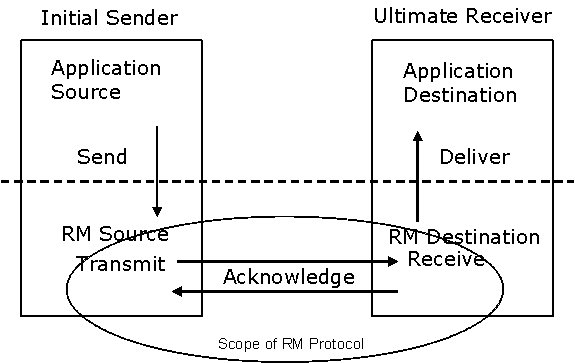
Figure 1: Reliable Messaging Model
The following definitions are used throughout
this specification:
Accept: The act of qualifying a
message by the RM Destination such that it becomes eligible for
Delivery and acknowledgement.
Acknowledgement: The
communication from the RM Destination to the RM Source indicating
the successful receipt of a message.
Acknowledgement Message: A message
containing a SequenceAcknowledgement header
block. Acknowledgement Messages may or may not contain a SOAP
body.
Acknowledgement Request: A message
containing an AckRequested header.
Acknowledgement Requests may or may not contain a SOAP body.
Application
Destination: The Endpoint to which a message is
Delivered.
Application Source:
The Endpoint that Sends a message.
Back-channel: When the underlying
transport provides a mechanism to return a transport-protocol
specific response, capable of carrying a SOAP message, without
initiating a new connection, this specification refers to this
mechanism as a back-channel.
Deliver: The act of
transferring responsibility for a message from the RM Destination
to the Application Destination.
Endpoint: As defined
in the WS-Addressing specification [WS-Addressing]; a Web service Endpoint is a
(referenceable) entity, processor, or resource to which Web service
messages can be addressed. Endpoint references (EPRs) convey the
information needed to address a Web service Endpoint.
Receive: The act of
reading a message from a network connection and accepting it.
RM Destination: The
Endpoint that Receives messages Transmitted reliably from an RM
Source.
RM Protocol Header
Block: One of Sequence,
SequenceAcknowledgement,
or AckRequested.
RM Source:
The Endpoint
that Transmits messages reliably to an RM
Destination.
Send: The act of
transferring a message from the Application Source to the RM Source
for reliable transfer.
Sequence Lifecycle Message: A message
that contains one of: CreateSequence, CreateSequenceResponse,
CloseSequence,
CloseSequenceResponse,
TerminateSequence,
TerminateSequenceResponse as the
child element of the SOAP body element.
Sequence Traffic Message: A message
containing a Sequence header block.
Transmit: The act of
writing a message to a network connection.
The correct operation of the protocol requires
that a number of preconditions MUST be established prior to the
processing of the initial sequenced message:
·
For any single message exchange the RM Source MUST have an endpoint
reference that uniquely identifies the RM Destination Endpoint.
·
The RM Source MUST have successfully created a Sequence with the RM
Destination.
·
The RM Source MUST be capable of formulating messages that adhere
to the RM Destination's policies.
·
If a secure exchange of messages is REQUIRED, then the RM Source
and RM Destination MUST have a security context.
During the lifetime of a Sequence, the
following invariants are REQUIRED for correctness:
·
The RM Source MUST assign each message within a Sequence a message
number (defined below) beginning at 1 and increasing by exactly 1
for each subsequent message. These numbers MUST be assigned in the
same order in which messages are sent by the Application
Source.
·
Within every Acknowledgement Message it issues, the RM Destination
MUST include one or more AcknowledgementRange child
elements that contain, in their collective ranges, the message
number of every message accepted by the RM Destination. The RM
Destination MUST exclude, in the AcknowledgementRange elements,
the message numbers of any messages it has not accepted. If no
messages have been received the RM Destination MUST return
None instead of an
AcknowledgementRange(s). The RM
Destination MAY transmit a Nack for a specific message or
messages instead of an AcknowledgementRange(s).
·
While the Sequence is not closed or terminated, the RM Source
SHOULD retransmit unacknowledged messages.
This section defines a number of Delivery
Assurance assertions, which can be supported by RM Sources and RM
Destinations. These assertions can be specified as policy
assertions using the WS-Policy framework [WS-Policy]. For details on this
see the WSRM Policy specification [WS-RM Policy].
AtLeastOnce
Each message is to be delivered at least
once, or else an error MUST be raised by the RM Source and/or RM
Destination. The requirement on an RM Source is that it SHOULD
retry transmission of every message sent by the Application Source
until it receives an acknowledgement from the RM Destination. The
requirement on the RM Destination is that it SHOULD retry the
transfer to the Application Destination of any message that it
accepts from the RM Source, until that message has been
successfully delivered. There is no requirement for the RM
Destination to apply duplicate message filtering.
AtMostOnce
Each message is to be delivered at most once.
The RM Source MAY retry transmission of unacknowledged messages,
but is NOT REQUIRED to do so. The requirement on the RM Destination
is that it MUST filter out duplicate messages, i.e. that it MUST
NOT deliver a duplicate of a message that has already been
delivered.
ExactlyOnce
Each message is to be delivered exactly once;
if a message cannot be delivered then an error MUST be raised by
the RM Source and/or RM Destination. The requirement on an RM
Source is that it SHOULD retry transmission of every message sent
by the Application Source until it receives an acknowledgement from
the RM Destination. The requirement on the RM Destination is that
it SHOULD retry the transfer to the Application Destination of any
message that it accepts from the RM Source until that message has
been successfully delivered, and that it MUST NOT deliver a
duplicate of a message that has already been delivered.
InOrder
Messages from each individual sequence are to
be delivered in the same order they have been sent by the
Application Source. The requirement on an RM Source is that it MUST
ensure that the ordinal position of each message in the sequence
(as indicated by a message sequence number) is consistent with the
order in which the messages have been sent from the Application
Source. The requirement on the RM Destination is that it MUST
deliver received messages for each sequence in the order indicated
by the message numbering. This DeliveryAssurance can be used in
combination with any of the AtLeastOnce, AtMostOnce or ExactlyOnce
assertions, and the requirements of those assertions MUST also be
met. In particular if the AtLeastOnce or ExactlyOnce assertion
applies and the RM Destination detects a gap in the sequence then
the RM Destination MUST NOT deliver any subsequent messages from
that sequence until the missing messages are received or until the
sequence is closed.
Figure 2 illustrates a possible message
exchange between two reliable messaging Endpoints A and B.
Figure 2: The WS-ReliableMessaging
Protocol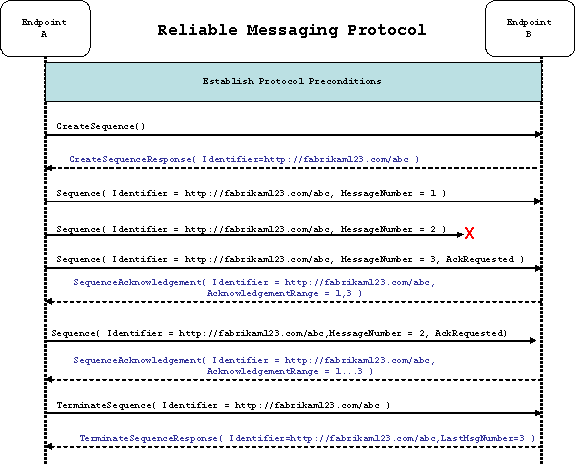
1.
The protocol preconditions are established. These include policy
exchange, endpoint resolution, and establishing trust.
2.
The RM Source requests creation of a new Sequence.
3.
The RM Destination creates a new Sequence and returns its unique
identifier.
4.
The RM Source begins Transmitting messages in the Sequence
beginning with MessageNumber 1. In the figure above, the RM Source
sends 3 messages in the Sequence.
5.
The 2nd message in the Sequence is lost in transit.
6.
The 3rd message is the last in this Sequence and the RM
Source includes an AckRequested header to ensure that it
gets a timely SequenceAcknowledgement for the
Sequence.
7.
The RM Destination acknowledges receipt of message numbers 1 and 3
as a result of receiving the RM Source's AckRequested
header.
8.
The RM Source retransmits the unacknowledged message with
MessageNumber 2. This is a new message from the perspective of the
underlying transport, but it has the same Sequence Identifier and
MessageNumber so the RM Destination can recognize it as a duplicate
of the earlier message, in case the original and retransmitted
messages are both Received. The RM Source includes an AckRequested
header in the retransmitted message so the RM Destination will
expedite an acknowledgement.
9.
The RM Destination Receives the second transmission of the message
with MessageNumber 2 and acknowledges receipt of message numbers 1,
2, and 3.
10.
The RM Source Receives this Acknowledgement and sends a
TerminateSequence message to the RM Destination indicating that the
Sequence is completed. The TerminateSequence message indicates that
message number 3 was the last message in the Sequence. The RM
Destination then reclaims any resources associated with the
Sequence.
11.
The RM Destination Receives the TerminateSequence message
indicating that the RM Source will not be sending any more
messages. The RM Destination sends a TerminateSequenceResponse
message to the RM Source and reclaims any resources associated with
the Sequence.
The RM Source will expect to Receive
Acknowledgements from the RM Destination during the course of a
message exchange at occasions described in section 3 below. Should
an Acknowledgement not be Received in a timely fashion, the RM
Source MUST re-transmit the message since either the message or the
associated Acknowledgement might have been lost. Since the nature
and dynamic characteristics of the underlying transport and
potential intermediaries are unknown in the general case, the
timing of re-transmissions cannot be specified. Additionally,
over-aggressive re-transmissions have been demonstrated to cause
transport or intermediary flooding which are counterproductive to
the intention of providing a reliable exchange of messages.
Consequently, implementers are encouraged to utilize adaptive
mechanisms that dynamically adjust re-transmission time and the
back-off intervals that are appropriate to the nature of the
transports and intermediaries envisioned. For the case of TCP/IP
transports, a mechanism similar to that described as RTTM in RFC
1323 [RTTM] SHOULD be considered.
Now that the basic model has been outlined,
the details of the elements used in this protocol are now provided
in section 3.
The following sub-sections define the various
RM protocol elements, and prescribe their usage by a conformant
implementations.
The following protocol elements define
extensibility points at various places. Implementations MAY add
child elements and/or attributes at the indicated extension points
but MUST NOT contradict the semantics of the parent and/or owner,
respectively. If a receiver does not recognize an extension, the
receiver SHOULD ignore the extension.
Some RM Protocol Header Blocks may be added to
messages that are targeted to the same Endpoint to which those
headers are to be sent (a concept often referred to as
"piggy-backing"), thus saving the overhead of an additional message
exchange. Reference parameters MUST be considered when determining
whether two EPRs are targeted to the same Endpoint. The
determination of if and when a Header Block will be piggy-backed
onto another message is made by the entity (RM Source or RM
Destination) that is sending the header. In order to ensure optimal
and successful processing of RM Sequences, endpoints that receive
RM-related messages SHOULD be prepared to process RM Protocol
Header Blocks that are included in any message it receives. See the
sections that define each RM Protocol Header Block to know which
ones may be considered for piggy-backing.
When the RM protocol, defined in this
specification, is composed with the WS-Addressing specification,
the following rules prescribe the constraints on the value of the
wsa:Action
header:
1.
When an Endpoint generates a message that carries an RM protocol
element, that is defined in the following sections, in the body of
a SOAP envelope that Endpoint MUST include in that envelope a
wsa:Action SOAP
header block whose value is an IRI that is a concatenation of the
WS-RM namespace URI, followed by a "/", followed by the value of
the local name of the child element of the SOAP body . For example,
for a Sequence creation request message as described in section 3.4
below, the value of the wsa:Action IRI would be:
http://docs.oasis-open.org/ws-rx/wsrm/200702/CreateSequence
2.
When an Endpoint generates an Acknowledgement Message that has no
element content in the SOAP body, then the value of the
wsa:Action IRI MUST
be:
http://docs.oasis-open.org/ws-rx/wsrm/200702/SequenceAcknowledgement
3.
When an Endpoint generates an Acknowledgement Request that has no
element content in the SOAP body, then the value of the
wsa:Action IRI MUST
be:
http://docs.oasis-open.org/ws-rx/wsrm/200702/AckRequested
4.
When an Endpoint generates an RM fault as defined in section 4
below, the value of the wsa:Action IRI MUST be as
defined in section 4 below.
The RM Source MUST request creation of an
outbound Sequence by sending a CreateSequence element in the body of a
message to the RM Destination which in turn responds either with a
message containing CreateSequenceResponse or a
CreateSequenceRefused
fault.The RM Source MAY include an offer
to create an inbound Sequence within the CreateSequence message. This offer is
either accepted or rejected by the RM Destination in the
CreateSequenceResponse message.
The SOAP version used for the CreateSequence message SHOULD be
used for all subsequent messages in or for that Sequence, sent by
either the RM Source or the RM Destination.
The following exemplar defines the
CreateSequence syntax:
<wsrm:CreateSequence ...>
<wsrm:AcksTo>
wsa:EndpointReferenceType </wsrm:AcksTo>
<wsrm:Expires ...> xs:duration
</wsrm:Expires> ?
<wsrm:Offer ...>
<wsrm:Identifier
...> xs:anyURI </wsrm:Identifier>
<wsrm:Endpoint>
wsa:EndpointReferenceType </wsrm:Endpoint>
<wsrm:Expires ...>
xs:duration </wsrm:Expires> ?
<wsrm:IncompleteSequenceBehavior>
wsrm:IncompleteSequenceBehaviorType
</wsrm:IncompleteSequenceBehavior> ?
...
</wsrm:Offer> ?
...
</wsrm:CreateSequence>
The following describes the content model of
the CreateSequence
element.
/wsrm:CreateSequence
This element requests creation of a new
Sequence between the RM Source that sends it, and the RM
Destination to which it is sent. The RM Source MUST NOT send this
element as a header block. The RM Destination MUST respond either
with a CreateSequenceResponse
response message or a CreateSequenceRefused fault.
/wsrm:CreateSequence/wsrm:AcksTo
The RM Source MUST include this element in
any CreateSequence message it sends. This element is of type
wsa:EndpointReferenceType (as
specified by WS-Addressing). It specifies the endpoint reference to
which messages containing SequenceAcknowledgement header blocks and
faults related to the created Sequence are to be sent, unless
otherwise noted in this specification (for example, see section
3.5).
Implementations MUST NOT use an endpoint
reference in the AcksTo element that would prevent the sending of
Sequence Acknowledgements back to the RM Source. For example, using
the WS-Addressing "http://www.w3.org/2005/08/addressing/none" IRI
would make it impossible for the RM Destination to ever send
Sequence Acknowledgements.
/wsrm:CreateSequence/wsrm:Expires
This element, if present, of type
xs:duration specifies the RM
Source's requested duration for the Sequence. The RM Destination
MAY either accept the requested duration or assign a lesser value
of its choosing. A value of "PT0S" indicates that the Sequence will
never expire. Absence of the element indicates an implied value of
"PT0S".
/wsrm:CreateSequence/wsrm:Expires/@{any}
This is an extensibility mechanism to allow
additional attributes, based on schemas, to be added to the
element.
/wsrm:CreateSequence/wsrm:Offer
This element, if present, enables an RM
Source to offer a corresponding Sequence for the reliable exchange
of messages Transmitted from RM Destination to RM Source.
/wsrm:CreateSequence/wsrm:Offer/wsrm:Identifier
The RM Source MUST set the value of this
element to an absolute URI (conformant with RFC3986 [URI]) that uniquely identifies the offered
Sequence.
/wsrm:CreateSequence/wsrm:Offer/wsrm:Identifier/@{any}
This is an extensibility mechanism to allow
additional attributes, based on schemas, to be added to the
element.
/wsrm:CreateSequence/wsrm:Offer/wsrm:Endpoint
An RM Source MUST include this element, of
type wsa:EndpointReferenceType
(as specified by WS-Addressing). This element specifies the
endpoint reference to which Sequence Lifecycle Messages,
Acknowledgement Requests, and fault messages related to the offered
Sequence are to be sent.
Implementations MUST NOT use an endpoint
reference in the Endpoint element that would prevent the sending of
Sequence Lifecycle Message, etc. For example, using the
WS-Addressing "http://www.w3.org/2005/08/addressing/none" IRI would
make it impossible for the RM Destination to ever send Sequence
Lifecycle Messages (e.g. TerminateSequence) to the RM
Source for the Offered Sequence.
The Offer of an
Endpoint containing the
"http://www.w3.org/2005/08/addressing/anonymous" IRI as its address
is problematic due to the inability of a source to connect to this
address and retry unacknowledged messages (as described in section
2.3). Note that this specification does not define any mechanisms
for providing this assurance. In the absence of an extension that
addresses this issue, an RM Destination MUST NOT accept (via the
/wsrm:CreateSequenceResponse/wsrm:Accept
element described below) an Offer that contains the
"http://www.w3.org/2005/08/addressing/anonymous" IRI as its
address.
/wsrm:CreateSequence/wsrm:Offer/wsrm:Expires
This element, if present, of type
xs:duration specifies the
duration for the offered Sequence. A value of "PT0S" indicates that
the offered Sequence will never expire. Absence of the element
indicates an implied value of "PT0S".
/wsrm:CreateSequence/wsrm:Offer/wsrm:Expires/@{any}
This is an extensibility mechanism to allow
additional attributes, based on schemas, to be added to the
element.
/wsrm:CreateSequence/wsrm:Offer/wsrm:IncompleteSequenceBehavior
This element, if present, specifies the
behavior that the destination will exhibit upon the closure or
termination of an incomplete Sequence. For the purposes of defining
the values used, the term "discard" refers to behavior equivalent
to the Application Destination never processing a particular
message.
A value of
“DiscardEntireSequence” indicates that the entire
Sequence MUST be discarded if the Sequence is closed, or
terminated, when there are one or more gaps in the final
SequenceAcknowledgement.
A value of
“DiscardFollowingFirstGap” indicates that messages in
the Sequence beyond the first gap MUST be discarded when there are
one or more gaps in the final SequenceAcknowledgement.
The default value of “NoDiscard”
indicates that no acknowledged messages in the Sequence will be
discarded.
/wsrm:CreateSequence/wsrm:Offer/{any}
This is an extensibility mechanism to allow
different (extensible) types of information, based on a schema, to
be passed.
/wsrm:CreateSequence/wsrm:Offer/@{any}
This is an extensibility mechanism to allow
additional attributes, based on schemas, to be added to the
element.
/wsrm:CreateSequence/{any}
This is an extensibility mechanism to allow
different (extensible) types of information, based on a schema, to
be passed.
/wsrm:CreateSequence/@{any}
This is an extensibility mechanism to allow
additional attributes, based on schemas, to be added to the
element.
A CreateSequenceResponse is sent in the
body of a response message by an RM Destination in response to
receipt of a CreateSequence request message. It
carries the Identifier of the created Sequence and
indicates that the RM Source can begin sending messages in the
context of the identified Sequence.
The following exemplar defines the
CreateSequenceResponse syntax:
<wsrm:CreateSequenceResponse ...>
<wsrm:Identifier ...> xs:anyURI
</wsrm:Identifier>
<wsrm:Expires ...> xs:duration
</wsrm:Expires> ?
<wsrm:IncompleteSequenceBehavior>
wsrm:IncompleteSequenceBehaviorType
</wsrm:IncompleteSequenceBehavior> ?
<wsrm:Accept ...>
<wsrm:AcksTo>
wsa:EndpointReferenceType </wsrm:AcksTo>
...
</wsrm:Accept> ?
...
</wsrm:CreateSequenceResponse>
The following describes the content model of
the CreateSequenceResponse
element.
/wsrm:CreateSequenceResponse
This element is sent in the body of the
response message in response to a CreateSequence request
message. It indicates that the RM Destination has created a
new Sequence at the request of the RM Source. The RM Destination
MUST NOT send this element as a header block.
/wsrm:CreateSequenceResponse/wsrm:Identifier
The RM Destination MUST include this element
within any CreateSequenceResponse message it sends. The RM
Destination MUST set the value of this element to the absolute URI
(conformant with RFC3986) that uniquely identifies the Sequence
that has been created by the RM Destination.
/wsrm:CreateSequenceResponse/wsrm:Identifier/@{any}
This is an extensibility mechanism to allow
additional attributes, based on schemas, to be added to the
element.
/wsrm:CreateSequenceResponse/wsrm:Expires
This element, if present, of type
xs:duration accepts or refines
the RM Source's requested duration for the Sequence. It specifies
the amount of time after which any resources associated with the
Sequence SHOULD be reclaimed thus causing the Sequence to be
silently terminated. At the RM Destination this duration is
measured from a point proximate to Sequence creation and at the RM
Source this duration is measured from a point approximate to the
successful processing of the CreateSequenceResponse. A value
of "PT0S" indicates that the Sequence will never expire. Absence of
the element indicates an implied value of "PT0S". The RM
Destination MUST set the value of this element to be equal to or
less than the value requested by the RM Source in the corresponding
CreateSequence message.
/wsrm:CreateSequenceResponse/wsrm:Expires/@{any}
This is an extensibility mechanism to allow
additional attributes, based on schemas, to be added to the
element.
/wsrm:CreateSequenceResponse/wsrm:IncompleteSequenceBehavior
This element, if present, specifies the
behavior that the destination will exhibit upon the closure or
termination of an incomplete Sequence. For the purposes of defining
the values used, the term "discard" refers to behavior equivalent
to the Application Destination never processing a particular
message.
A value of
“DiscardEntireSequence” indicates that the entire
Sequence MUST be discarded if the Sequence is closed, or
terminated, when there are one or more gaps in the final
SequenceAcknowledgement.
A value of
“DiscardFollowingFirstGap” indicates that messages in
the Sequence beyond the first gap MUST be discarded when there are
one or more gaps in the final SequenceAcknowledgement.
The default value of “NoDiscard”
indicates that no acknowledged messages in the Sequence will be
discarded.
/wsrm:CreateSequenceResponse/wsrm:Accept
This element, if present, enables an RM
Destination to accept the offer of a corresponding Sequence for the
reliable exchange of messages Transmitted from RM Destination to RM
Source.
Note: If a CreateSequenceResponse is
returned without a child Accept in response to a
CreateSequence that
did contain a child Offer, then the RM Source MAY
immediately reclaim any resources associated with the unused
offered Sequence.
/wsrm:CreateSequenceResponse/wsrm:Accept/wsrm:AcksTo
The RM Destination MUST include this element,
of type wsa:EndpointReferenceType (as
specified by WS-Addressing). It specifies the endpoint reference to
which messages containing SequenceAcknowledgement header
blocks and faults related to the created Sequence are to be sent,
unless otherwise noted in this specification (for example, see
section3.5).
Implementations MUST NOT use an endpoint
reference in the AcksTo element that would prevent the sending of
Sequence Acknowledgements back to the RM Source. For example, using
the WS-Addressing "http://www.w3.org/2005/08/addressing/none" IRI
would make it impossible for the RM Destination to ever send
Sequence Acknowledgements.
/wsrm:CreateSequenceResponse/wsrm:Accept/{any}
This is an extensibility mechanism to allow
different (extensible) types of information, based on a schema, to
be passed.
/wsrm:CreateSequenceResponse/wsrm:Accept/@{any}
This is an extensibility mechanism to allow
additional attributes, based on schemas, to be added to the
element.
/wsrm:CreateSequenceResponse/{any}
This is an extensibility mechanism to allow
different (extensible) types of information, based on a schema, to
be passed.
/wsrm:CreateSequenceResponse/@{any}
This is an extensibility mechanism to allow
additional attributes, based on schemas, to be added to the
element.
There are times during the use of an RM
Sequence that the RM Source or RM Destination will wish to
discontinue using a Sequence. Simply terminating the Sequence
discards the state managed by the RM Destination, leaving the RM
Source unaware of the final ranges of messages that were
successfully transferred to the RM Destination. To ensure that the
Sequence ends with a known final state either the RM Source or RM
Destination MAY choose to close the Sequence before terminating
it.
If the RM Source wishes to close the Sequence,
then it sends a CloseSequence element, in the
body of a message, to the RM Destination. This message indicates
that the RM Destination MUST NOT accept any new messages for the
specified Sequence, other than those already accepted at the time
the CloseSequence
element is interpreted by the RM Destination. Upon receipt of this
message, or subsequent to the RM Destination closing the Sequence
of its own volition, the RM Destination MUST include a final
SequenceAcknowledgement (within
which the RM Destination MUST include the Final element) header block on
any messages associated with the Sequence destined to the RM
Source, including the CloseSequenceResponse message or on any
Sequence fault Transmitted to the RM Source.
To allow the RM Destination to determine if it
has received all of the messages in a Sequence, the RM Source
SHOULD include the LastMsgNumber element in any
CloseSequence
messages it sends. The RM Destination can use this information, for
example, to implement the behavior indicated by /wsrm:CreateSequenceResponse/wsrm:IncompleteSequenceBehavior.
The value of the LastMsgNumber element MUST be
the same in all the CloseSequence messages for the closing
Sequence.
If the RM Destination decides to close a
Sequence of its own volition, it MAY inform the RM Source of this
event by sending a CloseSequence element, in the
body of a message, to the AcksTo EPR of that Sequence. The RM
Destination MUST include a final SequenceAcknowledgement (within
which the RM Destination MUST include the Final element) header block in
this message and any subsequent messages associated with the
Sequence destined to the RM Source.
While the RM Destination MUST NOT accept any
new messages for the specified Sequence it MUST still process
Sequence Lifecyle Messages and Acknowledgement Requests. For
example, it MUST respond to AckRequested, TerminateSequence as well
as CloseSequence messages. Note, subsequent CloseSequence messages
have no effect on the state of the Sequence.
In the case where the RM Destination wishes to
discontinue use of a Sequence it is RECOMMENDED that it close the
Sequence. Please see Final and the SequenceClosed fault. Whenever
possible the SequenceClosed fault SHOULD be
used in place of the SequenceTerminated fault to
allow the RM Source to still Receive Acknowledgements.
The following exemplar defines the
CloseSequence syntax:
<wsrm:CloseSequence ...>
<wsrm:Identifier ...> xs:anyURI
</wsrm:Identifier>
<wsrm:LastMsgNumber>
wsrm:MessageNumberType </wsrm:LastMsgNumber> ?
...
</wsrm:CloseSequence>
The following describes the content model of
the CloseSequence
element.
/wsrm:CloseSequence
This element MAY be sent by an RM Source to
indicate that the RM Destination MUST NOT accept any new messages
for this Sequence This element MAY also be sent by an RM
Destination to indicate that it will not accept any new messages
for this Sequence.
/wsrm:CloseSequence/wsrm:Identifier
The RM Source or RM Destination MUST include
this element in any CloseSequence messages it sends. The RM Source
or RM Destination MUST set the value of this element to the
absolute URI (conformant with RFC3986) of the closing Sequence.
/wsrm:CloseSequence/wsrm:LastMessageNumber
The RM Source SHOULD include this element in
any CloseSequence message it sends. The LastMsgNumber element specifies
the highest assigned message number of all the Sequence Traffic
Messages for the closing Sequence.
/wsrm:CloseSequence/wsrm:Identifier/@{any}
This is an extensibility mechanism to allow
additional attributes, based on schemas, to be added to the
element.
/wsrm:CloseSequence/{any}
This is an extensibility mechanism to allow
different (extensible) types of information, based on a schema, to
be passed.
/wsrm:CloseSequence/@{any}
This is an extensibility mechanism to allow
additional attributes, based on schemas, to be added to the
element.
A CloseSequenceResponse is sent in
the body of a message in response to receipt of a CloseSequence request message.
It indicates that the responder has closed the Sequence.
The following exemplar defines the
CloseSequenceResponse
syntax:
<wsrm:CloseSequenceResponse ...>
<wsrm:Identifier ...> xs:anyURI
</wsrm:Identifier>
...
</wsrm:CloseSequenceResponse>
The following describes the content model of
the CloseSequenceResponse
element.
/wsrm:CloseSequenceResponse
This element is sent in the body of a message
in response to receipt of a CloseSequence request message.
It indicates that the responder has closed the Sequence.
/wsrm:CloseSequenceResponse/wsrm:Identifier
The responder (RM Source or RM Destination)
MUST include this element in any CloseSequenceResponse message it
sends. The responder MUST set the value of this element to the
absolute URI (conformant with RFC3986) of the closing Sequence.
/wsrm:CloseSequenceResponse/wsrm:Identifier/@{any}
This is an extensibility mechanism to allow
additional attributes, based on schemas, to be added to the
element.
/wsrm:CloseSequenceResponse/{any}
This is an extensibility mechanism to allow
different (extensible) types of information, based on a schema, to
be passed.
/wsrm:CloseSequenceResponse/@{any}
This is an extensibility mechanism to allow
additional attributes, based on schemas, to be added to the
element.
When the RM Source has completed its use of
the Sequence it sends a TerminateSequence element, in the body
of a message, to the RM Destination to indicate that the Sequence
is complete and that it will not be sending any further messages
related to the Sequence. The RM Destination can safely reclaim any
resources associated with the Sequence upon receipt of the
TerminateSequence message. Under normal
usage the RM Source will complete its use of the Sequence when all
of the messages in the Sequence have been acknowledged. However,
the RM Source is free to Terminate or Close a Sequence at any time
regardless of the acknowledgement state of the messages.
To allow the RM Destination to determine if it
has received all of the messages in a Sequence, the RM Source
SHOULD include the LastMsgNumber element in any
TerminateSequence messages it sends. The RM Destination can use
this information, for example, to implement the behavior indicated
by /wsrm:CreateSequenceResponse/wsrm:IncompleteSequenceBehavior.
The value of the LastMsgNumber element in the
TerminateSequence message MUST be equal to the value of the
LastMsgNumber
element in any CloseSequence message(s) sent by the RM Source for
the same Sequence.
If the RM Destination decides to terminate a
Sequence of its own volition, it MAY inform the RM Source of this
event by sending a TerminateSequence element, in
the body of a message, to the AcksTo EPR for that Sequence. The RM
Destination MUST include a final SequenceAcknowledgement (within
which the RM Destination MUST include the Final element) header block in
this message.
The following exemplar defines the
TerminateSequence syntax:
<wsrm:TerminateSequence ...>
<wsrm:Identifier ...> xs:anyURI
</wsrm:Identifier>
<wsrm:LastMsgNumber>
wsrm:MessageNumberType </wsrm:LastMsgNumber> ?
...
</wsrm:TerminateSequence>
The following describes the content model of
the TerminateSequence element.
/wsrm:TerminateSequence
This element MAY be sent by an RM Source to
indicate it has completed its use of the Sequence. It indicates
that the RM Destination can safely reclaim any resources related to
the identified Sequence. The RM Source MUST NOT send this element
as a header block. The RM Source MAY retransmit this element. Once
this element is sent, other than this element, the RM Source MUST
NOT send any additional message to the RM Destination referencing
this Sequence.
This element MAY also be sent by the RM
Destination to indicate that it has unilaterally terminated the
Sequence. Upon sending this message the RM Destination MUST NOT
accept any additional messages (with the exception of the
corresponding TerminateSequenceResponse) for
this Sequence. Upon receipt of a TerminateSequence the RM Source
MUST NOT send any additional messages (with the exception of the
corresponding TerminateSequenceResponse) for
this Sequence.
/wsrm:TerminateSequence/wsrm:Identifier
The RM Source or RM Destination MUST include
this element in any TerminateSequence message it sends. The RM
Source or RM Destination MUST set the value of this element to the
absolute URI (conformant with RFC3986) of the terminating
Sequence.
/wsrm:TerminateSequence/wsrm:LastMsgNumber
The RM Source SHOULD include this element in
any TerminateSequence message it sends. The LastMsgNumber element specifies
the highest assigned message number of all the Sequence Traffic
Messages for the terminating Sequence.
/wsrm:TerminateSequence/wsrm:Identifier/@{any}
This is an extensibility mechanism to allow
additional attributes, based on schemas, to be added to the
element.
/wsrm:TerminateSequence/{any}
This is an extensibility mechanism to allow
different (extensible) types of information, based on a schema, to
be passed.
/wsrm:TerminateSequence/@{any}
This is an extensibility mechanism to allow
additional attributes, based on schemas, to be added to the
element.
A TerminateSequenceResponse is
sent in the body of a message in response to receipt of a
TerminateSequence
request message. It indicates that responder has terminated the
Sequence.
The following exemplar defines the
TerminateSequenceResponse
syntax:
<wsrm:TerminateSequenceResponse ...>
<wsrm:Identifier ...> xs:anyURI
</wsrm:Identifier>
...
</wsrm:TerminateSequenceResponse>
The following describes the content model of
the TerminateSequence element.
/wsrm:TerminateSequenceResponse
This element is sent in the body of a message
in response to receipt of a TerminateSequence request
message. It indicates that the responder has terminated the
Sequence. The responder MUST NOT send this element as a header
block.
/wsrm:TerminateSequenceResponse/wsrm:Identifier
The responder (RM Source or RM Destination)
MUST include this element in any TerminateSequenceResponse
message it sends. The responder MUST set the value of this element
to the absolute URI (conformant with RFC3986) of the terminating
Sequence.
/wsrm:TerminateSequenceResponse/wsrm:Identifier/@{any}
This is an extensibility mechanism to allow
additional attributes, based on schemas, to be added to the
element.
/wsrm:TerminateSequenceResponse/{any}
This is an extensibility mechanism to allow
different (extensible) types of information, based on a schema, to
be passed.
/wsrm:TerminateSequenceResponse/@{any}
This is an extensibility mechanism to allow
additional attributes, based on schemas, to be added to the
element.
On receipt of a TerminateSequence message the
receiver (RM Source or RM Destination) MUST respond with a
corresponding TerminateSequenceResponse
message or generate a fault UnknownSequenceFault if the
Sequence is not known.
The RM protocol uses a Sequence header block
to track and manage the reliable transfer of messages.The RM Source MUST include a Sequence
header block in all messages for
which reliable transfer is REQUIRED. The
RM Source MUST identify Sequences with unique Identifier elements
and the RM Source MUST assign each message within a Sequence a
MessageNumber element that increments
by 1 from an initial value of 1. These values are contained within
a Sequence header block accompanying each
message being transferred in the context of a Sequence.
The RM Source MUST NOT include more than one
Sequence header block in any
message.
A following exemplar defines its syntax:
<wsrm:Sequence ...>
<wsrm:Identifier ...> xs:anyURI
</wsrm:Identifier>
<wsrm:MessageNumber>
wsrm:MessageNumberType </wsrm:MessageNumber>
...
</wsrm:Sequence>
The following describes the content model of
the Sequence header
block.
/wsrm:Sequence
This protocol element associates the message
in which it is contained with a previously established RM Sequence.
It contains the Sequence's unique identifier and the containing
message's ordinal position within that Sequence. The RM Destination
MUST understand the Sequence header block. The RM Source
MUST assign a mustUnderstand
attribute with a value 1/true (from the namespace corresponding to
the version of SOAP to which the Sequence SOAP header block is
bound) to the Sequence header block
element.
/wsrm:Sequence/wsrm:Identifier
An RM Source that includes a Sequence header block in a SOAP
envelope MUST include this element in that header block. The RM
Source MUST set the value of this element to the absolute URI
(conformant with RFC3986) that uniquely identifies the
Sequence.
/wsrm:Sequence/wsrm:Identifier/@{any}
This is an extensibility mechanism to allow
additional attributes, based on schemas, to be added to the
element.
/wsrm:Sequence/wsrm:MessageNumber
The RM Source MUST include this element
within any Sequence headers it creates. This element is of type
MessageNumberType.
It represents the ordinal position of the message within a
Sequence. Sequence message numbers start at 1 and monotonically
increase by 1 throughout the Sequence. See section 4.5 for Message
Number Rollover fault.
/wsrm:Sequence/{any}
This is an extensibility mechanism to allow
different (extensible) types of information, based on a schema, to
be passed.
/wsrm:Sequence/@{any}
This is an extensibility mechanism to allow
additional attributes, based on schemas, to be added to the
element.
The following example illustrates a Sequence
header block.
<wsrm:Sequence>
<wsrm:Identifier>http://example.com/abc</wsrm:Identifier>
<wsrm:MessageNumber>10</wsrm:MessageNumber>
</wsrm:Sequence>
3.8 Request Acknowledgement
The purpose of the AckRequested
header block is to signal to the RM Destination that the RM Source
is requesting that a SequenceAcknowledgement be sent.
The RM Source MAY request an Acknowledgement
Message from the RM Destination at any time by independently
transmitting an AckRequested header block (i.e. as a
header of a SOAP envelope with an empty body). Alternatively the RM
Source MAY include an AckRequested header block in any
message targeted to the RM Destination. The RM Destination SHOULD
process AckRequested
header blocks that are included in any message it receives. If a
non-mustUnderstand fault occurs when processing an AckRequested header block that
was piggy-backed, a fault MUST be generated, but the processing of
the original message MUST NOT be affected.
An RM Destination that Receives a message that
contains an AckRequested header block MUST send a
message containing a SequenceAcknowledgement header block to
the AcksTo endpoint
reference (see section 3.4) for a known Sequence or else generate
an UnknownSequence
fault. It is RECOMMENDED that the RM Destination return a
AcknowledgementRange
or None element
instead of a Nack
element (see section 3.9).
The following exemplar defines its syntax:
<wsrm:AckRequested ...>
<wsrm:Identifier ...> xs:anyURI
</wsrm:Identifier>
...
</wsrm:AckRequested>
The following describes the content model of
the AckRequested
header block.
/wsrm:AckRequested
This element requests an Acknowledgement for
the identified Sequence.
/wsrm:AckRequested/wsrm:Identifier
An RM Source that includes an AckRequested header block in a SOAP envelope
MUST include this element in that header block. The RM Source MUST
set the value of this element to the absolute URI, (conformant with
RFC3986), that uniquely identifies the Sequence to which the
request applies.
/wsrm:AckRequested/wsrm:Identifier/@{any}
This is an extensibility mechanism to allow
additional attributes, based on schemas, to be added to the
element.
/wsrm:AckRequested/{any}
This is an extensibility mechanism to allow
different (extensible) types of information, based on a schema, to
be passed.
/wsrm:AckRequested/@{any}
This is an extensibility mechanism to allow
additional attributes, based on schemas, to be added to the
element.
The RM Destination informs the RM Source of
successful message receipt using a SequenceAcknowledgement header block.
Acknowledgements can be explicitly
requested using the AckRequested
directive (see section 3.8).
The RM Destination
MAY Transmit the SequenceAcknowledgement header block
independently (i.e. as a header of a SOAP envelope with an empty
body). Alternatively, an RM Destination MAY include a SequenceAcknowledgement header
block on any SOAP envelope targeted to the endpoint referenced by
the AcksTo EPR. The RM Source SHOULD process SequenceAcknowledgement header
blocks that are included in any message it receives. If a
non-mustUnderstand fault occurs when processing a SequenceAcknowledgement header
that was piggy-backed, a fault MUST be generated, but the
processing of the original message MUST NOT be affected.
During creation of a Sequence the RM Source
MAY specify the WS-Addressing anonymous IRI as the address of the
AcksTo EPR for that Sequence.
When the RM Source specifies the WS-Addressing anonymous IRI as the
address of the AcksTo EPR, the RM
Destination MUST Transmit any SequenceAcknowledgement headers for the
created Sequence in a SOAP envelope to be Transmitted on the
protocol binding-specific back-channel. Such a channel is provided
by the context of a Received message containing a SOAP envelope
that contains a Sequence header
block and/or an AckRequested
header block for that same Sequence identifier. When the RM
Destination receives an AckRequested header, and the
AckTo EPR for that
sequence is the WS-Addressing anonymous IRI, the RM Destination
SHOULD respond on the protocol binding-specific back-channel
provided by the Received message containing the AckRequested header block.
The following exemplar defines its syntax:
<wsrm:SequenceAcknowledgement ...>
<wsrm:Identifier ...> xs:anyURI
</wsrm:Identifier>
[ [ [ <wsrm:AcknowledgementRange ...
Upper="wsrm:MessageNumberType"
Lower="wsrm:MessageNumberType"/> +
| <wsrm:None/>
]
<wsrm:Final/> ?
]
| <wsrm:Nack>
wsrm:MessageNumberType </wsrm:Nack> + ]
...
</wsrm:SequenceAcknowledgement>
The following describes the content model of
the SequenceAcknowledgement header
block.
/wsrm:SequenceAcknowledgement
This element contains the Sequence
Acknowledgement information.
/wsrm:SequenceAcknowledgement/wsrm:Identifier
An RM Destination that includes a
SequenceAcknowledgement header
block in a SOAP envelope MUST include this element in that header
block. The RM Destination MUST set the value of this element to the
absolute URI (conformant with RFC3986) that uniquely identifies the
Sequence. The RM Destination MUST NOT include multiple SequenceAcknowledgement header blocks that
share the same value for Identifier within the same SOAP
envelope.
/wsrm:SequenceAcknowledgement/wsrm:Identifier/@{any}
This is an extensibility mechanism to allow
additional attributes, based on schemas, to be added to the
element.
/wsrm:SequenceAcknowledgement/wsrm:AcknowledgementRange
The RM Destination MAY include one or more
instances of this element within a SequenceAcknowledgement header block. It
contains a range of Sequence message numbers successfully accepted
by the RM Destination. The ranges MUST NOT overlap. The RM
Destination MUST NOT include this element if a sibling Nack or None element is also present as
a child of SequenceAcknowledgement.
/wsrm:SequenceAcknowledgement/wsrm:AcknowledgementRange/@Upper
The RM Destination MUST set the value of this
attribute equal to the message number of the highest contiguous
message in a Sequence range accepted by the RM Destination.
/wsrm:SequenceAcknowledgement/wsrm:AcknowledgementRange/@Lower
The RM Destination MUST set the value of this
attribute equal to the message number of the lowest contiguous
message in a Sequence range accepted by the RM Destination.
/wsrm:SequenceAcknowledgement/wsrm:AcknowledgementRange/@{any}
This is an extensibility mechanism to allow
additional attributes, based on schemas, to be added to the
element.
/wsrm:SequenceAcknowledgement/wsrm:None
The RM Destination MUST include this element
within a SequenceAcknowledgement
header block if the RM Destination has not accepted any messages
for the specified Sequence. The RM Destination MUST NOT include
this element if a sibling AcknowledgementRange or
Nack element is also
present as a child of the SequenceAcknowledgement.
/wsrm:SequenceAcknowledgement/wsrm:Final
The RM Destination MAY include this element
within a SequenceAcknowledgement
header block. This element indicates that the RM Destination is not
receiving new messages for the specified Sequence. The RM Source
can be assured that the ranges of messages acknowledged by this
SequenceAcknowledgement header block will not change in the future.
The RM Destination MUST include this element when the Sequence is
closed. The RM Destination MUST NOT include this element when
sending a Nack; it
can only be used when sending AcknowledgementRange elements or a
None.
/wsrm:SequenceAcknowledgement/wsrm:Nack
The RM Destination MAY include this element
within a SequenceAcknowledgement
header block. If used, the RM Destination MUST set the value of
this element to a MessageNumberType representing
the MessageNumber of an
unreceived message in a Sequence. The RM Destination MUST NOT
include a Nack element if a
sibling AcknowledgementRange or
None element is also
present as a child of SequenceAcknowledgement. Upon the receipt of
a Nack, an RM Source
SHOULD retransmit the message identified by the Nack. The RM Destination MUST
NOT issue a SequenceAcknowledgement
containing a Nack
for a message that it has previously acknowledged within an
AcknowledgementRange. The RM
Source SHOULD ignore a SequenceAcknowledgement
containing a Nack
for a message that has previously been acknowledged within an
AcknowledgementRange.
/wsrm:SequenceAcknowledgement/{any}
This is an extensibility mechanism to allow
different (extensible) types of information, based on a schema, to
be passed.
/wsrm:SequenceAcknowledgement/@{any}
This is an extensibility mechanism to allow
additional attributes, based on schemas, to be added to the
element.
The following examples illustrate SequenceAcknowledgement elements:
·
Message numbers 1...10 inclusive in a Sequence have been accepted
by the RM Destination.
<wsrm:SequenceAcknowledgement>
<wsrm:Identifier>http://example.com/abc</wsrm:Identifier>
<wsrm:AcknowledgementRange Upper="10"
Lower="1"/>
</wsrm:SequenceAcknowledgement>
·
Message numbers 1..2, 4..6, and 8..10 inclusive in a Sequence have
been accepted by the RM Destination, messages 3 and 7 have not been
accepted.
<wsrm:SequenceAcknowledgement>
<wsrm:Identifier>http://example.com/abc</wsrm:Identifier>
<wsrm:AcknowledgementRange Upper="2"
Lower="1"/>
<wsrm:AcknowledgementRange Upper="6"
Lower="4"/>
<wsrm:AcknowledgementRange Upper="10"
Lower="8"/>
</wsrm:SequenceAcknowledgement>
·
Message number 3 in a Sequence has not been accepted by the RM
Destination.
<wsrm:SequenceAcknowledgement>
<wsrm:Identifier>http://example.com/abc</wsrm:Identifier>
<wsrm:Nack>3</wsrm:Nack>
</wsrm:SequenceAcknowledgement>
Faults for the CreateSequence message exchange
are treated as defined in WS-Addressing. Create Sequence Refused is
a possible fault reply for this operation. Unknown Sequence is a
fault generated by Endpoints when messages carrying RM header
blocks targeted at unrecognized or terminated Sequences are
detected. WSRMRequired is a fault
generated by an RM Destination that requires the use of WS-RM on a
Received message that did not use the protocol. All other faults in
this section relate to known Sequences. Destinations that generate
faults related to known sequences SHOULD transmit those faults. If
transmitted, such faults MUST be transmitted to the same
[destination] as Acknowledgement messages.
Entities that generate WS-ReliableMessaging
faults MUST include as the [action] property the default fault
action IRI defined below. The value from the W3C Recommendation is
below for informational purposes:
http://docs.oasis-open.org/ws-rx/wsrm/200702/fault
The faults defined in this section are
generated if the condition stated in the preamble is met. Fault
handling rules are defined in section 6 of WS-Addressing SOAP
Binding.
The definitions of faults use the following
properties:
[Code] The fault code.
[Subcode] The fault subcode.
[Reason] The English language reason
element.
[Detail] The detail element(s). If absent, no
detail element is defined for the fault. If more than one detail
element is defined for a fault, implementations MUST include the
elements in the order that they are specified.
Entities that generate WS-ReliableMessaging
faults MUST set the [Code] property to either "Sender" or
"Receiver". These properties are serialized into text XML as
follows:
|
SOAP Version
|
Sender
|
Receiver
|
|
SOAP 1.1
|
S11:Client
|
S11:Server
|
|
SOAP 1.2
|
S:Sender
|
S:Receiver
|
The properties above bind to a SOAP 1.2 fault
as follows:
<S:Envelope>
<S:Header>
<wsa:Action>
http://docs.oasis-open.org/ws-rx/wsrm/200702/fault
</wsa:Action>
<!-- Headers elided for brevity. -->
</S:Header>
<S:Body>
<S:Fault>
<S:Code>
<S:Value> [Code]
</S:Value>
<S:Subcode>
<S:Value> [Subcode]
</S:Value>
</S:Subcode>
</S:Code>
<S:Reason>
<S:Text xml:lang="en"> [Reason]
</S:Text>
</S:Reason>
<S:Detail>
[Detail]
...
</S:Detail>
</S:Fault>
</S:Body>
</S:Envelope>
The properties above bind to a SOAP 1.1 fault
as follows when the fault is triggered by processing an RM header
block:
<S11:Envelope>
<S11:Header>
<wsrm:SequenceFault>
<wsrm:FaultCode> wsrm:FaultCodes
</wsrm:FaultCode>
<wsrm:Detail> [Detail]
</wsrm:Detail>
...
</wsrm:SequenceFault>
<!-- Headers elided for brevity. -->
</S11:Header>
<S11:Body>
<S11:Fault>
<faultcode> [Code] </faultcode>
<faultstring> [Reason]
</faultstring>
</S11:Fault>
</S11:Body>
</S11:Envelope>
The properties bind to a SOAP 1.1 fault as
follows when the fault is generated as a result of processing a
CreateSequence request message:
<S11:Envelope>
<S11:Body>
<S11:Fault>
<faultcode> [Subcode] </faultcode>
<faultstring> [Reason]
</faultstring>
</S11:Fault>
</S11:Body>
</S11:Envelope>
The purpose of the SequenceFault element is to carry the
specific details of a fault generated during the reliable messaging
specific processing of a message belonging to a Sequence.
WS-ReliableMessaging nodes MUST use the SequenceFault container only in
conjunction with the SOAP 1.1 fault mechanism. WS-ReliableMessaging
nodes MUST NOT use the SequenceFault container in
conjunction with the SOAP 1.2 binding.
The following exemplar defines its syntax:
<wsrm:SequenceFault ...>
<wsrm:FaultCode> wsrm:FaultCode
</wsrm:FaultCode>
<wsrm:Detail> ... </wsrm:Detail> ?
...
</wsrm:SequenceFault>
The following describes the content model of
the SequenceFault element.
/wsrm:SequenceFault
This is the element containing Sequence fault
information for WS-ReliableMessaging
/wsrm:SequenceFault/wsrm:FaultCode
WS-ReliableMessaging nodes that generate a
SequenceFault MUST
set the value of this element to a qualified name from the set of
faults [Subcodes] defined below.
/wsrm:SequenceFault/wsrm:Detail
This element, if present, carries application
specific error information related to the fault being
described.
/wsrm:SequenceFault/wsrm:Detail/{any}
The application specific error information
related to the fault being described.
/wsrm:SequenceFault/wsrm:Detail/@{any}
The application specific error information
related to the fault being described.
/wsrm:SequenceFault/{any}
This is an extensibility mechanism to allow
different (extensible) types of information, based on a schema, to
be passed.
/wsrm:SequenceFault/@{any}
This is an extensibility mechanism to allow
additional attributes, based on schemas, to be added to the
element.
The Endpoint that generates this fault SHOULD
make every reasonable effort to notify the corresponding Endpoint
of this decision.
Properties:
[Code] Sender or Receiver
[Subcode] wsrm:SequenceTerminated
[Reason] The Sequence has been terminated due
to an unrecoverable error.
[Detail]
<wsrm:Identifier ...> xs:anyURI
</wsrm:Identifier>
|
Generated by
|
Condition
|
Action Upon Generation
|
Action Upon Receipt
|
|
RM Source or RM
Destination.
|
Encountering an
unrecoverable condition or detection of violation of the
protocol.
|
Sequence termination.
|
MUST terminate the
Sequence if not otherwise terminated.
|
Properties:
[Code] Sender
[Subcode] wsrm:UnknownSequence
[Reason] The value of wsrm:Identifier is not a
known Sequence identifier.
[Detail]
<wsrm:Identifier ...> xs:anyURI
</wsrm:Identifier>
|
Generated by
|
Condition
|
Action Upon Generation
|
Action Upon Receipt
|
|
RM Source or RM
Destination.
|
In response to a message
containing an unknown or terminated Sequence identifier.
|
None.
|
MUST terminate the
Sequence if not otherwise terminated.
|
An example of when this fault is generated is
when a message is Received by the RM Source containing a
SequenceAcknowledgement covering
messages that have not been sent.
[Code] Sender
[Subcode] wsrm:InvalidAcknowledgement
[Reason] The SequenceAcknowledgement violates
the cumulative Acknowledgement invariant.
[Detail]
<wsrm:SequenceAcknowledgement ...> ...
</wsrm:SequenceAcknowledgement>
|
Generated by
|
Condition
|
Action Upon Generation
|
Action Upon Receipt
|
|
RM Source.
|
In response to a
SequenceAcknowledgement that
violate the invariants stated in 2.3 or any of the requirements in
3.9 about valid combinations of AckRange, Nack and None in a single
SequenceAcknowledgement element
or with respect to already Received such elements.
|
Unspecified.
|
Unspecified.
|
If the condition listed below is reached, the
RM Destination MUST generate this fault.
Properties:
[Code] Sender
[Subcode] wsrm:MessageNumberRollover
[Reason] The maximum value for
wsrm:MessageNumber has been exceeded.
[Detail]
<wsrm:Identifier ...> xs:anyURI
</wsrm:Identifier>
<wsrm:MaxMessageNumber> wsrm:MessageNumberType
</wsrm:MaxMessageNumber>
|
Generated by
|
Condition
|
Action Upon Generation
|
Action Upon Receipt
|
|
RM Destination.
|
Message number in
/wsrm:Sequence/wsrm:MessageNumber
of a Received message exceeds the internal limitations of an RM
Destination or reaches the maximum value of
9,223,372,036,854,775,807.
|
RM Destination SHOULD
continue to accept undelivered messages until the Sequence is
closed or terminated.
|
RM Source SHOULD continue
to retransmit undelivered messages until the Sequence is closed or
terminated.
|
Properties:
[Code] Sender or Receiver
[Subcode] wsrm:CreateSequenceRefused
[Reason] The Create Sequence request has been
refused by the RM Destination.
[Detail]
|
Generated by
|
Condition
|
Action Upon Generation
|
Action Upon Receipt
|
|
RM Destination.
|
In response to a
CreateSequence
message when the RM Destination does not wish to create a new
Sequence.
|
Unspecified.
|
Sequence terminated.
|
This fault is generated by an RM Destination
to indicate that the specified Sequence has been closed. This fault
MUST be generated when an RM Destination is asked to accept a
message for a Sequence that is closed.
Properties:
[Code] Sender
[Subcode] wsrm:SequenceClosed
[Reason] The Sequence is closed and cannot
accept new messages.
[Detail]
<wsrm:Identifier...> xs:anyURI
</wsrm:Identifier>
|
Generated by
|
Condition
|
Action Upon Generation
|
Action Upon Receipt
|
|
RM Destination.
|
In response to a message
that belongs to a Sequence that is already closed.
|
Unspecified.
|
Sequence closed.
|
If an RM Destination requires the use of
WS-RM, this fault is generated when it Receives an incoming message
that did not use this protocol.
Properties:
[Code] Sender
[Subcode] wsrm:WSRMRequired
[Reason] The RM Destination requires the use
of WSRM.
[Detail]
This specification considers two sets of
security requirements, those of the applications that use the WS-RM
protocol and those of the protocol itself.
This specification makes no assumptions about
the security requirements of the applications that use WS-RM.
However, once those requirements have been satisfied within a given
operational context, the addition of WS-RM to this operational
context should not undermine the fulfillment of those requirements;
the use of WS-RM should not create additional attack vectors within
an otherwise secure system.
There are many other security concerns that
one may need to consider when implementing or using this protocol.
The material below should not be considered as a "check list".
Implementers and users of this protocol are urged to perform a
security analysis to determine their particular threat profile and
the appropriate responses to those threats.
Implementers are also advised that there is a
core tension between security and reliable messaging that can be
problematic if not addressed by implementations; one aspect of
security is to prevent message replay but one of the invariants of
this protocol is to resend messages until they are acknowledged.
Consequently, if the security sub-system processes a message but a
failure occurs before the reliable messaging sub-system Receives
that message, then it is possible (and likely) that the security
sub-system will treat subsequent copies as replays and discard
them. At the same time, the reliable messaging sub-system will
likely continue to expect and even solicit the missing message(s).
Care should be taken to avoid and prevent this condition.
The primary security requirement of this
protocol is to protect the specified semantics and protocol
invariants against various threats. The following sections describe
several threats to the integrity and operation of this protocol and
provide some general outlines of countermeasures to those threats.
Implementers and users of this protocol should keep in mind that
all threats are not necessarily applicable to all operational
contexts.
In general, any mechanism which allows an
attacker to alter the information in a Sequence Traffic Message,
Sequence Lifecycle Message, Acknowledgement Messages,
Acknowledgement Request, or Sequence-related fault, or which allows
an attacker to alter the correlation of a RM Protocol Header Block
to its intended message represents a threat to the WS-RM
protocol.
For example, if an attacker is able to swap
Sequence headers
on messages in transit between the RM Source and RM Destination
then they have undermined the implementation's ability to guarantee
the first invariant described in section 2.3. The result is that
there is no way of guaranteeing that messages will be Delivered to
the Application Destination in the same order that they were sent
by the Application Source.
Integrity threats are generally countered via
the use of digital signatures some level of the communication
protocol stack. Note that, in order to counter header swapping
attacks, the signature SHOULD include both the SOAP body and any
relevant SOAP headers (e.g. Sequence
header). Because some headers (AckRequested,
SequenceAcknowledgement)
are independent of the body of the SOAP message in which they
occur, implementations MUST allow for signatures that cover only
these headers.
The creation of a Sequence with an RM
Destination consumes various resources on the systems used to
implement that RM Destination. These resources can include network
connections, database tables, message queues, etc. This behavior
can be exploited to conduct denial of service attacks against an RM
Destination. For example, a simple attack is to repeatedly send
CreateSequence
messages to an RM Destination. Another attack is to create a
Sequence for a service that is known to require in-order message
Delivery and use this Sequence to send a stream of very large
messages to that service, making sure to omit message number
“1” from that stream.
There are a number of countermeasures against
the described resource consumption threats. The technique advocated
by this specification is for the RM Destination to restrict the
ability to create a Sequence to a specific set of
entities/principals. This reduces the number of potential attackers
and, in some cases, allows the identity of any attackers to be
determined.
The ability to restrict Sequence creation
depends, in turn, upon the RM Destination's ability to identify and
authenticate the RM Source that issued the CreateSequence
message.
Sequence spoofing is a class of threats in
which the attacker uses knowledge of the Identifier for a
particular Sequence to forge Sequence Lifecycle or Traffic
Messages. For example the attacker creates a fake TerminateSequence
message that references the target Sequence and sends this message
to the appropriate RM Destination. Some sequence spoofing attacks
also require up-to-date knowledge of the current MessageNumber
for their target Sequence.
In general any Sequence Lifecycle Message, RM
Protocol Header Block, or sequence-correlated SOAP fault (e.g.
InvalidAcknowledgement)
can be used by someone with knowledge of the Sequence identifier to
attack the Sequence. These attacks are “two-way” in
that an attacker may choose to target the RM Source by, for
example, inserting a fake SequenceAcknowledgement
header into a message that it sends to the AcksTo EPR of an RM Source.
Sequence hijacking is a specific case of a
sequence spoofing attack. The attacker attempts to inject Sequence
Traffic Messages into an existing Sequence by inserting fake
Sequence
headers into those messages.
Note that “sequence hijacking”
should not be equated with “security session
hijacking”. Although a Sequence may be bound to some form of
a security session in order to counter the threats described in
this section, applications MUST NOT rely on WS-RM-related
information to make determinations about the identity of the entity
that created a message; applications SHOULD rely only upon
information that is established by the security infrastructure to
make such determinations. Failure to observe this rule creates,
among other problems, a situation in which the absence of WS-RM may
deprive an application of the ability to authenticate its peers
even though the necessary security processing has taken place.
There are a number of countermeasures against
sequence spoofing threats. The technique advocated by this
specification is to consider the Sequence to be a shared resource
that is jointly owned by the RM Source that initiated its creation
(i.e. that sent the CreateSequence
message) and the RM Destination that serves as its terminus (i.e.
that sent the CreateSequenceResponse
message). To counter sequence spoofing attempts the RM Destination
SHOULD ensure that every message or fault that it Receives that
refers to a particular Sequence originated from the RM Source that
jointly owns the referenced Sequence. For its part the RM Source
SHOULD ensure that every message or fault that it Receives that
refers to a particular Sequence originated from the RM Destination
that jointly owns the referenced Sequence.
For the RM Destination to be able to identify
its sequence peer it MUST be able to identify and authenticate the
entity that sent the CreateSequence
message. Similarly for the RM Source to identify its sequence peer
it MUST be able to identify and authenticate the entity that sent
the CreateSequenceResponse
message. For either the RM Destination or the RM Source to
determine if a message was sent by its sequence peer it MUST be
able to identify and authenticate the initiator of that message
and, if necessary, correlate this identity with the sequence peer
identity established at sequence creation time.
The security threats described in the previous
sections are neither new nor unique. The solutions that have been
developed to secure other SOAP-based protocols can be used to
secure WS-RM as well. This section maps the facilities provided by
common web services security solutions against countermeasures
described in the previous sections.
Before continuing this discussion, however,
some examination of the underlying requirements of the previously
described countermeasures is necessary. Specifically it should be
noted that the technique described in section 5.1.2.1 has two
components. Firstly, the RM Destination identifies and
authenticates the issuer of a CreateSequence
message. Secondly, the RM Destination performs an authorization
check against this authenticated identity and determines if the RM
Source is permitted to create Sequences with the RM Destination.
Since the facilities for performing this authorization check
(runtime infrastructure, policy frameworks, etc.) lie completely
within the domain of individual implementations, any discussion of
such facilities is considered to be beyond the scope of this
specification.
This section describes how the facilities
provided by SSL/TLS [RFC 4346] can be used
to implement the countermeasures described in the previous
sections. The use of SSL/TLS is subject to the constraints defined
in section 4 of the Basic Security Profile 1.0 [BSP
1.0].
The description provided here is general in
nature and is not intended to serve as a complete definition on the
use of SSL/TLS to protect WS-RM. In order to interoperate
implementations need to agree on the choice of features as well as
the manner in which they will be used. The mechanisms described in
the Web Services Security Policy Language [SecurityPolicy] MAY be used by services to
describe the requirements and constraints of the use of
SSL/TLS.
The basic model for using SSL/TLS is as
follows:
1.
The RM Source establishes an SSL/TLS session with the RM
Destination.
2.
The RM Source uses this SSL/TLS session to send a CreateSequence
message to the RM Destination.
3.
The RM Destination establishes an SSL/TLS session with the RM
Source and sends an asynchronous CreateSequenceResponse
using this session. Alternately it may respond with a synchronous
CreateSequenceResponse
using the session established in (1).
4.
For the lifetime of the Sequence the RM Source uses the SSL/TLS
session from (1) to Transmit any and all messages or faults that
refer to that Sequence.
5.
For the lifetime of the Sequence the RM Destination either uses the
SSL/TLS session established in (3) to Transmit any and all messages
or faults that refer to that Sequence or, for synchronous
exchanges, the RM Destination uses the SSL/TLS session established
in (1).
Used in its simplest fashion (without relying
upon any authentication mechanisms), SSL/TLS provides the necessary
integrity qualities to counter the threats described in section
5.1.1. Note, however, that the nature of SSL/TLS limits the scope
of this integrity protection to a single transport level session.
If SSL/TLS is the only mechanism used to provide integrity, any
intermediaries between the RM Source and the RM Destination MUST be
trusted to preserve the integrity of the messages that flow through
them.
As noted, the technique described in sections
5.1.2.1 involves the use of authentication. This specification
advocates either of two mechanisms for authenticating entities
using SSL/TLS. In both of these methods the SSL/TLS server (the
party accepting the SSL/TLS connection) authenticates itself to the
SSL/TLS client using an X.509 certificate that is exchanged during
the SSL/TLS handshake.
·
HTTP Basic Authentication: This method of authentication
presupposes that a SOAP/HTTP binding is being used as part of the
protocol stack beneath WS-RM. Subsequent to the establishment of
the SSL/TLS session, the sending party authenticates itself to the
receiving party using HTTP Basic Authentication [RFC 2617]. For example, a RM Source might
authenticate itself to a RM Destination (e.g. when transmitting a
Sequence Traffic Message) using BasicAuth. Similarly the RM
Destination might authenticate itself to the RM Source (e.g. when
sending an Acknowledgement) using BasicAuth.
·
SSL/TLS Client Authentication: In this method of
authentication, the party initiating the connection authenticates
itself to the party accepting the connection using an X.509
certificate that is exchanged during the SSL/TLS handshake.
To implement the countermeasures described in
section 5.1.2.1 the RM Source must authenticate itself using one
the above mechanisms. The authenticated identity can then be used
to determine if the RM Source is authorized to create a Sequence
with the RM Destination.
This specification advocates implementing the
countermeasures described in section 5.1.3.2 by requiring an RM
node's Sequence peer to be equivalent to their SSL/TLS session
peer. This allows the authorization decisions described in section
5.1.3.2 to be based on SSL/TLS session identity rather than on
authentication information. For example, an RM Destination can
determine that a Sequence Traffic Message rightfully belongs to its
referenced Sequence if that message arrived over the same SSL/TLS
session that was used to carry the CreateSequence
message for that Sequence. Note that requiring a one-to-one
relationship between SSL/TLS session peer and Sequence peer
constrains the lifetime of a SSL/TLS-protected Sequence to be less
than or equal to the lifetime of the SSL/TLS session that is used
to protect that Sequence.
This specification does not preclude the use
of other methods of using SSL/TLS to implement the countermeasures
(such as associating specific authentication information with a
Sequence) although such methods are not covered by this
document.
Issues specific to the life-cycle management
of SSL/TLS sessions (such as the resumption of a SSL/TLS session)
are outside the scope of this specification.
The mechanisms described in WS-Security may be
used in various ways to implement the countermeasures described in
the previous sections. This specification advocates using the
protocol described by WS-SecureConversation [SecureConversation] (optionally in
conjunction with WS-Trust [Trust]) as a
mechanism for protecting Sequences. The use of WS-Security (as an
underlying component of WS-SecureConversation) is subject to the
constraints defined in the Basic Security Profile 1.0.
The description provided here is general in
nature and is not intended to serve as a complete definition on the
use of WS-SecureConversation/WS-Trust to protect WS-RM. In order to
interoperate implementations need to agree on the choice of
features as well as the manner in which they will be used. The
mechanisms described in the Web Services Security Policy Language
MAY be used by services to describe the requirements and
constraints of the use of WS-SecureConversation.
The basic model for using
WS-SecureConversation is as follows:
1
The RM Source and the RM Destination create a WS-SecureConversation
security context. This may involve the participation of third
parties such as a security token service. The tokens exchanged may
contain authentication claims (e.g. X.509 certificates or Kerberos
service tickets).
2
During the CreateSequence
exchange, the RM Source SHOULD explicitly identify the security
context that will be used to protect the Sequence. This is done so
that, in cases where the CreateSequence
message is signed by more than one security context, the RM Source
can indicate which security context should be used to protect the
newly created Sequence.
3
For the lifetime of the Sequence the RM Source and the RM
Destination use the session key(s) associated with the security
context to sign (as defined by WS-Security) at least the body and
any relevant WS-RM-defined headers of any and all messages or
faults that refer to that Sequence.
Without relying upon any authentication
information, the per-message signatures provide the necessary
integrity qualities to counter the threats described in section
5.1.1.
To implement the countermeasures described in
section 5.1.2.1 some mutually agreed upon form of authentication
claims must be provided by the RM Source to the RM Destination
during the establishment of the Security Context. These claims can
then be used to determine if the RM Source is authorized to create
a Sequence with the RM Destination.
This specification advocates implementing the
countermeasures described in section 5.1.3.2 by requiring an RM
node's Sequence peer to be equivalent to their security context
session peer. This allows the authorization decisions described in
section 5.1.3.2 to be based on the identity of the message's
security context rather than on any authentication claims that may
have been established during security context initiation. Note that
other methods of using WS-SecureConversation to implement the
countermeasures (such as associating specific authentication claims
to a Sequence) are possible but not covered by this document.
As with transport security, the requisite
equivalence of a security context peer with a Sequence peer limits
the lifetime of a Sequence to the lifetime of the protecting
security context. Unlike transport security, the association
between a Sequence and its protecting security context cannot
always be established implicitly at Sequence creation time. This is
due to the fact that the CreateSequence
and CreateSequenceResponse
messages may be signed by more than one security context.
Issues specific to the life-cycle management
of WS-SecureConversation security contexts (such as amending or
renewing contexts) are outside the scope of this specification.
As noted in section 5, the RM Source and RM
Destination should be able to protect their shared Sequences
against the threat of Sequence Spoofing attacks. There are a number
of OPTIONAL means of achieving this objective depending upon the
underlying security infrastructure.
One mechanism for protecting a Sequence is to
include a security token using a wsse:SecurityTokenReference
element from WS-Security (see section 9 in WS-SecureConversation)
in the CreateSequence element. This
establishes an association between the created (and, if present,
offered) Sequence(s) and the referenced security token, such that
the RM Source and Destination MUST use the security token as the
basis for authorization of all subsequent interactions related to
the Sequence(s). The wsse:SecurityTokenReference
explicitly identifies the token as there may be more than one token
on a CreateSequence
message or inferred from the communication context (e.g. transport
protection).
It is RECOMMENDED that a message independent
referencing mechanism be used to identify the token, if the token
being referenced supports such mechanism.
The following exemplar defines the
CreateSequence
syntax when extended to include a wsse:SecurityTokenReference:
<wsrm:CreateSequence ...>
<wsrm:AcksTo>
wsa:EndpointReferenceType </wsrm:AcksTo>
<wsrm:Expires ...> xs:duration
</wsrm:Expires> ?
<wsrm:Offer ...>
<wsrm:Identifier
...> xs:anyURI </wsrm:Identifier>
<wsrm:Endpoint>
wsa:EndpointReferenceType </wsrm:Endpoint>
<wsrm:Expires ...>
xs:duration </wsrm:Expires> ?
<wsrm:IncompleteSequenceBehavior>
wsrm:IncompleteSequenceBehaviorType
</wsrm:IncompleteSequenceBehavior> ?
...
</wsrm:Offer> ?
...
<wsse:SecurityTokenReference>
...
</wsse:SecurityTokenReference> ?
...
</wsrm:CreateSequence>
The following describes the content model of
the additional CreateSequence elements.
/wsrm:CreateSequence/wsse:SecurityTokenReference
This element uses the extensibility mechanism
defined for the CreateSequence element (defined
in section 3.4) to communicate an explicit reference to the
security token, using a wsse:SecurityTokenReference as
documented in WS-Security, that the RM Source and Destination MUST
use to authorize messages for the created (and, if present, the
offered) Sequence(s). All subsequent messages related to the
created (and, if present, the offered) Sequence(s) MUST demonstrate
proof-of-possession of the secret associated with the token (e.g.,
by using or deriving from a private or secret key).
When a RM Source transmits a CreateSequence that has been
extended to include a wsse:SecurityTokenReference it
SHOULD ensure that the RM Destination both understands and will
conform to the requirements listed above. In order to achieve this,
the RM Source SHOULD include the UsesSequenceSTR element as a
SOAP header block within the CreateSequence message. This
element MUST include a soap:mustUnderstand attribute
with a value of ‘true’. Thus the RM Source can be
assured that a RM Destination that responds with a CreateSequenceResponse
understands and conforms with the requirements listed above. Note
that an RM Destination understanding this header does not mean that
it has processed and understood any WS-Security headers, the fault
behavior defined in WS-Security still applies.
The following exemplar defines the
UsesSequenceSTR
syntax:
<wsrm:UsesSequenceSTR ... />
The following describes the content model of
the UsesSequenceSTR
header block.
/wsrm:UsesSequenceSTR
This element SHOULD be included as a SOAP
header block in CreateSequence messages that use
the extensibility mechanism described above in this section. The
soap:mustUnderstand
attribute value MUST be ‘true’. The receiving RM
Destination MUST understand and correctly implement the extension
described above or else generate a soap:MustUnderstand fault, thus
aborting the requested Sequence creation.
The following is an example of a CreateSequence message using
the wsse:SecurityTokenReference
extension and the UsesSequenceSTR header
block:
<soap:Envelope ...>
<soap:Header>
...
<wsrm:UsesSequenceSTR
soap:mustUnderstand=’true’/>
...
</soap:Header>
<soap:Body>
<wsrm:CreateSequence>
<wsrm:AcksTo>
<wsa:Address>http://Business456.com/serviceA/789</wsa:Address>
</wsrm:AcksTo>
<wsse:SecurityTokenReference>
...
</wsse:SecurityTokenReference>
</wsrm:CreateSequence>
</soap:Body>
</soap:Envelope>
One mechanism for protecting a Sequence is to
bind the Sequence to the underlying SSL/TLS session(s). The RM
Source indicates to the RM Destination that a Sequence is to be
bound to the underlying SSL/TLS session(s) via the UsesSequenceSSL header block. If
the RM Source wishes to bind a Sequence to the underlying SSL/TLS
sessions(s) it MUST include the UsesSequenceSSL element as a
SOAP header block within the CreateSequence message.
The following exemplar defines the
UsesSequenceSSL
syntax:
<wsrm:UsesSequenceSSL soap:mustUnderstand=”true” ...
/>
The following describes the content model of
the UsesSequenceSSL
header block.
/wsrm:UsesSequenceSSL
The RM Source MAY include this element as a
SOAP header block of a CreateSequence message to
indicate to the RM Destination that the resulting Sequence is to be
bound to the SSL/TLS session that was used to carry the
CreateSequence
message. If included, the RM Source MUST mark this header with a
soap:mustUnderstand
attribute with a value of ‘true’. The receiving RM
Destination MUST understand and correctly implement the
functionality described in section 5.2.1 or else generate a
soap:MustUnderstand
fault, thus aborting the requested Sequence creation.
Note that the inclusion of the above header by
the RM Source implies that all Sequence-related information
(Sequence Lifecycle or Acknowledgment messages or Sequence-related
faults) flowing from the RM Destination to the RM Source will be
bound to the SSL/TLS session that is used to carry the CreateSequenceResponse
message.
The normative schema that is defined for
WS-ReliableMessaging using [XML-Schema
Part1] and [XML-Schema Part2] is
located at:
The following copy is provided for
reference.
<?xml
version="1.0" encoding="UTF-8"?>
<!-- Copyright(C) OASIS(R) 1993-2007. All Rights Reserved.
OASIS trademark, IPR and other policies
apply. -->
<xs:schema xmlns:xs="http://www.w3.org/2001/XMLSchema"
xmlns:wsa="http://www.w3.org/2005/08/addressing"
xmlns:wsrm="http://docs.oasis-open.org/ws-rx/wsrm/200702"
targetNamespace="http://docs.oasis-open.org/ws-rx/wsrm/200702"
elementFormDefault="qualified"
attributeFormDefault="unqualified">
<xs:import
namespace="http://www.w3.org/2005/08/addressing"
schemaLocation="http://www.w3.org/2006/03/addressing/ws-addr.xsd"/>
<!-- Protocol Elements -->
<xs:complexType name="SequenceType">
<xs:sequence>
<xs:element
ref="wsrm:Identifier"/>
<xs:element name="MessageNumber"
type="wsrm:MessageNumberType"/>
<xs:any namespace="##other"
processContents="lax" minOccurs="0"
maxOccurs="unbounded"/>
</xs:sequence>
<xs:anyAttribute namespace="##other"
processContents="lax"/>
</xs:complexType>
<xs:element name="Sequence"
type="wsrm:SequenceType"/>
<xs:element name="SequenceAcknowledgement">
<xs:complexType>
<xs:sequence>
<xs:element
ref="wsrm:Identifier"/>
<xs:choice>
<xs:sequence>
<xs:choice>
<xs:element name="AcknowledgementRange"
maxOccurs="unbounded">
<xs:complexType>
<xs:sequence/>
<xs:attribute name="Upper" type="xs:unsignedLong"
use="required"/>
<xs:attribute name="Lower" type="xs:unsignedLong"
use="required"/>
<xs:anyAttribute namespace="##other"
processContents="lax"/>
</xs:complexType>
</xs:element>
<xs:element name="None">
<xs:complexType>
<xs:sequence/>
</xs:complexType>
</xs:element>
</xs:choice>
<xs:element name="Final" minOccurs="0">
<xs:complexType>
<xs:sequence/>
</xs:complexType>
</xs:element>
</xs:sequence>
<xs:element name="Nack" type="xs:unsignedLong"
maxOccurs="unbounded"/>
</xs:choice>
<xs:any
namespace="##other" processContents="lax" minOccurs="0"
maxOccurs="unbounded"/>
</xs:sequence>
<xs:anyAttribute
namespace="##other" processContents="lax"/>
</xs:complexType>
</xs:element>
<xs:complexType name="AckRequestedType">
<xs:sequence>
<xs:element
ref="wsrm:Identifier"/>
<xs:any namespace="##other"
processContents="lax" minOccurs="0"
maxOccurs="unbounded"/>
</xs:sequence>
<xs:anyAttribute namespace="##other"
processContents="lax"/>
</xs:complexType>
<xs:element name="AckRequested"
type="wsrm:AckRequestedType"/>
<xs:element name="Identifier">
<xs:complexType>
<xs:annotation>
<xs:documentation>
This type is
for elements whose [children] is an anyURI and can have arbitrary
attributes.
</xs:documentation>
</xs:annotation>
<xs:simpleContent>
<xs:extension
base="xs:anyURI">
<xs:anyAttribute namespace="##other"
processContents="lax"/>
</xs:extension>
</xs:simpleContent>
</xs:complexType>
</xs:element>
<xs:element name="Address">
<xs:complexType>
<xs:simpleContent>
<xs:extension
base="xs:anyURI">
<xs:anyAttribute namespace="##other"
processContents="lax"/>
</xs:extension>
</xs:simpleContent>
</xs:complexType>
</xs:element>
<xs:simpleType name="MessageNumberType">
<xs:restriction
base="xs:unsignedLong">
<xs:minInclusive
value="1"/>
<xs:maxInclusive
value="9223372036854775807"/>
</xs:restriction>
</xs:simpleType>
<!-- Fault Container and Codes -->
<xs:simpleType name="FaultCodes">
<xs:restriction base="xs:QName">
<xs:enumeration
value="wsrm:SequenceTerminated"/>
<xs:enumeration
value="wsrm:UnknownSequence"/>
<xs:enumeration
value="wsrm:InvalidAcknowledgement"/>
<xs:enumeration
value="wsrm:MessageNumberRollover"/>
<xs:enumeration
value="wsrm:CreateSequenceRefused"/>
<xs:enumeration
value="wsrm:SequenceClosed"/>
<xs:enumeration
value="wsrm:WSRMRequired"/>
</xs:restriction>
</xs:simpleType>
<xs:complexType name="SequenceFaultType">
<xs:sequence>
<xs:element name="FaultCode"
type="wsrm:FaultCodes"/>
<xs:element name="Detail"
type="wsrm:DetailType" minOccurs="0"/>
<xs:any namespace="##other"
processContents="lax" minOccurs="0"
maxOccurs="unbounded"/>
</xs:sequence>
<xs:anyAttribute namespace="##other"
processContents="lax"/>
</xs:complexType>
<xs:complexType name="DetailType">
<xs:sequence>
<xs:any namespace="##other"
processContents="lax" minOccurs="0"
maxOccurs="unbounded"/>
</xs:sequence>
<xs:anyAttribute namespace="##other"
processContents="lax"/>
</xs:complexType>
<xs:element name="SequenceFault"
type="wsrm:SequenceFaultType"/>
<xs:element name="CreateSequence"
type="wsrm:CreateSequenceType"/>
<xs:element name="CreateSequenceResponse"
type="wsrm:CreateSequenceResponseType"/>
<xs:element name="CloseSequence"
type="wsrm:CloseSequenceType"/>
<xs:element name="CloseSequenceResponse"
type="wsrm:CloseSequenceResponseType"/>
<xs:element name="TerminateSequence"
type="wsrm:TerminateSequenceType"/>
<xs:element name="TerminateSequenceResponse"
type="wsrm:TerminateSequenceResponseType"/>
<xs:complexType name="CreateSequenceType">
<xs:sequence>
<xs:element
ref="wsrm:AcksTo"/>
<xs:element ref="wsrm:Expires"
minOccurs="0"/>
<xs:element name="Offer"
type="wsrm:OfferType" minOccurs="0"/>
<xs:any namespace="##other"
processContents="lax" minOccurs="0" maxOccurs="unbounded">
<xs:annotation>
<xs:documentation>
It is the authors intent that this extensibility be used to
transfer a Security Token Reference as defined in
WS-Security.
</xs:documentation>
</xs:annotation>
</xs:any>
</xs:sequence>
<xs:anyAttribute namespace="##other"
processContents="lax"/>
</xs:complexType>
<xs:complexType
name="CreateSequenceResponseType">
<xs:sequence>
<xs:element
ref="wsrm:Identifier"/>
<xs:element ref="wsrm:Expires"
minOccurs="0"/>
<xs:element
name="IncompleteSequenceBehavior"
type="wsrm:IncompleteSequenceBehaviorType" minOccurs="0"/>
<xs:element name="Accept"
type="wsrm:AcceptType" minOccurs="0"/>
<xs:any namespace="##other"
processContents="lax" minOccurs="0"
maxOccurs="unbounded"/>
</xs:sequence>
<xs:anyAttribute namespace="##other"
processContents="lax"/>
</xs:complexType>
<xs:complexType name="CloseSequenceType">
<xs:sequence>
<xs:element
ref="wsrm:Identifier"/>
<xs:element name="LastMsgNumber"
type="wsrm:MessageNumberType" minOccurs="0"/>
<xs:any namespace="##other"
processContents="lax" minOccurs="0"
maxOccurs="unbounded"/>
</xs:sequence>
<xs:anyAttribute namespace="##other"
processContents="lax"/>
</xs:complexType>
<xs:complexType
name="CloseSequenceResponseType">
<xs:sequence>
<xs:element
ref="wsrm:Identifier"/>
<xs:any namespace="##other"
processContents="lax" minOccurs="0"
maxOccurs="unbounded"/>
</xs:sequence>
<xs:anyAttribute namespace="##other"
processContents="lax"/>
</xs:complexType>
<xs:complexType name="TerminateSequenceType">
<xs:sequence>
<xs:element
ref="wsrm:Identifier"/>
<xs:element name="LastMsgNumber"
type="wsrm:MessageNumberType" minOccurs="0"/>
<xs:any namespace="##other"
processContents="lax" minOccurs="0"
maxOccurs="unbounded"/>
</xs:sequence>
<xs:anyAttribute namespace="##other"
processContents="lax"/>
</xs:complexType>
<xs:complexType
name="TerminateSequenceResponseType">
<xs:sequence>
<xs:element
ref="wsrm:Identifier"/>
<xs:any namespace="##other"
processContents="lax" minOccurs="0"
maxOccurs="unbounded"/>
</xs:sequence>
<xs:anyAttribute namespace="##other"
processContents="lax"/>
</xs:complexType>
<xs:element name="AcksTo"
type="wsa:EndpointReferenceType"/>
<xs:complexType name="OfferType">
<xs:sequence>
<xs:element
ref="wsrm:Identifier"/>
<xs:element name="Endpoint"
type="wsa:EndpointReferenceType"/>
<xs:element ref="wsrm:Expires"
minOccurs="0"/>
<xs:element
name="IncompleteSequenceBehavior"
type="wsrm:IncompleteSequenceBehaviorType" minOccurs="0"/>
<xs:any namespace="##other"
processContents="lax" minOccurs="0"
maxOccurs="unbounded"/>
</xs:sequence>
<xs:anyAttribute namespace="##other"
processContents="lax"/>
</xs:complexType>
<xs:complexType name="AcceptType">
<xs:sequence>
<xs:element
ref="wsrm:AcksTo"/>
<xs:any namespace="##other"
processContents="lax" minOccurs="0"
maxOccurs="unbounded"/>
</xs:sequence>
<xs:anyAttribute namespace="##other"
processContents="lax"/>
</xs:complexType>
<xs:element name="Expires">
<xs:complexType>
<xs:simpleContent>
<xs:extension
base="xs:duration">
<xs:anyAttribute namespace="##other"
processContents="lax"/>
</xs:extension>
</xs:simpleContent>
</xs:complexType>
</xs:element>
<xs:simpleType
name="IncompleteSequenceBehaviorType">
<xs:restriction base="xs:string">
<xs:enumeration
value="DiscardEntireSequence"/>
<xs:enumeration
value="DiscardFollowingFirstGap"/>
<xs:enumeration
value="NoDiscard"/>
</xs:restriction>
</xs:simpleType>
<xs:element name="UsesSequenceSTR">
<xs:complexType>
<xs:sequence/>
<xs:anyAttribute
namespace="##other" processContents="lax"/>
</xs:complexType>
</xs:element>
<xs:element name="UsesSequenceSSL">
<xs:complexType>
<xs:sequence/>
<xs:anyAttribute
namespace="##other" processContents="lax"/>
</xs:complexType>
</xs:element>
<xs:element name="UnsupportedElement">
<xs:simpleType>
<xs:restriction
base="xs:QName"/>
</xs:simpleType>
</xs:element>
</xs:schema>
This WSDL describes the WS-RM protocol from
the point of view of an RM Destination. In the case where an
endpoint acts both as an RM Destination and an RM Source, note that
additional messages may be present in exchanges with that
endpoint.
Also note that this WSDL is intended to
describe the internal structure of the WS-RM protocol, and will not
generally appear in a description of a WS-RM-capable Web service.
See WS-RM Policy [WS-RM Policy] for a
higher-level mechanism to indicate that WS-RM is engaged.
The normative WSDL 1.1 definition for
WS-ReliableMessaging is located at:
The following non-normative copy is provided
for reference.
<?xml
version="1.0" encoding="utf-8"?>
<!-- Copyright(C) OASIS(R) 1993-2007. All Rights Reserved.
OASIS trademark, IPR and other policies
apply. -->
<wsdl:definitions xmlns:wsdl="http://schemas.xmlsoap.org/wsdl/"
xmlns:xs="http://www.w3.org/2001/XMLSchema"
xmlns:wsa="http://www.w3.org/2005/08/addressing"
xmlns:wsam="http://www.w3.org/2007/02/addressing/metadata"
xmlns:rm="http://docs.oasis-open.org/ws-rx/wsrm/200702"
xmlns:tns="http://docs.oasis-open.org/ws-rx/wsrm/200702/wsdl"
targetNamespace="http://docs.oasis-open.org/ws-rx/wsrm/200702/wsdl">
<wsdl:types>
<xs:schema>
<xs:import
namespace="http://docs.oasis-open.org/ws-rx/wsrm/200702"
schemaLocation="http://docs.oasis-open.org/ws-rx/wsrm/200702/wsrm-1.1-schema-200702.xsd"/>
</xs:schema>
</wsdl:types>
<wsdl:message name="CreateSequence">
<wsdl:part name="create"
element="rm:CreateSequence"/>
</wsdl:message>
<wsdl:message name="CreateSequenceResponse">
<wsdl:part name="createResponse"
element="rm:CreateSequenceResponse"/>
</wsdl:message>
<wsdl:message name="CloseSequence">
<wsdl:part name="close"
element="rm:CloseSequence"/>
</wsdl:message>
<wsdl:message name="CloseSequenceResponse">
<wsdl:part name="closeResponse"
element="rm:CloseSequenceResponse"/>
</wsdl:message>
<wsdl:message name="TerminateSequence">
<wsdl:part name="terminate"
element="rm:TerminateSequence"/>
</wsdl:message>
<wsdl:message name="TerminateSequenceResponse">
<wsdl:part name="terminateResponse"
element="rm:TerminateSequenceResponse"/>
</wsdl:message>
<wsdl:portType name="SequenceAbstractPortType">
<wsdl:operation
name="CreateSequence">
<wsdl:input
message="tns:CreateSequence"
wsam:Action="http://docs.oasis-open.org/ws-rx/wsrm/200702/CreateSequence"/>
<wsdl:output
message="tns:CreateSequenceResponse"
wsam:Action="http://docs.oasis-open.org/ws-rx/wsrm/200702/CreateSequenceResponse"/>
</wsdl:operation>
<wsdl:operation
name="CloseSequence">
<wsdl:input
message="tns:CloseSequence"
wsam:Action="http://docs.oasis-open.org/ws-rx/wsrm/200702/CloseSequence"/>
<wsdl:output
message="tns:CloseSequenceResponse"
wsam:Action="http://docs.oasis-open.org/ws-rx/wsrm/200702/CloseSequenceResponse"/>
</wsdl:operation>
<wsdl:operation
name="TerminateSequence">
<wsdl:input
message="tns:TerminateSequence"
wsam:Action="http://docs.oasis-open.org/ws-rx/wsrm/200702/TerminateSequence"/>
<wsdl:output
message="tns:TerminateSequenceResponse"
wsam:Action="http://docs.oasis-open.org/ws-rx/wsrm/200702/TerminateSequenceResponse"/>
</wsdl:operation>
</wsdl:portType>
</wsdl:definitions>
Appendix C. Message Examples
Appendix C.1 Create Sequence
Create Sequence
<?xml
version="1.0" encoding="UTF-8"?>
<S:Envelope
xmlns:S="http://www.w3.org/2003/05/soap-envelope"
xmlns:wsrm="http://docs.oasis-open.org/ws-rx/wsrm/200702"
xmlns:wsa="http://www.w3.org/2005/08/addressing">
<S:Header>
<wsa:MessageID>
http://Business456.com/guid/0baaf88d-483b-4ecf-a6d8-a7c2eb546817
</wsa:MessageID>
<wsa:To>http://example.com/serviceB/123</wsa:To>
<wsa:Action>http://docs.oasis-open.org/ws-rx/wsrm/200702/CreateSequence</wsa:Action>
<wsa:ReplyTo>
<wsa:Address>http://Business456.com/serviceA/789</wsa:Address>
</wsa:ReplyTo>
</S:Header>
<S:Body>
<wsrm:CreateSequence>
<wsrm:AcksTo>
<wsa:Address>http://Business456.com/serviceA/789</wsa:Address>
</wsrm:AcksTo>
</wsrm:CreateSequence>
</S:Body>
</S:Envelope>
Create Sequence
Response
<?xml
version="1.0" encoding="UTF-8"?>
<S:Envelope xmlns:S="http://www.w3.org/2003/05/soap-envelope"
xmlns:wsrm="http://docs.oasis-open.org/ws-rx/wsrm/200702"
xmlns:wsa="http://www.w3.org/2005/08/addressing">
<S:Header>
<wsa:To>http://Business456.com/serviceA/789</wsa:To>
<wsa:RelatesTo>
http://Business456.com/guid/0baaf88d-483b-4ecf-a6d8a7c2eb546817
</wsa:RelatesTo>
<wsa:Action>
http://docs.oasis-open.org/ws-rx/wsrm/200702/CreateSequenceResponse
</wsa:Action>
</S:Header>
<S:Body>
<wsrm:CreateSequenceResponse>
<wsrm:Identifier>http://Business456.com/RM/ABC</wsrm:Identifier>
</wsrm:CreateSequenceResponse>
</S:Body>
</S:Envelope>
Appendix C.2 Initial Transmission
The following example WS-ReliableMessaging
headers illustrate the message exchange in the above figure. The
three messages have the following headers; the third message is
identified as the last message in the Sequence:
Message 1
<?xml
version="1.0" encoding="UTF-8"?>
<S:Envelope
xmlns:S="http://www.w3.org/2003/05/soap-envelope"
xmlns:wsrm="http://docs.oasis-open.org/ws-rx/wsrm/200702"
xmlns:wsa="http://www.w3.org/2005/08/addressing">
<S:Header>
<wsa:MessageID>
http://Business456.com/guid/71e0654e-5ce8-477b-bb9d-34f05cfcbc9e
</wsa:MessageID>
<wsa:To>http://example.com/serviceB/123</wsa:To>
<wsa:From>
<wsa:Address>http://Business456.com/serviceA/789</wsa:Address>
</wsa:From>
<wsa:Action>http://example.com/serviceB/123/request</wsa:Action>
<wsrm:Sequence>
<wsrm:Identifier>http://Business456.com/RM/ABC</wsrm:Identifier>
<wsrm:MessageNumber>1</wsrm:MessageNumber>
</wsrm:Sequence>
</S:Header>
<S:Body>
<!-- Some Application
Data -->
</S:Body>
</S:Envelope>
Message 2
<?xml
version="1.0" encoding="UTF-8"?>
<S:Envelope
xmlns:S="http://www.w3.org/2003/05/soap-envelope"
xmlns:wsrm="http://docs.oasis-open.org/ws-rx/wsrm/200702"
xmlns:wsa="http://www.w3.org/2005/08/addressing">
<S:Header>
<wsa:MessageID>
http://Business456.com/guid/daa7d0b2-c8e0-476e-a9a4-d164154e38de
</wsa:MessageID>
<wsa:To>http://example.com/serviceB/123</wsa:To>
<wsa:From>
<wsa:Address>http://Business456.com/serviceA/789</wsa:Address>
</wsa:From>
<wsa:Action>http://example.com/serviceB/123/request</wsa:Action>
<wsrm:Sequence>
<wsrm:Identifier>http://Business456.com/RM/ABC</wsrm:Identifier>
<wsrm:MessageNumber>2</wsrm:MessageNumber>
</wsrm:Sequence>
</S:Header>
<S:Body>
<!-- Some Application
Data -->
</S:Body>
</S:Envelope>
Message 3
<?xml
version="1.0" encoding="UTF-8"?>
<S:Envelope
xmlns:S="http://www.w3.org/2003/05/soap-envelope"
xmlns:wsrm="http://docs.oasis-open.org/ws-rx/wsrm/200702"
xmlns:wsa="http://www.w3.org/2005/08/addressing">
<S:Header>
<wsa:MessageID>
http://Business456.com/guid/0baaf88d-483b-4ecf-a6d8-a7c2eb546819
</wsa:MessageID>
<wsa:To>http://example.com/serviceB/123</wsa:To>
<wsa:From>
<wsa:Address>http://Business456.com/serviceA/789</wsa:Address>
</wsa:From>
<wsa:Action>http://example.com/serviceB/123/request</wsa:Action>
<wsrm:Sequence>
<wsrm:Identifier>http://Business456.com/RM/ABC</wsrm:Identifier>
<wsrm:MessageNumber>3</wsrm:MessageNumber>
</wsrm:Sequence>
<wsrm:AckRequested>
<wsrm:Identifier>http://Business456.com/RM/ABC</wsrm:Identifier>
</wsrm:AckRequested>
</S:Header>
<S:Body>
<!-- Some Application Data -->
</S:Body>
</S:Envelope>
Appendix C.3 First Acknowledgement
Message number 2 has not been accepted by the
RM Destination due to some transmission error so it responds with
an Acknowledgement for messages 1 and 3:
<?xml
version="1.0" encoding="UTF-8"?>
<S:Envelope
xmlns:S="http://www.w3.org/2003/05/soap-envelope"
xmlns:wsrm="http://docs.oasis-open.org/ws-rx/wsrm/200702"
xmlns:wsa="http://www.w3.org/2005/08/addressing">
<S:Header>
<wsa:MessageID>
http://example.com/guid/0baaf88d-483b-4ecf-a6d8-a7c2eb546810
</wsa:MessageID>
<wsa:To>http://Business456.com/serviceA/789</wsa:To>
<wsa:From>
<wsa:Address>http://example.com/serviceB/123</wsa:Address>
</wsa:From>
<wsa:Action>
http://docs.oasis-open.org/ws-rx/wsrm/200702/SequenceAcknowledgement
</wsa:Action>
<wsrm:SequenceAcknowledgement>
<wsrm:Identifier>http://Business456.com/RM/ABC</wsrm:Identifier>
<wsrm:AcknowledgementRange Upper="1" Lower="1"/>
<wsrm:AcknowledgementRange Upper="3" Lower="3"/>
</wsrm:SequenceAcknowledgement>
</S:Header>
<S:Body/>
</S:Envelope>
Appendix C.4 Retransmission
The RM Sourcediscovers that message number 2
was not accepted so it resends the message and requests an
Acknowledgement:
<?xml
version="1.0" encoding="UTF-8"?>
<S:Envelope
xmlns:S="http://www.w3.org/2003/05/soap-envelope"
xmlns:wsrm="http://docs.oasis-open.org/ws-rx/wsrm/200702"
xmlns:wsa="http://www.w3.org/2005/08/addressing">
<S:Header>
<wsa:MessageID>
http://Business456.com/guid/daa7d0b2-c8e0-476e-a9a4-d164154e38de
</wsa:MessageID>
<wsa:To>http://example.com/serviceB/123</wsa:To>
<wsa:From>
<wsa:Address>http://Business456.com/serviceA/789</wsa:Address>
</wsa:From>
<wsa:Action>http://example.com/serviceB/123/request</wsa:Action>
<wsrm:Sequence>
<wsrm:Identifier>http://Business456.com/RM/ABC</wsrm:Identifier>
<wsrm:MessageNumber>2</wsrm:MessageNumber>
</wsrm:Sequence>
<wsrm:AckRequested>
<wsrm:Identifier>http://Business456.com/RM/ABC</wsrm:Identifier>
</wsrm:AckRequested>
</S:Header>
<S:Body>
<!-- Some Application Data -->
</S:Body>
</S:Envelope>
Appendix C.5 Termination
The RM Destination now responds with an
Acknowledgement for the complete Sequence which can then be
terminated:
<?xml
version="1.0" encoding="UTF-8"?>
<S:Envelope
xmlns:S="http://www.w3.org/2003/05/soap-envelope"
xmlns:wsrm="http://docs.oasis-open.org/ws-rx/wsrm/200702"
xmlns:wsa="http://www.w3.org/2005/08/addressing">
<S:Header>
<wsa:MessageID>
http://example.com/guid/0baaf88d-483b-4ecf-a6d8-a7c2eb546811
</wsa:MessageID>
<wsa:To>http://Business456.com/serviceA/789</wsa:To>
<wsa:From>
<wsa:Address>http://example.com/serviceB/123</wsa:Address>
</wsa:From>
<wsa:Action>
http://docs.oasis-open.org/ws-rx/wsrm/200702/SequenceAcknowledgement
</wsa:Action>
<wsrm:SequenceAcknowledgement>
<wsrm:Identifier>http://Business456.com/RM/ABC</wsrm:Identifier>
<wsrm:AcknowledgementRange Upper="3" Lower="1"/>
</wsrm:SequenceAcknowledgement>
</S:Header>
<S:Body/>
</S:Envelope>
Terminate
Sequence
<?xml
version="1.0" encoding="UTF-8"?>
<S:Envelope
xmlns:S="http://www.w3.org/2003/05/soap-envelope"
xmlns:wsrm="http://docs.oasis-open.org/ws-rx/wsrm/200702"
xmlns:wsa="http://www.w3.org/2005/08/addressing">
<S:Header>
<wsa:MessageID>
http://Business456.com/guid/0baaf88d-483b-4ecf-a6d8-a7c2eb546812
</wsa:MessageID>
<wsa:To>http://example.com/serviceB/123</wsa:To>
<wsa:Action>
http://docs.oasis-open.org/ws-rx/wsrm/200702/TerminateSequence
</wsa:Action>
<wsa:From>
<wsa:Address>http://Business456.com/serviceA/789</wsa:Address>
</wsa:From>
</S:Header>
<S:Body>
<wsrm:TerminateSequence>
<wsrm:Identifier>http://Business456.com/RM/ABC</wsrm:Identifier>
<wsrm:LastMsgNumber> 3 </wsrm:LastMsgNumber>
</wsrm:TerminateSequence>
</S:Body>
</S:Envelope>
Terminate Sequence
Response
<?xml
version="1.0" encoding="UTF-8"?>
<S:Envelope
xmlns:S="http://www.w3.org/2003/05/soap-envelope"
xmlns:wsrm="http://docs.oasis-open.org/ws-rx/wsrm/200702"
xmlns:wsa="http://www.w3.org/2005/08/addressing">
<S:Header>
<wsa:MessageID>
http://Business456.com/guid/0baaf88d-483b-4ecf-a6d8-a7c2eb546813
</wsa:MessageID>
<wsa:To>http://example.com/serviceA/789</wsa:To>
<wsa:Action>
http://docs.oasis-open.org/ws-rx/wsrm/200702/TerminateSequenceResponse
</wsa:Action>
<wsa:RelatesTo>
http://Business456.com/guid/0baaf88d-483b-4ecf-a6d8-a7c2eb546812
</wsa:RelatesTo>
<wsa:From>
<wsa:Address>http://Business456.com/serviceA/789</wsa:Address>
</wsa:From>
</S:Header>
<S:Body>
<wsrm:TerminateSequenceResponse>
<wsrm:Identifier>http://Business456.com/RM/ABC</wsrm:Identifier>
</wsrm:TerminateSequenceResponse>
</S:Body>
</S:Envelope>
This appendix specifies the non-normative
state transition tables for RM Source and RM Destination.
The state tables describe the lifetime of a
sequence in both the RM Source and the RM Destination
Legend:
The first column of these tables contains the
motivating event and has the following format:
|
Event
|
|
Event name
[source]
{ref}
|
Where:
·
Event Name: indicates the name of the event. Event Names surrounded
by “<>” are optional as described by the
specification.
·
[source]: indicates the source of the event; one of:
o
[msg] a Received message
o
[int]: an internal event such as the firing of a timer
o
[app]: the application
o
[unspec]: the source is unspecified
Each event / state combination cell in the
tables in this appendix has the following format:
|
State Name
|
|
Action to take
[next state]
{ref}
|
Where:
·
action to take: indicates that the state machine performs the
following action. Actions surrounded by “<>” are
optional as described by the specification. “Xmit” is
used as a short form for the word “Transmit”
·
[next state]: indicates the state to which the state machine will
advance upon the performance of the action. For ease of reading the
next state “same” indicates that the state does not
change.
·
{ref} is a reference to the document section describing the
behavior in this cell
“N/A” in a cell indicates a state
/ event combination self-inconsistent with the state machine;
should these conditions occur, it would indicate an implementation
error. A blank cell indicates that the behavior is not
described in this specification and does not indicate normal
protocol operation. Implementations MAY generate a Sequence
Terminated fault (see section 4.2) in these circumstances. Robust
implementations MUST be able to operate in a stable manner despite
the occurrence of unspecified event / state combinations.
Table 1 RM Source Sequence State Transition
Table
|
Events
|
|
Sequence States
|
|
None
|
Creating
|
Created
|
Closing
|
Closed
|
Terminating
|
|
|
Create Sequence
[unspec]
{3.4}
|
Xmit Create Sequence
[Creating]
{3.4}
|
N/A
|
N/A
|
N/A
|
N/A
|
N/A
|
|
Create Sequence
Response
[msg]
{3.4)
|
|
Process Create Sequence
Response
[Created]
{3.4}
|
|
|
|
|
|
Create Sequence Refused
Fault
[msg]
{3.4}
|
|
No action
[None]
{4.6}
|
|
|
|
|
|
Send message
[app]
{2.1}
|
N/A
|
N/A
|
Xmit message
[Same]
{2}
|
No action
[Same]
{2}
|
N/A
|
N/A
|
|
Retransmit of un-ack’d
message
[int]
|
N/A
|
N/A
|
Xmit message
[Same]
{2.3}
|
Xmit message
[Same]
{2.3}
|
N/A
|
N/A
|
|
SeqAck
(non-final)
[msg]
{3.9}
|
Generate Unknown Sequence Fault
[Same]
{4.3}
|
Generate Unknown Sequence Fault
[Same]
{4.3}
|
Process Ack ranges
[Same]
{3.9}
|
Process Ack ranges
[Same]
{3.9}
|
Process Ack ranges
[Same]
{3.9}
|
Process Ack ranges
[Same]
{3.9}
|
|
Nack
[msg]
{3.9)
|
Generate Unknown Sequence Fault
[Same]
{4.3}
|
Generate Unknown Sequence Fault
[Same]
{4.3}
|
<Xmit message(s)>
[Same]
{3.9}
|
<Xmit message(s)>
[Same]
{3.9}
|
No action
[Same]
|
No action
[Same]
|
|
Message Number Rollover
Fault
[msg]
|
Generate Unknown Sequence Fault
[Same]
{4.3}
|
Generate Unknown Sequence Fault
[Same]
{4.3}
|
No action
[Rollover]
|
No action
[Same]
|
No action
[Same]
|
No action
[Same]
|
|
CloseSequence
[msg]
{3.5}
|
Generate Unknown Sequence Fault
[Same]
{4.3}
|
Generate Unknown Sequence Fault
[Same]
{4.3}
|
Xmit CloseSequence Response
[Closed]
{3.5}
|
Xmit CloseSequence Response
[Closed]
{3.5}
|
Xmit CloseSequence Response
[Closed]
{3.5}
|
Generate Unknown Sequence Fault
[Same]
{4.3}
|
|
<Close
Sequence>
[int]
{3.5}
|
N/A
|
|
Xmit Close Sequence
[Closing]
{3.5}
|
N/A
|
N/A
|
N/A
|
|
Close Sequence
Response
[msg]
{3.5}
|
Generate Unknown Sequence Fault
[Same]
{4.3}
|
Generate Unknown Sequence Fault
[Same]
{4.3}
|
|
No action
[Closed]
{3.5}
|
No action
[Same]
{3.5}
|
No action
[Same]
{3.5}
|
|
SeqAck (final)
[msg]
{3.9}
|
Generate Unknown Sequence Fault
[Same]
{4.3}
|
Generate Unknown Sequence Fault
[Same]
{4.3}
|
Process Ack ranges
[Closed]
{3.9}
|
Process Ack ranges
[Closed]
{3.9}
|
Process Ack ranges
[Same]
|
Process Ack ranges
[Same]
|
|
Sequence Closed
Fault
[msg]
{4.7}
|
Generate Unknown Sequence Fault
[Same]
{4.3}
|
Generate Unknown Sequence Fault
[Same]
{4.3}
|
No action
[Closed]
{4.7}
|
No action
[Closed]
{4.7}
|
No action
[Same]
|
No action
[Same]
|
|
Unknown Sequence
Fault
[msg]
{4.3}
|
|
|
Terminate Sequence
[None]
{4.3}
|
Terminate Sequence
[None]
{4.3}
|
Terminate Sequence
[None]
{4.3}
|
Terminate Sequence
[None]
{4.3}
|
|
Sequence Terminated
Fault
[msg]
{4.2}
|
N/A
|
|
Terminate Sequence
[None]
{4.2}
|
Terminate Sequence
[None]
{4.2}
|
Terminate Sequence
[None]
{4.2}
|
Terminate Sequence
[None]
{4.2}
|
|
TerminateSequence
[msg]
{3.6}
|
Generate Unknown Sequence Fault
[Same]
{4.3}
|
Generate Unknown Sequence Fault
[Same]
{4.3}
|
Xmit Terminate Sequence
Response
[None]
{3.6}
|
Xmit Terminate Sequence
Response
[None]
{3.6}
|
Xmit Terminate Sequence
Response
[None]
{3.6}
|
Generate Unknown Sequence Fault
[Same]
{4.3}
|
|
Terminate
Sequence
[int]
|
N/A
|
No action
[None]
{unspec}
|
Xmit Terminate Sequence
[Terminating]
|
Xmit Terminate Sequence
[Terminating]
|
Xmit Terminate Sequence
[Terminating]
|
N/A
|
|
Terminate Sequence
Response
[msg]
|
Generate Unknown Sequence Fault
[Same]
{4.3}
|
Generate Unknown Sequence Fault
[Same]
{4.3}
|
|
|
|
Terminate
Sequence
[None]
{3.6}
|
|
Expires exceeded
[int]
|
N/A
|
Terminate Sequence
[None]
{3.7}
|
Terminate Sequence
[None]
{3.7}
|
Terminate Sequence
[None]
{3.7}
|
Terminate Sequence
[None]
{3.7}
|
Terminate Sequence
[None]
{3.7}
|
|
Invalid
Acknowledgement
[msg]
{4.4]
|
Generate Unknown Sequence Fault
[Same]
{4.3}
|
Generate Unknown Sequence Fault
[Same]
{4.3}
|
Generate Invalid Acknowledgement
Fault
[Same]
{4.4}
|
Generate Invalid Acknowledgement
Fault
[Same]
{4.4}
|
Generate Invalid Acknowledgement
Fault
[Same]
{4.4}
|
Generate Invalid Acknowledgement
Fault
[Same]
{4.4}
|
Table 2 RM Destination Sequence State
Transition Table
|
Events
|
|
Sequence States
|
|
None
|
Created
|
Closed
|
Terminating
|
|
|
CreateSequence
(successful)
[msg/int]
{3.4}
|
Xmit Create Sequence Response
[Created]
{3.4}
|
N/A
|
N/A
|
|
|
CreateSequence
(unsuccessful)
[msg/int]
{3.4}
|
Generate Create Sequence Refused
Fault
[None]
{3.4}
|
N/A
|
N/A
|
|
|
Message (with message number
within range)
[msg]
|
Generate Unknown Sequence Fault
[Same]
{4.3}
|
Accept Message;
<Xmit SeqAck>
[Same]
|
Generate Sequence Closed Fault (with
SeqAck+Final)
[Same]
{3.5}
|
Generate Sequence Terminated
Fault
[Same]
{4.2}
|
|
Message (with message number
outside of range)
[msg]
|
Generate Unknown Sequence Fault
[Same]
{4.3}
|
Xmit Message Number Rollover
Fault
[Same]
{3.7}{4.5}
|
Generate Sequence Closed Fault (with
SeqAck+Final)
[Same]
{3.5}
|
Generate Sequence Terminated
Fault
[Same]
{4.2}
|
|
<AckRequested>
[msg]
{3.8}
|
Generate Unknown Seq Fault
[Same]
{4.3}
|
Xmit SeqAck
[Same]
{3.8}
|
Xmit SeqAck+Final
[Same]
{3.9}
|
Generate Sequence Terminated
Fault
[Same]
{4.2}
|
|
CloseSequence
[msg]
{3.5}
|
Generate Unknown Sequence Fault
[Same]
{4.3}
|
Xmit CloseSequence Response with
SeqAck+Final
[Closed]
{3.5}
|
Xmit CloseSequence Response with
SeqAck+Final
[Closed]
{3.5}
|
Generate Sequence Terminated
Fault
[Same]
{4.2}
|
|
<CloseSequence
autonomously>
[int]
|
|
Xmit CloseSequence with
SeqAck+Final
[Closed]
{3.5}
|
Xmit CloseSequence with
SeqAck+Final
[Same]
{3.5}
|
|
|
CloseSequenceResponse
[msg]
{3.5}
|
Generate Unknown Sequence Fault
[Same]
{4.3}
|
|
No Action
[Closed]
{3.5}
|
Generate Sequence Terminated
Fault
[Same]
{4.2}
|
|
TerminateSequence
[msg]
{3.6)
|
Generate Unknown Sequence Fault
[Same]
{4.3}
|
Xmit Terminate Sequence
Response
[None]
{3.6}
|
Xmit Terminate Sequence
Response
[None]
{3.6}
|
Xmit Terminate Sequence
Response
[None]
{3.6}
|
|
<TerminateSequence
autonomously>
[int]
|
|
Xmit TerminateSequence with
SeqAck+Final
[Terminating]
{3.6}
|
Xmit TerminateSequence with
SeqAck+Final
[Terminating]
{3.6}
|
Xmit TerminateSequence with
SeqAck+Final
[Terminating]
{3.6}
|
|
TerminateSequenceResponse
[msg]
|
Generate Unknown Sequence Fault
[Same]
{4.3}
|
|
|
Terminate Sequence
[None]
|
|
UnknownSequence
Fault
[msg]
{4.3}
|
|
Terminate Sequence
[None]
{4.3}
|
Terminate Sequence
[None]
{4.3}
|
Terminate Sequence
[None]
{4.3}
|
|
SequenceTerminated
Fault
[msg]
{4.2}
|
|
Terminate Sequence
[None]
{4.2}
|
Terminate Sequence
[None]
{4.2}
|
Terminate Sequence
[None]
{4.3}
|
|
Invalid Acknowledgement
Fault
[msg]
{4.4}
|
N/A
|
|
|
|
|
Expires exceeded
[int]
|
N/A
|
Terminate Sequence
[None]
{3.4}
|
Terminate Sequence
[None]
{3.4}
|
|
|
<Seq Acknowledgement
autonomously>
[int]
{3.9}
|
N/A
|
Xmit SeqAck
[Same]
{3.9}
|
Xmit SeqAck+Final
[Same]
{3.9}
|
|
|
Non WSRM message when WSRM
required
[msg]
{4.8}
|
Generate WSRMRequired Fault
[Same]
{4.8}
|
Generate WSRMRequired Fault
[Same]
{4.8}
|
Generate WSRMRequired Fault
[Same]
{4.8}
|
|
Appendix E. Acknowledgments
This document is based on initial contribution
to OASIS WS-RX Technical Committee by the following authors: