As detailed in the EDXL-DE Specification, the
goal of the EDXL project is to facilitate emergency information sharing and
data exchange across the local, state, tribal, national and non-governmental
organizations of different professions that provide emergency response and
management services. EDXL will accomplish this goal by focusing on the
standardization of specific messages (messaging interfaces) to facilitate
emergency communication and coordination particularly when more than one
profession or governmental jurisdiction is involved.
The primary purpose of the Emergency Data
Exchange Language Resource Messaging (EDXL-RM) Specification is to provide a
set of standard formats for XML emergency response messages. These Resource
Messages are specifically designed as payloads of Emergency Data Exchange
Language Distribution Element- (EDXL-DE)-routed messages. Together EDXL-DE and EDXL-RM
are intended to expedite all activities associated with resources needed to
respond and adapt to emergency incidents. The Distribution Element may be
thought of as a "container". It provides the information to route
"payload" message sets (such as Alerts or Resource Messages), by
including key routing information such as distribution type, geography,
incident, and sender/recipient IDs.
The Resource Message is constrained to the set
of Resource Message Types contained in this specification. The Resource Message
is intended to be the payload or one of the payloads of the Distribution
Element which contains it.
Disaster Management (DM) is a communications program in the
Department of Homeland Security’s (DHS) Office for Interoperability and
Compatibility (OIC) and managed by the Science and Technology (S&T)
Directorate. The program was initiated as one of the President’s e-government
initiatives. DM’s mission is to serve as the program within the Federal
Government to help local, tribal, state, and federal public safety and
emergency response agencies improve public safety response through more
effective and efficient interoperable data sharing. The DHS DM program sponsors
a Practitioner Steering Group (PSG).
The DM Practitioner Steering Group (PSG) governance was
formalized following publication of the EDXL Distribution Element. It plays a
key role in the direction, prioritization, definition, and execution of the DHS-DM
program. The group is comprised of representatives of major emergency response
associations, setting priorities and providing recommendations regarding messaging
standards development as well as the other facets of the DM program.
The PSG specified messaging standards-based
systems interoperability as the top priority for the DHS Disaster Management
program. The EDXL Resource Messaging Specification effort was identified
as the top priority standard by this group following the EDXL-DE. The
requirements and specification effort was initiated by this group in partnership
with industry members of the Emergency Interoperability
Consortium (EIC) in a Standards Working Group (SWG). That group developed a
draft specification which was submitted to the OASIS Emergency Management
Technical Committee to begin work on this EDXL-RM specification.
The process remained the same as with the EDXL-DE
specification with the exception that the Technical Committee requested that
the initial candidate specification submitted by the expert group be recast as
a formal Requirements Document according to a template that the Technical
Committee provided to the expert group. The candidate specification was then
resubmitted along with this requested requirements document.
As stated in Section 1.1, the EDXL Resource Message specification defines
16 separate and specific message types supporting the major communication requirements
for allocation of resources across the emergency incident life-cycle. This
includes preparedness, pre-staging of resources, initial and ongoing response,
recovery and demobilization / release of resources.
The EDXL Resource Message structure is defined
using successively more detailed or constrained artifacts in the form of
diagrams, figures and tables. The overall structure of the EDXL Resource
Message is first represented in a reference model referred to as the
Element Reference Model (ERM). This overall model is the foundation from which
individual constraint schemas (individual resource message types) are
defined. The ERM (Section 3.2) with the
Data Dictionary (Section 4) defines
the overall structure of Resource Messages including message structure (element
cardinality), message element definitions and cardinality which must be adhered
to. An overall XML schema is also provided for the ERM.
Following overall Resource Message definition,
each individual EDXL Resource Message type is defined. Table 2 provides a matrix defining required, optional and conditional message
elements for each EDXL Resource Message. A section is then provided for each
individual EDXL Resource Message (each message constrains the overall
ERM or reference model), providing the normative ERM, element cardinality and
optionality, business rules and message flow that defines each individual
message type. Message XML and example XML is also provided for each message.
The following descriptions of these artifacts
are here only as preparation to better understand how to use these diagrams,
figures and tables
The non-normative Abstract Reference Model
diagram in Figure 1 shows the abstract structural
relationships of the main components or elements. The normative ERM diagram in Figure 2 shows the structural relationships of the main Resource
Messaging elements. Elements are logical groupings of message elements
for purposes of defining message structure
- The EDXLResourceMessage element
itself is the top level element of this specification as a whole, and
contains the message elements that identify and describe the message with
information such as ID, DateTime, ContactInformation, MessageDescription
and previous message references;
- An IncidentInformation element identifies
and describes the incident with which the message is concerned;
- A MessageRecall element is needed when
a message updates or cancels a previous message;
- A Funding element specifies
applicable codes and specific funding information;
- A ResourceInformation element specifies
the resource information or resource requirement. The
ResourceInformation element contains:
- A Resource element to
identify and describe the specific resource or resources with which the
message is concerned, such as ID, Name, Type and Description.
The Resource element contains the following additional elements:
i. An OwnershipInformation element; and,
ii. A ResourceStatus element.
- A ResponseInformation element that
identifies the Resource to which it applies, specifies the ResponseType
such as Accept or Decline, a ResponseCode and ResponseReason;
- An AssignmentInformation element to
specify information such as Quantity, PriceQuote and OrderID.
The AssignmentInformation element includes:
i. An AssignmentInstructions element for specifying ModeOfTransportation,
NavigationInstructions and ReportingInstructions; and,
- A ScheduleInformation element to
specify a ScheduleType, such as RequestedArrival, RequestedDeparture,
ActualArrival and Actual Departure, as well as DateTime
and Location;
- A ContactInformation element is
organized separately to be reused in Resource Message Elements as needed,
and it reuses the OASIS Customer Information Quality Specifications;
- A LocationType element is organized
separately to be used in Resource Message elements as needed, using the
geo-oasis:WhereType;
- A ValueListType element is organized and
specified separately to be used in Resource Message elements as needed.
Table 1 provides a Resource Message Type
Summary of the 16 specific types of Resource Message. This is useful for
getting a quick overview of the message types contained in the specification.
Figure 3 illustrates the three primary types
of behavior which Resource Messages enable:
·
Discovery;
·
Ordering; and
·
Deployment.
Table 2 provides a Resource Message Type – Element Matrix
where each row represents a specific message element grouped by element group and
each column represents a specific message type. Using this matrix, one can
determine whether any combination of message element and message type is
Required, Conditional, or Optional.
Finally, each specific message type is fully defined in
Sections 3.4 through 3.19.
The key words “MUST”, “MUST NOT”, “REQUIRED”, “SHALL”, “SHALL
NOT”, “SHOULD”, “SHOULD NOT”, “RECOMMENDED”, “MAY”, and “OPTIONAL” in this
document are to be interpreted as described in [RFC2119].
The term “Conditional” as used in this
specification is to be interpreted that a message element MUST be
used, according to specified rules, within a particular message type (elements MUST
be one of “Required,” “Optional” or “Conditional”).
The term “Provisional” as used in this specification
is to be interpreted that the Request, Requisition or Commit is accepted on a tentative;
constrained or probationary basis; or that a Release is made on a tentative,
constrained or probationary basis.
[RFC2046] N.
Freed, Multipurpose Internet
Mail Extensions (MIME) Part Two: Media Types, http://www.ietf.org/rfc/rfc2046.txt, IETF RFC 2046, November 1996.
[RFC2119] S. Bradner, Key words for use in RFCs to Indicate
Requirement Levels, http://www.ietf.org/rfc/rfc2119.txt, IETF RFC 2119, March 1997.
[RFC3066] H. Alvestrand, Tags for the Identification of
Languages, http://www.ietf.org/rfc/rfc3066.txt, IETF
RFC 3066, January 2001.
[WGS 84] National
Geospatial Intelligence Agency, Department of Defense World Geodetic System
1984, http://earth-info.nga.mil/GandG/tr8350_2.html, NGA Technical Report TR8350.2, January 2000.
[XML 1.0] T. Bray, Extensible Markup Language (XML) 1.0
(Third Edition), http://www.w3.org/TR/REC-xml/, W3C REC-XML-20040204, February 2004.
[namespaces] T.
Bray, Namespaces in XML,
http://www.w3.org/TR/REC-xml-names/, W3C REC-xml-names-19990114, January 1999.
[dateTime] N.
Freed, XML Schema Part 2:
Datatypes Second Edition, http://www.w3.org/TR/xmlschema-2/#dateTime, W3C REC-xmlschema-2, October 2004.
[EDXL-HAVE] Emergency Data Exchange Language Hospital AVailablity Exchange http://www.oasis-open.org/apps/org/workgroup/emergency/download.php/25719/emergency_edxl_have-1.0-spec-pr03.pdf
[OGC
03-105r1] OpenGIS Geography Markup Language (GML)
Implementation Specification, http://portal.opengeospatial.org/files/?artifact_id=4700,
Version 3.1.1, 2003
[OGC CRS] Open
Geospatial Consortium, Topic 2 - Spatial Referencing by Coordinates (Topic
2) (CRS Abstract Specification), https://portal.opengeospatial.org/files/?artifact_id=6716,
Version 3, 2004.
[OGC 04-092r4] Open Geospatial Consortium, GML
3.1.1 schemas, http://schemas.opengis.net/gml/3.1.1/,
2004
[EDXL GFR] EDXL General Functional Requirements,
http://www.oasis-open.org/committees/download.php/10031/EDXL%20General%20Functional%20Requirements.doc, November 2004
[EDXL-DE IG] EDXL Distribution Element
Implementer's Guide, http://www.oasis-open.org/committees/download.php/14120/EDXL_Implementer%27sGuide.doc, August 2005
[EDXL-RM SRS] EDXL Resource Messaging Standard Requirements Supplement, workgroup http://www.oasis-open.org/committees/download.php/14981/EDXLRqmtsSupplement101905.doc, October 19, 2005
[EDXL-RM SF] EDXL Resource Messaging Standard Format for Resource Messaging
(candidate specification) http://www.oasis-open.org/committees/download.php/13690/EDXL_ResourceDraft07152005.doc, July 15, 2005
[ISO 4217] ISO 4217:2001, Codes
for the representation of currencies and funds
[ISO 4217 codes] ISO 4217 currency
names and code elements, http://www.iso.org/iso/support/faqs/faqs_widely_used_standards/widely_used_standards_other/currency_codes/currency_codes_list-1.htm
[UCUM] Gunther
Schadow, Clement J. McDonald, The Unified Code for Units of Measure,Version
1.6, http://aurora.regenstrief.org/UCUM/ucum.html, Regenstrief Institute for Health Care, 2005
Below are some of the guiding principles behind
the development of EDXL-RM:
- Provide a standard message format for the
Resource Message
- Provide separate specific formats for the
distinct Resource Message Types
- Enable dissemination of messages based on
geographic delivery area
- Use and reuse of data content and models
developed by other initiatives
- Business process-driven specific messaging
needs across emergency professions
- Supporting everyday events and incident
preparedness, as well as disasters
- Facilitate emergency information sharing and
data exchange across the local, state, tribal, national and
non-governmental organizations of different professions that provide
emergency response and management services
The initial requirements submitted to the
Technical Committee by the EDXL Standards Working Group described in Section 1.2 can be reviewed:
EDXL Resource Messaging Standard Requirements Supplement, workgroup
http://www.oasisopen.org/committees/download.php/14981/EDXLRqmtsSupplement101905.doc,
October 19, 2005
In summary, the EDXL Resource Messaging
specification should
1. Define a detailed message structure for the following specific EDXL
Resource Message Types: (Note that requirements that are self-evident from
Message Type names are not separately listed)
a. RequestResource
b. ResponseToRequestResource
c.
RequisitionResource
d. CommitResource
e. RequestInformation
f. ResponseToRequestInformation
g. OfferUnsolicitedResource
h. ReleaseResource
i.
RequestReturn
j.
ResponseToRequestReturn
k. RequestQuote
l.
ResponseToRequestQuote
m. RequestResourceDeploymentStatus
n. ReportResourceDeploymentStatus
o. RequestExtendedDeploymentDuration
p. ResponseToRequestExtendedDeploymentDuration
2. Explicitly specify use of EDXL-DE as the routing mechanism for the EDXL
Resource Message
3. Provide the ability to specify a desired geographic Resource delivery
area, provide for notice of Resource demobilization and the ability to
communicate information to provide for returning Resource
4. Provide ability to accept or decline in a ResponseToRequestResource
that indicates availability of the requested Resource or to accept or decline to
an OfferUnsolicitedResource
5. Provide the ability to cancel any Resource Message (actual method is
MessageRecall)
6. Provide the ability to reference specific incidents in Resource Message
7. Provide unique identifier for each message as well as the ability to
reference previous messages, including but not limited to originating message
in a given sequence
8. Provide the ability to specify Date and Time of Resource Message,
referenced messages, scheduling information, assignment information and
specific instructions
9. Provide the ability to report Disposition of referenced Resource
Message(s)
10. Provide the ability to specify contact information of individuals
responsible for Resource Message(s) and/or Resource(s)
11. Provide the ability to specify funding information for Resources
12. Provide the ability to reference external lists for Resource Message
content
13. Provide the ability to fully describe Resource(s)
14. Provide the ability to specify Special Requirements such as protective
equipment or specific skill credentials, e.g. certifications, licenses
15. Provide the ability to specify Resource Information for purposes beyond
identification and qualification such as scheduling and assignment.
2.2 Distribution of EDXL-RM
The primary purpose of the Emergency Data
Exchange Language Resource Messaging (EDXL-RM) Specification is to provide a
set of standard formats for XML emergency messages. These Resource Messages are
specifically designed as payloads of the EDXL-DE. Together EDXL-DE and EDXL-RM
are intended to expedite activities associated with managing resources during
all phases of Emergency Management. Routing and distribution information is
found only in the EDXL-DE and not in the EDXL-RM.
EDXL
Distribution Element (EDXL-DE) V 1.0 was approved as an OASIS standard in April
2006. The EDXL-DE provides a flexible message-distribution framework for data
sharing among emergency information systems using XML. The EDXL-DE may be used
over any data transmission system, including, but not limited to, the SOAP HTTP
binding.
The
primary purpose of the Distribution Element is to facilitate the routing of
emergency messages to recipients. The Distribution Element may be thought of as
a "container". It provides the information to route
"payload" message sets by including key routing information such as
distribution type, geography, incident, and sender/recipient IDs. Messages may
be distributed to specific recipients, to a geographic area, or based on codes
such as agency type (police, fire, etc.).
The
EDXL-DE is designed to carry one or more payloads called Content Objects. Each
Content Object may be well-formed XMLContent, or NonXMLContent. The EDXL-RM is designed to be well-formed XMLContent for routing using the
EDXL-DE. The EDXL-DE supports both context sensitive routing via metadata (i.e.
information about the Content Objects) and directed distribution (i.e. the
sender specifies specific recipients).
While the EDXL-RM is designed to be an EDXL-DE payload, other routing
mechanisms may be used to distribute EDXL-RM content if the message metadata is
provided in the same form or if the sender specifies specific recipients of the
payload.
Note: The following examples of usage scenarios
were used as a basis for design and review of the EDXL Resource Messaging
Specification. These scenarios are non-normative and not intended to be
exhaustive or to reflect actual practices.
This scenario follows the detection of a noxious
aerosol substance leak at a chemical plant that produces toxic materials. This
scenario involves evacuations, requests for hazmat teams and the evolution of
the incident into an explosion that destroys the leak site and an adjacent
building with casualties requiring emergency healthcare teams, full incident
command establishment, responses of various kinds and cleanup.
Full use case
available: http://www.oasis-open.org/committees/download.php/26805/EDXL_use_example_SafecomExplosion%20060805.doc
Explosion scenarios from the following source document provided
scenario content for this use case:
“SAFECOM
Statement of Requirements for Public Safety Wireless Communications and Interoperability”
The SAFECOM Program
Department of Homeland Security
Version 1.0
March 10, 2004
2.3.2 Cedar Fire Incident
This is an actual use case that follows the
events of the “Cedar” fire incident in late October and November 2003 in San Diego County, California. Operation Center (EOC) has been activated, and requests the
agencies to be on alert. This scenario represents a large scale incident
involving activation of the state Emergency Operation Center (EOC). This use
example is based upon four official source documents which provide a detailed
description of the incident and response, and provides independent evaluations
of overall response. The use example chronicles a lack of radio
interoperability coupled with poor coordination of mutual aid in the area, due
to several concurrent fires back to back with other recent fires in this
geographical region.
Full use case available: http://www.oasis-open.org/committees/download.php/26803/EDXL_use_example_Fire061005.doc
The following source documents provided
scenario content for this use case:
1.
Final
Draft_ 2003 SD Co Fire Safety Review-no pics.pdf http://www.oasis-open.org/committees/download.php/26809/Final%20Draft_%202003%20SD%20Co%20Fire%20Safety%20Review-no%20pics.pdf
2.
Cedar
Fire SDFD.pdf http://www.oasis-open.org/committees/download.php/26808/Cedar%20Fire%20SDFD.pdf
3.
City
of SD City Mgr Rpt Fire 2003.pdf http://www.oasis-open.org/committees/download.php/26810/City%20of%20SD%20City%20Mgr%20Rpt%20Fire%202003.pdf
Firestorm
2003 Case Study – Final.pdf http://www.oasis-open.org/committees/download.php/26807/Firestorm%202003%20Case%20Study%20-%20Final.pdf
This scenario modeled a category 5 hurricane
several months prior to the start of the 2005 hurricane season in earnest, and
follows many different kinds of resource requests and evolving situations as a
widespread incident with mass casualties and damage occurs.
Full use case
available: http://www.oasis-open.org/committees/download.php/26804/EDXL_use_example_Hurricane061005.doc
The following source
document provided scenario content for this use case: “Planning Scenarios,
Executive Summaries, Created for use in National, Federal, State and Local
Homeland Security Preparedness Activities” – Version 2.0 – The Homeland
Security Council, David Howe, Senior Director for Response and Planning – July
2004”
“Scenario 10: Natural Disaster – Major Hurricane http://www.altheim.com/lit/planning_scenarios_exec_summary.html#p36
2.3.4 Pandemic Influenza
This scenario models
an Influenza Pandemic outbreak at Phase 6 (Increased and pre-sustained transmission
in general population) as determined by the State Health Agency/Public Health
Department. It includes such activities as requesting medical facilities to
take stock and determine what resources are readily available and on hand
(inventory of available supplies). It includes a wide range of resource
messages such as requests for vaccines and antivirals.
Full use
case available: http://www.oasis-open.org/committees/download.php/26806/EDXL_use_example_Influenza_06152005%20LaniGrahmRev.doc
3 EDXL Resource Messaging Model (Normative unless otherwise stated)
Section 3 of this Standard is normative unless otherwise
stated. If any differences are found between any XML schema and its associated
model, diagram, table or other artifact or text, then the XML schema shall
always take precedence and the other artifact(s) must be changed to match the
XML schema.
NOTE: Please report any such errors to OASIS
Figure 1 below shows the Resource Messaging
Abstract Reference Model (RM-ARM). The purpose of the RM-ARM is to highlight
the high-level structure of the RM framework and the relationships between the
main entities.
The Resource Message contains one of two major
message categories: a Request or a Response message; or a minor message
category type, or a Report message. These two major and one minor message
categories form the underlying framework for all messages. The Resource Message
also contains information on the Party or Parties (person or organization)
that plays a significant Role in the message transaction. Funding information
can also be specified.
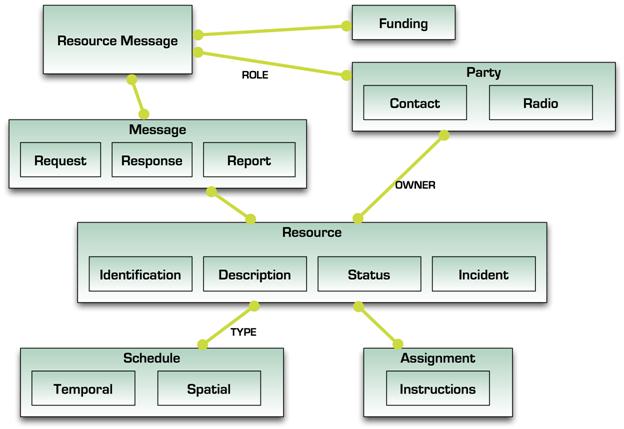
Figure 1: Resource Messaging –
Abstract Reference Model
The core of any message is the Resource or
Resources with which it is concerned. A Resource contains information about its
Identity, Description and Status. A Resource owner can also be identified.
A Resource may also have a schedule which
includes Temporal and Spatial details. For example, the expected arrival time
and place for a specific resource. There are a number of types for Schedules.
A Resource may also have information about its
Assignment including the identified Incident and Instructions related to the
incident assignment.
Figure 2 below shows the EDXL–RM Element
Reference Model (ERM). The purpose of the ERM is to highlight the low-level
structure of the RM framework and the relationships between the main entities
and their elements.
It is important to note that the ERM should
not be used as an implementation model as the exact semantics and structure are
captured in the subsequent sections on the Resource Message Types.
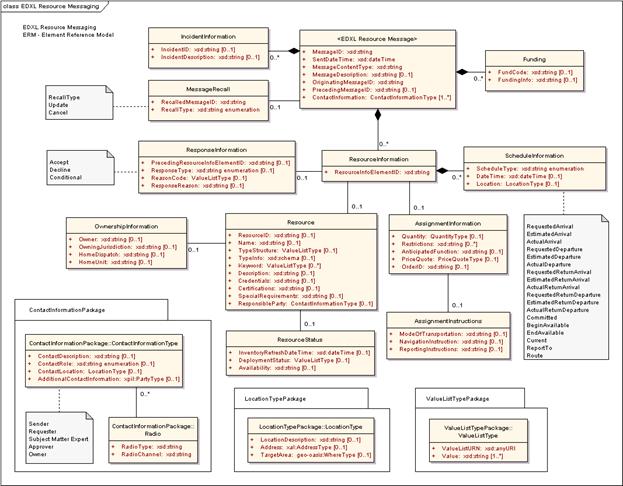
Figure 2: Resource Messaging –
Element Reference Model
The RM-ERM shows the
element-level details for the main entities in the RM. The semantics for each
of the elements is defined in Section 3.3.
The general RM framework is based on a Request/Response
model. Most of the Request messages expect a Response, and in some cases,
messages are used to notify others of changes or offers of resources.
An RM message MUST be carried as the payload of the EDXL-DE
or a distribution mechanism with the distribution type values of Report,
Update, Cancel, Request, Response, Dispatch, Ack and Error, as defined in
EDXL-DE. For example, the acknowledgement of an RM message is handled by the distribution
mechanism.
When a message recipient receives an RM message, it uses the
EDXL-DE DistributionType value of Ack as an acknowledgement. An acknowledgement
is intended to inform the sender that the RM message has been received.
The EDXL-RM provides the mechanism to recall or update a
previously sent resource message through the EDXL MessageRecall element. The
MessageRecall element, when present, contains the RecalledMessageID and the RecallType.
The RecalledMessageID contains the MessageID of the message previously sent
that is being either canceled or updated. If the RecallType element contains
the value “Cancel”, then the entire message specified in RecalledMessageID is
to be canceled. If the RecallType element contains the value “Update”, then the
entire message specified in RecalledMessageID is replaced by the new message.
This two-way communication is characterized by two classes
of primary actors. The Resource Consumer is an actor that needs or requires
resources to undertake response to an incident. The Resource Supplier is an
owner, or distributor, or manager of resources that can meet the needs of
Resource Consumers. There may be more than one actor of each class for a given
sequence of message exchanges, and there may also be other classes of actors
besides these two primary types.
There are 16 resource messages defined in this
specification, which are summarized in Table 1 below.
Table 1: Resource Message Type
Summary
|
Message Type
|
Description
|
Message
Sender
|
|
RequestResource
|
Message used to request
needed resources from one or many recipients, possibly spawning multiple
responses.
|
Resource Consumer
|
|
ResponseToRequestResource
|
Message used as the response
to a “RequestResource”. Allows sender to list resource(s) which they feel
represent suitable match with a resource request.
|
Resource Supplier
|
|
RequisitionResource
|
Message used to “order”
specific resource, or to confirm specific resource to be “ordered” relating
to one or more responses to a “RequestResource”.
|
Resource Consumer
|
|
CommitResource
|
Message used to agree or
commit specific resource in response to a RequestResoure or RequisitionResource,”.
|
Resource Supplier
|
|
RequestInformation
|
Message used to ask resource
questions or provide general description of situation and general resources
needs.
|
Resource Consumer,
Resource Supplier
|
|
ResponseToRequestInformation
|
Message used as the response
to a RequestInformation message providing general information or to list
resource that may meet the specified need.
|
Resource Supplier, Resource
Consumer
|
|
OfferUnsolicitedResource
|
Message used to offer
available resources (that have not been requested) to assist with an
emergency response.
|
Resource Supplier
|
|
ReleaseResource
|
Message used at the incident
to “release” (demobilize) resource back to its original Supplier.
|
Resource Consumer
|
|
RequestReturn
|
Message used to request
release (demobilize) of resources back to its original point of assignment or
to another location / assignment ("I want my stuff back").
|
Resource Supplier
|
|
ResponseToRequestReturn
|
Message used as the response
to a "RequestReturn" indicating whether the resource may be
released, with relevant time-line information.
|
Resource Consumer
|
|
RequestQuote
|
Message used to request a
price quote from a seller or supplier.
|
Resource Consumer
|
|
ResponseToRequestQuote
|
Message used as the response
to a “RequestQuote”. Allows sender to list resource(s) which they feel
represent suitable match with the request, with pricing information.
|
Resource Supplier
|
|
RequestResourceDeploymentStatus
|
Message used to request
current “status” of resource.
|
Both
|
|
ReportResourceDeploymentStatus
|
Message used to report on
the current “status” of any resource.
|
Both
|
|
RequestExtendedDeploymentDuration
|
A request initiated by the
requester / receiver of resource, “I want to extend how long I need to keep
this resource”
|
Resource Consumer
|
|
ResponseToRequestExtendedDeployment
Duration
|
Message used as the response
to “RequestExtendedDeploymentDuration”.
|
Resource Supplier
|
Table 1 above and Figure 3 below are informative only. They are included to show how the resource
messages might flow between the Resource Consumer and Resource Supplier during
resource management. Note, however, that this specification does not prescribe the
sequence of message exchanges, except for some dependencies between messages
which are described in Section3.3.
The Resource Messages can be used in three
phases of resource management:
·
Discovery,
·
Ordering, and
·
Deployment, as shown in Figure 3.
The Discovery phase enables Resource Consumers
to find out about available resources, including their costs, and offers of
resources from Resource Suppliers.
The Ordering phase enables Resource Consumers
to explicitly requisition Resources from Resource Suppliers.
The Deployment phase enables both actors to
find about the current status of resources in the field, request extensions and
returns.
It is important to note that this specification
does not mandate an exact order and workflow of Resource Messages. For example,
the Ordering phase may actually only require the CommitResource message for
some actors.
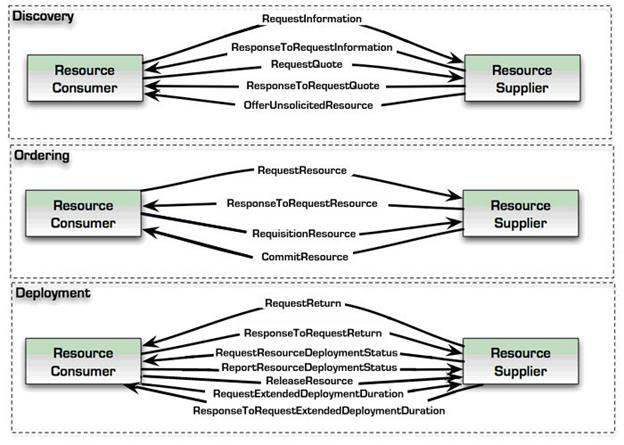
Figure 3: Resource Message
Phases
Table 2 (below) summarizes all the Message
Types and their element contents. The specific details on each of the
Message Types are outlined in the following sections.
Table 2: Resource Message Type – Element Matrix (Key: R = Required, C = Conditional, O = Optional)
N/A – Not Applicable to the message type)
|
Schema Element
|
Message Element
|
EDXL Request Resource
|
ResponseTo Request Resource
|
Requisition Resource
|
Commit Resource
|
Request Information
|
ResponseTo Request Information
|
Offer Unsolicited Resource
|
Release Resource
|
Request Return
|
ResponseTo Request Return
|
Request Quote
|
ResponseTo Request Quote
|
Request Resource Deployment
Status
|
Report Resource Deployment
Status
|
Request Extended Deployment
Duration
|
ResponseTo Request Extended
Deployment Duration
|
|
Resource
Message
|
MessageID
|
R
|
R
|
R
|
R
|
R
|
R
|
R
|
R
|
R
|
R
|
R
|
R
|
R
|
R
|
R
|
R
|
|
SentDateTime
|
R
|
R
|
R
|
R
|
R
|
R
|
R
|
R
|
R
|
R
|
R
|
R
|
R
|
R
|
R
|
R
|
|
MessageContentType
|
R
|
R
|
R
|
R
|
R
|
R
|
R
|
R
|
R
|
R
|
R
|
R
|
R
|
R
|
R
|
R
|
|
MessageDescription
|
O
|
O
|
O
|
O
|
R
|
O
|
O
|
O
|
O
|
O
|
O
|
O
|
O
|
O
|
O
|
O
|
|
OriginatingMessageID
|
R
|
R
|
R
|
R
|
R
|
R
|
R
|
R
|
R
|
R
|
R
|
R
|
R
|
R
|
R
|
R
|
|
PrecedingMessageID
|
N/A
|
R
|
O
|
R
|
O
|
R
|
N/A
|
O
|
O
|
R
|
O
|
R
|
O
|
O
|
O
|
R
|
|
Incident Information
|
O
|
O
|
O
|
O
|
O
|
O
|
O
|
O
|
O
|
O
|
O
|
O
|
O
|
O
|
O
|
O
|
|
MessageRecall
|
O
|
O
|
O
|
O
|
O
|
O
|
O
|
O
|
O
|
O
|
O
|
O
|
O
|
O
|
O
|
O
|
|
Funding
|
O
|
O
|
R
|
O
|
O
|
O
|
N/A
|
O
|
O
|
O
|
O
|
O
|
O
|
O
|
O
|
O
|
|
ContactInformation
|
R
|
R
|
R
|
R
|
R
|
R
|
R
|
R
|
R
|
R
|
R
|
R
|
R
|
R
|
R
|
R
|
|
Resource Information
|
R
|
R
|
R
|
R
|
O
|
O
|
R
|
R
|
R
|
R
|
R
|
R
|
R
|
R
|
R
|
R
|
|
Incident Information
|
IncidentID
|
C
|
C
|
C
|
C
|
C
|
C
|
C
|
C
|
C
|
C
|
C
|
C
|
C
|
C
|
C
|
C
|
|
IncidentDescription
|
C
|
C
|
C
|
C
|
C
|
C
|
C
|
C
|
C
|
C
|
C
|
C
|
C
|
C
|
C
|
C
|
|
Message Recall
|
RecalledMessageID
|
R
|
R
|
R
|
R
|
R
|
R
|
R
|
R
|
R
|
R
|
R
|
R
|
R
|
R
|
R
|
R
|
|
RecallType
|
R
|
R
|
R
|
R
|
R
|
R
|
R
|
R
|
R
|
R
|
R
|
R
|
R
|
R
|
R
|
R
|
|
Funding
|
FundCode
|
C
|
C
|
C
|
C
|
C
|
C
|
N/A
|
C
|
C
|
C
|
C
|
C
|
C
|
C
|
C
|
C
|
|
FundingInfo
|
C
|
C
|
C
|
C
|
C
|
C
|
N/A
|
C
|
C
|
C
|
C
|
C
|
C
|
C
|
C
|
C
|
|
Resource Information
|
ResourceInfoElementID
|
R
|
R
|
R
|
R
|
R
|
R
|
R
|
R
|
R
|
R
|
R
|
R
|
R
|
R
|
R
|
R
|
|
Response Information
|
N/A
|
R
|
N/A
|
R
|
N/A
|
O
|
N/A
|
O
|
N/A
|
R
|
O
|
R
|
N/A
|
O
|
N/A
|
R
|
|
Resource
|
R
|
O
|
R
|
C
|
O
|
O
|
R
|
R
|
R
|
O
|
R
|
C
|
R
|
O
|
R
|
C
|
|
AssignmentInformation
|
O
|
O
|
R
|
C
|
O
|
O
|
O
|
O
|
O
|
O
|
O
|
O
|
O
|
O
|
O
|
O
|
|
Schedule Information
|
O
|
O
|
O
|
C
|
O
|
O
|
O
|
O
|
O
|
O
|
O
|
O
|
O
|
O
|
O
|
O
|
|
Response Information
|
PrecedingResourceInfoElementID
|
N/A
|
R
|
N/A
|
R
|
N/A
|
R
|
N/A
|
R
|
N/A
|
R
|
R
|
R
|
N/A
|
R
|
N/A
|
R
|
|
ResponseType
|
N/A
|
R
|
N/A
|
R
|
N/A
|
R
|
N/A
|
R
|
N/A
|
R
|
R
|
R
|
N/A
|
R
|
N/A
|
R
|
|
ReasonCode
|
N/A
|
C
|
N/A
|
C
|
N/A
|
C
|
N/A
|
C
|
N/A
|
C
|
C
|
C
|
N/A
|
C
|
N/A
|
C
|
|
ResponseReason
|
N/A
|
C
|
N/A
|
C
|
N/A
|
C
|
N/A
|
C
|
N/A
|
C
|
C
|
C
|
N/A
|
C
|
N/A
|
C
|
|
Resource
|
ResourceID
|
C
|
C
|
C
|
C
|
C
|
C
|
C
|
C
|
C
|
C
|
C
|
C
|
C
|
C
|
C
|
C
|
|
Name
|
C
|
C
|
C
|
C
|
C
|
C
|
C
|
C
|
C
|
C
|
C
|
C
|
C
|
C
|
C
|
C
|
|
TypeStructure
|
C
|
C
|
C
|
C
|
C
|
C
|
C
|
C
|
C
|
C
|
C
|
C
|
C
|
C
|
C
|
C
|
|
TypeInfo
|
O
|
O
|
O
|
O
|
O
|
O
|
O
|
O
|
O
|
O
|
O
|
O
|
O
|
O
|
O
|
O
|
|
Keyword
|
O
|
O
|
O
|
O
|
O
|
O
|
O
|
O
|
O
|
O
|
O
|
O
|
O
|
O
|
O
|
O
|
|
Description
|
O
|
O
|
O
|
O
|
O
|
O
|
O
|
O
|
O
|
O
|
O
|
O
|
O
|
O
|
O
|
O
|
|
Credentials
|
O
|
O
|
O
|
O
|
O
|
O
|
O
|
O
|
O
|
O
|
O
|
O
|
O
|
O
|
O
|
O
|
|
Certifications
|
O
|
O
|
O
|
O
|
O
|
O
|
O
|
O
|
O
|
O
|
O
|
O
|
O
|
O
|
O
|
O
|
|
SpecialRequirements
|
O
|
O
|
O
|
O
|
O
|
O
|
O
|
O
|
O
|
O
|
O
|
O
|
O
|
O
|
O
|
O
|
|
ResponsibleParty
|
N/A
|
O
|
O
|
O
|
O
|
O
|
O
|
O
|
O
|
O
|
O
|
O
|
O
|
O
|
O
|
O
|
|
OwnershipInformation
|
N/A
|
O
|
O
|
O
|
O
|
O
|
O
|
O
|
O
|
O
|
O
|
O
|
O
|
O
|
O
|
O
|
|
Resource Status
|
N/A
|
O
|
N/A
|
O
|
O
|
O
|
O
|
O
|
O
|
R
|
N/A
|
O
|
NA
|
O
|
O
|
O
|
|
Ownership Information
|
Owner
|
N/A
|
C
|
C
|
C
|
C
|
C
|
C
|
C
|
C
|
C
|
C
|
C
|
C
|
C
|
C
|
C
|
|
OwningJurisdiction
|
N/A
|
C
|
C
|
C
|
C
|
C
|
C
|
C
|
C
|
C
|
C
|
C
|
C
|
C
|
C
|
C
|
|
HomeDispatch
|
N/A
|
O
|
O
|
O
|
O
|
O
|
O
|
O
|
O
|
O
|
O
|
O
|
O
|
O
|
O
|
O
|
|
HomeUnit
|
N/A
|
O
|
O
|
O
|
O
|
O
|
O
|
O
|
O
|
O
|
O
|
O
|
O
|
O
|
O
|
O
|
|
Resource Status
|
InventoryRefreshDateTime
|
N/A
|
O
|
N/A
|
O
|
O
|
O
|
O
|
N/A
|
N/A
|
N/A
|
N/A
|
O
|
N/A
|
O
|
N/A
|
N/A
|
|
DeploymentStatus
|
N/A
|
O
|
N/A
|
O
|
O
|
O
|
O
|
O
|
O
|
R
|
N/A
|
O
|
N/A
|
O
|
O
|
O
|
|
Availability
|
N/A
|
O
|
N/A
|
N/A
|
O
|
O
|
O
|
O
|
O
|
R
|
N/A
|
O
|
N/A
|
O
|
O
|
O
|
|
Assignment
Information
|
Quantity
|
O
|
C
|
R
|
R
|
O
|
O
|
O
|
R
|
O
|
O
|
O
|
O
|
O
|
O
|
O
|
O
|
|
Restrictions
|
O
|
O
|
O
|
O
|
O
|
O
|
O
|
O
|
O
|
O
|
O
|
O
|
O
|
O
|
O
|
O
|
|
AnticipatedFunction
|
O
|
O
|
O
|
O
|
O
|
O
|
O
|
O
|
O
|
O
|
O
|
O
|
O
|
O
|
O
|
O
|
|
PriceQuote
|
N/A
|
O
|
O
|
O
|
O
|
O
|
O
|
O
|
O
|
O
|
N/A
|
R
|
O
|
O
|
O
|
O
|
|
OrderID
|
N/A
|
N/A
|
N/A
|
O
|
O
|
O
|
N/A
|
O
|
O
|
O
|
N/A
|
N/A
|
O
|
O
|
O
|
O
|
|
Assignment
Instructions
|
N/A
|
O
|
O
|
O
|
O
|
O
|
O
|
O
|
O
|
O
|
O
|
O
|
O
|
O
|
N/A
|
O
|
|
Assignment
Instructions
|
ModeOfTransportation
|
N/A
|
O
|
O
|
O
|
O
|
O
|
O
|
O
|
O
|
O
|
O
|
O
|
O
|
O
|
N/A
|
O
|
|
NavigationInstructions
|
N/A
|
O
|
O
|
O
|
O
|
O
|
O
|
O
|
O
|
O
|
O
|
O
|
O
|
O
|
N/A
|
O
|
|
ReportingInstructions
|
N/A
|
O
|
O
|
O
|
O
|
O
|
O
|
O
|
O
|
O
|
O
|
O
|
O
|
O
|
N/A
|
O
|
|
Schedule Information
|
ScheduleType
|
R
|
R
|
R
|
R
|
R
|
R
|
R
|
R
|
R
|
R
|
R
|
R
|
R
|
R
|
R
|
R
|
|
DateTime
|
O
|
O
|
O
|
O
|
O
|
O
|
O
|
O
|
O
|
O
|
O
|
O
|
O
|
O
|
O
|
O
|
|
Location
|
O
|
O
|
O
|
O
|
O
|
O
|
O
|
O
|
O
|
O
|
O
|
O
|
O
|
O
|
O
|
O
|
Table 3: ScheduleTypes – Message Matrix
|
|
RequestResource
|
ResponseToRequestResource
|
RequisitionResource
|
CommitResource
|
RequestInformation
|
ResponseToRequestInformation
|
OfferUnsolicitedResource
|
ReleaseResource
|
RequestReturn
|
ResponseToRequestReturn
|
RequestQuote
|
ResponseToRequestQuote
|
RequestResourceDeploymentStatus
|
ReportResourceDeploymentStatus
|
RequestExtendedDeploymentDuration
|
ResponseToRequestExtendedDeploymentDuration
|
|
RequestedArrival
|
x
|
x
|
x
|
x
|
x
|
x
|
|
x
|
x
|
x
|
x
|
x
|
x
|
x
|
x
|
x
|
|
EstimatedArrival
|
|
x
|
x
|
x
|
x
|
x
|
x
|
x
|
x
|
x
|
|
x
|
x
|
x
|
x
|
x
|
|
ActualArrival
|
|
|
|
|
x
|
x
|
|
x
|
x
|
x
|
|
|
x
|
x
|
x
|
x
|
|
RequestedDeparture
|
x
|
x
|
x
|
x
|
x
|
x
|
|
x
|
x
|
x
|
x
|
x
|
x
|
x
|
x
|
x
|
|
EstimatedDeparture
|
|
x
|
x
|
x
|
x
|
x
|
x
|
x
|
x
|
x
|
|
x
|
x
|
x
|
x
|
x
|
|
ActualDeparture
|
|
|
|
x
|
x
|
x
|
|
x
|
x
|
x
|
|
|
x
|
x
|
x
|
x
|
|
RequestedReturnArrival
|
|
x
|
x
|
x
|
x
|
x
|
x
|
x
|
x
|
x
|
|
x
|
x
|
x
|
x
|
x
|
|
EstimatedReturnArrival
|
x
|
x
|
x
|
x
|
x
|
x
|
|
x
|
|
x
|
x
|
x
|
x
|
x
|
x
|
x
|
|
ActualReturnArrival
|
|
|
|
|
x
|
x
|
|
|
|
|
|
|
x
|
x
|
|
|
|
RequestedReturnDeparture
|
|
x
|
x
|
x
|
x
|
x
|
x
|
x
|
x
|
x
|
|
x
|
x
|
x
|
x
|
x
|
|
EstimatedReturnDeparture
|
x
|
x
|
x
|
x
|
x
|
x
|
|
x
|
|
x
|
x
|
x
|
x
|
x
|
x
|
x
|
|
ActualReturnDeparture
|
|
|
|
|
x
|
x
|
|
x
|
|
x
|
|
|
x
|
x
|
|
|
|
Committed
|
|
|
|
x
|
x
|
x
|
|
x
|
x
|
x
|
|
|
x
|
x
|
x
|
x
|
|
BeginAvailable
|
|
x
|
x
|
x
|
x
|
x
|
x
|
x
|
x
|
x
|
|
x
|
x
|
x
|
|
|
|
EndAvailable
|
|
x
|
x
|
x
|
x
|
x
|
x
|
x
|
x
|
x
|
|
x
|
x
|
x
|
|
x
|
|
Current
|
|
|
|
x
|
x
|
x
|
|
x
|
x
|
x
|
|
x
|
x
|
x
|
x
|
x
|
|
ReportTo
|
x
|
x
|
x
|
x
|
x
|
x
|
|
x
|
x
|
x
|
x
|
x
|
x
|
x
|
x
|
x
|
|
Route
|
x
|
x
|
x
|
x
|
x
|
x
|
x
|
x
|
x
|
x
|
x
|
x
|
x
|
x
|
x
|
x
|
The “RequestResource” message is used as an
announcement to a broad audience of potential suppliers as well as potential
suppliers in the local geographic area of interest. It is intended to be used
by Emergency Managers, Incident Commanders and other First Responders to
request information on availability of needed resources.
Figure 4 below shows
the EDXL–RM Element Reference Model (ERM) tailored for the RequestResource
Message. The ERM shows the element-level details for the
main entities in the RM.

Figure 4: EDXL-RM ERM for
RequestResource Message
The following table outlines the element cardinalities for
this message type, as follows:
–
bold indicates an element that is required
–
italics indicate an element that is conditional (the
applicable rules for these elements appear below the table)
–
an asterisk (*) indicates that an element can appear multiple
times
–
a caret symbol (^) indicates that the values of an element are
constrained, as per the rules shown below the table.
All elements that are not shown in bold or italics are
optional.
Table 4: RequestResource Message Elements
|
Parent Element
|
Sub-Elements
|
|
RequestResource
|
MessageID, SentDateTime, MessageContentType^,
MessageDescription, OriginatingMessageID, IncidentInformation*,
MessageRecall, Funding*, ContactInformation*, ResourceInformation*
|
|
IncidentInformation
|
IncidentID, IncidentDescription
|
|
MessageRecall
|
RecalledMessageID, RecallType
|
|
Funding
|
FundCode, FundingInfo
|
|
ResourceInformation
|
ResourceInfoElementID, Resource,
AssignmentInformation, ScheduleInformation*
|
|
Resource
|
ResourceID, Name, TypeStructure,
TypeInfo, Keyword*, Description, Credentials, Certifications,
SpecialRequirements
|
|
AssignmentInformation
|
Quantity, Restrictions, AnticipatedFunction
|
|
ScheduleInformation
|
ScheduleType^, DateTime, Location
|
The following rules apply to the above elements: The
following notation is used throughout this document: a colon is used as a
separator between the name of an element and the name of a child of that
element.
·
The RequestResource:MessageID, RequestResource:SentDateTime, RequestResource:MessageContentType,
RequestResource:OriginatingMessageID, RequestResource:ContactInformation, and RequestResource:ResourceInformation
elements MUST be present.
·
The value of RequestResource:MessageContentType MUST be “RequestResource”.
·
If a RequestResource:IncidentInformation element is present, then
at least one of IncidentInformation:IncidentID and/or
IncidentInformation:IncidentDescription MUST be present.
·
If the RequestResource:MessageRecall element is present, then the
MessageRecall:RecalledMessageID and MessageRecall:RecallType elements MUST be
present.
·
If a ResourceMessage:Funding element is present, then at least
one of Funding:FundCode and/or Funding:FundingInfo MUST be present.
·
The ResourceInformation:ResourceInfoElementID and ResourceInformation:Resource
elements MUST be present.
·
At least one of Resource:ResourceID, Resource:Name and/or
Resource:TypeStructure MUST be present.
·
If the ResourceInformation:ScheduleInformation element is
present, then the ScheduleInformation:ScheduleType MUST be present and contain
one of the following values:
·
“RequestedArrival”, “RequestedDeparture”, “EstimatedReturnDeparture”,
“EstimatedReturnArrival”, “ReportTo”, or “Route”.
The schema for a
RequestResource message can be found in Appendix A.3.
The RequestResource message is an initial message created
and sent by the Resource Consumer to any number of Resource Suppliers.
The potential responses to this message include:
·
ResponseToRequestResource (See Section 3.5)
·
Response may include Accept, Decline, and Provisional responses.
The message may
be canceled or updated through the RequestResource:MessageRecall element.
Below is an example of a RequestResource Message, in which
three resource requests are shown:
·
Small Animal Sheltering Team (ResourceInfoElementID=001)
·
Patrol and Surveillance Helicopters (ResourceInfoElementID =002)
·
Electrical Power Restoration Team (ResourceInfoElementID =003).
[Note: The XML example
shown in this section is informative only.]
<?xml
version="1.0" encoding="UTF-8"?>
<RequestResource
xmlns:xsi="http://www.w3.org/2001/XMLSchema-instance"
xsi:schemaLocation="urn:oasis:names:tc:emergency:EDXL:RM:1.0:msg
EDXL-RMRequestResource.xsd"
xmlns="urn:oasis:names:tc:emergency:EDXL:RM:1.0:msg"
xmlns:rm="urn:oasis:names:tc:emergency:EDXL:RM:1.0"
xmlns:xpil="urn:oasis:names:tc:ciq:xpil:3"
xmlns:xnl="urn:oasis:names:tc:ciq:xnl:3"
xmlns:xal="urn:oasis:names:tc:ciq:xal:3"
xmlns:geo-oasis="urn:oasis:names:tc:emergency:EDXL:HAVE:1.0:geo-oasis"
xmlns:gml="http://www.opengis.net/gml">
<MessageID>urn:au-qld-eoc:12332</MessageID>
<SentDateTime>2006-03-21T11:58:00+10:00</SentDateTime>
<MessageContentType>RequestResource</MessageContentType>
<OriginatingMessageID>urn:au-qld-eoc:12332</OriginatingMessageID>
<IncidentInformation>
<rm:IncidentDescription>Cyclone Larry</rm:IncidentDescription>
</IncidentInformation>
<ContactInformation>
<rm:ContactRole>Sender</rm:ContactRole>
<rm:AdditionalContactInformation>
<xpil:PartyName>
<xnl:PersonName>
<xnl:NameElement
xnl:ElementType="FirstName">Alex</xnl:NameElement>
<xnl:NameElement
xnl:ElementType="LastName">Jones</xnl:NameElement>
</xnl:PersonName>
<xnl:OrganisationName>
<xnl:NameElement>Dept of Emergency Services</xnl:NameElement>
</xnl:OrganisationName>
</xpil:PartyName>
<xpil:ContactNumbers>
<xpil:ContactNumber xpil:CommunicationMediaType="Telephone"
xpil:ContactHours="9:00AM - 5:00PM">
<xpil:ContactNumberElement
xpil:Type="CountryCode">61</xpil:ContactNumberElement>
<xpil:ContactNumberElement
xpil:Type="AreaCode">7</xpil:ContactNumberElement>
<xpil:ContactNumberElement xpil:Type="LocalNumber">
3000
1234
</xpil:ContactNumberElement>
</xpil:ContactNumber>
</xpil:ContactNumbers>
<xpil:ElectronicAddressIdentifiers>
<xpil:ElectronicAddressIdentifier>alexj@emergencyservices.gov.au
</xpil:ElectronicAddressIdentifier>
</xpil:ElectronicAddressIdentifiers>
</rm:AdditionalContactInformation>
</ContactInformation>
<ResourceInformation>
<ResourceInfoElementID>001</ResourceInfoElementID>
<Resource>
<TypeStructure>
<rm:ValueListURN>urn:x-hazard:vocab:resourceTypes</rm:ValueListURN>
<rm:Value>Small Animal Sheltering Team</rm:Value>
</TypeStructure>
<Description>
5-person response team to advise and support local efforts to set up a
small animal shelter
</Description>
<SpecialRequirements>A qualified veterinary
surgeon</SpecialRequirements>
</Resource>
<AssignmentInformation>
<Quantity>
<rm:MeasuredQuantity>
<rm:Amount>1</rm:Amount>
</rm:MeasuredQuantity>
</Quantity>
</AssignmentInformation>
<ScheduleInformation>
<ScheduleType>RequestedArrival</ScheduleType>
<DateTime>2006-03-24T09:00:00+10:00</DateTime>
<Location>
<rm:LocationDescription>Innisfail Animal
Refuge</rm:LocationDescription>
<rm:Address>
<xal:Country>
<xal:NameElement>Australia</xal:NameElement>
</xal:Country>
<xal:AdministrativeArea>
<xal:NameElement>QLD</xal:NameElement>
</xal:AdministrativeArea>
<xal:Locality>
<xal:NameElement>Innisfail</xal:NameElement>
</xal:Locality>
<xal:Thoroughfare>
<xal:NameElement>Downing St</xal:NameElement>
<xal:Number>27</xal:Number>
</xal:Thoroughfare>
<xal:PostCode>
<xal:Identifier>4860</xal:Identifier>
</xal:PostCode>
</rm:Address>
</Location>
</ScheduleInformation>
<ScheduleInformation>
<ScheduleType>EstimatedReturnDeparture</ScheduleType>
<DateTime>2006-03-30T17:00:00+10:00</DateTime>
</ScheduleInformation>
</ResourceInformation>
<ResourceInformation>
<ResourceInfoElementID>002</ResourceInfoElementID>
<Resource>
<TypeStructure>
<rm:ValueListURN>urn:x-hazard:vocab:resourceTypes</rm:ValueListURN>
<rm:Value>Patrol and Surveillance Helicopters</rm:Value>
</TypeStructure>
</Resource>
<AssignmentInformation>
<Quantity>
<rm:MeasuredQuantity>
<rm:Amount>3</rm:Amount>
</rm:MeasuredQuantity>
</Quantity>
<AnticipatedFunction>
Aerial surveillance to determine extent of
flooding
</AnticipatedFunction>
</AssignmentInformation>
<ScheduleInformation>
<ScheduleType>RequestedArrival</ScheduleType>
<DateTime>2006-03-22T09:00:00+10:00</DateTime>
<Location>
<rm:LocationDescription>Innisfail airport</rm:LocationDescription>
</Location>
</ScheduleInformation>
</ResourceInformation>
<ResourceInformation>
<ResourceInfoElementID>003</ResourceInfoElementID>
<Resource>
<TypeStructure>
<rm:ValueListURN>urn:x-hazard:vocab:resourceTypes</rm:ValueListURN>
<rm:Value>Electrical Power Restoration Team</rm:Value>
</TypeStructure>
</Resource>
<AssignmentInformation>
<Quantity>
<rm:MeasuredQuantity>
<rm:Amount>2</rm:Amount>
</rm:MeasuredQuantity>
</Quantity>
<AnticipatedFunction>
Restore power to critical infrastructure in and around the
Innisfail area
</AnticipatedFunction>
</AssignmentInformation>
<ScheduleInformation>
<ScheduleType>RequestedArrival</ScheduleType>
<DateTime>2006-03-22T08:00:00+10:00</DateTime>
<Location>
<rm:TargetArea>
<gml:Point>
<gml:pos> 146.03 -17.53 </gml:pos>
</gml:Point>
</rm:TargetArea>
</Location>
</ScheduleInformation>
</ResourceInformation>
</RequestResource>
The “ResponseToRequestResource” message
is used by potential resource suppliers (e.g. mutual aid partners, equipment
suppliers, etc.) to respond to RequestResource messages from Emergency
Managers, Incident Commanders and First Responders or others with logistics
responsibilities. The response may identify availability, limitations and other
pertinent information related to resources in the original request.
Figure 5 below shows the EDXL–RM Element
Reference Model (ERM) tailored for the ResponseToRequestResource Message. The ERM shows the element-level details for the main entities in the RM.
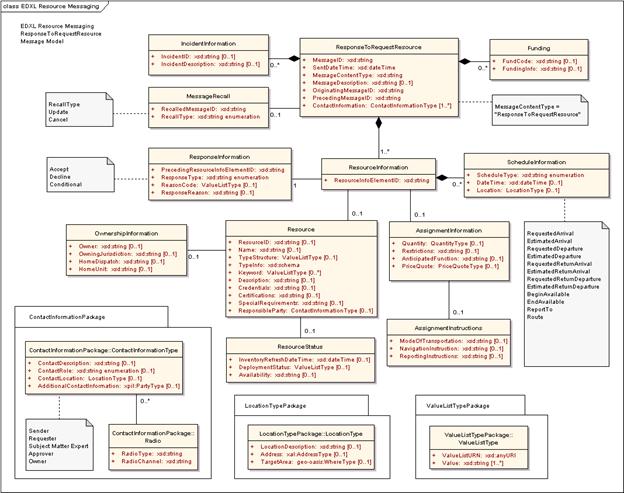
Figure 5: EDXL-RM ERM for
ResponseToRequestResource Message
The following table outlines the element cardinalities for
this message type.
Table 5: ResponseToRequestResource Message Elements
|
Parent Element
|
Sub-Elements
|
|
ResponseToRequestResource
|
MessageID, SentDateTime, MessageContentType^,
MessageDescription, OriginatingMessageID, PrecedingMessageID,
IncidentInformation*, MessageRecall, Funding*, ContactInformation*, ResourceInformation*
|
|
IncidentInformation
|
IncidentID, IncidentDescription
|
|
MessageRecall
|
RecalledMessageID, RecallType
|
|
Funding
|
FundCode, FundingInfo
|
|
ResourceInformation
|
ResourceInfoElementID, ResponseInformation, Resource,
AssignmentInformation, ScheduleInformation*
|
|
ResponseInformation
|
PrecedingResourceInfoElementID, ResponseType,
ReasonCode, ResponseReason
|
|
Resource
|
ResourceID, Name, TypeStructure,
TypeInfo, Keyword*, Description, Credentials, Certifications,
SpecialRequirements, ResponsibleParty, OwnershipInformation, ResourceStatus
|
|
OwnershipInformation
|
Owner, OwningJurisdiction, HomeDispatch, HomeUnit
|
|
ResourceStatus
|
InventoryRefreshDateTime, DeploymentStatus, Availability
|
|
AssignmentInformation
|
Quantity, Restrictions, AnticipatedFunction,
PriceQuote, AssignmentInstructions
|
|
AssignmentInstructions
|
ModeOfTransportation, NavigationInstructions,
ReportingInstructions
|
|
ScheduleInformation
|
ScheduleType^, DateTime, Location
|
The following rules apply to the above elements:
·
The ResponseToRequestResource:MessageID, ResponseToRequestResource:SentDateTime,
ResponseToRequestResource:MessageContentType, ResponseToRequestResource:OriginatingMessageID,
ResponseToRequestResource:PrecedingMessageID, ResponseToRequestResource:ContactInformation,
and ResponseToRequestResource:ResourceInformation elements MUST be present.
·
The value of ResponseToRequestResource:MessageContentType MUST be
“ResponseToRequestResource”.
·
If a ResponseToRequestResource:IncidentInformation element is
present, then at least one of IncidentInformation:IncidentID and/or IncidentInformation:IncidentDescription
MUST be present.
·
If the ResponseToRequestResource:MessageRecall element is
present, then the MessageRecall:RecalledMessageID and MessageRecall:RecallType
elements MUST be present.
·
If a ResponseToRequestResource:Funding element is present, then
at least one of Funding:FundCode and/or Funding:FundingInfo elements MUST be
present.
·
The ResourceInformation:ResourceInfoElementID and
ResourceInformation:ResponseInformation elements MUST be present.
·
The ResponseInformation:PrecedingResourceInfoElementID and
ResponseInformation:ResponseType elements MUST be present.
·
At least one of Resource:ResourceID, Resource:Name, and/or
Resource:TypeStructure elements MUST be present.
·
If a ResourceInformation:Resource element is present, then at
least one of Resource:ResourceID, Resource:Name, and/or Resource:TypeStructure element
MUST be present.
·
If Resource:OwnershipInformation element is present, then at
least one of OwnershipInformation:Owner and/or
OwnershipInformation:OwningJurisdiction element MUST be present.
·
If the ResourceInformation:AssignmentInformation element is
present and the ResponseInformation:ResponseType contains a value of “Accept”
or “Provisional”, then the AssignmentInformation:Quantity element MUST be
present.
·
If ResourceInformation:ScheduleInformation is present then
ScheduleInformation:ScheduleType MUST be present and contain one of the
following values:
·
“EstimatedArrival”, “EstimatedDeparture”, “RequestedReturnDeparture”,
“RequestedReturnArrival”, “BeginAvailable”, and “EndAvailable”, “RequestedArrival”,
“RequestedDeparture”, “EstimatedReturnArrival” or “ReportTo”, “Route”.
The schema for a ResponseToRequestResource
message can be found in Appendix A.4.
The ResponseToRequestResource message is sent by a Resource
Supplier in response to an original RequestResource message.
The potential
responses to this message include:
·
RequisitionResource (See Section 3.6).
The message may
be canceled or updated through the ResponseToRequestResource:MessageRecall
element.
Below is an example of a ResponseToRequestResource Message.
This is an example response to the original request shown in Section 3.4.5 . In this example, the three requests have different responses:
·
The “Small Animal Sheltering Team” (ResourceInfoElementID=001)
has Conditional changes to the request. In this case the Schedule information
is different from that requested.
·
The “Patrol and Surveillance Helicopters” (ResourceInfoElementID=002)
is Declined.
·
The “Electrical Power Restoration Team” (ResourceInfoElementID=003)
is Accepted.
[Note: The XML example
shown in this section is informative only.]
<?xml
version="1.0" encoding="UTF-8"?>
<ResponseToRequestResource
xmlns:xsi="http://www.w3.org/2001/XMLSchema-instance"
xsi:schemaLocation="urn:oasis:names:tc:emergency:EDXL:RM:1.0:msg
EDXL-RMResponseToRequestResource.xsd"
xmlns="urn:oasis:names:tc:emergency:EDXL:RM:1.0:msg"
xmlns:rm="urn:oasis:names:tc:emergency:EDXL:RM:1.0"
xmlns:xpil="urn:oasis:names:tc:ciq:xpil:3"
xmlns:xnl="urn:oasis:names:tc:ciq:xnl:3"
xmlns:xal="urn:oasis:names:tc:ciq:xal:3"
xmlns:geo-oasis="urn:oasis:names:tc:emergency:EDXL:HAVE:1.0:geo-oasis"
xmlns:gml="http://www.opengis.net/gml">
<MessageID>urn:au-qld-eoc:12334</MessageID>
<SentDateTime>2006-03-21T12:34:00+10:00</SentDateTime>
<MessageContentType>ResponseToRequestResource</MessageContentType>
<OriginatingMessageID>urn:au-qld-eoc:12332</OriginatingMessageID>
<PrecedingMessageID>urn:au-qld-eoc:12332</PrecedingMessageID>
<IncidentInformation>
<rm:IncidentDescription>Cyclone Larry</rm:IncidentDescription>
</IncidentInformation>
<ContactInformation>
<rm:ContactRole>Sender</rm:ContactRole>
<rm:AdditionalContactInformation>
<xpil:PartyName>
<xnl:PersonName>
<xnl:NameElement xnl:ElementType="FirstName">Charlotte</xnl:NameElement>
<xnl:NameElement
xnl:ElementType="LastName">Ryan</xnl:NameElement>
</xnl:PersonName>
<xnl:OrganisationName>
<xnl:NameElement>EMA</xnl:NameElement>
</xnl:OrganisationName>
</xpil:PartyName>
<xpil:ContactNumbers>
<xpil:ContactNumber xpil:CommunicationMediaType="Telephone">
<xpil:ContactNumberElement
xpil:Type="CountryCode">61</xpil:ContactNumberElement>
<xpil:ContactNumberElement
xpil:Type="AreaCode">2</xpil:ContactNumberElement>
<xpil:ContactNumberElement xpil:Type="LocalNumber">
9864
4321
</xpil:ContactNumberElement>
</xpil:ContactNumber>
</xpil:ContactNumbers>
</rm:AdditionalContactInformation>
</ContactInformation>
<ResourceInformation>
<ResourceInfoElementID>001</ResourceInfoElementID>
<ResponseInformation>
<rm:PrecedingResourceInfoElementID>001</rm:PrecedingResourceInfoElementID>
<rm:ResponseType>Provisional</rm:ResponseType>
<rm:ResponseReason>Earliest arrival date is
2006-03-25</rm:ResponseReason>
</ResponseInformation>
<ScheduleInformation>
<ScheduleType>EstimatedDeparture</ScheduleType>
<DateTime>2006-03-25T08:10:00</DateTime>
<Location>
<rm:LocationDescription>Cairns Airport</rm:LocationDescription>
</Location>
</ScheduleInformation>
<ScheduleInformation>
<ScheduleType>EstimatedArrival</ScheduleType>
<DateTime>2006-03-25T09:00:00+10:00</DateTime>
<Location>
<rm:LocationDescription>Innisfail Airport</rm:LocationDescription>
</Location>
</ScheduleInformation>
<ScheduleInformation>
<ScheduleType>EstimatedArrival</ScheduleType>
<DateTime>2006-03-25T09:30:00+10:00</DateTime>
<Location>
<rm:LocationDescription>Innisfail Animal Refuge</rm:LocationDescription>
<rm:Address>
<xal:Country>
<xal:NameElement>Australia</xal:NameElement>
</xal:Country>
<xal:AdministrativeArea>
<xal:NameElement>QLD</xal:NameElement>
</xal:AdministrativeArea>
<xal:Locality>
<xal:NameElement>Innisfail</xal:NameElement>
</xal:Locality>
<xal:Thoroughfare>
<xal:NameElement>Downing St</xal:NameElement>
<xal:NameElement>27</xal:NameElement>
</xal:Thoroughfare>
<xal:PostCode>
<xal:Identifier>4860</xal:Identifier>
</xal:PostCode>
</rm:Address>
</Location>
</ScheduleInformation>
</ResourceInformation>
<ResourceInformation>
<ResourceInfoElementID>002</ResourceInfoElementID>
<ResponseInformation>
<rm:PrecedingResourceInfoElementID>002</rm:PrecedingResourceInfoElementID>
<rm:ResponseType>Accept</rm:ResponseType>
</ResponseInformation>
</ResourceInformation>
<ResourceInformation>
<ResourceInfoElementID>003</ResourceInfoElementID>
<ResponseInformation>
<rm:PrecedingResourceInfoElementID>003</rm:PrecedingResourceInfoElementID>
<rm:ResponseType>Decline</rm:ResponseType>
</ResponseInformation>
</ResourceInformation>
</ResponseToRequestResource>
The “RequisitionResource” message is used by
Resource Consumers to order resources from Resource Suppliers. These may relate
to one or more responses to a previous Request Resource message.
Figure 6 below shows the EDXL–RM Element
Reference Model (ERM) tailored for the RequisitionResource Message. The ERM shows the element-level details for the main entities in the RM.
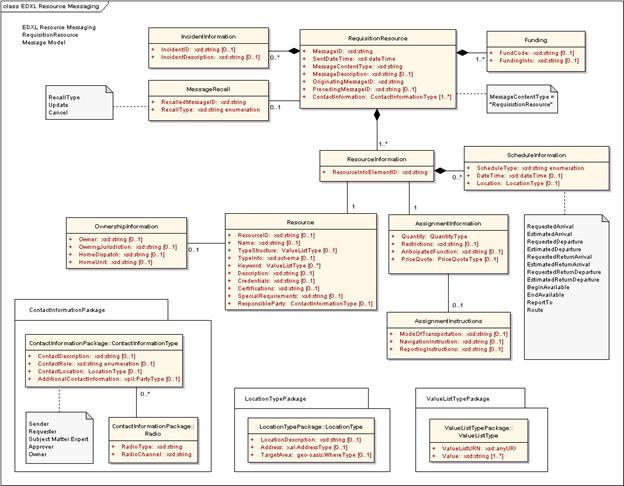
Figure 6: EDXL-RM ERM for RequisitionResource
Message
The following table outlines the element cardinalities for
this message type.
Table 6: RequisitionResource Message Elements
|
Parent Element
|
Sub-Elements
|
|
RequisitionResource
|
MessageID, SentDateTime, MessageContentType^,
MessageDescription, OriginatingMessageID, PrecedingMessageID,
IncidentInformation*, MessageRecall, Funding*, ContactInformation*,
ResourceInformation*
|
|
IncidentInformation
|
IncidentID, IncidentDescription
|
|
MessageRecall
|
RecalledMessageID, RecallType
|
|
Funding
|
FundCode, FundingInfo
|
|
ResourceInformation
|
ResourceInfoElementID, Resource, AssignmentInformation,
ScheduleInformation*
|
|
Resource
|
ResourceID, Name, TypeStructure,
TypeInfo, Keyword*, Description, Credentials, Certifications,
SpecialRequirements, ResponsibleParty, OwnershipInformation
|
|
OwnershipInformation
|
Owner, OwningJurisdiction, HomeDispatch, HomeUnit
|
|
AssignmentInformation
|
Quantity, Restrictions, AnticipatedFunction,
PriceQuote, AssignmentInstructions
|
|
AssignmentInstructions
|
ModeOfTransportation, NavigationInstructions,
ReportingInstructions
|
|
ScheduleInformation
|
ScheduleType^, DateTime, Location
|
The following rules apply to the above elements:
·
The RequisitionResource:MessageID, RequisitionResource:SentDateTime,
RequisitionResource:MessageContentType, RequisitionResource:OriginatingMessageID,
RequisitionResource:Funding, RequisitionResource:ContactInformation, and RequisitionResource:ResourceInformation
elements MUST be present.
·
The value of RequisitionResource:MessageContentType MUST be “RequisitionResource”.
·
If a RequisitionResource:IncidentInformation element is present,
then at least one of IncidentInformation:IncidentID and/or IncidentInformation:IncidentDescription
elements MUST be present.
·
If the RequisitionResource:MessageRecall element is present, then
the MessageRecall:RecalledMessageID and MessageRecall:RecallType elements MUST be
present.
·
If a RequisitionResource:Funding element is present, then at
least one of Funding:FundCode and/or Funding:FundingInfo elements MUST be
present.
·
The ResourceInformation:ResourceInfoElementID, ResourceInformation:Resource
and ResourceInformation:AssignmentInformation elements MUST be present.
·
At least one of Resource:ResourceID, Resource:Name, and/or
Resource:TypeStructure elements MUST be present.
·
If a Resource:OwnershipInformation element is present, then at
least one of OwnershipInformation:Owner and/or
OwnershipInformation:OwningJurisdiction elements MUST be present.
·
The AssignmentInformation:Quantity element MUST be present.
·
If ResourceInformation:ScheduleInformation is present, then the
ScheduleInformation:ScheduleType element MUST be present and contain one of the
following values:
·
“RequestedArrival”, “RequestedDeparture”, “EstimatedArrival”,
“EstimatedDeparture”, “RequestedReturnArrival”, “EstimatedReturnArrival”, “RequestedReturnDeparture”,
“EstimatedReturnDeparture”, “BeginAvailable”, “EndAvailable”, “ReportTo”, or
“Route”
The schema for a RequisitionResource
message can be found in Appendix A.5.
The RequisitionResource message is a
message created and sent by the Resource Consumer to any number of Resource
Suppliers.
The potential responses to this message include:
·
CommitResource (See Section 3.7)
·
This includes Accept, Decline and Provisional responses.
The message may
be canceled or updated through the RequisitionResource:MessageRecall element.
Below is an example of a RequisitionResource
Message, in which two resource requisitions are shown:
·
Small Animal Sheltering Team (ResourceInfoElementID=001)
·
Patrol and Surveillance Helicopters (ResourceInfoElementID=002).
[Note: The XML example
shown in this section is informative only.]
<?xml
version="1.0" encoding="UTF-8"?>
<RequisitionResource
xmlns:xsi="http://www.w3.org/2001/XMLSchema-instance"
xsi:schemaLocation="urn:oasis:names:tc:emergency:EDXL:RM:1.0:msg
EDXL-RMRequisitionResource.xsd"
xmlns="urn:oasis:names:tc:emergency:EDXL:RM:1.0:msg"
xmlns:rm="urn:oasis:names:tc:emergency:EDXL:RM:1.0"
xmlns:xpil="urn:oasis:names:tc:ciq:xpil:3"
xmlns:xnl="urn:oasis:names:tc:ciq:xnl:3"
xmlns:xal="urn:oasis:names:tc:ciq:xal:3"
xmlns:geo-oasis="urn:oasis:names:tc:emergency:EDXL:HAVE:1.0:geo-oasis"
xmlns:gml="http://www.opengis.net/gml">
<MessageID>urn:au-qld-eoc:987654</MessageID>
<SentDateTime>2006-03-21T12:39:00+10:00</SentDateTime>
<MessageContentType>RequisitionResource</MessageContentType>
<OriginatingMessageID>urn:au-qld-eoc:12332</OriginatingMessageID>
<IncidentInformation>
<rm:IncidentDescription>Cyclone Larry</rm:IncidentDescription>
</IncidentInformation>
<Funding>
<rm:FundCode>HP4347</rm:FundCode>
</Funding>
<ContactInformation>
<rm:ContactRole>Requester</rm:ContactRole>
<rm:AdditionalContactInformation>
<xpil:PartyName>
<xnl:PersonName>
<xnl:NameElement
xnl:ElementType="FirstName">Alex</xnl:NameElement>
<xnl:NameElement xnl:ElementType="LastName">Jones</xnl:NameElement>
</xnl:PersonName>
<xnl:OrganisationName>
<xnl:NameElement>Dept of Emergency Services</xnl:NameElement>
</xnl:OrganisationName>
</xpil:PartyName>
<xpil:ContactNumbers>
<xpil:ContactNumber xpil:CommunicationMediaType="Telephone"
xpil:ContactHours="9:00AM - 5:00PM">
<xpil:ContactNumberElement
xpil:Type="CountryCode">61</xpil:ContactNumberElement>
<xpil:ContactNumberElement xpil:Type="AreaCode">7</xpil:ContactNumberElement>
<xpil:ContactNumberElement xpil:Type="LocalNumber">
3000
1234
</xpil:ContactNumberElement>
</xpil:ContactNumber>
</xpil:ContactNumbers>
<xpil:ElectronicAddressIdentifiers>
<xpil:ElectronicAddressIdentifier>alexj@emergencyservices.gov.au
</xpil:ElectronicAddressIdentifier>
</xpil:ElectronicAddressIdentifiers>
</rm:AdditionalContactInformation>
</ContactInformation>
<ContactInformation>
<rm:ContactRole>Approver</rm:ContactRole>
<rm:AdditionalContactInformation>
<xpil:PartyName>
<xnl:PersonName>
<xnl:NameElement
xnl:ElementType="FirstName">Michelle</xnl:NameElement>
<xnl:NameElement xnl:ElementType="LastName">Yates</xnl:NameElement>
</xnl:PersonName>
<xnl:OrganisationName>
<xnl:NameElement>QLD Police</xnl:NameElement>
</xnl:OrganisationName>
</xpil:PartyName>
<xpil:ContactNumbers>
<xpil:ContactNumber xpil:CommunicationMediaType="Cellphone">
<xpil:ContactNumberElement xpil:Type="NationalNumber">
0422 877
665
</xpil:ContactNumberElement>
</xpil:ContactNumber>
</xpil:ContactNumbers>
<xpil:Occupations>
<xpil:Occupation>
<xpil:OccupationElement xpil:Type="Role">
District Disaster
Coordinator
</xpil:OccupationElement>
</xpil:Occupation>
</xpil:Occupations>
</rm:AdditionalContactInformation>
</ContactInformation>
<ResourceInformation>
<ResourceInfoElementID>001</ResourceInfoElementID>
<Resource>
<TypeStructure>
<rm:ValueListURN>urn:x-hazard:vocab:resourceTypes</rm:ValueListURN>
<rm:Value>Small Animal Sheltering Team</rm:Value>
</TypeStructure>
<Description>
5-person response team to advise and support local efforts to set up a
small animal shelter
</Description>
<SpecialRequirements>A qualified veterinary
surgeon</SpecialRequirements>
</Resource>
<AssignmentInformation>
<Quantity>
<rm:MeasuredQuantity>
<rm:Amount>1</rm:Amount>
</rm:MeasuredQuantity>
</Quantity>
<AssignmentInstructions>
<rm:ReportingInstructions>
Report to Mark Darcy, Innisfail Animal
Refuge
</rm:ReportingInstructions>
</AssignmentInstructions>
</AssignmentInformation>
<ScheduleInformation>
<ScheduleType>EstimatedArrival</ScheduleType>
<DateTime>2006-03-25T09:30:00+10:00</DateTime>
<Location>
<rm:LocationDescription>Innisfail Animal
Refuge</rm:LocationDescription>
</Location>
</ScheduleInformation>
<ScheduleInformation>
<ScheduleType>EstimatedReturnDeparture</ScheduleType>
<DateTime>2006-03-30T17:00:00+10:00</DateTime>
</ScheduleInformation>
</ResourceInformation>
<ResourceInformation>
<ResourceInfoElementID>002</ResourceInfoElementID>
<Resource>
<TypeStructure>
<rm:ValueListURN>urn:x-hazard:vocab:resourceTypes</rm:ValueListURN>
<rm:Value>Patrol and Surveillance Helicopters</rm:Value>
</TypeStructure>
</Resource>
<AssignmentInformation>
<Quantity>
<rm:MeasuredQuantity>
<rm:Amount>3</rm:Amount>
</rm:MeasuredQuantity>
</Quantity>
<AnticipatedFunction>
Aerial surveillance to determine extent of
flooding
</AnticipatedFunction>
</AssignmentInformation>
<ScheduleInformation>
<ScheduleType>RequestedArrival</ScheduleType>
<DateTime>2006-03-22T09:00:00+10:00</DateTime>
<Location>
<rm:LocationDescription>Innisfail airport</rm:LocationDescription>
</Location>
</ScheduleInformation>
</ResourceInformation>
</RequisitionResource>
The “CommitResource” message is used by a
Resource Supplier to confirm that resources have been committed to a Resource
Consumer request. Usually, the CommitResource is in response to a RequisitionResource,
or even a RequestResource. The CommitResource is the only message used to
indicate the resources have been allocated to an assignment/incident.
Figure 7 below shows the EDXL–RM Element Reference
Model (ERM) tailored for the CommitResource Message. The ERM
shows the element-level details for the main entities in the RM.
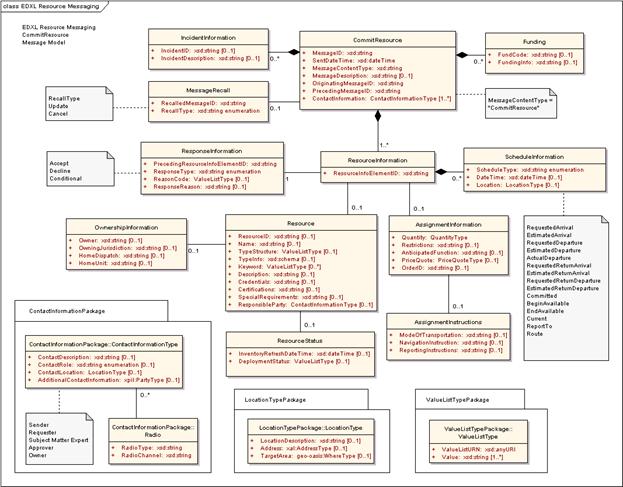
Figure 7: EDXL-RM ERM for
CommitResource Message
The following table outlines the element cardinalities for
this message type.
Table 7: CommitResource Message Elements
|
Parent Element
|
Sub-Elements
|
|
CommitResource
|
MessageID, SentDateTime, MessageContentType^,
MessageDescription, OriginatingMessageID, PrecedingMessageID,
IncidentInformation*, MessageRecall, Funding*, ContactInformation*, ResourceInformation*
|
|
IncidentInformation
|
IncidentID, IncidentDescription
|
|
MessageRecall
|
RecalledMessageID, RecallType
|
|
Funding
|
FundCode, FundingInfo
|
|
ResourceInformation
|
ResourceInfoElementID, ResponseInformation, Resource,
AssignmentInformation, ScheduleInformation*
|
|
ResponseInformation
|
PrecedingResourceInfoElementID, ResponseType, ReasonCode,
ResponseReason
|
|
Resource
|
ResourceID, Name, TypeStructure,
TypeInfo, Keyword*, Description, Credentials, Certifications,
SpecialRequirements, ResponsibleParty, OwnershipInformation, ResourceStatus
|
|
OwnershipInformation
|
Owner, OwningJurisdiction, HomeDispatch, HomeUnit
|
|
ResourceStatus
|
InventoryRefreshDateTime, DeploymentStatus
|
|
AssignmentInformation
|
Quantity, Restrictions, AnticipatedFunction,
PriceQuote, OrderID, AssignmentInstructions
|
|
AssignmentInstructions
|
ModeOfTransportation, NavigationInstructions,
ReportingInstructions
|
|
ScheduleInformation
|
ScheduleType^, DateTime, Location
|
The following rules apply to the above elements:
·
The CommitResource:MessageID, CommitResource:SentDateTime, CommitResource:MessageContentType,
CommitResource:OriginatingMessageID, CommitResource:PrecedingMessageID, CommitResource:ContactInformation,
and CommitResource:ResourceInformation elements MUST be present.
·
The value of CommitResource:MessageContentType MUST be “CommitResource”.
·
If a CommitResource:IncidentInformation element is present, then
at least one of IncidentInformation:IncidentID and/or
IncidentInformation:IncidentDescription elements MUST be present.
·
If the CommitResource:MessageRecall element is present, then the
MessageRecall:RecalledMessageID and MessageRecall:RecallType elements MUST be
present.
·
If a CommitResource:Funding element is present, then at least one
of Funding:FundCode and/or Funding:FundingInfo elements MUST be present.
·
The ResourceInformation:ResourceInfoElementID and
ResourceInformation:ResponseInformation elements MUST be present.
·
If ResponseInformation:ResponseType has a value of “Accept” or “Provisional”,
then the ResourceInformation:Resource element MUST be present.
·
If ResponseInformation:ResponseType has a value of “Accept” or “Provisional”,
then the ResourceInformation:AssignmentInformation element MUST be present. If
ResponseInformation:ResponseType has a value of “Decline”, then the
ResourceInformation:AssignmentInformation is not applicable.
·
If ResponseInformation:ResponseType has a value of “Accept” or “Provisional”,
then the ResourceInformation:ScheduleInformation element MUST be present. If
ResponseInformation:ResponseType has a value of “Decline”, then the
ResourceInformation:ScheduleInformation is not applicable.
·
The ResponseInformation:PrecedingResourceInfoElementID and
ResponseInformation:ResponseType elements MUST be present.
·
If ResponseInformation:ResponseType has a value of “Provisional”,
then at least one of ResponseInformation:ReasonCode and/or ResponseInformation:ResponseReason
elements MUST be present.
·
If a ResourceInformation:Resource element is present, then at
least one of Resource:ResourceID, Resource:Name, and/or Resource:TypeStructure elements
MUST be present.
·
If a Resource:OwnershipInformation is present, then at least one
of OwnershipInformation:Owner and/or OwnershipInformation:OwningJurisdiction
elements MUST be present.
·
If a ResourceInformation:AssignmentInformation element is
present, then the AssignmentInformation:Quantity element MUST be present.
·
If the ResourceInformation:ScheduleInformation element is
present, then the ScheduleInformation:ScheduleType element MUST be present and contain
one of the following values:
·
“RequestedArrival”, “EstimatedArrival “, “EstimatedDeparture”, “RequestedDeparture”,
“ActualDeparture”, “RequestedReturnArrival”, “EstimatedReturnArrival“, “RequestedReturnDeparture”,
”EstimatedReturnDeparture”, “Committed”, “BeginAvailable”, “EndAvailable”, “Current”,
“ReportTo” or “Route”.
The schema for a
CommitResource message can be found in Appendix A.6.
The CommitResource message is sent by a Resource Supplier in
response to either a RequestResource or RequisitionResource message sent by the
Resource Consumer.
The message may
be canceled or updated through the CommitResource:MessageRecall element.
Below is an example of a CommitResource Message. This is an
example Response to the original RequisitionResource shown in Section 3.6.5. In this example, the two requests have different responses:
·
The “Small Animal Sheltering Team” (ResourceInfoElementID=001) is
Accepted. In this case the Schedule information is updated with Committed date.
·
The “Patrol and Surveillance Helicopters” (ResourceInfoElementID=002)
is Declined.
[Note: The XML example
shown in this section is informative only.]
<?xml
version="1.0" encoding="UTF-8"?>
<CommitResource
xmlns:xsi="http://www.w3.org/2001/XMLSchema-instance"
xsi:schemaLocation="urn:oasis:names:tc:emergency:EDXL:RM:1.0:msg
EDXL-RMCommitResource.xsd"
xmlns="urn:oasis:names:tc:emergency:EDXL:RM:1.0:msg"
xmlns:rm="urn:oasis:names:tc:emergency:EDXL:RM:1.0"
xmlns:xpil="urn:oasis:names:tc:ciq:xpil:3"
xmlns:xnl="urn:oasis:names:tc:ciq:xnl:3"
xmlns:xal="urn:oasis:names:tc:ciq:xal:3"
xmlns:geo-oasis="urn:oasis:names:tc:emergency:EDXL:HAVE:1.0:geo-oasis"
xmlns:gml="http://www.opengis.net/gml">
<MessageID>urn:au-qld-eoc:997754</MessageID>
<SentDateTime>2006-03-21T12:46:00+10:00</SentDateTime>
<MessageContentType>CommitResource</MessageContentType>
<OriginatingMessageID>urn:au-qld-eoc:12332</OriginatingMessageID>
<PrecedingMessageID>urn:au-qld-eoc:987654</PrecedingMessageID>
<IncidentInformation>
<rm:IncidentDescription>Cyclone Larry</rm:IncidentDescription>
</IncidentInformation>
<Funding>
<rm:FundCode>HP4347</rm:FundCode>
</Funding>
<ContactInformation>
<rm:ContactRole>Sender</rm:ContactRole>
<rm:AdditionalContactInformation>
<xpil:PartyName>
<xnl:PersonName>
<xnl:NameElement xnl:ElementType="FirstName">Charlotte</xnl:NameElement>
<xnl:NameElement
xnl:ElementType="LastName">Ryan</xnl:NameElement>
</xnl:PersonName>
<xnl:OrganisationName>
<xnl:NameElement>EMA</xnl:NameElement>
</xnl:OrganisationName>
</xpil:PartyName>
</rm:AdditionalContactInformation>
</ContactInformation>
<ResourceInformation>
<ResourceInfoElementID>001</ResourceInfoElementID>
<ResponseInformation>
<rm:PrecedingResourceInfoElementID>001</rm:PrecedingResourceInfoElementID>
<rm:ResponseType>Accept</rm:ResponseType>
</ResponseInformation>
<Resource>
<TypeStructure>
<rm:ValueListURN>urn:x-hazard:vocab:resourceTypes</rm:ValueListURN>
<rm:Value>Small Animal Sheltering Team</rm:Value>
</TypeStructure>
<Description>
5-person response team to advise and support local efforts to set up a
small animal shelter
</Description>
<SpecialRequirements>A qualified veterinary
surgeon</SpecialRequirements>
</Resource>
<AssignmentInformation>
<Quantity>
<rm:MeasuredQuantity>
<rm:Amount>1</rm:Amount>
</rm:MeasuredQuantity>
</Quantity>
</AssignmentInformation>
<ScheduleInformation>
<ScheduleType>Committed</ScheduleType>
<DateTime>2006-03-21T12:46:00+10:00</DateTime>
</ScheduleInformation>
</ResourceInformation>
<ResourceInformation>
<ResourceInfoElementID>002</ResourceInfoElementID>
<ResponseInformation>
<rm:PrecedingResourceInfoElementID>002</rm:PrecedingResourceInfoElementID>
<rm:ResponseType>Decline</rm:ResponseType>
</ResponseInformation>
</ResourceInformation>
</CommitResource>
One use of the “RequestInformation” message is
to ask questions about specific resources. In this case, the message can be the
initial message sent from the Resource Consumer to the Resource Suppliers, or
it can be a follow up message seeking further information after the Resource
Consumer has sent a RequestResource or other resource messages. A
RequestInformation can be used in this manner even after a resource has been
committed and/or deployed; however, if the request is related to the status of
a deployed resource, the RequestResourceDeploymentStatus message MUST be used
instead.
A second use of this message type is to
provide a general description of the sender’s situation and needs, with the
expectation of receiving responses suggesting suitable resources. This is useful
when the Resource Consumer is not able to issue a specific RequestResource
message because of a lack of knowledge about the resources that would be most
appropriate for the situation.
Figure 8 below shows the EDXL–RM Element
Reference Model (ERM) tailored for the RequestInformation Message. The ERM shows the element-level details for the main entities in the RM.

Figure 8: EDXL-RM ERM for
RequestInformation Message
The following table outlines the element cardinalities for
this message type.
Table 8: RequestInformation Message Elements
|
Parent Element
|
Sub-Elements
|
|
RequestInformation
|
MessageID, SentDateTime, MessageContentType^,
MessageDescription, OriginatingMessageID, PrecedingMessageID, IncidentInformation*,
MessageRecall, Funding*, ContactInformation*, ResourceInformation*
|
|
IncidentInformation
|
IncidentID, IncidentDescription
|
|
MessageRecall
|
RecalledMessageID, RecallType
|
|
Funding
|
FundCode, FundingInfo
|
|
ResourceInformation
|
ResourceInfoElementID, Resource, AssignmentInformation,
ScheduleInformation*
|
|
Resource
|
ResourceID, Name, TypeStructure,
TypeInfo, Keyword*, Description, Credentials, Certifications,
SpecialRequirements, ResponsibleParty, OwnershipInformation, ResourceStatus
|
|
OwnershipInformation
|
Owner, OwningJurisdiction, HomeDispatch, HomeUnit
|
|
ResourceStatus
|
InventoryRefreshDateTime, DeploymentStatus, Availability
|
|
AssignmentInformation
|
Quantity, Restrictions, AnticipatedFunction, PriceQuote,
OrderID, AssignmentInstructions
|
|
AssignmentInstructions
|
ModeOfTransportation, NavigationInstructions,
ReportingInstructions
|
|
ScheduleInformation
|
ScheduleType^, DateTime, Location
|
The following rules apply to the above elements:
·
The RequestInformation:MessageID, ResourceMessage:SentDateTime ResourceMessage:MessageContentType,
ResourceMessage:MessageDescription, ResourceMessage:OriginatingMessageID, and ResourceMessage:ContactInformation
elements MUST be present.
·
The value of RequestInformation:MessageContentType MUST be “RequestInformation”.
·
If a RequestInformation:IncidentInformation element is present,
then at least one of IncidentInformation:IncidentID and/or
IncidentInformation:IncidentDescription elements MUST be present.
·
If the ResourceMessage:MessageRecall element is present, then the
MessageRecall:RecalledMessageID and MessageRecall:RecallType elements MUST be
present.
·
If a RequestInformation:Funding element is present, then at least
one of Funding:FundCode and/or Funding:FundingInfo elements MUST be present.
·
If a RequestInformation:ResourceInformation element is present,
then the ResourceInformation:ResourceInfoElementID element MUST be present.
·
If a ResourceInformation:Resource element is present, then at
least one of Resource:ResourceID, Resource:Name, and/or Resource:TypeStructure elements
MUST be present.
·
If a Resource:OwnershipInformation is present, then at least one
of OwnershipInformation:Owner and/or OwnershipInformation:OwningJurisdiction
elements MUST be present.
·
If the ResourceInformation:ScheduleInformation element is
present, then the ScheduleInformation:ScheduleType element MUST be present and contain
one of the following values:
·
“RequestedArrival”, “EstimatedArrival”, “ActualArrival”, “RequestedDeparture”,
“EstimatedDeparture”, “ActualDeparture”, “RequestedReturnDeparture”, “EstimatedReturnDeparture”,
“ActualReturnDeparture”, “RequestedReturnArrival”, “EstimatedReturnArrival”, “ActualReturnArrival”,
“BeginAvailable”, “EndAvailable”, “Committed”, “Current”, “ReportTo” or “Route”.
The schema for a
RequestInformation message can be found in Appendix A.7.
The RequestInformation message may be sent by the Resource
Consumer to any number of Resource Suppliers, or may it may be sent vice versa.
The RequestInformation message may follow earlier resource messages.
The potential responses to this message include:
·
ResponseToRequestInformation (See Section 3.9)
·
ReportResourceDeploymentStatus
·
This includes Accept, Decline, and Provisional responses.
The message may be canceled or updated through the RequestInformation:MessageRecall
element.
Below is an example RequestInformation
messages. The first is intended as a follow up message to the RequestResource
and ResponseToRequestResource messages shown in Sections 3.4.5 and 3.5.5, requesting further information about the
third resource that was requested (two electrical power restoration teams).
[Note: The XML examples
shown in this section are informative only.]
<?xml
version="1.0" encoding="UTF-8"?>
<RequestInformation
xmlns:xsi="http://www.w3.org/2001/XMLSchema-instance"
xsi:schemaLocation="urn:oasis:names:tc:emergency:EDXL:RM:1.0:msg
EDXL-RMRequestInformation.xsd"
xmlns="urn:oasis:names:tc:emergency:EDXL:RM:1.0:msg"
xmlns:rm="urn:oasis:names:tc:emergency:EDXL:RM:1.0"
xmlns:xpil="urn:oasis:names:tc:ciq:xpil:3"
xmlns:xnl="urn:oasis:names:tc:ciq:xnl:3"
xmlns:xal="urn:oasis:names:tc:ciq:xal:3"
xmlns:geo-oasis="http://www.oasis-open.org/oasis/10"
xmlns:gml="http://www.opengis.net/gml">
<MessageID>urn:au-qld-eoc:12338</MessageID>
<SentDateTime>2006-03-21T12:35:00+10:00</SentDateTime>
<MessageContentType>RequestInformation</MessageContentType>
<MessageDescription>
Could you please advise the size (personnel and equipment) of each power
restoration team?
</MessageDescription>
<OriginatingMessageID>urn:au-qld-eoc:12332</OriginatingMessageID>
<PrecedingMessageID>urn:au-qld-eoc:12332</PrecedingMessageID>
<IncidentInformation>
<rm:IncidentDescription>Cyclone Larry</rm:IncidentDescription>
</IncidentInformation>
<ContactInformation>
<rm:ContactRole>Sender</rm:ContactRole>
<rm:AdditionalContactInformation>
<xpil:PartyName>
<xnl:PersonName>
<xnl:NameElement xnl:ElementType="FirstName">Charlotte</xnl:NameElement>
<xnl:NameElement
xnl:ElementType="LastName">Ryan</xnl:NameElement>
</xnl:PersonName>
<xnl:OrganisationName>
<xnl:NameElement>EMA</xnl:NameElement>
</xnl:OrganisationName>
</xpil:PartyName>
</rm:AdditionalContactInformation>
</ContactInformation>
<ResourceInformation>
<ResourceInfoElementID>001</ResourceInfoElementID>
<Resource>
<TypeStructure>
<rm:ValueListURN>urn:x-hazard:vocab:resourceTypes</rm:ValueListURN>
<rm:Value>Electrical Power Restoration Team</rm:Value>
</TypeStructure>
</Resource>
<AssignmentInformation>
<Quantity>
<rm:MeasuredQuantity>
<rm:Amount>1</rm:Amount>
</rm:MeasuredQuantity>
</Quantity>
<AnticipatedFunction>
Restore power to critical infrastructure in and around the
Innisfail area
</AnticipatedFunction>
</AssignmentInformation>
</ResourceInformation>
</RequestInformation>
The “ResponseToRequestInformation” message is
used by Resource Suppliers to respond to a RequestInformation message from
Resource Consumers. If the RequestInformation message contained one or more ResourceInformation
elements, the response MUST Accept or Decline for each ResourceInformation element
with a separate ResponseInformation element. However, accepting here only
entails agreeing to supply the requested information, not agreeing to supply
resources. If the RequestInformation message did not contain any ResourceInformation
elements, one or more ResponseInformation elements MAY be included in the
response message.
Figure 9 below shows the EDXL–RM Element
Reference Model (ERM) tailored for the ResponseToRequestInformation Message. The
ERM shows the element-level details for the main entities
in the RM.
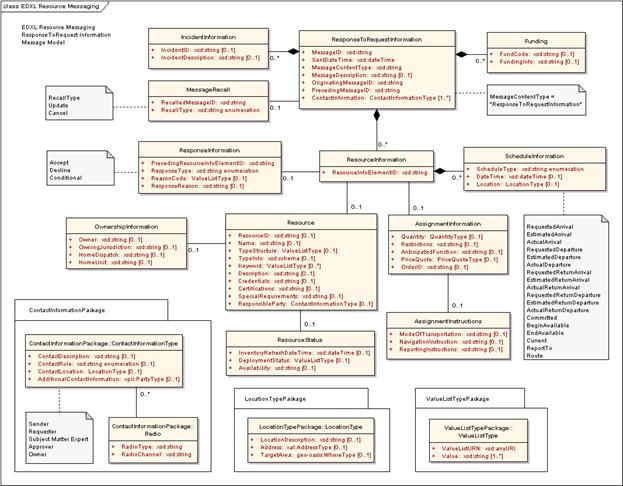
Figure 9: EDXL-RM ERM for
ResponseToRequestInformation Message
The following table outlines the element cardinalities for
this message type.
Table 9: ResponseToRequestInformation Message Elements
|
Parent Element
|
Sub-Elements
|
|
ResponseToRequestInformation
|
MessageID, SentDateTime, MessageContentType^,
MessageDescription, OriginatingMessageID, PrecedingMessageID, IncidentInformation*,
MessageRecall, Funding*, ContactInformation*, ResourceInformation*
|
|
IncidentInformation
|
IncidentID, IncidentDescription
|
|
MessageRecall
|
RecalledMessageID, RecallType
|
|
Funding
|
FundCode, FundingInfo
|
|
ResourceInformation
|
ResourceInfoElementID, ResponseInformation,
Resource, AssignmentInformation, ScheduleInformation*
|
|
ResponseInformation
|
PrecedingResourceInfoElementID, ResponseType, ReasonCode,
ResponseReason
|
|
Resource
|
ResourceID, Name, TypeStructure,
TypeInfo, Keyword*, Description, Credentials, Certifications,
SpecialRequirements, ResponsibleParty, OwnershipInformation, ResourceStatus
|
|
OwnershipInformation
|
Owner, OwningJurisdiction, HomeDispatch, HomeUnit
|
|
ResourceStatus
|
InventoryRefreshDateTime, DeploymentStatus, Availability
|
|
AssignmentInformation
|
Quantity, Restrictions, AnticipatedFunction, PriceQuote,
OrderID, AssignmentInstructions
|
|
AssignmentInstructions
|
ModeOfTransportation, NavigationInstructions,
ReportingInstructions
|
|
ScheduleInformation
|
ScheduleType, DateTime, Location
|
The following rules apply to the above elements:
·
The ResponseToRequestInformation:MessageID, ResponseToRequestInformation:SentDateTime
ResponseToRequestInformation:MessageContentType, ResponseToRequestInformation:OriginatingMessageID,
ResponseToRequestInformation:PrecedingMessageID, and ResponseToRequestInformation:ContactInformation
elements MUST be present.
·
The value of ResponseToRequestInformation:MessageContentType MUST
be “ResponseToRequestInformation”.
·
If a ResponseToRequestInformation:IncidentInformation element is
present, then at least one of IncidentInformation:IncidentID and/or
IncidentInformation:IncidentDescription elements MUST be present.
·
If the ResponseToRequestInformation:MessageRecall element is
present, then the MessageRecall:RecalledMessageID and MessageRecall:RecallType
elements MUST be present.
·
If a ResponseToRequestInformation:Funding element is present,
then at least one of Funding:FundCode and/or Funding:FundingInfo elements MUST
be present.
·
If a ResponseToRequestInformation:ResourceInformation element is
present, then the ResourceInformation:ResourceInfoElementID element MUST be
present.
·
If the ResourceInformation:ResponseInformation element is
present, then the ResponseInformation:PrecedingResourceInfoElementID and
ResponseInformation:ResponseType elements MUST be present.
·
If the ResourceInformation:ResponseInformation element is present
and the ResponseInformation:ResponseType element has a value of “Provisional”,
then at least one of ResponseInformation:ReasonCode and/or ResponseInformation:ResponseReason
elements MUST be present.
·
If a ResourceInformation:Resource element is present, then at
least one of Resource:ResourceID, Resource:Name, and/or Resource:TypeStructure elements
MUST be present.
·
If a Resource:OwnershipInformation element is present, then at
least one of OwnershipInformation:Owner and/or
OwnershipInformation:OwningJurisdiction elements MUST be present.
·
If the ResourceInformation:ScheduleInformation element is
present, then the ScheduleInformation:ScheduleType element MUST be present and
contain one of the following values:
·
“RequestedArrival”, “EstimatedArrival”, “ActualArrival”, “RequestedDeparture”,
“EstimatedDeparture”, “ActualDeparture”, “RequestedReturnDeparture”,
“EstimatedReturnDeparture”, “ActualReturnDeparture”, “RequestedReturnArrival”, “EstimatedReturnArrival”,
“ActualReturnArrival”, “BeginAvailable”, “EndAvailable”, “Committed”, “Current”,
“ReportTo” or “Route”.
The schema for a ResponseToRequestInformation message can be
found in Appendix A.8.
The ResponseToRequestInformation message is sent by a
Resource Supplier or Resource Consumer in response to an original RequestInformation
message.
The potential responses to this message include:
·
RequisitionResource message from the Resource Consumer. (See
Section 3.6)
The message may
be canceled or updated through the ResponseToRequestInformation:MessageRecall
element.
3.9.5 Message
Example
Below are two example ResponseToRequestInformation
messages. These are example responses to the RequestInformation messages shown
in Section 3.8.5.
[Note: The XML examples
shown in this section are informative only.]
<?xml
version="1.0" encoding="UTF-8"?>
<ResponseToRequestInformation
xmlns:xsi="http://www.w3.org/2001/XMLSchema-instance"
xsi:schemaLocation="urn:oasis:names:tc:emergency:EDXL:RM:1.0:msg
EDXL-RMResponseToRequestInformation.xsd"
xmlns="urn:oasis:names:tc:emergency:EDXL:RM:1.0:msg"
xmlns:rm="urn:oasis:names:tc:emergency:EDXL:RM:1.0"
xmlns:xpil="urn:oasis:names:tc:ciq:xpil:3"
xmlns:xnl="urn:oasis:names:tc:ciq:xnl:3" xmlns:xal="urn:oasis:names:tc:ciq:xal:3"
xmlns:geo-oasis="urn:oasis:names:tc:emergency:EDXL:HAVE:1.0:geo-oasis"
xmlns:gml="http://www.opengis.net/gml">
<MessageID>urn:au-qld-eoc:12346</MessageID>
<SentDateTime>2006-03-21T12:37:00+10:00</SentDateTime>
<MessageContentType>ResponseToRequestInformation</MessageContentType>
<MessageDescription>
Team consists of 5 overhead (2 person) crews with material handlers; 1
overhead (2 person) crew; 2 designers; 1 team leader; 1 safety specialist and
fleet
services support. Each team is additionally equipped with
digger derrick/pole
trailer
and auxiliary (material handler or 36' bucket).
</MessageDescription>
<OriginatingMessageID>urn:au-qld-eoc:12332</OriginatingMessageID>
<PrecedingMessageID>urn:au-qld-eoc:12338</PrecedingMessageID>
<IncidentInformation>
<rm:IncidentDescription>Cyclone Larry</rm:IncidentDescription>
</IncidentInformation>
<ContactInformation>
<rm:ContactRole>Sender</rm:ContactRole>
<rm:AdditionalContactInformation>
<xpil:PartyName>
<xnl:PersonName>
<xnl:NameElement
xnl:ElementType="FirstName">Alex</xnl:NameElement>
<xnl:NameElement
xnl:ElementType="LastName">Jones</xnl:NameElement>
</xnl:PersonName>
<xnl:OrganisationName>
<xnl:NameElement>Dept of Emergency Services</xnl:NameElement>
</xnl:OrganisationName>
</xpil:PartyName>
<xpil:ContactNumbers>
<xpil:ContactNumber xpil:CommunicationMediaType="Telephone"
xpil:ContactHours="9:00AM - 5:00PM">
<xpil:ContactNumberElement
xpil:Type="CountryCode">61</xpil:ContactNumberElement>
<xpil:ContactNumberElement
xpil:Type="AreaCode">7</xpil:ContactNumberElement>
<xpil:ContactNumberElement xpil:Type="LocalNumber">
3000
1234
</xpil:ContactNumberElement>
</xpil:ContactNumber>
</xpil:ContactNumbers>
<xpil:ElectronicAddressIdentifiers>
<xpil:ElectronicAddressIdentifier>alexj@emergencyservices.gov.au
</xpil:ElectronicAddressIdentifier>
</xpil:ElectronicAddressIdentifiers>
</rm:AdditionalContactInformation>
</ContactInformation>
</ResponseToRequestInformation>
<?xml version="1.0" encoding="UTF-8"?>
<ResponseToRequestInformation
xmlns:xsi="http://www.w3.org/2001/XMLSchema-instance"
xsi:schemaLocation="urn:oasis:names:tc:emergency:EDXL:RM:1.0:msg
EDXL-RMResponseToRequestInformation.xsd"
xmlns="urn:oasis:names:tc:emergency:EDXL:RM:1.0:msg"
xmlns:rm="urn:oasis:names:tc:emergency:EDXL:RM:1.0"
xmlns:xpil="urn:oasis:names:tc:ciq:xpil:3"
xmlns:xnl="urn:oasis:names:tc:ciq:xnl:3"
xmlns:xal="urn:oasis:names:tc:ciq:xal:3"
xmlns:geo-oasis="urn:oasis:names:tc:emergency:EDXL:HAVE:1.0:geo-oasis"
xmlns:gml="http://www.opengis.net/gml">
<MessageID>urn:au-qld-eoc:77397</MessageID>
<SentDateTime>2006-03-22T08:22:00+10:00</SentDateTime>
<MessageContentType>ResponseToRequestInformation</MessageContentType>
<MessageDescription>
QBuild can send a damage assessment team from Cairns this afternoon.
</MessageDescription>
<OriginatingMessageID>urn:au-qld-eoc:77388</OriginatingMessageID>
<PrecedingMessageID>urn:au-qld-eoc:77388</PrecedingMessageID>
<IncidentInformation>
<rm:IncidentDescription>Cyclone Larry</rm:IncidentDescription>
</IncidentInformation>
<ContactInformation>
<rm:ContactRole>Sender</rm:ContactRole>
<rm:AdditionalContactInformation>
<xpil:PartyName>
<xnl:PersonName>
<xnl:NameElement
xnl:ElementType="FirstName">Barnaby</xnl:NameElement>
<xnl:NameElement
xnl:ElementType="LastName">James</xnl:NameElement>
</xnl:PersonName>
<xnl:OrganisationName>
<xnl:NameElement>EMA</xnl:NameElement>
</xnl:OrganisationName>
</xpil:PartyName>
<xpil:ContactNumbers>
<xpil:ContactNumber xpil:CommunicationMediaType="Telephone">
<xpil:ContactNumberElement
xpil:Type="CountryCode">61</xpil:ContactNumberElement>
<xpil:ContactNumberElement xpil:Type="AreaCode">2</xpil:ContactNumberElement>
<xpil:ContactNumberElement xpil:Type="LocalNumber">
9864
4329
</xpil:ContactNumberElement>
</xpil:ContactNumber>
</xpil:ContactNumbers>
</rm:AdditionalContactInformation>
</ContactInformation>
<ContactInformation>
<rm:ContactRole>Requester</rm:ContactRole>
<rm:AdditionalContactInformation>
<xpil:PartyName>
<xnl:PersonName>
<xnl:NameElement
xnl:ElementType="FirstName">Alex</xnl:NameElement>
<xnl:NameElement
xnl:ElementType="LastName">Jones</xnl:NameElement>
</xnl:PersonName>
<xnl:OrganisationName>
<xnl:NameElement>Dept of Emergency Services</xnl:NameElement>
</xnl:OrganisationName>
</xpil:PartyName>
</rm:AdditionalContactInformation>
</ContactInformation>
<ResourceInformation>
<ResourceInfoElementID>001</ResourceInfoElementID>
<Resource>
<TypeStructure>
<rm:ValueListURN>urn:x-hazard:vocab:resourceTypes</rm:ValueListURN>
<rm:Value>Engineering Services: Damage Assessment Team</rm:Value>
</TypeStructure>
</Resource>
<AssignmentInformation>
<Quantity>
<rm:MeasuredQuantity>
<rm:Amount>1</rm:Amount>
</rm:MeasuredQuantity>
</Quantity>
<AnticipatedFunction>
Preliminary assessment of cracks in Centenary Bridge,
Innisfail.
</AnticipatedFunction>
</AssignmentInformation>
<ScheduleInformation>
<ScheduleType>EstimatedDeparture</ScheduleType>
<DateTime>2006-03-22T15:00:00</DateTime>
<Location>
<rm:LocationDescription>Cairns Airport</rm:LocationDescription>
</Location>
</ScheduleInformation>
<ScheduleInformation>
<ScheduleType>EstimatedArrival</ScheduleType>
<DateTime>2006-03-25T16:00:00+10:00</DateTime>
<Location>
<rm:LocationDescription>Innisfail Airport</rm:LocationDescription>
</Location>
</ScheduleInformation>
</ResourceInformation>
</ResponseToRequestInformation>
The “OfferUnsolicitedResource” message is used
to offer available resources (that have not been requested) to assist with an
emergency response.
Figure 10 below shows the EDXL–RM Element
Reference Model (ERM) tailored for the OfferUnsolicitedResource Message. The ERM shows the element-level details for the main entities in the RM.
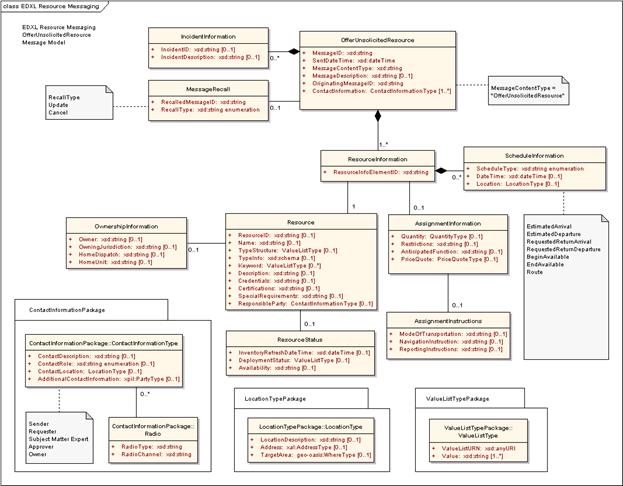
Figure 10: EDXL-RM ERM for
OfferUnsolicitedResource Message
The following table outlines the element cardinalities for
this message type.
Table 10: OfferUnsolicitedResource Message Elements
|
Parent Element
|
Sub-Elements
|
|
OfferUnsolicitedResource
|
MessageID, SentDateTime, MessageContentType^,
MessageDescription, OriginatingMessageID, IncidentInformation*,
MessageRecall, ContactInformation*, ResourceInformation*
|
|
IncidentInformation
|
IncidentID, IncidentDescription
|
|
MessageRecall
|
RecalledMessageID, RecallType
|
|
ResourceInformation
|
ResourceInfoElementID, Resource,
AssignmentInformation, ScheduleInformation*
|
|
Resource
|
ResourceID, Name, TypeStructure,
TypeInfo, Keyword*, Description, Credentials, Certifications,
SpecialRequirements, ResponsibleParty, OwnershipInformation, ResourceStatus
|
|
OwnershipInformation
|
Owner, OwningJurisdiction, HomeDispatch, HomeUnit
|
|
ResourceStatus
|
InventoryRefreshDateTime, DeploymentStatus, Availability
|
|
AssignmentInformation
|
Quantity, Restrictions, AnticipatedFunction, PriceQuote, AssignmentInstructions
|
|
AssignmentInstructions
|
ModeOfTransportation, NavigationInstructions,
ReportingInstructions
|
|
ScheduleInformation
|
ScheduleType^, DateTime, Location
|
The following rules apply to the above elements:
·
The OfferUnsolicitedResource:MessageID, OfferUnsolicitedResource:SentDateTime
OfferUnsolicitedResource:MessageContentType, OfferUnsolicitedResource:OriginatingMessageID,
OfferUnsolicitedResource:ContactInformation, and OfferUnsolicitedResource:ResourceInformation
elements MUST be present.
·
The value of OfferUnsolicitedResource:MessageContentType MUST be
“OfferUnsolicitedResource”.
·
If an OfferUnsolicitedResource:IncidentInformation element is
present, then at least one of IncidentInformation:IncidentID and/or
IncidentInformation:IncidentDescription elements MUST be present.
·
If the OfferUnsolicitedResource:MessageRecall element is present,
then the MessageRecall:RecalledMessageID and MessageRecall:RecallType elements MUST
be present.
·
For each OfferUnsolicitedResource:ResourceInformation element,
the ResourceInformation:ResourceInfoElementID and ResourceInformation:Resource
elements MUST be present.
·
At least one of Resource:ResourceID, Resource:Name, and/or Resource:TypeStructure
elements MUST be present.
·
If a Resource:OwnershipInformation element is present, then at
least one of OwnershipInformation:Owner and/or
OwnershipInformation:OwningJurisdiction elements MUST be present.
·
If the ResourceInformation:ScheduleInformation element is
present, then the ScheduleInformation:ScheduleType element MUST be present and contain
one of the following values:
·
“EstimatedArrival”, “EstimatedDeparture”, “RequestedReturnDeparture”,
“RequestedReturnArrival”, “BeginAvailable”, “EndAvailable”, or “Route”.
The schema for an OfferUnsolicitedResource message can be
found in Appendix A.9.
The OfferUnsolicitedResource message is an initial message
created and sent by the Resource Supplier to any number of Resource Consumers.
The potential responses to this message include:
·
RequestInformation (See Section 3.8)
·
RequisitionResource (See Section 3.6)
The message may
be canceled or updated through the OfferUnsolicitedResource:MessageRecall
element.
Below is an example OfferUnsolicitedResource
message. This message offers a donation of 100 large and 100 small tarpaulins.
[Note: The XML example
shown in this section is informative only.]
<?xml
version="1.0" encoding="UTF-8"?>
<OfferUnsolicitedResource
xmlns:xsi="http://www.w3.org/2001/XMLSchema-instance"
xsi:schemaLocation="urn:oasis:names:tc:emergency:EDXL:RM:1.0:msg
EDXL-RMOfferUnsolicitedResource.xsd"
xmlns="urn:oasis:names:tc:emergency:EDXL:RM:1.0:msg"
xmlns:rm="urn:oasis:names:tc:emergency:EDXL:RM:1.0"
xmlns:xpil="urn:oasis:names:tc:ciq:xpil:3"
xmlns:xnl="urn:oasis:names:tc:ciq:xnl:3"
xmlns:xal="urn:oasis:names:tc:ciq:xal:3">
<MessageID>urn:au-qld-eoc:84313</MessageID>
<SentDateTime>2006-03-22T10:34:00+10:00</SentDateTime>
<MessageContentType>OfferUnsolicitedResource</MessageContentType>
<MessageDescription>
We would like to donate 100 small and 100 large tarps for use by residents
whose homes have been damaged by the cyclone.
</MessageDescription>
<OriginatingMessageID>urn:au-qld-eoc:84313</OriginatingMessageID>
<IncidentInformation>
<rm:IncidentDescription>Cyclone Larry</rm:IncidentDescription>
</IncidentInformation>
<ContactInformation>
<rm:ContactRole>Owner</rm:ContactRole>
<rm:AdditionalContactInformation>
<xpil:PartyName>
<xnl:PersonName>
<xnl:NameElement
xnl:ElementType="FirstName">Joe</xnl:NameElement>
<xnl:NameElement
xnl:ElementType="LastName">Williams</xnl:NameElement>
</xnl:PersonName>
<xnl:OrganisationName>
<xnl:NameElement>Hardware Megastore Cairns</xnl:NameElement>
</xnl:OrganisationName>
</xpil:PartyName>
<xpil:Addresses>
<xpil:Address>
<xal:Country>
<xal:NameElement>Australia</xal:NameElement>
</xal:Country>
<xal:AdministrativeArea>
<xal:NameElement>QLD</xal:NameElement>
</xal:AdministrativeArea>
<xal:Locality>
<xal:NameElement>Cairns</xal:NameElement>
</xal:Locality>
<xal:Thoroughfare>
<xal:NameElement>Spence St</xal:NameElement>
</xal:Thoroughfare>
<xal:PostCode>
<xal:Identifier>4870</xal:Identifier>
</xal:PostCode>
</xpil:Address>
</xpil:Addresses>
<xpil:ContactNumbers>
<xpil:ContactNumber xpil:CommunicationMediaType="Telephone"
xpil:ContactHours="8:00AM - 6:00PM">
<xpil:ContactNumberElement
xpil:Type="CountryCode">61</xpil:ContactNumberElement>
<xpil:ContactNumberElement
xpil:Type="AreaCode">7</xpil:ContactNumberElement>
<xpil:ContactNumberElement xpil:Type="LocalNumber">
4052
0378
</xpil:ContactNumberElement>
</xpil:ContactNumber>
</xpil:ContactNumbers>
</rm:AdditionalContactInformation>
</ContactInformation>
<ResourceInformation>
<ResourceInfoElementID>001</ResourceInfoElementID>
<Resource>
<TypeStructure>
<rm:ValueListURN>urn:x-hazard:vocab:resourceTypes</rm:ValueListURN>
<rm:Value>Large tarpaulin</rm:Value>
</TypeStructure>
<Description> 30 x 40 ft, 800 denier blue tarp </Description>
</Resource>
<AssignmentInformation>
<Quantity>
<rm:MeasuredQuantity>
<rm:Amount>100</rm:Amount>
</rm:MeasuredQuantity>
</Quantity>
<AssignmentInstructions>
<rm:ModeOfTransportation>
We have a truck available to deliver to Innisfail (or other
preferred location).
</rm:ModeOfTransportation>
</AssignmentInstructions>
</AssignmentInformation>
<ScheduleInformation>
<ScheduleType>BeginAvailable</ScheduleType>
<DateTime>2006-03-22T12:00:00+10:00</DateTime>
<Location>
<rm:LocationDescription>Hardware Megastore
Cairns</rm:LocationDescription>
<rm:Address>
<xal:Country>
<xal:NameElement>Australia</xal:NameElement>
</xal:Country>
<xal:AdministrativeArea>
<xal:NameElement>QLD</xal:NameElement>
</xal:AdministrativeArea>
<xal:Locality>
<xal:NameElement>Cairns</xal:NameElement>
</xal:Locality>
<xal:Thoroughfare>
<xal:NameElement>Spence St</xal:NameElement>
</xal:Thoroughfare>
<xal:PostCode>
<xal:Identifier>4870</xal:Identifier>
</xal:PostCode>
</rm:Address>
</Location>
</ScheduleInformation>
</ResourceInformation>
<ResourceInformation>
<ResourceInfoElementID>002</ResourceInfoElementID>
<Resource>
<TypeStructure>
<rm:ValueListURN>urn:x-hazard:vocab:resourceTypes</rm:ValueListURN>
<rm:Value>Small tarpaulin</rm:Value>
</TypeStructure>
<Description> 8 x 10 ft, 800 denier blue tarp </Description>
</Resource>
<AssignmentInformation>
<Quantity>
<rm:MeasuredQuantity>
<rm:Amount>100</rm:Amount>
</rm:MeasuredQuantity>
</Quantity>
<AssignmentInstructions>
<rm:ModeOfTransportation>
We have a truck available to deliver to Innisfail (or other
preferred location).
</rm:ModeOfTransportation>
</AssignmentInstructions>
</AssignmentInformation>
<ScheduleInformation>
<ScheduleType>BeginAvailable</ScheduleType>
<DateTime>2006-03-22T12:00:00+10:00</DateTime>
<Location>
<rm:LocationDescription>Hardware Megastore
Cairns</rm:LocationDescription>
<rm:Address>
<xal:Country>
<xal:NameElement>Australia</xal:NameElement>
</xal:Country>
<xal:AdministrativeArea>
<xal:NameElement>QLD</xal:NameElement>
</xal:AdministrativeArea>
<xal:Locality>
<xal:NameElement>Cairns</xal:NameElement>
</xal:Locality>
<xal:Thoroughfare>
<xal:NameElement>Spence St</xal:NameElement>
</xal:Thoroughfare>
<xal:PostCode>
<xal:Identifier>4870</xal:Identifier>
</xal:PostCode>
</rm:Address>
</Location>
</ScheduleInformation>
</ResourceInformation>
</OfferUnsolicitedResource>
The “ReleaseResource” message is used by
authorities at the incident to “release” (demobilize) a resource back to its
original point of assignment or to another location / assignment.
Figure 11 below shows the EDXL–RM Element
Reference Model (ERM) tailored for the ReleaseResource Message. The ERM shows the element-level details for the main entities in the RM.

Figure 11: EDXL-RM ERM for ReleaseResource Message
The following table outlines the element cardinalities for
this message type.
Table 11: ReleaseResource Message Elements
|
Parent Element
|
Sub-Elements
|
|
ReleaseResource
|
MessageID, SentDateTime, MessageContentType^,
MessageDescription, OriginatingMessageID, PrecedingMessageID,
IncidentInformation*, MessageRecall, Funding*, ContactInformation*, ResourceInformation*
|
|
IncidentInformation
|
IncidentID, IncidentDescription
|
|
MessageRecall
|
RecalledMessageID, RecallType
|
|
Funding
|
FundCode, FundingInfo
|
|
ResourceInformation
|
ResourceInfoElementID, ResponseInformation,
Resource, AssignmentInformation, ScheduleInformation*
|
|
ResponseInformation
|
PrecedingResourceInfoElementID, ResponseType, ReasonCode,
ResponseReason
|
|
Resource
|
ResourceID, Name, TypeStructure,
TypeInfo, Keyword*, Description, Credentials, Certifications,
SpecialRequirements, ResponsibleParty, OwnershipInformation, ResourceStatus
|
|
OwnershipInformation
|
Owner, OwningJurisdiction, HomeDispatch, HomeUnit
|
|
ResourceStatus
|
DeploymentStatus, Availability
|
|
AssignmentInformation
|
Quantity, Restrictions, AnticipatedFunction,
PriceQuote, OrderID, AssignmentInstructions
|
|
AssignmentInstructions
|
ModeOfTransportation, NavigationInstructions,
ReportingInstructions
|
|
ScheduleInformation
|
ScheduleType, DateTime, Location
|
The following rules apply to the above elements:
·
The ReleaseResource:MessageID, ReleaseResourceMessage:SentDateTime,
ReleaseResource Message:MessageContentType, ReleaseResource Message:OriginatingMessageID,
ReleaseResource Message:ContactInformation, and ReleaseResource Message:ResourceInformation
elements MUST be present.
·
The value of ReleaseResource Message:MessageContentType MUST be “ReleaseResource”.
·
If a ReleaseResource Message:IncidentInformation element is
present, then at least one of IncidentInformation:IncidentID and/or
IncidentInformation:IncidentDescription elements MUST be present.
·
If the ReleaseResource Message:MessageRecall element is present,
then the MessageRecall:RecalledMessageID and MessageRecall:RecallType elements MUST
be present.
·
If a ReleaseResource Message:Funding element is present, then at
least one of Funding:FundCode and/or Funding:FundingInfo elements MUST be
present.
·
For each ReleaseResource Message:ResourceInformation element, the
ResourceInformation:ResourceInfoElementID and ResourceInformation:Resource
elements MUST be present.
·
If a ResourceInformation:ResponseInformation element is present,
then the ResponseInformation:PrecedingResourceInfoElementID and
ResponseInformation:ResponseType elements MUST be present.
·
If a ResourceInformation:ResponseInformation element is present and
the ResponseInformation:ResponseType has a value of “Provisional”, then at
least one of ResponseInformation:ReasonCode and/or ResponseInformation:ResponseReason
elements MUST be present.
·
At least one of Resource:ResourceID, Resource:Name, and/or Resource:TypeStructure
elements MUST be present.
·
If a Resource:OwnershipInformation element is present, then at
least one of OwnershipInformation:Owner and/or
OwnershipInformation:OwningJurisdiction elements MUST be present.
·
If the ResourceInformation:AssignmentInformation element is
present, then the AssignmentInformation:Quantity element MUST be present.
·
If the ResourceInformation:ScheduleInformation element is
present, then the ScheduleInformation:ScheduleType element MUST must be present
and contain one of the following values:
·
“RequestedArrival”, “EstimatedArrival”, “ActualArrival”,
“RequestedDeparture” , “EstimatedDeparture”, “ActualDeparture”,
“RequestedReturnDeparture”, “EstimatedReturnDeparture”, “ActualReturnDeparture”
“RequestedReturnArrival”, “EstimatedReturnArrival”, “BeginAvailable”,
“EndAvailable”, “Committed”, “ReportTo”, “Current” or “Route”.
The schema for a ReleaseResource message can be found in
Appendix A.10.
The ReleaseResource message is sent by the Resource Consumer
to the Resource Supplier, and typically follows an earlier sequence of messages
(e.g., RequisitionResource and CommitResource messages).
The potential responses to this message include:
·
RequestInformation (See Section 3.8)
·
RequisitionResource (See Section 3.6)
·
Consumers waiting on the release of resources may send to a
RequisitionResource Message after receipt of a ReleaseResource Message.
The message may
be canceled or updated through the ReleaseResource:MessageRecall element.
3.11.5 Message Example
Below is an example ReleaseResource message. This
message releases the Small Animal Sheltering Team committed in the example in
Section 3.7.5.
[Note: The XML example
shown in this section is informative only.]
<?xml
version="1.0" encoding="UTF-8"?>
<ReleaseResource
xmlns:xsi="http://www.w3.org/2001/XMLSchema-instance"
xsi:schemaLocation="urn:oasis:names:tc:emergency:EDXL:RM:1.0:msg
EDXL-RMReleaseResource.xsd"
xmlns="urn:oasis:names:tc:emergency:EDXL:RM:1.0:msg"
xmlns:rm="urn:oasis:names:tc:emergency:EDXL:RM:1.0"
xmlns:xpil="urn:oasis:names:tc:ciq:xpil:3"
xmlns:xnl="urn:oasis:names:tc:ciq:xnl:3"
xmlns:xal="urn:oasis:names:tc:ciq:xal:3"
xmlns:geo-oasis="urn:oasis:names:tc:emergency:EDXL:HAVE:1.0:geo-oasis">
<MessageID>urn:au-qld-eoc:997985</MessageID>
<SentDateTime>2006-03-29T10:17:00+10:00</SentDateTime>
<MessageContentType>ReleaseResource</MessageContentType>
<MessageDescription>
Small Animal Sheltering Team will be flying back to Cairns this evening.
</MessageDescription>
<OriginatingMessageID>urn:au-qld-eoc:12332</OriginatingMessageID>
<IncidentInformation>
<rm:IncidentDescription>Cyclone Larry</rm:IncidentDescription>
</IncidentInformation>
<ContactInformation>
<rm:ContactRole>Sender</rm:ContactRole>
<rm:AdditionalContactInformation>
<xpil:PartyName>
<xnl:PersonName>
<xnl:NameElement
xnl:ElementType="FirstName">Alex</xnl:NameElement>
<xnl:NameElement xnl:ElementType="LastName">Jones</xnl:NameElement>
</xnl:PersonName>
<xnl:OrganisationName>
<xnl:NameElement>Dept of Emergency Services</xnl:NameElement>
</xnl:OrganisationName>
</xpil:PartyName>
<xpil:ContactNumbers>
<xpil:ContactNumber xpil:CommunicationMediaType="Telephone"
xpil:ContactHours="9:00AM - 5:00PM">
<xpil:ContactNumberElement
xpil:Type="CountryCode">61</xpil:ContactNumberElement>
<xpil:ContactNumberElement xpil:Type="AreaCode">7</xpil:ContactNumberElement>
<xpil:ContactNumberElement xpil:Type="LocalNumber">
3000
1234
</xpil:ContactNumberElement>
</xpil:ContactNumber>
</xpil:ContactNumbers>
<xpil:ElectronicAddressIdentifiers>
<xpil:ElectronicAddressIdentifier>
alexj@emergencyservices.gov.au
</xpil:ElectronicAddressIdentifier>
</xpil:ElectronicAddressIdentifiers>
</rm:AdditionalContactInformation>
</ContactInformation>
<ResourceInformation>
<ResourceInfoElementID>001</ResourceInfoElementID>
<Resource>
<TypeStructure>
<rm:ValueListURN>urn:x-hazard:vocab:resourceTypes</rm:ValueListURN>
<rm:Value>Small Animal Sheltering Team</rm:Value>
</TypeStructure>
</Resource>
<AssignmentInformation>
<Quantity>
<rm:MeasuredQuantity>
<rm:Amount>1</rm:Amount>
</rm:MeasuredQuantity>
</Quantity>
</AssignmentInformation>
<ScheduleInformation>
<ScheduleType>Current</ScheduleType>
<Location>
<rm:LocationDescription>Innisfail Animal
Refuge</rm:LocationDescription>
<rm:Address>
<xal:Country>
<xal:NameElement>Australia</xal:NameElement>
</xal:Country>
<xal:AdministrativeArea>
<xal:NameElement>QLD</xal:NameElement>
</xal:AdministrativeArea>
<xal:Locality>
<xal:NameElement>Innisfail</xal:NameElement>
</xal:Locality>
<xal:Thoroughfare>
<xal:NameElement>Downing St</xal:NameElement>
<xal:Number>27</xal:Number>
</xal:Thoroughfare>
<xal:PostCode>
<xal:Identifier>4860</xal:Identifier>
</xal:PostCode>
</rm:Address>
</Location>
</ScheduleInformation>
<ScheduleInformation>
<ScheduleType>EstimatedReturnDeparture</ScheduleType>
<DateTime>2006-03-29T19:05:00+10:00</DateTime>
<Location>
<rm:LocationDescription>Innisfail Airport</rm:LocationDescription>
</Location>
</ScheduleInformation>
<ScheduleInformation>
<ScheduleType>EstimatedReturnArrival</ScheduleType>
<DateTime>2006-03-29T19:55:00+10:00</DateTime>
<Location>
<rm:LocationDescription>Cairns Airport</rm:LocationDescription>
</Location>
</ScheduleInformation>
</ResourceInformation>
</ReleaseResource>
The “RequestReturn” message is used to request
release (demobilization) of resource(s) back to its original owning
jurisdiction and location or to another location / assignment.
Figure 12 below shows the EDXL–RM Element
Reference Model (ERM) tailored for the RequestReturn Message. The ERM shows the element-level details for the main entities in the RM.
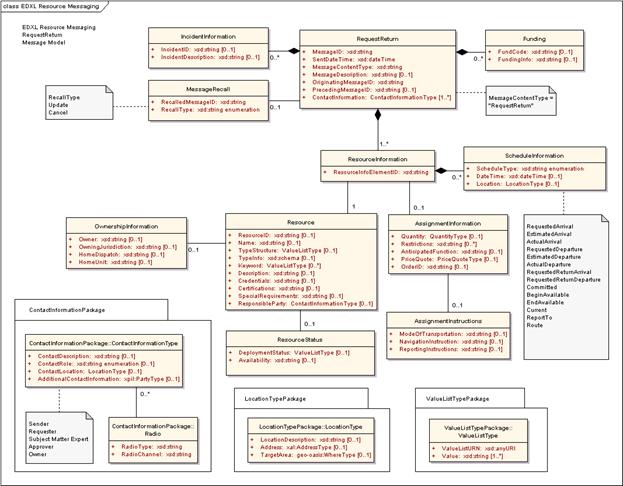
Figure 12: EDXL-RM ERM for
RequestReturn Message
The following table outlines the element cardinalities for
this message type.
Table 12: RequestReturn Message Elements
|
Parent Element
|
Sub-Elements
|
|
RequestReturn
|
MessageID, SentDateTime, MessageContentType^,
MessageDescription, OriginatingMessageID, PrecedingMessageID,
IncidentInformation*, MessageRecall, Funding*, ContactInformation*, ResourceInformation*
|
|
IncidentInformation
|
IncidentID, IncidentDescription
|
|
MessageRecall
|
RecalledMessageID, RecallType
|
|
Funding
|
FundCode, FundingInfo
|
|
ResourceInformation
|
ResourceInfoElementID, Resource,
AssignmentInformation, ScheduleInformation*
|
|
Resource
|
ResourceID, Name, TypeStructure,
TypeInfo, Keyword*, Description, Credentials, Certifications,
SpecialRequirements, ResponsibleParty, OwnershipInformation, ResourceStatus
|
|
OwnershipInformation
|
Owner, OwningJurisdiction, HomeDispatch, HomeUnit
|
|
ResourceStatus
|
DeploymentStatus, Availability
|
|
AssignmentInformation
|
Quantity, Restrictions, AnticipatedFunction, PriceQuote,
OrderID, AssignmentInstructions
|
|
AssignmentInstructions
|
ModeOfTransportation, NavigationInstructions,
ReportingInstructions
|
|
ScheduleInformation
|
ScheduleType^, DateTime, Location
|
The following rules apply to the above elements:
·
The RequestReturn:MessageID, ResourceMessage:SentDateTime, RequestReturn:MessageContentType,
RequestReturn:OriginatingMessageID, RequestReturn:ContactInformation, and RequestReturn:ResourceInformation
elements MUST be present.
·
The value of RequestReturn:MessageContentType MUST be “RequestReturn”.
·
If a RequestReturn:IncidentInformation element is present, then
at least one of IncidentInformation:IncidentID and/or IncidentInformation:IncidentDescription
elements MUST be present.
·
If the RequestReturn:MessageRecall element is present, then the
MessageRecall:RecalledMessageID and MessageRecall:RecallType elements MUST be
present.
·
If a RequestReturn:Funding element is present, then at least one
of Funding:FundCode and/or Funding:FundingInfo elements MUST be present.
·
The ResourceInformation:ResourceInfoElementID and ResourceInformation:Resource
elements MUST be present.
·
At least one of Resource:ResourceID, Resource:Name, and/or Resource:TypeStructure
elements MUST be present for each ResourceInformation:Resource element present.
·
If a Resource:OwnershipInformation element is present, then at
least one of OwnershipInformation:Owner and/or
OwnershipInformation:OwningJurisdiction elements MUST be present.
·
If the ResourceInformation:ScheduleInformation element is
present, then the ScheduleInformation:ScheduleType element MUST be present and contain
one of the following values:
·
“RequestedArrival”, “EstimatedArrival”, “ActualArrival”,
“RequestedDeparture”, “EstimatedDeparture”, “ActualDeparture”, “RequestedReturnDeparture”,
“RequestedReturnArrival”, “BeginAvailable”, “Committed”, “EndAvailable”, “Current”,
“ReportTo” or “Route”.
The schema for a
RequestReturn message can be found in Appendix A.11.
3.12.4
Message Flow
The RequestReturn message is sent by the Resource Supplier
to the Resource Consumer, and typically follows an earlier sequence of messages
(e.g., RequisitionResource and CommitResource messages).
The potential responses to this message include:
·
ResponseToRequestReturn (See Section 3.13)
·
ReleaseResource (See Section 3.11)
·
This includes Accept, Decline, and Provisional responses.
The message may
be canceled or updated through the RequestReturn:MessageRecall element.
Below is an example of a RequestReturn Message, in which one
request return is shown:
·
Small Animal Sheltering Team (ResourceInfoElementID=001).
[Note: The XML example
shown in this section is informative only.]
<?xml
version="1.0" encoding="UTF-8"?>
<RequestReturn
xmlns:xsi="http://www.w3.org/2001/XMLSchema-instance"
xsi:schemaLocation="urn:oasis:names:tc:emergency:EDXL:RM:1.0:msg
EDXL-RMRequestReturn.xsd"
xmlns="urn:oasis:names:tc:emergency:EDXL:RM:1.0:msg"
xmlns:rm="urn:oasis:names:tc:emergency:EDXL:RM:1.0"
xmlns:xpil="urn:oasis:names:tc:ciq:xpil:3"
xmlns:xnl="urn:oasis:names:tc:ciq:xnl:3"
xmlns:xal="urn:oasis:names:tc:ciq:xal:3"
xmlns:geo-oasis="urn:oasis:names:tc:emergency:EDXL:HAVE:1.0:geo-oasis">
<MessageID>urn:au-qld-eoc:997821</MessageID>
<SentDateTime>2006-03-28T14:48:00+10:00</SentDateTime>
<MessageContentType>RequestReturn</MessageContentType>
<OriginatingMessageID>urn:au-qld-eoc:12332</OriginatingMessageID>
<IncidentInformation>
<rm:IncidentDescription>Cyclone Larry</rm:IncidentDescription>
</IncidentInformation>
<ContactInformation>
<rm:ContactRole>Sender</rm:ContactRole>
<rm:AdditionalContactInformation>
<xpil:PartyName>
<xnl:PersonName>
<xnl:NameElement xnl:ElementType="FirstName">Charlotte</xnl:NameElement>
<xnl:NameElement
xnl:ElementType="LastName">Ryan</xnl:NameElement>
</xnl:PersonName>
<xnl:OrganisationName>
<xnl:NameElement>EMA</xnl:NameElement>
</xnl:OrganisationName>
</xpil:PartyName>
</rm:AdditionalContactInformation>
</ContactInformation>
<ResourceInformation>
<ResourceInfoElementID>001</ResourceInfoElementID>
<Resource>
<TypeStructure>
<rm:ValueListURN>urn:x-hazard:vocab:resourceTypes</rm:ValueListURN>
<rm:Value>Small Animal Sheltering Team</rm:Value>
</TypeStructure>
</Resource>
<AssignmentInformation>
<Quantity>
<rm:MeasuredQuantity>
<rm:Amount>1</rm:Amount>
</rm:MeasuredQuantity>
</Quantity>
</AssignmentInformation>
<ScheduleInformation>
<ScheduleType>RequestedReturnArrival</ScheduleType>
<DateTime>2006-03-29T20:00:00+10:00</DateTime>
<Location>
<rm:LocationDescription>Cairns Airport</rm:LocationDescription>
</Location>
</ScheduleInformation>
</ResourceInformation>
</RequestReturn>
The “ResponseToRequestReturn” message is used
by Resource Consumers to respond to a RequestReturn message from Resource Suppliers.
The response identifies the resources in the original request message and how
the Resource Consumer has responded.
Figure 13 below shows the EDXL–RM Element
Reference Model (ERM) tailored for the ResponseToRequestReturn Message. The ERM shows the element-level details for the main entities in the RM.
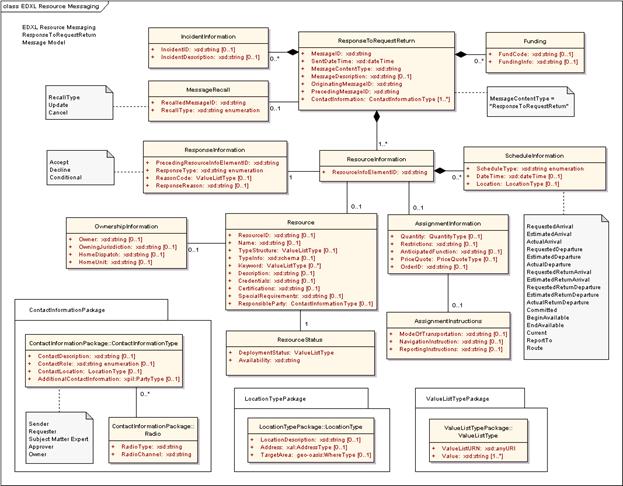
Figure 13: EDXL-RM ERM for
ResponseToRequestReturn Message
The following table outlines the element cardinalities for
this message type.
Table 13: ResponseToRequestReturn Message Elements
|
Parent Element
|
Sub-Elements
|
|
ResponseToRequestReturn
|
MessageID, SentDateTime, MessageContentType^,
MessageDescription, OriginatingMessageID, PrecedingMessageID,
IncidentInformation*, MessageRecall, Funding*, ContactInformation*, ResourceInformation*
|
|
IncidentInformation
|
IncidentID, IncidentDescription
|
|
MessageRecall
|
RecalledMessageID, RecallType
|
|
Funding
|
FundCode, FundingInfo
|
|
ResourceInformation
|
ResourceInfoElementID, ResponseInformation, Resource,
AssignmentInformation, ScheduleInformation*
|
|
ResponseInformation
|
PrecedingResourceInfoElementID, ResponseType, ReasonCode,
ResponseReason
|
|
Resource
|
ResourceID, Name, TypeStructure,
TypeInfo, Keyword*, Description, Credentials, Certifications,
SpecialRequirements, ResponsibleParty, OwnershipInformation, ResourceStatus
|
|
OwnershipInformation
|
Owner, OwningJurisdiction, HomeDispatch, HomeUnit
|
|
ResourceStatus
|
DeploymentStatus, Availability
|
|
AssignmentInformation
|
Quantity, Restrictions, AnticipatedFunction, PriceQuote,
OrderID, AssignmentInstructions
|
|
AssignmentInstructions
|
ModeOfTransportation, NavigationInstructions,
ReportingInstructions
|
|
ScheduleInformation
|
ScheduleType^, DateTime, Location
|
The following rules apply to the above elements:
·
The ResponseToRequestReturn:MessageID, ResponseToRequestReturn:SentDateTime,
ResponseToRequestReturn:MessageContentType, ResponseToRequestReturn:OriginatingMessageID,
ResponseToRequestReturn:PrecedingMessageID, ResponseToRequestReturn:ContactInformation,
and ResponseToRequestReturn:ResourceInformation elements MUST be present.
·
The value of ResponseToRequestReturn:MessageContentType MUST be “ResponseToRequestReturn”.
·
If a ResponseToRequestReturn:IncidentInformation element is
present, then at least one of IncidentInformation:IncidentID and/or
IncidentInformation:IncidentDescription elements MUST be present.
·
If the ResponseToRequestReturn:MessageRecall element is present,
then the MessageRecall:RecalledMessageID and MessageRecall:RecallType elements MUST
be present.
·
If a ResponseToRequestReturn:Funding element is present, then at
least one of Funding:FundCode and/or Funding:FundingInfo elements MUST be
present.
·
The ResourceInformation:ResourceInfoElementID and ResourceInformation:ResponseInformation
elements MUST be present.
·
The ResponseInformation:PrecedingResourceInfoElementID and ResponseInformation:ResponseType
elements MUST be present.
·
If the ResponseInformation:ResponseType element has a value of “Provisional”,
then at least one of ResponseInformation:ReasonCode and/or ResponseInformation:ResponseReason
elements MUST be present.
·
At least one of Resource:ResourceID, Resource:Name, and/or Resource:TypeStructure
elements MUST be present for each ResourceInformation:Resource element present.
·
The Resource:ResourceStatus element MUST be present for each
ResourceInformation:Resource element present.
·
If a Resource:OwnershipInformation element is present, then at
least one of OwnershipInformation:Owner and/or
OwnershipInformation:OwningJurisdiction elements MUST be present.
·
The ResourceStatus:DeploymentStatus and
ResourceStatus:Availability elements MUST be present.
·
If the ResourceInformation:ScheduleInformation element is
present, then the ScheduleInformation:ScheduleType element MUST be present and contain
one of the following values:
·
“RequestedArrival”, “EstimatedArrival”, “ActualArrival”,
“RequestedDeparture”, “EstimatedDeparture”, “ActualDeparture”, RequestedReturnArrival”,
“EstimatedReturnArrival”,” “BeginAvailable”, “RequestedReturnDeparture”,
“EstimatedReturnDeparture”, “ActualReturnDeparture”, “EndAvailable”,
“Committed”, “Current”, “ReportTo” or “Route.”
The schema for a ResponseToRequestReturn message can be
found in Appendix A.12.
3.13.4 Message Flow
The ResponseToRequestReturn message is sent by a Resource Consumer
in response to an original RequestReturn message sent by the Resource Supplier.
The potential responses to this message include:
·
RequestReturn (See Section 3.12)
·
The Supplier may send this response when the Consumer has
specified return conditions with which the Supplier is not in agreement.
The message will
typically be followed by a ReleaseResource message (See Section 3.11) when the Resource Consumer is ready to return the resource to the Resource
Supplier.
The message may
be canceled or updated through the ResponseToRequestReturn:MessageRecall
element.
Below is an example of a ResponseToRequestReturn message.
This is an example response to the RequestReturn message shown in Section.3.12.5 The sender of the message is the original resource requester (Resource
Consumer). The response is an “Accept” (i.e., the Resource Consumer agrees to
return the resource according to the specified schedule).
[Note: The XML example
shown in this section is informative only.]
<?xml
version="1.0" encoding="UTF-8"?>
<ResponseToRequestReturn
xmlns:xsi="http://www.w3.org/2001/XMLSchema-instance"
xsi:schemaLocation="urn:oasis:names:tc:emergency:EDXL:RM:1.0:msg
EDXL-RMResponseToRequestReturn.xsd"
xmlns="urn:oasis:names:tc:emergency:EDXL:RM:1.0:msg"
xmlns:rm="urn:oasis:names:tc:emergency:EDXL:RM:1.0"
xmlns:xpil="urn:oasis:names:tc:ciq:xpil:3"
xmlns:xnl="urn:oasis:names:tc:ciq:xnl:3"
xmlns:xal="urn:oasis:names:tc:ciq:xal:3"
xmlns:geo-oasis="urn:oasis:names:tc:emergency:EDXL:HAVE:1.0:geo-oasis">
<MessageID>urn:au-qld-eoc:997981</MessageID>
<SentDateTime>2006-03-28T16:17:00+10:00</SentDateTime>
<MessageContentType>ResponseToRequestReturn</MessageContentType>
<OriginatingMessageID>urn:au-qld-eoc:12332</OriginatingMessageID>
<PrecedingMessageID>urn:au-qld-eoc:997821</PrecedingMessageID>
<IncidentInformation>
<rm:IncidentDescription>Cyclone Larry</rm:IncidentDescription>
</IncidentInformation>
<ContactInformation>
<rm:ContactRole>Sender</rm:ContactRole>
<rm:AdditionalContactInformation>
<xpil:PartyName>
<xnl:PersonName>
<xnl:NameElement
xnl:ElementType="FirstName">Alex</xnl:NameElement>
<xnl:NameElement
xnl:ElementType="LastName">Jones</xnl:NameElement>
</xnl:PersonName>
<xnl:OrganisationName>
<xnl:NameElement>Dept of Emergency Services</xnl:NameElement>
</xnl:OrganisationName>
</xpil:PartyName>
</rm:AdditionalContactInformation>
</ContactInformation>
<ResourceInformation>
<ResourceInfoElementID>001</ResourceInfoElementID>
<ResponseInformation>
<rm:PrecedingResourceInfoElementID>001</rm:PrecedingResourceInfoElementID>
<rm:ResponseType>Accept</rm:ResponseType>
</ResponseInformation>
</ResourceInformation>
</ResponseToRequestReturn>
The “RequestQuote” message is used by the
Resource Consumer to request a price quote from the Resource Supplier.
Figure 14 below shows the EDXL–RM Element
Reference Model (ERM) tailored for the RequestQuote Message. The ERM shows the element-level details for the main entities in the RM.
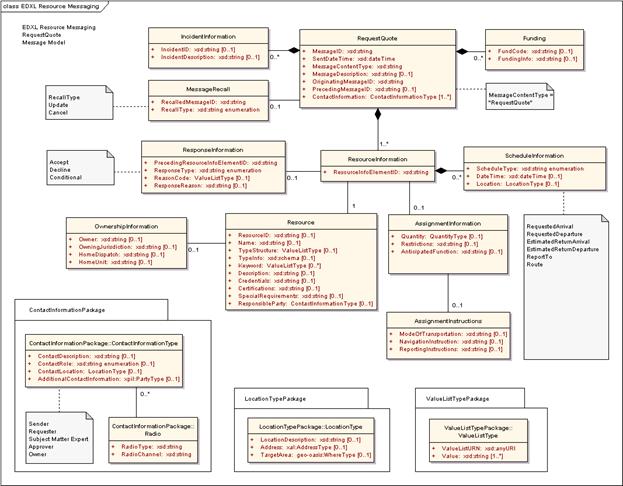
Figure 14: EDXL-RM ERM for
RequestQuote Message
The following table outlines the element cardinalities for
this message type.
Table 14: RequestQuote Message Elements
|
Parent Element
|
Sub-Elements
|
|
RequestQuote
|
MessageID, SentDateTime, MessageContentType^,
MessageDescription, OriginatingMessageID, PrecedingMessageID, IncidentInformation*,
MessageRecall, Funding*, ContactInformation*, ResourceInformation*
|
|
IncidentInformation
|
IncidentID, IncidentDescription
|
|
MessageRecall
|
RecalledMessageID, RecallType
|
|
Funding
|
FundCode, FundingInfo
|
|
ResourceInformation
|
ResourceInfoElementID, ResponseInformation, Resource,
AssignmentInformation, ScheduleInformation*
|
|
ResponseInformation
|
PrecedingResourceInfoElementID, ResponseType, ReasonCode,
ResponseReason
|
|
Resource
|
ResourceID, Name, TypeStructure,
TypeInfo, Keyword*, Description, Credentials, Certifications, SpecialRequirements,
ResponsibleParty, OwnershipInformation
|
|
OwnershipInformation
|
Owner, OwningJurisdiction, HomeDispatch, HomeUnit
|
|
AssignmentInformation
|
Quantity, Restrictions, AnticipatedFunction, AssignmentInstructions
|
|
AssignmentInstructions
|
ModeOfTransportation, NavigationInstructions,
ReportingInstructions
|
|
ScheduleInformation
|
ScheduleType^, DateTime, Location
|
The following rules apply to the above elements:
·
The RequestQuote:MessageID, RequestQuote:SentDateTime, RequestQuote:MessageContentType,
RequestQuote:OriginatingMessageID, RequestQuote:ContactInformation, and RequestQuote:ResourceInformation
elements MUST be present.
·
The value of RequestQuote:MessageContentType MUST be “RequestQuote”.
·
If a RequestQuote:IncidentInformation element is present, then at
least one of IncidentInformation:IncidentID and/or
IncidentInformation:IncidentDescription elements MUST be present.
·
If the RequestQuote:MessageRecall element is present, then the
MessageRecall:RecalledMessageID and MessageRecall:RecallType elements MUST be
present.
·
If a RequestQuote:Funding element is present, then at least one
of Funding:FundCode and/or Funding:FundingInfo elements MUST be present.
·
The ResourceInformation:ResourceInfoElementID and ResourceInformation:Resource
elements MUST be present.
·
If the ResourceInformation:ResponseInformation element is
present, then the ResponseInformation:PrecedingResourceInfoElementID” and
“ResponseInformation:ResponseType MUST be present.
·
If ResponseInformation:ResponseType has a value of “Conditional”,
then at least one of ResponseInformation:ReasonCode and/or ResponseInformation:ResponseReason
elements MUST be present.
·
At least one of Resource:ResourceID, Resource:Name, and/or Resource:TypeStructure
elements MUST be present for each ResourceInformation:Resource element present.
·
If a Resource:OwnershipInformation element is present, then at
least one of OwnershipInformation:Owner and/or
OwnershipInformation:OwningJurisdiction elements MUST be present.
·
If the ResourceInformation:ScheduleInformation element is
present, then the ScheduleInformation:ScheduleType element MUST be present and contain
one of the following values:
·
“RequestedArrival”, “RequestedDeparture”, “EstimatedReturnDeparture”,
“EstimatedReturnArrival”, “ReportTo” or “Route”.
The schema for a RequestQuote message can be found in
Appendix A.13.
3.14.4 Message Flow
The RequestQuote message is usually an initial message
created and sent by the Resource Consumer to any number of Resource Suppliers.
The potential responses to this message include:
·
ResponseToRequestQuote (See 3.3.12)
·
This includes Accept, Decline, and Provisional responses.
The message may
be canceled or updated through the RequestQuote:MessageRecall element.
Below is an example RequestQuote message. This
message requests quotes for a “Debris Management Team” (ResourceInfoElementID=001)
and two “All Terrain Cranes” (ResourceInfoElementID=002).
[Note: The XML example
shown in this section is informative only.]
<?xml
version="1.0" encoding="UTF-8"?>
<RequestQuote
xmlns:xsi="http://www.w3.org/2001/XMLSchema-instance"
xsi:schemaLocation="urn:oasis:names:tc:emergency:EDXL:RM:1.0:msg
EDXL-RMRequestQuote.xsd"
xmlns="urn:oasis:names:tc:emergency:EDXL:RM:1.0:msg"
xmlns:rm="urn:oasis:names:tc:emergency:EDXL:RM:1.0"
xmlns:xpil="urn:oasis:names:tc:ciq:xpil:3"
xmlns:xnl="urn:oasis:names:tc:ciq:xnl:3"
xmlns:xal="urn:oasis:names:tc:ciq:xal:3"
xmlns:geo-oasis="urn:oasis:names:tc:emergency:EDXL:HAVE:1.0:geo-oasis">
<MessageID>urn:au-qld-eoc:77388</MessageID>
<SentDateTime>2006-03-30T10:45:00+10:00</SentDateTime>
<MessageContentType>RequestQuote</MessageContentType>
<OriginatingMessageID>urn:au-qld-eoc:77388</OriginatingMessageID>
<IncidentInformation>
<rm:IncidentDescription>Cyclone Larry</rm:IncidentDescription>
</IncidentInformation>
<ContactInformation>
<rm:ContactRole>Sender</rm:ContactRole>
<rm:AdditionalContactInformation>
<xpil:PartyName>
<xnl:PersonName>
<xnl:NameElement
xnl:ElementType="FirstName">Alex</xnl:NameElement>
<xnl:NameElement
xnl:ElementType="LastName">Jones</xnl:NameElement>
</xnl:PersonName>
<xnl:OrganisationName>
<xnl:NameElement>Dept of Emergency Services</xnl:NameElement>
</xnl:OrganisationName>
</xpil:PartyName>
<xpil:ContactNumbers>
<xpil:ContactNumber xpil:CommunicationMediaType="Telephone"
xpil:ContactHours="9:00AM - 5:00PM">
<xpil:ContactNumberElement
xpil:Type="CountryCode">61</xpil:ContactNumberElement>
<xpil:ContactNumberElement
xpil:Type="AreaCode">7</xpil:ContactNumberElement>
<xpil:ContactNumberElement xpil:Type="LocalNumber">
3000
1234
</xpil:ContactNumberElement>
</xpil:ContactNumber>
</xpil:ContactNumbers>
<xpil:ElectronicAddressIdentifiers>
<xpil:ElectronicAddressIdentifier>alexj@emergencyservices.gov.au
</xpil:ElectronicAddressIdentifier>
</xpil:ElectronicAddressIdentifiers>
</rm:AdditionalContactInformation>
</ContactInformation>
<ResourceInformation>
<ResourceInfoElementID>001</ResourceInfoElementID>
<Resource>
<TypeStructure>
<rm:ValueListURN>urn:x-hazard:vocab:resourceTypes</rm:ValueListURN>
<rm:Value>Debris Management Team</rm:Value>
</TypeStructure>
<Description>
5 person team to clear roads of debris incl. fallen
trees. </Description>
<SpecialRequirements>
Team to supply own equipment, such as trucks and chainsaws
</SpecialRequirements>
</Resource>
<AssignmentInformation>
<Quantity>
<rm:MeasuredQuantity>
<rm:Amount>1</rm:Amount>
</rm:MeasuredQuantity>
</Quantity>
<AssignmentInstructions>
<rm:ModeOfTransportation>Team's own
trucks</rm:ModeOfTransportation>
</AssignmentInstructions>
</AssignmentInformation>
<ScheduleInformation>
<ScheduleType>ReportTo</ScheduleType>
<DateTime>2006-04-01T09:00:00+10:00</DateTime>
<Location>
<rm:LocationDescription>Johnstone Shire
Council</rm:LocationDescription>
<rm:Address>
<xal:Country>
<xal:NameElement>Australia</xal:NameElement>
</xal:Country>
<xal:AdministrativeArea>
<xal:NameElement>QLD</xal:NameElement>
</xal:AdministrativeArea>
<xal:Locality>
<xal:NameElement>Innisfail</xal:NameElement>
</xal:Locality>
<xal:Thoroughfare>
<xal:NameElement>Rankin St</xal:NameElement>
<xal:Number>70</xal:Number>
</xal:Thoroughfare>
</rm:Address>
</Location>
</ScheduleInformation>
<ScheduleInformation>
<ScheduleType>EstimatedReturnDeparture</ScheduleType>
<DateTime>2006-04-21T09:00:00+10:00</DateTime>
</ScheduleInformation>
</ResourceInformation>
<ResourceInformation>
<ResourceInfoElementID>002</ResourceInfoElementID>
<Resource>
<TypeStructure>
<rm:ValueListURN>urn:x-hazard:vocab:resourceTypes</rm:ValueListURN>
<rm:Value>All Terrain Crane</rm:Value>
</TypeStructure>
<Description> Crane with minimum boom reach of 150 feet.
</Description>
</Resource>
<AssignmentInformation>
<Quantity>
<rm:MeasuredQuantity>
<rm:Amount>2</rm:Amount>
</rm:MeasuredQuantity>
</Quantity>
</AssignmentInformation>
<ScheduleInformation>
<ScheduleType>ReportTo</ScheduleType>
<DateTime>2006-04-01T09:00:00+10:00</DateTime>
<Location>
<rm:LocationDescription>Johnstone Shire
Council</rm:LocationDescription>
<rm:Address>
<xal:Country>
<xal:NameElement>Australia</xal:NameElement>
</xal:Country>
<xal:AdministrativeArea>
<xal:NameElement>QLD</xal:NameElement>
</xal:AdministrativeArea>
<xal:Locality>
<xal:NameElement>Innisfail</xal:NameElement>
</xal:Locality>
<xal:Thoroughfare>
<xal:NameElement>Rankin St</xal:NameElement>
<xal:Number>70</xal:Number>
</xal:Thoroughfare>
</rm:Address>
</Location>
</ScheduleInformation>
<ScheduleInformation>
<ScheduleType>EstimatedReturnDeparture</ScheduleType>
<DateTime>2006-04-21T09:00:00+10:00</DateTime>
</ScheduleInformation>
</ResourceInformation>
</RequestQuote>
The “ResponseToRequestQuote” message is used
by the Resource Supplier to respond to a RequestQuote Message. The supplier may
respond with pricing or decline to respond with pricing (i.e. a response that
says that the Resource Supplier is unable to supply a requested quote). The
Resource Supplier may provide quotes for several alternative resources that
match a single resource request.
Figure 15 below shows the EDXL–RM Element
Reference Model (ERM) tailored for the ResponseToRequestQuote Message. The ERM shows the element-level details for the main entities in the RM.

Figure 15: EDXL-RM ERM for
ResponseToRequestQuote Message
The following table outlines the element cardinalities for
this message type.
Table 15: ResponseToRequestQuote Message Elements
|
Parent Element
|
Sub-Elements
|
|
ResponseToRequestQuote
|
MessageID, SentDateTime, MessageContentType^,
MessageDescription, OriginatingMessageID, PrecedingMessageID, IncidentInformation*,
MessageRecall, Funding*, ContactInformation*, ResourceInformation*
|
|
IncidentInformation
|
IncidentID, IncidentDescription
|
|
MessageRecall
|
RecalledMessageID, RecallType
|
|
Funding
|
FundCode, FundingInfo
|
|
ResourceInformation
|
ResourceInfoElementID, ResponseInformation, Resource,
AssignmentInformation, ScheduleInformation*
|
|
ResponseInformation
|
PrecedingResourceInfoElementID, ResponseType, ReasonCode,
ResponseReason
|
|
Resource
|
ResourceID, Name, TypeStructure,
TypeInfo, Keyword*, Description, Credentials, Certifications,
SpecialRequirements, ResponsibleParty, OwnershipInformation, ResourceStatus
|
|
OwnershipInformation
|
Owner, OwningJurisdiction, HomeDispatch, HomeUnit
|
|
ResourceStatus
|
InventoryRefreshDateTime, DeploymentStatus, Availability
|
|
AssignmentInformation
|
Quantity, Restrictions, AnticipatedFunction, PriceQuote,
AssignmentInstructions
|
|
AssignmentInstructions
|
ModeOfTransportation, NavigationInstructions,
ReportingInstructions
|
|
ScheduleInformation
|
ScheduleType^, DateTime, Location
|
The following rules apply to the above elements:
·
The ResponseToRequestQuote:MessageID, ResponseToRequestQuote:SentDateTime,
ResponseToRequestQuote:MessageContentType, ResponseToRequestQuote:OriginatingMessageID,
ResponseToRequestQuote:PrecedingMessageID, ResponseToRequestQuote:ContactInformation,
and ResponseToRequestQuote:ResourceInformation elements MUST be present.
·
The value of ResponseToRequestQuote:MessageContentType MUST be
“ResponseToRequest Quote”.
·
If a ResponseToRequestQuote:IncidentInformation element is
present, then at least one of IncidentInformation:IncidentID and/or
IncidentInformation:IncidentDescription elements MUST be present.
·
If the ResponseToRequestQuote:MessageRecall element is present,
then the MessageRecall:RecalledMessageID and MessageRecall:RecallType elements MUST
be present.
·
If a ResponseToRequestQuote:Funding element is present, then at
least one of Funding:FundCode and/or Funding:FundingInfo elements MUST be
present.
·
The ResourceInformation:ResourceInfoElementID and ResourceInformation:ResponseInformation
elements MUST be present.
·
If the ResponseInformation:ResponseType element has a value of
“Accept” or “Provisional”, then the ResourceInformation:Resource element MUST
be present.
·
The ResponseInformation:PrecedingResourceInfoElementID and ResponseInformation:ResponseType
elements MUST be present.
·
If ResponseInformation:ResponseType has a value of “Provisional”,
at least one of ResponseInformation:ReasonCode and/or ResponseInformation:ResponseReason
elements MUST be present.
·
At least one of Resource:ResourceID, Resource:Name, and/or
Resource:TypeStructure elements MUST be present for each
ResourceInformation:Resource element present.
·
If a Resource:OwnershipInformation element is present, then at
least one of OwnershipInformation:Owner and/or
OwnershipInformation:OwningJurisdiction element MUST be present.
·
If a ResourceInformation:AssignmentInformation element is
present, then the AssignmentInformation:PriceQuote element MUST be present.
·
If the ResourceInformation:ScheduleInformation element is
present, then the ScheduleInformation:ScheduleType element MUST be present and contain
one of the following values:
·
“EstimatedArrival”, “RequestedArrival”, “RequestedDeparture”, “EstimatedDeparture”,
“RequestedReturnDeparture”, “EstimatedReturnDeparture”, “RequestedReturnArrival”,
“EstimatedReturnArrival”, “BeginAvailable”, EndAvailable”, “Current”, “ReportTo”
or “Route”.
The schema for a ResponseToRequestQuote
message can be found in Appendix A.14.
3.15.4 Message Flow
The ResponseToRequestQuote message is sent by the Resource
Supplier to the Resource Consumer in response to a RequestQuote message.
The potential responses to this message include:
·
Request Information (See Section 3.8)
·
RequisitionResource (See Section 3.6).
The message may
be canceled or updated through the ResponseToRequestQuote:MessageRecall
element.
Below is an example ResponseToRequestQuote
message. The message is a possible response to the RequestQuote message shown
in Section 3.14.5. The first quote
request (“Debris Management Team”, ResourceInfoElementID=001)
is accepted, while the second (“All Terrain Crane”, ResourceInfoElementID=002)
is declined.
[Note: The XML example
shown in this section is informative only.]
<?xml
version="1.0" encoding="UTF-8"?>
<ResponseToRequestQuote
xmlns:xsi="http://www.w3.org/2001/XMLSchema-instance"
xsi:schemaLocation="urn:oasis:names:tc:emergency:EDXL:RM:1.0:msg
EDXL-RMResponseToRequestQuote.xsd"
xmlns="urn:oasis:names:tc:emergency:EDXL:RM:1.0:msg"
xmlns:rm="urn:oasis:names:tc:emergency:EDXL:RM:1.0"
xmlns:xpil="urn:oasis:names:tc:ciq:xpil:3"
xmlns:xnl="urn:oasis:names:tc:ciq:xnl:3"
xmlns:xal="urn:oasis:names:tc:ciq:xal:3"
xmlns:geo-oasis="urn:oasis:names:tc:emergency:EDXL:HAVE:1.0:geo-oasis">
<MessageID>urn:au-qld-eoc:77396</MessageID>
<SentDateTime>2006-03-28T14:48:00+10:00</SentDateTime>
<MessageContentType>ResponseToRequestQuote</MessageContentType>
<MessageDescription>
This message provides a quote for the services of a debris management team
for the requested period of 3 weeks. We do not have any all-terrain cranes, and
therefore unable to quote on this element of the request.
</MessageDescription>
<OriginatingMessageID>urn:au-qld-eoc:77388</OriginatingMessageID>
<PrecedingMessageID>urn:au-qld-eoc:77388</PrecedingMessageID>
<IncidentInformation>
<rm:IncidentDescription>Cyclone Larry</rm:IncidentDescription>
</IncidentInformation>
<ContactInformation>
<rm:ContactRole>Sender</rm:ContactRole>
<rm:AdditionalContactInformation>
<xpil:PartyName>
<xnl:PersonName>
<xnl:NameElement
xnl:ElementType="FirstName">Alison</xnl:NameElement>
<xnl:NameElement xnl:ElementType="LastName">Smith</xnl:NameElement>
</xnl:PersonName>
<xnl:OrganisationName>
<xnl:NameElement>QBuild</xnl:NameElement>
</xnl:OrganisationName>
</xpil:PartyName>
</rm:AdditionalContactInformation>
</ContactInformation>
<ContactInformation>
<rm:ContactRole>Requester</rm:ContactRole>
<rm:AdditionalContactInformation>
<xpil:PartyName>
<xnl:PersonName>
<xnl:NameElement
xnl:ElementType="FirstName">Alex</xnl:NameElement>
<xnl:NameElement xnl:ElementType="LastName">Jones</xnl:NameElement>
</xnl:PersonName>
<xnl:OrganisationName>
<xnl:NameElement>Dept of Emergency Services</xnl:NameElement>
</xnl:OrganisationName>
</xpil:PartyName>
</rm:AdditionalContactInformation>
</ContactInformation>
<ResourceInformation>
<ResourceInfoElementID>001</ResourceInfoElementID>
<ResponseInformation>
<rm:PrecedingResourceInfoElementID>001</rm:PrecedingResourceInfoElementID>
<rm:ResponseType>Accept</rm:ResponseType>
</ResponseInformation>
<Resource>
<TypeStructure>
<rm:ValueListURN>urn:x-hazard:vocab:resourceTypes</rm:ValueListURN>
<rm:Value>Debris Management Team</rm:Value>
</TypeStructure>
<Description>
5 person team to clear roads of debris incl. fallen
trees. </Description>
<SpecialRequirements>
Team to supply own equipment, such as trucks and chainsaws
</SpecialRequirements>
</Resource>
<AssignmentInformation>
<Quantity>
<rm:MeasuredQuantity>
<rm:Amount>1</rm:Amount>
</rm:MeasuredQuantity>
</Quantity>
<PriceQuote>
<rm:QuantityText>Daily rate: $2100</rm:QuantityText>
<rm:QuantityText>Total before tax: $31500</rm:QuantityText>
<rm:QuantityText>Tax: $3150</rm:QuantityText>
<rm:QuantityText>Total including tax: $34650</rm:QuantityText>
<rm:QuantityText>
NOTES: Accommodation for the team will be organised
and paid by us. Team will
work Mon-Fri for 3 weeks.Total including tax:
$34650</rm:QuantityText>
</PriceQuote>
</AssignmentInformation>
<ScheduleInformation>
<ScheduleType>BeginAvailable</ScheduleType>
<DateTime>2006-03-31T15:00:00+10:00</DateTime>
</ScheduleInformation>
<ScheduleInformation>
<ScheduleType>ReportTo</ScheduleType>
<DateTime>2006-04-01T09:00:00+10:00</DateTime>
<Location>
<rm:LocationDescription>Johnstone Shire
Council</rm:LocationDescription>
<rm:Address>
<xal:Country>
<xal:NameElement>Australia</xal:NameElement>
</xal:Country>
<xal:AdministrativeArea>
<xal:NameElement>QLD</xal:NameElement>
</xal:AdministrativeArea>
<xal:Locality>
<xal:NameElement>Innisfail</xal:NameElement>
</xal:Locality>
<xal:Thoroughfare>
<xal:NameElement>Rankin St</xal:NameElement>
<xal:Number>70</xal:Number>
</xal:Thoroughfare>
</rm:Address>
</Location>
</ScheduleInformation>
<ScheduleInformation>
<ScheduleType>EstimatedReturnDeparture</ScheduleType>
<DateTime>2006-04-21T09:00:00+10:00</DateTime>
</ScheduleInformation>
</ResourceInformation>
<ResourceInformation>
<ResourceInfoElementID>002</ResourceInfoElementID>
<ResponseInformation>
<rm:PrecedingResourceInfoElementID>002</rm:PrecedingResourceInfoElementID>
<rm:ResponseType>Decline</rm:ResponseType>
</ResponseInformation>
</ResourceInformation>
</ResponseToRequestQuote>
The “RequestResourceDeploymentStatus” message
is used to request the current status of one or more deployed resources. It can
be sent by the Resource Supplier to the Resource Consumer (e.g., to check the
status of the resource after a “ReleaseResource” message) or by the Resource
Consumer to the Resource Supplier (e.g., to track the progress of a resource
after a “RequisitionResource” message).
Figure 16 below shows the EDXL–RM Element
Reference Model (ERM) tailored for the RequestResourceDeploymentStatus Message.
The ERM shows the element-level details for the main
entities in the RM.
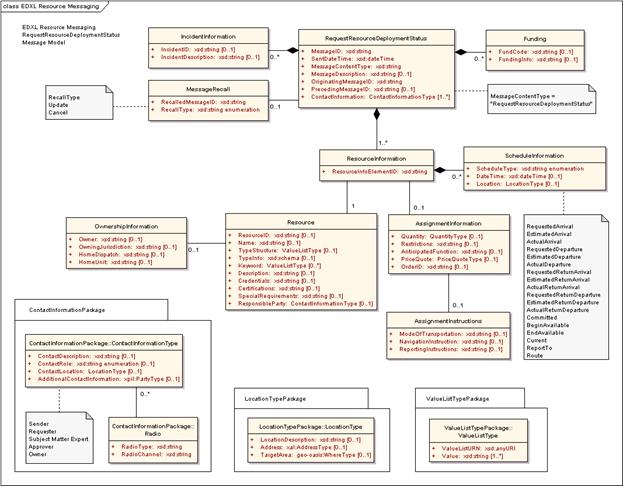
Figure 16: EDXL-RM ERM for
RequestResourceDeploymentStatus Message
The following table outlines the element cardinalities for
this message type.
Table 16: RequestResourceDeploymentStatus Message Elements
|
Parent Element
|
Sub-Elements
|
|
RequestResourceDeploymentStatus
|
MessageID, SentDateTime, MessageContentType^,
MessageDescription, OriginatingMessageID, PrecedingMessageID, IncidentInformation*,
MessageRecall, Funding*, ContactInformation*, ResourceInformation*
|
|
IncidentInformation
|
IncidentID, IncidentDescription
|
|
MessageRecall
|
RecalledMessageID, RecallType
|
|
Funding
|
FundCode, FundingInfo
|
|
ResourceInformation
|
ResourceInfoElementID, Resource,
AssignmentInformation, ScheduleInformation*
|
|
Resource
|
ResourceID, Name, TypeStructure,
TypeInfo, Keyword*, Description, Credentials, Certifications,
SpecialRequirements, ResponsibleParty, OwnershipInformation
|
|
OwnershipInformation
|
Owner, OwningJurisdiction, HomeDispatch, HomeUnit
|
|
AssignmentInformation
|
Quantity, Restrictions, AnticipatedFunction, PriceQuote,
OrderID, AssignmentInstructions
|
|
AssignmentInstructions
|
ModeOfTransportation, NavigationInstructions,
ReportingInstructions
|
|
ScheduleInformation
|
ScheduleType^, DateTime, Location
|
The following rules apply to the above elements:
·
The RequestResourceDeploymentStatus:MessageID, RequestResourceDeploymentStatus:SentDateTime,
RequestResourceDeploymentStatus:MessageContentType, RequestResourceDeploymentStatus:OriginatingMessageID,
RequestResourceDeploymentStatus:ContactInformation, and RequestResourceDeploymentStatus:ResourceInformation
elements MUST be present.
·
The value of RequestResourceDeploymentStatus:MessageContentType
MUST be “RequestResourceDeploymentStatus”.
·
If a RequestResourceDeploymentStatus:IncidentInformation element
is present, then at least one of IncidentInformation:IncidentID and/or
IncidentInformation:IncidentDescription elements MUST be present.
·
If the RequestResourceDeploymentStatus:MessageRecall element is
present, then the MessageRecall:RecalledMessageID and MessageRecall:RecallType
elements MUST be present.
·
If a RequestResourceDeploymentStatus:Funding element is present,
then at least one of Funding:FundCode and/or Funding:FundingInfo elements MUST
be present.
·
The ResourceInformation:ResourceInfoElementID and ResourceInformation:Resource
elements MUST be present.
·
At least one of Resource:ResourceID, Resource:Name, and/or Resource:TypeStructure
element MUST be present for each ResourceInformation:Resource element present.
·
If a Resource:OwnershipInformation element is present, then at
least one of OwnershipInformation:Owner and/or
OwnershipInformation:OwningJurisdiction elements MUST be present.
·
If the ResourceInformation:ScheduleInformation element is
present, then the ScheduleInformation:ScheduleType element MUST be present and contain
one of the following values:
·
“RequestedArrival”, “EstimatedArrival”, “ActualArrival”, “RequestedDeparture”,
“EstimatedDeparture”, “ActualDeparture”, “RequestedReturnDeparture”,
“EstimatedReturnDeparture”, “ActualReturnDeparture”, “RequestedReturnArrival”, “EstimatedReturnArrival”,
“ActualReturnArrival”, “BeginAvailable”, “EndAvailable”, “Committed”, “Current”,
“ReportTo” or “Route”.
The schema for a RequestResourceDeploymentStatus
message can be found in Appendix A.15.
The RequestResourceDeploymentStatus message can be sent from
the Resource Supplier to the Resource Consumer, or from the Resource Consumer
to the Resource Supplier, any time after a resource is requisitioned or
committed.
The potential responses to this message include:
·
ReportResourceDeploymentStatus (See Section 3.17)
·
This may include Accept, Decline, and Provisional responses.
The message may
be canceled or updated through the RequestResourceDeploymentStatus:MessageRecall
element.
Below is an example RequestResourceDeploymentStatus
message. This message requests the deployment status of the “Small Animal
Sheltering Team”; it follows on from the example CommitResource message in
Section 3.7.5, and precedes the ReleaseResource
message in Section 3.11.5 .
[Note: The XML example
shown in this section is informative only.]
<?xml
version="1.0" encoding="UTF-8"?>
<RequestResourceDeploymentStatus
xmlns:xsi="http://www.w3.org/2001/XMLSchema-instance"
xsi:schemaLocation="urn:oasis:names:tc:emergency:EDXL:RM:1.0:msg
EDXL-RMRequestResourceDeploymentStatus.xsd"
xmlns="urn:oasis:names:tc:emergency:EDXL:RM:1.0:msg"
xmlns:rm="urn:oasis:names:tc:emergency:EDXL:RM:1.0"
xmlns:xpil="urn:oasis:names:tc:ciq:xpil:3"
xmlns:xnl="urn:oasis:names:tc:ciq:xnl:3"
xmlns:xal="urn:oasis:names:tc:ciq:xal:3"
xmlns:geo-oasis="urn:oasis:names:tc:emergency:EDXL:HAVE:1.0:geo-oasis">
<MessageID>urn:au-qld-eoc:997958</MessageID>
<SentDateTime>2006-03-25T09:05:00+10:00</SentDateTime>
<MessageContentType>RequestResourceDeploymentStatus</MessageContentType>
<OriginatingMessageID>urn:au-qld-eoc:12332</OriginatingMessageID>
<IncidentInformation>
<rm:IncidentDescription>Cyclone Larry</rm:IncidentDescription>
</IncidentInformation>
<ContactInformation>
<rm:ContactRole>Sender</rm:ContactRole>
<rm:AdditionalContactInformation>
<xpil:PartyName>
<xnl:PersonName>
<xnl:NameElement
xnl:ElementType="FirstName">Alex</xnl:NameElement>
<xnl:NameElement
xnl:ElementType="LastName">Jones</xnl:NameElement>
</xnl:PersonName>
<xnl:OrganisationName>
<xnl:NameElement>Dept of Emergency Services</xnl:NameElement>
</xnl:OrganisationName>
</xpil:PartyName>
</rm:AdditionalContactInformation>
</ContactInformation>
<ResourceInformation>
<ResourceInfoElementID>001</ResourceInfoElementID>
<Resource>
<TypeStructure>
<rm:ValueListURN>urn:x-hazard:vocab:resourceTypes</rm:ValueListURN>
<rm:Value>Small Animal Sheltering Team</rm:Value>
</TypeStructure>
</Resource>
<AssignmentInformation>
<Quantity>
<rm:MeasuredQuantity>
<rm:Amount>1</rm:Amount>
</rm:MeasuredQuantity>
</Quantity>
</AssignmentInformation>
<ScheduleInformation>
<ScheduleType>EstimatedArrival</ScheduleType>
<DateTime>2006-03-25T09:30:00+10:00</DateTime>
<Location>
<rm:LocationDescription>Innisfail Animal
Refuge</rm:LocationDescription>
</Location>
</ScheduleInformation>
<ScheduleInformation>
<ScheduleType>EstimatedReturnDeparture</ScheduleType>
<DateTime>2006-03-30T17:00:00+10:00</DateTime>
</ScheduleInformation>
<ScheduleInformation>
<ScheduleType>Committed</ScheduleType>
<DateTime>2006-03-21T12:46:00+10:00</DateTime>
</ScheduleInformation>
</ResourceInformation>
</RequestResourceDeploymentStatus>
The “ReportResourceDeploymentStatus” message is
used to report on the current status of any deployed resource. The message can
be sent from the Resource Supplier to the Resource Consumer, or from the
Resource Consumer to the Resource Supplier.
Figure 17 below shows the EDXL–RM Element
Reference Model (ERM) tailored for the ReportResourceDeploymentStatus Message. The
ERM shows the element-level details for the main entities
in the RM.

Figure 17: EDXL-RM ERM for ReportResourceDeploymentStatus
Message
The following table outlines the element cardinalities for
this message type.
Table 17: ReportResourceDeploymentStatus Message Elements
|
Parent Element
|
Sub-Elements
|
|
ReportResourceDeploymentStatus
|
MessageID, SentDateTime, MessageContentType^,
MessageDescription, OriginatingMessageID, PrecedingMessageID,
IncidentInformation*, MessageRecall, Funding*, ContactInformation*, ResourceInformation*
|
|
IncidentInformation
|
IncidentID, IncidentDescription
|
|
MessageRecall
|
RecalledMessageID, RecallType
|
|
Funding
|
FundCode, FundingInfo
|
|
ResourceInformation
|
ResourceInfoElementID, ResponseInformation, Resource,
AssignmentInformation, ScheduleInformation*
|
|
ResponseInformation
|
PrecedingResourceInfoElementID, ResponseType, ReasonCode,
ResponseReason
|
|
Resource
|
ResourceID, Name, TypeStructure,
TypeInfo, Keyword*, Description, Credentials, Certifications,
SpecialRequirements, ResponsibleParty, OwnershipInformation, ResourceStatus
|
|
OwnershipInformation
|
Owner, OwningJurisdiction, HomeDispatch, HomeUnit
|
|
ResourceStatus
|
InventoryRefreshDateTime, DeploymentStatus, Availability
|
|
AssignmentInformation
|
Quantity, Restrictions, AnticipatedFunction, PriceQuote,
OrderID, AssignmentInstructions
|
|
AssignmentInstructions
|
ModeOfTransportation, NavigationInstructions,
ReportingInstructions
|
|
ScheduleInformation
|
ScheduleType^, DateTime, Location
|
The following rules apply to the above elements:
·
The ReportResourceDeploymentStatus:MessageID, ReportResourceDeploymentStatus:SentDateTime,
ReportResourceDeploymentStatus:MessageContentType, ReportResourceDeploymentStatus:OriginatingMessageID,
ReportResourceDeploymentStatus:ContactInformation, and ReportResourceDeploymentStatus:ResourceInformation
elements MUST be present.
·
The value of ReportResourceDeploymentStatus:MessageContentType
MUST be “ReportResourceDeploymentStatus”.
·
If a ReportResourceDeploymentStatus:IncidentInformation element
is present, then at least one of IncidentInformation:IncidentID and/or
IncidentInformation:IncidentDescription elements MUST be present.
·
If the ReportResourceDeploymentStatus:MessageRecall element is
present, then the MessageRecall:RecalledMessageID and MessageRecall:RecallType
elements MUST be present.
·
If a ReportResourceDeploymentStatus:Funding element is present,
then at least one of Funding:FundCode and/or Funding:FundingInfo elements MUST
be present.
·
The ResourceInformation:ResourceInfoElementID and ResourceInformation:Resource
elements MUST be present.
·
If the ResourceInformation:ResponseInformation element is
present, then the ResponseInformation:PrecedingResourceInfoElementID and
ResponseInformation:ResponseType elements MUST be present.
·
If the ResponseInformation:ResponseType element has a value of “Provisional”,
at least one of ResponseInformation:ReasonCode and/or ResponseInformation:ResponseReason
elements MUST be present.
·
At least one of Resource:ResourceID, Resource:Name, and/or
Resource:TypeStructure element MUST be present for each
ResourceInformation:Resource element present.
·
If a Resource:OwnershipInformation element is present, then at
least one of OwnershipInformation:Owner and/or
OwnershipInformation:OwningJurisdiction elements MUST be present.
·
If the ResourceInformation:ScheduleInformation element is
present, then the ScheduleInformation:ScheduleType element MUST be present and contain
one of the following values:
·
“RequestedArrival”, “EstimatedArrival”, “ActualArrival”, “RequestedDeparture”,
“EstimatedDeparture”, “ActualDeparture”, “RequestedReturnDeparture”,
“EstimatedReturnDeparture”, “ActualReturnDeparture”, “RequestedReturnArrival”, “EstimatedReturnArrival”,
“ActualReturnArrival”, “BeginAvailable”, “EndAvailable”, “Committed”, “Current”,
“ReportTo” or “Route”.
The schema for a ReportResourceDeploymentStatus message can
be found in Appendix A.16.
The ReportResourceDeploymentStatus message can be sent from
the Resource Supplier to the Resource Consumer, or from the Resource Consumer
to the Resource Supplier, any time after a resource is requisitioned or
committed. The message MAY be sent in response to an earlier
RequestResourceDeploymentStatus message. (See Section 3.16)
The message may
be canceled or updated through the EDXLResourceMessage:MessageRecall element.
Below is an example ReportResourceDeploymentStatus
message. This message shows a possible response to the
RequestResourceDeploymentStatus message in Section 3.16.
[Note: The XML example
shown in this section is informative only.]
<?xml
version="1.0" encoding="UTF-8"?>
<ReportResourceDeploymentStatus
xmlns:xsi="http://www.w3.org/2001/XMLSchema-instance"
xsi:schemaLocation="urn:oasis:names:tc:emergency:EDXL:RM:1.0:msg
EDXL-RMReportResourceDeploymentStatus.xsd"
xmlns="urn:oasis:names:tc:emergency:EDXL:RM:1.0:msg"
xmlns:rm="urn:oasis:names:tc:emergency:EDXL:RM:1.0"
xmlns:xpil="urn:oasis:names:tc:ciq:xpil:3"
xmlns:xnl="urn:oasis:names:tc:ciq:xnl:3"
xmlns:xal="urn:oasis:names:tc:ciq:xal:3"
xmlns:geo-oasis="urn:oasis:names:tc:emergency:EDXL:HAVE:1.0:geo-oasis">
<MessageID>urn:au-qld-eoc:997967</MessageID>
<SentDateTime>2006-03-25T09:16:00+10:00</SentDateTime>
<MessageContentType>ReportResourceDeploymentStatus</MessageContentType>
<OriginatingMessageID>urn:au-qld-eoc:12332</OriginatingMessageID>
<PrecedingMessageID>urn:au-qld-eoc:997958</PrecedingMessageID>
<IncidentInformation>
<rm:IncidentDescription>Cyclone Larry</rm:IncidentDescription>
</IncidentInformation>
<ContactInformation>
<rm:ContactRole>Sender</rm:ContactRole>
<rm:AdditionalContactInformation>
<xpil:PartyName>
<xnl:PersonName>
<xnl:NameElement xnl:ElementType="FirstName">Charlotte</xnl:NameElement>
<xnl:NameElement
xnl:ElementType="LastName">Ryan</xnl:NameElement>
</xnl:PersonName>
<xnl:OrganisationName>
<xnl:NameElement>EMA</xnl:NameElement>
</xnl:OrganisationName>
</xpil:PartyName>
</rm:AdditionalContactInformation>
</ContactInformation>
<ContactInformation>
<rm:ContactRole>Requester</rm:ContactRole>
<rm:AdditionalContactInformation>
<xpil:PartyName>
<xnl:PersonName>
<xnl:NameElement
xnl:ElementType="FirstName">Alex</xnl:NameElement>
<xnl:NameElement
xnl:ElementType="LastName">Jones</xnl:NameElement>
</xnl:PersonName>
<xnl:OrganisationName>
<xnl:NameElement>Dept of Emergency Services</xnl:NameElement>
</xnl:OrganisationName>
</xpil:PartyName>
</rm:AdditionalContactInformation>
</ContactInformation>
<ResourceInformation>
<ResourceInfoElementID>001</ResourceInfoElementID>
<ResponseInformation>
<rm:PrecedingResourceInfoElementID>001</rm:PrecedingResourceInfoElementID>
<rm:ResponseType>Accept</rm:ResponseType>
</ResponseInformation>
<Resource>
<TypeStructure>
<rm:ValueListURN>urn:x-hazard:vocab:resourceTypes</rm:ValueListURN>
<rm:Value>Small Animal Sheltering Team</rm:Value>
</TypeStructure>
<ResourceStatus>
<DeploymentStatus>
<rm:ValueListURN>urn:x-hazard:vocab:deploymentStatusTypes</rm:ValueListURN>
<rm:Value>In Transit</rm:Value>
</DeploymentStatus>
</ResourceStatus>
</Resource>
<AssignmentInformation>
<Quantity>
<rm:MeasuredQuantity>
<rm:Amount>1</rm:Amount>
</rm:MeasuredQuantity>
</Quantity>
</AssignmentInformation>
<ScheduleInformation>
<ScheduleType>ActualDeparture</ScheduleType>
<DateTime>2006-03-25T08:20:00+10:00</DateTime>
<Location>
<rm:LocationDescription>Cairns Airport</rm:LocationDescription>
</Location>
</ScheduleInformation>
<ScheduleInformation>
<ScheduleType>ActualArrival</ScheduleType>
<DateTime>2006-03-25T09:00:00+10:00</DateTime>
<Location>
<rm:LocationDescription>Innisfail Airport</rm:LocationDescription>
</Location>
</ScheduleInformation>
<ScheduleInformation>
<ScheduleType>EstimatedArrival</ScheduleType>
<DateTime>2006-03-25T09:40:00+10:00</DateTime>
<Location>
<rm:LocationDescription>Innisfail Animal
Refuge</rm:LocationDescription>
</Location>
</ScheduleInformation>
</ResourceInformation>
</ReportResourceDeploymentStatus>
The “RequestExtendedDeploymentDuration”
message is sent by the Resource Consumer to the Resource Supplier when the
Consumer wishes to retain one or more resources longer than previously agreed
(e.g., in the original RequisitionResource and CommitResource messages).
Figure 18 below shows the EDXL–RM Element
Reference Model (ERM) tailored for the RequestExtendedDeploymentDuration
Message. The ERM shows the element-level details for the
main entities in the RM.
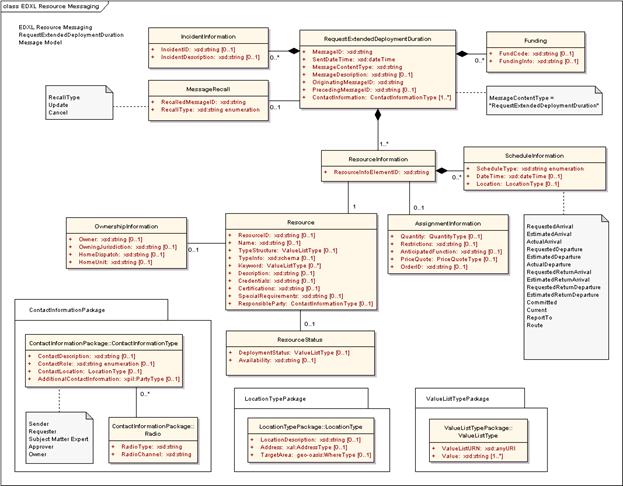
Figure 18: EDXL-RM ERM for
RequestExtendedDeploymentDuration Message
The following table outlines the element cardinalities for
this message type.
Table 18: RequestExtendedDeploymentDuration Message
Elements
|
Parent Element
|
Sub-Elements
|
|
RequestExtendedDeploymentDuration
|
MessageID, SentDateTime, MessageContentType^,
MessageDescription, OriginatingMessageID, PrecedingMessageID, IncidentInformation*,
MessageRecall, Funding*, ContactInformation*, ResourceInformation*
|
|
IncidentInformation
|
IncidentID, IncidentDescription
|
|
MessageRecall
|
RecalledMessageID, RecallType
|
|
Funding
|
FundCode, FundingInfo
|
|
ResourceInformation
|
ResourceInfoElementID, Resource,
AssignmentInformation, ScheduleInformation*
|
|
Resource
|
ResourceID, Name, TypeStructure,
TypeInfo, Keyword*, Description, Credentials, Certifications,
SpecialRequirements, ResponsibleParty, OwnershipInformation, ResourceStatus
|
|
OwnershipInformation
|
Owner, OwningJurisdiction, HomeDispatch, HomeUnit
|
|
ResourceStatus
|
DeploymentStatus, Availability
|
|
AssignmentInformation
|
Quantity, Restriction, AnticipatedFunction, PriceQuote,
OrderID
|
|
ScheduleInformation
|
ScheduleType^, DateTime, Location
|
The following rules apply to the above elements:
·
The RequestExtendedDeploymentDuration:MessageID, RequestExtendedDeploymentDuration:SentDateTime,
RequestExtendedDeploymentDuration:MessageContentType, RequestExtendedDeploymentDuration:OriginatingMessageID,
RequestExtendedDeploymentDuration:ContactInformation, and RequestExtendedDeploymentDuration:ResourceInformation
elements MUST be present.
·
The value of RequestExtendedDeploymentDuration:MessageContentType
MUST be “RequestExtendedDeploymentDuration”.
·
If a RequestExtendedDeploymentDuration:IncidentInformation
element is present, then at least one of IncidentInformation:IncidentID and/or
IncidentInformation:IncidentDescription elements MUST be present.
·
If the RequestExtendedDeploymentDuration:MessageRecall element is
present, then the MessageRecall:RecalledMessageID and MessageRecall:RecallType
elements MUST be present.
·
If a RequestExtendedDeploymentDuration:Funding element is
present, then at least one of Funding:FundCode and/or Funding:FundingInfo
elements MUST be present.
·
The ResourceInformation:ResourceInfoElementID and ResourceInformation:Resource
elements MUST be present.
·
At least one of Resource:ResourceID, Resource:Name, and/or
Resource:TypeStructure element MUST be present for each
ResourceInformation:Resource element present.
·
If a Resource:OwnershipInformation element is present, then at
least one of OwnershipInformation:Owner and/or
OwnershipInformation:OwningJurisdiction elements MUST be present.
·
If a ResourceInformation:ScheduleInformation element is present,
then the ScheduleInformation:ScheduleType element MUST be present and contain
one of the following values:
·
“RequestedArrival”, “EstimatedArrival”, “ActualArrival”,
“RequestedDeparture”, “EstimatedDeparture”, “ActualDeparture”, “RequestedReturnArrival”,
“EstimatedReturnArrival”, “RequestedReturnDeparture”, “EstimatedReturnDeparture”,
“Committed”, “Current”, “ReportTo”
or “Route”.
The schema for a
RequestExtendedDeploymenDuration message can be found in Appendix A.17.
The RequestExtendedDeploymentDuration message is sent from
the Resource Consumer to the Resource Supplier after the Commit Resource
message and prior to the Release Resource message.
The potential responses to this message include:
·
ResponseToRequestExtendedDeploymentDuration (See Section 3.19)
·
This includes Accept, Decline and Provisional responses.
The message may
be canceled or updated through the RequestExtendedDeploymentDuration:MessageRecall
element.
Below is an example
RequestExtendedDeploymentDuration message. This message follows on from the
CommitResource message in Section 3.7.5 and preceeds the RequestReturn and
ReleaseResource messages in Sections 3.12.5 and 3.11.5 respectively.
[Note: The XML example
shown in this section is informative only.]
<?xml
version="1.0" encoding="UTF-8"?>
<RequestExtendedDeploymentDuration
xmlns:xsi="http://www.w3.org/2001/XMLSchema-instance"
xsi:schemaLocation="urn:oasis:names:tc:emergency:EDXL:RM:1.0:msg
EDXL-RMRequestExtendedDeploymentDuration.xsd"
xmlns="urn:oasis:names:tc:emergency:EDXL:RM:1.0:msg"
xmlns:rm="urn:oasis:names:tc:emergency:EDXL:RM:1.0"
xmlns:xpil="urn:oasis:names:tc:ciq:xpil:3"
xmlns:xnl="urn:oasis:names:tc:ciq:xnl:3"
xmlns:xal="urn:oasis:names:tc:ciq:xal:3"
xmlns:geo-oasis="urn:oasis:names:tc:emergency:EDXL:HAVE:1.0:geo-oasis">
<MessageID>urn:au-qld-eoc:997814</MessageID>
<SentDateTime>2006-03-22T16:38:00+10:00</SentDateTime>
<MessageContentType>RequestExtendedDeploymentDuration</MessageContentType>
<OriginatingMessageID>urn:au-qld-eoc:12332</OriginatingMessageID>
<IncidentInformation>
<rm:IncidentDescription>Cyclone Larry</rm:IncidentDescription>
</IncidentInformation>
<ContactInformation>
<rm:ContactRole>Sender</rm:ContactRole>
<rm:AdditionalContactInformation>
<xpil:PartyName>
<xnl:PersonName>
<xnl:NameElement
xnl:ElementType="FirstName">Alex</xnl:NameElement>
<xnl:NameElement
xnl:ElementType="LastName">Jones</xnl:NameElement>
</xnl:PersonName>
<xnl:OrganisationName>
<xnl:NameElement>Dept of Emergency Services</xnl:NameElement>
</xnl:OrganisationName>
</xpil:PartyName>
</rm:AdditionalContactInformation>
</ContactInformation>
<ResourceInformation>
<ResourceInfoElementID>001</ResourceInfoElementID>
<Resource>
<TypeStructure>
<rm:ValueListURN>urn:x-hazard:vocab:resourceTypes</rm:ValueListURN>
<rm:Value>Small Animal Sheltering Team</rm:Value>
</TypeStructure>
</Resource>
<AssignmentInformation>
<Quantity>
<rm:MeasuredQuantity>
<rm:Amount>1</rm:Amount>
</rm:MeasuredQuantity>
</Quantity>
</AssignmentInformation>
<ScheduleInformation>
<ScheduleType>RequestedReturnArrival</ScheduleType>
<DateTime>2006-04-07T17:00:00+10:00</DateTime>
<Location>
<rm:LocationDescription>Cairns Airport</rm:LocationDescription>
</Location>
</ScheduleInformation>
</ResourceInformation>
</RequestExtendedDeploymentDuration>
The “ResponseToRequestExtendedDeploymentDuration”
message is used as the response to a “RequestExtendedDeploymentDuration”
message. It allows the sender to accept, decline, or offer conditions upon
which deployment duration of resources may be extended.
Figure 19 below shows the EDXL–RM Element
Reference Model (ERM) tailored for the ResponseToRequestExtendedDeploymentDuration
message. The ERM shows the element-level details for the
main entities in the RM.
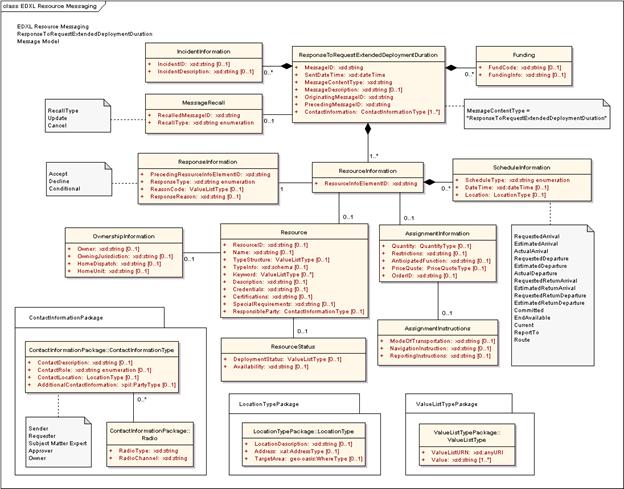
Figure 19: EDXL-RM ERM for ResponseToRequestExtendedDeploymentDuration
Message
The following table outlines the element cardinalities for
this message type.
Table 19: Response to RequestExtendedDeploymentDuration Message
Elements
|
Parent Element
|
Sub-Elements
|
|
ResponseToRequestExtendedDeploymentDuration
|
MessageID, SentDateTime, MessageContentType^,
MessageDescription, OriginatingMessageID, PrecedingMessageID,
IncidentInformation*, MessageRecall, Funding*, ContactInformation*, ResourceInformation*
|
|
IncidentInformation
|
IncidentID, IncidentDescription
|
|
MessageRecall
|
RecalledMessageID, RecallType
|
|
Funding
|
FundCode, FundingInfo
|
|
ResourceInformation
|
ResourceInfoElementID, ResponseInformation, Resource,
AssignmentInformation, ScheduleInformation*
|
|
ResponseInformation
|
PrecedingResourceInfoElementID, ResponseType, ReasonCode,
ResponseReason
|
|
Resource
|
ResourceID, Name, TypeStructure,
TypeInfo, Keyword*, Description, Credentials, Certifications,
SpecialRequirements, ResponsibleParty, OwnershipInformation, ResourceStatus
|
|
OwnershipInformation
|
Owner, OwningJurisdiction, HomeDispatch, HomeUnit
|
|
ResourceStatus
|
DeploymentStatus, Availability
|
|
AssignmentInformation
|
Quantity, Restrictions, AnticipatedFunction, PriceQuote,
OrderID, AssignmentInstructions
|
|
AssignmentInstructions
|
ModeOfTransportation, NavigationInstructions,
ReportingInstructions
|
|
ScheduleInformation
|
ScheduleType^, DateTime, Location
|
The following rules apply to the above elements:
·
The ResponseToRequestExtendedDeploymentDuration:MessageID, ResponseToRequestExtendedDeploymentDuration:SentDateTime,
ResponseToRequestExtendedDeploymentDuration:MessageContentType, ResponseToRequestExtendedDeploymentDuration:OriginatingMessageID,
ResponseToRequestExtendedDeploymentDuration:PrecedingMessageID, ResponseToRequestExtendedDeploymentDuration:ContactInformation,
and ResponseToRequestExtendedDeploymentDuration:ResourceInformation elements
MUST be present.
·
The value of ResponseToRequestExtendedDeploymentDuration:MessageContentType
MUST be “ResponseToRequestExtendedDeploymentDuration”.
·
If a ResponseToRequestExtendedDeploymentDuration:IncidentInformation
element is present, then at least one of IncidentInformation:IncidentID and/or
IncidentInformation:IncidentDescription elements MUST be present.
·
If the ResponseToRequestExtendedDeploymentDuration:MessageRecall
element is present, then the MessageRecall:RecalledMessageID and
MessageRecall:RecallType elements MUST be present.
·
If a ResponseToRequestExtendedDeploymentDuration:Funding element
is present, then at least one of Funding:FundCode and/or Funding:FundingInfo
elements MUST be present.
·
The ResourceInformation:ResourceInfoElementID and ResourceInformation:ResponseInformation
elements MUST be present.
·
The ResponseInformation:PrecedingResourceInfoElementID and ResponseInformation:ResponseType
elements MUST be present.
·
If the ResponseInformation:ResponseType element has a value of
“Accept” or “Provisional”, then ResourceInformation:Resource element MUST be
present. Otherwise, the ResourceInformation:Resource element is optional.
·
If ResponseInformation:ResponseType has a value of “Provisional”,
at least one of ResponseInformation:ReasonCode and/or ResponseInformation:ResponseReason
elements MUST be present.
·
If a ResourceInformation:Resource element is present, then at
least one of Resource:ResourceID, Resource:Name, and/or Resource:TypeStructure elements
MUST be present.
·
If a Resource:OwnershipInformation element is present, then at
least one of OwnershipInformation:Owner and/or
OwnershipInformation:OwningJurisdiction elements MUST be present.
·
If the ResourceInformation:ScheduleInformation element is
present, then the ScheduleInformation:ScheduleType element MUST be present and contain
one of the following values:
·
“RequestedArrival”, “EstimatedArrival”, “ActualArrival”,
“RequestedDeparture”, “EstimatedDeparture”, “ActualDeparture”, “RequestedReturnArrival”,
“EstimatedReturnArrival”, “RequestedReturnDeparture”, “EstimatedReturnDeparture”,
“Committed”, “EndAvailable”, “Current”, “ReportTo” or “Route”.
The schema for a ResponseToRequestExtendedDeploymentDuration
message can be found in Appendix A.18.
The ResponseToRequestExtendedDeploymentDuration message is
sent from the Resource Supplier to the Resource Consumer in response to a
RequestExtendedDeploymentDuration message.
The message may
be canceled or updated through the ResponseToRequestExtendedDeploymentDuration:MessageRecall
element.
Below is an example ResponseToRequestExtendedDeploymentDuration
message. This message follows on from the example
RequestExtendedDeploymentDuration message shown in Section 3.18.5 (declining the request).
[Note: The XML example
shown in this section is informative only.]
<?xml
version="1.0" encoding="UTF-8"?>
<ResponseToRequestExtendedDeploymentDuration
xmlns:xsi="http://www.w3.org/2001/XMLSchema-instance"
xsi:schemaLocation="urn:oasis:names:tc:emergency:EDXL:RM:1.0:msg
EDXL-RMResponseToRequestExtendedDeploymentDuration.xsd"
xmlns="urn:oasis:names:tc:emergency:EDXL:RM:1.0:msg"
xmlns:rm="urn:oasis:names:tc:emergency:EDXL:RM:1.0"
xmlns:xpil="urn:oasis:names:tc:ciq:xpil:3"
xmlns:xnl="urn:oasis:names:tc:ciq:xnl:3"
xmlns:xal="urn:oasis:names:tc:ciq:xal:3"
xmlns:geo-oasis="urn:oasis:names:tc:emergency:EDXL:HAVE:1.0:geo-oasis">
<MessageID>urn:au-qld-eoc:997816</MessageID>
<SentDateTime>2006-03-22T17:02:00+10:00</SentDateTime>
<MessageContentType>ResponseToRequestExtendedDeploymentDuration</MessageContentType>
<OriginatingMessageID>urn:au-qld-eoc:12332</OriginatingMessageID>
<PrecedingMessageID>urn:au-qld-eoc:997814</PrecedingMessageID>
<IncidentInformation>
<rm:IncidentDescription>Cyclone Larry</rm:IncidentDescription>
</IncidentInformation>
<ContactInformation>
<rm:ContactRole>Sender</rm:ContactRole>
<rm:AdditionalContactInformation>
<xpil:PartyName>
<xnl:PersonName>
<xnl:NameElement xnl:ElementType="FirstName">Charlotte</xnl:NameElement>
<xnl:NameElement
xnl:ElementType="LastName">Ryan</xnl:NameElement>
</xnl:PersonName>
<xnl:OrganisationName>
<xnl:NameElement>EMA</xnl:NameElement>
</xnl:OrganisationName>
</xpil:PartyName>
</rm:AdditionalContactInformation>
</ContactInformation>
<ContactInformation>
<rm:ContactRole>Requester</rm:ContactRole>
<rm:AdditionalContactInformation>
<xpil:PartyName>
<xnl:PersonName>
<xnl:NameElement
xnl:ElementType="FirstName">Alex</xnl:NameElement>
<xnl:NameElement
xnl:ElementType="LastName">Jones</xnl:NameElement>
</xnl:PersonName>
<xnl:OrganisationName>
<xnl:NameElement>Dept of Emergency Services</xnl:NameElement>
</xnl:OrganisationName>
</xpil:PartyName>
</rm:AdditionalContactInformation>
</ContactInformation>
<ResourceInformation>
<ResourceInfoElementID>001</ResourceInfoElementID>
<ResponseInformation>
<rm:PrecedingResourceInfoElementID>001</rm:PrecedingResourceInfoElementID>
<rm:ResponseType>Decline</rm:ResponseType>
<rm:ResponseReason>
Team is already committed elsewhere for the period of
4 to April.
</rm:ResponseReason>
</ResponseInformation>
<Resource>
<TypeStructure>
<rm:ValueListURN>urn:x-hazard:vocab:resourceTypes</rm:ValueListURN>
<rm:Value>Small Animal Sheltering Team</rm:Value>
</TypeStructure>
</Resource>
<AssignmentInformation>
<Quantity>
<rm:MeasuredQuantity>
<rm:Amount>1</rm:Amount>
</rm:MeasuredQuantity>
</Quantity>
</AssignmentInformation>
<ScheduleInformation>
<ScheduleType>RequestedReturnArrival</ScheduleType>
<DateTime>2006-04-07T17:00:00+10:00</DateTime>
<Location>
<rm:LocationDescription>Cairns Airport</rm:LocationDescription>
</Location>
</ScheduleInformation>
</ResourceInformation>
</ResponseToRequestExtendedDeploymentDuration>
4
Data Dictionary (NORMATIVE)
|
Element
|
MessageID
|
|
Type
|
MessageIDType [xsd:string]
|
|
Usage
|
REQUIRED, MUST be used once and only once
|
|
Definition
|
Each EDXL resource message contains an identifier that
uniquely identifies the resource message.
|
|
Comments
|
·
The EDXL Distribution Element contains the "Distribution
ID", which identifies the "container" for the distribution
message information.
|
|
Requirements
Supported
|
20
|
|
Element
|
SentDateTime
|
|
Type
|
DateTimeType [xsd:dateTime]
|
|
Usage
|
REQUIRED, MUST be used once and only once
|
|
Definition
|
The system stamped date and time the resource message was sent. (1) The
date and time is represented in [dateTime]
format (e. g., "2002-05-24T16:49:00-07:00"
for 24 May 2002 at 16: 49 PDT). (2) Alphabetic time zone designators such
as “Z” MUST NOT be used. The time zone for UTC MUST be represented as
“-00:00”
or “+00:00.
|
|
Comments
|
·
Original requirement = ICS "Request Date/Time"
|
|
Requirements
Supported
|
21
|
|
Element
|
MessageContentType
|
|
Type
|
MessageContentTypeType
[xsd:string]
|
|
Usage
|
REQUIRED, MUST be used once and only once
|
|
Definition
|
Specifies the purpose / type of resource content / payload
being sent within the Resource Messaging – Element Reference Model
|
|
Constraints
|
·
Value MUST be one of the following:
1. RequestResource
2. ResponseToRequestResource
3. RequisitionResource
4. CommitResource
5. RequestInformation
6. ResponseToRequestInformation
7. OfferUnsolicitedResource
8. ReleaseResource
9. RequestReturn
10. ResponseToRequestReturn
11. RequestQuote
12. ResponseToRequestQuote
13. RequestResourceDeploymentStatus
14. ReportResourceDeploymentStatus
15. RequestExtendedDeploymentDuration
16. ResponseToRequestExtendedDeploymentDuration
|
|
Requirements
Supported
|
2,3,4,5,6,7,8,9,10,11,12,17
|
|
Element
|
MessageDescription
|
|
Type
|
MessageDescriptionType [xsd:string]
|
|
Usage
|
CONDITIONAL, MAY be used once and only once
|
|
Definition
|
Text field used to specify the information requested in a
request for information and the response to a request for information. May
also be used to include additional information in other message types.
|
|
Constraints
|
·
Conditional Usage:
- Required:
- EDXLResourceMessage:MessageContentType = “RequestInformation”
- Optional:
|
|
Requirements
Supported
|
20
|
|
Element
|
OriginatingMessageID
|
|
Type
|
MessageIDType [xsd:string]
|
|
Usage
|
REQUIRED, MUST be used
once and only once
|
|
Definition
|
Each EDXL resource message contains a MessageID that
uniquely identifies the resource message. OriginatingMessageID identifies the
MessageID of the first message in a message sequence to which the message
belongs. If the message is itself the originating message in a new sequence, OriginatingMessageID
will have the same value as the MessageID element. In some other cases, the OriginatingMessageID
element will have the same value as the PrecedingMessageID element. The OriginatingMessageID
value essentially forms a unique identifier for a group of related messages,
linking them together so that the relationship between the messages is made
explicit and unambiguous (and threads of messages can be tracked by resource
management software).
|
|
Comments
|
·
This MessageID is an EDXL-RM MessageID, not an
EDXL-Distribution Element MessageID.
|
|
Requirements Supported
|
20
|
|
Element
|
PrecedingMessageID
|
|
Type
|
MessageIDType [xsd:string]
|
|
Usage
|
CONDITIONAL, MAY be used
once and only once
|
|
Definition
|
The PrecedingMessageID identifies the message that
immediately preceded the current message in the message sequence. This
MessageID is an EDXL-RM MessageID not and EDXL-Distribution Element
MessageID.
|
|
Constraints
|
·
Conditional Usage:
- Required:
- EDXLResourceMessage:MessageContentType = “ResponseToRequestResource”
- EDXLResourceMessage:MessageContentType = “CommitResource”
- EDXLResourceMessage:MessageContentType = “ResponseToRequestInformation”
- EDXLResourceMessage:MessageContentType = “ResponseToRequestReturn”
- EDXLResourceMessage:MessageContentType = “ResponseToRequestQuote”
- EDXLResourceMessage:MessageContentType = “ResponseToRequestExtendedDeploymentDuration”
- Optional:
- EDXLResourceMessage:MessageContentType = “RequisitionResource”
- EDXLResourceMessage:MessageContentType =
“Request Information”
- EDXLResourceMessage:MessageContentType = “ReleaseResource”
- EDXLResourceMessage:MessageContentType = “RequestReturn”
- EDXLResourceMessage:MessageContentType = “RequestQuote”
- EDXLResourceMessage:MessageContentType = “RequestResourceDeploymentStatus”
- EDXLResourceMessage:MessageContentType = “ReportResourceDeploymentStatus”
- Not Applicable:
|
|
Element
|
ContactInformation
|
|
Type
|
ContactInformationType [XML structure]
|
|
Usage
|
REQUIRED, MUST be used
at least once
|
|
Definition
|
The contact associated with the resource message.
|
|
Comments
|
- Refer to Section 4.1.13.1 for ContactInformationType
- There may be more than one contact given – message
sender, requester, subject matter expert, approver, owner, etc.
|
4.1.2
IncidentInformation Element
|
Element
|
IncidentID
|
|
Type
|
IncidentIDType [xsd:string]
|
|
Usage
|
CONDITIONAL, MAY be used once and only once.
|
|
Definition
|
The name or other identifier of the incident to which the
current message refers.
|
|
Constraints
|
·
If an IncidentInformation element is present, then at least one
of IncidentInformation:IncidentID or IncidentInformation:IncidentDescription
MUST be present
|
|
Requirements Supported
|
19
|
|
Element
|
IncidentDescription
|
|
Type
|
IncidentDescriptionType [xsd:string]
|
|
Usage
|
CONDITIONAL, MAY be used once and only once.
|
|
Definition
|
A free form description of the incident to which the
current message refers.
|
|
Constraints
|
·
If an IncidentInformation element is present, then at least one
of IncidentInformation:IncidentID or IncidentInformation:IncidentDescription
MUST be present
|
|
Requirements Supported
|
19
|
4.1.3 MessageRecall Element
|
Element
|
RecalledMessageID
|
|
Type
|
MessageIDType [xsd:string]
|
|
Usage
|
REQUIRED, MUST be used once and only once.
|
|
Definition
|
The identifier of the previously sent message that is to
be recalled. MessageRecall is used to replace a previously sent message by
updating or canceling it.
|
|
Comments
|
·
The MessageRecall element is Optional.
|
|
Requirements Supported
|
14, 15
|
|
Element
|
RecallType
|
|
Type
|
RecallTypeType [xsd:string]
|
|
Usage
|
REQUIRED, MUST be used once and only once.
|
|
Definition
|
Specifies the recall type as either an update or a cancel
of the previously sent message. MessageRecall is used to replace a previously
sent message which is then updated or cancelled.
|
|
Constraints
|
§
Value MUST be one of the following:
1. Update
2. Cancel
|
|
Comments
|
·
The MessageRecall element is Optional.
|
|
Requirements Supported
|
14,15
|
4.1.4 Funding Element
|
Element
|
FundCode
|
|
Type
|
FundCodeType [xsd:string]
|
|
Usage
|
CONDITIONAL, MAY be used once and only once.
|
|
Definition
|
Identifies the funds that will pay for the resource
|
|
Constraints
|
·
The Funding element MUST be present in a Requisition Resource
message.
·
If a Funding element is present, then at least one of
Funding:FundCode or Funding:FundingInfo MUST be present
|
|
Comments
|
·
Identified in support of NIMS Resource Management Guide
NIC-GDL0004
·
This field may be used as a comma separated list of fund codes
(e.g. “HP4347,RT45S”
|
|
Requirements Supported
|
18, 24
|
|
Element
|
FundingInfo
|
|
Type
|
FundingInfoType [xsd:string]
|
|
Usage
|
CONDITIONAL, MAY be used once and only once.
|
|
Definition
|
Provides additional information on the funds that will pay
for the resource
|
|
Constraints
|
- A textual description of funding sources or distribution
- The Funding element MUST be present in a Requisition
Resource message.
- If a Funding element is present, then at least one of
Funding:FundCode or Funding:FundingInfo MUST be present
|
|
Requirements Supported
|
18, 24
|
ResourceInformation Element
|
Element
|
ResourceInfoElementID
|
|
Type
|
ResourceInfoElementIDType[xsd:string]
|
|
Usage
|
REQUIRED, MUST be used once and only
once.
|
|
Definition
|
This element identifies the instance of
ResourceInformation within the message. It does not identify the Resource.
|
|
Comments
|
·
The purpose of this element is to uniquely identify the
ResourceInformation element in future messages that refer to this message.
·
The Resource is identified by a combination of one or more of
ResourceID, Name and/or ResourceTypeStructure.
|
4.1.6
ResponseInformation Element
|
Element
|
PrecedingResourceInfoElementID
|
|
Type
|
ResourceInfoElementIDType[xsd:string]
|
|
Usage
|
REQUIRED, MUST be used once and only
once
|
|
Definition
|
This element identifies the instance of
ResourceInformation within the message specified in the EDXLResourceMessage:PrecedingMessageID
element.
|
|
Element
|
ResponseType
|
|
Type
|
ResponseTypeType [xsd:string enumeration]
|
|
Usage
|
REQUIRED, MUST be used
once and only once
|
|
Definition
|
Used to accept, decline, or provisionally accept a Request
or Unsolicited Offer.
|
|
Constraints
|
·
Value MUST be one of the following:
1. Accept
2. Decline
3. Provisional
|
|
Comments
|
·
The “ResponseReason” element is associated with a “Provisional”
or “Decline” value.
|
|
Requirements Supported
|
6,29
|
|
Element
|
ReasonCode
|
|
Type
|
ValueListType[XML structure]
|
|
Usage
|
CONDITIONAL, MAY be used once and only once
|
|
Definition
|
Code from a managed list that offers an explanation for a
declined or provisional response to a Request or Unsolicited Offer.
|
|
Constraints
|
§
If the ResponseInformation:ResponseType element has a value of
“Provisional”, then at least one of the ResponseInformation:ReasonCode and/or
ResponseInformation:ResponseReason elements MUST be present.
|
|
Requirements Supported
|
6,29
|
|
Element
|
ResponseReason
|
|
Type
|
ResponseReasonType [xsd:string]
|
|
Usage
|
CONDITIONAL, MAY be used once and only once
|
|
Definition
|
Explanation for a declined or provisional response to a
Request, Response, Unsolicited Offer, or a Request Return.
|
|
Constraints
|
§
If the ResponseInformation:ResponseType element has a value of
“Provisional”, then at least one of the ResponseInformation:ReasonCode and/or
ResponseInformation: ResponseReason elements MUST be present.
|
|
Requirements Supported
|
6,29
|
4.1.7
Resource Element
|
Element
|
ResourceID
|
|
Type
|
ResourceIDType [xsd:string]
|
|
Usage
|
CONDITIONAL, MAY be used once and
only once.
|
|
Definition
|
This identifier (if available) is used to identify and
track a resource.
|
|
Constraints
|
- At least one of Resource:ResourceID, Resource:Name or
Resource:TypeStructure MUST be present to identify a specific resource
and the same element and value MUST be used consistently within a
sequence from a common Originating Message.
|
|
Requirements Supported
|
3,16,26
|
|
Element
|
Name
|
|
Type
|
ResourceNameType [xsd:string]
|
|
Usage
|
CONDITIONAL, MAY be used once and
only once.
|
|
Definition
|
A name or title of the resource used for identification
and tracking.
|
|
Constraints
|
- At least one of Resource:ResourceID, Resource:Name or
Resource:TypeStructure MUST be present to identify a specific resource
and the same element and value MUST be used consistently within a
sequence from a common Originating Message.
|
|
Requirements Supported
|
3,16,18,26
|
|
Element
|
TypeStructure
|
|
Type
|
ValueListType [XML structure]
|
|
Usage
|
CONDITIONAL, MAY be used once and
only once.
|
|
Definition
|
Uniform Resource Name (URN) paired with a string “keyword”
value such as
<TypeStructure>
<rm:ValueListURN>urn:x-hazard:vocab:resourceTypes</rm:ValueListURN>
<rm:Value>Debris Management Team</rm:Value>
</TypeStructure>
for a certified list of resources maintained by the
Community of Interest (for the value referenced.)
|
|
Constraints
|
·
At least one of Resource:ResourceID, Resource:Name or Resource:TypeStructure
MUST be present to identify a specific resource and the same element and
value MUST be used consistently within a sequence from a common Originating
Message for each Resource element present.
|
|
Comments
|
·
Refer to Section 4.1.13.3 for ValueListType
|
|
Requirements Supported
|
3,16,25, 26
|
|
Element
|
TypeInfo
|
|
Type
|
TypeInfoType [sequence of xsd:any]
|
|
Usage
|
OPTIONAL, MAY be used once and only once
|
|
Definition
|
The resource type as defined by either a Keyword structure
or a valid schema.
|
|
Comments
|
·
This element contains one or more child elements whose names
and types depend on the value of the TypeStructure element.
|
|
Requirements Supported
|
3,16,25,26
|
|
Element
|
Keyword
|
|
Type
|
ValueListType [XML structure]
|
|
Usage
|
OPTIONAL, MAY be used one or more
times
|
|
Definition
|
Any value from a discrete managed list, used to specify a
keyword.
|
|
Comments
|
- Allows reference to a separate schema for enumerations. Example:
ValueListURN= "http://www.dhs.gov/NiemEquipmentResources" and Value="Portable
Radio",
or ValueListURN= "http://www.eic.org/Package" and Value="DMAT
– burn"
- A Type Structure is assumed to have an enumerated, allowed
list.
- A Keyword is not restricted to a particular enumeration,
a Keyword can be any word or string.
|
|
Requirements Supported
|
3,16,25,26
|
|
Element
|
Description
|
|
Type
|
DescriptionType [xsd:string]
|
|
Usage
|
OPTIONAL, MAY be used once and only once
|
|
Definition
|
Free Text description of resource or resource
characteristics, situation requiring resource assistance, or statement of
mission the resource satisfies.
|
|
Requirements Supported
|
3,7,16,18,26
|
|
Element
|
Credentials
|
|
Type
|
CredentialsType [xsd:string]
|
|
Usage
|
OPTIONAL, MAY be used once and only
once
|
|
Definition
|
Statements of resource qualifications showing that a
person or role has a right to exercise official power
|
|
Comments
|
- Multiple credentials may be included as a
comma-separated list.
Example 1: “Splinting, bandaging, oxygen administration”
Example 2: “A practitioner credentialed by a State to function as an
EMT by a State Emergency Medical Services (EMS) system.”
|
|
Element
|
Certifications
|
|
Type
|
CertificationsType [xsd:string]
|
|
Usage
|
OPTIONAL, MAY be used once and only
once
|
|
Definition
|
Statements of recognition that a resource has met special
requirements or qualifications within a field
|
|
Comments
|
·
Multiple certifications may be included as a comma-separated list.
Example 1: “ALS; Advanced First Aid & CPR, BLS; Advanced First Aid &
CPR”
Example 2: “Pilot – Commercial (instrument) or higher
certificate and complete unit certification program”, “Pilot –
Private Pilot (instrument) or higher certificate and complete unit
certification program”
Example 3: “Trained to the HazMat First Responder Operational Level (NFPA
472); Comply with organization; Operations Level for support personnel as
outlined in NFPA 1670”
|
|
Element
|
SpecialRequirements
|
|
Type
|
SpecialRequirementsType [xsd:string]
|
|
Usage
|
OPTIONAL, MAY be used once and only once
|
|
Definition
|
A description of any special needs related to the
requested resource (e.g. must carry protective equipment)
|
|
Comments
|
- Not intended to carry certifications or capabilities.
|
|
Requirements Supported
|
3,7,16,27
|
|
Element
|
ResponsibleParty
|
|
Type
|
ContactInformationType [XML Structure]
|
|
Usage
|
CONDITIONAL, MAY be used once and only once
|
|
Definition
|
Contact Info for person currently responsible for resource
|
|
Comments
|
§
Conditional Usage:
o
Not Applicable:
§
EDXLResourceMessage:MessageContentType = “RequestResource”
o
Optional, otherwise
|
|
Requirements Supported
|
3,7,16,27
|
4.1.8
OwnershipInformation Element
|
Element
|
Owner
|
|
Type
|
OwnerType [xsd:string]
|
|
Usage
|
CONDITIONAL, MAY be used once and only once
|
|
Definition
|
The name of an agency or supplier that owns the resource (which
may not be the home unit or dispatch). Also referred to as home agency.
|
|
Constraints
|
- At least one of OwnershipInformation:Owner or
OwnershipInformation:OwningJurisdiction MUST be present for each
OwnershipInformation element.
|
|
Requirements Supported
|
3,16,18
|
|
Element
|
OwningJurisdiction
|
|
Type
|
OwningJurisdictionType [xsd:string]
|
|
Usage
|
CONDITIONAL, MAY be used once and only once
|
|
Definition
|
A geopolitical area in which an organization, person, or
object has a specific range of authority for specified resources.
|
|
Constraints
|
- At least one of OwnershipInformation:Owner or
OwnershipInformation:OwningJurisdiction MUST be present for each
OwnershipInformation element.
|
|
Comments
|
|
|
Requirements Supported
|
3, 16, 18
|
|
Element
|
HomeDispatch
|
|
Type
|
HomeDispatchType [xsd:string]
|
|
Usage
|
CONDITIONAL, MAY be used once and only once
|
|
Definition
|
Resource home agency dispatch center name. This identifies
the dispatch unit that has primary responsibility for maintaining information
on the resource (e.g., Ft. Collins Dispatch Center, Rocky Mountain Area Coordination Center).
|
|
Comments
|
§
Conditional Usage:
o
Not Applicable:
§
EDXLResourceMessage:MessageContentType = “RequestResource”
o
Optional, otherwise
|
|
Requirements Supported
|
18
|
|
Element
|
HomeUnit
|
|
Type
|
HomeUnitType [xsd:string]
|
|
Usage
|
CONDITIONAL, MAY be used once and only once
|
|
Definition
|
The unit (office, district, organization, etc.) from which
the resource typically works or is used (e.g., Manti-LaSalle National
Forest/Sanpete District). When released from an assignment, the location to
which the resource is released will usually be determined by the home unit.
|
|
Comments
|
§
Conditional Usage:
o
Not Applicable:
§
EDXLResourceMessage:MessageContentType = “RequestResource”
o
Optional, otherwise
|
|
Requirements Supported
|
18
|
|
Element
|
InventoryRefreshDateTime
|
|
Type
|
DateTimeType[xsd:dateTime]
|
|
Usage
|
CONDITIONAL, MAY be used
once and only once
|
|
Definition
|
Date and time that resource inventory counts were last
updated
|
|
Comments
|
§
Conditional Usage:
o
Optional:
§
EDXLResourceMessage:MessageContentType = “ResponseToRequestResource”
§
EDXLResourceMessage:MessageContentType = “CommitResource”
§
EDXLResourceMessage:MessageContentType = “RequestInformation”
§
EDXLResourceMessage:MessageContentType = “ResponseToRequestInformation”
§
EDXLResourceMessage:MessageContentType = “OfferUnsolicitedResource”
§
EDXLResourceMessage:MessageContentType = “ResponseToRequestQuote”
§
EDXLResourceMessage:MessageContentType = “ReportResourceDeploymentStatus”
o
Not Applicable, otherwise
|
|
Requirements Supported
|
2,12
|
|
Element
|
DeploymentStatus
|
|
Type
|
ValueListType [XML structure]
|
|
Usage
|
CONDITIONAL, MAY be used once and only once
|
|
Definition
|
Any value from a discrete managed list, used to specify
the general state of a resource if known.
|
|
Comments
|
§
Conditional Usage:
o
Required
§
EDXLResourceMessage:MessageContentType = “ResponseToRequestReturn”
o
Optional:
§
EDXLResourceMessage:MessageContentType = “ResponseToRequestResource”
§
EDXLResourceMessage:MessageContentType = “CommitResource”
§
EDXLResourceMessage:MessageContentType = “RequestInformation”
§
EDXLResourceMessage:MessageContentType = “ResponseToRequestInformation”
§
EDXLResourceMessage:MessageContentType = “OfferUnsolicitedResource”
§
EDXLResourceMessage:MessageContentType = “ReleaseResource”
§
EDXLResourceMessage:MessageContentType = “RequestReturn”
§
EDXLResourceMessage:MessageContentType = “ResponseToRequestQuote”
§
EDXLResourceMessage:MessageContentType = “ReportResourceDeploymentStatus”
§
EDXLResourceMessage:MessageContentType = “RequestExtendedDeploymentDuration”
§
EDXLResourceMessage:MessageContentType = “ResponseToRequestExtendedDeploymentDuration”
o
Not Applicable, otherwise
·
Allows reference to a separate schema for enumerations. Example:
ValueListURN= "http://www.dhs.gov/NIMSResourceStatus" and Value="Available”.
Example values include:
o
atBase-Available
o
enroute-Unavailable
o
on-scene-Unavailable
o
returning-Unavailable
o
Resource Maintenance
o
Out of Service
o
Depleted
o
Available
o
Committed
o
In Transit
o
At incident (ROSS)
o
Assigned
o
In Camp
o
Reassignment
o
Return Transit
o
Returned
o
Demobilized
|
|
Requirements Supported
|
18
|
|
Element
|
Availability
|
|
Type
|
AvailabilityType [xsd:string]
|
|
Usage
|
CONDITIONAL, MAY be used once and only once
|
|
Definition
|
Text to describe availability and limitations on
availability. Resource availability refers to resource that it is present or
ready for immediate use, or otherwise accessible or obtainable, or is qualified
or willing to do something or to assume a responsibility.
|
|
Comments
|
§
Conditional Usage:
o
Required
§
EDXLResourceMessage:MessageContentType = “ResponseToRequestReturn”
o
Optional:
§
EDXLResourceMessage:MessageContentType = “ResponseToRequestResource”
§
EDXLResourceMessage:MessageContentType = “RequestInformation”
§
EDXLResourceMessage:MessageContentType = “ResponseToRequestInformation”
§
EDXLResourceMessage:MessageContentType = “OfferUnsolicitedResource”
§
EDXLResourceMessage:MessageContentType = “ReleaseResource”
§
EDXLResourceMessage:MessageContentType = “RequestReturn”
§
EDXLResourceMessage:MessageContentType = “ResponseToRequestQuote”
§
EDXLResourceMessage:MessageContentType = “ReportResourceDeploymentStatus”
§
EDXLResourceMessage:MessageContentType = “RequestExtendedDeploymentDuration”
§
EDXLResourceMessage:MessageContentType = “ResponseToRequestExtendedDeploymentDuration”
o
Not Applicable, otherwise
|
|
Requirements Supported
|
3,16
|
|
Element
|
Quantity
|
|
Type
|
QuantityType [XML structure]
|
|
Usage
|
CONDITIONAL, MAY be used once and only once
|
|
Definition
|
Description of amount of resource needed in both quantity
and units of measure (if applicable).
|
|
Comments
|
·
This element carries quantity information expressed in one of
two ways:
o
informally, as one or more lines of text (the QuantityText
element); or
o
formally, as an element (the MeasuredQuantity element)
containing an amount (required) and a unit of measure (optional).
The unit of measure is
expressed, in turn, as a uniform resource name (ValueListURN) identifying a
managed code list of units of measure, paired with a code from that list
(identifying a particular unit of measure).
The use of the first
alternative (the QuantityText element) is not recommended when the second
alternative (the MeasuredQuantity element) can be used. For example, in a
RequestResource message requesting 10000 liters of water, the second
alternative (the MeasuredQuantity element) is the preferred one.
A Community of Interest can
either use an existing managed code list of units of measure, or define its
own code list and use it.
One possibility is to use one
of the two lists specified in the Unified Code for Units of Measure [UCUM]: case-sensitive
codes (“c/s”) and case-insensitive codes (“c/i”). It is recommended that the
two following URNs be used within EDXL-RM messages to identify those two code
lists (respectively):
urn:oasis:names:tc:emergency:EDXL:RM:1.0:ucum:1.6:cs
urn:oasis:names:tc:emergency:EDXL:RM:1.0:ucum:1.6:ci
|
|
Constraints
|
·
Value MUST be non-negative.
·
Conditional Usage:
o
Required
§
EDXLResourceMessage:MessageContentType = “ResponseToRequestResource”
and ResponseInformation:ResponseType = “Accept”
§
EDXLResourceMessage:MessageContentType = “ResponseToRequestResource”
and ResponseInformation:ResponseType = “Conditional”
§
EDXLResourceMessage:MessageContentType = “RequisitionResource”
§
EDXLResourceMessage:MessageContentType = “CommitResource”
§
EDXLResourceMessage:MessageContentType = “ReleaseResource”
o
Optional, otherwise.
|
|
Requirements Supported
|
3,16,18,26
|
|
Element
|
Restrictions
|
|
Type
|
RestrictionsType [xsd:string]
|
|
Usage
|
OPTIONAL, MAY be used once and only
once
|
|
Definition
|
Description of a condition governing the availability of
resources. E.g. condition for number of beds available may be "if patients
have insurance". This may be thought of as a term/condition or a
restriction on availability.
|
|
Requirements Supported
|
28
|
|
Element
|
AnticipatedFunction
|
|
Type
|
AnticipatedFunctionType [xsd:string]
|
|
Usage
|
OPTIONAL, MAY be used once and only once
|
|
Definition
|
Anticipated function, task, job, or role to be provided by
the requested resource.
|
|
Requirements Supported
|
18,28
|
|
Element
|
PriceQuote
|
|
Type
|
PriceQuoteType [XML structure]
|
|
Usage
|
CONDITIONAL, MAY be used once and only once
|
|
Definition
|
Description of quoted cost to acquire desired resource
including currency, if the distinction is appropriate.
|
|
Comments
|
·
This element carries price information expressed in one of two
ways:
o
informally, as one or more lines of text (element
QuantityText); or
o
formally, as an element (element MeasuredQuantity) containing
an amount (required) and a unit of measure (optional).
The unit of measure is
expressed, in turn, as a uniform resource name (ValueListURN) identifying a
managed code list of units of measure, paired with a code from that list
(identifying a particular unit of measure–usually a currency).
The use of the first
alternative (the QuantityText element) is not recommended when the second
alternative (the MeasuredQuantity element) can be used.
A Community of Interest can either
use an existing managed code list of units of measure, or define its own code
list and use it.
Usually, the unit of measure is
a currency and the code list consists of the alphabetic currency codes
specified in [ISO 4217] and summarized in [ISO 4217 codes]. It is recommended
that the following URN be used within EDXL-RM messages to identify the
alphabetic currency code list specified in [ISO 4217]:
urn:oasis:names:tc:emergency:EDXL:RM:1.0:iso4217:a
- Completed in response to a “RequestQuote”
- Conditional Usage:
- Required
- EDXLResourceMessage:MessageContentType = “ResponseToRequestQuote”
- May be indeterminate, i.e. “current market value.”
- Not Applicable
- EDXLResourceMessage:MessageContentType = “RequestResource”
- EDXLResourceMessage:MessageContentType = “RequestQuote”
- Optional, otherwise
|
|
Requirements Supported
|
10,30
|
|
Element
|
OrderID
|
|
Type
|
OrderIDType [xsd:string]
|
|
Usage
|
CONDITIONAL, MAY be used
once and only once
|
|
Definition
|
Reference to the external system number or ID assigned by
the ordering system or personnel meeting the request for resources that has
been made.
|
|
Comments
|
- There is no assurance of uniqueness between various
external systems.
- Conditional Usage:
- Optional
- EDXLResourceMessage:MessageContentType = “CommitResource”
- EDXLResourceMessage:MessageContentType = “RequestInformation”
- EDXLResourceMessage:MessageContentType = “ResponseToRequestInformation”
- EDXLResourceMessage:MessageContentType = “ReleaseResource”
- EDXLResourceMessage:MessageContentType = “RequestReturn”
- EDXLResourceMessage:MessageContentType = “ResponseToRequestReturn”
- EDXLResourceMessage:MessageContentType = “RequestResourceDeploymentStatus”
- EDXLResourceMessage:MessageContentType = “ReportResourceDeploymentStatus”
- EDXLResourceMessage:MessageContentType = “RequestExtendedDeploymentDuration”
- EDXLResourceMessage:MessageContentType = “ResponseToRequestExtendedDeploymentDuration”
- Not Applicable, otherwise
|
|
Requirements Supported
|
18,30
|
4.1.11
AssignmentInstructions Element
|
Element
|
ModeOfTransportation
|
|
Type
|
ModeOfTransportationType [xsd:string]
|
|
Usage
|
CONDITIONAL, MAY be used once and only once
|
|
Definition
|
Method or mode used to transport the resource to or from
the incident.
|
|
Comments
|
- Conditional Usage:
- Not Applicable
- EDXLResourceMessage:MessageContentType = “RequestResource”
- EDXLResourceMessage:MessageContentType = “RequestExtendedDeploymentDuration”
- Optional, otherwise
|
|
Requirements Supported
|
18,30
|
|
Element
|
NavigationInstructions
|
|
Type
|
NavigationInstructionsType [xsd:string]
|
|
Usage
|
CONDITIONAL, MAY be used
once and only once
|
|
Definition
|
Instructions that define how to get to the “ReportTo”
location.
|
|
Comments
|
- Conditional Usage:
- Not Applicable
- EDXLResourceMessage:MessageContentType = “RequestResource”
- EDXLResourceMessage:MessageContentType = “RequestExtendedDeploymentDuration”
- Optional, otherwise
|
|
Requirements Supported
|
28
|
|
Element
|
ReportingInstructions
|
|
Type
|
ReportingInstructionsType [xsd:string]
|
|
Usage
|
CONDITIONAL, MAY be used once and only once
|
|
Definition
|
A text description which explains to whom or where the
resource should report upon arrival. This could include a name for a person,
place or functional role.
|
|
Comments
|
- Conditional Usage:
- Not Applicable
- EDXLResourceMessage:MessageContentType = “RequestResource”
- EDXLResourceMessage:MessageContentType = “RequestExtendedDeploymentDuration”
- Optional, otherwise
|
|
Requirements Supported
|
30
|
4.1.12
ScheduleInformation Element
|
Element
|
ScheduleType
|
|
Type
|
ScheduleTypeType [xsd:string]
|
|
Usage
|
REQUIRED, MUST be used once and only once
|
|
Definition
|
A scheduled event that occurs at a particular time and/or
at a particular location.
|
|
Constraints
|
·
Value MUST be one of the following:
1. RequestedArrival
§
When the resource is needed. Completed for Resource requests,
returns, etc.
§
ICS uses the term "delivery" vs. "arrival".
“Arrival" is used here because this applies to Human Resources also
2. EstimatedArrival
§
Date and time the resource is expected to arrive at its “ReportTo”
location.
3. ActualArrival
§
Date and time when the resource arrives at its “ReportTo”
location.
4. RequestedDeparture
§
Date and time when the resource is requested to Depart from its
current location for transit to a “ReportTo” location.
5. EstimatedDeparture
§
Date and time when the resource is estimated to Depart from its
current location for transit to a “ReportTo” location.
6. ActualDeparture
§
Date and time when the resource Departs from its current location
for transit to a “ReportTo” location.
7. RequestedReturnArrival
§
Date and time the resource is requested to arrive from its
deployment at its “OwningJurisdiction”.
8. EstimatedReturnArrival
§
Date and time the resource is expected to arrive from its
deployment at its “OwningJurisdiction”.
9. ActualReturnArrival
§
Date and time the resource arrives from its deployment at its
“OwningJurisdiction”.
10. RequestedReturnDeparture
§
Date and time the resource is requested to Depart from its
deployment for transit to its “OwningJurisdiction”.
11. EstimatedReturnDeparture
§
Date and time the resource is expected to Depart from its
deployment for transit to its “OwningJurisdiction”.
12. ActualReturnDeparture
§
Date and time the resource Departs from its deployment for
transit to its “OwningJurisdiction”.
13. Committed
§
Confirmation from Resource Supplier that resource has been
allocated to Resource Consumer, usually in response to a
“RequisitionResource” message.
§
May be part of an “OriginatingMessage”.
14. BeginAvailable
§
Date and time the resource will become available for
allocation.
15. EndAvailable
§
Date and time the resource will cease to be available for
deployment.
16. Current
§
Location of resource at date and time of message.
17. ReportTo
§
Location of place where resource is to be delivered.
§
May include a text description which explains to whom or where
the resource should report upon arrival. This could include a name for a
person, place or functional role.
18. Route
§
Information specifying the course of transit of resource from.Resource
Supplier to Resource Consumer.
|
|
Requirements Supported
|
2, 11, 12, 28, 30
|
|
Element
|
DateTime
|
|
Type
|
DateTimeType [xsd:dateTime]
|
|
Usage
|
OPTIONAL, MAY be used once and only once
|
|
Definition
|
The date and time that a scheduled event takes place.
|
|
Requirements Supported
|
2, 11, 12, 28, 30
|
|
Element
|
Location
|
|
Type
|
LocationType [XML structure]
|
|
Usage
|
OPTIONAL, MAY be used once and only once
|
|
Definition
|
The location in which a scheduled event takes place.
|
|
Comments
|
Information on the structure of LocationType can be found
in Section 4.1.13.2.
|
4.1.13 Supporting
Element Types
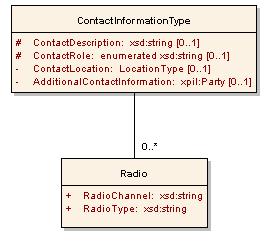
Figure 20: ContactInformationType Structure
|
Element
|
ContactDescription
|
|
Type
|
ContactDescriptionType [xsd:string]
|
|
Usage
|
CONDITIONAL, MAY be used once and only once.
|
|
Definition
|
Identifying information associated with a contact role related
to the resource message.
|
|
Constraints
|
·
If a ContactInformation element is present, then at least one
of ContactInformation:ContactDescription or ContactInformation:ContactRole
MUST be present.
|
|
Comments
|
·
The ContactDescription element is free text information
identifying a contact that acts as an alternative to the ContactRole element
for roles that are not covered by the ContactRole enumeration. The
identifying information should be as specific as possible but can be suitably
flexible (e.g. “Accounts Payable Clerk”).
·
The element contains information associated with the contact
role that is easily understood by humans but that is not necessarily usable
by automation systems.
|
|
Requirements Supported
|
18,23,24
|
|
Element
|
ContactRole
|
|
Type
|
ContactRoleType [xsd:string enumeration] ]
|
|
Usage
|
CONDITIONAL, MAY be used once and only once.
|
|
Definition
|
Role of the contact associated with the resource message.
|
|
Constraints
|
- If a ContactInformation element is present, then at
least one of ContactInformation:ContactDescription or ContactInformation:ContactRole
MUST be present
- Value MUST be one of the following:
1. "Sender"
(who sent the message)
2. ”Requester"
(authorization for the message / request)
3. "SubjectMatterExpert"
(answer questions or provide details)
4. "Approver"
5. "RespondingOrg"
(who responded to the message)
6. “Owner”
|
|
Requirements Supported
|
18,23,24
|
|
Element
|
ContactLocation
|
|
Type
|
LocationType [XML Structure]
|
|
Usage
|
OPTIONAL, MAY be used once and only once.
|
|
Definition
|
The geophysical location of the contact.
|
|
Constraints
|
·
If a PostalAddress needs to be included, an
AdditionalContactInformation element MUST be included, and MUST be placed in
the xAL:Address element within the AdditionalContactInformation element.
|
|
Comments
|
·
Information on the structure of LocationType can be found in
Section 4.1.13.2.
|
|
Requirements Supported
|
18,23,24
|
|
Element
|
AdditionalContactInformation
|
|
Type
|
AdditionalContactInformationType [xpil:PartyType]
|
|
Usage
|
OPTIONAL, MAY be used once and only once.
|
|
Definition
|
Any other contact information including name and other Party
information.
|
|
Comments
|
·
The AdditionalContactInformation element is an xpil:PartyType
structure that includes an xal:AddressType.
·
If the optional AdditionalContactInformation element is
included, the physical postal address should be included in the AdditionalContactInformation
xal:Address element. Otherwise, it may be included in the ContactLocation
element.
·
The CIQ xpil:PartyType can specify person name, Organization
name, contact phone numbers, email addresses, street addresses, etc. suitable
for use in any country. This is the element that should be used to capture
most of the contact information.
·
Example:
<rm:AdditionalContactInformation>
<xnl:PartyName>
<xnl:PersonName>
<xnl:NameElement
xnl:ElementType="FirstName">Joe
</xnl:NameElement>
<xnl:NameElement
xnl:ElementType="LastName">Williams
</xnl:NameElement>
</xnl:PersonName>
<xnl:OrganizationName>
<xnl:NameElement>Hardware Megastore Cairns
</xnl:NameElement>
</xnl:OrganizationName>
</xnl:PartyName>
<xpil:Addresses>
<xal:Address>
<xal:Country>
<xal:Name>Australia</xal:Name>
</xal:Country>
<xal:AdministrativeArea>
<xal:Name>QLD</xal:Name>
</xal:AdministrativeArea>
<xal:Locality>
<xal:Name>Cairns</xal:Name>
</xal:Locality>
<xal:Thoroughfare>
<xal:NameElement>Spence St</xal:NameElement>
</xal:Thoroughfare>
<xal:PostCode>
<xal:Identifier>4870</xal:Identifier>
</xal:PostCode>
</xal:Address>
</xpil:Addresses>
<xpil:ContactNumbers>
<xpil:ContactNumber
xpil:MediaType="Telephone"
xpil:ContactHours="8:00AM - 6:00PM">
<xpil:ContactNumberElement
xpil:ElementType="CountryCode">61
</xpil:ContactNumberElement>
<xpil:ContactNumberElement
xpil:ElementType="AreaCode">7
</xpil:ContactNumberElement>
<xpil:ContactNumberElement
xpil:ElementType="LocalNumber">4052
0378
</xpil:ContactNumberElement>
</xpil:ContactNumber>
</xpil:ContactNumbers>
</rm:AdditionalContactInformation>
|
|
Requirements Supported
|
18,23,24
|
|
Element
|
RadioType
|
|
Type
|
RadioTypeType [xsd:string]
|
|
Usage
|
REQUIRED, MUST be used once and only
once
|
|
Definition
|
Contact radio type of the person or organization referred
to in ContactRole
|
|
Requirements Supported
|
18,23
|
|
Element
|
RadioChannel
|
|
Type
|
RadioChannelType [xsd:string] ]
|
|
Usage
|
REQUIRED, MUST be used once and only
once
|
|
Definition
|
Contact radio channel of the person or organization
referred to in ContactRole
|
|
Comments
|
·
“Channel” and “Frequency” are synonyms for purposes of this
standard
|
|
Requirements Supported
|
18,23
|
4.1.13.2 LocationType
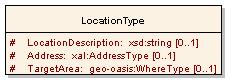
Figure 21: LocationType Structure
|
Element
|
LocationDescription
|
|
Type
|
LocationDescriptionType [xsd:string]
|
|
Usage
|
CONDITIONAL, MAY be used once and only once.
|
|
Definition
|
A free-form textual description of a location.
|
|
Constraints
|
·
At least one of the LocationDescription, Address or TargetArea
elements MUST be present.
|
|
Element
|
Address
|
|
Type
|
xal:AddressType
|
|
Usage
|
CONDITIONAL, MAY be used once and only once.
|
|
Definition
|
A CIQ structure containing address details in an internationally-applicable
format [todo: link to CIQ reference].
|
|
Constraints
|
·
At least one of the Description, Address or TargetArea elements
MUST be present.
·
An example of a CIQ AddressType can be found in section 3.10.5
|
|
Element
|
TargetArea
|
|
Type
|
geo-oasis:WhereType
|
|
Usage
|
CONDITIONAL, MAY be used once and only once.
|
|
Definition
|
The container element for GML-based geospatial information.
This element uses the EDXL-HAVE geo-oasis schema. It allows the target Area
to be defined by a choice that includes:
|
|
Constraints
|
·
At least one of the LocationDescription, Address or TargetArea
elements MUST be present.
|
|
Comments
|
·
More detailed definitions for geo-oasis:WhereType and its
components can be found in the geo-oasis schema. Specific usage of those
types for EDXL-RM are found in section 4.1.13.2.1.
|
|
Type
|
geo-oasis:WhereType
|
|
Usage
|
Used for as the type value for TargetArea elements
|
|
Definition
|
WhereType provides a mechanism for defining location. This
element uses the EDXL-HAVE geo-oasis schema. It allows the target Area to be
defined as a choice of one of the following:
- gml:Point – WGS84 latitude and longitude
- gml:LineString – a series of points
- gml:CircleByCenterPoint – a point and radius
- gml:Polygon – a set of connected non-crossing lines
- gml:Envelope – two points used to define a bounding
rectangle
It also allows the use of a set
of attributes (geo-oasis:whereAttrGroup) defined for “WhereType.” More
detailed definitions for geo-oasis:WhereType can be found in the geo-oasis schema
|
|
Comments
|
·
EDXL-RM uses the geo-oasis schema that is specified as an element
of EDXL-HAVE, Both EDXL-RM and EDXL-HAVE require the use of the WGS84
coordinate reference system.
|
|
Type
|
geo-oasis:WhereType using gml:Point
|
|
Usage
|
Where TargetAreaType is best represented as a WGS84 point.
|
|
Definition
|
The use of gml:Point within TargetArea provides location
using a specific WGS84 point value that is compatible with GML compliant
geospatial information systems. The following example applies:
<gml:Point> <gml:pos>45.256 -71.92</gml:pos> </gml:Point>
More detailed definitions for geo-oasis:WhereType
can be found in the geo-oasis schema.
|
|
Constraints
|
·
WGS84 MUST be used for EDXL-RM.
|
|
Requirements Supported
|
|
|
Type
|
geo-oasis:WhereType using gml:LineString
|
|
Usage
|
Where TargetAreaType is best represented as a route along
a series of WGS84 points.
|
|
Definition
|
The use of gml:LineString within TargetArea provides
location along a line represented by a specific list of WGS84 point values
that is compatible with GML compliant geospatial information systems. The
following example applies:
<gml:LineString> <gml:posList> 45.256 -110.45 46.46 -109.48 43.84 -109.86 </gml:posList> </gml:LineString> More detailed definitions for geo-oasis:WhereType can be found in the geo-oasis schema. |
|
Constraints
|
·
WGS84 MUST be used for EDXL-RM.
|
|
Requirements Supported
|
|
|
Type
|
geo-oasis:WhereType using gml:CircleByCenterPoint
|
|
Usage
|
Where TargetAreaType is best represented circular area of
a given radius in kilometers around a center point represented in WGS84.
|
|
Definition
|
The use of gml:CircleByCenterPoint within TargetArea
provides location as a circle centered on a WGS84 referenced point with a
radius defined in kilometers. The following example applies:
<gml:CircleByCenterPoint> <gml:pos> 45.256 -110.45 </gml:pos> <gml:radius> 10 </gml:radius> <gml:CircleByCenterPoint>
More detailed definitions for geo-oasis:WhereType
can be found in the geo-oasis schema.
|
|
Constraints
|
·
WGS84 MUST be used for EDXL-RM.
·
For EDXL-RM the unit of measure MUST be kilometers.
|
|
Type
|
geo-oasis:WhereType using gml:Polygon
|
|
Usage
|
Where TargetAreaType is best represented as a connected
group of WGS84 points representing an actual area of concern.
|
|
Definition
|
The use of gml:Polygon within TargetArea provides a ring
of points (first and last point are the same) represented by a specific list
of WGS84 point values that is compatible with GML compliant geospatial
information systems. The following example applies:
<gml:Polygon> <gml:exterior> <gml:LinearRing> <gml:posList> 45.256 -110.45 46.46 -109.48 43.84 -109.86 45.256 -110.45 </gml:posList> </gml:LinearRing> </gml:exterior> </gml:Polygon>
More detailed definitions for geo-oasis:WhereType
can be found in the geo-oasis schema.
|
|
Constraints
|
§
WGS84 MUST be used for EDXL-RM.
§
For EDXL-RM gml:posList layout MUST be used.
|
|
Requirements Supported
|
|
|
Type
|
geo-oasis:WhereType using gml:Envelope
|
|
Usage
|
Where TargetAreaType is best represented as a rectangular
area of interest often known as a “bounding box” of WGS84 points representing
an actual area of concern.
|
|
Definition
|
The use of gml:Envelope within TargetArea provides two WGS
84 point representations, the first representing a lower corner of the box
and the second representing an upper corner. The following example applies:
<gml:Envelope> <gml:lowerCorner>42.943 -71.032</gml:lowerCorner>
<gml:upperCorner>43.039 -69.856</gml:upperCorner>
</gml:Envelope>
More detailed definitions for geo-oasis:WhereType
can be found in the geo-oasis schema.
|
|
Constraints
|
·
WGS84 MUST be used for EDXL-RM.
|

Figure 22: ValueListType Structure
|
Element
|
ValueListURN
|
|
Type
|
ValueListURNType[xsd:anyURI]
|
|
sage
|
REQUIRED, MUST be used once and only once
|
|
Definition
|
The name of the certified list maintained by the Community
of Interest for the value referenced.
|
|
Requirements Supported
|
25,26
|
|
Element
|
Value
|
|
Type
|
ValueType [xsd:string]
|
|
Usage
|
REQUIRED, MUST be used one to many
|
|
Definition
|
A value from the certified list maintained by the
Community of Interest.
|
The two following conformance targets are
defined in order to support the specification of conformance to this
standard:
- EDXL-RM Message Producer.
An EDXL-RM Message is an XML 1.0 element whose syntax
and semantics are specified in this standard. An EDXL-RM Message
Producer is a software entity that produces EDXL-RM Messages.
NOTE There is no conformance target corresponding to the
consumers of EDXL-RM messages. All the existing requirements for the
consumption of an incoming EDXL-RM message are, in fact, requirements on the
type and content of the EDXL-RM message that is produced by the consumer in
reply to that message (if any). Therefore, a conforming EDXL-RM Message
Producer (as defined in Section 5.4) will necessarily meet all the existing
requirements for the production as well as for the consumption of EDXL-RM messages.
The two following conformance
levels are defined for EDXL-RM Messages:
- Level-1 EDXL-RM Message; and
- Level-2 EDXL-RM Message.
NOTE The conformance requirements for Level-1 and Level-2
EDXL-RM Messages are given in Section 5.3, and summarized here. A Level-1
EDXL-RM Message is either one of the 16 resource message elements specified in sections
3.4 to 3.19, or a different element (with a different namespace name and an
arbitrary local name) whose type is the complex type
“EDXLResourceMessageReferenceType” specified in Section 4.1.1. A Level-2 EDXL-RM Message is restricted to be one of the 16 resource message elements specified
in sections 3.4 to 3.19. Every Level-2 EDXL-RM Message is also a conforming
Level-1 EDXL-RM Message.
The two following conformance levels are defined for
EDXL-RM Message Producers:
- Level-1 EDXL-RM Message Producer; and
- Level-2 EDXL-RM Message Producer.
NOTE The conformance requirements for Level-1 and Level-2
EDXL-RM Message Producers are given in Section 5.4, and summarized here. A
Level-1 EDXL-RM Message Producer is a software entity that produces conforming
(Level-1) EDXL-RM Messages whenever a (Level-1) EDXL-RM Message is expected. A
Level-2 EDXL-RM Message Producer is a software entity that only produces
Level-2 EDXL-RM Messages whenever a Level-2 EDXL-RM Message is expected. Every
Level-2 EDXL-RM Message Producer is also a conforming Level-1 EDXL-RM Message
Producer.
An XML 1.0 element is a conforming Level-1 EDXL-RM
Message if and only if:
a) it meets the
general requirements specified in Section 3.3;
b) if its namespace
name is "urn:oasis:names:tc:emergency:EDXL:RM:1.0:msg",
then its local name is one of the 16 resource message type names specified in
sections 3.4 to 3.19 (also listed in Table 1), and the element is valid according to the schema located at
http://docs.oasis-open.org/emergency/EDXL-RM/EDXL-RM.xsd,
where validation is performed against the global element declaration with the
same local name;
c) if its
namespace name is not "urn:oasis:names:tc:emergency:EDXL:RM:1.0:msg",
then the element is valid according to the schema located at
http://docs.oasis-open.org/emergency/EDXL-RM/EDXL-RM.xsd,
where validation is performed against the complex type definition
“EDXLResourceMessageReferenceType”;
d) if its namespace
name is "urn:oasis:names:tc:emergency:EDXL:RM:1.0:msg",
then its content (which includes the content of each of its
descendants) meets all the additional mandatory requirements provided in the
specific subsection of Section 3 (sections 3.4 to 3.19) corresponding to the
element’s name, with the exception of the Message Flow; such
requirements include:
·
the content of the Element Reference Model;
·
each of the Message Rules; and
·
the normative parts (element name, usage, and constraints) of any
dictionary data entries (in Section 4) corresponding to the elements that
actually occur in the content of the element;
e) if its
namespace name is not "urn:oasis:names:tc:emergency:EDXL:RM:1.0:msg",
then its content (which includes the content of each of its
descendants) meets all the additional mandatory requirements provided in the
normative parts (element name, usage, and constraints) of all the dictionary
data entries (in Section 4) corresponding to the elements that actually occur
in the content of the element.
NOTE The Information Exchange Package Documentation (IEPD)
process, specified within the United States National Information Exchange Model
(available on www.niem.gov), can be used by a Community of Interest when
specifying new types of resource messages conforming to Level 1.
An XML 1.0 element is a conforming Level-2 EDXL-RM
Message if and only if:
a) it meets all
the requirements for a Level-1 EDXL-RM Message specified in Section 5.3.1; and
b) its
namespace name is "urn:oasis:names:tc:emergency:EDXL:RM:1.0:msg";
and
c) its content
meets all the requirements provided in the specific subsection of Section 3 (sections 3.4 to 3.19) corresponding to the element’s name (see also Section 5.3.1item (d)), including the Message Flow.
NOTE The conditions in (a) and (b) above imply
that the local name of the element is one of the 16 resource message type names
specified in sections 3.4 to 3.19 (see Section 5.3.1 item (b)).
A software entity is a conforming Level-1 EDXL-RM Message
Producer if and only if it is constructed in such a way that any XML 1.0
element produced by it and present in a place in which a conforming Level-1
EDXL-RM message is expected (based on contextual information) is indeed a
conforming Level-1 EDXL-RM message according to this standard.
NOTE The condition above can be satisfied in many different
ways. Here are some examples of possible scenarios:
–
a standard distribution protocol (say, EDXL-DE)
transfers EDXL-RM messages; a resource consumer has sent an
EDXL-RM request message to a resource supplier which claims to be a
conforming EDXL-RM Message Producer, and has received an EDXL-DE message
which is therefore expected to carry a conforming EDXL-RM Message;
–
a local test environment has been set up, and the application under test
(which claims to be a conforming EDXL-RM Message Producer) has the ability
to produce an EDXL-RM message and write it to a file in
a directory in response to a request coming from the testing tool; the
testing tool has sent many requests to the application under test and is now
verifying all the files present in the directory, which is expected to contain
only conforming EDXL-RM Messages.
A software entity is a conforming Level-2 EDXL-RM Message
Producer if and only if:
a) it meets all
the requirements for a Level-1 EDXL-RM Producer Message specified in Section 5.4.1; and
b) it
produces a conforming Level-2 EDXL-RM Message when such a message is expected.
NOTE There is no requirement for a Level-2 EDXL-RM Message
Producer to be able to produce resource messages of all 16 resource message
types specified in sections 3.4 to 3.19.
A. XML
Schema for the EDXL Resource Messaging (NORMATIVE)
Schemas included in
Appendix A are for reference only. The normative schemas can be found at http://docs.oasis-open.org/emergency/edxl-rm/v1.0/cd01/schemas/.
A.1 Resource Messaging Common Types
<xsd:schema
xmlns:xsd="http://www.w3.org/2001/XMLSchema"
xmlns:xnal="urn:oasis:names:tc:ciq:xnal:3"
xmlns:xnl="urn:oasis:names:tc:ciq:xnl:3"
xmlns:xal="urn:oasis:names:tc:ciq:xal:3"
xmlns:xpil="urn:oasis:names:tc:ciq:xpil:3"
xmlns:geo-oasis="urn:oasis:names:tc:emergency:EDXL:HAVE:1.0:geo-oasis"
xmlns="urn:oasis:names:tc:emergency:EDXL:RM:1.0"
targetNamespace="urn:oasis:names:tc:emergency:EDXL:RM:1.0"
elementFormDefault="qualified"
attributeFormDefault="unqualified">
<!-- All elements that have unchanged internal content across the entire
matrix of
RM messages are typed here.
Where internal content differs between messages, please see the appropriate
schemas. -->
<xsd:import namespace="urn:oasis:names:tc:ciq:xpil:3"
schemaLocation="xpil.xsd"/>
<xsd:import namespace="urn:oasis:names:tc:ciq:xal:3"
schemaLocation="xal.xsd"/>
<xsd:import namespace="urn:oasis:names:tc:ciq:xnl:3"
schemaLocation="xnl.xsd"/>
<xsd:import
namespace="urn:oasis:names:tc:emergency:EDXL:HAVE:1.0:geo-oasis"
schemaLocation="geo-oasis.xsd"/>
<xsd:simpleType name="MessageIDType">
<xsd:restriction base="xsd:string"/>
</xsd:simpleType>
<xsd:simpleType name="DateTimeType">
<xsd:restriction base="xsd:dateTime"/>
</xsd:simpleType>
<xsd:simpleType name="MessageContentTypeType">
<xsd:restriction base="xsd:string">
<xsd:annotation>
<xsd:documentation>
The following strings values for MessageContentType
are reserved for Level 2 Conformant Message types (New
level 1 conformant messagetypes should use other name strings):
RequestResource
ResponseToRequestResource
RequisitionResource
CommitResource
RequestInformation
ResponseToRequestInformation
OfferUnsolicitedResource
ReleaseResource
RequestReturn
ResponseToRequestReturn
RequestQuote
ResponseToRequestQuote
RequestResourceDeploymentStatus
ReportResourceDeploymentStatus
RequestExtendedDeploymentDuration
ResponseToRequestExtendedDeploymentDuration
</xsd:documentation>
</xsd:annotation>
</xsd:restriction>
</xsd:simpleType>
<xsd:simpleType name="MessageDescriptionType">
<xsd:restriction base="xsd:string"/>
</xsd:simpleType>
<xsd:complexType name="IncidentInformationType">
<!-- One(or both) of the IncidentID and IncidentDescription elements is
required -->
<xsd:sequence>
<xsd:element name="IncidentID" type="IncidentIDType"
minOccurs="0"/>
<xsd:element name="IncidentDescription"
type="IncidentDescriptionType"
minOccurs="0"/>
</xsd:sequence>
</xsd:complexType>
<xsd:simpleType name="IncidentIDType">
<xsd:restriction base="xsd:string"/>
</xsd:simpleType>
<xsd:simpleType name="IncidentDescriptionType">
<xsd:restriction base="xsd:string"/>
</xsd:simpleType>
<xsd:complexType name="MessageRecallType">
<xsd:sequence>
<xsd:element name="RecallMessageID"
type="MessageIDType"/>
<xsd:element name="RecallType"
type="RecallTypeType"/>
</xsd:sequence>
</xsd:complexType>
<xsd:simpleType name="RecallTypeType">
<xsd:restriction base="xsd:string">
<xsd:enumeration value="Update"/>
<xsd:enumeration value="Cancel"/>
</xsd:restriction>
</xsd:simpleType>
<xsd:complexType name="FundingType">
<!-- One (or both) of the FundCode and FundingInfo elements is required
-->
<xsd:sequence>
<xsd:element name="FundCode" type="FundCodeType"
minOccurs="0" maxOccurs="1"/>
<xsd:element name="FundingInfo" type="FundingInfoType"
minOccurs="0"
maxOccurs="1"/>
</xsd:sequence>
</xsd:complexType>
<xsd:simpleType name="FundCodeType">
<xsd:restriction base="xsd:string"/>
</xsd:simpleType>
<xsd:simpleType name="FundingInfoType">
<xsd:restriction base="xsd:string"/>
</xsd:simpleType>
<xsd:complexType name="ContactInformationType">
<xsd:sequence>
<!-- At least one of ContactDescription and ContextRole is required -->
<xsd:element name="ContactDescription"
type="ContactDescriptionType" minOccurs="0"
maxOccurs="1"/>
<xsd:element name="ContactRole" type="ContactRoleType"
minOccurs="0"
maxOccurs="1"/>
<xsd:element name="Radio" type="RadioInformationType"
minOccurs="0"
maxOccurs="unbounded"/>
<xsd:element name="ContactLocation" type="LocationType"
minOccurs="0"
maxOccurs="1"/>
<xsd:element name="AdditionalContactInformation" type="xpil:PartyType"
minOccurs="0" maxOccurs="1"/>
</xsd:sequence>
</xsd:complexType>
<xsd:simpleType name="ContactDescriptionType">
<xsd:restriction base="xsd:string"/>
</xsd:simpleType>
<xsd:simpleType name="ContactRoleType">
<xsd:restriction base="xsd:string">
<xsd:enumeration value="Sender"/>
<xsd:enumeration value="Requester"/>
<xsd:enumeration value="SubjectMatterExpert"/>
<xsd:enumeration value="Approver"/>
<xsd:enumeration value="RespondingOrg"/>
<xsd:enumeration value="Owner"/>
</xsd:restriction>
</xsd:simpleType>
<xsd:complexType name="RadioInformationType">
<xsd:sequence>
<xsd:element name="RadioType" type="ValueListType"/>
<xsd:element name="RadioChannel"
type="RadioChannelType"/>
</xsd:sequence>
</xsd:complexType>
<xsd:simpleType name="RadioTypeType">
<xsd:restriction base="xsd:string"/>
</xsd:simpleType>
<xsd:simpleType name="RadioChannelType">
<xsd:restriction base="xsd:string"/>
</xsd:simpleType>
<xsd:complexType name="ResponseInformationType">
<xsd:sequence>
<xsd:element name="PrecedingResourceInfoElementID"
type="ResourceInfoElementIDType"/>
<xsd:element name="ResponseType"
type="ResponseTypeType"/>
<!-- If the ResponseType element has the value "Provisional", one
(or both) of
ReasonCode and ResponseReason must be present
-->
<xsd:element name="ReasonCode" type="ValueListType"
minOccurs="0" maxOccurs="1"/>
<xsd:element name="ResponseReason"
type="ResponseReasonType" minOccurs="0"
maxOccurs="1"/>
</xsd:sequence>
</xsd:complexType>
<xsd:simpleType name="ResourceInfoElementIDType">
<xsd:restriction base="xsd:string"/>
</xsd:simpleType>
<xsd:simpleType name="ResponseTypeType">
<xsd:restriction base="xsd:string">
<xsd:enumeration value="Accept"/>
<xsd:enumeration value="Decline"/>
<xsd:enumeration value="Provisional"/>
</xsd:restriction>
</xsd:simpleType>
<xsd:simpleType name="ResponseReasonType">
<xsd:restriction base="xsd:string"/>
</xsd:simpleType>
<xsd:simpleType name="ResourceIDType">
<xsd:restriction base="xsd:string"/>
</xsd:simpleType>
<xsd:simpleType name="ResourceNameType">
<xsd:restriction base="xsd:string"/>
</xsd:simpleType>
<xsd:complexType name="TypeInfoType">
<xsd:sequence>
<xsd:any processContents="skip"
maxOccurs="unbounded"/>
</xsd:sequence>
<xsd:anyAttribute/>
</xsd:complexType>
<xsd:simpleType name="DescriptionType">
<xsd:restriction base="xsd:string"/>
</xsd:simpleType>
<xsd:simpleType name="CredentialsType">
<xsd:restriction base="xsd:string"/>
</xsd:simpleType>
<xsd:simpleType name="CertificationsType">
<xsd:restriction base="xsd:string"/>
</xsd:simpleType>
<xsd:simpleType name="SpecialRequirementsType">
<xsd:restriction base="xsd:string"/>
</xsd:simpleType>
<xsd:complexType name="OwnershipInformationType">
<!-- One (or both) of the Owner and OwningJurisdiction elements is required
-->
<xsd:sequence>
<xsd:element name="Owner" type="OwnerType"
minOccurs="0" maxOccurs="1"/>
<xsd:element name="OwningJurisdiction"
type="OwningJurisdictionType" minOccurs="0"
maxOccurs="1"/>
<xsd:element name="HomeDispatch" type="HomeDispatchType"
minOccurs="0"
maxOccurs="1"/>
<xsd:element name="HomeUnit" type="HomeUnitType"
minOccurs="0" maxOccurs="1"/>
</xsd:sequence>
</xsd:complexType>
<xsd:simpleType name="OwnerType">
<xsd:restriction base="xsd:string"/>
</xsd:simpleType>
<xsd:simpleType name="OwningJurisdictionType">
<xsd:restriction base="xsd:string"/>
</xsd:simpleType>
<xsd:simpleType name="HomeDispatchType">
<xsd:restriction base="xsd:string"/>
</xsd:simpleType>
<xsd:simpleType name="HomeUnitType">
<xsd:restriction base="xsd:string"/>
</xsd:simpleType>
<xsd:simpleType name="AvailabilityType">
<xsd:restriction base="xsd:string"/>
</xsd:simpleType>
<xsd:simpleType name="QuantityTypeOld">
<xsd:restriction base="xsd:string"/>
</xsd:simpleType>
<xsd:complexType name="QuantityType">
<xsd:choice>
<xsd:element name="QuantityText" type="xsd:string"
maxOccurs="unbounded"/>
<xsd:element name="MeasuredQuantity">
<xsd:complexType>
<xsd:sequence>
<xsd:element name="Amount" type="xsd:double"/>
<xsd:element name="UnitOfMeasure" type="ValueListType"
minOccurs="0"/>
</xsd:sequence>
</xsd:complexType>
</xsd:element>
</xsd:choice>
</xsd:complexType>
<xsd:simpleType name="RestrictionsType">
<xsd:restriction base="xsd:string"/>
</xsd:simpleType>
<xsd:simpleType name="AnticipatedFunctionType">
<xsd:restriction base="xsd:string"/>
</xsd:simpleType>
<xsd:complexType name="PriceQuoteType">
<xsd:complexContent>
<xsd:extension base="QuantityType"/>
</xsd:complexContent>
</xsd:complexType>
<xsd:simpleType name="OrderIDType">
<xsd:restriction base="xsd:string"/>
</xsd:simpleType>
<xsd:complexType name="AssignmentInstructionsType">
<xsd:sequence>
<xsd:element name="ModeOfTransportation"
type="ModeOfTransportationType"
minOccurs="0"
maxOccurs="1"/>
<xsd:element name="NavigationInstructions"
type="NavigationInstructionsType"
minOccurs="0" maxOccurs="1"/>
<xsd:element name="ReportingInstructions"
type="ReportingInstructionsType"
minOccurs="0"
maxOccurs="1"/>
</xsd:sequence>
</xsd:complexType>
<xsd:simpleType name="ModeOfTransportationType">
<xsd:restriction base="xsd:string"/>
</xsd:simpleType>
<xsd:simpleType name="NavigationInstructionsType">
<xsd:restriction base="xsd:string"/>
</xsd:simpleType>
<xsd:simpleType name="ReportingInstructionsType">
<xsd:restriction base="xsd:string"/>
</xsd:simpleType>
<xsd:simpleType name="ScheduleTypeType">
<xsd:restriction base="xsd:string">
<xsd:enumeration value="RequestedArrival"/>
<xsd:enumeration value="EstimatedArrival"/>
<xsd:enumeration value="ActualArrival"/>
<xsd:enumeration value="RequestedDeparture"/>
<xsd:enumeration value="EstimatedDeparture"/>
<xsd:enumeration value="ActualDeparture"/>
<xsd:enumeration value="EstimatedReturnDeparture"/>
<xsd:enumeration value="EstimatedReturnArrival"/>
<xsd:enumeration value="ActualReturnArrival"/>
<xsd:enumeration value="RequestedReturnDeparture"/>
<xsd:enumeration value="RequestedReturnArrival"/>
<xsd:enumeration value="ActualReturnDeparture"/>
<xsd:enumeration value="BeginAvailable"/>
<xsd:enumeration value="EndAvailable"/>
<xsd:enumeration value="Committed"/>
<xsd:enumeration value="Current"/>
<xsd:enumeration value="ReportTo"/>
<xsd:enumeration value="Route"/>
</xsd:restriction>
</xsd:simpleType>
<xsd:complexType name="LocationType">
<xsd:sequence>
<!-- One (or more) of the LocationDescription, Address and TargetArea
elements is
required -->
<xsd:element name="LocationDescription"
type="LocationDescriptionType"
minOccurs="0"
maxOccurs="1"/>
<xsd:element name="Address" type="xal:AddressType"
minOccurs="0" maxOccurs="1"/>
<xsd:element name="TargetArea"
type="geo-oasis:WhereType" minOccurs="0"
maxOccurs="1"/>
</xsd:sequence>
</xsd:complexType>
<xsd:simpleType name="LocationDescriptionType">
<xsd:restriction base="xsd:string"/>
</xsd:simpleType>
<xsd:complexType name="ValueListType">
<xsd:sequence>
<xsd:element name="ValueListURN"
type="ValueListURNType"/>
<xsd:element name="Value" type="ValueType"
maxOccurs="unbounded"/>
</xsd:sequence>
</xsd:complexType>
<xsd:simpleType name="ValueListURNType">
<xsd:restriction base="xsd:anyURI"/>
</xsd:simpleType>
<xsd:simpleType name="ValueType">
<xsd:restriction base="xsd:string"/>
</xsd:simpleType>
</xsd:schema>
A.2 Resource Messaging Reference Schema
<schema xmlns="http://www.w3.org/2001/XMLSchema"
xmlns:rmsg="urn:oasis:names:tc:emergency:EDXL:RM:1.0:msg"
targetNamespace="urn:oasis:names:tc:emergency:EDXL:RM:1.0:msg"
xmlns:rm="urn:oasis:names:tc:emergency:EDXL:RM:1.0"
xmlns:xsd="http://www.w3.org/2001/XMLSchema"
elementFormDefault="qualified"
attributeFormDefault="unqualified">
<xsd:import
namespace="urn:oasis:names:tc:emergency:EDXL:RM:1.0"
schemaLocation="EDXL-RMCommonTypes.xsd"/>
<!-- This schema is the base reference schema for all EDXL-RM
messages.
All resource messages will conform to this schema and to the elementicular
sub-schema corresponding to the message
type.-->
<complexType name="EDXLResourceMessageReferenceType">
<sequence>
<element name="MessageID"
type="rm:MessageIDType"/>
<element name="SentDateTime"
type="rm:DateTimeType"/>
<element name="MessageContentType"
type="rm:MessageContentTypeType"/>
<element name="MessageDescription"
type="rm:MessageDescriptionType"
minOccurs="0"
maxOccurs="1"/>
<element name="OriginatingMessageID"
type="rm:MessageIDType"/>
<element name="PrecedingMessageID"
type="rm:MessageIDType"
minOccurs="0"
maxOccurs="1"/>
<element name="IncidentInformation"
type="rm:IncidentInformationType"
minOccurs="0"
maxOccurs="unbounded"/>
<element name="MessageRecall"
type="rm:MessageRecallType"
minOccurs="0"
maxOccurs="1"/>
<element name="Funding"
type="rm:FundingType" minOccurs="0"
maxOccurs="unbounded"/>
<element name="ContactInformation"
type="rm:ContactInformationType"
minOccurs="1"
maxOccurs="unbounded"/>
<element name="ResourceInformation"
minOccurs="0" maxOccurs="unbounded">
<complexType>
<sequence>
<element name="ResourceInfoElementID"
type="rm:ResourceInfoElementIDType"/>
<element name="ResponseInformation"
type="rm:ResponseInformationType"
minOccurs="0"
maxOccurs="1"/>
<element name="Resource"
minOccurs="0" maxOccurs="1">
<complexType>
<sequence>
<!-- One (or more) of first three elements is
required -->
<element name="ResourceID"
type="rm:ResourceIDType" minOccurs="0"
maxOccurs="1"/>
<element name="Name"
type="rm:ResourceNameType" minOccurs="0"
maxOccurs="1"/>
<element name="TypeStructure"
type="rm:ValueListType" minOccurs="0"
maxOccurs="1"/>
<element name="TypeInfo"
type="rm:TypeInfoType" minOccurs="0"
maxOccurs="1"/>
<element name="Keyword"
type="rm:ValueListType" minOccurs="0"
maxOccurs="unbounded"/>
<element name="Description"
type="rm:DescriptionType" minOccurs="0"
maxOccurs="1"/>
<element name="Credentials"
type="rm:CredentialsType" minOccurs="0"
maxOccurs="1"/>
<element name="Certifications"
type="rm:CertificationsType"
minOccurs="0"
maxOccurs="1"/>
<element name="SpecialRequirements"
type="rm:SpecialRequirementsType"
minOccurs="0" maxOccurs="1"/>
<element name="ResponsibleParty"
type="rm:ContactInformationType"
minOccurs="0"
maxOccurs="1"/>
<element name="OwnershipInformation"
type="rm:OwnershipInformationType"
minOccurs="0" maxOccurs="1"/>
<element name="ResourceStatus"
minOccurs="0" maxOccurs="1">
<complexType>
<sequence>
<element
name="InventoryRefreshDateTime"
type="rm:DateTimeType"
minOccurs="0" maxOccurs="1"/>
<element name="DeploymentStatus"
type="rm:ValueListType"
minOccurs="0"
maxOccurs="1"/>
<element name="Availability"
type="rm:AvailabilityType"
minOccurs="0"
maxOccurs="1"/>
</sequence>
</complexType>
</element>
</sequence>
</complexType>
</element>
<element name="AssignmentInformation"
minOccurs="0" maxOccurs="1">
<complexType>
<sequence>
<element name="Quantity"
type="rm:QuantityType" minOccurs="0"
maxOccurs="1"/>
<element name="Restrictions"
type="rm:RestrictionsType"
minOccurs="0"
maxOccurs="1"/>
<element name="AnticipatedFunction"
type="rm:AnticipatedFunctionType"
minOccurs="0" maxOccurs="1"/>
<element name="PriceQuote"
type="rm:PriceQuoteType" minOccurs="0"
maxOccurs="1"/>
<element name="OrderID"
type="rm:OrderIDType" minOccurs="0"
maxOccurs="1"/>
<element name="AssignmentInstructions"
type="rm:AssignmentInstructionsType"
minOccurs="0" maxOccurs="1"/>
</sequence>
</complexType>
</element>
<element name="ScheduleInformation"
minOccurs="0" maxOccurs="unbounded">
<complexType>
<sequence>
<element name="ScheduleType"
type="rm:ScheduleTypeType"/>
<element name="DateTime"
type="rm:DateTimeType" minOccurs="0"
maxOccurs="1"/>
<element name="Location"
type="rm:LocationType" minOccurs="0"
maxOccurs="1"/>
</sequence>
</complexType>
</element>
</sequence>
</complexType>
</element>
</sequence>
</complexType>
</schema>
A.3 RequestResource Message Schema
<schema xmlns="http://www.w3.org/2001/XMLSchema"
xmlns:rmsg="urn:oasis:names:tc:emergency:EDXL:RM:1.0:msg"
targetNamespace="urn:oasis:names:tc:emergency:EDXL:RM:1.0:msg"
xmlns:rm="urn:oasis:names:tc:emergency:EDXL:RM:1.0"
xmlns:xsd="http://www.w3.org/2001/XMLSchema"
elementFormDefault="qualified"
attributeFormDefault="unqualified">
<xsd:import
namespace="urn:oasis:names:tc:emergency:EDXL:RM:1.0"
schemaLocation="EDXL-RMCommonTypes.xsd"/>
<!-- This schema describes the structure of
EDXL-RM "RequestResource"
messages.-->
<element name="RequestResource">
<complexType>
<sequence>
<element name="MessageID"
type="rm:MessageIDType"/>
<element name="SentDateTime"
type="rm:DateTimeType"/>
<element name="MessageContentType">
<simpleType>
<restriction
base="rm:MessageContentTypeType">
<enumeration value="RequestResource"/>
</restriction>
</simpleType>
</element>
<element
name="MessageDescription" type="rm:MessageDescriptionType"
minOccurs="0"
maxOccurs="1"/>
<element name="OriginatingMessageID"
type="rm:MessageIDType"/>
<element name="IncidentInformation"
type="rm:IncidentInformationType"
minOccurs="0" maxOccurs="unbounded"/>
<element name="MessageRecall"
type="rm:MessageRecallType" minOccurs="0"
maxOccurs="1"/>
<element name="Funding" minOccurs="0"
maxOccurs="unbounded">
<complexType>
<sequence>
<!-- One(or both) of the FundCode and FundingInfo
elements is required -->
<element name="FundCode"
type="rm:FundCodeType" minOccurs="0"
maxOccurs="1"/>
<element name="FundingInfo"
type="rm:FundingInfoType" minOccurs="0"
maxOccurs="1"/>
</sequence>
</complexType>
</element>
<element name="ContactInformation"
type="rm:ContactInformationType"
minOccurs="1" maxOccurs="unbounded"/>
<element name="ResourceInformation"
minOccurs="1" maxOccurs="unbounded">
<complexType>
<sequence>
<element name="ResourceInfoElementID"
type="rm:ResourceInfoElementIDType"/>
<element name="Resource">
<complexType>
<sequence>
<!-- One (or more) of first three elements is
required -->
<element name="ResourceID" type="rm:ResourceIDType"
minOccurs="0"
maxOccurs="1"/>
<element name="Name"
type="rm:ResourceNameType"
minOccurs="0"
maxOccurs="1"/>
<element name="TypeStructure"
type="rm:ValueListType"
minOccurs="0"
maxOccurs="1"/>
<element name="TypeInfo"
type="rm:TypeInfoType"
minOccurs="0"
maxOccurs="1"/>
<element name="Keyword"
type="rm:ValueListType"
minOccurs="0"
maxOccurs="unbounded"/>
<element name="Description"
type="rm:DescriptionType"
minOccurs="0"
maxOccurs="1"/>
<element name="Credentials"
type="rm:CredentialsType"
minOccurs="0"
maxOccurs="1"/>
<element name="Certifications"
type="rm:CertificationsType"
minOccurs="0"
maxOccurs="1"/>
<element name="SpecialRequirements"
type="rm:SpecialRequirementsType"
minOccurs="0"
maxOccurs="1"/>
</sequence>
</complexType>
</element>
<element name="AssignmentInformation" minOccurs="0"
maxOccurs="1">
<complexType>
<sequence>
<element name="Quantity"
type="rm:QuantityType"
minOccurs="0"
maxOccurs="1"/>
<element name="Restrictions" type="rm:RestrictionsType"
minOccurs="0"
maxOccurs="1"/>
<element name="AnticipatedFunction"
type="rm:AnticipatedFunctionType"
minOccurs="0"
maxOccurs="1"/>
</sequence>
</complexType>
</element>
<element name="ScheduleInformation"
minOccurs="0" maxOccurs="unbounded">
<complexType>
<sequence>
<element name="ScheduleType">
<simpleType>
<restriction
base="rm:ScheduleTypeType">
<enumeration
value="RequestedArrival"/>
<enumeration value="RequestedDeparture"/>
<enumeration value="EstimatedReturnDeparture"/>
<enumeration
value="EstimatedReturnArrival"/>
<enumeration
value="ReportTo"/>
<enumeration value="Route"/>
</restriction>
</simpleType>
</element>
<element name="DateTime"
type="rm:DateTimeType"
minOccurs="0"
maxOccurs="1"/>
<element name="Location"
type="rm:LocationType"
minOccurs="0"
maxOccurs="1"/>
</sequence>
</complexType>
</element>
</sequence>
</complexType>
</element>
</sequence>
</complexType>
</element>
</schema>
A.4 ResponseToRequestResource Message Schema
<schema xmlns="http://www.w3.org/2001/XMLSchema"
xmlns:rmsg="urn:oasis:names:tc:emergency:EDXL:RM:1.0:msg"
targetNamespace="urn:oasis:names:tc:emergency:EDXL:RM:1.0:msg"
xmlns:rm="urn:oasis:names:tc:emergency:EDXL:RM:1.0"
xmlns:xsd="http://www.w3.org/2001/XMLSchema"
elementFormDefault="qualified"
attributeFormDefault="unqualified">
<xsd:import
namespace="urn:oasis:names:tc:emergency:EDXL:RM:1.0"
schemaLocation="EDXL-RMCommonTypes.xsd"/>
<!-- This schema describes the structure of
EDXL-RM
"ResponseToRequestResource"
messages.-->
<element name="ResponseToRequestResource">
<complexType>
<sequence>
<element name="MessageID"
type="rm:MessageIDType"/>
<element name="SentDateTime"
type="rm:DateTimeType"/>
<element name="MessageContentType">
<simpleType>
<restriction
base="rm:MessageContentTypeType">
<enumeration
value="ResponseToRequestResource"/>
</restriction>
</simpleType>
</element>
<element name="MessageDescription"
type="rm:MessageDescriptionType"
minOccurs="0"
maxOccurs="1"/>
<element name="OriginatingMessageID"
type="rm:MessageIDType"/>
<element name="PrecedingMessageID"
type="rm:MessageIDType"/>
<element name="IncidentInformation"
type="rm:IncidentInformationType"
minOccurs="0"
maxOccurs="unbounded"/>
<element name="MessageRecall"
type="rm:MessageRecallType" minOccurs="0"
maxOccurs="1"/>
<element name="Funding"
type="rm:FundingType" minOccurs="0"
maxOccurs="unbounded"/>
<element name="ContactInformation"
type="rm:ContactInformationType"
minOccurs="1"
maxOccurs="unbounded"/>
<element name="ResourceInformation"
minOccurs="1" maxOccurs="unbounded">
<complexType>
<sequence>
<element name="ResourceInfoElementID"
type="rm:ResourceInfoElementIDType"/>
<element name="ResponseInformation"
type="rm:ResponseInformationType"/>
<element name="Resource"
minOccurs="0" maxOccurs="1">
<complexType>
<sequence>
<!-- One (or more) of first three elements is
required -->
<element name="ResourceID"
type="rm:ResourceIDType" minOccurs="0"
maxOccurs="1"/>
<element name="Name"
type="rm:ResourceNameType" minOccurs="0"
maxOccurs="1"/>
<element name="TypeStructure"
type="rm:ValueListType" minOccurs="0"
maxOccurs="1"/>
<element name="TypeInfo"
type="rm:TypeInfoType" minOccurs="0"
maxOccurs="1"/>
<element name="Keyword"
type="rm:ValueListType" minOccurs="0"
maxOccurs="unbounded"/>
<element name="Description"
type="rm:DescriptionType" minOccurs="0"
maxOccurs="1"/>
<element name="Credentials"
type="rm:CredentialsType" minOccurs="0"
maxOccurs="1"/>
<element name="Certifications"
type="rm:CertificationsType"
minOccurs="0"
maxOccurs="1"/>
<element name="SpecialRequirements"
type="rm:SpecialRequirementsType"
minOccurs="0" maxOccurs="1"/>
<element name="ResponsibleParty"
type="rm:ContactInformationType"
minOccurs="0"
maxOccurs="1"/>
<element name="OwnershipInformation"
type="rm:OwnershipInformationType"
minOccurs="0" maxOccurs="1"/>
<element name="ResourceStatus"
minOccurs="0" maxOccurs="1">
<complexType>
<sequence>
<element
name="InventoryRefreshDateTime"
type="rm:DateTimeType"
minOccurs="0" maxOccurs="1"/>
<element name="DeploymentStatus"
type="rm:ValueListType"
minOccurs="0"
maxOccurs="1"/>
<element name="Availability"
type="rm:AvailabilityType"
minOccurs="0"
maxOccurs="1"/>
</sequence>
</complexType>
</element>
</sequence>
</complexType>
</element>
<element name="AssignmentInformation"
minOccurs="0" maxOccurs="1">
<complexType>
<sequence>
<element name="Quantity"
type="rm:QuantityType" minOccurs="0"
maxOccurs="1"/>
<element name="Restrictions"
type="rm:RestrictionsType"
minOccurs="0"
maxOccurs="1"/>
<element name="AnticipatedFunction"
type="rm:AnticipatedFunctionType"
minOccurs="0" maxOccurs="1"/>
<element name="PriceQuote"
type="rm:PriceQuoteType" minOccurs="0"
maxOccurs="1"/>
<element name="AssignmentInstructions"
type="rm:AssignmentInstructionsType"
minOccurs="0" maxOccurs="1"/>
</sequence>
</complexType>
</element>
<element name="ScheduleInformation"
minOccurs="0" maxOccurs="unbounded">
<complexType>
<sequence>
<element name="ScheduleType">
<simpleType>
<restriction
base="rm:ScheduleTypeType">
<enumeration
value="EstimatedArrival"/>
<enumeration value="EstimatedDeparture"/>
<enumeration value="RequestedReturnDeparture"/>
<enumeration
value="RequestedReturnArrival"/>
<enumeration
value="BeginAvailable"/>
<enumeration
value="EndAvailable"/>
<enumeration value="RequestedArrival"/>
<enumeration value="RequestedDeparture"/>
<enumeration value="EstimatedReturnDeparture"/>
<enumeration
value="ReportTo"/>
<enumeration value="Route"/>
</restriction>
</simpleType>
</element>
<element name="DateTime"
type="rm:DateTimeType" minOccurs="0"
maxOccurs="1"/>
<element name="Location"
type="rm:LocationType" minOccurs="0"
maxOccurs="1"/>
</sequence>
</complexType>
</element>
</sequence>
</complexType>
</element>
</sequence>
</complexType>
</element>
</schema>
A.5 RequisitionResource Message Schema
<schema xmlns="http://www.w3.org/2001/XMLSchema"
xmlns:rmsg="urn:oasis:names:tc:emergency:EDXL:RM:1.0:msg"
targetNamespace="urn:oasis:names:tc:emergency:EDXL:RM:1.0:msg"
xmlns:rm="urn:oasis:names:tc:emergency:EDXL:RM:1.0"
xmlns:xsd="http://www.w3.org/2001/XMLSchema"
elementFormDefault="qualified"
attributeFormDefault="unqualified">
<xsd:import namespace="urn:oasis:names:tc:emergency:EDXL:RM:1.0"
schemaLocation="EDXL-RMCommonTypes.xsd"/>
<!-- This schema describes the structure of
EDXL-RM "RequisitionResource"
messages.-->
<element name="RequisitionResource">
<complexType>
<sequence>
<element name="MessageID"
type="rm:MessageIDType"/>
<element name="SentDateTime"
type="rm:DateTimeType"/>
<element name="MessageContentType">
<simpleType>
<restriction
base="rm:MessageContentTypeType">
<enumeration
value="RequisitionResource"/>
</restriction>
</simpleType>
</element>
<element name="MessageDescription"
type="rm:MessageDescriptionType"
minOccurs="0"
maxOccurs="1"/>
<element name="OriginatingMessageID"
type="rm:MessageIDType"/>
<element name="PrecedingMessageID"
type="rm:MessageIDType" minOccurs="0"
maxOccurs="1"/>
<element name="IncidentInformation"
type="rm:IncidentInformationType"
minOccurs="0"
maxOccurs="unbounded"/>
<element name="MessageRecall"
type="rm:MessageRecallType" minOccurs="0"
maxOccurs="1"/>
<element name="Funding"
type="rm:FundingType" minOccurs="1"
maxOccurs="unbounded"/>
<element name="ContactInformation" type="rm:ContactInformationType"
minOccurs="1"
maxOccurs="unbounded"/>
<element name="ResourceInformation"
minOccurs="1" maxOccurs="unbounded">
<complexType>
<sequence>
<element name="ResourceInfoElementID"
type="rm:ResourceInfoElementIDType"/>
<element name="Resource">
<complexType>
<sequence>
<!-- One (or more) of first three elements is
required -->
<element name="ResourceID"
type="rm:ResourceIDType" minOccurs="0"
maxOccurs="1"/>
<element name="Name"
type="rm:ResourceNameType" minOccurs="0"
maxOccurs="1"/>
<element name="TypeStructure"
type="rm:ValueListType" minOccurs="0"
maxOccurs="1"/>
<element name="TypeInfo"
type="rm:TypeInfoType" minOccurs="0"
maxOccurs="1"/>
<element name="Keyword"
type="rm:ValueListType" minOccurs="0"
maxOccurs="unbounded"/>
<element name="Description"
type="rm:DescriptionType" minOccurs="0"
maxOccurs="1"/>
<element name="Credentials"
type="rm:CredentialsType" minOccurs="0"
maxOccurs="1"/>
<element name="Certifications"
type="rm:CertificationsType"
minOccurs="0"
maxOccurs="1"/>
<element name="SpecialRequirements"
type="rm:SpecialRequirementsType"
minOccurs="0" maxOccurs="1"/>
<element name="ResponsibleParty"
type="rm:ContactInformationType"
minOccurs="0"
maxOccurs="1"/>
<element name="OwnershipInformation"
type="rm:OwnershipInformationType"
minOccurs="0" maxOccurs="1"/>
</sequence>
</complexType>
</element>
<element name="AssignmentInformation">
<complexType>
<sequence>
<element name="Quantity"
type="rm:QuantityType"/>
<element name="Restrictions"
type="rm:RestrictionsType"
minOccurs="0"
maxOccurs="1"/>
<element name="AnticipatedFunction"
type="rm:AnticipatedFunctionType"
minOccurs="0" maxOccurs="1"/>
<element name="PriceQuote"
type="rm:PriceQuoteType" minOccurs="0"
maxOccurs="1"/>
<element name="AssignmentInstructions"
type="rm:AssignmentInstructionsType"
minOccurs="0" maxOccurs="1"/>
</sequence>
</complexType>
</element>
<element name="ScheduleInformation"
minOccurs="0" maxOccurs="unbounded">
<complexType>
<sequence>
<element name="ScheduleType">
<simpleType>
<restriction
base="rm:ScheduleTypeType">
<enumeration
value="EstimatedArrival"/>
<enumeration value="EstimatedDeparture"/>
<enumeration value="EstimatedReturnDeparture"/>
<enumeration value="EstimatedReturnArrival"/>
<enumeration
value="ReportTo"/>
<enumeration
value="RequestedArrival"/>
<enumeration value="RequestedDeparture"/>
<enumeration value="Route"/>
</restriction>
</simpleType>
</element>
<element name="DateTime"
type="rm:DateTimeType" minOccurs="0"
maxOccurs="1"/>
<element name="Location"
type="rm:LocationType" minOccurs="0"
maxOccurs="1"/>
</sequence>
</complexType>
</element>
</sequence>
</complexType>
</element>
</sequence>
</complexType>
</element>
</schema>
A.6 CommitResource Message Schema
<schema xmlns="http://www.w3.org/2001/XMLSchema"
xmlns:rmsg="urn:oasis:names:tc:emergency:EDXL:RM:1.0:msg"
targetNamespace="urn:oasis:names:tc:emergency:EDXL:RM:1.0:msg"
xmlns:rm="urn:oasis:names:tc:emergency:EDXL:RM:1.0"
xmlns:xsd="http://www.w3.org/2001/XMLSchema"
elementFormDefault="qualified"
attributeFormDefault="unqualified">
<xsd:import
namespace="urn:oasis:names:tc:emergency:EDXL:RM:1.0"
schemaLocation="EDXL-RMCommonTypes.xsd"/>
<!-- This schema describes the structure of
EDXL-RM "CommitResource"
messages.-->
<element name="CommitResource">
<complexType>
<sequence>
<element name="MessageID"
type="rm:MessageIDType"/>
<element name="SentDateTime"
type="rm:DateTimeType"/>
<element name="MessageContentType">
<simpleType>
<restriction
base="rm:MessageContentTypeType">
<enumeration value="CommitResource"/>
</restriction>
</simpleType>
</element>
<element name="MessageDescription"
type="rm:MessageDescriptionType"
minOccurs="0"
maxOccurs="1"/>
<element name="OriginatingMessageID"
type="rm:MessageIDType"/>
<element name="PrecedingMessageID"
type="rm:MessageIDType"/>
<element name="IncidentInformation"
type="rm:IncidentInformationType"
minOccurs="0"
maxOccurs="unbounded"/>
<element name="MessageRecall"
type="rm:MessageRecallType" minOccurs="0"
maxOccurs="1"/>
<element name="Funding"
type="rm:FundingType" minOccurs="0"
maxOccurs="unbounded"/>
<element name="ContactInformation"
type="rm:ContactInformationType"
minOccurs="1"
maxOccurs="unbounded"/>
<element name="ResourceInformation"
minOccurs="1" maxOccurs="unbounded">
<complexType>
<sequence>
<element name="ResourceInfoElementID"
type="rm:ResourceInfoElementIDType"/>
<element name="ResponseInformation"
type="rm:ResponseInformationType"/>
<element name="Resource"
minOccurs="0" maxOccurs="1">
<complexType>
<sequence>
<!-- One (or more) of first three elements is
required -->
<element name="ResourceID"
type="rm:ResourceIDType" minOccurs="0"
maxOccurs="1"/>
<element name="Name"
type="rm:ResourceNameType" minOccurs="0"
maxOccurs="1"/>
<element name="TypeStructure"
type="rm:ValueListType" minOccurs="0"
maxOccurs="1"/>
<element name="TypeInfo"
type="rm:TypeInfoType" minOccurs="0"
maxOccurs="1"/>
<element name="Keyword"
type="rm:ValueListType" minOccurs="0"
maxOccurs="unbounded"/>
<element name="Description"
type="rm:DescriptionType" minOccurs="0"
maxOccurs="1"/>
<element name="Credentials"
type="rm:CredentialsType" minOccurs="0"
maxOccurs="1"/>
<element name="Certifications"
type="rm:CertificationsType"
minOccurs="0"
maxOccurs="1"/>
<element name="SpecialRequirements"
type="rm:SpecialRequirementsType"
minOccurs="0" maxOccurs="1"/>
<element name="ResponsibleParty"
type="rm:ContactInformationType"
minOccurs="0"
maxOccurs="1"/>
<element name="OwnershipInformation"
type="rm:OwnershipInformationType"
minOccurs="0" maxOccurs="1"/>
<element name="ResourceStatus"
minOccurs="0" maxOccurs="1">
<complexType>
<sequence>
<element
name="InventoryRefreshDateTime"
type="rm:DateTimeType"
minOccurs="0" maxOccurs="1"/>
<element name="DeploymentStatus"
type="rm:ValueListType"
minOccurs="0"
maxOccurs="1"/>
</sequence>
</complexType>
</element>
</sequence>
</complexType>
</element>
<element name="AssignmentInformation"
minOccurs="0" maxOccurs="1">
<complexType>
<sequence>
<element name="Quantity"
type="rm:QuantityType"/>
<element name="Restrictions"
type="rm:RestrictionsType"
minOccurs="0"
maxOccurs="1"/>
<element name="AnticipatedFunction"
type="rm:AnticipatedFunctionType"
minOccurs="0" maxOccurs="1"/>
<element name="PriceQuote"
type="rm:PriceQuoteType" minOccurs="0"
maxOccurs="1"/>
<element name="OrderID"
type="rm:OrderIDType" minOccurs="0"
maxOccurs="1"/>
<element name="AssignmentInstructions"
type="rm:AssignmentInstructionsType"
minOccurs="0" maxOccurs="1"/>
</sequence>
</complexType>
</element>
<element name="ScheduleInformation"
minOccurs="0" maxOccurs="unbounded">
<complexType>
<sequence>
<element name="ScheduleType">
<simpleType>
<restriction
base="rm:ScheduleTypeType">
<enumeration value="ActualDeparture"/>
<enumeration
value="Committed"/>
<enumeration
value="RequestedArrival"/>
<enumeration value="RequestedDeparture"/>
<enumeration value="EstimatedReturnDeparture"/>
<enumeration
value="RequestedReturnArrival"/>
<enumeration
value="EstimatedReturnArrival"/>
<enumeration
value="ReportTo"/>
<enumeration
value="EstimatedArrival"/>
<enumeration value="EstimatedDeparture"/>
<enumeration value="RequestedReturnDeparture"/>
<enumeration
value="BeginAvailable"/>
<enumeration
value="EndAvailable"/>
<enumeration
value="Current"/>
<enumeration value="Route"/>
</restriction>
</simpleType>
</element>
<element name="DateTime"
type="rm:DateTimeType" minOccurs="0"
maxOccurs="1"/>
<element name="Location"
type="rm:LocationType" minOccurs="0"
maxOccurs="1"/>
</sequence>
</complexType>
</element>
</sequence>
</complexType>
</element>
</sequence>
</complexType>
</element>
</schema>
A.7 RequestInformation Message Schema
<schema xmlns="http://www.w3.org/2001/XMLSchema"
xmlns:rmsg="urn:oasis:names:tc:emergency:EDXL:RM:1.0:msg"
targetNamespace="urn:oasis:names:tc:emergency:EDXL:RM:1.0:msg"
xmlns:rm="urn:oasis:names:tc:emergency:EDXL:RM:1.0"
xmlns:xsd="http://www.w3.org/2001/XMLSchema"
elementFormDefault="qualified"
attributeFormDefault="unqualified">
<xsd:import
namespace="urn:oasis:names:tc:emergency:EDXL:RM:1.0"
schemaLocation="EDXL-RMCommonTypes.xsd"/>
<!-- This schema describes the structure of
EDXL-RM "RequestInformation" messages.-->
<element name="RequestInformation">
<complexType>
<sequence>
<element name="MessageID"
type="rm:MessageIDType"/>
<element name="SentDateTime"
type="rm:DateTimeType"/>
<element name="MessageContentType">
<simpleType>
<restriction
base="rm:MessageContentTypeType">
<enumeration
value="RequestInformation"/>
</restriction>
</simpleType>
</element>
<element name="MessageDescription"
type="rm:MessageDescriptionType"/>
<element name="OriginatingMessageID"
type="rm:MessageIDType"/>
<element name="PrecedingMessageID"
type="rm:MessageIDType" minOccurs="0"
maxOccurs="1"/>
<element name="IncidentInformation"
type="rm:IncidentInformationType"
minOccurs="0"
maxOccurs="unbounded"/>
<element name="MessageRecall"
type="rm:MessageRecallType" minOccurs="0"
maxOccurs="1"/>
<element name="Funding"
type="rm:FundingType" minOccurs="0"
maxOccurs="unbounded"/>
<element name="ContactInformation"
type="rm:ContactInformationType"
minOccurs="1"
maxOccurs="unbounded"/>
<element name="ResourceInformation" minOccurs="0"
maxOccurs="unbounded">
<complexType>
<sequence>
<element name="ResourceInfoElementID"
type="rm:ResourceInfoElementIDType"/>
<element name="Resource"
minOccurs="0" maxOccurs="1">
<complexType>
<sequence>
<!-- One (or more) of first three elements is
required -->
<element name="ResourceID"
type="rm:ResourceIDType" minOccurs="0"
maxOccurs="1"/>
<element name="Name"
type="rm:ResourceNameType" minOccurs="0"
maxOccurs="1"/>
<element name="TypeStructure"
type="rm:ValueListType" minOccurs="0"
maxOccurs="1"/>
<element name="TypeInfo"
type="rm:TypeInfoType" minOccurs="0"
maxOccurs="1"/>
<element name="Keyword"
type="rm:ValueListType" minOccurs="0"
maxOccurs="unbounded"/>
<element name="Description"
type="rm:DescriptionType" minOccurs="0"
maxOccurs="1"/>
<element name="Credentials"
type="rm:CredentialsType" minOccurs="0"
maxOccurs="1"/>
<element name="Certifications"
type="rm:CertificationsType"
minOccurs="0"
maxOccurs="1"/>
<element name="SpecialRequirements"
type="rm:SpecialRequirementsType"
minOccurs="0" maxOccurs="1"/>
<element name="ResponsibleParty"
type="rm:ContactInformationType"
minOccurs="0"
maxOccurs="1"/>
<element name="OwnershipInformation"
type="rm:OwnershipInformationType"
minOccurs="0" maxOccurs="1"/>
<element name="ResourceStatus"
minOccurs="0" maxOccurs="1">
<complexType>
<sequence>
<element
name="InventoryRefreshDateTime"
type="rm:DateTimeType"
minOccurs="0" maxOccurs="1"/>
<element name="DeploymentStatus"
type="rm:ValueListType"
minOccurs="0"
maxOccurs="1"/>
<element name="Availability"
type="rm:AvailabilityType"
minOccurs="0"
maxOccurs="1"/>
</sequence>
</complexType>
</element>
</sequence>
</complexType>
</element>
<element name="AssignmentInformation"
minOccurs="0" maxOccurs="1">
<complexType>
<sequence>
<element name="Quantity"
type="rm:QuantityType" minOccurs="0"
maxOccurs="1"/>
<element name="Restrictions"
type="rm:RestrictionsType"
minOccurs="0"
maxOccurs="1"/>
<element name="AnticipatedFunction"
type="rm:AnticipatedFunctionType"
minOccurs="0" maxOccurs="1"/>
<element name="PriceQuote"
type="rm:PriceQuoteType" minOccurs="0"
maxOccurs="1"/>
<element name="OrderID"
type="rm:OrderIDType" minOccurs="0"
maxOccurs="1"/>
<element name="AssignmentInstructions"
type="rm:AssignmentInstructionsType"
minOccurs="0" maxOccurs="1"/>
</sequence>
</complexType>
</element>
<element name="ScheduleInformation"
minOccurs="0" maxOccurs="unbounded">
<complexType>
<sequence>
<element name="ScheduleType"
type="rm:ScheduleTypeType"/>
<element name="DateTime"
type="rm:DateTimeType" minOccurs="0"
maxOccurs="1"/>
<element name="Location"
type="rm:LocationType" minOccurs="0"
maxOccurs="1"/>
</sequence>
</complexType>
</element>
</sequence>
</complexType>
</element>
</sequence>
</complexType>
</element>
</schema>
A.8 ResponseToRequestInformation Message Schema
<schema xmlns="http://www.w3.org/2001/XMLSchema"
xmlns:rmsg="urn:oasis:names:tc:emergency:EDXL:RM:1.0:msg"
targetNamespace="urn:oasis:names:tc:emergency:EDXL:RM:1.0:msg"
xmlns:rm="urn:oasis:names:tc:emergency:EDXL:RM:1.0"
xmlns:xsd="http://www.w3.org/2001/XMLSchema"
elementFormDefault="qualified"
attributeFormDefault="unqualified">
<xsd:import
namespace="urn:oasis:names:tc:emergency:EDXL:RM:1.0"
schemaLocation="EDXL-RMCommonTypes.xsd"/>
<!-- This schema describes the structure of
EDXL-RM
"ResponseToRequestInformation" messages.-->
<element name="ResponseToRequestInformation">
<complexType>
<sequence>
<element name="MessageID"
type="rm:MessageIDType"/>
<element name="SentDateTime"
type="rm:DateTimeType"/>
<element name="MessageContentType">
<simpleType>
<restriction
base="rm:MessageContentTypeType">
<enumeration
value="ResponseToRequestInformation"/>
</restriction>
</simpleType>
</element>
<element name="MessageDescription"
type="rm:MessageDescriptionType"
minOccurs="0"
maxOccurs="1"/>
<element name="OriginatingMessageID"
type="rm:MessageIDType"/>
<element name="PrecedingMessageID"
type="rm:MessageIDType"/>
<element name="IncidentInformation"
type="rm:IncidentInformationType"
minOccurs="0"
maxOccurs="unbounded"/>
<element name="MessageRecall"
type="rm:MessageRecallType" minOccurs="0"
maxOccurs="1"/>
<element name="Funding"
type="rm:FundingType" minOccurs="0"
maxOccurs="unbounded"/>
<element name="ContactInformation"
type="rm:ContactInformationType"
minOccurs="1"
maxOccurs="unbounded"/>
<element name="ResourceInformation"
minOccurs="0" maxOccurs="unbounded">
<complexType>
<sequence>
<element name="ResourceInfoElementID"
type="rm:ResourceInfoElementIDType"/>
<element name="ResponseInformation"
type="rm:ResponseInformationType"
minOccurs="0"
maxOccurs="1"/>
<element name="Resource"
minOccurs="0" maxOccurs="1">
<complexType>
<sequence>
<!-- One (or more) of first three elements is
required -->
<element name="ResourceID"
type="rm:ResourceIDType" minOccurs="0"
maxOccurs="1"/>
<element name="Name"
type="rm:ResourceNameType" minOccurs="0"
maxOccurs="1"/>
<element name="TypeStructure"
type="rm:ValueListType" minOccurs="0"
maxOccurs="1"/>
<element name="TypeInfo"
type="rm:TypeInfoType" minOccurs="0"
maxOccurs="1"/>
<element name="Keyword"
type="rm:ValueListType" minOccurs="0"
maxOccurs="unbounded"/>
<element name="Description"
type="rm:DescriptionType" minOccurs="0"
maxOccurs="1"/>
<element name="Credentials"
type="rm:CredentialsType" minOccurs="0"
maxOccurs="1"/>
<element name="Certifications"
type="rm:CertificationsType"
minOccurs="0"
maxOccurs="1"/>
<element name="SpecialRequirements"
type="rm:SpecialRequirementsType"
minOccurs="0" maxOccurs="1"/>
<element name="ResponsibleParty"
type="rm:ContactInformationType"
minOccurs="0"
maxOccurs="1"/>
<element name="OwnershipInformation"
type="rm:OwnershipInformationType"
minOccurs="0" maxOccurs="1"/>
<element name="ResourceStatus"
minOccurs="0" maxOccurs="1">
<complexType>
<sequence>
<element
name="InventoryRefreshDateTime"
type="rm:DateTimeType"
minOccurs="0" maxOccurs="1"/>
<element name="DeploymentStatus"
type="rm:ValueListType"
minOccurs="0"
maxOccurs="1"/>
<element name="Availability"
type="rm:AvailabilityType"
minOccurs="0"
maxOccurs="1"/>
</sequence>
</complexType>
</element>
</sequence>
</complexType>
</element>
<element name="AssignmentInformation"
minOccurs="0" maxOccurs="1">
<complexType>
<sequence>
<element name="Quantity" type="rm:QuantityType"
minOccurs="0"
maxOccurs="1"/>
<element name="Restrictions"
type="rm:RestrictionsType"
minOccurs="0"
maxOccurs="1"/>
<element name="AnticipatedFunction"
type="rm:AnticipatedFunctionType"
minOccurs="0" maxOccurs="1"/>
<element name="PriceQuote"
type="rm:PriceQuoteType" minOccurs="0"
maxOccurs="1"/>
<element name="OrderID" type="rm:OrderIDType"
minOccurs="0"
maxOccurs="1"/>
<element name="AssignmentInstructions"
type="rm:AssignmentInstructionsType"
minOccurs="0" maxOccurs="1"/>
</sequence>
</complexType>
</element>
<element name="ScheduleInformation"
minOccurs="0" maxOccurs="unbounded">
<complexType>
<sequence>
<element name="ScheduleType"
type="rm:ScheduleTypeType"/>
<element name="DateTime"
type="rm:DateTimeType" minOccurs="0"
maxOccurs="1"/>
<element name="Location"
type="rm:LocationType" minOccurs="0"
maxOccurs="1"/>
</sequence>
</complexType>
</element>
</sequence>
</complexType>
</element>
</sequence>
</complexType>
</element>
</schema>
A.9 OfferUnsolicitedResource
Message Schema
<schema xmlns="http://www.w3.org/2001/XMLSchema"
xmlns:rmsg="urn:oasis:names:tc:emergency:EDXL:RM:1.0:msg"
targetNamespace="urn:oasis:names:tc:emergency:EDXL:RM:1.0:msg"
xmlns:rm="urn:oasis:names:tc:emergency:EDXL:RM:1.0"
xmlns:xsd="http://www.w3.org/2001/XMLSchema"
elementFormDefault="qualified"
attributeFormDefault="unqualified">
<xsd:import
namespace="urn:oasis:names:tc:emergency:EDXL:RM:1.0"
schemaLocation="EDXL-RMCommonTypes.xsd"/>
<!-- This schema describes the structure of
EDXL-RM
"OfferUnsolicitedResource" messages.-->
<element name="OfferUnsolicitedResource">
<complexType>
<sequence>
<element name="MessageID"
type="rm:MessageIDType"/>
<element name="SentDateTime"
type="rm:DateTimeType"/>
<element name="MessageContentType">
<simpleType>
<restriction
base="rm:MessageContentTypeType">
<enumeration
value="OfferUnsolicitedResource"/>
</restriction>
</simpleType>
</element>
<element name="MessageDescription"
type="rm:MessageDescriptionType"
minOccurs="0"
maxOccurs="1"/>
<element name="OriginatingMessageID"
type="rm:MessageIDType"/>
<element name="IncidentInformation"
type="rm:IncidentInformationType"
minOccurs="0"
maxOccurs="unbounded"/>
<element name="MessageRecall"
type="rm:MessageRecallType" minOccurs="0"
maxOccurs="1"/>
<element name="ContactInformation"
type="rm:ContactInformationType"
minOccurs="1"
maxOccurs="unbounded"/>
<element name="ResourceInformation"
minOccurs="1" maxOccurs="unbounded">
<complexType>
<sequence>
<element name="ResourceInfoElementID"
type="rm:ResourceInfoElementIDType"/>
<element name="Resource">
<complexType>
<sequence>
<!-- One (or more) of first three elements is
required -->
<element name="ResourceID"
type="rm:ResourceIDType" minOccurs="0"
maxOccurs="1"/>
<element name="Name"
type="rm:ResourceNameType" minOccurs="0"
maxOccurs="1"/>
<element name="TypeStructure"
type="rm:ValueListType" minOccurs="0"
maxOccurs="1"/>
<element name="TypeInfo"
type="rm:TypeInfoType" minOccurs="0"
maxOccurs="1"/>
<element name="Keyword"
type="rm:ValueListType" minOccurs="0"
maxOccurs="unbounded"/>
<element name="Description"
type="rm:DescriptionType" minOccurs="0"
maxOccurs="1"/>
<element name="Credentials"
type="rm:CredentialsType" minOccurs="0"
maxOccurs="1"/>
<element name="Certifications"
type="rm:CertificationsType"
minOccurs="0"
maxOccurs="1"/>
<element name="SpecialRequirements"
type="rm:SpecialRequirementsType"
minOccurs="0" maxOccurs="1"/>
<element name="ResponsibleParty"
type="rm:ContactInformationType"
minOccurs="0"
maxOccurs="1"/>
<element name="OwnershipInformation"
type="rm:OwnershipInformationType"
minOccurs="0" maxOccurs="1"/>
<element name="ResourceStatus"
minOccurs="0" maxOccurs="1">
<complexType>
<sequence>
<element name="InventoryRefreshDateTime"
type="rm:DateTimeType"
minOccurs="0" maxOccurs="1"/>
<element name="DeploymentStatus"
type="rm:ValueListType"
minOccurs="0"
maxOccurs="1"/>
<element name="Availability"
type="rm:AvailabilityType"
minOccurs="0"
maxOccurs="1"/>
</sequence>
</complexType>
</element>
</sequence>
</complexType>
</element>
<element name="AssignmentInformation"
minOccurs="0" maxOccurs="1">
<complexType>
<sequence>
<element name="Quantity"
type="rm:QuantityType" minOccurs="0"
maxOccurs="1"/>
<element name="Restrictions"
type="rm:RestrictionsType"
minOccurs="0"
maxOccurs="1"/>
<element name="AnticipatedFunction"
type="rm:AnticipatedFunctionType"
minOccurs="0" maxOccurs="1"/>
<element name="PriceQuote"
type="rm:PriceQuoteType" minOccurs="0"
maxOccurs="1"/>
<element name="AssignmentInstructions"
type="rm:AssignmentInstructionsType"
minOccurs="0" maxOccurs="1"/>
</sequence>
</complexType>
</element>
<element name="ScheduleInformation"
minOccurs="0" maxOccurs="unbounded">
<complexType>
<sequence>
<element name="ScheduleType">
<simpleType>
<restriction
base="rm:ScheduleTypeType">
<enumeration value="EstimatedArrival"/>
<enumeration value="EstimatedDeparture"/>
<enumeration value="RequestedReturnDeparture"/>
<enumeration
value="RequestedReturnArrival"/>
<enumeration
value="BeginAvailable"/>
<enumeration
value="EndAvailable"/>
<enumeration value="Route"/>
</restriction>
</simpleType>
</element>
<element name="DateTime"
type="rm:DateTimeType" minOccurs="0"
maxOccurs="1"/>
<element name="Location"
type="rm:LocationType" minOccurs="0"
maxOccurs="1"/>
</sequence>
</complexType>
</element>
</sequence>
</complexType>
</element>
</sequence>
</complexType>
</element>
</schema>
A.10 ReleaseResource
Message Schema
<schema xmlns="http://www.w3.org/2001/XMLSchema"
xmlns:rmsg="urn:oasis:names:tc:emergency:EDXL:RM:1.0:msg"
targetNamespace="urn:oasis:names:tc:emergency:EDXL:RM:1.0:msg"
xmlns:rm="urn:oasis:names:tc:emergency:EDXL:RM:1.0"
xmlns:xsd="http://www.w3.org/2001/XMLSchema"
elementFormDefault="qualified"
attributeFormDefault="unqualified">
<xsd:import
namespace="urn:oasis:names:tc:emergency:EDXL:RM:1.0"
schemaLocation="EDXL-RMCommonTypes.xsd"/>
<!-- This schema describes the structure of
EDXL-RM "ReleaseResource"
messages.-->
<element name="ReleaseResource">
<complexType>
<sequence>
<element name="MessageID"
type="rm:MessageIDType"/>
<element name="SentDateTime"
type="rm:DateTimeType"/>
<element name="MessageContentType">
<simpleType>
<restriction
base="rm:MessageContentTypeType">
<enumeration value="ReleaseResource"/>
</restriction>
</simpleType>
</element>
<element name="MessageDescription"
type="rm:MessageDescriptionType"
minOccurs="0"
maxOccurs="1"/>
<element name="OriginatingMessageID"
type="rm:MessageIDType"/>
<element name="PrecedingMessageID"
type="rm:MessageIDType" minOccurs="0"
maxOccurs="1"/>
<element name="IncidentInformation"
type="rm:IncidentInformationType"
minOccurs="0"
maxOccurs="unbounded"/>
<element name="MessageRecall"
type="rm:MessageRecallType" minOccurs="0"
maxOccurs="1"/>
<element name="Funding"
type="rm:FundingType" minOccurs="0"
maxOccurs="unbounded"/>
<element name="ContactInformation"
type="rm:ContactInformationType"
minOccurs="1"
maxOccurs="unbounded"/>
<element name="ResourceInformation" minOccurs="1"
maxOccurs="unbounded">
<complexType>
<sequence>
<element name="ResourceInfoElementID"
type="rm:ResourceInfoElementIDType"/>
<element name="ResponseInformation"
type="rm:ResponseInformationType"
minOccurs="0"
maxOccurs="1"/>
<element name="Resource">
<complexType>
<sequence>
<!-- One (or more) of first three elements is
required -->
<element name="ResourceID"
type="rm:ResourceIDType" minOccurs="0"
maxOccurs="1"/>
<element name="Name"
type="rm:ResourceNameType" minOccurs="0"
maxOccurs="1"/>
<element name="TypeStructure"
type="rm:ValueListType" minOccurs="0"
maxOccurs="1"/>
<element name="TypeInfo"
type="rm:TypeInfoType" minOccurs="0"
maxOccurs="1"/>
<element name="Keyword" type="rm:ValueListType"
minOccurs="0"
maxOccurs="unbounded"/>
<element name="Description"
type="rm:DescriptionType" minOccurs="0"
maxOccurs="1"/>
<element name="Credentials"
type="rm:CredentialsType" minOccurs="0"
maxOccurs="1"/>
<element name="Certifications"
type="rm:CertificationsType"
minOccurs="0"
maxOccurs="1"/>
<element name="SpecialRequirements"
type="rm:SpecialRequirementsType"
minOccurs="0" maxOccurs="1"/>
<element name="ResponsibleParty"
type="rm:ContactInformationType"
minOccurs="0"
maxOccurs="1"/>
<element name="OwnershipInformation"
type="rm:OwnershipInformationType"
minOccurs="0" maxOccurs="1"/>
<element name="ResourceStatus"
minOccurs="0" maxOccurs="1">
<complexType>
<sequence>
<element name="DeploymentStatus"
type="rm:ValueListType"
minOccurs="0"
maxOccurs="1"/>
<element name="Availability"
type="rm:AvailabilityType"
minOccurs="0"
maxOccurs="1"/>
</sequence>
</complexType>
</element>
</sequence>
</complexType>
</element>
<element name="AssignmentInformation"
minOccurs="0" maxOccurs="1">
<complexType>
<sequence>
<element name="Quantity"
type="rm:QuantityType"/>
<element name="Restrictions"
type="rm:RestrictionsType"
minOccurs="0"
maxOccurs="1"/>
<element name="AnticipatedFunction"
type="rm:AnticipatedFunctionType"
minOccurs="0" maxOccurs="1"/>
<element name="PriceQuote"
type="rm:PriceQuoteType" minOccurs="0"
maxOccurs="1"/>
<element name="OrderID"
type="rm:OrderIDType" minOccurs="0"
maxOccurs="1"/>
<element name="AssignmentInstructions"
type="rm:AssignmentInstructionsType"
minOccurs="0" maxOccurs="1"/>
</sequence>
</complexType>
</element>
<element name="ScheduleInformation"
minOccurs="0" maxOccurs="unbounded">
<complexType>
<sequence>
<element name="ScheduleType">
<simpleType>
<restriction
base="rm:ScheduleTypeType">
<enumeration value="ActualReturnDeparture"/>
<enumeration
value="Current"/>
<enumeration
value="RequestedArrival"/>
<enumeration
value="EstimatedArrival"/>
<enumeration
value="ActualArrival"/>
<enumeration value="RequestedDeparture"/>
<enumeration value="EstimatedDeparture"/>
<enumeration value="ActualDeparture"/>
<enumeration value="RequestedReturnDeparture"/>
<enumeration
value="RequestedReturnArrival"/>
<enumeration
value="BeginAvailable"/>
<enumeration
value="EndAvailable"/>
<enumeration
value="Committed"/>
<enumeration
value="ReportTo"/>
<enumeration value="EstimatedReturnDeparture"/>
<enumeration
value="EstimatedReturnArrival"/>
<enumeration value="Route"/>
</restriction>
</simpleType>
</element>
<element name="DateTime"
type="rm:DateTimeType" minOccurs="0"
maxOccurs="1"/>
<element name="Location"
type="rm:LocationType" minOccurs="0"
maxOccurs="1"/>
</sequence>
</complexType>
</element>
</sequence>
</complexType>
</element>
</sequence>
</complexType>
</element>
</schema>
A.11 RequestReturn
Message Schema
<schema xmlns="http://www.w3.org/2001/XMLSchema"
xmlns:rmsg="urn:oasis:names:tc:emergency:EDXL:RM:1.0:msg"
targetNamespace="urn:oasis:names:tc:emergency:EDXL:RM:1.0:msg"
xmlns:rm="urn:oasis:names:tc:emergency:EDXL:RM:1.0"
xmlns:xsd="http://www.w3.org/2001/XMLSchema"
elementFormDefault="qualified"
attributeFormDefault="unqualified">
<xsd:import
namespace="urn:oasis:names:tc:emergency:EDXL:RM:1.0"
schemaLocation="EDXL-RMCommonTypes.xsd"/>
<!-- This schema describes the structure of
EDXL-RM "RequestReturn"
messages.-->
<element name="RequestReturn">
<complexType>
<sequence>
<element name="MessageID" type="rm:MessageIDType"/>
<element name="SentDateTime"
type="rm:DateTimeType"/>
<element name="MessageContentType">
<simpleType>
<restriction
base="rm:MessageContentTypeType">
<enumeration value="RequestReturn"/>
</restriction>
</simpleType>
</element>
<element name="MessageDescription"
type="rm:MessageDescriptionType"
minOccurs="0"
maxOccurs="1"/>
<element name="OriginatingMessageID"
type="rm:MessageIDType"/>
<element name="PrecedingMessageID"
type="rm:MessageIDType" minOccurs="0"
maxOccurs="1"/>
<element name="IncidentInformation"
type="rm:IncidentInformationType"
minOccurs="0"
maxOccurs="unbounded"/>
<element name="MessageRecall"
type="rm:MessageRecallType" minOccurs="0"
maxOccurs="1"/>
<element name="Funding"
type="rm:FundingType" minOccurs="0"
maxOccurs="unbounded"/>
<element name="ContactInformation"
type="rm:ContactInformationType"
minOccurs="1"
maxOccurs="unbounded"/>
<element name="ResourceInformation"
minOccurs="1" maxOccurs="unbounded">
<complexType>
<sequence>
<element name="ResourceInfoElementID"
type="rm:ResourceInfoElementIDType"/>
<element name="Resource">
<complexType>
<sequence>
<!-- One (or more) of first three elements is
required -->
<element name="ResourceID" type="rm:ResourceIDType"
minOccurs="0"
maxOccurs="1"/>
<element name="Name"
type="rm:ResourceNameType" minOccurs="0"
maxOccurs="1"/>
<element name="TypeStructure"
type="rm:ValueListType" minOccurs="0"
maxOccurs="1"/>
<element name="TypeInfo"
type="rm:TypeInfoType" minOccurs="0"
maxOccurs="1"/>
<element name="Keyword"
type="rm:ValueListType" minOccurs="0"
maxOccurs="unbounded"/>
<element name="Description"
type="rm:DescriptionType" minOccurs="0"
maxOccurs="1"/>
<element name="Credentials"
type="rm:CredentialsType" minOccurs="0"
maxOccurs="1"/>
<element name="Certifications"
type="rm:CertificationsType"
minOccurs="0"
maxOccurs="1"/>
<element name="SpecialRequirements"
type="rm:SpecialRequirementsType"
minOccurs="0" maxOccurs="1"/>
<element name="ResponsibleParty"
type="rm:ContactInformationType"
minOccurs="0"
maxOccurs="1"/>
<element name="OwnershipInformation"
type="rm:OwnershipInformationType"
minOccurs="0" maxOccurs="1"/>
<element name="ResourceStatus"
minOccurs="0" maxOccurs="1">
<complexType>
<sequence>
<element name="DeploymentStatus"
type="rm:ValueListType"
minOccurs="0"
maxOccurs="1"/>
<element name="Availability"
type="rm:AvailabilityType"
minOccurs="0"
maxOccurs="1"/>
</sequence>
</complexType>
</element>
</sequence>
</complexType>
</element>
<element name="AssignmentInformation"
minOccurs="0" maxOccurs="1">
<complexType>
<sequence>
<element name="Quantity"
type="rm:QuantityType" minOccurs="0"
maxOccurs="1"/>
<element name="Restrictions"
type="rm:RestrictionsType"
minOccurs="0"
maxOccurs="1"/>
<element name="AnticipatedFunction"
type="rm:AnticipatedFunctionType"
minOccurs="0" maxOccurs="1"/>
<element name="PriceQuote"
type="rm:PriceQuoteType" minOccurs="0"
maxOccurs="1"/>
<element name="OrderID"
type="rm:OrderIDType" minOccurs="0"
maxOccurs="1"/>
<element name="AssignmentInstructions"
type="rm:AssignmentInstructionsType"
minOccurs="0" maxOccurs="1"/>
</sequence>
</complexType>
</element>
<element name="ScheduleInformation"
minOccurs="0" maxOccurs="unbounded">
<complexType>
<sequence>
<element name="ScheduleType">
<simpleType>
<restriction
base="rm:ScheduleTypeType">
<enumeration
value="RequestedArrival"/>
<enumeration
value="EstimatedArrival"/>
<enumeration
value="ActualArrival"/>
<enumeration value="RequestedDeparture"/>
<enumeration value="EstimatedDeparture"/>
<enumeration value="ActualDeparture"/>
<enumeration value="RequestedReturnDeparture"/>
<enumeration
value="RequestedReturnArrival"/>
<enumeration
value="BeginAvailable"/>
<enumeration
value="EndAvailable"/>
<enumeration
value="Committed"/>
<enumeration
value="ReportTo"/>
<enumeration value="Route"/>
</restriction>
</simpleType>
</element>
<element name="DateTime"
type="rm:DateTimeType" minOccurs="0"
maxOccurs="1"/>
<element name="Location"
type="rm:LocationType" minOccurs="0"
maxOccurs="1"/>
</sequence>
</complexType>
</element>
</sequence>
</complexType>
</element>
</sequence>
</complexType>
</element>
</schema>
A.12 ResponseToRequestReturn
Message Schema
<schema xmlns="http://www.w3.org/2001/XMLSchema"
xmlns:rmsg="urn:oasis:names:tc:emergency:EDXL:RM:1.0:msg"
targetNamespace="urn:oasis:names:tc:emergency:EDXL:RM:1.0:msg"
xmlns:rm="urn:oasis:names:tc:emergency:EDXL:RM:1.0"
xmlns:xsd="http://www.w3.org/2001/XMLSchema"
elementFormDefault="qualified"
attributeFormDefault="unqualified">
<xsd:import
namespace="urn:oasis:names:tc:emergency:EDXL:RM:1.0"
schemaLocation="EDXL-RMCommonTypes.xsd"/>
<!-- This schema describes the structure of
EDXL-RM
"ResponseToRequestReturn" messages.-->
<element name="ResponseToRequestReturn">
<complexType>
<sequence>
<element name="MessageID"
type="rm:MessageIDType"/>
<element name="SentDateTime"
type="rm:DateTimeType"/>
<element name="MessageContentType">
<simpleType>
<restriction
base="rm:MessageContentTypeType">
<enumeration
value="ResponseToRequestReturn"/>
</restriction>
</simpleType>
</element>
<element name="MessageDescription"
type="rm:MessageDescriptionType"
minOccurs="0"
maxOccurs="1"/>
<element name="OriginatingMessageID"
type="rm:MessageIDType"/>
<element name="PrecedingMessageID"
type="rm:MessageIDType"/>
<element name="IncidentInformation"
type="rm:IncidentInformationType"
minOccurs="0"
maxOccurs="unbounded"/>
<element name="MessageRecall"
type="rm:MessageRecallType" minOccurs="0"
maxOccurs="1"/>
<element name="Funding"
type="rm:FundingType" minOccurs="0"
maxOccurs="unbounded"/>
<element name="ContactInformation"
type="rm:ContactInformationType"
minOccurs="1"
maxOccurs="unbounded"/>
<element name="ResourceInformation"
minOccurs="1" maxOccurs="unbounded">
<complexType>
<sequence>
<element name="ResourceInfoElementID"
type="rm:ResourceInfoElementIDType"/>
<element name="ResponseInformation"
type="rm:ResponseInformationType"/>
<element name="Resource"
minOccurs="0" maxOccurs="1">
<complexType>
<sequence>
<!-- One (or more) of first three elements is
required -->
<element name="ResourceID"
type="rm:ResourceIDType" minOccurs="0"
maxOccurs="1"/>
<element name="Name"
type="rm:ResourceNameType" minOccurs="0"
maxOccurs="1"/>
<element name="TypeStructure"
type="rm:ValueListType" minOccurs="0"
maxOccurs="1"/>
<element name="TypeInfo"
type="rm:TypeInfoType" minOccurs="0"
maxOccurs="1"/>
<element name="Keyword"
type="rm:ValueListType" minOccurs="0"
maxOccurs="unbounded"/>
<element name="Description"
type="rm:DescriptionType" minOccurs="0"
maxOccurs="1"/>
<element name="Credentials"
type="rm:CredentialsType" minOccurs="0"
maxOccurs="1"/>
<element name="Certifications"
type="rm:CertificationsType"
minOccurs="0"
maxOccurs="1"/>
<element name="SpecialRequirements"
type="rm:SpecialRequirementsType"
minOccurs="0" maxOccurs="1"/>
<element name="ResponsibleParty"
type="rm:ContactInformationType"
minOccurs="0"
maxOccurs="1"/>
<element name="OwnershipInformation"
type="rm:OwnershipInformationType"
minOccurs="0" maxOccurs="1"/>
<element name="ResourceStatus">
<complexType>
<sequence>
<element name="DeploymentStatus"
type="rm:ValueListType"/>
<element name="Availability"
type="rm:AvailabilityType"/>
</sequence>
</complexType>
</element>
</sequence>
</complexType>
</element>
<element name="AssignmentInformation"
minOccurs="0" maxOccurs="1">
<complexType>
<sequence>
<element name="Quantity"
type="rm:QuantityType" minOccurs="0"
maxOccurs="1"/>
<element name="Restrictions"
type="rm:RestrictionsType"
minOccurs="0"
maxOccurs="1"/>
<element name="AnticipatedFunction"
type="rm:AnticipatedFunctionType"
minOccurs="0" maxOccurs="1"/>
<element name="PriceQuote"
type="rm:PriceQuoteType" minOccurs="0"
maxOccurs="1"/>
<element name="OrderID"
type="rm:OrderIDType" minOccurs="0"
maxOccurs="1"/>
<element name="AssignmentInstructions"
type="rm:AssignmentInstructionsType"
minOccurs="0" maxOccurs="1"/>
</sequence>
</complexType>
</element>
<element name="ScheduleInformation"
minOccurs="0" maxOccurs="unbounded">
<complexType>
<sequence>
<element name="ScheduleType">
<simpleType>
<restriction
base="rm:ScheduleTypeType">
<enumeration value="ActualReturnDeparture"/>
<enumeration
value="RequestedArrival"/>
<enumeration
value="EstimatedArrival"/>
<enumeration
value="ActualArrival"/>
<enumeration value="RequestedDeparture"/>
<enumeration value="EstimatedDeparture"/>
<enumeration value="ActualDeparture"/>
<enumeration value="RequestedReturnDeparture"/>
<enumeration value="RequestedReturnArrival"/>
<enumeration
value="BeginAvailable"/>
<enumeration
value="EndAvailable"/>
<enumeration
value="Committed"/>
<enumeration value="ReportTo"/>
<enumeration value="EstimatedReturnDeparture"/>
<enumeration
value="EstimatedReturnArrival"/>
<enumeration value="Route"/>
<enumeration value="Current"/>
</restriction>
</simpleType>
</element>
<element name="DateTime"
type="rm:DateTimeType" minOccurs="0"
maxOccurs="1"/>
<element name="Location"
type="rm:LocationType" minOccurs="0"
maxOccurs="1"/>
</sequence>
</complexType>
</element>
</sequence>
</complexType>
</element>
</sequence>
</complexType>
</element>
</schema>
A.13 RequestQuote Message Schema
<schema xmlns="http://www.w3.org/2001/XMLSchema"
xmlns:rmsg="urn:oasis:names:tc:emergency:EDXL:RM:1.0:msg"
targetNamespace="urn:oasis:names:tc:emergency:EDXL:RM:1.0:msg"
xmlns:rm="urn:oasis:names:tc:emergency:EDXL:RM:1.0"
xmlns:xsd="http://www.w3.org/2001/XMLSchema"
elementFormDefault="qualified"
attributeFormDefault="unqualified">
<xsd:import
namespace="urn:oasis:names:tc:emergency:EDXL:RM:1.0"
schemaLocation="EDXL-RMCommonTypes.xsd"/>
<!-- This schema describes the structure of
EDXL-RM "RequestQuote"
messages.-->
<element name="RequestQuote">
<complexType>
<sequence>
<element name="MessageID" type="rm:MessageIDType"/>
<element name="SentDateTime"
type="rm:DateTimeType"/>
<element name="MessageContentType">
<simpleType>
<restriction
base="rm:MessageContentTypeType">
<enumeration value="RequestQuote"/>
</restriction>
</simpleType>
</element>
<element name="MessageDescription"
type="rm:MessageDescriptionType"
minOccurs="0"
maxOccurs="1"/>
<element name="OriginatingMessageID"
type="rm:MessageIDType"/>
<element name="PrecedingMessageID"
type="rm:MessageIDType" minOccurs="0"
maxOccurs="1"/>
<element name="IncidentInformation"
type="rm:IncidentInformationType"
minOccurs="0"
maxOccurs="unbounded"/>
<element name="MessageRecall"
type="rm:MessageRecallType" minOccurs="0"
maxOccurs="1"/>
<element name="Funding"
type="rm:FundingType" minOccurs="0"
maxOccurs="unbounded"/>
<element name="ContactInformation"
type="rm:ContactInformationType"
minOccurs="1"
maxOccurs="unbounded"/>
<element name="ResourceInformation"
minOccurs="1" maxOccurs="unbounded">
<complexType>
<sequence>
<element name="ResourceInfoElementID"
type="rm:ResourceInfoElementIDType"/>
<element name="ResponseInformation"
type="rm:ResponseInformationType"
minOccurs="0"
maxOccurs="1"/>
<element name="Resource">
<complexType>
<sequence>
<!-- One (or more) of first three elements is
required -->
<element name="ResourceID"
type="rm:ResourceIDType" minOccurs="0"
maxOccurs="1"/>
<element name="Name" type="rm:ResourceNameType"
minOccurs="0" maxOccurs="1"/>
<element name="TypeStructure"
type="rm:ValueListType" minOccurs="0"
maxOccurs="1"/>
<element name="TypeInfo"
type="rm:TypeInfoType" minOccurs="0"
maxOccurs="1"/>
<element name="Keyword"
type="rm:ValueListType" minOccurs="0"
maxOccurs="unbounded"/>
<element name="Description"
type="rm:DescriptionType" minOccurs="0"
maxOccurs="1"/>
<element name="Credentials"
type="rm:CredentialsType" minOccurs="0"
maxOccurs="1"/>
<element name="Certifications"
type="rm:CertificationsType"
minOccurs="0"
maxOccurs="1"/>
<element name="SpecialRequirements"
type="rm:SpecialRequirementsType"
minOccurs="0" maxOccurs="1"/>
<element name="ResponsibleParty"
type="rm:ContactInformationType"
minOccurs="0"
maxOccurs="1"/>
<element name="OwnershipInformation"
type="rm:OwnershipInformationType"
minOccurs="0" maxOccurs="1"/>
</sequence>
</complexType>
</element>
<element name="AssignmentInformation"
minOccurs="0" maxOccurs="1">
<complexType>
<sequence>
<element name="Quantity"
type="rm:QuantityType" minOccurs="0"
maxOccurs="1"/>
<element name="Restrictions"
type="rm:RestrictionsType"
minOccurs="0"
maxOccurs="1"/>
<element name="AnticipatedFunction"
type="rm:AnticipatedFunctionType"
minOccurs="0" maxOccurs="1"/>
<element name="AssignmentInstructions"
type="rm:AssignmentInstructionsType"
minOccurs="0" maxOccurs="1"/>
</sequence>
</complexType>
</element>
<element name="ScheduleInformation"
minOccurs="0" maxOccurs="unbounded">
<complexType>
<sequence>
<element name="ScheduleType">
<simpleType>
<restriction
base="rm:ScheduleTypeType">
<enumeration
value="RequestedArrival"/>
<enumeration value="RequestedDeparture"/>
<enumeration value="EstimatedReturnDeparture"/>
<enumeration
value="EstimatedReturnArrival"/>
<enumeration
value="ReportTo"/>
<enumeration value="Route"/>
</restriction>
</simpleType>
</element>
<element name="DateTime"
type="rm:DateTimeType" minOccurs="0"
maxOccurs="1"/>
<element name="Location"
type="rm:LocationType" minOccurs="0"
maxOccurs="1"/>
</sequence>
</complexType>
</element>
</sequence>
</complexType>
</element>
</sequence>
</complexType>
</element>
</schema>
A.14 ResponseToRequestQuote Message Schema
<schema xmlns="http://www.w3.org/2001/XMLSchema"
xmlns:rmsg="urn:oasis:names:tc:emergency:EDXL:RM:1.0:msg"
targetNamespace="urn:oasis:names:tc:emergency:EDXL:RM:1.0:msg"
xmlns:rm="urn:oasis:names:tc:emergency:EDXL:RM:1.0"
xmlns:xsd="http://www.w3.org/2001/XMLSchema"
elementFormDefault="qualified"
attributeFormDefault="unqualified">
<xsd:import
namespace="urn:oasis:names:tc:emergency:EDXL:RM:1.0"
schemaLocation="EDXL-RMCommonTypes.xsd"/>
<!-- This schema describes the structure of
EDXL-RM
"ResponseToRequestQuote" messages.-->
<element name="ResponseToRequestQuote">
<complexType>
<sequence>
<element name="MessageID"
type="rm:MessageIDType"/>
<element name="SentDateTime" type="rm:DateTimeType"/>
<element name="MessageContentType">
<simpleType>
<restriction
base="rm:MessageContentTypeType">
<enumeration
value="ResponseToRequestQuote"/>
</restriction>
</simpleType>
</element>
<element name="MessageDescription"
type="rm:MessageDescriptionType"
minOccurs="0"
maxOccurs="1"/>
<element name="OriginatingMessageID"
type="rm:MessageIDType"/>
<element name="PrecedingMessageID"
type="rm:MessageIDType"/>
<element name="IncidentInformation"
type="rm:IncidentInformationType"
minOccurs="0"
maxOccurs="unbounded"/>
<element name="MessageRecall"
type="rm:MessageRecallType" minOccurs="0"
maxOccurs="1"/>
<element name="Funding"
type="rm:FundingType" minOccurs="0"
maxOccurs="unbounded"/>
<element name="ContactInformation"
type="rm:ContactInformationType"
minOccurs="1"
maxOccurs="unbounded"/>
<element name="ResourceInformation"
minOccurs="1" maxOccurs="unbounded">
<complexType>
<sequence>
<element name="ResourceInfoElementID"
type="rm:ResourceInfoElementIDType"/>
<element name="ResponseInformation" type="rm:ResponseInformationType"/>
<element name="Resource"
minOccurs="0" maxOccurs="1">
<complexType>
<sequence>
<!-- One (or more) of first three elements is
required -->
<element name="ResourceID"
type="rm:ResourceIDType" minOccurs="0"
maxOccurs="1"/>
<element name="Name"
type="rm:ResourceNameType" minOccurs="0"
maxOccurs="1"/>
<element name="TypeStructure"
type="rm:ValueListType" minOccurs="0"
maxOccurs="1"/>
<element name="TypeInfo"
type="rm:TypeInfoType" minOccurs="0"
maxOccurs="1"/>
<element name="Keyword" type="rm:ValueListType"
minOccurs="0"
maxOccurs="unbounded"/>
<element name="Description"
type="rm:DescriptionType" minOccurs="0"
maxOccurs="1"/>
<element name="Credentials"
type="rm:CredentialsType" minOccurs="0"
maxOccurs="1"/>
<element name="Certifications"
type="rm:CertificationsType"
minOccurs="0"
maxOccurs="1"/>
<element name="SpecialRequirements"
type="rm:SpecialRequirementsType"
minOccurs="0" maxOccurs="1"/>
<element name="ResponsibleParty"
type="rm:ContactInformationType"
minOccurs="0"
maxOccurs="1"/>
<element name="OwnershipInformation"
type="rm:OwnershipInformationType"
minOccurs="0" maxOccurs="1"/>
<element name="ResourceStatus"
minOccurs="0" maxOccurs="1">
<complexType>
<sequence>
<element
name="InventoryRefreshDateTime"
type="rm:DateTimeType"
minOccurs="0" maxOccurs="1"/>
<element name="DeploymentStatus"
type="rm:ValueListType"
minOccurs="0"
maxOccurs="1"/>
<element name="Availability"
type="rm:AvailabilityType"
minOccurs="0"
maxOccurs="1"/>
</sequence>
</complexType>
</element>
</sequence>
</complexType>
</element>
<element name="AssignmentInformation"
minOccurs="0" maxOccurs="1">
<complexType>
<sequence>
<element name="Quantity"
type="rm:QuantityType" minOccurs="0"
maxOccurs="1"/>
<element name="Restrictions"
type="rm:RestrictionsType"
minOccurs="0"
maxOccurs="1"/>
<element name="AnticipatedFunction"
type="rm:AnticipatedFunctionType"
minOccurs="0" maxOccurs="1"/>
<element name="PriceQuote"
type="rm:PriceQuoteType"/>
<element name="AssignmentInstructions"
type="rm:AssignmentInstructionsType"
minOccurs="0" maxOccurs="1"/>
</sequence>
</complexType>
</element>
<element name="ScheduleInformation"
minOccurs="0" maxOccurs="unbounded">
<complexType>
<sequence>
<element name="ScheduleType">
<simpleType>
<restriction
base="rm:ScheduleTypeType">
<enumeration value="EstimatedArrival"/>
<enumeration value="EstimatedDeparture"/>
<enumeration value="RequestedReturnDeparture"/>
<enumeration
value="RequestedReturnArrival"/>
<enumeration
value="BeginAvailable"/>
<enumeration
value="EndAvailable"/>
<enumeration
value="RequestedArrival"/>
<enumeration value="RequestedDeparture"/>
<enumeration value="EstimatedReturnDeparture"/>
<enumeration
value="EstimatedReturnArrival"/>
<enumeration
value="ReportTo"/>
<enumeration value="Route"/>
</restriction>
</simpleType>
</element>
<element name="DateTime"
type="rm:DateTimeType" minOccurs="0"
maxOccurs="1"/>
<element name="Location"
type="rm:LocationType" minOccurs="0"
maxOccurs="1"/>
</sequence>
</complexType>
</element>
</sequence>
</complexType>
</element>
</sequence>
</complexType>
</element>
</schema>
A.15 RequestResourceDeploymentStatus
Message Schema
<schema xmlns="http://www.w3.org/2001/XMLSchema"
xmlns:rmsg="urn:oasis:names:tc:emergency:EDXL:RM:1.0:msg"
targetNamespace="urn:oasis:names:tc:emergency:EDXL:RM:1.0:msg"
xmlns:rm="urn:oasis:names:tc:emergency:EDXL:RM:1.0"
xmlns:xsd="http://www.w3.org/2001/XMLSchema"
elementFormDefault="qualified"
attributeFormDefault="unqualified">
<xsd:import
namespace="urn:oasis:names:tc:emergency:EDXL:RM:1.0"
schemaLocation="EDXL-RMCommonTypes.xsd"/>
<!-- This schema describes the structure of
EDXL-RM
"RequestResourceDeploymentStatus" messages.-->
<element name="RequestResourceDeploymentStatus">
<complexType>
<sequence>
<element name="MessageID"
type="rm:MessageIDType"/>
<element name="SentDateTime"
type="rm:DateTimeType"/>
<element name="MessageContentType">
<simpleType>
<restriction
base="rm:MessageContentTypeType">
<enumeration value="RequestResourceDeploymentStatus"/>
</restriction>
</simpleType>
</element>
<element name="MessageDescription"
type="rm:MessageDescriptionType"
minOccurs="0"
maxOccurs="1"/>
<element name="OriginatingMessageID"
type="rm:MessageIDType"/>
<element name="PrecedingMessageID"
type="rm:MessageIDType" minOccurs="0"
maxOccurs="1"/>
<element name="IncidentInformation"
type="rm:IncidentInformationType"
minOccurs="0" maxOccurs="unbounded"/>
<element name="MessageRecall"
type="rm:MessageRecallType" minOccurs="0"
maxOccurs="1"/>
<element name="Funding"
type="rm:FundingType" minOccurs="0"
maxOccurs="unbounded"/>
<element name="ContactInformation"
type="rm:ContactInformationType"
minOccurs="1"
maxOccurs="unbounded"/>
<element name="ResourceInformation"
minOccurs="1" maxOccurs="unbounded">
<complexType>
<sequence>
<element name="ResourceInfoElementID"
type="rm:ResourceInfoElementIDType"/>
<element name="Resource">
<complexType>
<sequence>
<!-- One (or more) of first three elements is
required -->
<element name="ResourceID"
type="rm:ResourceIDType" minOccurs="0"
maxOccurs="1"/>
<element name="Name"
type="rm:ResourceNameType" minOccurs="0"
maxOccurs="1"/>
<element name="TypeStructure"
type="rm:ValueListType" minOccurs="0"
maxOccurs="1"/>
<element name="TypeInfo"
type="rm:TypeInfoType" minOccurs="0"
maxOccurs="1"/>
<element name="Keyword"
type="rm:ValueListType" minOccurs="0"
maxOccurs="unbounded"/>
<element name="Description"
type="rm:DescriptionType" minOccurs="0"
maxOccurs="1"/>
<element name="Credentials" type="rm:CredentialsType"
minOccurs="0"
maxOccurs="1"/>
<element name="Certifications"
type="rm:CertificationsType"
minOccurs="0"
maxOccurs="1"/>
<element name="SpecialRequirements"
type="rm:SpecialRequirementsType"
minOccurs="0" maxOccurs="1"/>
<element name="ResponsibleParty"
type="rm:ContactInformationType"
minOccurs="0"
maxOccurs="1"/>
<element name="OwnershipInformation"
type="rm:OwnershipInformationType"
minOccurs="0" maxOccurs="1"/>
</sequence>
</complexType>
</element>
<element name="AssignmentInformation" minOccurs="0"
maxOccurs="1">
<complexType>
<sequence>
<element name="Quantity"
type="rm:QuantityType" minOccurs="0"
maxOccurs="1"/>
<element name="Restrictions"
type="rm:RestrictionsType"
minOccurs="0"
maxOccurs="1"/>
<element name="AnticipatedFunction"
type="rm:AnticipatedFunctionType"
minOccurs="0" maxOccurs="1"/>
<element name="PriceQuote"
type="rm:PriceQuoteType" minOccurs="0"
maxOccurs="1"/>
<element name="OrderID"
type="rm:OrderIDType" minOccurs="0"
maxOccurs="1"/>
<element name="AssignmentInstructions"
type="rm:AssignmentInstructionsType"
minOccurs="0" maxOccurs="1"/>
</sequence>
</complexType>
</element>
<element name="ScheduleInformation"
minOccurs="0" maxOccurs="unbounded">
<complexType>
<sequence>
<element name="ScheduleType">
<simpleType>
<restriction
base="rm:ScheduleTypeType">
<enumeration value="RequestedArrival"/>
<enumeration
value="EstimatedArrival"/>
<enumeration
value="ActualArrival"/>
<enumeration value="RequestedDeparture"/>
<enumeration value="EstimatedDeparture"/>
<enumeration value="ActualDeparture"/>
<enumeration value="RequestedReturnDeparture"/>
<enumeration value="EstimatedReturnDeparture"/>
<enumeration value="ActualReturnDeparture"/>
<enumeration
value="RequestedReturnArrival"/>
<enumeration
value="EstimatedReturnArrival"/>
<enumeration value="ActualReturnArrival"/>
<enumeration
value="BeginAvailable"/>
<enumeration
value="EndAvailable"/>
<enumeration
value="Committed"/>
<enumeration
value="ReportTo"/>
<enumeration value="Route"/>
</restriction>
</simpleType>
</element>
<element name="DateTime"
type="rm:DateTimeType" minOccurs="0"
maxOccurs="1"/>
<element name="Location"
type="rm:LocationType" minOccurs="0"
maxOccurs="1"/>
</sequence>
</complexType>
</element>
</sequence>
</complexType>
</element>
</sequence>
</complexType>
</element>
</schema>
A.16 ReportResourceDeploymentStatus
Message Schema
<schema xmlns="http://www.w3.org/2001/XMLSchema"
xmlns:rmsg="urn:oasis:names:tc:emergency:EDXL:RM:1.0:msg"
targetNamespace="urn:oasis:names:tc:emergency:EDXL:RM:1.0:msg"
xmlns:rm="urn:oasis:names:tc:emergency:EDXL:RM:1.0"
xmlns:xsd="http://www.w3.org/2001/XMLSchema"
elementFormDefault="qualified"
attributeFormDefault="unqualified">
<xsd:import
namespace="urn:oasis:names:tc:emergency:EDXL:RM:1.0"
schemaLocation="EDXL-RMCommonTypes.xsd"/>
<!-- This schema describes the structure of
EDXL-RM
"ReportResourceDeploymentStatus" messages.-->
<element name="ReportResourceDeploymentStatus">
<complexType>
<sequence>
<element name="MessageID"
type="rm:MessageIDType"/>
<element name="SentDateTime"
type="rm:DateTimeType"/>
<element name="MessageContentType">
<simpleType>
<restriction
base="rm:MessageContentTypeType">
<enumeration
value="ReportResourceDeploymentStatus"/>
</restriction>
</simpleType>
</element>
<element name="MessageDescription"
type="rm:MessageDescriptionType"
minOccurs="0"
maxOccurs="1"/>
<element name="OriginatingMessageID"
type="rm:MessageIDType"/>
<element name="PrecedingMessageID"
type="rm:MessageIDType" minOccurs="0"
maxOccurs="1"/>
<element name="IncidentInformation"
type="rm:IncidentInformationType"
minOccurs="0"
maxOccurs="unbounded"/>
<element name="MessageRecall"
type="rm:MessageRecallType" minOccurs="0"
maxOccurs="1"/>
<element name="Funding" type="rm:FundingType"
minOccurs="0"
maxOccurs="unbounded"/>
<element name="ContactInformation"
type="rm:ContactInformationType"
minOccurs="1"
maxOccurs="unbounded"/>
<element name="ResourceInformation"
minOccurs="1" maxOccurs="unbounded">
<complexType>
<sequence>
<element name="ResourceInfoElementID"
type="rm:ResourceInfoElementIDType"/>
<element name="ResponseInformation"
type="rm:ResponseInformationType"
minOccurs="0"
maxOccurs="1"/>
<element name="Resource"
minOccurs="0" maxOccurs="1">
<complexType>
<sequence>
<!-- One (or more) of first three elements is
required -->
<element name="ResourceID"
type="rm:ResourceIDType" minOccurs="0"
maxOccurs="1"/>
<element name="Name"
type="rm:ResourceNameType" minOccurs="0"
maxOccurs="1"/>
<element name="TypeStructure"
type="rm:ValueListType" minOccurs="0"
maxOccurs="1"/>
<element name="TypeInfo"
type="rm:TypeInfoType" minOccurs="0"
maxOccurs="1"/>
<element name="Keyword"
type="rm:ValueListType" minOccurs="0"
maxOccurs="unbounded"/>
<element name="Description"
type="rm:DescriptionType" minOccurs="0"
maxOccurs="1"/>
<element name="Credentials"
type="rm:CredentialsType" minOccurs="0"
maxOccurs="1"/>
<element name="Certifications"
type="rm:CertificationsType"
minOccurs="0"
maxOccurs="1"/>
<element name="SpecialRequirements"
type="rm:SpecialRequirementsType"
minOccurs="0" maxOccurs="1"/>
<element name="ResponsibleParty"
type="rm:ContactInformationType"
minOccurs="0"
maxOccurs="1"/>
<element name="OwnershipInformation"
type="rm:OwnershipInformationType"
minOccurs="0" maxOccurs="1"/>
<element name="ResourceStatus"
minOccurs="0" maxOccurs="1">
<complexType>
<sequence>
<element
name="InventoryRefreshDateTime"
type="rm:DateTimeType"
minOccurs="0" maxOccurs="1"/>
<element name="DeploymentStatus"
type="rm:ValueListType"
minOccurs="0"
maxOccurs="1"/>
<element name="Availability"
type="rm:AvailabilityType"
minOccurs="0"
maxOccurs="1"/>
</sequence>
</complexType>
</element>
</sequence>
</complexType>
</element>
<element name="AssignmentInformation"
minOccurs="0" maxOccurs="1">
<complexType>
<sequence>
<element name="Quantity"
type="rm:QuantityType" minOccurs="0"
maxOccurs="1"/>
<element name="Restrictions"
type="rm:RestrictionsType"
minOccurs="0"
maxOccurs="1"/>
<element name="AnticipatedFunction"
type="rm:AnticipatedFunctionType"
minOccurs="0" maxOccurs="1"/>
<element name="PriceQuote"
type="rm:PriceQuoteType" minOccurs="0"
maxOccurs="1"/>
<element name="OrderID"
type="rm:OrderIDType" minOccurs="0"
maxOccurs="1"/>
<element name="AssignmentInstructions"
type="rm:AssignmentInstructionsType"
minOccurs="0" maxOccurs="1"/>
</sequence>
</complexType>
</element>
<element name="ScheduleInformation"
minOccurs="0" maxOccurs="unbounded">
<complexType>
<sequence>
<element name="ScheduleType">
<simpleType>
<restriction
base="rm:ScheduleTypeType">
<enumeration
value="RequestedArrival"/>
<enumeration
value="EstimatedArrival"/>
<enumeration
value="ActualArrival"/>
<enumeration value="RequestedDeparture"/>
<enumeration value="EstimatedDeparture"/>
<enumeration value="ActualDeparture"/>
<enumeration value="RequestedReturnDeparture"/>
<enumeration value="EstimatedReturnDeparture"/>
<enumeration value="ActualReturnDeparture"/>
<enumeration value="RequestedReturnArrival"/>
<enumeration
value="EstimatedReturnArrival"/>
<enumeration
value="ActualReturnArrival"/>
<enumeration
value="BeginAvailable"/>
<enumeration
value="EndAvailable"/>
<enumeration
value="Committed"/>
<enumeration
value="Current"/>
<enumeration
value="ReportTo"/>
<enumeration value="Route"/>
</restriction>
</simpleType>
</element>
<element name="DateTime"
type="rm:DateTimeType" minOccurs="0"
maxOccurs="1"/>
<element name="Location"
type="rm:LocationType" minOccurs="0"
maxOccurs="1"/>
</sequence>
</complexType>
</element>
</sequence>
</complexType>
</element>
</sequence>
</complexType>
</element>
</schema>
A.17 Request
Extended Deployment Duration Message Schema
<schema xmlns="http://www.w3.org/2001/XMLSchema"
xmlns:rmsg="urn:oasis:names:tc:emergency:EDXL:RM:1.0:msg"
targetNamespace="urn:oasis:names:tc:emergency:EDXL:RM:1.0:msg"
xmlns:rm="urn:oasis:names:tc:emergency:EDXL:RM:1.0"
xmlns:xsd="http://www.w3.org/2001/XMLSchema"
elementFormDefault="qualified"
attributeFormDefault="unqualified">
<xsd:import namespace="urn:oasis:names:tc:emergency:EDXL:RM:1.0"
schemaLocation="EDXL-RMCommonTypes.xsd"/>
<!-- This schema describes the structure of
EDXL-RM "RequestExtendedDeploymentDuration"
messages.-->
<element name="RequestExtendedDeploymentDuration">
<complexType>
<sequence>
<element name="MessageID"
type="rm:MessageIDType"/>
<element name="SentDateTime"
type="rm:DateTimeType"/>
<element name="MessageContentType">
<simpleType>
<restriction base="rm:MessageContentTypeType">
<enumeration
value="RequestExtendedDeploymentDuration"/>
</restriction>
</simpleType>
</element>
<element name="MessageDescription"
type="rm:MessageDescriptionType"
minOccurs="0"
maxOccurs="1"/>
<element name="OriginatingMessageID"
type="rm:MessageIDType"/>
<element name="PrecedingMessageID"
type="rm:MessageIDType" minOccurs="0"
maxOccurs="1"/>
<element name="IncidentInformation"
type="rm:IncidentInformationType"
minOccurs="0"
maxOccurs="unbounded"/>
<element name="MessageRecall"
type="rm:MessageRecallType" minOccurs="0"
maxOccurs="1"/>
<element name="Funding"
type="rm:FundingType" minOccurs="0"
maxOccurs="unbounded"/>
<element name="ContactInformation"
type="rm:ContactInformationType"
minOccurs="1"
maxOccurs="unbounded"/>
<element name="ResourceInformation"
minOccurs="1" maxOccurs="unbounded">
<complexType>
<sequence>
<element name="ResourceInfoElementID"
type="rm:ResourceInfoElementIDType"/>
<element name="Resource">
<complexType>
<sequence>
<!-- One (or more) of first three elements is
required -->
<element name="ResourceID"
type="rm:ResourceIDType" minOccurs="0"
maxOccurs="1"/>
<element name="Name"
type="rm:ResourceNameType" minOccurs="0"
maxOccurs="1"/>
<element name="TypeStructure"
type="rm:ValueListType" minOccurs="0"
maxOccurs="1"/>
<element name="TypeInfo"
type="rm:TypeInfoType" minOccurs="0"
maxOccurs="1"/>
<element name="Keyword"
type="rm:ValueListType" minOccurs="0"
maxOccurs="unbounded"/>
<element name="Description"
type="rm:DescriptionType" minOccurs="0"
maxOccurs="1"/>
<element name="Credentials"
type="rm:CredentialsType" minOccurs="0"
maxOccurs="1"/>
<element name="Certifications"
type="rm:CertificationsType"
minOccurs="0"
maxOccurs="1"/>
<element name="SpecialRequirements"
type="rm:SpecialRequirementsType"
minOccurs="0" maxOccurs="1"/>
<element name="ResponsibleParty"
type="rm:ContactInformationType"
minOccurs="0"
maxOccurs="1"/>
<element name="OwnershipInformation"
type="rm:OwnershipInformationType"
minOccurs="0" maxOccurs="1"/>
<element name="ResourceStatus"
minOccurs="0" maxOccurs="1">
<complexType>
<sequence>
<element name="DeploymentStatus"
type="rm:ValueListType"
minOccurs="0"
maxOccurs="1"/>
<element name="Availability"
type="rm:AvailabilityType"
minOccurs="0"
maxOccurs="1"/>
</sequence>
</complexType>
</element>
</sequence>
</complexType>
</element>
<element name="AssignmentInformation"
minOccurs="0" maxOccurs="1">
<complexType>
<sequence>
<element name="Quantity"
type="rm:QuantityType" minOccurs="0"
maxOccurs="1"/>
<element name="Restrictions"
type="rm:RestrictionsType"
minOccurs="0"
maxOccurs="1"/>
<element name="AnticipatedFunction"
type="rm:AnticipatedFunctionType"
minOccurs="0" maxOccurs="1"/>
<element name="PriceQuote"
type="rm:PriceQuoteType" minOccurs="0"
maxOccurs="1"/>
<element name="OrderID"
type="rm:OrderIDType" minOccurs="0"
maxOccurs="1"/>
</sequence>
</complexType>
</element>
<element name="ScheduleInformation"
minOccurs="0" maxOccurs="unbounded">
<complexType>
<sequence>
<element name="ScheduleType">
<simpleType>
<restriction
base="rm:ScheduleTypeType">
<enumeration
value="RequestedArrival"/>
<enumeration value="EstimatedArrival"/>
<enumeration
value="ActualArrival"/>
<enumeration value="RequestedDeparture"/>
<enumeration value="EstimatedDeparture"/>
<enumeration value="ActualDeparture"/>
<enumeration
value="RequestedReturnArrival"/>
<enumeration
value="Committed"/>
<enumeration
value="ReportTo"/>
<enumeration value="RequestedReturnDeparture"/>
<enumeration value="EstimatedReturnDeparture"/>
<enumeration
value="EstimatedReturnArrival"/>
<enumeration value="Route"/>
</restriction>
</simpleType>
</element>
<element name="DateTime"
type="rm:DateTimeType" minOccurs="0"
maxOccurs="1"/>
<element name="Location"
type="rm:LocationType" minOccurs="0"
maxOccurs="1"/>
</sequence>
</complexType>
</element>
</sequence>
</complexType>
</element>
</sequence>
</complexType>
</element>
</schema>
A.18 ResponseToRequestExtendedDeploymentDuration Message Schema
<schema xmlns="http://www.w3.org/2001/XMLSchema"
xmlns:rmsg="urn:oasis:names:tc:emergency:EDXL:RM:1.0:msg"
targetNamespace="urn:oasis:names:tc:emergency:EDXL:RM:1.0:msg"
xmlns:rm="urn:oasis:names:tc:emergency:EDXL:RM:1.0"
xmlns:xsd="http://www.w3.org/2001/XMLSchema"
elementFormDefault="qualified"
attributeFormDefault="unqualified">
<xsd:import
namespace="urn:oasis:names:tc:emergency:EDXL:RM:1.0"
schemaLocation="EDXL-RMCommonTypes.xsd"/>
<!-- This schema describes the structure of
EDXL-RM
"ResponseToRequestExtendedDeploymentDuration" messages.-->
<element
name="ResponseToRequestExtendedDeploymentDuration">
<complexType>
<sequence>
<element name="MessageID"
type="rm:MessageIDType"/>
<element name="SentDateTime"
type="rm:DateTimeType"/>
<element name="MessageContentType">
<simpleType>
<restriction base="rm:MessageContentTypeType">
<enumeration
value="ResponseToRequestExtendedDeploymentDuration"/>
</restriction>
</simpleType>
</element>
<element name="MessageDescription"
type="rm:MessageDescriptionType"
minOccurs="0"
maxOccurs="1"/>
<element name="OriginatingMessageID"
type="rm:MessageIDType"/>
<element name="PrecedingMessageID"
type="rm:MessageIDType"/>
<element name="IncidentInformation"
type="rm:IncidentInformationType"
minOccurs="0"
maxOccurs="unbounded"/>
<element name="MessageRecall"
type="rm:MessageRecallType" minOccurs="0"
maxOccurs="1"/>
<element name="Funding"
type="rm:FundingType" minOccurs="0"
maxOccurs="unbounded"/>
<element name="ContactInformation"
type="rm:ContactInformationType"
minOccurs="1"
maxOccurs="unbounded"/>
<element name="ResourceInformation"
minOccurs="1" maxOccurs="unbounded">
<complexType>
<sequence>
<element name="ResourceInfoElementID"
type="rm:ResourceInfoElementIDType"/>
<element name="ResponseInformation"
type="rm:ResponseInformationType"/>
<element name="Resource"
minOccurs="0" maxOccurs="1">
<complexType>
<sequence>
<!-- One (or more) of first three elements is
required -->
<element name="ResourceID"
type="rm:ResourceIDType" minOccurs="0"
maxOccurs="1"/>
<element name="Name"
type="rm:ResourceNameType" minOccurs="0"
maxOccurs="1"/>
<element name="TypeStructure"
type="rm:ValueListType" minOccurs="0"
maxOccurs="1"/>
<element name="TypeInfo"
type="rm:TypeInfoType" minOccurs="0"
maxOccurs="1"/>
<element name="Keyword"
type="rm:ValueListType" minOccurs="0"
maxOccurs="unbounded"/>
<element name="Description"
type="rm:DescriptionType" minOccurs="0"
maxOccurs="1"/>
<element name="Credentials"
type="rm:CredentialsType" minOccurs="0"
maxOccurs="1"/>
<element name="Certifications" type="rm:CertificationsType"
minOccurs="0"
maxOccurs="1"/>
<element name="SpecialRequirements"
type="rm:SpecialRequirementsType"
minOccurs="0" maxOccurs="1"/>
<element name="ResponsibleParty"
type="rm:ContactInformationType"
minOccurs="0"
maxOccurs="1"/>
<element name="OwnershipInformation"
type="rm:OwnershipInformationType"
minOccurs="0" maxOccurs="1"/>
<element name="ResourceStatus"
minOccurs="0" maxOccurs="1">
<complexType>
<sequence>
<element name="DeploymentStatus"
type="rm:ValueListType"
minOccurs="0"
maxOccurs="1"/>
<element name="Availability"
type="rm:AvailabilityType"
minOccurs="0"
maxOccurs="1"/>
</sequence>
</complexType>
</element>
</sequence>
</complexType>
</element>
<element name="AssignmentInformation"
minOccurs="0" maxOccurs="1">
<complexType>
<sequence>
<element name="Quantity"
type="rm:QuantityType" minOccurs="0"
maxOccurs="1"/>
<element name="Restrictions"
type="rm:RestrictionsType"
minOccurs="0"
maxOccurs="1"/>
<element name="AnticipatedFunction"
type="rm:AnticipatedFunctionType"
minOccurs="0" maxOccurs="1"/>
<element name="PriceQuote"
type="rm:PriceQuoteType" minOccurs="0"
maxOccurs="1"/>
<element name="OrderID"
type="rm:OrderIDType" minOccurs="0"
maxOccurs="1"/>
<element name="AssignmentInstructions"
type="rm:AssignmentInstructionsType"
minOccurs="0" maxOccurs="1"/>
</sequence>
</complexType>
</element>
<element name="ScheduleInformation"
minOccurs="0" maxOccurs="unbounded">
<complexType>
<sequence>
<element name="ScheduleType">
<simpleType>
<restriction
base="rm:ScheduleTypeType">
<enumeration
value="EndAvailable"/>
<enumeration
value="RequestedArrival"/>
<enumeration
value="EstimatedArrival"/>
<enumeration
value="ActualArrival"/>
<enumeration value="RequestedDeparture"/>
<enumeration value="EstimatedDeparture"/>
<enumeration value="ActualDeparture"/>
<enumeration
value="RequestedReturnArrival"/>
<enumeration
value="Committed"/>
<enumeration
value="ReportTo"/>
<enumeration value="RequestedReturnDeparture"/>
<enumeration value="EstimatedReturnDeparture"/>
<enumeration
value="EstimatedReturnArrival"/>
<enumeration value="Route"/>
</restriction>
</simpleType>
</element>
<element name="DateTime"
type="rm:DateTimeType" minOccurs="0"
maxOccurs="1"/>
<element name="Location"
type="rm:LocationType" minOccurs="0"
maxOccurs="1"/>
</sequence>
</complexType>
</element>
</sequence>
</complexType>
</element>
</sequence>
</complexType>
</element>
</schema>
A.19 Acknowledgements
The following individuals have participated in the creation
of this specification and are gratefully acknowledged:
Participants:
Dr. Patti Aymond, Individual
Art Botterell, Individual
Rex Brooks, Individual
Kurt Buehler, Associate Member
Mr. Mark Carlson, Conneva, Inc.
Eliot Christian, US Department of the Interior
Mr. David Danko, ESRI
Mr. Sukumar Dwarkanath, Associate
Member
David Ellis, Individual
Jack Fox, US Department of Homeland Security
Tim Grapes, Evolution Technologies
Inc.
Gary Ham, Individual
Adam Hocek, Associate Member
Dr. Renato Iannella, NICTA
Mrs. Elysa Jones, Warning Systems,
Inc.
Mr. David Kehrlein, ESRI
Mr. Jeff Kyser, Warning Systems,
Inc.
Ron Lake, Galdos Systems Inc.
Mr. Tom Merkle, Lockheed Martin
Mr. Enoch Moses, ManTech Enterprise Integration Center (e-IC)
Michelle Raymond, Associate Member
Dr. Carl Reed, Open Geospatial
Consortium, Inc. (OGC)
Ms. Julia Ridgely, Individual
Dr. Karen Robinson, NICTA
Mr. Anthony Sangha, Raining Data
Corporation
Mr. Josh Shows, ESI Acquisition,
Inc.
Aviv Siegel, Athoc, Inc.
Mr. Bryan Small, ESI Acquisition,
Inc.
Dr. Aaron Temin, Individual
Lee Tincher, Evolution Technologies
Inc.
Mr. Tom Wall, Evolution
Technologies Inc.
Ms. Sylvia Webb, Individual
|
Revision
|
Date
|
Editor
|
Changes Made
|
|
|
|
|
|