This document describes the OASIS Election Mark-up Language
(EML) version 5.0 schemas.
The messages that form part of EML are intended for transfer
between systems. It is not intended that all outputs of a registration or
election system will have a corresponding schema.
This document and its accompanying set of schemas do not
claim to satisfy the final requirements of a registration or election system.
It is incumbent on the users of this document to identify any mistakes,
inconsistencies or missing data and to propose corrections to the OASIS
Election and Voter Services Technical Committee.
The key words “MUST”, “MUST NOT”, “REQUIRED”, “SHALL”, “SHALL
NOT”, “SHOULD”, “SHOULD NOT”, “RECOMMENDED”, “MAY”, and “OPTIONAL” in this
document are to be interpreted as described in [RFC2119].
[RFC2119] S.
Bradner, Key words for use in RFCs to Indicate Requirement Levels, http://www.ietf.org/rfc/rfc2119.txt,
IETF RFC 2119, March 1997.
[MIME PART 2] Multipurpose Internet Mail
Extensions (MIME) Part Two: Media Types IETF http://www.ietf.org/rfc/rfc2046.txt
[MIME] MIME Media Types
IANA http://www.iana.org/assignments/media-types/
[XMLDSig] XML-Signature Syntax and
Processing W3C http://www.w3.org/TR/xmldsig-core/
[XPATH] XML Path Language
(XPath) Version 1.0 W3C http://www.w3.org/TR/xpath
The following is the Executive Summary of the “EML Process and
Data Requirements”:
OASIS, the XML interoperability consortium, formed the
Election and Voter Services Technical Committee in the spring of 2001 to
develop standards for election and voter services information using XML. The
committee’s mission statement is, in part, to:
“Develop a standard for the structured interchange among
hardware, software, and service providers who engage in any aspect of providing
election or voter services to public or private organizations...”
The objective is to introduce a uniform and reliable way to
allow systems involved in the election process to interact. The overall effort
attempts to address the challenges of developing a standard that is:
·
Multinational: Our aim is to have these standards adopted
globally.
·
Flexible: Effective across the different voting regimes
(e.g. proportional representation or 'first past the post') and voting channels
(e.g. Internet, SMS, postal or traditional paper ballot).
·
Multilingual: Flexible enough to accommodate the various
languages and dialects and vocabularies.
·
Adaptable: Resilient enough to support elections in both
the private and public sectors.
·
Secure: Able to secure the relevant data and interfaces
from any attempt at corruption, as appropriate to the different requirements of
varying election rules.
The primary deliverable of the committee is the Election
Markup Language (EML). This is a set of data and message definitions described
as XML schemas. At present EML includes specifications for:
·
Candidate Nomination, Response to Nomination and Approved
Candidate Lists
·
Referendum Options Nomination, Response to Nomination and
Approved Options Lists
·
Voter Registration information, including eligible voter lists
·
Various communications between voters and election officials,
such as polling information, election notices, etc.
·
Ballot information (races, contests, candidates, etc.)
·
Voter Authentication
·
Vote Casting and Vote Confirmation
·
Election counts and results
·
Audit information pertinent to some of the other defined data and
interfaces
·
EML is flexible enough to be used for elections and referendums
that are primarily paper-based or that are fully e-enabled.
As an international specification, EML is generic in nature, and
so needs to be tailored for specific scenarios. Some aspects of the language
are indicated in EML as required for all scenarios and so can be used
unchanged. Some aspects (such as the ability to identify a voter easily from
their vote) are required in some scenarios but prohibited in others, so EML
defines them as optional. Where they are prohibited, their use must be changed
from an optional to prohibited classification, and where they are mandatory,
their use must be changed from an optional to required classification.
EML schemas are supplied as text documents. For viewing the
structure of the schemas, we recommend use of one of the many schema
development tools available. Many of these provide graphical displays.
The Schematron schemas are mainly short and simple to
understand as text documents for those with a working knowledge of Xpath.
The schema diagrams in this document were created using XML
Spy 2007. The following is a guide to their interpretation.
In this section, terms with specific meanings in XML or XML
Schema are shown in italics, e.g. sequence.
Note that the diagrams in this document do not use the
default diagramming options of XML Spy, but have additional information. The
additional information to be shown can be set using the menu selections Schema
Design | View Config.
In this section, and throughout this document, the prefix
"xs" denotes the XML schema namespace http://www.w3.org/2001/XMLSchema.
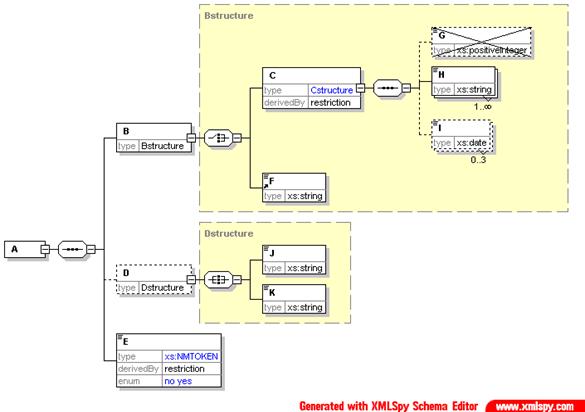
The diagram below represents a simple schema. The root
element of an instance described by this schema is the element
A. The content model
of this element is a sequence of the elements B, D
and E. The element
B is of complex data
type Bstructure. This
contains a choice of either element C or element F. Element C is a restriction of another complex data
type Cstructure. In
this case, the restriction is to forbid the use of the element G (which
is defined in Cstructure
as optional). The other elements allowed are H, which can appear any number of times (but must
appear at least once), and I,
which can appear up to three times (or not at all). Element D is optional, and of data
type Dstructure. This
has a content model requiring all of elements J and K, which are both of type xs:string. Finally, element
E is of simple data
type Etype, which is restricted
from the xs:NMTOKEN data type by only allowing the values ‘yes’ and ‘no’.
It is important to remember that these diagrams do not
include any attributes. In this document, these are shown in tables
below the diagrams.
The full schema is shown below the diagram.
the element is crossed out as the restriction is to
forbid its occurrence
|
|
indicates that this is a sequence
|
|
dotted box around element indicates that element is
optional
|
|

The yellow box represents the content model of the
complex data type (in this case, Bstructure)
|
|
the data type is in blue, so this is a derivation. The
derivation is to allow only the values ‘yes’ or ‘no’
|
|
a data type in blue shows a derivation, in this case, a
restriction
|
|

indicates that this is a choice
|
|
indicates that this is an ‘all’
|
|
indicates zero to three occurrences
|
|
indicates one to many occurrences
|
|





<?xml
version="1.0" encoding="UTF-8"?>
<!--
edited with XMLSPY v2004 rel. 2 U (http://www.xmlspy.com) by Paul Spencer (Boynings
Consulting) -->
<xs:schema
xmlns:xs="http://www.w3.org/2001/XMLSchema"
elementFormDefault="qualified"
attributeFormDefault="unqualified">
<xs:element name="A">
<xs:complexType>
<xs:sequence>
<xs:element name="B" type="Bstructure"/>
<xs:element name="D" type="Dstructure"
minOccurs="0"/>
<xs:element name="E">
<xs:simpleType>
<xs:restriction base="xs:NMTOKEN">
<xs:enumeration value="no"/>
<xs:enumeration value="yes"/>
</xs:restriction>
</xs:simpleType>
</xs:element>
</xs:sequence>
</xs:complexType>
</xs:element>
<xs:complexType name="Bstructure">
<xs:choice>
<xs:element name="C">
<xs:complexType>
<xs:complexContent>
<xs:restriction base="Cstructure">
<xs:sequence>
<xs:element name="G" type="xs:positiveInteger"
minOccurs="0" maxOccurs="0"/>
<xs:element name="H" type="xs:string"
maxOccurs="unbounded"/>
<xs:element name="I" type="xs:date"
minOccurs="0" maxOccurs="3"/>
</xs:sequence>
</xs:restriction>
</xs:complexContent>
</xs:complexType>
</xs:element>
<xs:element ref="F"/>
</xs:choice>
</xs:complexType>
<xs:complexType name="Cstructure">
<xs:sequence>
<xs:element name="G" type="xs:positiveInteger"
minOccurs="0"/>
<xs:element name="H" type="xs:string"
maxOccurs="unbounded"/>
<xs:element name="I" type="xs:date"
minOccurs="0" maxOccurs="3"/>
</xs:sequence>
</xs:complexType>
<xs:complexType name="Dstructure">
<xs:all>
<xs:element name="J" type="xs:string"/>
<xs:element name="K" type="xs:string"/>
</xs:all>
</xs:complexType>
<xs:element name="F" type="xs:string"/>
</xs:schema>
It is up to each specific system implementation whether it
uses these schemas for validation of EML messages for either testing or live
use. The recommended approach is to validate incoming messages against the EML
schemas (with the application-specific EML externals schema), then further
validate against the relevant Schematron schema. The first stage requires the
use of an XML processor (parser) that conforms to W3C XML Schema. The second
stage requires either an XSLT processor or a dedicated Schematron processor.
However, an implementation may choose to:
·
modify the EML schemas to incorporate those application-specific
constraints that can be represented in W3C XML Schema;
·
not validate the rules that are encoded as Schematron schemas;
·
not perform any validation; or
·
develop some alternative validation.
The message schemas and the core schema are associated with
the namespace urn:oasis:names:tc:evs:schema:eml.
This is defined using the prefix eml. The XML Schema
namespace http://www.w3c.org/2001/XMLSchema is
identified by the prefix xs and the XML Schema
Instance namespace
http://www.w3.org/2001/XMLSchema-instance by the prefix xsi.
Use is also made of namespaces for the Extensible Name and
Address Language (xNAL). The Extensible Name Language namespace urn:oasis:tc:ciq:xsdschema:xNL:2.0 is identified by the
prefix xNL, and the Extensible Language namespace urn:oasis:names:tc:ciq:xsdschema:xAL:2.0 by the prefix xAL.
Various elements allow extensibility through the use of the xs:any element. This is used both for display information
(for example, allowing the sending of HTML in a message) and for local
extensibility. Note that careless use of this extensibility mechanism could
reduce interoperability.
The EML schemas provide a set of constraints common to most
types of elections worldwide. Each specific election type will require
additional constraints, for example, to enforce the use of a seal or to ensure
that a cast vote is anonymous. It is recommended that these additional
constraints be expressed using the Schematron language although other
validators, eg OASIS CAM, can be used. This allows additional constraints to be
described without altering or interacting with the EML schemas. Any document
that is valid to a localization expressed in Schematron must also be a valid
EML document.
Within this specification, the following conventions are
used throughout:
·
Diagrams are shown as generated by XML Spy 2007 which was also
used to generate the schemas and samples. These diagrams show element content,
but not attributes
·
Elements and attributes in schemas are identified by partial
XPath expressions. Enough of a path is used to identify the item without
putting in a full path.
Some messages need information relating to the issuing of
them, such as the issue date, who issued them etc. This is most likely to be a
requirement for the 330 message but is equally applicable to 120, 130, 230,
350a and several others. For that reason, it is useful to make this optional
information available in the header. The information usually consists of:
managing authority, date of issue, start of list period (used for changes to
the list to indicate the start of the period for which changes are being
shown), end of list period (i.e. the date of the snapshot of the list).
This section gives a short introduction to how validation
can be achieved using Schematron schemas and an XSLT processor. Alternatively,
direct validation using the Schematron schemas can be achieved using a
dedicated Schematron processor.
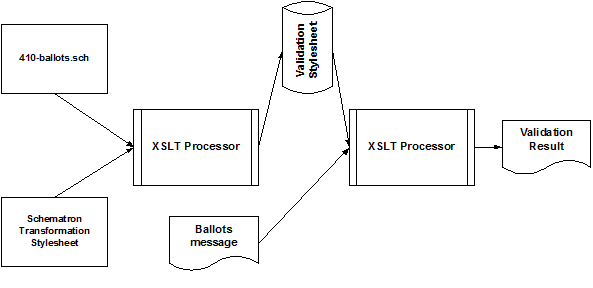
A Schematron schema is an XML document that can be converted
to XSLT using an XSLT stylesheet. There is a published stylesheet
(skeleton1-5.xslt) that can be used to achieve this. This produces an HTML
output from the validation. A separate stylesheet can be produced that will
create an output to the specification below. This stylesheet can import the
skeleton and just over-ride those aspects where changes are required.
This stylesheet can be used once on each Schematron schema
to produce the XSLT file that will be used for validating a specific message
type. This stylesheet is then used to transform the incoming EML message into
an error report based on the additional constraints.
The process is shown in the diagram below.
There is sometimes a need to split long messages into
several parts. By their nature, each of these messages will contain a small
amount of background information and a single element type that is repeated
many times. For example, the 330-electionlist message can have many
VoterDetails elements.
When a message is split, each part must be a complete, valid
EML document. This will contain all the elements required by EML and the
specific application. Those parts outside the repeated element that relate to
the message as a whole, such as the TransactionId, must have the same values in
each part message. The values of those elements and attributes that relate to
an individual part message, such as the SequenceNumber, may vary between the
individual part messages. Information in the EML element indicates the sequence
number of the message and the number of messages in the sequence. Each message
in the sequence must contain the same TransactionId, and must indicate the
repeated element according to the table below. Only the messages shown in the
table may be split in this way.\
|
Message
|
Repeated Element
|
|
330-electionlist
|
VoterDetails
|
|
340-pollinginformation
|
Polling
|
|
410-ballots
|
Ballot
|
|
460-votes
|
CastVote
|
|
470-vtokenlog
|
VTokens
|
|
480-auditlog
|
LoggedSeal
|
For ease of implementation, a message that can be split may
contain the elements used for splitting even if the entire message is sent in
one piece. In this case, the values of SequenceNumber and NumberInSequence will
both be "1".
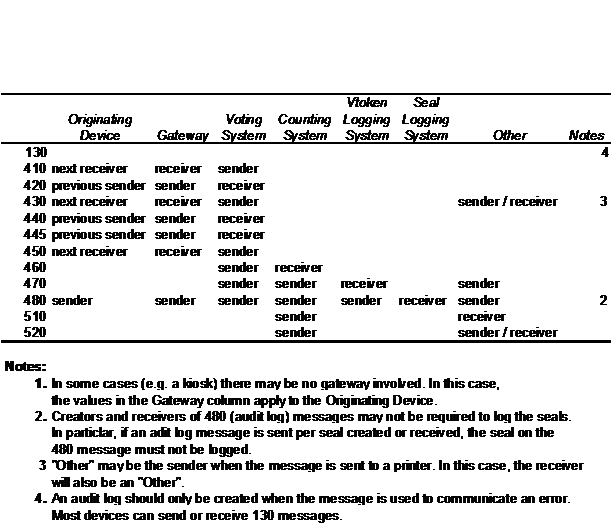
The 130 schema is used to define a message for reporting
errors in EML messages.
Error messages are given codes. These fall into one of five
series:
|
1000
|
XML well-formedness or Schema validation error
|
|
2000
|
Seal error
|
|
3000
|
EML rule error
|
|
4000
|
Localization rule error
|
|
5000
|
System specific error
|
If the error type is not message-specific (or is a general
rule applying to several schemas), the series reference above is used. If it is
message-specific, the last three digits of the error series (and possibly a
final alpha character) reflect the message type. A three digit error code is
appended to the series code, separated by a hyphen.
An error code relating to a localisation applicable to all
message types could therefore be 4000-001. One specific to the localization of
schema 110 could be 4110-002.
|
Error code
|
Error
Description
|
|
1000-001
|
Message is not well-formed
|
|
1000-002
|
Message is not valid
|
|
Error code
|
Error Description
|
|
2000-001
|
The Seal does
not match the data
|
The following rules apply to messages regardless of
localization. One of the two rules on splitting will apply to each message type
as described in the table below.
|
Error Code
|
Error Description
|
|
3000-001
|
If there are processing units in the AuditInformation, one must have the role of sender
|
|
3000-002
|
If there are processing units in the AuditInformation, one must have the role of receiver
|
|
3000-003
|
This message must not contain the elements used for splitting
|
|
3000-004
|
The value of the Id
attribute of the EML element is incorrect
|
|
3000-005
|
The message type must match the Id attribute of the EML element
|
|
3000-006
|
All messages that are split must include the correct
sequenced element name.
|
|
|
|
|
|
|
ü
|
|
|
|
ü
|
|
|
|
ü
|
|
|
|
ü
|
|
|
|
ü
|
|
|
|
ü
|
|
|
|
ü
|
|
|
|
|
ü
|
|
|
|
ü
|
|
|
ü
|
|
|
|
ü
|
|
|
|
ü
|
|
|
|
ü
|
|
|
|
ü
|
|
|
|
|
ü
|
|
|
ü
|
|
|
|
ü
|
|
|
|
ü
|
|
|
|
ü
|
|
|
|
|
ü
|
|
|
|
ü
|
|
|
|
ü
|
|
|
|
ü
|
|
|
ü
|
|
|
|
ü
|
|
|
|
ü
|
|
|
|
ü
|
|
|
|
ü
|
|
The EML Core schema contains elements and
data types that are used throughout the e-voting schemas.
To help message schema diagrams fit on the
page, these elements and data types are not expanded each time they appear in
other diagrams.
The following schema components are defined
in the EML Core:
|
Elements
|
Complex
Data Types
|
Simple
Data Types
|
|
Accepted
|
AffiliationIdentifierStructure
|
ConfirmationReferenceType
|
|
Affiliation
|
AffiliationStructure
|
CountingAlgorithmType
|
|
AffiliationIdentifier
|
AgentIdentifierStructure
|
DateType
|
|
Agent
|
AgentStructure
|
EmailType
|
|
AgentIdentifier
|
AreaStructure
|
ErrorCodeType
|
|
Area
|
AuditInformationStructure
|
GenderType
|
|
AuditInformation
|
AuthorityIdentifierStructure
|
LanguageType
|
|
AuthorityIdentifier
|
BallotIdentifierRangeStructure
|
MessageTypeType
|
|
BallotIdentifier
|
BallotIdentifierStructure
|
SealUsageType
|
|
BallotIdentifierRange
|
BinaryStructure
|
ShortCodeType
|
|
Candidate
|
CandidateIdentifierStructure
|
TelephoneNumberType
|
|
CandidateIdentifier
|
CandidateStructure
|
VotingChannelType
|
|
ContactDetails
|
ChannelStructure
|
VotingMethodType
|
|
ContestIdentifier
|
ComplexDateRangeStructure
|
VotingValueType
|
|
CountQualifier
|
ContactDetailsStructure
|
WriteInType
|
|
CountingAlgorithm
|
ContestIdentifierStructure
|
YesNoType
|
|
DocumentIdentifier
|
CountMetricStructure
|
|
|
ElectionIdentifier
|
CountQualifierStructure
|
|
|
ElectionStatement
|
DocumentIdentifierStructure
|
|
|
EventIdentifier
|
ElectionGroupStructure
|
|
|
EventQualifier
|
ElectionIdentifierStructure
|
|
|
Gender
|
EmailStructure
|
|
|
Logo
|
EMLStructure
|
|
|
ManagingAuthority
|
Endorsement
|
|
|
MaxVotes
|
EventIdentifierStructure
|
|
|
MessageType
|
EventQualifierStructure
|
|
|
MinVotes
|
IncomingGenericCommunicationStructure
|
|
|
NominatingOfficer
|
InternalGenericCommunicationStructure
|
|
|
NumberInSequence
|
LogoStructure
|
|
|
NumberOfPositions
|
ManagingAuthorityStructure
|
|
|
Period
|
MessagesStructure
|
|
|
PersonName
|
NominatingOfficerStructure
|
|
|
PollingDistrict
|
OutgoingGenericCommunicationStructure
|
|
|
PollingPlace
|
|
|
|
Position
|
PeriodStructure
|
|
|
PreferredChannel
|
PictureDataStructure
|
|
|
PreviousElectoralAddress
|
PollingDistrictStructure
|
|
|
Profile
|
PollingPlaceStructure
|
|
|
Proposal
|
PositionStructure
|
|
|
ProposalIdentifier
|
ProcessingUnitStructure
|
|
|
Proposer
|
ProposalIdentifierStructure
|
|
|
Proxy
|
ProposalStructure
|
|
|
ReferendumOptionIdentifier
|
ProposerStructure
|
|
|
ReportingUnitIdentifier
|
ProxyStructure
|
|
|
ResponsibleOfficer
|
ReferendumOptionIdentifierStructure
|
|
|
ScrutinyRequirement
|
ReportingUnitIdentifierStructure
|
|
|
Seal
|
ResponsibleOfficerStructure
|
|
|
SequenceNumber
|
ResultsReportingStructure
|
|
|
TransactionId
|
ScrutinyRequirementStructure
|
|
|
VoterId
|
SealStructure
|
|
|
VoterName
|
SimpleDateRangeStructure
|
|
|
VotingChannel
|
TelephoneStructure
|
|
|
VotingMethod
|
VoterIdentificationStructure
|
|
|
VToken
|
VoterInformationStructure
|
|
|
VTokenQualified
|
VTokenStructure
|
|
|
|
VTokenQualifiedStructure
|
|
|
|
|
|
The simple data types are included here
with their base data types and any restrictions applied.
xs:token.
The reference generated once the
confirmation of a vote has been completed.
xs:token
The method of counting used for more
complex forms of election.
Union of xs:date
and xs:dateTime
There are several possible dates associated
with an election. Some of these can be either just a date or have a time
associated with them. These can use this data type.
xs:token with restrictions.
Restrictions: xs:maxLength: 129
xs:pattern:
[^@]+@[^@]+
This type is a simple definition of an
email address, pending a more complete description that is widely accepted in
industry and government. It allows any characters except the @ symbol, followed
by an @ symbol and another set of characters excluding this symbol.
xs:token
One of a pre-defined set of error codes as
described in the section "Error Messages”.
xs:token with restrictions.
Restrictions: xs:enumeration:
male, female, unknown
The gender of a voter or candidate. Options
are male, female or unknown (unknown is not allowed in all contexts).
xs:language
Declaration of the type of language used in
the election.
xs:NMTOKEN
This is the alphanumeric type of the
message (e.g. 440 or 350a). This may be required for audit purposes.
xs:NMTOKEN with restrictions.
Restrictions: xs:enumeration:
receiver, sender
Indicates whether a device logging a seal
was the sender or receiver of the seal.
xs:NMTOKEN
This identifies an aspect of the election
(such as a contest or candidate) when voting using SMS or other voting
mechanisms where a short identifier is required.
xs:token with restrictions.
Restrictions: xs:maxLength: 35
xs:minLength: 1
xs:pattern:
\+?[0-9\(\)\-\s]{1,35}
Since this must allow for various styles of
international telephone number, the pattern has been kept simple. This allows
an optional plus sign, then between 1 and 35 characters with a combination of
digits, brackets, the dash symbol and white space. If a more complete
definition becomes widely accepted in industry and government, this will be
adopted.
xs:token with restrictions.
Restrictions: xs:enumeration:
SMS, WAP, digitalTV, internet, kiosk, polling, postal, telephone, other
This type exists to hold the possible
enumerations for the channel through which a vote is cast.
SMS is the Short Message Service (text
message). WAP is the Wireless Access Protocol.
If other is used, it is assumed that those
managing the election will have a common understanding of the channel in use.
xs:token with restrictions.
Restrictions: xs:enumeration:
AMS, FPP, IRV, OPV, RCV, SPV, STV, NOR, cumulative, approval, block, partylist,
partisan, supplementaryvote, other
The VotingMethod type holds the enumerated
values for the type of election (such as first past the post or single
transferable vote). The meanings of the acronyms are:
AMS – Additional Member System
FPP - First Past the Post
IRV - Instant Runoff Voting
NOR – Norwegian Voting
OPV - Optional Preferential Voting
RCV - Ranked Choice Voting
SPV - Single Preferential Vote
STV - Single Transferable Vote
xs:positiveInteger.
Indicates a value assigned when voting for
a candidate or referendum option. This might be a weight or preference order
depending on the election type.
xs:token
Indicates the type of Write-ins allowed, eg
allowed, strikeout, none.
xs:token with restrictions.
Restrictions: xs:enumeration:
no, yes
This is a simple enumeration of yes and no
and is used for elements and attributes that can only take these binary values.
The choice between defining an element or a
data type for a reusable message component is a significant design issue. It is
widely accepted as good practice to use element declarations when there is good
reason to always refer to an element by the same name and there is no
expectation of a need to derive new definitions. In all other cases, data type
declarations are preferable. The term schema component is used to refer to
elements and data types collectively.
When defining a complete mark-up language,
limiting the use of elements and types can restrict further development of the
language. For that reason, both data types and elements are defined in EML.
Only where an element is an example of a primitive or derived data type defined
in XML Schema Descriptions is no explicit data type defined within EML.
In use, it is expected that, for example:
·
A voting token will always have an element name
VToken and so will use the element name.
·
A logo or a map have similar definitions, so
both use the PictureDataStructure. There is no PictureData element.
·
Within voter identification, some elements will
usually need to be made mandatory and so a schema will specify a new element
based on the VoterIdentificationStructure data type.
|
Element
|
Attribute
|
Type
|
Use
|
Comment
|
|
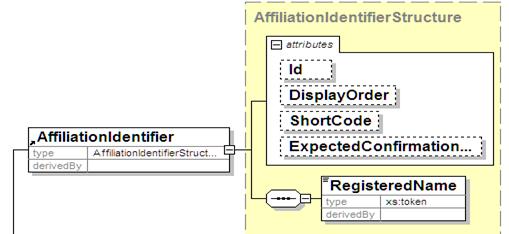
AffiliationIdentifierStructure
|
Id
|
xs:NMTOKEN
|
optional
|
|
|
|
DisplayOrder
|
xs:positiveInteger
|
optional
|
|
|
|
ShortCode
|
ShortCodeType
|
optional
|
|
|
|
ExpectedConfirmationReference
|
ConfirmationReferenceType
|
optional
|
|
This data type is used to identify an
affiliation, such as a political party. The identifier indicates the official
name and ID of the organization. It supports use of a short code for voting
systems such as SMS, and an expected confirmation reference for security
systems that require this.
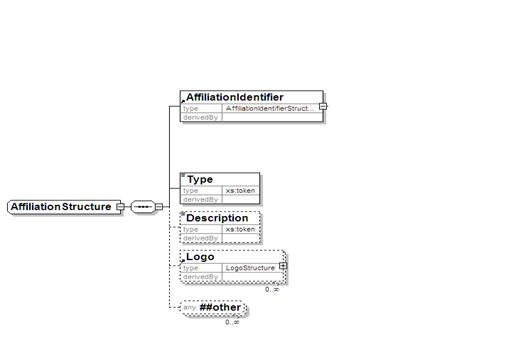
AffiliationStructure data type indicates
membership of some organization such as a political party. The description will
normally be used to indicate the name usually associated with the organization,
and so is the value that will usually be shown on a ballot. An organization may
indicate several logos, each with a role. For example, one role might indicate
that the logo should be used on a ballot paper. Each logo can be identified by
a URL or sent as a Base64 encoded binary value. In the latter case, the format
of the logo (BMP, TIFF, PNG, GIF or JPEG) must be indicated.
The Affiliation Type allows for a number of
different types of affiliations and endorsements to be recorded. For example which
political party specifically endorses a candidate or which party(ies) or other
organisations the candidate says he/she is affiliated to.

|
Element
|
Attribute
|
Type
|
Use
|
Comment
|
|
AgentIdenttifierStructure
|
Id
|
xs:NMTOKEN
|
optional
|
|
|
|
DisplayOrder
|
xs:positiveInteger
|
optional
|
|
The agent identifier contains a name and
ID. The data type for the name is localized using the EML externals schema.
|
Element
|
Attribute
|
Type
|
Use
|
Comment
|
|
AgentStructure
|
Id
|
xs:NMTOKEN
|
optional
|
|
|
|
DisplayOrder
|
xs:positiveInteger
|
optional
|
|
|
|
Role
|
xs:token
|
optional
|
|
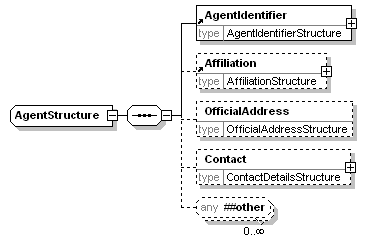
A candidate in an election can have one or
more agents, each agent having a specific role, identified by the Role
attribute. For example, an agent may be allowed access to the count, but not to
amend details of the candidate.
The agent has an identifier, comprising a
name and ID, and an affiliation. He or she also has an official address and a
standard set of contact details.
The AreaStructure is an extension of
xs:token to add the following attributes:
|
Element
|
Attribute
|
Type
|
Use
|
Comment
|
|
AreaStructure
|
Id
|
xs:NMTOKEN
|
optional
|
|
|
|
DisplayOrder
|
xs:positiveInteger
|
optional
|
|
|
|
Type
|
xs:token
|
optional
|
|
This data type is used to define elements
defining the geographical area covered by a contest. The Type attribute is used
to indicate the type of area, such as "county".
|
Element
|
Attribute
|
Type
|
Use
|
Comment
|
|
Other
|
Role
|
xs:token (restricted)
|
required
|
Standard attribute for a ProcessingUnitStructure
|
|
|
Type
|
xs:token
|
required
|
Additional attribute for this element
|
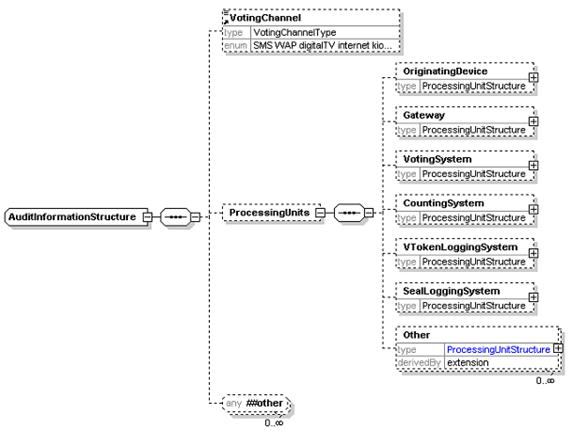
The AuditInformationStructure is used to define an element
to provide information for audit purposes. It allows the voting channel in use
to be described, with the identities of those devices that have participated in
the message being sent. Each device has an attribute to describe its role (see
ProcessingUnitStructure).
Where a device does not fit any of the categories here, it
can be described as Other with the addition of a Type attribute.
The AuthorityIdentifierStructure is an
extension of xs:token to add the following attributes:
|
Element
|
Attribute
|
Type
|
Use
|
Comment
|
|
AuthorityIdentifierStructure
|
Id
|
xs:NMTOKEN
|
optional
|
|
|
|
DisplayOrder
|
xs:positiveInteger
|
optional
|
|
This data type defines information to
identify an election authority. This may include a system ID and text
description.
|
Element
|
Attribute
|
Type
|
Use
|
Comment
|
|
BallotIdentifierStructure
|
Id
|
xs:NMTOKEN
|
required
|
|
|
|
DisplayOrder
|
xs:positiveInteger
|
optional
|
|
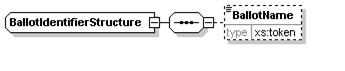
This data type is used to define an element
that is an identifier for a ballot. This will usually use the Id attribute as
the identifier, but might use a name to indicate a set of identical ballots.
Elements using this data type will usually only be used for paper ballots.
|
Element
|
Attribute
|
Type
|
Use
|
Comment
|
|
BallotIdentifierRangeStructure
|
Colour
|
xs:token
|
optional
|
|
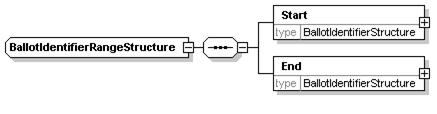
This data type is used to define an element
that identifies a range of ballots. This might be used, for example, to assign
ranges of ballot identifiers to different reporting units for a contest. It is
unlikely that the ballot name would be used when defining range, the Id
attribute being used instead. Elements using this data type will usually only
be used for paper ballots.
|
Element
|
Attribute
|
Type
|
Use
|
Comment
|
|
BinaryItemStructure
|
Id
|
xs:NMTOKEN
|
optional
|
|
|
|
DisplayOrder
|
xs:positiveInteger
|
optional
|
|
|
|
ItemType
|
Xs:token
|
optional
|
|
|
|
Verified
|
YesNoType
|
optional
|
|
|
|
Problem
|
YesNoType
|
optional
|
|
|
|
Notes
|
Xs:string
|
optional
|
|
|
|
Role
|
Xs:token
|
|
|
|
Binary
|
Format
|
xs:NMTOKEN (restricted)
|
required
|
|
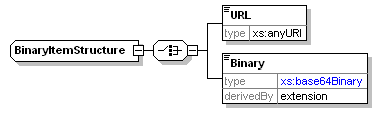
Where a binary (fingerprint, logo, map,
photo,) is provided, it may be given as either a link or as Base64 encoded
binary data. In the latter case, the format of the binary (bmp, gif, jpeg, png
or tiff) must be indicated using the Format attribute of the Binary element.
|
Element
|
Attribute
|
Type
|
Use
|
Comment
|
|
CandidateIdentifierStructure
|
Id
|
xs:NMTOKEN
|
required
|
|
|
|
DisplayOrder
|
xs:positiveInteger
|
optional
|
|
|
|
ShortCode
|
ShortCodeType
|
optional
|
|
|
|
ExpectedConfirmationReference
|
ConfirmationReferenceType
|
optional
|
|
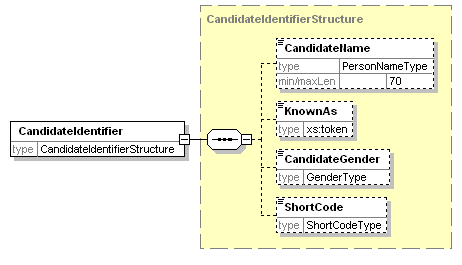
The candidate identifier indicates a system
ID for the candidate and the candidate's name as it will appear in a ballot.
Sometimes an additional line is required on the ballot to help identify the
candidate. This will use the KnownAs element of the candidate identifier. A short code can also be
included, either for SMS voting or where the security mechanism in place
requires it. An ExpectedConfirmationReference attribute also allows for security mechanisms where the confirmation
reference may be different for each combination of voter and candidate.
|
Element
|
Attribute
|
Type
|
Use
|
Comment
|
|
CandidateStructure
|
Independent
|
YesNoType
|
optional
|
|
|
|
DisplayOrder
|
xs:positiveInteger
|
optional
|
|
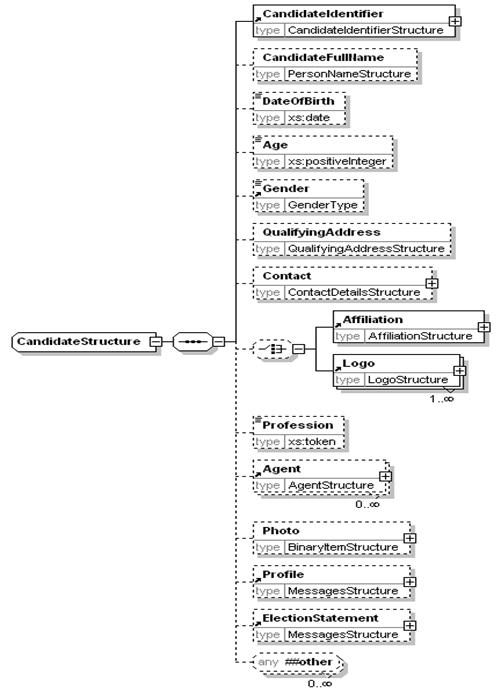
The candidate description includes all the
information required about the candidate. In different messages, the amount of
information is reduced, either by restricting the information in EML or as part
of a localisation.
The candidate has an identifier. The full
name of the candidate may also be provided, and whether the candidate is an
independent. This is supplied as an attribute rather than affiliation as
certain election types treat independents differently from other candidates,
even though they may define an affiliation.
The candidate profile describes the
candidate. The election statement describes the opinions of the candidate.
Optionally, a photo may be included, either as a link or as Base64 encoded
binary.
|
Element
|
Attribute
|
Type
|
Use
|
Comment
|
|
PreferredChannel
|
Fixed
|
Yes/NoType
|
optional
|
|
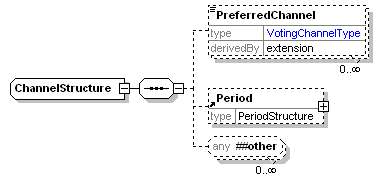
This data type is used to describe the
voter’s preferred channel for casting of the vote and the period for which that
preference is valid.
|
Element
|
Attribute
|
Type
|
Use
|
Comment
|
|
ComplexDateRangeStructure
|
Type
|
xs:token
|
required
|
|
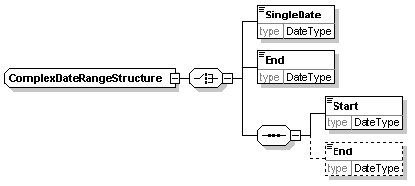
This data type is used to describe ranges of dates or dates
and times. Each date can be a single date, a start date, an end date or include
both start and end dates.
The Type attribute is used to
indicate the purpose of the date (e.g. "deadline for nominations").
|
Element
|
Attribute
|
Type
|
Use
|
Comment
|
|
ContactDetailsStructure
|
DisplayOrder
|
xs:positiveInteger
|
optional
|
|
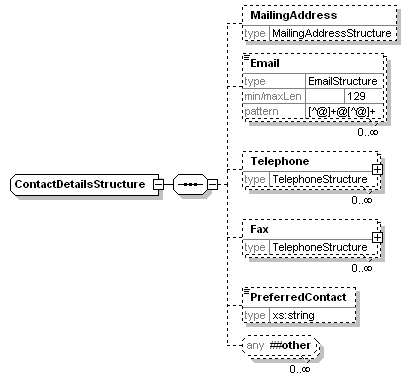
This data type is used in many places
throughout the EML schemas. The mailing address uses whatever format is defined
in the EML externals schema document. Where several addresses or numbers can be
given (for example, email addresses), there is a facility to indicate whichever
is preferred. The overall preferred method of contact can also be provided by
placing an XPath to the preferred method in the PreferredContact element.

|
Element
|
Attribute
|
Type
|
Use
|
Comment
|
|
ContestIdentifierStructure
|
Id
|
xs:NMTOKEN
|
required
|
|
|
|
DisplayOrder
|
xs:positiveInteger
|
optional
|
|
|
|
ShortCode
|
ShortCodeType
|
optional
|
|
This data type is used to define an element
that is an identifier for a contest. It holds a name and ID. A short code can
also be included, for example, for SMS voting.
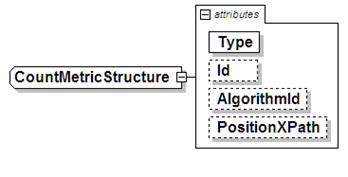
This allows for the metrics to be used in
the Count of cast votes to be defined.
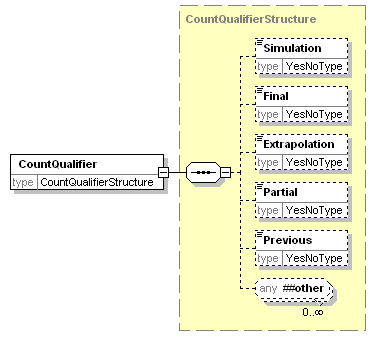
This allows for an indication of whether
the count is final or not, and for the count to be either simulated or
extrapolated.
The DocumentIdentifierStructure is an
extension of xs:token to add the following attribute:
|
Element
|
Attribute
|
Type
|
Use
|
Comment
|
|
DocumentIdentifierStructure
|
Href
|
xs:anyURI
|
required
|
|
This allows identification of external
documents relating to an event, election or contest. The document can have a
name and URL.
The ElectionGroupStructure is an extension
of xs:token to add the following attribute:
|
Element
|
Attribute
|
Type
|
Use
|
Comment
|
|
DocumentIdentifierStructure
|
Id
|
xs:token
|
required
|
|
The election group is used to group a
number of elections together. This could be required, for example, under the
additional member system, where two elections are held, the result of one
influencing the result of the other. It could also be used at a company AGM,
where proposals might be grouped for display purposes.
|
Element
|
Attribute
|
Type
|
Use
|
Comment
|
|
ElectionIdentifierStructure
|
Id
|
xs:NMTOKEN
|
required
|
|
|
|
DisplayOrder
|
xs:positiveInteger
|
optional
|
|
|
|
ShortCode
|
ShortCodeType
|
optional
|
|
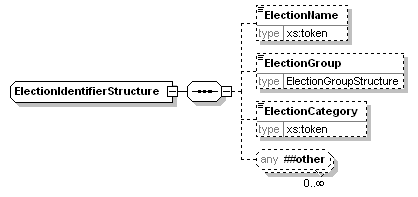
The election identifier is used wherever the election needs
to be specified. There is an Id
attribute, which can often be used on its own to identify the election. In
other cases, particularly where the content of a message is to be displayed,
the election name can also be provided. The election group is used to group a
number of elections together as described above.
The election category is used in messages where several
elections are included in the message, but may be treated differently under
localisation rules. Each election that requires different treatment will be
given a category unique within that election event, allowing a Schematron
processor to distinguish between the elections.
The EmailStructure is an extension of the
EmailType to add the following attribute:
|
Element
|
Attribute
|
Type
|
Use
|
Comment
|
|
EmailStructure
|
Preferred
|
YesNoType
|
optional
|
|
The Preferred attribute is used to
distinguish which of several email addresses to use.
|
Element
|
Attribute
|
Type
|
Use
|
Comment
|
|
EMLstructure
|
Id
|
MessageTypeType
|
required
|
|
|
|
SchemaVersion
|
xs:NMTOKEN
|
requried
|
|
|
|
|
|
|
|
|
Stylesheet
|
Type
|
xs:token
|
required
|
|
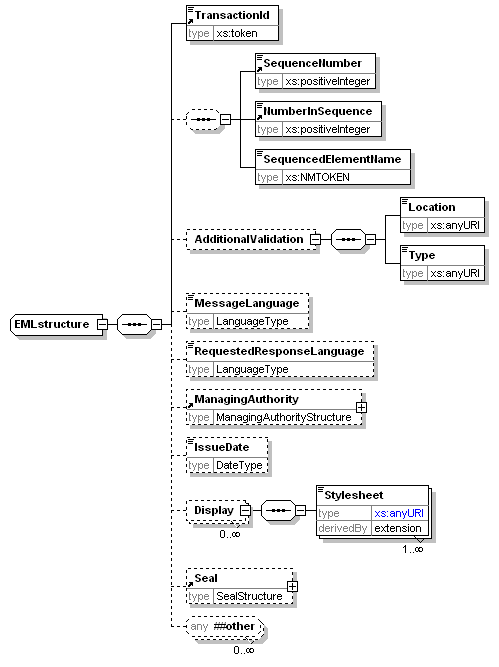
The EML element defined by this data type
forms the root element of all EML documents. The transaction ID is used to
group messages together, for example, when they are split using the message
splitting mechanism. This mechanism is implemented using the next three
elements. The optional message language indicates the language of the message
using ISO 639 three letter language codes, while the requested response language
can be used to indicate the preferred language for a response. This element is
used in messages from the voter or candidate to the election organizers.
The display element allows the definition
of stylesheets to display the message. Multiple stylesheets can be declared.
When displaying on the web, the first is likely to be an XSLT stylesheet, while
the second might describe a CSS stylesheet to be incorporated as well. The Type attribute of
the Stylesheet element should contain a media types as defined in RFC 2046 Pt 2
[1] using the list of media types defined by IANA, for example, text/xsl. The
final element defined is the seal, which is used to seal the complete message.
|
Element
|
Attribute
|
Type
|
Use
|
Comment
|
|
EventIdentifierStructure
|
Id
|
xs:NMTOKEN
|
optional
|
|
|
|
DisplayOrder
|
xs:positiveInteger
|
optional
|
|
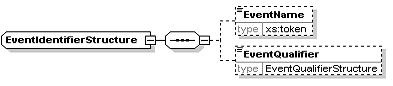
The event identifier is used wherever the election event
needs to be specified. There is an Id attribute, which can often be used on its
own to identify the event. In other cases, particularly where the content of a
message is to be displayed, the event name can also be provided. The event
qualifier is used to further identify the event.
The EventQualifierStructure is an extension of xs:token to add the following attribute:
|
Element
|
Attribute
|
Type
|
Use
|
Comment
|
|
EventQualifierStructure
|
Id
|
xs:NMTOKEN
|
optional
|
|
The event qualifier is used to further identify the event.
For example, there might be "County Elections" covering an entire
country, but the events are organized at a county level, so the event qualifier
would identify the county.
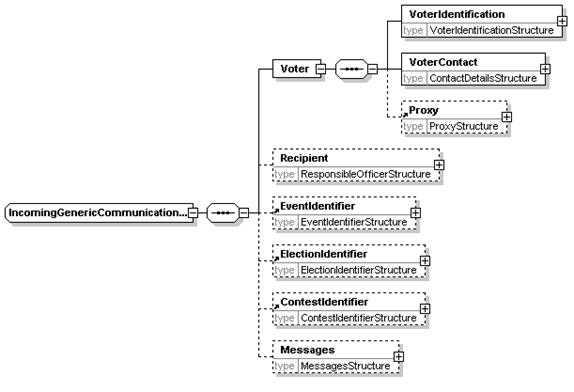
This data type provides a common structure for incoming
communications. Individual message types, such as that used for selecting a
preferred voting channel (schema 360b) are based on extensions of this type.
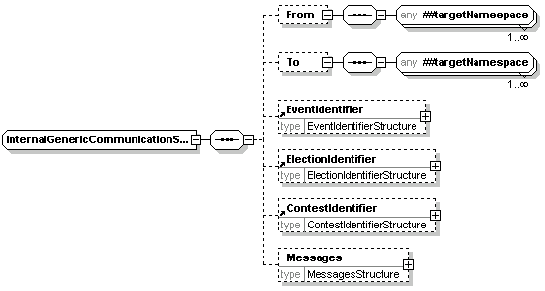
This data type provides a common structure
for communications between entities involved in the organisation of an
election. Individual message types are based on extensions of this type. The
sender and recipient can use any elements defined within EML.
The LogoStructure is an extension of the
BinaryItemStructure to add attributes:
|
Element
|
Attribute
|
Type
|
Use
|
Comment
|
|
LogoStructure
|
Id
|
xs:NMTOKEN
|
optional
|
Standard attribute for a BinaryItemStructure
|
|
|
DisplayOrder
|
xs:positiveInteger
|
optional
|
Standard attribute for a BinaryItemStructure
|
|
|
ItemType
|
xs:token
|
optional
|
|
|
|
Verified
|
YesNoType
|
optional
|
|
|
|
Problem
|
YesNoType
|
optional
|
|
|
|
Notes
|
Xs:string
|
optional
|
|
|
|
Role
|
xs:token
|
optional
|
Additional attribute for this element
|
This element extends the binary item
structure by adding attributes to define the type and role of the logo. This
can be used to indicate the purpose of the logo (for example, it is to appear
on a ballot).
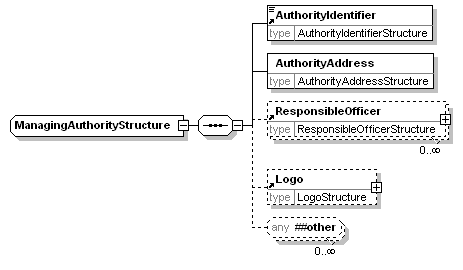
The managing authority is the body
responsible for an election event, election, contest or reporting unit. In most
cases, not all of these will be required, but sometimes more than one is
necessary. For example, an election using the additional member system might be
organized on a regional basis, whilst local authorities organise their local
election events. In this case, the region becomes the managing authority for
the contest, whilst the local authority is the managing authority for the
event. There will also be an authority responsible for the overall conduct of
the election, although this information might not be required.
The managing authority indicates the
authority name, address, Id, any logo that might be required for display during
the election and a list of responsible officers.

|
Element
|
Attribute
|
Type
|
Use
|
Comment
|
|
MessagesStructure
|
DisplayOrder
|
xs:positiveInteger
|
optional
|
|
|
Message
|
Format
|
xs:topken
|
optional
|
|
|
|
Type
|
xs:token
|
optional
|
|
|
|
Lang
|
LanguageType
|
optional
|
|
The Message element is of ‘mixed’ type, so
can have both text and element content. The intention is that it should have
one or the other. The Message element has three attributes: Lang is used to
indicate the language of the message using ISO 639 three letter language codes,
Format indicates the format of element content using the media types definition
from RFC 2046 Pt 2 [1] and the list of media types defined by IANA, for
example, text/html, and Type indicates the purpose of the message.
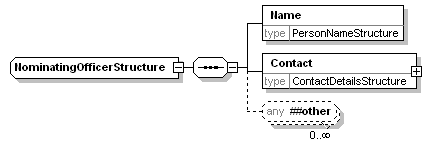
The nominating officer is the person
nominating a party in an election run under, for example, the party list
system. The data type includes a name and contact information.
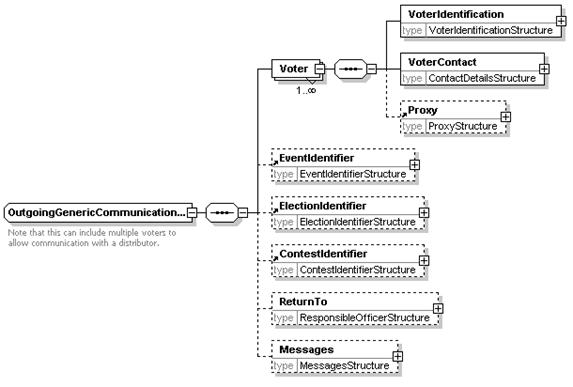
This data type provides a common structure
for communications from electoral service organisers to voters. Multiple voters
can be identified to allow printing of messages. Individual message types, such
as that used for offering voting channel options (360a) are based on extensions
of this type.
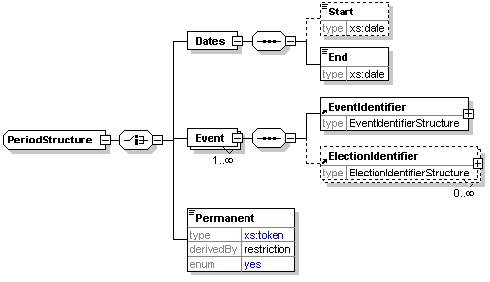
This element can be used when appointing a
proxy or registering to vote using a specific channel (e.g. postal). It allows
this registration to be for a period of time, for specific election events (and
possibly elections within those events) or permanently.
|
Element
|
Attribute
|
Type
|
Use
|
Comment
|
|
PollingDistrictStructure
|
Id
|
xs:NMTOKEN
|
optional
|
|
|
|
DisplayOrder
|
xs:positiveInteger
|
optional
|
|
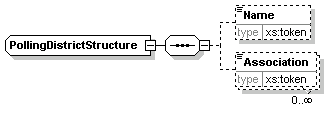
The polling district indicates where a
voter is registered to vote. The polling district can have a name and an Id
attribute. It can also be associated with other terms such as a constituency.
This is done through the Association element, which has Type attribute and may have an Id attribute as well as a text
value.
|
Element
|
Attribute
|
Type
|
Use
|
Comment
|
|
PollingPlaceStructure
|
Channel
|
VotingChannelType
|
required
|
|
|
|
DisplayOrder
|
xs:positiveInteger
|
optional
|
|
|
PhysicalLocation
|
Id
|
xs:NMTOKEN
|
optional
|
|
|
|
DisplayOrder
|
xs:positiveInteger
|
optional
|
|
|
PostalLocation
|
Id
|
xs:NMTOKEN
|
optional
|
|
|
|
DisplayOrder
|
xs:positiveInteger
|
optional
|
|
|
ElectronicLocation
|
Id
|
xs:NMTOKEN
|
optional
|
|
|
|
DisplayOrder
|
xs:positiveInteger
|
optional
|
|
|
OtherLocation
|
Id
|
xs:NMTOKEN
|
optional
|
|
|
|
DisplayOrder
|
xs:positiveInteger
|
optional
|
|
|
PollingStation
|
Id
|
xs:NMTOKEN
|
optional
|
|
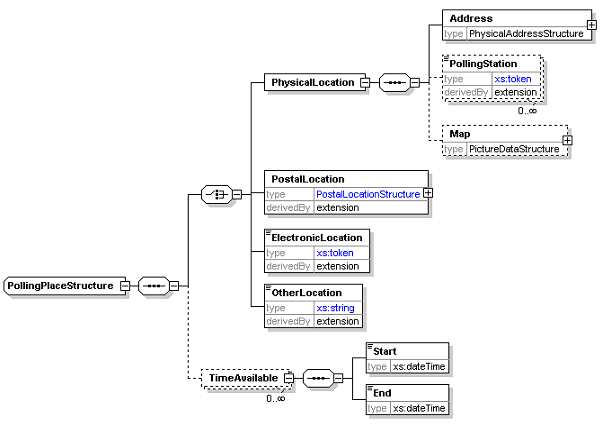
In general, a polling place will be either a physical
location (for paper or kiosk voting), a postal address (for postal votes) or an
electronic location (for Internet, SMS, telephone and other electronic means of
voting). However, it is possible that none of these types will meet every need,
and so an OtherLocation element has been included.
Each of these locations must indicate the channel for which it is to be used.
If a single location supports multiple channels, it must be included multiple
times.
A physical location has an address. Sometimes, several
polling stations will be at the same address, so a polling station can be
defined by name and/or Id within the address. Access to an external map can
also be provided as a URI or Base64 encoded binary data.
An electronic location must indicate its address (e.g. phone
number, URL).
An optional TimeAvailable element
is also provided. In most cases, this is not required as the time a location is
available is the same as the time the channel is available. However, there are
circumstances, such as the use of mobile polling stations, where this is not
the case.
The PositionStructure is an extension of xs:token to add the
following attributes:
|
Element
|
Attribute
|
Type
|
Use
|
Comment
|
|
PositionStructure
|
Id
|
xs:NMTOKEN
|
optional
|
|
|
|
DisplayOrder
|
xs:positiveInteger
|
optional
|
|
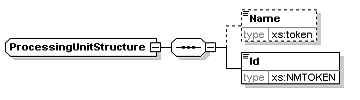
The element defined by this type indicates the position
(e.g. President) for which an election is being held. It has a text description
and an optional ID.
|
Element
|
Attribute
|
Type
|
Use
|
Comment
|
|
ProcessingUnitStructure
|
Role
|
xs:token (restricted)
|
required
|
|
A processing unit is a physical system used in the election
process. It is identified as part of audit information by its ID (which might
be an IP address or an URI) and optional name.
Each processing unit has an attribute to describe its role.
The role can be "sender", "receiver", "previous
sender" or "next receiver". The latter two are used when there
is a gateway involved. For example, a 440 (cast vote) message might have an OriginatingDevice as its original sender, a gateway as
sender and voting system as receiver.

|
Element
|
Attribute
|
Type
|
Use
|
Comment
|
|
ProposalIdentifierStructure
|
Id
|
xs:NMTOKEN
|
optional
|
|
|
|
DisplayOrder
|
xs:positiveInteger
|
optional
|
|
|
|
ShortCode
|
ShortCodeType
|
optional
|
|
|
|
ExpectedConfirmationReference
|
ConfirmationReferenceType
|
optional
|
|
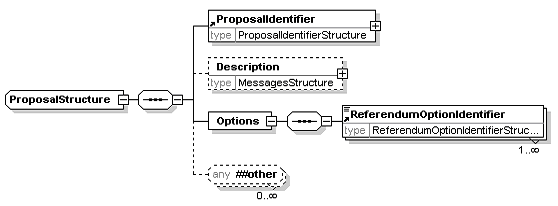
A proposal is used in a referendum. At a basic level, it is
a piece of text with the options (‘yes’ and ‘no’, ‘for’ and ‘against’ etc) to
be voted on.
The proposal identifier indicates a system ID for the
proposal. A short code can also be included, either for SMS voting or where the
security mechanism in place requires it. An ExpectedConfirmationReference
attribute also allows for security mechanisms where the confirmation reference
may be different for each combination of voter and candidate.
|
Element
|
Attribute
|
Type
|
Use
|
Comment
|
|
ProposalStructure
|
Type
|
xs:token
|
optional
|
|
The proposal identifier provides a name and ID. The
description is used to provide the information that will be displayed to the
voter to indicate the aim of the proposal. The options are then used to
indicate how the voter may vote.
The Type attribute allows for
referenda where there are different kinds of proposal, for example,
‘initiative’ or ‘referendum’.
|
Element
|
Attribute
|
Type
|
Use
|
Comment
|
|
ProposerStructure
|
Category
|
xs:token (restricted)
|
optional
|
|
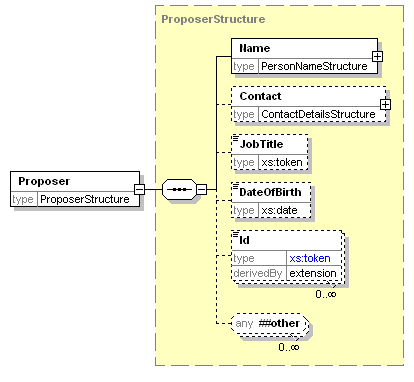
A proposer proposes, seconds or endorses a candidate or
referendum proposal. A proposer can have a category, which indicates one of
"primary", "secondary" or "other". A name is
always required, and additional information might be needed.
|
Element
|
Attribute
|
Type
|
Use
|
Comment
|
|
ProxyStructure
|
Id
|
xs:NMTOKEN
|
optional
|
|
|
|
DisplayOrder
|
xs:positiveInteger
|
optional
|
|
|
PreferredChannel
|
Fixed
|
YesNoType
|
optional
|
|
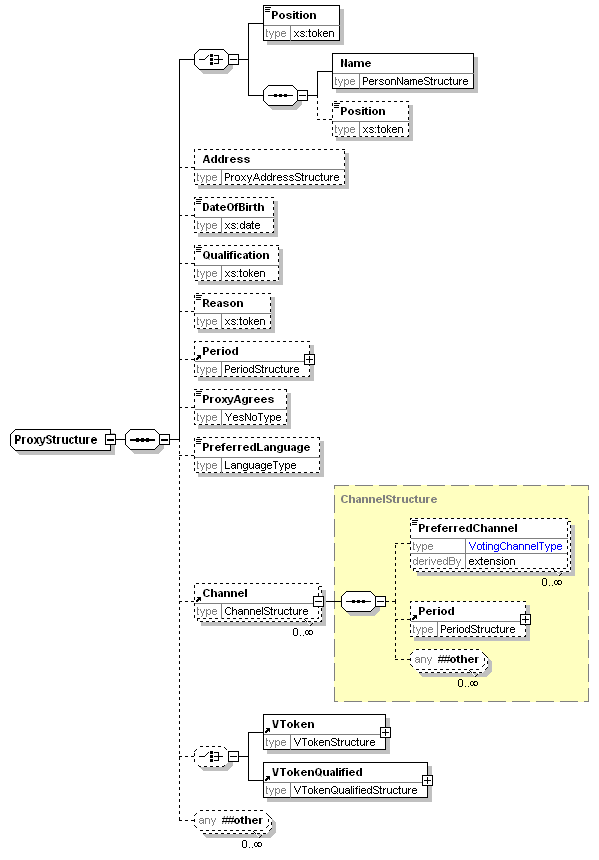
In many elections, a voter may appoint a proxy to vote on
his or her behalf. That proxy may be identified by position (for example,
appointing the chairman as proxy at a company AGM), or by name (for example,
appointing your spouse as proxy for a public election), or both.
In some elections, the proxy must, for example, be a family
member. This is indicated using the Qualification
element, while a reason for appointing a proxy can be indicated using the
Reason element.
A proxy can be permanent (i.e. appointed until revoked),
appointed for one or more election events (and individual elections within each
event) or for a period of time. A proxy can also list his or her preferred
voting channels. These are listed in order of preference for a given period
(which may be specific election events, a date range or permanent), so that
information can be sent regarding the most appropriate voting channel at any
election. The channel may be fixed, for example, if registering to vote by a
specific channel prevents voting by other means.
A proxy may also have a voting token, indicating the right
to vote, or a qualified voting token, indicating that there is a question over
their right to vote.
The ReferendumOptionIdentifierStructure is an extension of
xs:token to add the following attributes:
|
Element
|
Attribute
|
Type
|
Use
|
Comment
|
|
ReferendumOptionIdentifierStructure
|
Id
|
xs:NMTOKEN
|
optional
|
|
|
|
DisplayOrder
|
xs:positiveInteger
|
optional
|
|
|
|
ShortCode
|
ShortCodeType
|
optional
|
|
|
|
ExpectedConfirmationReference
|
ConfirmationReferenceType
|
optional
|
|
A referendum option is used to indicate the
possible answers to a referendum question, such as "yes" and
"no" or "for" and "against".
The referendum option identifier has a text
description and can have a system ID. A short code can also be included, either
for SMS voting or where the security mechanism in place requires it. An
ExpectedConfirmationReference attribute also allows for security mechanisms
where the confirmation reference may be different for each combination of voter
and option.
The ReportingUnitIdentifierStructure is an
extension of xs:token to add the following attributes:
|
Element
|
Attribute
|
Type
|
Use
|
Comment
|
|
ReportingUnitIdentifierStructure
|
Id
|
xs:NMTOKEN
|
optional
|
|
|
|
DisplayOrder
|
xs:positiveInteger
|
optional
|
|
A reporting unit is an entity that reports
partial information relating to a contest (votes or the results of a count)
without having the full set of information required to generate a result. This
will happen when votes from several independently managed areas must be
amalgamated to produce a result.
The reporting unit identifier structure
defines a string with an optional Id.
|
Element
|
Attribute
|
Type
|
Use
|
Comment
|
|
ResponsibleOfficerStructure
|
Id
|
xs:NMTOKEN
|
optional
|
|
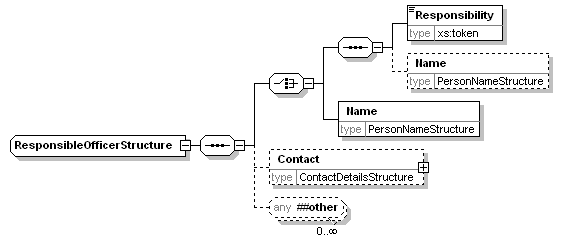
A responsible officer is someone who has
some sort of role to play in the organization of an election. Each responsible
officer has a name and/or responsibility (such as ‘returning officer’) and
optional contact information. Local rules will usually indicate the values
allowed in the Responsibility element.
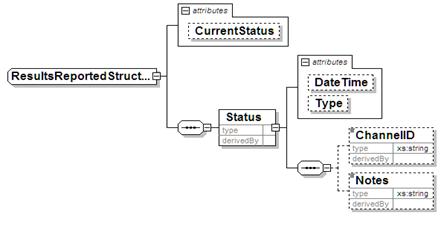
This allows for the
extending ability to report optionally on partial/complete results and prior
election result comparisons along with external press release totals rather
than tabulation result totals.
The ScrutinyRequirementStructure is an
extension of xs:token to add the following attribute:
|
Element
|
Attribute
|
Type
|
Use
|
Comment
|
|
ScrutinyRequirementStructure
|
Type
|
xs:token
|
required
|
|
A scrutiny requirement has two parts, a
Type attribute and a text value. The Type specifies a condition that a
candidate must meet, such as an age or membership requirement or the payment of
a fee. The text describes how that condition has been met. For example:
<ScrutinyRequirement Type="dateofbirth">8 June 1955</ScrutinyRequirement>
|
Element
|
Attribute
|
Type
|
Use
|
Comment
|
|
OtherSeal
|
Type
|
xs:token
|
required
|
|
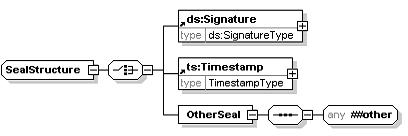
The seal is used to protect information
such as a vote, voting token or complete message. The seal provides the means
of proving that no alterations have been made to a message or individual parts
of a message such as a vote or collection of votes, from when they were
originally created by the voter. The seal may also be used to authenticate the
identity of the system that collected a vote, and provide proof of the time at
which the vote was cast.
If a message is to be divided, each part
must be separately sealed to protect the integrity of the data. For example, if
votes in several elections are entered on a single ballot, and these votes are
being counted in separate locations, each vote must be separately sealed.
A seal may be any structure which provides
the required integrity characteristics, including an XML signature [1] or a
time-stamp.
The XML signature created by the voting
system provides integrity and authentication of the identity of the system that
collected the vote. The time-stamp provides integrity of the vote and proof of
the time that the vote was cast.
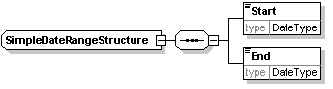
This data type is used to describe ranges of dates or dates and times.
|
Element
|
Attribute
|
Type
|
Use
|
Comment
|
|
TelephoneStructure
|
Preferred
|
YesNoType
|
optional
|
|
|
|
Mobile
|
YesNoType
|
optional
|
|
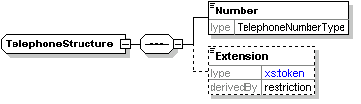
This is an extension of the TelephoneType and
adds an Extension element and the two attributes Preferred and Mobile of YesNoType. The
Preferred attribute indicates which of several phone numbers or fax numbers is
preferred.
|
Element
|
Attribute
|
Type
|
Use
|
Comment
|
|
VoterIdentificationStructure
|
VoterId
|
xs:any
|
optional
|
|
|
|
DisplayOrder
|
xs:positiveInteger
|
optional
|
|
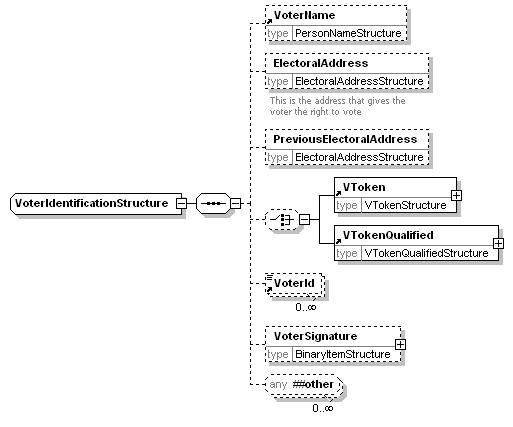
An element defined by this data type is
used wherever identification of a voter is required. It contains the voter's
name and electoral address (the address that gives them the right to vote in a
specific contest), the voting token (either normal or qualified) and a number
of identifiers (such as an electoral registration number, the scanned signature
of the voter, the voter’s Social Security Number or driving licence). It may
also include a previous electoral address if this is required (for example,
because a voter has not been at his or her current address for more than a
predefined period).
|
Element
|
Attribute
|
Type
|
Use
|
Comment
|
|
VoterInformationStructure
|
Id
|
xs:NMTOKEN
|
optional
|
|
|
|
DisplayOrder
|
xs:positiveInteger
|
optional
|
|
|
ContactDetailsStructure
|
DisplayOrder
|
xs:positiveInteger
|
optional
|
standard attribute for this data type
|
|
|
ElectionId
|
xs:NMTOKEN
|
optional
|
additional attribute
|
|
PreferredChannel
|
Fixed
|
YesNoType
|
optional
|
|
|
Checkbox
|
Type
|
xs:token
|
required
|
|
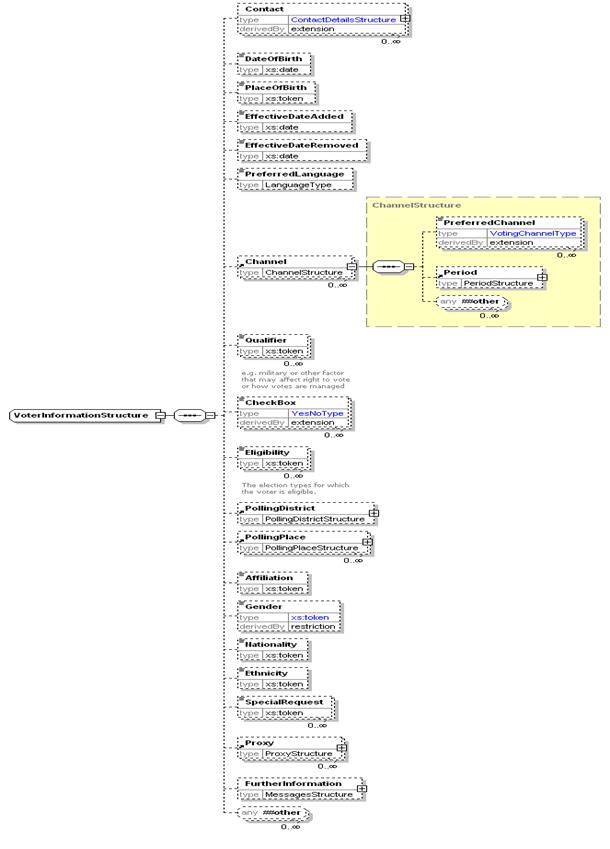
This contains more information about the
voter. It contains all the information that would typically be included on an
electoral register other than that used for identification of the voter. In
many cases, it will be restricted to only include the information required in a
specific message type.
A voter can list his or her preferred
voting channels. These are listed in order of preference for a given period
(which may be specific election events, a date range or permanent), so that
information can be sent regarding the most appropriate voting channel at any
election. The channel may be fixed, for example, if registering to vote by a
specific channel prevents voting by other means.
The Qualifier element is used to hold
information that might affect a voter's right to vote or how the voting process
is managed. Suitable enumerations for this are likely to be added as part of
localisation. The CheckBox element with its Type attribute allows binary
information such as whether the voter's entry on the electoral register can be
sold, or whether the voter wants to participate in the count. The eligibility
indicates what election types a voter is eligible to participate in.
Special requests are requests from the
voter, for example, for wheelchair access to a polling station.

|
Element
|
Attribute
|
Type
|
Use
|
Comment
|
|
Component
|
Type
|
xs:NMTOKEN
|
required
|
|
The voting token contains the information
required to authenticate the voter’s right to vote in a specific election or
contest. A voting token can consist of a continuous string of encoded or
encrypted data, alternatively it may be constructed from several data
components that a user may input at various stages during the voting process
(such as PIN, password and other coded data elements). The totality of the
voting token data proves that a person with the right to vote in the specific
election has cast the vote.
Depending on the type of election, the
voter may need to cast their votes anonymously, thus not providing a link to
the voter’s true identity. In this case the voting token data will not identify
the actual person casting the vote; it just proves that the vote was cast by a
person with the right to do so. Election rules may require a link to be
maintained between a vote and a voter, in which case a link is maintained
between the voting token data and the voter’s identity.
The components of the voting token are
identified by a Type attribute and may contain text or markup from any
namespace depending on the token type. The content could be defined further in
separate schemas for specific types of token.
|
Element
|
Attribute
|
Type
|
Use
|
Comment
|
|
Reason
|
Type
|
xs:token
|
required
|
|
There are occasions when a normal voting
token cannot be used. For example, if a voter is challenged, or an election
officer claims the voter has already voted. In these circumstances a qualified
voting token can be used and treated appropriately by the election system
according to the election rules. For example, challenged votes might be ignored
unless there were sufficient to alter the result of the election, in which case
each vote would be investigated and counted if deemed correct to do so.
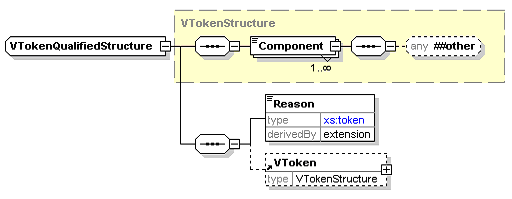
The VTokenQualifiedStructure is therefore
an extension of the VTokenStructure to add the additional information required. This additional
information comprises a reason for qualification (as a Reason element with a
Type attribute and textual description) and possibly an original VToken.
The following elements are simply specified by their
similarly-named data type and are not described further here:
Affiliation, AffiliationIdentifier, Agent, AgentIdentifier,
Area, AuditInformation, AuthorityIdentifier, BallotIdentifier,
BallotIdentifierRange, Candidate, CandidateIdentifier, ContactDetails,
ContestIdentifier, CountingAlgorithm, DocumentIdentifier, ElectionIdentifier,
EventIdentifier, EventQualifier, Gender , Logo, ManagingAuthority, MessageType,
NominatingOfficer, NumberOfPositions, Period, PollingDistrict, PollingPlace,
Position, PreferredChannel, Proposal, ProposalIdentifier, Proposer, Proxy,
ReferendumOptionIdentifier, ReportingUnitIdentifier, ResponsibleOfficer,
ScrutinyRequirement, Seal, VoterId, VToken, VTokenQualified
YesNoType
This element indicates that a candidate, referendum proposal
or vote has been accepted.
MessagesStructure
This is the candidate's message to voters.
xs:positiveInteger
The maximum number of votes allowed (also
known as the vote limit). This defaults to the value of "1".
xs:nonNegativeInteger
The minimum number of votes allowed. This
defaults to the value of "0".
xs:positiveInteger
The number of partial messages when a
message is split. See “Spitting of Messages”
This element represents the number of
identical positions that will be elected as the result of a contest. For
example, in a contest for a Town Council, three councillors might be elected as
the result of the contest in one part of the town. The element is an xs:positiveInteger
and defaults to a value of "1".
This element uses the PersonNameStructure
defined in the EML externals schema.
MessagesStructure
This is the candidate's profile statement.
xs:positiveInteger
The sequence number of a partial message when a message is split.
See “Splitting of Messages” (Section 4).
xs:token
A reference code for a specific transaction, which may
comprise several messages.
PersonNameStructure
The name of a voter.
This section describes the EML messages and how the message
specifications change for this application. It uses the element and attribute
names from the schemas.
Attributes are shown where they are not the standard
attributes of data types already described.
|
Element
|
Attribute
|
Type
|
Use
|
Comment
|
|
AllowedChannels
|
DisplayOrder
|
xs:positiveInteger
|
optional
|
|
|
Contest
|
DisplayOrder
|
xs:positiveInteger
|
optional
|
|
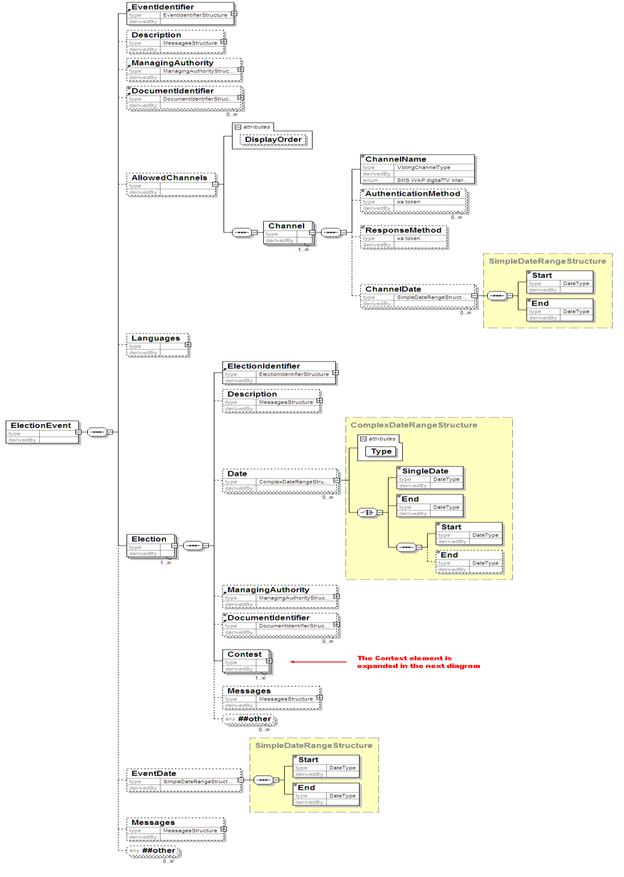
This schema is used for messages providing information about
an election or set of elections. It is usually used to communicate information
from the election organisers to those providing the election service.
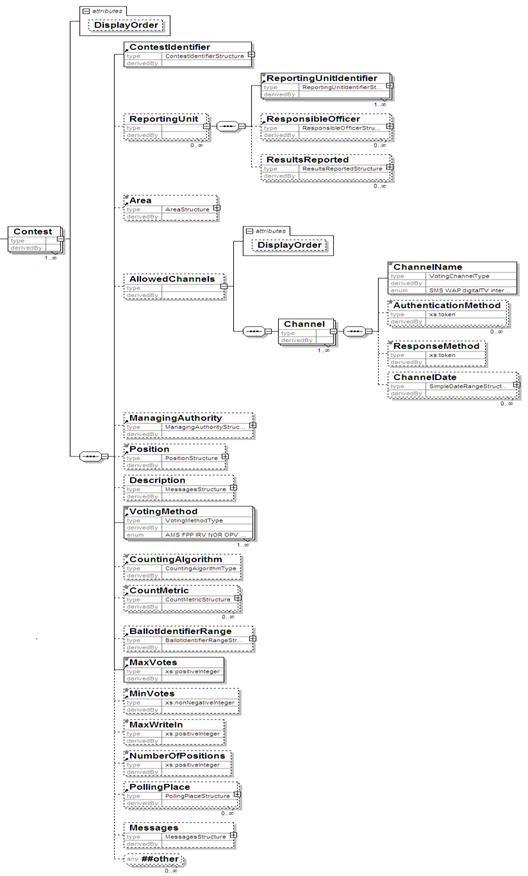
The message therefore provides information about the
election event, all elections within that event and all contests for each
election.
For the election event, the information includes the ID and
name of the event, possibly with a qualifier on the event. This qualifier is
used when an event has several local organisers. For example, for a UK general election, each constituency organises its own contests. The election event is
therefore the general election, whilst the qualifier would indicate the
constituency. Other information regarding an election event comprises the
languages to be used, the start and end dates of the event, potentially a list
of external documents that are applicable (such as the rules governing the
election), a description and information about the managing authority.
The managing authority can be indicated for the event, each
election, each contest within the election and each reporting unit.
An election can have a number of dates associated with it.
For example, there is likely to be a period allowed for nomination of
candidates and a date when the list of eligible voters is fixed. Each date can
be expressed as a single date when something happens, a start date, an end
date, or both start and end dates. These dates can be either just a date or
both a date and time using the subset of the ISO 8601 format supported by XML
Schema.
Like the event, an election can have both a managing
authority and referenced documents. Finally, there is a Messages
element for additional information.
A contest has a name and ID. It can also have reporting unit
identifiers. A contest may need to specify its geographical area independently
from its name, for which purpose the Area element is provided. Each contest can
specify the voting channels allowed. In general, the list of possible channels
will be further restricted as part of a local customisation. Each channel can
specify several methods for authenticating the voter, such as PIN and password,
and a response method, indicating the type of response to be given to a cast
vote. Finally, facilities are provided to indicate the dates and times when the
channel will be available to the voter.
As described previously, a contest can indicate its managing
authority. It may also indicate the position (such as ‘President’) for which
votes are being cast. The Description allows for additional text describing the
contest. Each contest indicates the voting method being used, whilst the CountingAlgorithm indicates the method of counting (such
as the d'Hondt or Meeks method) that will be used. The minimum and maximum
number of votes to be cast by each voter can also be indicated.
A list of polling places can be provided. These can be
either physical locations for people to go to vote, postal addresses for postal
votes or electronic locations. An ‘other location’ is also allowed for cases
where these do not meet the requirements. A location can also say when it will
be available. This is intended for mobile polling stations that will only be
available at a given address for a part of the voting period.
Finally, a Messages element
allows for additional information that might be communicated to the voter later
through other messages.
|
Error Code
|
Error Description
|
|
3110-001
|
The
allowed channels must not be declared at both the election event level
and the contest level.
|
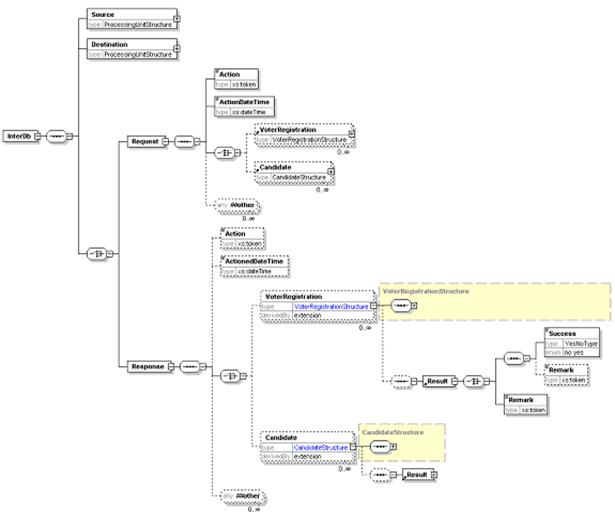
This schema is used for messages requesting services from
other electoral registers or candidate databases. This can, for example, be
used to de-dupe databases, check that a candidate in an election is only
standing in one contest or confirm that the proposers of a candidate are
included on a relevant electoral register. The schema is in two parts, so a
message will be either a request or a response.
Both request and response start by identifying the source
and destination as processing units.
A request has an Action code to
identify the request being made. Possible actions include, but are not limited
to, ‘add’, ‘delete’, ‘replace’, ‘confirm’ and ‘return’. The code ‘confirm’
returns success if the person indicated is included in the database. The code
‘return’ causes the receiving the database to return the full information for
the person identified. The ActionDateTime is used to
specify when the action should be carried out, and then there is an optional
list of voters or candidates.
A response has a similar structure. It could be that the
Action code is no longer required, so this is now optional. The TransactionID must match that given in the request. The
Result is either a binary Success flag or a remark or both. Again, there is a
date and time, but in this case it is the date and time at which the action
took place.
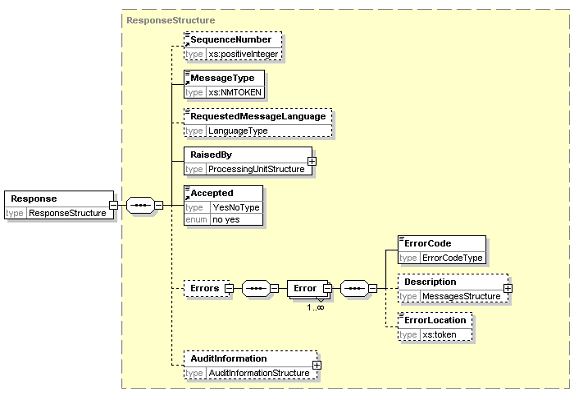
Some messages have a defined response message that provides
useful information. However, there is a need for a more general response,
either to indicate that a message has been accepted, or to indicate the reasons
for rejection.
The message includes information to identify the message to
which the response applies (by using the same transaction id in the EML element and, if necessary, including the sequence
number of the message to which the response applies in the Response element),
with information on the entity raising the message, whether the message was
accepted and information about the errors if it was not. The desired language
for a display message can also be included to allow a downstream processor to
substitute a language-specific error message if required.
If the message is reporting an error, the location of the
error within the message can be indicated. Usually, this will be an XPath to
the location of the error. However, errors detected by an XML parser may be in
a different format, such as a line number.
Note that a single response can be raised for a series of
sub-messages with the same transaction ID. This allows indication, for example,
that a sub-message was missing.
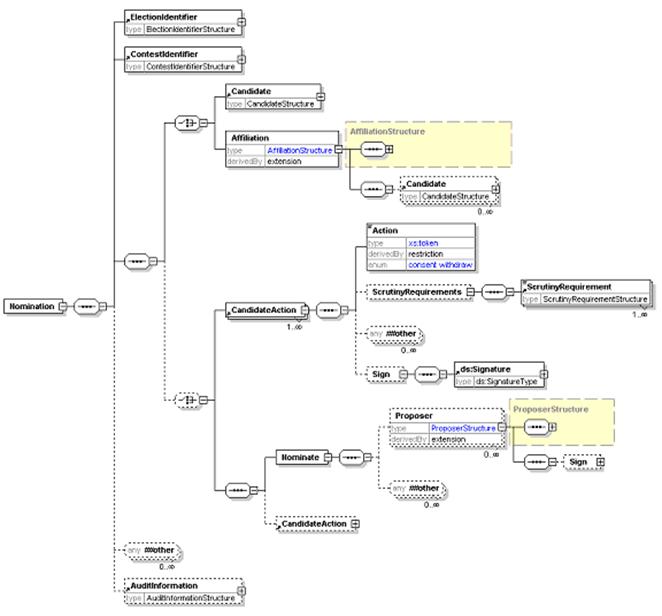
Messages conforming to this schema are used for four
purposes:
1.
nominating candidates in an election;
2.
nominating parties in an election;
3.
consenting to be nominated; or
4.
withdrawing a nomination.
Candidate consent can be combined in a single message with a
nomination of the candidate or party or sent separately.
Note that the message does not cover nomination for
referendums.
The election and contest must be specified. When a candidate
is being nominated, there must be information about the candidate and one or
more proposers. The candidate must supply a name. Optionally, the candidate can
provide contact information, an affiliation (e.g. a political party) and
textual profiles and election statements. These two items use the MessagesStructure to allow text in multiple languages.
There is also scope to add additional information defined by the election organiser.
The proposers use the standard proposer declaration with a
mandatory name and optional contact information and job title. Again,
additional information can be required.
If a party is being nominated, the primary proposer will be
the contact. Information on candidates in a party list can also be provided.
Candidates, either individuals or on a party list, must
define the action being taken and may provide scrutiny information. The
scrutiny requirements indicate how the candidate has met any conditions for
standing in this election. This could include indicating that a deposit has
been paid or providing a reference to prove that he or she lives in the
appropriate area. This information can be signed independently of the complete
message.
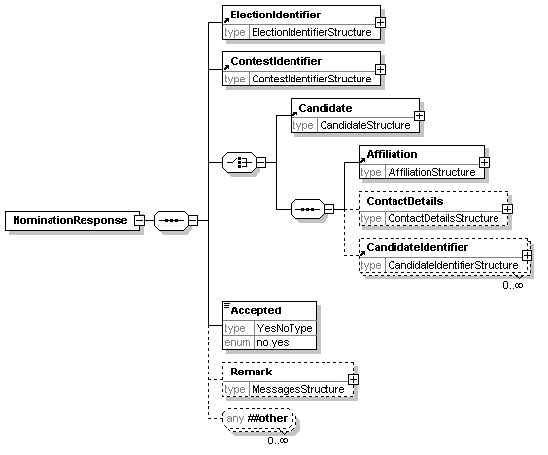
This message is sent from the election organiser to the
candidate or nomination authority for a party to say whether the nomination has
been accepted. Along with the acceptance information and the basic information
of election, contest and party and candidate names, the candidate's contact
details and affiliation can be included and a remark explaining the decision.
|
Error Code
|
Error Description
|
|
3220-001
|
If
the nomination has not been accepted, a reason for rejection is required
in the Remark element
|
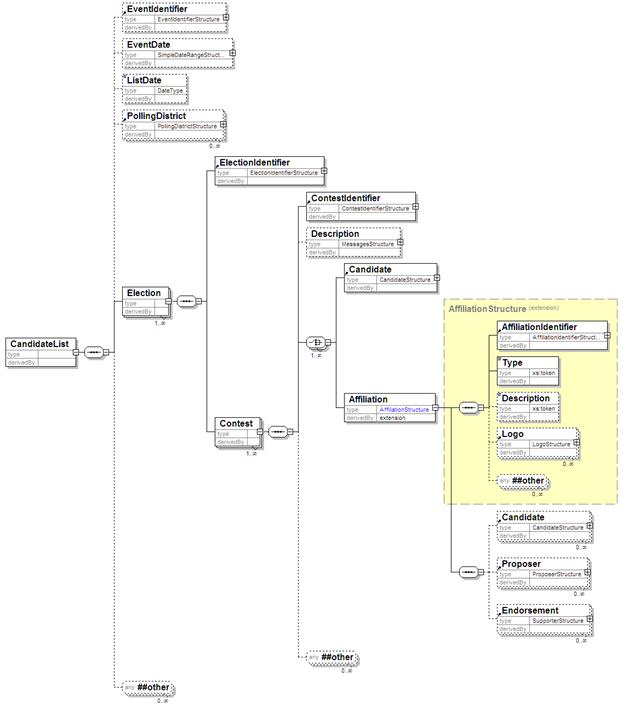
This schema is used for messages transferring candidate
lists for specified contests. It has the election event, election and contest
identifiers, and optionally the event dates and a contest description. The list
itself can be either a list of candidates, each with a name, address, optional
affiliation and other useful data, or a list of parties. In the latter case,
contact information and a list of candidates under a party list system can also
be included.
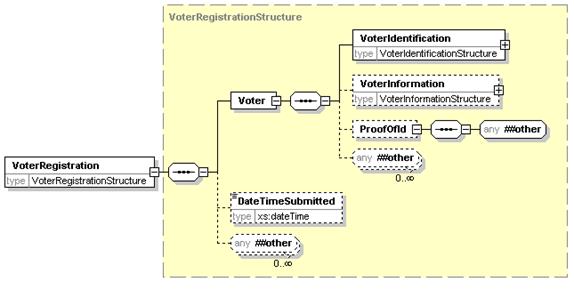
This schema is used for messages registering voters. It uses
the VoterIdentificationStructure. The VoterInformationStructure is used unchanged. Proof of ID can
be provided.
There is the facility for the transmission channel (for
example a trusted web site) to add the time of transmission.
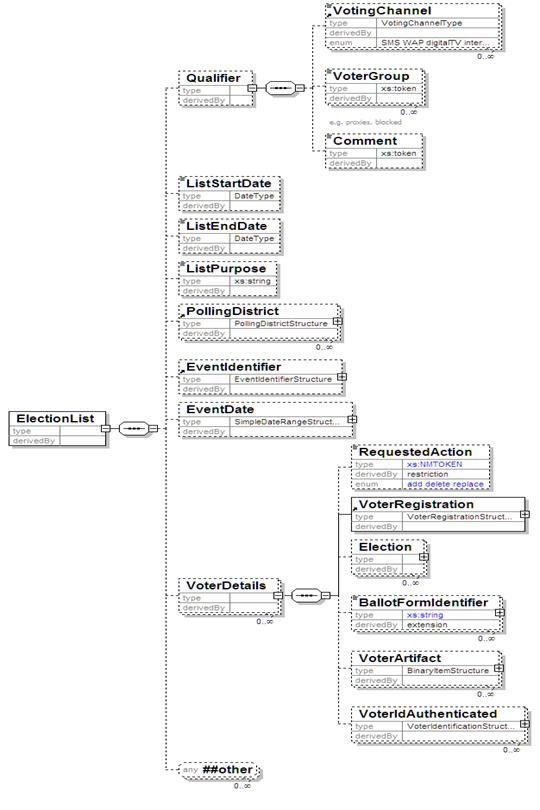
|
Element
|
Attribute
|
Type
|
Use
|
Comment
|
|
Blocked
|
Reason
|
xs:token
|
optional
|
|
|
|
Channel
|
VotingChannelType
|
optional
|
|
This schema is primarily used for messages communicating the
list of eligible voters for an election or set of elections. It can also be
used for any other purpose that involves the transfer of voter information
where the 120-interDB message is not appropriate. Partial lists are allowed
through the use of the Qualifier, Blocked and VoterGroup elements. So, for example,
a list of postal voters or a list of proxies can be produced. The schema can
also be used for filtered lists such as a list of postal proxies. These lists
sometimes do not contain any names meeting the filter so empty lists are
allowed.
For each voter, information is provided about the voter
himself or herself, and optionally about the elections and contests in which
the voter can participate. The information about the voter is the same as that
defined in the 310-voterregistration schema. Added to this can be a list of
elections, each identifying the election and the contest in which this voter is
eligible to vote, and the polling places available. Any voter can have a
Blocked element set against them with an optional Reason and Channel. This
allows a list to be produced for a polling place indicating those that have
already voted by another means or who have registered for a postal vote. It can
also be used if the complete electoral register must be transmitted (perhaps as
a fraud prevention measure) but some people on the register are no longer
eligible to vote.
|
Error Code
|
Error Description
|
|
3330-002
|
The
polling district can only be included for either the voter or the
election.
|
|
3330-003
|
The polling place can only be included for either the voter
or the election.
|
The Election element is expanded in the
next diagram
|
|

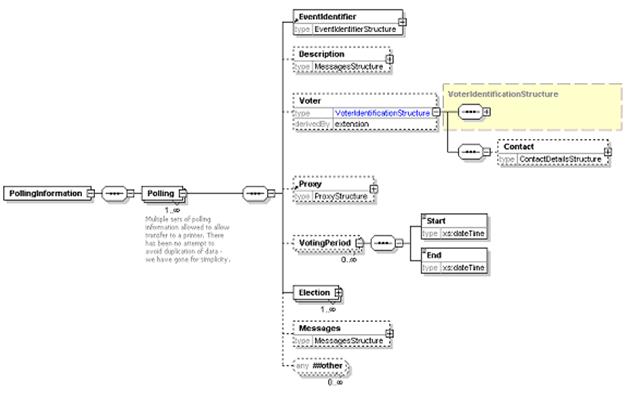

The BallotInformation element is expanded
in the next diagram
|
|
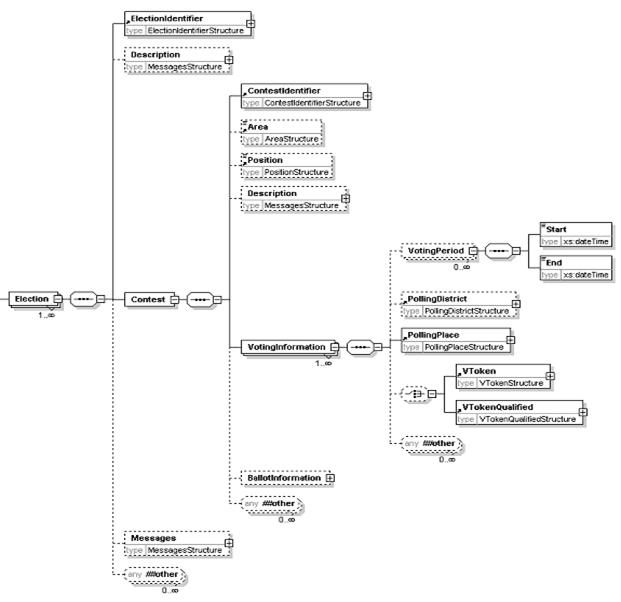
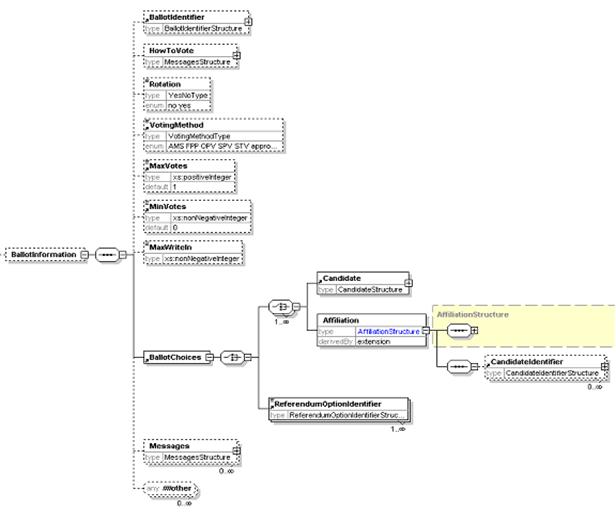
|
Element
|
Attribute
|
Type
|
Use
|
Comment
|
|
BallotChoices
|
Contested
|
YesNoType
|
optional
|
|
|
VotingPeriod
|
DisplayOrder
|
xs:positiveInteger
|
|
|
|
VotingInformation
|
DisplayOrder
|
xs:positiveInteger
|
optional
|
|
|
|
Channel
|
VotingChannelType
|
optional
|
|
The polling information message defined by this schema is
sent to a voter to provide details of how to vote. It can also be sent to a
distributor, so multiple sets of information are allowed. In the case of SMS
voting, ballot information may also be required, so this can be included.
Either one or several sets of polling information may be sent to each voter for
any election event.
Some information about the voter and any proxy may be
included, for example to print on a polling card. This can also include a
mailing address for a distributor to use.
Information about the elections and contests is included for
the benefit of the voter. For each voting channel, this includes where to vote
(which could be a polling station, address for postal voting, URL for Internet
voting, phone number for SMS voting etc) and the times that votes can be
placed. Use of the DisplayOrder attribute on these allows the display or
printing of information to be tailored from within the XML message.
Ballot information may be included if required. This is a
subset of the information defined in the 410-ballots schema. In this case, it
is likely that the short code for a candidate will be used for SMS voting. It
is possible that an expected response code will be provided as well. Both the
short code and expected response code may be tailored to the individual voter
as part of a security mechanism.
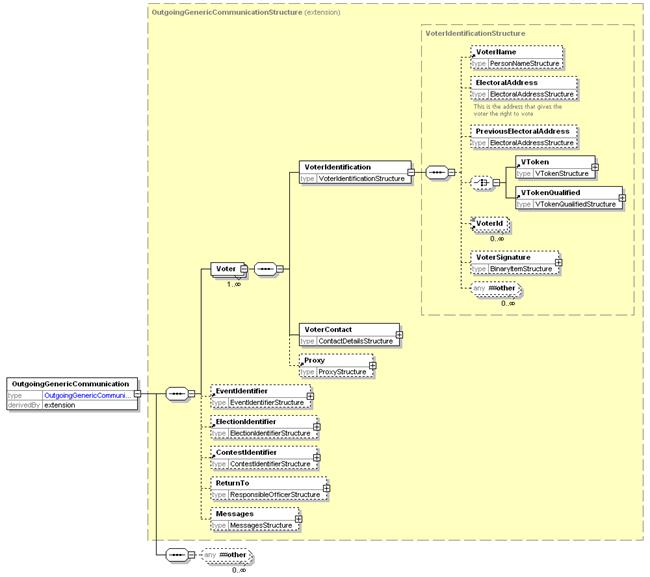
This schema provides a common structure for communications
to the voter. Individual message types can be designed based on extensions of
this schema.
The voter must always provide a name and might provide one
or more identifiers. These are shown as a restriction of the VoterIdentificationStructure,
the restriction being to leave out the VToken and VTokenQualified. Contact
details are also required, and it is expected that at least one of the allowed
contact methods will be included. Inclusion of proxy information is optional.
The identifiers for the election event, election and contest
are optional. There is then an element in which a message can be placed in any
of several different formats according to the channel being used.
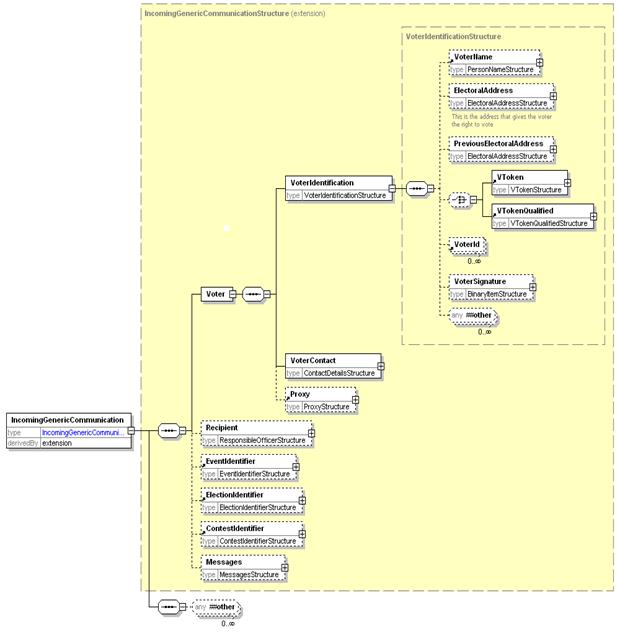
This schema provides a common structure for communications
from the voter. Individual message types can be designed based on extensions of
this schema.
The voter's name must be provided and there can be one or
more identifiers. These are shown as a restriction of the VoterIdentificationStructure,
the restriction being to leave out the VToken and VTokenQualified. Contact details are also required, and it
is expected that at least one of the allowed contact methods will be included.
Inclusion of proxy information is optional.
The identifiers for the election event, election and contest
are optional. There is then an element in which a message can be placed in any
of several different formats according to the channel being used.
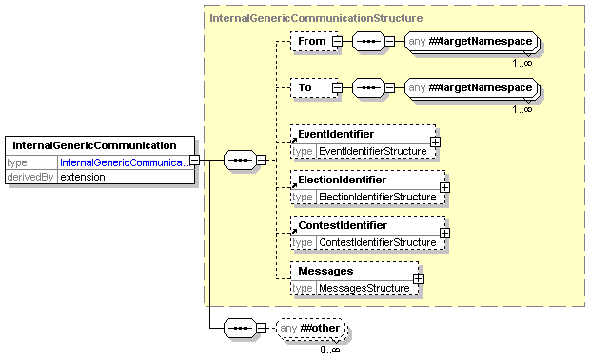
This schema provides a common structure for communications
between those involved in organizing an election. Individual message types can
be designed based on extensions of this schema.
There are optional To and From elements, which can contain any EML elements. It is
expected that these will usually be a responsible officer or a person's name
and contact information.
The identifiers for the election event, election and contest
are optional. There is then an element in which a message can be placed in any
of several different formats according to the channel being used.
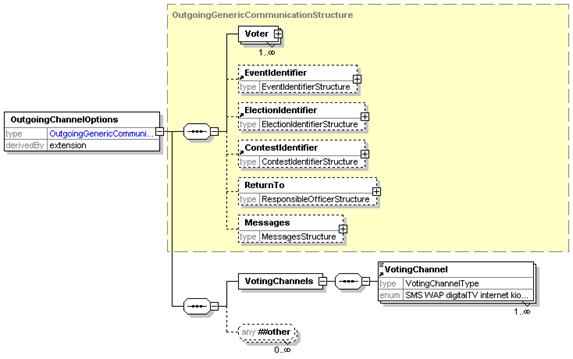
This schema is used for messages offering a set of voting
channels to the voter. It is an extension of schema 350a. A message conforming
to this schema will include a list of allowed channels, either to request
general preferences or for a specific election event or election within the
event.
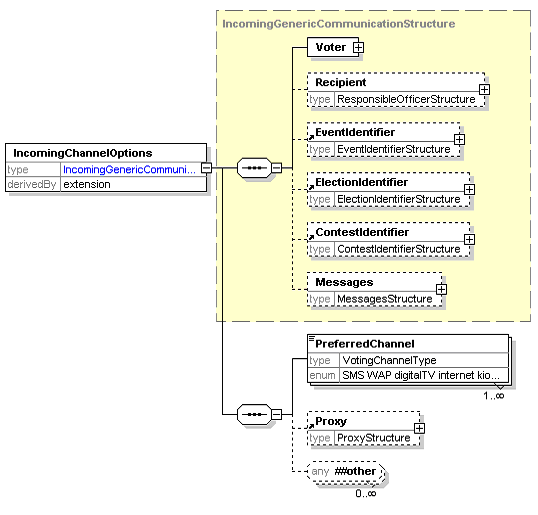
This schema is used for messages indicating one or more
preferred voting channels. It may be sent in response to 360a or as an
unsolicited message if this is supported within the relevant jurisdiction.
It is an extension of schema 350b, and indicates preferred
voting channels in order of preference.

The Contest element is expanded
below
|
|
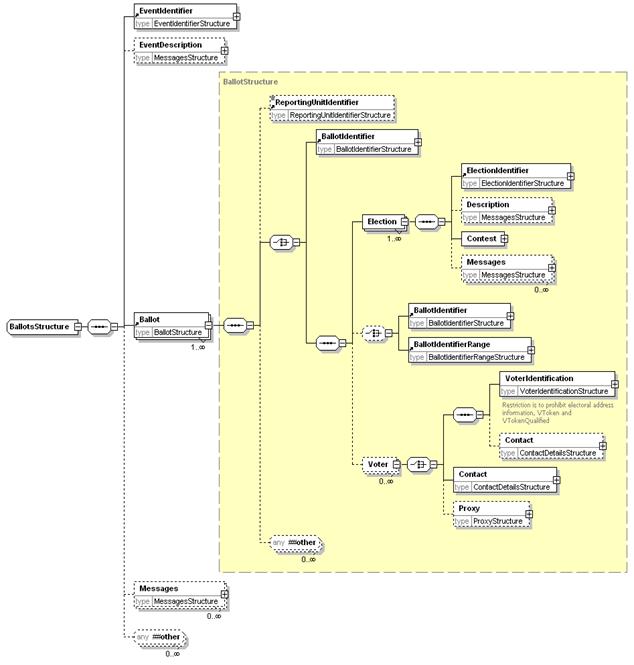
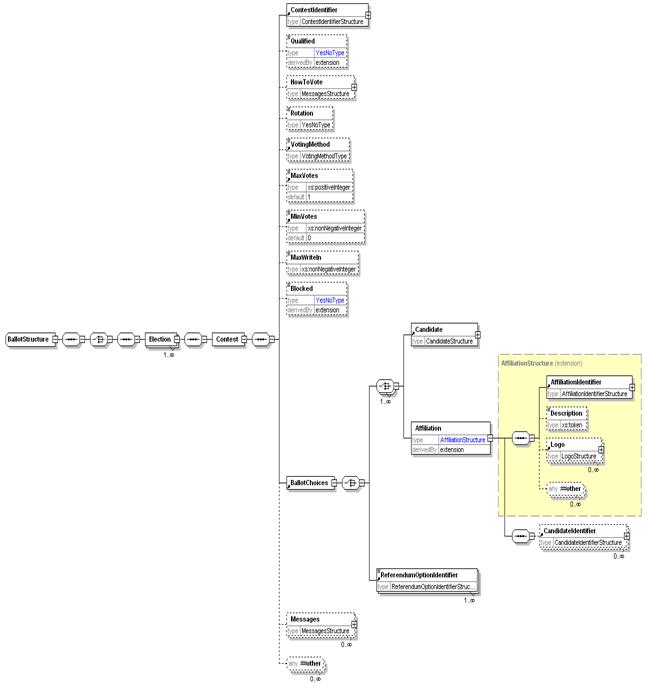
|
Element
|
Attribute
|
Type
|
Use
|
Comment
|
|
Contest
|
DisplayOrder
|
xs:positiveInteger
|
optional
|
|
|
|
Completed
|
YesNoType
|
optional
|
|
|
Qualified
|
Reason
|
xs:token
|
required
|
|
|
Blocked
|
Reason
|
xs:token
|
optional
|
|
|
|
Channel
|
VotingChannelType
|
optional
|
|
|
BallotChoices
|
Contested
|
YesNoType
|
optional
|
|
This schema is used for messages presenting the ballot to
the voter or providing a distributor with the information required to print or
display multiple ballots.
In the simplest case, a distributor can be sent information
about the election event and a ballot ID to indicate the ballot to print.
In other cases, the full information about the elections
will be sent with either an election rule ID to identify the voters to whom
that election applies or a set of voter names and contact information. If the
ballot is being sent directly to the voter, this information is not required.
Since printed ballot papers are likely to require a unique identifier printed
on them, the range to be used for each ballot type can be defined.
The election information starts with the election identifier
and description. This is followed by information related to the contest and any
other messages and information required. Note that each voter can only vote in
a single contest per election, so only a single iteration of the Contest
element is required.
A contest must have its identifier and a list of choices for
which the voter can vote. A voter can vote for a candidate, an affiliation (possibly
with a list of candidates) or a referendum proposal. There is also a set of
optional information that will be required in some circumstances. Some of this
is for display to the voter (HowToVote and Messages) and some controls the ballot and voting process
(Rotation, VotingMethod, MaxVotes, MinVotes, MaxWriteIn).
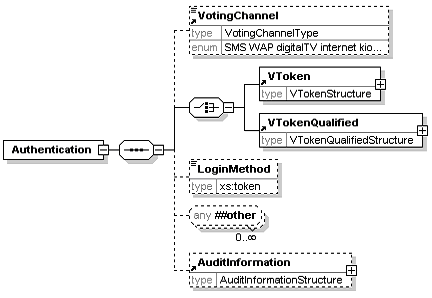
The authentication message defined by this schema may be
used to authenticate a user during the voting process. Depending on the type of
election, a voter's authentication may be required. The precise mechanism used
may be channel and implementation specific, and can be indicated using the LoginMethod element. In some public elections the voter
must be anonymous, in which case the prime method used for authentication is
the voting token. The voting token can contain the information required to
authenticate the voter's right to vote in a specific election or contest,
without revealing the identity of the person voting. Either the VToken or the VTokenQualified
must always be present in an authenticated message. The VotingChannel
identifies the channel by which the voter has been authenticated.
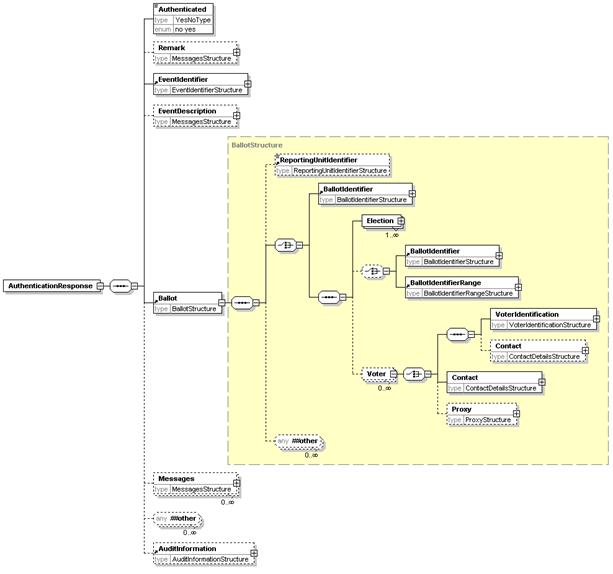
|
Element
|
Attribute
|
Type
|
Use
|
Comment
|
|
Contest
|
DisplayOrder
|
xs:positiveInteger
|
optional
|
|
|
|
Completed
|
YesNoType
|
optional
|
|
|
Qualified
|
Reason
|
xs:token
|
required
|
|
|
Blocked
|
Reason
|
xs:token
|
optional
|
|
|
|
Channel
|
VotingChannelType
|
optional
|
|
|
BallotChoices
|
Contested
|
YesNoType
|
optional
|
|
The authentication response is a response to message 420. It
indicates whether authentication succeeded using the Authenticated element, and
might also present the ballot to the user. This is a restriction of the Ballots
element to allow only a single ballot per reply.
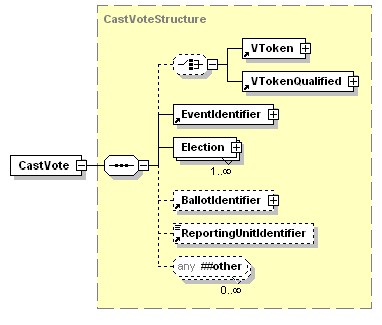
|
Element
|
Attribute
|
Type
|
Use
|
Comment
|
|
CastVote
|
Spoilt
|
xs:token
|
optional
|
|
|
Contest
|
Spoilt
|
xs:token
|
optional
|
|
|
Selection
|
Value
|
VotingValueType
|
optional
|
|
|
|
ShortCode
|
ShortCodeType
|
optional
|
|
|
Candidate
|
Value
|
VotingValueType
|
optional
|
|
This message represents a cast vote, which comprises an
optional voting token (which may be qualified) to ensure that the vote is being
cast by an authorized voter, information about the election event, each
election within the event and the vote or votes being cast in each election, an
optional reference to the ballot used, the identifier of the reporting unit if
applicable and a set of optional audit information.
For each election, the contest is identified, with a set of,
possibly sealed, votes. The votes are sealed at this level if there is a chance
that the message will be divided, for example so that votes in different
elections can be counted in different locations.
The selection of candidates, affiliations or a referendum
option uses the Selection element. If an election
requires preferences to be expressed between candidates, multiple Selection elements will be used, each of these having a
suitable Value attribute. Some elections allow
write-in candidates, and these are handled in a similar way. Preferences can also
be expressed between parties, using the Affiliation
element. The PersonalIdentifier is used in elections
where each voter is given an individual list of codes to indicate their
selection.
A more complex election might request the voter to vote for
a party, then express a preferences of candidates within the party. In this
case, the Affiliation element is used to indicate
the party selected, and multiple CandidateIdentifier
elements, each with a Value attribute are used to
express candidate preferences.
Preferences in a referendum are handled in the same way as
they are for candidates and parties, using the ReferendumOptionIdentifier.
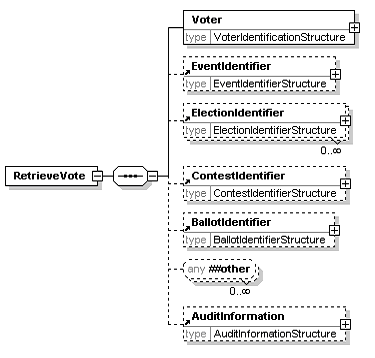
This message is used for voting systems that include a
pre-ballot box from which votes can be retrieved and amended before being
counted. When a vote is retrieved, it should be deleted from the pre-ballot
box.
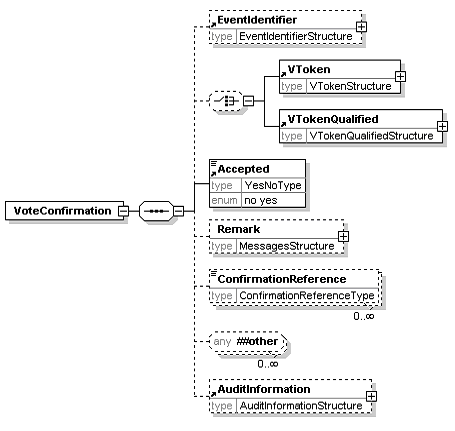
The vote confirmation message can be used to show whether a
vote has been accepted and provide a reference number in case of future
queries. Some voting mechanisms require multiple ConfirmationReference
elements. If the vote is rejected, the Remark element can be used to show a
reason.
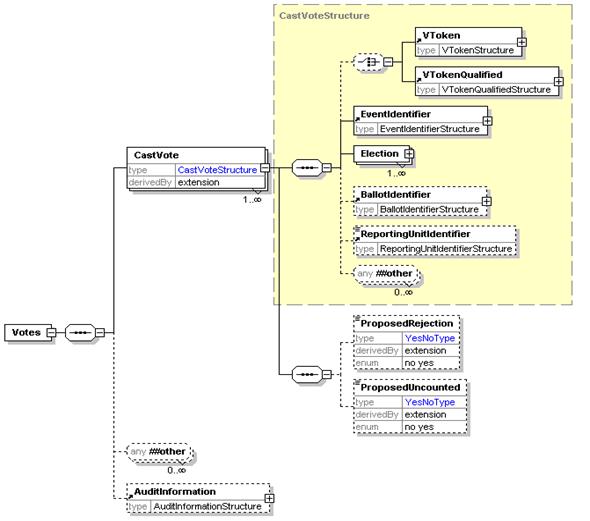
See 440-CastVote for the detail of the
CastVoteStructure.
|
Element
|
Attribute
|
Type
|
Use
|
Comment
|
|
CastVote
|
Spoilt
|
xs:token
|
optional
|
|
|
Contest
|
Spoilt
|
xs:token
|
optional
|
|
|
Selection
|
Value
|
VotingValueType
|
optional
|
|
|
|
ShortCode
|
ShortCodeType
|
optional
|
|
|
Candidate
|
Value
|
VotingValueType
|
optional
|
|
|
ProposedRejection
|
Reason
|
xs:token
|
optional
|
|
|
|
ReasonCode
|
xs:token
|
required
|
|
|
|
Objection
|
YesNoType
|
optional
|
|
|
ProposedUncounted
|
Reason
|
xs:token
|
optional
|
|
|
|
ReasonCode
|
xs:token
|
required
|
|
|
|
Objection
|
YesNoType
|
optional
|
|
This schema is used to define a message comprising a set of
votes being transferred for counting. It is a set of CastVote
elements from schema 440 with the addition of the ProposedRejection
and ProposedUncounted elements and audit information
for the voting system. If a vote is rejected, for example, because a voter has
chosen to spoil a ballot paper, many authorities will want to count that vote
as having been cast. The UncountedVotes element is
reserved for those cases where that record is not required, for example when
the result is thought to be fraudulent. A ProposedRejection
or ProposedUncounted element must have a ReasonCode attribute, and may have a Reason
attribute to describe the code. They may also have an Objection
attribute. This indicates that someone has objected to this vote being rejected
or the proposal that it should not be counted.
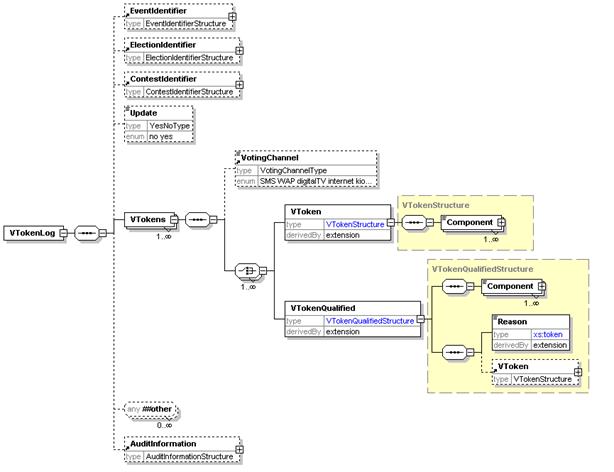
|
Element
|
Attribute
|
Type
|
Use
|
Comment
|
|
VToken
|
Status
|
xs:token (restricted)
|
required
|
|
|
VTokenQualified
|
Status
|
xs:token (restricted)
|
required
|
|
The message defined by this schema is used to add voting
tokens (which may be qualified) to an audit log. The VToken
or VTokenQualified is extended by the addition of a Status attribute with a value of voted or unvoted for the VToken and voted, unvoted and withdrawn for the VTokenQualified. In addition to sending single tokens as
they are used, the schema can be used to validate a message sending multiple
tokens optionally grouped by voting channel. This might be used instead of
sending tokens as they used or, for example, to send the unused tokens at the
end of an election. The Update element can be used
to indicate that an existing log is being updated rather than the message
containing a complete new log. The logging system can also be identified for
audit purposes.
The AuditInformation element is expanded
in the next diagram
|
|

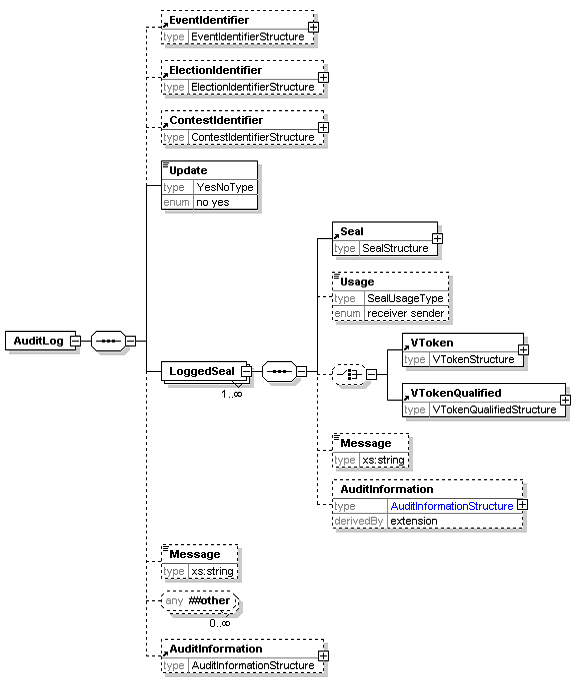
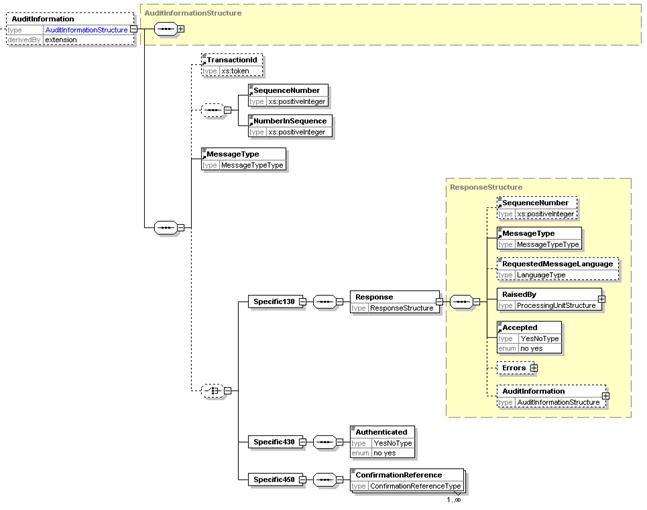
The message defined by this schema is used to log the use of each seal with associated
information for audit purposes.
An audit log message can be transmitted individually as the
message causing the log entry is sent or received, or the logs can be stored,
and several seals logged at once. Ideally, every device that can create or
consume a message will create a log entry so that pairs of entries can be
matched. The most important messages to log are those associated with the
voting process itself, and these are shown below.
When used in this message, the Response
element will not have an AuditInformation child.
The message may contain the name and ID of the event,
election and contest. It can also indicate whether this is an update to an
existing log or a new log. Following the logged seals, a text message can be
added as well as audit information for the audit logging message itself.
Each seal being logged must indicate whether the device
sending the log was the sender or receiver of the sealed message. It may be
accompanied by the voting token associated with the seal and possibly
additional audit information. This will be the audit information from the
message being logged with additional information about the message. Most of
this is common to all message types, but some message types require specific
audit information. One of these is the 130-response message. When this is used
to convey an error, almost the complete message payload (the Response element and its
contents apart from the audit information) is logged with the usual
message-independent data.
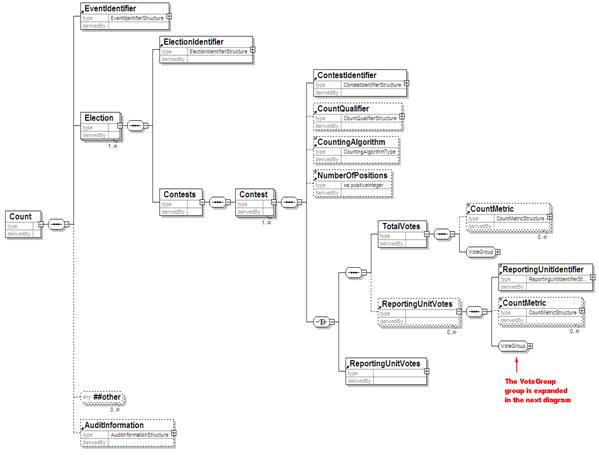
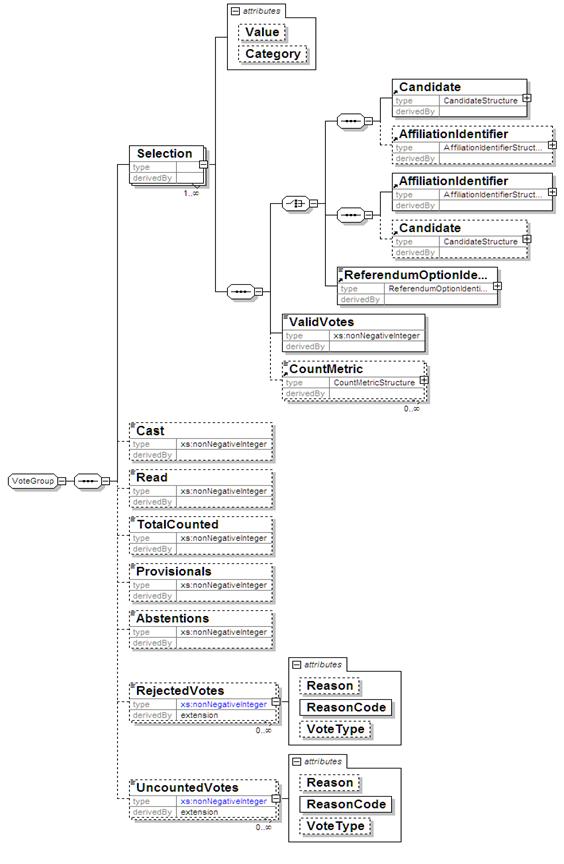
|
Element
|
Attribute
|
Type
|
Use
|
Comment
|
|
Selection
|
Value
|
VotingValueType
|
optional
|
|
|
RejectedVotes
|
Reason
|
xs:token
|
optional
|
|
|
|
ReasonCode
|
xs:token
|
required
|
|
|
UncountedVotes
|
Reason
|
xs:token
|
optional
|
|
|
|
ReasonCode
|
xs:token
|
required
|
|
The count message defined by this schema is used to communicate the
results of one or more contests that make up one or more elections within an
election event. It may also be used to communicate the count of a single
reporting unit for amalgamation into a complete count.
The message includes the election event identifier, and for
each election, the election identifier, an optional reference to the election
rule being used and information concerning the set of contests.
In some cases, reporting for a contest may be required at a
lower level (for example, for each county in a state). For this reason,
reporting may be done at the level of the reporting unit, the total votes, or
for a total vote and the breakdown according to the multiple reporting units.
Each contest indicates its identifier, and optionally the
counting system and the maximum number of votes that each voter could cast. The
key information is that about the votes cast for each of the choices available
and the numbers of abstentions and rejected and uncounted votes. If a vote is
rejected, for example, because a voter has chosen to spoil a ballot paper, many
authorities will want to count that vote as having been cast. The UncountedVotes element is
reserved for those cases where that record is not required, for example when
the result is thought to be fraudulent. Both the UncountedVotes and RejectedVotes elements have Reason (optional) and ReasonCode (mandatory) attributes to indicate why the
votes were treated as they have been. The former is a textual description, and
the latter a code.
For each choice available to the voter, the identifier and
number of valid votes are mandatory. The other information provided depends on
the type of election. For example, the Value
attribute of the Selection
element can be used to indicate whether a candidate was a first or second
choice in an election run under the single transferable vote system. In the
simplest cases, the identifier for the candidate (perhaps with the party), the
party or the referendum option is given. If the voter was able to vote for a
party and provide a preference for candidates within the party, the AffiliationIdentifier element
is used, and multiple CandidateIdentifier
elements may be used, each with a Count
attribute. This count is the result of whatever algorithm has been used to
calculate the ranking of the candidates.
This schema allows for Simulation and Extrapolation of
Counts and subsequently Results. Simulation being the facility to forecast the
result of a contest based on the result of another contest. Extrapolation is
the facility to forecast the final result of a contest based on the count so
far.
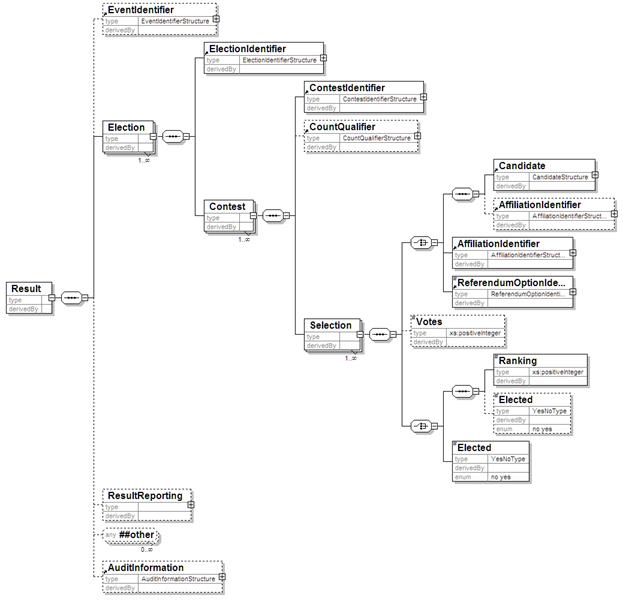
Messages described by this schema can be used to communicate the results of simple election
types. One specific use is to provide an input into the calculation algorithm
for elections using the additional member system.
The main part of the schema is held within the Selection element. This allows
a choice of candidate, affiliation or referendum option identifiers to be
defined with the position that choice achieved (first, second etc). Optionally,
the number of votes can be shown. A candidate can be associated with his or her
affiliation if required. Write in candidates will be shown in the same way as
other candidates, although they will only have an Id attribute if this is assigned in the election
system after the votes are cast.
This schema allows for Simulation and Extrapolation of
Results using data from Counts. Simulation being the facility to forecast the
result of a contest based on the result of another contest. Extrapolation is
the facility to forecast the final result of a contest based on the count so
far.
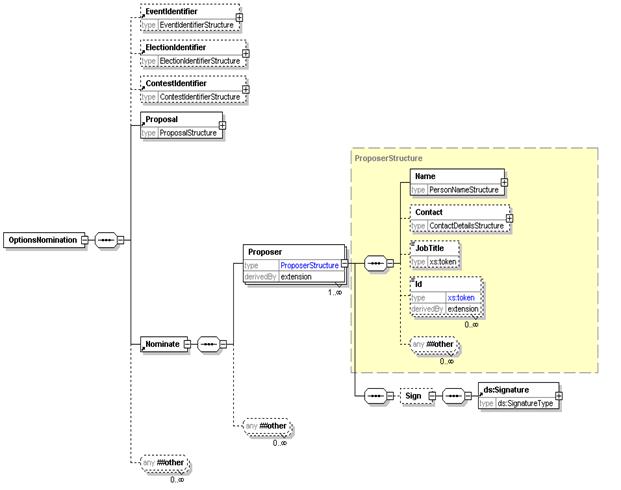
This schema is used to submit proposals, for example for a referendum or company AGM. It uses
the generic Proposal element to define the proposal itself. One of more proposers
can be named and may sign the nomination.
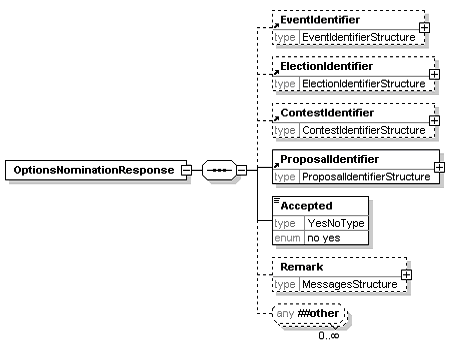
This message is sent from the election organiser to the proposer to
say whether the nomination has been accepted. Along with the acceptance information
and the basic information of election, contest and identifier for the proposal,
a remark can be made explaining the decision.
|
Error Code
|
Error Description
|
|
3620-001
|
If
the nomination has not been accepted, a reason for rejection is required
in the Remark element
|
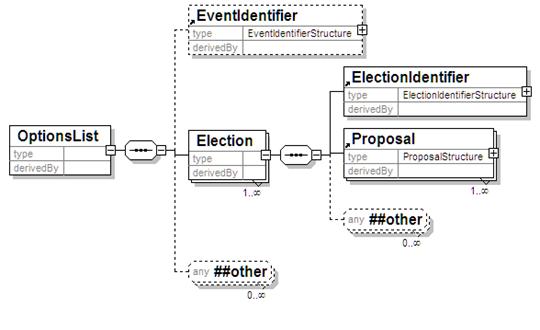
This schema is used for messages transferring lists of proposals for a referendum. It may
identify the election event, and provides details about the election. Each
proposal in a referendum counts as an election, so each election identified
will hold a single proposal.
The following individuals have participated in the creation
of this specification and are gratefully acknowledged:
Participants:
Charbel Aoun, Accenture
Siobhan Donaghy, OPT2VOTE Ltd
Bruce Elton, Oracle Corporation
Joseph Hall, University of California, Berkeley
Roy Hill, OPT2VOTE Ltd
John Ross, Associate
Paul Spencer, Associate
Johan Terryn, EDS
Bernard Van Acker, IBM
David Webber, Individual
Peter Zelechoski, Associate