The core role of CAM remains the same - defining, composing and validating XML
content. The version 1.1 of the CAM specification
seeks to simplify the original work and more clearly delimit
between core normative features and extended non-normative sections
and items. Also V1.1 builds from lessons learned over the
past two years in developing actual CAM templates. The new
approach aligns closely with common industry practice in
marshalling and unmarshalling XML content, the XML DOM and allows
the use of common XML tools, including rule engines, alongside the
CAM toolset. Consequently the CAM toolset now provides a
powerful set of typical XML scripted functional components that by
default are needed when exchanging XML business
transactions.
The XML scripting is designed to be obvious,
human readable and declarative. This means that the task of
providing rule-driven control mechanisms can become open and
re-usable across an ebusiness community of practice, not just for
localized internal point solutions. This is especially
important in today's web service environments to support the
concept of loose-coupling of service interfaces and their
associated transaction interchanges. We have also taken into
account the W3C and OMG work on rules.
The objective in releasing v1.1 is to provide
a foundation specification that is simple, clear and easy to
implement today. Whereas the new approach now allows integration
with specialized tools that link into backend database systems
and/or handles specialized structure formats, specialized error
handling mechanisms or provide engines for complex rule based
logic. In addition support for external context mechanisms are
provided to align with business process needs, such as the OASIS
ebBP/BPSS.
This approach is designed to separate the
common sharable needs from the in-house local specializations in a
coherent systematic way. This allows implementers to isolate
their own point development and still align with common community
practice and core business information handling structures and
rules.
Future extensions to the specification may
then build out and provide additional normative tools as extended
areas are better formalized and common industry practice
establishes itself. An example of the need to develop further
normalized specification parts include registry interfacing and
marshalling and unmarshalling to and from SQL content repositories.
Today these are provided by specialized tools and CAM provides a
formal extension mechanism and application programming interface
(API) for these non-normative needs.
Figure 1 - The implementation model for a
CAM processor
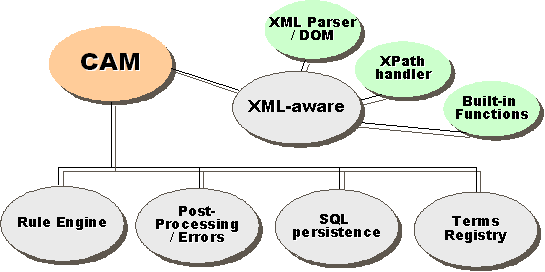
Referencing Figure 1 - the top-most XML-aware
functions are normative components required of a CAM processor to
support the core XML-scripting functionality. The lower
components are optional tools supported by the pluggable interface
that CAM v1.1 provides. Implementers can use local specialized
tools as determined by their specific application
environment. It is envisioned this implementation model can
be developed using a variety of modern programming languages and
the pluggable interface is supported by tools such as the Apache
Foundation Maven technology. This flexibility allows
for support of W3C Rule Interchange Format (RIF)
and OMG Production Rule Representation (PRR)
as applicable.
The key words "MUST", "MUST NOT", "REQUIRED",
"SHALL", "SHALL NOT", "SHOULD", "SHOULD NOT", "RECOMMENDED", "MAY",
and "OPTIONAL" in this document are to be interpreted as described
in RFC2119 (see abbreviation references below).
All text is normative unless otherwise
labelled.
-
XML Path Language (XPath) specifications document, version 1.0, W3C
Recommendation 16 November 1999, http://www.w3.org/TR/xpath/
-
Extensible Markup Language (XML) specifications document, version
1.1, W3C Candidate Recommendation, 15 October 2002, http://www.w3.org/TR/xml11/
-
XML Schema Definitions (XSD) - [XSD1]
XML Schema Part 1: Structures, W3C Recommendation 2
May 2001 http://www.w3.org/TR/xmlschema-1/
http://www.oasis-open.org/committees/download.php/6248/xsd1.html
[XSD2] XML
Schema Part 2: Datatypes, W3C Recommendation 2 May 2001
http://www.w3.org/TR/xmlschema-2/
http://www.oasis-open.org/committees/download.php/6247/xsd2.html
-
XNL: Specifications & Description Document, OASIS CIQ TC, http://www.oasis-open.org/committees/ciq
-
XAL: Specifications & Description Document, OASIS CIQ TC, http://www.oasis-open.org/committees/ciq
-
ISO 16642 - Representing data categories http://www.loria.fr/projets/TMF/
-
CEFACT - Core components specifications - http://webster.disa.org/cefact-groups/tmg/
-
Jaxen reference site - http://jaxen.org/
-
UN - eDocs resource site - http://www.unece.org/etrades/unedocs/
-
UN - Codelists reference site for eDocs - http://www.unece.org/etrades/unedocs/codelist.htm
Assembly model
A tree-structured model that
can be implemented as a document schema.
Class diagram
A graphical notation used by
[UML]
to describe the static structure of a system, including object
classes and their attributes and associations.
Component model
A representation of
normalized data components describing a potential network of
associations and roles between object classes.
Context
The circumstance or events
that form the environment within which something exists or takes
place.
Dependency
diagram
A refinement of a class
diagram that emphasizes the dependent associations between object
classes.
Document
A set of information
components that are interchanged as part of a business transaction;
for example, in placing an order.
Functional
dependency
A means of aggregating
components based on whether the values of a set of properties
change when another set of properties changes, that is, whether the
former is dependent on the latter.
Normalization
A formal technique for
identifying and defining functional dependencies.
Spreadsheet
model
A representation of an
assembly model in tabular form.
XSD schema
An XML document definition
conforming to the W3C XML Schema language [XSD1][XSD2].
The terms Core Component (CC),
Basic Core Component (BCC), Aggregate Core Component (ACC),
Association Core Component (ASCC), Business Information Entity
(BIE), Basic Business Information Entity (BBIE), and Aggregate
Business Information Entity (ABIE) if used in this specification
refer to the meanings given in [CCTS].
The terms Object Class,
Property Term, Representation Term, and Qualifier are used in this
specification with the meanings given in [ISO11179].
The keywords MUST, MUST NOT,
REQUIRED, SHALL, SHALL NOT, SHOULD, SHOULD NOT, RECOMMENDED, MAY
and OPTIONAL, when they appear in this document, are to be
interpreted as described in [RFC2119].
ABIE
Aggregate Business
Information Entity
ACC
Aggregate Core
Component
ASBIE
Association Business
Information Entity
ASCC
Association Core
Component
ASN.1
ITU-T X.680-X.683: Abstract
Syntax Notation One; ITU-T X.690-X.693: ASN.1 encoding
rules
http://www.itu.int/ITU-T/studygroups/com17/languages/X.680-X.693-0207w.zip
http://www.oasis-open.org/committees/download.php/6320/X.680-X.693-0207w.zip
BBIE
Basic Business Information
Entity
BCC
Basic Core
Component
BIE
Business Information
Entity
CC
Core Component
CCTS
UN/CEFACT ebXML Core
Components Technical Specification 2.01
http://www.untmg.org/downloads/General/approved/CEFACT-CCTS-Version-2pt01.zip
http://www.oasis-open.org/committees/download.php/6232/CEFACT-CCTS-Version-2pt01.zip
EAN
European Article Numbering
Association
EDI
Electronic Data
Interchange
ISO
International Organization
for Standardization
ISO11179
ISO/IEC 11179-1:1999
Information technology - Specification and standardization of data
elements - Part 1: Framework for the specification and
standardization of data elements
http://www.iso.org/iso/en/ittf/PubliclyAvailableStandards/c002349_ISO_IEC_11179-1_1999(E).zip
http://www.oasis-open.org/committees/download.php/6233/c002349_ISO_IEC_11179-1_1999%28E%29.pdf
JSDF
Java Simple Date Format
library
NDR
UBL Naming and Design Rules
(see Appendix B.4)
RFC2119
Key words for use in
RFCs to Indicate Requirement Levels
http://www.faqs.org/rfcs/rfc2119.html
http://www.oasis-open.org/committees/download.php/6244/rfc2119.txt.pdf
S. Bradner, Key words for use in RFCs
to Indicate Requirement Levels, http://www.ietf.org/rfc/rfc2119.txt,
IETF RFC 2119, March 1997.
UML
Unified Modeling Language [UML]
Version 1.5 (formal/03-03-01)
http://www.omg.org/docs/formal/03-03-01.pdf
http://www.oasis-open.org/committees/download.php/6240/03-03-01.zip
UN/CEFACT
United Nations Centre for
Trade Facilitation and Electronic Business
XML
Extensible Markup Language [XML] 1.0
(Second Edition),W3C Recommendation 6 October 2000
http://www.w3.org/TR/2000/REC-xml-20001006
http://www.oasis-open.org/committees/download.php/6241/REC-xml-20001006.pdf
XSD
W3C XML Schema Language [XSD1]
[XSD2]
These specifications make use of W3C
technologies, including the XML V1.0, XML namespaces, W3C Schema
V1.0 (XSD) with W3C Schema data types V1.0, and XPath 1.0
recommendations. It should be noted that only a subset
of the XPath technology, specifically the locator sections of the
XPath specification are utilized. Explicit details of XPath syntax
are provided in the body of this specification. A schema
definition is provided for the assembly mechanism structure.
Knowledge of these technologies is required to interpret the XML
sections of this document.
Figure 2 - Deploying CAM Technology -
Context Driven Assembly
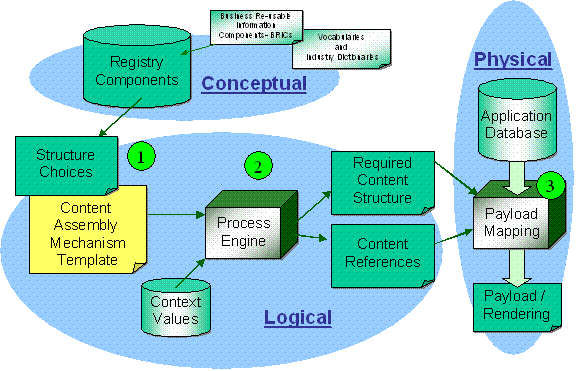
In reference to Figure 2 - Deploying CAM Technology - Context Driven
Assembly, item 1 is the subject of this section, describing
the syntax and mechanisms. Item 2 is a process engine
designed to implement the CAM logic as an executable software
component, and similarly item 3 is the application XML marshalling
and unmarshalling component that links the e-business software to
the physical business application software and produces the
resultant transaction payload for the business process
needs.
Figure 3 - Deploying CAM technology -
Context Driven Validation
Figure 4 - Deploying CAM technology -
Defining Content Rules and Structures
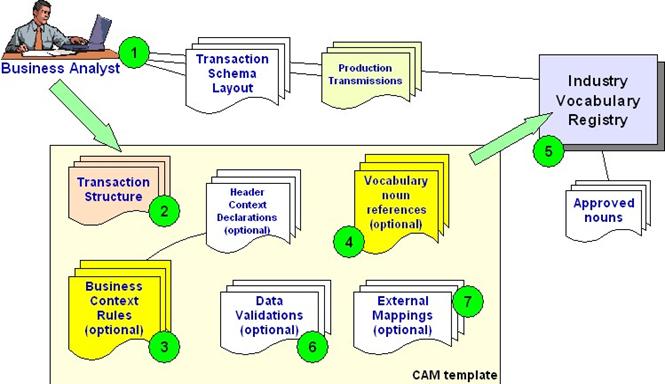
Referencing Figure 4 above the business
analyst examines the business transaction schema layouts (#1), the
sample production transmissions, and references the industry
vocabulary dictionary. Using the CAM template the actual
transaction structure required (#2) is defined. This may
optionally contain additional context rules (#3) that direct CAM
processing based on variables and values (the header section can
contain global context declarations). Then noun references may also
be created (#4) that cross-reference between the structure elements
(#2) and the registry dictionary (#5) and the approved industry
noun definitions. Optionally local application validation
rules (#6) may also be added that test specific local requirements
and also optional (#7) is the application mappings (such as
database table columns). Used in this role the CAM template
captures the information exchange details in an XML template that
can then be shared and referenced between partners and agreed to as
the business information requirements.
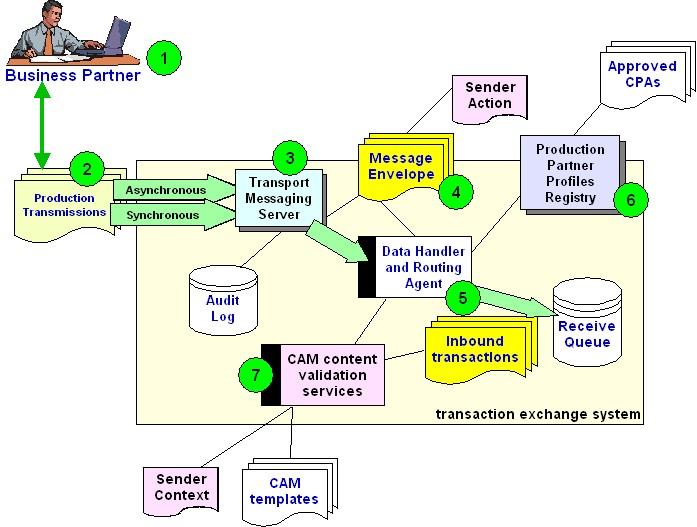
The tools from both Figure 3 and Figure 4 can
also be deployed interactively via a web browser interface to allow
partners to pre-test, and / or, self-certify prior to production
message exchanges being sent. This can provide online interactive
tools where sample XML transactions can be tested by upload to a
CAM validation tool that applies the selected template and reports
online any errors detected.
The CAM itself consists of four logical
sections and the CAM template is expressed in XML syntax.
This is shown in figure 5 as high-level XML structure parent
elements.
Figure 5 - High-level parent elements of
CAM (in simple XML syntax)
<CAM CAMlevel="1" version="1.1">
<Header>
<AssemblyStructure/>
<BusinessUseContext/>
<Extension/> <!-Optional,
repeatable -->
</CAM>
The structure sections provide the core of the
publically agreed interchange definition between exchange partners
- Assembly Structure(s), and Business Use Context
Rules. Then the internal pre- or post processing can be
referenced as local include extensions as needed for
specializations.
The optional extensions and includes are
envisioned to support specialized non-normative handling that in
the prior CAM specification functionality included items such
as Content References (with optional associated data
validation), extended Data Validations including rule agents
and marshalling/unmarshalling content via External
Mappings. These process needs are now retained as future
potential normative items that are still evolving and described in
a non-normative companion document to the main V1.1 specification
as Appendix B.
Figure 6 - Structure for entire CAM syntax at
a glance next shows the
complete v1.1 specification hierarchy for CAM at a
glance.
The CAM header it should be
noted has built-in support for compatibility levels within the
specification to both aid in implementation of the CAM tools, and
also to ensure interoperability across versions.
This is controlled via the
CAMlevel attribute of the CAM root element. More details on
the CAM implementation levels and features are provided in advanced
options section later.
Figure 6 - Structure for entire CAM syntax
at a glance
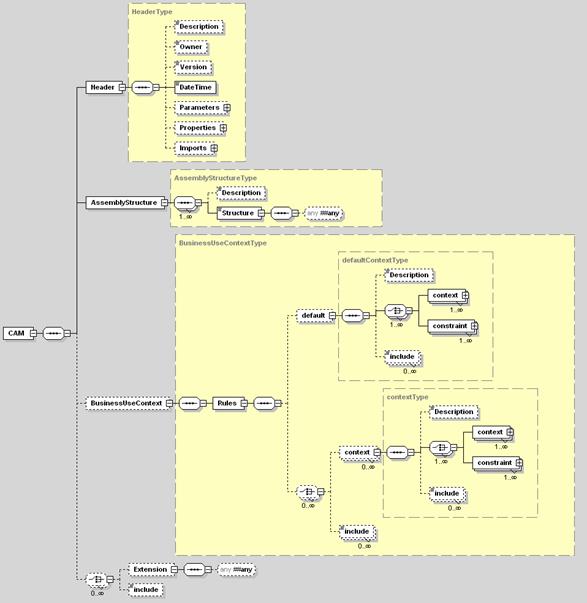
Each of the parent items is now described in
detail in the following sub-sections, while the formal schema
definition for CAM is provided at the OASIS web site in machine
readable Schema format XSD syntax. While the documented
schema provides a useful structural overview, implementers should
always check for the very latest version on-line at the
docs.oasis-open.org/cam area to ensure conformance and compliance
to the latest explicit programmatic details.
The next sections describe each parent element
in the CAM in sequence, their role and their implementation
details.
The purpose of the Header
section is to declare properties and parameters for the CAM process
to reference. There are three sub-sections: parameters,
properties and imports. Within the main header there are
elements that allow documenting of the template description, owner,
assigning of a version number and providing a date/time
stamp. These are used for informational purposes only and
maybe used by external processes to verify and identify that a
particular CAM template instance is the one required to be
used.
This section allows
parameters to be declared that can then be used in context specific
conditions and tests within the CAM template itself. These
can either be substitution values, or can be referencing external
parameter values that are required to be passed into this
particular CAM template by an external process. CAM uses the
$name syntax to denote external parameter references where required
in the CAM template statements. External parameters can be
passed using the CAM context mechanism (see later section on
Advanced Features support).
This item is non-normative,
level 2.
When processing documents
it is often expedient to have access to the system time. This
would allow checks against that time to be made and therefore
validation to check for example that delivery dates are in the
future. To do this CAM defines the following pseudo
variables.
·
$date - this gives today's date in the format
YYYY-MM-DD
·
$time - this gives the time at the start of
processing the incoming file in the format HH:MI:SS
·
$dateTime - this is a combination of the
previous variables in the format YYYY-MM-DDTHH:MI:SS
These variables should be
set by the processor at the start of processing for each incoming
document.
In addition there is a need
for date math functions to be provided to allow checks against the
current time and date and also between date fields. The
following is considered a minimal set that may be
provided.
These functions compare a
field with the date or time of the validation:
·
dateAfterNow(xpath,dateMask)
·
timeAfterNow(xpath,timeMask)
·
dateBeforeNow(xpath,dateMask)
·
timeBeforeNow(xpath,timeMask)
The following functions
allow either a positive or negative integer, which represents
either days or hours to be added to Now:
·
dateAfterDays(xpath,dateMask,numofdays)
·
timeAfterHours(xpath,dateMask,numofhours)
·
dateBeforeDays(xpath,dateMask,numofdays)
·
timeBeforeHours(xpath,dateMask,numofhours)
The following functions
allow comparison between two fields:
·
after(xpath,mask,xpath,mask)
·
before(xpath,mask,xpath,mask)
This item is non-normative,
level 2.
These allow creation of
shorthand macros that can be referenced from anywhere in the
remainder of the CAM template using the ${macroname} reference
method. This is designed to provide an easy way to
maintain references to external static URL values
particularly. It can also be used to define shorthand for
commonly repeated blocks of syntax mark-up within the CAM template
itself, such as a name and address layout, or a particular XPath
expression.
This item is non-normative,
level 2.
The import reference allows
the CAM processor to pre-load any reference links to external files
containing syntax to be included into the CAM template. It also
allows the external path of that include file to be maintained in
just one place in the template; making easier maintenance if this
is re-located. In addition this then allows an
<include> statement within the CAM template to reference the
import declaration and select a particular sub-tree of content
syntax to insert at that given point (using an XPath statement to
point to the fragment within the overall import file). This
also allows the included content to be done by using just one large
file, instead of multiple small files.
The include statements
would have the format:
<as:include>$importname/xpath</as:include>
An example with an import declared as
'common_rules' would be as follows:
<as:include>$common_rules//as:BusinessUseContext/as:Rules/as:default</as:include>
This example will load any
default rules from the 'common_rules' CAM Template into the current
template.
The next section begins
describing the main processing associated with the CAM
template.
The purpose of the
AssemblyStructure section is to capture the required content
structure or structures that are needed for the particular business
process step (i.e. one business process step may have more or more
structures it may contextually need to create). This section
is designed to be extremely flexible in allowing the definition of
such structures. The current V1.x series of the specification
uses simple well-formed XML throughout to illustrate the
usage. Later releases of the CAM specification consideration
will be made to allow any fixed structured markup as potentially
being utilized as an assembly structure, such as DTD, Schema,
EDI,
or other (typically they will be used as substitution structures
for each other). It is the responsibility of the implementer
to ensure that all parties to an e-business transaction interchange
can process such content formats where they are applicable to them
(of course such parties can simply ignore content structures that
they will never be called upon to process).
Notice also that typically
a single business process with multiple steps would be expected to
have multiple CAM templates, one for each business process
step. While it is also possible to provide a single CAM
template with multiple structures for a business process with
multiple steps, this will likely not work unless the business
transaction for each step is essentially the same (since the
content reference section and context rules section would have to
reference potentially extremely different
structures).
Using single CAM templates
per step and transaction structure also greatly enhances re-use of
CAM templates across business processes that use the same structure
content, but different context.
The formal structure rules for
AssemblyStructure are expressed by the syntax in 0 below. The
Figure 7 - Example of Structure and format for AssemblyStructure
here shows a simple example for an AssemblyStructure using a single
structure for content.
Figure 7 - Example of Structure and format
for AssemblyStructure
<Header>
<Description>Example 4.2.1 using
structures</Description>
<Version>0.05</Version>
</Header>
<AssemblyStructure>
<Structure taxonomy="XML"> //XML is
the only allowed value for Version 1.1
<!-- the physical structure of the required
content goes here, and can be a schema instance, or simply
well-formed XML detail, see example below in Figure 8 -->
</Structure >
</AssemblyStructure>
In the basic usage, there
will be just a single structure defined in the AssemblyStructure /
Structure section. However, in the more advanced use,
multiple substitution structures may be provided and use of include
directives. These can also be included from external sources, with
nesting of assemblies; see the section below on Advanced Features
for details. Also a mechanism is provided to select a
structure based on an XPath reference to content within an XML
instance.
To provide the direct means
to express content values within the structure syntax the following
two methods apply. A variable substitution value for an
element or attribute is indicated by text that must start and
end with a '%'sign, for example '%Description%'; or simply %% where
no indicative content is preferred. Any other value is assumed to
be a fixed content value. Figure 8 -
Substitution and fixed parameters values, with a well-formed XML
structure shows examples of this technique.
Figure 8 - Substitution and fixed
parameters values, with a well-formed XML structure
<Header>
<Description>Example 4.2.2 Well-formed XML
structure</Description>
<Version>1.0</Version>
<as:Parameters>
<as:Parameter name="DeliveryCountry"
values="USA|Mexico|Canada|Europe "
use="Global"
default="USA"/>
</as:Parameters>
</Header>
<AssemblyStructure>
<Structure taxonomy="XML"
ID="SoccerGear">
<Items CatalogueRef="2006">
//Fixed Value
<SoccerGear>
<Item>
<RefCode>%000_00_0000%</RefCode> //
Value subject to rules
<Description>%any text
line%</Description>
<Style>WorldCupSoccer</Style>
<UnitPrice>%amount%</UnitPrice>
</Item>
<QuantityOrdered>%integer%</QuantityOrdered>
<SupplierID>%%</SupplierID>
<DistributorID>%%</DistributorID>
<OrderDelivery>Normal</OrderDelivery>
<DeliveryAddress>
<USA>
// details of address
here
</USA>
<Mexico>
// details of address here
</Mexico>
<Canada> //
details of address here
</Canada>
<Europe> //
details of address here
</Europe>
</DeliveryAddress>
</SoccerGear>
</Items>
</Structure>
</AssemblyStructure>
Referring to Figure 8 - Substitution and fixed parameters values,
with a well-formed XML structure, the "2006", "WorldCupSoccer" and
"Normal" are
fixed values that will always appear in the payload transaction at
the completion of the CAM processing of the content.
In addition to the XML
markup, within the AssemblyStructure itself may optionally be
included in-line syntax statements. The CAM system provides
the BusinessUseContext section primarily to input context rules
(see section below), however, these rules may be optionally
included as in-line syntax in the AssemblyStructure. However,
all rules where present in the BusinessUseContext section take
precedence over such in-line syntax rules.
The next section details
examples of in-line context rules.
3.4 Business Use Context Rules
Figure 9 - The Assertion predicates for
BusinessUseContext
|
excludeAttribute()
|
useAttribute()
|
|
excludeElement()
|
useChoice()
|
|
excludeTree()
|
useElement()
|
|
makeOptional()
|
useTree()
|
|
makeMandatory()
|
useAttributeByID()
|
|
makeRepeatable()
|
useChoiceByID()
|
|
setChoice()
|
useElementByID()
|
|
setId()
|
useTreeByID()
|
|
setLength()
|
startBlock()
|
|
setLimit()
|
endBlock()
|
|
setValue()
|
checkCondition()
|
|
setDateMask()
|
makeRecursive()
|
|
setStringMask()
|
setUID()
|
|
setNumberMask()
|
restrictValues()
|
|
datatype() or
setDataType()
|
restrictValuesByUID()
|
|
setRequired()
|
orderChildren()
|
|
allowNulls()
|
setDefault()
|
|
|
setNumberRange()
|
Each predicate provides the
ability to control the cardinality of elements within the structure, or whole pieces of the structure
hierarchy (children within parent).
An example of such context
rules use is provided below, and also each predicate and its'
behaviour is described in the matrix in figure 4.3.3 below.
Also predicates can be used in combination to provide a resultant
behaviour together, an example is using makeRepeatable() and
makeOptional() together on a structure member.
Note that the
BusinessUseContext section controls use of the structure, while if
it is required to enforce explicit validation of content, then
there is also the non-normative DataValidations section that
provides the means to check explicitly an element to enforce
content rules as required. See below for details on
this section. This validation section is also further described in
the advanced use section since it can contain extended
features.
Predicates that affect the
definition are applied using the following precedence rules.
The lower numbered rules are applied first and can be overridden by
the high numbered rules.
Figure 10 - Syntax example for
BusinessUseContext
<BusinessUseContext>
<Rules>
<default>
<context>
<!-- default structure constraints -->
<constraint
action="makeRepeatable(//SoccerGear)" />
<!-- type 1
Xpath-->
<constraint
action="makeMandatory(//SoccerGear/Items/*)" />
<constraint
action="makeOptional(//Description)" />
<constraint
action="makeMandatory(//Items@CatalogueRef)" />
<constraint
action="makeOptional(//DistributorID)" />
<constraint
action="makeOptional(//SoccerGear/DeliveryAddress)" />
</context>
</default>
<context
condition="//SoccerGear/SupplierID = 'SuperMaxSoccer'">
<!-- type 2
Xpath-->
<constraint
action="makeMandatory(//SoccerGear/DeliveryAddress)"/>
</context>
<context
condition="$DeliveryCountry = 'USA'">
<!-- type 3 Xpath using
parameter DeliveryCountry-->
<constraint
action="useTree(//SoccerGear/DeliveryAddress/USA)"/>
</context>
</Rules>
</BusinessUseContext>
Referring to the XPath
expressions in Figure 10 - Syntax example for
BusinessUseContext, examples of all three types of
expression are given to show how the XPath expressions are
determined and used. For external control values the special
leading $ indicator followed by the variable name denotes a
substitution value from a context reference variable that is
declared in the CAM template header.
Referring to Figure 11 - Matrix of predicates for BusinessUseContext
declarations) below, the following
applies:
Figure 11 - Matrix of predicates for BusinessUseContext
declarations
|
Predicate
|
Parameter(s)
|
Description
|
|
excludeAttribute()
|
//elementpath@attributename
|
Conditionally exclude
attribute from structure
|
|
excludeElement()
|
//elementpath
|
Conditionally exclude
element from structure
|
|
excludeTree()
|
treepath
|
Conditionally exclude a
whole tree from structure
|
|
makeOptional()
|
//elementpath
|
Conditionally allow part of
structure to be optional
|
|
makeMandatory()
|
//elementpath
|
Conditionally make part of
structure required
|
|
makeRepeatable()
|
//elementpath
|
Conditionally make part of
structure occur one or more times in the content
|
|
setChoice()
|
//elementpath
|
Indicate that the first
level child elements below the named elementpath are actually
choices that are conditionally decided with a useChoice() predicate
action
|
|
setId()
|
//elementpath,IDvalue
|
Associate an ID value with
a part of the structure so that it can be referred to directly by
ID
|
|
setLength()
|
//memberpath, value
|
Control the length of
content in a structure member
|
|
setLength()
|
//memberpath,
[minvalue-maxvalue]
|
Control the length of
content in a structure member, allows two factors for range of
lengths.
|
|
setLimit()
|
//elementpath,
count
|
For members that are
repeatable, set a count limit to the number of times they are
repeatable
|
|
setDateMask()
setStringMask()
setNumberMask()
|
//memberpath, [mask |
masklist]
or
//memberpath, [mask |
masklist]
|
Assign a CAM picture mask
to describe the content. The mask can also set explicit
datatype of an item as well using the first parameter of the mask
accordingly (default is string if datatype parameter omitted).
Masklist allows an optional list of masks to be provided as well as
one single mask.
|
|
datatype()
or
setDatatype()
|
//memberpath, value
|
associate datatype with
item, valid datatypes are same as W3C datatypes. If a
setMask() statement is present for the item, this statement will be
ignored.
|
|
setRequired()
|
//elementpath,value
|
For members that are
repeatable, set a required occurrence for the number of members
that must at least be present (nnnn must be greater than
1).
|
|
setValue()
|
//memberpath, value
|
Place a value into the
content of a structure
|
|
setValue()
|
//memberpath,
[valuelist]
|
Place a set of values into
the content of a structure (allows selection of multiple values of
member items).
|
|
as:datetime()
Non-Normative,level
2
|
date-picture-mask
date-picture-mask +
P7D
date-picture-mask -
P30D
|
Allows variables to contain
computed date values for use in rule comparisons or setting event
timings (value is returned from system clock of server)
|
|
setUID()
Non-Normative,level
2
|
//memberpath, alias,
value
|
Assign a UID value to a
structure element. Alias must be declared in registry
addressing section of ContentReferences).
|
|
restrictValues()
|
//memberpath,
[valuelist],[defaultValue]
|
Provide a list of allowed
values for a member item
|
|
restrictValuesByUID()
|
//memberpath, UIDreference,
[defaultValue]
|
Provide a list of allowed
values for a member item from a registry reference
|
|
useAttribute()
|
//elementpath@attributename,
or //attributepath
|
Require use of an attribute
for a structure element and exclude other attributes
|
|
useChoice()
|
//elementpath
|
Indicate child element to
select from choices indicated using a setChoice()
predicate.
|
|
useElement()
|
//elementpath
|
Where a structure
definition includes choices indicate which choice to use (this
function is specific to an element path, and does not require a
prior setChoice() predicate to be specified).
|
|
useTree()
|
//treepath
|
Where a structure member
tree is optional indicate that it is to be used. Note: the
//treepath points directly to the parent node of the branch and
implicitly the child nodes below that, that are then
selected.
|
|
useAttributeByID()
Non-Normative
|
StructureID
|
As per useAttribute but
referenced by structure ID defined by SetId or in-line ID
assignment
|
|
useChoiceByID()
Non-Normative
|
StructureID
|
As per useChoice but
referenced by structure ID defined by SetId or in-line ID
assignment
|
|
useTreeByID()
Non-Normative
|
StructureID
|
As per useTree but
referenced by structure ID defined by SetId or in-line ID
assignment
|
|
useElementByID()
Non-Normative
|
StructureID
|
As per useElement but
referenced by structure ID defined by SetId or in-line ID
assignment
|
|
checkCondition()
Non-Normative,level
2
|
conditionID
|
conditionID is required and
references the ID of the conditional block in the data validation
section (defined in attribute - conditioned). The validation
block will be performed at that point in the structure processing
flow.
|
|
makeRecursive()
|
StructureID
|
Denote that the specified
parent element can occur recursively as a child of this parent.
Note that if the orderChildren() is set the recursive element must
occur after all the other children.
|
|
startBlock()
Non-Normative,level
2
|
StartBlock,
[StructureID]
|
Denote the beginning of a
logical block of structure content. The StructureID is an
optional reference. This function is provided for
completeness. It should not be required for XML structures,
but may be required for non-XML content; basic CAM conformance at
Level 1 does not require this function.
|
|
endBlock()
Non-Normative,level
2
|
endBlock,
[StructureID]
|
Denote the end of a logical
block of structure content. The StructureID is an optional
reference, but if provided must match a previous startBlock()
reference. This function is provided for completeness.
It should not be required for XML structures, but may be required
for non-XML content; basic CAM conformance at Level 1 does not
require this function.
|
|
orderChildren()
|
//elementpath
|
This means that the
children must occur within the element in the order that they occur
in the Structure provided. This overrides the default CAM
behaviour which is to allow child elements to occur in any
order.
|
|
allowNulls()
|
//memberpath
|
When used for elements either the XML empty syntax <empty/> format or the <empty></empty> format would be accepted as valid mandatory content.
For attributes they are permitted to be empty i.e. no white space or any characters between value delimiters ("" or '').
Note: This is to enable a similar functionality to the "nillable" function in xsd, however the user would not have to supply the XML instance xsi:nil="true" attribute.
|
|
setDefault()
|
//memberpath
|
Sets the default value for a node to the value given (applies to element or attribute) when the item is empty or missing (if optional).
This will allow defaults to be applied either directly or in conjunction with the restrictValues() function.
Note: This can also apply with the lookup() extension function (non-normative).
|
|
setNumberRange()
|
//memberpath
|
For use with nodes of content type number.
This would allow the specification of a number being between two values inclusively (e.g. 0-10 would include 0 and 10).
Note: This supplements the restrictValues() function for nodes of type number.
|
The predicates shown in
Figure 11 - Matrix of predicates for BusinessUseContext
declarations) can also be used as in-line
statements within an assembly structure, refer to the section on
advanced usage to see examples of such use.
The W3C XPath specification
provides for extended functions. The CAM XPath usage exploits
this by following the same conditional evaluations as used in the
open source project for the jaxen parser (this is used as the
reference XPath implementation). The base XPath
provides the "contains" function for examining content, the jaxen
functions shown in Figure 12 - XPath Comparator
functions below extend this to provide the
complete set of familiar logical comparisons.
Figure 12 - XPath Comparator functions
|
Comparator
|
Syntax
|
Description
|
|
Equal to
|
$variable =
'testValue'
|
|
|
Not equal to
|
not(value1,'value')
|
Conditionally check for a
non-matching value
|
|
Greater than
|
value >
value or value >
value
|
Conditionally check for a
greater value
|
|
Less than
|
value <
value or value <
value
|
Conditionally check for a
lesser value
|
|
Greater than or
equal
|
value >=
value or value >=
value
|
Conditionally check for a
greater than or equal to value
|
|
Less than or equal
|
Value
<=value or value
<= value
|
Conditionally check for a
lesser or equal value
|
|
begins
|
starts-with(value,value)
|
Conditionally check for a
string matching the front part of value, equal or longer strings
match.
|
|
ends
|
ends-with(value,value)
|
Conditionally check for a
string matching the end part of value, equal or longer strings
match.
|
|
String length
|
string-length()
|
Conditional check for the
length of a string.
|
|
Count
|
count()
|
Conditionally check for the
occurrence of an element
|
|
Contains
|
contains
(value,'value')
|
Conditional check for an
occurance of one string within another.
|
|
concat
|
concat(//elementpath,
//elementpath,
'stringvalue')
|
This operator concatenates
the values from locators together as a string, or constant string
values. This allows evaluations where the content source may
separate related fields; e.g. Month, Day, Year.
|
|
after
|
after(xpath,
DateMaskPicture,$pseudovariable)
|
Non-normative extra
function for comparison of dates and times
|
|
before
|
before(xpath,
DateMaskPicture,$pseudovariable)
|
Non-normative extra
function for comparison of dates and times
|
Using these capabilities
provides sufficient expressive capability to denote structural
combinations for context driven assembly and also for basic data
validation (see following applicable sections).
The next section shows how
to associate a reference to a dictionary of content model metadata,
or to provide the content model directly for members of the
structure content.
3.4.3 CAM content mask syntax
In order to provide a
base-line character mask set, and also to provide a character mask
set that is accessible to business technical users as well as
programming staff, CAM provides a default character mask
system. This mask system is based on that used by typical
program generator tools available today and is designed to provide
a neutral method that can be mapped to specific program language
syntax as needed. The mask system syntax is provided below
and usage details can be found by studying the examples provided in
the example tables.
The ability to support
alternate date mask syntax for dates, such as with the Java Simple
Date and Numeric Format (JSDF / JSNF) syntax and class methods, is now also permitted and a
mechanism described.
The JSDF / JSNF
functionality is very similar to the original CAM mask system but
provides some extra capabilities and formats.
(Note: this
technique can allow use of alternate mask systems syntaxes such as
SQL, Perl, and so on as may be required for specific industry /
partner use).
Description
Picture masks are categorized by the basic
data-typing element that they can be used in combination with. CAM
processors must check the content of the element or attribute
against the masks and report any errors.
Note for items of arbitrary length and no mask
- use the datatype() function instead of mask functions.
String Pictures
The positional directives and mask characters
for string pictures are as follows:
X - any character mandatory
Aa - A for alphanumeric mandatory and a for
alphanumeric optional may include spaces
? - any character optional, * -
more than one character, arbitrary occurrence of - (equivalent to
CDATA).
U - a character to be converted to upper
case
^ - uppercase optional
L - a character to be converted to lower
case
_ - Lowercase optional
0 - a digit (0-9 only)
# - a digit (0-9 only), trailing and leading
zeros shown as absent
' ' - single quotes, escape character block to
denote actual mandatory character
Examples of string pictures are shown in the
following table:
|
String value
|
Picture mask (shorthand)
|
Full expanded mask
|
Validation match
|
|
portability
|
X6
|
XXXXXX
|
portab
|
|
portability
|
UX3
|
UXXX
|
Port
|
|
portability
|
XXXXing
|
XXXXing
|
porting
|
|
realtime
|
XXXX-XXXX
|
XXXX-XXXX
|
real-time
|
|
BOLD!
|
L5
|
LLLLL
|
bold!
|
|
asX
|
XX'X'
|
XX'X'
|
Matches asX but not asd
|
Numeric Pictures
The positional directives and mask characters
for numeric pictures are as follows:
0 - a digit (0-9 only)
# - a digit (0-9 only), trailing and leading
zeros shown as absent
. - indicates the location of the decimal
point. For example, '0000.000' defines a numeric variable of four
whole digits and three decimal digits
J - Uppercase, first character of - invoke
alternate optional Java character format library methods to handle
mask processing - character J is ignored in actual mask (see
alternate masks item below)
Examples of numeric pictures are shown in the
following table (the ^ symbol represents one space character):
|
Numeric value
|
Picture
|
|
-1234.56
|
######.##
|
|
-1234.56
|
000000.##
|
|
-1234.56
|
-######.##
|
|
0
|
-######.##Z*
where Z indicates zero suppress -
e.g. 000000.01 becomes 0.01
|
Basic Date Pictures
The typical date formats are DD/MM/YYYY
(European), MM/DD/YYYY (American), or YYYY/MM/DD (Scandinavian).
When you define the attribute Date for a variable, you must also
select the format for the date item (see below). You can change
this default picture and place in it any positional directives and
mask characters you need.
DD-A place holder for the number of the day in
a month
DDD-The number of the day in a year
DDDD-The relative day number in a month
MM-A place holder for the number of the month
in a year
MMM...-Month displayed in full name form (up
to 10 'M's in a sequence). e.g. January, February. If the month
name is shorter than the number 'M's in the string, the rest of the
'M' positions are filled with blanks.
YY-A place holder of the number of the
year
YYYY-A place holder for the number of the
year, represented in full format (e.g. 1993)
W-Day number in a week
WWW...-Name of day in a week. The string can
be from 3 to 10 'W's. If the name of the day is shorter than the
number of 'W's in the string, the rest is filled with blanks.
/-Date separator position.
--Date separator position (alternate).
J - Uppercase, first character of - invoke
alternate optional Java character format library methods to handle
mask processing - character J is ignored in actual mask (see
alternate masks item below)
Examples of date pictures are shown in the
following table, using the date of 21 March 1992 (the ^ symbol
represents one space character - used to show spaces for this
document only):
|
Picture
|
Validation Matches
|
|
MM/DD/YYYY
|
03/21/1992
|
|
MMMMMMMMMM^DDDD, ^YYYY
|
March^^^^^^21st,^1992
|
|
MMMMMMMMMM^DDDD, ^YYYYT
|
March^21st,^1992 with trimming directive (see
below)
|
|
WWWWWWWWWW^-^W
|
Saturday^^^-^7
|
|
WWWWWWWWWW^-^WT
|
Saturday^-^7 with trimming directive
(see below)
|
"Trimming directive" is invoked by adding the
directive T to the variable picture. This directive instructs XML
parser to remove any blanks created by the positional directives
'WWW...' (weekday name), 'MMM...' (month name), or 'DDDD' (ordinal
day, e.g. 4th, 23rd). Since these positional directives must be
specified in the picture string using the maximum length possible,
unwanted blanks may be inadvertently created for names shorter than
the specified length. The Trim Text directive will remove all such
blanks. If a space is required nevertheless, it must be explicitly
inserted in the picture string as a mask character, (the ^ symbol
is used to indicate a blank character), e.g., 'TWWWWWWWWW^DDDD
MMMMMMMMM,^YYYY'
"Zero fill" is invoked by adding the
functional directive Z to the variable picture. This directive
instructs XML parser to fill the entire displayed variable, if its
value is zero, with the "Character" value. If you don't specify a
Character the variable is filled with blanks.
Time Pictures
The XML parser defines the default picture
mask HH/MM/SS for an element of datatype Time. Examples of time
pictures are shown in the following table:
|
Picture
|
Result
|
Comments
|
|
HH:MM:SS
|
08:20:00
|
Time displayed on 24-hour clock.
|
|
HH:MM:SS
|
16:40:00
|
Time displayed on 24-hour clock.
|
|
HH:MM PM
|
8:20 am
|
Time displayed on 12-hour clock.
|
|
HH:MM PM
|
4:40 pm
|
Time displayed on 12-hour clock.
|
|
HH-MM-SS
|
16-40-00
|
Using Time Separator of '-'
|
3.4.3.1 Alternate Simple Date Format - Date and
Time Patterns
The simple date and time formats are specified
by date and time pattern
strings. Within date and time
pattern strings, unquoted letters from 'A' to
'Z' and from 'a' to 'z' are
interpreted as pattern letters representing the components of a
date or time string. Text can be quoted using single quotes
(') to avoid interpretation, where "''"
represents a single quote. All other characters are not
interpreted; they're simply copied into the output string during
formatting or matched against the input string during parsing.
The following tables provide details of the
patterns and their usage.
A compliant implementation should first check
the initial character of the picture mask. If it is uppercase J
character - then the mask is assumed to be of Java simple format.
Then the processor should pass the mask to the equivalent alternate
mask processor - such as the Java Simple Date Format method - for
either date or time handling, and if that then fails - then an
error should be returned.
The following pattern letters are defined (all
other characters from 'A' to 'Z' and from
'a' to 'z' are reserved):
Pattern letters are usually repeated, as their
number determines the exact presentation:
- Text: For formatting, if the number
of pattern letters is 4 or more, the full form is used; otherwise a
short or abbreviated form is used if available. For parsing, both
forms are accepted, independent of the number of pattern
letters.
- Number: For formatting, the number
of pattern letters is the minimum number of digits, and shorter
numbers are zero-padded to this amount. For parsing, the number of
pattern letters is ignored unless it's needed to separate two
adjacent fields.
- Year: For formatting, if the number
of pattern letters is 2, the year is truncated to 2 digits;
otherwise it is interpreted as a
number.
For parsing, if the number of pattern letters
is more than 2, the year is interpreted literally, regardless of
the number of digits. So using the pattern "MM/dd/yyyy", "01/11/12"
parses to Jan 11, 12 A.D.
For parsing with the abbreviated year pattern
("y" or "yy"), SimpleDateFormat must interpret the
abbreviated year relative to some century. It does this by
adjusting dates to be within 80 years before and 20 years after the
time the SimpleDateFormat instance is created. For
example, using a pattern of "MM/dd/yy" and a
SimpleDateFormat instance created on Jan 1, 1997, the
string "01/11/12" would be interpreted as Jan 11, 2012 while the
string "05/04/64" would be interpreted as May 4, 1964. During
parsing, only strings consisting of exactly two digits, as defined
by
Character.isDigit(char), will be
parsed into the default century. Any other numeric string, such as
a one digit string, a three or more digit string, or a two digit
string that isn't all digits (for example, "-1"), is interpreted
literally. So "01/02/3" or "01/02/003" are parsed, using the same
pattern, as Jan 2, 3 AD. Likewise, "01/02/-3" is parsed as Jan 2, 4
BC.
- Month: If the number of pattern
letters is 3 or more, the month is interpreted as
text; otherwise, it is interpreted as a
number.
- General time
zone: Time zones are interpreted as
text if they have names. For time zones representing a GMT
offset value, the following syntax is used:
· GMTOffsetTimeZone:
· GMT Sign Hours : Minutes
· Sign: one of
· + -
· Hours:
· Digit
· Digit Digit
· Minutes:
· Digit Digit
· Digit: one of
0 1 2 3 4 5 6 7 8 9
Hours must be between 0 and 23, and
Minutes must be between 00 and 59. The format is locale
independent and digits must be taken from the Basic Latin block of
the Unicode standard.
For parsing,
RFC 822 time zones are also accepted.
· RFC822TimeZone:
· Sign TwoDigitHours Minutes
· TwoDigitHours:
Digit Digit
TwoDigitHours must be between 00
and 23. Other definitions are as for
general time zones.
For parsing,
general time zones are also accepted.
SimpleDateFormat also supports
localized date and time pattern
strings. In these strings, the pattern letters described above may
be replaced with other, locale dependent, pattern letters.
SimpleDateFormat does not deal with the localization
of text other than the pattern letters; that's up to the client of
the class.
3.4.3.2 Examples
The following examples show how date and time
patterns are interpreted in the U.S. locale. The given date and
time are 2001-07-04 12:08:56 local time in the U.S. Pacific Time
time zone.
|
Date and Time Pattern
|
Examples
|
|
"yyyy.MM.dd G 'at' HH:mm:ss
z"
|
2001.07.04 AD at 12:08:56 PDT
|
|
"EEE, MMM d, ''yy"
|
Wed, Jul 4, '01
|
|
"h:mm a"
|
12:08 PM
|
|
"hh 'o''clock' a, zzzz"
|
12 o'clock PM, Pacific
Daylight Time
|
|
"K:mm a, z"
|
0:08 PM, PDT
|
|
"yyyyy.MMMMM.dd GGG hh:mm
aaa"
|
02001.July.04 AD 12:08 PM
|
|
"EEE, d MMM yyyy HH:mm:ss Z"
|
Wed, 4 Jul 2001 12:08:56
-0700
|
|
"yyMMddHHmmssZ"
|
010704120856-0700
|
3.4.3.3 Alternate Simple Decimal Format - Number
Patterns
The Java simple decimal formats are specified
by patterns that represent the number formatting required. These patterns are
selected using an uppercase J character to indicate the pattern
syntax.
3.4.3.4 Patterns
DecimalFormat patterns have the
following syntax:
Pattern:
PositivePattern
PositivePattern ; NegativePattern
PositivePattern:
Prefixopt Number Suffixopt
NegativePattern:
Prefixopt Number Suffixopt
Prefix:
any Unicode characters except \uFFFE, \uFFFF, and special characters
Suffix:
any Unicode characters except \uFFFE, \uFFFF, and special characters
Number:
Integer Exponentopt
Integer . Fraction Exponentopt
Integer:
MinimumInteger
#
# Integer
# , Integer
MinimumInteger:
0
0 MinimumInteger
0 , MinimumInteger
Fraction:
MinimumFractionopt OptionalFractionopt
MinimumFraction:
0 MinimumFractionopt
OptionalFraction:
# OptionalFractionopt
Exponent:
E MinimumExponent
MinimumExponent:
0 MinimumExponentopt
A DecimalFormat pattern contains
a positive and negative subpattern, for example,
"#,##0.00;(#,##0.00)". Each subpattern has a prefix,
numeric part, and suffix. The negative subpattern is optional; if
absent, then the positive subpattern prefixed with the localized
minus sign (code>'-' in most locales) is used as the negative
subpattern. That is, "0.00" alone is equivalent to
"0.00;-0.00". If there is an explicit negative
subpattern, it serves only to specify the negative prefix and
suffix; the number of digits, minimal digits, and other
characteristics are all the same as the positive pattern. That
means that "#,##0.0#;(#)" produces precisely the same
behavior as "#,##0.0#;(#,##0.0#)".
The prefixes, suffixes, and various symbols
used for infinity, digits, thousands separators, decimal
separators, etc. may be set to arbitrary values, and they will
appear properly during formatting. However, care must be taken that
the symbols and strings do not conflict, or parsing will be
unreliable. For example, either the positive and negative prefixes
or the suffixes must be distinct for
DecimalFormat.parse() to be able to distinguish
positive from negative values. (If they are identical, then
DecimalFormat will behave as if no negative subpattern
was specified.) Another example is that the decimal separator and
thousands separator should be distinct characters, or parsing will
be impossible.
The grouping separator is commonly used for
thousands, but in some countries it separates ten-thousands. The
grouping size is a constant number of digits between the grouping
characters, such as 3 for 100,000,000 or 4 for 1,0000,0000. If you
supply a pattern with multiple grouping characters, the interval
between the last one and the end of the integer is the one that is
used. So "#,##,###,####" == "######,####"
== "##,####,####".
3.4.3.5 Special Pattern Characters
Many characters in a pattern are taken
literally; they are matched during parsing and output unchanged
during formatting. Special characters, on the other hand, stand for
other characters, strings, or classes of characters. They must be
quoted, unless noted otherwise, if they are to appear in the prefix
or suffix as literals.
The characters listed here are used in
non-localized patterns. Localized patterns use the corresponding
characters taken from this formatter's
DecimalFormatSymbols object instead, and these
characters lose their special status. Two exceptions are the
currency sign and quote, which are not localized.
|
Symbol
|
Location
|
Localized?
|
Meaning
|
|
0
|
Number
|
Yes
|
Digit
|
|
#
|
Number
|
Yes
|
Digit, zero shows as absent
|
|
.
|
Number
|
Yes
|
Decimal separator or monetary decimal
separator
|
|
-
|
Number
|
Yes
|
Minus sign
|
|
,
|
Number
|
Yes
|
Grouping separator
|
|
E
|
Number
|
Yes
|
Separates mantissa and exponent in scientific
notation. Need not be quoted in prefix or
suffix.
|
|
;
|
Subpattern boundary
|
Yes
|
Separates positive and negative
subpatterns
|
|
%
|
Prefix or suffix
|
Yes
|
Multiply by 100 and show as percentage
|
|
\u2030
|
Prefix or suffix
|
Yes
|
Multiply by 1000 and show as per mille
|
|
¤
(\u00A4)
|
Prefix or suffix
|
No
|
Currency sign, replaced by currency symbol. If
doubled, replaced by international currency symbol. If present in a
pattern, the monetary decimal separator is used instead of the
decimal separator.
|
|
'
|
Prefix or suffix
|
No
|
Used to quote special characters in a prefix
or suffix, for example, "'#'#" formats 123 to
"#123". To create a single quote itself, use two in a
row: "# o''clock".
|
For more information,
examples and pattern manipulation see the documentation for the
Java DecimalFormat method and links to examples there. The
library also supports use of scientific notation numbers.
There are several ways in
which predicates can be referenced with a CAM template. The
tables below show the different forms to be used and when.
The first table shows the BusinessUseContext Rules format when a
constraint is applying one and only one action to an element or
attribute. The second table is for when a constraint is
applying several actions to one item (specified by a path).
The third table shows the inline functions when applied to
elements. The fourth shows a proposed extension for the
inline definitions to be used with attributes.
|
TABLE 1: Functions used for
constraint action attribute:
<as:constraint
action="functiondefn"/>
|
|
excludeAttribute(xpath)
|
|
excludeElement(xpath)
|
|
excludetree(xpath)
|
|
makeMandatory(xpath)
|
|
makeOptional(xpath)
|
|
makeRepeatable(xpath)
|
|
restrictValues(xpath,valuesList)
|
|
setChoice(xpath)
|
|
setDateMask(xpath,dateMask)
|
|
setID(xpath,idValue)
|
|
setLength(xpath,lengthDescription)
|
|
setLimit(xpath,limitValue)
|
|
setMask(xpath,datatype,Mask)
|
|
setValue(xpath,value)
|
|
useAttribute(xpath)
|
|
useChoice(xpath)
|
|
useElement(xpath)
|
|
useTree(xpath)
|
|
orderChildren(xpath)
|
|
TABLE 2: Function used for
constraint action element:
<as:constraint
item="xpath">
<as:action>functiondefn</as:action>
</asconstraint>
|
|
excludeAttribute()
|
|
excludeElement()
|
|
excludetree()
|
|
makeMandatory()
|
|
makeOptional()
|
|
makeRepeatable()
|
|
restrictValues(valuesList)
|
|
setChoice()
|
|
setDateMask(dateMask)
|
|
setID(idValue)
|
|
setLength(lengthDescription)
|
|
setLimit(limitValue)
|
|
setMask(datatype,Mask)
|
|
setValue(value)
|
|
useAttribute()
|
|
useChoice()
|
|
useElement()
|
|
useTree()
|
|
orderChildren()
|
|
TABLE 3: Inline Element
functions - used alongside structure example - all are
attributes
|
|
as:makeMandatory="true"
|
|
as:makeOptional="true"
|
|
as:makeRepeatable="true"
|
|
as:restrictValues="valuesList"
valuesList ::=
value|value|... value ::= string with or without single
quotes
|
|
as:setChoice="idValue"
all elements in choice have
same idValue
|
|
as:setDateMask="dateMask"
|
|
as:setID="idValue"
|
|
as:setLength="lengthDescription" : lengthDescription =
min-max or max
|
|
as:setLimit="limitValue"
|
|
as:setMask="Mask" - must be
used with a as:datatype attribute for non string masks
|
|
as:setValue="value"
|
|
as:orderChildren="true"
|
|
TABLE 4: Inline attribute
functions - used alongside structure example all are
attributes. Assumed to be for an attribute called
'example' - <element
example="value"/>
|
|
as:makeMandatory-example="true"
|
|
as:makeOptional-example
="true"
|
|
as:restrictValues-example
="valuesList"
valuesList ::=
value|value|... value ::= string with or without
quotes
|
|
as:setMask-example ="Mask" -
must be used with a as:datatype attribute for non string
masks
|
|
as:setID-example
="idValue"
|
|
as:setLength-example
="lengthDescription" : lengthDescription = min-max or
max
|
|
as:setNumberMask-example
="numberMask"
|
|
as:setValue-example
="value"
|
Figure 8 in Section 3.3
above shows an example for an AssemblyStructure with different
structure components for address (e.g. US, Europe, Canada). Using
different structures for content can be controlled with in-line
statements indicating by context those optional and required
content selections. The in-line commands are inserted using
the "as:" namespace prefix, to allow insertion of the command
statements wherever they are required. These in-line
commands compliment the predicates used within the
<BusinessUseContext> section of the assembly for setChoice()
and useChoice(). The table in Figure 13 below gives the list
of these in-line statements and the equivalent predicate form where
applicable.
In-line command entries
marked as "not applicable" can only be used within the
<BusinessUseContext> section. Also where there is both
a predicate statement and an in-line command, then the predicate
statement overrides and takes precedent. For attributes
inline functions can be included by using the format 'as:attributename-functionname="value"'. .
The in-line statements
available are detailed in the table shown in Figure 13. In-line
command entries marked as "not applicable" can only be used within
the <BusinessUseContext> section. Also where there is
both a predicate statement and an in-line command, then the
predicate statement overrides and takes precedent. See Figure
14 below for examples of using in-line predicates.
Figure 13 - Matrix of in-line statement commands and predicate
commands
|
Predicate
|
In-line
Command
|
Notes
|
|
excludeAttribute()
|
Not applicable
|
|
|
excludeElement()
|
Not applicable
|
|
|
excludeTree()
|
Not applicable
|
|
|
makeOptional()
|
as:makeOptional="true"
|
Make part of structure
optional, or make a repeatable part of the structure optional (e.g.
occurs=zero)
|
|
makeMandatory()
|
as:makeMandatory="true"
|
Make part of the structure
required; leaf element may not be nillable
|
|
allowNull()
|
as:allowNull="true"
|
Allow null content model
for leaf element
|
|
makeRepeatable()
|
as:makeRepeatable="true" as:setLimit="5n"
as:setRequired="3n"
|
|
|
setChoice()
|
Not applicable
|
|
|
setId()
|
as:choiceID="label"
|
Associate an ID value with
a part of the structure so that it can be referred to directly by
ID
|
|
setLength()
|
as:setLength="nnnn-mmmm"
|
Control the length of
content in a structure member
|
|
setLimit()
|
as:setLimit="nnnn"
|
For members that are
repeatable, set a count limit to the number of times they are
repeatable
|
|
setRequired()
|
as:setRequired="nnnn"
|
For members that are
repeatable, set a required occurrence for the number of members
that must at least be present (nnnn must be greater than
1).
|
|
setDateMask()
setNumberMask()
setStringMask()
|
as:setDateMask="DD-MM-YY"
as:setNumberMask="####.##"
as:setStringMask="U8"
"x'Mask'"
|
Assign a regular expression
or picture mask to describe the content. First character of the
mask indicates the type of mask.
|
|
setValue()
|
as:setValue="string"
|
Place a value into the
content of a structure
|
|
restrictValues()
|
as:restrictValues="'value'|'value'"
"[valuelist]"
|
Provide a list of allowed
values for a member item
|
|
restrictValuesByUID())
|
as:restrictValuesByUID=
"UID"
|
Provide a list of allowed
values for a member item from an registry reference
|
|
useAttribute()
|
Not applicable
|
|
|
useChoice()
|
Not applicable
|
|
|
useElement()
|
as:useElement="true"
|
Where a structure
definition includes choices indicate which choice to
use.
|
|
useTree()
|
as:useTree="true"
|
Where a structure member
tree is optional indicate that it is to be used.
|
|
useAttributeByID()
|
Not applicable
|
|
|
useChoiceByID()
|
Not applicable
|
|
|
useTreeByID()
|
Not applicable
|
|
|
useElementByID()
|
Not applicable
|
|
|
Not applicable
|
<as:include>URL
</as:include>
<as:include
ignoreRoot="yes">
|
|
|
checkCondition()
|
as:checkCondition=
"conditionID"
|
|
|
makeRecursive()
|
as:makeRecursive="true"
|
|
|
orderChildren()
|
as:orderChildren="true"
|
|
Figure 14 - Use of in-line commands with a well-formed XML
structure
<AssemblyStructure
xmlns:as="http://www.oasis-open.org/committees/cam">
<Structure
taxonomy='XML'>
<Items
CatalogueRef="2002">
<SoccerGear>
<Item
as:makeRepeatable="true">
<RefCode as:makeMandatory="true"
as:setLength="10">%%</RefCode>
<Description>%%</Description>
<Style>WorldCupSoccer</Style>
<UnitPrice
as:setNumberMask="q999.9###.##">%%</UnitPrice>
</Item>
<QuantityOrdered
as:setNumberMask="q999####">%%</QuantityOrdered>
<SupplierID
as:makeMandatory="true">%%</SupplierID>
<DistributorID>%%</DistributorID>
<OrderDelivery>Normal</OrderDelivery>
<DeliveryAddress/>
</SoccerGear>
</Items>
</Structure>
</AssemblyStructure>
It should be noted that
in-line commands cannot be used with non-XML structures; all such
structures require the use of predicates within the
<BusinessUseContext> section of the assembly
instead.
The following sections
contain advanced feature options and use details.
The default CAM template
assumes that all that is required is one namespace declaration for
use with in-line CAM predicates within a template (e.g.
<myTagName as:setValue="xxx">).
However many business
vocabularies have adopted wholesale use of namespace prefixes for
the elements and attributes in their schemas regardless of whether
this is necessary or not. While this is not an issue for the
design of CAM it is an issue for several of the XML parser
implementations and the way they have been coded, including their
DOM representations. Essentially when multi-namespace
declarations exist in an XML instance they can no long support the
default namespace having no prefix.
Unfortunately this is a
common behaviour that has been widely copied due to sharing of the
underlying Java libraries involved. Another issue is the
placing of namespace declarations. Again the XML
specifications permit these to occur anywhere in the XML
instance. However the Java library implementation will often
fail if all namespace declarations are not placed at the top of the
XML instance.
To resolve this CAM
templates permit the use of a global namespace at the root CAM
template level and placing all namespace declarations in the root
element declaration. You should only need to resort to this
when handling structures that involve multiple inline namespace
declarations within the XMl content. Processors can provide a
function to extract namespace definitions from an XML example and
correctly define a CAM template skeleton with namespaces moved to
the root node and any anonymous namespaces provided with a prefix
(the jCAM editor implementation provides an example of this, along
with the autogenerate template feature in jCAM itself). The
figure 15 here illustrates an example.
Figure 15 - An example of namespace declarations for CAM
templates
<?xml version="1.0"
encoding="utf-8"?>
<!-- Sample CAM Template showing use of
namespaces extensions -->
<as:CAM CAMlevel="1" version="0.13"
xmlns:as="http://www.oasis-open.org/committees/cam"
xmlns:tic="http://era.nih.gov/Projectmgmt/SBIR/CGAP/ticket.namespace"
xmlns:cb="http://era.nih.gov/Messaging/SBIR/CGAP/ticket.namespace"
xmlns:xsi="http://www.w3.org/2001/XMLSchema-instance"
xsi:schemaLocation="http://www.oasis-open.org/committees/cam
file:///D:/eclipse/workspace/camprocessor/schema/CAMv0151.xsd">
<!-- note: namespace declarations
should all be here, not in body of CAM template -->
<as:Header>
<as:Description>Validates an Incoming
transaction</as:Description>
<as:Owner>CAM smaple
templates</as:Owner>
<as:Version>0.1</as:Version>
<as:DateTime>2004-09-09T17:00:00</as:DateTime>
<as:Parameters>
<!-- example parameter declaration
-->
<as:Parameter name="applicationType"
values="competing_continuation|80|70" use="global"
default="competing_continuation"/>
</as:Parameters>
</as:Header>
<as:AssemblyStructure>
<as:Structure ID="default"
taxonomy="XML">
<cb:MessageType>
<tic:ticket>
<tic:institutionID>%%</tic:institutionID>
<tic:correctionID>%%</tic:correctionID>
<tic:timestamp>%%</tic:timestamp>
<tic:application>
<tic:projectTitle>%text%</tic:projectTitle>
<tic:applicationType>%%</tic:applicationType>
<tic:revisionNumber>%%</tic:revisionNumber>
</tic:application>
</tic:ticket>
</cb:MessageType>
</as:Structure>
</as:AssemblyStructure>
<as:BusinessUseContext>
<as:Rules>
<as:default>
<as:context>
<as:constraint
action="setNumberMask(//tic:institutionID,#9)"/>
<as:constraint
action="restrictValues(//tic:correctionID,'N'|'Y')"/>
<as:constraint
action="setDateMask(//tic:timestamp,YYYY-MM-DDTHH:MI:SS)"/>
<as:constraint
action="restrictValues(//tic:applicationType,'competing_continuation'|'other')"/>
<as:constraint
action="setNumberMask(//tic:revisionNumber,##)"/>
</as:context>
</as:default>
<!-- example additional rules -->
<as:context>
</as:context>
</as:Rules>
</as:BusinessUseContext>
</as:CAM>
Originally CAM v1.0 was designed to have 5
distinct areas within the template. These were to cover off
expected forms of content handling and advanced
functionality. In the 1.1 specification these have been
replaced in favour of a more extensible framework. This
framework is based on the idea of a CAM processor being able to
provide a core set of XML handling functions, while allowing
extensions via the optional include or ANY functionality.
An extension entry is designed to allow CAM
processors to invoke functionality that is too specialized to allow
strict normative definition by the CAM specification and
implementation by the CAM processor developers (such as for local
integration specialization needs, error handling and reporting, XML
marshalling or un-marshalling, or mutually agreed to vertical
industry extensions).
There are two types of extension allowed,
preprocessor and postprocessor. If more than one
included extension is defined of a given type they will be handled
in the order that the extensions appear within the CAM
template.
Further ideas for implementing extensions and
example syntax are provided in the Addendum B of this document.
This is a hook to enable any extension to be
included in the CAM Template. It may contain any valid XML
from any defined source. Any number of extensions may be
defined. Any process dependencies must be defined by the CAM
processor supporting the Extension.
For Java implementations of CAM the Apache
Maven linkage approach provides a default configuration method for
associating external process handlers with the default CAM
processor.
An example of an extension is provision of a
lookup() function. This can be tailored to suit the
particular domain and/or local application needs.
Preprocessor extensions are run after
the CAM template has been read in to the processor and after any
pseudo-variables have been defined for the run. Any includes
of any type are also completed before the extensions run.
They are run before any BusinessUseContext rules are applied
to the Structure in question.
In order to run the processor must supply an
API to allow the preprocessor extension access to the complete CAM
template and also to any input file that has been supplied to the
processor. The preprocessor may then update either of these
items before completion. A method to pass back any errors to
the processor for onward communication must be provided.
Postprocessor extensions are to be run after
all the BusinessRulesContext rules have been completed.
Processors are at liberty to provide an option as to whether
extensions are run in the case of errors occurring during the core
processing.
As with the preprocessors there are
requirements to be able to access both the CAM template after any
processing and the input file that has been processed. Each
extension may change these and return them via the API for either
the processor to complete work or to pass onto further extensions.
A method to pass back any errors to the processor for onward
communication must be provided.
The include provided outside the
AssemblyStructure and BusinessUseContext elements is purely to
allow as:Extension elements to be included.
In addition note that the as:include may
optionally specify the ignoreRoot="yes" attribute. This
permits inclusion of XML fragments that are not well-formed, by
allowing a dummy root element to be used to ensure the fragment is
well-formed - but then the dummy root element is ignored.
e.g. :
<tempRoot>
<not_well_formed_by_itself/>
<tag1_include/>
<tag2_include/>
<well_formed>
<tag3_include/>
<well_formed>
</tempRoot>
So tempRoot will be ignored
This provides the ability to associate from an
XML instance to the CAM template that validates it. A URL is
provided for the CAM template location. A CAM processor
therefore can locate and validate XML directly. The syntax
for this is:
asi:templateLocation="[URL]">
and the namespace declaration is:
xmlns:asi="http://www.oasis-open.org/committees/cam/instance"
and these should occur on the root element of
the XML instance.
When a template contains more than one
structure instance (such as different versions of the same
structure) it is necessary to provide the ability to dynamically
select which structure to apply to an XML instance for
validation. One option is to pass in a CAM parameter.
However this advanced feature permits the use of an xpath attribute
onto the Structure element that then uniquely identifies the ID
value of the relevant structure that should be used to validate the
message (this can optionally be overridden by the structure ID name
being passed in from outside the template). This first
matching XPath expression that returns true is then selected for
use.
The XML below provides an example. The xpath expression
effectively equates to true if the XML instance contains the
matching relevant structure item, and / or associated value.
<as:AssemblyStructure>
<as:Structure ID="ex_1" taxonomy="XML"
xpath="/ex:example"> <!-- Xpath check here -->
<ex:example>
<ex:test name="Fred">
</ex:example>
</as:Structure>
<as:Structure ID="new_1"
taxonomy="XML"
xpath="/new:example"> <!-- Xpath
check here -->
<new:example>
<new:test name="%Fred%">
<new:inside>%value%</new:inside>
</new:example>
</as:Structure>
</as:AssemblyStructure>
3.10 Future Feature Extensions
This section is provided as a holding area for
potential extensions to the base CAM specifications.
W3C RIF and OMG PRR Rule Support
The ability to add extensions to the base CAM
templates means that common rule syntax approaches can be exploited
easily to augment the base XML content validations that CAM
provides. W3C Rule Interchange Format (RIF)
and OMG Production Rule Representation (PRR)
are both examples of such extended rules syntax that can be used to
augment the basic built-in XPath support and CAM functions to add
more complex logic handling. Examples of these techniques
will be developed for future use.
RDF / OWL support
The ability to use RDF / OWL syntax to provide
metadata and semantics in the ContentReference section for
elements.
Registry based noun semantics
This is currently under development with the
Registry SCM group and will be referenced here when complete.
WSDL support for CAM processor
A draft WSDL interface has been posted to the
OASIS CAM TC site for discussion and is available.
Implementers may use this as a basis for deploying a CAM processor
as a web service.
Accessing content in ebXML Registry
The ebXML Registry Services Specification
(RSS) describes this capability.
Typical functions include the QueryManager's getRegistryObject, and
getRepositoryItem operations. Also there is the HTTP interface and
also the SQL or Filter query interface as described by
AdhocQueryRequest.
This also includes the possibility of running
external library functions offered by a registry.
The registry specifications may be found
at:
[3] ebXML Registry specifications
http://www.oasis-open.org/committees/regrep/documents/2.5/specs/
Import Feature
Some basic IMPORT functionality is available
in this V1.0 of CAM, however this is not intended to be
comprehensive or complete. Subsequent versions of CAM will
enhance the basic functions available in V1.0 and allow more
sophisticated sub-assembly techniques.
XACML support
In many ways the CAM context mechanisms mirror
the ability to include or exclude content as a filtering style
operation between the input and output. An extension to
support XACML (eXtensible Access Control Markup
Language) syntax is there a natural addition to CAM
processing. CAM functions can simplify the creation and
coding of XACML while being able to call an XACML extension.
A1.1 CAM
schema (W3C XSD syntax)
This item is provided as a
reference to the formal specification of the XML structure
definition for CAM itself. However specific implementation
details not captured by the XSD syntax should be referenced by
studying the specification details provided in this document and
clarification of particular items can be obtained by participating
in the appropriate on-line e-business developer community
discussion areas and from further technical bulletins supplementing
the base specifications. For specific details of the
latest XSD documentation please reference the OASIS CAM TC
documents area where the latest approved XSD version is
available. This is also mirrored to the open source jCAM site
as well ( http://www.jcam.org.uk ). See document download area from OASIS website: http://www.oasis-open.org/committees/cam
In addition OASIS may
provide a static location to the reference CAM XSD schema under http://docs.oasis-open.org/cam
once an approved specification is available.
CAM processor notes assist implementers
developing assembly software, these are non-normative. Within an assembly implementation the
processor examines the assembly document, interprets the
instructions, and provides the completed content structure details
given a particular set of business context parameters as
input. This content structure could be stored as an XML DOM
structure for XML based content, or can be stored in some other
in-memory structure format for non-XML content. Additionally
the memory structure could be temporarily stored and then passed to
a business application step for final processing of the business
content within the transaction.
Non-normative
Context elements can have conditions.
These conditions can either be evaluated against variables
(parameters) or XPath statements. These conditions can be
evaluated in two modes:
1) A standalone
CAM template - i.e. on the basis of external parameters values
passed to the CAM processor to evaluate the conditionals.
2) CAM template
and XML instance - check the XML instance to evaluate the condition
and then proceed (this is the normal mode for a CAM processor).
The first mode is typically used when you are
trying to produce documentation about what is allowed for a
transaction and it is useful to pre-process (precompile) the
structure rules without the existence of an XML instance
file. This means that any condition that falls into the
second category can not be evaluated (these conditions then behave
equivalent of having Schematron asserts, and are documented but not
actioned).
B1.1 CAMextension mechanism example
This item illustrates the
approach using Apache Maven linker technology to implement the
component and Extension mechanism in CAM as implemented in the jCAM
open source tool. It also shows how alternative strict
and lax XML conformance can be optionally configured via this
mechanisms.
Figure
B1.1.1
<container>
<component-implementation
class="uk.org.jcam.processor.dataObjects.Template" />
<component-implementation
class="uk.org.jcam.processor.dataObjects.DataFile" />
<!--
<component-implementation
class='uk.org.jcam.processor.validator.DefaultValidator'/>
-->
<!--
<component-implementation
class='uk.org.jcam.processor.validator.UnOrderedValidatorLax'/>
-->
<component-implementation
class="uk.org.jcam.processor.validator.UnOrderedValidatorStrict"
/>
<component-implementation
class="uk.org.jcam.processor.trimmer.DefaultTrimmer"
/>
<component-implementation
class="uk.org.jcam.processor.adorner.DefaultAdorner"
/>
<component-implementation
class="uk.org.jcam.processor.transformer.XSLTransformer"
/>
<component-implementation
class="uk.org.jcam.drools.DroolsDataValidator" />
<component-implementation
class="uk.org.jcam.groovy.GroovyDataValidator" />
<component-implementation
class="uk.org.jcam.beanshell.BeanShellDataValidator"
/>
</container>
The views and specification expressed in this
document are those of the authors and are not necessarily those of
their employers. The authors and their employers specifically
disclaim responsibility for any problems arising from correct or
incorrect implementation or use of this design.
The following individuals have participated in
the creation of this specification and are gratefully
acknowledged.
Participants:
|
Fred Carter
|
AmberPoint
|
CAM TC member
|
|
Chris Hipson
|
BTplc
|
CAM TC member
|
|
Martin Roberts
|
BTplc
|
CAM TC member
|
|
Hans Aanesen
|
Individual
|
CAM TC member
|
|
Ram Kumar
|
Individual
|
CAM TC member
|
|
Joe Lubenow
|
Individual
|
CAM TC member
|
|
Colin Wallis
|
New Zealand Government
|
Member, CIQ TC
|
|
David Webber
|
Individual
|
Chair CAM TC
|
|
Tom Rhodes
|
NIST
|
CAM TC member
|
|
Bernd Eckenfels
|
Seeburger, AG
|
CAM TC member
|
|
Paul Boos
|
US Dept of the
Navy
|
CAM TC member
|
Non-normative items are noted as such in the
body of the specification as applicable. Possible Future Extensions
are noted in that section above. Also a separate document is
maintained by the CAM TC of experimental and extension items that
are under consideration for inclusion in future versions of the
specification. The latest public version of that draft
non-normative items document is available from the committee area
web site.
Change History:
|
Status
|
Version
|
Revision
|
Date
|
Editor
|
Summary of Changes
|
|
Draft
|
1.0
|
0.10
|
30 December, 2002
|
DRRW
|
Rough Draft
|
|
|
|
0.11
|
12th February, 2003
|
DRRW
|
Initial Draft
|
|
|
|
0.12
|
23rd February, 2003
|
DRRW
|
Revision for comments to 28/02/2003
|
|
|
|
0.13
|
17th May, 2003
|
DRRW
|
Revision for comments to 08/05/2003
|
|
|
|
0.14
|
13th August, 2003
|
DRRW
|
Revision for comments to 15/08/2003
|
|
|
|
0.15
|
3rd February, 2004
|
DRRW
|
Final edits prior to first public release
|
|
|
|
0.16
|
15th February, 2004
|
DRRW
|
Release Candidate for Committee Draft CAM
|
|
|
|
0.17
|
19th February 2004
|
MMER
|
Edited detailed comments into draft.
|
|
Committee
Draft
|
|
0.17C
|
12th March 2004
|
DRRW
|
Cosmetic changes to look of document to match
new OASIS template and notices statement.
|
|
Revised
Committee Draft
|
|
0.18
|
10th December 2004
|
DRRW
|
Revisions from comment period, corrections,
and bug fixes to examples. Added Table of Figures index.
|
|
|
|
0.19
|
4th January, 2005
|
DRRW
|
Layout changes to align with new OASIS
document template formatting and logo. Update figure 4.1.2 to
reflect latest schema, and also 4.5 for noun content referencing.
Add addendum glossary of terms and abbreviations.
|
|
Revised
Committee Draft
|
1.1
|
0.01
|
25th May, 2006
|
DRRW
|
New revised specification to reflect
extensible model and architecture.
|
|
|
1.1
|
0.02
|
27th June 2006
|
MR
|
Explicit corrections to line up with
implementable features and also explicit definition of normative
and non-normative sections.
|
|
|
1.1
|
0.03
|
28th June 2006
|
MR
|
Included section on extensions (plug-ins).
|
|
|
1.1
|
0.04
|
4th July 4, 2006
|
DRRW
|
Refined text, general edits.
|
|
|
1.1
|
0.05
|
27th July, 2006
|
DRRW
|
Revise examples + figure captioning
|
|
|
1.1
|
0.06
|
5th Sept 2006
|
MR
|
Issues around Order tackled
|
|
|
1.1
|
0.06
|
12th September 2006
|
DRRW
|
Changes consolidation and clean-up edits
|
|
|
1.1
|
0.07
|
12th Sept 2006
|
MR
|
Schema Diagram Updated, Appendix re-factored,
extensions approach re-worked
|
|
|
1.1
|
0.08
|
15th Sept 2006
|
DRRW / MR
|
Edits and changes for accuracy. Import
Function refined, Date comparison functions amended. W3C RIF
and OMG PRR notes
|
|
|
1.1
|
0.09
|
21st October 2006
|
MR / DRRW
|
Very Simple Extensions added. Align date masks
with Java SDF. Correct examples XML
|
|
|
1.1
|
0.10
|
24th October 2006
|
DRRW
|
Refine masks mechanism details, including both
date and numeric masks.
|
|
|
1.1
|
0.11
|
2nd November 2006
|
DRRW/ MR
|
Minor editing corrections and fixes to mask
details, handling of quote characters and non-normative
clarification of psuedo-variables.
|
|
|
1.1
|
0.12
|
15th February 2007
|
DRRW
|
Revised to include comments from OASIS member
60 day review period (changes noted in comment review log
document).
|
|
|
1.1
|
0.13
|
5th March 2007
|
DRRW
|
Revised to use new OASIS document template and
include TC member comments prior to formal Committee Specification
ballot (changes noted in comment review log document).
|
|
|
1.1
|
0.14
|
8th March 2007
|
DRRW
|
Cosmetic edits/fixes to URLs and layout to
meet OASIS document specification, template and site
requirements.
|
|
|
|
|
|
|
|