[WS-Security] defines the basic mechanisms for providing
secure messaging. This specification uses these base mechanisms and defines
additional primitives and extensions for security token exchange to enable the
issuance and dissemination of credentials within different trust domains.
In order to secure
a communication between two parties, the two parties must exchange security
credentials (either directly or indirectly). However, each party needs to
determine if they can "trust" the asserted credentials of the other
party.
In this
specification we define extensions to [WS-Security]
that provide:
·
Methods for
issuing, renewing, and validating security tokens.
·
Ways to establish
assess the presence of, and broker trust relationships.
Using these
extensions, applications can engage in secure communication designed to work
with the general Web services framework, including WSDL service descriptions,
UDDI businessServices and bindingTemplates, and [SOAP]
[SOAP2] messages.
To achieve this,
this specification introduces a number of elements that are used to request
security tokens and broker trust relationships.
This specification
defines a number of extensions; compliant services are NOT REQUIRED to
implement everything defined in this specification. However, if a service
implements an aspect of the specification, it MUST comply with the requirements
specified (e.g. related "MUST" statements).
Section 12 is
non-normative.
The goal of WS-Trust
is to enable applications to construct trusted [SOAP]
message exchanges. This trust is represented through the exchange and brokering
of security tokens. This specification provides a protocol agnostic way to
issue, renew, and validate these security tokens.
This specification
is intended to provide a flexible set of mechanisms that can be used to support
a range of security protocols; this specification intentionally does not
describe explicit fixed security protocols.
As with every
security protocol, significant efforts must be applied to ensure that specific
profiles and message exchanges constructed using WS-Trust are not vulnerable to
attacks (or at least that the attacks are understood).
The following are
explicit non-goals for this document:
·
Password
authentication
·
Token revocation
·
Management of
trust policies
Additionally, the
following topics are outside the scope of this document:
·
Establishing a
security context token
·
Key derivation
The Web services trust
specification must support a wide variety of security models. The following
list identifies the key driving requirements for this specification:
·
Requesting and
obtaining security tokens
·
Establishing,
managing and assessing trust relationships
The [URI] that MUST be used by implementations of this
specification is:
http://docs.oasis-open.org/ws-sx/ws-trust/200512
Table 1 lists XML
namespaces that are used in this specification. The choice of any namespace
prefix is arbitrary and not semantically significant.
Table 1: Prefixes and XML
Namespaces used in this specification.
1.4 Schema
and WSDL Files
The schema [XML-Schema1], [XML-Schema2] for
this specification can be located at:
http://docs.oasis-open.org/ws-sx/ws-trust/200512/ws-trust.xsd
The WSDL for this
specification can be located in Appendix II of this document as well as at:
http://docs.oasis-open.org/ws-sx/ws-trust/200512/ws-trust.wsdl
In this document, reference is made to the wsu:Id attribute, wsu:Created
and wsu:Expires elements in the utility schema.
These were added to the utility schema with the intent that other
specifications requiring such an ID or timestamp could reference it (as is done
here).
Claim – A claim
is a statement made about a client, service or other resource (e.g. name,
identity, key, group, privilege, capability, etc.).
Security Token – A security token
represents a collection of claims.
Signed
Security Token – A
signed security token is a security token that is cryptographically
endorsed by a specific authority (e.g. an X.509 certificate or a Kerberos
ticket).
Proof-of-Possession
Token – A proof-of-possession (POP) token is a security token that
contains secret data that can be used to demonstrate authorized use of an
associated security token. Typically, although not exclusively, the
proof-of-possession information is encrypted with a key known only to the
recipient of the POP token.
Digest – A digest
is a cryptographic checksum of an octet stream.
Signature – A signature
is a value computed with a cryptographic algorithm and bound to data in such a
way that intended recipients of the data can use the signature to verify that
the data has not been altered and/or has originated from the signer of the
message, providing message integrity and authentication. The signature can be
computed and verified with symmetric key algorithms, where the same key is used
for signing and verifying, or with asymmetric key algorithms, where different
keys are used for signing and verifying (a private and public key pair are
used).
Security
Token Service – A security token service (STS) is a Web service that issues
security tokens (see [WS-Security]). That is, it
makes assertions based on evidence that it trusts, to whoever trusts it (or to
specific recipients). To communicate trust, a service requires proof, such as
a signature to prove knowledge of a security token or set of security tokens. A
service itself can generate tokens or it can rely on a separate STS to issue a
security token with its own trust statement (note that for some security token
formats this can just be a re-issuance or co-signature). This forms the basis
of trust brokering.
Trust – Trust is the
characteristic that one entity is willing to rely upon a second entity to
execute a set of actions and/or to make set of assertions about a set of
subjects and/or scopes.
Direct
Trust – Direct trust is when a relying party accepts as true all
(or some subset of) the claims in the token sent by the requestor.
Direct
Brokered Trust – Direct Brokered Trust is when one party trusts a second
party who, in turn, trusts or vouches for, a third party.
Indirect
Brokered Trust – Indirect Brokered Trust is a variation on direct brokered
trust where the second party negotiates with the third party, or additional
parties, to assess the trust of the third party.
Message
Freshness – Message
freshness is the process of verifying that the message has not been
replayed and is currently valid.
We provide basic
definitions for the security terminology used in this specification. Note that
readers should be familiar with the [WS-Security]
specification.
The keywords
"MUST", "MUST NOT", "REQUIRED",
"SHALL", "SHALL NOT", "SHOULD", "SHOULD
NOT", "RECOMMENDED", "MAY", and "OPTIONAL"
in this document are to be interpreted as described in [RFC2119].
Namespace URIs of
the general form "some-URI" represents some application-dependent or
context-dependent URI as defined in [URI ].
This specification
uses the following syntax to define outlines for messages:
·
The syntax appears
as an XML instance, but values in italics indicate data types instead of
literal values.
·
Characters are
appended to elements and attributes to indicate cardinality:
o
"?" (0
or 1)
o
"*" (0
or more)
o
"+" (1
or more)
·
The character
"|" is used to indicate a choice between alternatives.
·
The characters
"(" and ")" are used to indicate that contained items are
to be treated as a group with respect to cardinality or choice.
·
The characters
"[" and "]" are used to call out references and property
names.
·
Ellipses (i.e.,
"...") indicate points of extensibility. Additional children and/or
attributes MAY be added at the indicated extension points but MUST NOT
contradict the semantics of the parent and/or owner, respectively. By default,
if a receiver does not recognize an extension, the receiver SHOULD ignore the
extension; exceptions to this processing rule, if any, are clearly indicated
below.
·
XML namespace prefixes
(see Table 1) are used to indicate the namespace of the element
being defined.
Elements and Attributes defined by
this specification are referred to in the text of this document using XPath 1.0
expressions. Extensibility points are referred to using an extended version of
this syntax:
- An element extensibility point is
referred to using {any} in place of the element name. This indicates that
any element name can be used, from any namespace other than the namespace
of this specification.
- An attribute extensibility point is
referred to using @{any} in place of the attribute name. This indicates
that any attribute name can be used, from any namespace other than the namespace
of this specification.
In this document
reference is made to the wsu:Id
attribute and the wsu:Created and wsu:Expires elements in a utility schema (http://docs.oasis-open.org/wss/2004/01/oasis-200401-wss-wssecurity-utility-1.0.xsd).
The wsu:Id attribute and the wsu:Created and
wsu:Expires elements were added to the utility schema with the
intent that other specifications requiring such an ID type attribute or
timestamp element could reference it (as is done here).
1.6 Normative References
[RFC2119] S.
Bradner, "Key words for use in RFCs to Indicate Requirement Levels",
RFC 2119, Harvard University, March 1997.
http://www.ietf.org/rfc/rfc2119.txt.
[RFC2246] IETF Standard,
"The TLS Protocol", January 1999.
http://www.ietf.org/rfc/rfc2246.txt.
[SOAP] W3C Note, "SOAP:
Simple Object Access Protocol 1.1", 08 May 2000.
http://www.w3.org/TR/2000/NOTE-SOAP-20000508/.
[SOAP12] W3C
Recommendation, "SOAP 1.2 Part 1: Messaging Framework", 24 June 2003.
http://www.w3.org/TR/2003/REC-soap12-part1-20030624/.
[URI] T. Berners-Lee,
R. Fielding, L. Masinter, "Uniform Resource Identifiers (URI): Generic
Syntax", RFC 3986, MIT/LCS, Day Software, Adobe Systems, January 2005.
http://www.ietf.org/rfc/rfc3986.txt
[WS-Addressing] W3C Recommendation, "Web Services
Addressing (WS-Addressing)", 9 May 2006.
http://www.w3.org/TR/2006/REC-ws-addr-core-20060509.
[WS-Policy] W3C Member
Submission, "Web Services Policy 1.2 - Framework", 25 April 2006.
http://www.w3.org/Submission/2006/SUBM-WS-Policy-20060425/
[WS-PolicyAttachment] W3C Member Submission, "Web Services
Policy 1.2 - Attachment", 25 April 2006.
http://www.w3.org/Submission/2006/SUBM-WS-PolicyAttachment-20060425/
[WS-Security] OASIS Standard,
"OASIS Web Services Security: SOAP Message Security 1.0 (WS-Security
2004)", March 2004.
http://docs.oasis-open.org/wss/2004/01/oasis-200401-wss-soap-message-security-1.0.pdf
OASIS Standard, "OASIS Web Services
Security: SOAP Message Security 1.1 (WS-Security 2004)", February 2006.
http://www.oasis-open.org/committees/download.php/16790/wss-v1.1-spec-os-SOAPMessageSecurity.pdf
[XML-C14N] W3C
Recommendation, "Canonical XML Version 1.0", 15 March 2001.
http://www.w3.org/TR/2001/REC-xml-c14n-20010315.
[XML-Encrypt] W3C Recommendation,
"XML Encryption Syntax and Processing", 10 December 2002.
http://www.w3.org/TR/2002/REC-xmlenc-core-20021210/.
[XML-Schema1] W3C
Recommendation, "XML Schema Part 1: Structures Second Edition", 28
October 2004.
http://www.w3.org/TR/2004/REC-xmlschema-1-20041028/.
[XML-Schema2] W3C Recommendation, "XML Schema Part
2: Datatypes Second Edition", 28 October 2004.
http://www.w3.org/TR/2004/REC-xmlschema-2-20041028/
[XML-Signature] W3C Recommendation,
"XML-Signature Syntax and Processing", 12 February 2002.
http://www.w3.org/TR/2002/REC-xmlenc-core-20021210/.
[Kerberos]
J. Kohl and C. Neuman, "The Kerberos Network 149 Authentication Service
(V5)," RFC 1510, September 1993.
http://www.ietf.org/rfc/rfc1510.txt
[WS-Federation] "Web Services Federation
Language," BEA, IBM, Microsoft, RSA Security, VeriSign, July 2003.
[WS-SecurityPolicy]
OASIS Committee Draft, “WS-SecurityPolicy 1.2”, September 2006
http://docs.oasis-open.org/ws-sx/ws-securitypolicy/200512
[X509] S. Santesson, et al,"Internet
X.509 Public Key Infrastructure Qualified Certificates Profile."
http://www.itu.int/rec/recommendation.asp?type=items&lang=e&parent=T-REC-X.509-200003-I
2 Web
Services Trust Model
The Web service
security model defined in WS-Trust is based on a process in which a Web service
can require that an incoming message prove a set of claims (e.g., name, key,
permission, capability, etc.). If a message arrives without having the
required proof of claims, the service SHOULD ignore or reject the message. A
service can indicate its required claims and related information in its policy
as described by [WS-Policy] and [WS-PolicyAttachment] specifications.
Authentication of
requests is based on a combination of optional network and transport-provided
security and information (claims) proven in the message. Requestors can
authenticate recipients using network and transport-provided security, claims
proven in messages, and encryption of the request using a key known to the
recipient.
One way to
demonstrate authorized use of a security token is to include a digital
signature using the associated secret key (from a proof-of-possession token).
This allows a requestor to prove a required set of claims by
associating security tokens (e.g., PKIX, X.509 certificates) with the messages.
·
If the requestor
does not have the necessary token(s) to prove required claims to a service, it
can contact appropriate authorities (as indicated in the service's policy) and
request the needed tokens with the proper claims. These "authorities",
which we refer to as security token services, may in
turn require their own set of claims for authenticating and authorizing the
request for security tokens. Security token services form the basis of trust
by issuing a range of security tokens that can be used to broker trust
relationships between different trust domains.
·
This specification
also defines a general mechanism for multi-message exchanges during token
acquisition. One example use of this is a challenge-response protocol that is
also defined in this specification. This is used by a Web service for
additional challenges to a requestor to ensure message freshness and
verification of authorized use of a security token.
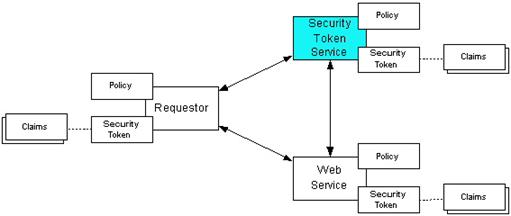
This model is illustrated
in the figure below, showing that any requestor may also be a service, and that
the Security Token Service is a Web service (that is, it may express policy and
require security tokens).
This general security
model – claims, policies, and security tokens – subsumes and supports several
more specific models such as identity-based authorization, access control
lists, and capabilities-based authorization. It allows use of existing
technologies such as X.509 public-key certificates, XML-based tokens, Kerberos
shared-secret tickets, and even password digests. The general model in
combination with the [WS-Security]
and [WS-Policy] primitives is sufficient to
construct higher-level key exchange, authentication, policy-based access
control, auditing, and complex trust relationships.
In the figure
above the arrows represent possible communication paths; the requestor may
obtain a token from the security token service, or it may have been obtained
indirectly. The requestor then demonstrates authorized use of the token to the
Web service. The Web service either trusts the issuing security token service
or may request a token service to validate the token (or the Web service may
validate the token itself).
In summary, the
Web service has a policy applied to it, receives a message from a requestor
that possibly includes security tokens, and may have some protection applied to
it using [WS-Security] mechanisms. The following key steps
are performed by the trust engine of a Web service (note that the order of
processing is non-normative):
1. Verify that the claims in the token
are sufficient to comply with the policy and that the message conforms to the
policy.
2. Verify that the attributes of the
claimant are proven by the signatures. In brokered trust models, the signature
may not verify the identity of the claimant – it may verify the identity of the
intermediary, who may simply assert the identity of the claimant. The claims
are either proven or not based on policy.
3. Verify that the issuers of the
security tokens (including all related and issuing security token) are trusted
to issue the claims they have made. The trust engine may need to externally
verify or broker tokens (that is, send tokens to a security token service in order
to exchange them for other security tokens that it can use directly in its
evaluation).
If these
conditions are met, and the requestor is authorized to perform the operation,
then the service can process the service request.
In this
specification we define how security tokens are requested and obtained from
security token services and how these services may broker trust and trust
policies so that services can perform step 3.
Network and
transport protection mechanisms such as IPsec or TLS/SSL [RFC2246] can be used in conjunction with this
specification to support different security requirements and scenarios. If
available, requestors should consider using a network or transport security
mechanism to authenticate the service when requesting, validating, or renewing
security tokens, as an added level of security.
The [WS-Federation] specification builds on this
specification to define mechanisms for brokering and federating trust,
identity, and claims. Examples are provided in [WS-Federation] illustrating different trust
scenarios and usage patterns.
This section
outlines different models for obtaining tokens and brokering trust. These
methods depend on whether the token issuance is based on explicit requests
(token acquisition) or if it is external to a message flow (out-of-band and
trust management).
As part of a
message flow, a request may be made of a security token service to exchange a
security token (or some proof) of one form for another. The exchange request
can be made either by a requestor or by another party on the requestor's
behalf. If the security token service trusts the provided security token (for
example, because it trusts the issuing authority of the provided security
token), and the request can prove possession of that security token, then the
exchange is processed by the security token service.
The previous
paragraph illustrates an example of token acquisition in a direct trust
relationship. In the case of a delegated request (one in which another party
provides the request on behalf of the requestor rather than the requestor
presenting it themselves), the security token service generating the new token
may not need to trust the authority that issued the original token provided by
the original requestor since it does trust the security token service that is
engaging in the exchange for a new security token. The basis of the trust is
the relationship between the two security token services.
The previous
section illustrated acquisition of tokens. That is, a specific request is made
and the token is obtained. Another model involves out-of-band acquisition of
tokens. For example, the token may be sent from an authority to a party
without the token having been explicitly requested or the token may have been
obtained as part of a third-party or legacy protocol. In any of these cases
the token is not received in response to a direct SOAP request.
An administrator
or other trusted authority may designate that all tokens of a certain type are
trusted (e.g. all Kerberos tokens from a specific realm or all X.509 tokens
from a specific CA). The security token service maintains this as a trust
axiom and can communicate this to trust engines to make their own trust
decisions (or revoke it later), or the security token service may provide this
function as a service to trusting services.
There are several
different mechanisms that can be used to bootstrap trust for a service. These
mechanisms are non-normative and are not required in any way. That is,
services are free to bootstrap trust and establish trust among a domain of
services or extend this trust to other domains using any mechanism.
Fixed
trust roots – The
simplest mechanism is where the recipient has a fixed set of trust
relationships. It will then evaluate all requests to determine if they contain
security tokens from one of the trusted roots.
Trust
hierarchies –
Building on the trust roots mechanism, a service may choose to allow
hierarchies of trust so long as the trust chain eventually leads to one of the
known trust roots. In some cases the recipient may require the sender to
provide the full hierarchy. In other cases, the recipient may be able to
dynamically fetch the tokens for the hierarchy from a token store.
Authentication
service – Another
approach is to use an authentication service. This can essentially be thought
of as a fixed trust root where the recipient only trusts the authentication
service. Consequently, the recipient forwards tokens to the authentication
service, which replies with an authoritative statement (perhaps a separate
token or a signed document) attesting to the authentication.
This section
defines the general framework used by security token services for token
issuance.
A requestor sends
a request, and if the policy permits and the recipient's requirements are met,
then the requestor receives a security token response. This process uses the <wst:RequestSecurityToken> and <wst:RequestSecurityTokenResponse> elements respectively. These
elements are passed as the payload to specific WSDL ports (described in section
1.4) that are
implemented by security token services.
This framework
does not define specific actions; each binding defines its own actions.
When requesting
and returning security tokens additional parameters can be included in
requests, or provided in responses to indicate server-determined (or used)
values. If a requestor specifies a specific value that isn't supported by the
recipient, then the recipient MAY fault with a wst:InvalidRequest (or a more specific fault code), or
they MAY return a token with their chosen parameters that the requestor may
then choose to discard because it doesn't meet their needs.
The requesting and
returning of security tokens can be used for a variety of purposes. Bindings
define how this framework is used for specific usage patterns. Other
specifications may define specific bindings and profiles of this mechanism for
additional purposes.
In general, it is
RECOMMENDED that sources of requests be authenticated; however, in some cases
an anonymous request may be appropriate. Requestors MAY make anonymous
requests and it is up to the recipient's policy to determine if such requests
are acceptable. If not a fault SHOULD be generated (but is not required to be
returned for denial-of-service reasons).
The [WS-Security] specification defines and
illustrates time references in terms of the dateTime
type defined in XML Schema. It is RECOMMENDED that all time references use
this type. It is further RECOMMENDED that all references be in UTC time. Requestors and receivers SHOULD NOT
rely on other applications supporting time resolution finer than milliseconds.
Implementations MUST NOT generate time instants that specify leap seconds.
Also, any required clock synchronization is outside the scope of this
document.
The following
sections describe the basic structure of token request and response elements
identifying the general mechanisms and most common sub-elements. Specific
bindings extend these elements with binding-specific sub-elements. That is,
sections 3.1 and 3.2 should be viewed as patterns or templates on which
specific bindings build.
It should be noted
that all time references use the XML Schema dateTime type and use universal
time.
The <wst:RequestSecurityToken> element (RST) is used to request a
security token (for any purpose). This element SHOULD be signed by the
requestor, using tokens contained/referenced in the request that are relevant
to the request. If using a signed request, the requestor MUST prove any
required claims to the satisfaction of the security token service.
If a parameter is
specified in a request that the recipient doesn't understand, the recipient
SHOULD fault.
The syntax for
this element is as follows:
<wst:RequestSecurityToken Context="..." xmlns:wst="...">
<wst:TokenType>...</wst:TokenType>
<wst:RequestType>...</wst:RequestType>
...
</wst:RequestSecurityToken>
The following
describes the attributes and elements listed in the schema overview above:
/wst:RequestSecurityToken
This is a request to have a security token issued.
/wst:RequestSecurityToken/@Context
This optional URI specifies an identifier/context for this
request. All subsequent RSTR elements relating to this request MUST carry this
attribute. This, for example, allows the request and subsequent responses to
be correlated. Note that no ordering semantics are provided; that is left to
the application/transport.
/wst:RequestSecurityToken/wst:TokenType
This optional element describes the type of security token
requested, specified as a URI. That is, the type of token that will be
returned in the <wst:RequestSecurityTokenResponse>
message. Token type URIs are typically defined in token profiles such as those
in the OASIS WSS TC.
/wst:RequestSecurityToken/wst:RequestType
The mandatory RequestType element
is used to indicate, using a URI, the class of function that is being
requested. The allowed values are defined by specific bindings and profiles of
WS-Trust. Frequently this URI corresponds to the [WS-Addressing]
Action URI provided in the message header as described in the binding/profile;
however, specific bindings can use the Action URI to provide more details on
the semantic processing while this parameter specifies the general class of
operation (e.g., token issuance). This parameter is required.
/wst:RequestSecurityToken/wst:SecondaryParameters
If specified, this optional element contains zero or more
valid RST parameters (except wst:SecondaryParameter)
for which the requestor is not the originator.
The STS processes parameters that
are direct children of the <wst:RequestSecurityToken>
element. If a parameter is not specified as a direct child, the STS MAY
look for the parameter within the <wst:SecondaryParameters>
element (if present). The STS MAY filter secondary parameters if it doesn't
trust them or feels they are inappropriate or introduce risk (or based on its
own policy).
/wst:RequestSecurityToken/{any}
This is an extensibility mechanism to allow additional
elements to be added. This allows requestors to include any elements that the
service can use to process the token request. As well, this allows bindings to
define binding-specific extensions. If an element is found that is not
understood, the recipient SHOULD fault.
/wst:RequestSecurityToken/@{any}
This is an extensibility mechanism to allow additional
attributes, based on schemas, to be added. If an attribute is found that is
not understood, the recipient SHOULD fault.
The <wst:RequestSecurityTokenResponse> element (RSTR) is used to return a
security token or response to a security token request. The <wst:RequestSecurityTokenResponseCollection> element (RSTRC) MUST be used to return
a security token or response to a security token request on the final response.
It should be noted
that any type of parameter specified as input to a token request MAY be present
on response in order to specify the exact parameters used by the issuer.
Specific bindings describe appropriate restrictions on the contents of the RST
and RSTR elements.
In general, the
returned token should be considered opaque to the requestor. That is, the
requestor shouldn't be required to parse the returned token. As a result,
information that the requestor may desire, such as token lifetimes, SHOULD be
returned in the response. Specifically, any field that the requestor includes
SHOULD be returned. If an issuer doesn't want to repeat all input parameters,
then, at a minimum, if the issuer chooses a value different from what was
requested, the issuer SHOULD include the parameters that were changed.
If a parameter is
specified in a response that the recipient doesn't understand, the recipient
SHOULD fault.
In this specification
the RSTR message is illustrated as being passed in the body of a message.
However, there are scenarios where the RSTR must be passed in conjunction with
an existing application message. In such cases the RSTR (or the RSTR
collection) MAY be specified inside a header block. The exact location is
determined by layered specifications and profiles; however, the RSTR MAY be
located in the <wsse:Security> header if the token is being used to
secure the message (note that the RSTR SHOULD occur before any uses of the
token). The combination of which header block contains the RSTR and the value
of the optional @Context attribute indicate how the
RSTR is processed. It should be noted that multiple RST elements can be
specified in the header blocks of a message.
It should be noted
that there are cases where an RSTR is issued to a recipient who did not
explicitly issue an RST (e.g. to propagate tokens). In such cases, the RSTR
may be passed in the body or in a header block.
The syntax for
this element is as follows:
<wst:RequestSecurityTokenResponse Context="..." xmlns:wst="...">
<wst:TokenType>...</wst:TokenType>
<wst:RequestedSecurityToken>...</wst:RequestedSecurityToken>
...
</wst:RequestSecurityTokenResponse>
The following
describes the attributes and elements listed in the schema overview above:
/wst:RequestSecurityTokenResponse
This is the response to a security token request.
/wst:RequestSecurityTokenResponse/@Context
This optional URI specifies the identifier from the
original request. That is, if a context URI is specified on a RST, then it
MUST be echoed on the corresponding RSTRs. For unsolicited RSTRs (RSTRs that
aren't the result of an explicit RST), this represents a hint as to how the
recipient is expected to use this token. No values are pre-defined for this
usage; this is for use by specifications that leverage the WS-Trust mechanisms.
/wst:RequestSecurityTokenResponse/wst:TokenType
This optional element specifies the type of security token
returned.
/wst:RequestSecurityTokenResponse/wst:RequestedSecurityToken
This optional element is used to return the requested
security token. Normally the requested security token is the contents of this
element but a security token reference MAY be used instead. For example, if
the requested security token is used in securing the message, then the security
token is placed into the <wsse:Security>
header (as described in [WS-Security]) and a <wsse:SecurityTokenReference> element is placed
inside of the <wst:RequestedSecurityToken>
element to reference the token in the <wsse:Security>
header. The response MAY contain a token reference where the token is located
at a URI outside of the message. In such cases the recipient is assumed to
know how to fetch the token from the URI address or specified endpoint
reference. It should be noted that when the token is not returned as part of
the message it cannot be secured, so a secure communication mechanism SHOULD be
used to obtain the token.
/wst:RequestSecurityTokenResponse/{any}
This is an extensibility mechanism to allow additional
elements to be added. If an element is found that is not understood, the
recipient SHOULD fault.
/wst:RequestSecurityTokenResponse/@{any}
This is an extensibility mechanism to allow additional
attributes, based on schemas, to be added. If an attribute is found that is
not understood, the recipient SHOULD fault.
3.3
Binary Secrets
It should be noted
that in some cases elements include a key that is not encrypted. Consequently,
the <xenc:EncryptedData> cannot be used. Instead, the <wst:BinarySecret> element can be used. This SHOULD only be used when the
message is otherwise protected (e.g. transport security is used or the
containing element is encrypted). This element contains a base64 encoded value
that represents an arbitrary octet sequence of a secret (or key). The general
syntax of this element is as follows (note that the ellipses below represent
the different containers in which this element may appear, for example, a <wst:Entropy>
or <wst:RequestedProofToken> element):
.../wst:BinarySecret
This element contains a base64 encoded binary secret (or
key). This can be either a symmetric key, the private portion of an asymmetric
key, or any data represented as binary octets.
.../wst:BinarySecret/@Type
This optional attribute indicates the type of secret being
encoded. The pre-defined values are listed in the table below:
.../wst:BinarySecret/@{any}
This is an extensibility mechanism to allow additional
attributes, based on schemas, to be added. If an attribute is found that is not
understood, the recipient SHOULD fault.
The sections
below, as well as other documents, describe a set of bindings using the model
framework described in the above sections. Each binding describes the amount
of extensibility and composition with other parts of WS-Trust that is
permitted. Additional profile documents MAY further restrict what can be
specified in a usage of a binding.
Using the token
request framework, this section defines bindings for requesting security tokens
to be issued:
Issue – Based on the credential
provided/proven in the request, a new token is issued, possibly with new proof
information.
For this binding,
the following [WS-Addressing] actions are defined to enable
specific processing context to be conveyed to the recipient:
For this binding,
the <wst:RequestType> element uses the following URI:
The mechanisms
defined in this specification apply to both symmetric and asymmetric keys. As
an example, a Kerberos KDC could provide the services defined in this
specification to make tokens available; similarly, so can a public key
infrastructure. In such cases, the issuing authority is the security token
service. It should be noted that in practice, asymmetric key usage often
differs as it is common to reuse existing asymmetric keys rather than
regenerate due to the time cost and desire to map to a common public key. In
such cases a request might be made for an asymmetric token providing the public
key and proving ownership of the private key. The public key is then used in
the issued token.
A public key
directory is not really a security token service per se; however, such a
service MAY implement token retrieval as a form of issuance. It is also possible
to bridge environments (security technologies) using PKI for authentication or
bootstrapping to a symmetric key.
This binding
provides a general token issuance action that can be used for any type of token
being requested. Other bindings MAY use separate actions if they have
specialized semantics.
This
binding supports the optional use of exchanges during the token acquisition
process as well as the optional use of the key extensions described in a later
section. Additional profiles are needed to describe specific behaviors (and
exclusions) when different combinations are used.
4.1
Requesting a Security Token
When requesting a
security token to be issued, the following optional elements MAY be included in
the request and MAY be provided in the response. The syntax for these elements
is as follows (note that the base elements described above are included here
italicized for completeness):
<wst:RequestSecurityToken xmlns:wst="...">
<wst:TokenType>...</wst:TokenType>
<wst:RequestType>...</wst:RequestType>
...
<wsp:AppliesTo>...</wsp:AppliesTo>
<wst:Claims Dialect="...">...</wst:Claims>
<wst:Entropy>
<wst:BinarySecret>...</wst:BinarySecret>
</wst:Entropy>
<wst:Lifetime>
<wsu:Created>...</wsu:Created>
<wsu:Expires>...</wsu:Expires>
</wst:Lifetime>
</wst:RequestSecurityToken>
The following
describes the attributes and elements listed in the schema overview above:
/wst:RequestSecurityToken/wst:TokenType
If this optional element is not specified in an issue
request, it is RECOMMENDED that the optional element <wsp:AppliesTo>
be used to indicate the target where this token will be used (similar to the
Kerberos target service model). This assumes that a token type can be inferred
from the target scope specified. That is, either the <wst:TokenType>
or the <wsp:AppliesTo> element SHOULD be
defined within a request. If both the <wst:TokenType>
and <wsp:AppliesTo> elements are defined,
the <wsp:AppliesTo> element takes
precedence (for the current request only) in case the target scope requires a
specific type of token.
/wst:RequestSecurityToken/wsp:AppliesTo
This optional element specifies the scope for which this
security token is desired – for example, the service(s) to which this token
applies. Refer to [WS-PolicyAttachment] for
more information. Note that either this element or the <wst:TokenType> element SHOULD be defined in a <wst:RequestSecurityToken> message. In the
situation where BOTH fields have values, the <wsp:AppliesTo>
field takes precedence. This is because the issuing service is more likely to
know the type of token to be used for the specified scope than the requestor
(and because returned tokens should be considered opaque to the requestor).
/wst:RequestSecurityToken/wst:Claims
This optional element requests a specific set of claims. Typically,
this element contains required and/or optional claim information identified in
a service's policy.
/wst:RequestSecurityToken/wst:Claims/@Dialect
This required attribute contains a URI that indicates the
syntax used to specify the set of requested claims along with how that syntax
should be interpreted. No URIs are defined by this specification; it is
expected that profiles and other specifications will define these URIs and the
associated syntax.
/wst:RequestSecurityToken/wst:Entropy
This optional element allows a requestor to specify entropy
that is to be used in creating the key. The value of this element SHOULD be
either a <xenc:EncryptedKey> or <wst:BinarySecret> depending on whether or not
the key is encrypted. Secrets SHOULD be encrypted unless the transport/channel
is already providing encryption.
/wst:RequestSecurityToken/wst:Entropy/wst:BinarySecret
This optional element specifies a base64 encoded sequence
of octets representing the requestor's entropy. The value can contain either a
symmetric or the private key of an asymmetric key pair, or any suitable key
material. The format is assumed to be understood by the requestor because the
value space may be (a) fixed, (b) indicated via policy, (c) inferred from the
indicated token aspects and/or algorithms, or (d) determined from the returned
token. (See Section 3.3)
/wst:RequestSecurityToken/wst:Lifetime
This optional element is used to specify the desired valid
time range (time window during which the token is valid for use) for the
returned security token. That is, to request a specific time interval for
using the token. The issuer is not obligated to honor this range – they may
return a more (or less) restrictive interval. It is RECOMMENDED that the
issuer return this element with issued tokens (in the RSTR) so the requestor
knows the actual validity period without having to parse the returned token.
/wst:RequestSecurityToken/wst:Lifetime/wsu:Created
This optional element represents the creation time of the
security token. Within the SOAP processing model, creation is the instant that
the infoset is serialized for transmission. The creation time of the token
SHOULD NOT differ substantially from its transmission time. The difference in
time should be minimized. If this time occurs in the future then this is a
request for a postdated token. If this attribute isn't specified, then the
current time is used as an initial period.
/wst:RequestSecurityToken/wst:Lifetime/wsu:Expires
This optional element specifies an absolute time
representing the upper bound on the validity time period of the requested
token. If this attribute isn't specified, then the service chooses the
lifetime of the security token. A Fault code (wsu:MessageExpired)
is provided if the recipient wants to inform the requestor that its security
semantics were expired. A service MAY issue a Fault indicating the security
semantics have expired.
The following is a
sample request. In this example, a username token is used as the basis for the
request as indicated by the use of that token to generate the signature. The
username (and password) is encrypted for the recipient and a reference list
element is added. The <ds:KeyInfo> element refers to a <wsse:UsernameToken> element that has been encrypted to protect the password
(note that the token has the wsu:Id of
"myToken" prior to encryption). The request is for a custom token
type to be returned.
<S11:Envelope
xmlns:S11="..." xmlns:wsu="..." xmlns:wsse="..."
xmlns:xenc="..." xmlns:wst="...">
<S11:Header>
...
<wsse:Security>
<xenc:ReferenceList>...</xenc:ReferenceList>
<xenc:EncryptedData
Id="encUsername">...</xenc:EncryptedData>
<ds:Signature xmlns:ds="...">
...
<ds:KeyInfo>
<wsse:SecurityTokenReference>
<wsse:Reference URI="#myToken"/>
</wsse:SecurityTokenReference>
</ds:KeyInfo>
</ds:Signature>
</wsse:Security>
...
</S11:Header>
<S11:Body wsu:Id="req">
<wst:RequestSecurityToken>
<wst:TokenType>
http://example.org/mySpecialToken
</wst:TokenType>
<wst:RequestType>
http://docs.oasis-open.org/ws-sx/ws-trust/200512/Issue
</wst:RequestType>
</wst:RequestSecurityToken>
</S11:Body>
</S11:Envelope>
4.2 Request Security Token
Collection
There are
occasions where efficiency is important. Reducing the number of messages in a
message exchange pattern can greatly improve efficiency. One way to do this in
the context of WS-Trust is to avoid repeated round-trips for multiple token
requests. An example is requesting an identity token as well as tokens that
offer other claims in a single batch request operation.
To give an
example, imagine an automobile parts supplier that wishes to offer parts to an
automobile manufacturer. To interact with the manufacturer web service the
parts supplier may have to present a number of tokens, such as an identity
token as well as tokens with claims, such as tokens indicating various
certifications to meet supplier requirements.
It is possible for
the supplier to authenticate to a trust server and obtain an identity token and
then subsequently present that token to obtain a certification claim token.
However, it may be much more efficient to request both in a single interaction
(especially when more than two tokens are required).
Here is an example
of a collection of authentication requests corresponding to this scenario:
<wst:RequestSecurityTokenCollection
xmlns:wst="...">
<!-- identity token request -->
<wst:RequestSecurityToken Context="http://www.example.com/1">
<wst:TokenType>
http://docs.oasis-open.org/wss/oasis-wss-saml-token-profile-1.1#SAMLV2.0
</wst:TokenType>
<wst:RequestType>http://docs.oasis-open.org/ws-sx/ws-trust/200512/BatchIssue</wst:RequestType>
<wsp:AppliesTo xmlns:wsp="..." xmlns:wsa="...">
<wsa:EndpointReference>
<wsa:Address>http://manufacturer.example.com/</wsa:Address>
</wsa:EndpointReference>
</wsp:AppliesTo>
<wsp:PolicyReference xmlns:wsp="..." URI='http://manufacturer.example.com/IdentityPolicy'
/>
</wst:RequestSecurityToken>
<!-- certification claim token request -->
<wst:RequestSecurityToken Context="http://www.example.com/2">
<wst:TokenType>
http://docs.oasis-open.org/wss/oasis-wss-saml-token-profile-1.1#SAMLV2.0
</wst:TokenType>
<wst:RequestType>http://docs.oasis-open.org/ws-sx/ws-trust/200512
/BatchIssue</wst:RequestType>
<wsp:Claims xmlns:wsp="...">
http://manufacturer.example.com/certification
</wsp:Claims>
<wsp:PolicyReference
URI='http://certificationbody.example.org/certificationPolicy’ />
</wst:RequestSecurityToken>
</wst:RequestSecurityTokenCollection>
The following
describes the attributes and elements listed in the overview above:
/wst:RequestSecurityTokenCollection
The RequestSecurityTokenCollection
(RSTC) element is used to provide multiple RST requests. One or more RSTR
elements in an RSTRC element are returned in the response to the RequestSecurityTokenCollection.
The RequestSecurityTokenCollection (RSTC) element contains 2 or more RequestSecurityToken elements.
1.
The single RequestSecurityTokenResponseCollection response MUST contain at least one
RSTR element corresponding to each RST element in the request. A RSTR element
corresponds to an RST element if it has the same Context attribute value as the
RST element. Note: Each request may generate more than
one RSTR sharing the same Context attribute value
a.
Specifically there
is no notion of a deferred response
b.
If any RST request
results in an error, then no RSTRs will be returned and a SOAP Fault will be
generated as the entire response.
2.
Every RST in the
request MUST use an action URI value in the RequestType element that is a batch
version corresponding to the non-batch version, in particular one of the
following:
·
http://docs.oasis-open.org/ws-sx/ws-trust/200512/BatchIssue
·
http://docs.oasis-open.org/ws-sx/ws-trust/200512/BatchValidate
·
http://docs.oasis-open.org/ws-sx/ws-trust/200512/BatchRenew
·
http://docs.oasis-open.org/ws-sx/ws-trust/200512/BatchCancel
These
URIs MUST also be used for the [WS-Addressing] actions defined to enable specific
processing context to be conveyed to the recipient.
Note: that these operations require that
the service can either succeed on all the RST requests or must not perform any
partial operation.
3.
All Signatures
MUST reference the entire RSTC. One or more Signatures referencing the entire
collection MAY be used.
4.
No negotiation or
other multi-leg authentication mechanisms are allowed in batch requests or
responses to batch requests; the communication with STS is limited to one RSTC
request and one RSTRC response.
5.
This mechanism
requires that every RST in a RSTC is to be handled by the single endpoint
processing the RSTC.
If any error
occurs in the processing of the RSTC or one of its contained RSTs, a SOAP fault
must be generated for the entire batch request so no RSTC element will be
returned.
When returning a
security token, the following optional elements MAY be included in the
response. Security
tokens can only be returned in the RSTRC on the final leg. The syntax for these elements is as
follows (note that the base elements described above are included here
italicized for completeness):
<wst:RequestSecurityTokenResponse
xmlns:wst="...">
<wst:TokenType>...</wst:TokenType>
<wst:RequestedSecurityToken>...</wst:RequestedSecurityToken>
...
<wsp:AppliesTo xmlns:wsp="...”>...</wsp:AppliesTo>
<wst:RequestedAttachedReference>
...
</wst:RequestedAttachedReference>
<wst:RequestedUnattachedReference>
...
</wst:RequestedUnattachedReference>
<wst:RequestedProofToken>...</wst:RequestedProofToken>
<wst:Entropy>
<wst:BinarySecret>...</wst:BinarySecret>
</wst:Entropy>
<wst:Lifetime>...</wst:Lifetime>
</wst:RequestSecurityTokenResponse>
The following
describes the attributes and elements listed in the schema overview above:
/wst:RequestSecurityTokenResponse/wsp:AppliesTo
This optional element specifies the scope to which this
security token applies. Refer to [WS-PolicyAttachment]
for more information. Note that if an <wsp:AppliesTo>
was specified in the request, the same scope SHOULD be returned in the response
(if a <wsp:AppliesTo> is returned).
/wst:RequestSecurityTokenResponse/wst:RequestedSecurityToken
This optional element is used to return the requested
security token. This element is optional, but it is REQUIRED that at least one
of <wst:RequestedSecurityToken> or <wst:RequestedProofToken> be returned unless
there is an error or part of an on-going message exchange (e.g. negotiation). If
returning more than one security token see section 4.3, Returning Multiple
Security Tokens.
/wst:RequestSecurityTokenResponse/wst:RequestedAttachedReference
Since returned tokens are considered opaque to the
requestor, this optional element is specified to indicate how to reference the
returned token when that token doesn't support references using URI fragments
(XML ID). This element contains a <wsse:SecurityTokenReference>
element that can be used verbatim to reference the
token (when the token is placed inside a message). Typically tokens allow the
use of wsu:Id so this element isn't required. Note
that a token MAY support multiple reference mechanisms; this indicates the
issuer’s preferred mechanism. When encrypted tokens are returned, this element
is not needed since the <xenc:EncryptedData>
element supports an ID reference. If this element is not present in the RSTR
then the recipient can assume that the returned token (when present in a
message) supports references using URI fragments.
/wst:RequestSecurityTokenResponse/wst:RequestedUnattachedReference
In some cases tokens need not be present in the message.
This optional element is specified to indicate how to reference the token when
it is not placed inside the message. This element contains a <wsse:SecurityTokenReference> element that can
be used verbatim to reference the token (when the
token is not placed inside a message) for replies. Note that a token MAY
support multiple external reference mechanisms; this indicates the issuer’s
preferred mechanism.
/wst:RequestSecurityTokenResponse/wst:RequestedProofToken
This optional element is used to return the
proof-of-possession token associated with the requested security token.
Normally the proof-of-possession token is the contents of this element but a
security token reference MAY be used instead. The token (or reference) is
specified as the contents of this element. For example, if the
proof-of-possession token is used as part of the securing of the message, then
it is placed in the <wsse:Security>
header and a <wsse:SecurityTokenReference>
element is used inside of the <wst:RequestedProofToken>
element to reference the token in the <wsse:Security>
header. This element is optional, but it is REQUIRED that at least one of <wst:RequestedSecurityToken> or <wst:RequestedProofToken> be returned unless
there is an error.
/wst:RequestSecurityTokenResponse/wst:Entropy
This optional element allows an issuer to specify entropy
that is to be used in creating the key. The value of this element SHOULD be either
a <xenc:EncryptedKey> or <wst:BinarySecret> depending on whether or not
the key is encrypted (it SHOULD be unless the transport/channel is already
encrypted).
/wst:RequestSecurityTokenResponse/wst:Entropy/wst:BinarySecret
This optional element specifies a base64 encoded sequence
of octets represent the responder's entropy. (See Section 3.3)
/wst:RequestSecurityTokenResponse/wst:Lifetime
This optional element specifies the lifetime of the issued
security token. If omitted the lifetime is unspecified (not necessarily
unlimited). It is RECOMMENDED that if a lifetime exists for a token that this
element be included in the response.
Both the requestor
and the issuer can specify a scope for the issued token using the <wsp:AppliesTo> element. If a token issuer cannot
provide a token with a scope that is at least as broad as that requested by the
requestor then it SHOULD generate a fault. This section defines some rules for
interpreting the various combinations of provided scope:
·
If neither the
requestor nor the issuer specifies a scope then the scope of the issued token
is implied.
·
If the requestor
specifies a scope and the issuer does not then the scope of the token is
assumed to be that specified by the requestor.
·
If the requestor
does not specify a scope and the issuer does specify a scope then the scope of
the token is as defined by the issuers scope
·
If both requestor
and issuer specify a scope then there are two possible outcomes:
o
If both the issuer
and requestor specify the same scope then the issued token has that scope.
o
If the issuer
specifies a wider scope than the requestor then the issued token has the scope
specified by the issuer.
The following
table summarizes the above rules:
|
Requestor
wsp:AppliesTo
|
Issuer
wsp:AppliesTo
|
Results
|
|
Absent
|
Absent
|
OK. Implied
scope.
|
|
Present
|
Absent
|
OK. Issued token
has scope specified by requestor.
|
|
Absent
|
Present
|
OK. Resulting
token has scope specified by issuer.
|
|
Present
|
Present and
matches Requestor
|
OK.
|
|
Present
|
Present and
specifies a scope greater than specified by the requestor
|
OK. Issuer
scope.
|
The token issuer
can optionally provide <wst:RequestedAttachedReference> and/or <wst:RequestedUnattachedReference> elements in the RSTR. It is assumed
that all token types can be referred to directly when present in a message.
This section outlines the expected behaviour on behalf of clients and servers
with respect to various permutations:
·
If a <wst:RequestedAttachedReference> element is NOT returned in the RSTR
then the client SHOULD assume that the token can be referenced by ID.
Alternatively, the client MAY use token-specific knowledge to construct an STR.
·
If a <wst:RequestedAttachedReference> element is returned in the RSTR then
the token cannot be referred to by ID. The supplied STR MUST be used to refer
to the token.
·
If a <wst:RequestedUnattachedReference> element is returned then the server MAY
reference the token using the supplied STR when sending responses back to the
client. Thus the client MUST be prepared to resolve the supplied STR to the
appropriate token. Note: the server SHOULD NOT send the token back to the
client as the token is often tailored specifically to the server (i.e. it may
be encrypted for the server). References to the token in subsequent messages,
whether sent by the client or the server, that omit the token MUST use the
supplied STR.
The keys resulting
from a request are determined in one of three ways: specific, partial, and
omitted.
·
In the case of
specific keys, a <wst:RequestedProofToken> element is included in the response
which indicates the specific key(s) to use unless the key was provided by the
requestor (in which case there is no need to return it).
·
In the case of
partial, the <wst:Entropy> element is included in the response,
which indicates partial key material from the issuer (not the full key) that is
combined (by each party) with the requestor's entropy to determine the
resulting key(s). In this case a <wst:ComputedKey> element is returned inside the <wst:RequestedProofToken> to indicate how the key is computed.
·
In the case of
omitted, an existing key is used or the resulting token is not directly
associated with a key.
The decision as to
which path to take is based on what the requestor provides, what the issuer
provides, and the issuer's policy.
·
If the requestor
does not provide entropy or issuer rejects the requestor's entropy, a
proof-of-possession token MUST be returned with an issuer-provided key.
·
If the requestor
provides entropy and the responder doesn't (issuer uses the requestor's key),
then a proof-of-possession token need not be returned.
·
If both the
requestor and the issuer provide entropy, then the partial form is used.
Ideally both entropies are specified as encrypted values and the resultant key
is never used (only keys derived from it are used). As noted above, the <wst:ComputedKey>
element is returned inside the <wst:RequestedProofToken> to indicate how the key is computed.
The following
table illustrates the rules described above:
|
Requestor
|
Issuer
|
Results
|
|
Provide Entropy
|
Uses requestor
entropy as key
|
No
proof-of-possession token is returned.
|
|
Provides entropy
|
No keys
returned, key(s) derived using entropy from both sides according to method
identified in response
|
|
Issues own key
(rejects requestor's entropy)
|
Proof-of-possession
token contains issuer's key(s)
|
|
No Entropy
provided
|
Issues own key
|
Proof-of-possession
token contains issuer's key(s)
|
|
Does not issue
key
|
No
proof-of-possession token
|
As previously
described, in some scenarios the key(s) resulting from a token request are not
directly returned and must be computed. One example of this is when both
parties provide entropy that is combined to make the shared secret. To
indicate a computed key, the <wst:ComputedKey> element MUST be returned inside the <wst:RequestedProofToken> to indicate how the key is computed.
The following illustrates a syntax overview of the <wst:ComputedKey>
element:
<wst:RequestSecurityTokenResponseCollection
xmlns:wst="...">
<wst:RequestSecurityTokenResponse>
<wst:RequestedProofToken>
<wst:ComputedKey>...</wst:ComputedKey>
</wst:RequestedProofToken>
</wst:RequestSecurityTokenResponse>
</wst:RequestSecurityTokenResponseCollection>
The following describes
the attributes and elements listed in the schema overview above:
/wst:RequestSecurityTokenResponse/wst:RequestedProofToken/wst:ComputedKey
The value of this element is a URI describing how to
compute the key. While this can be extended by defining new URIs in other
bindings and profiles, the following URI pre-defines one computed key
mechanism:
|
URI
|
Meaning
|
|
http://docs.oasis-open.org/ws-sx/ws-trust/200512/CK/PSHA1
|
The key
is computed using P_SHA1 from the TLS specification to generate a bit stream
using entropy from both sides. The exact form is:
key = P_SHA1 (EntREQ,
EntRES)
It is
RECOMMENDED that EntREQ be a string of length at least 128 bits.
|
This element MUST be returned
when key(s) resulting from the token request are computed.
The following
illustrates the syntax of a sample security token response. In this example
the token requested in section 4.1 is returned. Additionally a
proof-of-possession token element is returned containing the secret key
associated with the <wst:RequestedSecurityToken> encrypted for the requestor (note
that this assumes that the requestor has a shared secret with the issuer or a
public key).
<wst:RequestSecurityTokenResponseCollection xmlns:wst="...”>
<wst:RequestSecurityTokenResponse>
<wst:RequestedSecurityToken>
<xyz:CustomToken xmlns:xyz="...">
...
</xyz:CustomToken>
</wst:RequestedSecurityToken>
<wst:RequestedProofToken>
<xenc:EncryptedKey Id="newProof" xmlns:xenc="...">
...
</xenc:EncryptedKey>
</wst:RequestedProofToken>
</wst:RequestSecurityTokenResponse>
</wst:RequestSecurityTokenResponseCollection>
4.3.6
Sample Response with Unencrypted Secret
The following
illustrates the syntax of an alternative form where the secret is passed in the
clear because the transport is providing confidentiality:
<wst:RequestSecurityTokenResponseCollection xmlns:wst="...”>
<wst:RequestSecurityTokenResponse>
<wst:RequestedSecurityToken>
<xyz:CustomToken xmlns:xyz="...">
...
</xyz:CustomToken>
</wst:RequestedSecurityToken>
<wst:RequestedProofToken>
<wst:BinarySecret>...</wst:BinarySecret>
</wst:RequestedProofToken>
</wst:RequestSecurityTokenResponse>
</wst:RequestSecurityTokenResponseCollection>
If the returned
token doesn't allow the use of the wsu:Id attribute,
then a <wst:RequestedTokenReference> is returned as illustrated below. The
following illustrates the syntax of the returned token has a URI which is
referenced.
<wst:RequestSecurityTokenResponseCollection xmlns:wst="...”>
<wst:RequestSecurityTokenResponse>
<wst:RequestedSecurityToken>
<xyz:CustomToken ID="urn:fabrikam123:5445"
xmlns:xyz="...">
...
</xyz:CustomToken>
</wst:RequestedSecurityToken>
<wst:RequestedTokenReference>
<wsse:SecurityTokenReference xmlns:wsse="...”>
<wsse:Reference URI="urn:fabrikam123:5445"/>
</wsse:SecurityTokenReference>
</wst:RequestedTokenReference>
...
</wst:RequestSecurityTokenResponse>
</wst:RequestSecurityTokenResponseCollection>
In the example
above, the recipient may place the returned custom token directly into a
message and include a signature using the provided proof-of-possession token.
The specified reference is then placed into the <ds:KeyInfo>
of the signature and directly references the included token without requiring
the requestor to understand the details of the custom token format.
The following
illustrates the syntax of a response that doesn't include a
proof-of-possession token. For example, if the basis of the request were a
public key token and another public key token is returned with the same public
key, the proof-of-possession token from the original token is reused (no new
proof-of-possession token is required).
<wst:RequestSecurityTokenResponseCollection xmlns:wst="...”>
<wst:RequestSecurityTokenResponse>
<wst:RequestedSecurityToken>
<xyz:CustomToken xmlns:xyz="...">
...
</xyz:CustomToken>
</wst:RequestedSecurityToken>
</wst:RequestSecurityTokenResponse>
</wst:RequestSecurityTokenResponseCollection>
In
the zero or single proof-of-possession token case, a primary token and one or
more tokens are returned. The returned tokens either use the same
proof-of-possession token (one is returned), or no proof-of-possession token is
returned. The tokens are returned (one each) in the response. The following example
illustrates this case. The
following illustrates the syntax of a supporting security token is
returned that has no separate proof-of-possession token as it is secured using
the same proof-of-possession token that was returned.
<wst:RequestSecurityTokenResponseCollection xmlns:wst="...”>
<wst:RequestSecurityTokenResponse>
<wst:RequestedSecurityToken>
<xyz:CustomToken xmlns:xyz="...">
...
</xyz:CustomToken>
</wst:RequestedSecurityToken>
<wst:RequestedProofToken>
<xenc:EncryptedKey Id="newProof" xmlns:xenc="...”>
...
</xenc:EncryptedKey>
</wst:RequestedProofToken>
</wst:RequestSecurityTokenResponse>
</wst:RequestSecurityTokenResponseCollection>
The second case is
where multiple security tokens are returned that have separate
proof-of-possession tokens. As a result, the proof-of-possession tokens, and
possibly lifetime and other key parameters elements, may be different. To
address this scenario, the body MAY be specified using the syntax illustrated
below:
<wst:RequestSecurityTokenResponseCollection xmlns:wst="...”>
<wst:RequestSecurityTokenResponse>
...
</wst:RequestSecurityTokenResponse>
<wst:RequestSecurityTokenResponse>
...
</wst:RequestSecurityTokenResponse>
...
</wst:RequestSecurityTokenResponseCollection>
The following
describes the attributes and elements listed in the schema overview above:
/wst:RequestSecurityTokenResponseCollection
This element is used to provide multiple RSTR responses,
each of which has separate key information. One or more RSTR elements are
returned in the collection. This MUST always be used on the final response to
the RST.
/wst:RequestSecurityTokenResponseCollection/wst:RequestSecurityTokenResponse
Each RequestSecurityTokenResponse element is an individual
RSTR.
/wst:RequestSecurityTokenResponseCollection/{any}
This is an extensibility mechanism to allow additional
elements, based on schemas, to be added.
/wst:RequestSecurityTokenResponseCollection/@{any}
This is an extensibility mechanism to allow additional
attributes, based on schemas, to be added.
The following
illustrates the syntax of a response that includes multiple tokens each, in a
separate RSTR, each with their own proof-of-possession token.
<wst:RequestSecurityTokenResponseCollection
xmlns:wst="...”>
<wst:RequestSecurityTokenResponse>
<wst:RequestedSecurityToken>
<xyz:CustomToken xmlns:xyz="...">
...
</xyz:CustomToken>
</wst:RequestedSecurityToken>
<wst:RequestedProofToken>
<xenc:EncryptedKey Id="newProofA">
...
</xenc:EncryptedKey>
</wst:RequestedProofToken>
</wst:RequestSecurityTokenResponse>
<wst:RequestSecurityTokenResponse>
<wst:RequestedSecurityToken>
<abc:CustomToken xmlns:abc="...">
...
</abc:CustomToken>
</wst:RequestedSecurityToken>
<wst:RequestedProofToken>
<xenc:EncryptedKey Id="newProofB xmlns:xenc="...”>
...
</xenc:EncryptedKey>
</wst:RequestedProofToken>
</wst:RequestSecurityTokenResponse>
</wst:RequestSecurityTokenResponseCollection>
In
certain situations it is useful to issue one or more security tokens as part of
a protocol other than RST/RSTR. This typically requires that the tokens be
passed in a SOAP header. The tokens present in that element can then be
referenced from elsewhere in the message. This section defines a specific
header element, whose type is the same as that of the <wst:RequestSecurityTokenCollection> element (see Section 4.3),
that can be used to carry issued tokens (and associated proof tokens,
references etc.) in a message.
<wst:IssuedTokens xmlns:wst="...”>
<wst:RequestSecurityTokenResponse>
...
</wst:RequestSecurityTokenResponse>+
</wst:IssuedTokens>
The following
describes the attributes and elements listed in the schema overview above:
/wst:IssuedTokens
This header element carries one or more issued security
tokens. This element schema is defined using the RequestSecurityTokenResponse
schema type.
/wst:IssuedTokens/wst:RequestSecurityTokenResponse
This element MUST appear at least once. Its meaning and
semantics are as defined in Section 4.2.
/wst:IssuedTokens/{any}
This is an extensibility mechanism to allow additional
elements, based on schemas, to be added.
/wst:IssuedTokens/@{any}
This is an extensibility mechanism to allow additional
attributes, based on schemas, to be added.
There
MAY be multiple instances of the <wst:IssuedTokens> header in a given message. Such
instances MAY be targeted at the same actor/role. Intermediaries MAY add
additional <wst:IssuedTokens> header elements to a
message. Intermediaries SHOULD NOT modify any <wst:IssuedTokens> header already present in a message.
It is
RECOMMENDED that the <wst:IssuedTokens> header be signed to
protect the integrity of the issued tokens and of the issuance itself. If
confidentiality protection of the <wst:IssuedTokens> header is required then the entire
header MUST be encrypted using the <wsse11:EncryptedHeader> construct. This helps
facilitate re-issuance by the receiving party as that party can re-encrypt the
entire header for another party rather than having to extract and re-encrypt portions
of the header.
The following
example illustrates a response that includes multiple <wst:IssuedTokens> headers.
<?xml
version="1.0" encoding="utf-8"?>
<S11:Envelope
xmlns:S11="..." xmlns:wst="..." xmlns:wsp="..."
xmlns:ds="..." xmlns:x="...">
<S11:Header>
<wst:IssuedTokens>
<wst:RequestSecurityTokenResponse>
<wsp:AppliesTo>
<x:SomeContext1 />
</wsp:AppliesTo>
<wst:RequestedSecurityToken>
...
</wst:RequestedSecurityToken>
...
</wst:RequestSecurityTokenResponse>
<wst:RequestSecurityTokenResponse>
<wsp:AppliesTo>
<x:SomeContext1 />
</wsp:AppliesTo>
<wst:RequestedSecurityToken>
...
</wst:RequestedSecurityToken>
...
</wst:RequestSecurityTokenResponse>
</wst:IssuedTokens>
<wst:IssuedTokens S11:role="http://example.org/somerole" >
<wst:RequestSecurityTokenResponse>
<wsp:AppliesTo>
<x:SomeContext2 />
</wsp:AppliesTo>
<wst:RequestedSecurityToken>
...
</wst:RequestedSecurityToken>
...
</wst:RequestSecurityTokenResponse>
</wst:IssuedTokens>
</S11:Header>
<S11:Body>
...
</S11:Body>
</S11:Envelope>
Using the token
request framework, this section defines bindings for requesting security tokens
to be renewed:
Renew – A previously issued token
with expiration is presented (and possibly proven) and the same token is
returned with new expiration semantics.
For this binding,
the following actions are defined to enable specific processing context to be
conveyed to the recipient:
For this binding,
the <wst:RequestType> element uses the following URI:
http://docs.oasis-open.org/ws-sx/ws-trust/200512/Renew
For this binding
the token to be renewed is identified in the <wst:RenewTarget> element and the optional <wst:Lifetime>
element MAY be specified to request a specified renewal duration.
Other extensions
MAY be specified in the request (and the response), but the key semantics
(size, type, algorithms, scope, etc.) MUST NOT be altered during renewal.
Token services MAY use renewal as an opportunity to rekey, so the renewal
responses MAY include a new proof-of-possession token as well as entropy and
key exchange elements.
The request MUST
prove authorized use of the token being renewed unless the recipient trusts the
requestor to make third-party renewal requests. In such cases, the third-party
requestor MUST prove its identity to the issuer so that appropriate
authorization occurs.
The original proof
information SHOULD be proven during renewal.
The renewal
binding allows the use of exchanges during the renewal process. Subsequent
profiles MAY define restriction around the usage of exchanges.
During renewal,
all key bearing tokens used in the renewal request MUST have an associated
signature. All non-key bearing tokens MUST be signed. Signature confirmation
is RECOMMENDED on the renewal response.
The renewal
binding also defines several extensions to the request and response elements.
The syntax for these extension elements is as follows (note that the base
elements described above are included here italicized for completeness):
<wst:RequestSecurityToken xmlns:wst="...”>
<wst:TokenType>...</wst:TokenType>
<wst:RequestType>...</wst:RequestType>
...
<wst:RenewTarget>...</wst:RenewTarget>
<wst:AllowPostdating/>
<wst:Renewing Allow=”...” OK=”...”/>
</wst:RequestSecurityToken>
/wst:RequestSecurityToken/wst:RenewTarget
This required element identifies the token being renewed. This
MAY contain a <wsse:SecurityTokenReference>
pointing at the token to be renewed or it MAY directly contain the token to be
renewed.
/wst:RequestSecurityToken/wst:AllowPostdating
This optional element indicates that returned tokens should
allow requests for postdated tokens. That is, this allows for tokens to be
issued that are not immediately valid (e.g., a token that can be used the next
day).
/wst:RequestSecurityToken/wst:Renewing
This optional element is used to specify renew semantics
for types that support this operation.
/wst:RequestSecurityToken/wst:Renewing/@Allow
This optional Boolean attribute is used to request a
renewable token. If not specified, the default value is true.
A renewable token is one whose lifetime can be extended. This is done using a
renewal request. The recipient MAY allow renewals without demonstration of
authorized use of the token or they MAY fault.
/wst:RequestSecurityToken/wst:Renewing/@OK
This optional Boolean attribute is used to indicate that a
renewable token is acceptable if the requested duration exceeds the limit of
the issuance service. That is, if true then tokens
can be renewed after their expiration. It should be noted that the token is
NOT valid after expiration for any operation except renewal. The default for
this attribute is false. It NOT RECOMMENDED to use
this as it can leave you open to certain types of security attacks. Issuers
MAY restrict the period after expiration during which time the token can be
renewed. This window is governed by the issuer's policy.
The following
example illustrates a request for a custom token that can be renewed.
<wst:RequestSecurityToken
xmlns:wst="...”>
<wst:TokenType>
http://example.org/mySpecialToken
</wst:TokenType>
<wst:RequestType>
http://docs.oasis-open.org/ws-sx/ws-trust/200512/Issue
</wst:RequestType>
<wst:Renewing/>
</wst:RequestSecurityToken>
The following
example illustrates a subsequent renewal request and response (note that for
brevity only the request and response are illustrated). Note that the response
includes an indication of the lifetime of the renewed token.
<wst:RequestSecurityToken
xmlns:wst="...”>
<wst:TokenType>
http://example.org/mySpecialToken
</wst:TokenType>
<wst:RequestType>
http://docs.oasis-open.org/ws-sx/ws-trust/200512/Renew
</wst:RequestType>
<wst:RenewTarget>
... reference to previously issued token ...
</wst:RenewTarget>
</wst:RequestSecurityToken>
<wst:RequestSecurityTokenResponse xmlns:wst="...”>
<wst:TokenType>
http://example.org/mySpecialToken
</wst:TokenType>
<wst:RequestedSecurityToken>...</wst:RequestedSecurityToken>
<wst:Lifetime>...</wst:Lifetime>
...
</wst:RequestSecurityTokenResponse>
Using the token
request framework, this section defines bindings for requesting security tokens
to be cancelled:
Cancel – When a previously issued
token is no longer needed, the Cancel binding can be used to cancel the token,
terminating its use. After canceling a token at the issuer, a STS MUST not
validate or renew the token. A STS MAY initiate the revocation of a token,
however, revocation is out of scope of this specification and a client MUST NOT
rely on it. If a client needs to ensure the validity of a token, it must
validate the token at the issuer.
For this binding,
the following actions are defined to enable specific processing context to be
conveyed to the recipient:
For this binding,
the <wst:RequestType> element uses the following URI:
http://docs.oasis-open.org/ws-sx/ws-trust/200512/Cancel
Extensions MAY be
specified in the request (and the response), but the semantics are not defined
by this binding.
The request MUST
prove authorized use of the token being cancelled unless the recipient trusts
the requestor to make third-party cancel requests. In such cases, the
third-party requestor MUST prove its identity to the issuer so that appropriate
authorization occurs.
In a cancel
request, all key bearing tokens specified MUST have an associated signature.
All non-key bearing tokens MUST be signed. Signature confirmation is
RECOMMENDED on the closure response.
A cancelled token
is no longer valid for authentication and authorization usages.
On success a
cancel response is returned. This is an RSTR message with the <wst:RequestedTokenCancelled> element in the body. On failure, a
Fault is raised. It should be noted that the cancel RSTR is informational.
That is, the security token is cancelled once the cancel request is processed.
The syntax of the
request is as follows:
<wst:RequestSecurityToken xmlns:wst="...”>
<wst:RequestType>...</wst:RequestType>
...
<wst:CancelTarget>...</wst:CancelTarget>
</wst:RequestSecurityToken>
/wst:RequestSecurityToken/wst:CancelTarget
This required element identifies the token being
cancelled. Typically this contains a <wsse:SecurityTokenReference>
pointing at the token, but it could also carry the token directly.
The following
example illustrates a request to cancel a custom token.
<S11:Envelope
xmlns:S11="..." xmlns:wst="..." xmlns:wsse="...">
<S11:Header>
<wsse:Security>
...
</wsse:Security>
</S11:Header>
<S11:Body>
<wst:RequestSecurityToken>
<wst:RequestType>
http://docs.oasis-open.org/ws-sx/ws-trust/200512/Cancel
</wst:RequestType>
<wst:CancelTarget>
...
</wst:CancelTarget>
</wst:RequestSecurityToken>
</S11:Body>
</S11:Envelope>
The following
example illustrates a response to cancel a custom token.
<S11:Envelope
xmlns:S11="..." xmlns:wst="..." xmlns:wsse="...">
<S11:Header>
<wsse:Security>
...
</wsse:Security>
</S11:Header>
<S11:Body>
<wst:RequestSecurityTokenResponse>
<wst:RequestedTokenCancelled/>
</wst:RequestSecurityTokenResponse>
</S11:Body>
</S11:Envelope>
Using the token
request framework, this section defines an optional binding for requesting
security tokens to be cancelled by the STS:
STS-initiated Cancel – When a
previously issued token becomes invalid on the STS, the STS-initiated Cancel
binding can be used to cancel the token, terminating its use. After canceling a
token, a STS MUST not validate or renew the token. This binding can be only
used when STS can send one-way messages to the original token requestor.
For this binding,
the following actions are defined to enable specific processing context to be
conveyed to the recipient:
http://docs.oasis-open.org/ws-sx/ws-trust/200512/RST/STSCancel
For this binding,
the <wst:RequestType> element uses the following URI:
http://docs.oasis-open.org/ws-sx/ws-trust/200512/STSCancel
Extensions MAY be
specified in the request, but the semantics are not defined by this binding.
The request MUST
prove authorized use of the token being cancelled unless the recipient trusts
the requestor to make third-party cancel requests. In such cases, the
third-party requestor MUST prove its identity to the issuer so that appropriate
authorization occurs.
In a cancel
request, all key bearing tokens specified MUST have an associated signature.
All non-key bearing tokens MUST be signed.
A cancelled token
is no longer valid for authentication and authorization usages.
The mechanism to
determine the availability of STS-initiated Cancel binding on the STS is out of
scope of this specification. Similarly, how the client communicates its
endpoint address to the STS so that it can send the STSCancel messages to the
client is out of scope of this specification. This functionality is
implementation specific and can be solved by different mechanisms that are not
in scope for this specification.
This is a one-way
operation, no response is returned from the recipient of the message.
The syntax of the
request is as follows:
<wst:RequestSecurityToken xmlns:wst="...”>
<wst:RequestType>...</wst:RequestType>
...
<wst:CancelTarget>...</wst:CancelTarget>
</wst:RequestSecurityToken>
/wst:RequestSecurityToken/wst:CancelTarget
This required element identifies the token being
cancelled. Typically this contains a <wsse:SecurityTokenReference>
pointing at the token, but it could also carry the token directly.
The following
example illustrates a request to cancel a custom token.
<?xml
version="1.0" encoding="utf-8"?>
<S11:Envelope
xmlns:S11="..." xmlns:wst="..." xmlns:wsse="...">
<S11:Header>
<wsse:Security>
...
</wsse:Security>
</S11:Header>
<S11:Body>
<wst:RequestSecurityToken>
<wst:RequestType>
http://docs.oasis-open.org/ws-sx/ws-trust/200512/STSCancel
</wst:RequestType>
<wst:CancelTarget>
...
</wst:CancelTarget>
</wst:RequestSecurityToken>
</S11:Body>
</S11:Envelope>
Using the token
request framework, this section defines bindings for requesting security tokens
to be validated:
Validate – The validity of the
specified security token is evaluated and a result is returned. The result may
be a status, a new token, or both.
It should be noted
that for this binding, a SOAP Envelope MAY be specified as a "security
token" if the requestor desires the envelope to be validated. In such
cases the recipient SHOULD understand how to process a SOAP envelope and adhere
to SOAP processing semantics (e.g., mustUnderstand) of the version of SOAP used
in the envelope. Otherwise, the recipient SHOULD fault.
For this binding,
the following actions are defined to enable specific processing context to be
conveyed to the recipient:
http://docs.oasis-open.org/ws-sx/ws-trust/200512/RST/Validate
http://docs.oasis-open.org/ws-sx/ws-trust/200512/RSTR/Validate
http://docs.oasis-open.org/ws-sx/ws-trust/200512/RSTR/ValidateFinal
For this binding,
the <wst:RequestType> element contains the following URI:
http://docs.oasis-open.org/ws-sx/ws-trust/200512/Validate
The request
provides a token upon which the request is based and optional tokens. As well,
the optional <wst:TokenType> element in the request can indicate
desired type response token. This may be any supported token type or it may be
the following URI indicating that only status is desired:
http://docs.oasis-open.org/ws-sx/ws-trust/200512/RSTR/Status
For some use cases
a status token is returned indicating the success or failure of the
validation. In other cases a security token MAY be returned and used for
authorization. This binding assumes that the validation requestor and provider
are known to each other and that the general issuance parameters beyond
requesting a token type, which is optional, are not needed (note that other
bindings and profiles could define different semantics).
For this binding
an applicability scope (e.g.,
<wsp:AppliesTo>)
need not be specified. It is assumed that the applicability of the validation
response relates to the provided information (e.g. security token) as
understood by the issuing service.
The validation
binding does not allow the use of exchanges.
The RSTR for this
binding carries the following element even if a token is returned (note that
the base elements described above are included here italicized for
completeness):
<wst:RequestSecurityToken
xmlns:wst="...”>
<wst:TokenType>...</wst:TokenType>
<wst:RequestType>...</wst:RequestType>
<wst:ValidateTarget>... </wst:ValidateTarget>
...
</wst:RequestSecurityToken>
<wst:RequestSecurityTokenResponse
xmlns:wst="..." >
<wst:TokenType>...</wst:TokenType>
<wst:RequestedSecurityToken>...</wst:RequestedSecurityToken>
...
<wst:Status>
<wst:Code>...</wst:Code>
<wst:Reason>...</wst:Reason>
</wst:Status>
</wst:RequestSecurityTokenResponse>
/wst:RequestSecurityToken/wst:ValidateTarget
This required element identifies the token being validated.
Typically this contains a <wsse:SecurityTokenReference>
pointing at the token, but could also carry the token directly.
/wst:RequestSecurityTokenResponse/wst:Status
When a validation request is made, this element MUST be in
the response. The code value indicates the results of the validation in a
machine-readable form. The accompanying text element allows for human textual
display.
/wst:RequestSecurityTokenResponse/wst:Status/wst:Code
This required URI value provides a machine-readable status
code. The following URIs are predefined, but others MAY be used.
|
URI
|
Description
|
|
http://docs.oasis-open.org/ws-sx/ws-trust/200512/status/valid
|
The Trust
service successfully validated the input
|
|
http://docs.oasis-open.org/ws-sx/ws-trust/200512/status/invalid
|
The Trust
service did not successfully validate the input
|
/wst:RequestSecurityTokenResponse/wst:Status/wst:Reason
This optional string provides human-readable text relating
to the status code.
The following
illustrates the syntax of a validation request and response. In this example
no token is requested, just a status.
<wst:RequestSecurityToken
xmlns:wst="...”>
<wst:TokenType>
http://docs.oasis-open.org/ws-sx/ws-trust/200512/RSTR/Status
</wst:TokenType>
<wst:RequestType>
http://docs.oasis-open.org/ws-sx/ws-trust/200512/Validate
</wst:RequestType>
</wst:RequestSecurityToken>
<wst:RequestSecurityTokenResponse xmlns:wst="...”>
<wst:TokenType>
http://docs.oasis-open.org/ws-sx/ws-trust/200512/RSTR/Status
</wst:TokenType>
<wst:Status>
<wst:Code>
http://docs.oasis-open.org/ws-sx/ws-trust/200512/status/valid
</wst:Code>
</wst:Status>
...
</wst:RequestSecurityTokenResponse>
The following
illustrates the syntax of a validation request and response. In this example a
custom token is requested indicating authorized rights in addition to the
status.
<wst:RequestSecurityToken
xmlns:wst="...”>
<wst:TokenType>
http://example.org/mySpecialToken
</wst:TokenType>
<wst:RequestType>
http://docs.oasis-open.org/ws-sx/ws-trust/200512/Validate
</wst:RequestType>
</wst:RequestSecurityToken>
<wst:RequestSecurityTokenResponse
xmlns:wst="...”>
<wst:TokenType>
http://example.org/mySpecialToken
</wst:TokenType>
<wst:Status>
<wst:Code>
http://docs.oasis-open.org/ws-sx/ws-trust/200512/status/valid
</wst:Code>
</wst:Status>
<wst:RequestedSecurityToken>...</wst:RequestedSecurityToken>
...
</wst:RequestSecurityTokenResponse>
The general
security token service framework defined above allows for a simple request and
response for security tokens (possibly asynchronous). However, there are many
scenarios where a set of exchanges between the parties is required prior to
returning (e.g., issuing) a security token. This section describes the
extensions to the base WS-Trust mechanisms to enable exchanges for negotiation
and challenges.
There are potentially
different forms of exchanges, but one specific form, called
"challenges", provides mechanisms in addition to those described in [WS-Security] for authentication. This section
describes how general exchanges are issued and responded to within this
framework. Other types of exchanges include, but are not limited to,
negotiation, tunneling of hardware-based processing, and tunneling of legacy
protocols.
The process is
straightforward (illustrated here using a challenge):
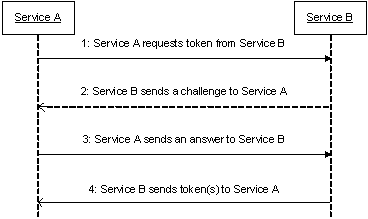
1. A requestor sends, for example, a <wst:RequestSecurityToken> message with a timestamp.
2. The recipient does not trust the
timestamp and issues a <wst:RequestSecurityTokenResponse> message with an embedded challenge.
3. The requestor sends a <wst:RequestSecurityTokenReponse> message with an answer to the
challenge.
4. The recipient issues a <wst:RequestSecurityTokenResponseCollection> message with the issued security
token and optional proof-of-possession token.
It should be noted
that the requestor might challenge the recipient in either step 1 or step 3.
In which case, step 2 or step 4 contains an answer to the initiator's
challenge. Similarly, it is possible that steps 2 and 3 could iterate multiple
times before the process completes (step 4).
The
two services can use [WS-SecurityPolicy] to state their requirements and
preferences for security tokens and encryption and signing algorithms (general
policy intersection). This section defines mechanisms for legacy and more
sophisticated types of negotiations.
The general
mechanisms defined for requesting and returning security tokens are
extensible. This section describes the general model for extending these to
support negotiations and challenges.
The exchange model
is as follows:
1. A request is initiated with a <wst:RequestSecurityToken> that identifies the details of the
request (and may contain initial negotiation/challenge information)
2. A response is returned with a <wst:RequestSecurityTokenResponse> that contains additional
negotiation/challenge information. Optionally, this may return token
information in the form of a <wst:RequestSecurityTokenResponseCollection> (if the exchange is two legs long).
3. If the exchange is not complete, the
requestor uses a <wst:RequestSecurityTokenResponse> that contains additional
negotiation/challenge information.
4. The process repeats at step 2 until
the negotiation/challenge is complete (a token is returned or a Fault occurs).
In the case where token information is returned in the final leg, it is
returned in the form of a <wst:RequestSecurityTokenResponseCollection>.
The
negotiation/challenge information is passed in binding/profile-specific
elements that are placed inside of the <wst:RequestSecurityToken> and <wst:RequestSecurityTokenResponse> elements.
It is RECOMMENDED
that at least the <wsu:Timestamp> element be included in messages (as
per [WS-Security]) as a way to ensure freshness of the
messages in the exchange. Other types of challenges MAY also be included. For
example, a <wsp:Policy> element may be used to negotiate
desired policy behaviors of both parties. Multiple challenges and responses MAY
be included.
Exchange requests
are issued by including an element that describes the exchange (e.g. challenge)
and responses contain an element describing the response. For example,
signature challenges are processed using the <wst:SignChallenge> element. The response is returned in
a <wst:SignChallengeResponse> element. Both the challenge and the
response elements are specified within the <wst:RequestSecurityTokenResponse> element. Some forms of negotiation
MAY specify challenges along with responses to challenges from the other
party. It should be noted that the requestor MAY provide exchange information
(e.g. a challenge) to the recipient in the initial request. Consequently,
these elements are also allowed within a <wst:RequestSecurityToken> element.
The syntax of
these elements is as follows:
<wst:SignChallenge xmlns:wst="...”>
<wst:Challenge ...>...</wst:Challenge>
</wst:SignChallenge>
<wst:SignChallengeResponse xmlns:wst="...”>
<wst:Challenge ...>...</wst:Challenge>
</wst:SignChallengeResponse>
The following
describes the attributes and tags listed in the schema above:
.../wst:SignChallenge
This optional element describes a challenge that requires
the other party to sign a specified set of information.
.../wst:SignChallenge/wst:Challenge
This required string element describes the value to be
signed. In order to prevent certain types of attacks (such as
man-in-the-middle), it is strongly RECOMMENDED that the challenge be bound to
the negotiation. For example, the challenge SHOULD track (such as using a
digest of) any relevant data exchanged such as policies, tokens, replay protection,
etc. As well, if the challenge is happening over a secured channel, a
reference to the channel SHOULD also be included. Furthermore, the recipient
of a challenge SHOULD verify that the data tracked (digested) matches their
view of the data exchanged. The exact algorithm MAY be defined in profiles or
agreed to by the parties.
.../SignChallenge/{any}
This is an extensibility mechanism to allow additional
negotiation types to be used.
.../wst:SignChallenge/@{any}
This is an extensibility mechanism to allow additional
attributes, based on schemas, to be added to the element.
.../wst:SignChallengeResponse
This optional element describes a response to a challenge
that requires the signing of a specified set of information.
.../wst:SignChallengeResponse/wst:Challenge
If a challenge was issued, the response MUST contain the
challenge element exactly as received. As well, while the RSTR response SHOULD
always be signed, if a challenge was issued, the RSTR MUST be signed (and the
signature coupled with the message to prevent replay).
.../wst:SignChallengeResponse/{any}
This is an extensibility mechanism to allow additional
negotiation types to be used.
.../wst:SignChallengeResponse/@{any}
This is an extensibility mechanism to allow additional
attributes, based on schemas, to be added to the element.
8.3 Binary Exchanges and Negotiations
Exchange requests
may also utilize existing binary formats passed within the WS-Trust framework.
A generic mechanism is provided for this that includes a URI attribute to
indicate the type of binary exchange.
The syntax of this
element is as follows:
<wst:BinaryExchange ValueType="..." EncodingType="..."
xmlns:wst="...”>
</wst:BinaryExchange>
The following
describes the attributes and tags listed in the schema above (note that the
ellipses below indicate that this element may be placed in different
containers. For this specification, these are limited to <wst:RequestSecurityToken> and <wst:RequestSecurityTokenResponse>):
.../wst:BinaryExchange
This optional element is used for a security negotiation
that involves exchanging binary blobs as part of an existing negotiation
protocol. The contents of this element are blob-type-specific and are encoded
using base64 (unless otherwise specified).
.../wst:BinaryExchange/@ValueType
This required attribute specifies a URI to identify the
type of negotiation (and the value space of the blob – the element's contents).
.../wst:BinaryExchange/@EncodingType
This required attribute specifies a URI to identify the
encoding format (if different from base64) of the negotiation blob. Refer to [WS-Security] for sample encoding format URIs.
.../wst:BinaryExchange/@{any}
This is an extensibility mechanism to allow additional
attributes, based on schemas, to be added to the element.
Some binary
exchanges result in a shared state/context between the involved parties. It is
RECOMMENDED that at the conclusion of the exchange, a new token and
proof-of-possession token be returned. A common approach is to use the
negotiated key as a "secure channel" mechanism to secure the new
token and proof-of-possession token.
For example, an
exchange might establish a shared secret Sx that can then be used to sign the
final response and encrypt the proof-of-possession token.
In some cases it
may be necessary to provide a key exchange token so that the other party
(either requestor or issuer) can provide entropy or key material as part of the
exchange. Challenges may not always provide a usable key as the signature may
use a signing-only certificate.
The section
describes two optional elements that can be included in RST and RSTR elements
to indicate that a Key Exchange Token (KET) is desired, or to provide a KET.
The syntax of
these elements is as follows (Note that the ellipses below indicate that this
element may be placed in different containers. For this specification, these
are limited to <wst:RequestSecurityToken> and <wst:RequestSecurityTokenResponse>):
<wst:RequestKET
xmlns:wst="..." />
<wst:KeyExchangeToken
xmlns:wst="...”>...</wst:KeyExchangeToken>
The following
describes the attributes and tags listed in the schema above:
.../wst:RequestKET
This optional element is used to indicate that the
receiving party (either the original requestor or issuer) should provide a KET
to the other party on the next leg of the exchange.
.../wst:KeyExchangeToken
This optional element is used to provide a key exchange
token. The contents of this element either contain the security token to be
used for key exchange or a reference to it.
Using the
extensibility model described in this specification, any custom XML-based
exchange can be defined in a separate binding/profile document. In such cases
elements are defined which are carried in the RST and RSTR elements.
It should be noted
that it is NOT REQUIRED that exchange elements be symmetric. That is, a
specific exchange mechanism MAY use multiple elements at different times,
depending on the state of the exchange.
Here is an example
exchange involving a signature challenge. In this example, a service requests
a custom token using a X.509 certificate for authentication. The issuer uses
the exchange mechanism to challenge the requestor to sign a random value (to
ensure message freshness). The requestor provides a signature of the requested
data and, once validated, the issuer then issues the requested token.
The first message
illustrates the initial request that is signed with the private key associated
with the requestor's X.509 certificate:
<S11:Envelope
xmlns:S11="..." xmlns:wsse="..."
xmlns:wsu="..." xmlns:wst="...">
<S11:Header>
...
<wsse:Security>
<wsse:BinarySecurityToken
wsu:Id="reqToken"
ValueType="...X509v3">
MIIEZzCCA9CgAwIBAgIQEmtJZc0...
</wsse:BinarySecurityToken>
<ds:Signature xmlns:ds="...">
...
<ds:KeyInfo>
<wsse:SecurityTokenReference>
<wsse:Reference URI="#reqToken"/>
</wsse:SecurityTokenReference>
</ds:KeyInfo>
</ds:Signature>
</wsse:Security>
...
</S11:Header>
<S11:Body>
<wst:RequestSecurityToken>
<wst:TokenType>
http://example.org/mySpecialToken
</wst:TokenType>
<wst:RequestType>
http://docs.oasis-open.org/ws-sx/ws-trust/200512/Issue
</wst:RequestType>
</wst:RequestSecurityToken>
</S11:Body>
</S11:Envelope>
The issuer
(recipient) service doesn't trust the sender's timestamp (or one wasn't
specified) and issues a challenge using the exchange framework defined in this
specification. This message is signed using the private key associated with
the issuer's X.509 certificate and contains a random challenge that the
requestor must sign:
<S11:Envelope
xmlns:S11="..." xmlns:wsse="..." xmlns:wsu="..."
xmlns:wst="...">
<S11:Header>
...
<wsse:Security>
<wsse:BinarySecurityToken
wsu:Id="issuerToken"
ValueType="...X509v3">
DFJHuedsujfnrnv45JZc0...
</wsse:BinarySecurityToken>
<ds:Signature xmlns:ds="...">
...
</ds:Signature>
</wsse:Security>
...
</S11:Header>
<S11:Body>
<wst:RequestSecurityTokenResponse>
<wst:SignChallenge>
<wst:Challenge>Huehf...</wst:Challenge>
</wst:SignChallenge>
</wst:RequestSecurityTokenResponse>
</S11:Body>
</S11:Envelope>
The requestor receives the issuer's challenge and issues a response that is
signed using the requestor's X.509 certificate and contains the challenge. The
signature only covers the non-mutable elements of the message to prevent
certain types of security attacks:
<S11:Envelope
xmlns:S11="..." xmlns:wsse="..." xmlns:wsu="..."
xmlns:wst="...">
<S11:Header>
...
<wsse:Security>
<wsse:BinarySecurityToken
wsu:Id="reqToken"
ValueType="...X509v3">
MIIEZzCCA9CgAwIBAgIQEmtJZc0...
</wsse:BinarySecurityToken>
<ds:Signature xmlns:ds="...">
...
</ds:Signature>
</wsse:Security>
...
</S11:Header>
<S11:Body>
<wst:RequestSecurityTokenResponse>
<wst:SignChallengeResponse>
<wst:Challenge>Huehf...</wst:Challenge>
</wst:SignChallengeResponse>
</wst:RequestSecurityTokenResponse>
</S11:Body>
</S11:Envelope>
The issuer
validates the requestor's signature responding to the challenge and issues the
requested token(s) and the associated proof-of-possession token. The
proof-of-possession token is encrypted for the requestor using the requestor's
public key.
<S11:Envelope
xmlns:S11="..." xmlns:wsse="..." xmlns:wsu="..."
xmlns:wst="..." xmlns:xenc="...">
<S11:Header>
...
<wsse:Security>
<wsse:BinarySecurityToken
wsu:Id="issuerToken"
ValueType="...X509v3">
DFJHuedsujfnrnv45JZc0...
</wsse:BinarySecurityToken>
<ds:Signature xmlns:ds="...">
...
</ds:Signature>
</wsse:Security>
...
</S11:Header>
<S11:Body>
<wst:RequestSecurityTokenResponseCollection>
<wst:RequestSecurityTokenResponse>
<wst:RequestedSecurityToken>
<xyz:CustomToken xmlns:xyz="...">
...
</xyz:CustomToken>
</wst:RequestedSecurityToken>
<wst:RequestedProofToken>
<xenc:EncryptedKey Id="newProof">
...
</xenc:EncryptedKey>
</wst:RequestedProofToken>
</wst:RequestSecurityTokenResponse>
</wst:RequestSecurityTokenResponseCollection>
</S11:Body>
</S11:Envelope>
Here is another
illustrating the syntax for a token request using a custom XML exchange. For
brevity, only the RST and RSTR elements are illustrated. Note that the
framework allows for an arbitrary number of exchanges, although this example
illustrates the use of four legs. The request uses a custom exchange element
and the requestor signs only the non-mutable element of the message:
<wst:RequestSecurityToken
xmlns:wst="...”>
<wst:TokenType>
http://example.org/mySpecialToken
</wst:TokenType>
<wst:RequestType>
http://docs.oasis-open.org/ws-sx/ws-trust/200512/Issue
</wst:RequestType>
<xyz:CustomExchange xmlns:xyz="...">
...
</xyz:CustomExchange>
</wst:RequestSecurityToken>
The issuer service
(recipient) responds with another leg of the custom exchange and signs the
response (non-mutable aspects) with its token:
<wst:RequestSecurityTokenResponse
xmlns:wst="...”>
<xyz:CustomExchange xmlns:xyz="...">
...
</xyz:CustomExchange>
</wst:RequestSecurityTokenResponse>
The requestor
receives the issuer's exchange and issues a response that is signed using the
requestor's token and continues the custom exchange. The signature covers all
non-mutable aspects of the message to prevent certain types of security
attacks:
<wst:RequestSecurityTokenResponse
xmlns:wst="...”>
<xyz:CustomExchange xmlns:xyz="...">
...
</xyz:CustomExchange>
</wst:RequestSecurityTokenResponse>
The issuer
processes the exchange and determines that the exchange is complete and that a
token should be issued. Consequently it issues the requested token(s) and the
associated proof-of-possession token. The proof-of-possession token is
encrypted for the requestor using the requestor's public key.
<wst:RequestSecurityTokenResponseCollection xmlns:wst="...”>
<wst:RequestSecurityTokenResponse>
<wst:RequestedSecurityToken>
<xyz:CustomToken xmlns:xyz="...">
...
</xyz:CustomToken>
</wst:RequestedSecurityToken>
<wst:RequestedProofToken>
<xenc:EncryptedKey Id="newProof" xmlns:xenc="...">
...
</xenc:EncryptedKey>
</wst:RequestedProofToken>
<wst:RequestedProofToken>
<xenc:EncryptedKey
xmlns:xenc="...">...</xenc:EncryptedKey>
</wst:RequestedProofToken>
</wst:RequestSecurityTokenResponse>
</wst:RequestSecurityTokenResponseCollection>
It should be noted
that other example exchanges include the issuer returning a final custom
exchange element, and another example where a token isn't returned.
There are some
attacks, such as forms of man-in-the-middle, that can be applied to token
requests involving exchanges. It is RECOMMENDED that the exchange sequence be
protected. This may be built into the exchange messages, but if metadata is
provided in the RST or RSTR elements, then it is subject to attack.
Consequently, it
is RECOMMENDED that keys derived from exchanges be linked cryptographically to
the exchange. For example, a hash can be computed by computing the SHA1 of the
exclusive canonicalization [XML-C14N]
of all RST and RSTR elements in messages exchanged. This value can then be
combined with the exchanged secret(s) to create a new master secret that is
bound to the data both parties sent/received.
To this end, the
following computed key algorithm is defined to be optionally used in these
scenarios:
|
URI
|
Meaning
|
|
http://docs.oasis-open.org/ws-sx/ws-trust/200512/CK/HASH
|
The key is
computed using P_SHA1 as follows:
H=SHA1(ExclC14N(RST...RSTRs))
X=encrypting H
using negotiated
key and mechanism
Key=P_SHA1(X,H+"CK-HASH")
The octets for
the "CK-HASH" string are the UTF-8 octets.
|
After an exchange
both parties have a shared knowledge of a key (or keys) that can then be used
to secure messages. However, in some cases it may be desired to have the
issuer prove to the requestor that it knows the key (and that the returned metadata
is valid) prior to the requestor using the data. However, until the exchange
is actually completed it may (and is often) inappropriate to use the computed
keys. As well, using a token that hasn't been returned to secure a message may
complicate processing since it crosses the boundary of the exchange and the
underlying message security. This means that it may not be appropriate to sign
the final leg of the exchange using the key derived from the exchange.
For this reason an
authenticator is defined that provides a way for the issuer to verify the hash
as part of the token issuance. Specifically, when an authenticator is
returned, the <wst:RequestSecurityTokenResponseCollection> element is returned. This contains
one RSTR with the token being returned as a result of the exchange and a second
RSTR that contains the authenticator (this order SHOULD be used). When an
authenticator is used, RSTRs MUST use the @Context element
so that the authenticator can be correlated to the token issuance. The authenticator
is separated from the RSTR because otherwise computation of the RST/RSTR hash
becomes more complex. The authenticator is represented using the <wst:Authenticator> element as illustrated below:
<wst:RequestSecurityTokenResponseCollection
xmlns:wst="...”>
<wst:RequestSecurityTokenResponse Context="...">
...
</wst:RequestSecurityTokenResponse>
<wst:RequestSecurityTokenResponse Context="...">
<wst:Authenticator>
<wst:CombinedHash>...</wst:CombinedHash>
...
</wst:Authenticator>
</wst:RequestSecurityTokenResponse>
</wst:RequestSecurityTokenResponseCollection>
The following
describes the attributes and elements listed in the schema overview above (the
... notation below represents the path RSTRC/RSTR and is used for brevity):
.../wst:Authenticator
This optional element provides verification
(authentication) of a computed hash.
.../wst:Authenticator/wst:CombinedHash
This optional element proves the hash and knowledge of the
computed key. This is done by providing the base64 encoding of the first 256
bits of the P_SHA1 digest of the computed key and the concatenation of the hash
determined for the computed key and the string "AUTH-HASH".
Specifically, P_SHA1(computed-key, H +
"AUTH-HASH")0-255. The octets for the
"AUTH-HASH" string are the UTF-8 octets.
This <wst:CombinedHash> element is optional (and an open content model is used)
to allow for different authenticators in the future.
This section
outlines additional parameters that can be specified in token requests and
responses. Typically they are used with issuance requests, but since all types
of requests may issue security tokens they could apply to other bindings.
In some scenarios
the requestor is obtaining a token on behalf of another party. These
parameters specify the issuer and original requestor of the token being used as
the basis of the request. The syntax is as follows (note that the base
elements described above are included here italicized for completeness):
<wst:RequestSecurityToken xmlns:wst="...”>
<wst:TokenType>...</wst:TokenType>
<wst:RequestType>...</wst:RequestType>
...
<wst:OnBehalfOf>...</wst:OnBehalfOf>
<wst:Issuer>...</wst:Issuer>
</wst:RequestSecurityToken>
The following
describes the attributes and elements listed in the schema overview above:
/wst:RequestSecurityToken/wst:OnBehalfOf
This optional element indicates that the requestor is
making the request on behalf of another. The identity on whose behalf the
request is being made is specified by placing a security token, <wsse:SecurityTokenReference> element, or <wsa:EndpointReference> element within the <wst:OnBehalfOf> element. The requestor MAY
provide proof of possession of the key associated with the OnBehalfOf identity
by including a signature in the RST security header generated using the
OnBehalfOf token that signs the primary signature of the RST (i.e. endorsing
supporting token concept from WS-SecurityPolicy). Additional signed supporting
tokens describing the OnBehalfOf context MAY also be included within the RST
security header.
/wst:RequestSecurityToken/wst:Issuer
This optional element specifies the issuer of the security
token that is presented in the message. This element's type is an endpoint
reference as defined in [WS-Addressing].
In the following illustrates
the syntax for a proxy that is requesting a security token on behalf of another
requestor or end-user.
<wst:RequestSecurityToken
xmlns:wst="...”>
<wst:TokenType>...</wst:TokenType>
<wst:RequestType>...</wst:RequestType>
...
<wst:OnBehalfOf>endpoint-reference</wst:OnBehalfOf>
</wst:RequestSecurityToken>
9.2 Key
and Encryption Requirements
This section
defines extensions to the <wst:RequestSecurityToken> element for requesting specific types
of keys or algorithms or key and algorithms as specified by a given policy in
the return token(s). In some cases the service may support a variety of key
types, sizes, and algorithms. These parameters allow a requestor to indicate
its desired values. It should be noted that the issuer's policy indicates if
input values must be adhered to and faults generated for invalid inputs, or if
the issuer will provide alterative values in the response.
Although
illustrated using the <wst:RequestSecurityToken> element, these options can also be
returned in a <wst:RequestSecurityTokenResponse> element.
The syntax for
these optional elements is as follows (note that the base elements described
above are included here italicized for completeness):
<wst:RequestSecurityToken
xmlns:wst="...”>
<wst:TokenType>...</wst:TokenType>
<wst:RequestType>...</wst:RequestType>
...
<wst:AuthenticationType>...</wst:AuthenticationType>
<wst:KeyType>...</wst:KeyType>
<wst:KeySize>...</wst:KeySize>
<wst:SignatureAlgorithm>...</wst:SignatureAlgorithm>
<wst:EncryptionAlgorithm>...</wst:EncryptionAlgorithm>
<wst:CanonicalizationAlgorithm>...</wst:CanonicalizationAlgorithm>
<wst:ComputedKeyAlgorithm>...</wst:ComputedKeyAlgorithm>
<wst:Encryption>...</wst:Encryption>
<wst:ProofEncryption>...</wst:ProofEncryption>
<wst:UseKey Sig="..."> </wst:UseKey>
<wst:SignWith>...</wst:SignWith>
<wst:EncryptWith>...</wst:EncryptWith>
</wst:RequestSecurityToken>
The following
describes the attributes and elements listed in the schema overview above:
/wst:RequestSecurityToken/wst:AuthenticationType
This optional URI element indicates the type of
authentication desired, specified as a URI. This specification does not
predefine classifications; these are specific to token services as is the
relative strength evaluations. The relative assessment of strength is up to
the recipient to determine. That is, requestors should be familiar with the
recipient policies. For example, this might be used to indicate which of the four
U.S. government authentication levels is required.
/wst:RequestSecurityToken/wst:KeyType
This optional URI element indicates the type of key desired
in the security token. The predefined values are identified in the table
below. Note that some security token formats have fixed key types. It should
be noted that new algorithms can be inserted by defining URIs in other
specifications and profiles.
|
URI
|
Meaning
|
|
http://docs.oasis-open.org/ws-sx/ws-trust/200512/PublicKey
|
A public
key token is requested
|
|
http://docs.oasis-open.org/ws-sx/ws-trust/200512/SymmetricKey
|
A
symmetric key token is requested (default)
|
|
http://docs.oasis-open.org/ws-sx/wstrust/200512/Bearer
|
A bearer
token is requested. This key type can be used by requestors to indicate that they want a security token to
be issued that does not require proof of possession.
|
/wst:RequestSecurityToken/wst:KeySize
This optional integer element indicates the size of the key
required specified in number of bits. This is a request, and, as such, the
requested security token is not obligated to use the requested key size. That
said, the recipient SHOULD try to use a key at least as strong as the specified
value if possible. The information is provided as an indication of the desired
strength of the security.
/wst:RequestSecurityToken/wst:SignatureAlgorithm
This optional URI element indicates the desired signature
algorithm used within the returned token. This is specified as a URI
indicating the algorithm (see [XML-Signature] for typical
signing algorithms).
/wst:RequestSecurityToken/wst:EncryptionAlgorithm
This optional URI element indicates the desired encryption
algorithm used within the returned token. This is specified as a URI
indicating the algorithm (see [XML-Encrypt] for typical
encryption algorithms).
/wst:RequestSecurityToken/wst:CanonicalizationAlgorithm
This optional URI element indicates the desired
canonicalization method used within the returned token. This is specified as a
URI indicating the method (see [XML-Signature] for
typical canonicalization methods).
/wst:RequestSecurityToken/wst:ComputedKeyAlgorithm
This optional URI element indicates the desired algorithm
to use when computed keys are used for issued tokens.
/wst:RequestSecurityToken/wst:Encryption
This optional element indicates that the requestor desires
any returned secrets in issued security tokens to be encrypted for the
specified token. That is, so that the owner of the specified token can decrypt
the secret. Normally the security token is the contents of this element but a
security token reference MAY be used instead. If this element isn't specified,
the token used as the basis of the request (or specialized knowledge) is used
to determine how to encrypt the key.
/wst:RequestSecurityToken/wst:ProofEncryption
This optional element indicates that the requestor desires
any returned secrets in proof-of-possession tokens to be encrypted for the
specified token. That is, so that the owner of the specified token can decrypt
the secret. Normally the security token is the contents of this element but a
security token reference MAY be used instead. If this element isn't specified,
the token used as the basis of the request (or specialized knowledge) is used
to determine how to encrypt the key.
/wst:RequestSecurityToken/wst:UseKey
If the requestor wishes to use an existing key rather than
create a new one, then this optional element can be used to reference the
security token containing the desired key. This element either contains a
security token or a <wsse:SecurityTokenReference>
element that references the security token containing the key that should be
used in the returned token. If <wst:KeyType>
is not defined and a key type is not implicitly known to the service, it MAY be
determined from the token (if possible). Otherwise this parameter is
meaningless and is ignored. Requestors SHOULD demonstrate authorized use of
the public key provided.
/wst:RequestSecurityToken/wst:KeyWrapAlgorithm
This optional URI element indicates the desired algorithm
to use for key wrapping when STS encrypts the issued token for the relying
party using an asymmetric key.
/wst:RequestSecurityToken/wst:UseKey/@Sig
In order to authenticate the key
referenced, a signature MAY be used to prove the referenced token/key. If
specified, this optional attribute indicates the ID of the corresponding
signature (by URI reference). When this attribute is present, a key need not
be specified inside the element since the referenced signature will indicate
the corresponding token (and key).
/wst:RequestSecurityToken/wst:SignWith
This optional URI element indicates the desired signature
algorithm to be used with the issued security token (typically from the policy
of the target site for which the token is being requested. While any of these
optional elements MAY be included in RSTRs, this one is a likely candidate if
there is some doubt (e.g., an X.509 cert that can only use DSS).
/wst:RequestSecurityToken/wst:EncryptWith
This optional URI element indicates the desired encryption
algorithm to be used with the issued security token (typically from the policy
of the target site for which the token is being requested.) While any of these
optional elements MAY be included in RSTRs, this one is a likely candidate if
there is some doubt.
The
following summarizes the various algorithm parameters defined above. T is the
issued token, P is the proof key.
SignatureAlgorithm - The signature algorithm to use to
sign T
EncryptionAlgorithm - The encryption algorithm to use to
encrypt T
CanonicalizationAlgorithm - The canonicalization algorithm to
use when signing T
ComputedKeyAlgorithm - The key derivation algorithm to use
if using a symmetric key for P where P is computed using client, server, or combined
entropy.
Encryption - The token/key to use when
encrypting T
ProofEncryption - The token/key to use when
encrypting P
UseKey - This is P. This is generally used
when the client supplies a public-key that it wishes to be embedded in T as the
proof key.
SignWith - The signature algorithm the client
intends to employ when using P to
sign.
The encryption
algorithms further differ based on whether the issued token contains asymmetric
key or symmetric key. Furthermore, they differ based on what type of key is
used to protect the issued token from the STS to the relying party. The
following cases can occur:
T contains
symmetric key/STS uses symmetric key to encrypt T for RP
EncryptWith – used to indicate symmetric
algorithm that client will use to protect message to RP when using the proof
key (e.g. AES256).
EncryptionAlgorithm – used to indicate the symmetric
algorithm that the STS should use to encrypt the T (e.g. AES256)
T contains
symmetric key/STS uses asymmetric key to encrypt T for RP
EncryptWith – used to indicate symmetric
algorithm that client will use to protect message to RP when using the proof
key (e.g. AES256)
EncryptionAlgorithm – used to indicate the symmetric
algorithm that the STS should use to encrypt T for RP (e.g. AES256)
KeyWrapAlgorithm – used to indicate the KeyWrap
algorithm that the STS should use to wrap the generated key that is used to
encrypt the T for RP.
T contains
asymmetric key/STS uses symmetric key to encrypt T for RP
EncryptWith – used to indicate the KeyWrap
algorithm that the client will use to
protect
symmetric key that is used to protect message to RP when using the proof
key (e.g.
RSA-OAEP-MGF1P)
EncryptionAlgorithm – used to indicate the symmetric
algorithm that the STS should use to encrypt T for RP (e.g. AES256)
T contains
asymmetric key/STS uses asymmetric key to encrypt T for RP
EncryptWith - used to indicate the KeyWrap
algorithm that the client will use to
protect
symmetric key that is used to protect message to RP when using the proof
key (e.g.
RSA-OAEP-MGF1P)
EncryptionAlgorithm - used to indicate the symmetric
algorithm that the STS should use to encrypt T for RP (e.g. AES256)
KeyWrapAlgorithm – used to indicate the KeyWrap
algorithm that the STS should use to wrap the generated key that is used to
encrypt the T for RP.
The example below
illustrates a request that utilizes several of these parameters. A request is
made for a custom token using a username and password as the basis of the
request. For security, this token is encrypted (see "encUsername")
for the recipient using the recipient's public key and referenced in the
encryption manifest. The message is protected by a signature using a public
key from the sender and authorized by the username and password.
The requestor
would like the custom token to contain a 1024-bit public key whose value can be
found in the key provided with the "proofSignature" signature (the
key identified by "requestProofToken"). The token should be signed
using RSA-SHA1 and encrypted for the token identified by "requestEncryptionToken".
The proof should be encrypted using the token identified by
"requestProofToken".
<S11:Envelope
xmlns:S11="..." xmlns:wsse="..." xmlns:wsu="..."
xmlns:wst="..." xmlns:ds="..."
xmlns:xenc="...">
<S11:Header>
...
<wsse:Security>
<xenc:ReferenceList>...</xenc:ReferenceList>
<xenc:EncryptedData
Id="encUsername">...</xenc:EncryptedData>
<wsse:BinarySecurityToken wsu:Id="requestEncryptionToken"
ValueType="...SomeTokenType" xmlns:x="...">
MIIEZzCCA9CgAwIBAgIQEmtJZc0...
</wsse:BinarySecurityToken>
<wsse:BinarySecurityToken wsu:Id="requestProofToken"
ValueType="...SomeTokenType" xmlns:x="...">
MIIEZzCCA9CgAwIBAgIQEmtJZc0...
</wsse:BinarySecurityToken>
<ds:Signature Id="proofSignature">
... signature proving requested key ...
... key info points to the "requestedProofToken" token ...
</ds:Signature>
</wsse:Security>
...
</S11:Header>
<S11:Body wsu:Id="req">
<wst:RequestSecurityToken>
<wst:TokenType>
http://example.org/mySpecialToken
</wst:TokenType>
<wst:RequestType>
http://docs.oasis-open.org/ws-sx/ws-trust/200512/Issue
</wst:RequestType>
<wst:KeyType>
http://docs.oasis-open.org/ws-sx/ws-trust/200512/PublicKey
</wst:KeyType>
<wst:KeySize>1024</wst:KeySize>
<wst:SignatureAlgorithm>
http://www.w3.org/2000/09/xmldsig#rsa-sha1
</wst:SignatureAlgorithm>
<wst:Encryption>
<Reference URI="#requestEncryptionToken"/>
</wst:Encryption>
<wst:ProofEncryption>
<wsse:Reference URI="#requestProofToken"/>
</wst:ProofEncryption>
<wst:UseKey Sig="#proofSignature"/>
</wst:RequestSecurityToken>
</S11:Body>
</S11:Envelope>
This section
defines extensions to the <wst:RequestSecurityToken> element for indicating delegation and
forwarding requirements on the requested security token(s).
The syntax for
these extension elements is as follows (note that the base elements described
above are included here italicized for completeness):
<wst:RequestSecurityToken xmlns:wst="...”>
<wst:TokenType>...</wst:TokenType>
<wst:RequestType>...</wst:RequestType>
...
<wst:DelegateTo>...</wst:DelegateTo>
<wst:Forwardable>...</wst:Forwardable>
<wst:Delegatable>...</wst:Delegatable>
</wst:RequestSecurityToken>
/wst:RequestSecurityToken/wst:DelegateTo
This optional element indicates that the requested or
issued token be delegated to another identity. The identity receiving the
delegation is specified by placing a security token or <wsse:SecurityTokenReference> element within
the <wst:DelegateTo> element.
/wst:RequestSecurityToken/wst:Forwardable
This optional element, of type xs:boolean, specifies
whether the requested security token should be marked as
"Forwardable". In general, this flag is used when a token is
normally bound to the requestor's machine or service. Using this flag, the
returned token MAY be used from any source machine so long as the key is
correctly proven. The default value of this flag is true.
/wst:RequestSecurityToken/wst:Delegatable
This optional element, of type xs:boolean, specifies
whether the requested security token should be marked as
"Delegatable". Using this flag, the returned token MAY be delegated
to another party. This parameter SHOULD be used in conjunction with <wst:DelegateTo>. The default value of this
flag is false.
The following
illustrates the syntax of a request for a custom token that can be delegated to
the indicated recipient (specified in the binary security token) and used in
the specified interval.
<wst:RequestSecurityToken
xmlns:wst="...”>
<wst:TokenType>
http://example.org/mySpecialToken
</wst:TokenType>
<wst:RequestType>
http://docs.oasis-open.org/ws-sx/ws-trust/200512/Issue
</wst:RequestType>
<wst:DelegateTo>
<wsse:BinarySecurityToken xmlns:wsse="...">...</wsse:BinarySecurityToken>
</wst:DelegateTo>
<wst:Delegatable>true</wst:Delegatable>
</wst:RequestSecurityToken>
This section
defines extensions to the <wst:RequestSecurityToken> element for passing policies.
The syntax for
these extension elements is as follows (note that the base elements described
above are included here italicized for completeness):
<wst:RequestSecurityToken xmlns:wst="...”>
<wst:TokenType>...</wst:TokenType>
<wst:RequestType>...</wst:RequestType>
...
<wsp:Policy xmlns:wsp="...”>...</wsp:Policy>
<wsp:PolicyReference xmlns:wsp="...”>...</wsp:PolicyReference>
</wst:RequestSecurityToken>
The following
describes the attributes and elements listed in the schema overview above:
/wst:RequestSecurityToken/wsp:Policy
This optional element specifies a policy (as defined in [WS-Policy]) that indicates desired settings for the
requested token. The policy specifies defaults that can be overridden by the
elements defined in the previous sections.
/wst:RequestSecurityToken/wsp:PolicyReference
This optional element specifies a reference to a policy (as
defined in [WS-Policy]) that indicates desired settings
for the requested token. The policy specifies defaults that can be overridden
by the elements defined in the previous sections.
The following
illustrates the syntax of a request for a custom token that provides a set of
policy statements about the token or its usage requirements.
<wst:RequestSecurityToken
xmlns:wst="...”>
<wst:TokenType>
http://example.org/mySpecialToken
</wst:TokenType>
<wst:RequestType>
http://docs.oasis-open.org/ws-sx/ws-trust/200512/Issue
</wst:RequestType>
<wsp:Policy xmlns:wsp="...">
...
</wsp:Policy>
</wst:RequestSecurityToken>
9.5 Authorized Token
Participants
This section
defines extensions to the <wst:RequestSecurityToken> element for passing information about
which parties are authorized to participate in the use of the token. This
parameter is typically used when there are additional parties using the token
or if the requestor needs to clarify the actual parties involved (for some
profile-specific reason).
It should be noted
that additional participants will need to prove their identity to recipients in
addition to proving their authorization to use the returned token. This
typically takes the form of a second signature or use of transport security.
The syntax for
these extension elements is as follows (note that the base elements described
above are included here italicized for completeness):
<wst:RequestSecurityToken xmlns:wst="...”>
<wst:TokenType>...</wst:TokenType>
<wst:RequestType>...</wst:RequestType>
...
<wst:Participants>
<wst:Primary>...</wst:Primary>
<wst:Participant>...</wst:Participant>
</wst:Participants>
</wst:RequestSecurityToken>
The following
describes elements and attributes used in a <wsc:SecurityContextToken> element.
/wst:RequestSecurityToken/wst:Participants/
This optional element specifies the participants sharing
the security token. Arbitrary types may be used to specify participants, but a
typical case is a security token or an endpoint reference (see [WS-Addressing]).
/wst:RequestSecurityToken/wst:Participants/wst:Primary
This optional element specifies the primary user of the
token (if one exists).
/wst:RequestSecurityToken/wst:Participants/wst:Participant
This optional element specifies participant (or multiple
participants by repeating the element) that play a (profile-dependent) role in
the use of the token or who are allowed to use the token.
/wst:RequestSecurityToken/wst:Participants/{any}
This is an extensibility option to allow other types of
participants and profile-specific elements to be specified.
Using the token
request framework, this section defines a binding for requesting a key exchange
token (KET). That is, if a requestor desires a token that can be used to
encrypt key material for a recipient.
For this binding,
the following actions are defined to enable specific processing context to be
conveyed to the recipient:
For this binding,
the RequestType element contains the following URI:
http://docs.oasis-open.org/ws-sx/ws-trust/200512/KET
For this binding
very few parameters are specified as input. Optionally the <wst:TokenType>
element can be specified in the request can indicate desired type response
token carrying the key for key exchange; however, this isn't commonly used.
The applicability
scope (e.g. <wsp:AppliesTo>) MAY be specified if the requestor
desires a key exchange token for a specific scope.
It is RECOMMENDED
that the response carrying the key exchange token be secured (e.g., signed by
the issuer or someone who can speak on behalf of the target for which the KET
applies).
Care should be taken
when using this binding to prevent possible man-in-the-middle and substitution
attacks. For example, responses to this request SHOULD be secured using a
token that can speak for the desired endpoint.
The RSTR for this
binding carries the <RequestedSecurityToken> element even if a token is returned
(note that the base elements described above are included here italicized for
completeness):
<wst:RequestSecurityToken xmlns:wst="...”>
<wst:TokenType>...</wst:TokenType>
<wst:RequestType>...</wst:RequestType>
...
</wst:RequestSecurityToken>
<wst:RequestSecurityTokenResponseCollection xmlns:wst="...”>
<wst:RequestSecurityTokenResponse>
<wst:TokenType>...</wst:TokenType>
<wst:RequestedSecurityToken>...</wst:RequestedSecurityToken>
...
</wst:RequestSecurityTokenResponse>
</wst:RequestSecurityTokenResponseCollection>
The following
illustrates the syntax for requesting a key exchange token. In this example,
the KET is returned encrypted for the requestor since it had the credentials
available to do that. Alternatively the request could be made using transport
security (e.g. TLS) and the key could be returned directly using <wst:BinarySecret>.
<wst:RequestSecurityToken
xmlns:wst="...”>
<wst:RequestType>
http://docs.oasis-open.org/ws-sx/ws-trust/200512/KET
</wst:RequestType>
</wst:RequestSecurityToken>
<wst:RequestSecurityTokenResponseCollection xmlns:wst="...”>
<wst:RequestSecurityTokenResponse>
<wst:RequestedSecurityToken>
<xenc:EncryptedKey xmlns:xenc="...”>...</xenc:EncryptedKey>
</wst:RequestedSecurityToken>
</wst:RequestSecurityTokenResponse>
</wst:RequestSecurityTokenResponseCollection>
There are many
circumstances where an error can occur while
processing security information. Errors use the SOAP Fault mechanism. Note
that the reason text provided below is RECOMMENDED, but alternative text MAY be
provided if more descriptive or preferred by the implementation. The tables
below are defined in terms of SOAP 1.1. For SOAP 1.2, the Fault/Code/Value is
env:Sender (as defined in SOAP 1.2) and the Fault/Code/Subcode/Value is the faultcode below and the Fault/Reason/Text is the faultstring below. It should be noted that profiles MAY
provide second-level detail fields, but they should be careful not to introduce
security vulnerabilities when doing so (e.g., by providing too detailed
information).
|
Error that
occurred (faultstring)
|
Fault
code (faultcode)
|
|
The request was
invalid or malformed
|
wst:InvalidRequest
|
|
Authentication
failed
|
wst:FailedAuthentication
|
|
The specified
request failed
|
wst:RequestFailed
|
|
Security token
has been revoked
|
wst:InvalidSecurityToken
|
|
Insufficient
Digest Elements
|
wst:AuthenticationBadElements
|
|
The specified RequestSecurityToken
is not understood.
|
wst:BadRequest
|
|
The request data is out-of-date
|
wst:ExpiredData
|
|
The requested time range is invalid or unsupported
|
wst:InvalidTimeRange
|
|
The request scope is invalid or
unsupported
|
wst:InvalidScope
|
|
A renewable security token has expired
|
wst:RenewNeeded
|
|
The requested renewal failed
|
wst:UnableToRenew
|
As stated in the
Goals section of this document, this specification is meant to provide
extensible framework and flexible syntax, with which one could implement
various security mechanisms. This framework and syntax by itself does not
provide any guarantee of security. When implementing and using this framework
and syntax, one must make every effort to ensure that the result is not
vulnerable to any one of a wide range of attacks.
It is not feasible
to provide a comprehensive list of security considerations for such an
extensible set of mechanisms. A complete security analysis must be conducted
on specific solutions based on this specification. Below we illustrate some of
the security concerns that often come up with protocols of this type, but we
stress that this is not an exhaustive list of concerns.
The following
statements about signatures and signing apply to messages sent on unsecured
channels.
It is critical
that all the security-sensitive message elements must be included in the scope
of the message signature. As well, the signatures for conversation
authentication must include a timestamp, nonce, or sequence number depending on
the degree of replay prevention required as described in [WS-Security] and the UsernameToken Profile.
Also, conversation establishment should include the policy so that supported
algorithms and algorithm priorities can be validated.
It is required
that security token issuance messages be signed to prevent tampering. If a
public key is provided, the request should be signed by the corresponding
private key to prove ownership. As well, additional steps should be taken to
eliminate replay attacks (refer to [WS-Security] for additional information).
Similarly, all token references should be signed to prevent any tampering.
Security token
requests are susceptible to denial-of-service attacks. Care should be taken to
mitigate such attacks as is warranted by the service.
For security, tokens containing a
symmetric key or a password should only be sent to parties who have a need to
know that key or password.
For privacy,
tokens containing personal information (either in the claims, or indirectly by
identifying who is currently communicating with whom) should only be sent
according to the privacy policies governing these data at the respective
organizations.
For some forms of
multi-message exchanges, the exchanges are susceptible to attacks whereby
signatures are altered. To address this, it is suggested that a signature
confirmation mechanism be used. In such cases, each leg should include the
confirmation of the previous leg. That is, leg 2 includes confirmation for leg
1, leg 3 for leg 2, leg 4 for leg 3, and so on. In doing so, each side can
confirm the correctness of the message outside of the message body.
There are many
other security concerns that one may need to consider in security protocols.
The list above should not be used as a "check list" instead of a
comprehensive security analysis.
It should be noted
that use of unsolicited RSTRs implies that the recipient is prepared to accept
such issuances. Recipients should ensure that such issuances are properly
authorized and recognize their use could be used in denial-of-service attacks.
In addition to the
consideration identified here, readers should also review the security
considerations in [WS-Security].
Both token
cancellation bindings defined in this specification require that the STS MUST
NOT validate or renew the token after it has been successfully canceled. The
STS must take care to ensure that the token is properly invalidated before
confirming the cancel request or sending the cancel notification to the client.
This can be more difficult if the token validation or renewal logic is
physically separated from the issuance and cancellation logic. It is out of
scope of this spec how the STS propagates the token cancellation to its other
components. If STS cannot ensure that the token was properly invalidated it
MUST NOT send the cancel
notification or confirm the cancel request to the client.
Key exchange is an
integral part of token acquisition. There are several mechanisms by which keys
are exchanged using [WS-Security]
and WS-Trust. This section highlights and summarizes these mechanisms. Other
specifications and profiles may provide additional details on key exchange.
Care must be taken when employing a
key exchange to ensure that the mechanism does not provide an attacker with a
means of discovering information that could only be discovered through use of
secret information (such as a private key).
It is therefore
important that a shared secret should only be considered as trustworthy as its
source. A shared secret communicated by means of the direct encryption scheme
described in section I.1 is acceptable if the encryption key is provided by a
completely trustworthy key distribution center (this is the case in the
Kerberos model). Such a key would not be acceptable for the purposes of
decrypting information from the source that provided it since an attacker might
replay information from a prior transaction in the hope of learning information
about it.
In most cases the
other party in a transaction is only imperfectly trustworthy. In these cases
both parties should contribute entropy to the key exchange by means of the <wst:entropy> element.
A.1 Ephemeral
Encryption Keys
The simplest form
of key exchange can be found in [WS-Security] for encrypting message data. As
described in [WS-Security] and [XML-Encrypt], when data is encrypted, a temporary
key can be used to perform the encryption which is, itself, then encrypted
using the <xenc:EncryptedKey> element.
The illustrates
the syntax for encrypting a temporary key using the public key in an issuer
name and serial number:
<xenc:EncryptedKey xmlns:xenc="...">
...
<ds:KeyInfo xmlns:ds="...">
<wsse:SecurityTokenReference xmlns:wsse="...">
<ds:X509IssuerSerial>
<ds:X509IssuerName>
DC=ACMECorp, DC=com
</ds:X509IssuerName>
<ds:X509SerialNumber>12345678</ds:X509SerialNumber>
</ds:X509IssuerSerial>
</wsse:SecurityTokenReference>
</ds:KeyInfo>
...
</xenc:EncryptedKey>
A.2 Requestor-Provided Keys
When a request
sends a message to an issuer to request a token, the client can provide
proposed key material using the <wst:Entropy>
element. If the issuer
doesn't contribute any key material, this is used as the secret (key). This
information is encrypted for the issuer either using <xenc:EncryptedKey> or by using a transport security. If the requestor
provides key material that the recipient doesn't accept, then the issuer should
reject the request. Note that the issuer need not return the key provided by
the requestor.
The following
illustrates the syntax of a request for a custom security token and includes a
secret that is to be used for the key. In this example the entropy is
encrypted for the issuer (if transport security was used for confidentiality
then the <wst:Entropy> element would contain a <wst:BinarySecret> element):
<wst:RequestSecurityToken
xmlns:wst="...”>
<wst:TokenType>
http://example.org/mySpecialToken
</wst:TokenType>
<wst:RequestType>
http://docs.oasis-open.org/ws-sx/ws-trust/200512/Issue
</wst:RequestType>
<wst:Entropy>
<xenc:EncryptedData xmlns:xenc="...">...</xenc:EncryptedData>
</wst:Entropy>
</wst:RequestSecurityToken>
A.3 Issuer-Provided Keys
If a requestor
fails to provide key material, then issued proof-of-possession tokens contain
an issuer-provided secret that is encrypted for the requestor (either using <xenc:EncryptedKey> or by using a transport security).
The following
illustrates the syntax of a token being returned with an associated
proof-of-possession token that is encrypted using the requestor's public key.
<wst:RequestSecurityTokenResponseCollection
xmlns:wst="...”>
<wst:RequestSecurityTokenResponse>
<wst:RequestedSecurityToken>
<xyz:CustomToken xmlns:xyz="...">
...
</xyz:CustomToken>
</wst:RequestedSecurityToken>
<wst:RequestedProofToken>
<xenc:EncryptedKey xmlns:xenc="..." Id="newProof">
...
</xenc:EncryptedKey>
</wst:RequestedProofToken>
</wst:RequestSecurityTokenResponse>
</wst:RequestSecurityTokenResponseCollection>
A.4 Composite Keys
The safest form of
key exchange/generation is when both the requestor and the issuer contribute to
the key material. In this case, the request sends encrypted key material. The
issuer then returns additional encrypted key material. The actual secret (key)
is computed using a function of the two pieces of data. Ideally this secret is
never used and, instead, keys derived are used for message protection.
The following
example illustrates a server, having received a request with requestor entropy
returning its own entropy, which is used in conjunction with the requestor's to
generate a key. In this example the entropy is not encrypted because the
transport is providing confidentiality (otherwise the <wst:Entropy> element
would have an <xenc:EncryptedData> element).
<wst:RequestSecurityTokenResponseCollection
xmlns:wst="...”>
<wst:RequestSecurityTokenResponse>
<wst:RequestedSecurityToken>
<xyz:CustomToken xmlns:xyz="...">
...
</xyz:CustomToken>
</wst:RequestedSecurityToken>
<wst:Entropy>
<wst:BinarySecret>UIH...</wst:BinarySecret>
</wst:Entropy>
</wst:RequestSecurityTokenResponse>
</wst:RequestSecurityTokenResponseCollection>
A.5 Key Transfer and
Distribution
There are also a
few mechanisms where existing keys are transferred to other parties.
A.5.1 Direct Key Transfer
If one party has a
token and key and wishes to share this with another party, the key can be
directly transferred. This is accomplished by sending an RSTR (either in the
body or header) to the other party. The RSTR contains the token and a
proof-of-possession token that contains the key encrypted for the recipient.
In the following
example a custom token and its associated proof-of-possession token are known
to party A who wishes to share them with party B. In this example, A is a
member in a secure on-line chat session and is inviting B to join the
conversation. After authenticating B, A sends B an RSTR. The RSTR contains
the token and the key is communicated as a proof-of-possession token that is
encrypted for B:
<wst:RequestSecurityTokenResponseCollection
xmlns:wst="...”>
<wst:RequestSecurityTokenResponse>
<wst:RequestedSecurityToken>
<xyz:CustomToken xmlns:xyz="...">
...
</xyz:CustomToken>
</wst:RequestedSecurityToken>
<wst:RequestedProofToken>
<xenc:EncryptedKey xmlns:xenc="..." Id="newProof">
...
</xenc:EncryptedKey>
</wst:RequestedProofToken>
</wst:RequestSecurityTokenResponse>
</wst:RequestSecurityTokenResponseCollection>
A.5.2 Brokered Key Distribution
A third party may
also act as a broker to transfer keys. For example, a requestor may obtain a
token and proof-of-possession token from a third-party STS. The token contains
a key encrypted for the target service (either using the service's public key
or a key known to the STS and target service). The proof-of-possession token
contains the same key encrypted for the requestor (similarly this can use
public or symmetric keys).
In the following
example a custom token and its associated proof-of-possession token are
returned from a broker B to a requestor R for access to service S. The key for
the session is contained within the custom token encrypted for S using either a
secret known by B and S or using S's public key. The same secret is encrypted
for R and returned as the proof-of-possession token:
<wst:RequestSecurityTokenResponseCollection
xmlns:wst="...”>
<wst:RequestSecurityTokenResponse>
<wst:RequestedSecurityToken>
<xyz:CustomToken xmlns:xyz="...">
...
<xenc:EncryptedKey xmlns:xenc="...">
...
</xenc:EncryptedKey>
...
</xyz:CustomToken>
</wst:RequestedSecurityToken>
<wst:RequestedProofToken>
<xenc:EncryptedKey Id="newProof">
...
</xenc:EncryptedKey>
</wst:RequestedProofToken>
</wst:RequestSecurityTokenResponse>
</wst:RequestSecurityTokenResponseCollection>
A.5.3 Delegated Key Transfer
Key transfer can
also take the form of delegation. That is, one party transfers the right to
use a key without actually transferring the key. In such cases, a delegation
token, e.g. XrML, is created that identifies a set of rights and a delegation
target and is secured by the delegating party. That is, one key indicates that
another key can use a subset (or all) of its rights. The delegate can provide
this token and prove itself (using its own key – the delegation target) to a
service. The service, assuming the trust relationships have been established
and that the delegator has the right to delegate, can then authorize requests
sent subject to delegation rules and trust policies.
In this example a
custom token is issued from party A to party B. The token indicates that B
(specifically B's key) has the right to submit purchase orders. The token is
signed using a secret key known to the target service T and party A (the key
used to ultimately authorize the requests that B makes to T), and a new session
key that is encrypted for T. A proof-of-possession token is included that
contains the session key encrypted for B. As a result, B is effectively using A's key, but doesn't actually know the
key.
<wst:RequestSecurityTokenResponseCollection
xmlns:wst="...”>
<wst:RequestSecurityTokenResponse>
<wst:RequestedSecurityToken>
<xyz:CustomToken xmlns:xyz="...">
...
<xyz:DelegateTo>B</xyz:DelegateTo>
<xyz:DelegateRights>
SubmitPurchaseOrder
</xyz:DelegateRights>
<xenc:EncryptedKey xmlns:xenc="...">
...
</xenc:EncryptedKey>
<ds:Signature xmlns:ds="...">...</ds:Signature>
...
</xyz:CustomToken>
</wst:RequestedSecurityToken>
<wst:RequestedProofToken>
<xenc:EncryptedKey xmlns:xenc="..." Id="newProof">
...
</xenc:EncryptedKey>
</wst:RequestedProofToken>
</wst:RequestSecurityTokenResponse>
</wst:RequestSecurityTokenResponseCollection>
A.5.4 Authenticated Request/Reply Key Transfer
In some cases the
RST/RSTR mechanism is not used to transfer keys because it is part of a simple
request/reply. However, there may be a desire to ensure mutual authentication
as part of the key transfer. The mechanisms of [WS-Security] can be used to implement this
scenario.
Specifically, the
sender wishes the following:
·
Transfer a key to
a recipient that they can use to secure a reply
·
Ensure that only
the recipient can see the key
·
Provide proof that
the sender issued the key
This scenario
could be supported by encrypting and then signing. This would result in
roughly the following steps:
1. Encrypt the message using a generated
key
2. Encrypt the key for the recipient
3. Sign the encrypted form, any other
relevant keys, and the encrypted key
However, if there
is a desire to sign prior to encryption then the following general process is
used:
1. Sign the appropriate message parts
using a random key (or ideally a key derived from a random key)
2. Encrypt the appropriate message parts
using the random key (or ideally another key derived from the random key)
3. Encrypt the random key for the
recipient
4. Sign just the encrypted key
This would result
in a <wsse:Security> header that looks roughly like the
following:
<wsse:Security
xmlns:wsse="..." xmlns:wsu="..."
xmlns:ds="..." xmlns:xenc="...">
<wsse:BinarySecurityToken wsu:Id="myToken">
...
</wsse:BinarySecurityToken>
<ds:Signature>
...signature over #secret using token #myToken...
</ds:Signature>
<xenc:EncryptedKey Id="secret">
...
</xenc:EncryptedKey>
<xenc:RefrenceList>
...manifest of encrypted parts using token #secret...
</xenc:RefrenceList>
<ds:Signature>
...signature over key message parts using token #secret...
</ds:Signature>
</wsse:Security>
As well, instead
of an <xenc:EncryptedKey> element, the actual token could be
passed using <xenc:EncryptedData>. The result might look like the
following:
<wsse:Security xmlns:wsse="..." xmlns:wsu="..."
xmlns:ds="..." xmlns:xenc="...">
<wsse:BinarySecurityToken wsu:Id="myToken">
...
</wsse:BinarySecurityToken>
<ds:Signature>
...signature
over #secret or #Esecret using token #myToken...
</ds:Signature>
<xenc:EncryptedData Id="Esecret”>
...Encrypted version of a token with Id="secret"...
</xenc:EncryptedData>
<xenc:RefrenceList>
...manifest of encrypted parts using token #secret...
</xenc:RefrenceList>
<ds:Signature>
...signature over key message parts using token #secret...
</ds:Signature>
</wsse:Security>
A.6 Perfect Forward Secrecy
In some situations
it is desirable for a key exchange to have the property of perfect forward
secrecy. This means that it is impossible to reconstruct the shared secret even
if the private keys of the parties are disclosed.
The most
straightforward way to attain perfect forward secrecy when using asymmetric key
exchange is to dispose of one's key exchange key pair periodically (or even
after every key exchange), replacing it with a fresh one. Of course, a freshly
generated public key must still be authenticated (using any of the methods
normally available to prove the identity of a public key's owner).
The perfect
forward secrecy property may be achieved by specifying a <wst:entropy>
element that contains an <xenc:EncryptedKey> that is encrypted under a public key
pair created for use in a single key agreement. The public key does not require
authentication since it is only used to provide additional entropy. If the
public key is modified, the key agreement will fail. Care should be taken,
when using this method, to ensure that the now-secret entropy exchanged via the
<wst:entropy> element is not revealed elsewhere in
the protocol (since such entropy is often assumed to be publicly revealed
plaintext, and treated accordingly).
Although any
public key scheme might be used to achieve perfect forward secrecy (in either
of the above methods) it is generally desirable to use an algorithm that allows
keys to be generated quickly. The Diffie-Hellman key exchange is often used for
this purpose since generation of a key only requires the generation of a random
integer and calculation of a single modular exponent.
The WSDL below
does not fully capture all the possible message exchange patterns, but captures
the typical message exchange pattern as described in this document.
<?xml
version="1.0"?>
<wsdl:definitions
targetNamespace="http://docs.oasis-open.org/ws-sx/ws-trust/200512/wsdl"
xmlns:tns="http://docs.oasis-open.org/ws-sx/ws-trust/200512/wsdl"
xmlns:wst="http://docs.oasis-open.org/ws-sx/ws-trust/200512"
xmlns:wsdl="http://schemas.xmlsoap.org/wsdl/"
xmlns:xs="http://www.w3.org/2001/XMLSchema"
>
<!--
this is the WS-I BP-compliant way to import a schema -->
<wsdl:types>
<xs:schema>
<xs:import
namespace="http://docs.oasis-open.org/ws-sx/ws-trust/200512"
schemaLocation="http://docs.oasis-open.org/ws-sx/ws-trust/200512/ws-trust.xsd"/>
</xs:schema>
</wsdl:types>
<!--
WS-Trust defines the following GEDs -->
<wsdl:message name="RequestSecurityTokenMsg">
<wsdl:part name="request"
element="wst:RequestSecurityToken" />
</wsdl:message>
<wsdl:message name="RequestSecurityTokenResponseMsg">
<wsdl:part name="response"
element="wst:RequestSecurityTokenResponse" />
</wsdl:message>
<wsdl:message name="RequestSecurityTokenResponseCollectionMsg">
<wsdl:part name="responseCollection"
element="wst:RequestSecurityTokenResponseCollection"/>
</wsdl:message>
<!--
This portType models the full request/response the Security Token Service:
-->
<wsdl:portType name="WSSecurityRequestor">
<wsdl:operation name="SecurityTokenResponse">
<wsdl:input
message="tns:RequestSecurityTokenResponseMsg"/>
</wsdl:operation>
<wsdl:operation name="SecurityTokenResponse2">
<wsdl:input
message="tns:RequestSecurityTokenResponseCollectionMsg"/>
</wsdl:operation>
<wsdl:operation name="Challenge">
<wsdl:input message="tns:RequestSecurityTokenResponseMsg"/>
<wsdl:output message="tns:RequestSecurityTokenResponseMsg"/>
</wsdl:operation>
<wsdl:operation name="Challenge2">
<wsdl:input message="tns:RequestSecurityTokenResponseMsg"/>
<wsdl:output
message="tns:RequestSecurityTokenResponseCollectionMsg"/>
</wsdl:operation>
</wsdl:portType>
<!--
These portTypes model the individual message exchanges -->
<wsdl:portType name="SecurityTokenRequestService">
<wsdl:operation name="RequestSecurityToken">
<wsdl:input message="tns:RequestSecurityTokenMsg"/>
</wsdl:operation>
</wsdl:portType>
<wsdl:portType name="SecurityTokenService">
<wsdl:operation name="RequestSecurityToken">
<wsdl:input message="tns:RequestSecurityTokenMsg"/>
<wsdl:output message="tns:RequestSecurityTokenResponseMsg"/>
</wsdl:operation>
<wsdl:operation name="RequestSecurityToken2">
<wsdl:input message="tns:RequestSecurityTokenMsg"/>
<wsdl:output
message="tns:RequestSecurityTokenResponseCollectionMsg"/>
</wsdl:operation>
</wsdl:portType>
</wsdl:definitions>
The
following individuals have participated in the creation of this specification
and are gratefully acknowledged:
Original Authors of the
initial contribution:
Steve Anderson, OpenNetwork
Jeff Bohren, OpenNetwork
Toufic Boubez, Layer 7
Marc Chanliau, Computer Associates
Giovanni Della-Libera, Microsoft
Brendan Dixon, Microsoft
Praerit Garg, Microsoft
Martin Gudgin (Editor), Microsoft
Phillip Hallam-Baker, VeriSign
Maryann Hondo, IBM
Chris Kaler, Microsoft
Hal Lockhart, BEA
Robin Martherus, Oblix
Hiroshi Maruyama, IBM
Anthony Nadalin (Editor), IBM
Nataraj Nagaratnam, IBM
Andrew Nash, Reactivity
Rob Philpott, RSA Security
Darren Platt, Ping Identity
Hemma Prafullchandra, VeriSign
Maneesh Sahu, Actional
John Shewchuk, Microsoft
Dan Simon, Microsoft
Davanum Srinivas, Computer Associates
Elliot Waingold, Microsoft
David Waite, Ping Identity
Doug Walter, Microsoft
Riaz Zolfonoon, RSA Security
Original Acknowledgments
of the initial contribution:
Paula Austel, IBM
Keith Ballinger, Microsoft
Bob Blakley, IBM
John Brezak, Microsoft
Tony Cowan, IBM
Cédric Fournet, Microsoft
Vijay Gajjala, Microsoft
HongMei Ge, Microsoft
Satoshi Hada, IBM
Heather Hinton, IBM
Slava Kavsan, RSA Security
Scott Konersmann, Microsoft
Leo Laferriere, Computer Associates
Paul Leach, Microsoft
Richard Levinson, Computer Associates
John Linn, RSA Security
Michael McIntosh, IBM
Steve Millet, Microsoft
Birgit Pfitzmann, IBM
Fumiko Satoh, IBM
Keith Stobie, Microsoft
T.R. Vishwanath, Microsoft
Richard Ward, Microsoft
Hervey Wilson, Microsoft
TC Members
during the development of this specification:
Don Adams, Tibco
Software Inc.
Jan Alexander,
Microsoft Corporation
Steve Anderson, BMC
Software
Donal Arundel, IONA Technologies
Howard Bae, Oracle
Corporation
Abbie Barbir,
Nortel Networks Limited
Charlton Barreto,
Adobe Systems
Mighael Botha,
Software AG, Inc.
Toufic Boubez,
Layer 7 Technologies Inc.
Norman Brickman,
Mitre Corporation
Melissa Brumfield,
Booz Allen Hamilton
Lloyd Burch, Novell
Scott Cantor,
Internet2
Greg Carpenter, Microsoft Corporation
Steve Carter,
Novell
Ching-Yun (C.Y.)
Chao, IBM
Martin Chapman,
Oracle Corporation
Kate Cherry,
Lockheed Martin
Henry (Hyenvui)
Chung, IBM
Luc Clement,
Systinet Corp.
Paul Cotton, Microsoft Corporation
Glen Daniels, Sonic
Software Corp.
Peter
Davis, Neustar, Inc.
Martijn
de Boer, SAP AG
Werner
Dittmann, Siemens AG
Abdeslem DJAOUI, Associate
Member
Fred Dushin, IONA Technologies
Petr Dvorak,
Systinet Corp.
Colleen Evans, Microsoft Corporation
Ruchith Fernando,
WSO2
Mark Fussell, Microsoft Corporation
Vijay Gajjala, Microsoft Corporation
Marc Goodner,
Microsoft Corporation
Hans Granqvist,
VeriSign
Martin Gudgin, Microsoft Corporation
Tony Gullotta, SOA
Software Inc.
Jiandong Guo, Sun
Microsystems
Phillip
Hallam-Baker, VeriSign
Patrick Harding,
Ping Identity Corporation
Heather Hinton, IBM
Frederick Hirsch,
Nokia Corporation
Jeff Hodges,
Neustar, Inc.
Will Hopkins, BEA
Systems, Inc.
Alex Hristov,
Otecia Incorporated
John Hughes, Associate
Member
Diane Jordan, IBM
Venugopal K, Sun
Microsystems
Chris Kaler,
Microsoft Corporation
Dana Kaufman, Forum
Systems, Inc.
Paul Knight, Nortel
Networks Limited
Ramanathan
Krishnamurthy, IONA Technologies
Christopher Kurt,
Microsoft Corporation
Kelvin Lawrence,
IBM
Hubert Le Van Gong,
Sun Microsystems
Jong Lee, BEA
Systems, Inc.
Rich Levinson,
Oracle Corporation
Tommy Lindberg, Associate
Member
Mark Little, JBoss
Inc.
Hal Lockhart, BEA
Systems, Inc.
Mike Lyons, Layer 7
Technologies Inc.
Eve Maler, Sun
Microsystems
Ashok Malhotra,
Oracle Corporation
Anand Mani,
CrimsonLogic Pte Ltd
Jonathan Marsh, Microsoft Corporation
Robin Martherus,
Oracle Corporation
Miko Matsumura,
Infravio, Inc.
Gary McAfee, IBM
Michael McIntosh,
IBM
John Merrells, Sxip
Networks SRL
Jeff Mischkinsky,
Oracle Corporation
Prateek Mishra,
Oracle Corporation
Bob Morgan,
Internet2
Vamsi Motukuru,
Oracle Corporation
Raajmohan Na, EDS
Anthony Nadalin,
IBM
Andrew Nash,
Reactivity, Inc.
Eric Newcomer, IONA Technologies
Duane Nickull,
Adobe Systems
Toshihiro
Nishimura, Fujitsu Limited
Rob Philpott, RSA
Security
Denis Pilipchuk,
BEA Systems, Inc.
Darren Platt, Ping
Identity Corporation
Martin Raepple, SAP
AG
Nick Ragouzis, Associate
Member
Prakash Reddy, CA
Alain Regnier,
Ricoh Company, Ltd.
Irving Reid,
Hewlett-Packard
Bruce Rich, IBM
Tom Rutt, Fujitsu
Limited
Maneesh Sahu,
Actional Corporation
Frank Siebenlist, Argonne National Laboratory
Joe Smith, Apani
Networks
Davanum Srinivas,
WSO2
Yakov Sverdlov, CA
Gene Thurston,
AmberPoint
Victor Valle, IBM
Asir Vedamuthu, Microsoft Corporation
Greg Whitehead,
Hewlett-Packard
Ron Williams, IBM
Corinna Witt, BEA
Systems, Inc.
Kyle Young, Microsoft Corporation
